Artículos
Characterization of Moringa oleifera commercial crops in southeastern Mexico

-
Publication dates-
May 27, 2025
Nov-Dec , 2024
- Article in PDF
- Article in XML
- Automatic translation
- Send this article by e-mail
- Share this article +
Abstract
Moringa oleifera Lam. is a species native to India, used in many countries for its great commercial potential in the diet and its health benefits. In Mexico, its cultivation, use, and commercialization has spread in the last 10 years. This study aimed to characterize the commercial crops of Moringa oleifera in the south-southeast of Mexico. A structured questionnaire was used and 27 commercial moringa producers were interviewed in the states of Veracruz (18.52%), Oaxaca (22.22%), Guerrero (22.22%), Chiapas (18.52%), and Yucatán (18.52%). The research was carried out in the south-southeast of Mexico in April and May 2018. Descriptive statistical analyses were performed. It was found that 81% of the producers sell moringa products, for medicinal purposes (100%), food (85%), bioenergy (19%), fodder (14%), flocculant (11%), and for honey production (4%). The products marketed are leaves (89%), seeds (70%), and seedlings (56%). It is concluded that the cultivation of moringa in the south-southeast of Mexico for commercial purposes in different presentations and uses is booming. For several producers, this plant represented a business opportunity.
Keywords::
marketing, organization, production, tropical agroecosystem
Introduction
Moringa oleifera Lam. is a tree native to the tropical dry forests of the lowlands of northwestern India (Estrada-Hernández et al., 2016). It is cultivated in tropical and subtropical climates, from sea level to altitudes of 2 000 m (Leone et al., 2015). Nonetheless, crop performance is affected as altitude increases (Olson and Alvarado-Cárdenas, 2016). Due to its diversity and potential uses (medicinal, food, fodder, bioenergetic, flocculant, industrial, biofertilizer, and bioadsorbent), this plant has become a business opportunity in several countries, including Mexico (Velázquez-Zavala et al., 2016).
-
Estrada-Hernández et al., 2016Múltiples formas de aprovechar los beneficios de moringa (Moringa oleifera Lam.)Medio ambiente y Desarrollo Sustentable, 2016
-
Leone et al., 2015Cultivation, genetic, ethnopharmacology, phytochemistry and pharmacology of Moringa oleifera leaves: an overviewInt. J. Mol. Sci., 2015
-
Olson and Alvarado-Cárdenas, 2016¿Dónde cultivar el árbol milagro, Moringa oleifera en México? Un análisis de su distribución potencialRevista Mexicana de Biodiversidad, 2016
-
Velázquez-Zavala et al., 2016Moringa (Moringa oleifera Lam.): usos potenciales en la agricultura, industria y medicinaRevista Chapingo Serie Horticultura, 2016
Its leaves contain significant levels of proteins, carbohydrates, vitamins, minerals and phenolic compounds (Peñalver et al., 2022). This plant was introduced through the Mexican Pacific coast during the voyages of the Nao of China (Olson and Fahey, 2011). It should be noted that the semi-arid and subhumid tropics of Mexico have the right conditions for the cultivation of this plant (Olson and Fahey, 2011). Olson and Alvarado-Cárdenas (2016) point out that this plant has been cultivated with great success and its use has increased in Mexican society in the last 10 years.
-
Peñalver et al., 2022Nutritional and antioxidant properties of Moringa oleifera leaves in functional foodsFoods, 2022
-
Olson and Fahey, 2011Moringa oleifera: un árbol multiusos para las zonas tropicales secasRevista Mexicana de Biodiversidad, 2011
-
Olson and Fahey, 2011Moringa oleifera: un árbol multiusos para las zonas tropicales secasRevista Mexicana de Biodiversidad, 2011
-
Olson and Alvarado-Cárdenas (2016)¿Dónde cultivar el árbol milagro, Moringa oleifera en México? Un análisis de su distribución potencialRevista Mexicana de Biodiversidad, 2016
However, the good acceptance of this plant among producers is not a guarantee of good agronomic management. Gandji et al. (2018) describe that some producers who market moringa products do not have sufficient knowledge or carry out inefficient practices to obtain a vegetative material in quantity and quality. In addition, the agronomic management and production situation of moringa in the south-southeast of Mexico, particularly in commercial plantations, has not been characterized.
-
Gandji et al. (2018Status and utilization of Moringa oleifera Lam: a reviewAfr. Crop Sci. J., 2018
The importance of developing research related to the management and marketing of moringa lies in a rural development program that benefits producers (Seifu and Teketay, 2020). Currently, at the international level, the sale of commercial products made from moringa has increased substantially. It is common to see the sale of capsules and dehydrated leaves as a food supplement in health food stores and shopping centers. In the case of Mexico, there is little or no information on who is producing moringa for commercial purposes, the products they made and what the attributes of these producers are.
-
Seifu and Teketay, 2020Introduction and expansion of Moringa oleifera Lam. in Botswana: Status and potential for commercializationS. Afr. J. Bot., 2020
This study aimed to characterize the commercial crops of M. oleifera in the south-southeast of Mexico in terms of socioeconomic characteristics of the producers, level of agronomic management of the plantations, and diversity of the products processed and marketed.
Materials and methods
Study area
This study focused on knowing the agronomic management practices at the field level and the challenges faced by producers in terms of cultivation and marketing through the application of a structured questionnaire in the south-southeast of Mexico in April and May 2018. The research focused on producers who had moringa plantations for commercial purposes in the south-southeast of Mexico. To identify the existing commercial moringa plantations in the south-southeast of Mexico, an Internet search was carried out with keywords such as Moringa oleifera, sale of products, and commercial crops in the south-southeast of Mexico.
Once the sites, people, and companies were identified, they were contacted by telephone and email, explaining the purpose of the research, and requesting their cooperation to carry out the corresponding interview. Thus, 27 commercial moringa plantations were identified in the states of Veracruz (V), Oaxaca (O), Guerrero (G), Chiapas (C), and Yucatán (Y). Each crop was identified with locality, municipality, state, longitude, and latitude (Table 1).
Table 1
Location of M. oleifera crops in the south-southeast of Mexico.
Location of M. oleifera crops in the south-southeast of Mexico.
| No | Crop | State | Municipality | Locality | Longitude | Latitude |
|---|---|---|---|---|---|---|
| 1 | V1 | Veracruz | Soledad de Doblado | El Progreso | -96.4022719 | 19.0818742 |
| 2 | V2 | Veracruz | Paso del Macho | Loma Pelada | -96.5398368 | 18.9258796 |
| 3 | V3 | Veracruz | Tierra Blanca | Colonia Pemex | -96.3429545 | 18.435 |
| 4 | V4 | Veracruz | Misantla | Santa Cruz Hidalgo | -96.8628092 | 19.9555656 |
| 5 | V5 | Veracruz | Emiliano Zapata | La Cumbre | -96.6447222 | 19.3911111 |
| 6 | O1 | Oaxaca | Santa María Zacatepec | El Rosario | -97.9805556 | 16.8583333 |
| 7 | O2 | Oaxaca | Villa de Tututepec de Melchor Ocampo | Santa Rosa de Lima | -97.6133333 | 16.0675 |
| 8 | O3 | Oaxaca | Juchitán | Rancho S/N | ||
| 9 | O4 | Oaxaca | Santa Cruz Xoxocotlán | San Juan Bautista La Raya | -96.7280556 | 16.9791667 |
| 10 | O5 | Oaxaca | Santa María Huatulco | La Herradura | -96.3658333 | 15.7772222 |
| 11 | O6 | Oaxaca | Mariscala de Juárez | Guadalupe la Huertilla | -98.1088889 | 17.8513889 |
| 12 | G1 | Guerrero | José Azueta | San José Ixtapa | -101.6083333 | 17.7008333 |
| 13 | G2 | Guerrero | Petatlan | Rancho Nuevo | -101.2319444 | 17.4613889 |
| 14 | G3 | Guerrero | Acapulco | Costa Azul | -99.8430556 | 16.8636111 |
| 15 | G4 | Guerrero | Petatlan | Petatlan | ||
| 16 | G5 | Guerrero | Acapulco de Juárez | Colonia Salto | -99.766111 | 16.864444 |
| 17 | G6 | Guerrero | Acapulco de Juárez | Parrotillas | -99.6977778 | 16.8216667 |
| 18 | C1 | Chiapas | Tuzantán | Villa Hidalgo | -92.374722 | 15.108056 |
| 19 | C2 | Chiapas | Tuxtla Gutiérrez | Colonia La Salle | -93.0868889 | 16.7429444 |
| 20 | C3 | Chiapas | Tuxtla Gutiérrez | Barrio Sabal | ||
| 21 | C4 | Chiapas | Villa Corzo | Hoja blanca | -92.9663889 | 16.0511111 |
| 22 | C5 | Chiapas | Acala | 20 de noviembre | ||
| 23 | Y1 | Yucatán | Tzucacah | Tzucacah | -89.0391111 | 20.0720278 |
| 24 | Y2 | Yucatán | Mérida | Frac. el Parque | -89.5872222 | 20.9711111 |
| 25 | Y3 | Yucatán | Peto | Teshan | -88.62125 | 20.1486389 |
| 26 | Y4 | Yucatán | Mérida | Col. Mercedes Barrera | ||
| 27 | Y5 | Yucatán | Baca | Felipe Carrillo Puerto | -89.60700993 | 20.9954688 |
The plantations included in the study were geographically located through the ARCgis program, version 10.5 (ESRI, 2016) (Figure 1). The climatological data layers were obtained from Uniatmos (uniatmos.atmosfera.unam.mx/) and through the Qgis program, version 3.0.2, data on mean temperature, altitude, and average annual precipitation of the geographically located cultivation sites were obtained.
-
ESRI, 2016ARCgis, 2016
Thumbnail
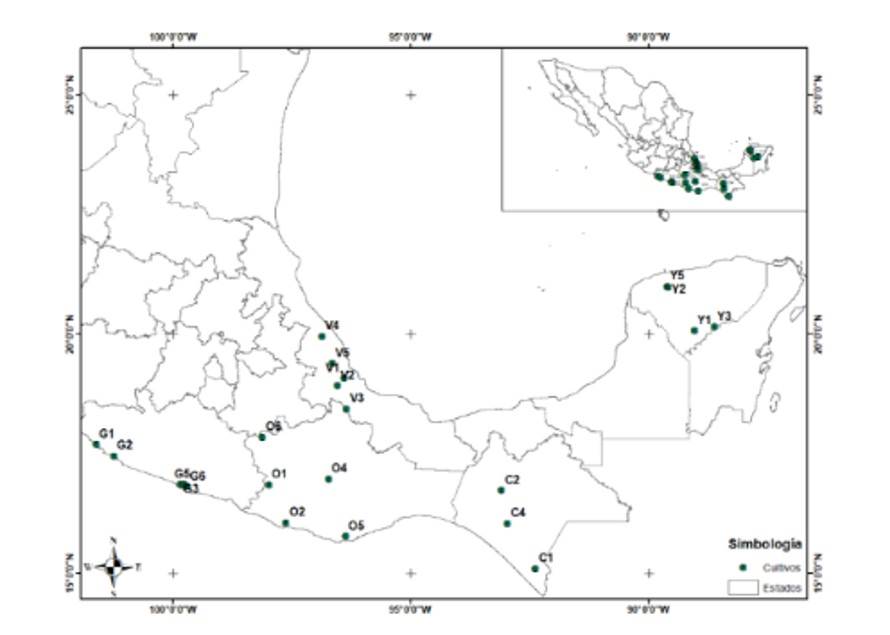
Figure 1
Geographical location of the evaluated commercial moringa crops in the south-southeast of Mexico.
Geographical location of the evaluated commercial moringa crops in the south-southeast of Mexico.
Sample selection and survey development
The selection of the sample was intentional (directed), with the selection criteria being the commercial purpose of the crop and geographical location. The 27 moringa producers interviewed correspond to 80% of the producers with commercial plantations in the south-southeast of Mexico. A structured questionnaire was designed in order to collect information that would allow us to know the characteristics of the moringa cultivation (Flick, 2006).
-
Flick, 2006An introduction to qualitative research, 2006
The questionnaire included the following sections: 1) profile of the interviewee; 2) profile of the farm; 3) process of adoption of the species; 4) agronomic management of the crop; 5) postharvest management; 6) commercial aspects and 7) organization and training. The questionnaire was applied through personalized interviews and telephone communication. All the interviewees showed willingness to be interviewed and the time of the interview varied depending on the means of communication.
In this work, the presence of several species associated with moringa crops was identified. The associated crops were lemon (33.33%), orange (11.11%), corn (11.11%), chili (3.7%), stevia (11.11%), pitaya (3.7%), basil (3.7%), neem (3.7%), papaya (7.41%), mangosteen (3.0%), bay cedar (3.7%), and coffee (3.7%).
Data analysis
The interview provided qualitative and quantitative information. The survey data were recorded in a spreadsheet of the Excel program, version 2016. Descriptive statistics were performed to determine the frequency for each response.
Results and discussion
The states of Oaxaca and Guerrero were represented by 22.22% of the survey participants and the states of Veracruz, Chiapas, and Yucatán by 18.52% each. The altitude (masl), mean temperature (°C), and annual precipitation (mm) were determined in each commercial crop. The environmental factors for the crops were V1 (67 masl, 26 °C, and 1 039 mm), V2 (210 masl, 25 °C, and 1 134 mm), V3 (50 masl, 26 °C, and 1 658 mm), V4 (202 masl, 23 °C, and 1 886 mm), V5 (349 masl, 25 °C, and 894 mm), O1 (341 masl, 26 °C, and 1 603 mm), O2 (17 masl, 28 °C, and 1 302 mm), O4 (1 507 masl, 21 °C, and 634 mm), O5 (175 masl, 26 °C, and 1 016 mm), O6 (1 081 masl, 24 °C, and 623 mm), G1 (21 masl, 27 °C, and 1 015 mm), G2 (10 masl, 27 °C, and 905 mm), G3 (124 masl, 27 °C, and 1 146 mm), G5 (17 masl, 27 °C, and 1 122 mm), G6 (19 masl, 27 °C, and 1 114 mm), C1 (134 masl, 27 °C, and 3 456 mm), C2 (525 masl, 25 °C, and 930 mm), C4 (570 masl, 25 °C, and 1 830 mm), Y1 (40 masl, 26 °C, and 1 168 mm), Y2 (8 masl, 27 °C, and 1 002 mm), and Y3 (29 masl, 26 °C, and 1 219 mm).
Differences were found in temperature, altitude, and average annual precipitation. Regarding the geographical location of the crop, it was found that it develops in temperatures between 13 °C and 34 °C and an annual average rainfall of 905 to 3 456 mm. Although the moringa plant has a high acclimatization capacity, its production can be affected by soil type, altitude, precipitation and geographical location (Olaoye et al., 2021). Carrión et al. (2022) describe that a large percentage of the territory of the state of Veracruz has favorable climatic conditions for the cultivation of moringa. This is particularly easy in subhumid tropical climates.
-
Olaoye et al., 2021Comparative Antioxidant analysis of Moringa oleifera leaf extracts from southwestern states in NigeriaFuture J. Pharm. Sci., 2021
-
Carrión et al. (2022Potencial agroecológico de Moringa oleifera Lam. para el estado de VeracruzRevista Mexicana de Ciencias Forestales, 2022
Interviewee profile
Eighty-seven percent of the producers were men and 13% women. The average age of the producers was 51.6 years, with a minimum and maximum of 21 and 87 years. The levels of education identified were: bachelor’s degree (37%), high school (26%), postgraduate studies (18%), elementary school (11%), and junior-high school (7%). Bachelor’s degree studies correspond to agronomy engineering (19%), administration (11%), education (7%), psychology (7%), a 4% is represented by bachelor’s degrees in accounting, civil engineering, chemical engineering, electrical engineering and 41% have no higher education.
Authors such as Mota-Fernández et al. (2019) identified a high level of education in moringa producers in the state of Veracruz. The activities identified were agriculture (33%), trade (22%), teaching (15%) and beekeeping, trainer, coffee taster, project coordinator, student of agronomy engineering, livestock farming, manager and person in charge of industrial maintenance represented 4%. Producers engaged exclusively in agriculture had better management of moringa crops than those who perform other trades. This was observed based on the information obtained in the interview.
-
Mota-Fernández et al. (2019Características socioeconómicas y prácticas agrícolas de los productores de Moringa oleifera Lam. en MéxicoAgroproductividad, 2019
Farm profile
Regarding the type of land tenure, 59% were small property, 33% ejido, 4% both (small property and ejido) and 4% communal. The average area for the cultivation of moringa was 1.3 ha, with the largest and smallest area being 11 and 0.001 ha, respectively. The date of establishment of the crops was from 2008 to 2017. The largest number of plantings occurred in 2013 and 2015, with 18.5%. Regarding participation in moringa cultivation, 81% stated that it is a family business and 19% mentioned that the participation corresponds only to producers.
The associations represent an advantage for obtaining several products on the same area since some producers have small areas. Moringa can be used as a polyculture in alleys and live fences or associated, facilitating its adoption by farmers. The advantages of associating crops with moringa are that it allows controlling pests, optimizing the use of soil and water, reducing wind and water erosion, and improving the conditions of other crops on farms or in family gardens (Gadzirayi et al., 2013). Nevertheless, the spatial and chronological arrangement and planting density are key in this aspect.
-
Gadzirayi et al., 2013Cultivation practices and utilisation of Moringa oleifera provenances by small holder farmers: case of ZimbabweAsian J. Agric. Ext. Economics Soc., 2013
Species adoption process
Regarding the adoption of moringa by producers, it took place through various means. Fifty-nine percent learned about the species through third parties, including researchers, technicians, producers, and traders and 41% through publications on the Internet. One hundred percent of the producers mentioned knowing at least one use of moringa. The uses of moringa were represented as follows: medicine (100%), food (85.18%), flocculant (11.11%), fodder (14.81%), bioenergy (18.51%), and beekeeping (3.7%). All the interviewees mentioned that they consume various parts of the plant such as leaves (88.88%), seeds (55.55%), flowers (3.7%), and stem as a tea (3.7%). The frequency of moringa consumption per week was seven times (48.15%), one time (25.93%), two times (11.11%), three times (7.41%) and four times (7.41%).
Through the survey carried out, it was identified that the knowledge of moringa is focused on food and medicinal uses, and very little on the following uses: bioenergetic, bioadsorbent, flocculant, and industrial. A high impact of moringa as a commercial crop due to its demand and also a lack of scientific information about industrial uses were observed. Therefore, there is a knowledge gap among producers about the different uses and added value of this multipurpose tree.
In this sense, Thurber and Fahey (2009) point out that the diffusion of innovations theory could support the establishment of a structured technology transfer program for the crop and its uses. To do this, it is necessary to understand the socioeconomic characteristics of producers (Fadoyin et al., 2014) and the current demand in the market in order to predict the level of acceptance and highlight the economic importance.
-
Thurber and Fahey (2009Adoption of Moringa oleifera to combat under-nutrition viewed through the lens of the ‘diffusion of innovations’ theoryEcology of Food and Nutrition, 2009
-
Fadoyin et al., 2014Socio-economic factors influencing adoption of Moringa oleifera water purification by farmers in Kaduna State, NigeriaInt. Lett. Nat. Sci., 2014
Agronomic crop management
It was found that the seed for the establishment of the crops comes from the states of Chiapas, Guerrero, Michoacán, Nuevo León, Oaxaca, Sonora, Sinaloa, Veracruz, and Yucatán in addition to the United States of America. All crops were established between 2008 and 2017. The year of cultivation, management conditions, and production records prevent comparison between populations. The producers mentioned that the demand for the seed is permanent and many times they are not able to meet the market demand.
The way of establishing the crops was through seed (93%) and both seed and cuttings (7%). Producers mentioned that the easiest way is through seed; however, vegetative reproduction is also a viable option when there is little availability of seeds or when the average temperature did not allow germination. The management of plants in the nursery phase is characterized by the use of substrate (compost, cane filter cake, and vermicompost), where 33% of producers stated that they use a substrate made from local resources such as soil and compost.
In the case of irrigation, 100% irrigate the plants in the nursery phase at least once a day. In the field phase, 67% of the interviewees stated that their crop has an irrigation system. The type of irrigation was 55% sprinkler, 39% drip, and 6% hose irrigation. This activity prevents water stress and leaf loss during the dry period. Nonetheless, many are unaware of the water requirements in the leaf production, flowering, and fruiting stages. In this research, it was identified that crops without irrigation have fewer harvests per year.
The effect of irrigation on this crop is a relevant topic to investigate. Tshabalala et al. (2020) cite that the acceptable annual precipitation range for moringa production fluctuates between 700 and 2 200 mm. In this research, it was identified that most of the commercial crops evaluated are within this range. Mabapa et al. (2017) indicated that the availability of soil moisture has a positive effect on leaf productivity.
-
Tshabalala et al. (2020Predicting the spatial suitability distribution of Moringa oleifera cultivation using analytical hierarchical process modellingS. Afr. J. Bot., 2020
-
Mabapa et al. (2017Effect of planting density and harvest interval on the leaf yield and quality of Moringa (Moringa oleifera) under diverse agroecological conditions of Northern South AfricaInt. J. Agron., 2017
Drip irrigation is the most efficient way to provide moisture to the moringa crops in the southeast since most of the crops are located in areas where water is limited. Muhl et al. (2013) state that low humidity conditions (300 mm) allow a greater number of flower buds and an irrigation of 900 mm allows a greater number of fruits. In terms of fertilization, 63% have fertilized at least once in the entire production period. The type of fertilizer used is 81% granulated, 13% liquid and 6% foliar.
-
Muhl et al. (2013Bud development, flowering and fruit set of Moringa oleifera Lam. (Horseradish Tree) as affected by various irrigation levelsJournal of Agriculture and Rural Development in the Tropics and Subtropics, 2013
The products for fertilization were divided into compost and vermicompost (33%), liquid humus and urea with 13%, and triple 17 with 7%. Manzano-Gómez et al. (2021) mention that the use of biofertilizers favors growth, survival, biomass production, and the chemical composition of the leaves. Moringa does not have the ability to fix nitrogen and phosphorus and therefore requires fertilization (Mudyiwa et al., 2013). Motis and Reader (2019) suggest that a fertilization with NPK (15:15:15) contributes to the growth of moringa.
-
Manzano-Gómez et al. (2021Evaluation of metabolomic profile and growth of Moringa oleifera L. cultivated with vermicompost under different soil typesAgronomy, 2021
-
Mudyiwa et al., 2013Constraints and opportunities for cultivation of Moringa oleifera in the Zimbabwean smallholder growersInt. J. Agric. Res. Innov. Technol., 2013
-
Motis and Reader (2019Moringa oleifera leaf production with NPK fertilizer and composted yard wasteISHS Acta Hortic., 2019
Nonetheless, organic moringa production is an area of opportunity for producers in the southeast, particularly if it is aimed at international sales and consumption. The cultural work of the crops was determined by the association of species and the density of plants. This aspect presented great variation due to the fact that there is no control over the activities carried out and the frequency of harvest was determined by the rainy season and the demand for leaves.
The main pests and diseases in the nursery phase were ants (Atta) (14.81%), worms (7.41%), butterflies (3.7%), grasshopper (Sphenarium) (3.7%), root fungus (3.7%), whiteflies (3.7%), and locusts (3.7%). In the field phase, they were gophers (22.22%), ants (Atta) (51.85%), and whiteflies (3.7%). In the postharvest phase, they were fungi (22.22%) and weevils (Sitophilus) (3.7%). Due to the lack of individuals at the time of the interview, the taxonomic identification of the species was not carried out. Pests were usually controlled with extracts of neem (Azadirachta indica) or cinnamon (Cinnamomum verum).
Regarding the use of pesticides, 19% stated that they use organic pesticides and 81% do not use them. Regarding the average days of work used for manual weeding, it was one. The average daily wage is $182.00. The average distance between plants was 1.69 m and between rows 2 m. According to the rating of the leaf product in the field, 55% rated it as good, 19% as very good and 26% as excellent. Seed production is divided as follows: 59% for commercial purposes and 41% is destined for the establishment of new crops.
The production of seed for the commercial part had medicinal purposes. It was identified that producers consume the seed for the treatment of diseases such as diabetes and hypertension. Pirrò et al. (2016) mention that the miRNAs contained in moringa seeds can be used to regulate human genes and intervene in processes such as leukemia, cell cycle and protein degradation. These miRNAs decrease the levels of the SIRT1-SIRT7 proteins related to neurodegenerative diseases, cancer, diabetes and obesity.
-
Pirrò et al. (2016MicroRNA from Moringa oleifera: identification by High throughput sequencing and their potential contribution to plant medicinal valuePlos One, 2016
Postharvest management
It was identified that the process of dehydrating moringa leaves is the most common for commercial purposes. Dehydration in the shade is the most frequent (7%), followed by dehydration in direct sunlight (4%), 11% do not dehydrate the leaf and 4% use a solar dehydration chamber. It was identified that dehydration techniques depend on the advice and technology available to the producer.
In this regard, Ahmed and Langthasa (2022) mention that the dehydration of moringa leaves concentrates nutrients, facilitates conservation and consumption and allows transport to areas where it cannot be grown. However, Ruiz-Hernandez et al. (2022) described that dehydrated conditions decrease the amount of nutrients in moringa leaves. During the postharvest phase, fungal contamination was identified due to poor dehydration of the leaves or excess relative humidity of certain regions of the subtropics.
-
Ahmed and Langthasa (2022Effect of dehydration methods on quality parameters of drumstick (Moringa oleifera Lam.) leaf powderJ. Hortic. Sci., 2022
-
Ruiz-Hernandez et al. (2022Moringa oleifera Lam.: a review of environmental and management factors that influence the nutritional content of leavesTropical and Subtropical Agroecosystems, 2022
The presence of beetles was also observed in dry leaves and seeds due to inadequate storage conditions or in plants that have dehiscent pods. It should be noted that there are few pests that attack the moringa tree and that such attacks endanger leaf production and product quality. Nevertheless, entomofauna is another aspect that must be investigated to improve postharvest management conditions. Regarding the technology used for grinding the leaves, it was found that 22% use a manual mill, 14% a forage mill, and 7% a leaf pulverizing mill and a blender.
Forty-four percent store dehydrated and ground leaves, 30% dehydrated leaves, 11% ground leaves and 15% do not store leaves. The storage material of the leaves is very diverse, 59% use airtight bags, 7% use cellophane bags and 4% use paper bags, airtight bottles, grainpro bags, and transparent bottles. Once dehydrated, they can be ground or stored to be sold in that presentation (Ojiako et al., 2011).
-
Ojiako et al., 2011Critical issues in Investment, Production and Marketing of Moringa oleifera as an industrial agricultural raw material in NigeriaJournal of Agricultural Research and Development, 2011
Under proper handling and hermetic sealing conditions, the quality of the leaves is maintained for several months. The material for storing moringa leaves must have the ability to protect the quality of the product from the sun’s rays as transparent bags promote the loss of vitamins and phenolic compounds (Kashyap et al., 2022).
-
Kashyap et al., 2022Recent advances in drumstick (Moringa oleifera) leaves bioactive compounds: composition, health benefits, bioaccessibility, and dietary applicationsAntioxidants, 2022
Commercial aspects
The moringa products marketed are leaves (88.89%), seeds (70.37%), and seedlings (55.56%). The average price per kilogram of moringa seeds varies and can reach a price of $2 161.00; most producers offer it in presentations of 50 to 100 seeds. Some sell the seeds at $1.00 per unit. The average cost of the moringa seedling is $30.00, with $10.00 being the minimum price and $50.00 being the maximum. Sixty-seven percent stated that they give added value to moringa. For example, dehydrated leaf (66.67%), meal (37.04%), capsules (37.04%), tea sachets (7.41%), soaps (7.41%), shampoo (7.41%), creams (3.7%) and oil obtained from seeds (3.7%).
The media used for the dissemination of the products were internet (81.84%), radio (7.41%), TV (3.7%), newspaper (7.41%), talks (23.63%) and flyers (29.63%). The average price per kg of dehydrated leaves was $1 333.00. The average number of capsules per bottle was 80 units, with the minimum being 30 and the maximum 150. Regarding the average cost of a bottle of capsules, it was $141.00, with presentations from $50.00 to $250.00. The price of each product is determined by handling and presentation. Twenty-three percent of the interviewees stated that they have a registered trademark and among them are Humar, MorinJic, MoringaGela, Amor Mixteco, viDa Moringa and Ocho Venados.
Ninety-three percent of producers responded that they sell their product directly in the local market. Seventy percent use the Internet to publicize and market their products. Of the total leaf production, the average marketed is 57%, and producers attribute it to the saturation of the market with moringa products and the disparity in the prices offered.
The frequency of marketing of the products is 55% eventually, 33% every year, and 12% do not sell leaves or only when they have excess production because they are used for livestock feed purposes. The commercialization of moringa seed oil in the south-southeast is low due to the lack of technology and diffusion. This represented a problem that can be solved through the development of prototypes focused on the extraction and transformation of oil.
Studies such as that by Leone et al. (2016) mention that the oil and nutrients contained in the seed have multiple benefits for human health. Moringa products are often marketed locally and the use of digital media to promote their products is becoming more common. Producers mention that the acceptance of the product has been good, but its price is affected by the increase in supply in the market. The perception that producers have about the moringa crop is positive due to its rapid growth and high tolerance to drought.
-
Leone et al. (2016Moringa oleifera seeds and oil: characteristics and uses for human healthInt. J. Mol. Sci., 2016
This is coupled with its high response to resprouting in the face of extreme pruning, allowing a greater number of harvests per year (Abdoun et al., 2022). Regarding the level of acceptance of the product, producers commented that the level of acceptance is high (67%), regular (22%) and low (11%). Ninety-three percent of the producers have a positive perception of the moringa crop, and they point out that it is a profitable crop and that the only limitation is the marketing channel.
-
Abdoun et al., 2022Cultivation and uses of Moringa oleifera as non-conventional feed stuff in livestock production: a reviewLife, 2022
Organization and training
Ninety-six point three percent stated that they do not belong to any organization of moringa producers and only in the state of Guerrero was an association identified. Eighty-one percent mentioned not having received any training for crop management. One hundred percent mentioned that they have not received financing from the government for crop management.
The producers stated that profitability depends on the dissemination of the products, the agronomic management, postharvest, and quality and variety of products marketed. Therefore, training is of great importance throughout the production process. Among the training needs expressed were agronomic management (44%), postharvest management (22%), forms of exploitation (11%), consumption (7%), forum for the exchange of experiences (4%), moringa varieties (4%) and marketing (4%).
Similar studies in countries such as Nigeria conclude that production, processing and marketing processes, investment, land disposal, density, variety and quality control are the main problems for producers (Ojiako et al., 2011). This problem is similar for producers in the southeast since, in the absence of a producers’ association, a moringa value chain, sources of financing and technical advice, they are vulnerable in the competitive environment (national and international) to products imported from other countries.
-
Ojiako et al., 2011Critical issues in Investment, Production and Marketing of Moringa oleifera as an industrial agricultural raw material in NigeriaJournal of Agricultural Research and Development, 2011
Conclusions
The commercial production of moringa in the south-southeast of Mexico is mainly focused on food and medicinal uses. The diversity of processed products allows for greater profits and new consumer markets. Moringa is grown in different states of the south-southeast of Mexico and with proper management, it is possible to obtain satisfactory yields and higher nutritional quality of leaves and seeds. There is a differentiated level of intensification in the management of moringa induced by its commercialization. Finally, moringa is perceived as a promising crop and for several producers, this plant represents a business opportunity.
Bibliografía
- Abdoun, K.; Alsagan, A.; Altahir, O.; Suliman, G.; Al-Haidary, A. and Alsaiady, M. 2022. Cultivation and uses of Moringa oleifera as non-conventional feed stuff in livestock production: a review. Life. 13(63):1-14. Doi: https://doi.org/10.3390/life13010063. Links
- Ahmed, S. and Langthasa, S. 2022. Effect of dehydration methods on quality parameters of drumstick (Moringa oleifera Lam.) leaf powder. J. Hortic. Sci. 17(1):137-152. Doi: https://doi.org/10.24154/jhs.v17i1.1292. Links
- Carrión, J. M. D.; Valdés, O. A. R.; Gallardo, F. L.; Palacios, O. M. W. 2022. Potencial agroecológico de Moringa oleifera Lam. para el estado de Veracruz. Revista Mexicana de Ciencias Forestales. 13(70):42-63. Doi: 10.29298/rmcf.v13i70.1077. Links
- ESRI. 2016. ARCgis Versión 10.5. Environmental Systems Resource Institute, Redlands, California. Links
- Estrada-Hernández, O. and Hernández-Rodríguez, O. A. 2016. Múltiples formas de aprovechar los beneficios de moringa (Moringa oleifera Lam.). Medio ambiente y Desarrollo Sustentable. 10(2):101-108. Links
- Fadoyin, A. S.; Oyewole, S. O.; Ayanrinde, F. A.; Baba, G. A. and Erhabor, T. A. 2014. Socio-economic factors influencing adoption of Moringa oleifera water purification by farmers in Kaduna State, Nigeria. Int. Lett. Nat. Sci. 15(1):85-90. Doi: https://doi.org/10.18052/www.scipress.com/ILNS.20.85. Links
- Flick, U. 2006. An introduction to qualitative research, 3rd . Ed. Sage, London, United Kingdom. 105-113 pp. Links
- Gadzirayi, C. T.; Mudyiwa, S. M.; Mupangwa, J. F. and Gotosa, J. 2013. Cultivation practices and utilisation of Moringa oleifera provenances by small holder farmers: case of Zimbabwe. Asian J. Agric. Ext. Economics Soc. 2(2):152-162. Doi: 10.9734/AJAEES/2013/5531. Links
- Gandji, K.; Chadare, F. J.; Idohou, R.; Salako, V. K.; Assogbadjo, A. E. and Kakaï, R. L. G. 2018. Status and utilization of Moringa oleifera Lam: a review. Afr. Crop Sci. J. 26(1):137-156. Doi: http://dx.doi.org/10.4314/acsj.v26i1.10. Links
- Kashyap, P.; Kumar, S.; Riar, C. S.; Jindal, N.; Baniwal, P.; Guiné, R. P. F.; Correia, P. M. R.; Mehra, R. and Kumar, H. 2022. Recent advances in drumstick (Moringa oleifera) leaves bioactive compounds: composition, health benefits, bioaccessibility, and dietary applications. Antioxidants. 11(402):2-37. Doi: https://doi.org/ 10.3390/antiox11020402. Links
- Leone, A.; Spada, A.; Battezzati, A.; Schiraldi, A.; Aristil, J. and Bertoli, S. 2015. Cultivation, genetic, ethnopharmacology, phytochemistry and pharmacology of Moringa oleifera leaves: an overview. Int. J. Mol. Sci. 16(6):12791-12835. Doi: 10.3390/ijms160612791. Links
- Leone, A.; Spada, A.; Battezzati, A.; Schiraldi, A.; Aristil, J. and Bertoli, S. 2016. Moringa oleifera seeds and oil: characteristics and uses for human health. Int. J. Mol. Sci. 17(12):2141-2155. Links
- Mabapa, M. P.; Ayisi, K. K. and Mariga, I. K. 2017. Effect of planting density and harvest interval on the leaf yield and quality of Moringa (Moringa oleifera) under diverse agroecological conditions of Northern South Africa. Int. J. Agron. 2941432:1-9. Links
- Manzano-Gómez, L. A.; Guzmán-Albores, J. M.; Rincón-Rosales, R.; Winkler, R.; Rincón-Molina, C. I.; Castañón-González, J. H.; Ruiz-Lau, N.; Gutiérrez-Miceli, F. A.; Rincón-Molina, F. A. and Ruíz-Valdiviezo, V. M. 2021. Evaluation of metabolomic profile and growth of Moringa oleifera L. cultivated with vermicompost under different soil types. Agronomy. 11(2061):1-15. Doi: https://doi.org/ 10.3390/agronomy11102061. Links
- Mota-Fernández, I. F.; Valdés-Rodríguez, O. A. y Quintas, G. S. 2019. Características socioeconómicas y prácticas agrícolas de los productores de Moringa oleifera Lam. en México. Agroproductividad. 12(2):3-8. Doi: https://doi.org/10.32854/agrop.v12i2.1357. Links
- Motis, T. N. and Reader, S. M. 2019. Moringa oleifera leaf production with NPK fertilizer and composted yard waste. ISHS Acta Hortic. 1253(1): 405-412. Links
- Mudyiwa, S. M.; Gadzirayi, C. T.; Mupangwa, J. F.; Gotosa, J. and Nyamugure, T. 2013. Constraints and opportunities for cultivation of Moringa oleifera in the Zimbabwean smallholder growers. Int. J. Agric. Res. Innov. Technol. 3(1):12-19. Doi: http://dx.doi.org/10.3329/ijarit.v3i1.16044. Links
- Muhl, Q. E.; Toit, E. S.; Steyn, J. M. and Apostolides, Z. 2013. Bud development, flowering and fruit set of Moringa oleifera Lam. (Horseradish Tree) as affected by various irrigation levels. Journal of Agriculture and Rural Development in the Tropics and Subtropics. 114(2):79-87. Links
- Ojiako, F. O.; Adikuru, N. C. and Emenyonu, C. A. 2011. Critical issues in Investment, Production and Marketing of Moringa oleifera as an industrial agricultural raw material in Nigeria. Journal of Agricultural Research and Development. 10(2):39-56. Links
- Olaoye, A. B.; Ologunde, C. A.; Molehin O. R. and Nwankwo, I. 2021. Comparative Antioxidant analysis of Moringa oleifera leaf extracts from southwestern states in Nigeria. Future J. Pharm. Sci. 7(68):1-15. Doi: https://doi.org/10.1186/s43094-021-00204-8. Links
- Olson, M. E. y Fahey, J. W. 2011. Moringa oleifera: un árbol multiusos para las zonas tropicales secas. Revista Mexicana de Biodiversidad. 82(4):1071-1082. Doi: https://doi.org/10.1016/j.rmb.2016.07.007. Links
- Olson, M. E. y Alvarado-Cárdenas, L. O. 2016. ¿Dónde cultivar el árbol milagro, Moringa oleifera en México? Un análisis de su distribución potencial. Revista Mexicana de Biodiversidad. 87(3):1089-1102. Links
- Peñalver, R.; Martínez-Zamora, L.; Lorenzo, J. M.; Ros, G. and Nieto, G. 2022. Nutritional and antioxidant properties of Moringa oleifera leaves in functional foods. Foods. 11(8):1-13. Doi: 10.3390/foods11081107. Links
- Pirrò, S.; Zanella, L.; Kenzo, M.; Montesano, C.; Minutolo, A.; Potestà, M.; Sobze, M. S.; Canini, A.; Cirilli, M.; Muleo, R.; Colizzi, V. and Galgani, A. 2016. MicroRNA from Moringa oleifera: identification by High throughput sequencing and their potential contribution to plant medicinal value. Plos One. 11(3):1-25. Links
- Ruíz-Hernández, R.; Hernández-Rodríguez, M.; Cruz-Monterrosa, R. G.; Díaz-Ramírez, M.; Martínez-García, C. G.; García-Martínez, A. and Rayas-Amor, A. A. 2022. Moringa oleifera Lam.: a review of environmental and management factors that influence the nutritional content of leaves. Tropical and Subtropical Agroecosystems. 25(1):1-15. Links
- Seifu, E. and Teketay, D. 2020. Introduction and expansion of Moringa oleifera Lam. in Botswana: Status and potential for commercialization. S. Afr. J. Bot. 129(2020):471-479. Links
- Thurber, M. D. and Fahey, J. W. 2009. Adoption of Moringa oleifera to combat under-nutrition viewed through the lens of the ‘diffusion of innovations’ theory. Ecology of Food and Nutrition. 48(3):212-225. Doi: 10.1080/03670240902794598. Links
- Tshabalala, T.; Ncube, B.; Moyo, H. P.; Abdel-Rahman, E. M.; Mutanga, O. and Ndhlala, A. R. 2020. Predicting the spatial suitability distribution of Moringa oleifera cultivation using analytical hierarchical process modelling. S. Afr. J. Bot. 129:161-168. Links
- Velázquez-Zavala, M.; Peón-Escalante, I. E.; Zepeda-Bautista, R. y Jiménez-Arellanes, M. A. 2016. Moringa (Moringa oleifera Lam.): usos potenciales en la agricultura, industria y medicina. Revista Chapingo Serie Horticultura. 22(2):95-116. Doi: 10.5154/r.rchsh.2015.07.018. Links