
Abstract
Sugar cane is one of the main crops in tropical and subtropical areas, which have little climatic variation. However, the Intergovernmental Panel on Climate Change (IPCC) said that agriculture in tropical areas will undergo major changes in the next 100 years as a result of this phenomenon. In the state of Veracruz, Mexico, the average annual rainfall is about 1 500 mm and an annual average temperature of 23 °C. However, in the last 30 years, there have been alterations in the hydrological cycle in the sugarcane areas of the central area of the state of Veracruz (Irrigation District 035 La Antigua), as a result of the phenomenon of climate change, significantly impacting the patterns of Precipitation (Pp), evaporation (Ev) and temperature (T) of the zone. The objective of this paper was to evaluate the estimated real evapotranspiration (ETR) of sugar cane, as a result of the increase in the evaporation rate and temperature, and changes in the precipitation patterns recorded in a period of 30 years (1980-2010); as well as the correspondence between the ETR and sugarcane yields observed during the period in the sugar mill area of La Gloria and El Modelo as a consequence of climate change. The ETR was calculated using the semi-empirical methods Penman-Monteith FAO, Blaney-Criddle, Hargreaves-Samani and the Evaporimeter Tank Type A. A high correlation was found between the Penman-Monteith FAO and Hargreaves-Samani methods (r2= 0.9307). No relationship was found between the ETR and the field yield recorded in the supply area of the referred mills. Finally, it is observed a high correlation between the ETR and the maximum temperature derived from the Penman-Monteith FAO (r2= 0.9445) and Hargreaves-Samani (r2= 0.7773) methods.
Keywords::
Blanney-Criddle, evaporimeter tank type A, Hargreaves-Samani, impact of climate change, Penman-Monteith FAO
Introduction
As reported by the Intergovernmental Panel on Climate Change (IPCC, 2001), the impact of climate change on agriculture varies according to the crop and crop production system, resulting in crop loss and decrease in agricultural productivity. Mexico is the second most vulnerable country to this phenomenon, after India and from this perspective, national agricultural production could fall by more than 25% by 2080 (Moyer, 2010). From the socioeconomic point of view, the cultivation of sugar cane, together with sugarcane agroindustry, is of paramount importance for the Mexican economy. The agroecosystem with sugar cane generates direct jobs of the order of 450 thousand and indirectly, for 2.2 million people (Moreno-Seceña et al., 2011).
-
IPCC, 2001Climate Change 2001: synthesis Report, 2001
-
Moyer, 2010How much is left? A graphical accounting of the limits to what one planet can provideSci. Am., 2010
-
Moreno-Seceña et al., 2011Fertilización nitrogenada en caña de azúcar en el módulo I-1 La Antigua Veracruz, MéxicoTrop. Subtrop. Agroecosy., 2011
Evapotranspiration is considered to be one of the important parameters during crop development and its understanding, allows establishing good water resources planning, as well as making efficient use of irrigation water at the parcel level (Rodríguez et al., 2015). Semiempirical methods are currently used, which are widely used in practical cases of irrigation management, especially the equation developed by Penman-Monteith, which is accepted by the world scientific community, and proposed by the FAO as a standardized method for the calculation of evapotranspiration, based on the climatic information.
-
Rodríguez et al., 2015Evapotranspiración y coeficientes de cultivo de chile Bell en el Valle de Culiacán, México.Terra Latinoam., 2015
For the particular case of this research it was considered the study of the amount of water that corresponds effectively to evapotranspiration. Therefore, the concept of actual or effective evapotranspiration was used, which is more commonly known as actual evapotranspiration (Mendoza, 2013). The objective of this paper was to evaluate the estimated real evapotranspiration (ETR) of sugarcane, as a result of an increase in the evaporation and temperature rate, and changes in precipitation patterns recorded over a period of 30 years (1980-2010); as well as the correspondence between the ETR and the sugar cane yields observed during the period in the sugar mill area of La Gloria and El Modelo as a consequence of climate change.
-
Mendoza, 2013Riego por goteo, 2013
Materials and methods
This research was carried out in the area of sugar cane supply of the mills La Gloria and El Modelo, located in the Irrigation District 035 La Antigua, Veracruz, Mexico. This supply zone is located in the central region of the state of Veracruz and includes the municipalities of Úrsulo Galván, La Antigua, Puente Nacional, Paso de Ovejas and Actopan (Figure 1).
Thumbnail
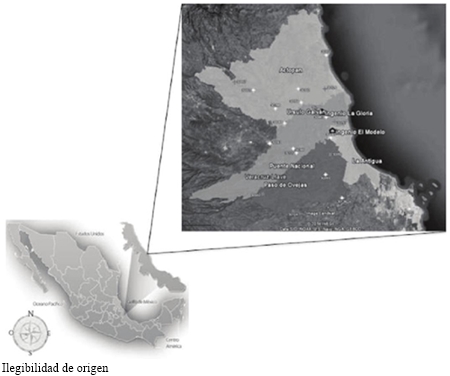
Figure 1
Location of the Irrigation District 035 La Antigua, Veracruz.
Location of the Irrigation District 035 La Antigua, Veracruz.
Given the importance of this agricultural activity in the social context of the region, a conceptual model was established in which the interaction of the agroecosystem (AES) with sugar cane and the Veracruz society in the central area of the Gulf of Mexico (Figure 2).
Thumbnail

Figure 2
Conceptual model of agroecosystem with sugar cane.
Conceptual model of agroecosystem with sugar cane.
In order to achieve the proposed objective, four research phases, which are described below, were established. The first consisted in the integration of a database with information on temperature (T), evaporation (Ev), precipitation (Pp) and sugarcane yield during the 1980-2010 period. The climatic information was recorded in the climatic stations located within the study area, such as: Los Ídolos (30068), Actopan (30003), La Mancha (30353), Santa Rosa (30158), El Diamante (30266), Tamarindo (30165), Puente Nacional (CFE) (30137), Rinconada (30141), Loma Fina (30093), Puente Jula (30136), and José Cardel (30193).
In the second one, the methods for estimating the reference evapotranspiration, which was used in the estimation of estimated real evapotranspiration (ETR) of sugarcane (Table 1), were defined.
Thumbnail
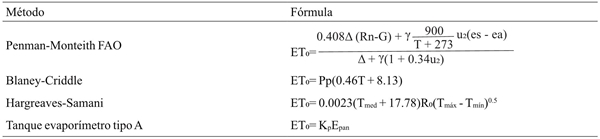
Table 1
Selected methods for calculation of reference evapotranspiration.
Selected methods for calculation of reference evapotranspiration.
The third phase involved the calculation of the ETR, based on the climatic variables included in the selected methods. Finally, in the last phase the obtained results of ETR were compared by the methods of Blaney-Criddle, Hargreaves-Samani and evaporimeter tank type A, with those calculated using the Penman-Monteith FAO method. The latter was established as a reference because it is the most complete and recommended method worldwide, considering most of the climatic variables, which increases the probability of obtaining more precise results (Medeiros, 1998). Statistical software STATISTICA v7.0 was used for the above. In addition, a correlation was made between sugarcane yields recorded during the period 1980-2010 by the mills La Gloria and El Modelo, and the ETR calculated by the four methods.
-
Medeiros, 1998Avaliacao de métodos de estimative de evapotranspiracao de referencia para a reqiáo mesoclimática de Santa Maria. R S.Rev. Bras. Agrometeorol, 1998
Results and discussion
Based on the data recorded in the climatic stations during the period 1980-2010, the ETR was calculated by using each of the above methods. Later, this was related to the yield of the sugar cane crop, reported by La Gloria and El Modelo mills, in the same period (Figure 3).
Thumbnail

Figure 3
Relationship of ETR values and sugarcane cultivation yield in the supply area of La Gloria and El Modelo mills, Veracruz, Mexico.
Relationship of ETR values and sugarcane cultivation yield in the supply area of La Gloria and El Modelo mills, Veracruz, Mexico.
From the analysis of the results shown in Figure 3, it was found that the ETR showed an almost constant behavior during the period of 1980-2010; also, a very erratic behavior in the field yield was observed for this same period. In addition to the above, Cassalett et al. (1995) reported that the total water consumption of sugarcane in different countries has very wide variation ranges. Generally, this annual crop consumption ranges from 1 200 to 1 500 mm and is higher in subtropical areas characterized by longer dry seasons and greater evaporation than in tropical areas.
-
Cassalett et al. (1995)El cultivo de la caña en la zona azucarera de Colombia, 1995
Likewise, Blaney-Criddle, Hargreaves-Samani and A-type evaporimeter methods were compared against the Penman-Monteith FAO method, in order to determine if the ETR calculated by the first three methods had a behavior similar to the calculated ETR by the latter. The first three methods used fewer climate variables for its calculation than Penman-Monteith (Figure 4).
Thumbnail

Figure 4
Comparison of the ETR calculated by the Blaney-Criddle, Hargreaves-Samani and evaporimeter tank type A methods, and the calculated by the Penman- Monteith FAO method.
Comparison of the ETR calculated by the Blaney-Criddle, Hargreaves-Samani and evaporimeter tank type A methods, and the calculated by the Penman- Monteith FAO method.
It was found that the Hargreaves-Samani method had a better fit to the FAO Penman-Monteith method (reference method) with a determination coefficient of r2= 0.9307. However, when comparing the calculated ETR data with the Blaney-Criddle methods (r2= 0.6585) and the A-type evaporimeter tank (r2= 0.4967) with the Penman-Monteith FAO method, the first method yielded higher values than those calculated By Penman-Monteith FAO. In the case of tank type A, the ETR values calculated with this method were lower than those calculated by the reference method.
Figure 5 shows the correlations between the field yield reported in the above mentioned mills and the ETR values calculated with the Penman-Monteith methods FAO (a), Hargreaves-Samani (b), Blaney-Criddle (c) and evaporimeter tank type A (d), demonstrating that there is a low correlation between the yield and the ETR calculated by the above methods.
Thumbnail

Figure 5
Correlation between sugar cane field yield recorded in La Gloria and El Modelo mills and the ETR calculated with the Penman-Monteith FAO (a), Hargreaves-Samani (b), Blaney-Criddle (c) and evaporimeter tank type A (d) methods.
Correlation between sugar cane field yield recorded in La Gloria and El Modelo mills and the ETR calculated with the Penman-Monteith FAO (a), Hargreaves-Samani (b), Blaney-Criddle (c) and evaporimeter tank type A (d) methods.
From the previous analysis it is inferred that the sugar cane crop did not have the water availability required to cover its evapotranspirative demand. Therefore, it was demonstrated that the low field yield, that is, values lower than 100 t ha-1, recorded during the 1980-2010period, is a consequence of the bad agricultural management by cane producers. This can also be a result of the lack of organization in the irrigation application plans during drought periods, the low water availability in the sugar cane irrigation areas, irregular precipitation distribution, and the presence in recent years of shorter precipitation periods, with more intense rains. The latter is clearly shown as one of the negative impacts of climate change.
Conclusions
Climate change plays an important role in agricultural production, primarily in the tropical zone, as increases in temperature and decreases in rainfall are estimated, resulting in losses and low yields in crops. Therefore, and based on the results observed in this research, the supply area of the Gloria and El Modelo mills in Veracruz, Mexico, may suffer serious effects that would result in non profitable yields of sugar cane per unit area, if adaptation measures of this crop to the climate change phenomenon are not applied.
Literatura citada
- Cassalett, D. C.; Torres, A.; Isaacs, E. C. H. 1995. El cultivo de la caña en la zona azucarera de Colombia. Cali, Colombia, CENICAÑA. 491 p. Links
- IPCC (Intergovernmental Panel on Climate Change). 2001. Climate Change 2001: synthesis Report, Watson, R. T. and the Core Writing Team (Eds.), Geneva, Switzerland. 184 p. http://www.pnuma.org/.../apellpublicaciones.php Links
- Medeiros, S. L. P. 1998. Avaliacao de métodos de estimative de evapotranspiracao de referencia para a reqiáo mesoclimática de Santa Maria. R S. Rev. Bras. Agrometeorol. (BR). 1(6):105-109. Links
- Mendoza M, A. E. 2013. Riego por goteo. (Ed.). Centro Nacional de Tecnología Agropecuaria y Forestal “Enrique Álvarez Córdova”. El Salvador. 91p. Links
- Moreno-Seceña J.; Landeros-Sánchez, C.; Pérez, V. A.; López-Collado J.; Palacios V, O. y Castañeda-Chávez, M. R. 2011. Fertilización nitrogenada en caña de azúcar en el módulo I-1 La Antigua Veracruz, México. Trop. Subtrop. Agroecosy. 13(3):373-379. Links
- Moyer, M. 2010. How much is left? A graphical accounting of the limits to what one planet can provide. Sci. Am. 303(3):74-81. Links
- Rodríguez, J. C.; López A, J. E.; Velázquez A, T. d J.; Díaz V, T.; Watts T, C.; Castellanos V, A. E. y Partida, R. L. 2015. Evapotranspiración y coeficientes de cultivo de chile Bell en el Valle de Culiacán, México. Terra Latinoam. 33(3):209-219. Links