




Servicios Personalizados
Revista
Articulo
 texto en
  Inglés (pdf)
 Artículo en XML
 Referencias del artículo
 Traducción automática
 Enviar artículo por email
Indicadores
-
 Citado por SciELO
 -
 Accesos
Links relacionados
-
 Similares en
SciELO
Similares en
SciELO
Compartir

 Permalink
Agricultura, sociedad y desarrollo
versión impresa ISSN 1870-5472
agric. soc. desarro vol.22 no.4 Texcoco oct./dic. 2025 Epub 11-Nov-2025
https://doi.org/10.22231/asyd.v22i4.1741
Articles
Urban agriculture in Mexico: evaluation of its technical, political, economic, and energy efficient feasibility and viability
11 Tecnológico Nacional de México, Celaya, Guanajuato, México, 38010.
Urban agriculture (UA) is a practice that involves growing food in spaces within or on the outskirts of urban areas, thereby fostering subsistence, commerce, and recreation. UA contributes to food security, income generation, natural resource conservation, climate change mitigation, and improved quality of life for the urban population. However, it also faces technical, political, and economic challenges that limit its development and expansion. This article presents an analysis of technical and energy efficiency feasibility, as well as the political and economic viability of urban agriculture in Mexico, considering its advantages and disadvantages, as well as the climatic and geographic conditions that favor soilless cultivation for the optimization of water and nutrient use. To this end, a methodology based on the PRISMA protocol is proposed, consisting of a systematic review and meta-analysis of studies on urban agriculture in Mexico and their respective implications, and varied challenges. The purpose of this article is to present scientific evidence on the technical, economic, and energy feasibility of urban agriculture. This scientific evidence may contribute to the implementation of public policies that promote sustainable UA.
Keywords: climate change; food security; public policies; soilless cultivation; urban agriculture
La agricultura urbana (AU), es una práctica que consiste en cultivar alimentos en espacios dentro o en la periferia de zonas urbanas, propiciando con esto, el autoconsumo, el comercio y la recreación. La AU, posibilita una contribución a la seguridad alimentaria, la generación de ingresos, la conservación de recursos naturales, la mitigación del cambio climático y la mejora de la calidad de vida de la población urbana. Sin embargo, también enfrenta desafíos técnicos, políticos y económicos que limitan su desarrollo y expansión. En este artículo, se presenta un análisis de la factibilidad técnica y de eficiencia energética, así como la vialidad política y económica de México, considerando sus ventajas y desventajas, así como las condiciones climáticas y geográficas que favorecen el cultivo sin suelo, para optimizar el uso de agua y nutrientes. Para ello, se propone una metodología basada en el protocolo PRISMA, que consiste en una revisión sistemática y un metaanálisis de estudios sobre la AU en México y sus respectivas implicaciones, así como sus diversos desafíos. La finalidad del presente artículo, es mostrar evidencia científica sobre la factibilidad técnica, económica y energética de la AU. Esta evidencia científica, podría contribuir a la implementación de políticas públicas que promuevan la AU de forma sostenible.
Palabras clave: agricultura urbana; cambio climático; cultivo sin suelo; políticas públicas; seguridad alimentaria
INTRODUCTION
Urban agriculture (UA) has a long history with great diversity in terms of type and scale, ranging from home gardens to commercial farms, including community, school, and therapeutic gardens that motivate home-consumption, commerce, and recreation (Morrison, 2020). UA has become a strategy to tackle the challenges posed by urban growth, poverty, food insecurity, environmental degradation, and climate change (Langemeyer et al., 2021). According to Moreno (2007), urban agriculture can be a platform for local and community development, generating synergies between resource recovery and the creation of productive activities. Protected Agriculture (PA) is defined as a set of techniques that enable plants to be grown in controlled environments that help avoid pests or adverse weather conditions, employing structures such as greenhouses, tunnels, etc.
According to FAO (2020), more than 800 million people practice urban farming worldwide, producing between 15 and 20% of the food consumed in cities. In Latin America and the Caribbean, there are an estimated 130 million urban farmers, who contribute 34% of the region’s horticultural production. Olivera and Zavaleta (2020) also conclude that UA, together with intra-urban open spaces, represent an optimal alternative for land use that conforms to the UN (United Nations) Sustainable Development Goals for 2030. Their study is based on analysis of official statistics and fieldwork carried out in the Tejalpa ejido, in Cuernavaca, Morelos. Findings indicate that UPA (Urban and Peri-Urban Agriculture) has proved viable thanks to its history and the availability of resources such as water and land; notable more for its commercial nature than as an urban garden trend.
Mexico is one of the countries with the greatest potential for UA, due to its cultural, biological, and geographic richness, as well as its high urban density and heterogeneity (Morrone, 2019). However, UA in Mexico also faces a series of technical, political, and economic challenges that limit its development and expansion. These challenges include a lack of access to land, water, inputs, and markets; limited training and technical assistance; low profitability and competitiveness; legal and social insecurity; soil and water pollution; and a lack of or inadequate public policies that recognize, regulate, and promote urban agriculture. Morrison (2020) mentions that although UA in Mexico has experienced significant growth in recent years, driven by the need to achieve food sustainably and promote food security in urban environments, in the form of community gardens, rooftop gardens, vertical gardens, hydroponic and aeroponic agriculture, etc., this review is focused on soilless crops, emphasizing hydroponic, aeroponic agriculture and protected agriculture, as this is the way cultivation can be improved with help from structures, control of variables and automated techniques for irrigation, pest monitoring, etc., used to grow plants.
Given this scenario, the research question arises: is UA technically and energy-efficiently feasible, as well as politically and economically viable, considering its advantages and disadvantages, as well as the climatic and geographic conditions that favor soilless cultivation? Soilless cultivation uses inert substrates or nutrient solutions, which optimize the use of water and nutrients (Savvas and Gruda, 2018). This technique can offer advantages for UA, such as reduced contamination risks, increased productivity and quality, and the capacity to adapt to small spaces or those unsuitable for conventional cultivation.
This article aims to conduct a literature review to evaluate technical and energy efficiency feasibility, as well as the political and economic viability, of soilless cultivation in Mexico, considering its advantages and disadvantages, as well as the climatic and geographic conditions that favor soilless cultivation. To this end, the following specific objectives have been formulated:
Analyze the historical evolution and current status of UA in Mexico, identifying its main characteristics, participants, modalities and results.
Examine Mexican public policies related to UA, evaluating their strengths, weaknesses, opportunities and threats.
Describe the climatic and geographical conditions that favor soilless cultivation in Mexico, considering the physical, biological, and socioeconomic factors that influence its implementation and performance.
Evaluate the technical feasibility and economic, energy and water use efficiency for UA in Mexico.
Evaluate the influence of UA on the recharging and quality of aquifers in urban areas of Mexico, considering sustainable water management practices and their potential to mitigate overexploitation.
THEORETICAL FRAMEWORK
Evolution of Urban Agriculture in Mexico
According to the 2022 Agricultural Census, the area used or designated for agricultural purposes in Mexico totaled 103.6 million hectares. Of this area, 29.8 million hectares were designated for agricultural use. In terms of production, 34.6 million tons of the principal grains produced in the country were obtained. Furthermore, the census reported that 26.9 million people comprised the agricultural labor force (INEGI, 2022). However, INEGI statistics did not provide information on the percentage of agricultural production obtained through UA techniques, which may be insignificant.
UA in Mexico has deep roots in Mesoamerican cultures, which developed diverse and complex agricultural systems, such as the milpa and the chinampa, adapting to local conditions. The arrival of the Spanish introduced significant changes, such as new crops and farming models, displacing small producers. Throughout history, UA has remained a marginal activity, practiced mainly by popular sectors in colonial and republican cities, as well as in urban peripheries by indigenous peoples. Notable examples include the chinamperos of Xochimilco. These agricultural systems combine food, medicinal, ornamental, and ritual crops, generating biodiversity and productivity (Bastista et al., 2022). At the beginning of the last century, and since the Mexican Revolution and the agrarian reform of 1917, public policies have played a fundamental role in shaping the agricultural sector. In recent decades, there has been an increase in government interest in integrating urban development into sustainable urban development strategies. This is reflected in initiatives such as the “Urban Development Program,” derived from the Federal Government’s 2020-2024 Institutional Development Plan, which seeks to incorporate urban development into territorial and urban planning to improve food security and quality of life in cities. Furthermore, it seeks to strengthen institutional capacity and promote sustainability (Government of Mexico City, 2022).
Likewise, urban farming in Mexico has proven to be technically feasible, thanks to the adaptation of practices such as hydroponics and vertical farming, which enable maximizing production in small spaces and with limited resources (Succar, 2024). Furthermore, the implementation of information and communication technologies (ICTs) has facilitated the management and monitoring of urban crops, thus increasing their efficiency and productivity.
Currently, instead of relying on chemical fertilizers, sustainable producers (Yúnez and López, 2021) are turning to biofertilizers and microorganisms that benefit by improving soil health. According to Moreno et al. (2019), these microorganisms play a crucial role in the development of more resilient and self-sufficient cities, where food production is carried out responsibly and without compromising the health of the environment. The use of biofertilizers in agriculture, including their application in soil-less cultivation, represents a promising strategy to promote sustainable agricultural practices. By enriching nutrient solutions and fostering a healthy microbial environment, it is possible to improve crop production in an ecological way, aligning with the sustainability and efficiency objectives that characterize both organic agriculture and hydroponic systems. This approach also reinforces the need for continued research to optimize the use of biofertilizers in soilless cultivation contexts, ensuring crop health and the sustainability of the agricultural system in general (Federal Government, 2022).
Public Policies in Mexico that Impact Urban Agriculture
In Mexico, although various related public programs and policies have promoted UA, these have been insufficient and disjointed, thus hindering its development. At the federal level, agricultural policy has prioritized the rural sector and large-scale producers to the detriment of small producers and subsistence production (Franco and Lanzaro, 2006). Notably, censuses conducted by the INEGI (National Institute of Statistics and Geography) provide information on the structure of agricultural production in Mexico, which aids decision-making to create programs that assist these small producers and encourage subsistence production. Social programs and government institutions such as SADER (Secretariat of Agriculture and Rural Development) also produce reports on the distribution of support and subsidies, etc. Furthermore, trade policy has increased food dependency (Cotler et al., 2020). At the state and municipal levels, urban policy has favored industrial and residential development over agricultural spaces, generating conflicts over land use. Lack of coordination and participation has hindered the integration of UA into urban policies (Escandón, 2020).
Among the main state and federal policies worth highlighting, we mention the following:
The Urban Garden Law, enacted in Mexico City in 2017, is a local initiative that seeks to promote food production in urban and peri-urban spaces, as well as citizen participation and environmental education, highlighting its specific application within that jurisdiction. This law establishes the requirements, rights, and obligations of urban producers, as well as the powers and responsibilities of the competent authorities. It is also responsible for the Urban Garden Registry and the Urban Garden Council, as management and coordination bodies. The impact of this policy has been unfavorable. According to the 2022 Agricultural Census of INEGI (National Institute of Statistics and Census), total agricultural production in Mexico City reached 190,947 tons annually, including crops such as forage oats, potatoes, broccoli, and perennial crops, among others. In contrast, urban gardens with protected agriculture contribute only 841.3 tons of food per year, representing approximately 0.44% of the city’s total production. Despite this low percentage, gardens contribute to food security, the recovery of public spaces, job creation, social inclusion, and climate change mitigation (Urías and Ochoa 2020).
The National Territorial Planning Strategy is a federal policy that was implemented in 2018, intended to guide the country’s territorial and urban development, by seeking to harmonize economic growth, social inclusion, and environmental sustainability. This policy considers urban planning to represent a productive activity that can contribute to the generation of employment, income, and well-being in urban and rural areas. It also establishes the principles, objectives, axes, and lines of action for territorial and urban planning, as well as the mechanisms for coordination, participation, monitoring, and evaluation. This policy defines the regulatory, technical, financial, and management instruments that facilitate its implementation. The impact of this policy with urban agriculture is to maintain synergy and complementarity, because by integrating it into territorial planning plans, more sustainable, resilient and equitable cities can be created, capable of facing challenges related to food, the environment and social development. All this is due to the fact that this strategy and urban agriculture address land use and the management of territorial resources, in a context that seeks sustainability, resilience and social equity (SEDATU, 2021).
Within the framework of public policies designed to positively impact UA in Mexico, specific government programs have also been developed to achieve these policy objectives. These programs include:
Urban Agriculture Program (UAP): Designed in 2002 by the Ministry of Agriculture, Livestock, Rural Development, Fisheries and Food (SAGARPA) with the support of the FAO, this promoted UAP to provide sustainable development and benefits for more than 100,000 families in more than 200 municipalities, with an investment of more than 300 million pesos (SAGARPA, 2016).
Public Spaces Rescue Program (PSRP): Initiative on the part of the Ministry of Social Development (SEDESOL) since 2007, supported by the Ministry of Agrarian, Territorial, and Urban Development (SEDATU). This project aims to rehabilitate abandoned spaces applying criteria for sustainability. It has benefited more than 15 million people in 2,000 public spaces, with an investment of more than 8 billion pesos (SEDATU, 2013). Its core strategies are sustainability and the environment, promoting the development of urban gardens, hydroponic crops and green roofs.
METHODOLOGY
The search methodology employed in this bibliographic review was based on the rigorous identification and selection of original articles, evaluated with anti-plagiarism tools; scientific quality was assessed according to the impact factor considering the Journal Citation Reports 2024 Statistics and public policy documents that address urban agriculture and protected agriculture, particularly concerning their technical, political, economic, and energy efficiency feasibility and viability. To ensure the relevance and timeliness of the reviewed studies, identification, selection, eligibility and inclusion criteria were applied. In terms of methodology, this section analyzes the significant results obtained by systematic review, which are integrated and contextualized within the existing corpus of relevant literature.
RESULTS
An analysis of UA public policy programs in Mexico (Table 1), made it possible to identify their main advantages and disadvantages as part of federal programs, where support from UA is recognized as a productive, social, and environmental activity, although evidently efforts are still not sufficient to satisfy the demand and diversified needs of urban and peri-urban farmers; besides encouraging citizen participation, technological innovation and food quality are promoted.
Table 1 Policies and main obstacles identifie.
| Programs | Advantages | Disadvantages |
| Urban and peri-urban agriculture sourcebook from production to food systems (FAO et al., 2022). | Recognition and support for a productive, social and environmental activity. | Insufficient to meet the demand and needs of urban and peri-urban farmers, or to fulfill the extent and diversity of UA requirements in the country. |
| Provision of technical, financial, and regulatory support to urban and peri-urban farmers. | Dispersed and disarticulated; lacking a comprehensive and coherent public policy to guide and coordinate UA at the national, state, and municipal levels. | |
| PRONASOL, PROGRESA, Opportunities and CNcH-PNMS management (Téllez, et al., 2022). | It motivated citizen participation and social. | Unstable and vulnerable to political, administrative, and budgetary changes, affecting the continuity and evaluation of UA programs and procedures. |
| PIIEX, Programa Integral de Impulso a la Extensión en el Sector Agropecuario (Comprehensive Program to Promote Extension to the Agricultural Sector), is a program of the Ministry of Agriculture and Rural Development (SADER) in Mexico. (SAGARPA, 2014) | Promoting technological innovation, product diversification and food quality. | Lack of transparency and equity in the allocation and distribution of resources and benefits, generating distrust, discontent, and exclusion among urban and peri-urban farmers. |
| General Law on Ecological Equilibrium and Environmental Protection, (SEMARNAT, 2015) | Promoting the conservation of natural resources. | Difficulties in the effective implementation of conservation measures that may result in low effectiveness of resource protection. |
| Evaluación Estratégica de la Estrategia Nacional de Cambio Climático. (Strategic Evaluation of National Climate Change Strategy) Visión 10-20-40, (INECC, 2023) | Adaptation to climate change. | Administrative obstacles or lack of technical and financial support limit UA's ability to adapt to climate change. |
| Public Spaces Rescue Program, (SEDATU, 2013) | Recovery of public and ecological spaces. | Challenges to the management and maintenance of these spaces may lead to reduced efficiency and raise doubts about the social legitimacy of the initiative. |
Source: self-elaborated.
Climatic and geographical conditions that favor soilless cultivation techniques
Soilless cultivation techniques involve producing plants without using soil as a support medium; instead, inert substrates or nutrient solutions are used, optimizing the use of water and nutrients. To evaluate the technical feasibility and viability of soilless cultivation in Mexico, it is necessary to consider the climatic and geographic conditions that favor or hinder this technique, as well as the socioeconomic aspects that determine its viability and profitability. Some of these factors include:
Climate: In Mexico, average climatic conditions vary significantly between regions, but in general, this country has a climate conducive to UA. For example, central and southern Mexico experience a temperate climate throughout the year, allowing for the continuous cultivation of a wide variety of plant species. Regular rainy seasons and the possibility of using greenhouses or hydroponic systems in areas with more extreme climates, such as the arid north or the tropical southeast, facilitate the adaptation of UA to a variety of environmental conditions.
Humidity: Optimal conditions for soilless crops require a relative humidity between 50% and 70%. This range is crucial for maintaining plant turgor and facilitating nutrient absorption, and is also referred to for soil-based crops (Horticultural Systems, 2022). Considering the different climates found in Mexico, protected agriculture offers an opportunity. With controlled crops, the optimal humidity ranges necessary for quality products can be maintained.
Solar Radiation (SR): Optimal conditions for soil-less crops require adequate solar radiation, which is essential for photosynthesis. For soilless crops, the amount of light can be controlled through the use of shade nets or artificial lighting systems, thus ensuring the appropriate amount of light for each type of crop. The wavelength range in SR that plants can use for photosynthesis is known as photosynthetically active radiation (PAR), which generally varies between 400 and 700 nanometers. Adequate PAR is crucial, as it influences plant growth and development. This incident radiation is decisive in shaping the specific agroclimatic characteristics of each region, and its control can optimize the efficiency of soil-less crops (Montero, 2022). Radiation in soil-based crops oscillates within similar parameters as those for soil-less crops, apparently wavelengths exceeding 700 nanometers do not promote photosynthesis (INTAGRI, 2024).
Flat or Moderately Sloped Topography: as urban greenhouse structures do not require large spaces, soil topography is not a significant limiting factor to the installation of this type of crop. Mexico’s topography facilitates cultivation in greenhouses and hydroponic systems, enabling better control of the environment for crops (Higashide et al., 2005).
Arid and Semi-arid Zones: The arid and semi-arid areas of northern Mexico, especially in states such as Sonora and Chihuahua, are particularly well-suited to soilless cultivation. These regions face significant challenges, such as aquifer overexploitation and soil erosion, which limit the viability of traditional agriculture. However, UA and soilless cultivation can help mitigate these problems by using less water and preventing soil degradation. These sustainable practices not only conserve water resources but can also help restore soil health and promote agricultural resilience in these areas (Noriega, 2017).
Environmental aspects of soilless cultivation: Soilless cultivation techniques, such as hydroponics and aeroponics, constitute agricultural innovations that respond to contemporary environmental challenges. These techniques not only adapt to Mexico’s climatic variations but also offer solutions to mitigate the environmental impacts of agricultural production, enabling water optimization by applying nutrients directly to plant roots; minimizing waste and evaporation. Furthermore, closed irrigation systems allow for the reuse of water and nutrients, reducing the amount of water required per kilogram of produce (Rufí et al., 2020). A study by Barbosa et al. (2015), in which the land, water and electricity requirements of lettuce, grown using hydroponic methods, were compared with conventional agricultural methods, indicated that hydroponic lettuce had a water demand of 20 ± 3.8 L/kg, whereas conventional production required 250±25 L/kg of water. Figures indicate significant differences between conventional agricultural methods and current methods.
Moreover, in terms of carbon footprint, soilless cultivation also shows a reduction in greenhouse gas emissions, thanks to the reduced use of heavy machinery and reduced transportation, as production is usually closer to consumption destinations.
In Mexico, water footprint measurement is carried out by institutions such as the Mexican Institute of Water Technology (Instituto Mexicano de Tecnología del Agua, IMTA), which conducts studies to identify water use and evaluate the sustainability of water resource consumption. These studies are essential for understanding the impact of agriculture on the country’s water resources and for promoting more sustainable practices such as soilless cultivation (Vázquez del Mercado and Lambarri, 2017). Thus, water footprint could be an alternative that contributes to urban agriculture in Mexico because of more efficient and sustainable water management. Consequently, soilless cultivation can be considered to represent, not only a response to climatic conditions but also as a proactive strategy to improve the environmental sustainability of urban agriculture in Mexico. The 2020-2024 Sectoral Program, presented to the Federal Government, promotes integrated water management through various activities, such as measuring the water footprint in order to understand water use in different sectors related to urban agriculture in Mexico (INECC, 2023).
Water use efficiency and ecological features
Urban agriculture (UA) contributes significantly to water savings in urban settings. Efficient irrigation techniques, such as drip irrigation, allow for precise water distribution, reducing waste and increasing water efficiency by up to 70% compared to traditional irrigation methods (Wikiwater, 2021). Below, we describe some of the key technical innovations that have been integrated into UA, with the aim of improving cultivation, mitigating environmental impact and reducing energy and water consumption.
Technological innovations and sustainable strategies in cultivation: Hydroponic and Aeroponic techniques
Hydroponic and aeroponic techniques, in the form of advanced soil-less cultivation, have been integrated into urban cultivation to optimize resource use in urban environments. These systems allow plants to be grown in nutrient-rich aqueous solutions or in an environment where the roots are suspended in air, resulting in a significant reduction of water consumption (Despommier, 2017). According to Pomoni et al. (2023), water savings can be as high as 90% compared to traditional cultivation.
Another example is the use of energy-efficient LED lighting, commonly used in hydroponics to control the climate, thus reducing energy consumption. A study by Loconsole et al. (2019) found that using LED lighting in hydroponic systems can reduce energy consumption by up to 60% compared to traditional lighting. The pumps and irrigation systems, essential to hydroponics and aeroponics are designed to be efficient and can operate with reduced energy consumption. Furthermore, by eliminating the need for soil, hydroponic and aeroponic systems require fewer pesticides and herbicides, resulting not only in healthier food but also in more sustainable and environmentally friendly agricultural practices. A study by Otazu (2010) revealed that aeroponic systems consume only one-tenth to one-thirtieth of the water used in conventional crop production of potatoes for example.
Another innovation in urban agriculture is the implementation of rainwater harvesting systems. These systems allow urban farmers to collect and store rainwater, providing an additional source of irrigation and significantly reducing their dependence on municipal water resources (Deng, 2021). In addition to offering a practical solution to water scarcity, rainwater harvesting also has significant environmental benefits. By capturing and storing rainwater, storm water runoff is reduced, which, in turn, helps mitigate the risk of urban flooding and minimizes soil erosion.
The integration of green roofs and walls into urban agriculture systems represents a comprehensive strategy for improving water efficiency and generating a range of benefits for urban communities (Manso et al., 2021). These structures are not only aesthetically pleasing but also play a crucial role in mitigating several urban environmental problems.
Technical feasibility of Protected Agriculture in Mexico
Due to the lack of technical, financial, and regulatory support, as well as competition for land, water and energy, and challenges related to environmental pollution and health risks, a comprehensive assessment of the technical and economic feasibility of urban urbanization is imperative (Zimmerer et al., 2021); (Orsini, 2020); (Kennard and Bamford, 2020). This assessment involves analyzing the capacity and viability of producing food efficiently and sustainably in urban environments. Technical, economic, and environmental aspects affecting energy and water consumption and savings, as well as the costs and benefits associated with the production, processing, marketing, and consumption of agricultural products, must be considered. In this context, the relationship between the number of protected agriculture facilities and the area they cover in hectares is presented for each state of the Mexican Republic, during the period from 2011 to 2014 (Table 2), according to research conducted by De Anda and Shear (2017). The information presented highlights the distribution and density of protected agriculture facilities in different states of the country, providing an overview of the adoption of these practices in various regions.
Table 2 Relationship between the number of protected agriculture facilities and the area they cover in hectares in Mexico.
| State | Number of PA Installations | Area covered (ha) | Number of Installations Area covered (ha) |
| Chihuahua | 275 | 1,497.74 | 0.18 |
| Sinaloa | 1,074 | 4,744.22 | 0.23 |
| Baja California Sur | 364 | 803.20 | 0.45 |
| Baja California | 1,339 | 2,689.91 | 0.50 |
| Sonora | 724 | 1,196.43 | 0.61 |
| Michoacán | 870 | 1,004.06 | 0.87 |
| Jalisco | 3,004 | 3,310.09 | 0.91 |
| Coahuila | 327 | 353.99 | 0.92 |
| Tamaulipas | 286 | 295.19 | 0.97 |
| Colima | 439 | 425.38 | 1.03 |
| Guanajuato | 811 | 655.34 | 1.24 |
| San Luis Potosí | 1129 | 901.41 | 1.25 |
| Zacatecas | 729 | 410.54 | 1.78 |
| Querétaro | 573 | 244.77 | 2.34 |
| Nuevo León | 282 | 106.64 | 2.64 |
| Quintana Roo | 151 | 56.48 | 2.67 |
| Aguascalientes | 238 | 87.96 | 2.71 |
| Puebla | 3,021 | 1,071.25 | 2.82 |
| Campeche | 199 | 69.51 | 2.86 |
| Veracruz | 367 | 112.38 | 3.27 |
| Estado de México | 5,564 | 1,517.39 | 3.67 |
| Morelos | 1,038 | 237.53 | 4.37 |
| Nayarit | 555 | 121.08 | 4.58 |
| Durango | 365 | 75.02 | 4.87 |
| Yucatán | 360 | 67.89 | 5.30 |
| Guerrero | 907 | 151.28 | 6.00 |
| Tabasco | 89 | 13.61 | 6.54 |
| Hidalgo | 2,556 | 272.47 | 9.38 |
| Oaxaca | 4,671 | 482.91 | 9.67 |
| Chiapas | 3,651 | 273.74 | 13.34 |
| Tlaxcala | 1,163 | 81.05 | 14.35 |
| Distrito Federal | 2,856 | 152.45 | 18.73 |
| Country | 39,977 | 23,482.92 | 1.70 |
Source: De Anda and Shear, 2017.
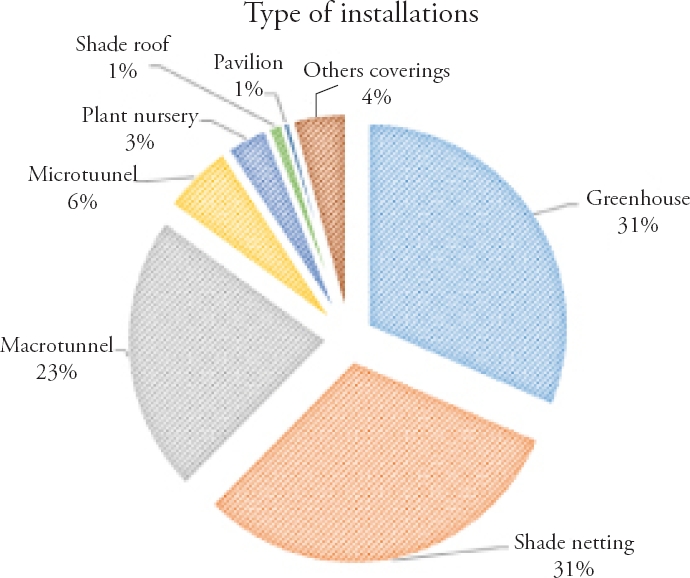
The 2022 census conducted by INEGI Agropecuario (INEGI Agricultural Institute) mentions protected agriculture (PA) as a productive system that appears to have expanded throughout the country. The use of technology and infrastructure has helped to address environmental factors and provide effective plant protection, by helping curtail pests and diseases, thereby improving crop yields. In Mexico, 30,179 production units practice PA, covering an area of 77,417 hectares; notably, 35 out of every 100 production units are located in the State of Mexico (INEGI, 2022). Figure 1 shows the types of facilities used in protected agriculture, in relation to surface area:
According to INEGI, these are the types of crops that benefited from AP during the period from October 2021 to September 2022 (Table 3); vegetables and fruit are predominant.
Table 3 Types of crops in Protected Agriculture.
| Crop | Cultivated area (hectares) | Production (tons) | |||||
| Total | In protected agriculture | Percentage % | Total | In protected agriculture | Percentage % | ||
| Tomato (red tomato) | 56,709 | 19, 653 | 34.7 | 3´835,148 | 2´405,207 | 62.7 | |
| Cucumber | 18,257 | 6,369 | 34.8 | 886,444 | 660,552 | 74.5 | |
| Chile | 137,321 | 7,996 | 5.8 | 2590,247 | 629,473 | 24.3 | |
| Strawberry | 20,121 | 6,397 | 31.8 | 680,275 | 251,234 | 36.9 | |
| Apple | 52,890 | 10,378 | 19.6 | 542,967 | 218,843 | 40.3 | |
| Blackberry | 16,482 | 2,290 | 13.9 | 237,329 | 46,648 | 19.7 | |
| Cranberry | 11,223 | 2,803 | 25.0 | 35,101 | 32,422 | 92.4 | |
Source: INEGI, 2022.
In order to evaluate the net economic benefit per plant, a comparison is made of energy savings, water consumption, costs and benefits, between Mexico and other countries that practice UA with soilless cultivation (Table 4).
Table 4 Comparative table of energy, water, cost and benefit consumption.
| Country | Crop in soil | Crop without soil | Savings in crop without soil | Crop in soil | Net benefit (USD/plant) | |||||||
| Energy consumption (MJ/kg) | Water consumption (L/kg) | Energy consumption (MJ/kg) | Water consumption (L/kg) | Energy saving (%) | Water saving (%) | Initial cost (USD/planta) | Operative cost (USD/planta) | |||||
| Mexico | 8,7 | 55 | 5.1 | 15 | 59 | 72 | 0.4 | 0.1 | 0.2 | |||
| Colombia | 7.8 | 45 | 5.8 | 15 | 25 | 66 | 0.3 | 0.1 | 0.3 | |||
| Spain | 6.5 | 24 | 5.1 | 4 | 21 | 83 | 0.5 | 0.3 | 0.4 | |||
| France | 2.2 | 16 | 0.4 | 4 | 81 | 75 | 0.8 | 0.2 | 0.6 | |||
| Canada | 4.2 | 37 | 2.2 | 17 | 47 | 54 | 0.6 | 0.3 | 0.5 | |||
*The amount of water may vary, as it depends on the type of crop and the climate prevailing in the geographical area.
Source: Ávila (2019); Salazar et al. (2014); y Barbosa et al. (2015).
From table 4, it is possible to deduce the following:
Mexico is one of the countries with the highest energy and water consumption for traditional soil-based crops. However, the adoption of soil-less cultivation offers considerable savings in the use of these resources. This indicates that urban agriculture (UA) in Mexico is evolving toward this modality, although currently, it is not as efficient and sustainable compared to countries like France, Spain, and Colombia. Furthermore, it is important to note that this practice can require a significant initial investment and depend on energy and technological sources, which generates risks and vulnerabilities in the face of external factors such as climate change, natural disasters, price fluctuations, and potential supply failures.
France has the lowest energy and water consumption and the highest energy and water savings of the five countries compared. This indicates that UA with soilless cultivation in France is more efficient and sustainable than in other countries, using more efficient and sustainable productive systems that reduce energy and water use, as well as waste, contributing to improved productivity and product quality.
Colombia, Spain, and Canada have intermediate levels of energy and water consumption and savings, which vary according to crop type, production system, climate, irrigation, and drainage. This indicates that UA with soilless cultivation in these countries has potential for improvement and should be adapted to local conditions and consumer demands by selecting the most appropriate crops, substrates, nutrient solutions, and irrigation systems in each case.
The initial and operating costs of UA with soilless cultivation are higher than those of conventional agriculture, due to the need for greater investment in infrastructure and technology. However, compared to other forms of urban production, such as family or community gardens, the costs are lower, especially in countries like Mexico, Colombia, and Spain, thanks to the use of vertical space.
The net benefit of UA with soilless cultivation is greater than that of conventional agriculture, both urban and rural, in all countries compared. This is because soilless cultivation produces fresh, healthy, and organic food, which has greater demand and added value in urban and peri-urban areas (Ávila, 2019). Furthermore, soilless cultivation generates income and jobs for urban and peri-urban farmers, as well as for other actors in the value chain, such as suppliers, distributors, and consumers.
In this sense, it is important to make a comparison of water consumption, energy consumption and water use efficiency (Pomoni et al., 2023), of crops with soil, compared to crops without soil (Table 5), particularly Hydroponic and Aeroponic crops without soil (Albrigth, 1990).
Table 5 Comparison of water and energy consumption and efficiency.
| Consumption and efficiency | Crops in Soil | Soil less crops |
| Water consumption | 400 to 600 liters of water per kg of product* | 70 to 150 liters per kg of product |
| Energy consumption | 1.5 kWh per kilo of product | 2 to 4 kWh per kilo of product |
| Efficiency of water use | Less efficient: because of evaporation or filtration | More efficient: because of greater control |
*Quantity of water may vary because it depends on the type of crop and climate that prevails in the geographical area.
Source: Albrigth (1990) and Pomoni et al., (2023).
DISCUSSION
Comparison with Existing Literature
An analysis of the reviewed articles shows a trend towards sustainability and efficiency in urban agriculture and protected agriculture, by introducing hydroponic and aeroponic crops. For example, Morrison (2020) highlights the importance of agricultural transformation in the Urban Food Agenda, which is consistent with the findings of Orsini (2020), who demonstrated the potential of rooftop gardens for food security and biodiversity in urban environments. These results coincide with those obtained by Savvas and Gruda (2018), who reviewed soil-less cultivation technologies, highlighting their efficiency in terms of water use and production.
Practical Implications
The implementation of urban agriculture practices in Mexico presents a less than encouraging outlook due to the lack of public policies. However, its presence is increasingly noticeable in Mexico City and surrounding areas. According to Ávila (2019), the city government has implemented support programs, such as the Small-Scale Urban Agriculture program, to promote these practices. A notable example is Xochimilco, where traditional agricultural techniques are being revitalized and microenterprises are being developed that supply products to gourmet restaurants. Similar initiatives are also being undertaken in other regions of Mexico. In Puebla and Tlaxcala, urban production spaces have also been established to supply organic markets. In Monterrey and Guadalajara, urban gardens have been created to meet the demands of local gastronomy. Likewise, in places like Xalapa and Oaxaca, organic food production is being promoted and advice is being offered for the creation of home gardens. Finally, in Chiapas, significant development of peri-urban agriculture has been documented. In summary, according to Ávila (2019), urban and peri-urban agriculture in Mexico, not only contributes to food security and economic development, but also strengthens community networks and promotes environmental sustainability.
Challenges and Future Considerations
Deng (2021) raises concerns about pollution in rainwater capture, which represents a challenge for the sustainability and resilience of urban agriculture. This underscores the need to consider water quality, when planning urban agricultural systems. However, Pomoni et al. (2023) compare hydroponics and conventional agriculture, highlighting the advantages of hydroponics in terms of land use efficiency and reduced water consumption, although they note that it requires more energy and greater initial investment.
Feasibility and Viability of UA in Mexico
Analysis of the literature review shows that UA, particularly soil-less cultivation, is feasible and viable in Mexico. Modern technologies, such as hydroponics and aeroponics, enable efficient use of water and space, which is crucial in a country with arid and semi-arid zones. Climatic and geographic conditions, such as abundant solar radiation in the northern states, favor these practices. Despite challenges such as the need for initial investment and water resource management, the advantages outweigh the disadvantages. These practices can reverse the overexploitation of aquifers and soil erosion, promoting environmental, economic, and social sustainability.
CONCLUSIONS
The description of the historical evolution at the federal, state, and municipal levels provides an overview of the evolution of these public policies and the technical and environmental impacts of protected urban agriculture in Mexico. Table 1 enables us to evaluate the advantages and disadvantages of existing programs related to Urban Agriculture. The literature review only allows us to evaluate the technical and energy efficiency feasibility, as well as the political viability of protected agriculture. Due to the above, it was determined that despite facing obstacles, such as lack of support and competition for essential resources, a promising field for food production in urban environments is emerging. That said, in Mexico, some challenges can be addressed, such as food security, environmental sustainability, and improving the quality of life in cities. To achieve this, truly effective policies must be implemented to improve UA. Economic incentives are needed for small and medium-sized businesses to establish projects of this type, as well as tax exemptions to promote urban agriculture, as well as the use of public spaces such as vacant lots and community spaces. Likewise, food safety policies to ensure that food production meets quality standards, can be established and the government can support research and development to encourage projects that promote new cultivation techniques that have social impact. All of these suggestions may be short-term, and some of them already exist but require modification to respond to changes. Such is the case of the Urban Garden Law, enacted in Mexico City in 2017. This law was not only implemented in Mexico City, it impacted Guadalajara, Jalisco, which, through local organizations, inspired the creation of gardens in public and private spaces. In Monterrey, Nuevo León, interest in protected urban agriculture has grown, driven by collectives and civil society organizations, encouraging the creation of gardens in urban neighborhoods and the use of vacant spaces for food production. In Puebla, there is no legislation similar to Mexico City’s Garden Law; however, efforts have been made to integrate urban agriculture. Similarly, the states of Baja California, Querétaro, and Veracruz are seeking to integrate sustainable practices into food production.
An evaluation of the capacity and viability of these practices, considering consumption and savings of energy and water, is presented in Table 5. Here, a comparison of the consumption and efficiency of water and energy with respect to urban agriculture and protected agriculture in greenhouses (hydroponics and aeroponics), shows that in terms of water consumption, a 75% reduction in water savings is made in soilless cultivation compared to cultivation in soil, but in terms of energy consumption; this increases up to 30%. In terms of water efficiency, evidently soilless cultivation is efficient, because it is a controlled crop, so the costs and benefits associated with the agricultural production chain, derived from its continued development are crucial. The data collected on protected agriculture in Mexico reflects a growing trend towards the adoption of these techniques, suggesting a positive change in the distribution and density of installations of these practices throughout the country. This review, by integrating significant findings with existing literature, highlights the relevance of urban agricultural transformation and its potential to improve the sustainability and resilience of cities in the face of current environmental and socioeconomic challenges. This study concludes that urban agriculture in the 21st century is a necessary reaction to global population growth, which entails challenges regarding the technical, political, economic, and energy efficiency feasibility and viability of ensuring urban food security, the fundamental objective of offsetting seasonal food deficits and adapting to changing global conditions. In Latin America, and especially in Mexico, urban agriculture has its roots in the agricultural practices of indigenous populations. A significant example of this is the chinampa system, a traditional cultivation practice in urban areas, as well as influence on the part of Spanish and Portuguese colonizers. After independence and with increased urbanization, this trend intensified, seeking to produce food sustainably.
Tables 2 and 3 present evident growth in Protected Agriculture in recent years. Currently, in the Latin American context, there are policies such as Zero Hunger, promoted by the FAO, which has conducted studies on the practices and dissemination of Urban Agriculture. Since 2002, public policies have been implemented in Mexico, such as the 2002 Urban Agriculture Program by SAGARPA, the 2007 Public Spaces Rescue Program (PREP) by SEDESOL, the 2007 Urban Gardens Program by SAGARPA, the National Strategy for Urban and Peri-Urban Agriculture (2012), promoted by the Federal government during that year, and the 2014 Policy to Support Sustainable Agriculture, promoted by SAGARPA. The Urban Development Program, derived from the Federal Government’s 2020-2024 Institutional Development Plan, is another program related to urban agriculture, for sustainable and equitable urban development, strengthening productive capacities, promoting comprehensive habitat, etc. All of these policies reflect recognition of food production and quality, representing an important step towards the effective development of urban agriculture in Mexico. However, Mexico must advance in surpassing the feasibility and technical viability to further explore the benefits of soilless farming. These policies must be governed by public policies that have only been established in large urban areas such as Mexico City, Guadalajara, and Monterrey. However, Mexico’s population continues to increase daily, and population density not only affects large cities but also medium- and low-density cities. In this regard, the Directorate of Strategic National Programs of Conacyt (Pronaces) is responsible for coordinating scientific and technical capabilities with public and private sector actors to address urgent national problems. The solutions it proposes are based on advanced knowledge in the humanities, sciences, and technologies and are aligned with the UN Sustainable Development Goals and the Mexican government’s National Development Plan. One of its key focuses is food sovereignty, where Pronaces seeks to solve problems within the Mexican agri-food system. It does so through a comprehensive analysis that considers epistemic diversity, promoting healthy eating and alternative production and consumption models. Furthermore, it focuses on designing public policies that are congruent and necessary to strengthen food sovereignty and self-determination in this country (SECIHTI, 2024).
Analyzing the characteristics of Urban and Protected Agriculture makes it possible to use land within and around cities, with the idea of implementing these projects throughout the country. They can be installed in backyards or on federal land, and even in public places such as parks and public schools. However, these practices must be regulated to avoid water waste. Regarding the economic factor, although Mexico has demonstrated that its cost is not as high as in France, it is a matter of a paradigm shift in cultivation, as farmers prefer traditional crops, that is, those grown in soil. Energy efficiency is another important factor for Urban Agriculture, in order to reduce energy consumption for soilless cultivation. In Mexico, significant savings are achieved in terms of resources. However, all of these factors will need to be fulfilled to maintain the development of Urban Agriculture in Mexico.
Evidently, urban agriculture and agricultural practices make it possible to take advantage of available land in and around cities, offering great flexibility for their implementation in various locations throughout the country. These initiatives can be installed in spaces such as backyards, federal lands, and even public places such as parks and schools. Similarly, greenhouses and vertical farming structures can be used to maximize space and extend the continuous production season offered by urban agriculture and soil-less farming. However, it is essential to establish adequate regulations to prevent water waste in these environments. From an economic perspective, although Mexico has demonstrated that the cost of urban agriculture is not as high as in France, there is a challenge related to the paradigm shift in agricultural practices. Many farmers still prefer traditional crops, i.e., those grown in soil, which can hinder the widespread adoption of innovative methods.
ACKNOWLEDGMENTS
We would like to thank the National Institute of Technology of Mexico and the Ministry of Education, Science, Humanities, Technology and Innovation (SECIHTI) for their support.
REFERENCES
Ávila H. 2019. Agricultura urbana y periurbana: Reconfiguraciones territoriales y potencialidades en torno a los sistemas alimentarios urbanos. Investigaciones geográficas, (98). 1-21. https://doi.org/10.14350/rig.59785. [ Links ]
Barbosa GL, Gadelha FDA, Kublik N, Proctor A, Reichelm L, Weissinger E, Wo-hlleb GM, Halden RU. 2015. Comparison of land, water, and energy requirements of lettuce grown using hydroponic vs. Conventional agricultural methods. International Journal of Environmental Research and Public Health, 12(6). 6879-6891. https://doi.org/10.3390/ijerph120606879. [ Links ]
Bastista E, Rodríguez D, Alvarado I. 2022. Circuitos de la Economía Urbana y Patrimonio-Territorial Latinoamericano, Mercado de Xochimilco, Ciudad de México. Urbano, 25(46). 90-105. https://dx.doi.org/10.22320/07183607.2022.25.46.08. [ Links ]
Cotler H, Corona JA, Galeana JM. 2020. Erosión de suelos y carencia alimentaria en México: una primera aproximación. Investigaciones geográficas, (101). https://doi.org/10.14350/rig.59976. [ Links ]
De Anda J, Shear H. 2017. Potential of vertical hydroponic agriculture in México. Sustainability, 9(1), 140. https://doi.org/10.3390/su9010140. [ Links ]
Deng Y. 2021. Pollution in rainwater harvesting: A challenge for sustainability and resilience of urban agriculture. Journal of Hazardous Materials Letters, 2: 100037. https://doi.org/10.1016/j.hazl.2021.100037. [ Links ]
Despommier D. 2017. Vertical Farming Using Hydroponics and Aeroponics. In: Urban Soils; Lal R, Stewart BA (eds); CRC Press: Boca Ratón, https://doi.org/10.1201/9781315154251. pp: 313-328. [ Links ]
Escandón JA. 2020. Visiones desiguales sobre la conservación en la periferia Urbana: ganadores y perdedores del suelo de conservación en la Ciudad de México. Sociedad y Ambiente, (23). 1-29. https://doi.org/10.31840/sya.vi23.2149. [ Links ]
FAO, Rikolto, RUAF. 2022. Urban and peri-urban agriculture sourcebook from production to food systems. FAO and Rikolto: Rome, Italy; https://doi.org/10.4060/cb9722en. 156 p. [ Links ]
FAO (Food and Agriculture Organization). 2020. El estado mundial de la agricultura y la alimentación 2020. Superar los desafíos relacionados con el agua en la agricultura. FAO: Roma, Italia; https://doi.org/10.4060/cb1447es. 236 p. [ Links ]
Franco R, Lanzaro JL. 2006. Política y políticas públicas en los procesos de reforma en América Latina; FLACSO: México. https://repositorio.cepal.org/entities/publication/e44b382a-0ae0-4e39-94d6-89db7b5c0b7c. [ Links ]
Gobierno de la Ciudad de México. 2022. Programa Institucional 2020-2024 recuperado el 20 de abril del 2025. https://www.gob.mx/cms/uploads/attachment/file/622670/Programa_Institucional_2020-2024_de_Seguridad_Alimentaria_Mexicana_SEGALMEX_2.pdf . [ Links ]
Gobierno Federal. 2022. Programa General de Desarrollo Urbano. Secretaría de Desarrollo Urbano y Vivienda de la CDMX. https://www.seduvi.cdmx.gob.mx/programas/programa/programa-general-de-desarrollo-urbano. [ Links ]
Higashide T, Kasahara Y, Ibuki T, Sumikawa O. 2005. Development of closed, energy-saving hydroponics for sloping land. Acta Horticulturae. 691. 243-248. https://doi.org/10.17660/ActaHortic.2005.691.28. [ Links ]
INECC (Instituto Nacional de Ecología y Cambio Climático). 2023, Evaluación estratégica de la estrategia nacional del cambio climático. Visión 10-20-40. Instituto Nacional de Ecología y Cambio Climático. Ciudad de México. https://www.gob.mx/cms/uploads/attachment/file/921071/03_2024_Eval_Estrat_Publicacio_n_060624_Final.pdf. [ Links ]
INEGI (Instituto Nacional de Estadística Geografía e Informática). 2022. Censo Agropecuario https://www.inegi.org.mx/contenidos/programas/ca/2022/doc/ca2022_rdnal.pdf [ Links ]
INTAGRI (Instituto para la innovación tecnológica en la agricultura). 2024. Importancia de la radiación solar en la producción bajo invernadero. Recuperado el 10 de abril del 2024. https://www.intagri.com/articulos/horticultura-protegida/importancia-de-la-radiacion-solar-en-la-produccion-bajo-invernadero [ Links ]
Kennard NJ, Bamford RH. 2020. Urban agriculture: Opportunities and Challenges for sustainable development. In: Zero Hunger. Encyclopedia of the UN Sustainable Development Goals; Leal W, Azul A, Brandli L, Özuyar P & Wall T (eds). Springer International Publishing; https://link.springer.com/referenceworkentry/10.1007/978-3-319-69626-3_102-1. pp: 929-942. [ Links ]
Langemeyer J, Madrid C, Mendoza A, Villalba G. 2021. Urban agriculture — A necessary pathway towards urban resilience and global sustainability? Landscape and Urban Planning. 210. 104055. https://doi.org/10.1016/j.landurbplan.2021.104055. [ Links ]
Loconsole D, Cocetta G, Santoro P, Ferrante A. 2019. Optimization of LED lighting and quality evaluation of romaine lettuce grown in an innovative indoor cultivation system. Sustainability, 11(3). 841. https://doi.org/10.3390/su11030841. [ Links ]
Manso M, Teotónio I, Matos C, Oliveira C. 2021. Green roof and green wall beneand costs: A review of the quantitative evidence. Renewable and Sustainable Energy Reviews, 135, 110111. https://doi.org/10.1016/j.rser.2020.110111. [ Links ]
Montero J. 2022. Relación de la radiación solar con la producción de plantas: agroproductivas. Revista de Investigación e Innovación Agropecuaria y de Recursos Naturales, 9(1). 48-62. https://doi.org/10.53287/oqym7033yy88k. [ Links ]
Moreno O. 2007. Agricultura Urbana: Nuevas Estrategias de Integración Social y Recuperación Ambiental en la Ciudad. Diseño urbano y paisaje. 4(11). https://repositorio.uchile.cl/handle/2250/117766. [ Links ]
Moreno SI, Jiménez MA, Hernández M. 2019. Sustentabilidad y agricultura urbana practicada por mujeres en la Zona Metropolitana de Ciudad de México, Valle de Chalco Solidaridad. Estudios Sociales. Revista de alimentación contemporánea y desarrollo regional, 29(54). e19795. https://doi.org/10.24836/es.v29i54.795. [ Links ]
Morrison J. 2020. Transformación agrícola y la Agenda Alimentaria Urbana Comité de Agricultura. FAO. https://openknowledge.fao.org/server/api/core/bitstreams/9b4c0fcf-bc30-4f76-ad09-9acf07dd95a6/content. [ Links ]
Morrone JJ. 2019. Regionalización biogeográfica y evolución biótica de México: encrucijada de la biodiversidad del Nuevo Mundo. Revista Mexicana de Biodiversidad, 90: e902980. https://doi.org/10.22201/ib.20078706e.2019.90.2980. [ Links ]
Noriega GG. 2017. Análisis de la desertificación y su relación con los niveles freáticos en el acuífero Valle del Río Yaqui, Sonora, México. Tesis de Maestría en Ciencias-Geología. Universidad de Sonora, México. https://maestriageologia.unison.mx/wp-content/uploads/2017/05/GLENDA-NORIEGA.pdf. [ Links ]
Olivera G, Zavaleta K. 2020. La agricultura urbana y periurbana como segundo mejor uso del suelo en la ciudad. Retos frente a la urbanización y las políticas urbanas: Cuernavaca, México. Quid 16: Revista del Área de Estudios Urbanos, (13). 216-242. https://www.redalyc.org/journal/5596/559666851011/html/. [ Links ]
Orsini F. 2020. Innovation and sustainability in urban agriculture: the path forward. Journal of Consumer Protection and Food Safety, 15. 203-204. https://doi.org/10.1007/s00003-020-01293-y. [ Links ]
Otazu V. 2010. Manual on quality seed potato production using aeroponics. International Potato Center: Lima, Perú; https://doi.org/10.4160/9789290603924. 42 p. [ Links ]
Pomoni DI, Koukou MK, Vrachopoulos MG, Vasiliadis L. 2023. A Review of Hydroponics and Conventional Agriculture Based on Energy and Water Consumption, Environmental Impact, and Land Use. Energies, 16(4). 1690. https://doi.org/10.3390/en16041690. [ Links ]
Rufí M, Petit A, Villalba G, Sanjuan D, Ercilla M, Arcas V, Muñoz J, Rieradevall J, Gabarrell X, Parada F. 2020. Recirculating water and nutrients in urban agriculture: An opportunity towards environmental sustainability and water use efficiency? Journal of Cleaner Production, 261. 121213. https://doi.org/10.1016/j.jclepro.2020.121213. [ Links ]
SAGARPA (Secretaría de Agricultura, Ganadería, Desarrollo Rural, Pesca y Alimentación). 2014. Convocatoria Estatal de los Proyectos Integrales de Innovación y Extensión (PIIEX). https://www.gob.mx/cms/uploads/attachment/file/373951/11_Convocatoria_Proyectos_Integrales_de_Innovaci_n_y_Extensi_n_2014.pdf. [ Links ]
SAGARPA (Secretaría de Agricultura, Ganadería, Desarrollo Rural, Pesca y Alimentación). 2016. Programa de Agricultura Urbana (PAU). Wordpress.com https://pausah.files.wordpress.com/2016/01/programa-de-agricultura-urbana-2011-jaliscomexico.pdf. [ Links ]
Salazar R, Rojano A, López L. 2014. La eficiencia en el uso del agua en la agricultura controlada. Tecnología y ciencias del agua, 5(2). 177-183. http://www.scielo.org.mx/scielo.php?script=sci_arttext&pid=S2007-24222014000200012&lng=es&tlng=es. [ Links ]
Savvas D, Gruda N. 2018. Application of soilless culture technologies in the modern gree house industry—A review. European Journal of Horticultural Science, 83(5). 280-293. https://doi.org/10.17660/eJHS.2018/83.5.2. [ Links ]
SECIHTI (Secretaría de Ciencia, Humanidades, Tecnología e Innovación). 2024. Programas-Nacionales Estratégicos del Conahcyt (Pronaces). https://secihti.mx/pronaces/pronaces-soberania-alimentaria/. [ Links ]
SEMARNAT (Secretaría de Medio Ambiente y Recursos Naturales). 2015. Ley General del Equilibrio Ecológico y la Protección al Ambiente. https://biblioteca.semarnat.gob.mx/janium/Documentos/Ciga/agenda/DOFsr/148.pdf. [ Links ]
SEDATU (Secretaría de Desarrollo Agrario, Territorial y Urbano). 2013. Programa de Rescate de Espacios Públicos. https://www.gob.mx/cms/uploads/attachment/file/5749/Lineamientos_PREP_2013_24-may-13_.pdf. [ Links ]
SEDATU (Secretaría de Desarrollo Agrario, Territorial y Urbano). 2021. Estrategia Nacional de ordenamiento territorial. https://www.gob.mx/cms/uploads/attachment/file/632549/ENOT._versio_n_ejecutiva._26.2.21-Abr_.pdf. [ Links ]
Sistemas Hortícolas. 2022. Humedad relativa ideal: ¿Qué es, por qué es importante y cómo conseguirla? Sistemas Hortícolas Almería; S.L. https://www.sistemashorticolasalmeria.com/blog/humedad-relativa-ideal/. [ Links ]
Succar JG. 2024. Hidroponía Vertical: Una Revolución Sostenible para alimentar Ciudades en Crecimiento. https://hidroponia.mx/sabias-que-la-agricultura-vertical-urbana-sera-la-base-para-producir-los-vegetales-que-seran-consumidos-en-las-grandes-ciudades-del-mundo-singularity-university/#:BORRACHECAR SIGNO~:text=La%20hidroponía%20vertical%20es%20un,para%20producir%20en%20metros%20cúbicos. [ Links ]
Téllez JM, Vargas S, Hernández J, Gómez W. 2022. Participación social y políticas públicas para el abastecimiento de alimentos básicos en México. Revista del Colegio de San Luis, 12(23). 1-38. https://doi.org/10.21696/rcsl122320221427. [ Links ]
Urías DS, Ochoa JM. 2020. Huertos urbanos como estrategia de resiliencia urbana en países en desarrollo. Vivienda y Comunidades Sustentables, (8). 81-102. https://doi.org/10.32870/rvcs.v0i8.143. [ Links ]
Vázquez del Mercado R, Lambarri J. 2017. Huella Hídrica en México: Análisis y perspectivas. Instituto Mexicano de Tecnología del Agua. Vázquez del Mercado R y Lambarri J, Eds. IMTA - Instituto Mexicano de Tecnología del Agua: Jiutepec, Morelos, México, http://repositorio.imta.mx/handle/20.500.12013/1714. 255 p. [ Links ]
Wikiwater AC. 2021. E52 - Las técnicas de riego simples y eficaces. https://wikiwater.fr/E52-Las-tecnicas-de-riego-simples-y-eficaces. [ Links ]
Yúnez A, López J. 2021. La política agrícola en México: evaluación a partir de una tipología de productores. Estudios sociológicos, 39(116). 495-532. https://www.scielo.org.mx/scielo.php?script=sci_arttext&pid=S2448-64422021000200495. [ Links ]
Zimmerer KS, Bell MG, Chirisa I, Duvall CS, Egerer M, Hung PY, Lerner AM, Shackleton C, Ward JD, Yacamán C. 2021. Grand challenges in urban agriculture: Ecological and social approaches to transformative sustainability. Frontiers in Sustainable Food Systems, 5: 668561. https://doi.org/10.3389/fsufs.2021.668561. [ Links ]
Received: September 17, 2024; Accepted: February 10, 2025
 Este es un artículo publicado en acceso abierto bajo una licencia Creative Commons
