




Servicios Personalizados
Revista
Articulo
 texto en
  Inglés (pdf)
 Artículo en XML
 Referencias del artículo
 Traducción automática
 Enviar artículo por email
Indicadores
-
 Citado por SciELO
 -
 Accesos
Links relacionados
-
 Similares en
SciELO
Similares en
SciELO
Compartir

 Permalink
Agricultura, sociedad y desarrollo
versión impresa ISSN 1870-5472
agric. soc. desarro vol.22 no.4 Texcoco oct./dic. 2025 Epub 11-Nov-2025
https://doi.org/10.22231/asyd.v22i4.1724
Articles
Estimate of potential economic income from home gardens in Palenque, Chiapas, Mexico
11 Universidad Autónoma de Chiapas (UNACH). Facultad Maya de Estudios Agropecuarios, Carretera Catazajá-Palenque km 4. 29980, Catazajá, Chiapas, México.
22 Colegio de Postgraduados, Campus Tabasco, Periférico Carlos A. Molina, km 3, Carretera Cárdenas-Huimanguillo, H. Cárdenas, Tabasco, México. 86500.
Production from home gardens in Palenque, Chiapas does not contribute to the supply of the products that families need because the size of the gardens offers little guarantee of productivity. This study aimed to estimate the economic and productive potential of home gardens in relation to the diversity of useful plant species found there. Semi-structured interviews were conducted with 43 heads of households. The gardens were classified as small, medium or large, based on their surface area. Monthly consumption of fruit and vegetables and their means of production were determined. The economic contribution generated by the production of a 132 m2 family vegetable garden in the Ejido Nueva Esperanza 1st Section, Palenque, Chiapas, was also estimated. We recorded the production volume1 of each garden and the economic contribution generated for the family. The income generated by the model vegetable garden was also estimated. In conclusion, it appears that families spend up to 68% of their monthly income on purchasing fruit and vegetables for their own consumption. However, cultivating a 132 m² garden with short-cycle vegetables enables increased production, which can generate savings of up to 74%.
Keywords: consumption; fruit; income; vegetables; vegetable gardens
La producción de los huertos familiares en Palenque, Chiapas, no contribuye al abastecimiento de los productos que las familias requieren, debido a que el tamaño de los huertos, ofrece poca garantía productiva. Este trabajo tuvo como objetivo, estimar el potencial económico y productivo de los huertos familiares en relación a la diversidad de especies vegetales útiles presentes. Se aplicaron entrevistas semiestructuradas a 43 jefes y jefas de familias. Los huertos, se clasificaron en pequeños, medianos y grandes, con base en la superficie de cada uno de ellos. Se identificó el consumo mensual de productos hortofrutícolas y sus formas de obtención. También, se estimó el aporte económico que genera la producción de un huerto familiar de hortalizas de 132 m2 en el Ejido Nueva Esperanza 1ra. Sección, Palenque, Chiapas. Se obtuvo el volumen de producción de cada huerto y el aporte económico generado a la familia. Asimismo, se estimó el ingreso generado en el huerto modelo de hortalizas. Se concluye que las familias, destinan hasta 68% de sus ingresos mensuales, a la adquisición de productos hortofrutícolas para su consumo. Sin embargo, al trabajar un huerto de 132 m2 con hortalizas de ciclo corto, permite potencializar la producción, lo que puede generar ahorros de hasta 74%.
Palabras clave: Consumo; frutícola; hortícolas; huertos; ingresos
INTRODUCTION
In traditional agriculture, production systems imitate nature by simultaneously developing diverse strata and species; similar to vegetable gardens (Gutiérrez et al., 2015). Vegetable gardens are generally located near the home, are small in size, and in some areas, are considered a sustainable production agroecosystem, where species are planted, tolerated, and managed, for diverse purposes such as self-consumption with sale of surplus, ensuring food availability, favoring generation of agricultural jobs and mitigating poverty, while conserving biodiversity and cultural traditions (Borbor et al., 2016; Reyes-Betanzos, 2017). Home gardens provide significant savings for families, by curtailing expenses, as products can be grown rather than purchased and in some cases used to generate income from the sale of surplus (Toledo et al., 2008; Sol, 2012); this income provides leverage to reduce investment in garden expenses and to acquire products not produced there (Cano, 2015).
Worldwide, home gardens have been recognized as an important strategy for achieving the Millennium Development Goals, by complying with Sustainable Development Goals and the 2030 Agenda; thus they have become a popular intervention strategy used by various different development actors to promote family farming (Pantoja, 2014; Krishnamurthy, et al., 2017; Castañeda-Navarrete, 2021; Farfán-García, 2022).
Home gardens have not been considered as an inclusive development strategy (Krishnamurthy et al., 2017), as generally initiatives, programs and projects have failed because they fail to consider local culture and realities (Cano, 2015), which may lead to the disappearance of these sustainable and productive systems (González, 2007).
In some areas, the productive potential of gardens, as a producer and generator of services that can later be transformed into useful goods has been wasted (Dussel, 2014), limiting their productive capacity and their function as services that could contribute to reducing the cost of living or meeting family needs. This scenario requires sustainable proposals or strategies for continuity, so it is important to consider the home garden as a means for transitioning from the local to the global, a paradigm shift in the social, economic, political, and environmental order that maximizes and rationally maximizes the ecosystem services generated by this agro-ecosystem for families.
Globally, home gardens are considered the main focus of production, especially for poor small-scale farming families (Kewesse, 2020). In Southeast Asia, considered to constitute an area where people suffer from severe malnutrition, home gardens have been promoted as a measure to counteract the problem of food shortages (Weinberger, 2013). In West Java, the garden is considered a socioeconomically sustainable production system, playing a fundamental role in providing food and income to the population, by means of a multi-tiered system (Park et al., 2019).
Therefore, this work aimed to estimate the economic and productive potential of small, medium and large vegetable gardens, in relation to the diversity of plant species recorded, by evaluating the monthly family consumption of fruit and vegetable products and the annual production of a 132 m2 vegetable garden.
THEORETICAL FRAMEWORK
Research on home gardens over the past 10 years has highlighted their importance for food security, sustainability, and family well-being. When properly managed, they contribute significantly to food security, especially in rural and peri-urban areas (Altieri et al., 2012; Gliessman, 2002). This production system promotes sustainability by reducing dependence on external inputs and encouraging the use of agro-ecological practices, specific to each region (Maroyi, 2009; Ibarra et al., 2019). Similarly, they generate health benefits by providing fresh and nutritious food and promoting physical activity and family life (Alaimo et al., 2008; Algert et al., 2016).
Women’s participation in the management of home gardens is essential to the success of these projects, as they are often primarily responsible for food production and management (Yáñez, 2016; Cobo and Paz, 2017; Román et al., 2024). Considering the current environmental crisis, home gardens constitute an effective tool for climate change adaptation, as they allow families to produce food in a resilient manner that can adapt to changing climatic conditions (Rivas, 2014; Mattsson et al., 2018).
The most well-known school of thought that addresses home gardens is agro-ecology, which focuses on designing and managing sustainable, diversified, and resilient agricultural systems that promote biodiversity and ecological health (Altieri, 1995).
Within agro-ecology, there are several theories and concepts that relate to family gardens, such as the theory of small-scale agriculture, which maintains that small-scale food production, such as that in home gardens, is more efficient and sustainable than large-scale production (Gliessman, 2018).
Likewise, the theory of food sovereignty maintains that communities and families should have control over their own food systems, including food production, processing, and consumption; this can be achieved by means of home gardens. Finally, the concept of agro-ecosystems refers to agricultural systems designed to mimic natural ecosystems, promoting biodiversity and ecological health, which home gardens can help achieve (Altieri, 1999).
METHODOLOGY
Location of study area
This research was carried out in the 1st Section of the Nueva Esperanza Ejido, in the municipality of Palenque, Chiapas, located at Km. 96 of Federal Highway 186 Villahermosa-Escárcega, located between the geographic coordinates 17° 41´ 57´´ north latitude and 92° 11’ 55 “west longitude, at an average altitude of 30 meters above sea level. The climate is warm humid with rain all year round, and warm humid with abundant summer rains (INEGI, 2020).
The methodology consisted of three phases: field visits to the community, semi-structured interviews, and data analysis. During the field visit phase, the types of gardens and their surface areas were determined; during the semi-structured interviews, principal species uses were obtained. In the data analysis phase, species uses were taken note of. Descriptive analyses were also conducted for the gardens. Sample size was estimated.
Sample size
To determine the sample size of the total number of homes registered, we applied the formula proposed by Linch et al. (1974)
where n: sample size; N: number of homes with gardens in the study area; Z: value of a normal distribution Z a/2 (1.96), for a confidence level of 95%; p: probability of success (0.95); d: sampling error (0.05).
Based on the calculated sample size, semi-structured interviews were randomly conducted with 43 garden owners (men and women) between May and November 2021. The productive potential and economic contribution provided by the gardens were considered, as well as monthly family consumption and the acquisition of principal horticultural products by families. Besides this, a demonstration vegetable garden was established to evaluate its production and profitability in relation to monthly family income, monthly expenditure on vegetable consumption, and the productive potential of the gardens.
Productive potential and economic contribution made by home gardens
To determine the productive potential of the gardens for the 43 families surveyed in the 1st Section of the Nueva Esperanza Ejido, Palenque, Chiapas, the plant species found were recorded and identified, and the species of greatest economic importance were prioritized.
Monthly consumption and acquisition of fruit and vegetable products for the family
We used information obtained from the interviews regarding monthly expenditure on the main fruit and vegetable products and their source. Expenditures were calculated based on market prices during the second half of 2021.
Design of a demonstration vegetable garden
As part of the integrated management strategy, a 132 m2 demonstration module was established in a producer’s garden for the production of vegetables managed using agro-ecological practices, following that recommended in various manuals (FAO, 2000; Espinosa et al., 2010; SEMARNAT, 2013; INDESOL, Tierra Verde, 2014; Pantoja, 2014).
Garden production was recorded for three periods: January-April, May-August, and September-December 2021, in order to evaluate the year referred to. During the first four months; tomato (Solanum lycopersicum L.), bell pepper (Capsicum annuum L.), cabbage (Brassica oleracea L.), chives (Allium fistulosum L.), parsley (Eryngium foetidum L.), coriander (Coriandrum sativum L.), radish (Raphanus sativus) and lemon grass (Cymbopogon citratus (DC.) Stapf) were planted around the edge of the garden to repel pests.
During the second quarter, bald beans (Vigna unguiculata L. Walp), were planted, along with chives at a distance of 10 x 10 cm, and coriander at a distance of 5 x 5 cm to make maximum use of available space. Germination beds measuring 3 x 0.90 m were prepared for saladette tomato seeds.
During the third quarter, seedbeds (3.0 x 0.90 m) containing tabaquero chili and costeño chili (Capsicum annuum L.) were produced to be traded as seedlings, and seedlings of saladette tomato, coriander, chives and parsley were planted out.
Monthly income according to garden size, monthly expenditure on vegetable consumption and the production potential of the gardens
The gardens were grouped by size, according to the area they presented: small (19 gardens with a surface area of 120 to 425 m2), medium (12 medium-sized gardens, with surface area between 425 and 800 m²) and 12 large gardens, ranging in size from 800 to 2,500 m². For the three types of gardens selected, the monthly income of the families, the monthly expenditure on horticultural products and potential income that could be generated by garden production were recorded. Finally, income from vegetable production was calculated.
RESULTS
Productive potential and economic contribution from family gardens
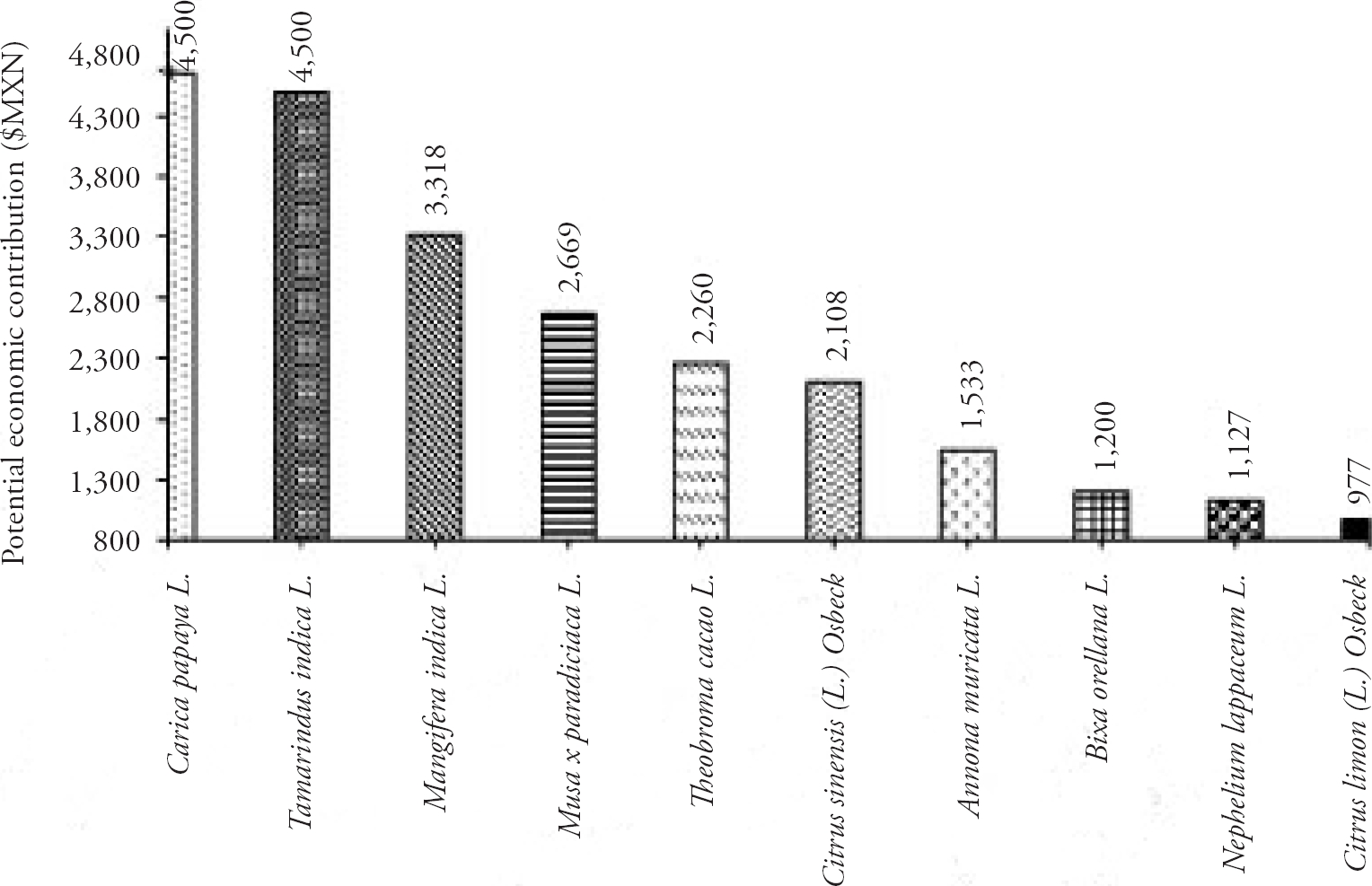
Of the 43 home gardens in the sample, a total of 3,549 plants were obtained, which were grouped into 46 botanical families; 82 genera and 89 species. Of the 89 species registered, the 10 species providing the greatest economic contribution to the families were placed in order; these were: papaya (Carica papaya L.), tamarind (Tamarindus indica L.), mango (Mangifera indica L), banana (Musa × paradisiaca L.), cocao (Theobroma cacao L.), orange (Citrus sinensis (L.) Osbeck), custard apple (Annona muricata L.), achiote (Bixa orellana L.), rambutan (Nephelium lappaceum L.) and lime (Citrus limon (L.) Osbeck). Trade from these species generated a contribution of $24,342.00, which signifies a significant contribution to the family economy and demonstrates the increased productivity of the home garden. Some of these species, such as lemon, orange, rambutan, mango, banana, and tamarind are introduced by grafting or purchased from local nurseries.
Figure 1 lists the top 10 species grown in the home gardens and their economic contribution. Papaya (Carica papaya L.) generates the most income ($4,650.00), as it is consumed fresh or as fruit juice, and the green fruit is used to make regional sweets; this is followed by tamarind, mango, banana, ornamental fruit, cocoa, etc.
Family monthly consumption and acquisition of fruit and vegetable products
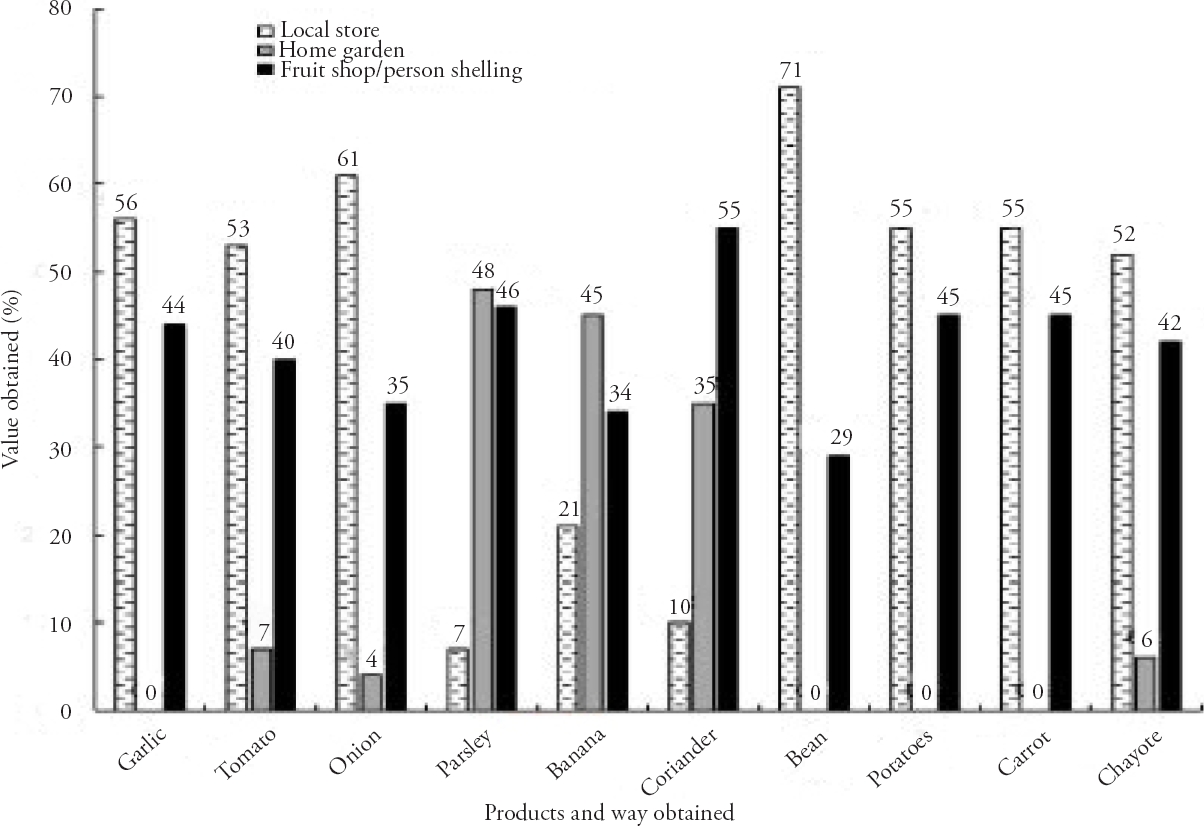
As the closest public market to the study area is Playas de Catazajá, Chiapas, located 28 km away, the community obtains its horticultural products from three sources: 35% of required products come from local stores, 34% from street markets and 31% from the family garden. The most consumed horticultural species are beans, onions, garlic, potatoes, carrots, tomatoes, and chayote, purchased from local stores. From street markets, coriander, parsley, potatoes, carrots, garlic and chayote are purchased. From the family garden, species consumed include parsley, plantains and coriander (Figure 2).
Design for a demonstration home garden
The demonstration garden generated variable economic benefits in terms of annual production during the three planting periods. Chives, coriander, parsley, and lemongrass were grown during the three established periods because only the foliage of these species is used; the stem remains in the ground to sprout new leaves. During the first four-month period, greatest income was obtained from the sale of saladette tomatoes, followed by coriander, bell peppers, cabbage, lemongrass, chives, parsley, and radishes. During the second four-month period, greatest income came from coriander, chives, parsley, beans, and lemongrass. In the third four-month period, greatest income was obtained from the sale of saladette tomatoes, tabasco peppers, chives, costeño chile, coriander, parsley, and lemongrass, respectively (Table 1).
Table 1 Species cultivated during each quarter in a demonstration garden, yield and income in MX pesos and in US.
| Crop | Yield | Measurement unit | Income in $MXN | Income in US$ |
| 1st quarter | ||||
| Capsicum annuum L. | 14 | kg | 840.00 | 40.4137 |
| Solanum lycopersicum L. | 80 | kg | 1,200.00 | 57.7339 |
| Brassica oleracea L. | 36 | Heads | 720.00 | 34.6404 |
| Allium schoenoprasum L. | 29 | Bunches | 290.00 | 13.9524 |
| Eryngium foetidum L. | 22 | Bunches | 220.00 | 10.5846 |
| Coriandrum sativum L. | 88 | Bunches | 880.00 | 42.3382 |
| Raphanus sativus | 6 | kg | 150.00 | 7.21674 |
| Cymbopogon citratus (DC.) Stapf | 35 | Bunches | 350.00 | 16.8391 |
| 2nd quarter | ||||
| Vigna unguiculata L. Walp | 15 | kg | 525.00 | 25.2586 |
| Allium schoenoprasum L. | 368 | Bunches | 1,840.00 | 88.5253 |
| Eryngium foetidum L. | 120 | Bunches | 600.00 | 28.867 |
| Coriandrum sativum L. | 828 | Bunches | 4,140.00 | 199.182 |
| Cymbopogon citratus (DC.) Stapf | 75 | Bunches | 375.00 | 16.8391 |
| 3rd quarter | ||||
| Capsicum annuum L. | 1,630 | Seedlings | 1,630.00 | 78.4219 |
| Capsicum annuum L. | 1,670 | Seedlings | 835.00 | 40.1732 |
| Solanum lycopersicum L. | 80 | kg | 2,400.00 | 115.468 |
| Allium schoenoprasum L. | 184 | Bunches | 920.00 | 44.2627 |
| Eryngium foetidum L. | 120 | Bunches | 600.00 | 28.867 |
| Coriandrum sativum L. | 126 | Bunches | 630.00 | 30.3103 |
| Cymbopogon citratus (DC.) Stapf | 75 | Bunches | 375.00 | 18.0419 |
Source: elaborated by the authors, based on field information. Conversion to dollars was undertaken on December 22, 2021.
The total cost of installing the demonstration garden was $7,270.00 pesos, which included the purchase of tools and supplies, as well as chili pepper seeds. During the first four-month period, $4,650.00 pesos of income was generated; during the second four-month period, $7,480.00 pesos; and during the third, $7,340.00 pesos. Total income reached $19,470.00 pesos, but after deducting the installation cost, the net income was $12,200.00 pesos. As apparent, the main source of income came from the sale of saladette tomatoes, coriander, chives, and tabasco chili pepper seedlings (Table 1).
Comparison of garden size and monthly household income, monthly expenditure on vegetable consumption and production potential of gardens
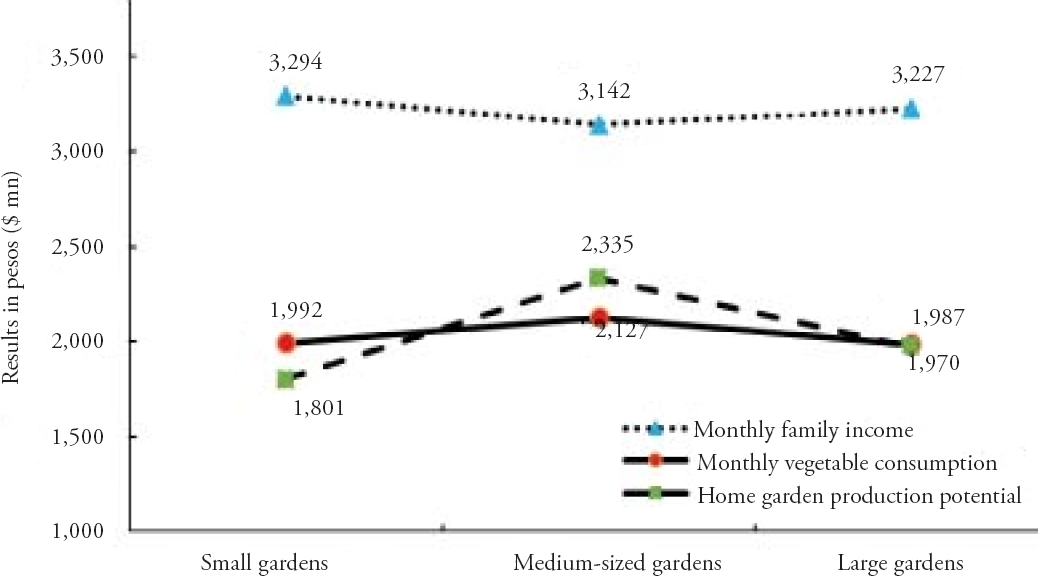
Figure 3 presents a comparison showing monthly family income, monthly expenditure on vegetable consumption and the garden’s production potential. Evidently, average family income is higher among those with small gardens than for those with the other two garden sizes. Similarly, production potential and monthly expenditure on vegetable consumption is lowest in the case of the small gardens, compared to the medium and large gardens. The medium-sized gardens produce less family income, but achieve greater production potential in the garden and there is greater monthly expenditure on vegetable consumption. Those with large gardens have high family income but the monthly expenditure on vegetable consumption and production potential are lower than in the medium-sized gardens.
Source: elaborated by the authors, based on field information.
Figure 3 Comparison of monthly family income, monthly expenditure on vegetable consumption and the production potential of gardens.
Medium-sized gardens had the greatest potential for vegetable production, followed by large and small gardens, respectively. This may be because they have space to plant vegetables and do not spend money on purchasing them. However, producers of medium-sized gardens spend more on purchasing vegetables that they do not produce in their gardens, such as garlic, carrots, onions, etc. Medium-sized gardens are those that generate the greatest production potential and benefit for families. This could be because they recorded the greatest number of individual plants; 1,261 that included 55 species, including coriander, chives, plantain, and parsley, which are of economic importance to families. Furthermore, these species are easy to cultivate in small spaces and are easy to manage, and are easy to grow and reuse. Although the same number of species (55) were reported in the small home gardens and the medium-sized ones, these only reported 793 individuals, among which, chives, cocoa and rambutan predominate, and the most and easily marketed is the chive. In the large home gardens, 1,095 of 42 species are reported among which coriander, tomato, banana and chives predominate.
DISCUSSION
The gardens selected in this study were shown to have species with diverse uses, such as fruit, medicinal, ornamental and horticultural plants, as well as those providing timber, condiments, fuel (firewood), condiment-timber, and medicinal-horticultural for personal consumption. These species are planted and harvested according to the agricultural calendar of the area. Results concur with those of Sol (2012), who points out that within the garden, there are specialized production areas. Generally, there are four areas: medicinal species, ornamental species, little-used species and common area. Ornamental plants are generally located in front of the house, providing a display of family flowers for others to observe. Medicinal plants are located to the side of the house. Little-used plants are located at the back of the garden, and the rest represents common area.
Of the species recorded making greatest economic contribution for families; these included papaya (Carica papaya L.), tamarind (Tamarindus indica L.), mango (Mangifera indica L), banana (Musa × paradisiaca L.), cocoa (Theobroma cacao L.), orange (Citrus sinensis (L.) Osbeck), soursop (Annona muricata L.), achiote (Bixa orellana L.), rambutn (Nephelium lappaceum L.) and lime (Citrus limon (L.) Osbeck); these species are valued at $24,342.00. A similar income ($23,800.00) was reported by Sol (2012), for home gardens on the Tabasco coast, when the dollar was at $12.95 exchange rate.
The fruit trees registered for family gardens in this study represented greater economic value due to trade, which generated extra income for the family and increased interest in self-consumption. Similar results were found for three municipalities in Veracruz, where fruit trees provided greater production in the orchards and were planted according to family needs (Álvarez, 2012; Chávez, 2012).
The cultivation of leafy vegetables such as pond apple (Piper auritum H.B.K.), basil (Ocimum basilicum L.), chaya (tree spinach shrub, Cnidoscolus chayamansa Mcvaught), chili amashito (Capsicum annuum var aviculare L.), coriander (Coriandrum sativum L.), parsley (Eryngium foetidum), and bulbs such as white chives (Allium fistulosum) and purple chives (Allium schoenoprasum) are planted in reduced spaces for self-consumption and their sale generates little income. These results concur with those obtained by Gerardo Méndez et al. (2022), who comment that leafy and bulbous vegetables are the most consumed, as they are used almost daily. They are always consumed fresh, depending on the family’s needs, representing a saving as their purchase is avoided.
In the case of medicinal plants, their presence was common in almost all gardens. These are not sold, but rather exchanged or given as gifts within the locality. Although they do not generate income, they make it possible to avoid expenses for treating certain illnesses.
Records show that women in the household decide the types of plants to introduce and experiment with in the gardens, especially ornamental and medicinal plants. This confirmed that women influence garden diversity (Lerner et al., 2009) and their knowledge of the methods and frequency of use of medicinal herbs is more accurate. The sale of fresh and dried medicinal plants is common in the markets of the local municipal capitals.
Among the economic benefits generated by a garden is that it avoids the family spending $24,342.00 per year, by producing for their needs in the garden (Moreno-Moreno et al., 2020). Some species found in the gardens are heliophilous and in the garden there are usually no empty spaces, as the three levels of stratification are occupied: at the top, trees such as orange, avocado or timber; in the middle, banana, guava plants and others; further below, herbs such as white leaf, achiote, lemon and at the lowest level, commonly used herbs, but only in small areas which receive the sun’s rays.
Tree species are fundamental to the structure of home gardens (Gliessman, 2002), increasing species diversity and abundance, and fulfilling environmental, social, cultural, economic, nutritional, ornamental, and medicinal functions, among others (Hylander and Nemomisa, 2008). Trees are an integral component of these systems; they are planted and allowed to exist in home gardens as extra food. 42.62% of the stratum is used for this purpose, and the fruit represents a food source (White-Olascoaga et al., 2017).
Regarding the demonstration garden, the tabasco and costeno rojo pepper seedlings were sold to community producers, as these are economically important crops in the region (García-Palomares, 2010). Tomato production also generated greatest income. In the 132 m2 garden, profits increased, contributing to family income and food security, as they include crops for personal consumption with sale of surplus (Cahuich-Campos, 2012).
According to the data obtained, establishment of small gardens generates income for families and reduces living costs. The challenge is to foster production systems that support greater access for low-income families, geared towards meeting future food needs (García-Flores et al., 2016).
The highest monthly income for a family was $3,294.00 and the cost of living for vegetable consumption was $1,992.00, which indicates that families spend 68% of their income on the purchase of fruits, vegetables and greens and the rest is to cover their other needs, meaning that income from garden products is not sufficient to cover the family’s requirements.
However, by taking advantage of the plant species in their gardens and implementing the 132 m2 vegetable production module, they can obtain an average monthly income of $1,801.00. This implies savings of up to 90% of the resources allocated to the acquisition of vegetables and a savings of 55% in their direct monthly income; these data concur with records from Calpan, Puebla, where the average annual economic contribution made by the family garden was $14,400.00 (López-González et al., 2019); however it has also been shown that with more years of intervention, biointensive gardens can increase their production from 20 to 40% (Bonilla-Aparicio et al., 2013).
Among ethnic groups (Peninsular Maya, Choles, and Mestizos) in the state of Campeche, home gardens have been reported to contribute between 12.40% and 18% of family income (Chi-Quej, 2009). Likewise, gardens in Cárdenas and Tabasco have registered incomes of between $150.00 and $450.00 per week and economic savings of between $100.00 and $250.00 per week (Gómez, 2010). In Honduras, the economic contribution of gardens varies between 10% and 26%, whereas in Nicaragua, it averages 35%. In general, family gardens generate monetary contributions ranging from 10% to 100%, which can be significant for household economies (Pulido et al., 2008).
CONCLUSIONS
Family gardens in communities represent the family’s productive unit. Their management is based on environmental knowledge, experience in cultivating plant species, and family food requirements. These are expressed in the agro-ecological attributes of species richness with nutritional, medicinal, condiment, and ornamental value and for use as posts and live fences, which translate into environmental, economic, social, and cultural benefits.
The gardens studied usually include empty, uncultivated spaces, one reason being that they constitute poor areas that lack organic matter and have become impoverished because prior to becoming gardens, they were livestock farms. Under current conditions, the family garden does not fully cover families’ food needs, as they spend 68% of their income on the fruits and vegetables they consume. However, by implementing a 132 m2 vegetable garden, they can produce an average monthly income of $1,801.00, implying savings of up to 90% of the resources allocated to the purchase of fruits and vegetables and a savings of 55% on their total monthly income.
Gardens are an essential part of a family’s economy, and their continued existence and enrichment should be encouraged, as their purpose is to provide fresh, low-cost food for the family and to serve as a supply of useful plants.
ACKNOWLEDGMENTS
We would like to thank the National Council of Science and Technology, for support in developing this master’s degree; to the College of Postgraduates, Tabasco Campus; and to the LGAC 1 Sustainable Management of Natural Resources for Agri-Food Production.
REFERENCES
Alaimo K., Packnett E, Miles RA, Kruger DJ. 2008. Fruit and vegetable intake among urban community gardeners. Journal of Nutrition Education and Behavior, 40(2). 94-101. https://doi.org/10.1016/j.jneb.2006.12.003. [ Links ]
Algert S, Diekmann L, Renvall M, Gray L. 2016. Community and home gardens increase vegetable intake and food security of residents in San Jose, California. California Agriculture, 70(2). 77-82. https://doi.org/10.3733/ca.v070n02p77. [ Links ]
Altieri MA. 1995. Agroecology. The science of sustainable agriculture. 2a ed. CRC Press. Boca Ratón, EEUU. https://doi.org/10.1201/9780429495465. 433 p. [ Links ]
Altieri MA. 1999. Agroecología: bases científicas para una agricultura sustentable. Editorial Nordan-Comunidad: Montevideo, Uruguay. https://agroeco.org/wp-content/uploads/2010/10/Libro-Agroecologia.pdf. pp. 325. [ Links ]
Altieri MA, Funes-Monzote FR, Petersen P. 2012. Agroecologically efficient agricultural systems for smallholder farmers: Contributions to food sovereignty. Agronomy for Sustainable Development, 32. 1-13. https://doi.org/10.1007/s13593-011-0065-6. [ Links ]
Álvarez MC. 2012. Modelo de gestión para el manejo integrado de los recursos del solar familiar. In: El huerto familiar del sureste de México. Mariaca R. Ed. Secretaría de Recursos Naturales y Protección Ambiental del Estado de Tabasco, ECOSUR: Tabasco, México, https://www.researchgate.net/profile/Leopoldo-Medina-2/publication/236870993_El_huerto_familiar_del_sureste_de_Mexico/links/02e7e519c0b4aa7874000000/El-huerto-familiar-del-sureste-de-Mexico.pdf. pp. 435-459. [ Links ]
Bonilla-Aparicio ME, Salcido-Ramos BA, Paredes-Sánchez JA, Aguirre-Álvarez L, Méndez-Cadena ME, Hernández-Rodríguez ML. 2013. La diversidad hortícola para la seguridad alimentaria en municipios marginados del Estado de Puebla. Ra Ximhai 9(2). 151-163. https://doi.org/10.35197/rx.09.02.e.2013.11.mb. [ Links ]
Borbor M, Mercado W, Soplín H, Blas R. 2016. Importancia de los huertos familiares en la estrategia de diversificación del ingreso y en la conservación in situ de Pouteria lucuma [R et. Pav] O. Kze. Ecología Aplicada, 15(2). 179-187. http://dx.doi.org/10.21704/rea.v15i2.757 [ Links ]
Cahuich-Campos D. 2012. El huerto maya y la alimentación cotidiana de las familias campesinas de X-Mejía, Hopelchén, Campeche. In: El huerto familiar del sureste de México. Mariaca R, Ed. Secretaría de Recursos Naturales y Protección Ambiental del Estado de Tabasco, ECOSUR: Tabasco, México , https://www.researchgate.net/profile/Leopoldo-Medina-2/publication/236870993_El_huerto_familiar_del_sureste_de_Mexico/links/02e7e519c0b4aa7874000000/El-huerto-familiar-del-sureste-de-Mexico.pdf. pp: 197229. [ Links ]
Cano EJ. 2015. Huertos familiares: un camino hacia la soberanía alimentaria. Revista Pueblos y Fronteras Digital. 10(20). 70-91. https://doi.org/10.22201/cimsur.18704115e.2015.20.33. [ Links ]
Castañeda-Navarrete J. 2021. Homegarden diversity and food security in southern Mexico. Food security, 13(3). 669-683. https://doi.org/10.1007/s12571-021-01148-w. [ Links ]
Chávez E. 2012. Desarrollo modernizador y manejo tradicional del huerto familiar: dos paradigmas diferentes. In: El huerto familiar del sureste de México. Mariaca R, Ed. Secretaría de Recursos Naturales y Protección Ambiental del Estado de Tabasco, ECOSUR: Tabasco, México, https://www.researchgate.net/profile/Leopoldo-Medina-2/publication/236870993_El_huerto_familiar_del_sureste_de_Mexico/links/02e7e519c0b4aa7874000000/El-huerto-familiar-del-sureste-de-Mexico.pdf. pp: 391-419. [ Links ]
Chi-Quej JA. 2009. Caracterización y manejo de los huertos caseros familiares en tres grupos étnicos (Mayas peninsulares, Choles y Mestizos) del Estado de Campeche, México. Tesis de maestría. Escuela de Posgrado, Centro Agronómico Tropical de Investigación y Enseñanza, Turrialba, Costa Rica. https://docs.repositoriobiocultural.org/2021/08/27/caracterizacion-y-manejo-de-los-huertos-caseros-familiares-en-tres-grupos-etnicos-mayas-peninsulares-choles-y-mestizos-del-estado-de-campeche-mexico/. [ Links ]
Cobo R y Paz L. 2017. Traspatios campesinos de Morelos. Textual, (70). 51-68. https://doi.org/10.5154/r.textual.2017.70.004. [ Links ]
Cruz LA. 2016. El papel de las mujeres en los huertos familiares. Revista Alternativas en Psicología, (36). 46-60. https://alternativas.me/wp-content/uploads/2016/11/El-papel-de-las-mujeres-en-los-huertos-familiares.pdf. [ Links ]
Dussel E. 2014. 16 tesis de economía política: interpretación filosófica. Siglo XXI editores. México. https://enriquedussel.com/txt/Textos_Obras_Selectas/(F)28.16_Tesis_economia_politica.pdf. 424 p. [ Links ]
Espinosa P, Gutiérrez R, Espinosa LM. 2010. 1. El huerto familiar. SAGARPA. México. https://ecotec.unam.mx/wp-content/uploads/SAGARPA.-Huerto-familiar.pdf. 10 p. [ Links ]
FAO. 2000. Mejorando la nutrición a través de huertos y granjas familiares. Manual de capacitación para trabajadores de campo en América Latina y El Caribe. FAO: Roma, Italia, http://www.fao.org/docrep/V5290S/v5290s00.htm. 139 p. [ Links ]
Farfán-García AG, Navarrete-Pita Y, Mendoza-Mero AE. 2022. Creación de huertos familiares para el desarrollo de la seguridad alimentaria en la ciudadela Panorama. Revista Estudios del Desarrollo Social: Cuba y América Latina, 10(1). 1-17. https://dialnet.unirioja.es/servlet/articulo?codigo=8517950. [ Links ]
García-Flores JC, Gutiérrez-Cedillo JG, Balderas-Plata MA, Araújo-Santana MR. 2016. Estrategia de vida en el medio rural del altiplano central mexicano: el huerto familiar. Agricultura, Sociedad y Desarrollo, 13(4). 621-641. https://www.revista-asyd.org/index.php/asyd/article/view/498. [ Links ]
García-Palomares J. 2010. Integración de innovaciones tecnológicas en el desarrollo del sistema producto chile de Chiapas. Fundación PRODUCE Chiapas A.C. 70 p. [ Links ]
Gerardo-Méndez C, Ramírez-Martínez A, Ruiz-Rosado O y Álvarez-Ávila MC. 2022. Aportes del agroecosistema en la seguridad alimentaria durante la pandemia Covid-19 en el sureste de México. Estudios Sociales. Revista de Alimentación Contemporánea y Desarrollo Regional. 32(60). 1-27. https://doi.org/10.24836/es.v32i60.1240. [ Links ]
Gliessman SR. 2002. Agroecología: Procesos ecológicos en agricultura sostenible. Centro Agronómico Tropical de Investigación y Enseñanza (CATIE). LITOCAT: Turrialba, Costa Rica, https://biowit.files.wordpress.com/2010/11/agroecologia-procesos-ecolc3b3gicos-en-agricultura-sostenible-stephen-r-gliessman.pdf. 359 p. [ Links ]
Gómez B. 2010. Potencial agroecológico de los huertos familiares en el municipio de H. Cárdenas, Tabasco: Permanencia y prospectivas de desarrollo. Tesis de maestría. Colegio de Postgraduados. Montecillo. Texcoco. México. http://colposdigital.colpos.mx:8080/xmlui/handle/10521/178 [ Links ]
González A. 2007. Agroecosistemas mexicanos: pasado y presente. Itinerarios. 6. 55-80. https://itinerarios.uw.edu.pl/resources/html/article/details?id=224357&language=es. [ Links ]
Gutiérrez JG, White, L, Juan JI, Chávez M.C.. 2015. Agroecosistemas de huertos familiares en el subtrópico del altiplano mexicano. Una visión sistémica. Tropical and Subtropical Agroecosystems 18(3). 237-250. https://www.redalyc.org/articulo.oa?id=93944043012. [ Links ]
Hylander K, Nemomissa S. 2008. Home garden coffee as a repository of epiphyte biodiversity in Ethiopia. Frontiers in Ecology and the Environment, 6. 524-528. https://doi.org/10.1890/080001. [ Links ]
Ibarra JT, Caviedes J, Barreau A, Pessa N. (eds). 2019. Huertas familiares y comunitarias: cultivando soberanía alimentaria. Universidad Católica de Chile: Santiado de Chile, https://opia.fia.cl/601/articles-99232_archivo_01.pdf. 228 p. [ Links ]
INDESOL, Tierra Verde. 2013. Manual de Huertos Orgánicos de Traspatio. https://www.scribd.com/document/495829064/Manual-de-Huertos-Organicos-de-Traspatio-2013. 14 p. [ Links ]
INEGI. 2020. Censo de población y vivienda. México. https://www.inegi.org.mx/programas/ccpv/2020/. [ Links ]
Kewessa G. 2020. Homegarden agroforestry as a tool for sustainable production unit in Ethiopia. Journal of Resources Development and Management, 67. 14-19. https://doi.org/10.7176/JRDM/67-02. [ Links ]
Krishnamurthy LR, Krishnamurthy S, Rajagopal I, Peralta A. 2017. Agricultura familiar para el desarrollo rural incluyente. Terra Latinoamericana, 35(2). 135-147. https://www.scielo.org.mx/scielo.php?script=sci_arttext&pid=S0187-57792017000200135. [ Links ]
Lerner T, Mariaca R, Salvatierra B, González-Jácome A, Wahl E. 2009. Aporte de alimentos del huerto familiar a la economía campesina Ch’ol, Suclumpá, Chiapas, México. Etnobiología, 7(1). 30-44. https://revistaetnobiologia.mx/index.php/etno/article/view/251/252. [ Links ]
Maroyi A. 2009. Traditional homegardens and rural livelihoods in Nhema, Zimbabwe: a sustainable agroforestry system. International Journal of Sustainable Development & World Ecology, 16(1), 1-8. https://doi.org/10.1080/13504500902745895. [ Links ]
Mattsson E, Ostwald M, Nissanka SP. 2018. What is good about Sri Lankan homegardens with regards to food security? A synthesis of the current scientific knowledge of a multifunctional land-use system. Agroforestry Systems, 92. 1469-1484. https://doi.org/10.1007/s10457-017-0093-6. [ Links ]
Moreno-Moreno RA, Orantes-G C, Cortes-P JR, Sánchez-C MS. 2020. Uso florístico de los huertos familiares y sus beneficios en la selva El Ocote, Chiapas. Revista Pakbal, (48). 27-31. https://www.ingenieria.unach.mx/index.php/investigadores/2-uncategorised/157-revista-pakbal-48. [ Links ]
Pantoja, A. 2014. Una Huerta para todos: Manual de Autoinstrucción. FAO. Quinta edición. Chile. https://www.fao.org/family-farming/detail/es/c/317903/. 295 p. [ Links ]
Park JH, Woo SY, Kwak MJ, Lee JK, Leti S, Soni T. 2019. Assessment of the diverse roles of home gardens and their sustainable management for livelihood improvement in West Java Indonesia. Forests 10(11). 970. https://doi.org/10.3390/f10110970. [ Links ]
Pulido MT, Pagaza-Calderón EM, Martínez-Ballesté A, Maldonado-Almanza B, Saynes A, Pacheco RM. 2008. Home gardens as an alternative for sustainability: challenges and perspectives in Latin America. Current Topics in Ethnobotany. 37(2). 1-25. https://web2.uaeh.edu.mx/investigacion/icbi/LI_ProdForestales/MaTeresa_Pulido/MTP_7_Pulido.pdf. [ Links ]
Reyes-Betanzos A, Álvarez-Ávila MC. 2017. Agrobiodiversidad, manejo del huerto familiar y contribución a la seguridad alimentaria. Agro Productividad. 10(7). 58-63. https://www.revista-agroproductividad.org/index.php/agroproductividad/article/view/1058/905. [ Links ]
Rivas G. 2014. Huertos familiares: para la conservación de la agrobiodiversidad, la promoción de la seguridad alimentaria y la adaptación al cambio climático. Ambientico, (243). 4-9. https://www.ambientico.una.ac.cr/wp-content/uploads/tainacan-items/5/25464/243_4-9.pdf. [ Links ]
Román E, Oviedo U, García A, Ayala MI. 2024. Participación de la mujer en los traspatios como alternativa de soberanía alimentaria. Estudios Rurales, 14(29). https://doi.org/10.48160/22504001er29.499. [ Links ]
SEMARNAT. 2013. El huerto familiar biointensivo. Introducción al método de cultivo biointensivo, alternativa para cultivar más alimentos en poco espacio y mejorar el suelo. Primera reedición; SEMARNAT: Tlalpan, México, D.F., https://biblioteca.semarnat.gob.mx/janium/Documentos/Ciga/Libros2013/CD001599.pdf. 52 p. [ Links ]
Sol, A. 2012. El papel económico de los huertos familiares y su importancia en la conservación de las especies y variedades locales. In: El huerto familiar del sureste de México. Mariaca R. Ed. Secretaría de Recursos Naturales y Protección Ambiental del Estado de Tabasco, ECOSUR: Tabasco, México, https://www.researchgate.net/profile/Leopoldo-Medina-2/publication/236870993_El_huerto_familiar_del_sureste_de_Mexico/links/02e7e519c0b4aa7874000000/El-huerto-familiar-del-sureste-de-Mexico.pdf. pp: 361-370. [ Links ]
Toledo V, Barrera-Bassols N, García-Frapolli E, Alarcón-Chaires P. 2008. Uso múltiple y biodiversidad entre los mayas yucatecos (México). Interciencia. 33(5). 345-352. http://www.unich.edu.mx/wp-content/uploads/2014/01/usos%20multiples%20y%20biodiversidad%20maya.pdf. [ Links ]
Weinberger K. 2013. Home and community gardens in Southeast Asia: potential and opportunities for contributing to nutrition-sensitive food systems. Food Security, 5: 847-856. https://doi.org/10.1007/s12571-013-0299-z. [ Links ]
White-Olascoaga L, Chávez-Mejía C, García-Mondragón D. 2017. Análisis del estrato arbóreo de agroecosistemas en una zona de transición ecológica. Ecosistemas y Recursos Agropecuarios, 4(11). 255-264. https://doi.org/10.19136/era.a4n11.882. [ Links ]
Received: July 30, 2024; Accepted: November 11, 2022
 Este es un artículo publicado en acceso abierto bajo una licencia Creative Commons
