




 nueva página del texto (beta)
 Inglés (pdf)
 Artículo en XML
 Referencias del artículo
 Traducción automática
 Enviar artículo por email
 Citado por SciELO
  Similares en
SciELO
Similares en
SciELO 
 Permalink

Introduction
The rise of antimicrobial resistance has generated a huge concern in the health system in recent decades [1]. This is a phenomenon in which microorganisms, such as bacteria, viruses, fungi, and parasites, evolve to become resistant to antimicrobial drugs. This has increased the risk of treatment failure, prolonged illness, and the spread of infections [1]. Furthermore, steroidal, and non-steroidal anti-inflammatory drugs are commonly used to treat inflammatory diseases, but they also have side effects and limitations [2]. Non-steroidal anti-inflammatory drugs can cause digestive problems, kidney damage, and increased risk of heart disease, while long-term use of steroids can result in osteoporosis, diabetes, and immunosuppression. Additionally, some inflammatory conditions can become resistant to these drugs over time, reducing their efficacy. In this context, essential oils, with their low toxicity and potential antimicrobial and anti-inflammatory properties as well as accompanied by reduced side effects, have attracted renewed attention as an alternative to conventional antimicrobial and anti-inflammatory drugs [3,4].
Croton L. is a genus of plants in the Euphorbiaceae family, with about 1300 species distributed in tropical and subtropical regions [5]. The plants are known for their bright and diversely coloured leaves and their use in traditional medicine to treat various ailments such as stomachache, abscesses, sore throat, and malaria [6,7]. Croton species have been found to contain phytochemicals such as diterpenes, triterpenes, sesquiterpenes, alkaloids, and flavonoids, which are thought to contribute to their medicinal properties [8-11]. Some Croton species have been found to possess anti-inflammatory, antimicrobial, antimalarial, anticancer, and antioxidant activities [8-11].
Croton kongensis Gagnep. (Synonym: Croton tonkinensis Gagnep.) is a species of plant in the genus Croton, native to China [12,13]. It is known for its medicinal properties and has been traditionally used for various purposes, including the treatment of skin conditions, diarrhea, stomach aches, and dysmenorrhoea [14, 15]. In terms of pharmacology, various parts of C. kongensis have been studied for their biological activities and potential medicinal properties. For example, the leaves and stems of C. kongensis have been found to possess antimicrobial and antimalarial activities [13,16]. The plant is also a rich source of diterpenoids, which are known to promote various beneficial biological activities [16-21]. Moreover, the authors have acknowledged the existence of two previously published studies on the chemical compositions of essential oils derived from C. kongensis [22,23]. The results of these studies demonstrated that the primary compounds found in the essential oil of C. kongensis were β-caryophyllene (10.1 %), β-bisabolene (9.6 %), bicycloelemene (8.0%), linalool (7.8 %), α-humulene (7.1 %), and β-sesquiphellandrene (6.9 %) in the leaves [22], as well as benzyl benzoate (12.7 %), β-selinene (9.8 %), bulnesol (8.0 %) and 5,6,7,8-tetrahydroquinoxaline (7.4 %) in the stems [23]. In addition, the chemical constituents and biological properties of essential oils extracted from other species of Croton have been extensively investigated [24-34]. Nevertheless, it is worth noting that the information available on the antimicrobial and anti-inflammatory activities of C. kongensis essential oil is limited, and the qualitative and quantitative profiles of essential oils can be affected by environmental factors, as evidenced by previous studies [35-37]. As a result, this current research aims to explore the chemical constituents, antimicrobial activity, and nitric oxide (NO) production inhibitory activity of essential oil obtained from C. kongensis leaves collected from two distinct regions in Thanh Hoa province, Vietnam, namely Nhu Xuan and Thuong Xuan.
Materials and methods
Plant material
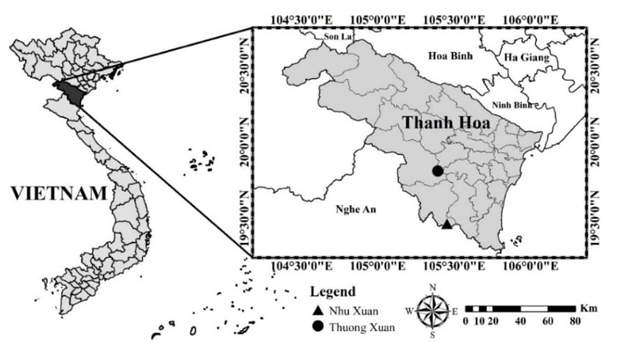
The Fresh leaves of Croton kongensis growing wild in Nhu Xuan (sample 1) and Thuong Xuan (sample 2) of Thanh Hoa province, Vietnam were randomly collected in February 2022 (Table 1 and Fig. 1). Geographic positions (latitude and longitude), altitude, locations, and key meteorological data (total rainfall, average minimum and maximum temperatures) of each collection site are presented in Table 1. The voucher specimens, NXTH-2022 for the Nhu Xuan sample and TXTH-2022 for the Thuong Xuan sample were identified by Dr. Le Dinh Chac, from Hong Duc University, Vietnam, and deposited in the herbarium of that university.
Table 1 Geographic positions and climatic data of the locations.
| Site No | Localities | Latitude | Longitude | Altitude (m) | Temperature (°C) | Rainfall (mm) | |
|---|---|---|---|---|---|---|---|
| Max. | Min. | ||||||
| 1 | Nhu Xuan, Thanh Hoa | 19°27'56.4"N | 105°27'10.5"E | 165 | 33.0 | 13.0 | 1095.7 |
| 2 | Thuong Xuan, Thanh Hoa | 19°48'36.2"N | 105°23'35.0"E | 47 | 35.0 | 13.0 | 1054.5 |
Extraction of the essential oil
The leaves of C. kongensis were prepared for essential oil extraction by cutting them into small pieces and subjecting them to hydrodistillation using a Clevenger-type apparatus. The extraction process was carried out for a duration of 4 h, following the methodology recommended by the Vietnamese Pharmacopoeia [38], and as described in earlier publications [39,40]. The experiments were conducted in triplicate. The resulting essential oils were then dried using anhydrous sodium sulfate, filtered, and stored at 4 °C until they were ready for testing and analysis.
Gas chromatography/mass spectrometry (GC/MS)
The GC/MS analysis was conducted to identify the chemical components of the essential oil samples obtained from the leaves of C. kongensis. The analysis was performed using an Agilent 7890A gas chromatograph, which was coupled with a 5975C Mass Spectrometer detector and equipped with a DB-XLB capillary column (60 m x 0.25 mm i.d., 0.25 μm film thickness). Helium was used as the carrier gas, with a flow rate of 1.0 mL/min. A volume of 1.0 μL of essential oil was injected into the column, with a split ratio of 100:1. The column temperature was maintained at 40 °C for 1 min, followed by a gradual increase to 270 °C at a rate of 4 °C/min, and held at 270 °C for 5 min. The inlet and ion source temperatures were set at 250 °C and 230 °C, respectively. The ionization voltage applied was 70 electron volts (eV), and the mass range was set between 35 and 450 atomic mass units (amu). Identification of the constituents was performed on the basis of their retention time, Kovats retention indices (relative to C7-C30 n-alkanes, under the same experimental conditions), and computer matching with the NIST Mass Spectral Database for GC-MS as well as comparisons of their mass spectra with those of authentic samples or with data already available in the literature [41,42]. The quantitative analysis was performed by integrating the peak areas.
Antimicrobial assay
The antimicrobial activity of essential oil samples from C. kongensis leaves was evaluated against eight microorganisms obtained from the American Type Culture Collection (ATCC, Manassas, USA). These included two Gram-positive bacteria (Bacillus subtilis ATCC 6633 and Staphylococcus aureus ATCC 6538), two Gram-negative bacteria (Escherichia coli ATCC 8739 and Pseudomonas aeruginosa ATCC 9027), two filamentous fungi (Aspergillus niger ATCC 9763 and Fusarium oxysporum ATCC 48112), and two yeasts (Candida albicans ATCC 10231 and Saccharomyces cerevisiae ATCC 16404). The broth microdilution method with minor modifications to a previous protocol was used to determine the minimum inhibitory concentration (MIC) of the tested oil samples [43,44]. The microorganisms were grown on Tryptic Soy Agar (TSA) and Sabouraud Dextrose Agar (SDA) for bacteria and fungi, respectively. The essential oil samples, dissolved in 10 % dimethylsulfoxide (DMSO), were added to 96-well microtiter plates in concentrations ranging from 200 to 12.5 µg/mL. The microorganisms were inoculated into each well at a concentration of 150 × 106 CFU/mL, and the plates were incubated at 37 °C for 24 h for bacteria and 48 h at 30 °C for fungi. The lowest concentration of essential oil that inhibited the visible growth of a microorganism after overnight incubation was defined as the MIC [44]. All the tests were repeated in triplicate. Streptomycin, tetracycline, and nystatin were used as positive controls for Gram-positive bacteria, Gram-negative bacteria, and fungi, respectively, while NaCl 0.9 % was used as a negative control.
Nitric oxide production inhibitory assay
The NO inhibitory activity assay was used to evaluate the anti-inflammatory potential of essential oil samples extracted from C. kongensis leaves, as previously described with minor modifications [45]. The assay was conducted on RAW 264.7 macrophage cells that were stimulated with lipopolysaccharide (LPS). The cells were obtained from the American Type Culture Collection (ATCC) and cultured in Dulbecco's Modified Eagle Medium (DMEM) supplemented with 10 % fetal bovine serum (FBS), 100 μg/mL streptomycin, and 100 U/mL penicillin, under 5 % CO2 at 37 °C for 48 h. The cells were then seeded at a density of 2.5 × 10⁵ cells/well in 96-well plates and treated with 1 μg/mL of LPS for 24 h. The quantity of nitrite in the culture medium was measured using the Griess reaction and quantified spectrophotometrically at 570 nm on an Infinite F50 microplate reader (Tecan, Männedorf, Switzerland). All the tests were repeated in triplicate. The 50 % inhibition concentration (IC50) was calculated using the program Table Curve Version 4.0.
To determine cell viability, the MTT assay was performed according to the protocol previously described [45]. After cell culture, the supernatants were collected for NO measurement. Next, 100 μL of 0.5 % w/v MTT, dissolved in phosphate buffer saline, was added to each well and incubated for an additional 4 h at 37 °C in a 5 % CO2 incubator. After incubation, the insoluble formazan product was dissolved in DMSO, and the degree of MTT reduction was measured by analyzing the absorbance at 540 nm on an Infinite F50 microplate reader (Tecan, Männedorf, Switzerland). All the tests were repeated in triplicate.
Statistical analysis
The experiments were conducted in triplicate, and their mean value was calculated. The results were presented as mean ± standard deviation, which was calculated using Microsoft Office Excel 2010. Statistical analysis was performed by Student’s t-test. Differences were considered significant at p ≤ 0.05.
Results and discussion
Chemical composition of the essential oil
Hydrodistillation of the leaves of C. kongensis collected from the two different locations yielded 0.13 % ± 0.01 and 0.15 % ± 0.01 pale yellowish oils for Nhu Xuan (sample 1) and Thuong Xuan (sample 2), respectively. Both essential oil samples from the leaves of C. kongensis were analyzed by GC/MS. The compositions of two samples of C. kongensis are displayed in Table 2, where constituents are listed in order of their elution on the DB-XLB column. A total of 54 components were detected, 42 and 50 of which were identified, accounting for 99.60 % and 97.55 % of the oil of Nhu Xuan and Thuong Xuan samples, respectively.
As can be seen from Table 2, the essential oil sample of Nhu Xuan was characterized by significantly larger amounts of monoterpenes (69.29 %) than sesquiterpenes (27.31 %), while the Thuong Xuan oil sample had a less different content of monoterpenes (54.79 %) and sesquiterpenes (38.42 %). The main composition of the oil of Nhu Xuan was characterized by its high content of sabinene (52.17 %). (E)-Caryophyllene and linalool were also found to be abundant in the Nhu Xuan oil sample with 7.23 % and 6.33 %, respectively. In the oil of Thuong Xuan, the most abundant composition was sabinene with 12.96 %, lower than that of the Nhu Xuan sample. Camphene (9.45 %), linalool (8.43 %), bornyl acetate (7.99 %), (E)-nerolidol (7.07 %), and (E)-caryophyllene (6.53 %) were also found to be abundant in the essential oil of Thuong Xuan. However, most of these compounds occurred in a lower content in the Nhu Xuan oil sample. In addition, our results also demonstrated that the composition was different not only quantitatively but also qualitatively. For instance, geraniol and borneol, which accounted for 0.29 % and 0.43 % of the volatile oil of the Thuong Xuan sample, respectively, were not identified in the Nhu Xuan sample. Two of the identified chemical compounds in the Nhu Xuan sample such as ar-curcumene and germacrene D, which accounted for 0.17 % and 0.15 %, respectively, were not detected in the Thuong Xuan sample.
Table 2 Chemical compositions of essential oil from the leaves of Croton kongensis from two different locations.
| No. | Compound a | RI b | RI c | Relative peak area (%) | |
|---|---|---|---|---|---|
| Nhu Xuan | Thuong Xuan | ||||
| 1. | Tricyclene | 928 | 921 | - d | 0.29 |
| 2. | α-Thujene | 929 | 924 | 0.60 | 0.36 |
| 3. | α-Pinene | 938 | 932 | 1.50 | 4.76 |
| 4. | Camphene | 955 | 946 | 0.58 | 9.45 |
| 5. | Sabinene | 979 | 969 | 52.17 | 12.96 |
| 6. | β-Pinene | 984 | 974 | 0.89 | 0.38 |
| 7. | Myrcene | 991 | 988 | 0.55 | 0.23 |
| 8. | α-Terpinene | 1021 | 1014 | 0.67 | 0.39 |
| 9. | o-Cymene | 1029 | 1022 | 0.11 | 0.20 |
| 10. | Limonene | 1033 | 1024 | 0.41 | 1.12 |
| 11. | 1,8-Cineole | 1037 | 1026 | 2.78 | 4.09 |
| 12. | 2-Heptyl acetate | 1039 | 1038 | 3.00 | 4.34 |
| 13. | γ‑Terpinene | 1063 | 1054 | 1.08 | 0.73 |
| 14. | cis-Sabinene hydrate | 1072 | 1065 | 0.18 | - |
| 15. | Terpinolene | 1094 | 1086 | 0.29 | 0.32 |
| 16. | Linalool | 1101 | 1095 | 6.33 | 8.43 |
| 17. | Borneol (= endo-Borneol) | 1175 | 1173 | - | 0.43 |
| 18. | Terpinen-4-ol | 1185 | 1174 | 0.63 | 1.00 |
| 19. | α-Terpineol | 1197 | 1186 | 0.25 | 0.73 |
| 20. | Geraniol | 1256 | 1249 | - | 0.29 |
| 21. | Linalyl acetate (= Linalool acetate) | 1257 | 1254 | - | 0.23 |
| 22. | Bornyl acetate | 1294 | 1287 | 0.27 | 7.99 |
| 23. | Methyl geranate | 1326 | 1320 | - | 0.24 |
| 24. | δ-Elemene | 1348 | 1335 | 0.19 | 0.15 |
| 25. | α-Terpinyl acetate | 1356 | 1346 | - | 0.17 |
| 26. | Cyclosativene | 1382 | 1372 | - | 0.12 |
| 27. | α-Copaene | 1389 | 1374 | 0.20 | 0.12 |
| 28. | Daucene | 1392 | 1385 | 0.53 | 0.60 |
| 29. | Cyperene | 1418 | 1398 | 0.13 | 0.71 |
| 30. | (E)-Caryophyllene (= β-Caryophyllene) | 1437 | 1417 | 7.23 | 6.53 |
| 31. | trans-α-Bergamotene | 1446 | 1432 | 0.13 | - |
| 32. | (E)-β-Farnesene | 1465 | 1443 | 0.19 | 0.17 |
| 33. | α-Humulene | 1471 | 1452 | 2.06 | 2.27 |
| 34. | 9-epi-(E)-Caryophyllene | 1479 | 1464 | 0.62 | 0.47 |
| 35. | γ-Curcumene | 1488 | 1470 | 0.33 | 0.19 |
| 36. | γ-Muurolene | 1490 | 1476 | - | 0.16 |
| 37. | ar-Curcumene | 1491 | 1482 | 0.17 | - |
| 38. | Germacrene D | 1498 | 1484 | 0.15 | - |
| 39. | trans-Muurola-4(14),5-diene | 1511 | 1498 | - | 0.35 |
| 40. | Bicyclogermacrene | 1514 | 1500 | 5.11 | 4.38 |
| 41. | β-Bisabolene | 1517 | 1507 | 1.69 | 2.82 |
| 42. | β-Sesquiphellandrene | 1534 | 1526 | 2.60 | 2.37 |
| 43. | δ-Cadinene | 1537 | 1528 | 0.23 | 0.30 |
| 44. | trans-Dauca-4(11),8-diene | 1547 | 1534 | 0.46 | 0.79 |
| 45. | (E)-Nerolidol | 1569 | 1561 | 3.50 | 7.07 |
| 46. | 4α-Hydroxygermacra-1(10),5-diene | 1593 | 1575 | 0.23 | 0.42 |
| 47. | Spathulenol | 1597 | 1577 | 0.43 | 1.51 |
| 48. | Caryophyllene oxide | 1605 | 1582 | 0.43 | 2.73 |
| 49. | Humulene epoxide I | 1620 | 1600 | - | 0.18 |
| 50. | Ledol | 1625 | 1602 | 0.23 | 0.66 |
| 21. | Humulene epoxide II | 1632 | 1608 | - | 1.07 |
| 52. | epi-α-Cadinol (= τ-Cadinol) | 1658 | 1638 | 0.31 | 1.28 |
| 53. | α-Cadinol | 1672 | 1652 | 0.16 | 0.75 |
| 54. | (E,E)-Farnesol | 1728 | 1719 | - | 0.25 |
| Monoterpene hydrocarbons | 58.85 | 31.19 | |||
| Oxygenated monoterpenes | 10.44 | 23.60 | |||
| Sesquiterpene hydrocarbons | 22.02 | 22.50 | |||
| Oxygenated sesquiterpenes | 5.29 | 15.92 | |||
| Others | 3.00 | 4.34 | |||
| Total identified | 99.60 | 97.55 | |||
Note: aElution order on the DB-XLB column; bCalculated Kovats retention index on the DB-XLB column; cLiterature retention index; dnot detected.
It is noteworthy that two prior studies have been conducted to investigate the composition of essential oil from C. kongensis. Dai et al. [22] reported the major components of essential oil from C. kongensis leaves as β-caryophyllene (10.1 %), β-bisabolene (9.6 %), bicycloelemene (8.0 %), linalool (7.8 %), α-humulene (7.1 %), and β-sesquiphellandrene (6.9 %). Apparently, both samples of essential oil from C. kongensis leaves obtained in the present study presented discrepancies when compared with data reported by Dai et al. [22]. Indeed, although bicycloelemene was one of the main components in Dai et al.’s study, this component was not detected in both oil samples of the present study. In addition, sabinene was found in high amounts in both oil samples of the present study (Table 2), while this component was in lower amounts in Dai et al.’s study [22]. Furthermore, the components in both oil samples of this study were significantly different from the essential oil of C. kongensis stems reported by Chau et al. [23]. Chau et al. [23] found that the major compounds in the essential oil of C. kongensis stems were benzyl benzoate (12.7 %), β-selinene (9.8 %), bulnesol (8.0 %), and 5,6,7,8-tetrahydroquinoxaline (7.4 %). Therefore, the essential oil composition of C. kongensis may vary depending on the part of the plant studied and environmental conditions.
Although there is little information available specifically about C. kongensis, there have been many studies on the essential oil compositions of other Croton species, particularly their leaves. For instance, previous studies have found that the major constituents of leaf essential oil from C. cajucara were linalool (41.2 %), (E)-nerolidol (12.6 %), and β-caryophyllene (6.9 %) [26], whereas in C. matourensis, β-caryophyllene was the most abundant compound [28]. Phenylpropanoid compounds were the main components of leaf essential oil of C. grewioides, which consisted mainly of (E)-anethole (65.5 %), eugenol (10.6 %), and (E)-methyl isoeugenol (4.7 %) [31]. In a study on C. campestris, caryophyllene oxide (29.9 %) and humulene oxide II (8.0 %) were the major components in leaf essential oil [34]. These findings indicate that the chemical variability of essential oils from Croton leaves depends largely on the species being studied.
The observed differences in essential oil compositions may be attributed to various factors, such as environmental conditions, genetic factors, season and harvest period, and other factors [37,46,47]. Additionally, there have been studies investigating the variation in essential oil compositions of Croton species collected from different locations. For instance, GC-MS analysis showed significant differences in essential oil compositions of C. rhamnifolioides samples collected from three different locations in the semiarid region of the state of Pernambuco, Brazil [36]. Similarly, essential oil compositions extracted from leaves of C. jimenezii collected from two locations in Costa Rica were found to vary significantly [35]. These findings support our results that environmental factors are important contributors to the variation in chemical components of essential oil from C. kongensis leaves across different geographical locations.
Antimicrobial activity
The present study tested the antimicrobial activity of essential oil extracted from C. kongensis leaves collected from two different locations. The findings are outlined in Table 3 using the broth microdilution method, which analyzed eight microorganisms. The essential oil from Nhu Xuan demonstrated inhibitory effects against S. aureus, A. niger, C. albicans, and S. cerevisiae with a MIC of 200 μg/mL. However, it did not suppress the growth of B. subtilis, E. coli, P. aeruginosa, and F. oxysporum. On the other hand, the essential oil sample from Thuong Xuan showed antimicrobial activity against almost all the tested microorganisms, except F. oxysporum. The most significant antimicrobial activity was observed in the essential oil sample from Thuong Xuan against C. albicans with a MIC of 150 μg/mL. In addition, the essential oil sample from Thuong Xuan inhibited the growth of B. subtilis, S. aureus, E. coli, P. aeruginosa, A. niger, and S. cerevisiae with a MIC of 200 μg/mL. Therefore, it can be concluded that the essential oil sample from Thuong Xuan demonstrated more effective antimicrobial activity than that from Nhu Xuan. This variance in activity could be due to the presence of distinct chemical compounds or differences in predominant compounds in the essential oils [46,47]. These research results align with prior studies examining the antimicrobial properties of essential oils from Croton plants, which selectively inhibited the growth of various microorganisms [29,30,33,34]. It is crucial to note that natural products with MIC values below 500 μg/mL are considered potent inhibitors, those with MIC values ranging from 600 to 1500 μg/mL are considered moderate inhibitors, and those with MIC values above 1600 μg/mL are considered weak inhibitors [48,49]. Based on these guidelines, both essential oils from C. kongensis leaves demonstrated potent antimicrobial activity and may represent a promising new source of antimicrobial agents.
Table 3 Antimicrobial activity of essential oil from the leaves of Croton kongensis from two different locations.
| Microorganisms | MIC | ||||
|---|---|---|---|---|---|
| Essential oil | Streptomycin | Tetracycline | Nystatin | ||
| Nhu Xuan | Thuong Xuan | ||||
| Bacillus subtilis | ND | 200 | 6.25 | NA | NA |
| Staphylococcus aureus | 200 | 200 | 6.25 | NA | NA |
| Escherichia coli | ND | 200 | NA | 6.25 | NA |
| Pseudomonas aeruginosa | ND | 200 | NA | 12.5 | NA |
| Aspergillus niger | 200 | 200 | NA | NA | 12.5 |
| Fusarium oxysporum | ND | ND | NA | NA | 25.0 |
| Candida albicans | 200 | 150 | NA | NA | 6.25 |
| Saccharomyces cerevisiae | 200 | 200 | NA | NA | 12.5 |
Note: MIC: minimum inhibitory concentration (μg/mL); ND: not determined; NA: not applicable.
The antimicrobial activity of both essential oil samples could be attributed to their chemical composition. Indeed, several investigations have shown that sabinene, linalool, and (E)-caryophyllene were major components in both essential oils with broadly antimicrobial [50-52]. Camphene, bornyl acetate, and (E)-nerolidol were abundant components in the essential oil sample of Thuong Xuan also known for their well-known antimicrobial properties [53-55]. However, the antimicrobial activity of essential oils may also be due to an additive or synergistic effect of the major constituents with the minor components [47,56]. This means that the overall activity of the oil is likely the result of a combination of compounds rather than a single compound. Therefore, minor components in two essential oil samples such as α-pinene, 1,8-cineole, α-humulene, and bicyclogermacrene, can be other possible factors affecting this antimicrobial activity [57-60]. These compounds can interact with the microorganism cell membrane and alter its permeability, leading to the leakage of cell contents and the death of the microorganism [61].
In general, the mechanism of action of essential oils against microorganisms is difficult to describe due to the complexity of their composition. However, one of the advantages of using essential oils is that the wide variety of chemical compounds present in the oil can interact with different targets in the microorganism and inhibit its growth and survival [61,62]. This multi-target effect can make it more difficult for the microorganism to develop resistance, as it would need to evolve multiple resistance mechanisms at the same time [61]. Therefore, using essential oils may be a way to decrease the likelihood of microorganism resistance.
Nitric oxide production inhibitory activity
Innate immune cells produce NO, a molecule that can be potentially harmful [63]. Immune cells such as macrophages release NO as part of the inflammatory response when the body experiences infection or injury. This NO can damage surrounding tissue, leading to chronic inflammation [64]. The measurement of NO production in response to stimuli, like LPS, in cells such as macrophages can help evaluate the anti-inflammatory effects of plant extracts. A reduction in NO production would indicate an anti-inflammatory effect.
In this study, the essential oil extracted from C. kongensis leaves collected from two locations was evaluated for its ability to inhibit NO production in LPS-stimulated RAW 264.7 macrophage cells. Both essential oil samples were effective in inhibiting NO production at all tested concentrations (25, 50, 100, and 200 μg/mL), as shown in Table 4. The 200 μg/mL concentration of Nhu Xuan and Thuong Xuan oil samples was found to inhibit NO production by 56.76 % and 78.51 %, respectively. Furthermore, the inhibition by both essential oil samples was found to be dose dependent. The IC50 values of Nhu Xuan and Thuong Xuan oil samples were 172.67 and 97.32 μg/mL, respectively. The MTT assay revealed that concentrations up to 100 μg/mL did not decrease the cell viability of RAW 264.7 cells treated with essential oils. Additionally, essential oil treatments with concentrations below 100 μg/mL were found to slightly increase the number of RAW 264.7 cells. However, when the concentration of both essential oil samples was increased to 200 µg/mL, the viability of RAW 264.7 cells decreased slightly. These results suggest that the Thuong Xuan essential oil sample exhibited a greater inhibitory effect on NO production in LPS-stimulated RAW 264.7 macrophages than the Nhu Xuan sample. The varying chemical compositions of the two essential oil samples may account for their different effects on NO production in LPS-stimulated RAW 264.7 macrophages. Each essential oil sample may have a unique combination of chemical compounds in its essential oil, which could have different abilities to interact with cellular signaling pathways involved in NO production [64]. Furthermore, the different concentrations of the same compounds in the essential oils of both samples could also contribute to the observed differences in NO inhibition.
Table 4 Inhibitory effects of essential oil of Croton kongensis leaves from two different locations on nitric oxide (NO) production and cell viability in LPS-stimulated RAW 264.7 macrophage cells.
| Concentration (µg/mL) | Nhu Xuan | Thuong Xuan | ||
|---|---|---|---|---|
| % Inhibition NO | % Cell viability | % Inhibition NO | % Cell viability | |
| 200 | 56.76 ± 0.98 | 87.05 ± 0.74 | 78.51 ± 0.61 | 86.74 ± 0.14 |
| 100 | 31.81 ± 0.73 | 101.95 ± 1.36 | 51.79 ± 0.53 | 99.64 ± 0.18 |
| 50 | 16.34 ± 1.04 | 103.75 ± 0.61 | 42.74 ± 0.72 | 105.17 ± 0.09 |
| 25 | 8.76 ± 0.83 | 115.66 ± 0.32 | 22.79 ± 0.68 | 106.13 ± 0.05 |
Note: Values are expressed as mean ± standard deviation (SD) (n = 3).
Overall, the inhibitory effects of two essential oil samples on NO production in LPS-stimulated RAW 264.7 macrophage cells could be explained by the presence of their abundant components such as sabinene, linalool, camphene, bornyl acetate, (E)-nerolidol, and (E)-caryophyllene. These compounds have been studied for their potential anti-inflammatory effects, including the inhibition of NO production in LPS-stimulated RAW 264.7 macrophages [64-67]. Sabinene has been shown to may inhibit the activity of inducible nitric oxide synthase (iNOS), the enzyme responsible for the production of NO in macrophages, by blocking the phosphorylation of iNOS [68,69]. Camphene and (E)-nerolidol may inhibit the activity of iNOS by decreasing the expression of the iNOS gene [70,71]. Furthermore, linalool, bornyl acetate, and (E)-caryophyllene may inhibit the activity of iNOS and the expression of pro-inflammatory cytokines such as TNF-α and IL-1β which are involved in the production of NO [64-67]. In addition, (E)-caryophyllene can also act as a selective activator of the Peroxisome Proliferator-Activated Receptor (PPAR-γ) which regulates the production of pro-inflammatory cytokines and the expression of iNOS [67]. However, we also hypothesize that the reduction of NO production by the two essential oil samples could be due to the effect of the minor components present in the essential oil as well as a synergism between the major and minor components [64,68].
Conclusions
In conclusion, both essential oil samples from the leaves of C. kongensis examined in the current study had different chemical compositions. The main compounds in the essential oil sample of Nhu Xuan were sabinene (52.17 %), (E)-caryophyllene (7.23 %), and linalool (6.33 %), while sabinene (12.96 %), camphene (9.45 %), linalool (8.43 %), bornyl acetate (7.99 %), (E)-nerolidol (7.07 %), and (E)-caryophyllene (6.53 %) were the main constituents in the essential oil sample of Thuong Xuan. Furthermore, the antimicrobial activity and production inhibitory activity of both essential oil samples were examined. The test results showed that the essential oil sample of Thuong Xuan had better antimicrobial and production inhibitory activities than the Nhu Xuan sample. These differences could be explained by different environmental parameters such as climatic conditions.

