




Servicios Personalizados
Revista
Articulo
 texto en
  Inglés (pdf)
 Artículo en XML
 Referencias del artículo
 Traducción automática
 Enviar artículo por email
Indicadores
-
 Citado por SciELO
 -
 Accesos
Links relacionados
-
 Similares en
SciELO
Similares en
SciELO
Compartir

 Permalink
Revista odontológica mexicana
versión impresa ISSN 1870-199X
Rev. Odont. Mex vol.27 no.4 Ciudad de México oct./dic. 2023 Epub 09-Feb-2026
https://doi.org/10.22201/fo.1870199xp.2023.27.4.85245
Original research
Ph Stability of Whitening Hydrogen Peroxide Gels with Different Application Times
1
 http://orcid.org/0000-0002-5073-02502
2
http://orcid.org/0000-0002-4941-0065
1Departamento de Odontologia, Faculdade de Ciencias da Saúde, Universidade de Brasília, Brasilia, Brazil. Departamento de Ortodoncia, Facultad de Odontología. Universidad de El Salvador, San Salvador, El Salvador.
2Faculdade de Odontologia da APCD. São Paulo, Brazil.
3Departamento de Odontologia, Faculdade de Ciencias da Saúde, Universidade de Brasília, Brasilia, Brazil.
4Departamento de Odontologia, Faculdade de Ciencias da Saúde, Universidade de Brasília, Brasilia, Brazil.
Introduction:
Tooth whitening is an aesthetic and conservative technique, with hydrogen peroxide in high concentrations being one of the most commonly used agents.
Objective:
This study evaluated the pH stability of whitening gels with a high hydrogen peroxide concentration during the application with and without bovine tooth enamel contact.
Material and methods:
The pH of three hydrogen peroxide bleaching gels was measured with the help of a calibrated pH meter. These were OpalescenceTM BoostTM 40% (OpB), Whiteness HP Blue 35% (WHPB), and Whiteness HP 35% (WHP). The gels were used following the manufacturer’s recommendations, and the pH was measured every 5 minutes until reaching the application time of each product, respectively, 20 minutes for OpB, 40 minutes for WHPB and 15 minutes for WHP. The measurement was also made with the gels in contact with bovine tooth enamel.
Results:
OpB and WHPB presented an alkaline and stable pH, while WHP started with a neutral pH at the time of application but became acidic over time. There were no significant differences between the pH of the gels alone or on enamel.
Conclusion:
The pH of OpB and WHPB remained stable during use, both alone and in interaction with dental tissue, while WHP decreased its pH after 15 min.
Keywords: Whitening gels; pH; Stability; Hydrogen peroxide
Introducción:
El blanqueamiento dental es una técnica estética y conservadora, siendo el peróxido de hidrógeno en altas concentraciones uno de los agentes más utilizados.
Objetivo:
Evaluar la estabilidad del pH de geles blanqueadores con alta concentración de peróxido de hidrógeno, durante la aplicación, sin y en contacto con esmalte bovino.
Material y métodos:
Se midió el pH de tres geles blanqueadores con peróxido de hidrógeno con la ayuda de un medidor de pH calibrado, los cuales fueron OpalescenceTM BoostTM 40% (OpB), Whiteness HP Blue 35% (WHPB), y Whiteness HP 35% (WHP). Los geles se usaron siguiendo las recomendaciones del fabricante, y el pH se midió cada 5 minutos hasta alcanzar el tiempo de aplicación de cada producto, respectivamente, 20 minutos para OpB, 40 minutos para WHPB y 15 minutos para WHP. A continuación, se realizó también la medición con los geles en contacto con el esmalte dental bovino.
Resultados:
OpB y WHPB presentaron un pH alcalino y estable, mientras que WHP inició con un pH neutro al momento de la aplicación, pero se volvió ácido con el tiempo; no hubo diferencias significativas entre los pH de los geles tanto solos como sobre el esmalte.
Conclusiones:
El pH de OpB y WHPB se mantuvo estable durante su uso, tanto solo como en interacción con el tejido dental, mientras que WHP redujo su pH a los 15 min.
Palabras clave: Geles; Blanqueadores; pH; Estabilidad; Peróxido de hidrógeno
Introduction
Currently, teeth whitening is considered a minimally invasive and aesthetic procedure for patients demanding to whiten their teeth, following the aesthetic standards of modern Western societies1,2. Intrinsic and extrinsic factors can cause the chromatic alteration of the teeth, the former being related to the staining of the internal dental structure due to systemic diseases, consumption of certain medications -like tetracycline- dental trauma, pulpal necrosis; while the latter is related to chromogenic agents deposition on the enamel surface, such as chlorhexidine, pigments from the consumption of beverages or foods, smoking, biofilm, among others3-6.
Since it was first described by Haywood and Heymann7 using a 10% carbamide peroxide-based antiseptic solution, a wide variety of chemicals are used as active principles for tooth bleaching, such as sodium perborate, carbamide peroxide, and hydrogen peroxide6,8. Teeth whitening can be performed in two different methods: i) In-office procedures using hydrogen peroxide-based gels in high concentrations, ranging from 35% to 40%5,9,10, with application time varying according to the manufacturer, dental condition, indications, and administered in single or multiple doses. ii) Supervised whitening, popularly known as at-home whitening, which uses low-concentrated hydrogen peroxide (typically up to 10%) or carbamide peroxide (between 16% and 22%) gel. This requires using at-home trays filled with the gels at predefined daily periods (30 minutes to 8 hours) for 1 to 4 weeks4,11. The patient performs the application of the agent, so the success of the treatment depends on his/her own, who must use the gel according to the dentist’s recommendations. Nowadays, studies show that no technique is better than any other in terms of whitening results12.
These gels work as a result of the degradation of their components that release highly reactive free radicals that, in order to stabilize themselves, bind to the organic molecules responsible for the pigmentation of dental tissues, breaking the carbon double bonds and changing their light reflection pattern, which culminates in the whitening of the dental structure12,13. The low molecular weight of hydrogen peroxide facilitates its diffusion through enamel and dentin14-16, releasing reactive oxygen which, being unstable, seeks to react with other free or weakly bound substances13,17. The thickness of enamel and dentin, the number of whitening sections performed, and the frequency of application, composition, and peroxide concentration in the gels are some of the factors that influence the penetration of oxygen-derived free radicals into the pulp chamber15,16. Still, these factors can also influence the occurrence of bleaching-induced dentin sensitivity and gingival irritation18,19, which are the most common side effects of the whitening technique.
Peroxide solutions are usually more stable in acidic environments and may cause an erosive tooth wear effect on the surface of dental tissues and increase tooth sensitivity after treatment. To avoid these effects, the most concentrated gels are presented in a two-phase system, in which one phase contains the acidic and stable peroxide solution and, in the other, a thickening agent associated or not with remineralizing substances (calcium, fluorides, etc.) in an alkaline medium. When mixed, the final solution becomes thixotropic with a pH near neutral, and the higher the pH of the gels, the greater their degradation, which results in a higher release of free radicals20. However, during peroxide degradation, there is a continuous release of free radicals, with an increase in the number of hydrogen ions that can cause the solution to return to a more acidic environment21 and become erosive again. Thus, it is questioned whether gels with neutral or alkaline pH can become acidic during the whitening process.
Therefore, this study aimed to evaluate the stability of 35% to 40% hydrogen peroxide bleaching gels used in office-based therapies alone and in contact with the enamel. The null hypotheses tested were that i) the pH of the gels tested will not change during the application period indicated by the manufacturer; ii) there will be no difference in the pH of the gels tested when placed over enamel.
Materials and methods
This was an observational and experimental in vitro study conducted with hydrogen peroxide gels and bovine substrate (n=3). The tested gels were OpalescenceTM BoostTM 40% (OpB) (Ultradent Products Inc., Utah, USA), Whiteness HP Blue 35% (WHPB) (FGM Dental Group, Santa Catarina, Brazil), and Whiteness HP 35% (WHP) (FGM Dental Group, Santa Catarina, Brazil). The composition and characteristics of each are described in Table 1.
Table 1 Products, composition, and application protocol
| Acronym | Commercial Brand | Active Component and Concentration * | Time of clinical application | Composition | pH |
|---|---|---|---|---|---|
| OpB | OpalescenceTM BoostTM 40% (Ultradent Products Inc., Utah, USA) | H2 O2 40% | Multiple application - 20 min each (max 3) | Thickener, Potassium Nitrate, Fluoride, and Hydrogen Peroxide | Neutral |
| WHPB | Whiteness HP Blue 35% (FGM Dental Group, Santa Catarina, Brazil) | H2 O2 35% | Single application - 40 min | Neutralizing Agents, Inert Violet Pigment, Calcium Gluconate, Glycol, Deionized Water, and Hydrogen Peroxide | Alkaline and stable |
| WHP | Whiteness HP 35% (WHP) (FGM Dental Group, Santa Catarina, Brasil) | H2 O2 35% | Multiple applications - 15 min each (max 3) | Thickener and Hydrogen Peroxide | Next to neutra |
H2 O2: Hydrogen Peroxide, pH: potential of Hydrogen-specified by the manufacture
Each gel was prepared by mixing the active principle with the thickener, following the indications recommended by the manufacturer. The mixture was placed inside a 15 mm diameter glass tube with a thickness of up to 8 mm to ensure total coverage of the electrode, which was placed in contact with the gel immediately after handling (Figure 1). The pH measurement of the gels was recorded and analysed with the aid of a contact pH meter (PG2000, Gehaka, São Paulo, Brazil) using an electrode sensitive to pH variation, which was calibrated using buffer solutions with pH values of 4, 7 and 10. The pH was measured at 5-minute intervals until completing the exposure time indicated by the manufacturer, which was 20 minutes for the OpB, 40 minutes for the WHPB and 15 minutes for WHP (Table 1).
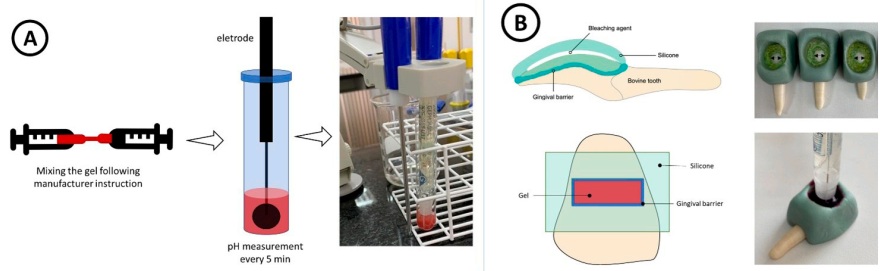
After the readings of each gel, the electrode was washed with distilled water to remove the excess gel and dried with absorbent paper. Then, it was recalibrated, and new measurements were made with the gels in contact with bovine tooth enamel. For that, three bovine crowns were cleaned with pumice and water, and one was used for each gel. The buccal surface was flattened in a polishing device (DP-10, Panambra Industrial e Técnica SA, São Paulo, Brazil) using aluminium oxide abrasive paper (EXTEC® Aluminium Oxide #600, Extec Corp., Connecticut, USA), to obtain a flat and standardised area, improving the contact area of the gel with the enamel. A barrier was built over the enamel surface with condensation silicone putty (Zetaplus, Zhermack SpA, Rovigo, Italy) and sealed with a gingival barrier to prevent the gel from flowing (Figure 1). This allowed the studied gels to be placed on the crown up to 8 mm thick to ensure complete coverage of the electrode. The pH measurement was performed every 5 min as described above. The pH measurement data were analysed qualitatively. The Mann-Whitney U test was used to compare the values of the gel isolated and in contact with the enamel. The statistical tests had a significance level of 5% (p<0.05).
Results
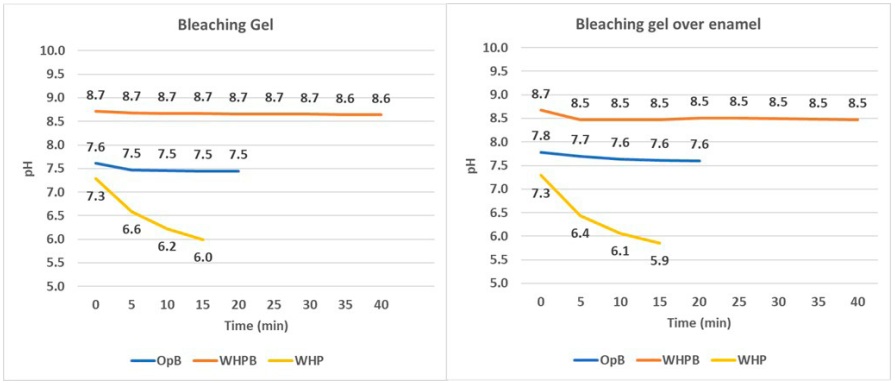
The pH values for the evaluated time of each gel are shown in Figure 2. The WHP gel showed a significant reduction in pH after 15 minutes, from 7.3 to 6.0 and 7.3 to 5.9, when measured alone or in contact with enamel, respectively. The OpB and WHPB gels maintained a stable and alkaline pH during the times evaluated (values higher than 7.0), with less than 0.5 variation along the test. The median pH values and the interquartile range are shown in Table 2. Although the Mann-Whitney U Test presented a significant difference between the values alone and in contact with enamel for the OpB and WHPB gel, the difference was clinically insignificant, and both remained alkaline along the tested period.
Discussion
High-concentration hydrogen peroxide-based whitening gels are widely used as an in-office tooth whitening treatment20. Our study compared the pH stability of different products for professional use with a high hydrogen peroxide concentration with and without bovine tooth enamel contact. The results show values from a slightly acidic pH (6.0 - 5.9) to an alkaline pH (8.5-8.7) without and with enamel contact, respectively (Figure 2). The pH of whitening gels is an issue of concern for dentists, as an acidic gel (pH 5.5 to 6.5) can cause enamel dissolution22-24, increasing enamel roughness and wear and the risk of tooth sensitivity10,24-26.
Modern whitening gels have pH levels closer to neutral, and the lower the concentration of hydrogen peroxide, the more alkaline the gel tends to be25. Mostly, the information regarding the pH of the whitening gels can be found in the safety sheet of the products (as described in Table 1) but maintaining the pH during the gel application over enamel is of utmost importance to avoid erosive wear of the tooth structure. In this study, the gels tested presented a stable behavior in terms of pH both alone and in contact with the enamel. Both OpB and WHPB, had an alkaline or near neutral pH (7.0) after mixing, with excellent stability after the manufacturer’s recommended use time, even in contact with the enamel. Therefore, in clinical use, the rate of peroxide degradation and free radical formation tends to be slower, being less likely to cause morphological changes on the enamel surface27. A lower degradation rate promoted by the use of gels with neutral or alkaline pH can also be a lower risk for tooth sensitivity, as shown in several studies25,28,29. Still, both gels have agents in their composition to help the reduction of sensitivity and/or detrimental effects on tooth structure, such as fluorides or calcium. Some clinical studies indicate that the presence of these agents could increase the saturation of the bleaching gel and minimise the loss of minerals30. The addition of small amounts of calcium effectively reduces the negative effects on enamel hardness and roughness31 without altering the effectiveness of whitening since they do not reduce the penetration of the gel through the enamel prisms16.
On the other hand, the WHP gel went from neutral to slightly acidic in the first 5 min and remained so until the final time of 15 min recommended by the manufacturer (Figure 2). For this gel, the manufacturer recommends up to 3 applications of 15 min each, for a total of 45 min session time (Table 1), possibly due to this pH drop, to avoid or minimise side effects. One of the possible explanations for the decrease in pH is the absence of other products, such as neutralizers, fillers, or even fluorides and calcium, which are intended to reduce the deleterious effects on the enamel, such as reduced microhardness and increased roughness32. The minimum value achieved for WHP gel was about 5.99 alone and 5.85 in contact with the enamel, considered close to the critical value (5.5) for enamel dissolution22-24, so effects on microhardness or roughness are not expected to be critical.
The behavior of bleaching gels, as well as their stability and pH control, are directly influenced by the type of thickener used, contributing to greater peroxide decomposition, and resulting in lower pH stability5. However, information on the type and amount of thickener used in the tested gels has not been found and was also not provided by the manufacturer in the product package inserts. Therefore, the first hypothesis is rejected because the pH of the WHP gel presented a decrease in pH values, going from a neutral pH (7.3) to an acid pH (around 6.0) in the two conditions tested. The second hypothesis is accepted as the pH of the gels tested in both conditions, alone and in contact with bovine tooth enamel, did not show significant differences.
Conclusion
The pH of the whitening gels was slightly affected by the interaction with the dental enamel and the time of clinical use. Despite being an observational study with a small sample size, it was possible to check the pH stability after handling and contact with the dental substrate. The gels OpalescenceTM BoostTM and Whiteness HP Blue showed higher pH stability during clinical use time, with minimal pH decrease only, remaining stable. The Whiteness HPTM presented a significant decrease from the beginning to the end (15 min), both alone and in contact with the enamel, going from neutral to slightly acidic.
Referencias bibliográficas
1. Bernardon JK, Sartori N, Ballarin A, Perdigão J, Lopes CG, Baratieri LN. Clinical performance of vital bleaching techniques. Oper Dent. 2010; 35(1): 3-10. DOI: 10.2341/09-008CR [ Links ]
2. Silva FBD, Chisini LA, Demarco FF, Horta BL, Correa MB. Desire for tooth bleaching and treatment performed in Brazilian adults: findings from a birth cohort. Braz Oral Res. 2018; 32: e12. DOI: 10.1590/1807-3107bor-2018.vol32.0012 [ Links ]
3. Armênio RV, Fitarelli F, Armênio MF, Demarco FF, Reis A, Loguercio AD. The effect of fluoride gel use on bleaching sensitivity: A double-blind randomized controlled clinical trial. J Am Dent Assoc. 2008; 139(5): 592-597. DOI: 10.14219/jada.archive.2008.0220 [ Links ]
4. Alkahtani R, Stone S, German M, Waterhouse P. A review on dental whitening. J Dent. 2020; 100: 103423. DOI: 10.1016/j.jdent.2020.103423 [ Links ]
5. Zanatta RF, Mailart MC, Freitas MR, Moecke SE, Torres CRG. Paradigmas e a ciência do clareamento dental? o que já sabemos. Rev APCD. 2020; 74(1): 11-17. https://apcd.org.br/revista-da-apcd/ano-2020 [ Links ]
6. Joiner A, Luo W. Tooth colour and whiteness: A review. J Dent. 2017; 67S: S3-S10. DOI: 10.1016/j.jdent.2017.09.006 [ Links ]
7. Haywood VB, Heymann HO. Nightguard vital bleaching. Quintessence Int. 1989; 20(3): 173-176. PMID: 2762507 [ Links ]
8. Dahl JE, Pallesen U. Tooth bleaching - a critical review of the biological aspects. Crit Rev Oral Biol Med. 2003; 14(4): 292-304. DOI: 10.1177/154411130301400406 [ Links ]
9. Azevedo JFDG. Avaliação clínica de diferentes técnicas de clareamento de dentes polpados quanto à efetividade durante 12 meses. [Tesis de Doctorado]. Faculdade de Odontologia de Bauru. Universidad de São Paulo; 2009. 1-143. DOI: 10.11606/T.25.2009.tde-05112009-101336 [ Links ]
10. Kwon SR, Wertz PW. Review of the mechanism of tooth whitening. J Esthet Restor Dent. 2015; 27(5): 240-257. DOI: 10.1111/jerd.12152 [ Links ]
11. Buchalla W, Attin T. External bleaching therapy with activation by heat, light or laser--a systematic review. Dent Mater. 2007;23(5):586-96. DOI: 10.1016/j.dental.2006.03.018 [ Links ]
12. de Geus JL, Wambier LM, Kossatz S, Loguercio AD, Reis A. At-home vs In-office Bleaching: A Systematic Review and Meta-analysis. Oper Dent. 2016; 41(4): 341-356. DOI: 10.2341/15-287-LIT [ Links ]
13. Torres CR, Zanatta RF, Godoy MM, Borges AB. Influence of bleaching gel peroxide concentration on color and penetration through the tooth structure. J Contemp Dent Pract. 2021; 22(5): 479-483. PMID: 34318764. [ Links ]
14. Gökay O, Yilmaz F, Akin S, Tunçbilek M, Ertan R. Penetration of the pulp chamber by bleaching agents in teeth restored with various restorative materials. J Endod. 2000; 26(2): 92-94. DOI: 10.1097/00004770-200002000-00008 [ Links ]
15. Benetti AR, Valera MC, Mancini MNG, Miranda CB, Balducci I. In vitro penetration of bleaching agents into the pulp chamber. Int Endod J. 2004; 37(2): 120-124. DOI: 10.1111/j.0143-2885.2004.00761.x [ Links ]
16. Torres CRG, Zanatta RF, Silva TJ, Borges AB. Effect of calcium and fluoride addition to hydrogen peroxide bleaching gel on tooth diffusion, color, and microhardness. Oper Dent. 2019; 44(4): 424-432. DOI: 10.2341/18-113-L [ Links ]
17. Kawamoto K, Tsujimoto Y. Effects of the hydroxyl radical and hydrogen peroxide on tooth bleaching. J Endod. 2004; 30(1): 45-50. DOI: 10.1097/00004770-200401000-00010 [ Links ]
18. Browning WD, Blalock JS, Frazier KB, Downey MC, Myers ML. Duration and timing of sensitivity related to bleaching. J Esthet Restor Dent. 2007; 19(5): 256-264. DOI: 10.1111/j.1708-8240.2007.00123_1.x [ Links ]
19. Reis A, Tay LY, Herrera DR, Kossatz S, Loguercio AD. Clinical effects of prolonged application time of an in-office bleaching gel. Oper Dent. 2011; 36(6): 590-596. DOI: 10.2341/10-173-C [ Links ]
20. Torres CRG, Crastechini E, Feitosa FA, Pucci CR, Borges AB. Influence of pH on the effectiveness of hydrogen peroxide whitening. Oper Dent. 2014; 39(6): E261-E268. DOI: 10.2341/13-214-L [ Links ]
21. Caneppele TMF, Torres CRG, Huhtala MFRL, Bresciani E. Influence of whitening gel application protocol on dental color change. Scientific World Journal. 2015; 2015: 420723. DOI: 10.1155/2015/420723 [ Links ]
22. Sulieman M, Addy M, Macdonald E, Rees JS. A safety study in vitro for the effects of an in-office bleaching system on the integrity of enamel and dentine. J Dent. 2004; 32(7): 581-590. DOI: 10.1016/j.jdent.2004.06.003 [ Links ]
23. Dawes C. What Is the critical pH and why does a tooth dissolve in acid? J Can Dent Assoc. 2003; 69(11): 722-724. PMID: 14653937 [ Links ]
24. Loguercio AD, Servat F, Stanislawczuk R, Mena-Serrano A, Rezende M, Prieto MV, et al. Effect of acidity of in-office bleaching gels on tooth sensitivity and whitening: a two-center double-blind randomized clinical trial. Clin Oral Investig. 2017; 21(9): 2811-2818. DOI: 10.1007/s00784-017-2083-5 [ Links ]
25. Trentino AC, Soares AF, Duarte MAH, Ishikiriama SK, Mondelli RFL. Evaluation of pH levels and surface roughness after bleaching and abrasion tests of eight commercial products. Photomed Laser Surg. 2015; 33(7): 372-377. DOI: 10.1089/pho.2014.3869 [ Links ]
26. Basson RA, Grobler SR, Kotze TJ vW, Osman Y. Guidelines for the selection of tooth whitening products amongst those available on the market. SADJ. 2013; 68(3): 122-129. PMID: 23951776 [ Links ]
27. Lugo-Varillas JG, Tinedo-López PL, Watanabe-Oshiro G, Correa-Medina A, Álvarez-Vidigal E, Hermoza Novoa M. Influence of pH value of bleaching gels on surface roughness of bovine enamel. Odovtos-Int J Dent Sc. 2020; 22(2): 311-321. DOI: 10.15517/ijds.2020.39733 [ Links ]
28. Reis A, Kossatz S, Martins GC, Loguercio A. Efficacy of and effect on tooth sensitivity of in-office bleaching gel concentrations: A randomized clinical trial. Oper Dent. 2013; 38(4): 386-393. DOI: 10.2341/12-140-C [ Links ]
29. Mendonça RP, Baliza JR, Burey A, Cavalcante LMA, Loguercio AD, Calazans FS, et al. In vitro analysis of the pH stability of dental bleaching gels during in-office procedures. J Clin Exp Dent. 2021; 13(1): e22-e29. DOI: 10.4317/jced.57367 [ Links ]
30. Alexandrino L, Gomes Y, Alves E, Costi H, Rogez H, Silva C. Effects of a bleaching agent with calcium on bovine enamel. Eur J Dent. 2014; 8(3): 320-325. DOI: 10.4103/1305-7456.137634 [ Links ]
31. Hughes JA, West NX, Parker DM, van den Braak MH, Addy M. Effects of pH and concentration of citric, malic and lactic acids on enamel, in vitro. J Dent. 2000; 28(2): 147-152. DOI: 10.1016/s0300-5712(99)00060-3 [ Links ]
32. Borges AB, Samezima LY, Fonseca LP, Yui KC, Borges ALS, Torres CRG. Influence of potentially remineralizing agents on bleached enamel microhardness. Oper Dent. 2009; 34(5): 593-597. DOI: 10.2341/08-081-L [ Links ]
Received: March 01, 2023; Accepted: January 01, 2024
 Este es un artículo publicado en acceso abierto bajo una licencia
Creative Commons
Este es un artículo publicado en acceso abierto bajo una licencia
Creative Commons
