




Servicios Personalizados
Revista
Articulo
 texto en
  Inglés (pdf)
 Artículo en XML
 Referencias del artículo
 Traducción automática
 Enviar artículo por email
Indicadores
-
 Citado por SciELO
 -
 Accesos
Links relacionados
-
 Similares en
SciELO
Similares en
SciELO
Compartir

 Permalink
Migraciones internacionales
versión On-line ISSN 2594-0279versión impresa ISSN 1665-8906
Migr. Inter vol.17 Tijuana ene./dic. 2026 Epub 16-Feb-2026
https://doi.org/10.33679/rmi.v1i1.3269
Papers
Reforming the Vertical Border? from Deportations to Containment Within Mexican Territory

1 El Colegio de la Frontera Norte (https://ror.org/04hft8h57), México, lecalva@colef.mx
2 El Colegio de la Frontera Norte (https://ror.org/04hft8h57), México, etorre@colef.mx
This study aims to analyze the transformation of Mexican migration policies during the López Obrador administration (2018-2024), highlighting the shift from a detention-deportation paradigm to containment strategies. Through descriptive statistical analysis of administrative records and newspaper data collection, five mechanisms are identified: 1) alignment with U.S. asylum and border policies; 2) detentions spanning from the southern border to the Isthmus of Tehuantepec; 3) delays in issuing non-conventional migration documents; 4) systematic blocking of migrant caravans; and 5) forced relocations from north to south. The results reveal that these strategies have consolidated an unprecedented detention-containment model, which is essential to understanding current transit migration management, thus serving as an explanatory and reference framework for other studies on migration in Mexico.
Keywords: 1. politics; 2. border; 3. migration; 4. Mexico; 5. deportation
Este estudio tiene por objetivo analizar la transformación de las políticas migratorias mexicanas durante el Gobierno de López Obrador (2018-2024), evidenciando el giro del paradigma de detención-deportación hacia estrategias de contención. Mediante el análisis con estadística descriptiva de registros administrativos y recopilación de datos hemerográficos, se identifican cinco mecanismos: 1) la connivencia con políticas de asilo y fronterizas estadounidenses; 2) las detenciones desde la frontera sur hasta el Istmo de Tehuantepec; 3) la demora en la emisión de documentos migratorios no convencionales; 4) los bloqueos sistemáticos a caravanas de migrantes; y 5) los traslados forzados de norte a sur. Los resultados revelan que estas estrategias han consolidado un modelo inédito de detención-contención que es fundamental para entender la gestión actual de la migración en tránsito, por lo que puede servir como marco explicativo y de referencia para otros estudios sobre migración en México.
Palabras clave: 1. política; 2. frontera; 3. migración; 4. México; 5. deportación
Introduction
In the context of an externalization of U.S. borders and migration policies, the management of transit migration flows became a priority for Mexican governments, particularly so during the last two past decades (Arriola, 2020; Ortega, 2023). Collaboration with the United States has focused on limiting the flow of migrants toward the southwest border of that country; yet strategies and actions have changed substantially, especially since 2019.
Prior to that year, migration control in Mexico was characterized by the expulsion of most people identified as being in an irregular situation, mainly coming from Honduras, Guatemala, and El Salvador. Some of the policies aligned with this practice include the Southern Plan (2001-2003) and the Southern Border Plan (2014), which significantly increased the number of arrests and deportations from Mexico (Castillo, 2021). These action plans focused on identifying people traveling irregularly throughout the country, particularly so across the border and the southern region (Garibo, 2016; Vila, 2024). These policies laid the groundwork for what is known as the “vertical border” (Rodríguez & Hoffmann, 2024; Vila, 2024).
More recently, in 2019, deportation figures from Mexico reached historical highs (149 812), matching with the threat from then-U.S. President Donald Trump, who in May of that year warned of imposing tariffs on Mexican imports if the Mexican government failed to reduce the flow of migrants (Rizzo, 2024). However, in recent years, and more noticeably between 2022 and 2024, the flow of people increased and underwent significant transformations in terms of their origin, composition, and reasons for displacement. These changes made deportation processes to countries of origin more complicated, and as a result, the Mexican government radically changed its migration control strategies, implementing new measures, some complementary and others alternative to deportation.
In a scenario highly challenging in terms of managing migration flows in transit, new government practices have created a context in which migrants are detained but not expelled. Thus, their situation in Mexico has been described using terms such as “stuck” (Frank-Vitale, 2020), “entrapped” (Arriola, 2020; Mena and Cruz, 2021; Odgers-Ortiz, 2024), “immobilized” (Álvarez, 2022), “stranded” (Izcara & Andrade, 2016; Varela, 2019), “locked up” and “imprisoned” (Jiménez & Henríquez, 2021), “blocked” (Bojórquez et al., 2021; París, 2022), and in a “liminal condition” (Arriola & Coraza, 2024). Overall, these terms emphasize the fact that migrants are forced to stay in a transit space for an extended period, which does not align with their interests or migration plans.
This relatively new migratory condition justifies questioning the practices implemented by the government to manage migration flows and trying to explain how these practices shape the situation of entrapment/immobility. To answer this question, this study aims to analyze five Mexican government policies: 1) collusion with U.S. asylum and border control policies; 2) detentions in the area between the southern border and the Isthmus of Tehuantepec; 3) delays in issuing non-standard documents; 4) blocking of migrant caravans; and 5) internal relocations from north to south.
Theoretical and methodological frmework: from containment to entrapment
Governments develop a series of containment practices to manage migration flows, which generate a certain degree of entrapment or immobility for people. To analyze such policies and understand their relevance, it is necessary to situate them within broader analytical frameworks that include people’s migration experiences.
The analysis of migration projects has included the difficulties face by people during migration. Lee’s pioneering theory (1966) broadly defined migration as a change of permanent or semi-permanent residence between origin and destination-imposing no restrictions regarding the distance of the displacement or the voluntary or involuntary nature of the act-which includes overcoming a series of intermediate obstacles. Although this author did not have transit migration in mind, it is one of the first analytical proposals that emphasized the barriers found by migrants in their migration processes. However, the inclusion of more analytical elements is necessary if we are to understand the link between migration policies and migration immobility.
More recently, Carling (2002) introduced the systematic study of migration immobility. His approach focuses on people who do not migrate, distinguishing between voluntary immobility (the decision not to emigrate) and forced immobility (when there is a desire to migrate, but the material, social, or legal resources to realize the project are lacking).
De Haas (2021) takes up these ideas and presents an analytical model explaining migration patterns as a function of aspirations and capabilities within a given set of perceived geographic opportunity structures, in which the ambition to migrate is a function of people’s general life aspirations and opportunity structures. Migration capabilities depend on positive freedoms (such as financial resources and social networks) and negative freedoms (such as migration policies). This author states that in some cases a person’s situation is characterized by a high desire to migrate but limited resources to accomplish so; these people find themselves in a situation of involuntary immobility and therefore feel “trapped.” In this sense, migrants can literally become “trapped” in transit due to violence, border controls, or a lack of resources (De Haas, 2021).
As for Odgers-Ortiz (2024), she uses “entrapment” as an analytical category to identify the phenomenon that “takes place when people are forced to stop in a place they did not choose and are compelled to wait for an uncertain period, while they are on their way to achieve a goal” (p. 3). The author contrasts this term with others such as “wait,” arguing that entrapment seeks to highlight the tension that arises between structural barriers and the plans or desires of migrants. She also points out that different approaches have addressed the issue: 1) that of the individual’s experience, which focuses on the perception of the place as a destination or as a forced detention; and 2) the structural approach, which analyzes the objective obstacles to mobility.
This study focuses on the obstacles and barriers to mobility; that is, it analyzes the context experienced by thousands of people in different parts of Mexico, based on the barriers and strategies that the government implements to contain their transit into the United States. We argue that the main objective of these migration policies is to restrict the mobility of migrants and prolong their stay in Mexican territory. It is for this reason that the five containment policies mentioned above, which give rise to the detention-containment model, are addressed and analyzed separately.
The methodology of this work brings together two analytical approaches: 1) a statistical-descriptive analysis of administrative migration records; 2) a systematic review of newspaper sources. In the first approach, the units of analysis are the records of the Administrative Migration Procedures (PAM, acronym in Spanish for Procedimientos Administrativos Migratorios) compiled by the National Migration Institute (INM, acronym in Spanish for Instituto Nacional de Migración). These INM records allow for the identification and examination of: a) the PAMs originating in the southern Mexican border and the Isthmus of Tehuantepec, which are then analyzed in relation to the national total. These PAMs are categorized by municipality of origin and classified into two main regions: the Gulf route and the Pacific route. For each region, events are characterized according to the profile of the migrant population and their origin, grouping them into South America, Central America, and other regions; b) the overlap or difference between the starting and ending points of the PAM, which allows for an approximate calculation of internal migration.
Other quantitative sources of official data are also used, such as the INM’s administrative records on visitor cards for humanitarian reasons (TVRH, for its acronym in Spanish), the statistics from the Mexican Commission for Refugee Assistance (COMAR, acronym in Spanish for Comisión Mexicana de Ayuda a Refugiados) regarding the processes for applying for refugee status, and U.S. statistics on the Remain in Mexico program, among others.
On the other hand, newspaper analysis is used as a research method to analyze, identify, and characterize patterns in the actions carried out by the Mexican government that aid in understanding the context of “entrapment.” Specifically, the review of news in the Mexican press allowed us to gather information on the Mexican government’s reactions to certain U.S. asylum and border control policies, the way in which arrests are carried out in the south of the country, the treatment that the Mexican government has given to the caravans that departed from Tapachula from March 2019 to January 2025, the phenomenon of internal relocations, as well as other precise aspects.
Mexico’s alignment with U.S. asylum and border control policies
A series of measures undertaken by the U.S. government to limit the entry of migrants across its southwest border have involved Mexican national sovereignty, as they have affected, to some extent, the decision making on who enters and remains in Mexican territory. Thus, we argue that these policies require the alignment, or at least the acquiescence, of the Mexican government. Among the most notable measures are the actions undertaken by the United States in relation to its asylum policies, which require migrants and asylum seekers to remain in Mexican territory while waiting for their legal procedures to begin (Wiltberger, 2025). The following is an overview of these policies and how the Mexican government has responded to them.
One of these policies was metering, implemented extra-institutionally by U.S. Customs and Border Protection (CBP) in early 2016, which affected thousands of people (Miranda & Silva, 2022). This mechanism regulated the daily number of asylum seekers allowed to enter U.S. ports of entry; once the figure was reached, the rest were blocked or rejected, generating waiting lists on the Mexican side (Yates & Bolter, 2021). Migrants had to wait days, weeks, or even months to begin their asylum processes, which increased their desperation, raised the likelihood that they would attempt undocumented crossings, and exposed them to living conditions that jeopardized their physical safety (Amuedo-Dorantes & Bucheli, 2023). Although this U.S. policy is not the most intrusive in Mexican territory, Mexican authorities still have faced criticism for collaborating with their U.S. counterparts, either by preventing asylum seekers from filing their applications with U.S. authorities or by managing waiting lists at some ports of entry.
A second example is the Migrant Protection Protocols (MPP) program, also known as Remain in Mexico. Announced during the first Trump administration, this program was implemented in January 2019 (Institute for Women in Migration [IMUMI, acronym in Spanish for Instituto para las Mujeres en la Migración], 2019). Based on section 235(b)(2)(C) of the U.S. Immigration and Nationality Act, this program required asylum seekers to remain in Mexico while their cases were being processed by U.S. courts (Paris, 2022). These procedures could last for months or even years, periods during which asylum seekers had to remain in Mexico exposed to serious risks (National Human Rights Commission [CNDH Mexico], 2021).
In its first phase, from January 2019 until its conclusion in June 2021, more than 71 000 people were processed under this program (Office of Immigration Statistics, 2022). The MPP was temporarily suspended during the COVID-19 pandemic. Thereafter, a court order issued in August 2021 compelled the U.S. government to reinstate it between December 6, 2021, and August 8, 2022. In this second phase, a total of 12 564 applicants were processed through the MPP, of whom 7 505 were returned to Mexico (Office of Immigration Statistics, 2022).
According to the Mexican government, compliance with the MPP was justified under humanitarian concerns (Imumi, 2019; Ocman & Ortega, 2023). However, its adoption and implementation, as well as its modifications, were marked by threats from the U.S. government toward Mexico. In May 2019, Trump threatened to impose a progressive tariff on all products imported from Mexico, arguing that the country was not doing enough to control migration from Central America (Calva & Torre, 2020).
The implementation of Title 42 during the health emergency is another example of Mexico’s alignment with U.S. immigration control policies, as it allowed the immediate expulsion, without a formal process, of migrants from the United States to Mexico, including people originally from other countries, which implied the forced stay of migrants in Mexican territory (Bojórquez et al., 2021). Between fiscal years 2020 and 2023, there were 2 912 200 “encounters” at the U.S. southwest border that were processed under Title 42 (U.S. Customs and Border Protection, 2025). Once again, the re-entry of foreign migrants affected Mexican national sovereignty and evidenced the alignment of the Mexican government with that of the U.S.
Finally, one of the most recent measures, although now discontinued, was the application for asylum in the United States through the CBP One app. In May 2023, the Biden administration implemented a rule that presumes, with some exceptions, that people who enter the United States irregularly cannot apply for asylum (Ríos-Rivera, 2024). As an alternative, it established the use of the app, which offers 1 450 appointments daily, forcing applicants to remain in central and northern Mexico while waiting for an appointment (Amnistía Internacional, 2024).
The availability of CBP One in the central region of the country, and not exclusively in the north, turned Mexico City into a waiting area for many migrants. Camps even sprang up where most of the residents were asylum seekers using the app (Martínez & Morbiato, 2024). The impact of this application on the distribution of migration flows in Mexico was so evident that the Mexican government asked its U.S. counterpart to expand access to it to the southern states, which happened in August 2024 (Clemente & Verza, 2024). It can be said that CBP One effectively distributed asylum seekers throughout Mexican territory, thus becoming a tool for containment (Ríos-Rivera, 2024).
Detentions from the southern border to the isthmus of Tehuantepec
In recent decades, the Mexican government has intensified efforts to identify and detain foreign nationals under irregular immigration status. Measures known as control belts have been implemented within the Mexican territory. These initiatives originated in the early 21st century with the implementation of Plan Sur, a project whose main objective was to strengthen the surveillance and control of migration flows from the country’s southern border to the Isthmus of Tehuantepec, as well as along the Gulf of Mexico and Pacific coasts (Casillas, 2002; Vila, 2024).
For much of the implementation of these measures, the approach was the detention and expulsion of irregular migrants, the most extreme expression of which was the vertical border; this materialized in the possibility of being detained anywhere in the country (Pérez & Barojas, 2019; Varela, 2019; Vila, 2024). It should be noted that most detentions took place in the southern region of the country, and that the vast majority of the flow consisted of Central American migrants. As such, geographical proximity facilitated the expulsion to a certain extent, expulsions that were mostly carried out by land (El Colegio de la Frontera Norte [El Colef] et al., 2019).
Nonetheless, during the second half of Mexican president López Obrador’s six-year term, a huge gap opened up between the number of detentions and expulsions (778 885 and 55 000 in 2023). In this sense, and given that most people who begin a PAM are not deported, detention takes on a different meaning within the framework of migration control policies, and so it is possible for these policies to adopt other objectives that must be monitored and examined: 1) hindering migrants’ progress northward, under the logic of blocking certain routes; 2) causing migrants to lose time and waste resources-such as payments made for transportation or to coyotes (smugglers)-by being detained, whether for a few hours or longer; 3) relocating migrants to the south of the country-as will be detailed in a later section; or 4) symbolically showing migrants that they are not welcome, since detentions represent them as criminals (Díaz de León, 2024). Moreover, the treatment that immigration authorities give to migrants, especially in immigration detention centers, has been described as deliberately unpleasant (Campos-Delgado, 2021; 2023).
Regarding the first point, the southern region has been important for policies aimed at controlling transit migration already for decades. However, in recent years this importance has taken on a new dimension, as the Mexican government has sought to retain migrants in this region of the country instead of deporting them. In the words of President López Obrador: “We have to ensure that migrants stay in the south-southeast, protect them, because letting them travel throughout the country without any protection is very risky” (López Obrador, cited in Monroy, 2021, para. 15). Nevertheless, this type of discourse has generally masked the main motives behind these measures, which are more related to migration control, such as wearing down migrants in transit and deterring potential ones.
The above has been evidenced by analyzing the incremental use of the southern region as a point of containment (Castillo, 2021). In 2018, Chiapas and Tabasco accounted for 54.8% of all anti-drug trafficking cases initiated in the country. By 2021, the percentage for both states had decreased to 39.4%, but in 2023 it reached its peak for the period at 66.7%, with the notable feature that arrests in Tabasco (37.3%) surpassed those in Chiapas (29.4%). In that last year, these states represented two out of every three arrests nationwide (see Map 1). Veracruz accounted for 8.5%, and the six northern states (Tamaulipas, Nuevo León, Coahuila, Chihuahua, Sonora, and Baja California) for 16.7%.
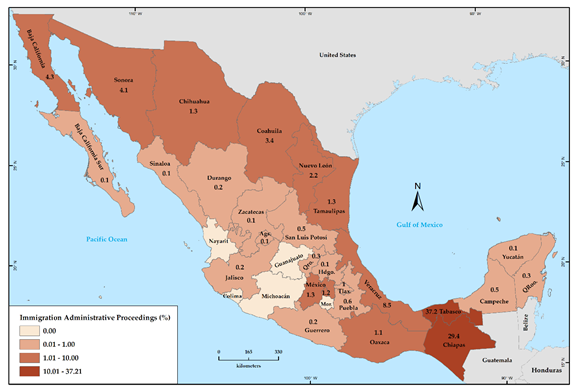
Source: Own elaboration based on data from the Migration Policy, Registration and Personal Identity Unit (UPMRIP, acronym in Spanish for Unidad de Política Migratoria, Registro e Identidad de Personas) (2023).
Map 1 Immigration Administrative Procedures Initiated in Mexico, by Federal Entity, 2023
The analysis of detentions at the municipal level in Chiapas and Tabasco allows for a more precise focus and for the identification of specific areas where detentions concentrate. One of these is located in the southern region, in the municipalities of Tapachula (9.1%), Suchiate (3.6%), Tuxtla Chico (2.5%), Huehuetán (1.9%), and Huixtla (3%). In these municipalities, one-fifth of all procedures registered in the country were initiated (see Map 2).
The higher concentration of migrants in Tapachula can be partly explained by the fact that it is the first medium-sized town migrants encounter after crossing the Mexico-Guatemala border-according to the 2020 Census, the population there is 353 706 inhabitants (National Institute of Statistics and Geography [INEGI, acronym in Spanish for Instituto Nacional de Estadística y Geografía], 2020)-and therefore offers services and opportunities for those seeking to continue their journey north. There, migrants seek various resources: economic-either through work or by receiving remittances from family members-, documentation-by initiating a migration process or other procedures that result in obtaining a document to attempt to travel freely within the country-, and institutional support-from civil society organizations (Arriola & Coraza, 2024). From this point on, migrants face risks and difficulties if they decide to continue their irregular migration. This includes checkpoints and roadblocks manned by Mexican authorities-obstacles that, in practice, are considerably greater than crossing the Mexico-Guatemala border, as detention figures demonstrate-as well as confronting organized crime, which profits from migrants.
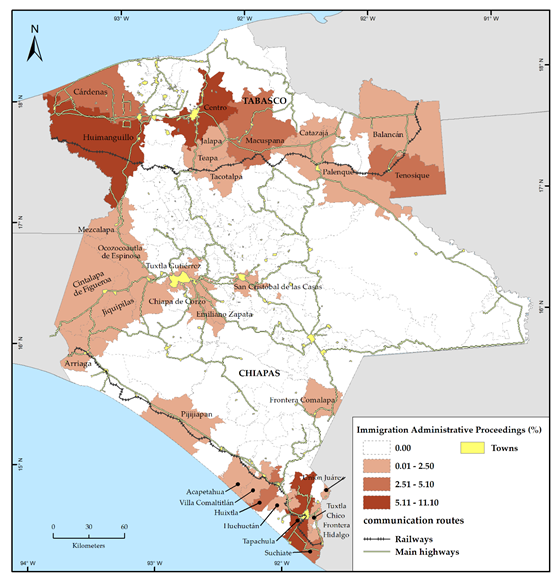
Source: Own elaboration based on data from the UPMRIP (2023).
Map 2 Administrative Migration Procedures Initiated in Chiapas and Tabasco, by Municipality, 2023
Map 2 shows another region extending from Palenque in northern Chiapas to Acayucan in the state of Veracruz. This region accounts for a significant proportion of migrant detentions nationwide, notably in Huimanguillo (11.1%), Centro (9.5%), Tenosique (5.1%), and Macuspana (4.1%) in Tabasco, and Acayucan (4.7%) in Veracruz. This concentration is due to the region’s strategic location along the Central American migration route. The railway lines, the Trans-Isthmus Highway connecting to Oaxaca, and the Córdoba-Minatitlán highway, which links to Coatzacoalcos, Tierra Blanca, and the port of Veracruz, make this area a mandatory transit point for migrants moving from Chiapas or Tabasco heading toward central Mexico, with the goal of continuing their journey north (Andrade et al., 2017). It is for this reason that the region has been used as a containment point by the INM for years now.
Unlike what can be observed in southern Chiapas, in this region it is more common to find news reports about “rescued” migrants, a term used to refer to those intercepted while being transported by human smugglers, primarily in cargo trucks (Osorio, 2024). The National Migration Institute, in its press releases, also highlights operations in which migrants traveling in risky conditions from Honduras, Guatemala, El Salvador, Nicaragua, and Ecuador have been “rescued” (INM, 2024); for the migrants, these “rescues” imply the risk of losing the money they invested in paying the coyotes.
One limitation of this news-based approach is that it makes it difficult to generalize about the characteristics and conditions of migrants transiting through Tabasco. Still, when analyzing the PAMs on the two main migration routes (Pacific and Gulf of Mexico), significant differences emerge that help to complement these scenarios. On the Gulf route, the highest percentage of migrants comes from Central America (47.5%), including groups that tend to have better financial standing to pay coyotes. In contrast, on the Pacific route, migrants from South America (66.2%) and other regions (27.6%) predominate.
Nevertheless, the differences in the strategies implemented by the Mexican government to limit migrant mobility on the Gulf and Pacific routes, as well as the events recorded in the Isthmus of Tehuantepec, reflect a strategy predominantly focused on containment. This argument is corroborated by the fact that in 2023 most detentions did not result in deportations: on the Pacific route, only 1.5% of detained migrants were deported, while on the Gulf route, the figure was 4%. These substantially low percentages suggest that detentions are primarily driven by a logic of containment rather than expulsion. It is worth noting that this pattern is mainly found in the southern region of the country, as the expulsion rate increases significantly in other areas (13%, see Table 1).
Table 1 Administrative Migration Procedures by Region of Origin, 2023 (percentages)
| Pacific Route1 | Gulf Route2 | Rest of the country | ||
|---|---|---|---|---|
| Events relative to the national total | 37.7 | 28.5 | 33.8 | |
| Procedures resulting in deportation | 1.5 | 4.0 | 13.0 | |
| Region of origin of the migrant | South America | 66.2 | 32.9 | 38.6 |
| Central America | 6.2 | 47.5 | 35.4 | |
| Other | 27.6 | 19.6 | 26.0 |
Note: 1Municipalities in southern Chiapas. 2From Palenque, Chiapas to Acayucan, Veracruz.
Source: Own elaboration based on data from the UPMRIP (2023).
Tardy issuance of non-conventional documents
As a containment strategy, the Mexican government has implemented the extension of processing times for non-conventional documents3-such as asylum, complementary protection, or visitor cards for humanitarian reasons (TVRH)-that allow migrants to remain in or transit through Mexican territory. These strategies, which delay procedures in processes such as international protection, have been categorized as waiting policies (Ceja & Miranda, 2022; Torre, 2023a). Furthermore, with this strategy comes along the spatial concentration of migrants in cities in southern Mexico (Arriola, 2020; Campos-Delgado, 2023).
Some of the migrants who cross the southern border irregularly choose or are compelled to remain in southern Mexican cities so as to obtain non-conventional documents that allow them to cross the country without being subjected to the detention regime described above.4 The problem is that the procedures for obtaining these documents-which are not intended as transit permits-involve long waits of weeks or months in conditions that pose a risk to people's physical and mental health (Brewer et al., 2022). These delays frustrate applicants, sometimes leading them to take all kinds of actions to demand documents or free movement to the north of the country: blocking highways, protesting in front of INM offices, holding vigils, or even marching in migrant caravans (García, 2022; Rizzo, 2021).
As for the Mexican refugee system, it should be noted that applications have experienced exponential growth, from barely a thousand applications annually in 2013, reaching 140 000 in 2023, before falling below 80 000 in 2024 (COMAR, 2024). However, this increase has not been followed by a sufficient expansion of infrastructure and resources able to serve this population. As the number of refugee status applications accumulates and the authorities fail to allocate adequate resources to process them, the time it takes to obtain a decision from the COMAR increases significantly, far exceeding the limits established by law (Bourgeois, 2022; Gil, 2025).
A study conducted by Asylum Access México (2020) shows that more than 13 000 people who had begun their asylum process in 2018 had still not received a decision by the end of October 2019. Along the same line, according to a 2019 survey of asylum seekers, 50% waited more than 4.7 months for a decision on their case, and in 30% of the cases still pending, the waiting time had already exceeded the legally stipulated deadline, this highlighting serious shortcomings in compliance with legal timelines (Hernández & Cruz, 2020). Furthermore, these application durations still not account for the time applicants spend initiating their application, which can be truly significant when there is a high influx of applicants (Bourgeois, 2022). During the pandemic, the situation worsened for those in need of international protection because, although the COMAR continued to accept applications, processing times were suspended (COMAR, 2020), making waits indefinite.
The problem is not only a matter of time, but also that, while their applications are being processed, people must remain, with few exceptions, in the same city where they began their process. The majority of asylum seekers do so in cities in the south of the country, particularly Tapachula, which frequently becomes overflown with migrants, turning into a “pressure cooker” (Reina, 2019). In 2023, 55% of asylum applications were filed there, and in 2024 this figure increased to 65% (COMAR, 2024).
Some procedural innovations in recent years have reduced waiting times for a decision, especially for applicants who meet the Cartagena Declaration on Refugees’ definition of refugee (Venezuela, El Salvador, and Guatemala). Likewise, according to the United Nations High Commissioner for Refugees (UNHCR) in Mexico, the COMAR has increased its processing capacity by 400% in the last six years, partly due to the financial support for infrastructure and human resources from the UNHCR (UNHCR, 2024).
Another significant change in migration management is the issuance of TVRH cards. The Mexican government has issued these cards since the mid-2010s, linked in most cases to the application for refugee status (UPMRIP, 2014-2024). Although with limitations, they represented a faster path to regularization than waiting for the application to be resolved. In 2022 and 2023, approximately 130 000 TVRH cards were issued each year (see Graph 1), the vast majority in Chiapas (78% in 2022).
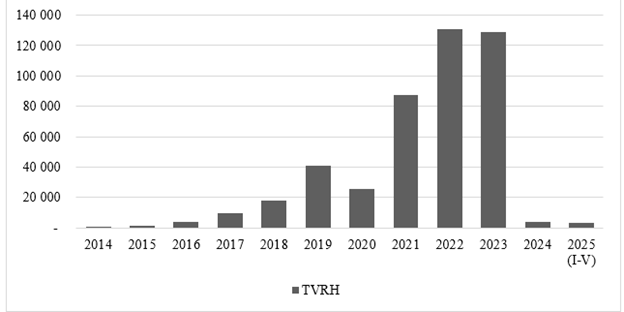
Note: *2025 includes five months.
Source: Own elaboration based on data from the UPMRIP (2014-2024).
Graph 1 Number of Visitor Cards for Humanitarian Reasons (TVRH) Issued in Mexico, 2014-2025*
However, the number dropped to only 4,138 in 2024. According to various media outlets, this decline, which began in late 2023, concurred with the instruction from the then-chair of the Secretary of the Interior (SEGOB, for its acronym in Spanish) to restrict their issuance as a measure to contain migration at a critical point in the phenomenon (Xantomila & Laureles, 2024). Although these cards allow free movement throughout the national territory, authorities would argue that this constitutes misuse, so as to justify not issuing them. This situation seriously harms both those who used these routes to travel safely through Mexican territory and those who require international protection and wish to settle in Mexico (Xantomila & Laureles, 2024).
Blocking of migrant caravans
The difficulties in traveling north from Tapachula due to detentions by authorities in the south of the country and long waits to obtain documents have led to the formation of large groups of people who migrate together-known as migrant caravans-with the intention of overcoming immigration controls (Arriola & Coraza, 2024; Torre, 2023b). According to journalistic sources, from March 2019 to January 2025, more than 50 caravans departed from the city of Chiapas, comprising approximately 70 000 migrants (Torre, 2025).
The caravans have been understood as a migration mobility strategy that seeks protection for its members, as well as a new form of collective action that challenges Mexican authorities (López et al., 2023; Rizzo, 2021; Torre & Mariscal, 2020). This dual nature is present in the marches departing from Tapachula, as migrants, along with their advocates, see the caravans as a way to move north more safely and to simultaneously confront the authorities who seek to stop them. Still, traveling in a caravan is not without dangers, nor does it guarantee success in achieving migratory and political objectives (Izcara & Andrade, 2022).
The migrant caravans departing from Tapachula are not only largely a result of containment migration policies, but many of their members have also directly experienced the authorities' efforts to detain them in that city. While authorities have blocked and dismantled most of these caravans in southern Mexico, the institutional treatment of them has varied considerably from case to case. The size of the caravans appears to be one of the key factors determining whether they succeed and overcome the various obstacles-both upon leaving Tapachula and before leaving Chiapas.
The larger caravans, such as those of June 2022 and December 2023, comprised of several thousand migrants-the second reaching 10 000 people-were able to overcome at least the initial barriers imposed by Mexican immigration authorities upon leaving Tapachula. Some of their members received some type of document allowing them to continue their migration journey even before leaving Chiapas (Clemente, 2022; INM, 2022b). Authorities likely allow their passage due to the operational difficulties of detaining such large numbers of people. Furthermore, the departure of migrants in large groups takes place when their conditions in Tapachula become untenable, and thus caravans serve as a kind of “escape valve.” This reveals a significant paradox of Mexican containment policies: in the long term, migrants who persevere eventually find a way to move north, either in caravans or, under other circumstances, individually or in small groups, led or not by coyotes.
The other caravans originating in Tapachula rarely exceeded 2 000 people; most of them did not reach 1 000 members. State agents tend to repress these groups of migrants shortly after they leave the city. For example, in January 2022, the INM publicized the dismantling of a caravan of fewer than 300 migrants near the Álvaro Obregón communal land (ejido), just a couple of kilometers from Tapachula, where the marching migrants were taken to immigration facilities (INM, 2022a).
Even if caravan members are not deported, authorities still show great interest in preventing migrants from forming these types of marches, both because of the difficulty of managing them and due to the media attention they garner, which can put Mexican authorities in charge of handling them in a difficult position.
Internal relocations
In addition to containment measures such as detecting migrants in the Isthmus region and the waiting periods imposed on those seeking to obtain unconventional immigration documents, the media has exposed other containment practices carried out by immigration authorities in Mexico: internal relocations or “internal deportations” (Brandariz & Fernández, 2025), that is to say, relocations of migrants in an irregular situation within the same country, presumably aimed at containing the migration flow. This practice gains further relevance in a context where the vast majority of irregular migrant detentions do not result in expulsion or deportation, as is currently the case in Mexico. In 2023, only 7% of the PAMs resulted in deportation.
According to journalistic investigations, the vast majority of relocations originate at the northern border (Gómez, 2024; Pradilla & Carabaña, 2024). However, INM operations to identify undocumented immigrants and relocate them to immigration detention centers in other states are also reported in other parts of the country. For example, in September 2024, INM agents raided migrant homes in Mexico City and detained more than 60 people from Venezuela, Colombia, and Haiti. Initially, these people were sent to the Iztapalapa immigration detention center in Mexico City, but were later relocated to Villahermosa, Tabasco (De la Sancha, 2024; Gómez, 2024). This is not an isolated case; other reports describe the same practice, the common denominator of which is the relocation of migrants to the country’s south. In some cases, figures have even been documented involving thousands of people being relocated (Vaquero, 2024).
To complement the scenario offered by the newspaper review and to understand the magnitude of these practices, the records of the 780 206 PAMs initiated during 2023 were analyzed, constructing an indicator that identifies whether the PAM ended in a different state than the one where it began. Nationally, 4.8% of the PAMs ended in another state, but with significant regional differences: on the northern border: Coahuila stood out with 51.5% of processes concluded in another state, while in the south, Tabasco showed the opposite case (99.8% in the same state).
This diversity is partially due to the geographic location of the states. To summarize, they were grouped into three regions: 1) Chiapas, Tabasco, and Veracruz (south); 2) the six states bordering the United States (north); and 3) the rest of the country (inland). The results show that virtually all detentions in the southern region concluded their legal process there (99.9%), reflecting the strategy of retaining migrants in that area. In contrast, in the inland region, 14.4% of the cases ended in another region (mainly in the south, 13.9%), and in the northern region, 14.2% ended outside the region, mostly in the south (9.9%) (see Table 2).
Table 2 Percentage of Administrative Migration Procedures by Region of Origin and Ending, 2023
| Region where it begins | ||||
|---|---|---|---|---|
| Chiapas, Tabasco, Veracruz (south) | Inland states | Northern border states | ||
| Region where it ends | Chiapas, Tabasco, Veracruz (south) | 99.9 | 13.9 | 9.9 |
| Inland | 0 | 85.6 | 4.3 | |
| Northern border | 0.1 | 0.5 | 85.8 | |
Source: Own elaboration based on data from the UPMRIP (2023).
According to the newspaper review, relocations carried out by the INM are usually from north to south, although cases in the opposite direction have also been observed (De la Sancha, 2024), a situation that is also identified when reviewing the PAMs. For example, some migrants who received a CBP One appointment were supported by the Government of Mexico to reach the northern border by bus (Martínez, 2024); However, their number is much lower and/or they may not even initiate a PAM, since, when analyzing the records of this procedure, it was observed that only 0.1% of those initiated in Chiapas, Tabasco, or Veracruz end up at the northern border, and if they originated in inland states, this figure increased to 0.5%. Both percentages are much lower than those identified in the opposite direction.
Finally, another aspect highlighted by news reports is that Villahermosa (Tabasco) has become the preferred location for these “internal deportations” (Pradilla & Carabaña, 2024). Analyzing the PAM data, it is noteworthy that the vast majority of those who complete their process in Tabasco initiated it there, 94.7% in 2023. However, the remaining percentage represents a significant number of cases (16 217), of which 41% began in the north of the country, specifically in Coahuila, and from there they were relocated to Tabasco.
Closing comments
During López Obrador’s six-year term (2018-2024), Mexico experienced a drastic change in the way the government manages the migrant population in transit to the United States. It can be argued that the strategy during this period shifted from a “vertical border” approach, based on a migrant detention and deportation model, mostly of Central Americans, to one of detention and containment within Mexican territory. This containment comprises a set of actions mainly intended to keep migrants in specific areas of Mexican territory for as long as possible. This is, therefore, a policy of containment and entrapment that emphasizes the spatiotemporal control of migrants’ trajectories, with the aim of causing their exhaustion, desperation, and eventual giving up, while also seeking to deter potential migrants from leaving their places of origin. This new approach affects not only Central American migrants but also a growing number of people from other regions.
Despite López Obrador’s claims in 2021 that he did not want Mexico to become a “migrant camp,” the truth is that, during his presidency, both U.S. and Mexican migration policies sought to keep migrants in the country (Monroy, 2021).
In line with other recent research, the empirical evidence analyzed in this work on Mexican migration policies allows us to affirm the existence of two main areas of confinement for migrants within the country. On the one hand, there is the northern border-particularly in border cities-where the Mexican government collaborates, through its acquiescence, with U.S. asylum policies. These policies require applicants to wait in Mexico to begin their processes-such as metering for asylum applications or waiting for Title 42 exceptions-or, once the processes have begun, they are returned to Mexico-under the MPP program. The CBP One app, especially in its latest version, expanded the waiting area not only to border cities but also to Mexico City and cities in the Mexican south. Mexico’s request to make the CBP One app available in Chiapas and Tabasco demonstrates the López Obrador administration's interest in creating a second area of confinement in the south of the country.
Indeed, the government’s central strategy was to contain migrants in Chiapas and Tabasco. This confinement policy was implemented through four key actions: 1) detention in the south of the country: control was intensified in this region, where it is more effective to detain migrants in irregular situations; 2) subordination of protection to control: asylum and humanitarian visa processes were slowed or suspended, keeping the migrant population “fixed” in southern cities like Tapachula. This affects both those seeking transit and those wishing to settle in Mexico; 3) blocking of caravans: caravans departing from Tapachula were systematically dismantled. Smaller caravans were dispersed by force, while larger ones were granted immigration documents and subjected to exhaustion tactics; and 4) forced internal relocations. The government resorted to “internal deportations,” relocating thousands of migrants from the north to the south of the country to hold back their advance toward the United States, as evidenced by official records and newspaper reports.
Historically, cities on Mexico’s southern and northern borders have served as waiting points for migrants seeking to gather resources before resuming their journey through the country or crossing into the United States (Jasso, 2021). However, in recent years this trend has intensified, and certain populations have faced considerably longer wait times. At the extreme are those migrants who spend years obtaining documents in the south of the country, only to repeat the process in the north in order to reach the United States (Torre, 2023a).
This phenomenon of slowing migration flows in Mexico is also manifested in the proliferation of migrant camps in various cities, where people wait for months or even more than a year. On top of that, during the six-year presidential term, migration patterns were impacted by the pandemic, which prolonged many of these waits, even rendering them indefinite.
Although internal containment policies may be less harmful than deportations, they still expose migrants to multiple risks while they wait to reach their destination (Amnistía Internacional, 2024; Rocha et al., 2025). Cities in the north and south of the country have high crime rates, which particularly affect the most vulnerable migrant populations. Faced with this situation, instead of accepting their “entrapment,” migrants employ diverse strategies to overcome the obstacles placed before them, whether through clandestine border crossings or by making themselves hyper visible in caravans. In this context, the perseverance and resilience of migrants in their journey, in their pursuit of achieving their migration goals, become clearly evident.
Given the questionable effectiveness of detention-deportation policies for migration control-taking into account that many deportees attempt to re-enter the country from which they were expelled-it is worth asking whether internal containment measures have had any impact on managing migration flows. That is to say, have they contributed to reducing migration flows or, as the authorities argue, to protecting migrants in the south of the country and to promoting safe, orderly, and regular migration? Or, conversely, do these policies reflect the State's inability to control migration and ultimately exacerbate the vulnerability of migrants?
Future research could also delve into how internal containment policies are applied differently depending on the migrants’ nationality. It would also be relevant to analyze the specific impact of these policies on particularly vulnerable migrant populations in transit through Mexico, such as women, children, and adolescents. Another matter that warrants further investigation is the increase in immigration to Mexico resulting from this scenario of externalization of U.S. immigration policies and Mexican detention and containment practices (Calva & Carrión, 2022).
Although a shift in the securitist paradigm has been observed, with a decrease in deportations and the rise of other forms of migration control, this does not imply that the expulsion of migrants will play a secondary role in the future. U.S. pressure to externalize its policies and borders to Mexico has been a constant throughout López Obrador’s six-year term. Thus, during a possible second Trump term, such pressure is expected to increase considerably. It is therefore foreseeable that Claudia Sheinbaum’s administration will reactivate the detention and deportation strategy, as it happened in 2019 after the first tariff threat, in order to satisfy the demands of the Republican administration.
In this scenario, Mexico will likely increase the deportation of migrants whose removal is less costly and presents fewer operational difficulties, such as Central Americans, with whom repatriation agreements already exist and who can be transported by land. At the same time, these deportations will likely be joined by detention and containment measures within the country for other nationalities.
Translation: Fernando Llanas.
REFERENCES
Agencia de la ONU para los Refugiados (Acnur). 9 de septiembre de 2024. Solicitantes de asilo podrán consultar sus casos en línea a través de COMARDigital. https://www.acnur.org/mx/noticias/comunicados-de-prensa/solicitantes-de-asilo-podran-consultar-sus-casos-en-linea-traves-de [ Links ]
Álvarez S. 2022. En búsqueda de un lugar: tránsitos irregularizados y la producción de corredores migratorios en las Américas. In Rivera-Sánchez L, Herrera G y Domenech E (Eds.), Movilidades, derecho a migrar y control fronterizo en América Latina y el Caribe (pp. 77-125). Consejo Latinoamericano de Ciencias Sociales. [ Links ]
Amnistía Internacional (2024). USA: CBP One: ¿una bendición o una trampa?https://www.amnesty.org/es/documents/amr51/7985/2024/es/ [ Links ]
Amuedo-Dorantes C y Bucheli JR. (2023). Implications of restrictive asylum policies: evidence from metering along the U. S.-Mexico Border. Journal of Population Economics, 36(3), 1941-1962. 10.1007/s00148-023-00949-x [ Links ]
Andrade GJ, Ávila MA y Díaz de León L. (2017). Informe sobre las condiciones de la Estación Migratoria del Instituto Nacional de Migración en Acayucan, Veracruz. Instituto para la Seguridad y la Democracia, A. C. https://insyde.org.mx/wp-content/uploads/2020/01/Informe-Estacion-Migratoria-Acayucan-2017.pdf [ Links ]
Arriola LA. (2020). Central American Asylum Seekers in Southern Mexico: Fluid (Im)mobility in Protracted Migration Trajectories. Journal of Immigrant & Refugee Studies, 19(4), 349-363. 10.1080/15562948.2020.1804033 [ Links ]
Arriola LA y Coraza E. (2024). Condición liminal de migrantes en Tapachula, Chiapas, México: Pre y postpandemia de COVID-19, 2019-2022. Si Somos Americanos,24. 10.61303/07190948.v24i.1146 [ Links ]
Asylum Access México. (2020). Hoja informativa sobre el asilo en México.https://asylumaccess.org/wp-content/uploads/2020/01/HOJA-INFORMATIVA-SOBRE-EL-ASILO-MEXICANO.pdf [ Links ]
Bojórquez I, Odgers-Ortiz O y Olivas-Hernández OL. (2021). Psychosocial and mental health during the COVID-19 lockdown: A rapid qualitative study in migrant shelters at the Mexico-United States border. Salud Mental, 44(4), 167-175. 10.17711/SM.0185-3325.2021.022 [ Links ]
Bourgeois C. (2022). En búsqueda del refugio, el peso del contexto. Miradas cruzadas desde Tapachula, Acayucan, Ciudad de México y Tijuana. Laboratorio Mixto Internacional. https://meso.hypotheses.org/files/2022/07/Cuaderno-Meso-8.pdf [ Links ]
Brandariz JÁ y Fernandez-Bessa C. (2025). La internalización del control migratorio: deportaciones internas y crisis del régimen de fronteras Schengen. Scripta Nova. Revista Electrónica de Geografía y Ciencias Sociales, 29(1), 27-51. https://revistes.ub.edu/index.php/ScriptaNova/article/view/46754 [ Links ]
Brewer S, Tejada L y Meyer M. (2022). Luchando por sobrevivir: la situación de las personas solicitantes de asilo en Tapachula, México. WOLA. https://www.wola.org/wp-content/uploads/2022/06/Luchando-por-Sobrevivir-Solicitantes-Asilo-Tapachula.pdf [ Links ]
Calva LE y Carrión-Latorre V del R. (2022). Cambios en la inmigración a México en el contexto de endurecimiento de las políticas migratorias en Estados Unidos. Huellas de la Migración, 7(13), 45-75. 10.36677/hmigracion.v7i13.17344 [ Links ]
Calva LE y Torre E. (2020). Cambios y continuidades en la política migratoria durante el primer año del gobierno de López Obrador. Norteamérica, 15(2), 157-181. https://www.revistanorteamerica.unam.mx/index.php/nam/article/view/415/617 [ Links ]
Campos-Delgado A. (2021). Abnormal Bordering: Control, Punishment and Deterrence in Mexico’s Migrant Detention Centres. The British Journal of Criminology, 61 (2), 476-496. 10.1093/bjc/azaa071 [ Links ]
Campos-Delgado A. (2023). Euphemistic rhetoric and dysphemistic practices: Governing migration in Mexico. Geopolitics, 29(1), 64-89. 10.1080/14650045.2023.2185513 [ Links ]
Carling J. (2002). Migration in the age of involuntary immobility: Theoretical reflections and Cape Verdean experiences. Journal of Ethnic and Migration Studies, 28(1), 5-42. 10.1080/13691830120103912 [ Links ]
Casillas R. (2002). El Plan Sur de México y sus efectos sobre la migración internacional. Ecuador Debate, (56), 199-210. https://repositorio.flacsoandes.edu.ec/bitstream/10469/4567/1/RFLACSO-ED56-14-Casillas.pdf [ Links ]
Castillo G. (2021). Migración centroamericana y procesos de contención territorial en la frontera sur de México. Revista Mexicana de Ciencias Políticas y Sociales, 67 (246), 239-266. 10.22201/fcpys.2448492xe.2022.246.80202 [ Links ]
Ceja I y Miranda B. (23 de mayo de 2022). La espera como técnica de gobierno de las migraciones en las Américas. Revista Común.https://revistacomun.com/blog/la-espera-como-tecnica-de-gobierno-de-las-migraciones-en-las-americas/ [ Links ]
Clemente EH. (26 de junio de 2022). México disuelve caravana migrante; otorga 3.000 permisos. Los Angeles Times. https://www.latimes.com/espanol/mexico/articulo/2022-06-26/mexico-disuelve-caravana-migrante-otorga-3-000-permisos [ Links ]
Clemente EH y Verza M. (23 de agosto de 2024). Comienza a funcionar en el sur de México el app CBP One para pedir asilo para frenar a los migrantes en su peligroso viaje a EE.UU. Telemundo.https://www.telemundo.com/noticias/noticias-telemundo/inmigracion/cpb-one-sur-mexico-migrantes-asilo-rcna167943 [ Links ]
Comisión Mexicana de Ayuda a Refugiados (Comar) (24 de marzo de 2020). Comunicado Comar. Se suspenden a nivel nacional los plazos para resolver los procedimientos iniciados al día de hoy ante la Comar. https://www.gob.mx/comar/articulos/comunicado-comar [ Links ]
Comisión Mexicana de Ayuda a Refugiados (Comar) (2024). La Comar en número. Cierre de diciembre 2024. https://www.gob.mx/comar/articulos/la-comar-en-numeros-387226?idiom=es [ Links ]
Comisión Nacional de los Derechos Humanos (CNDH México). (2021). Informe especial sobre los protocolos de protección a migrantes (MPP) - Programa “Quédate en México” 2019-2021. Análisis de su impacto en los derechos humanos de las personas en movilidad en México. https://www.cndh.org.mx/sites/default/files/documentos/2021-12/IE_MP_cndh_2021.pdf [ Links ]
De Haas H. (2021). A theory of migration: The aspirations-capabilities framework. Comparative Migration Studies, 9, art. 8. 10.1186/s40878-020-00210-4 [ Links ]
De la Sancha A. (1 octubre de 2024). Desalojan a migrantes y los dejan a la deriva: se los llevan de Iztapalapa a Tabasco. Nmas. https://www.nmas.com.mx/foro/nacional/agentes-inm-detienen-migrantes-en-viviendas-de-iztapalapa/ [ Links ]
Díaz de León A. (2024). Migración en tránsito, disuasión y violencia. Seminario “Migración, desigualdad y políticas públicas”. El Colegio de México. https://migdep.colmex.mx/destinomexico/alejandra-diaz-de-leon.html [ Links ]
El Colef, Segob /UPMRIP, Segob /Conapo, SRE, STPS, Conapred y Sedesol. (2019). Encuesta sobre migración en la frontera sur de México. Emif Sur. Informe anual de resultados 2018.https://www.colef.mx/emif/datasets/informes/norte/2018/Emif%20Norte%20Informe%20Anual%202018.pdf [ Links ]
Frank-Vitale A. (2020). Stuck in Motion: Inhabiting the Space of Transit in Central American Migration. The Journal of Latin American and Caribbean Anthropology, 25(1), 67-83. 10.1111/jlca.12465 [ Links ]
García A. (1 de agosto de 2022). INM retrasa trámites a migrantes; amenazan con un nuevo bloqueo carretero. El Sol de México. https://oem.com.mx/elsoldemexico/mexico/inm-retrasa-tramites-a-migrantes-amenazan-con-un-nuevo-bloqueo-carretero-15425697 [ Links ]
Garibo MG. (2016). Migración centroamericana en tránsito por México en el marco de la externalización de la frontera estadounidense: Plan Sur y Plan Frontera Sur. Punto Cunorte, 2 (3), 71-102. 10.32870/punto.v1i3.21 [ Links ]
Gil I. (2025). La Declaración de Cartagena y el sistema de refugio en México: debilidad institucional, discrecionalidad y desigualdades. Espacialidades,14(2), 1-19. 10.24275/esp/2024/02/01 [ Links ]
Gómez A. (10 de enero de 2024). Trasladan a 2 mil migrantes del norte del país a la frontera sur. Diario del Sur. https://oem.com.mx/diariodelsur/local/salen-migrantes-del-norte-de-mexico-a-la-frontera-sur-13207278 [ Links ]
Hernández RA y Cruz R (Coords.). (2020). Perfiles, dinámicas y perspectivas en torno a la situación de las personas refugiadas en México. Alto Comisionado de las Naciones Unidas para los Refugiados. https://www.acnur.org/mx/media/perfiles-dinamicas-y-perspectivas-en-torno-la-situacion-de-las-personas-refugiadas-en-mexico [ Links ]
Instituto Nacional de Estadística y Geografía (Inegi). (2020). ¿Cuántos habitantes tiene...https://www.inegi.org.mx/app/cpv/2020/resultadosrapidos/default.html?texto=Tapachula [ Links ]
Instituto Nacional de Migración (INM). (2022a). Disuelve INM caravana migrante que salió de Tapachula, Chiapas (Boletín núm. 021/2022). Gobierno de México. https://www.gob.mx/inm/prensa/disuelve-inm-caravana-migrante-que-salio-de-tapachula-chiapas-292852?idiom=en [ Links ]
Instituto Nacional de Migración (INM). (2022b). Concluye INM acciones de atención a alrededor de 3 mil personas migrantes que viajaban en caravana (Comunicado, núm. 274/2022). Gobierno de México. https://www.gob.mx/inm/prensa/concluye-inm-actions-de-atencion-a-alrededor-de-3-mil-personas-migrantes-que-viajaban-en-caravana-306204 [ Links ]
Instituto Nacional de Migración (INM). (28 de abril de 2024). En Tabasco fueron rescatadas 85 personas migrantes que viajaban en condiciones de riesgo. [Comunicado de prensa INM 045/24] . https://www.gob.mx/inm/prensa/en-tabasco-fueron-rescatadas-85-personas-migrantes-que-viajaban-en-condiciones-de-riesgo?idiom=es [ Links ]
Instituto para las Mujeres en la Migración (Imumi). (2019). Recursos para entender el protocolo “Quédate en México”. https://imumi.org/attachments/2019/Recursos-para-entender-el-Protocolo2019.pdf [ Links ]
Izcara SP y Andrade KL. (2016). Migrantes centroamericanos varados en el noreste de México. In Ramos Tovar ME (Coord.), Reconocimiento, derechos humanos e intervención social. Migrantes en el noroeste de México y el suroeste de Estados Unidos (pp. 87-114). Universidad Autónoma de Nuevo León. [ Links ]
Izcara SP y Andrade KL. (2022). Migración y violencia: las caravanas de migrantes centroamericanos. Revista Colombiana de Sociología,45(2), 91-115. 10.15446/rcs.v45n2.95765 [ Links ]
Jasso R. (2021). Espacios de estancia prolongada para la población migrante centroamericana en tránsito por México. Frontera Norte, 33, art. 4. 10.33679/rfn.v1i1.2075 [ Links ]
Jiménez N y Henríquez E. (14 de septiembre de 2021). Migrantes deben seguir trámites en cualquier ciudad: activistas. La Jornada. https://www.jornada.com.mx/notas/2021/09/14/politica/migrantes-deben-seguir-tramites-en-cualquier-ciudad-activistas/ [ Links ]
Lee E. (1966). A theory of migration. Demography, 3 (1), 47-57. https://www.jstor.org/stable/2060063 [ Links ]
López R, Isidro VM y Reyes A. (2023). El fenómeno de las caravanas de migrantes en territorio de México. In La situación demográfica de México (pp. 187-200). Gobierno de México, Secretaría de Gobernación y Consejo Nacional de Población. http://www.omi.gob.mx/work/models/OMI/Publicaciones/Articulos/Situacion_DEmografica_2023.pdf [ Links ]
Martínez A. (3 de septiembre de 2024). México transportará migrantes en camiones de forma segura hasta la frontera. El País. https://elpais.com/us/2024-09-03/mexico-transportara-migrantes-en-camiones-de-forma-segura-hasta-la-frontera.html [ Links ]
Martínez M y Morbiato C. (1 de septiembre de 2024). En espera de asilo en EEUU, migrantes improvisan su vida en campamentos en Ciudad de México. Los Angeles Times. https://www.latimes.com/espanol/eeuu/articulo/2024-09-01/en-espera-de-asilo-en-eeuu-migrantes-improvisan-su-vida-en-campamentos-en-ciudad-de-mexico [ Links ]
Mena L y Cruz R. (2021). Atrapados en busca de asilo. Entre la externalización fronteriza y la contención sanitaria. REMHU, Revista Interdisciplinar da Mobilidade Humana, 29(61), 49-65. 10.1590/1980-85852503880006104 [ Links ]
Miranda B y Silva A. (2022). Gestión desbordada: solicitudes de asilo en Estados Unidos y los mecanismos de espera allende sus fronteras. Migraciones Internacionales, 13 (4). 10.33679/rmi.v1i1.2385 [ Links ]
Monroy J. (24 de septiembre de 2021). No queremos que México se convierta en un campamento de migrantes: AMLO. El Economista. https://www.eleconomista.com.mx/politica/No-queremos-que-Mexico-se-convierta-en-un-campamento-de-migrantes-AMLO-20210924-0064.html [ Links ]
Ocman CA y Ortega AS. (2023). La gobernanza migratoria en el contexto de la Agenda 2030 y la gestión migratoria Estados Unidos-México. Comillas Journal of International Relations, (28), 50-64. 10.14422/cir.i28.y2023.004 [ Links ]
Odgers-Ortiz O. (2024). La era del atrapamiento migratorio: la migración africana hacia la frontera norte de México. Cuadernos Inter.c.a.mbio sobre Centroamérica y el Caribe, 21(1), e59300. 10.15517/ca.v21i1.59300 [ Links ]
Office of Immigration Statistics. (2022). Migrant Protection Protocols Cohort Report February 2022. U. S. Department of Homeland Security. https://ohss.dhs.gov/sites/default/files/2023-12/22_0215_plcy_mpp_cohort_report_feb2022_0.pdf [ Links ]
Ortega E. (2023). Contenido de la migración no deseada: discursos de securitización usados por Estados Unidos para externalizar su frontera a México de 1988 a 2020. Inter Disciplina, 11(29), 23-51. 10.22201/ceiich.24485705e.2023.29.84479 [ Links ]
Osorio D. (8 de mayo de 2024). Rescatan a 72 migrantes en situación de riesgo en Tabasco. El Heraldo de Tabasco. https://oem.com.mx/elheraldodetabasco/policiaca/cuantos-migrantes-rescataron-en-tabasco-13110816 [ Links ]
París MD. (2022). Externalización de las fronteras y bloqueo de los solicitantes de asilo en el norte de México. REMHU, Revista Intedisciplinar da Mobilidade Humana, 30(64), 101-116. 10.1590/1980-85852503880006407 [ Links ]
Pérez M y Barojas J. (2019). El tránsito esperanzador y vulnerable de los migrantes centroamericanos por la frontera vertical mexicana compleja. Ulúa, (34), 49-85. 10.25009/urhsc.v0i34.2661 [ Links ]
Pradilla A y Carabaña C. (18 de septiembre de 2024). Casilla de salida: la Política de Desgaste del Instituto Nacional de Migración. NMás. https://www.nmas.com.mx/nacional/seguridad/casilla-de-salida-la-politica-de-desgaste-del-instituto-nacional-de-migracion/ [ Links ]
Reina E. (19 de abril de 2019). La frontera sur de México es una olla a presión. El País. https://elpais.com/internacional/2019/04/17/mexico/1555463562_198481.html [ Links ]
Ríos-Rivera A. (2024). La digitalización de los procesos de solicitud de asilo en Estados Unidos y su externalización en México. Forced Migration Review, (73), 18-22. https://www.fmreview.org/disrupcion-digital/riosrivera/ [ Links ]
Rizzo R de la L. (2021). La Caminata del Migrante: a social movement. Journal of Ethnic and Migration Studies, 47(17), 3891-3910. 10.1080/1369183X.2021.1940111 [ Links ]
Rizzo R de la L. (2024). Managing irregularized migration in Mexico: Rhetoric of a renewed approach. Journal of Borderlands Studies, 39(3), 433-454. 10.1080/08865655.2022.2115391 [ Links ]
Rocha D, Orozco Z y Flores P. (2025). Necropolitics and crimmigration in Baja California, México. Mexican Law Review, 17(2), 37-64. 10.22201/iij.24485306e.2025.2.19823 [ Links ]
Rodríguez MT y Hoffmann O. (2024). Rompiendo paradigmas: una perspectiva multisituada del fenómeno migratorio en México y Centroamérica, 2010-2022. Cuadernos Inter.c.a.mbio sobre Centroamérica y el Caribe, 21(1), e59437. 10.15517/ca.v21i1.59437 [ Links ]
Torre E. (2023a). Campamento migrante: espera, asistencia y acción. El Colegio de la Frontera Norte. [ Links ]
Torre E. (2023b). Metáforas de protesta frente a las políticas migratorias. Discurso & Sociedad , 17 (2), 413-439. 10.14198/dissoc.17.2.8 [ Links ]
Torre E. (2025). Cronología de las caravanas migrantes 2018-2025. Observatorio de Política Migratoria y Derechos Humanos (Opomidh). https://observatorios.colef.mx/opomidh/wp-content/uploads/2025/05/Cantalapieda-Cronologia-de-las-caravanas-migrantes-2018-2025.pdf [ Links ]
Torre E y Mariscal D M. (2020). Batallando con fronteras: estrategias migratorias en tránsito de participantes en caravanas de migrantes. Estudios Fronterizos, 21, e047. 10.21670/ref.2005047 [ Links ]
Unidad de Política Migratoria, Registro e Identidad de Personas (UPMRIP). (2012-2024). Boletín estadístico anual [Varios años]. Secretaría de Gobernación. http://www.politicamigratoria.gob.mx/es/PoliticaMigratoria/Boletines_Estadisticos [ Links ]
Unidad de Política Migratoria, Registro e Identidad de Personas (UPMRIP). (2023). Base de datos. Eventos de personas en situación migratoria irregular por México [Conjunto de datos]. Secretaría de Gobernación. https://portales.segob.gob.mx/es/PoliticaMigratoria/EvPerMigrIrreg [ Links ]
U. S. Customs and Border Protection. (12 de agosto de 2025). Nationwide Encounters. U. S. Department of Homeland Security. https://www.cbp.gov/newsroom/stats/nationwide-encounters [ Links ]
Vaquero J. (20 de agosto de 2024). México invierte millones de pesos para convertir Tabasco en la tercera frontera de los migrantes. El País. https://elpais.com/mexico/2024-08-20/mexico-invierte-millones-de-pesos-para-convertir-tabasco-en-la-tercera-frontera-de-los-migrantes.html [ Links ]
Varela A. (2019). México, de “frontera vertical a país tapón”. Migrantes, deportados, retornados, desplazados internos y solicitantes de asilo en México. Iberoforum. Revista de Ciencias Sociales, 14(27), 49-76. [ Links ]
Vila A. (2024). ¿Paradigmas en conflicto? La creación y criminalización del migrante en tránsito en México. REMHU: Revista Interdisciplinar da Mobilidade Humana, 32, e321977. 10.1590/1980-85852503880003219 [ Links ]
Wiltberger J. (2025). Spatial Strategies of US-Mexico Border Control and the Situation of Central American Asylum Seekers Waiting in Mexico. Latin American Perspectives, 52 (2), 125-145. 10.1177/0094582X251319025 [ Links ]
Xantomila J y Laureles J. (24 de diciembre de 2024). INM redujo 97 % emisión de Tarjeta de Visitante por Razones Humanitarias. La Jornada.https://www.jornada.com.mx/2024/12/24/politica/005n1pol [ Links ]
Yates C y Bolter J. (2021). Migración africana a través del continente americano: impulsores, rutas y respuestas normativas. Migration Policy Institute. https://www.migrationpolicy.org/research/migracion-africana-continente-americano [ Links ]
3 In contrast with conventional documents, such as tourist and work visas, family reunification permits, and so on.
Received: May 26, 2025; Accepted: August 25, 2025
 Este es un artículo publicado en acceso abierto bajo una licencia Creative Commons
