Artículos
Migration and Exodus in Cuba: Migratory Trends from the 19th Century to the Present
Morales Pino, Loraine1
 http://orcid.org/0000-0002-6847-9041
Aguilar Solís, Guillermo Alberto2
http://orcid.org/0000-0002-3986-7264
http://orcid.org/0000-0002-6847-9041Aguilar Solís, Guillermo Alberto2
http://orcid.org/0000-0002-3986-7264
-
Publication dates-
April 04, 2025
Jan-Dec , 2025
- Article in PDF
- Article in XML
- Automatic translation
- Send this article by e-mail
- Share this article +
Abstract
This article explores the historical context of Cuban migration to the United States in order to analyze the exodus that occurred at the end of 2021. Through the analysis of historical data from the Department of Homeland Security (DHS), Immigration and Naturalization Service (INS), and Customs and Border Protection (CBP) covering the period 1894-2023, migration milestones from the 19th century, such as the 1959 Revolution and the 1994 rafter crisis, are traced. In addition, theoretical perspectives on migration are discussed with the aim of conceptualizing current mass flows as an exodus, characterized by five main features: 1) massive movements, 2) constant movements, 3) defined time span, 4) preeminence of international departures, and 5) response to a trigger. This proposal contributes to a deeper understanding of the migration phenomenon from a multidimensional approach that considers political, economic, social, and historical factors.
Keywords::
1. Cuban emigration, 2. exodus, 3. migration policy, 4. Cuba-United States flows, 5. Cuban Revolution
Introduction
Cuban migration is a phenomenon of great historical and social relevance, which has captured the attention of both academics and experts in politics and society. Since the 19th century, migration has played a fundamental role in the configuration and transformation of Cuban society, generating important changes in the economic, political, and cultural environment. Hence, understanding its dynamics, particularly the phenomenon of exodus, is essential to understand the complexity of migration processes and their implications at different levels of analysis.
The history of migration flows between Cuba and the United States dates back to the 19th century, and is long and complex. Initially, these migrations originated from colonial dynamics, but they gained intensity in the 1960s. In the beginning, mass migration was motivated mainly by political reasons, but over time it diversified and increased due to economic causes and the search for family reunification.
The political and economic change brought about by the Cuban Revolution impacted on the structure of society, leading to significant increases in international departures from Cuba. This uneasy relationship between the Cuba and the United States, marked by the context of the Cold War, the imposition of trade, and financial restrictions3 by the latter country (1960), and the subsequent declaration of Cuba as a socialist State on April 16, 1961, had a profound impact on migration flows between the two countries. This complex situation has given rise to relevant historical events such as the Freedom Flights between 1965 and 1973, the rafter crisis, and the Maleconazo, both of which took place in the 1990s. Likewise, from the 1960s on, the United States government implemented selective policies that influenced the Cuban migration potential, as will be analyzed in detail in this paper.
However, the recent exodus of Cuban migrants has been a topic of special interest for the media in the region due to its magnitude and complexity. The flows observed since late 2022 and early 2023 were unprecedented in the country’s history. In this regard, the analysis of Cuban migration and its underlying causes, as well as the exploration of its theoretical foundations, would aid in understanding its dynamics and contribute to a better comprehension of migratory processes in general. Thus, they enable to address the challenges and opportunities that arise for both Cuba and the receiving countries.
Based on the above arguments, this article aims to explore the theoretical foundations and specific contexts that have taken place in Cuba from the 19th century to current times. This will serve as a background to understand the complexity of the recent exodus of Cubans to the United States.
To analyze this phenomenon, data from Cuban migrants heading to the United States in different historical periods were used. The initial data, corresponding to years 1892 to 1932, were obtained from the immigration historical archive of the U.S. Department of Homeland Security (DHS, n.d.). For the period between years 1933 and 2003, data from the Immigration and Naturalization Service, also obtained from the DHS historical archive, as well as from the Statistical Yearbook of the Immigration and Naturalization Service, were used.
-
(DHS, n.d.)History Office and Library,
Finally, for the period from 2004 to 2023, the Customs and Border Protection (CBP, n.d.) yearbooks were consulted, which recorded the encounters of immigration authorities with the population from Cuba on the border with the United States. These data cover a period of 130 years, and are used to observe how the migration panorama has evolved from the end of the 19th century to the present, instead of the specific quantification of the migratory flow.
-
(CBP, n.d.)Yearbook of immigration statistics 2022,
Now, this article is structured in four main sections. First, an approach to the state of the art on the subject is presented, and the studies that are considered relevant to analyze Cuban migration and the recent exodus are shown. In this first section, classic postulates such as push-pull, global systems, migratory networks, the new economy, neoclassical theory, forced displacement, and the world system ones are mentioned.
In the second section, the migration trends and patterns observed until the end of the 20th century are analyzed, and key moments are identified. In a third section, the main events of the 21st century in migration are analyzed, and the socioeconomic and political factors that influenced the recent Cuban exodus are examined, including aspects such as economic difficulties, political repression, and the search for job opportunities and freedoms. Finally, closing reflections and remarks are presented, wherein the key findings are summarized and the importance of understanding Cuban migration and its implications is highlighted.
Theoretical foundations for the analysis of cuban migration
In order to understand the complexity of Cuban migration flows, it is pertinent to retrieve classical and contemporary migration theories, which provide a valuable conceptual framework for analyzing and understanding Cuban migration. Still, these approaches also pose challenges and questions when faced with the complexity of the country’s reality. Cuban migration, driven by an interplay of economic, political, and social factors, reflects the very complexity of the migratory experience and highlights the importance of approaching it from multiple theoretical perspectives, so as to acquire a comprehensive and nuanced understanding of the phenomenon.
As systematized by Morales and Hernández (2019) when referring to Cuban migration flows, most of the research focuses on topics related to “Cuba-United States emigration” (Urrutia, 1997; Rodríguez, 2004; Uriarte, 1995), to “sociodemographic description” and “theoretical explanations” (Aja, 2002a, 2002b, 2009; Aja & Gaztambide, 2007; Bueno et al., 2004; García, 2002), or to the “analysis associated with labor processes” (Martín & Araujo, 2013; Martín, 2013), to “family” (Martín, 2007), to “gender” (Núñez, 2007), and to the “reproductive behavior of Cuban migrants” (Rodríguez, 2013).
-
Morales and Hernández (2019)Características de la migración internacional en la provincia de Pinar del Río en el período 2011-2017. Un por quéNovedades en Población, 2019
-
(Urrutia, 1997Aproximación a un análisis del proceso migratorio cubanoPapers. Revista de Sociología, 1997
-
Rodríguez, 2004El proceso migratorio cubano hacia Estados Unidos: antecedentes, actualidad y perspectivas ante posibles escenarios, 2004
-
Uriarte, 1995)Los cubanos en su contexto: teorías y debates sobre la inmigración cubana en los Estados UnidosTemas, 1995
-
(Aja, 2002aLa emigración cubana hacia Estados Unidos a la luz de su política inmigratoria, 2002
-
2002bTendencias y Retos de Cuba ante el tema de la emigración, 2002
-
2009Al cruzar las fronteras, 2009
-
Aja & Gaztambide, 2007Migraciones: nueva frontera en el CaribeTemas, 2007
-
Bueno et al., 2004Apuntes sobre la migración internacional y su estudio, 2004
-
García, 2002)El caso cubano: un fenómeno de vieja data. Las migraciones internacionales en América Latina y el CaribeSELA, 2002
-
(Martín & Araujo, 2013Población y recursos laborales: La migración de profesionales cubanosAlmenara: revista extremeña de ciencias sociales, 2013
-
Martín, 2013)Cultura del trabajo, población y turismo: impactos del reajuste de los 90, 2013
-
(Martín, 2007)Familias y emigración cubana: estrategias cotidianas en su contexto psicohistórico, 2007
-
(Núñez, 2007)Género y migraciones externas en Cuba entre 1985 y 2005. Resultados preliminaresNovedades en Población, 2007
-
(Rodríguez, 2013)La migración internacional y el comportamiento reproductivo de las mujeres cubanas. Las singularidades de la transición demográfica en Cuba y su impacto en la fecundidad de las migrantesNovedades en Población, 2013
Uriarte (1995) contrasts classic postulates of migration studies with more contemporary approaches based on global systems and migratory networks, reaching the conclusion that at the end of the 20th century there were not enough analyses on Cuban migration from a comprehensive and contextualized perspective. Hence, the author points out that this topic has been studied mainly from an individual perspective (the motivations and characteristics of the person), without taking into account structural factors, from approaches biased by ideological positions. Therefore, he suggests the need for approaches that articulate the historical, socio-structural, and political factors, and that connect pre- and post-revolutionary migration.
-
Uriarte (1995)Los cubanos en su contexto: teorías y debates sobre la inmigración cubana en los Estados UnidosTemas, 1995
On the other hand, one of the most widely accepted postulates in scientific production is that this migration is of an economic nature, based on cost-benefit analysis, where emigration is considered the most rational option when the economic benefits of moving to a new country exceed the income in the place of origin, besides the costs associated with migration, both pecuniary and social (Harris & Todaro, 1970; Taylor, 1986). In the Cuban context, this analysis supports that the lack of economic opportunities has led many individuals to seek employment and personal development in other countries, where they make the most of their skills, education, and work experience. In this regard, Cobas and Fernández (2014) demonstrated empirically, based on census data, that there is a positive self-selection process in Cuban emigrants heading to the United States; their results show that those with a higher educational level have a greater probability of migrating.
-
(Harris & Todaro, 1970Migration, unemployment and development: A two-sector analysisThe American Economic Review, 1970
-
Taylor, 1986)Differential migration, networks, information and riskMigration, Human Capital and Development, 1986
-
Cobas and Fernández (2014)¿Los cubanos se autoseleccionan en su emigración? De Cuba a Estados UnidosRevista Internacional de Ciencias Sociales, 2014
In this vein, neoclassical theory argues that people make rational decisions based on maximizing benefits, which in the Cuban context may explain how the search for better employment opportunities and living standards acts as an incentive to emigrate. While this postulate highlights the weight of the search for better economic conditions, it can underestimate the impact of other factors of a political nature on the Cuban’s decision to migrate, which limits the ability of this approach to explain the complexity of the motivations behind migration.
Classic authors such as Lee (1966) defended the idea that variations in the magnitude of migratory movements are linked to the diversity of regions and their populations, the difficulty of the obstacles found, and economic changes, and so migration was considered a selective process whose degree depends on different elements. However, despite the solidity of these postulates in explaining different aspects of migration flows, it is important to recognize that the reality of the phenomenon transcends any unidimensional approach.
-
Lee (1966)A theory of migrationDemography, 1966
In addition to this, Cuban migrant networks abroad have played a vital role in providing financial support, information on job opportunities, and the transmission of migration experiences, influencing the mobility decisions of those who leave in search of a better life (Canales & Montiel, 2007). Some studies on Cuban migration suggest that it tends to flow from places with solid support to take that step towards destinations where there are support resources, by means of either family or professional ties (Uriarte, 1995).
-
(Canales & Montiel, 2007)De la migración interna a la internacional. En búsqueda del eslabón perdido, 2007
-
(Uriarte, 1995)Los cubanos en su contexto: teorías y debates sobre la inmigración cubana en los Estados UnidosTemas, 1995
This poses a dilemma in terms of representation in Cuban migration flows to the United States, such as the difference by skin color. The presence of a network of strong family connections with Cubans already established in the U.S., who are mostly of white descent, together with the influence of factors both internal to the country of origin and that of destination, does not encourage a significant representation of mestizos and Afro-descendants in the migration flow (Urrutia, 1997).
-
(Urrutia, 1997)Aproximación a un análisis del proceso migratorio cubanoPapers. Revista de Sociología, 1997
In turn, recent studies have theoretically identified a multifactorial relationship in the origins of migratory flows with significant connections to social, ethnic, political, and territorial conflicts (Renaud et al, 2007; Tacoli, 2009). The postulates that analyze the causes of forced displacement highlight how adverse circumstances, such as political repression and the search for personal safety, can drive people to leave their country of origin. In the Cuban case, the lack of individual freedoms has led to a reactivation of migration flows to other nations in search of better living conditions, which challenges the idea of migration based solely on the search for economic opportunities (Amnesty International, 2023). However, although the social displacement approach provides an important lens through which one may understand migration in contexts of political persecution, it does not fully capture the complexity of the reasons behind Cuban migration. In addition to political repression, other dynamics such as lack of access to basic services and economic uncertainty also influence the decision to migrate.
-
(Renaud et al, 2007Control, adapt or flee. How to face environmental migration?InterSections, 2007
-
Tacoli, 2009)Crisis or adaptation? Migration and climate change in a context of high mobilityEnvironment and Urbanization, 2009
-
(Amnesty International, 2023)La situación de los derechos humanos en el mundo, 2023
Therefore, an important additional approach to take into account is the world system theory, which stands as an essential theoretical foundation in the analysis of the factors that drive international migration. This theory argues that the causes of migratory movements do not originate exclusively in the differentiation of the labor market of local economies, but in the international labor system that has developed and expanded (Massey et al., 2000, p. 40).
-
(Massey et al., 2000, p. 40)Teoría sobre la migración internacional: una reseña y una evaluaciónRevista Trabajo, 2000
Moreover, it suggests that migration can be seen as an additional consequence of the control that developed countries exercise over less developed areas, within a framework of inequalities of class, ethnicity, gender, and conflict, which intensifies existing disparities instead of alleviating them (Morales, 2022; Arango, 2003). In the case of Cuba, the geographical proximity to the United States has been an incentive for the exodus of its inhabitants.
-
(Morales, 2022Migración internacional asociada a factores ambientales en la zona norte de Centroamérica en el periodo 2008-2019, 2022
-
Arango, 2003)La explicación teórica de las migraciones: luz y sombraMigración y Desarrollo, 1. Red Internacional de Migración y Desarrollo, 2003
In conclusion, although the theories discussed above provide valuable insights to understand Cuban migration, it must be recognized that their reality is more complex and multidimensional. The decisions to migrate made by this group are influenced by an intricate interaction of historical, economic, political, cultural, and emotional factors. It is thus essential to take into account multiple theoretical perspectives, so as to achieve a complete and accurate understanding of the phenomenon in the Cuban context.
Aja et al. (2017) consider that these elements are fundamental to understanding the origin of international migration from Cuba today. Modern migration patterns are influenced by the paradox of having achieved a high level of human capital formation, and the inability of the Cuban labor market to integrate and satisfy the aspirations of these professionals, given the current situation of economic development in the country. According to the authors, in this context, emigration from Cuba is due to challenges inherent to the country’s economic structure and serves as a decompression mechanism for overburdened labor markets. However, this also implies the loss of qualified and potentially productive labor force.
-
Aja et al. (2017)La migración internacional de cubanos. Escenarios actualesRevista Novedades en Población, 2017
In addition, there are problems of a cultural nature related to historical and regional trends. The United States’ migration policies towards Cuba facilitated the arrival and insertion processes of migrants. Among these policies, which will be addressed in greater depth in the following sections, the Cuban Adjustment Act (1966), the wet-foot/dry-foot policy (1995-2017), and the humanitarian parole (in force since 2023) can be found.
These regulations have contributed to the fact that Cuban migration and its integration in the United States-despite sharing similarities with other groups of Latin American migrants-present particularities that make it difficult to include them in the theoretical frameworks established in migration studies (Uriarte, 1995). There is also an ongoing debate on how to analyze the causes of migration of this group, with approaches that highlight political, economic, and social network factors, as discussed by Uriarte (1995) and Mirabal (2003).
-
(Uriarte, 1995)Los cubanos en su contexto: teorías y debates sobre la inmigración cubana en los Estados UnidosTemas, 1995
-
Uriarte (1995)Los cubanos en su contexto: teorías y debates sobre la inmigración cubana en los Estados UnidosTemas, 1995
-
Mirabal (2003)“Ser de aquí”: Beyond the Cuban exile modelLatino Studies, 2003
Roots and evolution of migration until the end of the 20th century
During the 19th century and the first decades of the 20th, Cuba stood out as a nation that received immigrants, mainly due to the processes of (re)colonization it went through. The arrival of around 1.5 million Spaniards to the country contrasted with the small number of hundreds or a few thousand migrants born in Cuba who emigrated each year.
However, the geographical proximity between Cuba and the United States, together with the economic and political ties between both nations, led to the emigration of Cubans to that country from the end of the 19th century onwards. During the colonial period, a migration flow of tobacco sector workers began, settling mainly in Florida, motivated by economic factors, due to the growth of the industry, and political factors, as a result of the independence struggles (Pérez, 2001).
-
(Pérez, 2001)La emigración y la crisis estructural de la República 1946-1958Temas, 2001
A constant increase in emigration took place with the onset of the 20th century, which reached its peak in the 1920s with figures exceeding 2 000 migrants annually in the last three years (see Graph 1). In contrast, immigration to Cuba suffered a drastic decrease after 1926, so that it came to represent only 3.95% of the total population in 1953 (Cobas & Fernández, 2014).
-
(Cobas & Fernández, 2014)¿Los cubanos se autoseleccionan en su emigración? De Cuba a Estados UnidosRevista Internacional de Ciencias Sociales, 2014
Thumbnail
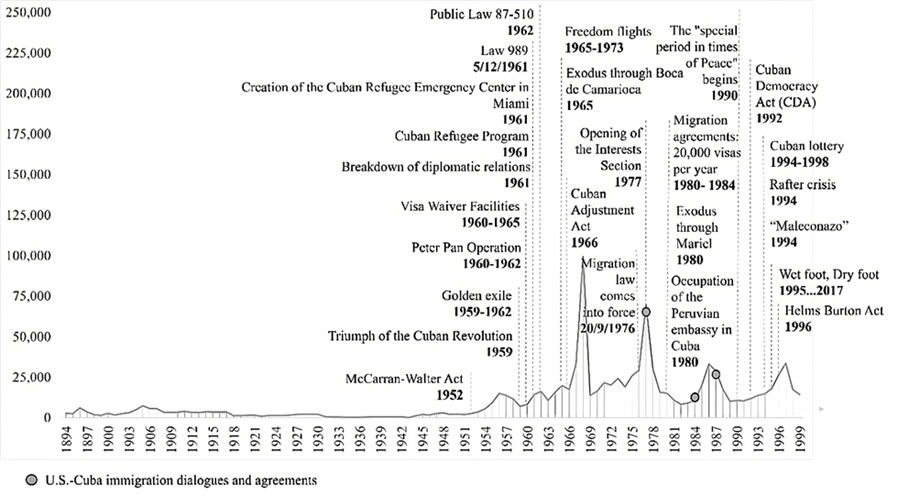 Source: Own elaboration based on data from the United States Department of Homeland Security (DHS, n.d.) and the yearbooks of the Customs and Border Protection Office (CBP, n.d.).
Graph 1
Chronological Order of the Main Events Related to Cuban Migration in the 20th Century
Chronological Order of the Main Events Related to Cuban Migration in the 20th Century
It was not until the 1950s that there was a marked change in the Cuban migratory trend due to the context of repression and violence, and of structural, political, social, and economic crisis that characterized the Fulgencio Batista dictatorship. In just three years-1956, 1957 and 1958-40 267 Cuban immigrants entered the United States, a figure that doubles the records of the previous five years (Pérez, 2001). Furthermore, with the enactment of the McCarran-Walter Act4 in 1952, discrimination barriers that existed in the previous immigration policy were eliminated, although the quotas by country were maintained, in which preference was given to migrants from Western Europe.
-
(Pérez, 2001)La emigración y la crisis estructural de la República 1946-1958Temas, 2001
These factors contributed to a significant change in migration flows between 1950 and 1960, with a notable increase in Cuban emigration to the United States. This migration was mainly made up of white-skinned individuals, adherents of the Catholic faith, many of whom opposed the Fulgencio Batista regime. Their decision to emigrate was driven mainly by economic and political reasons (López, 2014). By 1958, there were around 125 000 Cubans living in the United States, settled in cities such as Tampa, Key West, and New York, where the Cuban community began to arrive and prosper from the beginning of the 1800s (Aguirre, 1994; Moreno, 2019). Other international destinations were Spain, Venezuela, and Puerto Rico (Aja in Reed, 2015).
-
(López, 2014)De los Clubes Patrióticos 26 de Julio al Consejo Revolucionario Cubano. Diseños, comportamientos y transformaciones de la emigración cubana radicada en los Estados Unidos, 1955-1961, 2014
-
(Aguirre, 1994Cuban mass migration and the social construction of deviantsBulletin of Latin American Research, 1994
-
Moreno, 2019)Migración indocumentada cubana por Centroamérica: El papel de Nicaragua en la crisis migratoria de 2015Estudios Fronterizos, 2019
-
(Aja in Reed, 2015)Reflexiones sobre la migración cubana: entrevista con el Dr. Antonio Aja, director del Centro de Estudios Demográficos de la Universidad de La HabanaMEDICC Review Selecciones, 2015
After the triumph of the rebels led by Fidel Castro and the beginning of the period called the Cuban Revolution, the country began to undergo cyclical migratory exoduses. The first, recorded in the period between 1959 and 1962, was called the golden exile and was led by middle- and upper-class citizens, with educational and occupational characteristics similar to those of the dominant sectors of American society, many of whom had businesses and estate in Cuba that were expropriated (Pérez, 1986).
-
(Pérez, 1986)Immigrant economic adjustment and family organization: The Cuban success story reexaminedThe International Migration Review, 1986
Between 1960 and 1962, U.S. intelligence agencies, in alliance with opposition organizations and the Catholic Church, organized the departure to the United States of around 14 000 unaccompanied minors during the so-called Operation Peter Pan, an exceptional phenomenon at the time and in the region (Uriarte, 1995).
-
(Uriarte, 1995)Los cubanos en su contexto: teorías y debates sobre la inmigración cubana en los Estados UnidosTemas, 1995
Consequently, with the increasing arrival of Cuban migrants, a set of programs were set in motion at the beginning of the 1960s that gave birth to the Cuban Refugee Emergency Center in Miami and the Cuban Refugee Assistance Program, intended to provide funds for resettlement, housing, vocational and educational programs, employment, and food and health care for those who entered the United States, by means of sponsors (Humanities Texas, n.d.). In 1961, diplomatic relations between Cuba and the United States were broken, and political tensions were added to the underlying push/pull factors between both nations.
-
(Humanities Texas, n.d.)Cuban Refugee Center Flyer, 1962,
In turn, between 1960 and 1965, the process of granting waiver visas began, which constituted an entry permit to the country with a patent humanitarian character. In contrast, the Castro government implemented Law 989 in 1961, through which the entry and exit of Cuban citizens was regulated by imposing migratory filters from the origin point of the flows (Moreno, 2019). In 1962, in the midst of the Cuban Missile Crisis, the United States approved Public Law 87-510, also known as the Western Hemisphere Migration and Refugee Assistance Act. This legislation allowed the financing of current programs for the care of Cuban refugees.
-
(Moreno, 2019)Migración indocumentada cubana por Centroamérica: El papel de Nicaragua en la crisis migratoria de 2015Estudios Fronterizos, 2019
In 1965, after various social demonstrations, Fidel Castro announced that those who wanted to leave the country could do so freely. This led to two important events in Cuban migration history: the first was the exodus through the fishing port of Boca de Camarioca,5 through which 9 986 Cubans arrived illegally in Florida in rustic boats (López, 2008); the second was the airlift where the so-called freedom flights6 were carried out, transporting around 264 297 people between 1965 and 1973 (Pedraza-Bailey, 1985).
-
(López, 2008)Los cubanosEnciclopedia del español en los Estados Unidos: anuario del Instituto Cervantes 2008, 2008
-
(Pedraza-Bailey, 1985)Cuba’s exiles: Portrait of a refugee migrationThe International Migration Review, 1985
The increase in migration flows continued until the end of the 1960s with exceptionally high numbers for that time: 33 321 emigrants in 1967, followed by a record year in 1968 with 99 312 people leaving Cuba. The mass migration observed during those years is largely attributed to the political and social events that took place in Cuba during that period as a result of the transition to the so-called Cuban Revolution, and the political, ideological, and social changes that it entailed.
According to Aguirre (1994), there was a difference in migration between 1959 and the beginning of 1970, in terms of skin color. The first Cuban migrants, mostly white, came from more privileged sectors in racial terms, which had advantages such as extensive family networks and belonging to favored socioeconomic strata, which were affected by the policies of the Revolution, among other factors. Also, the influence of ideological factors is raised, such as the political propaganda that presented the United States as a racist society and, in contrast, the Cuban government’s discourse that showed the Afro-Cuban population as a pillar of the Revolution (Aguirre, 1976).
-
Aguirre (1994)Cuban mass migration and the social construction of deviantsBulletin of Latin American Research, 1994
-
(Aguirre, 1976)Differential migration of Cuban social races: A review and interpretation of the problemLatin American Research Review, 1976
In addition, the United States’ immigration policy towards Cuba has played an important role in the persistence and variations of the latter’s migration flows, even by granting preferential treatment after the implementation in 1966 of Public Law 89-732, popularly known as the Cuban Adjustment Act, which allowed these citizens to obtain permanent residence in the U.S. after one year of entering the country (Urrutia, 1997; Aja, 2002a; Clot & Martínez, 2018). In the two decades that followed, fluctuations were observed in the number of Cuban migrants, which, despite being lower than the record figures of the 1960s, was still high.
-
(Urrutia, 1997Aproximación a un análisis del proceso migratorio cubanoPapers. Revista de Sociología, 1997
-
Aja, 2002aLa emigración cubana hacia Estados Unidos a la luz de su política inmigratoria, 2002
-
Clot & Martínez, 2018)La “odisea” de los migrantes cubanos en América: modalidades, rutas y etapas migratoriasRevista Pueblos y fronteras digital, 2018
With the coming into force of the new Migration Law in Cuba in 1976, requirements were imposed on Cuban citizens for entering and leaving their own country, including obtaining an exit permit and an invitation letter. In addition, restrictions were applied to the temporary departure of minors, as well as provisions on the confiscation of property of those who left the national territory (Piñero, 2015).
-
(Piñero, 2015)Ley de Migración, 2015
The opening of the Interests Sections in 1977, both in Havana and Washington, marked a new diplomatic milestone between both nations by favoring the release of 4 000 political prisoners in Cuba and allowing economic negotiations, as well as the elimination of sanctions by the American government (Monteagudo, 2014). However, although the bilateral dialogues aspired to achieve greater stability for the Cuban people, the occupation of the Peruvian embassy and the subsequent exodus from the port of Mariel in 1980 evidenced that political intentions were far from achieving a transformation of reality.
-
(Monteagudo, 2014)A propósito de la comunidad emigrada cubana en Miami ¿diáspora o exilio?Atlántida. Revista Canaria de Ciencias Sociales, 2014
On April 5, 1980, a group of Cubans broke into the Peruvian Embassy in Havana to request political asylum. The number of people seeking refuge in the diplomatic headquarters rose to 10 800 (Córdova, 2021; Hernández, 2020). In response to this event, the country’s maritime border was again relaxed and in a period of just over five months, a total of 124 776 individuals crossed the Straits of Florida, including some with intellectual disabilities, addictions, physical conditions, and criminal records, mostly for minor crimes or political reasons (Pedraza-Bailey, 1985). Approximately 1 769 Cuban immigrants who participated in the Mariel exodus received criminal sentences in federal prisons; of these, 1 000 were classified as excludable or deportable. In addition, 63% of the total (78 545 people) managed to successfully establish themselves in Florida (Monteagudo, 2014).
-
(Córdova, 2021Cubanos en el Perú: en 1980 Lima recibió a 850 exiliados que invadieron la embajada peruana en la islaEl Comercio, 2021
-
Hernández, 2020)A 40 años del asalto necesario a la Embajada de Perú en La HabanaDiario de las Américas, 2020
-
(Pedraza-Bailey, 1985)Cuba’s exiles: Portrait of a refugee migrationThe International Migration Review, 1985
-
(Monteagudo, 2014)A propósito de la comunidad emigrada cubana en Miami ¿diáspora o exilio?Atlántida. Revista Canaria de Ciencias Sociales, 2014
In order to provide regular and safe migration options, migration agreements were established between 1980 and 1984 through which the United States government agreed to grant 20 000 visas annually, and Cuba would in turn accept the repatriation of rejected migrants. These agreements were halted by the Cuban government in 1985 and resumed again in 1987.
With the arrival of the Special Period in Time of Peace (1990s), the economic situation in Cuba and the living conditions of its population reached severely precarious levels. In addition to this, in 1992, the Cuban-American lobby promoted and fostered a bipartisan consensus in the United States to tighten the embargo against Cuba through the Cuban Democracy Act (CDA), also known as the Torricelli Act (Monteagudo, 2014). During the first years of the decade, migration flows did not show abrupt changes, but had a moderate tendency to increase (see Graph 1).
-
(Monteagudo, 2014)A propósito de la comunidad emigrada cubana en Miami ¿diáspora o exilio?Atlántida. Revista Canaria de Ciencias Sociales, 2014
Cuba’s economic situation continued to worsen, accompanied by a growth in popular discontent that reached its peak with the Maleconazo, a massive protest that took place in Havana in August 1994. This situation was followed by the subsequent rafter crisis, in which, in less than a month, nearly 35 000 Cubans set out on a journey by sea in improvised boats (Moreno, 2019). This new mass expulsion context led to both governments re-engaging in dialogue that same year. As a result, the United States implemented a special lottery to grant 20 000 visas annually to Cubans starting in 1995 (Aja, 2002a).
-
(Moreno, 2019)Migración indocumentada cubana por Centroamérica: El papel de Nicaragua en la crisis migratoria de 2015Estudios Fronterizos, 2019
-
(Aja, 2002Tendencias y Retos de Cuba ante el tema de la emigración, 2002
In response to the increase in maritime migration flows, the Bill Clinton administration initially decided to redirect Cubans intercepted at sea to the Guantanamo base instead of taking them to Florida. Thereafter, in 1995, the wet-foot/dry-foot policy was implemented, which established that those who managed to reach U.S. territory (dry feet) would obtain regularization facilities, such as work permits and food stamps, and could apply for permanent residence. In contrast, those intercepted at sea (wet feet) would be returned to Cuba (Clot & Martínez, 2018; Moreno, 2019).
-
(Clot & Martínez, 2018La “odisea” de los migrantes cubanos en América: modalidades, rutas y etapas migratoriasRevista Pueblos y fronteras digital, 2018
-
Moreno, 2019)Migración indocumentada cubana por Centroamérica: El papel de Nicaragua en la crisis migratoria de 2015Estudios Fronterizos, 2019
Towards 1996, with the implementation of the Helms-Burton Act, the economic and commercial embargo against Cuba was reinforced with the aim of promoting a change in the country’s political system. This law allows U.S. citizens, including Cuban exiles, to sue foreign companies that traffic in property confiscated by the Cuban government after 1959. In addition, this law codifies and extends the extraterritorial reach of sanctions, which discourages foreign investment on the island, exposing companies to potential lawsuits and sanctions (Dávalos, 2019).
-
(Dávalos, 2019)El título III de la Ley Helms Burton desde el derecho internacional. Un nuevo elemento de tensión jurídica entre Estados Unidos y CubaActualidad Jurídica, 2019
By the end of the 20th century, the profile of Cuban migrants had diversified. They were no longer primarily white-skinned, upper-middle class citizens with explicit political motivations as in the first waves, but rather more closely resembled the general composition of the Cuban population (Mirabal, 2003). In this sense, authors such as Mirabal (2003) argue that it is crucial to direct theoretical attention to how the perception of whiteness has been made use of to facilitate and sustain a privileged exile.
-
(Mirabal, 2003)“Ser de aquí”: Beyond the Cuban exile modelLatino Studies, 2003
-
Mirabal (2003)“Ser de aquí”: Beyond the Cuban exile modelLatino Studies, 2003
21st century in Cuban migration history
With the arrival of the 21st century and the administration of George W. Bush, Cuba’s migration panorama grew complex. During the first two decades, migration flows between Cuba and the United States remained at around 9 000 events on average per year. However, there were significant changes in 2002, when they reached their peak, with 28 272 emigrants, followed by a prolonged decline starting in 2005.
One of the notable events in the migration sphere between both countries was the creation in 2003 of the Commission for Assistance to a Free Cuba, with the intention of planning the political transition in that country once Fidel Castro ceded power. The travel restrictions from the United States to Cuba in 2004 and the impediment to the sending of remittances in 2006 were some of the most important provisions. In contrast, the U.S. government added new regular mechanisms for the protection of Cuban immigrants, such as the Welcome Program for Cuban doctors in 2006 and the Cuban Family Reunification Parole Program in 2007. Between 2004 and 2005, the flows decreased from 20 488 to 4 285 immigrants admitted by immigration authorities, respectively, values that had a moderate growth until reaching the figure of 6 677 people in 2008 (see Graph 2).
Thumbnail
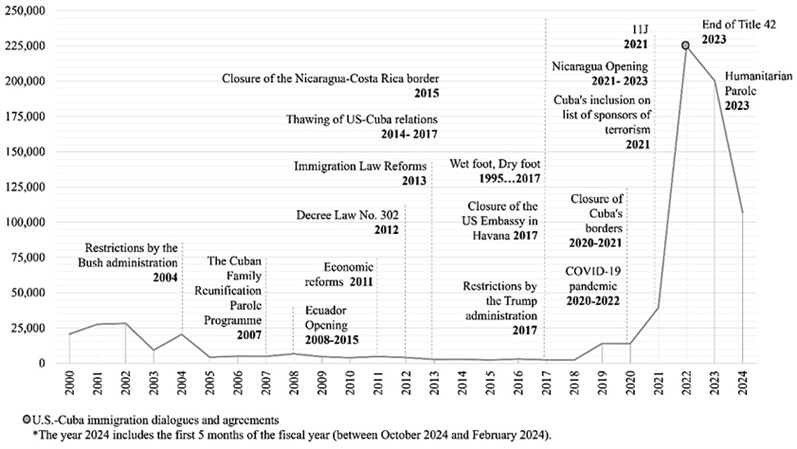 Source: Own elaboration based on data from the archives of the United States Department of Homeland Security (DHS, n.d.) and the yearbooks of the Customs and Border Protection Office (CBP, n.d.).
Graph 2
Key Events and Total Recorded Entries of Cuban Migrants to the United States According to Immigration Authorities (2000-2024)
Key Events and Total Recorded Entries of Cuban Migrants to the United States According to Immigration Authorities (2000-2024)
In Cuban territory, after Raúl Castro assumed power, there was an opening with the approval of the Economic and Social Policy Guidelines at the Sixth Party Congress in 2011. This led to changes in Cuban immigration policy (Frías, 2016). Thus, in order to respond to the demand of some Cubans to travel as tourists, Decree-Law No. 302 was enacted on October 11, 2012, which modified the Migration Law of 1976 to make regulations more flexible and guarantee safe regulations. In addition, Law 989 of 1961, which established the nationalization of emigrants’ assets, was repealed. Although this new provision allowed a Cuban to remain abroad for up to two years, authorization was required and an extension was offered for urgent reasons in Cuban consulates (Morales & Hernández, 2019).
-
(Frías, 2016)Migración: de la diáspora a la comunidad transnacional cubanaAsociación Estudiantes Graduados de Historia, 2016
-
(Morales & Hernández, 2019)Características de la migración internacional en la provincia de Pinar del Río en el período 2011-2017. Un por quéNovedades en Población, 2019
Article 48.1 of the aforementioned regulations establishes that Cuban citizens who wish to establish their residence in Cuban territory may submit their application to diplomatic or consular representations, or to the corresponding processing office of the Ministry of the Interior if they are in Cuba. This process is commonly known as repatriation (Morales, 2024).
-
(Morales, 2024)Ciudadano sin paíselTOQUE, 2024
However, regaining permanent residency in Cuba means that the emigrant from that country regains the economic, political, and social rights recognized in the legal system of that nation, including acquiring property, inheriting property from deceased relatives, accessing public services (health, education, social security), and exercising the right to vote, to mention those deemed most prominent. In this context, some analysts point out that the discretion of repatriation processes constitutes a tool of political coercion by the government towards those citizens who emigrated, considering its denial as an arbitrary and unjustified deprivation of human rights recognized by international laws and regulations (Morales, 2024).
-
(Morales, 2024)Ciudadano sin paíselTOQUE, 2024
The possibility of acquiring property, together with the opening to an incipient private sector in 2011, allowed small-scale investment in some sectors such as gastronomy and commerce. However, private investment does not have a significant weight in the economy and does not seem to be a priority for the authorities, unlike foreign direct investment (FDI). The lack of acknowledgement of property rights, the instability of regulatory frameworks, and the exclusion of certain professional activities, together with low efficiency, bureaucracy, and corruption, hinder the contributions of private investment to the Cuban economy (Guillén, 2022).
-
(Guillén, 2022)Inversiones y buena gobernanza en CubaRevista Foro Cubano de Divulgación, 2022
In parallel to the context described above, in the period between 2008 and 2015, Ecuador exempted the visa requirement for Cuban citizens, which led to a new exit route to other countries in the region. The main flow, which was destined for the United States, gained visibility after the closure of the border between Nicaragua and Costa Rica in 2015, where thousands of Cubans were held in a kind of forced entrapment. Clot and Martínez (2018), after describing the new land routes and the migratory stages through countries in Central and South America, concluded that the migratory management implemented by the governments of the transit nations affected the trajectories of Cuban migrants, and led them to adopt adaptive responses at a microsocial level in their mobility, such as the redefinition of their objectives and strategies.
-
Clot and Martínez (2018)La “odisea” de los migrantes cubanos en América: modalidades, rutas y etapas migratoriasRevista Pueblos y fronteras digital, 2018
Meanwhile, between 2014 and 2017, the United States and Cuba had begun to thaw diplomatic relations during Barack Obama’s second presidential term. As part of the negotiations on migration between both governments, new agreements were signed; among them, the repeal of the wet-foot/dry-foot policy.
By the end of the first quarter of 2016, data from the Dirección de Asuntos Consulares y de Cubanos Residentes en el Exterior (DACCRE) (Directorate of Consular Affairs and Cuban Residents Abroad) recorded that the population of Cubans living abroad exceeded 2.43 million (Aja et al., 2017). The majority, approximately 84%, settled in North America, mainly in the United States, where more than 1.15 million of them resided, while the rest were distributed throughout Europe (10%) and Latin America (5%) (Aja et al., 2017).
-
(Aja et al., 2017)La migración internacional de cubanos. Escenarios actualesRevista Novedades en Población, 2017
-
(Aja et al., 2017)La migración internacional de cubanos. Escenarios actualesRevista Novedades en Población, 2017
After the attempt at diplomatic normalization, a new period of tensions began between both nations. In June 2017, President Donald J. Trump amended U.S. policy toward Cuba with the aim of reversing the thaw initiated by the previous administration and pushing for democratic and human rights changes in the archipelago. These measures involved restricting financial transactions with entities controlled by Cuban military agencies, or intelligence and security services. This was supported by the publication of a list of such entities with which direct financial transactions would be prohibited. Restrictions on tourism to Cuba were also tightened, requiring educational trips to be for legitimate purposes under the auspices of a U.S. organization. A full itinerary of activities promoting contact with the Cuban people would also be required (Department of State, 2017).
-
(Department of State, 2017)Federal Register, 2017
Additionally, regular audits of trips to Cuba would be conducted to ensure compliance with regulations, and the definition of prohibited Cuban government officials would be expanded to restrict transactions with a broader group of government and State officials. In addition, the administration opposed efforts at the United Nations and other forums to lift the economic embargo on Cuba, reviewed democracy development programs in that country to align them with established criteria, formed a working group to examine ways to expand internet access in that nation, and discouraged illegal and dangerous migration of Cubans to the United States (Department of State, 2017).
-
(Department of State, 2017)Federal Register, 2017
In addition, in September 2017, the Trump administration expelled 15 Cuban diplomats and reduced embassy staff in Havana due to alleged sonic attacks that affected the health of American diplomats in Cuba. This reduction and the suspension of U.S. visa processing for Cuban citizens limited the embassy’s ability to process visa applications and other paperwork necessary for family reunification, which negatively impacted on wait times and the efficiency of the processes (Burgos, 2022).
-
(Burgos, 2022)La guerra híbrida de Estados Unidos contra CubaEl Otro Derecho, 2022
Finally, in 2021, at the end of Donald Trump’s term, Cuba was again included in the list of countries sponsoring terrorism, along with North Korea, Venezuela, Iran, and Syria. This measure was based on the argument that the Cuban government refused to extradite former Colombian combatants of the National Liberation Army. Inclusion on such a list implies that Cuba cannot access economic assistance or loans from the International Monetary Fund or other world organizations, as well as possible sanctions on third parties that carry out commercial or financial exchanges with that country (Basurto, 2021).
-
(Basurto, 2021)Causas y azares de la migración cubana en tránsito por la frontera sur de México, 2015-2020, 2021
Still, although the context during Trump’s term was not encouraging, the decade of 2020 brought with it unprecedented migration challenges, conditioned in part by the COVID-19 pandemic and the consequent closure of Cuban borders between 2020 and 2021, which already saw an increase in the migration flow. The Cuban context was marked by a prolonged economic crisis characterized by shortages of basic products, medicines, food, and constant power outages, which resulted in a notable deterioration of the population’s living conditions, aggravated by the pandemic.
In addition, the implementation of the so-called Tarea Ordenamiento (Ordering Task)7 in the economic sphere further exacerbated shortages and inflation (Ángel & Herrera, 2023). As a consequence, misguided policies such as the dollarization of the economy led to the devaluation of the Cuban peso, while the increase in wages without productivity support generated solvency problems in numerous companies, which led to an excessive increase in costs in various products and services. These effects were exacerbated by the economic paralysis caused by the pandemic, especially in the tourism sector (Amor, 2021). Although authors such as Gabilondo (2023) point out that it is difficult to assess the effects of structural adjustment programs, as they can take decades to unfold, the immediate results of these measures show a rapid deterioration in the country’s economic conditions. According to official data, Cuba’s GDP fell by 12% in 2020, one of the worst results in Latin America (Amor, 2021).
-
(Ángel & Herrera, 2023)A un año del Grito de Libertad: Reflexiones a propósito de las manifestaciones del 11J en Cuba, 2023
-
(Amor, 2021)La tarea ordenamiento: sus problemas y dificultadesForo Cubano-Divulgación, 2021
-
Gabilondo (2023)Transition-denial and structural adjustment: Causation and culpability in the Cuban economyFIU Law Review, 2023
-
(Amor, 2021)La tarea ordenamiento: sus problemas y dificultadesForo Cubano-Divulgación, 2021
In addition, restrictions on individual freedoms and the lack of political rights imposed by the regime have been a constant, which has fueled the discontent accumulated over decades among Cubans. Added to this is the fact that the increasing level of internet access in recent years facilitated greater synchronization of protests across much of the national territory. On top of that, the song Patria y Vida8 emerged as an anthem and motto for dissent, and as an expression of popular discontent. Finally, the health crisis in the province of Matanzas, together with the viral campaign SOS Matanzas, acted as a trigger for the largest anti-government protests of the current political system (Ángel & Herrera, 2023).
-
(Ángel & Herrera, 2023)A un año del Grito de Libertad: Reflexiones a propósito de las manifestaciones del 11J en Cuba, 2023
At the beginning of the 21st century, authors such as Mirabal (2003) raised the need to overcome the traditional view of Cuban exile, further emphasizing previous migrations for economic reasons. However, far from considering that said exile was a myth that was coming to an end, massive flows resumed their course and broke historical records after the social protests of July 11, 2021 -known as 11J-9 marked a turning point in the public perception and the internal dynamics of Cuba.
-
Mirabal (2003)“Ser de aquí”: Beyond the Cuban exile modelLatino Studies, 2003
As a result of the persistence of the triggers of such social outbreak, the economic/structural crisis, political repression, and the loss of confidence in the government’s management, and after the opening of the Nicaraguan air border in November 2021-after waiving the visa requirement for Cuban citizens-massive flows by land from Havana to the southern border of the United States were reactivated, crossing the countries of the northern zone of Central America and Mexico. The figures published by the U.S. border guard represent a benchmark in the history of Cuba between the years 2022 and 2023, with the arrival of 224 607 and 200 287 Cuban emigrants, respectively (see Graph 2). When comparing the totals recorded in 2018, before the pandemic, and in 2022, the year with the highest number of records, there is an increase of nearly 10 times in encounters with border authorities, which evidences the Cuban migration crisis in that period.
The massive flows continued until January 2023. At that time, the U.S. government included Cuba, Venezuela, Haiti, and Nicaragua as beneficiary countries of the humanitarian Temporary Parole Program. Official figures indicate that in the first four months of that same (calendar) year, more than 380 000 parole requests had been submitted by Cuban citizens, of which only 29 000 were approved, that is, only 6.3% (Morales, 2023a).
-
(Morales, 2023a)Parole humanitario: 29 mil cubanos autorizados para viajar a Estados UnidoselTOQUE, 2023
Furthermore, Inmigreat, a platform that provides intuitive technological tools for the management of immigration procedures, revealed that by February 6, 2024, the Department of Homeland Security was barely processing the humanitarian parole requests made in January 2023, which shows that the feedback received far exceeded the response capacity of the U.S. government (Immigration Café, 2024). In addition, the replacement of Title 42 with Title 8 in May 2023 brought with it more severe sanctions for those who try to cross the border irregularly. This way, the United States government sought to curb mass arrivals of irregular flows and establish migration channels that were more controlled and selective than safe, orderly, and regular.
-
(Immigration Café, 2024)New record in the humanitarian parole daily approvalsInmigreat, 2024
Towards the end of fiscal year 2023, an increase in encounters between Cuban migrants and the United States Border Patrol was recorded, a trend that has continued during the first five months of fiscal year 2024. The figures from the United States Border Patrol show a reactivation of Cuban migration flows, since the total recorded between October 2023 and February 2024 represents almost half of the total encounters recorded in fiscal year 2022 (see Graph 2).
Closing discussion and remarks
In the 130 years analyzed, trends and variations were identified in the migration flows of the Cuban community to the United States. Looking at the statistics, the range of Cuban emigrants shows a significant amplitude. Although in early years emigration was considerably lower than today, it began to gain relevance after the Cuban Revolution.
The annual average of emigrants is about 12 915, suggesting a constant flow of people on the move. However, this average figure does not reflect the true complexity of migration patterns, as significant fluctuations are observed at different historical moments. These variations are linked to political, economic, and social factors, both in Cuba and the United States, that influence the decision to emigrate, as can be seen in the contextual sections.
These indicators provide a snapshot of a deeply complex human phenomenon, rooted in the history and sociopolitical dynamics of both countries. Migration flows have therefore resulted in a diverse and constantly evolving Cuban-American community in the United States.
Cuban emigration has also been influenced by the persistence of social networks, which have expanded and reinforced since the success of the Revolution in January 1959 (Aja et al., 2017). However, after the application of Decree-Law No. 302, the characteristics, motivations, and expectations of migrants resemble the migration and insertion patterns of the region, and show a tendency towards temporary displacement and towards their incorporation into the labor market in sectors such as services, construction, and commerce. Therefore, the main destinations have been the large cities of the United States, not leaving out a growth in the importance of other destinations as well, where networks of immigrants of Cuban origin already exist and are strengthened (Morales, 2023b).
-
(Aja et al., 2017)La migración internacional de cubanos. Escenarios actualesRevista Novedades en Población, 2017
-
(Morales, 2023b)Más cubanos en la Corte de Inmigración, ¿dónde residen y qué causas tienen?elTOQUE, 2023
The above shows that economic changes and political transformations have impacted the decision of Cubans to migrate, especially in periods of economic and/or political crises. This highlights how migration can serve as a form of adjustment or escape valve in times of important changes. However, it is crucial to analyze how these crises are intertwined with other elements such as the lack of freedoms and political oppression to shape the migration decisions of Cubans.
In turn, the U.S. immigration policy, especially the Cuban Adjustment Act of 1966, has given preferential treatment to emigrants from Cuba, which has marked a distinction in relation to other Latin American groups. In this sense, the Cuban community in the United States presents a unique historical trajectory and distinctive characteristics that have undergone significant transformations in recent decades, manifesting greater heterogeneity, transnationality, and nuances in its political positions. Initially, the exile community was mostly composed of middle- and upper-class individuals who opposed the Revolution and who produced substantial increases, mainly after Fidel Castro came to power, establishing a solid exile in Miami. However, subsequent waves of migration such as the Mariel exodus in 1980 have introduced a diversity of origins that have complicated the homogeneous perception of migration.
Right when theoretical discussions advocated considering the Cuban community abroad as a diaspora rather than an exile, 11J occurred, triggered by the COVID-19 pandemic crisis, and the subsequent reaction of the Cuban State. This resulted in massive international departures, which demonstrated that the political dimension is transversal in the Cuban context, due to the lack of individual freedoms and the dominance of a military leadership that controls all aspects of the country. In this regard, and based on all the theoretical, historical, and contextual elements listed above, in this article the migration flows from Cuba in the period between November 2021 and January 2023 were defined as an exodus, due to five fundamental characteristics: they were 1) massive, and 2) constant movements, 3) in a defined period of time, 4) with a predominance of international departures, 5) as a response to a trigger or adverse context of great magnitude.
Migration policies and internal conditions in both countries continue to shape the characteristics of this migratory phenomenon. As such, this analysis underlines the need for a comprehensive approach that not only takes into account individual motivations, but also the structural and contextual factors that have shaped the history of Cuban migration. Furthermore, it is suggested for future studies to articulate historical, socio-structural, and political elements, thus achieving a deeper and richer understanding of the phenomenon and its impact on bilateral relations over time.
Analyzing historical circumstances makes it clear that a crucial factor in determining the profiles and characteristics of migrants who make up the flows is the availability of visas without restrictions. According to the Henley Passport Index, the Cuban passport is ranked 80th in the world ranking alongside Mozambique and Rwanda, due to its limitations on international mobility. Until 2023, to access approximately 130 destinations around the world, Cubans needed to obtain mandatory visas, especially in the case of the European Union and in countries such as the United States and Australia (Henley et al., n.d.).
-
(Henley et al., n.d.)The Henley Passport Index,
This visa requirement restricts the international mobility of Cubans and makes their migration processes through regular and safe routes difficult. Therefore, when a new route of unrestricted mobility opens between Cuba and another country or region, as occurred with Nicaragua in 2021 or Ecuador in 2008, migration flows and routes are reactivated or diversified, although the aspects of selectivity that this implies must also be accounted for. Although the present analysis assesses the dimension of migration flows in relation to the United States, which is their main destination, it would be relevant to also study how migratory flows and trends have developed towards other countries or regions.
Furthermore, in the analysis of the flows observed in the 21st century, a change in the type of prevailing trajectories was also noticed. While in the 1990s rafters became the stereotype of the Cuban migrant, by the beginning of 2022, the vast majority of Cuban migrants undertook irregular land routes and crossed Central America once Nicaragua ruled out the visa requirement.
At this point, the analysis allows migrants to be classified into three essential groups. The first group includes those who arrive by air, benefiting from programs such as humanitarian parole or family reunification, or those who have a visa. The second group is made up of those who undertake the land journey from South America or Central America. Finally, the third group is made up of those who seek to reach the United States or Mexico via sea routes. In future research, it would be pertinent to explore more thoroughly the differences between migrants who are part of the aforementioned groups, especially their socioeconomic and demographic characteristics. Likewise, it is necessary to thoroughly analyze the processes and experiences of socio-labor insertion of recent Cuban migrants in their destination countries, so as to obtain information on their adaptation and integration.
It is also essential to explore the various motivations, obstacles, and experiences in the migration process of Cuban women today from a gender perspective. Likewise, the evolution of the transnational social and family networks of Cuban migrants should be studied, as well as their fundamental role as support in migration decision-making. Finally, one may delve deeper into the impact of the migration policies recently implemented by both the United States and Cuba on the trends and patterns of migration flows.
Referencias
- Aguirre, B. E. (1976). Differential migration of Cuban social races: A review and interpretation of the problem. Latin American Research Review, 11(1), 103-124. Links
- Aguirre, B. E. (1994). Cuban mass migration and the social construction of deviants. Bulletin of Latin American Research, 13(2), 155-183. https://doi.org/10.2307/3338273 Links
- Aja, A. (2002a). La emigración cubana hacia Estados Unidos a la luz de su política inmigratoria [Documento de trabajo]. Centro de Estudios de Migraciones Internacionales. https://biblioteca.clacso.edu.ar/Cuba/cemi-uh/20120821035541/laemig.pdf Links
- Aja, A. (2002b). Tendencias y Retos de Cuba ante el tema de la emigración [Documento de trabajo]. Centro de Estudios de Migraciones Internacionales. https://biblioteca.clacso.edu.ar/Cuba/cemi-uh/20120822095244/tenden.pdf Links
- Aja, A. (2009). Al cruzar las fronteras. CEDEM. Links
- Aja, A. y Gaztambide, A. (2007). Migraciones: nueva frontera en el Caribe. Temas, (52), 13-20. Links
- Aja Díaz, A., Rodríguez Soriano, M. O., Orosa Busutil, R. y Albizu-Campos Espiñeira, J. C. (2017). La migración internacional de cubanos. Escenarios actuales. Revista Novedades en Población, 13(26), 40-57. Links
- Amnistía Internacional. (2023). Informe 2022/23. La situación de los derechos humanos en el mundo. https://www.amnesty.org/es/location/americas/central-america-and-the-caribbean/cuba/report-cuba/ Links
- Amor, E. (2021). La tarea ordenamiento: sus problemas y dificultades. Foro Cubano-Divulgación, 4(31). https://revistas.usergioarboleda.edu.co/index.php/fc_divul/article/view/1914 Links
- Ángel, S. y Herrera C. (Comps.). (2023). A un año del Grito de Libertad: Reflexiones a propósito de las manifestaciones del 11J en Cuba. Editorial 4Métrica. https://doi.org/10.56650/9786289521382 Links
- Arango, J. (2003). La explicación teórica de las migraciones: luz y sombra. Migración y Desarrollo, 1. Red Internacional de Migración y Desarrollo, (1). https://www.redalyc.org/articulo.oa?id=66000102 Links
- Basurto, M. A. (2021). Causas y azares de la migración cubana en tránsito por la frontera sur de México, 2015-2020 [Tesis de maestría, Universidad Autónoma Chapingo]. https://repositorio.chapingo.edu.mx/server/api/core/bitstreams/c719663d-23ab-471e-b611-7788e46c24e1/content Links
- BBC News Mundo. (2021, 13 de julio). Protestas en Cuba: el gobierno confirma un muerto en nuevos disturbios a las afueras de La Habana. BBC. https://www.bbc.com/mundo/noticias-america-latina-57829694 Links
- Bueno, E., García, R., Montes, N. y Valle, G. (2004). Apuntes sobre la migración internacional y su estudio. CEDEM. Links
- Burgos, M. (2022). La guerra híbrida de Estados Unidos contra Cuba. El Otro Derecho, 60, 73-91 https://ilsa.org.co/wp-content/uploads/2023/04/5-El-Otro-Derecho-60-La-guerra-hibrida-de-Estados-Unidos-contra-Cuba.pdf Links
- Canales, A. y Montiel, I. (2007, 16 de abril). De la migración interna a la internacional. En búsqueda del eslabón perdido [Ponencia]. Taller Nacional sobre “Migración interna y desarrollo en México: diagnóstico, perspectivas y políticas”. Ciudad de México, México. https://www.cepal.org/sites/default/files/courses/files/acanales.pdf Links
- Clot, J. y Martínez, G. (2018). La “odisea” de los migrantes cubanos en América: modalidades, rutas y etapas migratorias. Revista Pueblos y fronteras digital, 13. https://doi.org/10.22201/cimsur.18704115e.2018.v13.345 Links
- Cobas, A. y Fernández, A. (2014). ¿Los cubanos se autoseleccionan en su emigración? De Cuba a Estados Unidos. Revista Internacional de Ciencias Sociales, 3(1), 5. Links
- Córdova, L. (2021, 17 de julio). Cubanos en el Perú: en 1980 Lima recibió a 850 exiliados que invadieron la embajada peruana en la isla. El Comercio. https://elcomercio.pe/archivo-elcomercio/cubanos-en-el-peru-en-1980-lima-recibio-a-850-exiliados-que-invadieron-la-embajada-peruana-en-la-isla-protestas-en-cuba-nnsp-noticia/#google_vignette Links
- Custom Border Patrol (CBP). (s. f.). Yearbook of immigration statistics 2022. https://www.dhs.gov/immigration-statistics/yearbook/2022 Links
- Dávalos, L. (2019). El título III de la Ley Helms Burton desde el derecho internacional. Un nuevo elemento de tensión jurídica entre Estados Unidos y Cuba. Actualidad Jurídica, (51), 161-169. https://www.uria.com/documentos/publicaciones/6546/documento/foro-latam-03.pdf?forceDownload=true&id=8734 Links
- Department of State. (2017, octubre 20). Strengthening the policy of the United States toward Cuba (Public Notice núm 10178). Federal Register, 82(202) https://www.govinfo.gov/content/pkg/FR-2017-10-20/pdf/2017-22928.pdf Links
- Frías, E. (2016). Migración: de la diáspora a la comunidad transnacional cubana. Asociación Estudiantes Graduados de Historia, (21), 1-9. https://aeghcea.wordpress.com/wp-content/uploads/2016/09/22migracion-de-la-diaspora-a-la-comunidad-transnacional-cubana.pdf Links
- Gabilondo, J. (2023). Transition-denial and structural adjustment: Causation and culpability in the Cuban economy. FIU Law Review. 17(3), 547-561. https://dx.doi.org/10.25148/lawrev.17.3.8 Links
- García, R. (2002). El caso cubano: un fenómeno de vieja data. Las migraciones internacionales en América Latina y el Caribe. SELA, 65, 199-210. https://biblat.unam.mx/es/revista/capitulos-del-sela/articulo/el-caso-cubano-un-fenomeno-de-vieja-data Links
- Guillén, J. I. (2022). Inversiones y buena gobernanza en Cuba. Revista Foro Cubano de Divulgación. 5(40). https://revistas.usergioarboleda.edu.co/index.php/fc_divul/article/view/2214/1657 Links
- Harris, J. R. y Todaro, M. P. (1970). Migration, unemployment and development: A two-sector analysis. The American Economic Review, 60(1), 126-142. Links
- Henley y asociados (s. f.) The Henley Passport Index. https://www.henleyglobal.com/passport-index Links
- Hernández, J. (2020, 4 de abril). A 40 años del asalto necesario a la Embajada de Perú en La Habana. Diario de las Américas. https://www.diariolasamericas.com/america-latina/a-40-anos-del-asalto-necesario-la-embajada-peru-la-habana-n4196360 Links
- Humanities Texas (s. f.). Cuban Refugee Center Flyer, 1962. https://www.humanitiestexas.org/archives/digital-repository/cuban-refugee-center-flyer-1962 Links
- Immigration Cafe (2024, 6 de febrero). New record in the humanitarian parole daily approvals. Inmigreat. https://www.inmigreat.com/blogs-en/new-record-in-the-humanitarian-parole-daily-approvals Links
- Lee, E. S. (1966). A theory of migration. Demography, 3(1), 47-57. https://doi.org/10.2307/2060063 Links
- López, H. (2008). Los cubanos. En Enciclopedia del español en los Estados Unidos: anuario del Instituto Cervantes 2008 (pp. 112-123). Santillana. https://cvc.cervantes.es/lengua/anuario/anuario_08/pdf/demografia03.pdf Links
- López, S. (2014). De los Clubes Patrióticos 26 de Julio al Consejo Revolucionario Cubano. Diseños, comportamientos y transformaciones de la emigración cubana radicada en los Estados Unidos, 1955-1961 [Tesis de doctorado, Universidad de Valencia]. https://roderic.uv.es/bitstream/handle/10550/41749/Tesis_Sergio_correcion_FINAL_%282%29.pdf?sequence=1&isAllowed=y Links
- Martín, C. (2007, octubre). Familias y emigración cubana: estrategias cotidianas en su contexto psicohistórico [Resumen de presentación de la conferencia]. Quinta Reunión del Grupo de Trabajo, Familia e Infancia, México. Links
- Martín, J. L. (2013). Cultura del trabajo, población y turismo: impactos del reajuste de los 90. CEDEM. Links
- Martín, J. L. y Araujo, R. (2013). Población y recursos laborales: La migración de profesionales cubanos. Almenara: revista extremeña de ciencias sociales, (5), 40-61. Links
- Massey, D. S., Arango, J., Graeme, H., Kouaouci, A., Pellegrino, A. y Taylor J. E. (2000). Teoría sobre la migración internacional: una reseña y una evaluación. Revista Trabajo, 2(3), 5-50. Links
- Mirabal, N. R. (2003). “Ser de aquí”: Beyond the Cuban exile model. Latino Studies, 1(3), 366-382. https://doi.org/10.1057/palgrave.lst.8600044 Links
- Morales, L. y Hernández, W. (2019). Características de la migración internacional en la provincia de Pinar del Río en el período 2011-2017. Un por qué. Novedades en Población, 15(29), 1-11. http://scielo.sld.cu/pdf/rnp/v15n29/1817-4078-rnp-15-29-1.pdf Links
- Morales, L. (2022). Migración internacional asociada a factores ambientales en la zona norte de Centroamérica en el periodo 2008-2019 [Tesis de doctorado, El Colegio de la Frontera Norte]. https://posgrado.colef.mx/tesis/20191517/ Links
- Morales, L. (2023a). Parole humanitario: 29 mil cubanos autorizados para viajar a Estados Unidos. elTOQUE. https://eltoque.com/parole-humanitario-29-mil-cubanos-autorizados-para-viajar-a-estados-unidos Links
- Morales, L. (2023b). Más cubanos en la Corte de Inmigración, ¿dónde residen y qué causas tienen? elTOQUE. https://eltoque.com/cubanos-en-la-corte-de-inmigracion-en-estados-unidos Links
- Morales, L. (2024). Ciudadano sin país. elTOQUE. https://eltoque.com/ciudadano-sin-pais Links
- Moreno, G. (2019) Migración indocumentada cubana por Centroamérica: El papel de Nicaragua en la crisis migratoria de 2015. Estudios Fronterizos, 20. https://doi.org/10.21670/ref.1917038 Links
- Monteagudo, O. L. (2014). A propósito de la comunidad emigrada cubana en Miami ¿diáspora o exilio? Atlántida. Revista Canaria de Ciencias Sociales, 6, 267-280 Links
- Núñez, M. (2007). Género y migraciones externas en Cuba entre 1985 y 2005. Resultados preliminares. Novedades en Población, 3(6), 44-70. Links
- Pérez, L. (1986). Immigrant economic adjustment and family organization: The Cuban success story reexamined. The International Migration Review, 20(1), 4-20. https://doi.org/10.2307/2545681 Links
- Pérez, L. (2001). La emigración y la crisis estructural de la República 1946-1958. Temas, (24-25), 83-86. Links
- Pedraza-Bailey, S. (1985). Cuba’s exiles: Portrait of a refugee migration. The International Migration Review, 19(1), 4-34. https://doi.org/10.2307/2545654 Links
- Piñero, N. (2015). Ley de Migración. Ediciones ONBC. Links
- Portes, A., Clark, J.M. y Manning, R.D. (1985). After Mariel: A survey of the resettlement experiences of 1980 Cuba refugees in Miami. Cuban Studies/Estudios Cubanos, 15, 37-59. https://www.proquest.com/openview/451b8e3d03500997a2845ea800d4380e/1?pq-origsite=gscholar&cbl=1817313 Links
- Reed, G. (2015). Reflexiones sobre la migración cubana: entrevista con el Dr. Antonio Aja, director del Centro de Estudios Demográficos de la Universidad de La Habana. MEDICC Review Selecciones, 17(4), 15-18. Links
- Renaud, F., Bogardi, J. J., Dun, O. y Warner, K. (2007). Control, adapt or flee. How to face environmental migration? InterSections, 5. http://collections.unu.edu/view/UNU:1859#viewMetadata Links
- Rodríguez, M. (2004). El proceso migratorio cubano hacia Estados Unidos: antecedentes, actualidad y perspectivas ante posibles escenarios. Centro de Estudios de Migraciones Internacionales. http://bibliotecavirtual.clacso.org.ar/ar/libros/cuba/cemi/procmig.pdf Links
- Rodríguez, D. C. (2013). La migración internacional y el comportamiento reproductivo de las mujeres cubanas. Las singularidades de la transición demográfica en Cuba y su impacto en la fecundidad de las migrantes. Novedades en Población, (17), 80-94. Links
- Tacoli, C. (2009). Crisis or adaptation? Migration and climate change in a context of high mobility. Environment and Urbanization, 21(5), 513-25. https://doi.org/10.1177/0956247809342182 Links
- Taylor, J. E. (1986). Differential migration, networks, information and risk. Migration, Human Capital and Development, 4, 147-171. Links
- Uriarte, M. (1995). Los cubanos en su contexto: teorías y debates sobre la inmigración cubana en los Estados Unidos. Temas, 2, 64-78. Links
- Urrutia, L. (1997). Aproximación a un análisis del proceso migratorio cubano. Papers. Revista de Sociología, 52, 49-56. https://doi.org/10.5565/rev/papers/v52n0.1879 Links
- U.S. Department of Homeland Security (DHS). (s. f.) History Office and Library. https://www.uscis.gov/archive/historical-library Links