




 nueva página del texto (beta)
 Inglés (pdf)
 Artículo en XML
 Referencias del artículo
 Traducción automática
 Enviar artículo por email
 Citado por SciELO
  Similares en
SciELO
Similares en
SciELO 
 Permalink

1. Introduction
In the modern digital marketplace, businesses operating online recognize the paramount importance of engaging and retaining consumers. As e-commerce platforms become more widespread, companies are constantly exploring new and creative methods to attract and keep the interest of their desired customer base, especially in the face of intense competition. One of the marketing tactics that has become increasingly popular in recent times is gamification, which involves incorporating elements and mechanics typically found in games into non-game environments (Zichermann & Cunningham, 2011).This approach aims to improve user engagement and encourage specific behaviours (Deterding et al., 2011). Gamification harnesses principles of motivation, competition, and reward to incentivize user engagement and foster brand loyalty, ultimately influencing purchase intention (Huotari & Hamari, 2012; Hamari, Koivisto, & Sarsa, 2014).
At its core, gamification revolves around transforming mundane tasks or interactions into engaging experiences reminiscent of gameplay. These gamified elements can manifest in various forms, ranging from simple quizzes and challenges to more complex systems incorporating virtual currencies, levels, and leaderboards. For instance, an e-commerce platform might incorporate a spin-wheel feature, allowing users to spin for discounts or rewards upon completing certain actions like signing up for a newsletter or making a purchase. Similarly, loyalty programs that reward customers with points or badges for frequent engagement and purchases can be considered gamified approaches aimed at cultivating brand loyalty.
The effectiveness of gamification lies in its ability to tap into intrinsic human desires for achievement, progress, and social interaction. By providing users with clear goals, feedback mechanisms, and tangible rewards, gamification transforms passive consumers into active participants, driving deeper levels of engagement and investment in the brand. For example, a fitness app might employ gamified features like progress tracking, virtual challenges, and social sharing to motivate users to exercise regularly and achieve their fitness goals. In this context, the sense of accomplishment derived from completing challenges or unlocking achievements serves as a powerful motivator to sustain user engagement over time.
Furthermore, gamification leverages principles of behavioural psychology to influence consumer behaviour and decision-making. The use of rewards, whether tangible (e.g., discounts, freebies) or intangible (e.g., badges, status), triggers the release of dopamine in the brain, reinforcing desired actions and fostering positive associations with the brand (Kumar & Herger, 2013). Additionally, the element of competition introduced through leaderboards or peer comparisons can stimulate users' competitive instincts, driving them to outperform others and earn recognition within the community.
Considering these definitions and examples, it's clear that, gamification offers significant opportunities for businesses aiming to boost customer interaction, foster brand allegiance, and ultimately increase sales in the competitive e-commerce environment (Tai & Tu, 2023). This research endeavours to investigate the connections among gamification, brand loyalty, and buying intent in online consumer behaviour, providing an understanding of the mechanisms driving these dynamics and providing valuable insights for marketers and professionals. Through rigorous analysis and interpretation of data, we seek to uncover actionable strategies for leveraging gamification to achieve desired outcomes in the digital marketplace.
2. Theoretical background and hypothesis development
2.1. Gamification and marketing
Gamification stands out as a key motivational and persuasive tool within information systems (IS), designed to provide immersive, game-like experiences that elevate engagement (Koivisto & Hamari, 2019; Xi & Hamari, 2020). Its application and exploration have been particularly prominent in marketing and business spheres, garnering attention from both practitioners and researchers across various domains such as online communities (Xi & Hamari, 2020), fitness (Jang et al., 2018), and e-commerce (Poolperm & Thongmak, 2021), all aimed at driving business objectives. Originally conceived by Dr. Zachary Fitz Walter, gamification involves incorporating elements of game design into contexts outside of gaming (Fitz-Walter, n.d.). Its popularity surged around 2011, evolving into a multifaceted approach employed across various domains. Stone (2023) underscores its evolution, highlighting its contemporary relevance and applicability across diverse technological landscapes.
The integration of gamification in loyalty programs reflects its transformative potential within modern business landscapes. As consumer expectations burgeon, traditional methods no longer suffice in fostering brand loyalty. (Wahyu Karyadi et al., 2023). Кarmazinova (2024) emphasizes the significance of gamification in addressing this challenge, elucidating how personalized tasks and rewards augment consumer participation and brand affinity. Forbes further elucidates the impact, explicating how gamified challenges coupled with rewards engender revenue growth and brand loyalty (Selchau-Hansen, 2022).
This burgeoning interest in gamification within academia and industry underscores its efficacy in stimulating consumer interaction and enhancing marketing strategies (Google Trends, n.d.). By leveraging game elements to evoke positive emotions and motivation, businesses can fortify consumer-brand relationships, thus fostering sustained engagement and loyalty. Understanding these dynamics is critical for marketers seeking to harness the full potential of gamification in consumer loyalty programs.
2.2. Gamification and customer engagement
Brand engagement, a multifaceted concept encompassing emotional, cognitive, and social dimensions, arises from interactions with a brand (Hollebeek et al., 2019). Within gamified experiences, consumer engagement is further elucidated as cognitive viewpoints emphasize user perceptions and strategies to enhance brand interactions (Hollebeek et al., 2019; Harwood & Garry, 2015). Research indicates that gamification, by incentivizing and rewarding customer behaviours and emotions, fosters loyalty and interpersonal connections, thereby enhancing engagement (Harwood & Garry, 2015; Wongkitrungrueng & Assarut, 2020).
Games inherently evoke enjoyment and heightened engagement (Yang et al., 2023), thus making gamification a potent tool for enhancing customer satisfaction, loyalty, and engagement (Blohm & Leimeister, 2013; Hamari, Koivisto, & Sarsa, 2014). This heightened engagement is attributed to the elements of challenge, feedback, interactivity, and user control inherent in gamified experiences (Szyszka, 2019).
One recent example of gamification leading to increased customer engagement with an e-commerce platform is Nike's "Nike Run Club" app (Tai & Tu, 2023). The app gamifies the experience of running by offering challenges, achievements, and rewards to users for completing runs and meeting fitness goals. Users can participate in virtual races, earn badges for milestones, and compete with friends or other runners worldwide.
By integrating gamification elements such as progress tracking, social sharing, and personalized coaching, Nike has successfully engaged its customers on a deeper level. The application not only encourages users to maintain their activity levels but also cultivates a feeling of camaraderie among runners, thereby boosting loyalty to the Nike brand and prompting users to return to the Nike online store for purchasing running apparel and accessories.
Across diverse industries, the integration of gaming elements into marketing strategies has emerged as a trend, with businesses leveraging gamification to enrich user experiences, increase engagement, and alter consumer behaviour (Yadav & Dangi, 2023). This shift towards gamified interactions signifies a strategic endeavour to elevate customer engagement and satisfaction, thereby reshaping the landscape of consumer-brand interactions. Thus, the hypothesis was proposed: Ha1 - The utilization of gamification greatly influences the engagement of customers/users with brands.
2.3. Gamification and brand loyalty
Brand loyalty is a crucial aspect of consumer behaviour, representing the extent to which customers repeatedly purchase products or services from a particular brand over time (Liu et al., 2019; Martínez-López et al., 2020).
Several recent researchers have delved into defining and understanding brand loyalty.
According to Liu et al. (2019), brand loyalty is "a deeply held commitment to rebuy or patronize a preferred product/service consistently in the future." This definition emphasizes the emotional and behavioural aspects of loyalty, indicating a strong attachment to the brand. Similarly, Martínez-López et al. (2020) define brand loyalty as "a consumer's deeply held commitment to rebuy or patronize a preferred product/service consistently in the future despite situational influences and marketing efforts having the potential to cause switching behaviour." This definition emphasizes the resilience of loyalty against external influences and marketing strategies.
An example of brand loyalty can be seen in the tech industry, where many consumers exhibit strong allegiance to brands like Apple or Samsung, consistently purchasing their products despite the availability of alternatives.
Gamification in marketing, as discussed earlier, refers to the integration of game elements, such as points, badges, or leaderboards, into marketing strategies to engage customers. By incorporating elements of fun and competition, gamification enhances customer engagement with the brand, thereby fostering brand loyalty (Wahyu Karyadi et al., 2023). For instance, Starbucks' mobile app rewards customers with stars for each purchase, encouraging repeat visits and brand loyalty (Hamari, Koivisto, & Sarsa, 2014).
The relationship between gamification, customer engagement, and brand loyalty is symbiotic (Tien Minh et al., 2023). Increased engagement through gamification leads to stronger brand attachment, resulting in higher brand loyalty. This, in turn, positively impacts the buying intentions of consumers, as loyal customers are more likely to choose the brand over competitors, even when faced with tempting alternatives. Therefore, integrating gamification into marketing strategies can significantly influence consumer behaviour and drive purchase decisions. Thus, the hypothesis: Ha2 - The integration of gamification elements in marketing strategies positively influences brand loyalty, subsequently increasing consumers' buying intention towards the brand.
2.4. Gamification and buying intention
Gamification has emerged as a prominent strategy in marketing research, attracting attention for its ability to elevate customer engagement and purchase intention. This review delves into the realm of gamification and its impact on consumer purchasing behaviour, drawing insights from contemporary studies and theoretical frameworks like the stimulus-organism-response (S-O-R) model. Within this model, gamification acts as a catalyst, stimulating both the affective and cognitive responses of consumers.
By incorporating elements such as rewards and competition, gamification evokes positive emotions and perceptions, thereby shaping consumers' intentions to make purchases (Wu & Santana, 2022). This process of internal evaluation and attitude formation ultimately translates into observable behavioural outcomes, as consumers become more inclined to participate in purchasing activities due to the enjoyable and rewarding experiences facilitated by gamification.
Chang and Yu (2023) emphasize the crucial role of customer experience in fostering emotional connections between consumers and brands, suggesting that gamification indirectly impacts purchase intention through mechanisms like reward systems and competitive elements. While discussing the impact of gamification on purchase intention, Wu and Santana (2022) emphasized the scarcity of research in this domain and emphasized the need for additional investigation to better understand its effects (Wu & Santana, 2022) . Through the lens of the S-O-R model, this review elucidates how gamification elements prompt consumers' affective and cognitive evaluations, subsequently influencing their purchase decisions.
Recent studies by Haziri (2021) and Lu and Chen (2021) reinforce these findings, highlighting the direct and positive influence of game mechanics and engagement on purchase intention (Xu et al., 2020). Furthermore, contemporary examples like the integration of gamified features in mobile marketing campaigns (Wen et al., 2014) underscore the practical applicability of gamification strategies in boosting consumer purchase intent (Wahyu Karyadi et al., 2023). In sum, this review underscores the growing significance of gamification in shaping consumer behaviour and provides valuable insights for marketers seeking to enhance purchase intention through innovative engagement tactics. Thus, the hypothesis: Ha3 - The integration of gamification significantly influences customers' purchase intention.
3. Research methodology
The study involved both exploratory and conclusive phases. During the exploratory phase, background research was conducted, and the hypothesis and questionnaire were developed. Conversely, the conclusive phase aimed to collect data from real respondents using a structured questionnaire. SmartPLS 4.0 employs partial least squares structural equation modelling (PLS-SEM) to assess the correlation between observation variables and latent variables via a reflective measurement model. PLS-SEM, with its algorithm and bootstrapping, is a robust analytical method utilized for identifying and constructing predictive models. It is particularly effective in analyzing causal relationships among latent variables, distinguishing itself from the standard linear structural relationship model, which is more suited for exploratory research (Pavlou, P.A. et al., Melchor, M.Q.).
3.1. Sample size, participants, and data collection
This study focused on individuals who regularly interact with online e-commerce platforms and are familiar with mini-games such as quizzes, spin-wheels, and task completion (Wongkitrungrueng & Assarut, 2020). The practice of engaging in these games and earning rewards on e-commerce platforms has emerged as a powerful strategy for consumer engagement and motivation in today's dynamic market environment (Hamari et a., 2014).
To gather data, the research team conducted an online survey targeting consumers residing in three major districts of Chhattisgarh: Raipur, Durg-Bhilai, and Bilaspur, situated in central India. Utilizing a Simple Random Sampling method, the authors aimed to obtain responses from a total of 350 consumers. Simple random sampling ensures that every individual or item within the population has an equal chance of being selected for the sample. During the data collection phase, strict adherence to essential criteria such as a well-defined and homogeneous population, random selection, independence, absence of biases, and a fixed sample size was maintained while employing the simple random sampling technique.
As mentioned above (Table 1), a total of 311 consumer responses were gathered, resulting in an effective response rate of 88.8%. The largest segment of respondents (34.08%) fell within the age range of 26 to 35 years. The participant pool consisted of 52.09% males and 47.91% females, with the majority identifying as Salaried (28.62%) or Business (31.19%) individuals.
Table 1 Descriptive statistics.
| Age (in Years) | |||
| Levels | Counts | % of total | Cumulative % |
| 15 - 25 | 72 | 23.15 | 23.15 |
| 26 - 35 | 106 | 34.08 | 57.23 |
| 36 - 45 | 68 | 21.86 | 79.10 |
| 45 and above | 65 | 20.90 | 100.00 |
| Total | 311 | 100.00 | |
| Gender | |||
| Levels | Counts | % of total | Cumulative % |
| Male | 162 | 52.09 | 52.09 |
| Female | 149 | 47.91 | 100.00 |
| Total | 311 | 100.00 | |
| Occupation | |||
| Levels | Counts | % of total | Cumulative % |
| Service | 89 | 28.62 | 28.62 |
| Business | 97 | 31.19 | 59.81 |
| Professional | 73 | 23.47 | 83.28 |
| Household | 52 | 16.72 | 100.00 |
| Total | 311 | 100.00 | |
| Annual Income (in Lakhs per annum) | |||
| Levels | Counts | % of total | Cumulative % |
| 1.5 - 3.0 | 89 | 28.62 | 28.62 |
| 3.0 - 4.5 | 97 | 31.19 | 59.81 |
| 4.5 - 6.0 | 73 | 23.47 | 83.28 |
| 6.0 and above | 52 | 16.72 | 100.00 |
| Total | 311 | 100.00 | |
In this study, the Likert Scale rating technique was employed, where participants were asked to rate various items related to relevant variables on a scale ranging from 1 to 5, with 1 indicating the lowest score and 5 representing the highest score.
3.2. Reliability and validity test
The authors conducted a pilot test of their self-developed instrument on 48 respondents, which led to necessary adjustments. The study's evaluation of reliability and validity emphasizes the strength of its constructs. Reliability, in this context, refers to the consistency of scale tools and is evaluated through individual item reliability, determined by factor loading, as well as internal consistency, assessed using latent variable composition reliability (CR) and Cronbach’s alpha. The accepted standard for these values is typically greater than 0.7 (Hair et al., 1998).
The reliability and validity assessments provided offer crucial insights into the strength and accuracy of the study's measurement tools and constructs. As displayed in Table 2, the high values of Cronbach's alpha, composite reliability (rho_a and rho_c), and average variance extracted (AVE) indicate strong internal consistency and reliability of the constructs measured, namely, brand loyalty (BrandLo), buying intention (BuyInt), gamification, and user engagement (UserEngage). These values exceed the recommended threshold of 0.7, affirming the reliability of the measurement instruments used in the study.
Table 2 Reliability and validity.
| items | Cronbach's
alpha |
Composite
reliability (rho_a) |
Composite
reliability (rho_c) |
Average variance
extracted (AVE) |
| BrandLo | 0.961 | 0.962 | 0.961 | 0.892 |
| BuyInt | 0.953 | 0.953 | 0.953 | 0.870 |
| Gamification | 0.971 | 0.977 | 0.971 | 0.893 |
| UserEngage | 0.954 | 0.962 | 0.954 | 0.875 |
Furthermore, the discriminant validity analysis demonstrates the ability of the constructs to differentiate from each other. The heterotrait-monotrait ratio (HTM T) values are all below the threshold of 0.85, indicating adequate discriminant validity. This suggests that each construct measures a distinct aspect of the phenomenon under investigation.
Additionally, the collinearity statistics (VIF) indicate acceptable levels of multicollinearity, with all values well below 5. This implies that there are no significant issues with collinearity among the predictor variables. Thus, the results suggest that the measurement instruments used in the study are reliable, valid, and distinct, providing a solid foundation for the subsequent analysis and interpretation of the research findings.
3.3. Structural equation modelling
SmartPLS 4.0 software was utilized to conduct structural equation modelling (SEM) for data analysis, aiming to investigate the relationships and significance among the study variables. Partial least squares structural equation modelling (PLS-SEM) is particularly adept at assessing statistically significant linear relationships within causal models, making it well-suited for constructing theoretical frameworks. In this study, we employed PLS-SEM to explore the relationships among our research variables. By employing the PLS algorithm and bootstrapping with 5000 iterations, as recommended by Henseler et al. (2009), we were able to determine path coefficients and significance levels. This approach facilitated the analysis of correlations and influences among the various dimensions studied.
The path coefficients and total indirect effects presented in
the analysis (Figure 1) provide valuable insights into the relationships among the variables examined in the study.
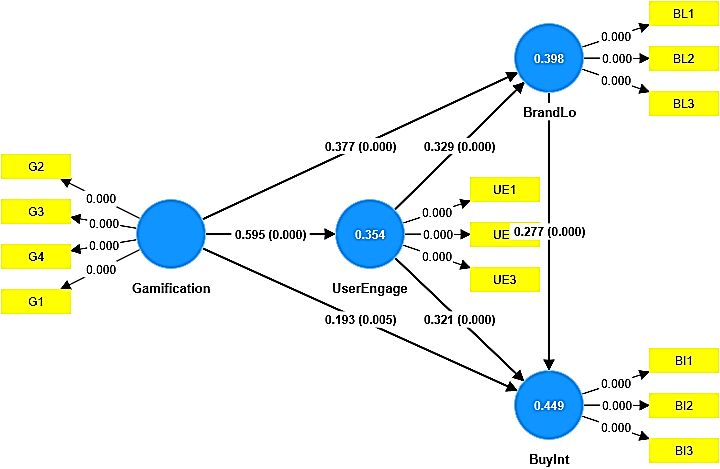
These coefficients represent the strength and direction of the connections between each pair of variables, shedding light on the underlying mechanisms at play.
Firstly, examining the path coefficients (Table 3), we observe significant positive relationships between various constructs. For instance, the path coefficient from BrandLo to BuyInt is 0.277, indicating a moderately strong positive relationship. Similarly, gamification exhibits a significant positive influence on both BrandLo (coefficient of 0.377) and BuyInt (coefficient of 0.193). Notably, the highest path coefficient is observed between gamification and UserEngage, with a substantial value of 0.595, suggesting a strong positive relationship between these constructs.
Table 3 Path coefficient.
| items | Original
sample (O) |
Sample
mean (M) |
Standard
deviation (STDEV) |
T statistics
(|O/STDEV|) |
P-values |
| BrandLo -> BuyInt | 0.277 | 0.276 | 0.073 | 3.802 | 0.000 |
| Gamification -> BrandLo | 0.377 | 0.374 | 0.079 | 4.772 | 0.000 |
| Gamification -> BuyInt | 0.193 | 0.191 | 0.069 | 2.778 | 0.005 |
| Gamification -> UserEngage | 0.595 | 0.594 | 0.053 | 11.30 | 0.000 |
| UserEngage -> BrandLo | 0.329 | 0.330 | 0.081 | 4.076 | 0.000 |
| UserEngage -> BuyInt | 0.321 | 0.321 | 0.078 | 4.115 | 0.000 |
The specific indirect effects presented in the analysis (Table 4) demonstrate the intricate pathways through which certain variables influence others indirectly. In this model, gamification serves as a key driver, affecting UserEngage, BrandLo, and BuyInt both directly and indirectly. For example, the specific indirect effect of gamification on UserEngage, then on BrandLo, and finally on BuyInt is quantified at 0.049, indicating a significant positive influence through this sequential pathway. Similarly, other indirect effects, such as gamification to BrandLo to BuyInt and gamification to UserEngage to BuyInt, further elucidate the multi-layered relationships within the model. These findings highlight the importance of considering not only direct relationships but also the cascading effects of variables in understanding the dynamics of consumer behaviour and engagement in the context of e-commerce platforms and gamification strategies.
Table 4 Specific indirect effects.
| Items | Original
sample (O) |
Sample
mean (M) |
Standard
deviation (STDEV) |
T statistics
(|O/STDEV|) |
P-values |
| Gamification -> UserEngage -> BrandLo -> BuyInt | 0.049 | 0.049 | 0.018 | 2.737 | 0.006 |
| UserEngage -> BrandLo -> BuyInt | 0.085 | 0.086 | 0.031 | 2.769 | 0.006 |
| Gamification -> BrandLo -> BuyInt | 0.100 | 0.099 | 0.033 | 3.026 | 0.002 |
| Gamification -> UserEngage -> BrandLo | 0.183 | 0.184 | 0.048 | 3.848 | 0.000 |
| Gamification -> UserEngage -> BuyInt | 0.177 | 0.178 | 0.046 | 3.884 | 0.000 |
The t-statistics and associated p-values provide information about the significance of these relationships. In all cases, the T-statistics show values well above the threshold for significance (usually 1.96 for a 95% confidence level), indicating that the observed effects are statistically significant. The p-values further confirm this, with all values being well below the conventional threshold of 0.05, indicating strong evidence against the null hypothesis of no effect.
To conclude, these findings suggest that the constructs of BrandLo, BuyInt, gamification, and UserEngage are interrelated in meaningful ways within the context of the study. Gamification, in particular, emerges as a significant driver of both BrandLo and BuyInt, while UserEngage plays a crucial role in influencing BuyInt indirectly. These insights can inform marketers and practitioners in designing strategies to enhance brand loyalty, purchase intention, and engagement through gamification techniques.
4. Conclusion and limitations
In conclusion, the study delved into the dynamics of consumer engagement with online e-commerce platforms, particularly focusing on the role of gamification strategies in shaping brand loyalty and purchase intention. Through rigorous data analysis using SmartPLS 4.0 software, we uncovered significant positive relationships between key constructs, namely BrandLo, BuyInt, gamification, and UserEngage. Our findings underscore the importance of incorporating gamification elements to enhance user engagement and foster brand loyalty, ultimately driving purchase intention among consumers, in relevance with the findings of (Selchau-Hansen, 2022). Moreover, the identification of specific indirect effects elucidates the complex pathways through which these variables interact, providing valuable insights for marketers and practitioners seeking to optimize their strategies in the digital marketplace (Google Trends, n.d.). By understanding the mechanisms underlying consumer behaviour in this context, businesses can tailor their approaches to effectively leverage gamification techniques and cultivate lasting relationships with their target audience. Moving forward, further research endeavours could explore additional moderating factors and longitudinal designs to deepen our understanding of these phenomena and inform more comprehensive marketing strategies.
The observed outcomes in the study, showcasing the significant positive relationships between gamification, brand loyalty, and purchase intention, could be attributed to several underlying factors. Firstly, the interactive and entertaining nature of gamification elements, such as quizzes and spin-wheels, may foster a sense of enjoyment and engagement among users, thereby strengthening their affinity towards the brand. Additionally, the intrinsic rewards offered through gamified experiences, such as virtual badges or discounts, may incentivize continued interaction and drive purchase intention by capitalizing on psychological motivations like achievement and gratification. Moreover, the gamification of tasks related to product exploration and purchase decisions could streamline the user experience, making it more enjoyable and intuitive, thus enhancing brand perception and purchase likelihood. Furthermore, the positive influence of gamification on user engagement may lead to increased brand exposure and word-of-mouth referrals, further bolstering brand loyalty and purchase intention. Overall, these potential reasons underscore the effectiveness of gamification strategies in cultivating meaningful connections with consumers and driving desirable outcomes in the digital marketplace.
Despite the insights gained from the research, several limitations warrant acknowledgement. Firstly, the study's focus on consumers residing in specific districts of Chhattisgarh, India, may limit the generalizability of findings to broader populations or different geographical regions. Moreover, the reliance on self-reported data through online surveys introduces the potential for response bias and inaccuracies due to social desirability or memory lapses. Additionally, while the use of SmartPLS 4.0 for structural equation modelling offers advantages, it may overlook certain nuances present in more complex statistical techniques. Furthermore, the study's cross-sectional design limits the ability to establish causality between variables, necessitating caution in interpreting the observed relationships. Lastly, the exclusion of potential confounding variables or moderating factors, such as cultural influences or individual differences, may present a narrow perspective on the dynamics of consumer engagement with e-commerce platforms and gamification strategies. Future research efforts could address these limitations by employing larger and more diverse samples, incorporating longitudinal designs, and considering a broader array of contextual factors to enhance the robustness and applicability of findings.

