




 nueva página del texto (beta)
 Inglés (pdf)
 Artículo en XML
 Referencias del artículo
 Traducción automática
 Enviar artículo por email
 Citado por SciELO
  Similares en
SciELO
Similares en
SciELO 
 Permalink
1. Introduction
Under ECC recommendation (08)01 (ECC Recommendation, 2020) and ECC decision (08)01 (ECC Decision, 2020), which were both endorsed by the ECC (CEPT) in March 2020, European authorities have designated the bands 5855-5875 MHz and 5875-5925 MHz, together referred to as the 5.9 GHz spectrum, for use by road Intelligent Transport Systems (ITS).
For this V2X, the security infrastructure needs to conduct the following tasks:
Verify the sender's identity to ensure that the message came from a reliable source.
Verify the message's integrity to ensure that its contents have not been changed.
By making sure that no individual or equipment-identifying information that could be used to observe or track the users is communicated, you can safeguard the privacy of the participants.
To increase the security of information, one of the fastest and most reliable asymmetric key cryptosystems is ECC. The arithmetic operations in a finite field determine how complex the hardware for the ECC is to implement. Addition, subtraction, multiplication, and inversion are the arithmetic operations involved in ECC (Nadikuda & Boppana, 2022). ECC is currently regarded as one of the greatest public key cryptographies (PKC) algorithms and provides significantly more security per bit than Rivest et al.,) RSA ((Rivest et al., 1978). Therefore, its effective hardware implementation is of utmost significance to achieving the speed requirements in real-time applications. The ECC based crypto systems are present over either one of the specific prime field or general prime field category.
Anatoly Karatsuba founded the Karatsuba algorithm in 1960, and it was published in 1962. Divide-and-conquer is the fundamental idea behind Karatsuba's method. In all base systems, Karatsuba can be used to multiply numbers (base-10, base-2, etc.). Introducing pipelining in Karatsuba multiplication doubles the frequency of operation (KS & Elavarasi, 2013) and improves performance.
1.1. Elliptic curves over prime fields
A finite set of elliptic curve points that satisfy the following Equation (1) is known as Elliptic Curve Cryptography (ECC).
over a finite field F p of p elements, where p is a prime number greater than 3 and p Ʃ Z, with a point at infinity. The formula k = log2 p + 1 represents the bit size of p. For point addition operations, the curve creates a cyclic group.
Algebraic addition of points on an elliptic curve defined over a finite field GF(p) with given points A(xA, yA) and B = (xB, yB) and calculation of their sum R = (xR, yR), requires the following operations: (Bernstein, 2006)
t1 |
= yA − yB (modular subtraction) |
t2 |
= xA − xB (modular subtraction) |
t2 |
= t−1 2 (modular inversion) |
λ |
= t4 = t2 * t1 (modular multiplication) |
t1 |
= t4 * t4 (modular squaring) |
t3 |
= xA + xB (modular addition) |
xR |
= t1 = t1 − t3 (modular subtraction) |
t2 |
= xR − t1 (modular subtraction) |
t3 |
= t2 * t4 (modular multiplication) |
yR |
= t3 = t3 − yA (modular subtraction) |
where
The term "vehicle-to-everything (V2X) communication" refers to a set of apps, services, and recent technologies that enable internal connectivity between equipment already present in the vehicle and/or enable communication of the car to external devices and networks. Therefore, for V2X to begin a secure network/cloud connection, authentication is required (Yoshizawa et al., 2022). The applications require high speed with minimal hardware resource usage along with improved authentication security.
Therefore, in the architectures described in (Asif et al., 2017; Hu et al., 2018; Hossain et al., 2017; Islam et al., 2020; Islam et al., 2019; Javeed & Wang, 2017; Shah et al., 2019), many optimization strategies have been applied to achieve high speed and decrease hardware resources. To reduce the critical route and raise the clock frequency, pipelining is applied (Imran et al., 2019). In Rashidi (2018), Khan and Benaissa (2013), bit/digit serial multipliers are employed to reduce hardware resources while significantly lowering design performance.
Multiple modular multipliers are employed in Khan and Benaissa, (2016) to reduce latency. In Ionita and Simion (2021), Morales-Sandoval et al. (2021), the Co-processor designs for Elliptic-curve Diffie-Hellman (ECDH)-based key agreements are discussed. To accomplish flexibility, a co-processor involves the integration of a field programmable gate array (FPGA) with a host device (such as a microcontroller or processor) without considering the performance factors (Rashid et al., 2019). The only constraint that the designs reported in Khan and Benaissa (2013) are the acceleration or implementation of Elliptic curve point multiplication (ECPM) computations. Like this, the designs reported in (Ionita & Simion, 2021; Morales-Sandoval et al., 2021) are limited by the enormous computation times.
In Imran et al. (2019) a two-stage pipelined design for ECPM computation over Galois field (GF) - (2163) was proposed. To minimize the critical path and increase clock frequency, pipelining is used. In (Hossain et al., 2016), an ECC-based crypto-processor for point multiplication over GF (2163) is implemented in high-performance hardware. An effective finite-field arithmetic unit, a control unit, and a memory unit make up the design of affine coordinate systems. Key-exchange hardware implementations are designated for use of ECDH cryptographic primitives in an effective architecture for quantum-safe hybrid key exchange (Azarderakhsh et al., 2021). To save size and power consumption, (Ionita & Simion, 2021) offloads the ECDH operations to an FPGA using a high-level synthesis (HLS) technique. A low-cost ECC hardware accelerator architecture on FPGA is given in Morales-Sandoval et al. (2021) for wireless sensor nodes. As a result, it is essential to provide a high-speed, low-resource ECC processor architecture for key agreement.
Bernstein stated that prime fields "have the virtue of minimizing the number of security concerns for Elliptic-Curve Cryptography". There is general agreement that prime fields are the safe, conservative choice for ECC (KS & Elavarasi, 2013). Due to the processing of the Karatsuba algorithm, the bit length rises together with the number of multiplications. Additionally, the number of hardware increases is in direct proportion to the number of multiplications. The Karatsuba algorithm performs fewer multiplications than the traditional multiplication method when they are compared to one another (Eyupoglu, 2015; Mishra & Pradhan, 2012). For LWR-based crypto-processors, the optimized hierarchical Karatsuba algorithm is appropriate. The degree-256 polynomial multiplication is reduced to coefficient-wise multiplication using an 8-level hierarchical Karatsuba structure. The area overheads of the scheduling approach are minimized by using an optimized pre-/post-processing structure and a hardware-efficient Karatsuba scheduling technique (Zhu et al., 2021).
1.2. Elliptical Curve Cryptography preliminaries
A solution set of the cubic equation with two variables is an elliptic curve. The elliptic curve over a finite field k can be defined by the Weierstrass equation. The equation is expressed as shown in (1) and must satisfy the following Equation (2) condition,
where a and b are integer coefficients. The points on the elliptic curve are the points over E p (a,b) equation. The parameters a, b, and p determine the number of rational points over the curve. The set of all points on the elliptic curve with the point at infinity is grouped as an abelian group.
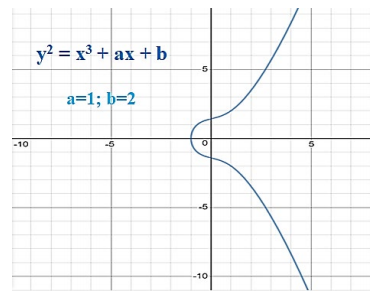
The elliptic curve points are found within the range where the x and y coordinate of the abelian group points lie within the range (0, p). A graph with the integer coefficients as a = 1 and b = 2 with the prime number p-value as 11 is shown in Figure 1. The points which satisfy this Weierstrass equation are tabulated in Table 1.
1.3. Objectives and scope of this research
With the support of basic cryptography techniques, this research aims to guarantee a high degree of security in the different vehicular communication protocols (V2V, V2I, and V2N) and to enable vehicles to securely receive all keys and messages from roadside units (RSU), other vehicles, or the network.
Effective security can be attained by incorporating Elliptic Curve Cryptography (ECC), which has the best security features.
The proposed ECC crypto processor supports the Koblitz curve secp256k1 for 256-bit point addition and multiplication.
The Karatsuba method follows the "divide and conquer" strategy that can asymptotically speed up multiplication.
The inclusion of pipelining speeds up the multiplication process of the ECC processor even further.
Key features of this research work ia as follows,
2. Materials and methods
2.1. Materials (algorithms and hardware architectures for ECC implementation)
2.1.1. Finite field arithmetic
Modular arithmetic is conducted for ECC which is done over the prime field. This wraps any number greater or equal to the prime number p to the range of 0 to p-1. Some of the modular arithmetic operations conducted in the Elliptic Curve Cryptography are addition, subtraction, multiplication, division, and multiplicative inverse. In division, the multiplicative inverse is needed for the computation since a / b mod p is defined as a ( b -1 (mod p). The multiplicative inverse can be found using the following algorithm (Parthasarathy, 2012).
Algorithm: Multiplicative inverse
while (r11 ! = 1)
To find the modulus value between two numbers a % b, the following algorithm (Rohn, 2012) has been incorporated irrespective of the sign of the numerator value ‘a’.
Algorithm: To find the modulus
2.1.2. Left to Right binary method
Assume that the curve has a point P and that we must determine the value of nP for some number n. Point addition and point doubling participate in this process (Gaur et al., 2019). The flow diagram of the binary Left to Right algorithm is shown in Figure 2.
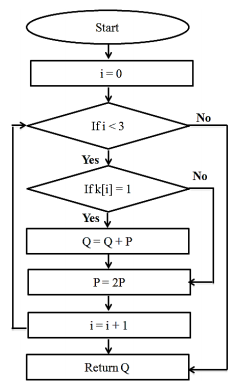
Algorithm: Left to Right binary method (Gaur et al., 2019)
If k[i] = 1,
then Q = Q + P // Point addition
P = 2P // Point doubling
2.1.3. Montgomery algorithm
The conventional algorithms are quite slow to compute multiplications like xy mod n because they need to divide the result to determine how many times n needs to be subtracted from the product. The lower bits are simply discarded after adding multiples of n to cancel them out rather than dividing the product and repeatedly removing n.
The modular Montgomery multiplier algorithm is as follows (Gaur et al., 2019).
If k[i] = 0,
then P = Q + P and Q = 2Q
Else,
then Q = Q + P and P = 2P
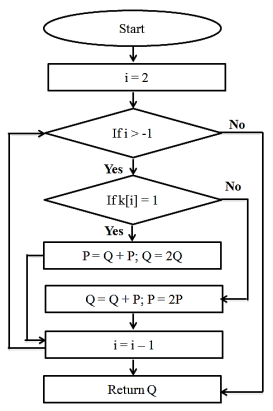
The flow diagram of the Montgomery algorithm is shown in Figure 3. In that, the Q point is set as infinite. i.e., Q = (0, 0) in the ECC curve initially as in binary Left to Right algorithm. k is generated as a binary stream of 3 bits (000 to 111) and is checked from the most significant bit (MSB). The loop is repeated for the length of binary stream ‘k’ times and finally, the Q value is returned as the output point of scalar multiplication (KS & Elavarasi, 2013).
2.1.4. Karatsuba algorithm
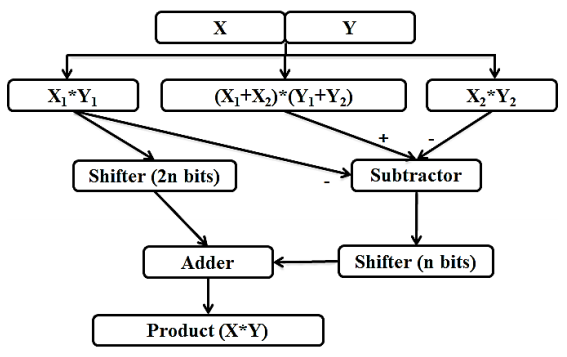
Divide-and-conquer is the fundamental idea behind Karatsuba's algorithm, which uses a formula to enable one to calculate the product of two large numbers, x and y, using three multiplications of smaller numbers, each with about half as many digits as x or y, along with some additions and digit shifts (Eyupoglu, 2015; Mishra & Pradhan, 2012).
The flow diagram of the Karatsuba Algorithm is shown in Figure 4, employs the divide and conquers strategy. By using addition operations rather than multiplication, this approach reduces the number of multiplier units needed to execute the largest multiplication (Mishra & Pradhan, 2012). The overall speed has increased since an adder operates faster than a multiplier.
2.2. Proposed methodology
The proposed ECC processor architecture's FPGA implementation methodology is presented in this section. The required curve order, coefficients, and base point coordinates are selected based on the NIST standard. In this research work, a 256-bit ECC processor has been considered. The ECC processor is designed using Verilog HDL, and simulation is performed using HDL Simulator. Xilinx ISE 14.6 was utilized for the synthesis, placement, and routing of the component. The proposed method implemented on the Virtex-7 (XC7VX485T-2FFG1761C) FPGA to attain the optimal speed and area.
Based on IEEE 802.11p, the first V2X technology was standardized. According to the IEEE 1609 series and SAE International (SAE) standard J2735, the V2X system using 802.11 OCB mode is also known as Dedicated Short-Range Communication (DSRC), and its upper layer is known as wireless access in vehicular environment (WAVE) (Houmer et al., 2022). Intelligent transport system G5 (ITS-G5) and C-ITS are the names given to ITS systems based on IEEE 802.11 OCB mode in Europe (Yoshizawa et al., 2022).
Elliptic Curve Cryptography (ECC) is used by ETSI ITS (ETSI, 2021) and IEEE 1609.2 (IEEE1609, 2016) to provide digital signatures and encrypt messages. However, it is well known that public key cryptography techniques now in use, particularly those relying on ECC, are weak in the face of a quantum computer (Shor, 1999). The size of the public key and signature from the ECC-based approach increases if we assume a code-based quantum-resistant signature mechanism. The ECC based crypto processor provides better resilience against the above parameter and the computational cost is also comparatively low (Kamaraj & Marichamy, 2022).
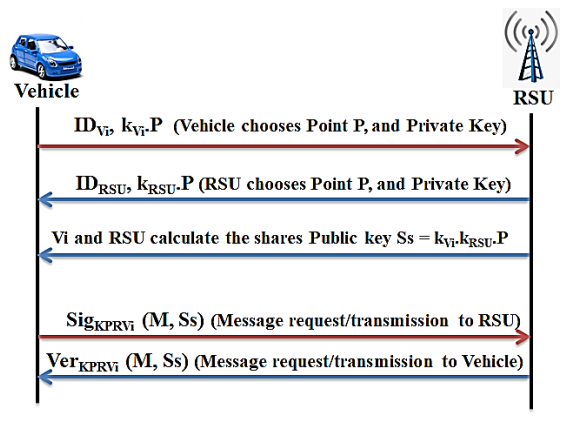
Figure 5 illustrates the procedure of authentication and communication between the vehicle and the roadside unit (RSU). We employ the elliptical curve encryption algorithm to ensure that the message authentication is secure for data transmission between vehicles as shown in Figure 6. The execution time (for key exchange, digital signature, and asymmetric encryption) of the ECC algorithm is comparatively faster than Diffie-Hellman (DH), digital signature algorithm (DSA) and RSA (Houmer et al., 2022).

2.2.1. Point multiplication and point doubling
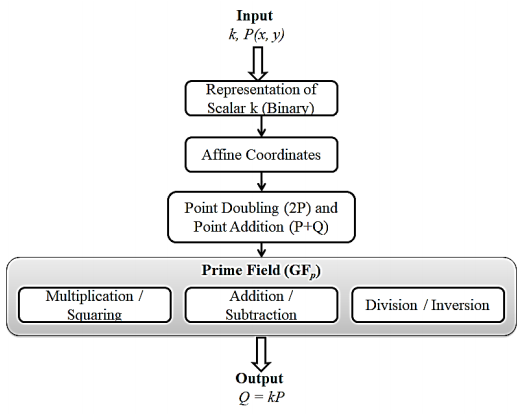
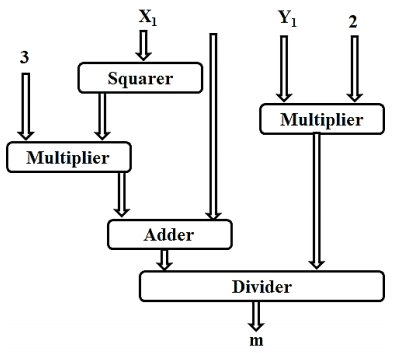
Multiplication of the ordered pair with a random integer is termed as point multiplication or scalar multiplication. The complex area in ECC is scalar multiplication which involves the computation of kP where P is a point on the abelian group (Kodali et al., 2015). The architectural design flow of scalar multiplication is shown in Figure 7a. Scalar multiplication is performed in the calculation of the public key (nb*G(x, y)), multiplication of the public key with a random integer (k*Pb (x, y)) and in the first pair of the ciphertext (k*G(x, y)). If the coordinates of points P and Q are equal, then point doubling is conducted. When Px = Qx and Py = Qy, then R (x, y) = 2P(x, y). The architecture of point doubling is shown in Figure 7b.
2.2.2. Point addition
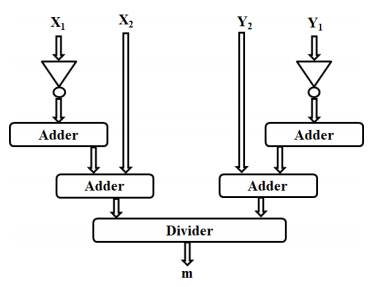
Two points that satisfy the abelian group, when added give a point that also satisfies the abelian group of the elliptic curve. That is when points P (x1, y1) and Q (x2, y2) are added it gives a point R(x, y) which lies in the ECC curve of the same Weierstrass equation. The architecture of point addition is shown in Figure 8. When the points P and Q are non-negatives of each other, the slope of the line that joins them is given by
The coordinates of the resultant point R are given by,
In point addition and point doubling, the Rx value is determined by the equation given below.
In point doubling since x1 and x2 are equal, Rx is also given by
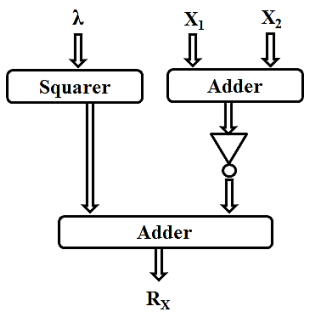
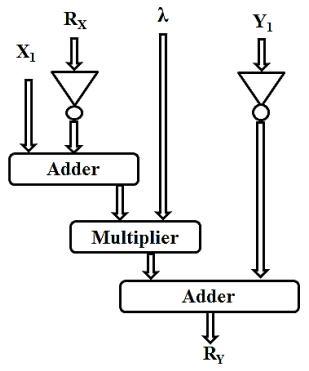
The architectural design for calculating Rx and 𝑅y is shown in Figure 9a and Figure 9b. In point addition and point doubling, the Ry value is determined by the equation given below.
3. Results and discussion
The proposed ECC processor architecture's FPGA implementation is presented in this section. Based on the NIST standard, the necessary parameters, including curve order, coefficients, and base point coordinates, are chosen. Here, a 256-bit ECC processor has been considered. Verilog HDL is used for the design of the ECC processor, and HDL Simulator is used for simulation. It was synthesized, placed, and routed with the help of Xilinx ISE 14.6. To achieve the optimal speed and area, the Virtex-7 (XC7VX485T-2FFG1761C) FPGA is employed in the proposed method. The performance factors throughput and efficiency are calculated based on Equation (6) (Kamaraj & Marichamy, 2022).
Cycle |
= Time for one ECPM × maximum frequency |
AT/Bit |
= Area-delay product / number of bits |
Throughput |
= (Maximum frequency × number of bits) / number of clock cycles |
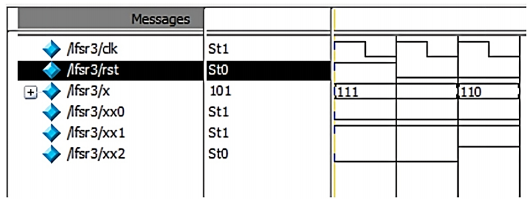
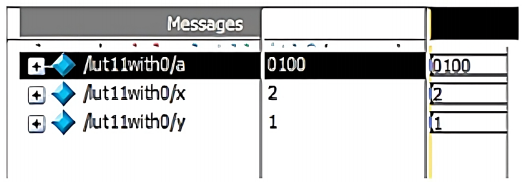
The simulation results of LFSR, lookup table, inverse lookup table, multiplicative inverse, modulus, point addition, point doubling, point multiplication (for Left to right, Montgomery, Karatsuba), encryption and decryption are shown in Figure 10 (a -l).
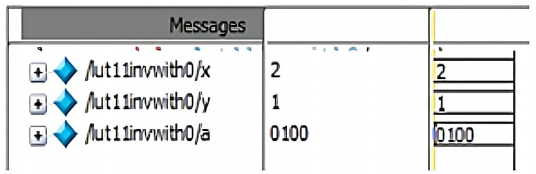
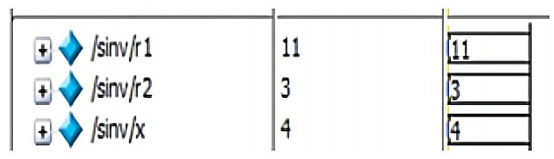
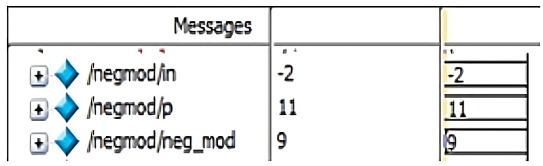
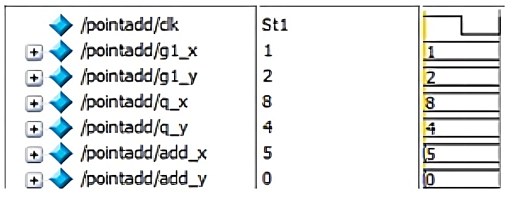
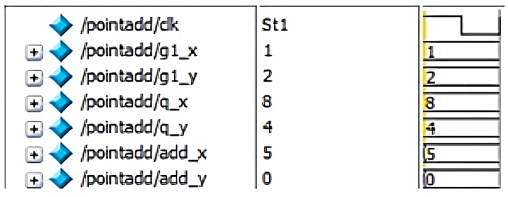
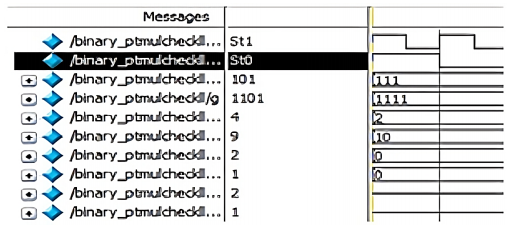
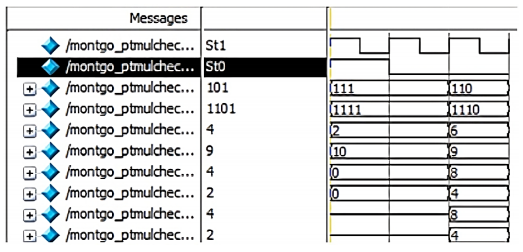
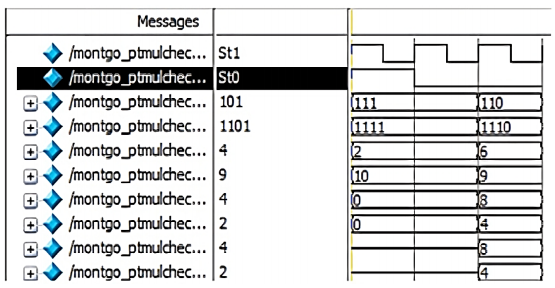
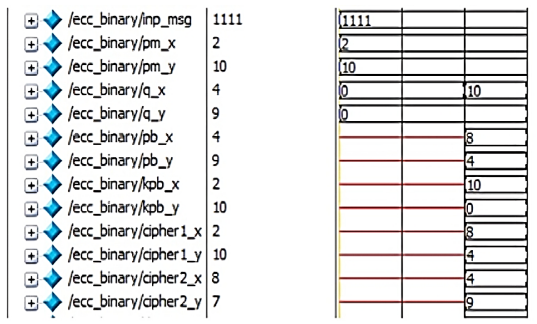
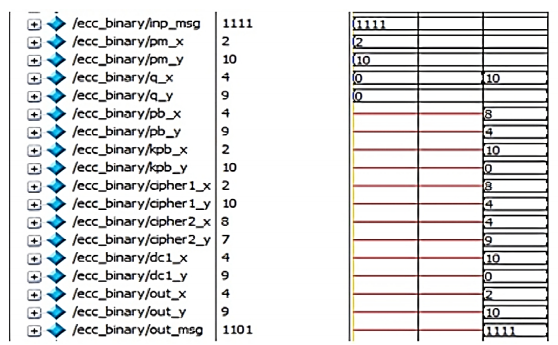
A nb and k are random integers that are used during the encryption and decryption of data. A Look-up table has the points having x and y-coordinates within a range [0, p-1] that satisfies the chosen ECC curve. Similarly, for each binary input, the data is mapped to the lookup table that is initialized and the data of the x and y-coordinates are stored to the respective points that are considered. Initially for the input message the s and u coordinate are mapped to the Pm(x,y). In Figure 10f, the input points are (a,b) (c,d) and the resultant point addition is available in (x3, y3).
During transmission of the encrypted data and during decryption the point must be mapped again to the binary stream. This is done using the inverse look-up module. Using the extended Euclidean algorithm, the multiplicative inverse is found. Point multiplication calculates the value of kP where k is of the binary form (kt-1, kt-2,….k0)2 and P is a point on the ECC curve. To encrypt a message of binary form, it is mapped to a point in the elliptic curve; this point is considered as Pm. A random generator point G is considered for encryption as shown in Figure 10k according to C1 (x, y) = k * G (x, y); C2 (x, y) = Pm (x, y) + [k * Pb (x, y)]. The two-cipher text point calculated as C1 and C2 form the encrypted data. Reconstructed plaintext is found in the simulation shown in Figure 10l according to Pm = C2 (x, y) - [nb * C1 (x, y)].
This yields an ordered pair of (x, y) which is further mapped with the inverse lookup table to generate the binary stream of data. The complete ECPM is completed in 229.63k cycles for Karatsuba based point multiplication without pipeline and 223.38k cycles for pipelined version. The Karatsuba pipelined ECC implemented on Virtex-7 occupies 8.42k slices, takes 223.38k clock cycles for process completion, the maximum operating frequency is 232.60MHz, and the process takes 0.937ms to complete as shown in Table 2. The area-delay product and throughput are 7.89 and 262.30kbps, respectively. The pipelined ECC has 32.45% efficiency. The pipelined ECC has 10.99% and 8.36% improvement in throughput and efficiency concerning non-pipelined implementation. This is due to the increased frequency of operation (238.40MHz) of pipelined architecture. It leads to an additional 2.43% overhead on the area, but the area-delay overhead is reduced by 7.71%.
Table 2 Performance of proposed ECC processor.
| Algorithm | Platform | Number of bits | Number of Slices (k) | Clock Cycles (k) | Maximum Frequency (MHz) | Time (ms) | Area Delay Product | AT/B | Throughput (kbps) | Efficiency |
|---|---|---|---|---|---|---|---|---|---|---|
| Montgomery | Virtex-7 (woP) | 256 | 8.46 | 239.39 | 198.50 | 1.21 | 10.20 | 0.0399 | 212.27 | 25.09 |
| Binary Left to Right | 8.26 | 234.14 | 216.80 | 1.08 | 8.92 | 0.0348 | 237.04 | 28.70 | ||
| Karatsuba | 8.22 | 229.63 | 220.80 | 1.04 | 8.55 | 0.0334 | 246.15 | 29.95 | ||
| Montgomery | Virtex-7 (wP) | 8.62 | 232.97 | 228.40 | 1.02 | 8.79 | 0.0343 | 250.98 | 29.12 | |
| Binary Left to Right | 8.46 | 227.02 | 232.60 | 0.98 | 8.26 | 0.0323 | 262.30 | 31.00 | ||
| Karatsuba | 8.42 | 223.38 | 238.40 | 0.94 | 7.89 | 0.0308 | 273.21 | 32.45 | ||
| Percentage of Improvement | woP Vs wP | 1.89 | -2.68 | 15.06 | 15.42 | 13.82 | 13.82 | 18.24 | 16.04 | |
| 2.42 | 3.04 | 7.29 | 9.63 | 7.44 | 7.44 | 10.66 | 8.04 | |||
| 2.43 | 2.72 | 7.97 | 9.90 | 7.71 | 7.71 | 10.99 | 8.36 | |||
| Karatsuba vs Montgomery | Virtex-7 (woP) | 2.84 | 4.08 | 11.23 | 13.76 | 16.21 | 16.21 | 15.96 | 19.35 | |
| Karatsuba vs Binary | 0.48 | 1.93 | 1.85 | 3.70 | 4.17 | 4.17 | 3.85 | 4.35 | ||
| Karatsuba vs Montgomery | Virtex-7 (wP) | 2.32 | 4.12 | 4.38 | 8.14 | 10.27 | 10.27 | 8.86 | 11.44 | |
| Karatsuba vs Binary | 0.47 | 1.60 | 2.49 | 4.00 | 4.45 | 4.45 | 4.16 | 4.66 |
Table 3 provides the performance comparison improvement of Karatsuba PM based ECC concerning Montgomery and binary Left to Right algorithm. It is observed that the performance has improved in the range of 0.47-2.84%, 1.60-4.08%, 2.49-11.23%, 4.45-16.21%, 4.16-15.96% and 4.66-19.35% in number of slices, clock cycles, maximum frequency, area delay product (AT/B), Throughput and efficiency, respectively.
Table 3 Performance comparison of Karatsuba ECC and other ECC.
| Improvement of Karatsuba w.r.t. | Pipeline | Number of Slices (%) | Clock Cycles (%) | Maximum Frequency (%) | Time (%) | Area Delay Product | AT/B | Throughput (%) | Efficiency |
|---|---|---|---|---|---|---|---|---|---|
| Montgomery | No Pipeline | 2.84 | 4.08 | 11.23 | 13.76 | 16.21 | 16.21 | 15.96 | 19.35 |
| Binary Left to Right | 0.48 | 1.93 | 1.85 | 3.70 | 4.17 | 4.17 | 3.85 | 4.35 | |
| Montgomery | Pipeline | 2.32 | 4.12 | 4.38 | 8.14 | 10.27 | 10.27 | 8.86 | 11.44 |
| Binary Left to Right | 0.47 | 1.60 | 2.49 | 4.00 | 4.45 | 4.45 | 4.16 | 4.66 |
Table 4 shows the quality attributes of the ECC implementation in FPGA. For implementation considerations, various FPGA families including Virtex-4, 5, 6, 7 and Kintex-7 are employed in this research. Except for (Shor, 1999; Kamaraj & Marichamy, 2022), where 192 and 193 bits, respectively, are taken into consideration, most researchers created their designs for the 256-bit size ECC. The key major performance parameters considered for the analysis are area, throughput, efficiency, maximum operating frequency, number of clock cycles, and area-delay product.
Table 4 Performance comparison of proposed ECC.
| Ref | Year | Platform | Number of bits | Number of Slices (k) | Clock Cycles (k) | Maximum Frequency (MHz) | Time (ms) | Area Delay Product | ϸAT/B | Throughput (kbps) | ϸEfficiency |
|---|---|---|---|---|---|---|---|---|---|---|---|
| Ours | 2023 | Virtex-7 (woP) | 256 | 8.46 | 239.39 | 198.50 | 1.21 | 10.20 | 0.0399 | 212.27 | 25.09 |
| 8.26 | 234.14 | 216.80 | 1.08 | 8.92 | 0.0348 | 237.04 | 28.70 | ||||
| 8.22 | 229.63 | 220.80 | 1.04 | 8.55 | 0.0334 | 246.15 | 29.95 | ||||
| Virtex-7 (wP) | 8.62 | 232.97 | 228.40 | 1.02 | 8.79 | 0.0343 | 250.98 | 29.12 | |||
| 8.46 | 227.02 | 232.60 | 0.98 | 8.26 | 0.0323 | 262.30 | 31.00 | ||||
| 8.42 | 223.38 | 238.40 | 0.94 | 7.89 | 0.0308 | 273.21 | 32.45 | ||||
| (Kamaraj & Marichamy, 2022) | 2023 | Virtex-7 | 256 | 8.23 | 232.2 | 192.5 | 1.2062 | 9.927 | 0.03878 | 212.23 | 25.79 |
| 8.46 | 212.4 | 226.8 | 0.9365 | 7.922 | 0.03095 | 273.36 | 32.31 | ||||
| Virtex-6 | 8.82 | 232.2 | 186.2 | 1.247 | 10.99 | 0.04296 | 205.29 | 23.27 | |||
| 9.12 | 212.4 | 216.8 | 0.98 | 8.93 | 0.03491 | 261.30 | 28.65 | ||||
| (Islam et al., 2020) | 2020 | Virtex-7 | 256 | 6.5 | 198.7 | 104.39 | 1.9 | 12.35 | 0.0482 | 134.49 | 20.69 |
| 2020 | Virtex-6 | 256 | 6.6 | 198.7 | 93.23 | 2.13 | 14.05 | 0.0549 | 120.12 | 18.20 | |
| (Islam et al., 2019) | 2019 | Virtex-7 | 256 | 8.9 | 262.7 | 177.7 | 1.48 | 13.17 | 0.051 | 173.2 | 19.46 |
| 2019 | Virtex-6 | 256 | 9.2 | 262.7 | 161.1 | 1.63 | 15.00 | 0.059 | 157.00 | 17.06 | |
| (Shah et al., 2019) | 2018 | Virtex-6 | 256 | 65.6 | 153.2 | 327 | 0.47 | 30.83 | 0.120 | 546.42 | 8.33 |
| (Hu et al., 2018) | 2018 | Virtex-4 | 256 | 9.4 + 14DSPs | 610 | 20.44 | 29.84 | 280.5 | 1.096 | 8.58 | 0.91 |
| (Hossain et al., 2017) | 2017 | Kintex-7 | 256 | 11.3 | 397.3 | 121.5 | 3.27 | 63.95 | 0.144 | 78.28 | 6.92 |
| (Asif et al., 2017) | 2017 | Virtex-7 | 256 | 24.2 | 215.9 | 72.9 | 2.96 | 71.63 | 0.280 | 1816.20 | 3.57 |
| (Kodali et al., 2015) | 2017 | Virtex-4 | 193 | 12 | 459.9 | 36.5 | 12.6 | 151.2 | 0.783 | 20.32 | 1.69 |
| (Javeed et al., 2017) | 2017 | Virtex-4 | 256 | 20.6 | 191.6 | 49 | 3.91 | 80.55 | 0.315 | 65.47 | 3.18 |
| (Javeed & Wang, 2017) | 2016 | Virtex-4 | 256 | 13.2 | 200 | 40 | 5 | 66 | 0.258 | 51 | 3.88 |
| (Javeed & Wang, 2016) | 2016 | Virtex-4 | 192 | 35.7 | 207.1 | 70 | 2.96 | 105.67 | 0.550 | 86.53 | 2.42 |
| (Marzouqi et al., 2015) | 2016 | Virtex-5 | 256 | 8.7 | 361.6 | 160 | 2.26 | 19.66 | 0.077 | 113.27 | 13.02 |
Table 4 proves that higher operating frequency reduces the number of clock cycles needed, speeds up completion times, and improves throughput. The area, speed, and throughput of the proposed pipelined Karatsuba multiplier are all optimized. In comparison to all the earlier works, the efficiency of the suggested method is better. Furthermore, the efficiency of the multiplication process has increased up to 32.45% through pipelining. Table 3 does not include the older FPGA research employing the Virtex-I Pro, Virtex-E, and Spartan 4 processors for comparison purposes because of their high-power consumption and constrained input/output capabilities. The better the communication the smooth intelligent transport systems are possible (Kamaraj et al., 2016).
4. Conclusions
The establishment of vehicle communication networks currently is a pertinent solution to guarantee the security of road users and improve traffic flow. Sharing information between vehicles (V2V) and between vehicles and infrastructure (V2I) and networks (V2N) is consequently important. The authentication and secrecy of data exchanged between entities are one of the issues that have developed in these networks. This paper develops an area efficient, high-speed ECC processor based on the secp256k1 Koblitz curve. It provides prime field-based 256-bit point addition and multiplication. In this research, Karatsuba multiplication is used to enhance performance. The pipeline technology accelerates multiplication much more. For the 256-bit prime field, the proposed pipelined Karatsuba multiplier based ECC processor is implemented on the Xilinx Virtex-7 FPGA. The implemented pipelined processor performs a single 256-bit multiplication in 0.937ms with a maximum clock frequency of 238.40MHz, which provides 273.21kbps throughput and occupies 8.42k slices in Virtex-7 FPGA. Incorporating pipeline in scalar multiplication improves the maximum clock frequency up to 7.97%, and reduces time by 9.90%, which in turn increases the throughput by 10.99%. The pipeline has an additional area overhead of 2.43% in Virtex-7. Also, the Karatsuba multiplier based ECC is providing better than the Montgomery and Left to Right algorithm based ECC. In terms of area, clock cycle count, operating frequency, time, area-delay product, throughput, efficiency, and security, the pipelined Karatsuba multiplier based ECC processor performs better than the existing designs. Based on the proposed ECC processor's overall performance, it is possible to conclude that both resource-constrained applications and V2X communication can utilize it with reliability.

