




 nueva página del texto (beta)
 Inglés (pdf)
 Artículo en XML
 Referencias del artículo
 Traducción automática
 Enviar artículo por email
 Citado por SciELO
  Similares en
SciELO
Similares en
SciELO 
 Permalink
1. Introduction
In this section various control strategies described by the researchers have been presented.
1.1. Open loop control
Zhao et al. (2004) have developed a novel Volt/Hz scheme for extra high speed Permanent magnet synchronous motor (PMSM). Chandra et al. (2015) have presented an open-loop control technique with space vector PWM scheme PMSM Drive. Liu et al. (2017) have proposed stability operation of PMSM Drive in open loop. Tang and Akin (2017) have developed an improved least-mean-square (LMS) based algorithm to minimize dead-time glitches in PMSM V/F controller techniques. For commercial appliances such as fan, thrust, and compressor drive, a cost-effective sensor-less controller scheme of PMSM constructed on Volt/Hz control is developed by Tu et al. (2017).
Volt/Hz control scheme PMSM Drive is proficient in acquiring relief from the pricey rotor location sensor and it has vast investigative importance. This scheme for PMSM Drive is proposed by Aijun and Xinhai (2017). (Pacha & Zossak, 2019), starting of PMSM Drive in open loop has been described.
1.2. PMSM MTPA control
Ahmed et al. (2017) have presented a novel MTPA technique for IPMSM motor with online search algorithm. Wide speed control concerning machines nonlinearity has been described (Ge et al., 2016). Lai et al. (2018) have proposed a novel MTPA based scheme with speed harmonics measurement. Li et al. (2019) have developed MTPA control method which is independent of drive parameter. de Castro et al. (2020) have presented an ANN based MTPA control algorithm.
Han and Liu (2021) have described the effect of vibration and noise in MTPA control PMSM Drive. Lee and Choi (2022) have proposed MTPA control with P&O algorithm for PMSM Drive. Huang et al. (2023) have investigated an offline data based MTPA control technique for IPMSM drive.
1.3. PMSM field weakening control
Sun et al. (2017) have developed a novel flux weakening algorithm with hybrid dual inverter technique. DC link voltage has been more utilize by this scheme. Xu et al. (2019) have explained swarm optimization scheme for flux weakening control in PMSM Drive. Zheng and Sun (2020) have investigated cost function predictive model flux control scheme for PMSM motor. The advantage of this method is to increase the torque at greater speed. Zheng et al. (2020) also studied the predictive model technique. Wang et al. (2022) have proposed a novel modulation technique for PMSM Drive.
1.4. Fractional order PI controller
Rajasekhar et al. (2011) have developed a special hybrid PSO FO-PI scheme for PMSM Drive. Li et al. (2014) have proposed FO-Pi scheme for PMSM Drive. Thakar et al. (2016) also explained the FO-PI technique for PMSM Drive.
Kumar et al. (2021) have presented the FO-PI scheme for PMSM Drive speed control. The system was developed in a labview, and an evaluation of FOPI and Existing PI was studied. Li et al. (2023) have proposed the FO-PI scheme to minimize for voltage faults in PMSM Drives.
The usefulness of a fractional order-proportional integral (FO-PI) controller in optimizing the dynamics of a dynamic system has been examined. The efficiency of the FO-PI controller was found to have the potential to improve the performance of dynamical systems.
The characteristics of the system better matched the response of the controller by modifying the fractional order exponent of FO-PI control. Additionally, because they enable more precise control of the transient response, the proposed controllers help to reduce overshoot and rise time in dynamical systems and enable smoother transitions between various control modes or set points.
2. Suggested control scheme
This paper presented the various PMSM Drive speed control schemes. The Figure 1 shows the proposed scheme.
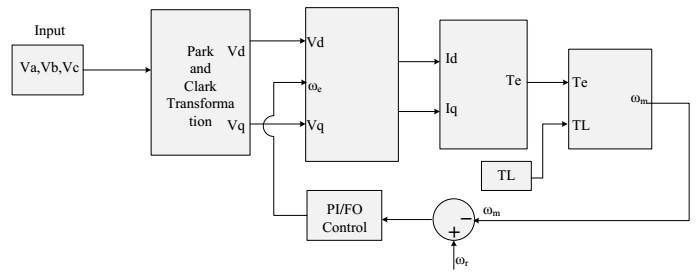
The voltage and current of the drive are used to compute the momentum of the motor. So, the sensor is not used for speed sensing.
Clark and Park's conversions are used for vector control. Calculated speed is then compared with reference speed then a FOPI control is being used to minimize error. FOPI is superior to exiting PI controller. The FOPI gives smother transitions between different states.
2.1. Vector transforms
Park’s and Clark's transformations are key to vector control. The transformation function is used is given by following program.
𝑓𝑢𝑛𝑐𝑡𝑖𝑜𝑛 [𝑣𝑑, 𝑣𝑞] = 𝑃𝑎𝑟𝑘𝐶𝑙𝑎𝑟𝑘𝑒(𝑣𝑎, 𝑣𝑏, 𝑣𝑐, 𝑡ℎ𝑒𝑡𝑎)
𝑖𝑓 𝑖𝑠𝑒𝑚𝑝𝑡𝑦 (𝑡ℎ𝑒𝑡𝑎)
𝑡ℎ𝑒𝑡𝑎 = 0;
𝑒𝑛𝑑
𝑣𝑑 = (2/3) ∗ (𝑣𝑎 ∗ 𝑐𝑜𝑠(𝑡ℎ𝑒𝑡𝑎)+ 𝑣𝑏 ∗ 𝑐𝑜𝑠(𝑡ℎ𝑒𝑡𝑎 − (2 ∗ 𝑝𝑖/3))+ 𝑣𝑐 ∗ 𝑐𝑜𝑠(𝑡ℎ𝑒𝑡𝑎 + (2 ∗ 𝑝𝑖/3)));
𝑣𝑞 = (2/3) ∗ (−??𝑎 ∗ 𝑠𝑖𝑛(𝑡ℎ𝑒𝑡𝑎)− 𝑣𝑏 ∗ 𝑠𝑖𝑛(𝑡ℎ𝑒𝑡𝑎 − (2 ∗ 𝑝𝑖/3))− 𝑣𝑐 ∗ 𝑠𝑖𝑛(𝑡ℎ𝑒𝑡𝑎 +(2 ∗ 𝑝𝑖/3)));
𝑒𝑛𝑑
3. Control schemes for PMSM Drives
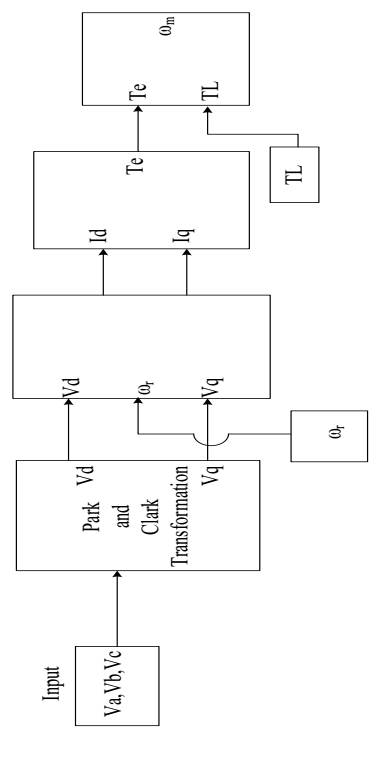
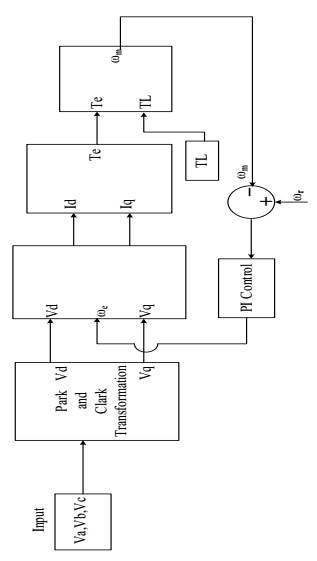
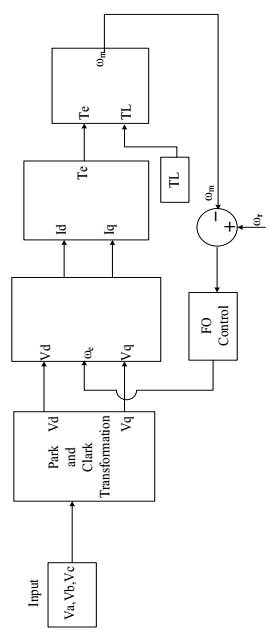
Different techniques to control the PMSM Drive have been presented in this section and simulated in MATLAB. The block diagrams have been depicted of these schemes.
In open loop, there is no feedback signal to speed; only reference speed is used as shown in Figure 2. In closed loop, there is a feedback signal of the speed; this signal is compared with the reference signal as shown in Figure 3. The PI regulator reduced the fault signal and the 2-𝜙 quantity is being transformed to 3- 𝜙 before being applied to the PWM inverter PMSM Drive.
Two manage loops have been used. The interior loop controls the motor's stator currents. The external loop with FOPi controller controls the rpm of the motor as depicted in Fig.4. A 3 − 𝜙 PMSM driven via a PWM inverter. The PWM inverter is designed by using the MATLAB library. Its output passes through the restricted voltage source blocks before giving to the stator windings of the PMSM Drive.
4. Simulation results and discussion
Figure 5 shows the open-loop control of PMSM Drive.
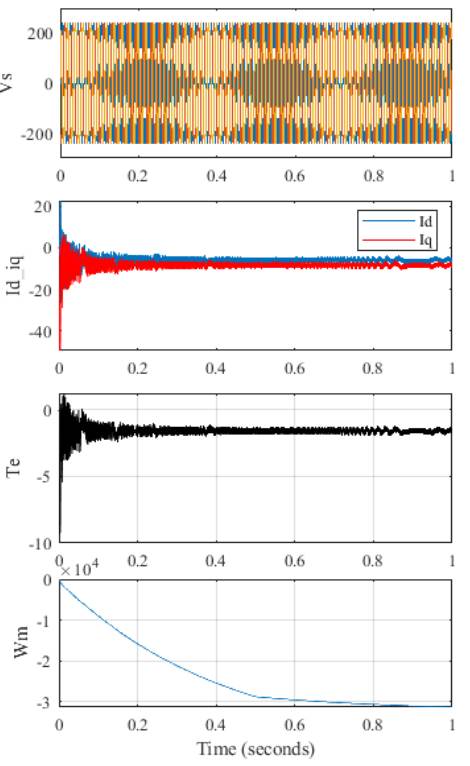
In open-loop system no feedback signal for the speed so the desired speed is not achieved with this, we must use some closed-loop system for this.
As shown in Figure 6 the closed-loop PI control PMSM Drive, the desired speed around 300 rps achieved and the is 3Nm; After 0.5 sec. load torque reduced and the torque is 1 Nm.
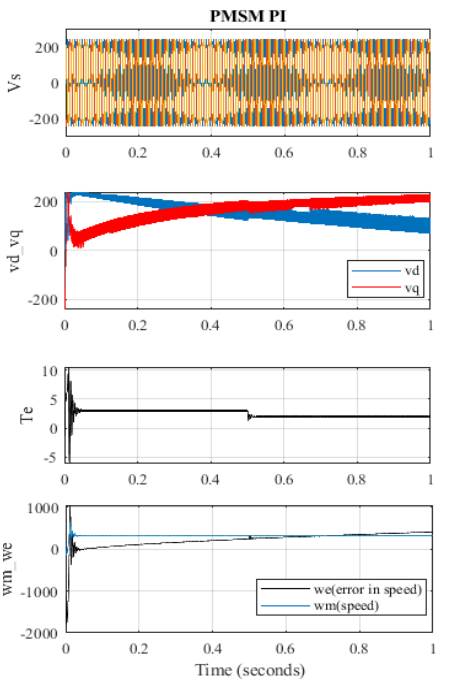
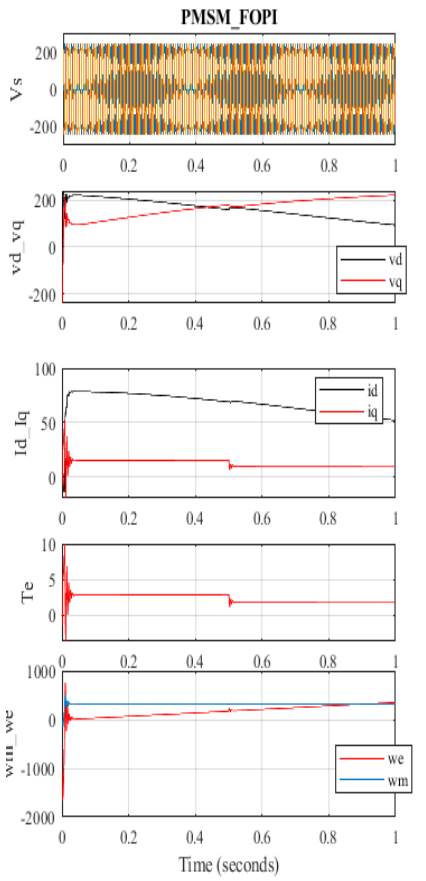
Figure 7 shows the FO control PMSM Drive. The results are better the existing PI control. Torque and speed are found very stable. A comparison of the speed and torque has been provided in the Section 4.2.
4.1. Fractional order proportional integral (FOPI) controller
A FOPI (Qureshi & Sharma, 2023) employed in the speed loop of the PSMM drive is represented in Figure 8.
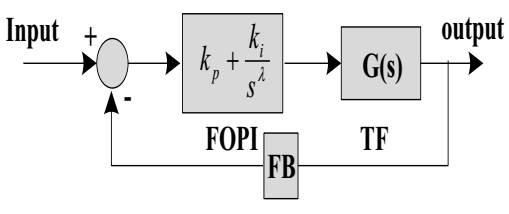
The transferal function of a FOPI is given by (1).
Where, 𝜆 is a positive real parameter between 0 and 1.
In FOPI controller values can be tuned by different ways. But in our system, a simple method is being used, because of their commercial used purpose. The parameter of 𝑘𝑝 and 𝑘𝑖 changed by existing hit and trial method for pi controller and value of 𝜆 in FOPI is set via same method to achieve the desired response.
4.2. Comparison of FOPI and PI control techniques
Figure 9 Shows speed comparison of controllers.
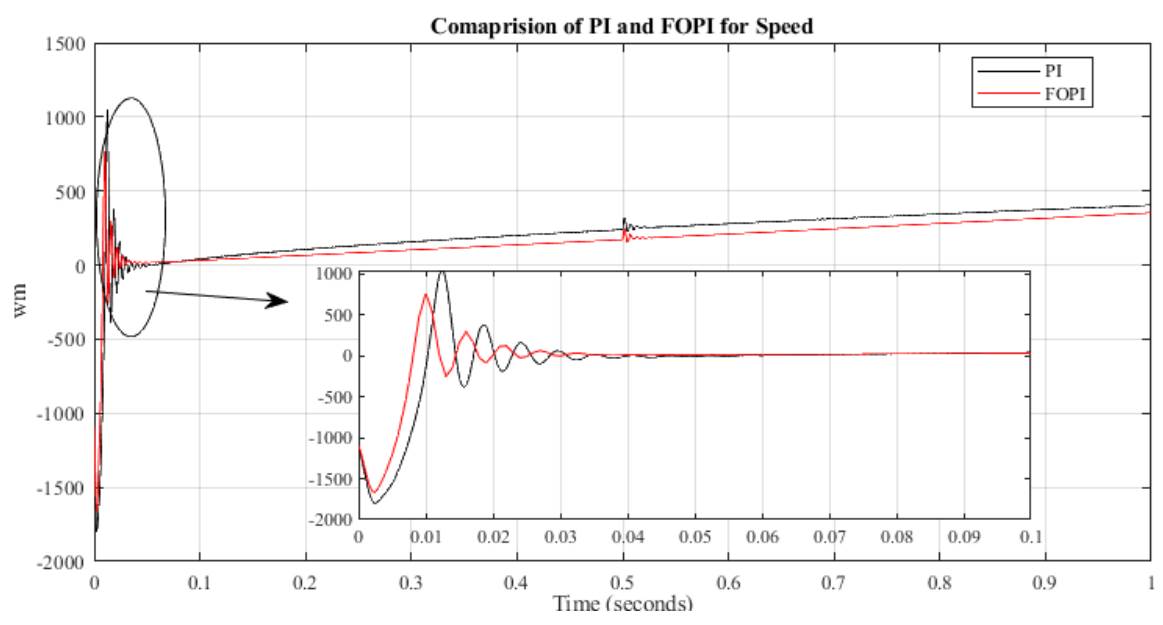
Using FOPI controller speed reaches stable condition faster the PI as depicted in Figure 9. As seen from the starting of motor. The Figure 10 shoes the torque comparison between the PI and FOPI controller, FOPI has smother response than PI controller as seen from the Figure 10 FOPI control waveform has fewer transients the PI.
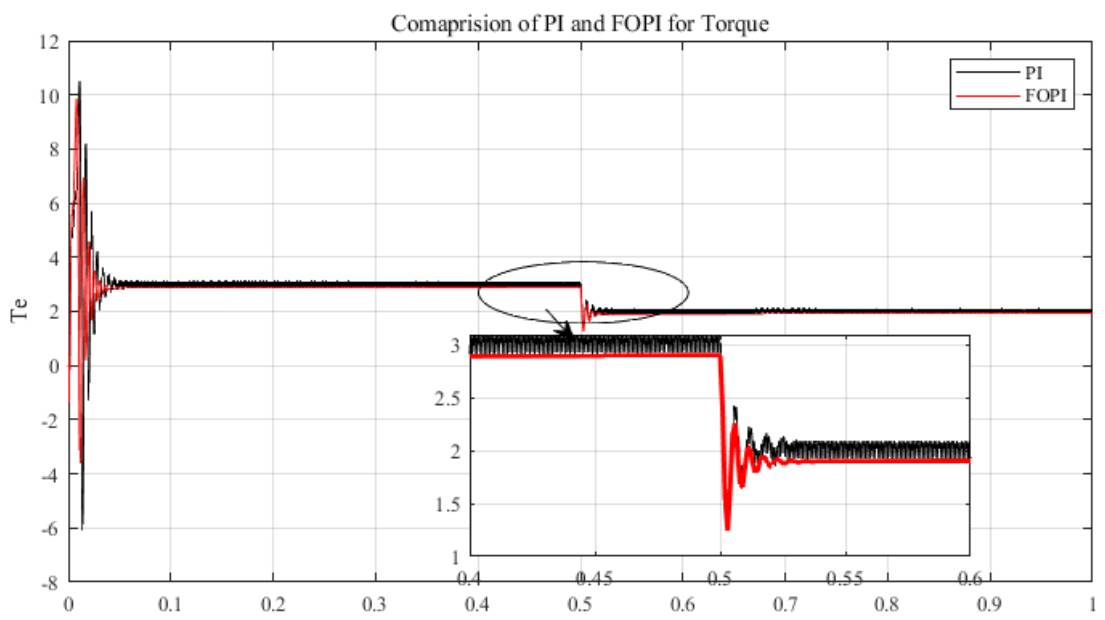
The Table 1 has been presented the comparison of FOPI and PI controller.
Table 1 Comparison of FOPI and PI.
| Parameter | FO Control | PI Control |
|---|---|---|
| Response time | Very good | Good |
| Stability | Much faster to reach stable condition than PI | Better than open loop but not as FOPI |
| Dynamic system | Smother transient response than PI. | Good but not as FOPI |
| Switching | Switching in different states is smother than PI | God but not as FOPI |
| Fluctuations | Less fluctuation in motor | Fluctuations are more compared to PI |
5. Conclusion and Future Scope
In this the speed-toque control of PMSM Drive using PI and Fractional Order Control methods has been presented. The open-loop PMSM Drive is easy to implement for the low cost and small industrial applications. The close loop PMSM Drive has been used widely in many applications like, EVs, HEVs, Water Pumping and etc. Here a comparison of existing PI controller with FO controller has been presented. Fractional Order Controller provides smother transient response and better stability control the existing PI controller.
For the Future Scope, further research the purposed Fractional Order Controller may be used in many multi-order systems and with other Artificial Intelligent system.

