




 nueva página del texto (beta)
 Inglés (pdf)
 Artículo en XML
 Referencias del artículo
 Traducción automática
 Enviar artículo por email
 Citado por SciELO
  Similares en
SciELO
Similares en
SciELO 
 Permalink
1. Introduction
According to the World Economic Forum (2022), digital payments are usually the gateway to financial inclusion, especially for recipients of remittances and government transfers. This is relevant, since the evidence has shown that financial inclusion tends to benefit low-income households more, since it can contribute to boost growth and employment, to reduce inequalities and poverty, and to a more effective management of financial shocks (Collins et al., 2009; Maravalle & Gonzalez Pandiella, 2022; Patnam & Weijia Yao, 2020; Suri, 2017). Mexico is no exception, 37.8% of the population in Mexico was in a situation of working poverty as of the second quarter of 2023, that is, close to 49.6 million people in the country were not capable of covering the cost of the food basket with their labor income (BBVA, 2023). According to the guidelines of the Prospera Social Inclusion Program, through the promotion of savings, the acquisition of credits and insurance, the standard of living of its beneficiaries will increase. Likewise, a positive causality of savings to the per capita income of the economically lagging population (Reyna, 2020). Some advantages of financial inclusion by digital payments are greater efficiency in the generation of information and the possibility of offering more personalized financial products.
Maravelle and González (Maravalle & Gonzalez Pandiella, 2022) affirm that digital payments increase the speed of making and receiving payments, while reducing its costs, security risks and help reduce crime. Similarly, Ozili (Ozili, 2018) argues that access to digital financial services can make it easier for low-income individuals to have financial tools that do not imply incurring travel costs or loss of working hours. It should be noted that, according to the National Banking and Securities Commission (CNBV, 2021), the average transfer time to a branch of a financial institution in Mexico is 39 minutes in rural areas; and Acevedo & Székely (Acevedo & Székely, 2021) estimate that for a person with an income of less than 5.5 dollars a day, going to an ATM can represent up to 97.7% of the monetary value of the poverty line.
The World Economic Forum (World Economic Forum & IDB Lab, 2022) points out that digital payments are strong drivers for digital commerce, since they allow people and companies to pay and receive payments quickly and safely, encouraging trade and economic growth; thus, being connected to digital payments also has a positive impact on the resilience and growth of micro, small, and medium-sized enterprises (MSMEs), as well as entrepreneurship in the country, which is one of the drivers for upward social mobility. Also joining the payments network allows MSMEs the possibility of selling online, having more customers and sales channels; and to reduce costs of physical facilities and inventories, allowing them to offer a greater variety of products and to reduce the physical distance between suppliers and customers. However, entrepreneurs in Mexico perceive more obstacles than advantages when joining the payments network, due to the requirements and costs to formalize, such as high bank fees and taxes (De la Calle, 2022).
As a result, Maravelle & González (Maravalle & Gonzalez Pandiella, 2022) estimate that only 35% of companies in Mexico accept digital payments, which means that online purchases in the country are much lower than in countries like Chile or Brazil. Some barriers that have been identified for a greater adoption of digital payments in Mexico are: the regulatory framework, the lack of standardization and uncompetitive market structures, infrastructure deficiencies, and general barriers to financial inclusion (World Economic Forum & IDB Lab, 2022); as well as the preference for cash, mistrust of the financial sector, and gaps in ages and those who live between urban and rural areas (Maravalle & Gonzalez Pandiella, 2022).
In this regard, many studies have analyzed if financial services create value to their customers and to other related stakeholders. One approach is the Service-Dominant Logic (SDL), which focuses on the processes of serving, rather than on the output in the form of a product offering (Lehrer et al., 2018). This view assumes that service innovation has shifted from a focus on firms’ products and services, to a focus on new ways of creating customer value through service processes, and financial services are not the exception. Hence, it is considered relevant to analyze how digital payments contribute to financial inclusion and if the SDL incentivizes a wider adoption of them, with the aim to provide evidence for policymakers and practitioners, to achieve a greater impact in the financial health of Mexican MSMEs and households.
The case study for this research is the company Trade E-fectivo Electrónico (https://www.efectivotech.com/index.php/es/), a technological solutions firm which offers financial products and services for the population of rural and semi-urban communities with less than 50,000 habitants, through partnerships with Cooperative Financial Institutions, Credit Unions, and similar institutions. The field research for this work took place in the town of Cuetzalan Puebla, in Mexico, a community in which E-fectivo has been engaged since it joined the collaboration network “Nodo de Impulso a la Economía Social y Solidaria (NODESS): Ecoturismo y su cadena de valor”; with the aim to verify if the local population and tourists perceive the technological application for financial services as a good and useful service from SDL. The study encompasses five different dimensions: 1) financial inclusion, 2) user experience, 3) personalization, 4) relationship and 5) financial education. The research questions are:
¿Does the use of the digital payment’s apps are easy to use and safe?
¿Does the user perceive value in using digital payment apps in presence of the SDL dimensions?
For that, the structure of this paper is as follows: the first section presents the literature review of the main theories and authors that support the development of this work; the second section describes the methodology followed; the next section shows the findings and results of the study; and, finally, it is described the main conclusions.
2. Literature review
2.1. Financial inclusion
According to the World Bank (World Bank Group, 2022), financial inclusion means that individuals and businesses have access to useful and affordable financial products and services that meet their needs - transactions, payments, savings, credit, and insurance - delivered in a responsible and sustainable way. Financial inclusion thus encompasses several dimensions including the access, use, quality, and affordability of financial services, as well as the level of financial literacy among the population. Financial inclusion is key to boosting economic and social inclusion and removing barriers to financial access is included among the key enablers for achieving Sustainable Development Goals (SDG) of the United Nations Organization of the 2030 Agenda (Cassimon et al., 2022). Often, financial inclusion refers to the availability of only financial resources for the broad layers of society and small and medium-sized businesses, although it is a far more common concept and includes a wide range of quality financial products and services, including loans, deposit services, insurance, pensions, and payment systems, as well as financial education and consumer protection mechanisms (Priale Reyes, 2010). Since 2012, financial inclusion in Mexico has been measured every three years with the National Survey of Financial Inclusion (ENIF for its acronym in Spanish), which is applied to a representative sample of the population 18 years of age or older. It includes sections on financial well-being, customer protection, the level of trust in financial institutions, preferred channels, and the level of digitization. There is a consensus in the literature that efficient and effective access to formal financial services is an important condition for people to improve their well-being, since it allows better management of income cycles, coverage, and diversification of financial risks, taking advantage of productive opportunities and consolidating a heritage (Bakar & Sulong, 2018; Churchill & Marisetty, 2020; Karlan Dean et al., 2016; Koomson et al., 2020).
Financial inclusion can help reduce poverty and inequality by helping people invest in the future, smooth their consumption, and manage financial risks. Access to formal financial services allows people to make financial transactions more efficiently and safely (Demirgüç-Kunt Asli et al., 2017; Klapper & Singer, 2014). In this sense, Beck, Demirgüç-Kunt and Levine (Beck et al., 2007) conclude that financial development contributes to the increase in the income of the lowest income segments in a greater proportion than in the upper income segments. Likewise, the literature agrees that financial inclusion has a positive impact on the wealth and prosperity of households, as well as on the reduction of poverty (World Bank Group, 2022).
Another positive impact of financial inclusion is that it can promote upward social mobility through investment in human capital and entrepreneurship and financial inclusion provides means to better address economic shocks that can cause downward social mobility, such as job loss or the death of a family breadwinner (Demirgüç-Kunt Asli et al., 2017). With a bit less than 70% of adults using at least one financial service in 2018, financial inclusion in Mexico remains low in international comparison (Cassimon et al., 2022). Moreover, access to financial services is significantly unequal across income levels, gender, between rural and urban areas and across states. Around one-eighth of Mexico’s municipalities does not have even one financial access point, though most of them are in sparsely inhabited rural areas. Ozili (Ozili, 2018) affirms that the excluded population does not have the incentives to make use of formal financial services, being exposed to regulatory risks and lacking cheap and good quality internet connectivity. For instance, Cassimon et al. (Cassimon et al., 2022) have found that the cost of financial services and the distance to a financial access point are among the main barriers to access to financial services. Also, the lack of skills and knowledge to make and receive digital payments in the population has been an obstacle.
Acevedo & Székely (Acevedo & Székely, 2021) have identified several barriers to financial inclusion in Mexico, mostly in the supply side. Some of these include higher fees and commissions charged by ATMs, point-of-sale (POS) terminals and mobile money services compared to other Latin American countries; stricter regulations for authorizing corresponding agents; a strict regulatory framework for mobile money services; insufficient technological infrastructure; and a lack of perceived benefits from users.
2.2. Digital payments
A digital or electronic payment is the transfer of value from one payment account to another using a digital device such as a mobile phone, POS or computer, a digital channel communication such as mobile wireless data or Society for Worldwide Interbank Financial Telecommunication (SWIFT). Digital payment systems can be broadly categorized into either POS (credit or debit card, radio-frequency identification enabled devices and biometrics-enabled technologies) or contactless payments (such as mobile apps, online browsers, electronic wallets, and machine-readable technologies) to send or receive a specific value. Fintech has boosted digital and peer-to-peer (P2P) cashless transactions, which have proved to be particularly profitable for people in emerging markets who are unable to take loans from traditional financial institutions because they do not have a financial or credit history that would allow them to assess their credibility (Kasradze, 2020). Financial services such as payments, savings accounts, and credit are a cornerstone of development. “Accounts- whether they are with a bank or regulated institution such as a credit union, microfinance institution, or a mobile money service provider-allow their owners to store, send, and receive money for everyday needs, plan for emergencies, and make productive investments for the future, such as in health, education, and businesses”. People without an account, by contrast, must manage their money using informal mechanisms, including cash, that may be less safe, less reliable, and more expensive than formal methods (THE GLOBAL FINDEX DATABASE 2021, 2021).
Banco de México (Banco de Mexico, 2021) points out that information from electronic payments can be used to facilitate the design of personalized goods and services, which is essential in an emerging economy like Mexico, which requires a technological and innovative drive, to grow and maintain, within a society with challenges of technology adoption. Digital payments offer users speed and efficiency in transactions with added transparency and security; digital financial services can help improve people's income-earning potential, increase women's economic participation and lead to more inclusive societies. The digital payment system takes place across countries and contributes to a more equitable and democratic world, in fact, it is a cross-cutting enabler of the 17 SDG (Bandura Romina et al., 2023). Receiving payments into an account is a catalyst for using other financial services, such as relying on an account to save, borrow, and store money for cash management -especially when it is easier to leave transferred money in an account until it is needed and then make a payment directly. Indeed, 83% of adults in developing economies who received a digital payment also made a digital payment, up from 66% in 2014 and 70% in 2017. Almost two-thirds of digital payment recipients also used their account to store money for cash management; about 40% used their account for saving; and 40% of payment recipients borrowed formally (THE GLOBAL FINDEX DATABASE 2021, 2021).
Globally, the number of non-cash transactions grew by 6% from 2019 to 2020. Digital-wallet usage surged, as consumer preferences evolved even within contactless forms. Real-time payments are playing an increasingly important role in the global payment ecosystem, with the number of such transactions soaring by 41% in 2020 alone, often in support of contactless/wallets and e-commerce. Over the last year growth in instant payments varied widely across countries-from Singapore at 58% to the United Kingdom at 17% (McKinsey Company, 2021). Developing countries have successfully implemented digital financial platforms, as well; for instance, China is leading the world in the digital payment revolution in transaction value (Better than Cash Alliance, 2021)
2.3. Service-Dominant Logic (SDL)
Over time there have been two logics to understand how companies satisfy the needs of their customers. The first is “Goods-Dominant logic (GDL)”, which views services in terms of an intangible good and implies that goods production and distribution practices should be modified to deal with the differences between tangible goods and services. The second logic is “Service-Dominant logic (SDL)” which considers service as the fundamental purpose of economic exchange. There has been a gradual shift from GDL to SDL and from a supplier-oriented perspective to a customer-oriented one.
(Vargo & Lusch, 2008). The Service-Dominant Logic (SDL) focuses on the processes of serving, rather than on output in the form of a product offering (Lehrer et al., 2018). Kowalkowski and Ballantyne (Kowalkowski & Ballantyne, 2009) found that the service dominant oriented firm should explore how it wants to act and interact in various contexts for value co-creation. From another perspective, Siano et al. (Siano et al., 2020) have identified threesub-constructs within SDL: 1) experience, 2) personalization, and 3) relationship.
The advent of digital devices has helped businesses accentuate their service dominant logic, providing not only quality goods or services but also customized services that customers desire. This has marked a relevant evolution for customers' value creation. Now customers demand not only quality of service, but also the type of service they prefer and how they perceive the experience of that use. The advantage of the SDL may be even better perceived if we consider services which do not produce any material goods. For example, consider service exchange between a capital investment adviser and an IT system security expert. This is indeed an exchange of non-material, knowledge-based services (Cellary, 2015). The co-creation of value has been one of the fundamental elements in consumer research in different sectors, such as in tourism and technology, where there is evidence that SDL allowed co-create sustainability and value between companies and users (Cellary, 2015; Peña-García et al., 2022).
This approach has also been used to analyze if a financial product or service offers value to the customer or to other related stakeholders, for instance, Siano et al. (Siano et al., 2020) explored the growth in the use of mobile banking in Nigeria by linking it with the value in use perspective. The study validated and supported that mobile banking is adopted by users because of utility expectancy (perceived usefulness), effort expectancy (perceived ease of use), and social influence expectancy (opinions of friends/relatives). In line with the trends of the digital age, the digital payment firms can be regarded as advanced technologies and platforms to create value for customers such as customize the service, efficiency in delivery and time, autonomous interaction and even make payment transactions without having a bank account.
3. Methodology
The methodology used is quantitative and the study encompasses the analysis of a questionnaire regarding the digital payment sector into the Dominant Service Logic (SDL) perspective. The questionnaire (Annex A) was applied in a face-to-face format to 322 people. The study was divided into three phases: firstly, a descriptive analysis of the demographic information from the questionnaire was obtained. Secondly, the collected data from the responses were ordered within five dimensions: 1) financial inclusion, 2) user experience, 3) personalization, 4) relationship and 5) financial education and a graph analysis was made to analyze the percentage of respondents that comply with the elements of the SDL. And finally, a statistical regression and test models were run to corroborate the consistency among the reviewed literature with the results.
3.1. Research site
The study was conducted in Cuetzalan, a Magical Town that lives in the mountains between forests with fog, coffee plantations, waterfalls, caves, and giant ferns in the state of Puebla, México. Its name drifts from the divine mythical bird of pre-Hispanic culture: the quetzal. Cuetzalan is recognized nationally and internationally for being a tourist destination that combines contact with nature, a cultural richness and beautiful architecture with the warmth of its people, which makes it a tourist destination of great importance. In 2020 Cuetzalan obtains recognition as Best Tourism Village, by the World Tourism Organization (WTO), a specialized agency of the United Nations and continues with initiatives for sustainable tourism.
Ecotourism becomes an axis of development for the town and a catalyst for the well-being of the communities and inhabitants who live here. The NODESS “Ecoturismo y su Cadena de Valor” in Cuetzalan, has as main objective to strengthen with technologies and technical assistance the value chain from the production of healthy agricultural and food products to nature tourism respecting practices and customs of indigenous peoples in the Northeastern region of Puebla (NODESS, 2021). Its governing body is the collegiate articulation and government of the educational, social, private, governmental, and environmental sectors and it promotes a democratic and solidary life for the promotion of communities and enhance their dignified work. E-fectivo has promoted collaborative work since its participation in the NODESS "Ecoturismo y Su Cadena de Valor", in rural and semi-urban communities (with less than 50 thousand inhabitants), being Cuetzalan the community where it has implemented an innovative product for promoting digital and financial inclusion for two sectors: 1) the digital payments channel through the Kostik app, where artisans, agricultural micro-producers and tourism service providers have been incorporated into e-commerce and 2) the incorporation of the digital payment application for businesses and consumers in, order to detonate the potential of the community and its work as a sustainable source of wellness and richness.
3.2. Application of surveys
The questionnaire consists of 33 questions divided into the five mentioned dimensions and there was a pilot test to confirm the survey was clear and useful for the objective of the study. It was applied to 3 local producers and their feedback was that the assessment instrument was adequate and effective. After the trial, the questionnaire was applied to 322 persons during the “tianguis” of Cuetzalan; there local inhabitants and tourists may make use of a digital payment application developed by E-fectivo for their purchases. In addition to helping people buy products and services, it will help producers and micro-enterprises in the region to increase their commercialization. The application was distributed in three groups to cover different areas of the population concentration: i) Downtown Cuetzalan, ii) San Andrés Tzicuilan, and iii) San Miguel Tzinacapan and Yohualichan.
3.3. Statistical Analysis
A statistical and graphical analysis of the sample was carried out using the Statistical Package for the Social Sciences (SPSS). Descriptive statistics were made to analyze the demographic variables and those related with technological capabilities of the sample. Also, it was run a logistic regression as it is suitable for predicting and understanding categorical outcomes such as "yes" or "no," "success" or "failure," or "agree" or "disagree." The logistic model helps quantify the relationship between predictor variables and the probability of a specific outcome occurring. This is used to model the relationship between a binary outcome variable and other predictor variables. In this case, the binary outcome variables are: dependent variable (Question 10: I use any tech digital payment methods/apps to purchase (Baz, Mercado Pago, Albo, Clip, Sr. Pago, iZettle, Mercado Libre, Wallmart, etc.)) independent variables related to attitudes and behaviors regarding digital payment platforms and financial literacy (Questions 11, 12, 13, 14, 15).
4. Results
4.1. Demographic Data
This section of the questionnaire has 7 questions (Table 1). About the gender of the respondents, 67% were women and 33% were men. 67% of the sample are between 20 and 40 years old (the higher-class frequency). 82% are consumers and their activities are mainly employees, housewives and business owners. 63% of the surveyed said they already use a financial product like a bank account, debit or credit cards or a loan.
Table 1 Demographics Data
| 1. Age | 2. Gender | 3. Are you a consumer? | 4. If you are a consumer, are you a tourist? | 5. If you are a consumer, indicate your main activity or what is most representative for you. | 6. Are you a provider of goods or services? That is, you have a business, trade or company | 7. If you are a provider of goods or services, indicate your main activity or what is most representative for you. | ||
|---|---|---|---|---|---|---|---|---|
| N | Valid | 322 | 322 | 322 | 318 | 322 | 322 | 322 |
| Missing value | 0 | 0 | 0 | 4 | 0 | 0 | 0 | |
| Mean | 35.92 | 0.82 | 0.32 | 0.48 | ||||
| Std. Deviation | 14.522 | 0.382 | 0.468 | 0.500 | ||||
Source: Own elaboration, 2024.
4.2. Dimension graph analysis
4.2.1. Financial inclusion dimension
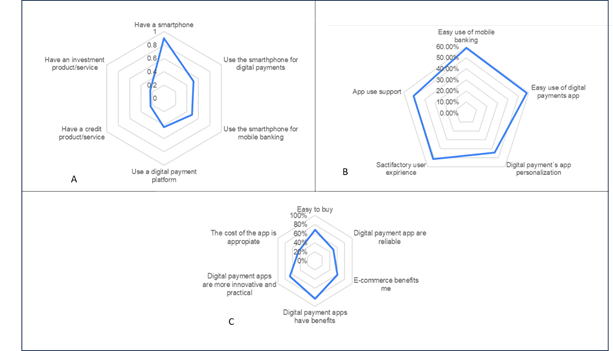
This section has 6 questions, and the intention is to know the level of financial inclusion among the sample. It is notorious that despite 90% of those surveyed said they had a cell phone, only 35% said they used it regularly for financial transactions. Half of them use this for digital payment and mobile banking transactions and almost a quarter have or use a formal bank product (credit or investment one) (Figure 1A).
4.2.2. User experience dimension
This analysis is related to the user experience of the digital payment apps. As described above, it is important to study if the respondents perceive a good experience or not while using it. We can assume that if 50% or more of them agree with a good experience, the digital payment sector complies with the SDL. We can see that 59% and 58% have an easy use of the mobile banking and digital payment applications, respectively and that practically half of them have a satisfactory experience using them, including because of the support and assistance (Figure 1B).
Regarding the question about the ease of use of mobile banking and digital payment platforms across different devices (mobile, tablet, computer), most respondents find it relatively easy to use mobile banking and digital payment platforms, 24.5% rated the ease of use as "very easy" and 42.2% consider it "very difficult". About 23% of the participants strongly agree that they feel safe using the digital payment application in terms of confidentiality and security. On the other hand, about 33.9% strongly disagree with this statement. The rest of the participants fall in between these two extremes.
4.2.3. Personalization dimension
The next section has 6 questions and is about what the user perceives as their own and comfortable digital payment apps. It is clearly noticeable that this dimension was one of the highest responses. The people who answered feel that it is easy and reliable to buy products and services in a digital environment and that this has benefits for them, especially in the practicality. Only 43% of them perceive the cost that some apps have are appropriate (Figure 1C). 98% of the respondents find an add value in using the digital payment platform and most respondents appear to perceive the cost of using financial payment technology applications as adequate.
4.2.4 Relationship dimension
This dimension is relevant because it makes known if the usability of the digital payment apps can be recommended among the community of relatives and acquaintances (the third party of the SDL theory). More than half of the respondents agree that the digital payment apps benefit e-commerce and, in some way, they have been recommended or they recommend the use of them.
4.2.5 Financial education dimension
Finally, it is wanted to test if the people who respond to the questionnaire have any o measure if the users of digital payments are people who know about the main financial decisions and regulations. This is a dimension where clearly it is noticed that the respondents answered negatively. This means that the sample expressed that they don't really know too much about these apps (the 60% of the respondent answered they do not) and fewer have taken a financial course of some educational bases like the financial system or regulations (only the 33%).
4.3 Statistical analysis
This section showcases the outcomes of the conducted survey, featuring a correlation analysis and a logistic regression model concerning the most impactful variables.
4.3.1 Correlation Matrix
An Inter-Item Correlation Matrix was run (Annex B), and the most significant correlations are:
The study variable “use of digital payment apps” has positive correlation with the use of smartphones to perform any financial transactions such as digital payments for services or consumption (0,59) and the use of mobile banking (0.62), both variables of the financial inclusion dimension. It is also observed a strong correlation with the user experience dimension (0.59). For the “use of smartphones to perform digital payments” it is found positive and negative correlations. The positive are with the user experience dimension (0.59) and the negative one is with the matter of having a financial product (loan, investment, bank account, credit card) with a value of -0.617.
The inter-item correlation matrix shows both positive and negative relationships among various survey items. The highest positive correlation is observed between ease of using digital financial tools (items 15 and 16), with a correlation coefficient of 0.82, indicating that respondents who find mobile banking platforms easy to use also find digital payment apps straightforward. Another notable positive correlation is between satisfaction with financial technology applications (item 18) and ease of use (item 15), with a correlation of 0.781, suggesting a link between satisfaction and ease of use. Conversely, the strongest negative correlations are between holding a financial product (item 8) and using mobile banking apps for payments or transfers (item 11), with a correlation of -0.618. This suggests that individuals who possess financial products may not frequently use mobile banking apps. Likewise, item 8 shows a strong negative correlation with using smartphones for financial transactions (item 10), at -0.617, indicating that owning financial products does not necessarily lead to frequent smartphone-based financial transactions. These patterns reveal a potential gap between financial product ownership and the adoption of digital financial tools.
4.3.2. Logistic Regression
To present the regression equation in scientific form based on the table from SPSS, it can be presented as follows. This assumes that "10. I use my smartphone for financial transactions such as making payments for services, purchases, credit payments, or transfers" is the dependent variable, and each of the other statements (related to banking app usage, payment platforms, credit products, savings products, ease of use, etc.) is an independent variable with their respective codes (e.g., “=1,” “=2,” etc.) used as indicators for categorical values:
Regression Equation in Scientific Form: Let Y represent the dependent variable: The regression equation is:
where:
Independent variables include categorical responses such as the use of the banking app, payment platforms, credit products, perceptions of ease of use, security, benefits of digital payment platforms, and innovation,
Each coefficient β reflects the impact of its respective category on the likelihood of using a smartphone for financial transactions. To complete the equation, replace each β with the specific coefficients obtained from SPSS. Each coefficient β quantifies the impact of its respective category on the likelihood of using a smartphone for financial transactions. If you have the specific coefficients and statistical outputs from SPSS, these values can be substituted directly to create a more precise version of the equation.
In this case processing summary (Table 2) shows that users of financial and mobile banking applications are divided between those who use them frequently and those who do not use them at all. About a third of respondents consistently use their smartphone and payment apps for transactions, while another significant group never does. Furthermore, although more than half of the participants use credit, savings or investment financial products, the perception of ease of use and security on these digital platforms varies widely. The perception of benefits is mostly positive, although there are divided opinions regarding the innovation, practicality and quality of the support received when using these financial technologies.
Table 2 Case Processing Summary
| N | Marginal Percentage | ||
|---|---|---|---|
| 10. I use my smartphone for financial transactions such as making payments for services, purchases, credit payments, or transfers. | 1 | 119 | 38.6% |
| 2 | 40 | 13.0% | |
| 3 | 20 | 6.5% | |
| 4 | 22 | 7.1% | |
| 5 | 107 | 34.7% | |
| 11. I use my bank's mobile banking app from my cell phone, tablet, or computer for payments or transfers (BBVA Bancomer, Citi Banamex, Bancoppel, Banco Azteca, Cooperative, or SOFIPO). | 1 | 113 | 36.7% |
| 2 | 38 | 12.3% | |
| 3 | 29 | 9.4% | |
| 4 | 24 | 7.8% | |
| 5 | 104 | 33.8% | |
| 12. I use a technological payment platform to make purchases (Baz, Mercado Pago, Albo, Clip, Sr. Pago, iZettle, Mercado Libre, Walmart, etc.). | 1 | 97 | 31.5% |
| 2 | 37 | 12.0% | |
| 3 | 26 | 8.4% | |
| 4 | 24 | 7.8% | |
| 5 | 124 | 40.3% | |
| 13. I utilize a formal credit financial product at a bank or financial institution such as savings cooperatives or SOFIPOs. | 1 | 54 | 17.5% |
| 2 | 20 | 6.5% | |
| 3 | 24 | 7.8% | |
| 4 | 41 | 13.3% | |
| 5 | 169 | 54.9% | |
| 14. I use a savings or investment financial product in banks or savings cooperatives, savings funds, or crowdfunding platforms. | 1 | 48 | 15.6% |
| 2 | 29 | 9.4% | |
| 3 | 21 | 6.8% | |
| 4 | 31 | 10.1% | |
| 5 | 179 | 58.1% | |
| 15. It's easy to use mobile banking and digital payment platforms from my cell phone, tablet, or computer. | 1 | 131 | 42.5% |
| 2 | 53 | 17.2% | |
| 3 | 37 | 12.0% | |
| 4 | 12 | 3.9% | |
| 5 | 75 | 24.4% | |
| 16. It's easy to use digital payment apps from my cell phone to purchase products or services. | 1 | 137 | 44.5% |
| 2 | 44 | 14.3% | |
| 3 | 36 | 11.7% | |
| 4 | 15 | 4.9% | |
| 5 | 76 | 24.7% | |
| 19. When I have needed advice or support for using the financial technology application, it has been very good. | 1 | 92 | 29.9% |
| 2 | 64 | 20.8% | |
| 3 | 56 | 18.2% | |
| 4 | 13 | 4.2% | |
| 5 | 83 | 26.9% | |
| 21. I feel very secure using the digital payment application in terms of confidentiality and security. | 1 | 104 | 33.8% |
| 2 | 49 | 15.9% | |
| 3 | 54 | 17.5% | |
| 4 | 30 | 9.7% | |
| 5 | 71 | 23.1% | |
| 23. Do you consider that using digital payment platforms brings you benefits? | 0 | 45 | 14.6% |
| 1 | 263 | 85.4% | |
| 24. Digital payment apps are becoming increasingly innovative and practical (they improve the service, enhance security or trust, and add more usage options). | 1 | 138 | 44.8% |
| 2 | 73 | 23.7% | |
| 3 | 44 | 14.3% | |
| 4 | 10 | 3.2% | |
| 5 | 43 | 14.0% | |
| Valid | 308 | 100.0% | |
| Missing | 14 | ||
| Total | 322 | ||
| Subpopulation | 242a | ||
Source: Own elaboration, 2023.
Summarizing the responses, it is indicated a generally positive sentiment toward using digital payment platforms, with varying degrees of agreement regarding ease of use, security, and perceived benefits.
For the fitting information analysis, two models are being compared: the "Intercept Only" and the "Final". It is observed that the first one, which only includes the intercept without explanatory variables, seems to have a value of 828.841 for a fitting criterion (possibly a goodness-of-fit measure) and the final model, which includes the selected explanatory variables, has a value of 194.061. Table 3 presents the data:
Table 3 Model Fitting Information
| Model | Model Fitting Criteria | Likelihood Ratio Tests | ||
|---|---|---|---|---|
| -2 Log Likelihood | Chi-Square | df | Sig. | |
| Intercept Only | 828.841 | |||
| Final | 194.061 | 634.780 | 148 | .000 |
Source: Own elaboration, 2023.
This significant decrease in the value of the fit criterion indicates that the "Final" model offers a better representation of the data, improving the quality of the fit compared to the basic model. This suggests that the variables added in the “Final” model have an important effect on the accuracy of the model and contribute significantly to explaining the variability in the data. It is also analyzed the likelihood ratio test, which is used to compare the goodness of fit between the two models. The "-2 Log Likelihood" values are used as part of the likelihood ratio test and the difference between the -2 Log Likelihood values of the two models is 634.780 (828.841 - 194.061). In summary, the model results suggest that the explanatory variables included in the “Final” model are relevant to understanding the perception and use of digital payment applications. The significant improvement in model fit, demonstrated by the reduction of the goodness-of-fit criterion from 828,841 to 194,061, indicates that these variables have an important effect in explaining the ease of use, security, and perceived value of these applications, as posed in the research questions. Furthermore, the likelihood ratio test supports the superiority of the “Final” model over the “Intercept Only” model, suggesting that value perception and user experience based on Service-Dominant Logic (SDL) dimensions are significant factors, which agrees with the previous literature. This gives empirical evidence in favor of the formulated research questions, underlining the relevance of these dimensions for users.
4.3.3. Most significant variables of the logistic model
The table shows the results of a regression analysis (Annex B) on the use of mobile banking applications and digital payment platforms. In general, it is observed that the ease of use of these tools is positively associated with their adoption. For example, the statement that it is easy to use digital platforms for payments shows a positive coefficient, suggesting that as users perceive these tools as more accessible, they are more likely to use them. However, there are also comments about the perceived lack of security in using payment applications, which could negatively affect their acceptance. In summary, the perception of ease and security in the use of these financial technologies is key to promote their adoption. Table 4 provides relevant information for these variables:
Table 4 Significant variables
| Variables | Coefficients | Standard Error | t Value | p Value | Conclusion |
|---|---|---|---|---|---|
| Ease of use of mobile banking applications | 0.421 | 0.095 | 4.426 | 0 | Higher ease of use leads to greater adoption. |
| Ease of use of digital payment platforms | 0.367 | 0.086 | 4.268 | 0 | Higher ease of use leads to greater adoption. |
| Perception of security in the use of payment apps | -0.214 | 0.078 | -2.743 | 0.006 | Lack of security decreases adoption. |
Source: Own elaboration, 2023.
The next results demonstrate a strong predictive value of using a bank's mobile app for payments or transfers, particularly when this usage aligns with high-frequency interactions or specific usage levels. Significant odds ratios (774.142, 254.538, and 1388.541) suggest that using mobile banking substantially increases the likelihood of successful transaction outcomes. Conversely, highly positive feedback on support experiences for the financial technology application correlates with a significant reduction in odds (0.015), indicating an inverse relationship between satisfaction with support and transaction success under certain conditions. These predictors are statistically significant in influencing the binary outcome (Table 5).
Table 5 Predictor
| Predictor | Coefficient | Standard Error | Wald Statistic | Significance (Sig.) | Odds Ratio (Exp(B)) | 95% Confidence Interval |
|---|---|---|---|---|---|---|
| "[11. I use my bank's mobile banking app for payments or transfers] = 1" | 6.652 | 1.515 | 19.276 | 0.000 (highly significant) | 774.142 | [39.739, 15080.899] |
| "[11. I use my bank's mobile banking app for payments or transfers] = 3" | 5.539 | 1.696 | 10.666 | 0.001 (significant) | 254.538 | [9.162, 7071.485] |
| "[19. Advice/support for using the financial tech application was very good] = 3" | -4.172 | 1.393 | 8.97 | 0.003 (significant) | 0.015 | [0.001, 0.237] |
| "[11. I use my bank's mobile banking app for payments or transfers] = 3" (repeated) | 7.236 | 2.395 | 9.129 | 0.003 (significant) | 1388.541 | [12.705, 151759.374] |
Source: Own elaboration, 2023.
This seems to be a repetition of the second predictor, indicating that the individual's use of the mobile banking app under specific conditions contributes to a high odds ratio of approximately 1388.541, with a 95% confidence interval ranging from 12.705 to 151759.374.
5. Discussion points
Results show that the probability of holding a formal financial product is largely associated with a subset of socio-economic characteristics that may change across financial products. Specifically, having a formal job strongly implies the probability of holding a bank account (savings, checking or payroll), while higher educational attainment, wealth, or income matter most for obtaining a credit, in line with past evidence of the relevance of indicators of individual creditworthiness. With most poor households working in a large informal sector, extending financial inclusion is a component of the comprehensive strategy required to reduce informality in Mexico, compared to the international scenario and identifying technological barriers, regulatory risks and lack of internet connectivity (Cassimon et al., 2022; Ozili, 2018).
Due to the type of commerce that takes place in Cuetzalan and the region, there has been a need to expand the use of electronic means, due to the limitation of ATMs and the needs of consumers to expand the possibilities of using debit cards, credit cards, interbank transfers, or others. However, according to the survey results, only a quarter of the population has or uses formal banking products, such as bank loans or investment products, which still presents a financial inclusion challenge.
The opportunity to make evident the expansion of technological and digital use in financial aspects, can be approached from the point of view of user experience, i.e., among other aspects, if the use of digital media, they perceive a good or bad experience, while using it. And in this way as mentioned by Lehrer et al., 2018, innovation in financial services should focus on new ways to create value for the customer, from the point of view of their own needs and personalization. By identifying that more than 50% of the surveyed population considers that the use of mobile banking applications and digital payments seems to them with an easy use and a satisfactory experience, this improves the probability of having more users who perceive the SDL more objectively.
An approach that will allow E-fectivo to position its technological solutions in its target market, identified within rural and semi-urban communities, is to continue with the customization of its products and services (both digital payment and e-commerce apps) to have the service logic approach towards users (according to Cassimon et al, 2022). This development initiatives contribute to the #8 and #9 Sustainable Development Goals (SDGs) of the United Nations Organization of the 2030 Agenda - 8) Promote sustained, inclusive and sustainable economic growth, full and productive employment, and decent work for all; 9) Develop resilient infrastructures, promote inclusive and sustainable industrialization, and foster innovation- for motivating the process of financial inclusion through economic and social inclusion (Priale Reyes, 2010).
Considering that the cost for using the digital payment apps is perceived as high, it is possible to develop e-commerce sites adapted to the prevailing conditions of the population in rural and semi-urban areas, so that artisans, micro-producers and tourism service providers can offer their merchandise to the general population. It stands out that the positive correlations that we found, allow us to see the possibility of increased use of financial technology, since the use of a smartphone for financial transactions is related to the use of the mobile banking application.
One important point is that users of digital payments are not people who know the main financial decisions and regulations, i.e. they do not know enough about these applications, because there isn´t a solid financial education, existing the opportunity to provide courses or training in this area; since the negative correlations of the study, it is identified that people who have various financial products, are less likely to use their smartphones for financial transactions or mobile banking, which, may also be strengthened if digital and financial services are approached from the logic of service.
6. Conclusions
Responding to the research questions of the study, it can be concluded that the perception of the people who consume and make digital payments in Cuetzalan find these apps useful and easy to use. According to the SDL dimensions, the respondents had a value perception and user experience; these are significant factors in explaining the variability in the use and acceptance of digital payment applications. It is observed that it´s five dimensions are observed in the results and this agrees with the reviewed literature. The dimension with the largest opportunity area is the “Personalization one” where the cost of the digital payment app is the obstacle. Here it is recommended that people compare between different apps and appreciate the benefit-cost relationship. Participants who agreed that digital payment apps are increasingly innovative and practical are significantly more likely to find it easy to use these platforms for purchasing products or services with their smartphones. This positive attitude has a substantial impact on their ease of use. And vice versa, participants who strongly agree that it is easy to use digital payment platforms for purchasing products or services with their smartphones are significantly more likely to find them easy to use. Their strong agreement is a substantial predictor of ease of use.
The use of digital technologies is common in the Mexican population, mostly between the ages of 20 to 40 years, but having over 90% of the sample possessing an electronic device does not guarantee confidence and/or interest in digital banking, as shown in our results. This means that only those who start using digital banking experience an increase in confidence and ease of use, which remains consistent. However, those who remain outside financial inclusion maintain their decision to use digital devices for other tasks, being a business opportunity for technology service companies.
Related to the financial education dimension, it is observed that there is practically not enough financial inclusion despite the existence of training and sources of information, there is probably not enough dissemination for the population to get involved in this. Perhaps this lack of interest or assertiveness in financial education is one of the most important points to consider for the use of technologies by the population.
It is identified that despite the use and interaction with smartphones, only half of the respondents use them to perform digital activities such as electronic payments and mobile banking, which shows a technological lag and an opportunity for digital and financial inclusion. This limits the potential for marketing products or services within rural or semi-urban regions. The authors propose future similar research in other regions to analyze new markets and variables such as open finance and AI models in the SDL context.

