Artículos
Farming with drip sea water irrigation for Salicornia production in Tierra del Fuego, Argentina
Agricultura con riego por goteo de agua de mar para la producción de Salicornia en Tierra del Fuego, Argentina

Abstract
Farming for the sustainable production of halophyte crops should begin with the popular knowledge of saline and beneficial plants. In this respect, the use of drip irrigation with a seawater supply for the production of the halophytic specie Salicornia magellanica was evaluated in a small-scale culture in three growth periods; a randomized design of fifteen plantings were developed in each treatment (n=15), with two irrigation flows in two plant stages (two and seven months of initial pre-planting growth in pots). The irrigation flow showed different effects on the production parameters and plant age, with highest yields recorded in more developed plants at the third season. Hydroponics with low concentration of sea water, showed a greater and significant values in survival of plants, largest length and number of shoots. These results made it possible to model the consumption of seawater for crops in Tierra del Fuego, Argentina, optimizing its use in order to reduce the cost of seawater provision for micro crops far from the sea coast.
Key words::
increasing density, levels, morphology, urban space
Introduction
Marsh ecosystems are home to most halophyte plant species that are components of the global coastal natural heritage. Those have been well studied for more than 20 years, as potential source for safe food for people (Kong and Zheng, 2014; Aarland et al., 2020). This has led to pilot tests of alternative agriculture in marginal environments, which do not require fresh water for its development (Beltran-Burboa et al., 2017; Feng et al., 2013; Harrouni et al., 2003a b; Davy et al., 2001). Worldwide freshwater shortages, and the possibility of producing food grown with seawater, make halophytes an important future possibility for the use of coasts and salinized inland lands (Rebolloza et al., 2020; Feng et al., 2013; Glen et al., 1998). In this way, new agricultural production systems began to emerge. The use of seawater for agriculture is an innovation in the quality food production process, based on research knowledge on the physiological mechanisms of high salinity adaptation and productive genotypes of marginal halogen and glycophyte plants at moderate salinities, with food production capacity, which has generated saline agriculture beginning slowly around the world (Bianciotto et al., 2014; Salazar et al., 2014; Boscaiu and Vicente, 2013; Lieth and Moschenco 2003; Koyro and Werner, 2003). In Tierra del Fuego Province (Argentina), the most interesting halophyte Sarcocornia magellanica (Phil.), reclassified by M.A. Alonso and M.B. Crespo as Salicornia (Amerocornia) magellanica Piirainen and Kadereit subg. (Bianciotto et al., 2004; 2006), covers around 60,000 ha of land, used only as waste dumps or oil exploitation areas, or at best, for sheep and cattle grazing (Bianciotto et al., 2004; 2006).
-
Kong and Zheng, 2014Potential of Producing Salicornia bigelovii Hydroponically as a Vegetable at Moderate NaCl SalinityHortsciencie, 2014
-
Aarland et al.,
2020Efecto del estrés salino sobre la morfología y fitoquímica de orégano mexicano (Lippia graveolens Kunth) cultivado in vitroBiotecnia, 2020
-
Beltran-Burboa et al., 2017Salicornia bigelovii (Torr): Un sistema modelo para incorporarse como cultivo agrícola en zonas árido-desérticosBiotecnia - Revista de Ciencias Biológicas y de la Salud, 2017
-
Feng et al., 2013Economic value and exploiting approaches of sea asparagus, a seawater-irrigated vegetableAgricultural Sciences, 2013
-
Harrouni et al., 2003aEffect of seawater irrigation on biomass Production and ion composition of seven halophytic species in MoroccoCash Crop Halophytes: Recent Studies. Task for Vegetation Science, 2003
-
bCash Crop Halophytes: Recent Studies, 2003
-
Davy et
al., 2001Salicornia L. (Salicornia pusilla J. Woods, S. europea L., S. obscura P.W. Ball and Tutin, S. nitens P.W. Ball and Tutin, S. fragilis P.W. Ball and Tutin, and S. dolichostachya Moos.)Journal Ecology, 2001
-
Rebolloza et al., 2020Fenotipeo y selección de líneas S1 segregantes de maíz tolerantes a estrés hídricoBiotecnia, 2020
-
Feng et al.,
2013Economic value and exploiting approaches of sea asparagus, a seawater-irrigated vegetableAgricultural Sciences, 2013
-
Glen et al., 1998Irrigating Crops with SeawaterScientific American Inc., 1998
-
Bianciotto et al.,
2014Sección Agricultura con Agua de Mar: El Cultivo de Halófitas Nativas Salicornia ambigua Michx. (Sarcocornia magellanica Alfonso and Castro) y algunas hortalizasInnovaciones Frutihortícolas en Regiones Australes: Invernaderos y Cultivos con Agua de Mar, 2014
-
Salazar et al., 2014Growing Salicornia for human consumption, in Natural Reserve RNSCMVRSA. 2014. Algarve, Portugal. Putting halophytes to work from genes to Ecosystems cost action FAO 901. Final meeting Coimbra I Portugal. 9th and 10 h. Abril (Book of Abstracts), 2014
-
Boscaiu and Vicente, 2013Halophytic crops for a salinising worldBulletin UASVM Horticulture, 2013
-
Lieth and Moschenco 2003Cash Crop Halophytes: Recent Studies ten years after the Al Ain Meeting, 2003
-
Koyro and Werner, 2003Study of potential cash crop halophytes by a quick check systemCash Crop Halophytes: Recent Studies (121-124) Task for Vegetation Science, 2003
-
Bianciotto et al., 2004Efectos ambientales sobre el potencial forrajero y evaluación de la aptitud para la alimentación ganadera y humana, de una comunidad de Salicornia y Puccinellia en marismas de Tierra del Fuego. Informe final Consejo Federal de Inversiones (CFI), 2004
-
2006Los ambientes Naturales de la Estepa Fueguina, 2006
-
Bianciotto et al., 2004Efectos ambientales sobre el potencial forrajero y evaluación de la aptitud para la alimentación ganadera y humana, de una comunidad de Salicornia y Puccinellia en marismas de Tierra del Fuego. Informe final Consejo Federal de Inversiones (CFI), 2004
-
2006Los ambientes Naturales de la Estepa Fueguina, 2006
Salicornia has begun to locally contribute as food for the population in the Patagonian region. Restaurants have integrate the product into the gastronomic charts, considering the contents of this species in essential fatty acids and salts of Calcium, Magnesium, Sodium, Potassium, trace elements, among others. It has been called the first Fuegian and Patagonian vegetable endemic to the region (Bianciotto et al., 2016; 2014; Arce et al., 2016).
-
Bianciotto et al., 2016Sarcocornia magellanica (Phil.) M. A. Alonso and M. B. Crespo: an halophyte native of Tierra del Fuego (Argentina) irrigated with sea water for human consumption and sheep meat productionSabka Ecosystem Vol. V: The Americas, 2016
-
2014Sección Agricultura con Agua de Mar: El Cultivo de Halófitas Nativas Salicornia ambigua Michx. (Sarcocornia magellanica Alfonso and Castro) y algunas hortalizasInnovaciones Frutihortícolas en Regiones Australes: Invernaderos y Cultivos con Agua de Mar, 2014
-
Arce et
al., 2016Agriculture and sheep production on Patagonian Sabkas with Sarcocornia neei, irrigated with sea water (Chubut - Argentina)Sabkha Ecosystems, 2016
The hypothesis proposed in this study is that under an irrigation system with an effective salinity, using seawater for Salicornia development, its establishment would be more successful in saline and / or coastal desert areas. Thus, it is important to determine the optimal conditions (drip irrigation system and pots), which would allow expanding the crop from small or medium scale, to urban areas. For this reason, the present work was aimed to evaluate the use of drip irrigation with seawater supply for the production of the halophytic specie Salicornia magellanica, considering two irrigation flows in plant stages (two months = 60 days after sowed =das=) and seven months (210 das), initial pre-planting growth in pots. Additionally, at the same time, another hydroponic growing experiment was carried out with four different seawater concentrations (0, 11, 20 and 33 g.L of salts) to determine the optimal concentration.
Material and methods
Salicornia magellanica on drip seawater irrigation
An experimental design with sixty (60) plants was implemented, grown from propagation lignified stems cuttings (10 cm in length and 1 cm in diameter) from mother plants at flowering stage, from a Bay called “enclosed bay” at coordinates 54° 49´21.95´´ S, 68° 19´04.22´´ O. They were cultivated in small 0.5-L pots; when the lignified cuttings had two months (60 days after transplanted =dat) and seven months (210 dat) they were transplanted a second time into 3-L pots. At each plants-age treatment (60 and 210 dat), seawater irrigation with two flows of 0.7 L.h (30 plants) and 1.43 L.h (30 plants) were evaluated from two peak flow openings; each group of plants in each flow were placed under two different conditions: seven months of growth (15 plants) in spring and seven months (15 plants) in winter.
An automatic irrigation and dripper system was chosen to facilitate the regulation mechanism. It was integrated with a system of tank and sea water transport tanks (Figure 1), manifolds with closed normal solenoid valve (220 V) and regulated by a timer. Hoses with dropper of variable flow, equipped with a drill tip, allows it to be inserted into the irrigation hose and an adjustable flow peak of 35 L.h and emission radius of 30 ± 5 cm.
Thumbnail

Figure 1
Drip irrigation system with 500 L sea water tank and hoses with variable flow dropper. Figura 1. Sistema de riego por goteo con tanque de agua de mar de 500 L y mangueras con gotero de flujo variable.
Drip irrigation system with 500 L sea water tank and hoses with variable flow dropper. Figura 1. Sistema de riego por goteo con tanque de agua de mar de 500 L y mangueras con gotero de flujo variable.
Thirty plants (30) were then considered for each type of flow opening, with two planting ages: fifteen (15) that spent one winter prior to the test (7 months of growth, named mature plants -MP) and fifteen (15) planted at spring (2 months of growth, named young plants -YP) for the purpose of recording and determining growth and productive variables differences. Measurements of the following biological parameters were taken in plants during three consecutive growth periods: number of green shoots, average length of green shoots (mm), length of the witness shoot (mm), biomass production by green weight (g.m2) and dry weight (g.m2). Rainwater was recorded and the amount of seawater used for each established flow rate, according the province of Tierra del Fuego conditions, was calculated.
Test Hydroponics Culture
The hydroponics culture test was carried out on square containers coated with transparent plastic LTD. Four different seawater dilutions were evaluated: 100, 50, 25 and 0 % of seawater (33, 18, 11 g.L of salts), respectively, and tap water plus urea fertilizer (2 g.L). Four repetitions were carried out of each solution. A water aeration system (fish tank aerator) with small pumps were used to recycle the culture medium. Over each seawater solution, sheets of perforated polystyrene (EPS), used to support the plants (Figure 2), were placed; one hundred fifty 10-cm long Salicornia cuts were grown, to achieve the same number of plant repetitions (n = 150). The plants development in each water salinity was measured, considering plant survival, length and number of shoots. The test was carried out under greenhouse conditions at 20 °C with moderated wind fluxes.
Thumbnail

Figure 2
Hydroponics containers with plants of Salicornia (Amerocornia) magellanica placed in greenhouse. Figura 2. Contenedores hidropónicos con plantas de Salicornia (Amerocornia) magellanica colocadas en invernadero.
Hydroponics containers with plants of Salicornia (Amerocornia) magellanica placed in greenhouse. Figura 2. Contenedores hidropónicos con plantas de Salicornia (Amerocornia) magellanica colocadas en invernadero.
Statistical Analysis
Data were analyzed under a completely randomized experimental design of repeated measures, with 2 flows, 2 ages and 15 repetitions (n = 15) for each plant age. Given the nature of the data, we chose to use three-way ANOVA under mixed linear models using the “name” package of the “R” program version 3.2.5. In addition, Principal Component Analysis was used to test the correlation between the length of shoots, number of shoots and dry weight per plant variables, given the high degree of correlation between fresh and dry weight expressed in plant or area.
Results and discussion
Salicornia magellanica on drip seawater irrigation
Table 1
Average volumes in litters of total rainwater and seawater for flow rates 1 and 2 supplied to each pot per month. 0.7 L.h (flow 1) and 1.43 L.h (Flow 2).Tabla 1Volúmenes promedio de agua de lluvia y agua de mar totales para los caudales 1 y 2 suministrados a cada maceta por mes 0.7 L.h (flujo 1) y 1.43 L.h (flujo 2).
Average volumes in litters of total rainwater and seawater for flow rates 1 and 2 supplied to each pot per month. 0.7 L.h (flow 1) and 1.43 L.h (Flow 2).Tabla 1Volúmenes promedio de agua de lluvia y agua de mar totales para los caudales 1 y 2 suministrados a cada maceta por mes 0.7 L.h (flujo 1) y 1.43 L.h (flujo 2).
| Months | Monthly average of Rainwater per pot (I) | Monthly average of SW (flow 1) (I.pot) | Monthly average of SW (flow 2) (I.pot) | Average total volume (SW + RW) per month for flow rate 1 (I.pot) | Average total volume (SW + RW) per month for flow rate 2 (I.pot) | % of average SW Flow 1 % of average SW Flow 2 | |
|---|---|---|---|---|---|---|---|
| I | II | III | IV= I + II | V= I + III | |||
| O | 0,638 | 5,536 | 11,071 | 6,174 | 11,709 | 90% | 95% |
| N | 0,730 | 5,357 | 10,714 | 6,087 | 11,444 | 88% | 94% |
| D | 0,896 | 5,536 | 11,071 | 6,432 | 11,967 | 86% | 93% |
| E | 0,875 | 5,536 | 11,071 | 6,410 | 11,946 | 86% | 93 |
| F | 0,744 | 5,000 | 10,000 | 5,744 | 10,744 | 87% | 93% |
| M | 0,785 | 5,536 | 11,071 | 6,320 | 11,856 | 88% | 93% |
Thumbnail
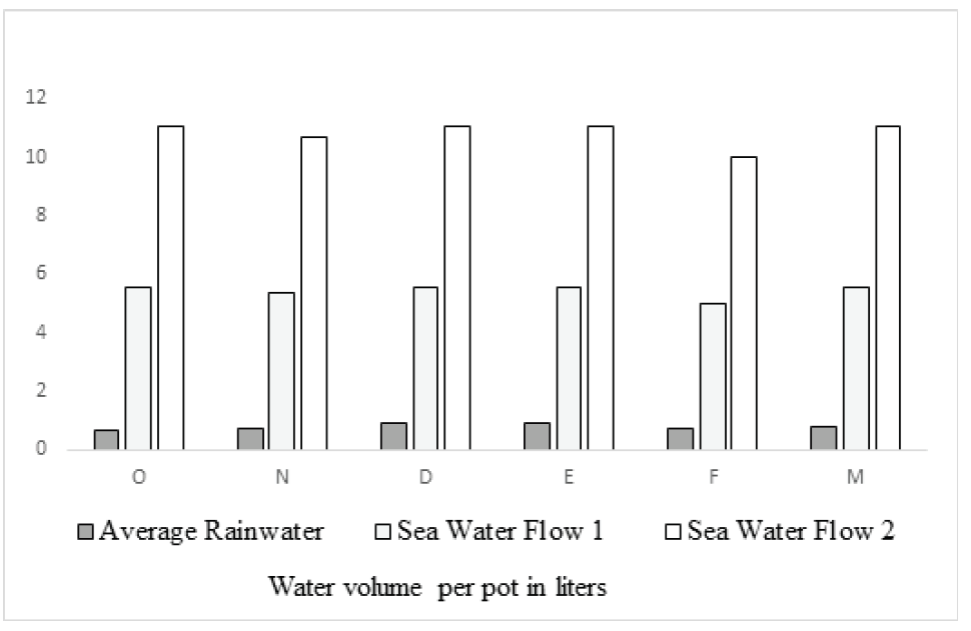
Figure 3
Average monthly volume of water (SW and RW) supplied for each flow rate and per pot in the drip irrigation system. Figura 3. Volumen mensual promedio de agua (SW y RW) suministrada para cada caudal y por maceta en el sistema de riego por goteo.
Average monthly volume of water (SW and RW) supplied for each flow rate and per pot in the drip irrigation system. Figura 3. Volumen mensual promedio de agua (SW y RW) suministrada para cada caudal y por maceta en el sistema de riego por goteo.
Drip seawater irrigation culture and Principal component analysis
Sprout length was the only parameter where a triple interaction was found (Flow x Maturity x Growing Season) (Table 2). This is because differences depend on the development of the plants (maturity) and the growing season considered (Table 2; Figure 4). In the second period, younger plants (YP) had significant differences and longer sprout lengths with the lowest flow, while the plants with greater development (MP) had significantly longer shoots in the third period. The number of shoots was significantly higher in PM plants in the three seasons. The maturity and growth period interaction (Maturity x Season) showed a substantial change in the magnitude of the differences, but not it their sign. This increase in the number of shoots in mature plants, represented a significant increase in green and dry biomass, per plant and in standardized values (m2), in the third growing season (Table 2, 3, Figure 4).
Table 2
Mean biological parameters of Salicornia (Amerocornia) magellanica, mature plants (MP) and young plants (YP) with two irrigation flows, for the 3 growth periods: number of shoots, length of shoots, length of marked bud, fresh weight per plant in grams dry matter per plant in g.plant, fresh and dry weight in square meters (g.m2). n = 15. Tabla 2. Parámetros biológicos medios de Salicornia (Amerocornia) magellanica, plantas maduras (MP) y plantas jóvenes (YP) con dos flujos de riego, para los tres períodos de crecimiento: número de brotes, longitud de brotes, longitud de brote marcado, peso fresco por planta en gramos de materia seca por planta en g.planta, peso fresco y seco en metros cuadrados (g.m2). n = 15.
Mean biological parameters of Salicornia (Amerocornia) magellanica, mature plants (MP) and young plants (YP) with two irrigation flows, for the 3 growth periods: number of shoots, length of shoots, length of marked bud, fresh weight per plant in grams dry matter per plant in g.plant, fresh and dry weight in square meters (g.m2). n = 15. Tabla 2. Parámetros biológicos medios de Salicornia (Amerocornia) magellanica, plantas maduras (MP) y plantas jóvenes (YP) con dos flujos de riego, para los tres períodos de crecimiento: número de brotes, longitud de brotes, longitud de brote marcado, peso fresco por planta en gramos de materia seca por planta en g.planta, peso fresco y seco en metros cuadrados (g.m2). n = 15.
| 1° growing period | 2° growing period | 3° growing period | ||||||||||
| Flow 0,71 L.h | Flow 1,43 L.h | Flow 0,71 L.h | Flow 1,43 L.h | Flow 0,71 L.h | Flow 1,43 L.h | |||||||
| YP | MP | YP | MP | YP | MP | YP | MP | YP | MP | YP | MP | |
| Sprout Number. plant | 7 | 28 | 6 | 21 | 10 | 25 | 9 | 15 | 18 | 35 | 15 | 28 |
| Sprout Length (mm) | 25,6 | 51,8 | 33,3 | 43,8 | 72,0 | 57,3 | 54,8 | 66,7 | 58,0 | 67,9 | 60,5 | 93,3 |
| Marked sprout length (mm) | s/d | 34,7 | s/d | 36,0 | s/d | 84,0 | s/d | 102,7 | s/d | s/d | s/d | s/d |
| Green weight. plant (g. plant) | s/d | 4,9 | s/d | 4,1 | 8,0 | 8,3 | 5,1 | 9,1 | 17,2 | 21,0 | 10,0 | 24,1 |
| Dry matter. plant (g.plant) | s/d | 0,23 | s/d | 0,19 | 0,92 | 0,98 | 0,56 | 0,99 | 1,89 | 2,38 | 1,18 | 2,65 |
| Std green weight (g.m2) | s/d | 88,80 | s/d | 73,20 | 144,60 | 150,00 | 91,20 | 163,20 | 309,86 | 378,00 | 180,00 | 434,57 |
| Std dry matter (g.m2) | s/d | 4,11 | s/d | 3,35 | 16,52 | 17,72 | 10,07 | 17,77 | 33,96 | 42,92 | 21,25 | 47,65 |
Thumbnail

Figure 4
Interaction triple length of shoots, maturity and growth period. Figure 4. Interaction triple length of shoots, maturity and growth period.
Interaction triple length of shoots, maturity and growth period. Figure 4. Interaction triple length of shoots, maturity and growth period.
Table 3
ANOVA of three factors, Flow, Maturity, growing period and their interaction. Chi (p). Tabla 3. ANOVA de tres factores, flujo, madurez, período de crecimiento y su interacción. Chi (p)
ANOVA of three factors, Flow, Maturity, growing period and their interaction. Chi (p). Tabla 3. ANOVA de tres factores, flujo, madurez, período de crecimiento y su interacción. Chi (p)
| Factor | Sprout Number | Sprout Length | Green Weight | Dry Matter | Std Green Weight | Std Dry Matter | Dry matter Percentage |
| Flow | 5,57 (0,0182) | 0,76 (0,3824) | 0,78 (0,3773) | 1,28 (0,2576) | 0,78 (0,3773) | 1,28 (0,2576) | 1,32 (0,2502) |
| Maturity | 45,31 (˂0,0001) | 13,92 (0,0002) | 11,03 (0,0009) | 12,16 (0,0005) | 11,03 (0,0009) | 12,16 (0,0005) | 0,65 (0,4185) |
| Growing period | 62,1 (˂0,0001) | 139,31 (˂0,0001) | 95,48 (˂0,0001) | 122,37 (˂0,0001) | 95,48 (˂0,0001) | 122,37 (˂0,0001) | 1,78 (0,1818) |
| Flow x maturity | 2,14 (0,1436) | 2,76 (0,0965) | 4,35 (0,0371) | 3,51 (0,0609) | 4,35 (0,0371) | 3,51 (0,0609) | 0,06 (0,8101) |
| Flow x growing period | 0,36 (0,8340) | 10,69 (0,0048) | 0,24 (0,6235) | 0,04 (0,8510) | 0,24 (0,6235) | 0,04 (0,8510) | 1,98 (0,1593) |
| Maturity x growing period | 8,99 (0,0112) | 19,83 (˂0,0001) | 10,43 (0,0012) | 11,92 (0,0006) | 10,43 (0,0012) | 11,92 (0,0006) | 0,21 (0,6484) |
| Flow x maturity x growing period | 0,72 (0,6967) | 18,36 (0,0001) | 2,49 (0,1146) | 1,86 (0,1731) | 2,49 (0,1146) | 1,86 (0,1731) | 1,1 (0,2936) |
In young plants, the flow was related to productivity (Flow x Maturity interaction). The fresh weight, both by plant and area, was significantly higher with the lowest flow (Table 2-3). Whereas the dry matter percent weight did not change significantly under any of the variables studied (Table 2, 3). There is no clear pattern between irrigation flows, but it is possible to see that the variation between periods is consistent. Plants increased productivity (green and dry weight) with the advance of the seasons (Figure 5). Analysis of major components shows that, in mature and new plants, variables length and number of shoots are poorly correlated. The dry weight is more correlated with the length of shoots in mature plants. Whereas for it shows greater correlation with the number of shoots in new plants. These results are supported by the correlation between variables (Table 3, 4; Figure 6, 7).
Thumbnail

Figure 5
Interaction of maturity, green weight, dry weight per plant and standardized weight, with season and number of outbreaks of Salicornia (Amerocornia) magellanica. Figura 5. Interacción de madurez, peso verde, peso seco por planta y peso estandarizado, con estación y número de brotes de Salicornia (Amerocornia) magellanica.
Interaction of maturity, green weight, dry weight per plant and standardized weight, with season and number of outbreaks of Salicornia (Amerocornia) magellanica. Figura 5. Interacción de madurez, peso verde, peso seco por planta y peso estandarizado, con estación y número de brotes de Salicornia (Amerocornia) magellanica.
Table 4
Correlation between variables. Upper triangle- MP, lower triangle -YP. Tabla 4. Correlación entre variables. Triángulo superior- MP, triángulo inferior –YP.
Correlation between variables. Upper triangle- MP, lower triangle -YP. Tabla 4. Correlación entre variables. Triángulo superior- MP, triángulo inferior –YP.
| Sprout length | Sprout length | Dry matter | Sprout number |
| Dry matter | 0,2046 | 0,6622 | 0,1221 |
| Sprout Number | 0,1400 | 0,8487 | 0,5019 |
Thumbnail

Figure 6
Flow and age interaction in Salicornia (Amerocornia) magellanica. Figura 6. Interacción de flujo y edad en Salicornia (Amerocornia) magellanica.
Flow and age interaction in Salicornia (Amerocornia) magellanica. Figura 6. Interacción de flujo y edad en Salicornia (Amerocornia) magellanica.
Thumbnail
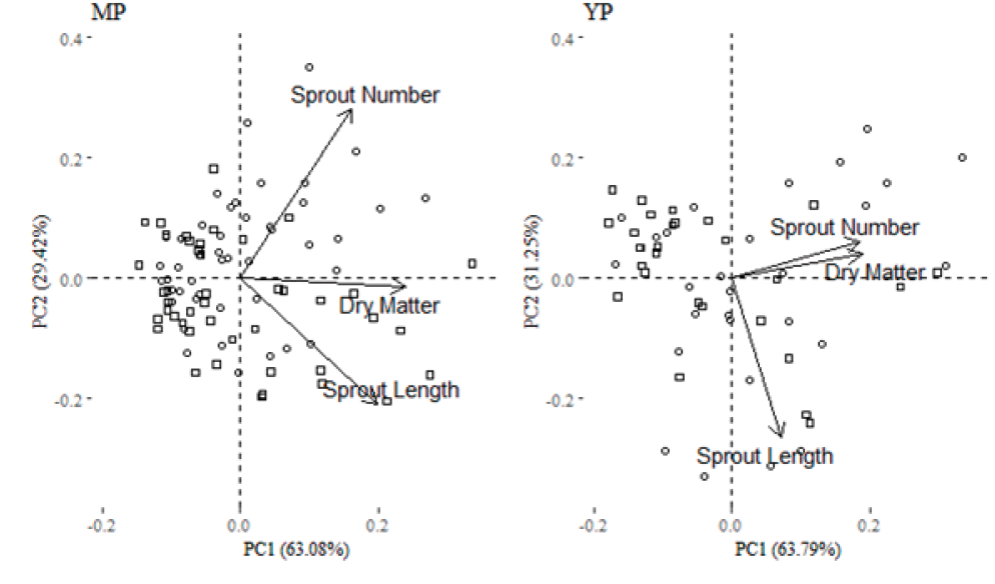
Figure 7
Graph of correlations between variables in Salicornia (Amerocornia) magellanica. Figura 7. Gráfico de correlaciones entre variables en Salicornia (Amerocornia) magellanica.
Graph of correlations between variables in Salicornia (Amerocornia) magellanica. Figura 7. Gráfico de correlaciones entre variables en Salicornia (Amerocornia) magellanica.
Correlation Analysis
Analysis shows that in mature and young plants, variables length and number of shoots are poorly correlated. The dry weight is more correlated with the length of shoots in mature plants, instead, it is more correlated with the number of shoots in young plants. These results are supported by the correlation between variables (Table 5).
Table 5
Simple ANOVA table, with Dilution as a factor F (p). Tabla 5. Tabla ANOVA simple, con dilución como factor F (p).
Simple ANOVA table, with Dilution as a factor F (p). Tabla 5. Tabla ANOVA simple, con dilución como factor F (p).
| Factor | Sprout Length | Sprout Number |
| Dilution | 9,52 (˂0,0001) | 2,62 (0,0422) |
There is no clear pattern between risks, but it is possible to see that the variation between seasons is consistent. The plants increased the dry weight as the growth stages passed, which we can mention, according to the physiological aspects that are influenced by salinity in the production of dry matter and green matter.
Test Hydroponics Culture
The hydroponics test showed a greater survival of young plants (82 - 84%) between 11 to 20 g.L of seawater salinity (Figure 8, 9). The sprouts length had significant differences between freshwater (2 g.L) and the concentration of 25% seawater (11 g.L) and the sprouts number was significantly greater with dilution of 50% seawater (18 g.L). This test substantially improved the one carried out the previous year in greenhouse conditions, where the average survival of plants of the different salinities was approximately 40% (Figure 8, 9, 10).
Thumbnail

Figure 8
Survival of Salicornia (Amerocornia) magellanica plants in each season and for each dilutions of the hydroponics crop: a) 100% Seawater, b) 50% seawater and 50% fresh water, c) 25% seawater and 75% fresh water and d) Water tap with fertilizer. Figura 8. Supervivencia de las plantas de Salicornia (Amerocornia) magellanica en porcentaje en cada estación y para cada dilución del cultivo hidropónico: a) 100% de agua de mar, b) 50% de agua de mar y 50% de agua dulce, c) 25% de agua de mar, 75% agua dulce y d) Grifo de agua con abono.
Survival of Salicornia (Amerocornia) magellanica plants in each season and for each dilutions of the hydroponics crop: a) 100% Seawater, b) 50% seawater and 50% fresh water, c) 25% seawater and 75% fresh water and d) Water tap with fertilizer. Figura 8. Supervivencia de las plantas de Salicornia (Amerocornia) magellanica en porcentaje en cada estación y para cada dilución del cultivo hidropónico: a) 100% de agua de mar, b) 50% de agua de mar y 50% de agua dulce, c) 25% de agua de mar, 75% agua dulce y d) Grifo de agua con abono.
Thumbnail

Figure 9
Statistical analysis of Salicornia seedlings survival, grown in hydroponics culture. Figura 9. Análisis estadístico de la supervivencia de plántulas de Salicornia cultivadas en cultivo hidropónico.
Statistical analysis of Salicornia seedlings survival, grown in hydroponics culture. Figura 9. Análisis estadístico de la supervivencia de plántulas de Salicornia cultivadas en cultivo hidropónico.
Thumbnail

Figure 10
Salicornia length and number of shoots. Individual ANOVA of hydroponics plants. Significant differences results with p<0.05. Figura 10. Longitud de Salicornia y número de brotes. ANOVA individuales de plantas hidropónicas. Resultados de diferencias significativas con p <0.05.
Salicornia length and number of shoots. Individual ANOVA of hydroponics plants. Significant differences results with p<0.05. Figura 10. Longitud de Salicornia y número de brotes. ANOVA individuales de plantas hidropónicas. Resultados de diferencias significativas con p <0.05.
This first experimental cultivation of Salicornia irrigated with seawater showed a significant increase in the number of outbreaks in plants with greater initial development (PM) and greater biomass production. Independent of the irrigation flow used and with water salinities between 11 and 20 g.L. Hasna et al. (2014) found that Sarcocornia ambigua (Michx) Alonso and Crespo (current Salicornia ambigua) plants defined as large (13 cm), brought to field cultivation, performed 3 to 4 times higher in growth parameters compared to 4 cm tach seedlings, initial end. Although a clear pattern between flows is not observed, young plants (YP) had greater green weight with the lowest flow, in mature plants they had significantly greater green and dry production during the third period of growth, regardless of the volume of seawater received. Ventura et al. (2011) , found a similar results when working with seawater in marsh conditions.
-
Hasna et al. (2014) A comparative study of the early osmotic, ionic, redoxand hormonal signaling response in leaves and rootsof two halophytes and a glycophyte to salinityPlanta, 2014
-
Ventura et al. (2011)
Effects of seawater concentration on the productivity and nutritional value of annual Salicornia and perennial Sarcocornia halophytes as leafy vegetable cropsScientia Horticulturae, 2011
There is little background of Salicornia cultivation based on localized irrigation with seawater. The works done on halophytes refers to trials in fields on marine coasts or inland environments salinized, irrigated by furrows or saline waters flooding (López et al., 2020; Rueda et al., 2012; Costa et al., 2006; Glenn et al., 1984). The green weight production of 100 to 435 g.m2 in this trial is comparable to coastal Beagle Channel crops and furrow irrigation, which produced between 300 and 500 g.m2 in unprotected tunnel plants in the second culture year (Bianciotto et al., 2017a b). There was an increase in production between the first and third harvest of 50 to 80% in both types of plants. In the case of mature plants (PM), irrigated with the highest flow and in young plants (YP), irrigated with the lowest flow. In general, mature plants have higher productivity in the third season, regardless of the flow of seawater received. The above considering maintaining soil moisture for each plant at field capacity (moist soil) which is a relevant aspect to for a good physiological performance of a plant (Fernández et al., 2010).
-
López et al.,
2020Evaluación del ciclo del nitrógeno en un suelo agrícola perturbado con compuestos Sal-fen de níquel y zincBiotecnia, 2020
-
Rueda et al., 2012Las Halófitas en la Agricultura de Zonas Áridas, 2012
-
Costa et al., 2006Producao de biomasa da halófita Salicornia gaudichaudiana irrigada com efluente de viveiro do camarão Lipopenaeus vannamaeino litoral do CearaResumos expandidos do I Simposio sobre Biomas Costeiros e Marinhos, 2006
-
Glenn et al., 1984Relationship between salt accumulation and water content of dicotyledonous halophytesPlant. Cell Environ, 1984
-
Bianciotto et al., 2017aSarcocornia magellanica y S. neei. Primeras hortalizas patagónicas para consumo humano y producción de carne ovina diferenciada. Presentado en la Semana de las Ciencias, 2017
-
bSarcocornia magellanica y S. neei. Primeras hortalizas patagónicas para consumo humano y producción de carne ovina diferenciada. Informe final del proyecto CIUNPAT: Sarcocornia spp. para alimentación humana y producción de carne ovina en Patagonia, 2017
-
Fernández et al., 2010Manual de riego para agricultores. Módulo 4. Riego Localizado, 2010
The irrigation system used with timer and variable flow drippers (Variflow), with flow rates of 0.7 to 1.5 L.h, showed no obstructions to the water flow by the effect of salt accumulation. Other models using perforated hoses with fixed flow calibrated drippers generate frequent obstructions due to accumulation of salts in low-pressure irrigation and flows below 16 L.h, (Jayakumar et al., 2014). The system also allows flexibility in the number of pots to be watered, allowing to add or remove spikes depending on the number of plants.
-
Jayakumar et al., 2014ROS homeostasis in halophytes in the context of salinity stress toleranceJournal of Experimental Botany, 2014
To facilitate the design of these small-scale agricultural systems using seawater, a linear mathematical model represented in an abacus for the cultivation of Salicornia is proposed. The water regime of each locality of Tierra del Fuego, the size of the pots, the number of plants and the irrigation with the necessary saline water are related, this results are in agree with Piirainen et al. (2017) , Boscaiu and Vicente (2013) and Izzeppi (2011) .
-
Piirainen et al. (2017) Phylogeny, Biogeography, systematics and taxonomy of Salicornioideae (Amaranthaceae / Chenopodiaceae) - A cosmopolitan, highlyspecialized hygrohalophyte lineage dating back to the OligoceneTaxon, 2017
-
Boscaiu and Vicente (2013) Halophytic crops for a salinising worldBulletin UASVM Horticulture, 2013
-
Izzeppi (2011) Efeitos da densidade de plantio na sobrevivência, desenvolvimento e produção de biomassa da halófita Sarcocornia ambígua (MICHX.) Alonso and Crespo, 2011
In hydroponic cultivation, the optimal dilution of seawater for the best development of Salicornia varied between 11-20 g.L, equivalent to a dilution of 25 - 50% of seawater, which produced the highest plant survival, length and number of shoots. Other works related to the genus Salicornia - Sarcocornia are defined as an appropriate salinity range of 18 to 35% g.L (Ayala and O´leary, 2003; Davy et al., 2001; Harrouni et al., 2003a b; Costa et al., 2006). In this test, the dilution by rain does not exceed 20% of the total water received by the plants, so the irrigation water had a salinity level of 18-20 g.L regardless of the flow applied.
-
Ayala and
O´leary, 2003Growth and physiology of Salicornia bigelovii (Torr). at sub-optimal salinity. Int: J Plant Sci (1995); 156:197-205Cash Crop Halophytes: Recent Studies, 2003
-
Davy et al.,
2001Salicornia L. (Salicornia pusilla J. Woods, S. europea L., S. obscura P.W. Ball and Tutin, S. nitens P.W. Ball and Tutin, S. fragilis P.W. Ball and Tutin, and S. dolichostachya Moos.)Journal Ecology, 2001
-
Harrouni et al., 2003a Effect of seawater irrigation on biomass Production and ion composition of seven halophytic species in MoroccoCash Crop Halophytes: Recent Studies. Task for Vegetation Science, 2003
-
bCash Crop Halophytes: Recent Studies, 2003
-
Costa
et al., 2006Producao de biomasa da halófita Salicornia gaudichaudiana irrigada com efluente de viveiro do camarão Lipopenaeus vannamaeino litoral do CearaResumos expandidos do I Simposio sobre Biomas Costeiros e Marinhos, 2006
Conclusions
The achieved cultivation unit compatible with the production data, allows us to infer that from 36 pots of 3 L.m2, it can be considered sufficient for home consumption. From the proposed abacus you can determine the volume of seawater needed in approximately 50-60 L per month, accessible transport in 6 L.containers. The system ordered by time of irrigation and variable opening of the dripper reduced their clogging, minimizing the maintenance of the system. The design offers enough flexibility for different productive units.
A better production in green weight is possible to achieve considering an initial development of the seedlings from five to seven months before the definitive transplant.
Acknowledgements
This study was financed by the Coordenação de Aperfeiçoamento de Pessoal de Nível Superior -Brasil (CAPES)-Finance Code 001 and the Brazilian Research Agency Fundação de Amparo à Pesquisa do Estado de São Paulo -FAPESP2012/50083-7. We thank also the National Council for Scientific and Technological Development (CNPq) for their granting of scholarships to students of this work.
References
- Arce, M. E., Bianciotto, O., Stronati, M.S., Yepes M.S., Blessio, A. and Aras, F.M. 2016. Agriculture and sheep production on Patagonian Sabkas with Sarcocornia neei, irrigated with sea water (Chubut - Argentina). Sabkha Ecosystems: V: 275-285. Links
- Aarland, Rayn, Osvaldo, Castellanos-Hernandez, Araceli, Rodriguez-Sahagun, Gustavo Acevedo-Hernandez. 2020. Efecto del estrés salino sobre la morfología y fitoquímica de orégano mexicano (Lippia graveolens Kunth) cultivado in vitro. Biotecnia Vol. 22 (3). DOI: https://doi.org/10.18633/biotecnia.v22i3.1223. Links
- Ayala, E and O’leary L.W. 2003. Growth and physiology of Salicornia bigelovii (Torr). at sub-optimal salinity. Int: J Plant Sci (1995); 156:197-205. In: H. Lieth (ed.), Cash Crop Halophytes: Recent Studies, (pp. 121-124). Task for Vegetation Science - 38. (pp. 59-70). © 2003 Springer Science+Business Media. Dordrecht. Kluwer Academic. (ISBN 978-90-481-6256-7). Links
- Beltrán-Burboa, C. E., Arce M. E., Bianciotto O., López Ahumada G. A., Vargas J. M., Hernández-Montiel L. G., Reyes-Pérez J. J., Nieto-Garibay A., Ruiz-Espinoza F. I., Ayala Alvarez F., Cisneros Almazán R., Wong Corral F. J., Borboa Flores J. and Rueda-Puente E. O. 2017. Salicornia bigelovii (Torr): Un sistema modelo para incorporarse como cultivo agrícola en zonas árido-desérticos. Biotecnia - Revista de Ciencias Biológicas y de la Salud recuperado de: http://biotecnia.unison.mx. Vol. XIX(E3): 46-50. Sonora - México. Links
- Bianciotto, O. , A. Blessio, L. Pinedo and Gea P. 2004. Efectos ambientales sobre el potencial forrajero y evaluación de la aptitud para la alimentación ganadera y humana, de una comunidad de Salicornia y Puccinellia en marismas de Tierra del Fuego. Informe final Consejo Federal de Inversiones (CFI) 400 pp. Links
- Bianciotto, O. 2006. “Los ambientes Naturales de la Estepa Fueguina”. Editorial Dunken, Buenos Aires. 200 pp. Links
- Bianciotto, O. , A. Blessio, L. Pinedo and Amin O. 2008. Agricultura con agua de mar en plantas nativas de tierra del Fuego. Informe final Proyectos Federales de Innovación productiva N° 8. 71 pp. Biblioteca CADIC- CONICET Ushuaia. PDF Links
- Bianciotto, O. , Blessio, A. and Vater, G. 2014. Sección Agricultura con Agua de Mar: El Cultivo de Halófitas Nativas Salicornia ambigua Michx. (Sarcocornia magellanica Alfonso and Castro) y algunas hortalizas: In Vater G., Bianciotto O. , Blessio A.; “Innovaciones Frutihortícolas en Regiones Australes: Invernaderos y Cultivos con Agua de Mar”. Editorial Fueguina. Ushuaia 109-171 Links
- Bianciotto, O. , Alicia, Y., Blessio and Rueda-Puente, E. O. 2016. Sarcocornia magellanica (Phil.) M. A. Alonso and M. B. Crespo: an halophyte native of Tierra del Fuego (Argentina) irrigated with sea water for human consumption and sheep meat production. in Sabka Ecosystem Vol. V: The Americas (Ed.) M. Ajmal Khan , Benno Boër, Munir Sturk, Miguel Clüsener-Godt, Bilquees Gul, Siegmar W. Breckler. Vol. 48: 225-236. in Sabka Ecosystem Vol. V: The Americas (Ed.) M. Ajmal Khan , Benno Boër, Munir Sturk, Miguel Clüsener-Godt, Bilquees Gul, Siegmar W. Breckler. Springer. Vol. 48. ISBN 978-3-319-27091-3. Links
- Bianciotto, O. Aras F. Blessio, A. Arce, M. and Robledo, A. 2017a. Sarcocornia magellanica y S. neei. Primeras hortalizas patagónicas para consumo humano y producción de carne ovina diferenciada. Presentado en la Semana de las Ciencias - CONICET - UNTDF. Links
- Bianciotto, O. Aras, F. Blessio, A. Arce, M. and Robledo, A. 2017b. Sarcocornia magellanica y S. neei. Primeras hortalizas patagónicas para consumo humano y producción de carne ovina diferenciada. Informe final del proyecto CIUNPAT: Sarcocornia spp. para alimentación humana y producción de carne ovina en Patagonia. UNTDF - UNPSJB. Links
- Boscaiu, M. and Vicente, O. 2013. Halophytic crops for a salinising world. Bulletin UASVM Horticulture, 70 (1):1-9. Print ISSN 1843-5254; Electronic ISSN 1843-5394. Links
- Costa, Csb, Bonilla, Oh, Gesteira, Tvc, Pereira, Já, Sousa De, Fym, Leite, Ms,Carvalho, Cc, Andrade, Fj and Augusto-Ruiz, W. 2006. Producao de biomasa da halófita Salicornia gaudichaudiana irrigada com efluente de viveiro do camarão Lipopenaeus vannamaeino litoral do Ceara. Resumos expandidos do I Simposio sobre Biomas Costeiros e Marinhos, Salvador, Bahia. Links
- Davy, A. J., Bishop, G. F. M. and Costa, C. B. 2001. Salicornia L. (Salicornia pusilla J. Woods, S. europea L., S. obscura P.W. Ball and Tutin, S. nitens P.W. Ball and Tutin, S. fragilis P.W. Ball and Tutin, and S. dolichostachya Moos.). Journal Ecology 89, 681-707. Links
- Feng, L.T., Ji, Bin and Su, Bin. 2013. Economic value and exploiting approaches of sea asparagus, a seawater-irrigated vegetable. Agricultural Sciences 4: 40-44. Recuperado de: http://dx.doi.org/10.4236/as. 2013.49081 Links
- Gleen, E.P. and O’leary. 1984. Relationship between salt accumulation and water content of dicotyledonous halophytes. Plant. Cell Environ; 7:253-61. Links
- Glenn, E. P., J. Brown, J. and O’leary J. W. 1998. Irrigating Crops with Seawater. Scientific American Inc. 76-81. Links
- Hasna, E., Karim, B.H., Iker, H., Jana, C.M., Chedly Abdelly, Sergi Munne´-Bosch. 2014. A comparative study of the early osmotic, ionic, redoxand hormonal signaling response in leaves and rootsof two halophytes and a glycophyte to salinity. Planta 240:1299-1317. DOI 10.1007/s00425-014-2154-7 Links
- Harrouni, M.C., Daoud S. and Koyro H-W. 2003a. Effect of seawater irrigation on biomass Production and ion composition of seven halophytic species in Morocco. En: H. Lieth and Marina Mochtchenko (Ed.)). Cash Crop Halophytes: Recent Studies. Task for Vegetation Science, 38 :59-70. Links
- Harrouni, M.C. , Daoud S. and Koyro H-W. Lieth H. and Mochtchenko M. (Ed.) 2003b. Salinity tolerance of Beta vulgaris ssp. maritima. Part I. Biomass production and osmotic adjustment. En: Cash Crop Halophytes: Recent Studies, 41-49. Links
- Jayakumar, B., Rodrigo-Moreno, A. and Sergey, S. 2014. ROS homeostasis in halophytes in the context of salinity stress tolerance. Journal of Experimental Botany doi:10.1093/jxb/ert430 Links
- López, A.J. González M.J. Lizárraga J.R., Díaz V.L. and Armenta, J.O. 2013. Temperatura del agua y su efecto en el funcionamiento hidráulico de cuatro modelos de goteros. Revista de Ciencias Agrícolas, 94 - 108. ISSN Impreso 0120-0135 Links
- Lieth, H. and Mochtchenko, M. (Ed.) 2003. Cash Crop Halophytes: Recent Studies ten years after the Al Ain Meeting. Springer - Science+Business Media, B.V. (ISBN 978-90-481-6256-7) Links
- López, P.A., Escárcega-Bobadilla, M., Mondragón-Camarillo, L., Hayano-Kanashiro, C., Varela-Romero, A., Vílchez-Vargas, A. y Kadiya, C.A. 2020. Evaluación del ciclo del nitrógeno en un suelo agrícola perturbado con compuestos Sal-fen de níquel y zinc. Biotecnia Vol. 22 (3). DOI: https://doi.org/10.18633/biotecnia.v22i3.1134 Links
- Kong, Y. and Zheng Y. 2014. Potential of Producing Salicornia bigelovii Hydroponically as a Vegetable at Moderate NaCl Salinity. Hortsciencie 49(9):1154-1157 Links
- Koyro, H. and Werner, L. 2003. Study of potential cash crop halophytes by a quick check system. In: H. Lieth (ed.), Cash Crop Halophytes: Recent Studies (121-124) Task for Vegetation Science - 38: 59-70. Links
- Izzeppi, M. E. 2011. Efeitos da densidade de plantio na sobrevivência, desenvolvimento e produção de biomassa da halófita Sarcocornia ambígua (MICHX.) Alonso and Crespo. Teses de graduação em maestria em aquicultura Univ. Fed. O Rio Grande - FURG (R. Grande do Sul - Brasil). Links
- Piirainen, M. Liebish, O. and Kadereit, G. 2017. Phylogeny, Biogeography, systematics and taxonomy of Salicornioideae (Amaranthaceae / Chenopodiaceae) - A cosmopolitan, highlyspecialized hygrohalophyte lineage dating back to the Oligocene. Taxon 66(1): 24-34 Links
- Fernández, G.R., Ruela, M. Ma., Milla, M.M., García, B.J. and Oyonarte, G. 2010. Manual de riego para agricultores. Módulo 4. Riego Localizado. Autores: Serie (Agricultura: formación). 231p. I.S.B.N: 84-8474-135-4 Links
- Rebolloza, Hernández H., Cervantes, A. Y., Broa, R.E., Bahena, D. G. and Olvera, V. 2020. Fenotipeo y selección de líneas S1 segregantes de maíz tolerantes a estrés hídrico. Biotecnia 22 (3). DOI: https://doi.org/10.18633/biotecnia.v22i3.1130 Links
- Rueda, P.E., López, E. J. and Huez López M. A. 2012. Las Halófitas en la Agricultura de Zonas Áridas. Editorial Academia Española, 14 pp. Links
- Salazar, M., Mendes, S. Lopes, M. Diogo, A. Santos, E. Pacheco, J. and Marques, D. 2014. Growing Salicornia for human consumption, in Natural Reserve RNSCMVRSA. 2014. Algarve, Portugal. Putting halophytes to work from genes to Ecosystems cost action FAO 901. Final meeting Coimbra I Portugal. 9th and 10 h. Abril (Book of Abstracts) Links
- Ventura, Y. Wuddineh, W.A., Myrzabayeva, M. Alikulov, Z.; Khozin-Golberg, I. Shpigel, M. Samocha, T. M. and Sagi, M. 2011. Effects of seawater concentration on the productivity and nutritional value of annual Salicornia and perennial Sarcocornia halophytes as leafy vegetable crops. Scientia Horticulturae 128: 189-196. Doi:10.1016/j.scienta.2011.02.001. Links