nueva página del texto (beta)
 Inglés (pdf)
 Artículo en XML
 Referencias del artículo
 Traducción automática
 Enviar artículo por email
 Citado por SciELO
  Similares en
SciELO
Similares en
SciELO 
 Permalink

Introduction
This article explores possible future scenarios for Mexico (by 2030) with respect to sustainable development. Given that Mexico signed the United Nations (UN) Agenda 2030, the country made the commitment to meet the 17 Sustainable Development Goals (Sdgs) (UN General Assembly, 2015) by the end of this decade. In light of these objectives, every signor country is trying to adjust its national development policies and transition to an economic model that is on a sustainable path to the future. In 2018 the incoming Mexican government prepared The National Plan for Development 2019-2024 (Plan Nacional de Desarrollo or PND) set out key development areas for Mexico for the six-year period of the incoming government (Plan Nacional de Desarrollo 2019-2024, 2019). Along with the task of paving the road towards sustainable development, the administration in power from 2024 to 2030 will be in charge of delivering results on the 17 Sdgs. As of 2022, Mexico ranked 80th in the global ranking of 165 countries on the UN’s Sustainable Dashboard (Sachs et al., 2021), dropping from the 69th place in 2020 (UN, 2020). The current trend indicates that there are major challenges that need to be attended to advance and reverse undesired trends in all three dimensions of sustainable development.
In addition to considering international agreements, every country designs its own development path according to the ruling government’s preferences and choices. In this aspect, Mexico has been aspiring to achieve higher living standards for its citizens and to make progress as an emerging country on such pressing issues as slow economic growth in the past decade, persistent inequality, lack of social mobility, continuous social tensions stemming from insecurity and violence in several parts of the country, and diverse environmental challenges ranging from water scarcity to pollution.
The purpose of this study is to explore how Mexico’s development might unfold by 2030 by using qualitative research methods: scenario planning based on expert opinion and cross impact analysis of key drivers. Expert opinion was collected with the application of the Delphi method of seeking consensus by interviewing thirty experts in the field of sustainable development and later extracting the information via content analysis with the use of the software Atlas.ti software (Atlas.ti, 2022). Based on coded information, key uncertainties were identified and used for cross-impact analysis, employing MICMAC (Arango Morales and Cuevas Pérez, 2014) as a software tool. The final step was to develop and discuss four possible scenarios and select which of these four would be the best-case, the worst-case and most likely scenario by 2030.
The article first reviews the context of the Mexican government’s focus on sustainable development and current status of the country’s performance in terms of the Sdg indicators. Next, in the methodology section the steps of scenario planning are presented along with the specific phases by which the research was conducted, including the investigation on expert opinion and key uncertainties. Following the methodology section, results are presented including the four possible scenarios for 2030. Finally, the paper lays out the implications of the scenarios and draws conclusions as to what may lay ahead for Mexico by the end of the decade. Among the conclusions the author argues that given the potential scenarios, the current data and trends, and the high level of uncertainty that stem from the post-pandemic economic recovery, socio-political tendencies, and geopolitical events, it is possible that the country may not meet the objectives of the UN Agenda 2030 unless favorable policies are implemented by the Mexican government in the upcoming years.
1. Background
To fulfill its commitment to the UN Agenda 2030, Mexico has, since 2016, developed several initiatives beginning with the establishment of the Specialized Technical Committee of the Sustainable Development Goals within the framework of the Instituto Nacional de Estadística y Geografia (Inegi). This body oversees coordinating the tasks of generating, monitoring, and updating the data and indicators to monitor progress in compliance with the 2030 Agenda at the national level Secretaría de Hacienda y Crédito Público (SHCP, 2020). Furthermore, Mexico ratified the Paris Agreement in September 2016 and its Intended Nationally Determined Contribution (Indc) from 2020 clearly confirming its commitment to environmental improvements in the form of unconditional and conditional contributions Secretaría de Medio Ambiente y Recursos Naturales (Semarnat, 2020). In this regard, unconditional contributions consist of reducing the greenhouse gas emissions (Ghg) by 22% and the black carbon emissions by 51% by 2030 as compared to the baseline business-as-usual scenario. Conditional contributions include a reduction in Ghg emissions by 36% and by 70% in black carbon emissions by 2030.
With respect to social issues, the 100 commitments of the President López Obrador (López Obrador, 2019) included several points that intended to address Mexican poverty and inequality, giving preference to the most vulnerable and marginalized segments of society. For example, measures included awarding scholarships to students and young people, increasing pensions for the elderly, creating new institutions such as the new Welfare Bank (Banco del Bienestar) to attend to the financial needs of the unbanked, cutting out middlemen from public tenders, reducing salaries of high-level public servants and announcing a general austerity plan in public finances. Other points include further reforms, the Fourth Transformation as the President named it, including the hallmark infrastructure projects of the current 2019-2024 administration such as the Maya Train in Southern Mexico, the Commercial and Transportation Project of the Trans-Isthmus region, the Santa Lucía Airport, and the Dos Bocas Oil Refinery, among many other programs that aim to change the previous government’s social and economic policies and programs. On the government’s website the progress and the actual status of these points are updated regularly. According to the site, by the second quarter of 2022, 80 of the 100 commitments were completed. This focus on the previously unattended segments of society may explain the high approval rating of President López Obrador three years after his election. In March 2022, it was 58%, according to polls (Coa (Americas society/Council of the Americas), 2022).
Nevertheless, the assessment on the United Nations Sdg Dashboard site (UN Desa, 2021) which tracks each country’s performance and progress on the 17 Sdgs, is less comforting. As previously noted, Mexico’s overall ranking fell from the 69th place in 2020 to the 80th place in 2021 according to the Sdg dashboard of 2021. Looking at the 17 Sdgs, progress is indicated on Sdg no. 1, eradication of poverty, while seven Sdgs (no. 3, 4, 5, 6, 7, 11, 13) showed modest improvements with a long way to go to achieve fulfillment. Progress on seven other Sdgs (no. 2, 8, 9, 10, 14, 16, 17) stagnated and on Sdg no. 15 (Life on land) actually declined. On Sdg no. 12 (Responsible consumption and production) no assessment was reported at the time of this writing, possibly due to missing data. Clearly, the covid-19 pandemic caused a serious setback on several fronts and the subsequent economic crisis resulted in the decline or stagnation of several indicators (Esquivel, 2020) that affect the Sdgs, including the reduction of inequality (Sdg no. 10) and zero hunger (Sdg no. 2). The status, nonetheless, is reason for concern as the country tries to recover from the deepest economic crisis in the past hundred years and make progress on all these social and environmental challenges.
The post-covid economic recovery offers an opportunity to take new approaches to addressing social, economic, and environmental issues, with the potential to execute the deep structural reforms that are needed. Mexico has been trying to find a new economic development model since the wake of three decades of economic policies that have not delivered the promise of inclusive economic growth. As there is no magic formula for development and adapting other countries’ models as a “straitjacket” has backfired in the past. For example, the implementation of neoliberal policies exposed the country to external business cycles (Moreno-Brid et al., 2009; Chang, 2007), the country needs to find its own path that is suited to its historic cultural-social legacy, geographic conditions, and economic capabilities (Calva, 2019).
Given the complexity of social, economic, and environmental issues such as the interdependent Sdgs, the challenge of making progress across the board appears to be a wicked problem: complex, open-ended, unpredictable, and intractable due to its nature (Alford and Head, 2017). However, as authors Alford and Head (2017) point out, these complex challenges can be viewed as “less wicked” and can be tackled by adequate policies that can be successful, without expecting impossibly ambitious outcomes. One way of looking at such problems is to analyze them according to their levels of complexity and the difficulty of involving stakeholders and institutions. Although it is useful to think along these axes, the more factors that are included, the more nuanced and formidable the problem becomes. Alternatively, such complex challenges can be viewed from another angle: What would be the most desirable outcome? What would be the worst or most disastrous result?
Thinking of future alternatives and possible outcomes can help to identify the desired scenarios that the country would like to achieve and undesired scenarios which are to be avoided. Foresight studies and methods offer tools precisely for the purpose of exploring alternative futures. The objective of foresight studies is never to try to predict the future but rather to engage in conversations and collective thinking about plausible outcomes and create desired future alternatives (Godet 2012; Glenn and Gordon 2009; Kuribayashi et al., 2018; UNDP - GCPSE (United Nations Development Programme - Global Centre for Public Service Excellence), 2018). Within the strategic methods toolbox, scenario planning has become more popular since its origins in 1950s when it was used in war games. Then, beginning in the 1960s in corporate boardrooms, and lately in very diverse contexts, including academia, from social science to business administration (De Klerk et al., 2021). Specifically for achieving Sdgs, several studies have applied this method (Kuribayashi et al., 2018; Hernández-Blanco et al., 2020).
The present study applies foresight methods to map future scenarios in Mexico by 2030, in terms of sustainable development. The next section presents the methodology that explains how the future thinking process was developed and how field research that provided primary data for the scenario planning was conducted. As an outcome, four scenarios are developed in the results section. Lastly, these scenarios serve as a basis to develop strategies to construct the best-case scenario while averting the worst-case scenario. The article contributes to strategic conversations and analysis for decision making with respect to achieving the UN Agenda 2030 in Mexico.
2. Methodology
For the exploration of future foresight methods offer multiple useful tools. Following the most used methods and techniques (Popper, 2008; Glenn and Gordon, 2009; UNDP - GCPSE, 2018), the present research was conducted in two major phases: the first phase included preliminary research methods that created the basis for the second phase, focusing on the development of scenarios.
2.1. Expert Panel (Phase 1)
The objective of the first phase of the investigation was to collect firsthand data using the Delphi method (Mozuni and Jonas, 2017). This research method, first introduced in the 1950s for exploring the future of complex and high stakes issues in the United States, offers valuable insights that are hard to obtain otherwise. Its usefulness lies in the fact that on one hand since the future does not exist yet, no hard data can be collected. Second, the key factors that influence a complex topic are in constant change, hence their relationships and impacts cannot be fully studied. These create structural uncertainties with regard to the future while there is a need to create desirable future outcomes. The strategic prospective methods are used precisely for these reasons; among them the Delphi Methods helps to obtain insight into expert judgement concerning the research topic (Mozuni and Jonas, 2017).
There have been several versions and variations of the Delphi method, the present research follows the steps described by Glenn and Gordon (2009) according to which the problem first needs to be formulated clearly, defining the research questions so that experts can be identified accordingly. Second, the expert panel is to be selected. Next, the research instrument needs to be defined, which in this case was an interview guide. Another option is using surveys, but they might be considered less valuable due to their potential lack of nuanced insights compared to in-depth interviews. The last phase of the Delphi method includes the implementation and the use of results.
Following these steps, first, the problem was defined. In the present investigation the main research question was phrased as “In terms of sustainable development, what future scenarios lie ahead for Mexico by 2030?”; this was followed by the sub-question: “Which are the key uncertainties that will most likely shape these future scenarios?” Second, after formulating these key questions, the profiles of the experts were defined. Glenn and Gordon (2009) suggest that when choosing experts, their titles and positions should hold less significance than their expertise, experience in the subject matter, and ability to envision the future. Additionally, the experts should not confer with each other and should be separated for an unbiased opinion. These criteria can be met by careful selection of experts from diverse and interdisciplinary contexts who are invited for an individual in-depth interview, not revealing their identity to each other nor to the public. The Delphi method places importance on the quality of information rather than quantitative assessment, making it unnecessary to have representative samples for expert panels. Nonetheless, when the research encompasses various fields of study, it's important to include the panelists from those disciplines (Mozuni and Jonas, 2017). The key advantage of this method is the richness of the information obtained that would be hard to collect otherwise. The method also has some disadvantages. Firstly, the availability of experts is naturally constrained, typically resulting in only a few being accessible for engagement in a particular study. Secondly, the procedure demands a significant investment of time and might be difficult to execute. Lastly, there's a potential for bias to emerge if the researcher doesn't ensure a diverse composition of the panel. All these points were observed during the design and execution phases of the research.
Considering these conditions and to minimize bias, an initial set of interviews was carried out with five experts from different backgrounds. The primary purpose of the pilot round was to test and calibrate the research instrument, the interview questions as well as gaining insight from these experts. Next, the Delphi method included three rounds: 1st round: In- depth interviews with a panel of 30 experts; 2nd round: Feedback and additional comments from experts; the 3rd round: Focus group session with a group of five experts.
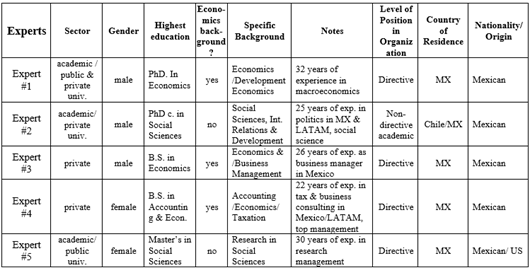
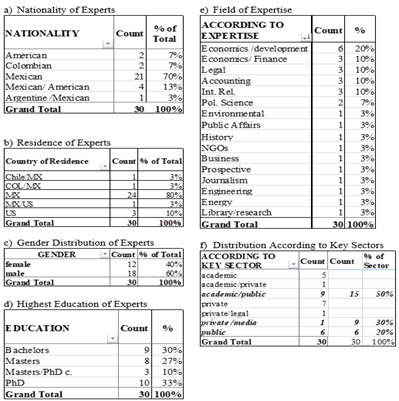
To start the process, the researcher selected the initial five experts for the pilot study. As recommended by Glenn and Gordon (2009), the five experts were selected based on their knowledge and experience from a circle of colleagues and acquaintances of the author, from different environments -the private sector, public sector and academic environment- to ensure diversity (list in Annex A). Out of the five experts three had direct work experience with sustainability, the other two were familiar with the UN Agenda 2030. These experts, including two with postgraduate degrees in economic development, were consulted about the scope of the in-depth interview and helped in defining the questions for the full interviews that followed. In addition, during this preliminary pilot round experts recommended additional potential interview candidates based on their knowledge and experience. Consequently, the sampling is a snowball and availability sampling, which brought about a panel of 35 experts out of whom, 30 people participated and contributed with their insights. To enssure diversity and heterogeneity, experts were invited from different sectors, including academia, government, and business sectors, considering that several scholars are also active in the public sector. Several of the participants are professors of economics or researchers specializing in economic development and work at renowned Mexican public and private universities or research centers. Public sector experts included those from the federal, state, and municipal government, with expertise in the energy, water management, education, and public policy sectors. The private sector was represented by professionals in areas such as law, consulting, strategic analysts, media, construction, and mining. The characteristics of the experts can be consulted in the summary tables of Annex B. It is important to mention that all experts had some experience with sustainability issues, two-third worked directly in contexts and topics that covered some aspect of sustainability.
The semi-structured interviews followed a pre-designed guideline with 18 open-ended questions which were previously calibrated with the five participants from the pilot-team. The interviews were conducted during an eight-week period from September through November 2020 via an online video meeting platform which had an average duration of one hour. With the permission of the participants, the conversations were recorded and processed for content analysis.
After gathering the results, a summary paper was sent out to the experts, expressing the group consensus, and noting issues on which divergent opinions were presented. During the second round the experts were asked to provide further responses with respect to the consensus and to justify their opinions if they felt that their position diverged from the consensus. This round, and the subsequent third round, aimed at obtaining a consensus on most questions by reducing the spread of opinions among the experts. This procedure enabled identification of a mean opinion and of the deviations within the expert panel. To reach a consensus three subsequent rounds are usually satisfactory. Based on these observations, the present research meets the criteria of the Delphi method. The validity and the reliability of the method derives from following the required steps of Delphi method described above and the careful selection of experts as indicated by Glenn and Gordon (2009).
2.2. Content analysis - coding with Atlas.ti
In the next step, content analysis was conducted on the transcribed interviews using the software Atlas.ti (Atlas.ti, 2022), that is often employed for this sort of qualitative analysis. Coding and subsequent content analysis followed the principles of Grounded Theory (Gt) (Charmaz and Belgrave, 2012).1 Following the procedure as illustrated in figure 1, after data collection and transcription, the next phase was scanning of the text and initiating the open coding of every transcript.
Open coding picks up on the most frequently repeated topics and expressions, for example, sustainable development or federal government. The final complete list of open codes included 80 codes. Several codes correspond to the questions as they were raised during the interview. For example, question no. 15 asked about the two most critical uncertainties. Therefore, separate codes were created for Uncertainty no. 1 and Uncertainty no. 2 which allowed ranking and summarizing the issues mentioned.
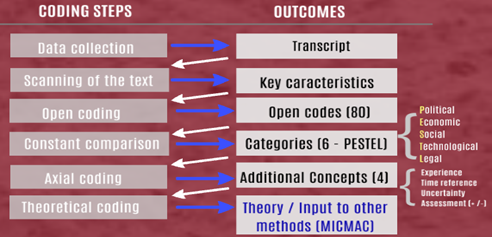
Source: Author´s elaboration based on Charmaz and Belgrave (2012).
Figure 1 Process of Coding and Development of Pestel Categories & Concepts
In the next step, axial coding was conducted. Axial coding helps create linkages and relations among the collected data. This type of coding provides the basis for creating categories, concepts and theory based on data. As an outcome of axial coding, the 80 open codes were organized into ten major groups including six dimensions according to the Pestel technique (political, economic, social, international, environmental, and legal dimensions), and four other categories that group certain perceptions (personal experiences; uncertainties; references to time, such as past and future and personal assessments if something was considered as positive or negative from a person’s perspective). Both the codes and code groups were adjusted several times to better synthesize the information and to keep them as simple as possible without losing the richness of the information provided by the participant. The description of the groups helped to aggregate the diverse topics into larger concepts. Based on that, it was possible to conduct frequency analysis on the various topics mentioned. After establishing connections among the code groups, the categories were organized and ranked by their importance, such as uncertainties. Later, networks were built with the concept groups, and generated specific reports, particularly concerning the two extreme scenarios.
In the second round, all participating experts received a copy of the summary report and were invited to comment on it. Specifically, they were explicitly asked if they agreed or disagreed with the key findings. Of the 30 participating experts, ten responded and gave feedback. Again, this information was also transferred and processed in Atlas.ti.
Next, in the third round a focus group session was conducted with five participants. These five people were selected from the panel of 30 experts. The focus group conversation aimed at clarifying critical issues from their point of view and discussing changes since the first interviews were completed. The selection was based on their availability and diversity; two participants were from government dependencies, two from the business sector and one scholar participated. The focus group discussion took place in the first quarter of 2021. The participants received the discussion topics in advance. Following the discussions, recordings were transcribed, coded, and processed in Atlas.ti using the same coding process described above. After the primary data collection and analysis, several results emerged. These are presented in the next section first, then the discussion focuses on the second research phase, the scenario planning.
3. Results
One of the first results was the analysis of critical uncertainties Mexico faces in the upcoming years. Participants gave their insights and ranked topics that they considered highly influential in this regard. Following this task, experts described their two extreme visions of the future: the best-case scenario, as most respondents imagine it, followed by a depiction of the worst-case scenario in Mexico by 2030.
3.1. Critical uncertainties by 2030
The two panels in table 1 present the top ten uncertainties over the next ten years for Mexico.
As identified in panel a) Uncertainty no. 1 and in panel b) Uncertainty no. 2), table 1 indicates the top ten topics defined as codes and these are ranked according to how often they were mentioned (Frequency Uncertainty no. 1) and their associated intensity calculation (Intensity= U1xGr, referring to U1= number of times the topic was selected as key uncertainty, Gr= how grounded the topic is, referring to the number of times the topic was mentioned in all 30 interviews). Among these the following critical issues stand out: political environment and political parties, federal government and public institutions, issues related to the environment and natural resource management, and economic issues linked to economic growth and the business environment.
Table 1 Ranking of key uncertainties
| a) Key uncertainty no. 1 | b) Key uncertainty no. 2 | ||||
|---|---|---|---|---|---|
| Frequency Uncertainty no. 1 | Intensity (U1xGr) | Frequency Uncertainty no. 2 | Intensity (U1xGr) | ||
| ● Political Environment and Parties Gr=37 | 9 | 333 | ● Public Safety Gr=17 | 4 | 68 |
| ● Public Safety Gr=17 | 4 | 68 | ● Political Environment and Parties Gr=37 | 3 | 111 |
| ● Government at federal level Gr=91 | 3 | 273 | ● Environment Gr=71 | 2 | 142 |
| ●Institutions/Institutional Environment Gr=15 | 3 | 45 | ● Social Tension and Polarization Gr=23 | 2 | 46 |
| ● Environment Gr=71 | 2 | 142 | ● Economic growth Gr=17 | 2 | 34 |
| ● Natural Resources Gr=39 | 2 | 78 | ● Government at federal level Gr=91 | 1 | 91 |
| ● Social Tension & Polarization Gr=23 | 2 | 46 | ● Private/Business Sector/SMEs Gr=69 | 1 | 69 |
| ● Economic growth Gr=17 | 2 | 34 | ● Government at state-local level Gr=37 | 1 | 37 |
| ● Private/Business Sector/SMEs Gr=69 | 1 | 69 | ● Investment Gr=34 | 1 | 34 |
| ● Government at state-local level Gr=37 | 1 | 37 | ● Institutions Gr=15 | 1 | 15 |
Source: Author’s work based on the data with the use of Atlas.ti software (Atlas.ti, 2022).
As it is noted above, experts mentioned the political environment as the most critical uncertainty for Mexico, adding a worrying tendency around the concentration of political power. Furthermore, considering political parties and politicians, participants noted that Mexican politicians often follow their own interests instead of the common good and lack the capacity to compromise and think in long term goals. Another commonly mentioned challenge is the lack of continuity in public policies. If there is a change in the governing party at the end of a sexennial, the new party and its leadership do not continue projects started by the previous government. Instead, they canceled infrastructure projects that were initiated by the preceding administration, e.g., the new airport in Mexico City.
In relation to governability and the rule of law, legal conditions also ranked high among the uncertainties. Experts commented that they observed serious challenges to the application of the rule of law at the federal and, to a lesser extent, at the state levels of governance. In addition, federal government inefficiency was also highlighted as a notorious problem that represents an obstacle for progress.
With respect to environmental issues, commonly mentioned concerns included the lack of coherent and progressive policies by the present administration, the U-turn on alternative energy projects launched by previous administrations, cancellation of several investment projects to generate energy from renewable sources (solar and wind energy), the push for oil-based projects (such as the construction of the Dos Bocas Oil Refinery), and the lack of adherence to international agreements related to climate change, e.g., the current administration reneging on previously set climate targets. In addition, experts expressed their concern about the country’s natural resource management, mentioning the following issues: too much extraction is taking place by private companies; improper management of forested areas; the lack of water resulting in possible future water shortages; environmental degradation due to infrastructure projects such as the construction of the Maya Train through the tropical forest in the Yucatán peninsula; and the threat of biodiversity loss due to urbanization and real estate developments.
Public insecurity appears also high on the list of uncertainties. In recent years public security has not improved in Mexico, as drug-related violence, extortions, homicides, feminicides, and robbery continue to rise. Participants indicated that the federal government has not presented coherent public policies addressing this issue; the National Development Plan (PND) did not cover several critical areas, even though insecurity has a clear negative impact on social well-being, domestic migration, and the business environment and investors’ trust.
Another key uncertainty is high inequality and unequal opportunities for disadvantaged and marginalized groups that result in social tensions within Mexican society. Strong discord and hostility among political parties and their voter base create an environment which is not favorable for achieving unity and accord for setting and reaching national goals and initiating important development projects. Communication is politized and polarized, not only along party preferences and affiliations but within a regional context as well. Participants expressed their concerns over a potential standoff between the economically prosperous central-northern regions and the south of Mexico which lags in development and economic performance. Experts also pointed out that the southeastern regions of Mexico, which are very rich in natural resources such as oil and water, are the least developed, have the highest indigenous community, and are more susceptible to extreme climatic events including hurricanes, floods, and earthquakes.
With respect to economic issues, the most notable risk and uncertainty was related to slow and insufficient economic growth and an unfavorable business environment as the business sector perceives hostility and a lack of cooperation and support from the current administration. All experts considered the role of the private sector as fundamental for economic development and the progress of the country given its key role in generating employment and wealth. However, several participants pointed out that the federal government’s unfriendly attitude towards the business sector negatively impacts entrepreneurs, workers and ultimately the country. For Mexico to advance more competitive jobs are needed and these are typically generated by the private sector, not by state-owned companies. Although the topic of education and human capital development did not appear among the top 10 critical issues, it was mentioned by almost every participant as a very important issue that the country needs to improve in the next decade.
3.2. Positive vs. negative perceptions of selected topics
To analyze the participant perceptions -positive or negative- with respect to each mentioned topic, whenever the speaker’s perception was clear, it was considered as well. Therefore, these either positive or negative perceptions were coded according to each topic and the Sankey graph view of code co-occurrence was generated Figure 2 shows the overwhelming number of negative perceptions of participants: negative comments more than doubled positive ones (305 vs. 134 quotes) and several co-occurrences appear with other codes. More specifically, it can be observed that many experts highlighted the negative aspects of current federal government, public policies, environmental and sustainable policies and most topics and codes related to the economic issues. Only a handful of questions received positive comments, for example, the code and topics related to the United States-Mexico-Canada free trade agreement (USMCA). One topic, monetary policy, received mixed comments and shows almost evenly split perception among the experts, indicating a lack of consensus about the topic and thus greater uncertainty.
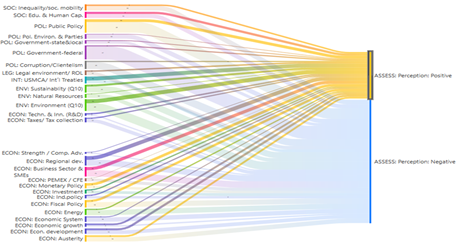
Source: Author’s elaboration using Atlas.ti software (Atlas.ti, 2022).
Figure 2 Table of co-occurrence of selected codes and positive vs. negative perceptions of each code
3.3. Networks created to visualize relationships among categories and codes
Following the perception assessment, different semantic maps were developed in order to visualize the network connections among key concepts, categories and perceptions. Figure 3 below displays the relationships among the following categories: Dimensions, Uncertainties, Perceptions and Scenarios. The letter “G” refers to how grounded each code was, in other words, how many times these phrases were mentioned in all the interviews? The letter “D”, on the hand, refers to density, indicating how many connections the phrase or concept has with other concepts? Clearly, the higher these numbers are, the more frequent and more connected a particular concept is. The connectors among the colored codes and concepts - such as “defines”, “influences”, “potential influence”, “is associated with”, or “contradicts” - indicate semantic linkages among them. With their help, the network offers a visual representation of how key uncertainties are related with the six dimensions. Key Uncertainty no. 1 was mostly related to the political, legal and social dimensions.
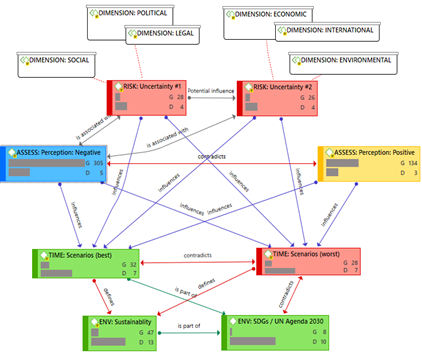
Source: Author’s elaboration using Atlas.ti (Atlas.ti, 2022). Letter “G” refers to how grounded each code is; “D” refers to density, indicating how many connections the phrase or concept has with other concepts.
Figure 3 Network of Relationships among six dimensions, key uncertainties, and perceptions
This network shows how key uncertainties are related with the six dimensions. Key Uncertainty no. 1 was mostly related to the political, legal and social dimensions. As the political dimension is very closely related to the legal dimension, for example, codes such as bureaucracy and corruption belong to both dimensions. These two dimensions visually overlap with each other. Similarly, codes of the international dimension overlap with three codes in the economic dimension, e.g., Foreign Direct Investment (FDI), USMCA trade agreement, foreign trade, consequently this overlap is visible as well. The two key uncertainties were grouped as Uncertainty no. 1: socio-political critical issues; Uncertainty no. 2: economic and environmental issues. These two categories will define the future scenarios, depending on the perceptions of each respondent. The perceptions were coded and grouped as either positive or negative with respect to any issue mentioned during the interview. These categories and concepts were instrumental to the formulation of the scenarios, best and worst, as these two extremes were asked of each participant. Ultimately, the definition of the scenarios helps indicate whether Mexico can meet the objectives of the UN Agenda by 2030.
3.4. Cross-Impact Analysis
Key variables and drivers obtained from the interviews and from the above presented network maps offer the list of variables for the MICMAC software (Arango Morales and Cuevas Pérez, 2014) used for cross-impact analysis. After capturing the variables and assigning the values in the cross-impact matrix, Figure 4 was generated. This provides a visual tool to select the most influential drivers and identify clusters that emerge in the upper quadrants.
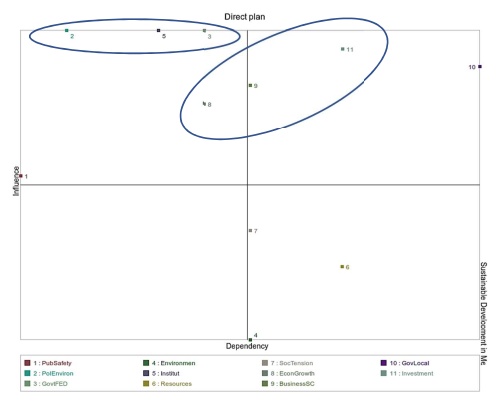
Source: Author’s elaboration using Atlas.ti (Atlas.ti, 2022). The eleven variables include: 1 Public Safety, 2 Political Environment and Parties, 3 Federal Government, 4 Environment, 5 Institutions, 6 Natural Resources, 7 Social Tension and Polarization, 8 Economic growth, 9 Business Sector, 10 Local Government, 11 Investment.
Figure 4 Matrix of Direct Influencers - Variables and Values
The matrix view above marks the two main clusters that can be identified as some variables are located close to each other on the Cartesian plane. All highly influential, variables 2, 3, 5 (political parties, federal government and institutions) form Cluster 1, while variables 8, 9, and 11 (economic growth, business environment, and investment) form Cluster 2. The common theme of these two clusters can be defined as Political-Institutional Environment for Cluster 1 and Economic Conditions for Cluster 2. These two themes uniting the two clusters serve as axes to formulate the four scenarios in the next scenario planning phase.
3.5. Scenario Planning
There are different types of scenario planning methods. Among the commonly used methods the three-scenario method and the cross-matrix method stand out. The first type usually includes a best-case scenario, a worst-case scenario and a most likely or inertia scenario. The cross-matrix method takes a different approach: it uses the two most relevant critical issues of the topic and considers their extreme opposing meaning (Rhydderch, 2017). As Schoemaker (1995) also pointed out, scenarios examine the collective effects of two uncertainties standing side by side and study their interaction. In this case, the two critical issues that emerged from the cross-impact analysis are Political-Institutional Environment and Economic Conditions, which can unfold either favorably or unfavorably. Using these two critical topics as axes, four future scenarios can be developed, by considering the opposites of each topic, whether the conditions are favorable or unfavorable towards achieving the UN Agenda 2030, as it is visible in figure 5 below.
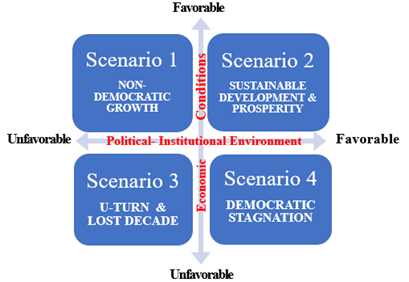
Detailed descriptions of the four scenarios can be seen in table 2.
As shown in table 2 four very different scenarios may unfold according to the logic of the matrix generated. The names of each scenario derive from the combination of the two conditions on each axis. Once the general conditions of a scenario were identified, each one was developed in greater detail, following the internal logic and coherence of each scenario.
Table 2 Four possible scenarios for sustainable development (Sd) in Mexico by 2030
| Political-Institutional Environment | |||
|---|---|---|---|
| Unfavorable | Favorable | ||
| Economic Conditions | F a v o r a b l e | NON-DEMOCRATIC GROWTH | SUSTAINABLE DEVELOPMENT & PROSPERITY |
|
Unfavorable political- institutional environment, but favorable economic conditions for growth Social effects: Democratic processes are curtailed, society is more divided, with social tensions increasing. Economic effects: Investment levels may rise, especially public investment. Some confidence in future business ventures promotes new job creation, mostly monopolistic big firms prevail along with widespread informal economy for PYMES. Energy is still based on fossil fuels. Environmental impacts: Assuming the current leading party winning in 2024, little change expected in moving from fossil energy sources to more sustainable energy sources. Partial fulfilment on UN Agenda (Sdg 8 met, SGD 7, 13, 15, 16 not met). |
Favorable political-institutional environment, coupled with favorable economic conditions for Sd Social effects: Democratic processes advance significantly, society is more supportive to the government, with social tensions decreasing. Less gap between poor and rich, creating a more inclusive and equitable society (meeting Sdg 1, 5, 10, 16, 17). Economic effects: Increasing public and private investment raises the confidence in business ventures due to democratic improvements. Informal economy is decreases. Energy is based increasingly on alternative energy sources (Sdg 7, 8, 9, 11). Environmental impacts: Moving to sustainable energy sources lead to less contamination. Improved stewardship of biodiversity, forests, aquamarine life contribute (Sdg 6, 7, 13, 14, 15). It is possible to meet the UN Agenda 2030. |
||
| U n f a v o r a b l e | U-TURN & LOST DECADE | DEMOCRATIC STAGNATION | |
|
Unfavorable political- institutional environment, with unfavorable economic conditions for Sd Social effects: Democratic processes are rolled back, society is more divided, with social tensions increasing. Insecurity and drug-related crime keep rising. Increased gap between poor and rich, social tensions, gender differences prevail. Economic effects: Low GDP growth, low investment, especially private. Informal economy expands, decent work opportunities stagnate. Low confidence limits business ventures and energy is still based on fossil fuels. Environmental impacts: Little achieved towards weaning from fossil energy sources to more sustainable energy sources. Biodiversity loss, losing forests have not been stopped, contamination continues to rise. Incompletion of the UN 2030 Agenda. |
Favorable political- institutional environment, with unfavorable economic conditions for Sd Social effects: Democratic processes advance significantly, society is more supportive to the government, with social tensions decreasing. Increases gap between poor and rich, gender differences still prevail, due to low economic development and job opportunities (Sdg 10). Economic effects: Low GDP growth, low investment, but increasing confidence in business ventures due to democratic improvements. Informal economy prevails. Environmental impacts: Little improvement from moving fossil energy sources to more sustainable energy sources. Biodiversity loss, losing forests have not been stopped, and contamination continues to rise. Partial achievement of the UN 2030 Agenda (e.g., Sdg 5, 16, 17 met, 1, 7, 8, 9, 11, 12 not met). |
||
Source: Author’s elaboration.
Non-Democratic Growth shows a future scenario in the upper left quadrant in which the country halts democratic processes and becomes increasingly authoritarian. The military and national guards keep general order. Insecurity and drug-related crime keep rising but are controlled by the military. Greater gap between poor and rich, gender differences prevail. Nonetheless, the country manages to push forward on key targeted public investment projects that may generate growth and positive spillover effect for job creation, making progress on Sdgs 8 and 9 but falling behind on other social and environmental issues, such as Sdg 5, 7, 11, 15, 16.
Sustainable Development & Prosperity in the upper right quadrant shows the most desirable scenario in which both political-institutional and economic environments favor sustainable growth and development, investment both public and private increase and generate prosperity while managing natural resources with care and focus on alternative energy sources instead of fossil fuels. The military and national guards have less involvement in everyday life. Insecurity and drug-related crime decline as more job opportunities are created in the formal economy. This scenario, which is the best of all four, could lead to the achievement of the 17 Sdgs of the UN Agenda 2030 and compliance with Mexico’s commitment to this international agreement.
U-Turn & Lost Decade scenario in the lower left quadrant presents the worst-case scenario, with unfavorable political-institutional and economic conditions that would make difficult the achievement of the UN Agenda 2030, as there would be little or no improvement on most of the Sdgs.
Democratic Stagnation in the lower right quadrant describes a future in which democratic processes advance giving rise to improvements on several Sdgs, such as 5, 16, and 17. However, the economic-environmental dimensions stagnate due to low level of investment and persistent reliance on fossil fuels as the main energy source.
Among the four potential scenarios, the most likely scenario may unfold paradoxically between Non-Democratic Growth and Democratic Stagnation scenarios, as there are signals that support either or both of these scenarios. An example of this is the sluggish growth expected for the upcoming years, as the country still has not recovered from the economic post pandemic economic crisis (IMF, 2021a). Other unforeseen events that may have high negative impact on economic growth, such as subsequent pandemic waves or a global economic downturn, may hinder Mexico’s economic progress even further (IMF, 2021b).
The following section presents comments from experts that support one of these two scenarios and discusses events that took place prior to 2022 signaling trends that would lead to these two scenarios.
4. Discussion: Visions of the future - Mexico in 2030
During the investigation experts shared their visions of Mexico by 2030. Visions make us reflect on how we imagine the future and are instrumental in creating plans and strategies to realize desired scenarios and avert undesired scenarios. The last interview questions asked each respondent to imagine their best-case and worst-case scenarios for Mexico. These scenarios are often extreme possibilities of the future, for the purpose of analysis and strategy development.
4.1. Visions of the best-case scenario
With respect to the presented scenarios, experts made several observations supporting the desired or best-case scenario, imagined as Sustainable Development and Prosperity. The primary recurring motifs highlight that it is desirable that Mexico would be a country with a vision and a “national pact” to push for development, investment in education and innovation, with a more inclusive and conscientious society that is united to strive for a common goal. Considering the political and institutional environment, table 3 displays comments that stood out:
Table 3 Excerpts related to the best-case scenario
| My best scenario would include more conscious citizens, not only in an economic sense, but also in a political sense; in the sense of beginning to have greater citizen participation, beyond mere electoral processes. (Expert no. 25, 2020) |
| Mexico is a more transparent country that has consistency between governments, continuity and a more even distribution of wealth. (Expert no. 6, 2020) |
| A country that really manages to control corruption. I believe that this is the main problem in this country, and it is closely linked to the issue of security and drug trafficking. Unfortunately, I think that this is one of the most degenerative problems that this country is having. And hopefully we can achieve that with strong institutions, whoever is the president, with a president who respects the institutions; to invest in education, to invest in the country’s infrastructure. (Expert no. 17, 2020) |
| My best scenario would be that changes could take place in 2021 and 2024, that some of the international commitments could be resumed to comply with the UN agreement. (Expert no. 26, 2020) |
| The best thing would be for us to have a true industrial policy that focuses on our strengths and strengthens them; try to make policies to encourage the industry. This would promote employment, improve education, give more resources to innovation and development, improving health issues. (Expert no. 21, 2020) |
| I would like to see companies in Mexico provide jobs and above all that we have strong and independent institutions. (Expert no. 22, 2020) |
| A country that is much more integrated with our regional partners, in a good measure with the United States. A more intense commercial exchange, which could allow us to have a greater advancement in technology, also in education, to have greater opportunities for our young people to have better preparation for the future. (Expert no. 20, 2020) |
| In ten years, we will begin to see Mexicans being competitive worldwide, generating effects. (Expert no. 17, 2020) |
| In the best scenario, I would like to see a Mexico logically with less inequality, but with a higher growth rate and where there are Mexican star products that play a strong role at the international level. That would be my best scenario. And, logically, a better public primary education; that is, that it would permeate the public, in a summary, better education for all. (Expert no. 16, 2020) |
| My best scenario would be a country in which the implementation of innovative environmental policies could be encouraged much more, that begin to encourage and invest much more in the development of new technologies that generate necessary energy. (Expert no. 10, 2020) |
| A self-sufficient Mexico in energy, preferably renewable energy, and in the production of its own food, emphasizing organic production, and with a decrease in animal products. (Expert no. 5, 2020) |
Source: Author’s elaboration based on interviews conducted [via online platform a total from 30 interviews, all names are confidential], in Mexico, September 27-November 22, 2020.
In summary, experts envision that Mexico continues to be a democratic country where the rule of law and electoral processes are respected, with more transparency and accountability. The federal, state, and municipal levels have made progress and it is readily apparent to their citizens. Regarding pressing social issues, experts hope to see Mexico manage to significantly reduce its notoriously high inequality. Furthermore, participants highlighted the importance of making progress on racial and gender inequality. Improvements on these issues would boost better and equal opportunities for Mexicans. Considering the environment, under a best-case scenario experts expect to see a conscious population and all three levels government-federal, state, and local level-committed to better steward the environment by reducing pollution, environmental degradation, and biodiversity loss.
4.2. Worst-case scenario for Mexico by 2030
When asked about the worst-case scenario, experts generally saw the continuation of the current governance and ideological direction in terms of political, economic, social, environmental policies as detrimental to the country’s progress and leading to a stagnating economy with a polarized society and deteriorating environmental conditions, e.g., serious water shortages, increased pollution, and energy derived from fossil fuels. Observations in table 4 underpin these ideas:
Table 4 Excerpts related to the worst-case scenario
| The worst scenario is that the democratic institutions, which guarantee us democracy and liberties, are taken over by the state, that the current government seizes control of the Ine [National Institution of Elections], the Central Bank, and everything necessary, to have a central and political control. That would lead to a continuity of a political vision, an ideology that is not shared by all Mexicans. (Expert no. 6, 2020) |
| In the worst case, we continue with a political system that simply cannot be specified, where the incentives for politicians are too far from the needs of the population and where we continue with a system of unsustainable differences. (Expert no. 25, 2020) |
| There is going to be a lot of pressure with the issue of water, it is very worrying and so is climate change. It is very likely that many of our freshwater deposits in the north on the coasts will become saline, that they will become no longer drinkable. (Expert no. 24, 2020) |
| … [ There are] policies that are not strategic, that are not visionary, that do not increase the growth of the country, … what is the unstable part of the country, once again going back to the system that they continue like this, with high level of violence, with lack of transparency, lack of security for the people, who do not have confidence in their government. And that they continue to think that developing the oil sector is the only way forward, if that is the focus for the next ten years, it will definitely not be good for Mexico. (Expert no. 10, 2020) |
| It would be a typical Venezuela scenario (...) The worst scenario would be to be in a civil war, although I don’t consider that is a realistic scenario (...) In that case, it would be a country that does not have self-confidence, where there are still many deaths, the “narco” has more power, lack of legal certainty would make the bad people have more confidence, more power, more weight in what is happening in the country, forgoing the idea of legal certainty, and economically it would be disastrous. That would be the worst scenario, it would be a situation where Mexicans would be leaving Mexico, like Venezuelans, there would be heavy migration. (Expert no. 18, 2020) |
| The worst-[case] would be to have this horrible combination of political polarization continuing, and also that policies around sustainable development are scaled back, thus making it more difficult to correct. I mention these two elements because they are complementary. In my opinion, the 2030 Agenda offers elements to be at the center. … the extreme would be to continue with this polarization that puts aside reasonable and scientific knowledge, and places emphasis above all on ideological definitions, even common agreements. (Expert no. 26, 2020) |
| A continuation of policies that have created uncertainty. Uncertainty to invest because contracts are not respected. It undoes investments that have already begun and seeks to return to state control of certain areas such as electricity, in which for years, the state has shown its inefficiency. (Expert no. 19, 2020) |
| My worst-case scenario is that we continue exactly the way we’re going. Where all industries begin to be attacked, a system begins to become more paternalistic than it already is, more clientelist and we arrive at a neo-patrimonial state. (Expert no. 21, 2020) |
Source: Author’s elaboration based on interviews conducted [via online platform a total from 30 interviews, all names are confidential], in Mexico, September 27-November 22, 2020
With respect to economic policies, experts envision a worst-case scenario that includes a prolonged post-pandemic economic crisis and misguided economic policies beyond 2022, causing long term stagnation where economic growth is well below the country’s capacity and potential. In this scenario the government does not cooperate with the private sector and makes entrepreneurship more difficult. Employment is at suboptimal level -with significant unemployment and underemployment- and many people find jobs only in the informal sector. There is a low level of investment and foreign direct investment, further worsening even further job and wealth creation. Instead of future-oriented sustainable infrastructure projects, e.g., better public transportation system, water, and energy generation facilities, non-productive and non-renewable energy generation is still prevalent in Mexico. Due to low investment, the country’s infrastructure, including health care system, public schools, and the highway network, deteriorates greatly.
Interestingly, several of the above cited comments support ideas that are presented in the two other scenarios. Participants expressed fears that the country will become less democratic (scenario Non-Democratic Growth) and feared the continuation of current policies that do not encourage economic growth (scenario Democratic Stagnation). Although these two scenarios seem like opposites, they may not need to be. The former emphasizes the lack of democratic political processes which are not favorable for sustainable development, while the latter highlights the foregone economic growth.
After studying these possible future outcomes, the most likely scenario may be Democratic Stagnation, based on the developments as of this writing. The reason for this is the expectation of slow growth for upcoming years and the shared belief that Mexico will continue to be a democratic country, in spite of worrisome signals that may indicate otherwise. For example, by early 2022 some institutional checks and balances had been severed, e.g., that of the National Electoral Institute (Ine), the National Commission on Human Rights (CNDH), Freedom of Information Agency (Inai) (O’Neil, 2022). In the economic arena private investment has not increased, thus curtailing employment and production growth. Investments related to energy generation continue to focus on fossil fuels instead of incentivizing green energy development. Social programs, albeit well-intentioned, do not offer a significant change in inequality as informality prospers and well-paying job opportunities are scarce. Considering these points, it would require substantial change in current policies in such key areas as strengthening institutions and the rule of law (Sdg 16), economic growth and job opportunities (Sdg 8), decreasing inequality (Sdg 10), attending to pressing environmental issues (Sdgs 13, 14, 15, 11) to achieve the UN Agenda 2030. Meeting all the established goals by the end of the decade does not seem to be realistic given the current policies.
However, even with the existing policies, progress on sub-indicators may be achieved against such goals as Sdg 2 (zero hunger), Sdg 3 (good health and well-being), Sdg 5 (gender equality). Only substantial negative change to existing public policies could reverse positive trends on even these Sdgs, which then could lead to the worst-case scenario (U-Turn & Lost Decade).
Currently, there are no signs of such regression on the abovementioned topics, signaling that the inertia or most likely scenario will probably unfold as described by the Democratic Stagnation scenario.
Conclusions
Based on the 30 interviews with experts several patterns emerge, including a generally pessimistic perception of the current state of affairs and the direction the country took in 2020-2021. Furthermore, converging ideas can be detected when analyzing the best and worst-case scenarios. A desirable future as described in the best-case scenario, presents a situation in which Mexico creates a “national pact” and the political leadership develops the appropriate strategies to achieve its goals, considering the specific cultural characteristics of the country. In the best-case scenario, there is improved and more transparent natural resource management which remains mostly in public ownership with the active contribution of the business community. The government provides proper, effective legal framework that promotes investment and business efficiency.
The cooperation between the private and public sectors allows the country to achieve energy self-sufficiency based primarily on renewable resources, rather than fossil fuels. Water will be a critical issue; several experts are deeply worried about the availability and access to fresh water in several parts of Mexico. It will be imperative to have a clear legal framework that can balance the need for water access by both business and the public.
In contrast, the worst-case scenario describes a very dark future by 2030, a lost decade for Mexico with severed democratic processes. This scenario could be averted with targeted policies and programs. However, out-of-the box programs and development plans can only work if Mexico’s natural and cultural heritage is respected and considered. The most likely scenario suggests that the country will face disappointing economic growth coupled with strong state intervention and a reduction in democratic processes in the upcoming years.
Lastly, as many experts pointed out, only radical and fundamental changes can put the country on a path to meeting the 17 Sdgs of the UN 2030 Agenda by 2030. Without strategic and ambitious policies, it is unlikely that Mexico will achieve these goals. The article and its findings contribute to strategic discussions and policy analysis regarding sustainable development in Mexico.
Nevertheless, the present research and its findings have limitations. Given that the investigation is based solely on expert opinion, it is possible that bias could not be fully eliminated even following the most rigorous selection and interviewing method. The reproducibility of this research lies in following the steps of the procedure and qualitative methods applied. Further research opportunities could be conducting a similar investigation with a different panel of experts and/or complementing the expert interviews with quantitative research methods.