




 nueva página del texto (beta)
 Inglés (pdf)
 Artículo en XML
 Referencias del artículo
 Traducción automática
 Enviar artículo por email
 Citado por SciELO
  Similares en
SciELO
Similares en
SciELO 
 Permalink

Introduction
Background
Mining has been practiced since prehistoric times. There are records from 300,000 years BC, of the search for non-metallic minerals such as stones, obsidian, and schist, which were suitable for tools and eventually for weapons. Other rocks and minerals such as kaolin, clays, iron, salt, and building materials were also exploited (Tatiya, 2013).
The extraction of mineral resources began at the surface level, by hand picking or simple washing. However, as the extraction of more resources increased, minerals on the surface became scarcer. They began to drill holes in hillsides to get the minerals, also to exploit them in rivers and streams. To this, Agricola in 1556 in his book "Re Metallica", mentions works such as stacking stones and sprinkling them with water for the recovery of alum (Agricola, 1556). This solution extraction procedure probably began with the heap leaching and precipitation of copper in Río Tinto, Spain, around 1752 (Lottermoser, 2010). This method produced a very high pollution of the river.
In countries like Peru and Mexico, gold and silver had already been exploited by the Incas and Aztecs since pre-Columbian times. With the arrival of the Spanish, gold was extracted by smelting ores, but mainly by amalgamation with mercury. The mine residues were stored to continue obtaining more benefits, trying to recover and conserve the mercury that was introduced to increase the yield in the mineral separation process, without understanding the damage these extraction methods caused to workers' health and the environment.
Products from mining are present in the industry and in people's daily lives. It is unknown, however, that during the process of obtaining them, activities are carried out from the extraction of soil and rock to the process of separating the beneficial minerals from the material with no economic value. These wastes, whether gaseous, liquid, or solid, vary significantly in their physicochemical composition. Therefore, it is necessary to dispose of them safely to avoid damage to the health of workers and surrounding populations and degradation of the environment.
Objectives
The objective of this work is to describe those environmental aspects that are involved during the development of a mining operation. Considering design variables and environmental regulations governing waste discharge, particularly into water and air.
Scope
A brief description of the mining activity from its beginnings to the present time is made. The socioeconomic impacts on both the exploitation region and the country are discussed. A review is made of the environmental water and air regulations of some countries with mining activity, which regulate and control the emission of pollutants into the environment. Finally, the environmental aspects involved during the design, operation and closure of mining waste deposits are discussed.
Mining operation
Generalities
Mining operation is the final stage of the mining activity and refers to all the phases to extract and concentrate the mineral of interest. Mining has played a primordial role in the development of humanity. Mining products are currently integral to both industry and daily life.
However, during mining, various activities are carried out that impact the environment. Soil and rock are extracted in open pit or underground mines through shafts and tunnels. Additionally, access roads, camps, and in some cases entire settlements, are constructed to accommodate the workforce at mining sites. This modifies the landscape and impacts the biota. In addition, during the ore benefit process, polluting residues of various types are produced in liquid, solid and gaseous states with no economic value.
After identifying a deposit through geological and geophysical explorations, its economic potential is evaluated to determine if the exploitation is profitable. Then a suitable extraction method is selected for the mineral benefit. Figure 1 shows schematically the components of a mining operation.
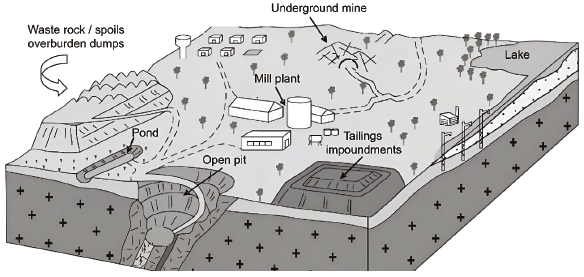
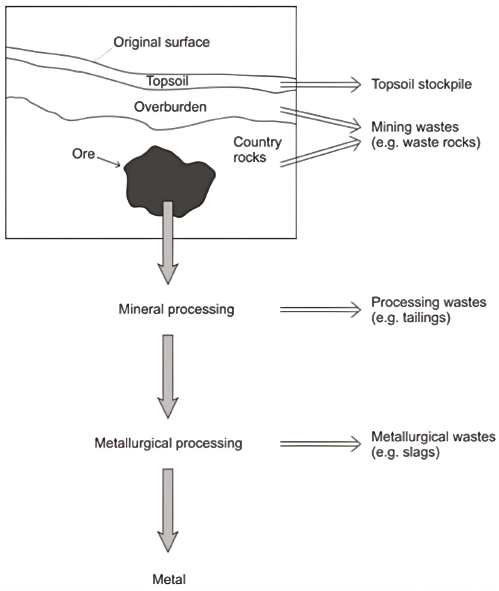
Different operations are carried out during the ore benefit. A very common one is the grinding of the mineral. The ground material is treated to obtain the concentrated mineral separated from other components that come with the excavated material. Liquid and solid wastes are produced in this activity. During the excavation to extract the ore, sterile waste of soil and rock is produced that must be properly disposed of (Figure 2).
Mineral processing
Figure 3 shows schematically the stages of mineral processing. At each stage, waste is generated that must be disposed of properly. The wastes generated during each stage take different names either by their size, physical and chemical composition, water content or by the process used during their production.
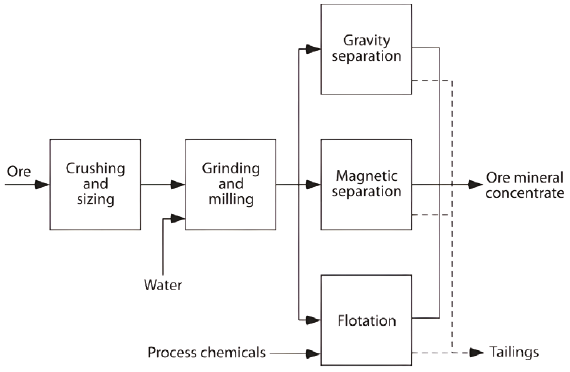
The characteristics of the ore, combined with the equipment used for crushing, screening, classification, and gravity concentration, determine the waste's physical properties, including particle size distribution. Subsequent processes involving the addition of water or reagents give the waste different consistency and strength properties, which are determinant for its proper and environmentally friendly disposal (Reemeyer, 2022).
Mining waste
Mining waste is the result of various operations. Some are sterile (waste rocks), others are the product of ore processing (tailings) and others. These can be in solid, liquid or gaseous states and are discharged or released directly or indirectly in a receiving body. Some can be reused.
Solid mining wastes are heterogeneous geological materials that may consist of sedimentary, metamorphic or igneous rocks, or loose soils and sediments. As a result, particle sizes vary from clay size to rock fragments. The wastes generated during mining operations are acid mine drainage (AMD), mine waste rock, tailings, heap leach tailings, placer or washings, cyanidation process wastes, metallurgical wastes (slag) and radioactive wastes.
Mining wastes with contamination potential have physicochemical characteristics that depend on the type of treatment to which they have been subjected. The addition of liquid solutions and water content in the discharged materials from concentration plants dictate the appropriate storage or disposal method, as well as the placement strategy. Although it is assumed that all mines have tailings storage facilities, small mines are known not to have such facilities and send tailings directly to ravines, nearby bodies of water or to the ground.
Therefore, mining produces several impacts, mainly: contamination of surface water, overexploitation of aquifers, destruction of habitats and the landscape. In addition, tailings deposits generate various toxic residues that affect the soil and groundwater quality.
These effects, of course, must be avoided or mitigated and corrected in a timely manner, taking them into account in the design of the mining operation.
Socioeconomic impact
Mining activities generate significant economic and social impacts, contributing substantially to a country's Gross Domestic Product (GDP), job creation, and foreign currency inflows, which support public spending. For example, the contribution of mining to GDP for the year 2021 in Mexico was 1.4 %, Peru 12.1 %, Chile 16.2 %, Canada 1.2 %, the United States 0.1 %, Australia 10.5 %, South Africa 3.8 % (World-Bank, 2021). These data were taken from the World Bank’s website in 2023 and vary annually. Properly managed mineral exploitation fosters national economic prosperity.
Design of mining waste storage
The environmental impact assessment must be integrated into the planning process to decide the best alternatives to carry out the mining project in its design, construction and operation (Jaime, 2003). When the available strategies for environmental management are analyzed, it becomes clear to prioritize long-term responsibilities to the risks associated with waste management and pollution, associating to each one the costs required for each activity (Table 1) (Cheremisinoff, 2003).
Table 1 Strategies for waste management (Cheremisinoff, 2003)
| Type | Description |
|---|---|
| Prevention |
Reduce the amount of
waste |
| Recycling, resource recovery and reuse in energy (R3WE) |
The recovery of certain waste
for reuse (known as resource recovery) and the conversion of certain types of waste into useful energy such as heat, electricity, among others. They are strategies that recover and offset the costs of general operation of waste |
| Treatment |
When waste cannot be avoided
or minimized through reuse or recycling, then strategies aimed at reducing volumes and/or amounts of pollutants must be followed. Treatment technologies are processes that focus on stabilizing waste, reducing toxicity, reducing volume prior to final disposal, or, in some cases, creating by-products with limited applications |
| Disposal |
Waste disposal practices are
embedded in the environmental management strategies of all countries, which are an integral part of most manufacturing operations, and are often among the highest direct cost components |
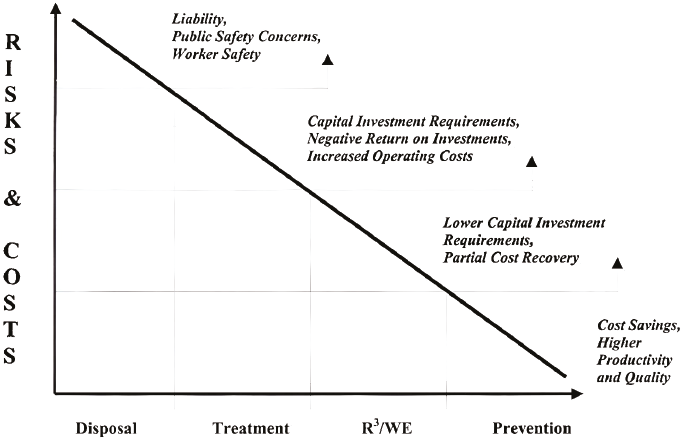
Waste management strategies are inherently linked to the costs and risks of their implementation.
Figure 4 shows that the costs and risks that arise in the disposal of waste reach higher values than when their generation is prevented, or when are recycled. From an economic point of view, that is the least desirable strategy. It must be addressed directly by reducing and recycling waste.
The design of mining waste deposits, like all engineering works, must consider both failure and service limit states. The first pertains to ensuring the structure can withstand the loads and stresses it will face, preventing catastrophic failure, the second refers to the fact that the settlements and displacements of the structure are kept within limits set by operating needs or by restrictions of the building codes or regulations. For mining deposits, additional service limit states must be considered, specifically those related to compliance with environmental regulations. That is, the waste deposit can be safe against failure and have allowable displacements. However, the infiltration of the reservoir can be of such magnitude that it contaminates an aquifer. Therefore, the design of the work must be modified to prevent this from happening (Jaime, 2011).
Environmental assessment is a process that enables decision makers to evaluate the potential economic, social, political, and environmental impacts of the proposed projects or actions under consideration. In this way, they can be presented to environmental authorities for formal analysis. In addition, the interested parties of the region or the country, and the users and beneficiaries can be informed rationally, with the data of the project and specific studies, as appropriate (Jaime, 2003; Jaime, 2011).
In a mining operation, the environmental factors that must be considered include landscape (topography), vegetation, fauna, water, infrastructure and waste (Table 2). The ability to specify closure goals will depend on the quantity and quality of environmental data collected at that time.
Table 2 Environmental impacts of mining operations during the stage of preliminary studies, construction, operation and closure (Jaime, 2011)
| Agent | Possible impact |
|---|---|
| Personnel
(Staff) |
Hunting, fish, disruption of
community life, economic impact, personnel waste and camps |
| Machinery |
Noise, polluting emissions,
waste oils and fats, maintenance and repair workshops |
| Construction methods: Open pit excavation Shafts and tunnels Explosives Pneumatic hammers Ducts |
Dust from work fronts, noise,
vibrations, handling of explosives, disposal of waste, disposal of sludge, impact on water quality of receiving bodies, alteration of springs and bodies of water, pollutant emissions into the atmosphere, Topographical and batimetric modifications affecting the habitat and altering the life of the Communities |
| Pumping |
Change of geohydrological
regime that can affect springs and wells of the region |
| Excavations
and fills |
Alteration of the landscape,
affectation of flora and fauna, loss of habitat, alteration of natural drainage |
| Management of water, reject sludge and leachate |
Affecting water quality of
streams, rivers, lagoons and aquifers |
| Waste
storage |
Pollution to air, soil, water
bodies and aquifers by dust, and leachates |
| Access
road |
Alteration of the landscape,
affectation of flora and fauna |
| Tunnel portals | Alteration of landscape and habitat |
The environmental aspects involved in the design of mining waste deposits are:
Environmental Baseline: The set of parameters that determines the details of an environmental monitoring program that describes the receiving environment.
Impact predictions: Definition of changes in parameters, both in spatial and temporal dimensions.
Selection of analytical parameters: It depends on the nature of the contaminants that are identified.
Identification of contaminants: Chemical characteristics, classifying into inorganic and organic contaminants.
Pollution processes: The water from the mining activity goes through several geochemical and biogeochemical processes that deteriorate its quality.
When selecting and designing a reservoir site, protecting groundwater quality is often the most critical environmental consideration (Davies et al., 2002). Assessing potential groundwater quality impacts requires:
Establish the groundwater quality baseline, by collecting samples of surface water and groundwater.
Identify the main hydrogeological units and develop a hydrogeological model of the site, local or regional.
Model the development of the waste deposit and estimate the pollutant loads. This may require characterization of attenuation capacity in hydrogeological units.
Mining is a transient land use that disrupts the environment, either on the surface or deep within the earth's crust to provide man with essential mineral and energy needs. The identification of the type of contaminant, the dissemination path, distribution and the associated effects to human health and the environment are important for the evaluation of risks in the affected area.
Mining waste is stored in deposits that must be designed to comply with environmental regulations as well as conventional civil and mining engineering regulations and design standards. The environmental regulations (standards) are intended to avoid (prevent), reduce, and mitigate the possible contamination that the waste may cause to the health of workers, surrounding communities and the ecosystem.
The primary design objective is to establish a safe and stable waste deposit (Davies et al., 2002). For the design of a waste deposit, some countries have guidelines, manuals or minimum design recommendations. In general, they include the following:
Basis of design. The conditions of the place, such as: the geological and geotechnical characteristics of the site, hydrology, geohydrology, seismicity, topographic relief, climatology, biodiversity and ecosystems and the operating requirements of the mine.
Design criteria. Set of standards and regulations, both environmental and those established by engineering practice. Among others: the geometry of the deposit, characteristics of the waste, construction method, safety factors.
During the development of the mining industry, the following types of storage are known and identified:
Surface storage, such as landfills (waste rock) and reservoirs (tailings, slag).
Storage in open pit or underground mines.
Aquatic storage.
A waste deposit in operation must have systems of waste transportation from the plant to the deposit. Liquid handling systems, containment structures, among other elements and components that together ensure adequate behavior during the operation and closure stages.
The definition of the parameters for the storage design is crucial. For example, the design storm for water management and the design of the overflow spillway, the design earthquake, wind characteristics, permeability of soils and rock formations. Furthermore, it is essential to determine vulnerability of surface water bodies and aquifers, as well as the risk of damage to population centers and the environment.
During the characterization of the site, the studies must identify vulnerable environmental elements or those susceptible to degradation. For this, the waste deposit site must be prepared to avoid or mitigate damage to the identified elements or move it to another place. Pollution prevention and control measures should be included (Jaime, 2011).
Blight points out seven factors that would cause a prospective storage site to be rejected. These are:
1) Flood zones with return periods T<50 years;
2) Areas close (<100 m) to rivers, lakes and dams;
3) Zones of geological instability, for example, faults, karstic limestone, among others
4) Archaeological zones;
5) Aquifer recharge zones;
6) Regions whose land use is not compatible with mining activity;
7) Lands in which the prevailing winds drag dust from the warehouse towards neighboring communities, forests or agricultural land (Jaime, 2011).
Therefore, the disposal of mining waste depends on the material to be disposed of, the physical and chemical characteristics, specific site conditions such as availability of areas, topography, climatic conditions and regulations of each country.
Water and air environmental regulations
Environmental regulations are legal provisions that establish which are the polluting substances and the acceptable concentration levels acceptable for human health and the preservation of the environment. These standards establish limits on the number of pollutants emitted into the air or water that can be produced by mining and industrial facilities or emission sources in general. The purpose of these standards is to reduce or mitigate pollution and/or its effects, or to be a means of restoring air or water quality levels when they have deteriorated. Some standards also regulate the exposure time.
High concentrations of heavy metals, dust particles, and gases cause harm to both humans and the environment. According to the periodic table, heavy metals are chemical elements with high density, mass, and atomic weights (atomic number greater than 20), and they are toxic even at low concentrations. These include aluminum (Al), barium (Ba), beryllium (Be), cobalt (Co), copper (Cu), tin (Sn), iron (Fe), manganese (Mn), cadmium (Cd), mercury (Hg), lead (Pb), arsenic (As), chromium (Cr), molybdenum (Mo), nickel (Ni), silver (Ag), selenium (Se), thallium (Tl), vanadium (Va), gold (Au) and zinc (Zn). In general, metals are harmful to human health and the environment. However, some in very low doses are essential in our diet. The human being requires iron, cobalt, copper, iron, manganese, molybdenum, vanadium, strontium and zinc. It is important to point out that high concentrations of these metals in the organism of living beings alter biochemical and physiological processes, causing different pathologies (Londoño et al., 2016).
Physical (sludge, dust, etc.) and chemical contaminants are the most critical to manage in most mining operations. The characterization, evaluation and control of these discharges, both in active and non-operating mines, are an important part of an overall environmental control program. The effect of heavy metals on the aquatic environment is considerable if discharges are not controlled.
Table 3 presents a summary of maximum-permissible values (monthly average) for wastewater discharge corresponding to the regulations of Mexico, Canada, the United States, Perú and Chile.
Table 3 Maximum permissible values discharge to water (Sanabria, 2018)
| Parameter | Unit | México | Canadá | USA | Perú | Chile | Australia | European Union |
|---|---|---|---|---|---|---|---|---|
| Temperature | °C | 35 | — | — | — | 30* | — | — |
| pH | — | 6-9 | 6.5-8.5 | 6-9 | 6-9 | 6-8.5 | 6.5-8.5 | — |
| Total suspended solids | mg/l | 60 | 25 | 20-30 | 25 | 80 | 40* | — |
| Total dissolved solids | mg/l | — | 2500 | — | — | — | — | — |
| Sedimentable solids | mg/l | — | — | — | — | 5 | — | — |
| Chemical oxygen demand COD | mg/l | 150 | — | 100-500 | — | 35 | — | — |
| Oil and fats | mg/l | 15 | 10 | — | 16 | 20 | — | — |
| Total arsenic (As) | mg/l | 0.2 | 0.1 | 0.5 | 0.08 | 0.5 | 0.03* | 0.15 |
| Total cadmium (Cd) | mg/l | 0.2 | 0.01 | 0.05 | 0.04 | 0.01 | 0.0002* | 0.05 |
| Cyanide (CN) | mg/l | 1 | 0.1 | — | 0.8 | 0.2 | 0.005* | — |
| Total copper (Cu) | mg/l | 4 | 0.05 | 0.15 | 0.4 | 0.1* | 0.0025 | 0.5 |
| Dissolved iron (Fe) | mg/l | - | 0.3 | 0.5-1.0 | - | 2* | 0.01 | — |
| Total lead (Pb) | mg/l | 0.2 | 0.05 | 0.3 | 0.16 | 0.05 | 0.001 | 0.2 |
| Total mercury (Hg) | mg/l | 0.005 | 0.005* | 0.001 | 0.0016 | 0.001 | 0.001* | 0.03 |
| Nickel (Ni) | mg/l | 2 | 0.2 | 0.1 | — | 0.2 | 0.017 | — |
| Total zinc (Zn) | mg/l | 10 | — | 0.5-0.75 | 1.2 | 3 | 0.005 | 1.5 |
Notes: * These values are determined from different analytical methods
The country that has the largest number of control parameters is Chile, followed by Canada. From the above, the following is observed:
Only Mexico and Chile have temperature limits with values of 35 and 30°C, respectively.
Regarding the intervals of pH values (hydrogen potential) it is mentioned that Mexico has the lowest and highest pH value, being 6 and 9, respectively (similar to USA and Perú).
Canada, the United States and Peru have lower values of total suspended solids (TSS), being 20 and 25 mg/l.
Regarding the maximum permissible limits of heavy metals, each country has different measurement procedures, making it difficult to compare these parameters. A distinction is made between the concentration of the pollutant and its exposure time, and both are regulated.
The observed air discharge measurement parameters differ in type, methodology, measurement values, and monitoring frequency. As an example, Table 4 corresponds to the standard issued by the USEPA (United States Environmental Agency). This standard specifies in more detail the measurement parameter, the form and the monitoring time.
Table 4 Maximum permissible values discharge to air (USEPA, 2020)
| Parameter | Primary/ secondary | Average time |
Arithmetic
mean concentration μg/m3(ppm) |
Form | ||
|---|---|---|---|---|---|---|
|
Carbon monoxide (CO) |
Primary |
8 hours |
(9) |
|
Not to be
exceeded more than once a year |
|
| 1 hour |
(35) |
|||||
| Lead (Pb) |
Primary and
secondary |
Continuous every 3 months on average |
0.15 |
Should not be
exceeded (not to be exceeded) |
||
| Nitrogen
dioxide (NO2) |
Primary |
1 hour |
100 ppb |
98th percentile of
1-hour daily maximum concen- trations, averaged over 3 years |
||
| Primary and
secondary |
1 year |
53 ppb |
Promedio
anual |
|||
| Ozone
(O3) |
Primary and
secondary |
8 hour |
0.07 ppb |
8-hour maximum
daily concentration, fourth highest, averaged over 3 years |
||
| Particulate
pollutant |
PM2.5 |
Primary |
1 year |
12 |
Annual average,
averaged over 3 years |
|
| Secondary |
1 year |
15 |
Annual average,
averaged over 3 years |
|||
| Primary and secondary |
24 hours |
35 |
98th percentile,
averaged over 3 years |
|||
| PM10 |
Primary and secondary |
24 hours |
150 |
Not to exceed more
than once a year on average for 3 years |
||
| Sulfur
dioxide (SO2) |
Primary |
1 hour |
75 ppb |
99th percentile of
1-hour daily maximum concentrations, averaged over 3 years |
||
| Secondary | 3 hours | 0.5 ppm | Not to exceed more than once a year | |||
Symbology: PPB, parts per billion; PPM, parts per million; PM2.5, particulate matter (PM) particles that have a diameter of 2.5 micrometers or less; PM10, particulate matter (PM) particles that have a diameter of 10 micrometers or less
The emission standards of the countries mentioned before, define the type of contaminant, exposure time and the measurement method to be carried out during the verification of the air quality present on the site.
Causes and effects of failures of mining deposits
Many mining waste storage failures have occurred in the world. Inadequate designs, poor construction, operation or closure practices are the main causes of the poor performance of the deposits. Reports from various international organizations were analyzed to assess the causes of recorded accidents. The main ones being inefficient design, and inadequate monitoring and maintenance during the construction, operation, or closure of the deposit (Williams, 2018). Figure 5 presents a graph of mining deposit failures. The most frequent causes of failure include overflow, seismic activity, and slope instability. Failures due to unknown causes show poor registration, investigation, or concealment of information by operators.
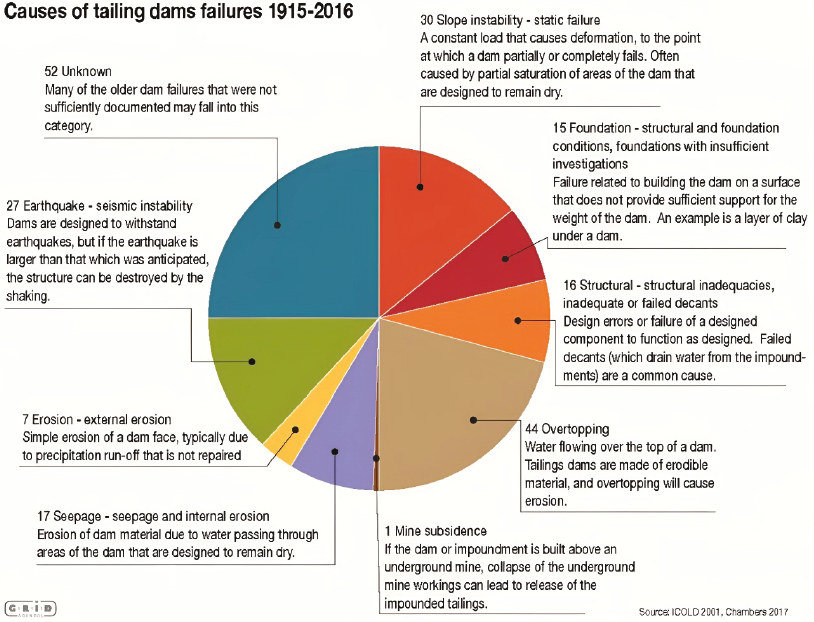
These failure modes respond to inadequate design, poor characterization of the material involved in the deposit, inexperience, occurrence of extreme events such as rains, storms or earthquakes not considered. These deficiencies, coupled with improper practices during construction, operation, and closure, have led to accidents and, in some cases, catastrophic failures resulting in loss of life and serious environmental damage (Jaime & Sanabria, 2018).
Site remediation should begin by determining the causes of failure. A comprehensive investigation must be conducted to identify root causes to consider in the design of remedial measures. These permanent corrective works would have to be the object of a more detailed engineering design, considering the feasibility and profitability of their execution.
It must be stressed that the human factor can lead to the failure of a deposit. The lack of review strategies, not making use of the observational method, inadequate supervision, and, finally, the lack of knowledge of the behavior of the waste, are invitations for a disaster to occur.
Considerations for the stages of construction, operation and closure
To begin with any construction activity, it is necessary to identify the species of trees and other plants that will be conserved in situ or integrated into the green areas, as well as the endemic species, among others, that can be transplanted, and those with regional or biological value. Species or populations of wild flora and fauna at risk located in the project area must be protected. The programs or actions must include relocation, nurseries, and hatcheries, as established in the applicable and current environmental laws or regulations.
It is essential to carry out a careful and rational operation, the use of an operations manual must include in its content what "to do" and "not to do” (Blight & Fourie, 2003). In addition, describe those dangerous situations, emergency procedures and alert systems among other directives that help proper management of the warehouse.
Monitoring and quality control
The objective of a control and monitoring program is to collect field data through systematic measurements. These must evaluate the behavior of the structures before failure or service requirements, safety at work, productivity, and performance during the useful life of the mine. Geotechnical controls and monitoring address soil and rock stability, as well as instability issues arising from mine development, ore extraction, and waste disposal. It must be guaranteed that the waste deposit is properly built, with an appropriate level of supervision and quality control of the materials used and that the plans and design specifications of the deposit are complied with (Jaime & Sanabria, 2018).
Routine monitoring and preventive maintenance are important to ensure the good performance of a deposit. Preventive maintenance is based on the early observation of potential critical points, which put the stability of the structure at risk, as well as keeping track of leaks. Good control reduces the costs associated with mine stoppages due to partial failures (Vick, 1990).
Groundwater monitoring is essential for waste management, enabling the assessment of potential aquifer contamination (Robertson, 1982). The instrumentation also allows the measurement of groundwater pressure in the field, whose variation can induce displacement of the deposits, sliding, load capacity and slope failure.
Water monitoring should include:
Water quality of surface and groundwater both upstream and downstream of the reservoir and in the storage itself.
Environmental monitoring should track closure strategies and plans, including slope treatments and coverage.
Open observation wells and piezometers now allow the use of electronic sensors to measure water pressure; in addition to environmental parameters such as temperature, electrical conductivity, and pH.
Monitoring reports must be prepared according to the plan proposed by the mining operation, and must be accessible, easy to understand and transparent to interested parties.
An adequate management in the operation of a deposit will demonstrate an operational responsibility, with a deep knowledge of design, operation, and closure. The implications of not operating in accordance with the design intent and design criteria must be clearly understood. Therefore, it is essential to have a waste storage operation manual for each storage facility, whose main objective is to guide and help operators with daily operation tasks, as well as with advance planning and maintenance.
Closure of mining deposits
In certain cases, tailings and waste rock may not contain substances harmful to the environment. If such is the case, during the closure phase, the mine will ensure that the water is drained from the tailings storage to safeguard its structural stability.
In general, the primary concerns during the recovery and closure of facilities involve long-term issues:
Structural stability of the deposit.
Chemical stability of tailings and waste rock.
Subsequent land use.
The selection of monitoring equipment depends on the type of waste, measurement parameters, construction method, and deposit height. Monitoring allows to detect possible contamination at an early stage and consequently take corrective measures to prevent its spread. The frequency of monitoring will depend on the type of preventive measures, the scope and incidence of the supervision and the regulations guidelines.
Quality monitoring and control must be aligned with current environmental regulations for water, soil and air in the region and country where the mining operation is located.
Environmental pollution issues are particularly evident near deposits located in inhabited areas. For example, the wind can carry heavy metal particles such as lead, which can be inhaled by the neighboring population increasing morbidity and mortality rates. Another significant issue is acid mine drainage (AMD) and acid rock drainage (ARD), which can accumulate in tailings, waste rock, and exposed surfaces.
For operating or abandoned mines that cause environmental damage, it is necessary to identify the type, quantity, and distribution of contaminants. This is achieved through a detailed investigation of the contaminated site. To establish the level of pollution is risk associated with the contaminated area (Rowe, 2001).
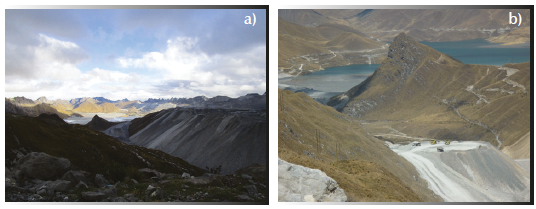
The height and steep slopes of some waste deposits such as tailings dams or rock dumps sometimes make collection and revegetation impractical (Figure 6a). Careful planning is required during mine operations to facilitate execution of the closure plan.
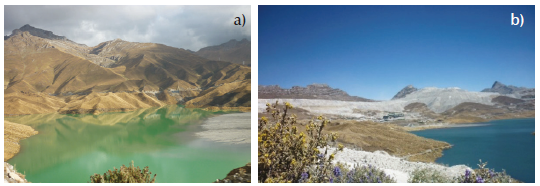
The mining activity causes the alteration of the landscape affecting the flora and fauna. The natural water channels are modified, the growth of plants and the habitat of animals in the affected area are restricted (Figures 7a and 7b).
A clear understanding of the impacts caused by mining activity and proper environmental management will promote sustainable development based on its three pillars, which are: society, economy, and environment.
Conclusions
Countries with active mining industries typically enforce regulations that limit the concentration of contaminants in waste discharges. Some of these have maximum permissible limits at the point of discharge and quality standards that regulate the number of contaminants in downstream areas or around of the mining operation.
The concentration of contaminants in waste does not always determine its impact on humans or the environment. The combined effect of the number of contaminants together with the time of exposure causes greater harmful effects.
It is necessary to monitor soil, water and air during mining operations and after closure to ensure that the environment is not being contaminated or to take appropriate remedial or mitigation measures before contamination spreads.
Defining the environmental baseline of the site during the design stage will allow the mine to identify and predict the behavior of the environment during the construction, operation, and closure stages of the mining deposits.
Effective management strategies, understanding of environmental impacts, monitoring, mitigation efforts, and pollutant control are essential to achieving sustainable development in any region or country.
Understanding the impacts caused by mining activities and having an adequate environmental management will promote sustainable development based on its three pillars, which are: society, economy, and environment.

