




 nueva página del texto (beta)
 Inglés (pdf)
 Artículo en XML
 Referencias del artículo
 Traducción automática
 Enviar artículo por email
 Citado por SciELO
  Similares en
SciELO
Similares en
SciELO 
 Permalink

Introduction
The use of pesticides is the most common practice for eliminating or controlling pests and unwanted species that cause damage to agricultural and forest production. Commonly used pesticides include herbicides, insecticides, fungicides, nematicides, and rodenticides (FAO, 1997; Ortiz et al., 2017; Hernández & Hansen, 2011).
At the Stockholm Convention in 2001, regulations were established for 12 substances considered persistent organic pollutants (POPs), including nine pesticides, some of which are organochlorines. Following this initial agreement, 10 additional substances were added in 2009, five of which were pesticides. Notable organochlorine pesticides included in this agreement are aldrin, dieldrin, chlordane, chlordecone, heptachlor, hexachlorobenzene, endrin, lindane, and endosulfan.
The Xochimilco canals are among the few remaining aquatic environments from what was once an impressive lake ecosystem in the pre-Hispanic era, specifically the great basin of the Mexico City Valley. Despite the significant ecological loss of the watershed, the cultural significance and economic importance of the area remain intact. The canals continue to be a vital agricultural resource for the population and serve as recreational areas, much like urban water bodies in cities worldwide (López et al., 2015). This paper evaluates the condition of the Xochimilco canals concerning the persistent substances that have been applied over time and continue to affect the environment, water, soil, and sediment.
Due to the absence of standards or guidelines in Mexico regarding permissible levels of organochlorine pesticides in recreational waters, this document refers to international guidelines that establish maximum permissible limits for such pesticides, including aldrin, dieldrin, and endosulfan. Table 1 reports these values in accordance with the Canadian Council of Ministers of the Environment (CCME), the United States Environmental Protection Agency (US EPA), and the European Community (CE).
Table 1 Maximum permissible concentrations in international regulations
| Pesticides | CCME1(μg/L) | EPA2(μg/L) | EU3 (mg/L) |
| Aldrin | 0.004 | 3 | 0.01 |
| Dieldrin | 0.004 | 0.24 | 0.01 |
| Endosulfan | 0.02 | 0.22 | 0.005 |
From:1 CCME (2008); 2 EPA (1985); 3 EU (2013)
Taking into consideration the parameters established by international regulations, a comparison was made using the Pesticide in Water Calculator (PWC), which estimates pesticide concentrations in surface and groundwater bodies resulting from their application to soil. The PWC is designed as a regulatory tool by the EPA's Office of Pesticide Programs and Canada Health’s Pest Control Regulatory Agency. It is based on two models: the Pesticide Root Zone Model (PRZM) and the Variable Volume Water Model (VVWM) (US EPA, 2016c).
The PRZM model simulates the transport and transformation of pesticides in the unsaturated zone on a daily, one-dimensional scale. It takes into account key chemical processes that occur during pesticide infiltration as water moves through soil (Pérez et al., 2018a).
On the other hand, the VVWM employs computational models to estimate pesticide exposure in surface water resulting from applications in agricultural fields. These models simulate pesticide application, its movement, and destination in surface water, and they ultimately calculate environmental concentrations (EEC) that are both protective and scientifically defensible (US EPA, 2016b).
The aim of this paper is to evaluate the condition of the study area by comparing the theoretical concentrations of various organochlorine pesticides, as calculated by the Pesticide in Water Calculator (PWC), with those detected in water and surface soil, while taking into account international regulations.
Method and study site
Study site: Xochimilco, Ampampilco and Apatlaco canals
The Xochimilco canals are part of the Panuco region and belong to the Moctezuma River hydrological basin and the Lake Texcoco-Zumpango sub-basin (INEGI, 2005). They consist of an estimated length of approximately 203 km of interconnected canals, with some of the most significant being Cuemanco, Nacional, Chalco, Del Bordo, Apatlaco, San Sebastián, Ampampilco, Texhuilo, Zacapa, Caltongo, Santa Cruz, and Japón (RAMSAR, 2004).
Chinampas have persisted due to their ecological and cultural importance. Since 1971, they, along with the Xochimilco wetland, have received national and international recognitions and designations aimed at promoting their conservation and highlighting their significance, not only for the inhabitants of Mexico but globally (Pérez et al., 2018b). The Chinampera area of Xochimilco falls within the protected areas of the Ejidos of Xochimilco and San Gregorio Atlapulco, designated by UNESCO, where significant agricultural activities occur (Guevara et al., 2015). Currently, efforts are underway to rehabilitate the Chinampera network and restore the habitat of native Xochimilco species (Zambrano et al., 2014).
Some of the most representative species in the region include the axolotl (Ambystoma mexicanum), Moctezuma frog (Rana montezumae), marsh or casquito turtles (Kinosternon hirtipes), and "charal" fish (Chirostoma jordani) (Gil, 2015; Centro Ecoturístico Olintlalli, 2018).
Currently, there are 20,000 Chinampas in Mexico City, covering an area of 30,348 hectares. Of these, 2,441 are designated for agriculture, producing approximately 19,000 tons of food. The most significant crops include romerito (4,680 tons), broccoli (4,674 tons), lettuce (4,187 tons), and verdolaga (1,776 tons). Other vegetables produced in the region include spinach, squash, green beans, celery, chard, and coriander (SAGARPA, 2018).
According to Bojórquez (2017), sampling and monitoring for pesticide detection in the Xochimilco canals began in 1988. Hernández (2005) reported the presence of organochlorine pesticides such as endrin, endosulfan, dieldrin, DDE, and aldrin in the Chinampera area, using gas chromatography and solid-phase microextraction. Borja (2017) identified areas where the use and application of pesticides in cultivation zones have been documented. Based on this information and Hernández's findings (2005), sampling was conducted in the Apatlaco and Ampampilco canals.
Samples compilation
Sampling was carried out during rainy season, while inputs and outputs, as well as the homogenization zones of the water body, were considered. The recommendations of the NMX-AA-014-1980 for collecting water samples were followed for this activity. Soil samples were obtained in corn cultivation areas taking into consideration the NOM-021-RECNAT-2000. Figure 1 shows the sampling network for the area detected by previous studies, using agrochemicals. The location of each sampling point is reported in Tables 2 and 3 for water and soil samples respectively.
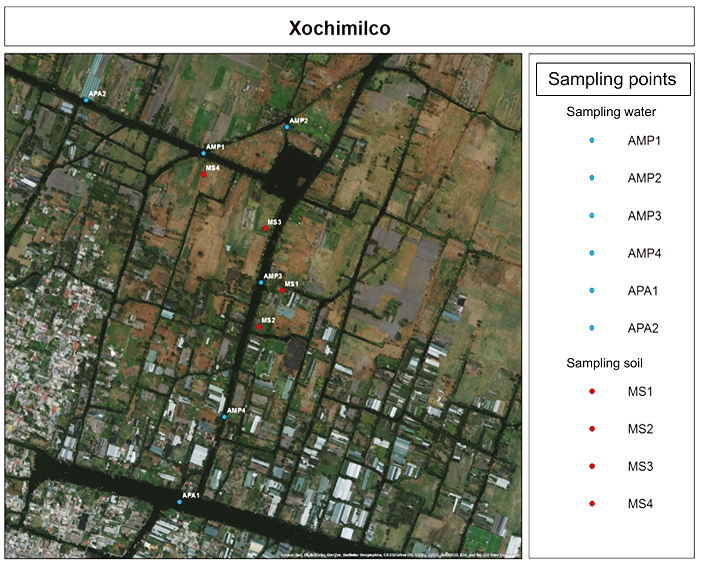
Table 2 Sampling points for water and soil
| Canal/Area | Point | Geographic location | |
| Latitude | Longitude | ||
| Ampampilco | AMP1 | 19°16'19.55" | -99°5'23.48" |
| Ampampilco | AMP2 | 19°16'21.59" | -99°5'16.29" |
| Ampampilco | AMP3 | 19°16'9.45" | -99°5'18.53" |
| Ampampilco | AMP4 | 19°15'58.95" | -99°5'21.67" |
| Ampampilco | APA2 | 19°16'23.7" | -99°5'33.6" |
| Apatlaco | APA1 | 19°15'52.30" | -99°5'25.54" |
| Ampampilco | MS1 | 19°16'8.83" | -99° 5'16.69" |
| Ampampilco | MS2 | 19°16'6.00" | -99° 5'18.70" |
| Ampampilco | MS3 | 19°16'13.68" | -99° 5'18.16" |
| Ampampilco | MS4 | 19°16'17.90" | -99° 5'23.50" |
Table 3 Organochlorine pesticide detected in water samples
| Pesticide | Water samples (μg/L) | ||
| APA 2 | AMP2 | APA1 | |
| Aldrin | N.D. | N.D. | 9.54 |
| Dieldrin | N.D. | 48.42 | N.D. |
| Endosulfan I | N.D. | N.D. | 29.91 |
| Endosulfan II | 55.02 | N.D. | 63.97 |
For the selection of water sampling points, corn growing areas were considered. Samples were taken 20 cm below the surface and collected in duplicate at each point by placing them in one-liter polypropylene containers and then stored, in black bags, to avoid photolysis degradation. Once identified, they were kept in refrigeration and moved to the laboratory for its analysis. As for soil sampling points, composite samples were taken from corn growing areas at a depth of 20 cm, then a quartering was performed to better homogenize the sample, placed in plastic bags of 2 kg. They were labeled with their respective coordinates and were also kept at low temperature. Both water and soil samples were kept refrigerated and protected from light until analysis and detection of organochlorine pesticides.
The determination of organochlorine pesticides in water and soil samples was performed using the EPA 8081B method "Organochlorine pesticides by gas chromatography". Finally, a Shimadzu GC-2014 electron capture detector was used for detection. The values obtained are reported in Tables 4 and 5.
Table 4 Organochlorine pesticide detected in soil samples
| Pesticide | Soil samples (μg/kg) | |
| MS1 | MS4 | |
| Aldrin | 1.43 | N.D. |
| Dieldrin | 3.72 | N.D. |
| Endosulfan II | N.D. | 3.19 |
Table 5 Physico-chemical properties of endosulfan, metabolite, aldrin and dieldrin
| Property | Endosulfan | Endosulfan sulfate | Aldrin | Dieldrin |
| Koc (mL/g) | 11500 | 5190 | 4.7x10⁶ | 4.7x10⁵ |
| Molecular weight (g/mol) | 406.93 | 422.95 | 364.91 | 380.91 |
| Steam pressure 20° C (torr) | 6.23 | 1x10-11 | 7.5x10⁻⁵ | 3.1x10⁻¹¹ |
| Solubility (mg/L) | 0.53 (at 25 °C) | 0.117 (at 25 °C) | 0.011 (at 20 °C) | 0.11 (at 20 °C) |
| Heat of vaporisation (J/mol) | 37,000 | 86,390 | 65,800 | 69,270 |
| Density20 °C (mg/mL) | 1.745 | 1.94 | 1.6 | 1.75 |
| Molar volume (g/ cm3) | 233.2 | 218 | 228.1 | 217.7 |
| Diffusion coefficient (cm2/day) | 4.78 | 5.4 | 5 | 5.5 |
| Half-life degradation in water (day) | 23-25 (at 20 °C) | - | 710 (at 25 °C) | 710 (at 25 °C) |
| Half-life degradation in soil (day) | 50 (at 20 °C) | 123-391 (at 20 °C) | 710 (at 25 °C) | 710 (at 25 °C) |
| Half-life of foliar degradation (day) | 3.7 | 4 | 1.7 | 6.8 |
| Half-life in benthic zone (day) | 120 (at 20 °C) | - | 2300 (at 25 °C) | 2300 (at 25 °C) |
| Hydrolysis in water to pH 7 (day) | 11 to 19 | 184 | 760 | - |
Source: (Betancur 2015; Guevara, 2015; University of Hertfordshire, 2019; Céondo, 2019 and ATSDR, 2015; ATSDR, 2002; O´Sullivan & Megson, 2014)
Pesticide modeling
Pesticide modeling using Pesticide in Water Calculator (PWC)
After confirming that organochlorine pesticides such as aldrin and endosulfan are applied to corn fields in the Xochimilco canals area of Ampampilco and Apatlaco, PWC modeling was performed to verify that the concentrations detected in water match the theoretical concentrations that the PWC can obtain, placing as a restriction if they are being applied only in corn cultivation fields and in a single season.
This software includes several tabs, such as pesticide properties, pesticide application, crop type, study site characteristics and meteorology, runoff parameters according to site characteristics and water body characteristics, all these windows are intended to perform pesticide simulation at the study site.
Pesticides
Initially some pesticide properties are needed such as Koc o Kd, molecular weight, steam pressure, solubility, vaporization energy and Henry's constant; in addition to these properties, it is necessary to place degradation times in various environmental counterfoils as water, soil, air, sediment, as well as the half-life time per foliar action. This is done for the pesticide and its metabolites if the information is available, as many times the substances that are generated are more toxic than the main agent. These values are set out in Tables 6 and 7.
Table 6 Soil profiles in chinampas
| Horizon | Depth (cm) | Classification | Max.
Cap. |
Min.
Cap. |
% sand | % clay | OC (%) | Density
[g cm-3] |
| A1 | 0-10 | Loam | 0.320 | 0.175 | 30.4 | 25.4 | 8.1 | 0.29 |
| A1 | 11-50 | Clayloam Soil | 0.380 | 0.210 | 22.8 | 37.4 | 5.9 | 0.69 |
| A2 | 50-110 | Sandy Clay Loam | 0.375 | 0.220 | 24.8 | 35.4 | 7.4 | 0.51 |
| A3 | 110-120 | Silty Clay Loam | 0.360 | 0.215 | 26.8 | 35.4 | 14.4 | 0.43 |
Source: (Ramos et al., 2001; US EPA, 2005; Ikkonen et al., 2012 and Guevara et al., 2015).
Table 7 Dates with significant runoff
| Date
(mm/dd/yy) |
Runoff
(cm) |
Date
(mm/dd/yy) |
Runoff
(cm) |
| 06/28/2012 | 2.42077865 | 06/14/2011 | 12.6708848 |
| 06/06/2011 | 1.96253548 | 06/15/2011 | 10.3821684 |
| 06/07/2011 | 9.72029697 | 06/16/2011 | 15.5246978 |
| 06/08/2011 | 6.73517338 | 08/23/2011 | 34.5565551 |
| 06/09/2011 | 27.7116044 | 08/25/2011 | 12.6984125 |
| 06/10/2011 | 19.90449 | 08/26/2011 | 14.1282913 |
| 06/11/2011 | 13.0384032 | 10/06/2011 | 19.3909075 |
| 06/12/2011 | 11.4114119 | 10/07/2011 | 14.0170873 |
| 06/13/2011 | 13.0476043 | - | - |
In addition, the air diffusion coefficient was calculated for each pesticide and its metabolite, which was determined from the following equation:
Pesticide application
Subsequently, information on the pesticide application in the growing area was added, for which the following was considered:
Supplied amount of pesticide to the crop 1.7 (kg/ha) for endosulfan and 3.4 kg for aldrin, as mentioned in the Rotterdam Convention, 2011 and ATSDR, 2002 respectively.
According to the research with the people of the site, the corn sowing season is between April and October; therefore, the estimated date of the pesticide application is proposed to be in the month of May, so the approximate days after the sampling date (23/09/2018) are 180.
In addition, the surface type application was considered and according to US EPA type application, 2016 is mentioned to be 0.99, while the load fraction (drift/T) is 0.064 for drinking water and of 0.01 for ecological risk.
It was also noted that the application is carried out every year during the 10 years considered in the weather archive.
Cultivation/Soil type
The meteorological file is added in this section, and it consists of information of the last years collected from the study area or, as in this case, what is closer to it. For this reason, the data from the monitoring station located in the “Escuela Nacional Preparatoria N° 1 “Gabino Barreda” of the Universidad Nacional Autónoma de México, in Av. de la Noria and Calle Prolongación de Aldama s/n Xochimilco, Santa María Tepepan, was used, which belongs to the Red Universitaria de Observatorios Atmosféricos (México). To complete the file, rainfall data (cm/day), temperature (°C), wind speed (cm/s), solar radiation (langley or cal/cm2) were obtained, and the evaporation factor was also calculated from the Meyer equation (1944):
Where:
E = |
evaporation factor [mm/day] |
C = |
0.5 this factor depends on the water mass |
ea = |
water steam pressure [mm Hg] |
e = |
air steam pressure [mm Hg] |
Vis = |
wind speed [cm/h] |
To calculate air steam pressure, temperature variation was recorded daily, considering the relative humidity, which was obtained hourly from the same weather station. The water temperature was kept constant at 15°C.
The information was gathered and settled for 10 years, from January 2009 to October 2018, the file was arranged according to the program requirements, which is a format style fortran: 1X, 3I2, 5F10.0 and was arranged in the following order: MM, MD, MY, PRECIP, PEVP, TEMP, WIND SOLRAD.
Where:
MM= |
meteorological month |
MD= |
meteorological day |
MY= |
meteorological year |
PRECIP= |
precipitation [cm/day] |
PEVP= |
evaporation factor [cm/day] |
TEMP= |
temperature [°C] |
WIND= |
wind [cm/s] |
SOLRAD= |
solar radiation [Langley] |
This section also includes crop growth factors such as emergence, maturity, and harvesting days, as well as root depth, crop coverage, height, and water retention, based on data from the growing season. Field data established that corn crops are planted annually on April 15th, and, according to Nafziger (2009), DuPont (2015), and Ciampitti et al. (2016), the maturation period is approximately four months. Therefore, the crop reaches maturity around August 15th each year, with harvest taking place the following month, as also indicated by DuPont (2015).
Additional parameters include root depth (60 cm), crop coverage (350 %), height (300 cm), and water retention (0.15 cm), as referenced from the previously mentioned authors and Via rural Agro y Construcción (2019).
Other hydrological factors considered in the model include the evaporation factor, snowmelt factor, and minimum evaporation depth, as recommended by the US EPA (2016a) manual.
Irrigation data is also taken into account, including potential excess irrigation, the allowed loss in available water, the maximum rate of water supplied, and the piezometric depth level. Finally, the soil profiles at the study site are incorporated, as reported in Table 8.
Table 8 Information of body of water
| Parameter | Value |
| Photolysis | 1.19 |
| Suspended solids concentration (mg/L) | 18.6 |
| Chlorophyll concentration (mg/L) | 0.8 |
| Organic Carbon Fraction (foc) | 0.6 |
| Dissolved Organic Carbon (mg/L) | 10 |
| Biosmass concentration (mg7L) | 15.65 |
Another important parameter that this section considers is the lower limit temperature and the albedo of the surface which the manual recommends being 0.2.
Runoff
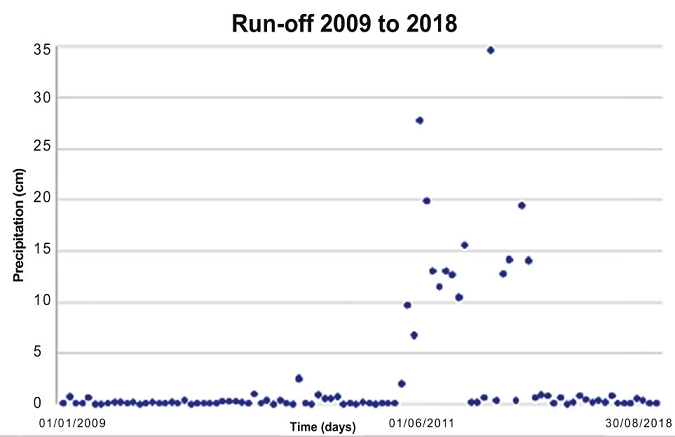
In the next PWC section, the runoff calculation was made in the study site, identifying the days that contributed with a visible effect, for this, the flow calculation was performed from precipitation.
To get the maximum potential the calculation was made from the curve number:
Where CN is the curve number, for the case study site is of 78 according to (Gaspari et al., 2007).
This identified the days that followed with the greatest run-off during the simulated years which are reported in Table 9 and can be seen in Figure 2.
Table 9 Comparison of detected pesticides and PWC
| Sample | Detected pesticide | Quantity detected (μg/L) | Calculated value (μg/L) |
| APA2 | Endosulfan II | 55.02 | 8.79 |
| AMP2 | Dieldrin | 48.42 | 0.0047 |
| APA1 | Aldrin | 9.54 | 0.036 |
| Endosulfan I | 29.91 | 8.79 | |
| Endosulfan II | 63.97 | 8.79 |
In addition, values for USLE C, USLE K, USLE LS, USLE P and IREG were determined, being 0.59, 0.21, 0.1, 0.6 and 1, respectively and according to US EPA (2005) recommendations, where:
USLE-C:Specify the universal soil loss cover management factor.
USLE K: Specify the universal soil loss equation of soil erodibility.
USLE LS: Specify the universal soil loss equation topographic factor.
USLE P: Specify the universal soil loss equation practice factor.
IREG: Specify location of NRCS 24-hour hyetograph.
Water body
In order to characterize the basin, it was necessary to define the type of surface for the simulation. It was determined that the canals have a constant volume, and although there is a small flow, it was considered negligible, as this is a lentic system. Additionally, the pesticide runoff rate (0.5) entering the water body due to erosion was defined and distributed between the water column and the benthic layer, as recommended by US EPA (2005).
The dimensions of the water body and basin were also determined. The cultivation area covers 400 m², based on observations made during exploration visits and the sampling day. The surface area of the water body is 2,400 m², considering the canals as an isolated body, with a depth ranging from 1 m to 1.3 m and a hydraulic length of 100 m, in relation to the canal’s downstream connection. The volume of the site remains constant, with a maximum increase of 10 cm during the rainy season, as confirmed by local residents.
These values were also added to the benthic zone section and some others were obtained as recommended by the manual (US EPA, 2005).
Results
Figure 3 shows data from the PWC calculations, indicating that the concentration of endosulfan in the water column is 8.79 μg/L, while no concentration is reported in the benthic zone. This calculation was made for the period from January 2009 to October 2018, where Year 1 corresponds to 2009.
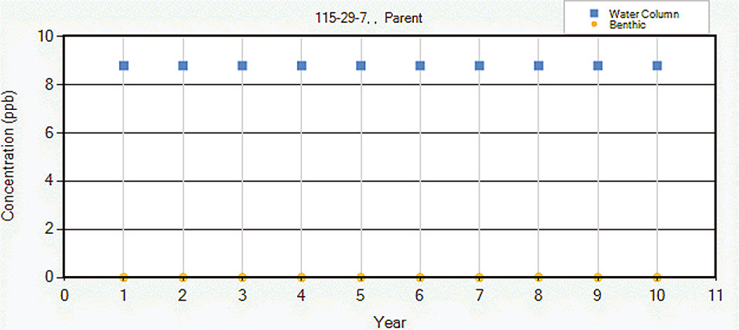
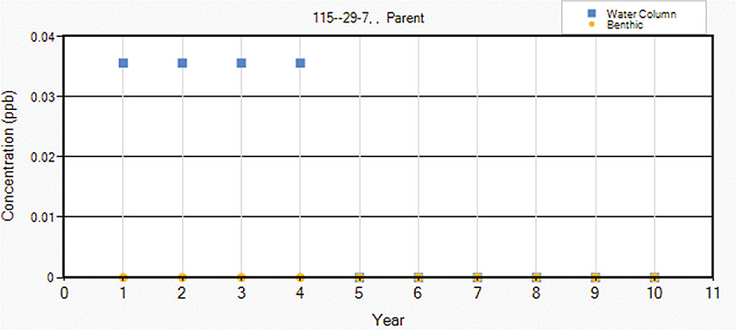
Figure 4 presents the PWC concentration report for aldrin. The concentration in the water column is 0.036 μg/L, with the application considered only until 2012, as SEMARNAT (2014) indicated it was the last year it should be applied. Afterward, no pesticide influence is observed in the water body for the subsequent years. Like endosulfan, the simulated years for aldrin were from 2009 to 2018.
Finally, Figure 5 shows the concentration of dieldrin, which follows the same application timeline as aldrin, up to 2012. However, in this case, the concentration of dieldrin, 0.0047 μg/L, persists and does not degrade over time.
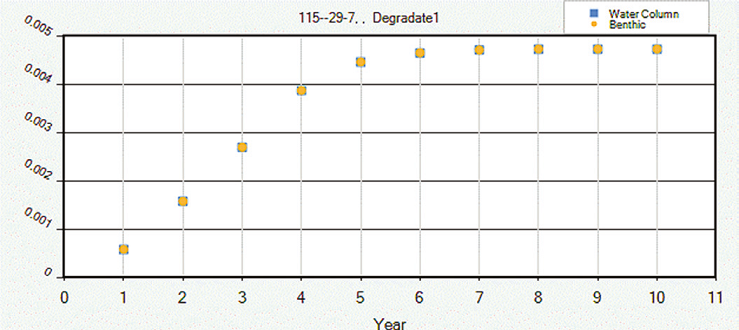
The average values obtained during the simulations were 8.79 μg/L for endosulfan, 0.036 μg/L for aldrin, and 0.0047 μg/L for dieldrin. Although aldrin and dieldrin are no longer used due to CICOPLAFEST restrictions, and they were reportedly no longer applied nationwide after 2012 (Bojorquez, 2017), traces are still detected.
In the Ampampilco canal area, where endosulfan (APA2) was identified, a nearby soil sample (MS4) revealed a concentration of 55.02 μg/L. This may be due to pesticide use in multiple cultivation areas and/or application amounts exceeding allowed standards.
For aldrin and dieldrin near the soil sample (MS1), these compounds were found, though they were not detected in the water body. This could be because the amounts used in the growing area were very low and remained in the soil. Conversely, dieldrin (AMP2) was detected in the water body at a concentration of 48.42 μg/L, though no soil sample was taken at this location. Similarly, for the sampling point where aldrin (9.54 μg/L), endosulfan I (29.91 μg/L), and endosulfan II (63.97 μg/L) were detected (APA1), no soil sample was collected. All detected values in the water body are higher than those calculated with the PWC.
Conclusions
For the pesticides aldrin and dieldrin, although their use by various organisms in Mexico has been banned, dieldrin continues to persist in the water bodies. This suggests that it is still being applied, creating a serious problem for aquatic biota as well as for people who come into contact with the water at the site.
The concentrations calculated for aldrin and dieldrin exceed the limits set by the CCME, but for the EPA, both are below the standard. For the CE, it can be observed that dieldrin is within acceptable limits, while aldrin exceeds them. Therefore, we need to monitor and control the usage of these pesticides.
As for endosulfan, it can be said that it is also persistent. Although its application rate is lower (1.7 kg/ha) compared to aldrin (3.4 kg/ha), its concentration in the water column is higher. This might be because the pesticide is still being used in cultivation areas.
The concentrations calculated for endosulfan exceed all three international standards (CCME, EPA, and CE). Therefore, the application of this pesticide should be avoided, as it shows higher levels in both the PWC calculations and field detections. This will undoubtedly affect the population in contact with the site's water and potentially harm the aquatic biota.
The reason the values obtained from the PWC pesticide calculations are lower than those observed in the field may be due to the presence of several surrounding cultivation areas where these pesticides were and are still being applied. Additionally, the calculations only estimate pesticide use during the corn cultivation period and do not account for their use during other seasons or in different types of crops.

