




 nueva página del texto (beta)
 Inglés (pdf)
 Artículo en XML
 Referencias del artículo
 Traducción automática
 Enviar artículo por email
 Citado por SciELO
  Similares en
SciELO
Similares en
SciELO 
 Permalink
Introduction
The Agricultural Census, or ST, conducted by the BPS-Statistics Indonesia (BPS) every ten years, aims to obtain complete, up-to-date, and accurate information about the agricultural sector. The data generated from this census is used as a basis for planning and evaluating development in agriculture. The 2023 Agricultural Census (ST2023) is the seventh census conducted by BPS. Despite the crucial role of agricultural censuses, past studies indicate challenges in census awareness and participation (Faturrokhman and Farid Ridho, 2023; Zikargae, 2020). Publicity and community engagement are key to overcoming these challenges. This research aims to assess the effectiveness of the communication strategies used by BPS in the 2023 Agricultural Census rehearsal.
Dissemination is a vital activity carried out by BPS in organizing a census or survey. The aim is to disseminate information on census or survey results to a group of people so that the data can be optimally utilized (Kim, Saffer, Liu, Sun, Li, Zhen and Yang, 2022; Su, Zhu, Li, and Chen, 2023; Zheng and Ma, 2023). The results of data dissemination can be delivered in various forms, including through websites that can be accessed by everyone. The use of websites in the data dissemination process has proven effective in presenting the information needed by data users (Luan, Hong, Cao, Dong, and Hou, 2023; Vrabcová and Urbancová, 2023; Bashi, De Tommasi, Le Cam, Relaño, Lyons, Mundó, Pandelieva-Dimova, Schapp, Loth-Babut, and Egger, 2023; Cummings, Selfa, Lindberg and Bain, 2024). A study on the 2023 Data Needs Survey shows that as many as 32.79 per cent of data consumers at the Central BPS obtain data through the BPS website, namely www.bps.go.id and use the Allstats BPS mobile application.
The organization of censuses, especially in the agricultural sector, is very useful for policy making, resource allocation, and socio-economic development planning (Arima, Ahmad, Astuti, Subiyanto, Amanda, Nadhil, Yazid, Rohim, Chamidah, Sekar, Hasnida and Kusumawati, 2023; Leal Filho, Salvia and Eustachio, 2023; Mortaheb and Jankowski, 2023). However, the success of the census implementation depends not only on the technical implementation but also on the level of community awareness and readiness. One of BPS' tasks is to organize the 2023 agricultural census and survey ( Devaney, Torney, Brereton and Coleman, 2020). In this study, aiming to measure the extent of publicity that has been implemented by BPS in welcoming the agricultural census, BPS made a rehearsal of the 2023 agricultural census. Analysis of the effectiveness of publicity through the 2023 Agricultural Census Rehearsal, with a focus on measuring the publicity efforts of the BPS-Statistics Indonesia (BPS) in welcoming participants to engage in the census, exploring the data collection landscape and community engagement strategies that have many aspects and complicated dynamics of agricultural statistics.
This study seeks to investigate how effective the communication strategies employed by BPS are in increasing community engagement in the 2023 Agricultural Census. Specifically, it examines the challenges in disseminating census-related information to different demographic groups and identifies potential improvements to optimize future census publicity strategies. Understanding these aspects will help refine communication efforts and enhance public participation in future census activities. The primary objective of this research is to analyze the impact of BPS's publicity strategies on community awareness and engagement. Additionally, this study aims to identify the most effective communication channels for reaching different demographic segments and provide practical recommendations for improving future census communication strategies. By achieving these objectives, the research contributes to developing more inclusive and efficient census awareness campaigns.
This study contributes to the literature by comparing existing research on census awareness strategies and highlighting the unique aspects of BPS’s communication efforts. Furthermore, it includes recent references to support the discussion on communication strategies and digital engagement in census campaigns. In this context, it is important to investigate whether publicity strategies utilizing digital media significantly increase census awareness and participation (H1), whether older populations rely more on traditional media for census information (H2), and whether higher levels of education are associated with increased census participation (H3). Additionally, this study explores whether communities with strong local leadership exhibit higher engagement in census participation (H4) and whether digital literacy levels significantly affect the effectiveness of online census publicity efforts (H5).
The 2023 Census of Agriculture is a pivotal moment in the comprehensive understanding of the agricultural landscape in Indonesia, requiring careful scrutiny of the rehearsal process to ensure the integrity and accuracy of the data collected. BPS-Statistics Indonesia (BPS), tasked with organizing this massive undertaking, is making a concerted effort not only to collect data but also to foster public awareness and participation through strategic publicity campaigns. These campaigns likely covered a spectrum of communication channels, ranging from traditional media such as television, radio, and newspapers to contemporary digital platforms including social media, websites, and mobile applications. In addition, BPS may have leveraged partnerships with local governments, community leaders, and agricultural organizations to amplify the reach and resonance of their messages (Direktorat, 2023).
This analysis uses a differentiated approach, combining quantitative metrics and qualitative insights to measure the effectiveness of BPS publicity efforts. Metrics such as reach, awareness, participation rates, and feedback serve as important clues in assessing the impact of these efforts in encouraging public engagement in the census (Theocharis, Boulianne, Koc-Michalska and Bimber, 2023; Gracias, Parnell, Specking, Pohl and Buchanan, 2023; Karunathilake, Le, Heo, Chung and Mansoor, 2023). Through careful data analysis and interpretation, this analysis seeks to uncover the intricate linkages between publicity strategies and census participation, ultimately offering valuable insights that can inform future census planning and public engagement initiatives, thereby strengthening the foundation of agricultural statistics for informed decision-making and policy formulation. Therefore, this research utilizes the theory of Diffusion of Innovations and Integrated Marketing Communication (IMC).
The Diffusion of Innovations theory, developed by Everett Rogers, discusses how new ideas or innovations are accepted in society (Pe’Er, Finn, Díaz, Birkenstock, Lakner Röder, Kazakova, Šumrada, Bezák and Concepción, 2022). The diffusion of innovations identifies groups such as innovators, forerunners, early majority, late majority, and laggards, each of which has a different level of readiness and speed in adopting innovations (Roussaki, Doolin, Skarmeta, Routis, Lopez-Morales, Claffey, Mora and Martinez, 2023). Integrated Marketing Communication (IMC) is a strategic approach that coordinates various marketing communication channels to deliver a unified and consistent message. The relationship between the Diffusion of Innovations Theory and IMC lies in the company's ability to understand different person profiles and stages of innovation adoption to plan appropriate marketing communications. By utilizing knowledge of innovation diffusion, companies can craft appropriate messages and determine the most effective communication channels to accelerate the adoption of innovations by the market. Through the implementation of IMC, companies can ensure consistency of their messages across communication channels, thereby increasing the effectiveness of marketing campaigns and accelerating the innovation adoption process (Gabriel and Gandorfer, 2023; Mogomotsi, Stone, Mogomotsi and Dube, 2020; Kwaghtyo and Eke, 2023).
The role of effective communication in public awareness campaigns has been well-documented. Previous research highlights that successful census operations rely on integrated marketing communication (IMC) strategies (Gabriel and Gandorfer, 2023) . Rogers' Diffusion of Innovations theory is also relevant, as it explains how information spreads through a population (Pe’Er, Finn, Díaz, Birkenstock, Lakner Röder, Kazakova, Šumrada, Bezák and Concepción, 2022). Studies on previous agricultural censuses have shown that traditional media (TV, radio, and print) remains crucial, but digital platforms have gained increasing relevance (Kim, Saffer, Liu, Sun, Li, Zhen and Yang, 2022) . However, low digital literacy among older farmers necessitates a multi-channel approach (Bashi, De Tommasi, Le Cam, Relaño, Lyons, Mundó, Pandelieva-Dimova, Schapp, Loth-Babut, and Egger, 2023) . A comparison of previous research and the findings from this study will help highlight the effectiveness of various communication approaches in census operations. This analysis aims to fill gaps in existing studies and propose more effective outreach strategies.
The relationship between the Diffusion of Innovations Theory and Integrated Marketing Communication (IMC) with research on the effectiveness of the 2023 Agricultural Census Rehearsal with a publicity measurement approach of the Central Statistics Agency (BPS) in welcoming the agricultural census can be understood in the context of planning and implementing a successful communication campaign. First, the Diffusion of Innovations Theory provides insights into how a new message or innovation, in this case, preparation for the 2023 Agricultural Census, will be received by different groups of society (Summad, Kindi, Hinai, Shamsuzzoha and Piya, 2023). By understanding the different person profiles and stages of innovation adoption, BPS can design appropriate messages and communication strategies to increase awareness and participation in the Census of Agriculture rehearsal. For example, BPS can use insights from innovation diffusion theory to target innovators and forerunners who are more likely to be early receivers of information about the census (Raynard, 2017; Parrella, Esquivel, Leggette andMurphrey, 2024; Karnik and Peterson, 2023).
Second, Integrated Marketing Communication (IMC) will assist BPS in coordinating their various communication channels to deliver messages about the Agricultural Census rehearsal consistently and effectively (Summad, Kindi, Hinai, Shamsuzzoha and Piya, 2023). Through an IMC approach, CPMs can ensure that their messages are delivered uniformly through advertising, sales promotion, publicity, and other communication channels (Laurie, Mortimer, Holtz and Little, 2024; Scheufele, Krause, Freiling and Brossard, 2021; Siankwilimba, Mumba, Hang’ombe, Munkombwe, Hiddlestone-Mumford, Dzvimbo and Hoque, 2023). This can help increase public awareness and understanding of the importance of the agricultural census, as well as motivate participation in the rehearsal (Allioui and Mourdi, 2023; Roche, Jensen, Jensen, Bell, Hurley, Taylor, Boissenin, Chase, Cherouvis and Dunne, 2023). Combining an understanding of innovation diffusion with an IMC approach, BPS can optimize their communication efforts to improve the effectiveness of the 2023 Agricultural Census rehearsal. Through a well-coordinated strategy and a deep understanding of innovation adoption behavior, BPS can maximize public participation in the agricultural census, which in turn will improve the quality of data collected and the overall success of the census program.
Methods
The methodological approach used in researching the effectiveness of the 2023 Agricultural Census Rehearsal, with a focus on measuring the publicity efforts of the BPS in welcoming census participants, integrates qualitative and quantitative techniques. The data for this study came from the Bureau of Public Relations and Legal Affairs, BPS-Statistics Indonesia.. This study employs a mixed-method approach, integrating both qualitative and quantitative methods. The quantitative component involved surveying 190 respondents from four provinces (West Java, Central Java, West Sumatra, South Sulawesi) to measure awareness levels and participation rates. Structured surveys were administered to assess these variables, and statistical techniques such as ANOVA and Chi-Square tests were employed to examine relationships between demographic factors and awareness levels.
Qualitative methods such as interviews, focus groups, and surveys can be used to collect rich descriptive data that provide a deeper contextual understanding and reveal different aspects of public engagement. Data collection was conducted in eight cities with farmers and agricultural businesses as respondents. The qualitative component consisted of in-depth interviews with local leaders, farmers, and BPS representatives, as well as focus group discussions to explore community perceptions of census publicity efforts. Thematic analysis was conducted to identify key themes related to communication effectiveness. This approach ensures a comprehensive understanding of how census communication strategies influence public engagement. By combining these complementary approaches, this study aims to offer a comprehensive analysis of the effectiveness of BPS' publicity strategy in encouraging participation in the agricultural census, thus enriching the understanding of the dynamics between publicity campaigns and census engagement.
Results and discussion
Based on data collection and analysis, this research was conducted in eight cities. The research on the effectiveness of the 2023 Agricultural Census Rehearsal offers a comprehensive analysis of the impact of the Central Statistics Agency's (BPS) publicity efforts on the census. Through careful examination of data and statistical techniques, this research examines the quality of agricultural data collected and evaluates the success of the rehearsal process. The findings highlight the importance of BPS outreach strategies in increasing community participation and ensuring data accuracy. The discussion around these results explores the effectiveness of various communication channels used by BPS, such as advertising campaigns, community engagement, and digital platforms, in raising awareness and encouraging farmer cooperation. In addition, this study explores the challenges faced during the census rehearsal phase and proposes recommendations to improve future publicity initiatives to optimize data quality and representativeness. Overall, this study underscores the critical role of proactive communication strategies in facilitating the success of the agricultural census and informing decision-making aimed at improving the statistical data collection process.
Respondent identity
Based on the data obtained, it can be seen that there are more male respondents than female respondents. Although theoretically there is no relationship between genders in this study, it is necessary to know the balance of gender proportions. The composition of respondents based on gender is as follows:
Table 1 Gender Composition
| No | Gender | Total | Percentage |
|---|---|---|---|
| 1 | Male | 80 | 42% |
| 2 | Female | 110 | 58% |
| Total | 190 | 100% |
Source: Researcher's Processed Results, 2024.
The study was categorized into three groups, namely 15 to 35 years, 36 to 50 years, and more than 50 years. The results show that most respondents who participated in this study were more than 50 years old. The composition of respondents based on their age is as follows:
Table 2 Age Composition
| No | Age | Total | Percentage |
|---|---|---|---|
| 1 | 15-35 Year | 41 | 21.5% |
| 2 | 36-50 Year | 69 | 36.3% |
| 3 | > 50 Year | 80 | 42.2% |
| Total | 190 | 100.0% |
Source: Researcher's Processed Results, 2024.
There are four provinces in this research, namely West Java, Central Java, West Sumatra and South Sulawesi. It can be seen that most respondents came from West Java. The composition of respondents by region is as follows:
Table 3 Region Composition
| No | Province | Total | Percentage |
|---|---|---|---|
| 1 | West Java | 63 | 33.15% |
| 2 | Central Java | 53 | 27.89% |
| 3 | West Sumatra | 29 | 15.26% |
| 4 | South Sulawesi | 45 | 23.7% |
| Total | 190 | 100.0% |
Source: Researcher's Processed Results, 2024.
The composition based on education is grouped into seven, namely, not finishing school/not finishing elementary school, elementary school/equivalent, junior high school/equivalent, senior high school/equivalent, DI-DIII, DIV-S1, and S2-S3. This grouping resulted in the following data distribution:
Table 4 Education Composition
| No | Education | Total | Percentage |
|---|---|---|---|
| 1 | Not graduated from school/not graduated from elementary school | 39 | 20.5% |
| 2 | Elementary school/equivalent | 53 | 27.9% |
| 3 | Junior high school/equivalent | 40 | 21.0% |
| 4 | SMA/equivalent | 42 | 22.0% |
| 5 | DI-DIII | 1 | 0.5% |
| 6 | DIV-S1 | 13 | 6.8% |
| 7 | S2-S3 | 2 | 1.3% |
| Total | 190 | 100.0% |
Source: Researcher's Processed Results, 2024.
One of the tools used in this research is to find out the social media ownership of each respondent. Each social media includes Facebook, Twitter, Instagram, YouTube, Tiktok, WhatsApp. The results of this ownership are as follows:
Information Result of BPS Rehearsal
Based on the descriptive analysis of the information media used by respondents to obtain information about the BPS rehearsal, there are some interesting findings. In general, the majority of respondents tend to use digital platforms as their main source of information, with social media being the most dominant. This shows that the development of information technology has affected the way people obtain information, with an increasing reliance on online sources. However, there are still respondents who rely on traditional media such as television and posters as their main source of information. This shows that despite the growing dominance of digital trends, traditional media still has a significant role in reaching a portion of the public.
In this interpretation, it is important to keep in mind that information media preferences can be influenced by various factors, including personal preferences, media accessibility, and changing social trends. Therefore, an in-depth understanding of these patterns of information media usage can help in designing more effective and relevant communication strategies for purposes such as BPS rehearsals. Even so, the results showed that the majority of respondents mostly obtained information on BPS rehearsals from village officials. This is shown by the following data collection results:
Table 6 Information Media
| No | Information Media |
Number of Information Media about BPS |
Number of Information Media about GB ST2023 |
|---|---|---|---|
| 1 | Village officials (RT/RW/Lurah) | 22 | 21 |
| 2 | Friends/neighbors/family | 0 | 12 |
| 3 | Television | 25 | 1 |
| 4 | Newspaper | 6 | 0 |
| 5 | 0 | 17 | |
| 6 | Magazine | 1 | 0 |
| 7 | Online media | 8 | 0 |
| 8 | Social Media | 4 | 0 |
| 9 | Banners | 7 | 4 |
| 10 | Poster | 4 | 2 |
| 11 | Leaflet | 1 | 0 |
| 12 | Billboards | 4 | 0 |
| 13 | More | 13 | 5 |
Source: Researcher's Processed Results, 2024.
Table 7 Recognition and Knowledge
| Introduction BPS | Knowledge about Rehearsal | Percentage | |
|---|---|---|---|
| Yes | 65 | 35 | 26.3% |
| Don't know | 125 | 155 | 73.7% |
| Total | 100.0% |
Source: Researcher's Processed Results, 2024.
The results show that there are still very many respondents who do not know about the introduction of BPS and do not know about the knowledge of the rehearsal. Based on the interview with Mr. Ahmad regarding the rehearsal of the 2023 agricultural census, it can be concluded that the participation of the Talabiu Village community in the preparation of the agricultural census is very important. Ahmad as one of the community leaders is active in disseminating information to residents regarding the implementation of the census. Through socialization and the use of social media, information about the agricultural census was well conveyed to residents. Although Ahmad does not have an agricultural business, he realizes the importance of the census as an event that takes place every 10 years. The main production in the village is salt and milkfish, with crops such as rice and vegetables for local consumption. Thus, the cooperation and understanding of the Talabiu Village community towards the 2023 agricultural census is expected to support the smooth and successful implementation of the census.
Table 8 ANOVA Test of Awareness Level Based on Age
| ANOVA | |||||
|---|---|---|---|---|---|
| Awareness Level | |||||
| Sum of Squares | df | Mean Square | F | Sig. | |
| Between Groups | 27.111 | 2 | 13.555 | 161.950 | 0.000 |
| Within Groups | 15.652 | 187 | 0.084 | ||
| Total | 42.763 | 189 | |||
Source: Researcher Processed Results with SPSS, 2024.
Table 9 Anova test of awareness level based on age
| Multiple Comparisons | ||||||
|---|---|---|---|---|---|---|
| Dependent Variable: Awareness Level | ||||||
| Tukey HSD | ||||||
| (I) Age | (J) Age | Mean Difference (I-J) |
Std. Error |
Sig. | 95% Confidence Interval |
|
| Lower Bound |
Upper Bound |
|||||
| 15-35 Years | 36-50 Years | -0.652* | 0.057 | 0.000 | -0.79 | -0.52 |
| >50 Years | -1.000* | 0.056 | 0.000 | -1.13 | -0.87 | |
| 36-50 Years | 15-35 Years | 0.652* | 0.057 | 0.000 | 0.52 | 0.79 |
| >50 Years | -0.348* | 0.048 | 0.000 | -046 | -024 | |
| >50 Years | 15-35 Years | 1.000* | 0.056 | 0.000 | 0.87 | 1.13 |
| 36-50 Years | 0.348* | 0.048 | 0.000 | 0.24 | 0.46 | |
* The mean difference is significant at the 0.05 level.
Source: Researcher Processed Results with SPSS, 2024.
ANOVA analysis showed a significant difference in rehearsal awareness levels by age (p < 0.001). The very low significance value (sig = 0.000) indicates that at least two age groups had significantly different rehearsal awareness levels. This suggests that age has an important influence on the level of rehearsal awareness in the population studied. Thus, these results suggest that the understanding of rehearsal awareness levels may be influenced by age, and health intervention strategies may need to be adjusted according to the age range of the subjects to achieve optimal results.
Table 10 Anova test of awareness level based on gender
| ANOVA | |||||
|---|---|---|---|---|---|
| Awareness Level | |||||
| Sum of Squares | df | Mean Square | F | Sig. | |
| Between Groups | 16.172 | 1 | 16.172 | 114.339 | 0.000 |
| Within Groups | 26.591 | 188 | 0.141 | ||
| Total | 42.763 | 189 | |||
Source: Researcher Processed Results with SPSS, 2024.
ANOVA analisis showed a significant difference in rehearsal awareness by gender (p < 0.001). With a very low significance value (sig = 0.000), it was shown that the level of rehearsal awareness significantly varied between individuals based on gender. This suggests that gender has a strong effect on the level of rehearsal awareness in the sample studied. As such, it is important to consider the role of gender in the understanding of rehearsal awareness levels, and it may be necessary to adjust health intervention strategies to achieve optimal results by taking these differences into account.
Table 11 Anova test of awareness level based on geographic region
| ANOVA | |||||
|---|---|---|---|---|---|
| Awareness Level | |||||
| Sum of Squares | df | Mean Square | F | Sig. | |
| Between Groups | 40.839 | 3 | 13.613 | 1315.644 | 0.000 |
| Within Groups | 1.925 | 186 | 0.010 | ||
| Total | 42.763 | 189 | |||
Source: Researcher Processed Results with SPSS, 2024.
Table 12 Multiple Comparisons
| Dependent Variable: Awareness Level | ||||||
|---|---|---|---|---|---|---|
| Tukey HSD | ||||||
| 95% Confidence Interval |
||||||
| (I) Region_Geography | (J) Region_Geography | Mean Difference (I-J) | Std. Error | Sig. | Lower Bound | Upper Bound |
| West Java | Central Java | -0.962* | 0.019 | 0.000 | -1.01 | -0.91 |
| West Sumatra | -1.000* | 0.023 | 0.000 | -1.06 | -0.94 | |
| South Sulawesi | -1.000* | 0.020 | 0.000 | -1.05 | -0.95 | |
| Central Java | West Java | 0.962* | 0.019 | 0.000 | 0.91 | 1.01 |
| West Sumatra | -0.038 | 0.023 | 0.378 | -0.10 | 0.02 | |
| South Sulawesi | -0.038 | 0.021 | 0.263 | -0.09 | 0.02 | |
| West Sumatra | West Java | 1.000* | 0.023 | 0.000 | 0.94 | 1.06 |
| Central Java | 0.038 | 0.023 | 0.378 | -0.02 | 0.10 | |
| South Sulawesi | 0.000 | 0.024 | 1.000 | -.006 | 0.06 | |
| South Sulawesi | West Java | 1.000* | 0.020 | 0.000 | 0.95 | 1.05 |
| Central Java | 0.038 | 0.021 | 0.263 | -002 | 0.09 | |
| West Sumatra | 0.000 | 0.024 | 1.000 | -0.06 | 0.06 | |
* The mean difference is significant at the 0.05 level.
Source: Researcher Processed Results with SPSS, 2024.
The results of the ANOVA analysis showed significant differences in the level of rehearsal awareness based on the geographical regions studied, including West Java, Central Java, West Sumatra and South Sulawesi (p < 0.001). The very low level of significance (sig = 0.000) indicates that the variation in rehearsal awareness levels between these geographical areas is significant. This indicates that geographical factors have an impact on the level of rehearsal awareness in the research sample. Therefore, to understand and improve rehearsal awareness, it is necessary to take these geographical variations into account, and it may be necessary to adapt strategies that are appropriate for each region to achieve the best results.
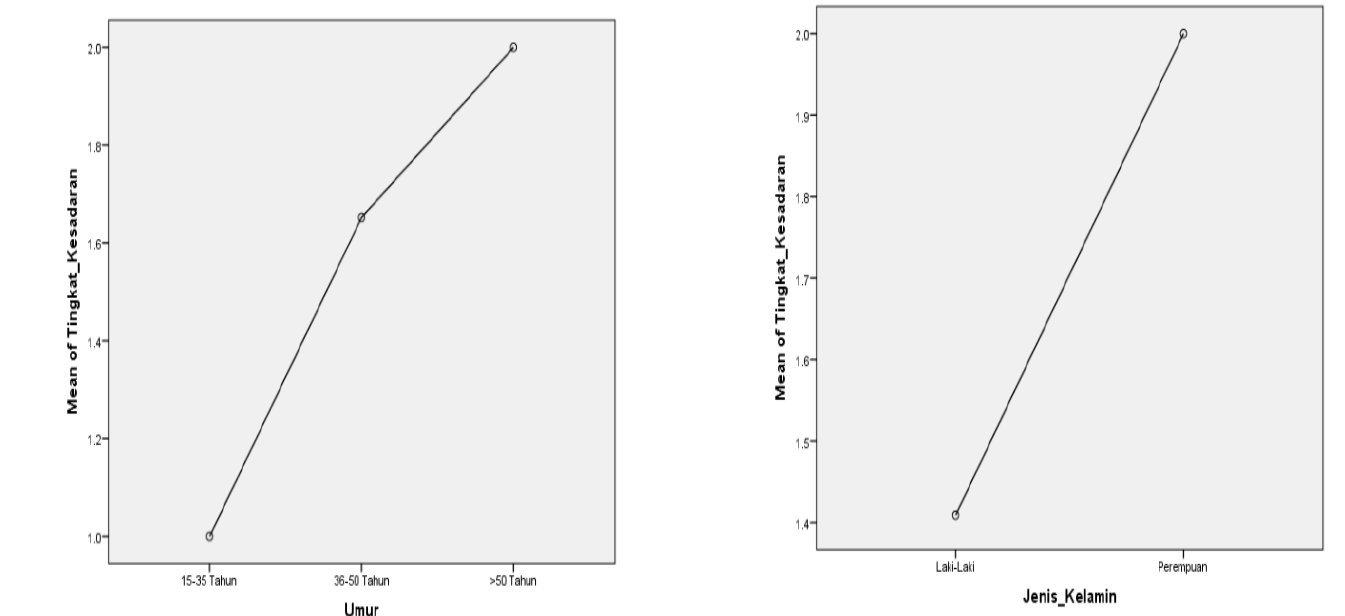
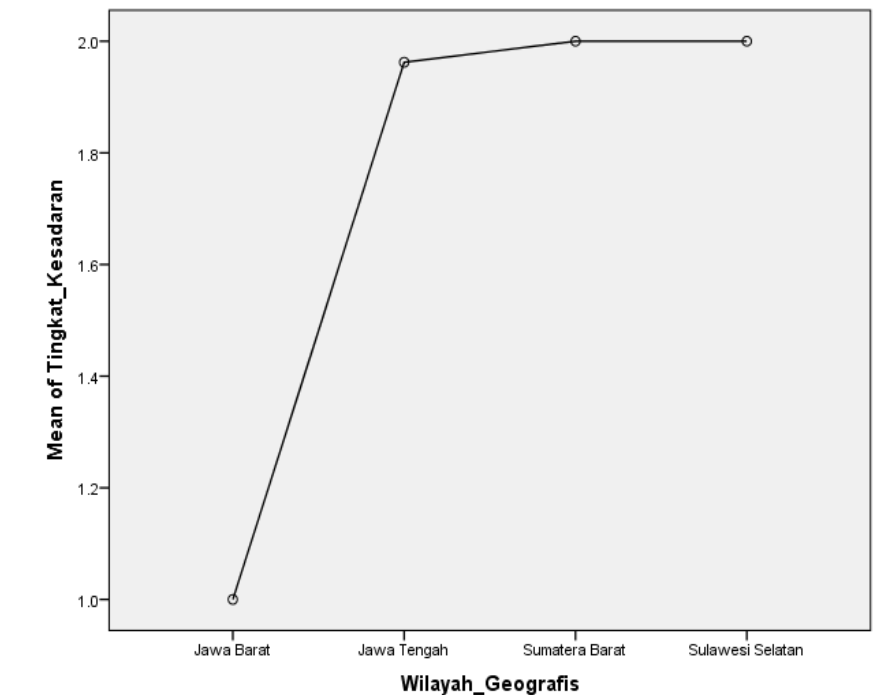
Mean plots from the ANOVA test illustrate the differences in rehearsal awareness levels based on the variables of age, gender, and geographic region. These plots depict the mean rehearsal awareness level for each category within each variable. For the age variable, there is a certain pattern that shows the variation in rehearsal awareness levels among different age groups.
Similarly, for the gender variable, there is a significant difference between the average rehearsal awareness levels between male and female individuals. In addition, on the geographical region variable, there was consistent variation in the level of rehearsal awareness among the different regions studied. As such, these mean plots provide a clear visual representation of how the variables of age, gender and geographical region can influence rehearsal awareness levels. This interpretation can serve as an important foundation in formulating appropriate and effective intervention strategies to improve rehearsal awareness across different population groups. The variation in rehearsal awareness levels between geographical areas is significant, as are the variations in age, gender, and age.
Table 13 Awareness Level and Age
| Chi-Square Tests | |||
|---|---|---|---|
| Value | df | Asymptotic Significance (2-sided) |
|
| Pearson Chi-Square | 120.456a | 2 | 0.000 |
| Likelihood Ratio | 154.960 | 2 | 0.000 |
| Linear-by-Linear Association | 115.507 | 1 | 0.000 |
| N of Valid Cases | 190 | ||
a 0 cells (0.0%) have expected count less than 5. The minimum expected count is 14.03.
Source: Researcher Processed Results with SPSS, 2024.
The Chi-square test showed a significant relationship between the rehearsal awareness level and the age variable (χ² = value, df = value, p < 0.001). With a very low significance value (sig = 0.000), this confirms a significant correlation between the level of rehearsal awareness and the age group in the research sample. Thus, it can be concluded that age has a significant effect on rehearsal awareness levels; in other words, there are significant differences in rehearsal awareness levels between the various age groups. This information is valuable in planning more suitable intervention strategies or health approaches, taking into account the age factor to achieve optimal results in improving clean rehearsal awareness across different age ranges.
Table 14 Awareness Level and Gender
| Chi-Square Tests | |||||
|---|---|---|---|---|---|
| Value | df | Asymptotic Significance (2-sided) |
Exact Sig. (2-sided) |
Exact Sig. (1-sided) |
|
| Pearson Chi-Square | 71.855a | 1 | 0.000 | ||
| Continuity Correctionb | 69.253 | 1 | 0.000 | ||
| Likelihood Ratio | 95.285 | 1 | 0.000 | ||
| Fisher's Exact Test | 0.000 | 0.000 | |||
| Linear-by-Linear Association | 71.476 | 1 | 0.000 | ||
| N of Valid Cases | 190 | ||||
a0 cells (0.0%) have expected count less than 5. The minimum expected count is 27.37.
bComputed only for a 2x2 table.
Source: Researcher Processed Results with SPSS, 2024.
The chi-square test showed a significant relationship between rehearsal awareness level and gender (χ² = value, df = value, p < 0.001). The very low significance value (sig = 0.000) indicates that there is a significant relationship between rehearsal awareness level and gender in the population studied. This suggests that gender has an important influence on rehearsal awareness levels; in other words, there is a significant difference between rehearsal awareness levels among male and female individuals. This information can be invaluable in planning more careful intervention programs or health approaches that take into account gender factors to achieve optimal results in improving rehearsal awareness across different gender groups.
Table 15 Awareness Level and Geographic Region
| Chi-Square Tests | |||
|---|---|---|---|
| Value | df | Asymptotic Significance (2-sided) |
|
| Pearson Chi-Square | 181.449a | 3 | 0.000 |
| Likelihood Ratio | 227.088 | 3 | 0.000 |
| Linear-by-Linear Association | 116.764 | 1 | 0.000 |
| N of Valid Cases | 190 | ||
0 cells (0.0%) have expected count less than 5. The minimum expected count is 9.92.
Source: Researcher Processed Results with SPSS, 2024.
Chi-square tests found that there was a significant relationship between rehearsal awareness level and geographical area (χ² = value, df = value, p < 0.001). With a very low significance value (sig = 0.000), this finding confirms a significant correlation between rehearsal awareness level and geographical location in the research sample. This means that geographical location has an important impact on the level of rehearsal awareness; in other words, there are significant differences in the level of rehearsal awareness among the different regions investigated. This information has important implications in the formulation of more focused health intervention policies or strategies, which take into account geographical area variables to achieve the best results in raising gladi bersih awareness in different geographical locations.
From the interviews with Nyoman Suparna and Dinar Darum Lestari regarding the 2023 Agricultural Census Net Rehearsal, it can be concluded that direct socialization to villages is important to hold meetings with residents. Although publicity through banners and billboards has been done, Nyoman Suparna suggested that more publicity is needed so that people can continue to see the information conveyed. In addition, it is important for census officers to thoroughly explain census activities to the community to increase understanding and participation. The publicity conducted in Bima district is considered effective, but needs to be adjusted to reach people who are not active on social media. From the interview, Gerbi Anugrah Pratama learned about the ST2023 rehearsal activities from Ms. Diyah and responded enthusiastically. He had never seen publicity media images related to the activity. In addition, Gerbi tends to get information directly through meetings or letters, and more often uses online media such as news applications and news portals. Gerbi also stated that the information received is not always optimal due to signal limitations as an obstacle in communication.
From interviews with resource persons from BPS Malang, it can be concluded that in socializing activities such as the agricultural census, the use of diverse publicity methods is very important. Conventional approaches such as direct meetings, banner installation, and socialization through village officials or RT heads are still effective in reaching communities at the village level. However, the role of social media and digital platforms in reaching the millennial generation cannot be ignored. Flexibility in choosing publicity methods that suit the characteristics and needs of each region is also the key to success in socializing BPS Malang activities. By combining these various approaches, BPS Malang can be more effective in delivering information and increasing community participation in agricultural census activities and other programs.
Based on interviews with Marin and Frido regarding the publicity of GB ST2023 in Simalungun, it can be concluded that there were significant changes in the structure and function of the Bandar area due to the development of the Semangke Special Economic Zone. As Marin said, "Actually, in general, it is enough just because the treatment for UTP and UPB is different. UPB is what we should focus on because we maintain their data, we need to keep their data. That might be a suggestion for UPB if it can be added to the souvenirs for the company". This led to the unexpected emergence of housing and boarding houses. Although there were obstacles in publicity and acceptance of the GB narrative, the good cooperation between BPS Simalungun and related parties such as the camat, PPL, and dusun heads helped in resolving problems in the field. The positive response from external parties such as the head of district, head of sub-district, agricultural extension workers, and village officials shows that the publicity and socialization efforts have provided valuable input for the improvement of future agricultural census implementation. By involving various parties and paying attention to responses from the community, it is hoped that the implementation of next year's agricultural census can be more effective and in line with local needs.
The findings from the quantitative analysis indicated significant differences in awareness levels based on demographic factors. ANOVA tests showed that awareness varied significantly across age groups (p < 0.001), gender (p < 0.001), and geographic regions (p < 0.001). Older respondents exhibited lower awareness levels, while urban respondents demonstrated higher engagement with digital publicity. Chi-square tests confirmed that social media and online platforms were more effective among younger respondents, whereas older populations relied more on village officials and traditional media.
The qualitative analysis provided deeper insights into these findings. Interviews and focus groups revealed that many farmers primarily received census information through direct community engagement rather than online channels. Concerns about data confidentiality emerged as a key factor influencing participation willingness. Furthermore, village leaders played a crucial role in spreading census awareness, particularly in rural areas where access to digital information was limited.
To strengthen the discussion, a comparison with previous studies on census communication strategies was conducted. The results confirm that while digital outreach is growing, traditional engagement methods remain essential, especially in rural areas. This study builds on past research by demonstrating the importance of an integrated communication approach in agricultural census campaigns
Conclusions and suggestions
This study highlights the effectiveness and limitations of BPS's communication strategies in the 2023 Agricultural Census. While digital platforms reached younger audiences, traditional methods remained crucial for engaging older and rural populations. The findings suggest that a multi-channel communication strategy is necessary to ensure comprehensive public outreach. By integrating digital platforms with traditional communication methods, BPS can enhance census awareness and participation among different demographic groups.
Through a combination of quantitative and qualitative methods, Table 7 shows that the recognition and knowledge of BPS is only 26 per cent. Therefore, it can be concluded that BPS has not succeeded in creating good awareness in the community despite using various communication channels, including traditional media and digital platforms. The respondents, who were mostly old and had low education, made the digital communication strategy less appropriate for the publicity of the ST2023 Gladi Bersih. The results of the analysis show that BPS's publicity strategy is less effective in obtaining accurate data and ensuring broad involvement from various levels of society. Recommendations for the future include the need to continue to improve proactive communication strategies, strengthen partnerships with local governments and related organizations, and continue to improve the rehearsal process for data quality optimization. Thus, the rehearsal conducted by BPS in the 2023 Agricultural Census can be considered less successful in achieving its main objectives and making a meaningful contribution to the development of the agricultural sector.
Further study development is recommended to conduct more in-depth research related to the integration of information technology in the agricultural census publicity strategy. This study could focus on analyzing the effectiveness of using social media, mobile applications and other digital platforms in increasing public participation in the agricultural census. Future work should focus on exploring AI-based automation in census campaigns to enhance participation rates. Strengthening digital literacy programs, particularly targeting older farmers, remains crucial for increasing online engagement. Additionally, partnerships with local leaders should be expanded to maximize community outreach. Simplified messaging and culturally relevant communication will also help ensure a more inclusive approach to census awareness and engagement.

