




 nueva página del texto (beta)
 Inglés (pdf)
 Artículo en XML
 Referencias del artículo
 Traducción automática
 Enviar artículo por email
 Citado por SciELO
  Similares en
SciELO
Similares en
SciELO 
 Permalink
1 Introduction
Information and Communication Technologies (ICTs) are present in homes, cultural, work and academic environments. The International Telecommunication Union (ITU) estimates that approximately 5.3 billion people (66% of the world’s population) used the Internet in 2022, while 2.7 billion people were still offline [15]. In Mexico, the percentage of internet users was 75.63% of the population of 2021 [11].
In many environments, ICTs improve quality of life. However, they are also means for harassment or cyberbullying. This phenomenon with negative impacts on society is defined in [14] as “an intentional act, either by an individual or a group, aimed at harming or annoying a person by means of ICTs, in particular, the internet”.
Cyberbullying is a form of violence that affects the mental and physical health of people. Annually, staff of the National Institute of Statistics and Geography (INEGI) collect anonymous data on the prevalence of cyberbullying via a survey called MOCIBA, by its name in Spanish: “Módulo sobre Ciberacoso” [12], the Cyberbullying Module under study in this research. The purpose of MOCIBA is to generate statistical information to know the prevalence of cyberbullying among the population aged 12 years and older who are internet users, as well as the characterization of those who experienced a cyberbullying situation in the last 12 months, including the identity and sex of the stalker, frequency of cyberbullying and consequences for the victim.
The staff of INEGI conducts interviews and collects the MOCIBA data using a questionnaire formed by closed and open questions. The results are presented at local and national level and they are disseminated from the INEGI web site [12] in two formats. On one hand, in a report entitled main results such as [14] of 2021, a PDF file that also includes a comparison of 2020 and 2021 data. On the other hand, raw data are available as open data, a set of files in CSV1 format.
Until now, the six applications of MOCIBA have had a distinct thematic coverage and questionnaire, as a consequence, heterogeneous datasets for results are produced making analysis over time difficult. In order to address the difficulties in the management and meaning of MOCIBA data, this paper presents a resource named Semantic MOCIBA 2021, a dedicated ontology and vocabulary to represent and organize concepts of the MOCIBA applied during 2021. The goal is to significantly improve reusability by providing a standardized vocabulary using Semantic Web technologies and ontologies.
The vocabulary emerged on the basis of raw data analysis gathered from August 2020 to September 2021, the most recent data available at INEGI web site [12]. The vocabulary was designed to the general public with focus on information systems communities, this is publicly available online2.
The paper is organized as follows. Section 2 deals with related work. Section 3 presents the development process of the Semantic MOCIBA 2021 vocabulary, this includes the description of main concepts, relationships and relevant instances. Section 4 provides examples of how to use the vocabulary and discuss its potential. Finally, Section 5 contains the conclusions and the future work.
2 Related Work
Around the world, information from public adminis-trations at local, regional, national or international level use open data portals. To begin with related works, the project described in [6] deals with cyberbullying and bullying as forms of violence against women, reflecting unequal power relations between women and men based on current national and Slovenian activities. The purpose was to determine the incidence of cyberbullying since a gender perspective. Although the theme in this project and our research is similar, the dataset are no longer accessible and therefore a comparison cannot be made.
Secondly, we found two datasets available since data.europa.eu web site, the official portal for European data. The first dataset is described in [5], this refers to an annual population survey on safety, quality of life and victimisation, collecting data on neighborhood nuisance, disrespectful behavior, prevention measures, police performance and municipal safety policy for the Netherlands. As a result, security figures are reported at national, regional and local levels. The latest data for this survey is 2012, only the statistical information is distributed in a tabular format but in dutch language.
[7] describes the second dataset, this is associated with two categories: 1) population and society, and 2) health. English and Spanish data are available in formats such as CSV, HTML3 and Resource Description Framework (RDF) [24], a standard of the World Wide Web Consortium (W3C) originally designed as a data model for metadata that is also used as a general method for description and exchange of graph data [16]. The dataset is a CSV file composed of statistical information represented in 3 columns and 241 rows; a graphical user interface (GUI) allow users to query data by community or autonomous city, genre and frequency of discrimination, the GUI is available at: https://ine.es/jaxi/Tabla.htm?tpx=51503&L=1.
Thirdly, we carried out a systematic review of the Linked Open Vocabularies web site [21], a widely-used catalog of vocabularies available for reuse with the aim of describing data on the web. As of the date of January 6th 2023, any of the 782 vocabularies deals with the cyberbullying domain.
Finally, we focused our efforts on review literature related with the process of working with messy data, ETL4 tools and transformation of tabular data into RDF tuples. Although the domain of the guide described in [26] is biodiversity, its application allow users to estimate and improve the quality of datasets.
A domain-independent and detailed description of the use of vocabularies and ontologies to represent data content and links can be found in [2]. Furthermore, available at the Spanish government portal, the guide [4] includes best practices, tips and workflows for the efficient and sustainable creation over time of datasets that according with the author’s point of view, bring greater economic and social value to citizens.
Related works mentioned above are focused on datasets, vocabularies and linked open data. In contrast, our research analyzed a large dataset of raw data, with the added value of following a domain-independent ontology design approach.
3 The Development Process of the Semantic MOCIBA 2021 Vocabulary
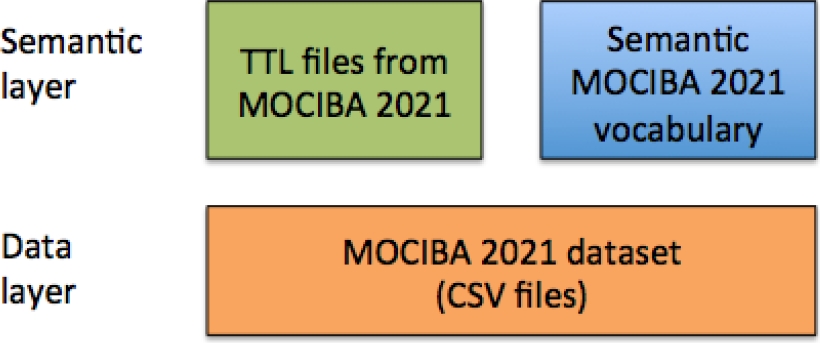
Besides usefulness and reusability, the motivation for developing Semantic MOCIBA 2021 is based on the understanding, in the information systems communities, that consuming open data requires to take into consideration the relations among the perspective of data producers and different types of consumers. Therefore, we executed our research taking into account a multi-disciplinary approach of participants and authors, (as is described in Section 3.1), as well as the framework of Figure 1, where “TTL files” refer to RDF files that uses the sintaxis of TURTLE.
3.1 Open Data Analysis
The open data analysis carried out to design the proposed vocabulary is presented according to the information of six applications of MOCIBA by identifying terms and their relationships, with special emphasis on MOCIBA 2021 dataset, that constitute the most recent data.
3.1.1 Applications of MOCIBA
As it was mentioned on Section 1, the MOCIBA raw data for each year are available as open data and distributed in a compressed file (*.zip format) that includes the following 5 folders: 1) metadata, 2) data dictionary, 3) catalogues, 4) model_entity_relationship and 5) the dataset itself, a large CSV file.
Thematic coverage and the questionnaires have been different over time as is summarized in the tables 1 and 2; the numbers in Table 2 refer to the possible answers per theme. Furthermore, take into account that the questionnaire of 2015 had 10 questions, 12 questions were included for the questionnaires of 2016, 2017, 2019 and 2020, while the latest has 14 questions (2021); the survey was not conducted in 2018.
Table 1 Themes directly related with cyberbullying in MOCIBA’s questionnaires
| ID | Theme |
| T1 | Cibyerbullying situations experienced |
| T2 | Effects on the victim |
| T3 | Frecuency of cyberbullying |
| T4 | Measures against cyberbullying |
| T5 | Media used for cyberbullying |
Table 2 Number of possible answers per theme
| ID | 2015 | 2016 | 2017 | 2019 | 2020 | 2021 |
| T1 | 4 | 10 | 10 | 10 | 10 | 12 |
| T2 | 0 | 9 | 9 | 9 | 10 | 15 |
| T3 | 5 | 5 | 3 | 4 | 5 | 5 |
| T4 | 0 | 0 | 0 | 9 | 10 | 13 |
| T5 | 6 | 7 | 2 | 4 | 4 | 4 |
Table 3 shows the size of the datasets that integrate the results per year, note that the 2015 corresponding dataset is not available. As a consequence, the data analysis over time is not a simple task and requires valuable human efforts and high processing capacity for computers.
Table 3 Size of the MOCIBA datasets per year
| Year | Columns | Rows |
| 2016 | 208 | 91,675 |
| 2017 | 172 | 33,566 |
| 2019 | 177 | 10,145 |
| 2020 | 228 | 37,867 |
| 2021 | 277 | 40,491 |
Our research is focused on MOCIBA 2021 dataset, the most recent data as is described in the following section.
3.1.2 The MOCIBA 2021 Dataset
The MOCIBA 2021 dataset gathers geographic and statistical information about cyberbullying considering a spacial coverage at national and local level that covers the following key themes:
— Condition of use of security measures,
— Implemented security measures, and
— Characterization of cyberbullying situations experienced.
Figure 2 shows the sequence of the questions that form the questionnaire of 2021. The notation is as follows: the rhomboids represent the dichotomous questions and the squares the multiple choice questions. The questions from Q5 to Q12 refer to one or more cyberbullying situation experienced (Q4), a maximum of three situations is recorded per each surveyed person.
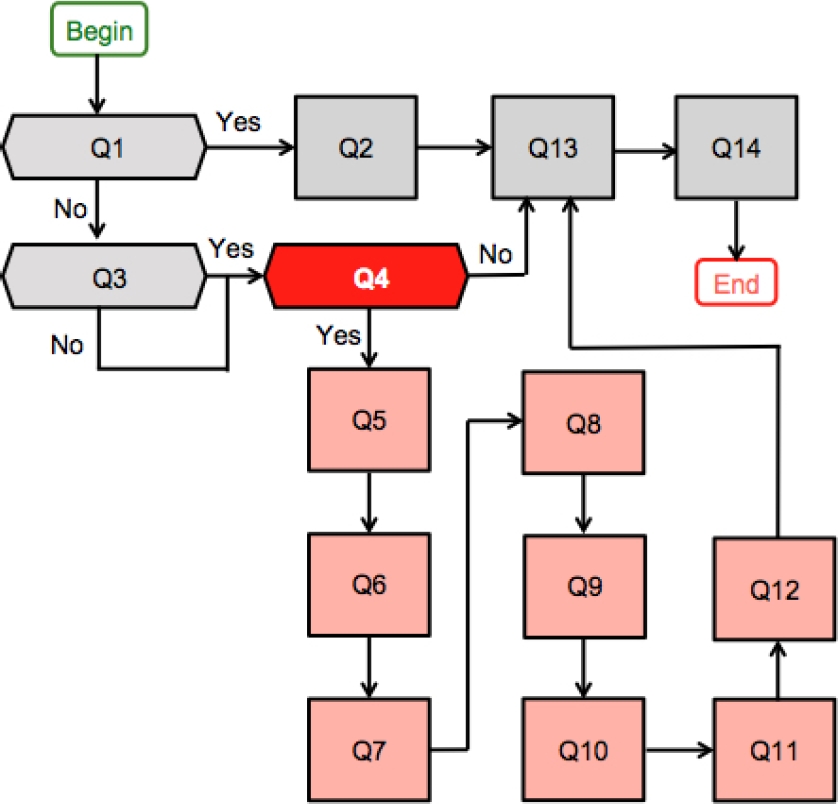
The MOCIBA 2021 dataset is accesible from the INEGI website [12] and allow users to verify the content of the report [14]; some of its features are the following:
— The dataset is formed by 277 columns and 40,491 rows (see Table 3),
— The interpretation of the data is based on catalogs, there is one catalog for each column,
— The data dictionary has 2,593 elements,
— The information gathered in each of ’Other’ option of the questionnaire is not part of the dataset,
— The image of the model_entity_relationship folder only shows the name and data types of 4 columns.
The analysis and interpretation of the data requires potential users to simultaneous manage the information, that represents a high cognitive load prior to its reuse. Some tasks carried out by the vocabulary development team are summarized as follows:
Content review of the folders catalogues, dataset, dictionary, metadata and entity-relationship model,
Study of the dictionaries,
Column grouping of the dataset by the-matic coverage,
Transformation of the rearranged dataset by integrating information from catalogues and dictionaries.
The tasks 3 and 4 were implemented using the OpenRefine software tool [8], the version 3.7 for Mac OS computers and 3.6.3 for Windows.
3.1.3 Identification of General Concepts and Basic Relationships
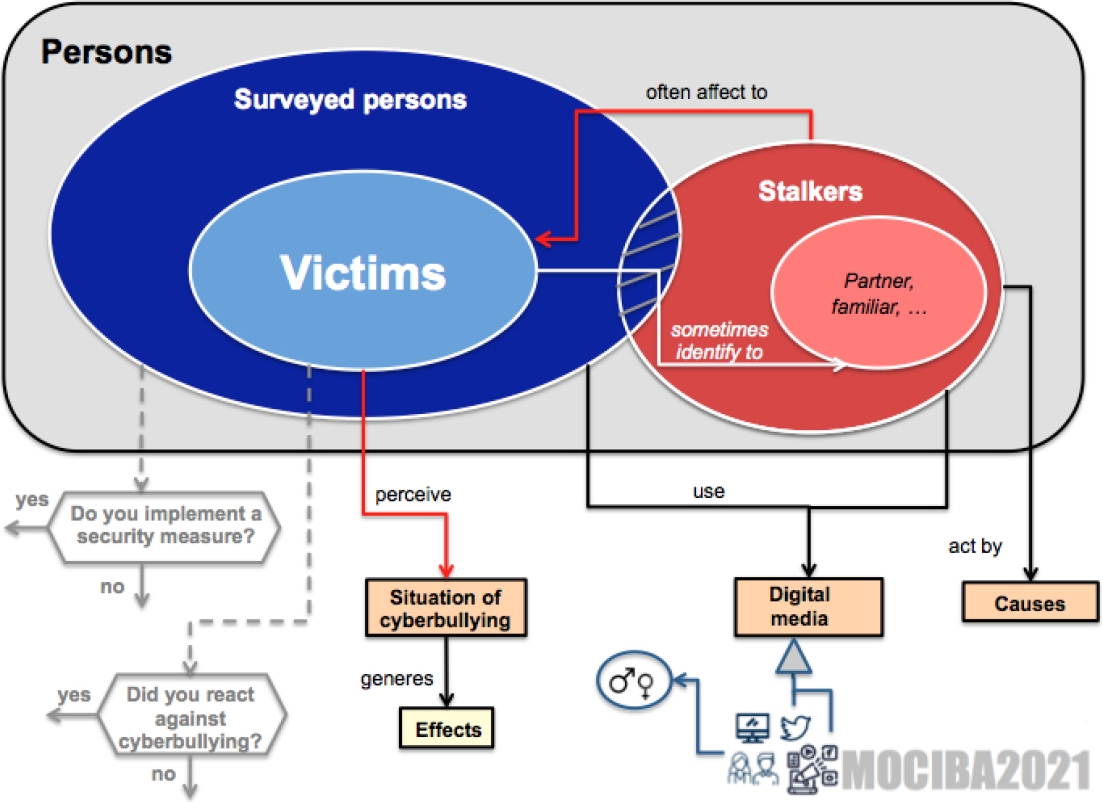
As a result of the tasks described in the Section 3.1.1 and 3.1.2 was the identification of general concepts and basic relationships about the characterization of cyberbullying. The development team built a graphical representation of these items to introduce the vocabulary to the general public, and asked the participation of 20 persons (male (♂):10, female (♀):10) for feedback; there was no answer of 6 persons (♂).
The profile of the 14 participants was as follows: 8 higher education teachers from 5 Mexican universities (♂:3, ♀:5), 3 masters and 1 Ph.D. student (♂:1, ♀:3) and one person with an administrative role (♀:1). After four versions and a consensus-based negotiation phase, the representation called the conceptual model of Semantic MOCIBA 2021 vocabulary was produced, this is illustrated in Figure 3, note that this combines elements of sets theory, flow charts and class diagrams which are widely-used in information systems communities.
3.2 Vocabulary Building
The Semantic MOCIBA 2021 vocabulary is built under the next key concepts: persons, cyberbullying and digital media. At present, there are two versions of this vocabulary, the first one uses labels only in Spanish language [18] while the second one also has labels in English language [19], both are available on the following web site: https://www.mauxmedina.com/vocabularies/. From now on, the figures and tables refer to the second version.
The vocabulary formalizes and specifies the conceptual model and reuse the MOCIBA 2021 dataset by implementing the steps proposed in [9], a domain-independent ontology design approach. The steps are the following:
Consider reusing existing ontologies,
Enumerate important terms in the ontology,
Define the classes and the class hierarchy,
Define the properties of classes - slots,
Define the facets of the slots,
Create instances.
The next sections describe those steps, they were implemented by using the Protégé editor [20].
3.2.1 Domain, Scope and Reuse of Ontologies
The domain of Semantic MOCIBA 2021 vocabulary is cyberbullying. The scope is the representation of terms and relationships found on the INEGI website [12], this includes the dataset itself, the report [14] and the questionnaire [13].
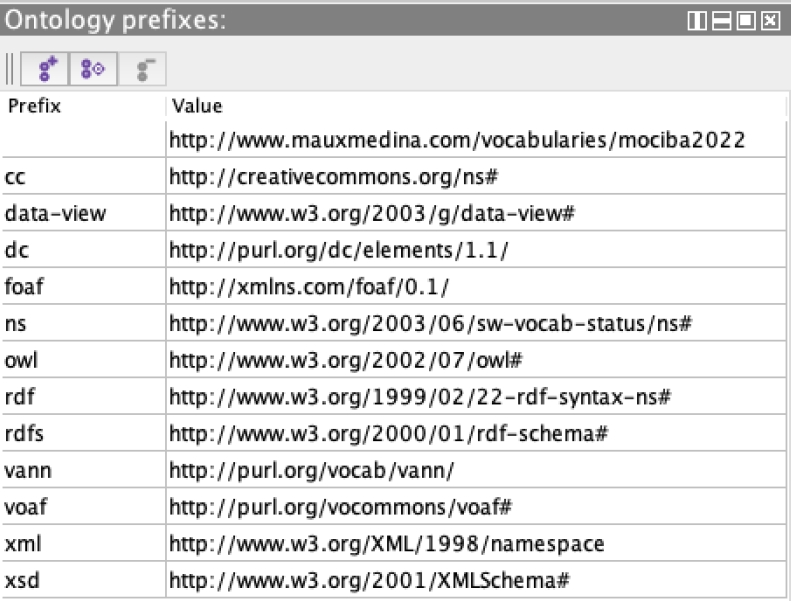
Table 4 shows the competency questions (CQs) that drive the vocabulary building. More information about CQs can be found in [10]. The reused ontologies and their prefixes are illustrated in Figure 4.
Table 4 Competency questions
| ID | Competency question |
| CQ1 | What are the cyberbullying situations experienced? |
| CQ2 | What security measures do surveyed persons implement? |
| CQ3 | How people relate to each other in cyberbullying situations? |
| CQ4 | What digital media do stalkers use? |
| CQ5 | What are the effects of cyberbullying? |
3.2.2 Terms, Classes and Hierarchy of Classes
After a systematic review of the documents enumerated in Section 3.2.1, the terms were extracted to define and construct the class hierarchy showed in Figure 5. The two main classes are:
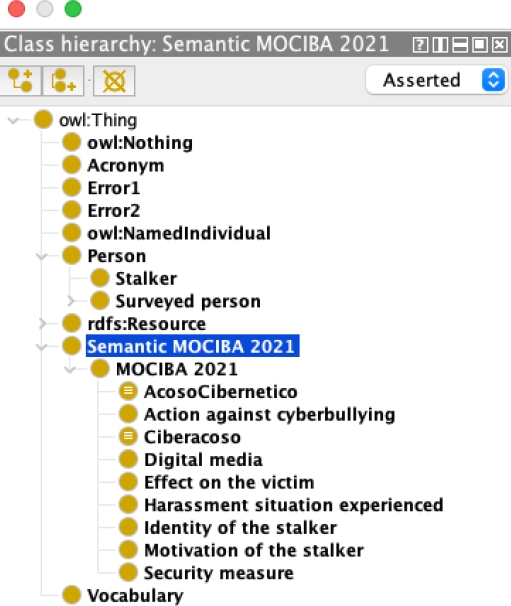
In the first place, the
3.2.3 Define the Properties of Classes and the Facets
Table 5 contains the properties of classes, also known as object properties, they represent the binary relationships between instances of the
Table 5 Domain and range for object properties
| Property | Domain | Range |
| acts_for | Stalker | Motivation |
| affects_to | Stalker | Victim |
| identifies | Victim | Identity of the stalker |
| perceives | Victim | Harassment situation experienced situation experienced |
| uses | Stalker or Victim | Digital media |
The object properties answer the question CQ3, they are also represented in the conceptual model. The facets for all of them are
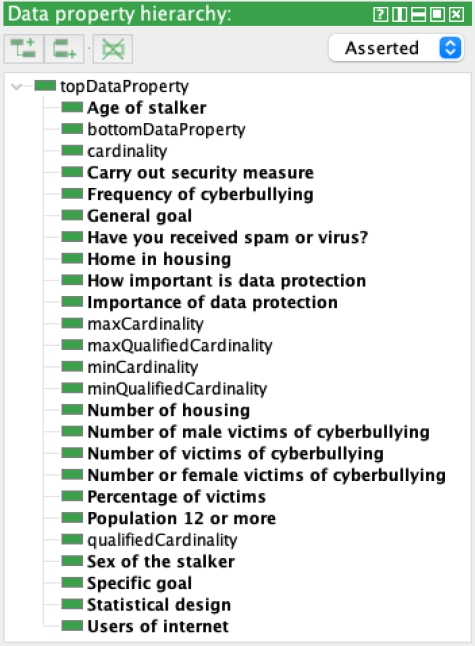
Besides object properties, the vocabulary has data properties that model the information of the questions
3.2.4 Create Instances
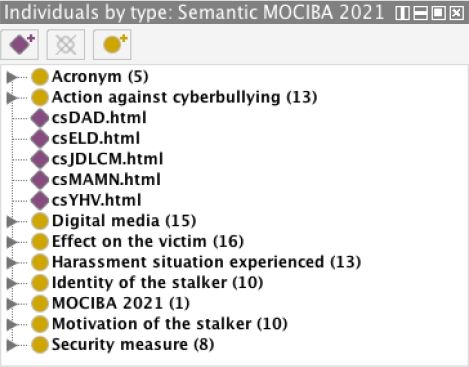
According to [9], the creation of instances is the last step of the vocabulary building. However, in this paper, they were introduced in the Figure 6.
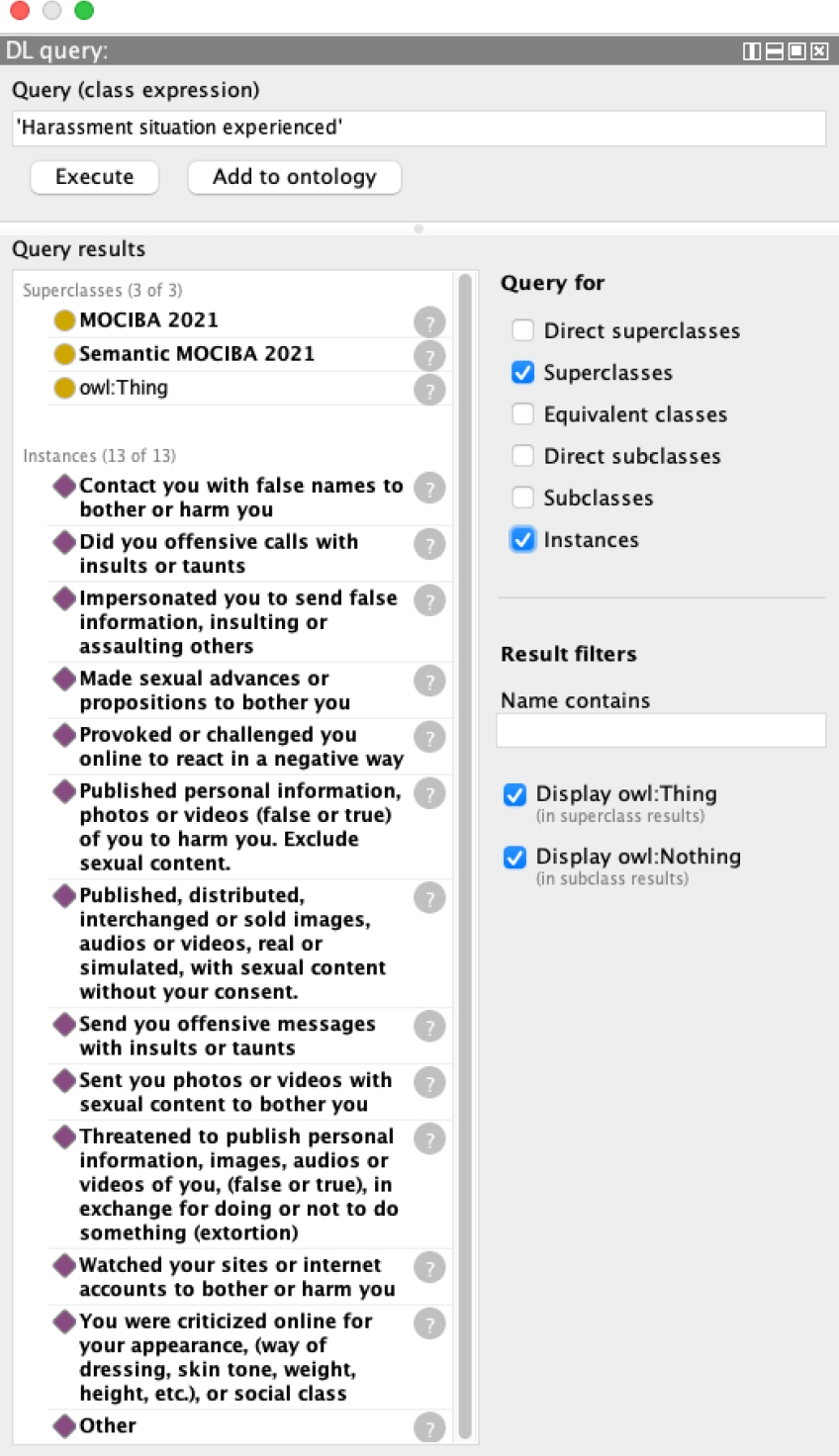
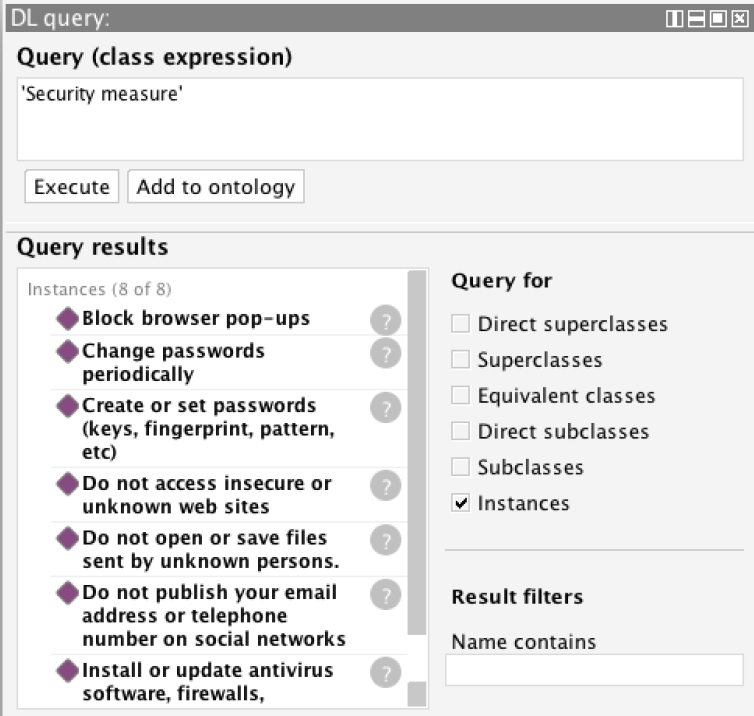
The instances of Figure 8 and 9 constitute the answers to CQ1 and CQ2, respectively. Figure 8 shows a DL6 query that retrieves the superclasses and the instances of the class
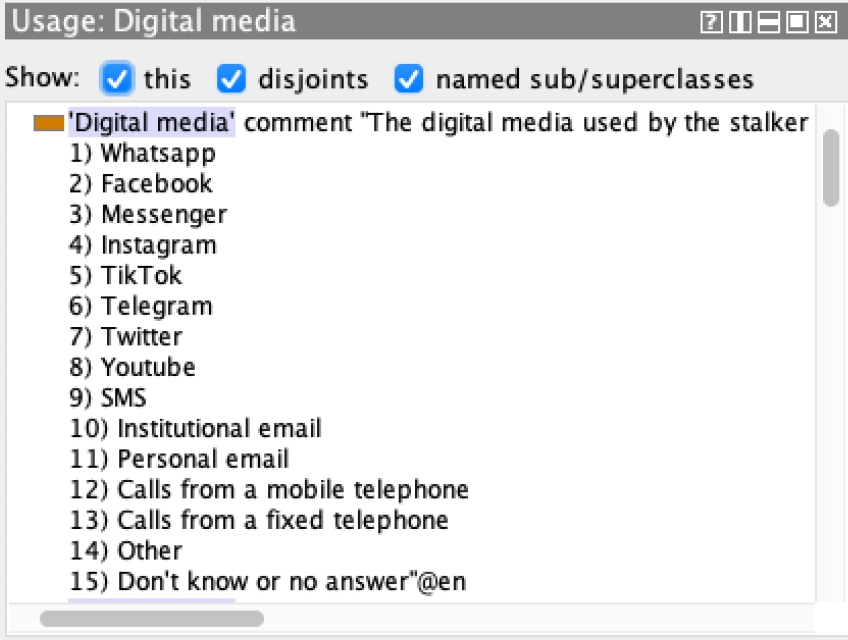
The digital media that answer to CQ4 are enumerated in Figure 10 as part of a comment, although they are also modeled as instances. The properties
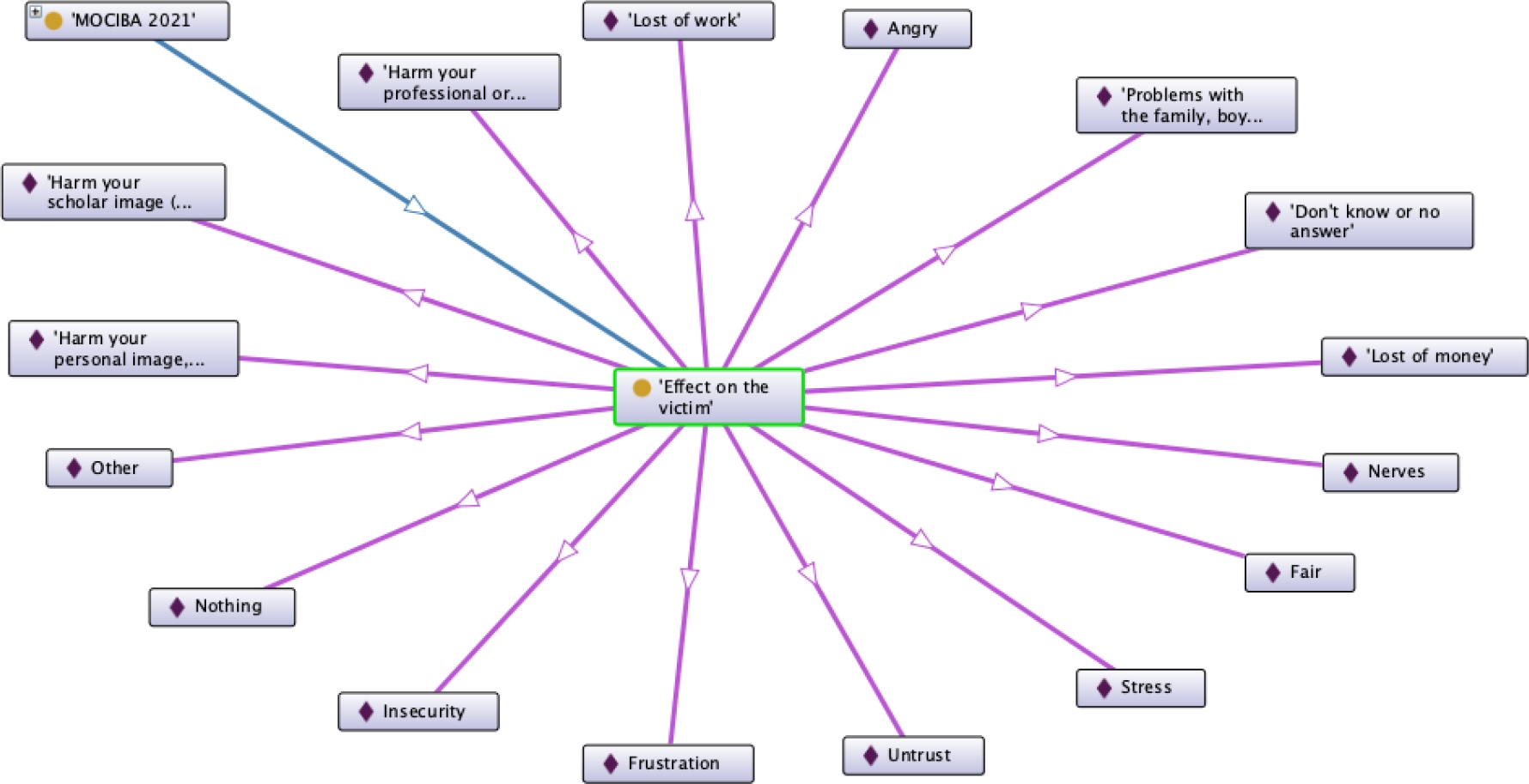
The module Ontograph of the Protégé editor support the construction of graphs with instances as in Figure 11, this shows the effects that the cyberbullying cause on the victims. The graph answers to CQ5.
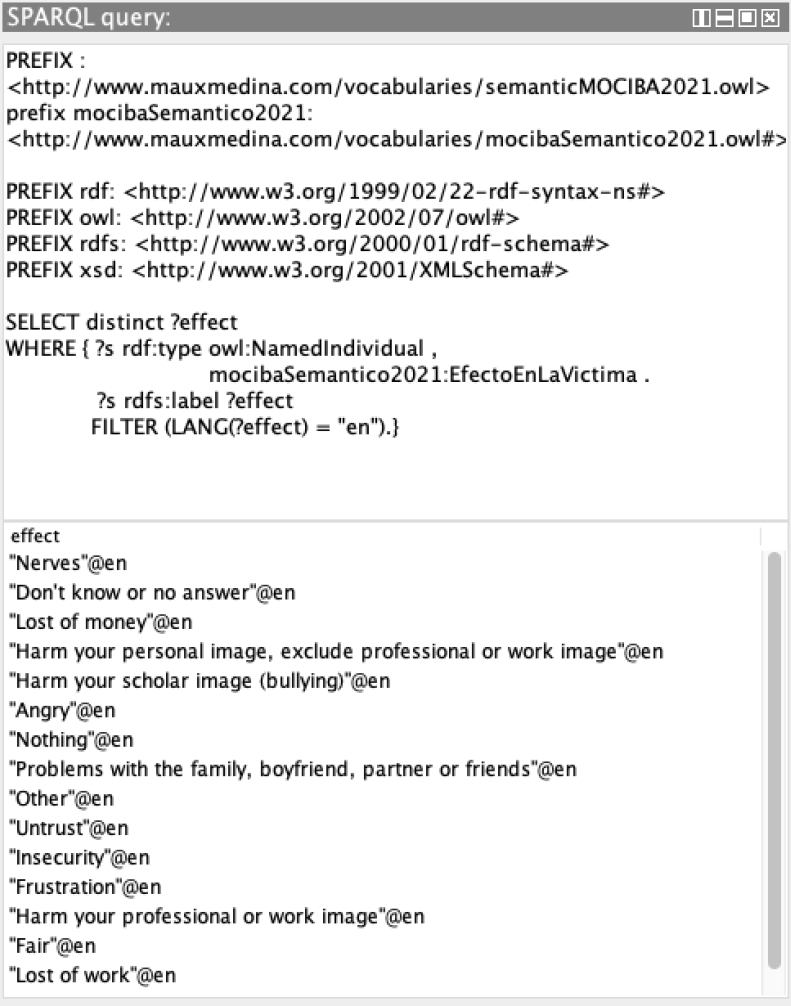
An error was fixed after the record of the vocabulary in the Copyrights National Institute, (its Spanish name is Instituto Nacional de Derechos de Autor (IndAutor), see [18] and [19]), the instance effect 16 was added with the label “Don’t know or no answer” and the label of effect 15 was changed by “Nothing”. Figure 12 shows how to retrieve these effects by using a SPARQL query within the Protégé editor itself.
The Ontology Web Language (OWL) is used to formalize the Semantic MOCIBA 2021 vocabulary. An overview of this language is available at [17]. In summary, the following modeling artifacts were used:
— Classes that model main concepts
— Instances associated with the answers to multiple choice questions
— Object properties to establish relationships between instances based on the conceptual model
— Data properties that refer to dichotomous questions and metadata
— Tagging of ontology elements by using the
— Capture of English and Spanish language specifics on the labels and comments
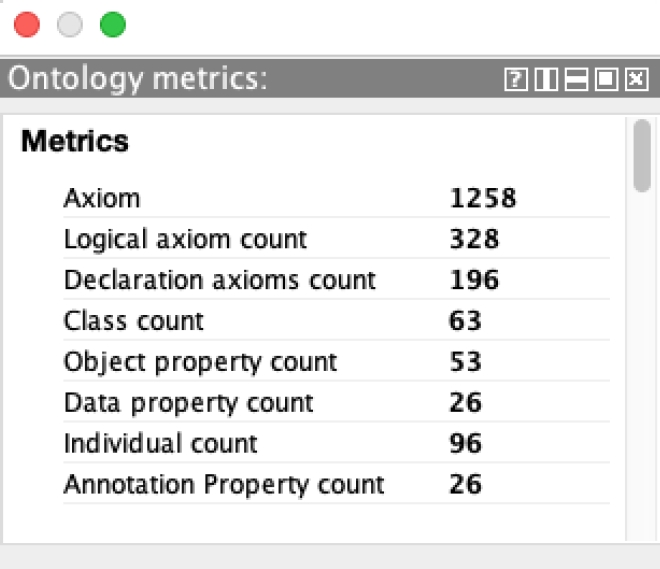
After following the recommendations for Linked Open Data vocabularies to improve reusability [25], the metrics of Semantic MOCIBA 2021 vocabulary are illustrated in Figure 13.
4 How to Use the Semantic MOCIBA 2021 Vocabulary
Semantic MOCIBA 2021 is an original ontology and vocabulary dedicated to the exploitation of MOCIBA 2021 dataset that provides context for data analysis. On one hand, a key use case for this vocabulary is to serve as a reference resource and practical tool for students and practitioners of Semantic Web technologies and for information systems communities.
On the other hand, the vocabulary can be used for exposing the complete MOCIBA 2021 dataset or some subsets as “Linked Data”, this enables the construction of enriched and interconnected data. For example, we propose to rename and arrange the columns of the MOCIBA 2021 dataset as follows:
Geographical data, (state, population, type of population, primary sampling unit, primary sampling unit_design),
Data of surveyed persons, (age and genre),
Answers per question
Figure 14 shows the geographical data used to identify the data for each questionnaire, the acronym UPM refers to the Spanish expression “Unidad Primaria de Muestreo”, primary sampling unit and UPM_DIS for “Unidad Primaria de Muestreo_diseño”, primary sampling unit_design.
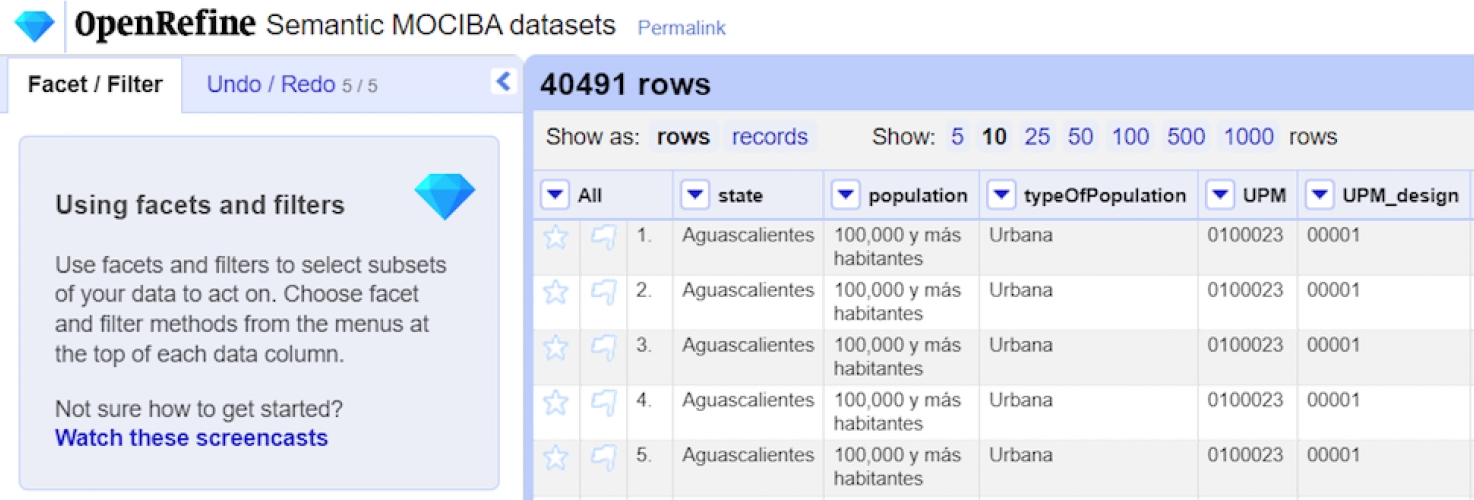
We used the terms of the vocabulary to rename the columns of interest that will be used to construct new datasets, in other words, we designed a mapping of MOCIBA 2021 columns and transform some cell values based on linked data principles.
Finally, we exported the new datasets into RDF tuples using the OpenRefine extension called
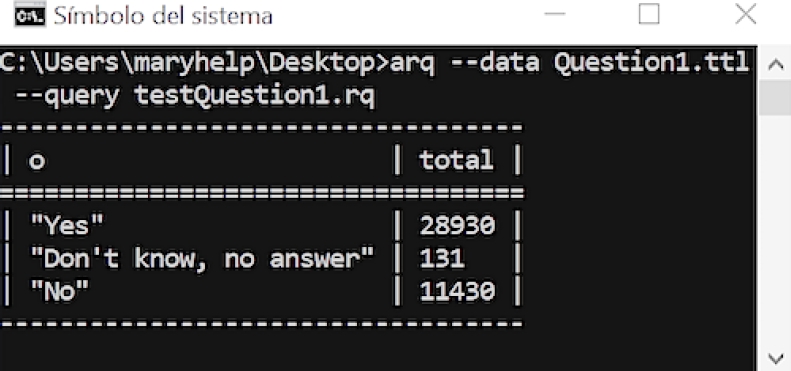
Figure 15 shows the execution of the SPARQL query 2 on a new dataset called
5 Conclusion and Future Work
This paper presented the Semantic MOCIBA 2021 vocabulary, an original ontology and standardized vocabulary dedicated to the exploitation of MO-CIBA 2021 dataset. The vocabulary emerged as an alternative to significantly improve reusability after understanding how data related to cyberbullying has been collected and disseminated according to the documentation distributed by INEGI; the difficulties of analyzing those heterogeneous data over time from a data management perspective were exposed.
The development process of the Semantic MOCIBA 2021 vocabulary was described from scratch to create new and enriched datasets where concepts and relationships are formalized to represent and reason via linked data; the process is useful to explore other sources of valuable datasets commonly distributed by public administrations since open data portals.
According to the author’s point of view, the contributions of this work are the following: the creation of a conceptual model to introduce the vocabulary to the general public, the construction of the Semantic MOCIBA 2021 vocabulary and its representation in the OWL language, the transformation of the vocabulary into RDF tuples in order to explore and retrieve information using SPARQL queries, and the exemplification to create new and enriched datasets using the proposed vocabulary.
The Semantic MOCIBA 2021 vocabulary serves as a reference resource and practical tool for students and practitioners for information systems communities, this was designed to support the decision-making process that can result in some actions against cyberbullying by individuals or organizations in the academic or social sector based on the evidence distributed as open data. We expect that its reuse will contribute to make visible the incidence of the cyberbullying phenomenon.
As future work, we plan to continue with the creation and exploration of new datasets to retrieve cyberbullying situations experienced according to specific features of the persons and the digital media involved.

