




 nueva página del texto (beta)
 Inglés (pdf)
 Artículo en XML
 Referencias del artículo
 Traducción automática
 Enviar artículo por email
 Citado por SciELO
  Similares en
SciELO
Similares en
SciELO 
 Permalink
1 Introduction
During the individual's daily life, security in many occasions can find very different applications. May be the most well-known and important could be fight against delinquency and crime [1]. Nevertheless, the security field application topics goes beyond law matters [2]. By considering the topic of security as a factor that seeks to reduce or nullify this human risk, as it is directed to the individual vulnerability. Furthermore, security can be found in a wide variety of possible fields of application [ and 4].
Vehicle transportation security is a topic that represents large and diverse areas of interest, which are related to the risk that passengers can suffer (humans, animals and/or objects). As well as the risks that the vehicle could be used as a weapon or instrument to produce damage or criminal acts [ and 6].
In other set of ideas, to increase the efficiency and effectiveness of transportation security procedures, countries around the world have taken initiatives to increase security in vehicles, especially during the physical movement of transportation. Some of these initiatives constitute legal obligations, others are voluntary certification programs [7].
The first self-propelled vehicle was the 3-wheel tractor built by Joseph Cugnot in 1771 (the Fardier). However, this was a machine with limited capacity [8]. This prototype crashed into a brick wall, and it was considered the first car accident in the transportation history. This accident was responsible for the cessation of the French army vehicles experimentation [9]. Also, it can be established that the automobile era began in January 1886, the year in which Karl Benz launched the first automobile in a formal way [10]. The first gasoline-powered four-wheel drive car was created thanks to the capabilities of Karl Benz and Gottlieb Daimler [11].
Later, Henry Ford developed a serial vehicle production system, which made the automobile popular and the demand for this product grew [12]. So, accidents and problems were imminent. In this sense, it was documented in 1869 the first accident involving a car and a human being, where a woman lost her life (Mary Ward) by falling out from the vehicle [13].
The first driver killed in a gasoline-powered vehicle accident was Edwin Sewell, who was driving at excessive speed to impress Major James Ritcher to sell the vehicle to the army. Nonetheless, the driver lost control and overturned, killing himself [14].
This was only the beginning, as technology improves also transportation has evolved and progressed, consequently the quantity and brutality of car accidents were increased. Consequently, it was extremely important to provide to the customer and public, the best security systems in transportation. But then again, regardless of public service movements and law implementations, car users still take unnecessary risks.
Additionally, vehicle makers take some of the responsibility for unsafe or malfunctioning products to which have contributed [15]. Along its entire car history, manufactures have tried to develop a great number of safety features (airbags, antilock brakes, seatbelt, template glass, less rigid structures, etc.) to assist into lower the number of accidents and deaths in vehicles misfortunes. Regardless of these features, car accidental deaths and injury rates are still very high [ to 20].
One of the solutions encompassed into the high rates in accidents, was to treat the motor vehicle as a mechanical structure and the manner to engage the energy of an impact to cause minimum damage to the occupants and pedestrians. So, the necessity to develop and perform automobile crash tests emerge, where it was necessary to record data and observe driver response, and this is directed to the understanding of vehicles crash accidents.
Taking into consideration all kinds of diverse situations and conditions, arrangements developed during the impact and the consequences after the completion of the test [21]. On the other hand, depending on the transportation group, industrial sector or community, different objectives and goals are considered, so the correlation in their definition and techniques to be found were extremely difficult to be defined.
For example, government sectors want to set safety standards and make sure automakers adhere to them, scientist and developers want to learn more about accidents themselves, so that accident investigators can reconstruct real-life accidents, consumers want to avoid or minimize risks and fatalities, manufactures want to engineer safety systems, etc. [22].
Vehicle crash testing should identify possible complications and provide a wide group of solutions directed to provide an early warning to consumers and pedestrians. When airbags were first introduced, they were seen as an incredible safety device. However, considerable resources are required to successfully conduct car crash tests.
The great and countless development of computers and systems over the years, have been able to provide numerical techniques, that can deliver models and assessments closer to reality. Mathematical modelling applied into virtual evaluations and/or vehicle crash experiments can facilitate the decrease in budgets on crash tests [23].
Nevertheless, numerical modelling can only be effective if it is applied alongside to vehicle crash tests, to decrease number of tests. Reduction in costs can provide the implementation of different structure forms, from a basic crash evaluation and time saving into product evaluation.
The main contribution of this paper is related to passive safety in vehicles. The work will be focused on the automotive monocoque structure, which is of the utmost importance to provide safety to the driver and occupants of the vehicle when a collision occurs.
The evolution of the monocoque has been the key in the development of passive safety for the vehicle, at the beginning the monocoque was built up from rails and cruisers on which the body was mounted. However, it was found that the chassis was very rigid and cause several deathly casualties. Consequently, it was opted for a new form of structure, less rigid and more ductile, less heavy, and lighter and cheaper, and in an intelligent manner one that it is known as the steel monocoque. This type of structure contains deformable areas at the front and rear of the vehicle.
But, on the other hand, the interior is usually more rigid, this to achieve a more efficient dissipation the energy during a collision and protect the occupants. To evaluate the effectiveness of a steel monocoque, impact tests are carried out through the EuroNCAP or the IIHS procedures.
This research work presents the numerical simulation (taking into an account the parameters and development of a real crash experiment) of the frontal impact on a steel monocoque structure. The objective is to analyse the severity of the impact and the injuries it can cause to the human body. The numerical simulation provides results that can estimate the total displacement in the vehicle structure when a collision occurs and the risk that victims can be facing.
Considering the large number of sales that the Chevrolet Aveo has had in México, it was taken as a reference for the numerical simulation of vehicular monocoque impact.
Additionally, this research work presents a proposal for the optimization of the steel monocoque structure and the application of various materials (such as high resistance steels) to reduce the risk to occupants in the vehicle and reduce costs.
It is important to mention, that the advances in the numerical impact simulation will considerably reduce the expenses generated by the impact crash tests, but the numerical evaluations are not appropriated if there are not developed from actual data of an impact crash tests.
2 Theoretical Backgrounds
In a general manner, a great percentage of the safety of a motor vehicle has been directed to implement and develop new technologies and elements in the main body structure of the automobile. In previous vehicles studies, the rigid body was thought to be better one. However, this type of bodywork caused the impact to be distributed with greater and harmful effect on the crew, causing serious injuries.
A major advance in safety was the implementation of programmed deformation zones in the steel unibodies. These areas are responsible for reducing the impact suffered by passengers when the vehicle collides. When performing collision tests, there is a need arising to return various parts of the vehicle to zones of programmed deformation.
Such as the engine mounts, stringers, and crossbars, which are the parts responsible for absorbing the energy produced in a collision. This results in the cabin being much stiffer at the programmed deformation zones. Thus, occupants have less risk of being caught in a collision [24].
The behaviour of programmed deformation zones is due to the folds, channels, holes, spars, and reinforcements that are placed at defined zones, so that they act progressively (sandwich). For such elements, steels of different strengths are used, and the geometric shapes and sheet thickness of each component are used [25].
Within the Mechanical Engineering area, there are various problems regarding mechanical design. One of them is in the improvement of structures for diverse applications. Therefore, it is sought to create optimal structures that make the solution to various problems easier.
The structural optimization is a fusion of the areas of Engineering, Mathematics, Science and Technology, which has the goal of obtaining the best function of a structure [26]. Optimization methods can be grouped into two categories, these being gradient-based methods (mathematical programming methods) and heuristic methods (so-called evolutionary techniques).
The type of optimization to be used is defined according to the design objective that is taken into account, there are three types of optimizations (properties, shape and topology) [27]. On the other hand, the conditions under which a crash test is carried out, are diverse and depend on the group in charge of carrying out the evaluation.
For example, the Euro NCAP mentions, in its frontal impact test protocol, that the appropriate speed for the test should be 50 km per hour, with a margin of error of 1 km [28]. Instead, the IIHS mentions that, for frontal impact, the vehicle's impact speed should be 40 miles per hour (64 km per hour) [29].
The impact of the vehicle is made against a barrier made of reinforced concrete. This barrier is fixed to the ground at the tested area, so that it reproduces a frontal impact as closely as possible to reality.
The crash test allows identifying the parts of greatest weakness in the vehicle structure, which are the parts that could cause the most damage to the occupants (Figure 2) [30]. There is very poor protection of the vehicle against a frontal collision according to Latin NCAP [30]. Listed below are injury patterns during front impact testing of the Chevrolet Aveo.
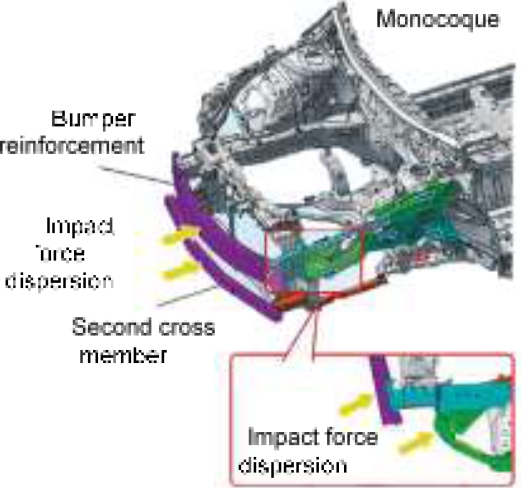
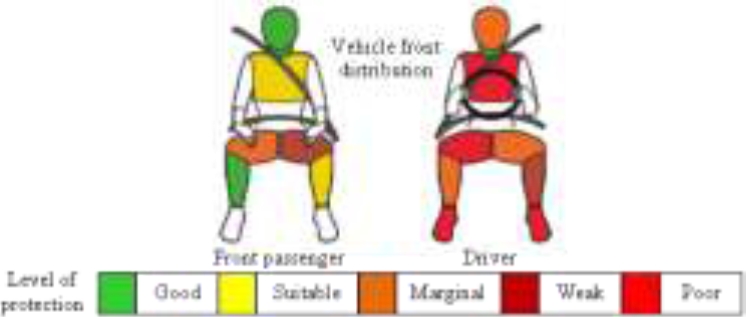
Based on the previous report, various thoughtful injuries can be assumed both for the driver, as for the front passenger, but the report states that both occupants will have a lower risk of serious injury. However, it remains a vehicle with very poor user protection and an unstable structure [30].
Nonetheless, the data from the crash test can be applied into a numerical simulation to provide better solutions or for optimization, and when this data is satisfactory, changes can be performed into the structure and retests could be performed, saving many resources.
3 Structural Conditions for the Numerical Analysis Applying the Finite Element Method
The numerical evaluation to be carried out and will be the representation of a frontal impact for two cases of study. In the first case, it will be evaluated the actual Chevrolet Aveo monocoque and for the second case it is presented a modification to this monocoque to provide a better protection to the occupants.
For both analyses, it is proposed that the speed at which the load was applied into the model is determined at 60 km per hour and the mass of the vehicle is 1353 kg [30]. By applying Newton´s second law and derivation of the particle in movement:
The numerical model of the Chevrolet Aveo monocoque was developed through information from internet by the Grabcad page and in a 3D manner [31]. The numerical model was adapted to real conditions of the impact evaluation and a free-body diagram was prepared, which stipulates the distribution, position of the external agents and boundary conditions (Figure 3).
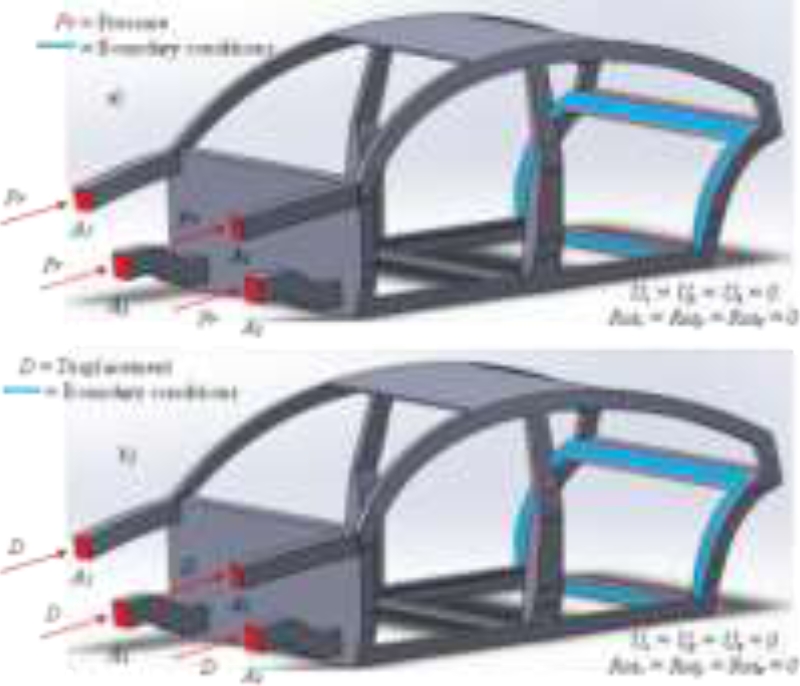
In both cases of study, the evaluation was performed to identify the worst scenery by identifying the effect of the external agent. So, two scenarios were performed, the first one by applying pressure and secondly by applying a proposed displacement.
The boundary conditions were applied at the rear of the monocoque to provide the best response against the impact of the vehicle and the most realistic one. The calculated load was a punctual load that must be converted to pressure and applied to the front areas of the structures (A1 and A2) of the monocoque.
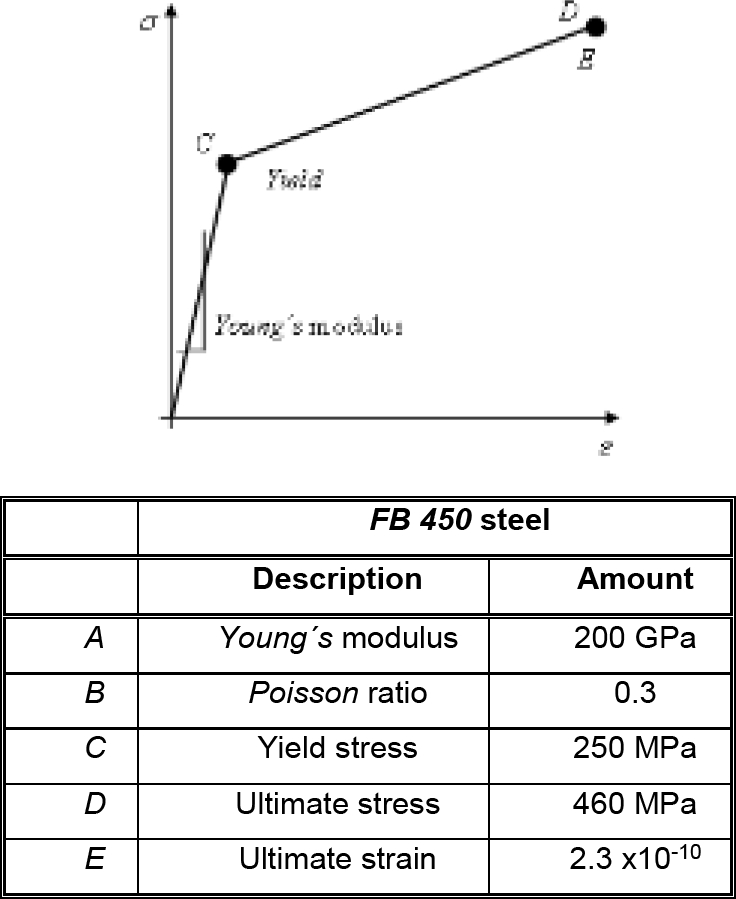
The pressures to be applied were, for area A1 a pressure of 8 565 718 N/m2 and for A2 a pressure of 7 031 250 N/m2. The displacement equivalent for the impact test was 130 mm. The monocoque is designed and manufactured from a FB 450 steel [ and 33]. For the numerical simulation the material behaviour will be considered bilinear and with a kinematic hardening rule performance (Figure 4) [34]:
For both cases, it was applied a commercial computational program with a Finite Element Method algorithm named ANSYS® Workbench. The analyses were static-structural. The program stipulates that the analysis will be non-linear, homogeneous, and continuous, with a kinematic hardening rule. Subsequently, the model was freely discretized with high-order 3D solid elements.
The discretization performed on the model has a size of 2.8 mm2 per element (62 151 nodes and 30 842 elements). Additionally, even when the unloading process is not applied, to predict better plastic stress-strain ratio, a general material model consisting of a non-linear kinematic hardening and isotropic hardening components is applied into the numerical simulation (Equations 2 and 3) [34]:
In equations,
Equation 2 describes the translation of the yield surface in the stress space due to the back-stress,
But then again, in a general manner, the stress-strain relation is given by the Ramberg-Osgood relation [35] and is applied in numerical analysis by the commercial computer program of Finite Element Method.
The next equation describes the relation between the stress and total strain [36]:
where σ represents the stress effect into the material, εT, εe and εp, indicate the total, elastic, and plastic strain, respectively and are considered separately, E is the elastic modulus, H signifies the ultimate constant value of the plastic performance and characterize the strain hardening behavior. Even when the algorithmic formulation can describe cyclic behavior, in this research it is only applied to represent the entire elastic and plastic behavior of the material.
4 First Case of Study Results (Original Monocoque)
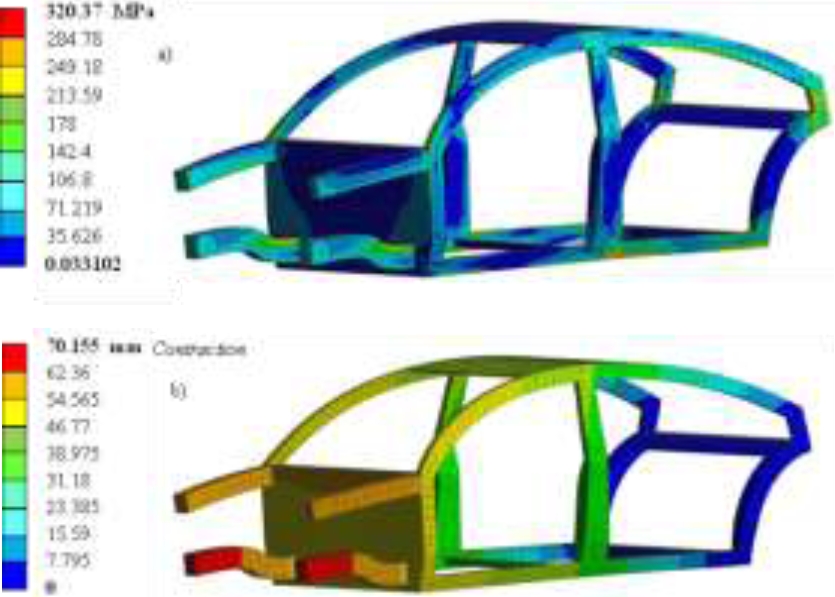
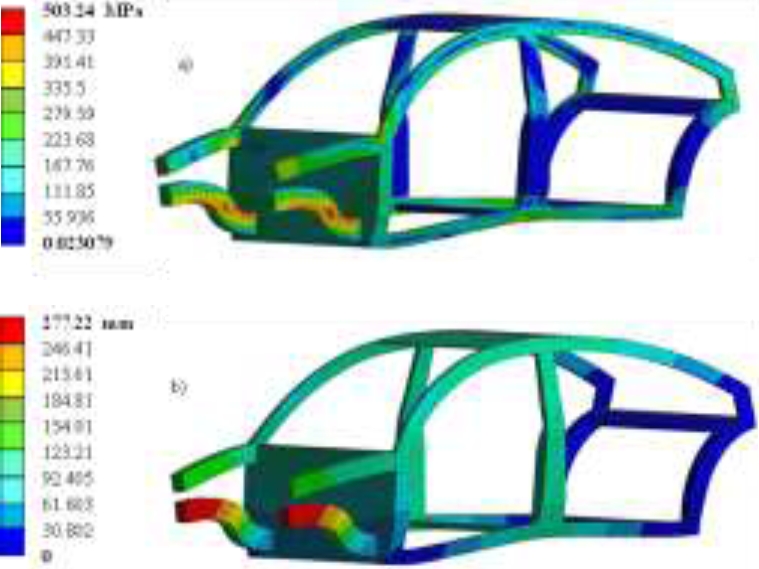
To minimize the length of this presentation, for both cases there are only presented the results concerning the general Von Mises stress as well as the global displacement of the monocoque, taking into consideration the applied pressure and displacement respectively. Furthermore, in this section it will be presented a table to summarize all the results.
4.1 1st Numerical Analysis of the Actual Monocoque by Pressurizing the System
For a load of 22.5 kN that has been transformed to pressure, the results can be observed in Figure 5, for general Von Mises stress and global displacement respectively.
4.2 1st Numerical Analysis of the Actual Monocoque by Displacement into the System
In this section an application of a 130 mm displacement at the front of the monocoque is evaluated and results can be seen in Figure 6, for both the general Von Mises stress and the global displacement respectively.
5 Second Case of Study Results (Optimized Monocoque)
Following up on the model that has been worked on, some adjustments were made to the front part of the monocoque, by means of the criteria of optimization of shape. Taking into consideration the results from the previous numerical analysis, modifications to the front frames and the fire wall were consolidated (Figure 7).
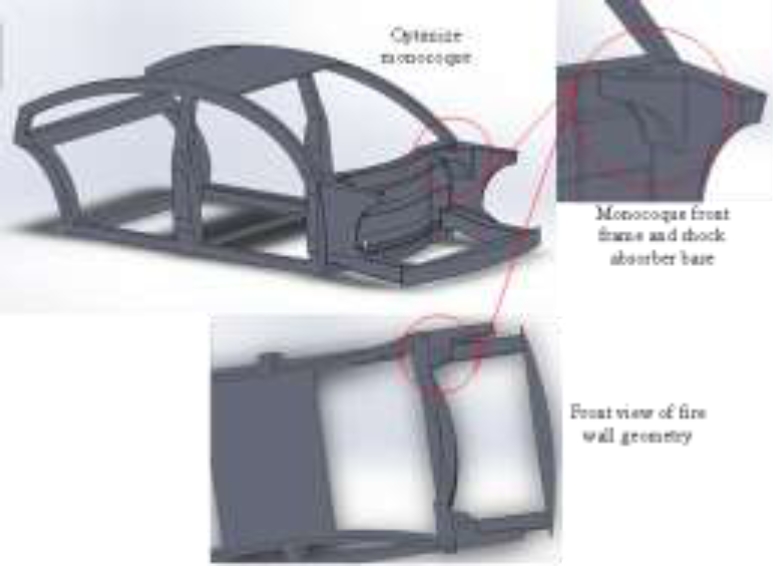
For the new optimized design, the frames are construct by a hollow shape, so that the deformation and displacement occur in the form of an accordion. The form of the fire wall is aimed to dissipate the energy produced by the impact of the engine, to avoid penetration into the passenger compartment.
It is important to mention that, for this analysis, elements such as the steel core or bumpers and the shock absorber bases are considered, as well as elements of utmost importance when dissipating the energy produced by a frontal impact.
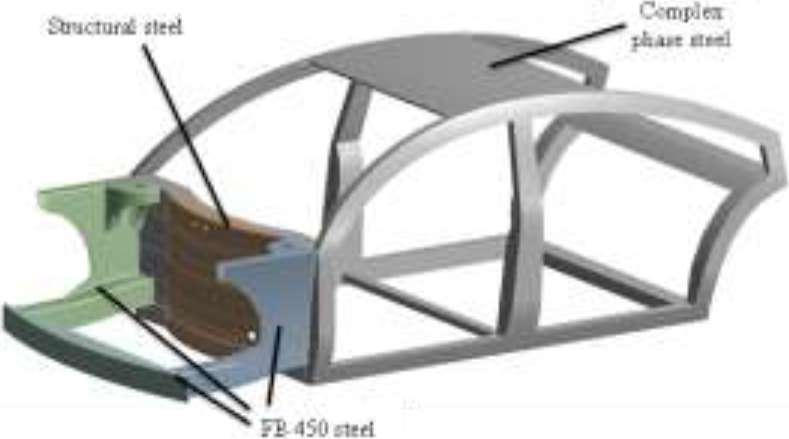
Additionally, for the optimization of the monocoque, different types of steels were used in different sections of the structure. These steels, for automotive practice, are high resistance steels, which are used as follows [37]:
– Structural steel. - It is a first-generation conventional steel, with resistance between 210-550 MPa and low ductility. Within this category are mild and mild steels. They are used in some body parts, closures, and auxiliary parts.
– FB Steel. - This type of high resistance steel has a ferrite and bainite microstructure. The 450/600 grade is widely used in bumpers, rim parts, chassis parts.
– Complex phase steel. - They have a matrix of ferrite and bainite. In addition to having smaller amounts of martensite, retained austenite and perlite. They have a high resistance to deformation, a characteristic that makes them excellent for application in the passenger compartment, luggage compartments and reinforcements.
The mechanical properties of the different steels to be used are shown in the following table. Bilinear elastoplastic performance of the materials is considered, as illustrated in Figure 4.
Table 1 Divers mechanical properties applied into the monocoque optimization model
| Entity | Structural steel | FB 450/600 steel | Complex phase steel |
| Elastic modulus | 200 GPa | 200 GPa | 205 GPa |
| Poisson ratio | 0.3 | 0.3 | 0.3 |
| Tensile yield stress | 250 MPa | 450 MPa | 570 MPa |
| Ultimate stress | 460 MPa | 600 MPa | 900 MPa |
| Ultimate strain | 2.3 x10⁻¹⁰ | 3 x 10⁻³ | 4.39 x 10⁻³ |
The monocoque is only modified at the front part and left without any change the rear of the monocoque. The different types of steels applied into the optimization of the monocoque is shown in Figure 8.
In Figure 9, are presented the manner the external agents and boundary conditions are applied into the new model. For the first case, it is applied a punctual force with a value of 22.5 kN and for the second case a displacement of 130 mm. The analyses were static-structural.
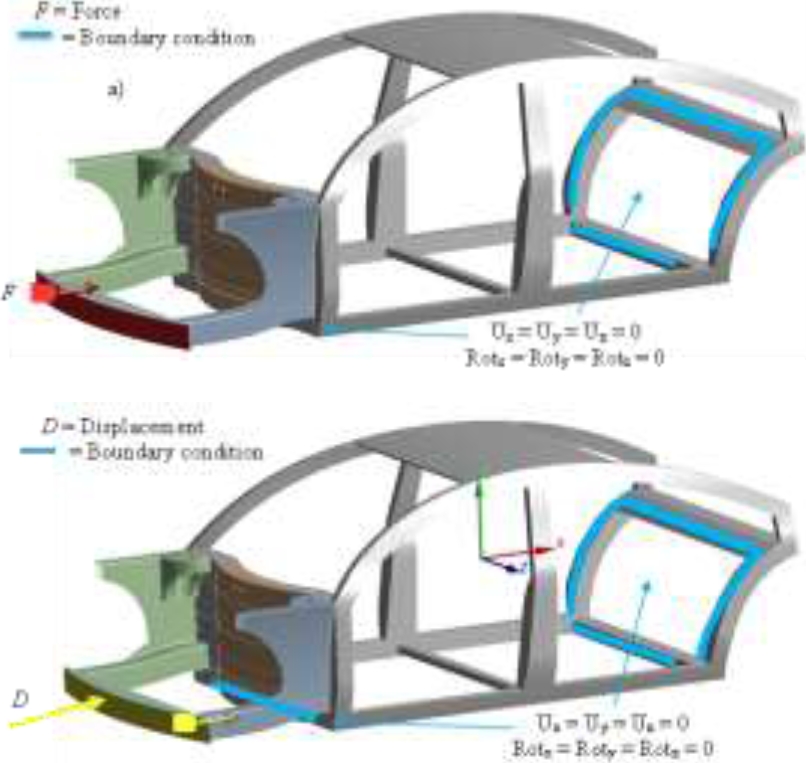
The program stipulates that the analysis will be non-linear, homogeneous, and continuous, with a kinematic hardening rule. Subsequently, the model was freely discretized with high-order 3D solid elements. The discretization performed on the model has a size of 1.95 x 10⁻³ mm2 per element (76 713 nodes y 37 447 elements).
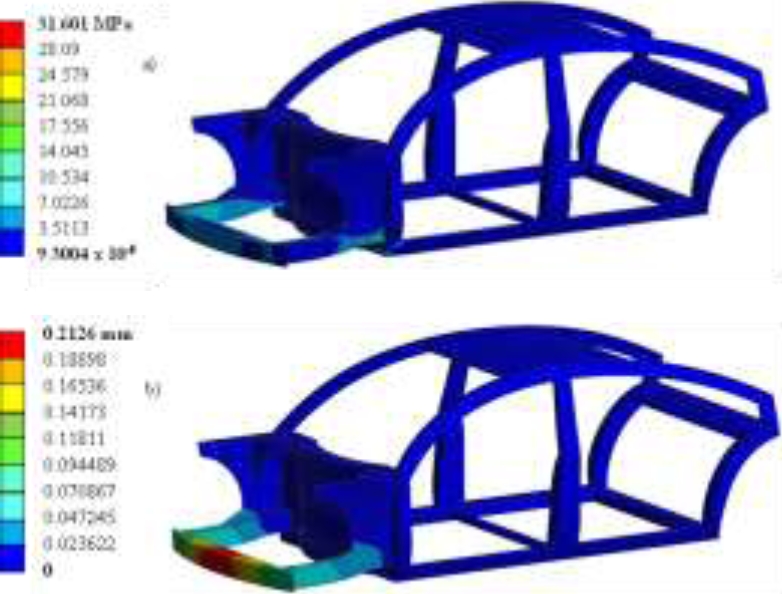
5.1 2nd Numerical Analysis of the Optimize Monocoque by Loading the System
For a load of 22.5 kN the results can be observed in Figure 10, for general Von Mises stress and global displacement respectively.
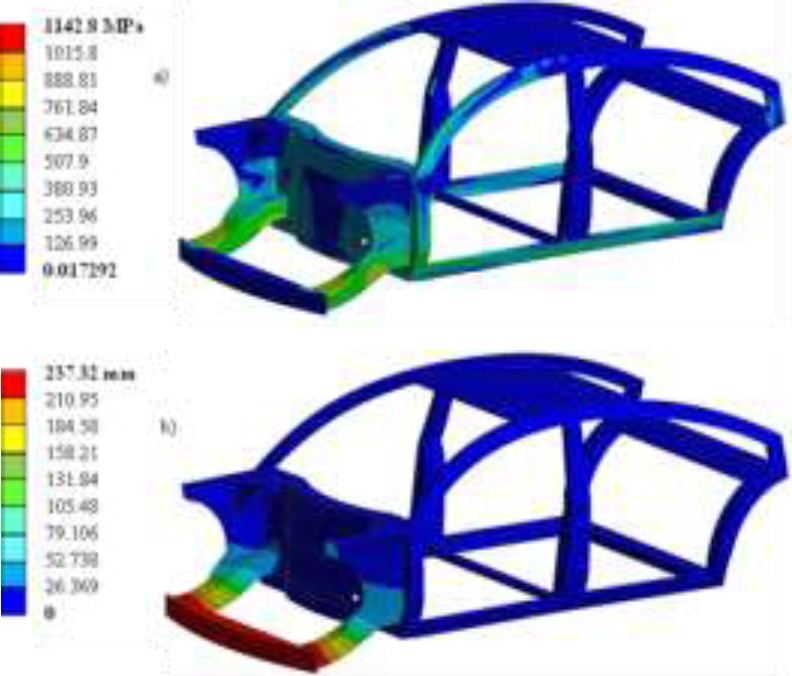
5.2 2nd Numerical Analysis of the Optimize Monocoque by Displacement into the System
In this section an application of a 130 mm at the front of the optimized monocoque and results can be seen in Figure 11, for general Von Mises stress and global displacement respectively.
6 Discussions and Conclusions
Although further improvements are still possible, these increasingly minor improvements are only to be obtained with a high effort and substantial resources. As a result, the key question must always be their efficacy in an accident situation. If reliable information is available on the imminent collision, measures taken in the pre-collision phase can, as a rule, frequently exert a significantly greater influence on the accident situation. Preventive measures are the key to success here.
To have conditions closer to reality, the next step will be to be able to simulate the joints or welding points of the material, as well as new cements or glues that are already used by some automobile brands.
The high cost of crash tests means that developers have to resort to other tools, such as the MEF, where they can not only simulate the behaviour of an impact, but also be able to apply various materials to launch a better proposal to the market.
Passive safety in a vehicle has been a matter of great importance in this industry, because in addition to offering good benefits in terms of engine, consumption, and comfort, it must have as its main goal the safety of the occupants in a situation of risk.
Table 2 Results comparison for both cases of study
| Actual monocoque | Optimize monocoque | |||||||
| Pressure | Displacement | Load | Displacement | |||||
| Min | Max | Min | Max | Min | Max | Min | Max | |
| Von Mises stress (MPa) | 0.0 | 320.37 | 0.023 | 503.24 | 0.0 | 31.601 | 0.0 | 1142.8 |
| Nominal x stress (MPa) | -298.33 | 360.57 | -633.91 | 418.01 | -34.1 | 11.356 | -1348 | 1224.1 |
| Nominal y stress (MPa) | -376.77 | 440.42 | -432.55 | 609.27 | -9.12 | 8.3858 | -1097.1 | 1295.5 |
| Nominal z stress (MPa) | -219.35 | 260.38 | -423.95 | 377.5 | -8.42 | 7.7847 | -1106.7 | 924.93 |
| Shear stress max (MPa) | 0.02 | 176.33 | 0.013 | 286.35 | 5 x10⁻⁵ | 17.009 | 0.0 | 620.23 |
| Shear stress, XY plane (MPa) | -127.83 | 120.83 | -190.3 | 166.09 | -6.1 | 8.3606 | -330.94 | 367.41 |
| Shear stress, YZ plane (MPa) | -151.25 | 138.42 | -152.91 | 152.58 | -6.41 | 6.4438 | -304.36 | 299.23 |
| Shear stress, XZ plane (MPa) | -127.2 | 155.15 | -162.08 | 161.82 | -7.43 | 7.9891 | -282.55 | 282.23 |
| Total displacement (mm) | 0.0 | 70.155 | 0.0 | 277.22 | 0.0 | 0.2126 | 0 | 237.32 |
| Displacement, x axis (mm) | -2.68 | 16.696 | -3.4814 | 133.43 | -0.009 | 0.196 | -9.3549 | 130.91 |
| Displacement, y axis (mm) | -1.28 | 69.897 | -4.6482 | 244.82 | -0.085 | 0.0114 | -198.48 | 10.795 |
| Displacement, z axis (mm) | -2.65 | 2.7551 | -76.017 | 80.379 | -0.03 | 0.033 | -24.861 | 15.407 |
| Total strain (mm/mm) | 4 x 10⁻⁷ | 0.025 | 3 x 10⁻⁷ | 0.185 | 1.2 x 10⁻⁹ | 0.00016 | 1 x 10⁻⁷ | 0.41 |
Nevertheless, the evaluation of the effectiveness of the automotive structure is too expensive for producers, this is because destructive impact tests are carried out on vehicles and for each car tested, the number of vehicles for the different phases of the Crash Test are considerable and too expensive. It is for this reason, that this research work is directed to the numerical simulation evaluation of a vehicle impacted frontally.
Additionally, it is proposed to change the geometry on the front part of the monocoque to obtain a better result than provide greater safety to occupants during frontal collision. For the first analysis carried out in this work, a basic structure of a compact car was taken into consideration.
Additionally, the material applied was a conventional steel and the movement against impact was only considered at the rear end of the car, in such a way that the material moves backwards as it happens in the crash impact.
Once the results of this numerical analysis are obtained, the similarity of results based on the reference frame taken from the NCAP shows that it is close to what is happening. In the second analysis, alloys and new generations of high resistance steels are considered to form the interior, frames and even the soul of the vehicle is considered (a piece in charge of first absorbing the force caused by a collision).
Also, it is considered a second boundary condition in the lower part of the fire wall, this to simulate the effect of the tires that act exerting a counter reaction and upwards of the impact force, which will make the simulation result closer to reality.
The results of the second numerical analysis, in terms of the total displacement of the material in the structure, suggest that the structure is safer compared to that of the first analysis, which translates into the percentage of victims who remain pressed or lose their lives it can be reduced only with topological optimization.
To give continuity to this work, it is of great importance to carry out the simulation including the elements such as engine, transmission, suspension components and steering, and in conclusion, to consider as many parts as the hood, fascia, doors, this will make the analysis have more validity and structural evaluation costs will decrease considerably.
Subsequently, the joining methods of the structural components such as cements, rivets or welds can be considered, and lastly, the implementation of the model of a dummy to the analysis will also allow analysing the pattern of injuries that may arise as it is carried out by NCAP.

