




 nueva página del texto (beta)
 Inglés (pdf)
 Artículo en XML
 Referencias del artículo
 Traducción automática
 Enviar artículo por email
 Citado por SciELO
  Similares en
SciELO
Similares en
SciELO 
 Permalink
1 Introduction
Industry 4.0 is becoming more and more popular as smart devices and Internet of Things (IoT) technologies proliferate. By merging the current manufacturing system with the industry technology system, this new paradigm aims to improve the production system [17]. Industry 4.0 gives birth to various technologies, such as the Internet of Robotic Things (IoRT). It combines IoT and robotics into one technology, which is called the IoRT. ABI Research [29] came up with the idea of the IoRT, which defines it as a collection of intelligent, disparate devices that can manage events and massive amounts of data.
Numerous researchers aim to leverage IoRT paradigm to incorporate it into other domains (e.g., Business Process (BP), etc.). Integrating IoRT technology into the traditional BP creates the IoRT-aware BP generation [4], which strives to increase productivity, automate operations, etc. However, executing an IoRT-aware BP within the organization could be expensive due to the energy and resources consumed, among others. To bridge these gaps, the Business Process Outsourcing strategy (BPO) remains the best solution by executing some parts of the entire process outside the enterprise [10].
Numerous environments can be considered to perform process outsourcing, for instance, the Cloud and Fog. The Cloud is defined as hardware resources and software services available on the internet [32]. It has a large storage capacity compared to other surroundings [1]. Furthermore, it enables businesses to increase their services in response to client demand gradually.
Using the Cloud during the execution of IoRT-aware BPs allows the business managers to meet their process’s computational and availability requirements. Despite its benefits, the Cloud fails to support sensitive applications due to the distance between the user devices and the Cloud data center. Therefore, the Fog environment appeared.
It is a paradigm that brings computational resources and services to the network edge near user devices, lowering latency and connecting with Cloud resources [2]. It is characterized by its ability to perform latency-sensitive applications regarding its proximity to the user’s devices (e.g., IoT, robots, etc.).
To achieve the outsourcing of an IoRT-aware BP into Cloud and Fog environments, a business manager should allocate the appropriate resources of (
It must match the demand of the instances of processes running with the resources available for a specific business objective (e.g., minimizing process cost, maximizing process availability, etc.) [28]. Thus, the RA will allow the business managers to ensure the effectiveness of their processes. Additionally, it enables businesses to increase production, realize an equitable distribution of responsibilities, and decrease the need for human intervention.
Back to the literature, several approaches addressed RA for the business process. In general, these approaches focus on the Cloud resources [11], or Fog ones [19, 31]. However, considering both environments enables business managers to take advantage of both. Furthermore, most of these approaches deal with process cost [23, 25, 22] and execution time [15, 12].
Nonetheless, reducing the energy consumption within the enterprise and reducing latency can improve the selection of resources. Furthermore, diverse algorithms were applied for supporting RA in the BPs field, including exact approaches [11], meta-heuristic methods (e.g., [12]), and machine learning [3]. However, these algorithms demonstrate serious overhead and the need for more accuracy in their evaluation.
Therefore, to close the gaps in the literature-based RA approach, we take advantage of Reinforcement Learning (RL) as an Artificial Intelligence (AI) algorithm to perform resource allocation with less overhead and scattered errors [19]. We aim through this paper to propose a Reinforcement Learning-based approach for the Fog and/or Cloud RA to achieve an optimal execution of the IoRT-aware BP. Our proposal aims to satisfy a set of different RA goals. Therefore, it intends to minimize the RA cost and reduce the energy consumed.
In addition, our proposal intends to reduce the execution time and the latency value. To accomplish these objectives, we extended the ifogSim tool to estimate the execution cost, consumed energy, execution time, and latency of an IoRT-aware BP using Fog and Cloud resources. The obtained results are promising. Furthermore, compared to other RA methodologies, the experimental results prove the efficacy of the proposed RL-based RA approach by offering a significant benefit in optimizing RA performance. The remainder of this paper is structured as follows. Section 2 presents a background that briefly describes the IoRT-aware BP and RL algorithm. Section 3 overviews the recently published approaches that deal with the RA question. Section 4 details the proposed reinforcement learning-based approach for RA to ensure the adequate execution of an IoRT-aware BP. The evaluation and discussion of the proposed approach are presented in Section 5. Finally, Section 6 summarizes our work and highlights its future directions.
2 Background
This section presents some relevant concepts to ensure the execution of an IoRT-aware BP using suppliers’ resources. In this setting, we intend to give an overview of an IoRT-aware BP. Then, we present a brief description of the RL algorithm.
2.1 IoRT-aware Business Process
In recent years, the fourth industrial revolution has led to the development of several new technologies, such as the Internet of Robotic Things (IoRT). The IoRT is defined as the improvement of the Internet of Things (IoT) itself, where robotic technology has been embedded in IoT, Cloud, and Networking [18]. The IoRT is characterized by heterogeneous advantages that make it among the most attractive technologies.
In [29], the authors classified the IoRT abilities into four main categories: basic, high-level, interaction, and system-level abilities.
Among the basic IoRT abilities, we note that it has a broader horizon in time, space, and information type regarding the integrated sensors within the devices.
Moreover, the robots’ ability to move independently is considered one of the basic IoRT advantages. In the IoRT higher-level abilities setting, we denote the capacity of the robot devices to automatically make the right decisions and distinguish the best course to meet its missions.
Furthermore, robot devices use AI techniques to improve their decisions. In the robot interaction ability context, the robots are characterized by their ability to interact with users and other systems. Besides, regarding their experience and reasoning information, the robots ensure communication between themselves, things, and their environment.
Nonetheless, in the system-level abilities setting, we cite its capability to be customized and configured for particular tasks. Regarding the advantages mentioned above, the IoRT technology sweeps several fields, for instance, agriculture, health, etc.
In this setting, business managers seek to benefit from this technology to automate their processes. Therefore, several researchers seek to integrate the IoRT technology within the BP; we cite among them [27], where the authors define the integration of the IoRT within the BP as the automation of the BP to resolve a complicated situation.
Moreover, in [21], authors the integration as a form of enterprise digitization through the automation of its process tasks. According to [4], integrating the IoRT within the BP gives the newest process generation called IoRT-aware Business Process.
The latter aims to automate the classic BP, where robots and IoT devices are used to perform process tasks rather than humans. Therefore, the automation of process tasks allows firms to eliminate the burden of human errors, speed up their production, improve their productivity, etc. Furthermore, embedding the IoRT technology within the classic process allows enterprises to reduce costs and eliminate the burden of recruiting employers.
2.2 Reinforcement Learning
Reinforcement Learning (RL) is an AI model that allows algorithms to learn from their trials and errors. Intending to understand how the algorithm makes the right decision, the RL has been confronted with a set of decisions [30].
Therefore, whether it has taken the wrong decision, it is penalized, while, in the case that the right decision is taken, the algorithm gains a reward. The problems in the RL are frequently formulated as a Markov Decision Process (MDP). The MDP is defined as a mathematical framework for solving decision-making problems [33].
It is used to present the environment model and dynamicity [14] (see Figure 1). The MDP model usually has a transition function to transform the environment from one state to another after applying an action using an agent. According to [33], the RL has five main components which are detailed in what follows:
–
–
–
–
–
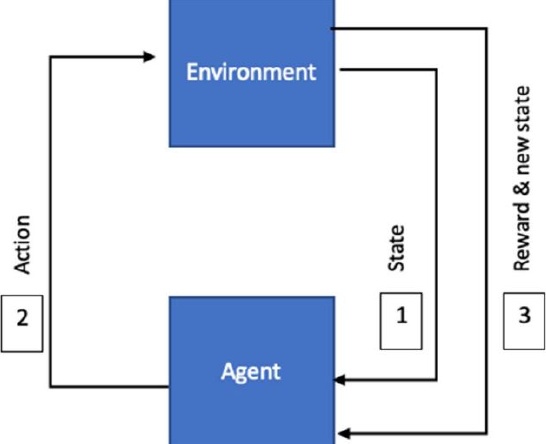
There are two main types of reinforcement models:
– Model-free: Means that the model is based on optimal policies and value functions of the obtained data regarding the agent’s interaction with the environment. For the model-free, the agent learns with trial and error from experiencing explicit [33].
– Model-based: Refers to learning optimal behavior from a model of the environment, taking actions, and observing the outcomes that include the next state and the immediate reward. The policy of a model-based can be discovered using various planning techniques [33].
In our work, we deal with the model-free as it does not require a model from the environment to make its decisions compared to the model-based.
In fact, the model-free is characterized by its simple implementation compared to the model-based that requires a lot of memory and computation.
Moreover, the model-free learns more quickly as it does not require a large amount of data to learn an optimal policy.
3 Related Work
In this section, we provide an overview of some recently published approaches that deal with the RA for a BP. These approaches are examined while relying on a set of relevant criteria, which are listed below:
– Business Type: This criterion lets us pinpoint the process type that is used to ensure its execution through the allocation of internal and external resources. Two types of process are addressed: a classic BP where its tasks are achieved by the human. However, an automated process gives the process that embeds one or more technologies.
– Granularity: It identifies the processing granularity used in RA. It may be a process or a sub-process that contains one or more tasks.
– Used resources: Numerous resources can be addressed to ensure the process’s execution. During this work, we are interested in the Cloud and Fog resources. In fact, the Cloud resources are considered regarding their storage and processing capacities. Nonetheless, Fog ones are selected regarding their closer to the end devices for instance, sensors, cameras, and so on.
– Used algorithm: It identifies the algorithms used to accomplish the RA goal. Referring to the literature, the RA problem can be solved using mainly exact methods, heuristic algorithms, and meta-heuristic algorithms. Moreover, numerous approaches address the RA using artificial intelligence (AI) algorithms.
-
– Used parameters: This criterion consists of a set of heterogeneous parameters that are considered to perform the RA decision. Our extensive literature review identified the consumed energy, cost, latency, and execution time as critical RA criteria. The energy criterion depicts the amount of consumed energy to perform such task. The cost specifies the fee that must be paid to accomplish a task using such a resource. The latency is among the criteria corresponding to the needed time to transfer data from the task to the used resource.
– RA support: Identifies whether the studied approaches deal with automatic or semi-automatic RA. It distinguishes approaches that refer to systems or processes to allocate resources without human intervention.
– Workflow patterns: Shows the dependency execution between the process tasks. Back to the literature, numerous patterns exist in the BP area, for instance, sequential flow, parallel split, etc. This criterion identifies which approaches consider workflow patterns between tasks during the RA.
– Simulation tool: Simulation is among the techniques that allow business designers to represent reality and generate hypothetical process instances. Different simulation tools have been developed in the literature to support the BP execution (e.g., ifogSim, CloudSim, etc.).
This criterion distinguishes the most considered simulation tool.
Tables 1 and 2 classify the studied approaches regarding the selected criteria. Referring to table 1, we remark that most of the recent approaches, for instance, [35], [15], [12], [11], [23], [7], and [20] address the RA for the classic BP. To our knowledge, no work has been proposed for allocating resources to accomplish IoRT-aware BP execution.
Table 1 Comparison of a set of RA-based approaches regarding the identified criteria (part 1)
| Year | Paper | BP Type | Resource Type | Used Algorithm | ||||
| Fog | Cloud | Exact | Heuristic | meta-heuristic | RL | |||
| 2021 | Classic BP | - | - | - | - | - | - | |
| 2022 | Classic BP | - | - | - | x | - | - | |
| 2022 | Classic BP | - | - | - | - | x | - | |
| 2021 | Classic BP | - | x | - | - | |||
| 2022 | Classic BP | - | - | - | - | - | x | |
| 2021 | IoT-aware BP | x | x | - | - | - | - | |
| 2020 | Classic BP | - | - | - | - | - | x | |
| 2020 | Classic BP | - | - | - | - | - | x | |
| 2020 | - | - | x | - | - | - | - | |
| 2022 | - | x | - | - | - | - | - | |
| 2024 | Classic BP | - | - | x | - | - | - | |
| 2024 | - | - | - | - | - | - | - | |
| 2024 | Classic BP | - | x | - | x | - | - | |
| 2022 | - | - | x | - | - | - | - | |
Table 2 Comparison of a set of RA-based approaches regarding the identified criteria (part 2)
| Paper | Used criteria | Simulation tool | RL support | Workflow patterns | Granularity | |||
| Cost | Energy | Execution time | Latency | |||||
| - | - | - | - | Simulation engine | semi-automatic | - | task | |
| - | - | x | - | TypeScript and MongoDB | automatic | x | task | |
| - | - | x | - | GRINGO 5.5.0, I-DLV 1.1.6 | automatic | x | task | |
| x | - | - | - | CloudSim | automatic | x | task | |
| x | - | - | - | Apromore | semi-automatic | - | task | |
| x | - | x | - | - | automatic | x | task | |
| x | - | - | - | - | automatic | - | task | |
| x | - | - | - | - | automatic | - | task | |
| - | x | - | - | - | automatic | - | task | |
| - | - | - | x | ifogSim | automatic | - | task | |
| x | - | x | - | Prosimos | automatic | x | task | |
| - | - | - | - | - | automatic | - | task | |
| x | x | - | - | - | automatic | - | task | |
| - | x | x | - | Cloudsim | automated | - | task | |
Moreover, from the same table, we note that some of the studied approaches, for instance, [11] deal with the Cloud resources for process execution. However, we noticed a lack of approaches that used both Cloud and Fog resources to execute the process. Furthermore, according to table 1, we denote that few works cope with the AI algorithms to support the RA. Indeed, AI has become fundamentally ingrained within numerous fields, for instance, the BP, and so on.
Referring to table 2, we note that most of the existing approaches (e.g., [12], [25], and [22]) deal with cost as a primary criterion to select the appropriate resources. Nevertheless, several other criteria can impact the selection of adequate resources. Therefore, the resource’s energy consumption can be tackled for the RA decision, where the business manager always seeks to execute their process using resources that consume less energy. Additionally, the execution time is among the relevant criteria that can impact the RA decision, where the business managers attempt to gain time by using resources that require less time to execute their processes. Furthermore, the latency can be considered when identifying suitable resources.
Our literature study points out that several approaches (e.g., [23, 16, 25, 22]) ignore the process workflow during the RA decision-making. However, to ensure the correct process execution, it seems crucial to capture dependency between its tasks. In the same setting, we outlined from our literature review that different methods address the RA decision using process task, such as [35, 15, 12, 11, 23, 16, 25, 22] rather than the sub-process.
However, addressing resource allocation for a sub-process ensures the preservation of task workflow integrity. To bridge the distinguished RA gaps, we introduce an innovative AI-based RA methodology to proficiently execute an IoRT-aware BP leveraging Cloud and Fog resources. Our proposed approach tackles the IoRT-aware BP by dividing it into Single Entry Single Exit (SESE) fragments, which are blocks comprising one or more tasks.
Moreover, it manages process workflow to uphold task dependency execution integrity. This methodology is rooted in Reinforcement Learning (RL), capitalizing on its advantages to optimize performance and adaptability. The proposed approach defines several goals including reducing the RA cost, consumed energy, execution time, and latency.
4 Reinforcement Learning Based Resource Allocation Approach
Achieving an optimal RA using hand-coded heuristics and fixed strategies is difficult due to the heterogeneity of processes and resource requirements. In this research work, we design and implement a decision-making approach based on an artificial intelligence algorithm to accomplish the selection of adequate Fog and Cloud resources.
The proposed approach is called Reinforcement Learning-based Fog and Cloud Resource Allocation, which is referred to as (RL-FCRA). Figure 2 illustrates an overview of the suggested RL-FCRA.
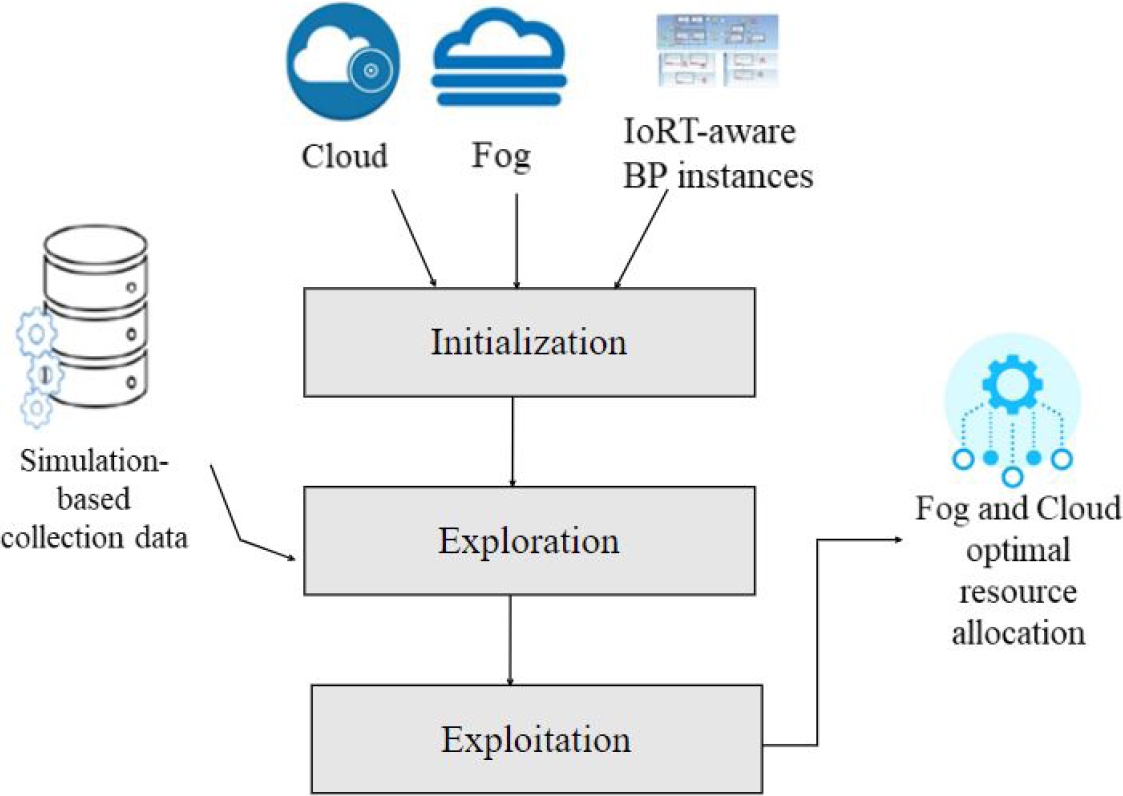
It is based on the RL algorithm, and it has several advantages that have proven worthwhile in the RA field. It does not require a large data set compared to the other AI algorithms. Furthermore, RL does not require training as it can automatically adapt to new environments.
In this work, we adopted Q-learning as an RL model-free algorithm. It handles issues with stochastic transitions and reward values. In the following, we describe the proposed approach steps.
4.1 Initialization
Initialization refers to setting the initial values of the model parameters before it is trained. In the RL setting, the initialization phase can have a relevant impact on the algorithm’s performance.
The initial values of the algorithm parameters can determine how the algorithm achieves its goals and who can handle the newest situations. Our proposal has as input an IoRT-aware BP divided into a set of SESE fragments. Each fragment includes one or more tasks.
The SESE tasks have to be executed using the Fog and/ or Cloud resources, where each resource has its initialized parameter values of cost, energy, execution time, and latency. To initialize the criteria mentioned above, for each resource, we propose to simulate the IoRT-aware BPs execution using a simulation tool.
Simulation is among the techniques that allow business designers to represent reality in a clarified manner and generate hypothetical process instances. In the literature, various simulator tools with different objectives are developed.
According to our literature exercise, we revealed that ifogSim [9] is among the most used tools for the simulation of Fog and Cloud environments. It is an open-source, java-based tool that allows easy modeling of Fog and Cloud [9].
Moreover, it enables the simulation of the process execution using Fog/ Cloud resources under different scenarios and conditions [9]. In the following, we briefly describe the considered criteria and how to estimate their values:
-
– Cost: Reducing expenses stands out as one of the compelling incentives driving enterprises to leverage external providers’ resources, including services, platforms, and infrastructures, for executing their processes. According to the authors in [8], the use of external resources for process execution is primarily guided by overhead expenses, with careful consideration given to both the processes and resources to gauge potential cost savings.
– Energy: Depicts the energy consumed to perform the execution of process fragments using Fog and/ or Cloud resources. The execution of an IoRT-aware BP within the enterprise can be costly in consuming energy regarding the used devices and equipped resources. Consequently, business managers aim to achieve the execution of their processes with less energy consumption using external resources. To estimate the consumed energy of the Fog or Cloud resource to perform a process task, we propose equation 2, where the CE represents the current energy consumed by the resource and T gives the current time:
– Execution_Time: Saving time is among the significant factors encouraging enterprises to execute their processes using external suppliers’ resources. These latter ones allow business managers to speed up the execution of their process where these resources replace human intervention. To estimate the execution time of a process fragment on a Fog or a Cloud resource, we propose the equation 3, where
-
– Latency: The required time to transfer data from the process task to such resource aligns with the concept of latency. This makes it a crucial criterion for performing the IoRT-aware BP execution.
Given that IoRT involves tasks encompassing both IoT and robotics, which can be particularly sensitive to latency, it is imperative to include latency as a key consideration.
To gauge the latency value for a process task on a Fog or Cloud resource, we consider equation 4, where
4.2 Exploration
In the RL, exploration involves trying different actions to discover which ones lead to the best reward. It is considered one of the relevant RL phases, allowing the agent to achieve their goals with the best reward.
We model the RA problem using the MDP which is considered the most popular mathematical framework for solving RL problems. The MDP defines the tuple {S, A, P, R}, where:
– S: Presents the environment states. In our work, we deal with tasks of the SESE fragments as a set of environment states (see equation 5):
– A: Depicts the actions that can be applied to the environment. In our work, we deal with selecting the resource as an action. Consequently, we can perform the selection of a Fog resource (see equation 6) and/ or Cloud resource (see equation 7):
-
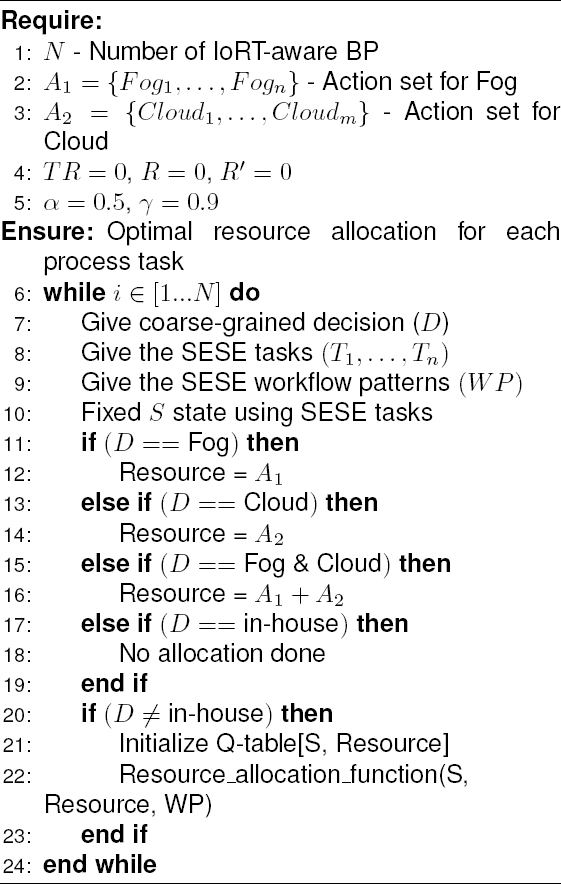
– P: Sets forward the policy that is considered for an RL algorithm. To achieve the Fog and Cloud RA goal, we propose our policy that allows the agent to receive an SESE coarse-grained decision
If the decision
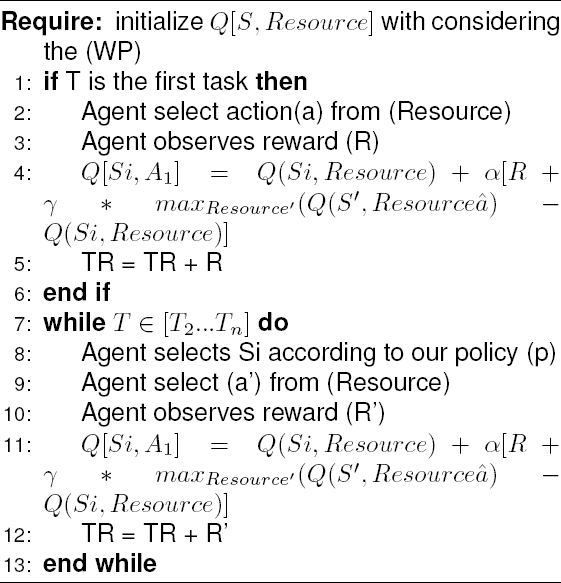
After identifying the set of resources, the agent initializes its Q-table values and applies algorithm 2 to both update the Q-table and select the appropriate resource. Based on algorithm 2, the agent selects the first task for each SESE and distinguishes the adequate resource according to the estimated reward
Hence, it is relevant to note that to achieve the RA goal, the agent takes into account the workflow patterns between tasks. As required by the process’s functional requirements, workflow patterns give the execution dependencies of the process tasks. During this work, We rely on the de facto BPMN standard [24] to consider the process workflow patterns (e.g., sequence, parallel, loop, etc.). After each iteration, the agent updates the Q-table values. The job repeats until the number of episodes (processes) is reached (see algorithm 1).
– R: Gives the reward function of the proposed RL-FCRA. Our proposed reward function (see equation 8) relies on the cost
4.3 Exploitation
Exploitation is among the proposed RL-based RA approach. It involves leveraging accumulated knowledge to make optimal decisions. In the proposed RL-FCRA, the goal refers to make a decision based on the identified policy to minimize the cumulative reward through the reduction of the cost, energy, execution time and latency values.
In algorithm 1, we detail the RL-FCRA based on Q-learning, as a RL algorithm. This approach has as input a set of IoRT-aware BPs modeled using the plug-in presented in [5]. We have divided each IoRT-aware BP into a set of Single Entry Single Exit (SESE) fragments to perform the RA goal using the Refined Process Structure Tree technique (RPST). Each SESE defines its workflow patterns between tasks (e.g., sequence, parallel, split, etc.).
Moreover, the proposed RL-FCRA has as input a set of Fog resources
5 Evaluations and Discussion
The goals of our experimental evaluations are two-fold:
– Examine the scalability of the RL-based RA approach concerning the number of (i) SESE, (ii) IoRT-aware BPs (episodes), and (iii) Fog/ Cloud resources.
– Estimate the cost, consumed energy, response time, and latency compared to other commonly RA approaches.
To conduct these experiments, we implemented the suggested approach using the Eclipse tool. It is defined as a free and Java-based development platform that allows developers to implement systems and applications within different fields.
In our experiments, we considered a dataset of IoRT-aware BPs in the agriculture field. These processes were defined in the frame of the PRECIMED project [26] and are developed under the Eclipse Modeling Framework (EMF) using the extended BPMN 2.0 modeler plug-in.
In Figure 3, we give an example of the developed IoRT-aware BPs, where this process presents a smart irrigation management system that aims to boost water-use efficiency and nutrients.
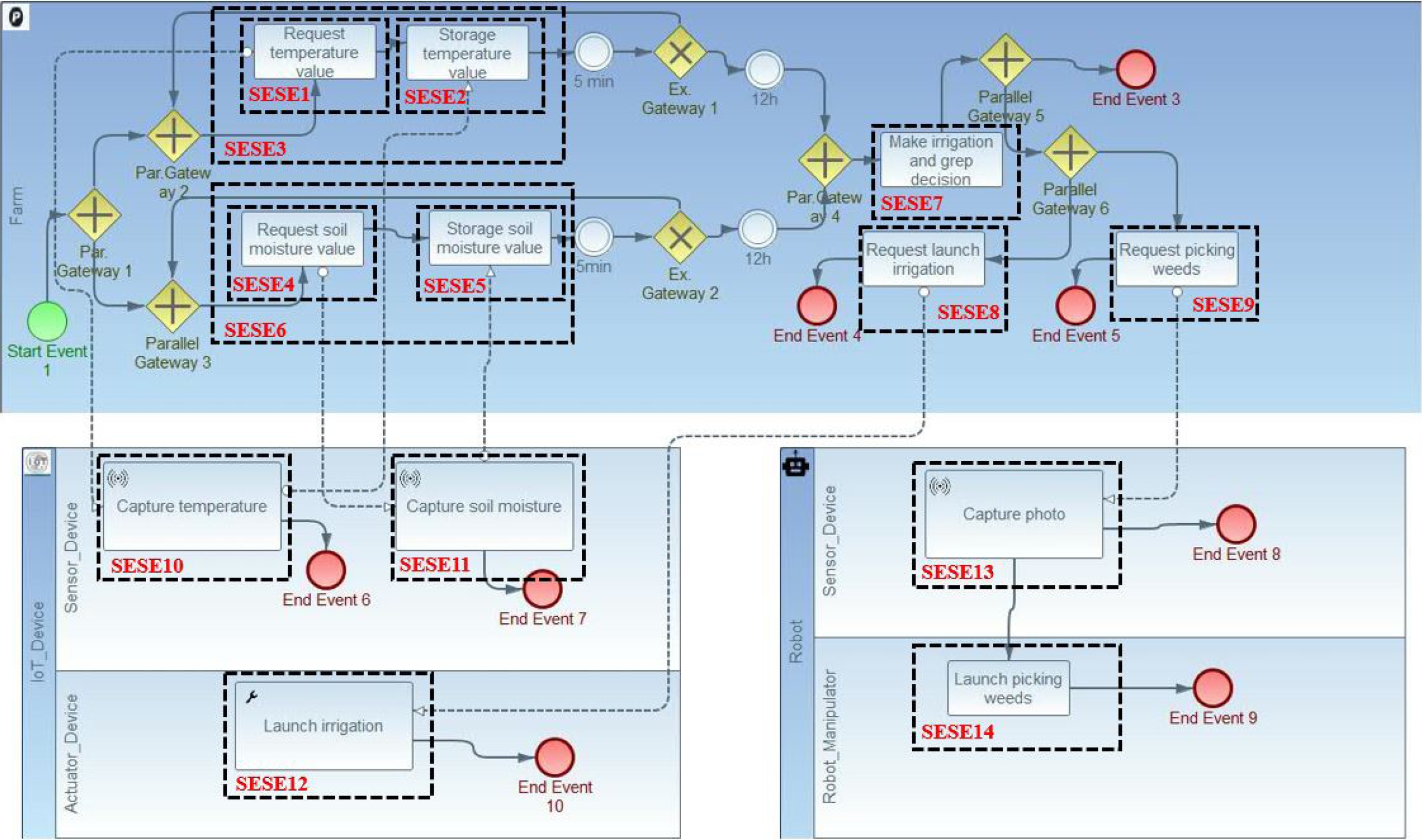
We divided the process into various SESE blocks using the Refined Process Structure Tree (RPST) technique. Each SESE has its requirements regarding the million instructions per second (MIPS), random access memory (RAM), size, and bandwidth (BW) (see Table 3).
Table 3 The SESE requirements on MIPS, RAM, size, and BW
| SESE Fragments | MIPS | RAM | Size | BW |
| SESE1 | 10 | 8 | 60 | 10 |
| SESE2 | 20 | 32 | 80 | 20 |
| SESE3 | 30 | 40 | 140 | 20 |
| SESE4 | 15 | 10 | 75 | 20 |
| SESE5 | 30 | 18 | 100 | 40 |
| SESE6 | 45 | 28 | 175 | 40 |
| SESE7 | 100 | 25 | 400 | 50 |
| SESE8 | 80 | 20 | 500 | 10 |
| SESE9 | 120 | 38 | 300 | 23 |
| SESE10 | 45 | 5 | 500 | 60 |
| SESE11 | 145 | 30 | 120 | 70 |
| SESE12 | 120 | 2 | 150 | 65 |
| SESE13 | 155 | 32 | 250 | 20 |
| SESE14 | 60 | 8 | 100 | 23 |
In the first experiment, we aim to estimate the required time to select adequate resources for each SESE tasks. In this setting, we measure the response time to allocate a resource regarding the number of process fragments and the number of considered processes.
Considering the results presented in Figures 4 and 5, we notice that the proposed RL-FCRA depends (i) on the considering SESE fragments of each IoRT-aware BP and (ii) the considered episodes (number of the IoRT-aware BPs). Therefore, we observe that the response time is directly proportional to the size of the involved fragments and episodes.
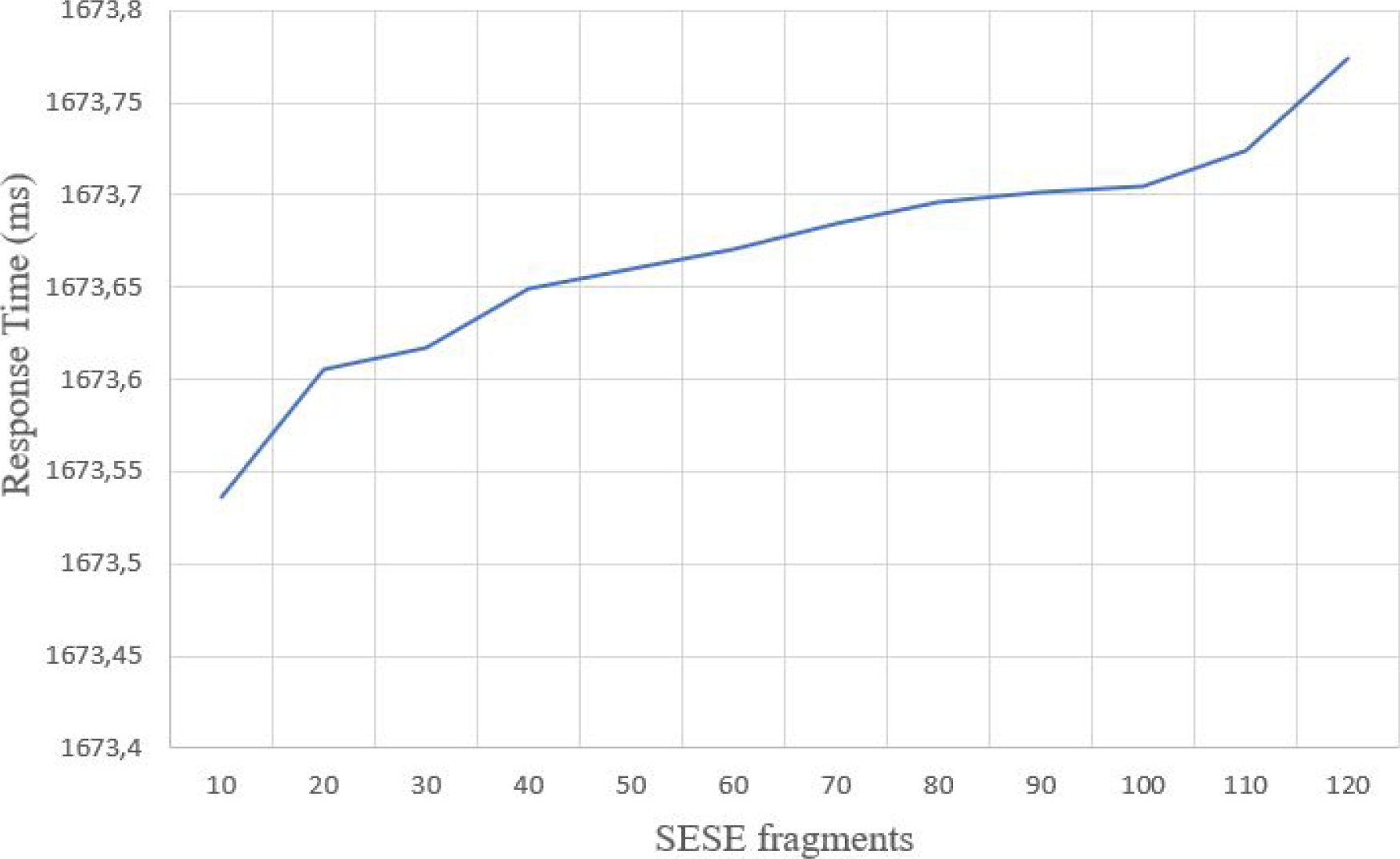
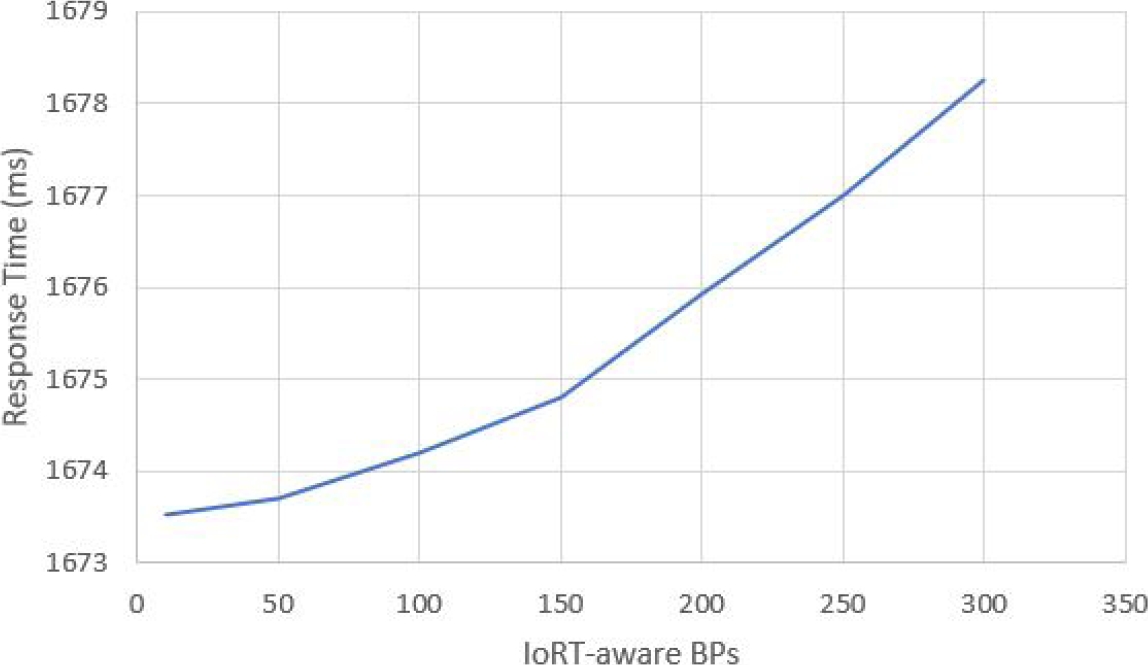
The obtained results are justified by the limited capacities (e.g., MIPS, RAM, etc.) of the selected resource, which can result in a longer response time, where the agent struggles to keep up with the requirements of the SESE fragment.
Moreover, we assess the response time of the RL-FCRA by varying the available resources provided by the Fog and Cloud. In this setting, we consider the process presented in Figure 3, which comprises fourteen SESE fragments.
The considered Fog and Cloud resources are presented in table 4. These resources are generated using the ifogSim. The result of this experimentation is shown in Figure 6. Figure 6 shows that the response time depends on the number of available Fog and/or Cloud resources, where the time increases regarding the considered resources.
Table 4 Scalability of the fog and cloud resources
| Case | Fog resources | Cloud resources |
| Case1 | 3 | 2 |
| Case2 | 5 | 5 |
| Case3 | 10 | 10 |
| Case4 | 15 | 15 |
| Case5 | 20 | 20 |
| Case6 | 30 | 30 |
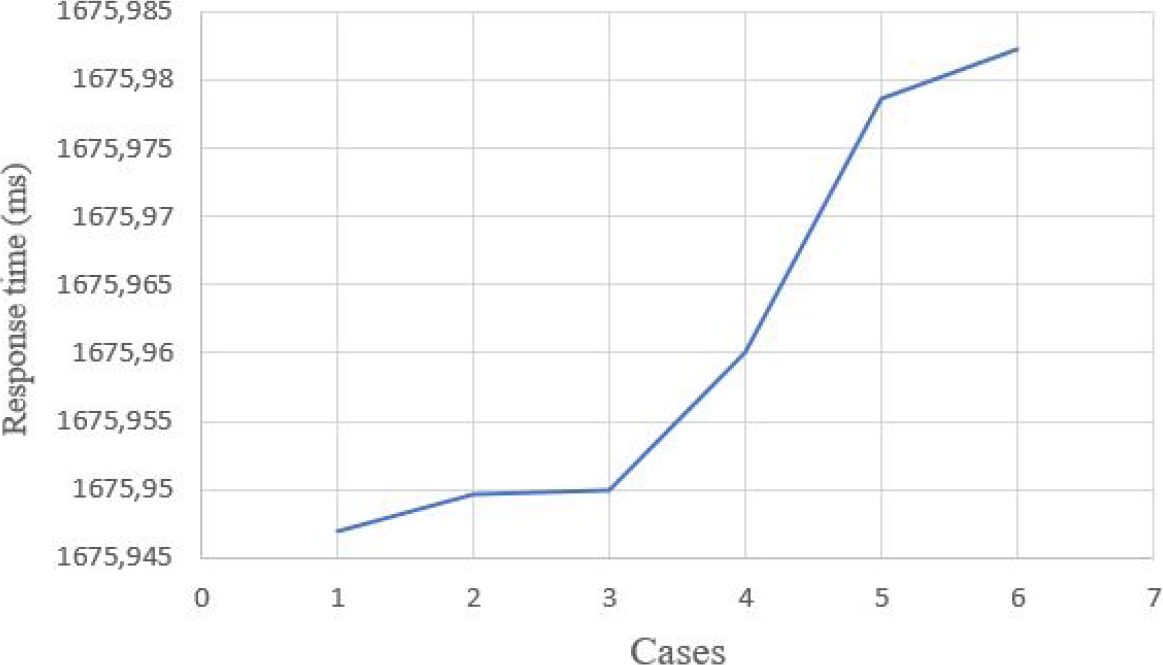
This is due to the exploitation phase ensured by the RL agent which should estimate the reward for each resource and then select the suitable one. In the context of the RL-FCRA evaluation, we conducted another experiment that aims to compare the rewarded cost, energy, execution time, and latency of our proposal with other RA approaches. The considered approaches are described in the following:
– FIFO: The First-In-First-Out strategy that aims to implement an unbiased conflict solver because it neglects properties of work items (SESE) and the state of resources [34].
– RLRAM: The Reinforcement Learning Based Resource Allocation Mechanism (RLRAM) aims to propose an optimal RA to the classic BP by trying to minimize the cost [13].
To be able to make this comparison in relevant conditions, the proposed RL-FCRA, RLRAM, and FIFO approaches were executed using the same input configuration of BPs, Fog, and Cloud features. In this setting, we take into account the process (see Figure 5) as an IoRT-aware BP that grouped fourteen SESE fragments, where each SESE has its characteristics (see table ??). Moreover, we consider a set of twenty Fog resources (
Table 5 Fog and cloud resources features
| Resource | MIPS | RAM | Up BW | Down BW | Rate Per MIPS | Busy Power | Idle Power |
| Fog1 | 155 | 50 | 200 | 100 | 0,0000006 | 0,1 | 0,001 |
| Fog2 | 200 | 40 | 300 | 110 | 0,000001 | 0.2 | 0.1 |
| Fog3 | 300 | 80 | 600 | 200 | 0.0000002 | 0.7 | 0.01 |
| Cloud1 | 100 | 40 | 400 | 100 | 0,00000003 | 100 | 70 |
| Cloud2 | 1000 | 500 | 10000 | 1000 | 0,000000005 | 200 | 200 |
| Cloud3 | 1500 | 750 | 900 | 900 | 0,0000004 | 750 | 310 |
Table 6 shows the results of the set forward experiment. It shows that the RL-FCRA outperforms FIFO and RLRAM regarding the consumed energy during the execution of the IoRT-aware BP instance (see table 6). Moreover, we denote from table 6 that our approach requires 1.10s to achieve the execution of the process while the FIFO requires 1.45s to execute it. Furthermore, the estimated latency for the RL-FCRA is around 0.04s. This value is relatively reduced compared to the RLRAM approach which is estimated to be 0.89s. However, for the cost parameter, we note that the proposed approach is less than FIFO.
Table 6 Comparison of RL-FCRA compared to the other RA approaches regarding the cost, energy, execution time, and latency
| Measured metrics | FIFO | RLRAM | RL-FCRA |
| Cost ($) | 86.46 | 44.85 | 45.00 |
| Energy(KJ) | 54.50 | 53.3 | 12.87 |
| Execution time (s) | 1.455 | 1.442 | 1.105 |
| Latency (mi/s) | 0.04 | 0,89 | 0,04 |
The experimental results indicate that the RL-FCRA offers a substantial advantage in optimizing the performance of RA in BPM, which confirms the usefulness of our approach and demonstrates its relevance compared to RLRAM and FIFO approaches.
6 Conclusion and Future Work
With the proliferation of Industry 4.0, business managers nowadays seek to benefit from IoT and robotics that bring them enormous change in production systems, especially in shorter lead times, flexibility in manufacturing, etc. This led to IoRT-aware BPs. Nonetheless, executing such a process inside the enterprise may be costly due to the consumed resources, the need for computational capacity, etc.
To close these gaps, the business process outsourcing (BPO) strategy can be carried out to externalize the IoRT-aware BP for Cloud and Fog environments. Towards this objective, we proposed a RL-based approach to achieve an optimal allocation of the Fog and Cloud resources for executing an IoRT-aware BP, where this approach addressed the cost, consumed energy, execution time, and latency.
In future directions, we will address some of the current study limitations such as Fog devices’ security and mobility issues. Furthermore, in the future, we aim to enhance our proposal by scheduling the RA for the different process fragments.

