




 nueva página del texto (beta)
 Inglés (pdf)
 Artículo en XML
 Referencias del artículo
 Traducción automática
 Enviar artículo por email
 Citado por SciELO
  Similares en
SciELO
Similares en
SciELO 
 Permalink
Introduction
In many engineering applications and designs, wood is preferred due to its superior properties such as high strength/weight ratio, easy workability, and different possibilities for architectural design. However, the hygroscopic and organic nature of wood presents some disadvantages by narrowing its applications and limiting its service life (Taghiyari et al., 2020). It is susceptible to degradation mainly caused by environmental impacts (i.e. wind, rain, UV light, snow, and frost), biological attacks (i.e. fungi and insects), natural disasters (i.e. flood and earthquake), and human interference (Unger et al., 2001; Kránitz, 2014; Uzun et al., 2018). Due to the adverse effects of traditional wood preservatives applied for the protection of wood against environmental and biological degradation in the indoor and outdoor environment, it has become a necessity to use and develop new nontoxic environmentally friendly wood protection methods to protect human health.
Nowadays, new solutions of eco-friendly wood preservatives focus on nanoparticles in wood protection methods. The application of nanotechnology in wood protection using nanoparticles can enhance the performance resistance to decay, scratch and abrasion resistance, blocking of UV radiation, hygroscopic properties without affecting the appearance of the wood due to its easy penetration and distribution, the effective surface area, high dispersion stability and low viscosity properties (Akhtari & Arefkhani, 2013). Currently, a variety of nanomaterials, including nano-oxides, metal nanoparticles, and nano-clays are applied to wood (Papadopoulos & Taghiyari, 2019). The application of metal nanoparticles with high thermal conductivity increased the heat transfer rate and resistance to rotting of solid wood and decreased the hot press time in particleboard production (Saber et al., 2013; Habibzade et al., 2014; Farahani & Banikarım, 2013). A significant increase was observed in the mechanical properties (bending strength, modulus of elasticity in bending, and compression strength) of wood treated with silver, copper, and zinc oxide nanoparticles (Akhtari et al., 2012). In the other study, it was concluded that zinc oxide nanoparticles (nano-ZnO) improved dimensional stability and water absorption, mechanical properties compared to control specimens, and some fire-retarding properties (Habibzade et al., 2016). In a similar study, it was determined that nano-ZnO reduced the UV interaction by preventing the formation of free radicals with the increase in the contact surface, to reduce erosion, graying and surface degradation occurring in the outdoor environment, and to improve optical properties (Afrouzi et al., 2013). Studies on the improvement of termite resistance of wood treated with ZnO reported that nano-ZnO inhibited termite feeding and fungal decay to some extent (except zinc tolerant fungi) and caused moderate termite mortality and inhibition (Lykidis et al., 2013; Lykidis et al., 2018; Clausen et al., 2010). Terzi et al. (2016) reported that various nanoparticles (ZnO, B2O3, CuO, TiO2, CeO2, and SnO2) improved the properties of wood against fungal rot, mold growth, and termite attack, and were successful in terms of biological resistance and leaching. In the laboratory leach test, virtually no leaching of nano-ZnO occurred at any treatment concentration previously reported by Clausen et al. (2010). Another nano-material is magnesium oxide nanoparticles (nano-MgO) to have antibacterial activity and is an effective alternative to Cu bactericides (Liao et al., 2018). Kiaei et al. (2017) determined the effect of nano-MgO on the mechanical and flammability features of composite material made of wood flour and high-density polyethylene. In another study, Holy et al. (2020) determined the physical, thermal, and biodegradation properties of wood treated with nano-clay and nano-sized particles of zinc oxide, titanium oxide, aluminum oxide, and magnesium oxide. Among these treatments, the specimens treated with nano-clay and MgO exhibited the lowest water absorption and the highest water repellency. Additionally, MgO is used as fire-retardant nanoparticles in particleboard production and the particleboard treated with 20% magnesium oxide showed better flame-retardant properties compared to the control ones (Selamat et al., 2018).
Applications of nano-based wood protection methods developed as an alternative to traditional methods have led to the development of self-cleaning, scratch, and weather resistance and biocide properties. Thus, new application areas of natural wood have emerged such as transparent wood, self-cleaning coatings, and smart windows.
Objectives
This study aimed to investigate the effects of nano-MgO and nano-ZnO impregnation at concentrations of 0.1%, 0.2%, and 0.3% on the physical, mechanical, and thermal properties of Scots pine (Pinus sylvestris L.) wood by examining its density, retention value, compression strength parallel to the grain, crystallinity index (CI) using X-ray diffraction (XRD), and thermal stability through thermogravimetric analysis (TGA).
Materials and methods
Scots pine (Pinus sylvestris L.) wood was obtained from a local timber supplier (Kastamonu, Türkiye). The Scots pine wood specimens were cut into blocks with dimensions of 20 mm × 20 mm × 30 mm. All the specimens were conditioned at 20 °C ±2 °C and relative humidity of 65% ± 5% for one month before impregnation. The specimens were randomly divided into seven groups which had 10 replicates, i.e., control, and impregnated specimens. NanoMgO and Nano-ZnO were obtained from Grafen Company, Ankara in Türkiye. Table 1 represents specific properties of nano-MgO and nano-ZnO.
TABLE 1 Optical and structural characterization of nano-ZnO and nano-MgO applied to Scots pine wood.
| Impregnating agent | Property | |||
| Appearance | Average Particle Size (nm) | Purity (%) | Specific Surface area (m2/g) | |
| Nano-ZnO | White nano powder | 15 | 99.00 | 110 |
| Nano-MgO | White nano powder | 30 | 99.80 | 24 |
Impregnation
The impregnation solution was prepared as a dispersion at 0.1%, 0.2%, and 0.3% concentrations, separately from nano-MgO and nano-ZnO. Distilled water was used as the dispersion medium, and a magnetic stirrer was used to ensure homogeneous distribution of nanoparticles in the solution. No instability issues such as precipitation were observed in dispersions at different concentrations. The impregnation process was carried out by completely immersing wooden blocks in the prepared dispersions for 24 hours. After the impregnation process, the retention levels and density of the samples were calculated. The retention rate (%) of each sample was determined according to equation 1:
where:
G = weight of the treatment solution absorbed by the wood specimen (g)
C = weight of the chemical solution in 100 g of the treatment solution (%)
V = volume of the wood specimen in cubic centimeters (cm3)
Compression strength test
A compression strength test was conducted at a speed of 5 mm/min on the Shimadzu AG-IC 20/50 KN STD Universal Test device. The compression strength parallel to the grain was conducted in accordance with ISO13061-17 (International Organization for Standardization [ISO], 2017). The dimension of the specimens for compression strength parallel to the grain was 20 mm × 20 mm × 30 mm (Radial×Tangential×Longitudinal). The Scots pine wood blocks were conditioned to a temperature of 20 °C ± 2 °C and 65% ± 5% relative humidity prior to the test.
Compression strength (CS) was calculated according to equation 2:
where:
Fmax = maximum load (N)
a = dept of cross-section (mm)
b = width of cross-section (mm)
Thermogravimetric analysis
The thermal stability of the wood specimens was investigated using thermogravimetric analysis (TGA) (Hitachi, STA7300) under the following conditions: the specimens were heated from 25 °C to 700 °C with a heating rate of 10 °C/min and a nitrogen flow of 100 mL/min. The specimens’ masses between 10 mg and 15 mg were weighed into 70 μl alumina crucibles.
X-ray diffraction (XRD) analysis
XRD analysis was performed on wood blocks specimens. X-ray patterns were measured using a Bruker D8 Advance Spectrometer (Billerica, MA, USA). The specimens were scanned in the range of 10° to 30°. A step size of 0.02° and a step time of 1.0 s were used during the measurements.
Data analysis
The one-way analysis of variance (ANOVA) procedure was performed on the individual data points on the compression strength parallel to the grain in Scots pine wood to analyze all treatment combinations together including the data from the control specimens to determine if there was any statistical difference among them. Besides, the main effects of the type and concentration of nanoparticles and their interactions on the compression strength parallel to the grain in the wood material were also analyzed; then the Fisher’s protected least significant difference (LSD) multiple comparisons procedure was performed to detect mean differences among treatment combinations of the type and amount of nanoparticle in the impregnation solution. All data were analyzed based on the 5% significance level using SAS software (SAS Institute INC 1999).
Results and discussion
Retention and oven-dried density of the specimens
The retention values for 0.1%, 0.2% and 0.3% solution ratios of nano-MgO were 0.55 kg/m3, 1.16 kg/m3 and 1.79 kg/m3, respectively. The retention values for 0.1%, 0.2% and 0.3% solution ratios of nano-ZnO were 0.57 kg/m3, 1.13 kg/m3 and 1.69 kg/m3, respectively. While the highest retention value was 1.79 kg/m3 in 0.3% nano-MgO, the lowest retention value was found 0.55 kg/m3 in 0.1% nanoMgO. The lowest density value was determined as 505 kg/m3 in control wood. In general, as the retention values of Scots pine wood increased, the density values increased. The oven-dry density of nano-MgO impregnated wood was found to be 507 kg/m3, 513 kg/m3 and 525 kg/m3 for 0.1%, 0.2% and 0.3% solution ratios, respectively. The oven-dry density of nano-ZnO impregnated wood was found to be 504 kg/m3, 512 kg/m3 and 517 kg/m3 for 0.1%, 0.2% and 0.3% solution ratios, respectively.
Mean comparison of compression strength parallel to the grain
Table 2 summarizes the mean compression strength parallel to the grain in Scots pine wood specimens impregnated with different amounts of nano-MgO and nano-ZnO. In general, the mean compression strength parallel to the grain in the wood material increased when the amount of the nanoparticle of nano-MgO added to impregnation solution increased from 0.1% to 0.3%, whereas it decreased in the case of nano-ZnO.
TABLE 2 Summary of mean analysis of compression strength parallel to the grain between each treatment combination in Scots pine wood impregnated with different percentages of nanoparticles of MgO and ZnO.
| Treatment combinations | |||||||
| Control | Nano-MgO | Nano-ZnO | |||||
| Percentage of nano particles in specimens | |||||||
| 0.1 | 0.2 | 0.3 | 0.1 | 0.2 | 0.3 | ||
| Compression strength parallel to the grain (N/mm2) | 57.5 | 45.94 | 48.93 | 51.82 | 50.23 | 47.38 | 45.98 |
| Coefficient of variance (%) | 10 | 9 | 8 | 10 | 3 | 6 | 4 |
| Statistical difference | A* | BCD | BC | B | B | D | D |
* The same letter represents no statistical difference.
The results of the ANOVA table showed that there was a statistical difference in the compression strength parallel to the grain in the wood material among the treatment combinations. The compression strength in control specimens was statistically higher than in the impregnated samples. Among the treated samples, wood specimens impregnated with 0.1%, 0.2%, and 0.3% nano-MgO showed no significant difference in compression strength, whereas the lowest compression strength was observed in specimens impregnated with 0.2% nano-ZnO, which had no statistical difference from those treated with 0.3% nanoZnO. The observed reduction in compression strength after impregnation with nano-compounds is consistent with previous findings. Akhtari et al. (2012) reported that nano-compound impregnation decreased the hardness of wood, with nano-zinc oxide-treated samples exhibiting higher hardness than nano-copper and nano-silver-treated ones. Although their study focused on hardness, Doyle (1980) demonstrated a strong correlation between hardness of wood and compressive strength perpendicular to the grain. This correlation suggests that a reduction in hardness due to nanoparticle impregnation may also contribute to decreased compression strength. Therefore, the results of this study align with existing literature, supporting the conclusion that nano-material impregnation affects the mechanical properties of wood.
In the case of the main effects of the amount and type of nanoparticle impregnated in the specimens, the ANOVA results indicated that the interaction among these main effects was statistically significant with a p-value less than 0.0001. Tables 3 and 4 show the mean comparisons of compression strength parallel to the grain in Scots Pine based on the main effects. The mean compression strength in the nano-MgO impregnated wood increased when the amount of nanoparticles in the impregnation solution added into the specimens increased, whereas it decreased in the corresponding one with nano-ZnO. In the case of comparing the 0.1% of nanoparticles in the impregnation solution, the mean compression strength was significantly higher in nano-ZnO than the corresponding ones with nano-MgO. Conversely, the impregnated wood specimens with nano-MgO in the amount of 0.03% had a significantly higher mean compression strength than the corresponding ones in nano-ZnO. In a study of mechanical properties in Pawlonia fortune wood specimens impregnated with different nanoparticles, the compression strength parallel to the grain in control specimens did not differ from the specimens impregnated with 400 × 10-6 (400 ppm) nano-silver, nanocopper, and nano-zinc oxide particles (Akhtari et al., 2012).
TABLE 3 Mean comparisons of compression strength parallel to the grain between nano particles concentration in Scots pine wood impregnated with different percentages of nanoparticles of MgO and ZnO.
| Compression strength parallel to the grain (N/mm2) | |||
| Impregnating agent | Percentage of nano particles in specimens | ||
| 0.1 | 0.2 | 0.3 | |
| Nano-MgO | 45.94 B | 48.93 AB | 51.82 A |
| Nano-ZnO | 50.23 A | 47.38 AB | 45.98 B |
TABLE 4 Mean comparisons of compression strength parallel to the grain between compounds in Scots pine wood impregnated with different percentages of nanoparticles of MgO and ZnO.
| Compression strength parallel to thegrain (N/mm2) | ||
| Percentage of nano particles in specimens | Type of nanoparticle | |
| Nano-MgO | Nano-ZnO | |
| 0.1 | 45.94 B | 50.23 A |
| 0.2 | 48.93 A | 47.38 A |
| 0.3 | 51.82 A | 45.98 B |
According to Onyszko et al. (2022), the effect of nanoparticles on the mechanical properties of nanocomposites depends on their morphological characteristics such as shape, size, and aspect ratio. In this context, the differences in the compressive strength of wood impregnated with nanoMgO and nano-ZnO create varying effects on mechanical performance due to the interaction of these morphological variations observed in both nanomaterials with the wood's fiber structure and microstructure.
Thermal properties
The TGA results of Scots pine wood specimens impregnated with nano-MgO and nano-ZnO are presented in figures 1a and 1b, respectively. Wood is a polymeric composite that mainly contains holocellulose, lignin, and extracts. Wood degradation occurs at a relatively low temperature, about 200 °C. The degradation of cellulose occurs due to the increasing temperature between 200 °C and 400 °C. At higher temperatures degradation of the lignin occurs. Initial degradation was observed to be around 220 °C, due to the most thermally sensitive components in the lignocellulosic filler, the hemicelluloses. This was followed by the degradation of cellulose and lignin. As shown in figure 1a and 1b, the thermal stability of the nanozinc oxide and nano-magnesium oxide treated Scots pine wood slightly better than untreated ones, but it was not significant. All specimens showed quite similar thermogravimetric curves, which reflect similar thermal degradation behavior. Similar results were also reported in the previous studies (Holy et al., 2020; Aydemir et al., 2016). Table 5 shows the amount of residue after TGA for all groups. It was observed that the specimens treated with nano-MgO showed lower residual weight than specimens without nano-MgO. The amount of residue of the control specimen was found to be 16.92%. The amount of residue in the specimens slightly decreased with increasing content of the nano-MgO ratio. The amount of residue after TGA decreased from 16.92% to 16.52% as the nano-MgO content increased from 0% to 0.3%. However, a different trend was observed in specimens treated with nano-ZnO. It was determined that the specimens treated with nanoZnO showed higher residual weight than control specimens. The amount of residue in the specimens slightly increased with increasing content of the nano-ZnO ratio. The amount of residue after TGA increased from 16.92% to 18.53% as the nano-ZnO content increased from 0 to 0.3%. According to Chong et al., (2020), although the addition of MgO and ZnO does not alter the fundamental pyrolytic reaction mechanism of cellulose, both Mg and Zn oxides reduce the average activation energies, thereby exhibiting catalytic effects and reducing the reaction rate in cellulose. The observed opposite trends in residual weight between nano-MgO and nano-ZnO treated specimens can be attributed to differences in the retention ratios of these nano-compounds during the impregnation process.
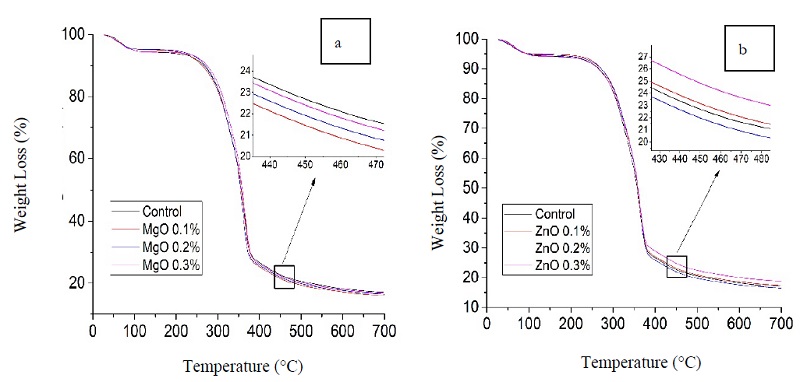
TABLE 5 Residue after thermogravimetric analyses (TGA) of Scots pine wood impregnated with different percentages of nanoparticles of MgO and ZnO.
| Treatment combinations | |||||||
| Control | Nano-MgO | Nano-ZnO | |||||
| Percentage of nano particles in specimens | |||||||
| 0.1 | 0.2 | 0.3 | 0.1 | 0.2 | 0.3 | ||
| Residue after TGA | 16.92 | 15.73 | 16.20 | 16.52 | 17.13 | 17.15 | 18.53 |
Crystallinity index
XRD was performed to determine the crystal structure of the Scots pine wood specimens impregnated with nanoMgO and nano-ZnO (Fig. 2). The crystallinity index (CI) was determined using 22° and 18° wide-angle X-ray diffraction counts near the 2θ angle. The sharp peak at 22° indicates the crystalline region, while the peak density at 18° reflected in the amorphous region in cellulosic materials. When comparing the untreated and treated wood XRD curves, it can be seen that the position of the peaks did not change, which indicates that the structure of the cellulose did not change. The main difference between the specimens is thought to be related to the density change in the peaks representing changes in wood crystallinity.
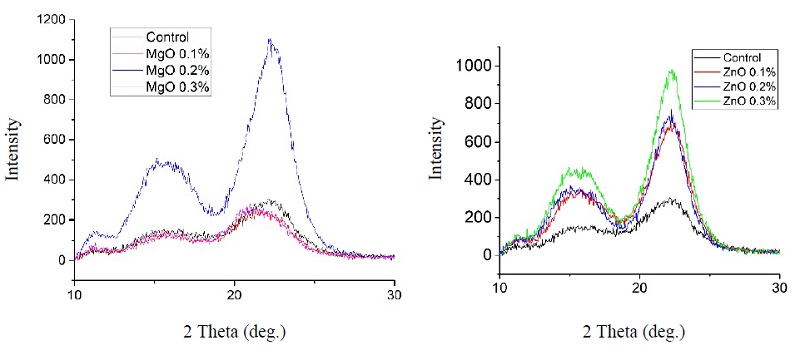
According to the results of the experiment, the crystallinity index of untreated pine was 66.7, while the results for wood specimens impregnated with nano-MgO were 66.9, 70.4 and 80.3, respectively (Table 6). It was determined that the crystallite index of the Scots pine wood treated with nano-MgO was generally higher than the control specimens. A similar trend was found in Scots pine wood treated with nano-ZnO. It was determined that the specimens treated with nano-ZnO showed higher crystallinity index than both control and Scots pine wood treated with nano-MgO specimens. In general, the crystallinity index of the specimens increased with increasing content of the nano-MgO and nano-ZnO.
Conclusions
The present study focused on the effects of impregnation with nano-MgO and nano-ZnO on the physical, mechanical, and thermal properties of Scots pine wood. After the impregnation process, the density of the pine wood increased as a result of nanoparticle uptake. The compression strength decreased due to the possible decrease in hardness during impregnation. Therefore, the short-term vacuum-pressure method is preferable to the long-term immersion method for impregnation. For enhancing the thermal stability of wood, impregnation with nano-MgO and nano-ZnO is recommended. The relative crystallinity of impregnated wood specimens was higher than the corresponding one in the untreated specimens, indicating that the impregnated nano-MgO and nano-ZnO precursor did not destroy the crystalline structure of cellulose. Overall, this study provides an overview of the advantages of nano-MgO and nano-ZnO as impregnating agents to improve some properties of wood. However, more research should be done by increasing the percentage of nanoparticles and enhancing their distribution.

