Artículos
Early Pliocene tracer of North Atlantic and South Pacific sea surface currents: Janthina typica (Bronn, 1860) (Mollusca: Gastropoda)
Trazador de corrientes marinas de superficie en el Atlántico norte y Pacífico sur durante el Plioceno temprano: Janthina typica (Bronn, 1860) (Mollusca: Gastropoda)

ABSTRACT
Janthina typica is an extinct, rare, floating species of gastropod from the early Pliocene whose fossils have an unusual geographic distribution, appearing in the eastern North Atlantic archipelagos (Canary, Azores, Madeira and Selvagen Islands), Morocco, and Pacific (New Zealand, Australia and Japan). This study examines the origin of this biogeography and how the species may have dispersed via sea surface currents. We have considered the published ecological aspects of the genus Janthina, the Janthina typica fossil localities, and ocean palaeocurrents. Abundant specimens of J. typica are found in marine deposits on Gran Canaria island (northeast Atlantic), 40Ar/39Ar dated at 4.2 Ma. These deposits therefore accumulated just before the end of the early Pliocene warm climate and closely predate the start of global changes that gave rise to the worlds present climate. In the early Pliocene, the cold Canary Current did not yet exist. The subtropical northeastern Atlantic Ocean was warmer than today and its waters would have met the Circumtropical Current that crossed the Central American Seaway from the Caribbean to the Pacific. From there, the South Equatorial Current flowed towards the eastern coast of Indonesia before splitting north towards Japan and south as the East Australian Current. The latter must also have extended along the southern coast of Australia, crossing the Bass Strait before reaching the area of modern-day Perth in southwestern Australia. The reverse journey (from Australia to the eastern Atlantic Ocean) would have posed far more obstacles, and is considered improbable. J. typica therefore likely originated in the East Atlantic. The main causes for its extraordinary geographic distribution are its ecology as a floating animal in warm water, tectonic plate movements that permitted an open Central American Seaway and a restricted Indonesian Seaway, and Earths rotation and its influence on marine currents.
Key words::
pelagic mollusk, warm water species, Pliocene climate, plate tectonics, Coriolis effect, early Pliocene currents
INTRODUCTION
On Gran Canaria (Canary Islands, Spain; Figure 1) marine deposits at La Esfinge site (Figure 2) host a considerable accumulation of Janthina typica (Figure 3). These deposits have been recently dated (Meco et al., 2015) using 40Ar/39Ar to 4.2 Ma from samples of pillow lava that entered into contact with it. The aim of the present paper is to show the geographic distribution of J. typica in the Atlantic and Pacific oceans during the early Pliocene. The paper presents hypotheses that could explain its notable dispersal as a floating animal in warm water.
-
Meco et al., 2015The Canary Record of the Evolution of the North Atlantic Pliocene: New 40Ar/39Ar Ages and Some Notable Palaeontological EvidencePalaeogeography, Palaeoclimatology, Palaeoecology, 2015
Thumbnail
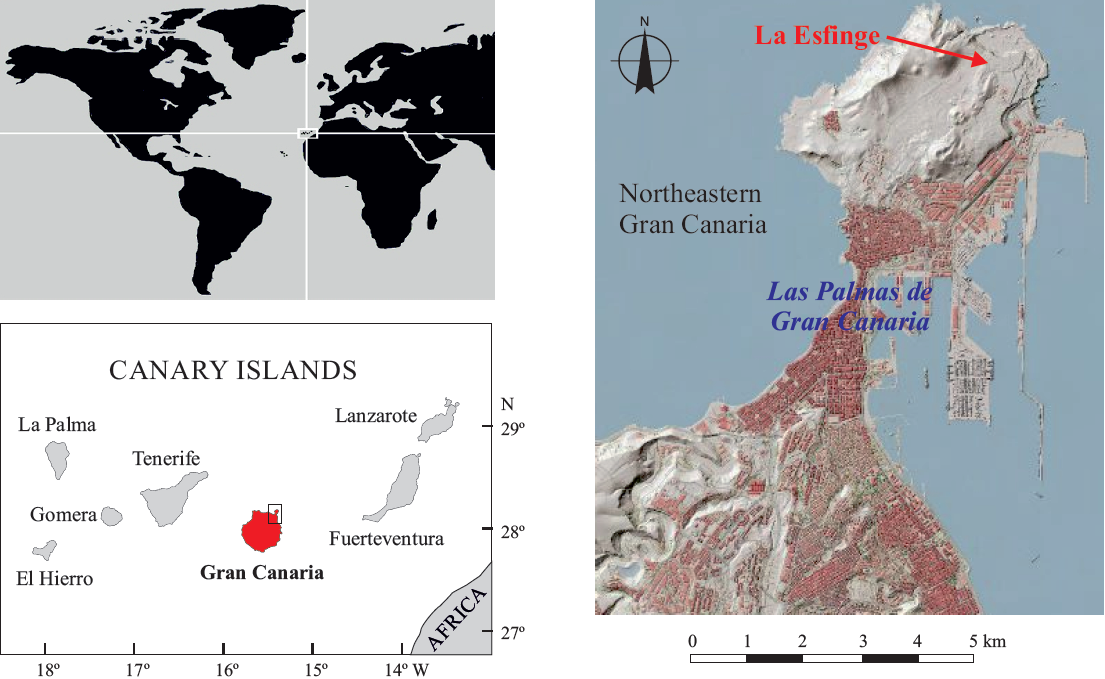
Figure 1
Location of La Esfinge site in northeastern Gran Canaria, where Janthina typica has been found.
Location of La Esfinge site in northeastern Gran Canaria, where Janthina typica has been found.
Thumbnail
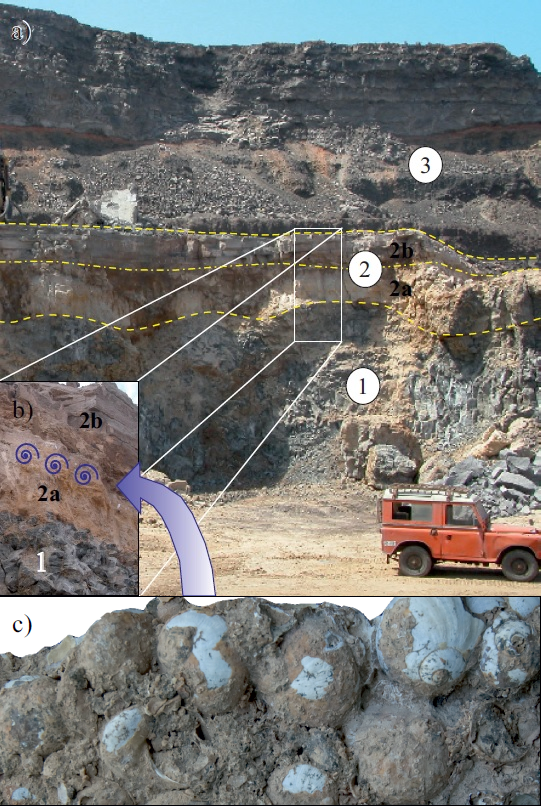
Figure 2
Geological context at La Esfinge (Gran Canaria), (a) Section showing the fossiliferous marine deposit (2) between pillow lavas with a 4.2 Ma 40Ar/39Ar age (1) (from Meco et al, 2015) and Pleistocene volcanics (3); (b) detail oflayer 2: 2a marine sands with fossils inside and 2b aeolian sands; (c) accumulation of Janthina typica at the top oflayer (2).
Geological context at La Esfinge (Gran Canaria), (a) Section showing the fossiliferous marine deposit (2) between pillow lavas with a 4.2 Ma 40Ar/39Ar age (1) (from Meco et al, 2015) and Pleistocene volcanics (3); (b) detail oflayer 2: 2a marine sands with fossils inside and 2b aeolian sands; (c) accumulation of Janthina typica at the top oflayer (2).
Thumbnail
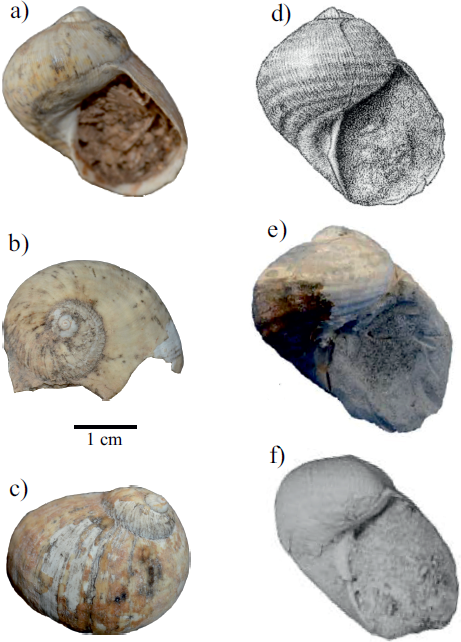
Figure 3
Janthina typica (Bronn, 1861) showing a) apertural view b) apical view c) lateral view (LE2051) from the early Pliocene (4.2 Ma) at La Esfinge (Gran Canaria, Spain). Note that it has faint but visible folds; d) drawing of apertural view from early Pliocene (Opoitian) at southwest Aukland, New Zealand (Beu and Maxwell, 1990); e) apertural view (MGF3472) from the Pliocene of Japan (Tomida et al. 2013); f) apertural view (MFM112203) from Upper Pliocene of Japan (Tomida and Kitao, 2002) as Hartungia japónica (Tomida and Itoigawa, 1984).
Janthina typica (Bronn, 1861) showing a) apertural view b) apical view c) lateral view (LE2051) from the early Pliocene (4.2 Ma) at La Esfinge (Gran Canaria, Spain). Note that it has faint but visible folds; d) drawing of apertural view from early Pliocene (Opoitian) at southwest Aukland, New Zealand (Beu and Maxwell, 1990); e) apertural view (MGF3472) from the Pliocene of Japan (Tomida et al. 2013); f) apertural view (MFM112203) from Upper Pliocene of Japan (Tomida and Kitao, 2002) as Hartungia japónica (Tomida and Itoigawa, 1984).
Janthina typica: ecology and palaeodistribution
The geographic distribution of fossil specimens of the tropical gastropod Janthina typica (Bronn, 1860) (= Hartungia typica Bronn =Janthina Hartungi Mayer = Hartungia chuberti Chavan) is striking for the great distances between the sites where this taxon has been found: from the Canary Islands (Meco et al., 2015), the Azores (Bronn, 1860; Mayer, 1864), Madeira (Mayer, 1864), Selvagem Grande (Joksimowitsch, 1911) and Atlantic Morocco (Chavan, 1951) to the antipodean locations of New Zealand, Australia and Japan (Tomida and Kitao, 2002; Beu and Raine, 2009).
-
Bronn, 1860Die fossilen Reste von Santa Maria, der südlichsten der Azorischen InselnDie Azoren, 1860
-
Meco et al., 2015The Canary Record of the Evolution of the North Atlantic Pliocene: New 40Ar/39Ar Ages and Some Notable Palaeontological EvidencePalaeogeography, Palaeoclimatology, Palaeoecology, 2015
-
Bronn, 1860Die fossilen Reste von Santa Maria, der südlichsten der Azorischen InselnDie Azoren, 1860
-
Mayer, 1864Die Tertiär-Fauna der Azor.en und Madeira. Systematisches Verzeichnis der fossilen Reste von Madeira, Porto Santo und Santa Maria nebst Beschreibung der neuen Arten, 1864
-
Mayer, 1864Die Tertiär-Fauna der Azor.en und Madeira. Systematisches Verzeichnis der fossilen Reste von Madeira, Porto Santo und Santa Maria nebst Beschreibung der neuen Arten, 1864
-
Joksimowitsch, 1911Die zweite Mediterranstufe von Porto Santo und SalvagemZeitschrift der Deutschen Geologischen Gesellschaft, 1911
-
Chavan, 1951Deux intéressants Gastropodes du Pliocène marocainNotes et Mémoires du Service géologique du Maroc, 1951
-
Tomida and Kitao, 2002Occurrence of Hartungia (Gastropoda: Janthinidae) from the Tonohama Group, Kochi Prefecture, JapanBulletin of the Mizunami Fossil Museum, 2002
-
Beu and Raine, 2009Revised descriptions of New Zealand Cenozoic Mollusca from Beu and Maxwell (1990), 2009
The current Janthinidae comprise a family of pelagic gastropods that live in colonies in warm and temperate seas, floating on a bubble-like raft of their own making, bound by mucus secreted from the organisms' feet, and they feed on hydrozoans such as Velella and Physalia (Nicklès, 1950; Laursen, 1953; Powell, 1979; Janssen, 2007; Churchill et al., 2011). This unusual adaptation enables them to travel enormous distances by drifting along with the currents, and sometimes they are cast onto beaches in significant numbers by on-shore winds (Beu and Raine, 2009).
-
Nicklès, 1950Mollusques testacés marins de la Côte occidentale d’Afrique, 1950
-
Laursen, 1953The genus Ianthina: A monographDana Report, 1953
-
Powell, 1979New Zealand Mollusca, 1979
-
Janssen, 2007Holoplanktonic Mollusca (Gastropoda: Pterotracheoidea, Janthinoidea, Thecosomata and Gymnosomata) from Pliocene of Pangasinan (Luzon, Philippines)Scripta Geologica, 2007
-
Churchill et al., 2011Females floated first in bubble-rafting snailsCurrent Biology, 2011
-
Beu and Raine, 2009Revised descriptions of New Zealand Cenozoic Mollusca from Beu and Maxwell (1990), 2009
J. typica is a fossil species from the early Pliocene (5.3 Ma to 3.6 Ma; Gradstein et al., 2004). The other localities where J. typica is found span much of the Pliocene. On Santa Maria Island in the Azores, specimens have been found in Feteirinhas and Pinheiro on the southeastern tip of the island (Reiss and Bronn, 1863). In a nearby locality, Pedra que Pica, the marine deposits have been attributed to the Messinian based on an 87Sr/86Sr age of 5.51 Ma (Kirby et al., 2007). The oldest shield of Madeira Island has yielded a 40Ar/39Ar age >4.6 Ma (Geldmacher et al., 2000) to 5.3 Ma (Klügel, 2009); therefore, the marine deposits at the Sao Vicente locality are also probably early Pliocene. In Selvagem Grande the marine deposits accumulated before the Pliocene volcanic cycle occurring at 3.4 Ma (Geldmacher et al., 2001).
-
Gradstein et al., 2004A Geologic Time Scale 2004, 2004
-
Reiss and Bronn, 1863Mittheilungen über die tertiären Schichten von Santa Maria, der südlichsten der Azoren, und ihre organischen EinschlüsseNeues Jahrbuch für Mineralogie, Geognosie, Geologie und Petrefaktenkunde, 1863
-
Kirby et al., 2007Neogene shallow-marine paleoenvironments and preliminary Strontium isotope chronostratigraphy of Santa Maria Island, AzoresAçoreana, 2007
-
Geldmacher et al., 2000The 40Ar/39Ar age dating of the Madeira Archipelago and hotspot track (eastern North Atlantic)Geochemistry, Geophysics, Geosystems, 2000
-
Klügel, 2009Atlantic RegionEncyclopedia of Islands, 2009
-
Geldmacher et al., 2001Earlier history of the ≥70-Ma-old Canary hotspot based on the temporal and geochemical evolution of the Selvagen Archipelago and neighboring seamouts in the eastern North AtlanticJournal of Volcanology and Geothermal Research, 2001
The marine deposits at Aïn s eb aa near Casablanca in Morocco are referred to the Piacenzian stage (Chavan, 1951). In New Zealand, J. typica has been found in deposits assigned to the Kapitean to Waipipian stages (Beu and Raine, 2009), which are roughly contemporaneous with the uppermost Messinian-Lower Zanclian to Lower Piacenzian stages (ca. 6 Ma to ca. 3 Ma). In southeastern Australia (Victoria) an d western Australia (Perth) the deposits that yielded J. typica were included in the Kalimnan stage (Tate, 1893; Beu and Raine, 2009), which corresponds roughly to the Upper Zanclian and Lower Piacenzian (ca. 4.4 to ca. 3 Ma). The >. typica specimens found in Kyushu, South Japan, were included in the earliest Pliocene (Tsuma Formation ca. 5 Ma) and in the latest Pliocene (Takanabe Formation, 2.6-2.5 Ma; Tomida et al., 2013).
-
Chavan, 1951Deux intéressants Gastropodes du Pliocène marocainNotes et Mémoires du Service géologique du Maroc, 1951
-
Beu and Raine, 2009Revised descriptions of New Zealand Cenozoic Mollusca from Beu and Maxwell (1990), 2009
-
Tate, 1893The gastropods of the older Tertiary of AustraliaTransaction of the Royal Society of South Australia, 1893
-
Beu and Raine, 2009Revised descriptions of New Zealand Cenozoic Mollusca from Beu and Maxwell (1990), 2009
-
Tomida et al., 2013A janthinid gastropod from Late Neogene Miyazaki Group of Southwestern Japan, and a status of HartungiaBulletin of the Mizunami Fossil Museum, 2013
In the early Pliocene (5 Ma to 4 Ma), Earth's climate was warm in many regions and temperate in others. The gradual cooling that followed the early Pliocene led to the establishment of modern temperature patterns (Fedorov et al. 2013). Thus, the age of the Gran Canaria marine deposits with J. typica (4.2 Ma) falls within the early Pliocene warm period, but is close to the transition into the cooling period that followed.
-
Fedorov et al. 2013Patterns and mechanisms of early Pliocene warmthNature, 2013
The geological characteristics and sedimentary interpretation of the Gran Canaria marine deposits that contain a significant accumulation of J. typica shells, along with their isotopie age (4.2 Ma; Figure 2), were reported in a previous paper (Meco et al., 2015). Other marine deposits of Las Palmas de Gran Canaria are also early Pliocene but these sediments provided a 40Ar/39Ar age of 4.8 Ma (Meco et al., 2015) and no fossil specimens of J. typica have been found in them. The fossils contained indicate a coastal and littoral habitat (e.g., Patella ambroggii Lecointre) with a warm intertropical climate (e.g., Persististrombus coronatus Defrance), Nerita emiliana Mayer).
-
Meco et al., 2015The Canary Record of the Evolution of the North Atlantic Pliocene: New 40Ar/39Ar Ages and Some Notable Palaeontological EvidencePalaeogeography, Palaeoclimatology, Palaeoecology, 2015
-
Meco et al., 2015The Canary Record of the Evolution of the North Atlantic Pliocene: New 40Ar/39Ar Ages and Some Notable Palaeontological EvidencePalaeogeography, Palaeoclimatology, Palaeoecology, 2015
In the present paper the ecology of Janthina is discussed and the oceanic currents of ca. 4 Ma are summarized, mainly from the findings of the Ocean Drilling Program (ODP), which allow sites where fossil specimens of J. typica have been found to be connected. The dispersal of this species from the eastern Atlantic to the western Pacific (or vice-versa), must have been determined by the sea surface currents at that time, which were in turn controlled by tectonic plate movements, and pressure gradients and the effect of the Earths rotation (the Coriolis effect).
INFLUENCE OF TECTONIC PLATE MOVEMENTS
Around 4.2 Ma ago, the geographic distribution of land masses (and so of the seas) differed significantly from today. Two important changes took place around this time that were caused by the movement of tectonic plates, and resulted in the closure of inter-ocean connections. One change caused the closure of the Central American Seaway, as the South American, Caribbean and North American plates moved closer together, and the Atlantic Ocean became isolated from the Pacific Ocean (Schmidt, 2007). In the other major change, the Indonesian Seaway closed as the Australian and Eurasian plates moved closer together, bringing about a partial isolation of the Pacific Ocean from the Indian Ocean (Gallagher et al., 2009).
-
Schmidt, 2007Deep Time Perspectives on Climate Change Marrying the Signal from Computer Models and Biological Proxies, 2007
-
Gallagher et al., 2009Neogene history of the West Pacific Warm Pool, Kuroshio and Leeuwin currentsPaleoceanography, 2009
Closure of Central American seaway
The closure of the Central American Seaway (also called the Panamanian Seaway) can be deduced from the progressive differentiation in salinity between the Caribbean Sea and the Pacific Ocean which was taking place about 4 Ma ago (Keigwin, 1982). This change is documented in isotopie analyses of foraminifera extracted from ODP oceanic drilling samples, including ODP Site 1241 (Groeneveld et al., 2006) in the eastern equatorial Pacific Ocean, and ODP Site 999 (Steph et al., 2006) in the Caribbean Sea. Salinity was virtually the same on both sides of present day Panama 4.2 Ma ago (Sarnthein et al., 2009), but shortly thereafter began the first phase of an increase in Caribbean salinity that concluded some 3.7 Ma ago. This time interval is considered to reflect the initial stage in the closure of the Central American Seaway (Chaisson and Ravelo, 2000). Thus, 4.2 Ma ago, the seaway still existed, and the Circumtropical Current that flowed east-to-west from the Caribbean to the Pacific, was still operative (Iturralde-Vinent and MacPhee, 1999; Mestas-Nuñez, 2014).
-
Keigwin, 1982Isotopic paleoceanography of the Caribbean and east PacificRole of Panama uplift in late Neogene time: Science, 1982
-
Groeneveld et al., 2006Pliocene mixed-layer oceanography for Site 1241 using combined Mg/Ca and δ18O analyses of Globigerina sacculiferProceedings of the Ocean Drilling Program, 2006
-
Steph et al., 2006Changes in Caribbean surface hydrography during the Pliocene shoaling of the Central American SeawayPaleoceanography, 2006
-
Sarnthein et al., 2009Mid-Pliocene shifts in ocean overturning circulation and the onset of Quaternary-style climatesClimate of the Past, 2009
-
Chaisson and Ravelo, 2000Pliocene development of the east-west hydrographic gradient in the equatorial PacificPaleoceanography, 2000
-
Iturralde-Vinent and MacPhee, 1999Paleogeography of the Caribbean Region: Implications for Cenozoic BiogeographyBulletin of the American Museum of Natural History, 1999
-
Mestas-Nuñez, 2014A mechanism for freshening the Caribbean Sea in pre-Ice Age timePaleoceanography, 2014
The Pacific Ocean warm pool
A comparison of foraminifera from ODP Site 806, near the Solomon Islands, and ODP Site 847, near the Galapagos Islands, reveals important changes 4.2 Ma ago that establish the timing of salinity differentiation at the latitude of Ecuador between the eastern and western sides of the Pacific Ocean. From this point onwards an enlargement of the West Pacific Warm Pool began and an eastwards lengthening of the cold tongue was initiated. The evolution of plank-tonic foraminifera and their ecology suggest that surface water cooling was taking place between 4.5 Ma and 4.0 Ma (Chaisson and Ravelo, 2000, Li et al., 2006), which is interpreted to be a consequence of the Panamanian Seaway closure.
-
Chaisson and Ravelo, 2000Pliocene development of the east-west hydrographic gradient in the equatorial PacificPaleoceanography, 2000
-
Li et al., 2006Late Miocene development of the western Pacific warm pool: Planktonic foraminifer and oxygen isotopic evidencePalaeogeography, Palaeoclimatology, Palaeoecology, 2006
Indonesian Seaway closure
Foraminiferal analyses of Miocene to Holocene strata of the northwestern continental shelf off Australia have been used to chart the influence of the West Pacific Warm Pool (Gallagher et al., 2009). Between 10 Ma and 4.4 Ma ago, the collision of Australia and Asia narrowed the Indonesian Throughflow. This "S" shaped current connects the West Pacific Warm Pool and the Indian Ocean, passing from south of the Philippines through the Makassar Strait (between Borneo and Sulawesi), turning southwards through the Flores Sea and the Timor Sea, ultimately heading southwest to the Indian Ocean (Figure 4). Warmer waters became trapped in the Pacific, creating a central West Pacific Warm Pool marine biogeographic province spanning a zone from the equator to 26°N (Gallagher et al., 2009).
-
Gallagher et al., 2009Neogene history of the West Pacific Warm Pool, Kuroshio and Leeuwin currentsPaleoceanography, 2009
-
Gallagher et al., 2009Neogene history of the West Pacific Warm Pool, Kuroshio and Leeuwin currentsPaleoceanography, 2009
Thumbnail

Figure 4
Biogeography or Janthina typica and reconstruction of the océanographie dispersal route around 4.2 Ma in accordance with the most likely hypothesis. Important localities (pink squares) are shown with numbered circles: (1) Santa Maria I. (Azores Islands), (2) Madeira I., (3) Selvagem Grande I., (4) Casablanca (Morocco), (5) Gran Canaria I. (Canary Islands), (6) Auckland (New Zealand), (7) Victoria (Australia), (8) Perth (Australia) and (9) Kyushu (Japan). ODP Sites (black circles). Dispersal route of Janthina typica (black arrows) from the East Atlantic Warm Pool (EAWP), through the Warm Canary Current (WCC), the Circumtropical Current (cc), the Central America Seaway (CAS), and the South Equatorial Current (SEC), and to the Warm East Australian Current (WEAC); or trough the Western Pacific Warm Pool (WPWP) to the Proto Kuroshio Current (PKC). Indonesian Through Flow (ITF). T: Trade winds (red arrows).
Biogeography or Janthina typica and reconstruction of the océanographie dispersal route around 4.2 Ma in accordance with the most likely hypothesis. Important localities (pink squares) are shown with numbered circles: (1) Santa Maria I. (Azores Islands), (2) Madeira I., (3) Selvagem Grande I., (4) Casablanca (Morocco), (5) Gran Canaria I. (Canary Islands), (6) Auckland (New Zealand), (7) Victoria (Australia), (8) Perth (Australia) and (9) Kyushu (Japan). ODP Sites (black circles). Dispersal route of Janthina typica (black arrows) from the East Atlantic Warm Pool (EAWP), through the Warm Canary Current (WCC), the Circumtropical Current (cc), the Central America Seaway (CAS), and the South Equatorial Current (SEC), and to the Warm East Australian Current (WEAC); or trough the Western Pacific Warm Pool (WPWP) to the Proto Kuroshio Current (PKC). Indonesian Through Flow (ITF). T: Trade winds (red arrows).
Between 4.4 Ma and 4 Ma, In do-Pacific marine taxa migrated to waters off of northwestern Australia possibly because of a limited Indonesian Throughflow, and the absence of these taxa after 4 Ma indicates the possible restriction of this current. The Leeuwin Current, which flows from south of Java to the south of Australia along its west coast, did not begin until much later, in the Early Pleistocene (Gallagher et al., 2009), and so offered no viable route for faun al migration 4.2 Ma ago. At the same time, beginning with the northward displacement of New Guinea and the emergence of the islands of Indonesia 5 Ma ago, exchange between the Pacific and Indian Oceans through the Indonesian Seaway was interrupted between 4 Ma and 3 Ma (Cane and Molnar, 2001). This had the effect of redirecting oceanic circulation from the southern Pacific warm waters northward to Japan surrounded by relatively cold waters of the northern Pacific. The presence of J. typica at ca. 5 Ma in southern Japan shows that the warm Kuroshio Currents flowed strongly in the earliest Pliocene (Tomida et al, 2013).
-
Gallagher et al., 2009Neogene history of the West Pacific Warm Pool, Kuroshio and Leeuwin currentsPaleoceanography, 2009
-
Cane and Molnar, 2001Closing of the Indonesian seaway as a precursor to east African aridification around 3-4 million years agoNature, 2001
-
Tomida et al, 2013A janthinid gastropod from Late Neogene Miyazaki Group of Southwestern Japan, and a status of HartungiaBulletin of the Mizunami Fossil Museum, 2013
Southern Australia
The Pliocene climatic and environmental evolution of southeastern Australia (Bass Strait) indicates that relatively stable and warmer marine conditions than the present day prevailed throughout most of the early Pliocene (Gallagher et al., 2003). This corresponds to a period of low marine δ18O values (corresponding to warmer waters and/or lower ice volume) from 4.2 Ma to 4.0 Ma (Shackleton et al., 1995). This was also a time of relatively low ice volume in the Antarctic (Bart 2001; Gallagher et al., 2003).
-
Gallagher et al., 2003The Pliocene climatic and environmental evolution of southeastern Australia: evidence from the marine and terrestrial realmPalaeogeography, Palaeoclimatology, Palaeoecology, 2003
-
Shackleton et al., 1995Pliocene stable isotope stratigraphy of Site 846Proceedings of the Ocean Drilling Program, Scientific Results, 138, 1995
-
Bart 2001Did the Antarctic ice sheets expand during the early Pliocene?Geology, 2001
-
Gallagher et al., 2003The Pliocene climatic and environmental evolution of southeastern Australia: evidence from the marine and terrestrial realmPalaeogeography, Palaeoclimatology, Palaeoecology, 2003
POSSIBLE HYPHOTHESES
There are no significant age differences among the sites where J. typica has been collected in the Pacific and Atlantic. This suggests that two opposing hypotheses may explain the path of its biogeographic dispersal: (a) migration from the eastern Atlantic Islands to the Australian coasts; or (b) migration from the western Australian coast to the eastern Atlantic islands.
Hypothesis 1: dispersal of J. typica from the eastern Atlantic Islands to the western Australian coast
At present, the Azores, Madeira, Salvagen and Canary Islands are situated within the North Atlantic subtropical gyre. Around 4.2 Ma, the waters were warmer and this gyre would have been weaker (Meco et al., 2015). Nevertheless, the trade winds and associated currents likely existed, and would have allowed J. typica to disperse into the Caribbean Sea, and cross the Central American Seaway to the equatorial Pacific. Once it reached the equatorial Pacific Ocean, the trade winds of the intertropical zone could have carried J. typica westward into the southern hemisphere toward Indonesia. Because the Indonesian Troughflow was closed at the time, once the Equatorial Current reached the western Pacific, separate currents may have formed, one moving northward in the direction of Japan, and another southward to Australia and New Zealand (Figure 4).
-
Meco et al., 2015The Canary Record of the Evolution of the North Atlantic Pliocene: New 40Ar/39Ar Ages and Some Notable Palaeontological EvidencePalaeogeography, Palaeoclimatology, Palaeoecology, 2015
Hypothesis 2: dispersal of J. typica from the western Australian coast to the eastern Atlantic islands
The reverse route, from the western Pacific to the eastern Atlantic, would have posed significant difficulties. Two possible paths could be invoked: (1) following the oceanic gyres through the Indian Ocean into the South Atlantic, and from there into the North Atlantic. This would have endangered the survival of J. typica, a warm water species, as it would have required passage through long sections of cold waters in both the northern and southern hemispheres; or (2) following the Equatorial Counter Currents eastward across the Pacific, though this would have meant overcoming the obstacle of the "doldrums", the area of low pressure around the equator where prevailing winds are calm. It should be noted that the Pacific Equatorial Countercurrent originated in the west and advanced eastward as modern climate conditions began to set in (Li et al., 2006). Some 4.2 Ma ago, however, the countercurrent was shorter and the oceanic gyres were only in the formative stage of their modern configurations (Li et al., 2006). The Pacific currents were no doubt different from those of today and in some areas may not have even existed. It would have been difficult for J. typica to migrate from the western Australian coast to the eastern Atlantic Ocean ca. 4.2 Ma ago.
-
Li et al., 2006Late Miocene development of the western Pacific warm pool: Planktonic foraminifer and oxygen isotopic evidencePalaeogeography, Palaeoclimatology, Palaeoecology, 2006
-
Li et al., 2006Late Miocene development of the western Pacific warm pool: Planktonic foraminifer and oxygen isotopic evidencePalaeogeography, Palaeoclimatology, Palaeoecology, 2006
Other older species of Janthina are very similar morphologically to the Canary I. J. typica (4.2 Ma), but designated Hartungia instead in the literature (for a taxonomie study, see Beu and Raine, 2009). Hartungia elegans occurred along the Pacific coast of southern and central Japan during the Late Miocene (planktonic foraminiferal Zone N. 17, at ca. 68 Ma; see Tomida and Nakamura, 2001) and Hartungia pehuensis occurs at Taranaki in northwestern New Zealand also during the Late Miocene (Marwick, 1926). The Late Miocene oceanic circulation pattern (Iturralde-Vinent and MacPhee, 1999, fig. 10; Li et al., 2006, flg. 8) may have set the precedent for the early Pliocene dispersal route of J. typica from the Atlantic Ocean to the Pacific Ocean.
-
Beu and Raine, 2009Revised descriptions of New Zealand Cenozoic Mollusca from Beu and Maxwell (1990), 2009
-
Tomida and Nakamura, 2001A new species of Hartungia (Gastropoda: Janthinidae) from late Miocene of JapanBulletin of the Mizunami Fossil Museum, 2001
-
Marwick, 1926New Tertiary mollusca from North TaranakiTransactions of the New Zealand Institute, 1926
-
Iturralde-Vinent and MacPhee, 1999, fig. 10Paleogeography of the Caribbean Region: Implications for Cenozoic BiogeographyBulletin of the American Museum of Natural History, 1999
-
Li et al., 2006, flg. 8Late Miocene development of the western Pacific warm pool: Planktonic foraminifer and oxygen isotopic evidencePalaeogeography, Palaeoclimatology, Palaeoecology, 2006
CONCLUSIONS
The principal explanation for the extraordinary geographic dispersal of J. typica are a combination of factors of different scale: ecological, geological and astronomical. Its ecology as a floating animal in warm waters and capable of long-distance transport in a short period of time (for a modern analog, see Bryan et al., 2004) and the tectonic plate configuration that permitted an open Central American Seaway and also brought about a restricted Indonesian Seaway. The ancestor of J. typica is unknown. The great similarity between the Pacific and Atlantic forms (Figure 3) suggests a rapid dispersal rather than a geographic speciation. Accordingly, this species must have originated in the western Atlantic during the Late Miocene or earliest Pliocene and experienced a remarkable dispersal, crossing into the Pacific during the early Pliocene before reaching the vicinity of present-day Perth in Western Australia, as well as southern Japan. The presence of J. typica in these diverse localities indicates that warm waters existed throughout the dispersal route, and that the Canary Current was at that time warmer. The Circumtropical Current must have extended to the western Pacific, while the cold Humboldt Current in the area of the Galapagos Islands must have been weak or absent. On reaching Panama, the Equatorial Countercurrent must have been deflected southward. This would allow connection with the Pacific South Equatorial Current, and end in a bifurcation in Indonesia with one branch heading north (Kuroshio Current) and the other south (East Australian Current). This latter current would extend through the Bass Strait and along the southern coast of Australia as far as modern-day Perth, which would also require some distancing of the West Wind Drift.
-
Bryan et al., 2004Pumice rafting and faunal dispersion during 2001-2002 in the Southwest Pacific: record of a dacitic submarine explosive eruption from TongaEarth and Planetary Science Letters, 2004
ACKNOWLEDGEMENTS
We are grateful to Daniel R. Muhs (U.S. Geological Survey), Alan G. Beu (GNS Science, New Zealand) and to Francisco García-Novo (Universidad de Sevilla, Spain) for comments on a draft of this manuscript. We also thank the comments from editor Thomas M. Lehman (Texas Tech University) and the suggestions of Sandra Gordillo and two anonymous reviewers.
REFERENCES
- Bart, P.J., 2001, Did the Antarctic ice sheets expand during the early Pliocene?: Geology, 29, 67-70. Links
- Beu, A.G., Maxwell, P.A., 1990, Cenozoic Mollusca of New Zealand: New Zealand Geological Survey Palaeontological Bulletin, 58, 1-518. Links
- Beu, A.G., Raine, J.J., 2009, Revised descriptions of New Zealand Cenozoic Mollusca from Beu and Maxwell (1990): Lower Hutt, New Zealand, GNS Science miscellaneous series, 27. Links
- Bronn, H.G., 1860, Die fossilen Reste von Santa Maria, der südlichsten der Azorischen Inseln, in Hartung, G. (ed.), Die Azoren: Leipzig, Germany, Engelmann, 116-151. Links
- Bryan, S.E., Cook, A., Evans, J.P., Colls, P.W., Wells, M.G., Lawrence, M.G., Jell, J.S., Greig, A., Leslie, R., 2004, Pumice rafting and faunal dispersion during 2001-2002 in the Southwest Pacific: record of a dacitic submarine explosive eruption from Tonga: Earth and Planetary Science Letters, 227, 135-154. Links
- Cane, M.A., Molnar, P., 2001, Closing of the Indonesian seaway as a precursor to east African aridification around 3-4 million years ago: Nature, 411, 157-162. Links
- Chaisson, W.P., Ravelo, A.C., 2000, Pliocene development of the east-west hydrographic gradient in the equatorial Pacific: Paleoceanography, 15, 497-505. Links
- Chavan, A., 1951, Deux intéressants Gastropodes du Pliocène marocain: Notes et Mémoires du Service géologique du Maroc, 83, 135-139. Links
- Churchill, C.K.C., Ó Foighil, D., Strong, E., Gittenberger, A., 2011, Females floated first in bubble-rafting snails: Current Biology, 21, R802-803. Links
- Fedorov, A.V., Brierley, C.M., Lawrence, K.T., Liu, Z., Dekens, P.S., Ravelo, A.C., 2013, Patterns and mechanisms of early Pliocene warmth: Nature, 496, 43-49. Links
- Gallagher, S.J., Greenwood, D.R., Taylor, D., Smith, A.J., Wallace, M.W., Holdgate, G.R., 2003, The Pliocene climatic and environmental evolution of southeastern Australia: evidence from the marine and terrestrial realm: Palaeogeography, Palaeoclimatology, Palaeoecology, 193, 349-382. Links
- Gallagher, S.J., Wallace, M.W., Li, C.L., Kinna, B., Bye, J.T., Akimoto, K., Torii, M., 2009, Neogene history of the West Pacific Warm Pool, Kuroshio and Leeuwin currents: Paleoceanography, 24 PA1206, DOI: 10 1029/2008PA001660. Links
- Geldmacher, J., Bogaard, P., Hoernle, K., Schmincke, H-U., 2000, The 40Ar/39Ar age dating of the Madeira Archipelago and hotspot track (eastern North Atlantic): Geochemistry, Geophysics, Geosystems, 1, 1008, DOI:10.1029/1999GC000018. Links
- Geldmacher, J., Hoernle, K., Bogaard, P., Zankl, G., Garbe-Schönberg, D., 2001, Earlier history of the ≥70-Ma-old Canary hotspot based on the temporal and geochemical evolution of the Selvagen Archipelago and neighboring seamouts in the eastern North Atlantic: Journal of Volcanology and Geothermal Research, 111, 55-87. Links
- Gradstein, F.M., Ogg, J.G., Smith, A.G., 2004, A Geologic Time Scale 2004: Cambridge, Cambridge University Press, 589 pp. Links
- Groeneveld, J., Steph, S., Tiedemann, R., Garbe-Schönberg, D., Nürnberg, D., Sturm, A., 2006, Pliocene mixed-layer oceanography for Site 1241 using combined Mg/Ca and δ18O analyses of Globigerina sacculifer: Proceedings of the Ocean Drilling Program. Scientific Results, 202, 1-27. Links
- Iturralde-Vinent, M.A., MacPhee, R.D.E., 1999, Paleogeography of the Caribbean Region: Implications for Cenozoic Biogeography: Bulletin of the American Museum of Natural History, 238, 1-95. Links
- Janssen, A.W., 2007, Holoplanktonic Mollusca (Gastropoda: Pterotracheoidea, Janthinoidea, Thecosomata and Gymnosomata) from Pliocene of Pangasinan (Luzon, Philippines): Scripta Geologica, 135, 29-177. Links
- Joksimowitsch, Z.J., 1911, Die zweite Mediterranstufe von Porto Santo und Salvagem: Zeitschrift der Deutschen Geologischen Gesellschaft, 62, 40-100. Links
- Keigwin, L.D., 1982, Isotopic paleoceanography of the Caribbean and east Pacific: Role of Panama uplift in late Neogene time: Science, 217, 350-353. Links
- Kirby, M.X., Jones, D.S., Ávila, S.P., 2007, Neogene shallow-marine paleoenvironments and preliminary Strontium isotope chronostratigraphy of Santa Maria Island, Azores: Açoreana, 5, 112-125. Links
- Klügel, A., 2009, Atlantic Region in Gillespie R.G., Clague, D.A. (eds.), Encyclopedia of Islands: Los Angeles, London, Berkeley, University of California Press, 63-67. Links
- Laursen, D., 1953, The genus Ianthina: A monograph: Dana Report, 38, 1-40. Links
- Li, Q., Li, B., Zhong, G., McGowran, B., Zhou, Z., Wang, J., Wang, P., 2006, Late Miocene development of the western Pacific warm pool: Planktonic foraminifer and oxygen isotopic evidence: Palaeogeography, Palaeoclimatology, Palaeoecology , 237, 465-482. Links
- Marwick, M.A., 1926, New Tertiary mollusca from North Taranaki: Transactions of the New Zealand Institute, 56, 317-331. Links
- Mayer, K., 1864, Die Tertiär-Fauna der Azor.en und Madeira. Systematisches Verzeichnis der fossilen Reste von Madeira, Porto Santo und Santa Maria nebst Beschreibung der neuen Arten: Zürich, Mayer, 107 pp. Links
- Meco, J., Koppers, A.A.P., Miggins, D.P., Lomoschitz, A., Betancort, J.-F., 2015, The Canary Record of the Evolution of the North Atlantic Pliocene: New 40Ar/39Ar Ages and Some Notable Palaeontological Evidence: Palaeogeography, Palaeoclimatology, Palaeoecology , 435, 53-69. Links
- Mestas-Nuñez, A.M., 2014, A mechanism for freshening the Caribbean Sea in pre-Ice Age time: Paleoceanography, 29, 508-517. Links
- Nicklès, M., 1950, Mollusques testacés marins de la Côte occidentale d’Afrique: Paris, Paul Lechevalier, 270 pp. Links
- Powell, A.W.B., 1979, New Zealand Mollusca: Auckland, William Collins Publishers, 500 pp. Links
- Reiss, W., Bronn H.G., 1863, Mittheilungen über die tertiären Schichten von Santa Maria, der südlichsten der Azoren, und ihre organischen Einschlüsse: Neues Jahrbuch für Mineralogie, Geognosie, Geologie und Petrefaktenkunde, 1862, 1-48. Links
- Shackleton, N.J., Hall, M.A., Pate, D., 1995, Pliocene stable isotope stratigraphy of Site 846, in Pisias, N.G. Mayer, L.A., Janecek, T.R., Plamer-Julson, A. and van Andel, T.H. (eds.), Proceedings of the Ocean Drilling Program, Scientific Results, 138: College Satation, TX, 337-355. Links
- Sarnthein, M., Bartoli, G., Prange, M., Schmittner, A., Weinelt, M., Andersen, N., Garbe-Schönberg, D., 2009, Mid-Pliocene shifts in ocean overturning circulation and the onset of Quaternary-style climates: Climate of the Past, 5, 269-283. Links
- Schmidt, D.N., 2007, The closure history of the Central American seaway: evidence from isotopes and fossils models and molecules, in Williams, M., Haywood, A.M., Gregory, J.F., Schmidt, D.N. (eds.), Deep Time Perspectives on Climate Change Marrying the Signal from Computer Models and Biological Proxies: London, Geological Society of London, 427-442. Links
- Steph, S., Tiedemann, R., Prange, M., Groeneveld, J., Nürnberg, D., Reuning, L., Schulz, M., Haug, G., 2006, Changes in Caribbean surface hydrography during the Pliocene shoaling of the Central American Seaway: Paleoceanography, 21, PA4221, DOI:10.1029/2004PA001092. Links
- Tate, R., 1893, The gastropods of the older Tertiary of Australia: Transaction of the Royal Society of South Australia, 17, 316-345. Links
- Tomida, S., Itoigawa, J., 1984, Hartungia, the correct name for Parajanthina: Bulletin of the Mizunami Fossil Museum, 9, 59-63. Links
- Tomida, S., Nakamura, Y., 2001, A new species of Hartungia (Gastropoda: Janthinidae) from late Miocene of Japan: Bulletin of the Mizunami Fossil Museum, 28, 217-221. Links
- Tomida, S., Kitao, F., 2002, Occurrence of Hartungia (Gastropoda: Janthinidae) from the Tonohama Group, Kochi Prefecture, Japan: Bulletin of the Mizunami Fossil Museum, 29, 157-160. Links
- Tomida, S., Akazaki, H., Kawano, T., 2013, A janthinid gastropod from Late Neogene Miyazaki Group of Southwestern Japan, and a status of Hartungia: Bulletin of the Mizunami Fossil Museum, 39, 59-63 Links