Artículos
Kimmeridgian pliosaurids (Sauropterygia, Plesiosauria) from Tlaxiaco, Oaxaca, southern Mexic
Pliosauridos kimmeridgianos (Sauropterygia, Plesiosauria) de Tlaxiaco, Oaxaca, sur de México

ABSTRACT
Fossil remains of two specimens of the family Pliosauridae are described in the present manuscript. These fossils are from the Kimmeridgian shallow marine strata belonging to the informally known Sabinal formation deposited in the Tlaxiaco Basin, which are exposed in Yosobé, near Tlaxiaco town, Oaxaca State, southern Mexico. The first of these specimens consists of a fragment of premaxilla with teeth, which show diagnostic characters that allow its taxonomical identification as member of the genus Liopleurodon. The second specimen is preserved by a significantly higher number of bone elements; however, this is only identified as a member of the family Pliosauridae. Despite the shortage of the pliosaurs fossil record so far recovered in Yosobé, the specimens described here significantly contribute to the knowledge of this extinct group. On the one hand, these Kimmeridgian fossils are the southernmost representatives of these reptiles discovered in North America and the first collected in deposits of the Hispanic Corridor. On the other hand, the presence of the genus Liopleurodon in this fossil locality confirms its biogeographical distribution into the western domain of the Tethys Sea, beyond Europe.
Key words::
Pliosauridae, Sabinal formation, Jurassic, Liopleurodon, Tlaxiaco
INTRODUCTION
Pliosaurid plesiosaurs form an extinct group of highly specialized marine sauropterygian reptiles. Although the first scientific reports of pliosaurids dates backs to the early 19th century, based on fossils recovered from English Kimmeridgian Clay Formation (Conybeare, 1821, 1822); the careful study of a rather scattered fossil record of these limbs reptiles shows them as a cosmopolitan group that dominated the oceanic large-bodied predator niche from the Callovian (Middle Jurassic) Turonian (Late Cretaceous) (Ketchum and Benson, 2011a, b; Schumacher et al., 2013; among others). Recent phylogenetic analyses recovered Pliosauridae as a well supported group including 12 genera, 6 of which lived during the Middle-Late Jurassic Pliosaurus Owen, 1840; Peloneustes Lydekker, 1889; Liopleurodon Sauvage, 1873; Simolestes Andrews, 1909; Gallardosaurus Gasparini, 2009; and Marmornectes Ketchum and Benson, 2011a (also see O'Keefe, 2002; Benson et al., 2013; Vincent et al., 2013; Benson and Druckenmiller, 2014; Foffa et al., 2014).
-
Conybeare, 1821Notice of the discovery of a new fossil animal, forming a link between the ichyosaurus and crocodile, together with general remark on the osteology of the ichyosaurusTransactions of the Geological Society of London, 1821
-
1822Additional notes on the fossil genera Ichthyosaurus and PlesiosaurusTransactions of the Geological Society of London, 1822
-
Ketchum and Benson, 2011aA new pliosaurid (sauropterygia, Plesiosauria) from the Oxford Clay Formation (middle Jurassic, Callovian) of England: Evidence for a gracile, longirostrine grade of erly-middle Jurassic pliosauridsSpecial Papers in Palaeontology, 2011
-
bThe cranial anatomy and taxonomy of Peloneustes philarchus (Sauropterygia, Pliosauridae) from the Peterborough Member (Callovian, Middle jurassic) of the United KingdomPalaeontology, 2011
-
Schumacher et al., 2013A new Cretaceous pliosaur (Plesiosauria, Pliosauridae, Brachauchenius eulerti) from the Carlile Shale (middle Turonian) of Russell County, KansasJournal of Vertebrate Paleontology, 2013
-
Owen, 1840Report on British fossil reptiles, 1840
-
Lydekker, 1889Catalogue of the fossil Reptilia and Amphibia in the British Musaem Part II. Containing the orders Ichthyopterygia and Sauropterygia, 1889
-
Sauvage, 1873Note sur les reptiles fossilesBulletin de la Société Géologique de France, 1873
-
Andrews, 1909On some new Plesiosauria from the Oxford Clay of PeterboroughAnnals Magazine Nature History London, 1909
-
Gasparini, 2009A new oxfordian Pliosaurid (Plesiosauria, Pliosauridae) in the Caribbean seawayPalaeontology, 2009
-
Ketchum and Benson, 2011aA new pliosaurid (sauropterygia, Plesiosauria) from the Oxford Clay Formation (middle Jurassic, Callovian) of England: Evidence for a gracile, longirostrine grade of erly-middle Jurassic pliosauridsSpecial Papers in Palaeontology, 2011
-
O'Keefe, 2002The evolution of plesiosaur and pliosaur morphotypes in the Plesiosauria (Reptilia: Sauropterygia)Paleobiology, 2002
-
Benson et al., 2013A Giant Pliosaurid Skull from the Late Jurassic of EnglandPlos One, 2013
-
Vincent et al., 2013A new pliosaurid from the Plesbachian, Early Jurassic of Normandy, Northern FranceActa Palaeontologica Polonica, 2013
-
Benson and Druckenmiller, 2014Faunal turnover of marine tetrapods during the Jurassic-Cretaceous transitionBiological Reviews, 2014
-
Foffa et al., 2014Complex rostral neurovascular system in a giant pliosaurNaturwissenschaften, 2014
Today, our knowledge of Middle-Late Jurassic pliosaurs is mainly based on northern hemisphere records, principally from the Oxford and Kimmeridge Clay formations of England and France (Sauvage, 1873; Andrews, 1913; Tarlo, 1960; Benson et al., 2013; among others), and well as from the Agardhfjellet Formation of Norway (Knutsen et al., 2012). Another boreal Jurassic pliosaurid is Megalneusaurus rex Knight, 1898, collected in Kimmeridgian marine deposits in the Pacific domain in the northwestern (Alaska) and western United States region (Wyoming) (Weems and Blodgett, 1996; and Wahl et al., 2007a, b); however, additional specimens are needed to define its relationships within Pliosauridae. Contrasting with the abundant northern hemisphere records, Southern hemisphere pliosaurids are scarce and restricted to the Early and Middle Jurassic of Australia (Kear, 2012) and the Middle and Late Jurassic of Argentina (Gasparini, 1997; O'Keefe, 2002; Gasparini and O ́Gorman, 2014).
-
Sauvage, 1873Note sur les reptiles fossilesBulletin de la Société Géologique de France, 1873
-
Andrews, 1913A descriptive catalogue of the marine reptiles of the Oxfor Clay, based on the Leeds Collection in the British Museum (Natural History), London, 1913
-
Tarlo, 1960A review of the upper Jurassic pliosaurs: Bulletin of the British Museum (Natural History)Geology, 1960
-
Benson et al., 2013A Giant Pliosaurid Skull from the Late Jurassic of EnglandPlos One, 2013
-
Knutsen et al., 2012A new species of Pliosaurus (Sauropterygia: Plesiosauria) From the Middle Volgian of central Spitsbergen, NorwayNorwegian Journal of Geology, 2012
-
Knight, 1898Some new Jurassic vertebrates from WyomingAmerican Journal of Science, 1898
-
Weems and Blodgett, 1996The pliosaurid Megalneusaurus; a newly recognized occurrence in the Upper Jurassic Naknek Formation of the Alaska Peninsula: Contributions to Alaska GeologyU.S. Geological Survey Bulletin, 1996
-
Wahl et al., 2007aRediscovery of Wilbur Knight's Megalneusaurus rex site: new material from an old pitPaludicola, 2007
-
bThe pliosaurid Megalneusaurus: a newly recognized occurrence in the Upper Jurassic Neknek Formation of the Alaska PeninsulaU.S. Geological Survey Bulletin, 2007
-
Kear, 2012A revision of Australia ́s Jurassic plesiosaursPalaeontology, 2012
-
Gasparini, 1997Tithonian marine reptiles of the eastern PacificAncient marine reptiles, 1997
-
O'Keefe, 2002The evolution of plesiosaur and pliosaur morphotypes in the Plesiosauria (Reptilia: Sauropterygia)Paleobiology, 2002
-
Gasparini and O ́Gorman, 2014A new species of Pliosaurus (Sauropterygia, Plesiosauria) from the Upper Jurassic of Northwestern Patagonia, ArgentinaAmeghiniana, 2014
In Mexico, the fossil record of pliosaurids has been extremely scarce, fragmentary, and taxonomically confusing. Wieland (1910) named the first Mexican plesiosaur as Plesiosaurus (Polypticodon) mexicanus, which is based on an isolated fragment of rostrum with teeth. Unfortunately, this author did not properly record the site of origin of this fossil or the evidence that led him to suggest its Neocomian age. Later, Buchy (2008) analyzed a cast of this specimen and identified it as a metriorhynchine crocodyliform, whose possible age is Late Jurassic. The direct examination of the Wieland ́s specimen carried out by one of the authors (JBL) confirms the identification. The second record of Mexican pliosaurs was published by Ferrusquía-Villafranca and Comas (1988), who describe few vertebral and jaw remains from supposedly Neocomian age strata exposed near Papalutla town, Huajuapan de León Municipality, State of Oaxaca. These authors conclude that these fossils represent a new genus related to Pliosaurus. Unfortunately, this proposal has not been due the lack of additional and the apparent loss of these fossils (Gracía-Barrera, 2014 pers. comm.). Other copious remains of pliosaurids have been recently recovered in northern Mexico, in numerous localities along the States of Coahuila and Nuevo León, where the marine sediments of La Caja and La Casita formations are exposed. After the review of these fossils, including a large specimen that could reach 15 m in length and commonly named as the Monster of Aramberri, the conclusion is that all pliosaurs found in northern Mexico are indeterminate members of the family Pliosauridae (Buchy, 2007; Buchy et al., 2003, 2006a-b-c).
-
Wieland (1910)Plesiosaurus (Polyptychodon) mexicanus WielandParergones del Instituto Geológico de México, 1910
-
Buchy (2008)Reevaluation of the holotype of Plesiosaurus (Polyptychodon) mexicanus Wieland, 1910 from the ?Upper Jurassic of Mexico: a thalattosuchian, not a sauropterygianRevista Mexicana de Ciencias Geológicas, 2008
-
Ferrusquía-Villafranca and Comas (1988)Reptiles marinos mesozoicos en el sureste de México y su significación geológica-paleontológicaInstituto de Geología, Revista, 1988
-
Buchy, 2007Mesozoic marine reptiles from north-east México: description, systematic, assemblages, and palaeobiogeography, 2007
-
Buchy et al., 2003First occurrence of a gigantic pliosaurid plesiosaur in the Late Jurassic of MéxicoBulletin de la Société Géologique de France, 2003
-
2006aAn unusual pliosaur (Reptilia, Sauropterygia) from the Kimmeridgian Upper Jurassic) of northeastern MexicoNeues Jahrbuch für Geologie und Paläontologie, 2006
-
bA new Tithonian (Upper Jurassic) marine vertebrate concentration Lagerstätte in north-eastern MexicoHantkeniana, 2006
-
cAn annotated catalogue of the Upper Jurassic (Kimmeridgian and Tithonian) marine reptiles in the collections of the Universidad Autónoma de Nuevo León, Facultad de Ciencias de la Tierra, Linares, MexicoOryctos, 2006
Since 2008, as part of a research program Mesozoic fishes of Mexico, sponsored by the Universidad Nacional Autónoma de México (UNAM), have been conducted fieldworks in different Mesozoic sedimentary outcrops in this country. A significant result of this program was the discovery Yosobé, near Tlaxiaco, Oaxaca, Mexico (Figure 1).
Thumbnail
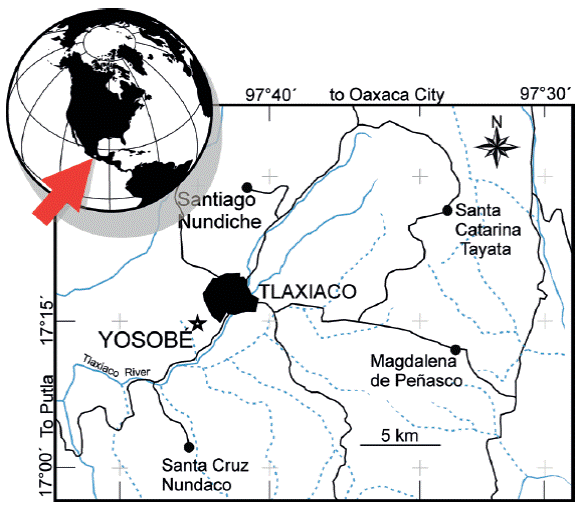
Figure 1
Map of Tlaxiaco area, Oaxaca State, southern Mexico, showing the location of Yosobé.
Map of Tlaxiaco area, Oaxaca State, southern Mexico, showing the location of Yosobé.
This site, a diverse vertebrate assemblage has been recovered from the Kimmeridgian-Tithonian sequence of shale and limestone belonging to the informally named Sabinal formation (Alvarado-Ortega et al., 2014; Barrientos-Lara, 2013), which is part of the Jurassic-Cretaceous sedimentary deposits of the Tlaxiaco Basin (Meneses-Rocha et al., 1994). The fossil assemblage of Yosobé comprises numerous invertebrates (ammonites and bivalves, among others), carbonized wood, and vertebrates including fishes and marine reptiles. Among these fossils, the pliosaurs are represented by two specimens. The aims of this manuscript are to provide a detailed description of the Late Jurassic pliosaurid remains recovered in Yosobé and a review of their biogeographical implications.
-
Alvarado-Ortega et al., 2014Late Jurassic marine vertebrates from Tlaxiaco, Oaxaca State, southern MexicoPalaeontologia Electronica, 2014
-
Barrientos-Lara, 2013Determinación de los reptiles marinos de la Formación Sabinal (Jurásico Superior, Kimmeridgiano-Tithoniano) Tlaxiaco, Oaxaca, 2013
-
Meneses-Rocha et al., 1994Bosquejo paleogeográfico y tectónico del sur de México durante el MesozoicoBoletín de la Asociación Mexicana de Geólogos Petroleros, 1994
MATERIAL AND METHODS
The two specimens described in this manuscript are deposited in the Colección Nacional de Paleontología, which is housed in the Museo María del Carmen Perrilliat, Instituto de Geología, UNAM. The Yobosé site is recorded as IGM-locality 3871 in the Catalog of Mexican localities of this collection. These fossils were prepared mechanically using fine air-scribe tools and dental needles, and they were hardened with plexygum. The institutional acronyms used in this manuscript are: IGM, Colección Nacional de Paleontología, Instituto de Geología, UNAM; BHN, Musée d ́Histoire Natrelle, Boulogne-sur-Mer, France.
SYSTEMATIC PALEONTOLOGY
Superorder Sauropterygia Owen, 1860
-
Owen, 1860On the orders of fossil and recent Rebtilia, and their distribution in time, 1860
Order Plesiosauria Blainville, 1835
-
Blainville, 1835Description de quelques espèces de reptiles de la Californie, precede de l ́analyse d ́un système general d ́Herpetologie et d ́amphibiologie: over of marine tetrapods during the Jurassic-Cretaceous transitionNouvelle Annales du Museum ltad de Estudiol d'Histoire Naturelle, 1835
Family Pliosauridae Seeley, 1874
-
Seeley, 1874Note on some of the generic modifications of the plesiosaurian pectoral archQuarterly Journal of the Geological Society, 1874
Unranked clade Thalassophonea Benson and Druckenmiller, 2014
-
Benson and Druckenmiller, 2014Faunal turnover of marine tetrapods during the Jurassic-Cretaceous transitionBiological Reviews, 2014
Liopleurodon Sauvage, 1873.
-
Sauvage, 1873Note sur les reptiles fossilesBulletin de la Société Géologique de France, 1873
Type species. Liopleurodon ferox Savage, 1873. BHN 3R 197; A single tooth from Wast, near Boulogne-sur-Mer, France.
Remarks. Although four species have been named within this genus (see Bardet, 1995); Noè (2001: 27-29 and 31-32) regarded Liopleurodon as a monospecific genus and L. ferox being its type species. The other species once referred to Liopleurodon, L. rossicus (Novozhilov, 1948) and L. macromerus (Phillips, 1871), today assigned to Pliosaurus (Tarlo, 1960; Halstead, 1971; Bardet, 1995; Noè et al., 2004; Knutsen, 2012; Benson et al., 2013). The species Liopleurodon ferox has been improperly also named as Pliosaurus ferox (Lydekker, 1888; Andrews, 1897; Delair, 1959; among others). Other possible synonyms of Liopleurodon ferox include nominal species as Ischyrodon meriani (von Meyer, 1838), Thaumatosaurus oolithicus (von Meyer, 1841), Pliosaurus giganteus (Conybeare, 1824), and Pliosaurus pachydeirus (Seeley, 1869) that are useless because these were erected on non-diagnostic and insufficiently characterized material (Brown, 1981; Noè, 2001).
-
Bardet, 1995Evolution et extinction des reptiles marins au cours du MesozoiquePalaeovertebrata, 1995
-
Noè (2001: 27-29 and 31-32)A taxonomic and functional study of the Callovian (Middle Jurassic) Pliosauroidea (Reptilia, Sauropterygia), 2001
-
Novozhilov, 1948Two new pliosaurs from the Lower Volgian beds, PovolzheDoklady Akademii Nauk, 1948
-
Phillips, 1871Geology of Oxford and the valley of the Thames, 1871
-
Tarlo, 1960A review of the upper Jurassic pliosaurs: Bulletin of the British Museum (Natural History)Geology, 1960
-
Halstead, 1971Liopleurodon rossicus (Novozhilov) -a pliosaur from the Lower Volgian of the Moscow BasinPalaeontology, 1971
-
Bardet, 1995Evolution et extinction des reptiles marins au cours du MesozoiquePalaeovertebrata, 1995
-
Noè et al., 2004A new species of Kimmeridgian pliosaur (Reptilia; Sauropterygia) and its bearing on the nomenclature of Liopleurodon macromerusProceedings of the Geologists' Association, 2004
-
Knutsen, 2012A new species of Pliosaurus (Sauropterygia: Plesiosauria) From the Middle Volgian of central Spitsbergen, NorwayNorwegian Journal of Geology, 2012
-
Benson et al., 2013A Giant Pliosaurid Skull from the Late Jurassic of EnglandPlos One, 2013
-
Lydekker, 1888Notes on the Sauropterygia of the Oxford and Kimeridge Clays, mainly based on the collection of Mr Leeds at EyeburyGeological Magazine, 1888
-
Andrews, 1897On the structure of the skullapliosaurQuarterly Journal of the Geological Society of London, 1897
-
Delair, 1959The Mesozoic reptiles of DorsetProceedings of the Dorset Natural History and Antiquities Field Club, 1959
-
von Meyer, 1838Mittheilungen an Professor Bronn gerichtetNeues Jahrbuch für Mineralogie, Geologie und Paläontologie, 1838
-
von Meyer, 1841Thaumatosaurus oolithicus, der fossile wunder-saurus aus dem OolithNeues Jahrbuch für Mineralogie, Geologie und Paläontologie, 1841
-
Conybeare, 1824On the discovery of an almost perfect skeleton of the PlesiosaurusTransactions of the Geological Society of London, 1824
-
Seeley, 1869Index to the fossil remains of Aves, Ornithosauria, and Reptilia, from the Secondary System of Strata arranged in the Woodwardian Museum of the University of Cambridge, 1869
-
Brown, 1981The English Upper Jurassic Plesiosauroidea (Reptilia) and a review of the phylogeny and classification of the PlesiosauriaBulletin of the British Museum (Natural History), 1981
-
Noè, 2001A taxonomic and functional study of the Callovian (Middle Jurassic) Pliosauroidea (Reptilia, Sauropterygia), 2001
Liopleurodon sp.
Thumbnail
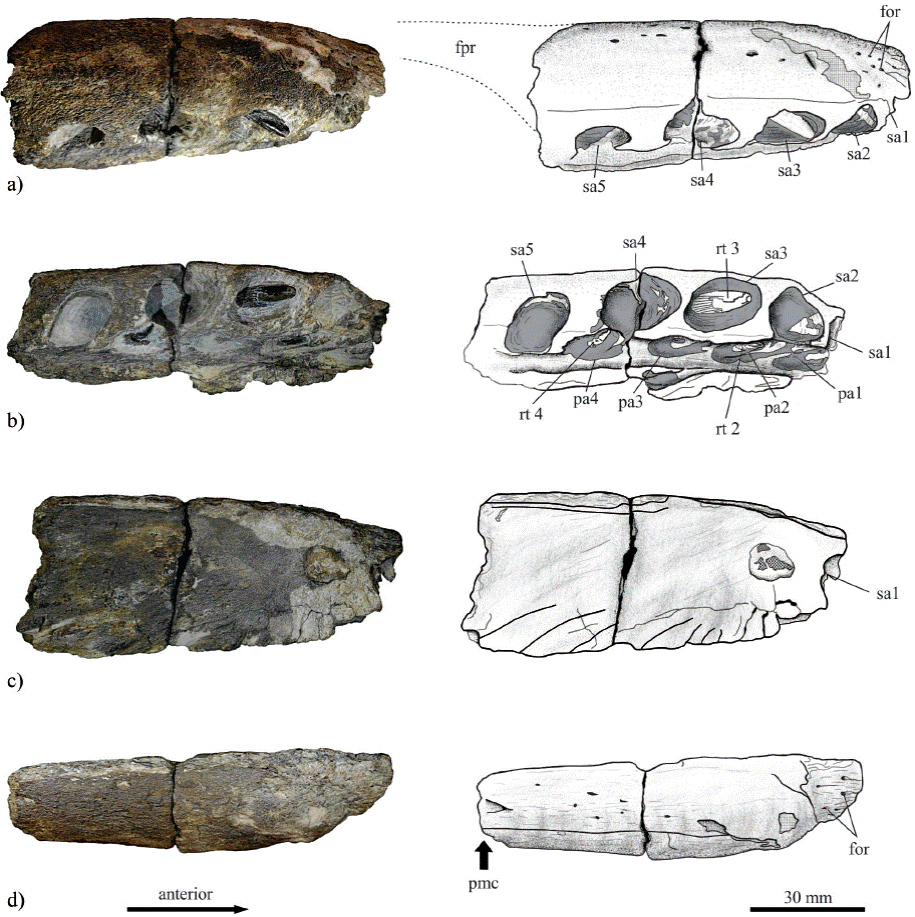
Figure 2
Photograph and line drawings of IGM 4545, fragment of right premaxilla of Liopleurodon sp. from the Kimmeridgian sediments of Yosobé , Oaxaca, southern Mexico. a) Lateral external view; b) ventral view; c) lateral medial view; d) dorsal view. Abbreviations: for, foraminae; pmc, premaxilla constriction; fpr, premaxilla facial process; rt 1-4, replacement tooth; pa 1-5, primary alveolus; sa 1-4 secondary alveolus.
Photograph and line drawings of IGM 4545, fragment of right premaxilla of Liopleurodon sp. from the Kimmeridgian sediments of Yosobé , Oaxaca, southern Mexico. a) Lateral external view; b) ventral view; c) lateral medial view; d) dorsal view. Abbreviations: for, foraminae; pmc, premaxilla constriction; fpr, premaxilla facial process; rt 1-4, replacement tooth; pa 1-5, primary alveolus; sa 1-4 secondary alveolus.
Thumbnail
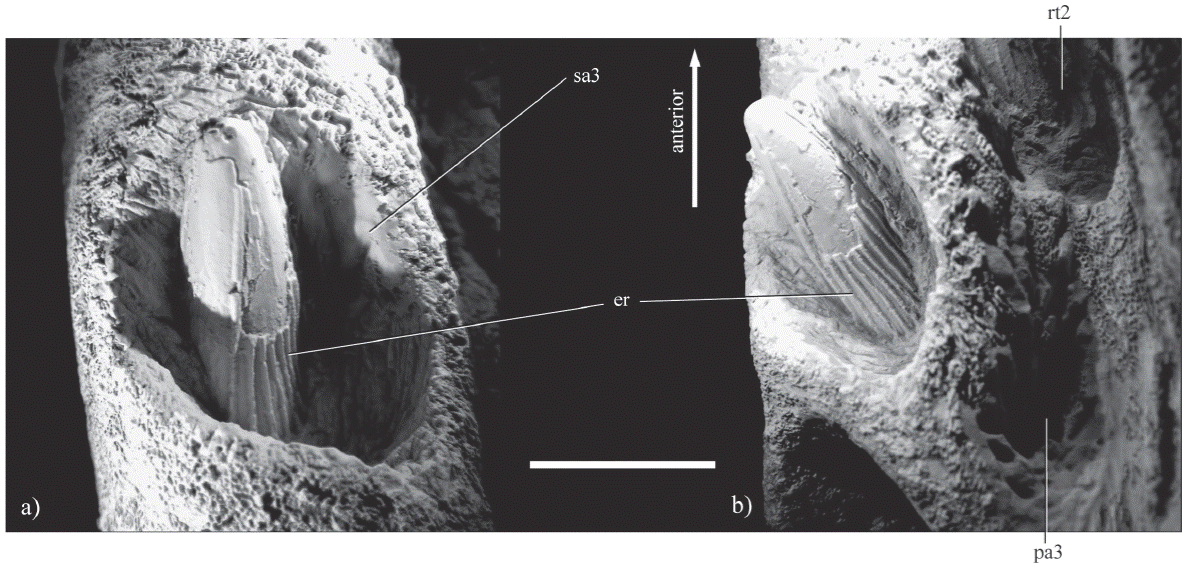
Figure 3
Replecement tooth in the functional alveolus 3 of IGM 4545, fragment of right premaxilla of Liopleurodon sp. from the Kimmeridgian sediments of Yosobé , Oaxaca, southern Mexico. shows that the enamel of near the crown tip was lost partially (the specimen is contrasted with ammonium chloride). a) lateraldorsal view; b) dorsal view. Abbreviations: er, enamel ridges; pa 3, primary alveoli 3; rt 2, replacement tooth 2; sa 3 secondary alveoli 3.
Replecement tooth in the functional alveolus 3 of IGM 4545, fragment of right premaxilla of Liopleurodon sp. from the Kimmeridgian sediments of Yosobé , Oaxaca, southern Mexico. shows that the enamel of near the crown tip was lost partially (the specimen is contrasted with ammonium chloride). a) lateraldorsal view; b) dorsal view. Abbreviations: er, enamel ridges; pa 3, primary alveoli 3; rt 2, replacement tooth 2; sa 3 secondary alveoli 3.
Thumbnail
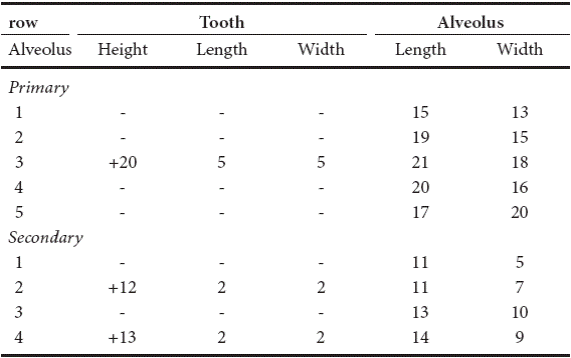
Table 1
Measurements of the teeth and alveolus of IGM 4545, a fragment of the right premaxilla of Liopleurodon sp. from Yosobé, Oaxaca, Mexico. All measurements are given in millimeters; +, means at least.
Measurements of the teeth and alveolus of IGM 4545, a fragment of the right premaxilla of Liopleurodon sp. from Yosobé, Oaxaca, Mexico. All measurements are given in millimeters; +, means at least.
Referred material. IGM 4545, fragment of a right premaxilla divided into parts and preserving three replacement teeth.
locality and horizon. The shale layer L4-L5 of the Kimmeridgian sequence belonging to Sabinal formation at Yosobé, near Tlaxiaco town, Oaxaca State, Mexico (see Alvarado-Ortega et al., 2014). Description. Specimen IGM 4545 is a fragment of the anterior end of the right premaxilla. The shape of this bony fragment can be crudely described as similar to a quarter of a cylinder cut lengthwise. This bone is not preserved entire, its posterior end is broken and lacks the long narrow premaxilla facial process; however, its anterior stout and tooth-bearing section is well-preserved.
-
Alvarado-Ortega et al., 2014Late Jurassic marine vertebrates from Tlaxiaco, Oaxaca State, southern MexicoPalaeontologia Electronica, 2014
This premaxilla fragment, in lateral external face is a long roughly rectangular structure (130 mm long, 53 mm in height, and 32 mm width), in which the anterior end is tapered forming a rounded edge. In this view, the smooth and almost flat symphyseal surface is exposed showing some dorsal and ventral ridges. The ventral ridges are somewhat wavy; here the smaller undulations were probably interdigitated with similar undulations of the left premaxilla to make up a strong suture. The large undulation in the posterior area probably represents part of the space occupied by the vomer. The lateral external view of this bone shows a convex surface with small foraminae that increase in size and number anteriorly.
The ventral view of this bony fragment corresponds to the alveolar surface. Here the alveoli form two rows; the primary or labial row is located alongside the extrenal edge including the larger alveoli whereas the secondary or lingual row, near the symphysial edge, includes small alveoli interspersed with larger alveoli (Table 1). The labial row is composed of at least five functional alveoli, which are large oval, longer than wide, and placed so close to each other that practically occupy the entire ventral surface. In contrast, the internal or lingual row includes four replacement alveoli that open into a longitudinal canal near to the symphysis. The axes of all alveoli are projected laterally and forward suggesting that the teeth were slightly procumbent and anteriorly directed.
The tooth of the third functional alveolus is well preserved and its crown is almost totally exposed reaching the length 23 mm. This crown clearly is conical, straight, and circular in cross section. Although two teeth are preserved in replacement alveoli two and four, these are not fully developed and are embedded in the rock only part of their crowns are exposed. The enamel on the crown surface is heavily ornamented in the lingual surface with longitudinal ridges spaced uniformly. These ridges are project continuously from the crown base to its apex; also, these are more numerous and regular on the lingual surface that in the labial surface, where the ridges are most widely spaced and unevenly distributed.
Remarks. At the end of the last century, Carpenter (1996, 1999) review the family Pliosauridae, then restricted to short-necked Middle-Late Jurassic plesiosaurians species, suggesting that pliosaurids differ from all other plesiosaurs by the heavy or thick enamel ridges on the teeth (also present in the members of the subfamily Brachaucheninae today included into Pliosauridae). After Carpenter ́s works the taxonomical diversity of Pliosauridae has been significantly enriched and reordered (e.g. Benson et al., 2013; Benson and Drunkenmiller, 2014; among others). If the Carpenter ́s observations are considered, IGM 4545 could be recognized an unquestionable representative of the family Pliosauridae; however, today the thick enamel ridges on teeth are not part of the last diagnosis of this family , as it was described by Ketchum and Benson (2010). Among Pliosauridae, only Liopleurodon and Simolestes share a group of characteristics that includes the presence of heavy (= coarse, thick) enamel ridges on dental crowns, a transverse constriction in the rostrum at the level of premaxilla-maxilla suture, and five conical and robust functional teeth in the premaxilla (see Druckenmiller and Russell, 2008; Benson and Druckenmiller, 2014; and O'Keefe, 2001). In the present context, despite the incompleteness of IGM 4545, this specimen is certainly included into the family because it shares the combination of characteris of two Liopleurodon and Simolestes.
-
Carpenter (1996A review of short-necked plesiosaurs from the Cretaceous of the Western Interior, North AmericaNeues Jahrbuch für Geologie und Paläontologie, 1996
-
1999)Revision of North American elasmosaurs from the Cretaceous of the Western InteriorPaludicola, 1999
-
Benson et al., 2013A Giant Pliosaurid Skull from the Late Jurassic of EnglandPlos One, 2013
-
Benson and Drunkenmiller, 2014Faunal turnover of marine tetrapods during the Jurassic-Cretaceous transitionBiological Reviews, 2014
-
Ketchum and Benson (2010)Global interrelationships of Plesiosauria (Reptilia, Sauropterygia) and the pivotal role of taxon sampling in determining the outcome of phylogenetic analysesBiological Reviews, 2010
-
Druckenmiller and Russell, 2008A phylogeny of Plesiosauria (Sauropterygia) and its bearing on the systematic status of Leptocleidus Andrews, 1922Zootaxa, 20081863
-
Benson and Druckenmiller, 2014Faunal turnover of marine tetrapods during the Jurassic-Cretaceous transitionBiological Reviews, 2014
-
O'Keefe, 2001A cladistic analysis and taxonomic revision of the Plesiosauria (Reptilia: Sauropterygia)Acta Zoologica Fennica, 2001
Among middle-Late Jurassic of pliosaurids, Pliosaurus and Gallardosaurus have trihedral teeth with two carinae separating the lingual and labial tooth faces (Knutsen, 2012; Gasparini, 2009). In teeth of IGM 4545, as in Simolestes and Liopleurodon, the enamel ridges runs almost continuously along the crown, from the base to apex (Tarlo 1960; Noè, 2001); however, the enamel ridges in Simolestes are comparatively less developed than those of Liopleurodon and IGM 4545. In Peloneustes and Marmornectes these ridges are present only in the basal half or three-quarters of the height of the crown (Ketchum and Benson, 2011a, b).
-
Knutsen, 2012A new species of Pliosaurus (Sauropterygia: Plesiosauria) From the Middle Volgian of central Spitsbergen, NorwayNorwegian Journal of Geology, 2012
-
Gasparini, 2009A new oxfordian Pliosaurid (Plesiosauria, Pliosauridae) in the Caribbean seawayPalaeontology, 2009
-
Tarlo 1960A review of the upper Jurassic pliosaurs: Bulletin of the British Museum (Natural History)Geology, 1960
-
Noè, 2001A taxonomic and functional study of the Callovian (Middle Jurassic) Pliosauroidea (Reptilia, Sauropterygia), 2001
-
Ketchum and Benson, 2011aA new pliosaurid (sauropterygia, Plesiosauria) from the Oxford Clay Formation (middle Jurassic, Callovian) of England: Evidence for a gracile, longirostrine grade of erly-middle Jurassic pliosauridsSpecial Papers in Palaeontology, 2011
-
bThe cranial anatomy and taxonomy of Peloneustes philarchus (Sauropterygia, Pliosauridae) from the Peterborough Member (Callovian, Middle jurassic) of the United KingdomPalaeontology, 2011
Liopleurodon and Simolestes clearly differ to each other if the shape of the premaxilla is considered (see Noè, 2001, vol. II, figs. 87-88, 94-95, 98-99, 108-111, and 130). In Simolestes the premaxilla is arrow shaped in dorsal view; it has a deep transverse constriction at the level of the premaxilla-maxilla suture, and its labial and symphysial edges are angled to each other. In Simolestes, the premaxilla is also twice wider than high. In contrast, the premaxilla of Liopleurodon is more rectangular, where the labial and symphyseal edges run parallel to each other almost all along and the transverse constriction is rather shallow. In Liopleurodon, the premaxilla is also higher than wide. IGM 4545 shares the premaxilla characters of Liopleurodon supporting its inclusion in this genus.
-
Noè, 2001A taxonomic and functional study of the Callovian (Middle Jurassic) Pliosauroidea (Reptilia, Sauropterygia), 2001
Although the specimen IGM 4545 shows the stout continuous enamel ridges that constitute the most remarkable features in the diagnosis of the monospecific genus Liopelurodon, which is also applicable to Liopleurodon ferox; currently, this species is restricted to the Callovian strata of Europe. Therefore, the specific determination of the Kimmeridgian Liopleurodon specimen from Tlaxiaco will require additional material and morphological data.
Genus and species indet.
Thumbnail

Figure 4
Photograph of selected bones of IGM 4546, an indeterminate Pliosauridae specimen from the Kimmeridgian sediments of Yosobé , Oaxaca, southern Mexico. a) Outline draw of a pliosaurid showing the position of bony elements illustrated here; b-e) a dorsal centrum (IGM 4546, element 11) in anterior, lateral, dorsal and ventral view respectively; f-i) a caudal centrum (IGM 4546, element 7) in anterior, lateral, dorsal and ventral view respectively; j) caudal centrum in lateral view (IGM 4546, elements 3-7) highlighting the facet for rib; k-n) neural arch (IGM 4546, element 17) in posterior, lateral, anterior and ventral view respectively. Abbreviations: fna, facet for neural arch; for, foramen; ribf, rib facet; nc, neural canal; ns, neural spine; rib, rib remains; st, shark tooth.
Photograph of selected bones of IGM 4546, an indeterminate Pliosauridae specimen from the Kimmeridgian sediments of Yosobé , Oaxaca, southern Mexico. a) Outline draw of a pliosaurid showing the position of bony elements illustrated here; b-e) a dorsal centrum (IGM 4546, element 11) in anterior, lateral, dorsal and ventral view respectively; f-i) a caudal centrum (IGM 4546, element 7) in anterior, lateral, dorsal and ventral view respectively; j) caudal centrum in lateral view (IGM 4546, elements 3-7) highlighting the facet for rib; k-n) neural arch (IGM 4546, element 17) in posterior, lateral, anterior and ventral view respectively. Abbreviations: fna, facet for neural arch; for, foramen; ribf, rib facet; nc, neural canal; ns, neural spine; rib, rib remains; st, shark tooth.
Thumbnail
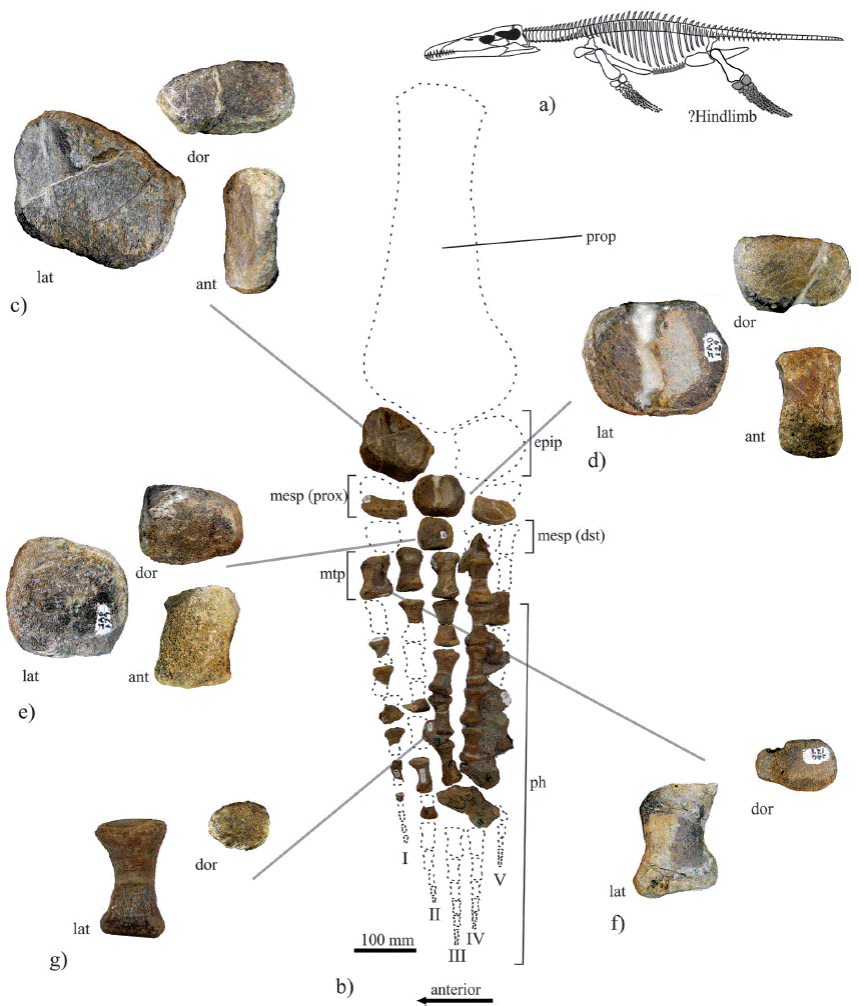
Figure 5
Photograph s of selected bones of the limb of IGM 4546, an indeterminate Pliosauridae specimen from the Kimmeridgian sediments of Yosobé , Oaxaca, southern Mexico. a) Outline draw of a complete pliosaurid showing the position of the bone elements illustrated here; b) bones of the limb showing their natural positions; c) epipodial (IGM 4546, element 19); d) Proximal medial mesopodial (IGM 4546, element 20); e) Distal mesopodial (IGM 4546, element 23); f) metapodial I (IGM 4546, element 24); g) phalanx 3-III (IGM 4546, element 37). Abbreviations: ant, anterios view; dor, dorsal view; dst, distal; epip, epipodial; I-V, digits; lat, lateral view; mesp, mesopodial; metp, metapodial; ph, phalanges; prop, propodial; prox, proximal.
Photograph s of selected bones of the limb of IGM 4546, an indeterminate Pliosauridae specimen from the Kimmeridgian sediments of Yosobé , Oaxaca, southern Mexico. a) Outline draw of a complete pliosaurid showing the position of the bone elements illustrated here; b) bones of the limb showing their natural positions; c) epipodial (IGM 4546, element 19); d) Proximal medial mesopodial (IGM 4546, element 20); e) Distal mesopodial (IGM 4546, element 23); f) metapodial I (IGM 4546, element 24); g) phalanx 3-III (IGM 4546, element 37). Abbreviations: ant, anterios view; dor, dorsal view; dst, distal; epip, epipodial; I-V, digits; lat, lateral view; mesp, mesopodial; metp, metapodial; ph, phalanges; prop, propodial; prox, proximal.
Thumbnail
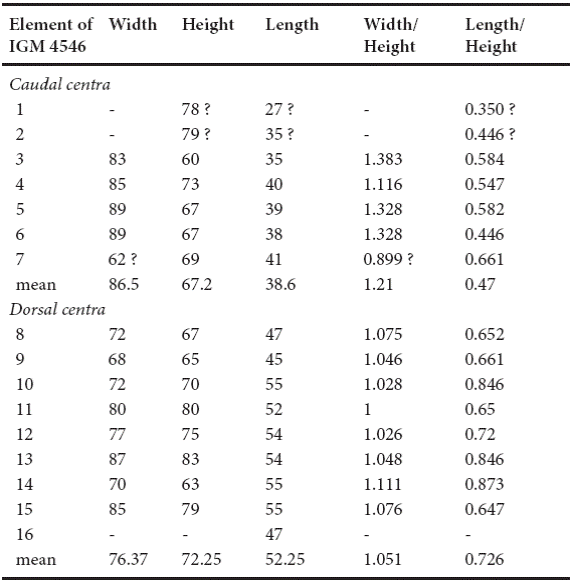
Table 2
Measurements and proportion of caudal and dorsal elements of the vertebral column of the specimen IGM 4546, an indeterminate Pliosauridae from Yosobé, Oaxaca, Mexico. Means do not include missing (-) or uncertain (?) measurements.
Measurements and proportion of caudal and dorsal elements of the vertebral column of the specimen IGM 4546, an indeterminate Pliosauridae from Yosobé, Oaxaca, Mexico. Means do not include missing (-) or uncertain (?) measurements.
Thumbnail
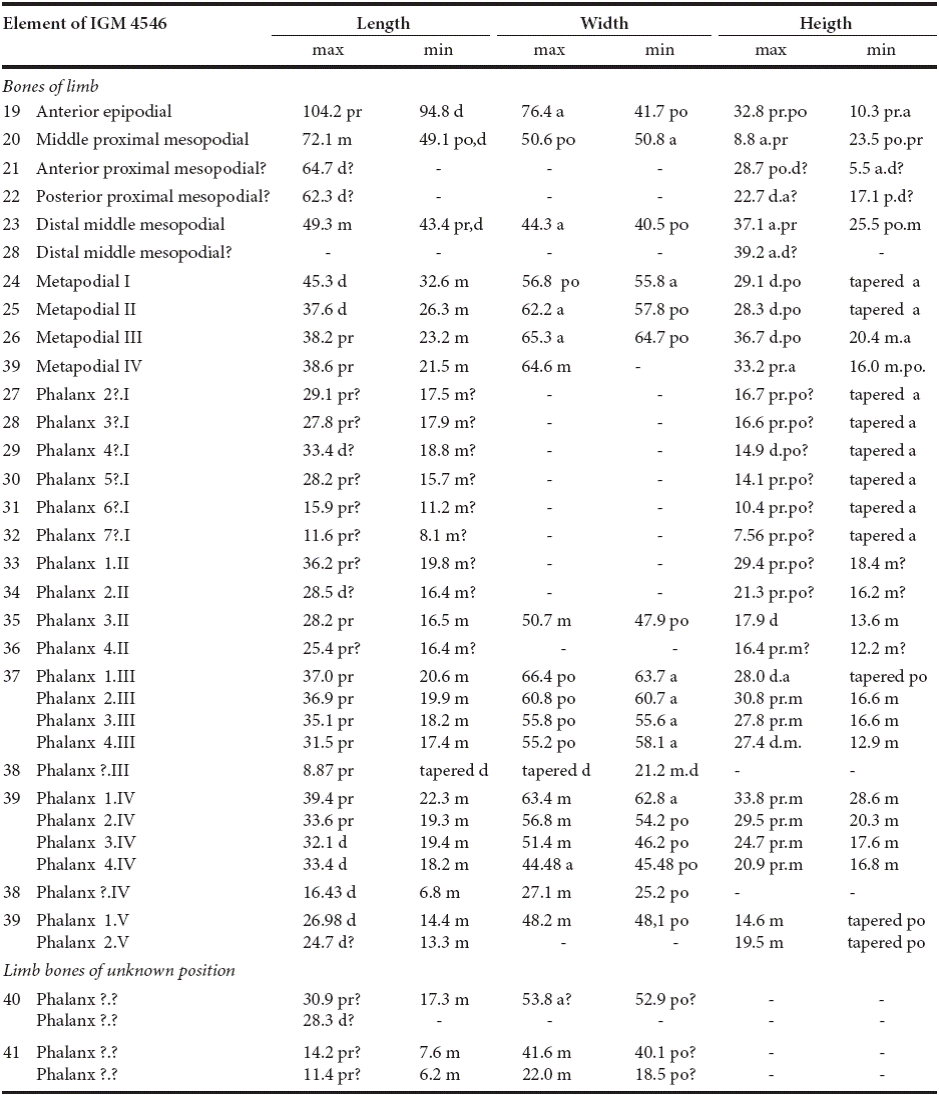
Table 3
Measurements and proportion of elements of IGM 4546 that represents the limb (expressed in millimeters). Arabic numerals show the position of the phalanges in a proximal-distal order; roman numerals indicate the digit to which they belong; anterior and posterior refers to the position of the element in the limb.
Measurements and proportion of elements of IGM 4546 that represents the limb (expressed in millimeters). Arabic numerals show the position of the phalanges in a proximal-distal order; roman numerals indicate the digit to which they belong; anterior and posterior refers to the position of the element in the limb.
Referred material. IGM 4546. This specimen consists of 16 vertebrae (nine dorsals and seven caudals (IGM 4546, elements 8-16 and 1-7, respectively); a neural arch almost complete and an articular pedicel of a neural arch (IGM 4546, elements 17 and 18 respectively); a epipodial, tree mesopodial proximals, two distal mesopodials, four metapodial elements, and twenty two phalanges of the same limb (11 of them articulated to each other) (IGM 4546, elements 19-39). There are also four phalanges of unknown position (preserved as part of the elements 40 and 41 of IGM 4546), plus several rib fragments and other unidentified bones. Here, all these skeletal elements are considered as belonging of the same individual because they were collected in the same spot with some of them in life position. A shark tooth of Planohybodus Rees and Underwood, 2008, was found associated to one of the vertebrae of this specimen (Figure 4f) (Alvarado-Ortega et al., 2014).
-
Rees and Underwood, 2008Hybodont sharks of the English Bathonian and Callovian (Middle Jurassic)Palaeontology, 2008
-
Alvarado-Ortega et al., 2014Late Jurassic marine vertebrates from Tlaxiaco, Oaxaca State, southern MexicoPalaeontologia Electronica, 2014
Ocurrence. Shale layer M-L1 of the Kimmeridgian bituminous shales belonging to Sabinal formation at Yosobé, Oaxaca, southern Mexico (see Alvarado-Ortega et al., 2014).
-
Alvarado-Ortega et al., 2014Late Jurassic marine vertebrates from Tlaxiaco, Oaxaca State, southern MexicoPalaeontologia Electronica, 2014
Description. Axial skeleton. Vertebrae are thick and short cylindrical structures. Their surfaces are strongly weathered and therefore the occurrence or absence of a ventral keel in these vertebrae cannot be confirmed. Large nutritive foramina are present on the lateral and ventral surfaces of the vertebrae. The inter-vertebral articular surfaces are weakly concave. There elongate oval facets for the attachment of the neural arch the dorsal surface of each centra. These facets frame the floor of the neural canal, is flat and hour-glass shaped. None of the centra are fused with their respective neural arches suggesting that IGM 4546 is a juvenile individual.
Table 2 summarizes the measures of vertebrae preserved of IGM 4546 and their basic proportions. The width and height of these bones range between 60 and 90 mm; these are approximately equal in length with a mean value of 45 mm. In IGM 4546, the dorsal centra are recognized for absence of rib facets. The caudal centra are proportionally wider than the dorsals and their inter-vertebral surfaces are ovate in outline. Additionally, caudal centra bear a single oval concave rib facet on each lateral surface; this is located on the top of a small lateral projection (Figure 4f and 4g). The anatomical position of these vertabrae within the caudal series cannot be confidently determined; however, five of these (IGM 4546, elements 3-7 in Figure 4j) have the rib facets placed on the upper half of the centra height, whereas this facet is placed very close to its dorsal edge in one (IGM 4546, element 7) (Figure 4g). The position of the rib facet suggests the caudal position of these vertebrae, with the latter being the closest to the sacral region.
There are two neural arches IGM 4546, one almost compete (element 17 in Figure 4k-4n) and other that only comprise the ventral processes that attach with the centra (element 18 of IGM 4546, not figured). In anterior view, the first of these arches shows a triangular shape, in which the neural cavity comprises a quarter of the height of the neural arch, and the rest of this bone forms a thin neural spine. In lateral view, this bone is sigmoid because the neural spine is tilted backward and has the anterior and posterior edges slightly curved. Laterally, the neural cavity is formed by two stout ventral pedicels that are ventrally expanded. In ventral view and at the end of these pedicels, the articular facet triangular with rounded edges. The lack of zygapophyses of the neural arches preserved, suggests that this elements correspond to the posterior caudal area.
Limb. The 20 element (IGM 4546, elements 9 to 39) of the limb bones described here, are considered as part of the same limb because they were collected together (Figure 5). The position of the some phalanges and other bones preserved in two rock fragments (IGM 4546, elements 40 and 41) is unknown. Table 2 summarizes the measurements of all these bones.
In dorsal and ventral view the epipodial (IGM 4546, element 19) is stout and roughly trapezoid in shape with a curved convex anterior border (Figure 5c). Is 1.5 times longer than wide, all its edges are almost straight but of unequal size; the proximal edge is the longer edges, it is followed by the distal, then the anterior is wider than the posterior, and the fifth edge that is located in the posterior distal end is the smaller. Although the ventral and dorsal surfaces of this bone are smooth; each of them is almost entirely occupied by a wide and shallow groove that is extended from anterior to posterior edge. The height of this bone is not uniform. The proximal and probably the distal articular surfaces are arrow shaped, whereas the posterior and posterior distal articular surfaces are rectangular. In this bone all the articular facets are rough and slightly convex.
In dorsal and ventral view, the proximal mesopodial located in the middle section is hexagonal shaped (IGM 4546, element 20), about 1.5 times longer than wide (Figure 5d). As the epipodial, the ventral and dorsal surfaces of this bone are smooth and concave. All its articular facets are rough and slightly convex (Figure 5d). However, unlike the epipodial, in the proximal middle mesopodial the height is 1.3 to three times higher in the anterior edge than in the posterior. Although the proximal and distal articular facets of this bone are trapezoids and similar in size; its transversal facets are different in shape and size. The anterior proximal transverse facet that articulates with the epipodial is rectangular and about 1.5 times higher than wide. The anterior distal transverse facet is square. The posterior proximal transverse facet is rectangular, about 1.2 to 1.3 times higher than wide, and with the dorsal edge strongly concave.
Two very poorly preserved bones collected near to the epipodial and proximal middle mesopodial are here identified as possible remains of the laterals proximal mesopodial element (IGM 4546, elements 21 and 22, respectively). Although, a large part of the proximal end is lost in these bones; Is estimated that these bones were rectangular shape in dorsal and ventral view, in this face is observe surfaces are smooth and concave.
A complete stout middle distal mesopodial is preserved (IGM 4546, element 23). A small bone fragment that probably represents another stout middle distal mesopodial of the same limb is preserved at the proximal end of rock that bears a series of metapodial and six phalanges in life position (IGM 4546, element 39). The 3-D shape of the complete middle distal mesopodial is almost cubic. In dorsal and ventral view, this bone is almost square, slightly longer than wide, and the anterior edge is slightly wider than the posterior edge. The ventral and dorsal surfaces of this bone are smooth and concave. Although the height of this bone tapers posteriorly, its anterior height is about 1.25 times the height of its rear. All the articular facets of this bone are coarse and slightly convex. Its anterior articular facet, the larger, is rectangular, slightly wider than high, and its ventral and dorsal borders are notably concave. The posterior facet also is rectangular and its ventral and dorsal borders are concave, but this facet is about 1.6 times wider than high and the ventral border is notably less curved. The proximal and distal facets of this bone are trapezoid shape and similar in size; in these the length is 1.125 times longer than the anterior height and 1.5 times the posterior height.
Other bones of this limb partially recovered include elements of the four metapodial element and other elements of the five digits (Figure 5b). All these bones show the typical "I"shape, in that the proximal and distal end form articular facet that are greatly expanded in relation to the central region of these bones. The four metapodial bones (IGM 4546, elements 24 to 26, and the second proximal bone in IGM 4546, element 39) were recovered. These are the most robust and long elements in the digits. The metapodial I tapers anteriorly. The metapodial I to IV are arranged in parallel to each other forming a line.
There are 26 phalanges of the limb preserved (IGM 4546, elements 27 to 39, in Figure 5b and Table 3). This series includes fragments of six thin phalanges that are tapered anteriorly and probably belong to digit I. This also includes one complete and three fragments of the phalanges of digit II, five complete phalanges belonging to digit III, as well as other of digit IV. Digit V only is represented by two complete phalanges. The size of the phalanges decreases in proximal distal order; those of digits I to IV are also arranged in lines and those belonging to the digit V are misaligned. The phalanges of digits I and V are tapered anteriorly and posteriorly, respectibvely. The distal end of the most distal phalanx of digit III identified here (in Table 4) is rounded.
Remarks. Vertebral morphology, including the proportions and the presence of paired or unpaired nutritive foramina on the ventral or lateral surfaces of caudal and dorsal centra, as well as the morphology of the limb guarantee the identification of the IGM 4546 as a Plesiosauria. Probability the limb described above of this specimen represents a hind limb, given its filed position near to the caudal vertebrae; however, there is no additional evidences to support this possibility. Therefore, it is not possible to use the features of this limb to reach an accurate taxonomical identification. Nevertheless, IGM 4546 shares with all the Jurassic Pliosauridae genera the proportion of the vertebrae; these areapproximately two times higher than long (Buchy et al., 2003). Recently, Benson and Druckenmiller (2014) defined the Thalassophonea clade within Pliosauridae; however, characters supporting this clade are not preserved in the IGM 4546 and therefore this material is identified here just to the family level, as Pliosauridae.
-
Buchy et al., 2003First occurrence of a gigantic pliosaurid plesiosaur in the Late Jurassic of MéxicoBulletin de la Société Géologique de France, 2003
-
Benson and Druckenmiller (2014)Faunal turnover of marine tetrapods during the Jurassic-Cretaceous transitionBiological Reviews, 2014
DISCUSSION AND CONCLUSION
Four European species (Liopleurodon ferox Sauvage, 1873; Pliosaurus pachideirus Lydekker, 1888; Stretosaurus macromerus Tarlo, 1959; and Pliosaurus rossicus Novozhilov, 1948) have been included within the genus Liopleurodon; however, today this is considered a monospecific genus represented by the species L. ferox. According Noè (2001: 31-32), the remains of L. ferox has been recorded from Bathonian-Tithonian marine deposits in France, England, Switzerland, and Germany, as well as probably from Poland and Russia; nonetheless, this author and Benson et al. (2013: 32) recognized that those fossils with indubitable diagnostic characters of this species are restricted to the Callovian, mainly to the Oxford Clay Formation of England. The morphology of premaxilla fragment and teeth preserved in IGM 4545 are consistent with those expressed in the diagnosis of Liopleurodon (Noè 2001); also the combination of dental features in IGM 4545 contrasts with those of all other Jurassic pliosaurid genera (see Systematic Paleontology). Considering the age and geographical distance between the Callovian of the Oxford Clay Formation, in Europe, and the Kimmeridgian deposits of the Sabinal formation, near Tlaxiaco, Mexico; there is a possibility that IGM 4545 could represents a new species. The incompleteness of IGM 4545 precludes the execution of a suitable morphological comparative exercise and the identification of this possible new species; hence, the authors prefer to wait for the discovery of more fossils in the Sabinal formation that allow us to determine the species of these Mexican Liopleurodon representatives. In any case, the identification of this specimen has significant implications because this finding extends the stratigraphic range of Liopleurodon into the Late Jurassic along the entire Tethys Sea domain, from Europe to Mexico.
-
Sauvage, 1873Note sur les reptiles fossilesBulletin de la Société Géologique de France, 1873
-
Lydekker, 1888Notes on the Sauropterygia of the Oxford and Kimeridge Clays, mainly based on the collection of Mr Leeds at EyeburyGeological Magazine, 1888
-
Tarlo, 1959Pliosaurus brachyspondylus (Owen) from the Kimmeridge ClayPalaeontology, 1959
-
Novozhilov, 1948Two new pliosaurs from the Lower Volgian beds, PovolzheDoklady Akademii Nauk, 1948
-
Noè (2001: 31-32)A taxonomic and functional study of the Callovian (Middle Jurassic) Pliosauroidea (Reptilia, Sauropterygia), 2001
-
Benson et al. (2013: 32A Giant Pliosaurid Skull from the Late Jurassic of EnglandPlos One, 2013
-
Noè 2001A taxonomic and functional study of the Callovian (Middle Jurassic) Pliosauroidea (Reptilia, Sauropterygia), 2001
Pliosaurids from the Sabinal formation are significant from a paleobiogeographical point of view. During the Jurassic one important paleogeographic process was the breakup of Pangea landmass in two large continents, Gondwana and Laurasia, whose final separation at the west resulted in a narrow and tight sea corridor, the Hispanic Corridor (Hallam, 1977). Since the Early Jurassic, this marine pathway connected the western Tethys with the eastern Pacific acting as an important dispersion route for marine benthonic organisms from both sides, which had to adjust to the consequent reorganization of marine flows patterns at global level triggered by this connection (Riccardi, 1991; Parrish, 1992; Damborenea et al., 2013). It has been hypothesized that the Hispanic Corridor was a barrier for most pelagic invertebrate faunas until Middle or even Late Jurassic (Damborenea and Manceñido, 1979; Boomer and Ballent,1996; Damborenea, 2000; Aberhan, 2001); contrary, records of Jurassic marine reptiles indicate the use of the Hispanic Corridor as a dispersal route for marine reptiles during Middle and Late Jurassic, with no evidence of selective barriers for pelagic versus costal forms. The use of this sea way by marine reptiles have been proposed since the 90 ́s based on the similarities between Middle and Late Jurassic western Tethys marine reptiles assemblages with those of the eastern Pacific, mainly the Late Jurassic assemblages of the Neuquén Basin in northwest Patagonia (e.g. Gasparini, 1992; Gasparini and Fernández, 1996, 1997, Gasparini and O ́Gorman, 2014). The first direct evidences of marine reptiles within the Hispanic Corridor have been yield by Oxfordian marine reptiles assemblage of the Jagua Formation of Cuba including off-shore predators such as ophthalmosaurid ichthyosaurs, metriorhynchid crocodylifomrs and cryptoclidid and pliosaurid plesiosaurs up to more costal forms such as pleurodiran turtles (Fernández and Iturralde-Vinent, 2000; Gasparini and Iturralde-Vinent, 2001; De la Fuente and Iturralde-Vinent, 2001; Gasparini et al., 2002; Gasparini, 2009). To these evidences must be added latter discoveries of Late Jurassic (Tithonian) marine assemblages of north-east México (Buchy et al., 2003; Buchy, 2007).
-
Hallam, 1977Jurassic bivalve biogeographyPaleobiology, 1977
-
Riccardi, 1991Jurassic and Cretaceous marine connections between the Southeast Pacific and TethysPalaeogeography, Palaeoclimatolgy, Palaeoecolgy, 1991
-
Parrish, 1992Phylogeny of the Erythrosuchidae (Reptilia: Archosauriformes)Journal of Vertebrate Paleontology, 1992
-
Damborenea et al., 2013Southern Hemisphere Palaeobiogeography of Triassic-Jurassic Marine Bivalves, 2013
-
Damborenea and Manceñido, 1979On The Palaeogeographical distribution of the pectinid Genus Weyla (Bivalvia, Lower Jurassic)Palaeogeography, Palaeoclimatology, Palaeoecology, 1979
-
Boomer and Ballent,1996Early-Middle Jurassic ostracod migration between the northern and southern hemispheres: further evidence for a proto Atlantic-Central America connectionPalaeogeography, Palaeoclimatology, Palaeoecology, 1996
-
Damborenea, 2000Hispanic Corridor: its evolution and the biogeography of bivalve molluscsGeoResearch Forum, 2000
-
Aberhan, 2001Bivalve palaeobiogeography and the Hispanic Corridor: time of opening and effectiveness of a proto-Atlantic seawayPalaeogeography, Palaeoclimatology, Palaeoecology, 2001
-
Gasparini, 1992Marine reptiles of the Circum-Pacific regionThe Jurassic of the Circum Pacific, 1992
-
Gasparini and Fernández, 1996Biogoegraphic evolutiongraphical affinities of the Jurassic marine reptiles of South AmericaAdvances in Jurassic Research, 1996
-
1997Tithonian marine reptiles of the eastern PacificAncient marine reptiles, 1997
-
Gasparini and O ́Gorman, 2014A new species of Pliosaurus (Sauropterygia, Plesiosauria) from the Upper Jurassic of Northwestern Patagonia, ArgentinaAmeghiniana, 2014
-
Fernández and Iturralde-Vinent, 2000An Oxfordian ichthyosauria (Reptilia) from Viñales, Western Cuba: paleobiogeographic significanceJournal of Vertebrate Paleontology, 2000
-
Gasparini and Iturralde-Vinent, 2001Metriorhynchid crocodiles (Crocodyliformes) from the Oxfordian of Western CubaNeues Jahrbuch für Geologie und Paläontologie, Monatshefte, 2001
-
De la Fuente and Iturralde-Vinent, 2001A new pleurodiran turtle from the Jagua Formation (Oxfordian) of western CubaJournal of Paleontology, 2001
-
Gasparini et al., 2002A new cryptoclidid Plesiosaur from the Oxfordian (Late Jurassic) of CubaGeobios, 2002
-
Gasparini, 2009A new oxfordian Pliosaurid (Plesiosauria, Pliosauridae) in the Caribbean seawayPalaeontology, 2009
-
Buchy et al., 2003First occurrence of a gigantic pliosaurid plesiosaur in the Late Jurassic of MéxicoBulletin de la Société Géologique de France, 2003
-
Buchy, 2007Mesozoic marine reptiles from north-east México: description, systematic, assemblages, and palaeobiogeography, 2007
In the particular case of pliosaurid recovered in the Hispanic Corridor area, previously represented for Gallardosaurus iturraldei from the Oxfordian of Cuba and the Pliosauridae indeterminate from the Late Kimmeridgian-Tithonian strata of La Casita Formation, northeastern Mexico, both Kimmeridgian specimens described here from the Sabinal formation at Tlaxiaco basin, complement and continue the geographical and temporal distribution known of the thalassophonean non-brachauchenine pliosaurids up to Kimmeridgian. Today, these pliosaurids are known in the Thitonian deposits of the Vaca Muerta Formation, Neuquen basin, Argentina Gasparini and O ́Gorman, 2014), the Kimmeridgian Clay Formation exposed in England and France (Ketchum and Benson, 2011a,b), the Volgian strata in Russia (Novozhilov, 1964), the Svalbard Archipelago, Norway (Knutsen, 2012), as well as other localities in Germany and Switzerland (Noè, 2001) and deposits in the southern tip of North America (Figure 6).
-
Gasparini and O ́Gorman, 2014A new species of Pliosaurus (Sauropterygia, Plesiosauria) from the Upper Jurassic of Northwestern Patagonia, ArgentinaAmeghiniana, 2014
-
Ketchum and Benson, 2011aA new pliosaurid (sauropterygia, Plesiosauria) from the Oxford Clay Formation (middle Jurassic, Callovian) of England: Evidence for a gracile, longirostrine grade of erly-middle Jurassic pliosauridsSpecial Papers in Palaeontology, 2011
-
bThe cranial anatomy and taxonomy of Peloneustes philarchus (Sauropterygia, Pliosauridae) from the Peterborough Member (Callovian, Middle jurassic) of the United KingdomPalaeontology, 2011
-
Novozhilov, 1964Order SauropterygiaOsnovy Paleontologii, 12 (Fundamentals of Palaeontology), 1964
-
Knutsen, 2012A new species of Pliosaurus (Sauropterygia: Plesiosauria) From the Middle Volgian of central Spitsbergen, NorwayNorwegian Journal of Geology, 2012
-
Noè, 2001A taxonomic and functional study of the Callovian (Middle Jurassic) Pliosauroidea (Reptilia, Sauropterygia), 2001
Thumbnail
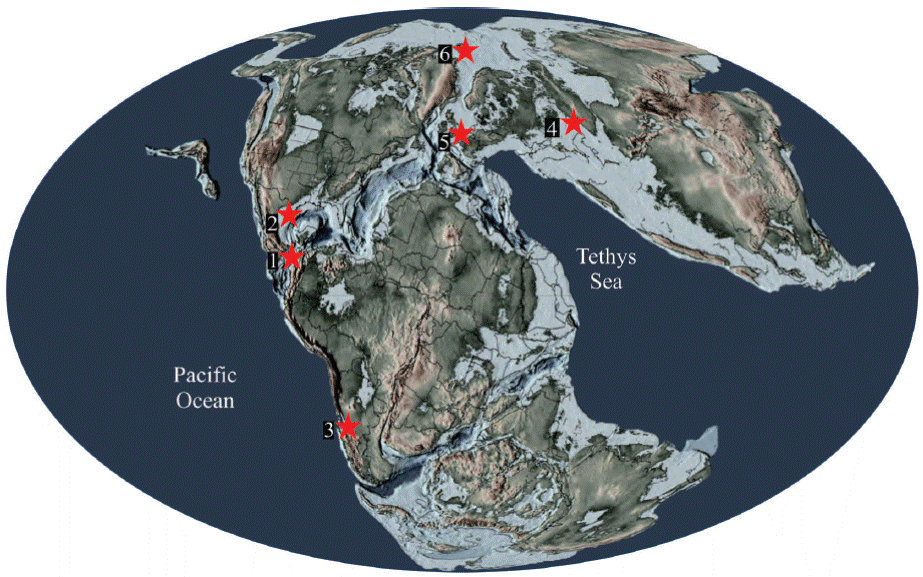
Figure 6
Distribution of Kimmeridgian-Thithonian pliosaurids 1, Liopleurodon ferox, and ndet. pliosaurids Sabinal formation Tlaxiaco Basin, Oaxaca, southern Mexico. 2, Indet. pliosaurids from La Caja and La Casita formations, Coahuila and Nuevo León, northern Mexico. 3, Pliosaurus patagonicus, Vaca Muerta Formation, Neuquen Basin, Argentina. 4, Pliosaurus rossicus, Volgian strata, Russia. 5) Pliosaurus brachyspondylus, Pliosaurus brachydeirus, Pliosaurus macromerus, Kimeridge Clay, England. 6), Pliosaurus funkei, Middle Volgian, Norway (redrawn from Scotese, 2014).
Distribution of Kimmeridgian-Thithonian pliosaurids 1, Liopleurodon ferox, and ndet. pliosaurids Sabinal formation Tlaxiaco Basin, Oaxaca, southern Mexico. 2, Indet. pliosaurids from La Caja and La Casita formations, Coahuila and Nuevo León, northern Mexico. 3, Pliosaurus patagonicus, Vaca Muerta Formation, Neuquen Basin, Argentina. 4, Pliosaurus rossicus, Volgian strata, Russia. 5) Pliosaurus brachyspondylus, Pliosaurus brachydeirus, Pliosaurus macromerus, Kimeridge Clay, England. 6), Pliosaurus funkei, Middle Volgian, Norway (redrawn from Scotese, 2014).
Although, IGM 4546 does not have enough features to support its taxonomical identity to genus and species level; IGM 4545 has a diagnostic character (the conical teeth with enamel ornamented with stout and continuous ridges) to include it as part of the genus Liopleurodon. This occurrence of IGM 4545 confirms the presence of Liopleurodon in the Kimmeridgian of the Hispanic Corridor area and represents the first occurrence of this taxon outside the European eastern Tethys Sea domians.
ACKNOWLEDGMENTS
We are deeply indebted with local people of Tlaxiaco, who made possible the field works. Also we thank the enthusiastic participation in this paleontological project of students and colleagues, and Patrick Druckenmiller and a reviewer by provide thorough and helpful reviews of this manuscript. The Universidad Nacional Autónoma de México (UNAM) provide the financial support to his research through the projects PAPIIT IN106011 and IN207314. CONACyT (Mexico) provided additional support to JIBL through the "Beca Mixta" Program. Financial support from the PICT 0748, PIP43 projects to MF are also acknowledged.
REFERENCES
- Aberhan, M., 2001, Bivalve palaeobiogeography and the Hispanic Corridor: time of opening and effectiveness of a proto-Atlantic seaway: Palaeogeography, Palaeoclimatology, Palaeoecology, 165, 375-394. Links
- Alvarado-Ortega, J., Barrientos-Lara, J.I., Espinosa-Arrubarrena, L., Melgarejo-Damilay, Ian, M.P., 2014, Late Jurassic marine vertebrates from Tlaxiaco, Oaxaca State, southern Mexico: Palaeontologia Electronica, 17(2.24A), 1-25. Links
- Andrews,C.W.,1897,On the structure of the skullapliosaur: Quarterly Journal of the Geological Society of London 53, 177-185 + pl. 12. Links
- Andrews, C.W., 1909, On some new Plesiosauria from the Oxford Clay of Peterborough: Annals Magazine Nature History London, 8, 4, 418-429. Links
- Andrews, C.W., 1913, A descriptive catalogue of the marine reptiles of the Oxfor Clay, based on the Leeds Collection in the British Museum (Natural History), London, Part II: London, British Museum (Natural History), xxiv+206 pp., 13 pls. Links
- Bardet, N., 1995, Evolution et extinction des reptiles marins au cours du Mesozoique: Palaeovertebrata, 24, 177-283. Links
- Barrientos-Lara, J.I. , 2013, Determinación de los reptiles marinos de la Formación Sabinal (Jurásico Superior, Kimmeridgiano-Tithoniano) Tlaxiaco, Oaxaca: México, D.F., Facultad de Estudios Superiores Iztacala, Universidad Nacional Autónoma de México, Bachelor's Thesis, 92 pp. Links
- Benson, R.B.J., Druckenmiller, P.S., 2014, Faunal turnover of marine tetrapods during the Jurassic-Cretaceous transition: Biological Reviews, 89, 1-23. Links
- Benson, R.B.J., Evans, M., Smith, A.S., Sasoon, J., Moore-Faye, S., Ketchum, H.F., Forres, R., 2013, A Giant Pliosaurid Skull from the Late Jurassic of England: Plos One 8, 5, 1-34. Links
- Blainville, H.D. de., 1835, Description de quelques espèces de reptiles de la Californie, precede de l ́analyse d ́un système general d ́Herpetologie et d ́amphibiologie: over of marine tetrapods during the Jurassic-Cretaceous transition: Paris, Nouvelle Annales du Museum ltad de Estudiol d'Histoire Naturelle, 4, 233-296. Links
- Boomer, I., Ballent, S., 1996, Early-Middle Jurassic ostracod migration between the northern and southern hemispheres: further evidence for a proto Atlantic-Central America connection: Palaeogeography, Palaeoclimatology, Palaeoecology, 121, 3-64. Links
- Brown, D.S., 1981, The English Upper Jurassic Plesiosauroidea (Reptilia) and a review of the phylogeny and classification of the Plesiosauria: Bulletin of the British Museum (Natural History), Geology Series, 35, 253-347. Links
- Buchy, M.-C., 2007, Mesozoic marine reptiles from north-east México: description, systematic, assemblages, and palaeobiogeography: Karlsruhe, Alemania, Universität Karlsruhe, Ph.D. Thesis, 98 pp. Links
- Buchy, M.-C., 2008, Reevaluation of the holotype of Plesiosaurus (Polyptychodon) mexicanus Wieland, 1910 from the ?Upper Jurassic of Mexico: a thalattosuchian, not a sauropterygian: Revista Mexicana de Ciencias Geológicas, 25(3), 517-522. Links
- Buchy, M.-C., Frey, E., Stinnesbeck, W., López-Oliva, G., 2003, First occurrence of a gigantic pliosaurid plesiosaur in the Late Jurassic of México: Bulletin de la Société Géologique de France, 174, 271-278. Links
- Buchy, M.-C., Frey, E., Salisbury, S.W., Stinnesbeck, W., López-Oliva, J.G., Götte, M., 2006a, An unusual pliosaur (Reptilia, Sauropterygia) from the Kimmeridgian Upper Jurassic) of northeastern Mexico: Neues Jahrbuch für Geologie und Paläontologie, 240, 241-270. Links
- Buchy, M.-C., Frey, E., Stinnesbeck, W., González-González, A.H., 2006b, A new Tithonian (Upper Jurassic) marine vertebrate concentration Lagerstätte in north-eastern Mexico: Hantkeniana, 5, 17-19. Links
- Buchy, M.-C., Frey, E., Stinnesbeck, W., López-Oliva, J.G., 2006c, An annotated catalogue of the Upper Jurassic (Kimmeridgian and Tithonian) marine reptiles in the collections of the Universidad Autónoma de Nuevo León, Facultad de Ciencias de la Tierra, Linares, Mexico: Oryctos 6, 1-18. Links
- Carpenter, K., 1996, A review of short-necked plesiosaurs from the Cretaceous of the Western Interior, North America: Neues Jahrbuch für Geologie und Paläontologie, 201, 259-287. Links
- Carpenter, K., 1999, Revision of North American elasmosaurs from the Cretaceous of the Western Interior: Paludicola, 2, 148-172. Links
- Conybeare, W.D., 1821, Notice of the discovery of a new fossil animal, forming a link between the ichyosaurus and crocodile, together with general remark on the osteology of the ichyosaurus: Transactions of the Geological Society of London, 5, 559-594. Links
- Conybeare, W.D., 1822, Additional notes on the fossil genera Ichthyosaurus and Plesiosaurus: Transactions of the Geological Society of London (series 2) 1, 103-123. Links
- Conybeare, W.D., 1824, On the discovery of an almost perfect skeleton of the Plesiosaurus: Transactions of the Geological Society of London 2(1), 381-389 + pls. 48-49. Links
- Damborenea, S.E., 2000, Hispanic Corridor: its evolution and the biogeography of bivalve molluscs: GeoResearch Forum 6, 369-380. Links
- Damborenea, S.E., Manceñido, M.O., 1979, On The Palaeogeographical distribution of the pectinid Genus Weyla (Bivalvia, Lower Jurassic): Palaeogeography, Palaeoclimatology, Palaeoecology, 27, 85-102. Links
- Damborenea, S.E., Echevarría, J., Ros-Franch, S., 2013, Southern Hemisphere Palaeobiogeography of Triassic-Jurassic Marine Bivalves: London, Series Briefs in Earth System Sciences, Springer, 139 pp. Links
- Delair, J.B., 1959, The Mesozoic reptiles of Dorset: Proceedings of the Dorset Natural History and Antiquities Field Club, 80(2), 52-90. Links
- De la Fuente, M., Iturralde-Vinent, M., 2001, A new pleurodiran turtle from the Jagua Formation (Oxfordian) of western Cuba: Journal of Paleontology, 75, 860-869. Links
- Druckenmiller, P.S., Russell, A.P., 2008, A phylogeny of Plesiosauria (Sauropterygia) and its bearing on the systematic status of Leptocleidus Andrews, 1922: Zootaxa, 1863, 1-120. Links
- Fernández, M., Iturralde-Vinent, M., 2000, An Oxfordian ichthyosauria (Reptilia) from Viñales, Western Cuba: paleobiogeographic significance: Journal of Vertebrate Paleontology, 20(1),191-193. Links
- Ferrusquía-Villafranca, I., Comas, O., 1988, Reptiles marinos mesozoicos en el sureste de México y su significación geológica-paleontológica: Universidad Nacional Autónoma de México, Instituto de Geología, Revista, 7(2), 168-181. Links
- Foffa, D., Sassoon, J., Cuff, A.R., Mavrogordato, M.N., Benton, M.J., 2014, Complex rostral neurovascular system in a giant pliosaur: Naturwissenschaften, 101, 453-456. Links
- Gasparini, Z., 1992, Marine reptiles of the Circum-Pacific region, Westermann, G.E.G. (ed.), The Jurassic of the Circum Pacific: World and Regional Geology 3, Cambridge University Press, 361-364. Links
- Gasparini, Z., 1997, A new pliosaur from the Bajocian of the Neuquen Basin, Argentina: Palaeontology, 40, 1, 135-147. Links
- Gasparini, Z., 2009, A new oxfordian Pliosaurid (Plesiosauria, Pliosauridae) in the Caribbean seaway: Palaeontology, 52 3, 661-669. Links
- Gasparini, Z., Fernández, M.S., 1996, Biogoegraphic evolutiongraphical affinities of the Jurassic marine reptiles of South America, Riccardi, A. (ed.), Advances in Jurassic Research: GeoResearch Forum, Transtec Publications, Zurich, pp. 443-450. Links
- Gasparini, Z., Fernández, M.S., 1997, Tithonian marine reptiles of the eastern Pacific, Callaway, J.M., Nicholls, E.L. (eds.), Ancient marine reptiles: Academic Press, London, 435-450. Links
- Gasparini, Z., Iturralde-Vinent, M., 2001, Metriorhynchid crocodiles (Crocodyliformes) from the Oxfordian of Western Cuba: Neues Jahrbuch für Geologie und Paläontologie, Monatshefte, 9, 534-542. Links
- Gasparini, Z., O'Gorman, J.P., 2014, A new species of Pliosaurus (Sauropterygia, Plesiosauria) from the Upper Jurassic of Northwestern Patagonia, Argentina: Ameghiniana, 51(4), 269-283. Links
- Gasparini, Z., Bardet, N., Iturralde-Vinent, M., 2002, A new cryptoclidid Plesiosaur from the Oxfordian (Late Jurassic) of Cuba: Geobios 35, 201-211. Links
- Hallam, A., 1977, Jurassic bivalve biogeography: Paleobiology, 3, 58-73. Links
- Halstead, L.B., 1971, Liopleurodon rossicus (Novozhilov) -a pliosaur from the Lower Volgian of the Moscow Basin: Palaeontology, 14(4), 566-570. Links
- Kear, B.P., 2012, A revision of Australia ́s Jurassic plesiosaurs: Palaeontology, 55(5), 1125-1138. Links
- Ketchum, H.F., Benson, R.B.J., 2010, Global interrelationships of Plesiosauria (Reptilia, Sauropterygia) and the pivotal role of taxon sampling in determining the outcome of phylogenetic analyses: Biological Reviews, 85(2), 1-32. Links
- Ketchum, H.F., Benson, R.B.J., 2011a, A new pliosaurid (sauropterygia, Plesiosauria) from the Oxford Clay Formation (middle Jurassic, Callovian) of England: Evidence for a gracile, longirostrine grade of erly-middle Jurassic pliosaurids: Special Papers in Palaeontology, 86, 109-129. Links
- Ketchum, H.F. Benson, R.B.J. , 2011b, The cranial anatomy and taxonomy of Peloneustes philarchus (Sauropterygia, Pliosauridae) from the Peterborough Member (Callovian, Middle jurassic) of the United Kingdom: Palaeontology, 54(3), 639-665. Links
- Knight, W.C., 1898, Some new Jurassic vertebrates from Wyoming: American Journal of Science, 4, 378-381. Links
- Knutsen, E.M., 2012, A taxonomic revision of the genus Pliosaurus (Owen, 1841a) Owen, 1841: Norwegian Journal of Geology, 92, 259-276. Links
- Knutsen, E.M., Druckenmiller, P.S. and Hurum, J.H., 2012, A new species of Pliosaurus (Sauropterygia: Plesiosauria) From the Middle Volgian of central Spitsbergen, Norway: Norwegian Journal of Geology, 92, 235-258. Links
- Lydekker, R., 1888, Notes on the Sauropterygia of the Oxford and Kimeridge Clays, mainly based on the collection of Mr Leeds at Eyebury: Geological Magazine 3(5), 350-356. Links
- Lydekker, R., 1889, Catalogue of the fossil Reptilia and Amphibia in the British Musaem Part II. Containing the orders Ichthyopterygia and Sauropterygia: London, British Museum (Natural History) , 307 pp. Links
- Meneses-Rocha, J.J., Monroy-Aduelo, M.A, Gómez-Chavarría, J.C., 1994, Bosquejo paleogeográfico y tectónico del sur de México durante el Mesozoico: Boletín de la Asociación Mexicana de Geólogos Petroleros, 44(2), 18-45. Links
- Noè, L.F., 2001, A taxonomic and functional study of the Callovian (Middle Jurassic) Pliosauroidea (Reptilia, Sauropterygia): United Kingdom, University of Derby, Unpublished Ph.D. thesis, 336 pp. Links
- Noè, L.F., Smith, D.T.J., Walton, D.I., 2004, A new species of Kimmeridgian pliosaur (Reptilia; Sauropterygia) and its bearing on the nomenclature of Liopleurodon macromerus: Proceedings of the Geologists' Association, 115(1), 13-24. Links
- Novozhilov, N.I., 1948, Two new pliosaurs from the Lower Volgian beds, Povolzhe: Doklady Akademii Nauk, 60, 115-118. Links
- Novozhilov, N.I., 1964, Order Sauropterygia, Orlov, J.A. (ed.) Osnovy Paleontologii, 12 (Fundamentals of Palaeontology): Moscow, Izdeltetsva Nauka, 309-332. Links
- O'Keefe, F.R., 2001, A cladistic analysis and taxonomic revision of the Plesiosauria (Reptilia: Sauropterygia): Acta Zoologica Fennica, 213, 1-63. Links
- O'Keefe, F.R., 2002, The evolution of plesiosaur and pliosaur morphotypes in the Plesiosauria (Reptilia: Sauropterygia): Paleobiology, 28(1), 101-112. Links
- Owen, R., 1840, Report on British fossil reptiles: Report of the British Association for the Advancement of Science, 9, 43-126. Links
- Owen, R., 1860, On the orders of fossil and recent Rebtilia, and their distribution in time: Report of the British Association for the Advancement of Science, 29, 153-166. Links
- Parrish, J.M., 1992, Phylogeny of the Erythrosuchidae (Reptilia: Archosauriformes): Journal of Vertebrate Paleontology, 12, 93-102. Links
- Phillips, J., 1871, Geology of Oxford and the valley of the Thames: Oxford, Clarendon Press, 523 pp. Links
- Rees, J., Underwood, C., 2008, Hybodont sharks of the English Bathonian and Callovian (Middle Jurassic): Palaeontology, 51(1),117-147. Links
- Riccardi, A.C., 1991, Jurassic and Cretaceous marine connections between the Southeast Pacific and Tethys: Palaeogeography, Palaeoclimatolgy, Palaeoecolgy, 87, 155-189. Links
- Sauvage, M.H.E., 1873, Note sur les reptiles fossiles : Bulletin de la Société Géologique de France, Paris, 3(1), 365-380. Links
- Schumacher, B.A., Carpenter, K., Everhart, M.J., 2013, A new Cretaceous pliosaur (Plesiosauria, Pliosauridae, Brachauchenius eulerti) from the Carlile Shale (middle Turonian) of Russell County, Kansas: Journal of Vertebrate Paleontology, 33(3), 613-628. Links
- Scotese, C.R., 2014, Atlas of Jurassic Paleogeographic Maps, PALEOMAP Atlas for Arc GIS, Volume 4, The Jurassic and Triassic. Evonston, IL, Mollweide Projecton, PALEO MAP Project, Maps 32-42. Links
- Seeley, H.G., 1869, Index to the fossil remains of Aves, Ornithosauria, and Reptilia, from the Secondary System of Strata arranged in the Woodwardian Museum of the University of Cambridge: Deighton, Bell and Co., xxiii + 143 pp. Links
- Seeley, H.G., 1874, Note on some of the generic modifications of the plesiosaurian pectoral arch: Quarterly Journal of the Geological Society, 30, 436-449. Links
- Tarlo, L.B., 1959, Pliosaurus brachyspondylus (Owen) from the Kimmeridge Clay: Palaeontology, 1(4), 283-291. Links
- Tarlo, L.B., 1960, A review of the upper Jurassic pliosaurs: Bulletin of the British Museum (Natural History), Geology, 4, 147-189. Links
- Vincent, P., Bardet, N., Mattiolo, E., 2013, A new pliosaurid from the Plesbachian, Early Jurassic of Normandy, Northern France: Acta Palaeontologica Polonica, 58(3), 471-485. Links
- von Meyer, H., 1838, Mittheilungen an Professor Bronn gerichtet: Neues Jahrbuch für Mineralogie, Geologie und Paläontologie, 1838, 413-418. Links
- von Meyer, H., 1841, Thaumatosaurus oolithicus, der fossile wunder-saurus aus dem Oolith: Neues Jahrbuch für Mineralogie, Geologie und Paläontologie, 1841, 176-184. Links
- Wahl, W.R., Ross, M., Massare, J.A., 2007a, Rediscovery of Wilbur Knight's Megalneusaurus rex site: new material from an old pit: Paludicola, 6, 94-104. Links
- Wahl, W.R., Ross, M., Massare, J.A., 2007b, The pliosaurid Megalneusaurus: a newly recognized occurrence in the Upper Jurassic Neknek Formation of the Alaska Peninsula: U.S. Geological Survey Bulletin, 2152, 169-175. Links
- Weems, R.E., Blodgett, R.B., 1996, The pliosaurid Megalneusaurus; a newly recognized occurrence in the Upper Jurassic Naknek Formation of the Alaska Peninsula: Contributions to Alaska Geology, U.S. Geological Survey Bulletin, 2152, 169-176. Links
- Wieland, G.R., 1910, Plesiosaurus (Polyptychodon) mexicanus Wieland: Parergones del Instituto Geológico de México, 3(6), 359-365. Links