




 nueva página del texto (beta)
 Inglés (pdf)
 Artículo en XML
 Referencias del artículo
 Traducción automática
 Enviar artículo por email
 Citado por SciELO
  Similares en
SciELO
Similares en
SciELO 
 Permalink
INTRODUCTION
Air pollution is caused by a mixture of solid particles and gases that alter air quality, implying risk, damage, or discomfort for people. Currently, it is one of the main environmental causes of mortality globally, strongly affecting urban areas. It is estimated that approximately nine million people die prematurely each year due to air pollution (Burnett et al. 2018). According to the World Air Quality Report, seven of the 10 cities with the worst air quality in Latin America are Chilean (IQAir 2021). All these urban areas are intermediate cities located in the center-south zone of the country.
The massive use of wood-burning stoves and stoves is the main source of high levels of particulate matter emissions in the region (Huneeus et al. 2020). In the country’s south, firewood is the most economically affordable fuel. It is easily accessible, both in formal and informal markets, and can be purchased on a daily or weekly basis, with payment in installments. In addition, a significant percentage of the region’s housing stock has very limited energy efficiency due to the precariousness of the construction materials and the absence of adequate thermal insulation systems for cold winter temperatures. For this reason, when the low temperatures of winter arrive and rainfall decreases, the intermediate cities of southern Chile experience a significant deterioration in air quality that reflects an energy deprivation suffered by a large part of the households in the region.
Given the geographic dispersion of its sources and the relative multiplicity of factors underlying pollution in southern Chile, municipalities affected by poor air quality have many difficulties managing this environmental problem. In response to the high levels of pollution recorded each winter in this region, Chilean environmental authorities have implemented an Atmospheric Decontamination Plan (ADP) in some cities in the south of the country.
ADPs are a control tool for managing critical episodes, but, at the same time, they establish a series of incentives to promote pro-environmental behavior and accelerate energy transitions at the local level. Although there are certain variations by commune, in general, ADPs consider four major areas of action: (a) improving the quality of fuels for energy generation; (b) improving the thermal conditioning and energy efficiency of housing; (c) replacing wood-burning stoves with less polluting technologies; and (d) implementing educational and risk communication programs. Despite the efforts made in most cities in southern Chile, emissions continue to exceed by far the healthy limits established by international or local agencies. Moreover, not all Chilean cities polluted by wood smoke have decontamination plans.
Chilean legislation establishes that, for a city to implement an ADP, it must have previously spent three years exceeding the pollution levels established by Chilean standards (PM2.5 concentrations above 20 µg/m3). When that happens, the city is declared a saturated zone and a management plan can be developed to control pollution and protect the population. Measurements prior to the implementation of a plan must be made by an official monitoring station certified by the health services. To date, the various Chilean governments have not assumed the cost of installing and maintaining highly reliable air quality monitoring stations in all potentially polluted cities. For this reason, it is suspected that most intermediate cities in the south of the country that do not have an ADP could also be polluted.
The absence of ADPs means that local authorities in a city affected by air pollution lack the resources to manage its mitigation. But how does the lack of environmental management plans affect the perception of air pollution risk? Undoubtedly, urban air pollution control requires the implementation of regulatory mechanisms that incentivize pro-environmental and healthy behaviors. However, understanding the attitudinal dimensions of human behavior in the face of air pollution is a fundamental aspect often neglected by policymakers.
Non-expert public becomes aware of air pollution through sensory experiences and interprets air quality based on their perceptions. Studies have demonstrated that objective air quality levels often differ from people’s subjective perceptions of air quality (Brody et al. 2004, Reames and Bravo 2019, Barg et al 2022, Boso et al. 2022a). For instance, recent research conducted in southern Chile demonstrated that individuals have difficulty discerning when they are in a polluted environment, both indoors and outdoors (Boso et al. 2020, 2022a). This discrepancy arises because people’s perceptions are influenced by a range of factors, including socio-demographic background, economic status, and education (Cisneros et al. 2017, Schmitz et al. 2018, Balžekienė et al. 2022, Boso et al. 2022a, de Macêdo et al. 2022). Some studies have indicated that access to information, as outlined in environmental management plans, facilitates citizens’ comprehension of air quality and the measures they can implement to mitigate pollution (Oltra and Sala 2018, Schmitz et al. 2018, Fang et al. 2022, Kiss et al. 2022). However, we have not identified any previous research that explicitly compares the public perception of city residents that, despite having high pollution levels, differ in the presence or absence of environmental management plans.
Knowledge, experience, values, or emotions determine how people reflect on environmental risks and, ultimately, guide their behavior. Risk perception plays a key role in individual and collective motivation to mitigate, adapt to, or even ignore the dangers to which we are exposed (Slovic 1987, Kasperson et al. 1988, Siegrist and Árvai 2020). The scientific literature indicates that people with a low perception of the risk of air pollution are less likely to be involved in the control of this problem and more likely to neglect their self-protection (Egondi et al. 2013, D’Antoni et al. 2017, Oltra et al. 2017, Hodgson and Hitchings 2018).
Following a long tradition in the social sciences, in this study, risk perception is understood as the process of collecting, selecting, and interpreting signals about a given environmental or technological hazard (Slovic 1987), which in this case concerns air pollution caused by wood smoke. Risk perceptions differ depending on the specific characteristics of the risk, the individual’s personal characteristics, and the context (Wachinger et al. 2013). The focus of this study is directed towards the latter element. According to the perspective of risk-taken, the health risk perception of a given environmental risk strongly depends on the context (Zinn 2015). Thus, assessments of the probability of a certain negative outcome from exposure to a particular environmental risk are deeply rooted in social structures. From this theoretical perspective, it is understood that intermediate institutions, such as ADPs, can exert a fundamental influence on how people perceive and live with air pollution (Zinn 2015).
The main objective of this article is to examine how citizens of five cities in southern Chile, three with ADPs and two without them, perceive the health risks of air pollution. The scientific literature has shown that, within a community, different social groups may perceive the risks and benefits associated with activities that generate emissions in different ways, sometimes leading to socio-technical controversies, which are difficult to reconcile (Bickerstaff 2004, Zinn 2015). This study is part of a long tradition in the social sciences that has sought since the 1960s to understand the demographic, cultural, and institutional determinants of the perceived risk of poor air quality (Smith et al. 1964, de Groot 1967, Bickerstaff and Walker 1999, Johnson 2002, 2012, Howel et al. 2003, Saksena 2011, Oltra and Sala 2018, Reames and Bravo 2019). To the best of our knowledge, in the Latin American context, the impact of ADPs on the risk perception of the non-expert population is unknown. In this sense, for the first time in cities saturated by wood smoke, this study provides the opportunity to understand to what extent the presence or absence of environmental policy at the municipal level affects public perception of air pollution.
DATA AND METHODS
The data come from an online survey conducted in five cities in southern Chile: Temuco, Padre Las Casas, Coyhaique, Villarrica, and Victoria. In the following section, the main characteristics of each city and the data collection process are explained in more detail.
Study locations
The selected areas are situated between 37º and 45.5º S (Fig. 1). Temuco, Padre Las Casas, Villarrica, and Victoria are located in the Araucanía region and Coyhaique is the capital city of the Aysén region. The five cities share similar weather conditions, based on the Köppen-Geiger climate classification, they can be classified as “rainy temperate climate” (Sarricolea et al. 2017).
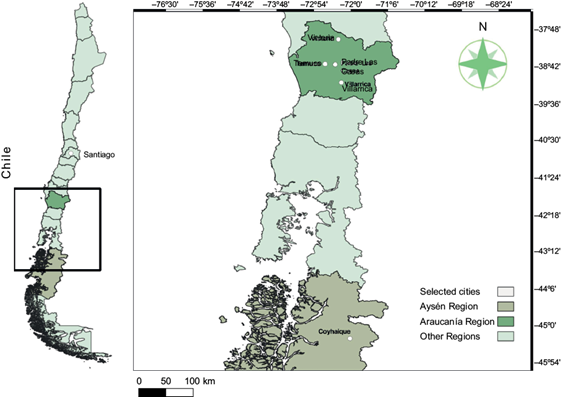
The main difference between these five cities is that Temuco, Padre Las Casas, and Coyhaique have implemented the ADP. In contrast, despite the current high level of air pollution due to wood-burning stoves, Villarrica and Victoria have not yet implemented the ADP. As figure 2 shows, due to the low temperatures during the winter season, residents primarily use wood-burning stoves for heating or cooking at home. According to the Chilean Ministry of the Environment, households contribute 99.67% of the total emissions (MMA 2019).
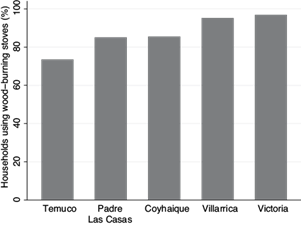
Fig. 2 Percentage of households using wood/burning stoves for heating and cooking. Source: Encuesta de Caracterización Socioeconómica Nacional (National Socio-Economic Characterization Survey) (MDSF 2017).
We collected data from these five cities with similar levels of air pollution due to the use of wood-burning stoves to analyze whether ADP influences people’s perception of health.
Data collection
This study was conducted during the winter (June-September) of 2020 and 2021. Three different but complementary strategies were used to collect information: an online survey, phone calls, and face-to-face surveys. The survey response time was, on average, 20 min, and the participants were over 17 years of age. First, an online survey was conducted using the institutional social media of Universidad de la Frontera (Temuco) and Aysén (Coyhaique), such as Instagram, Facebook, and WhatsApp. As a second strategy, phone calls were used to connect with neighborhood associations and share the survey. Finally, community and health care centers were visited, where the survey was applied face-to-face. In total, 1456 surveys were conducted: 213 in Victoria, 227 in Villarrica, 529 in Temuco, 109 in Padre Las Casas, and 378 in Coyhaique.
These strategies allowed access to a diverse and wide spectrum of the population, as shown in table I. The participants’ ages ranged from 18 to 84 years; most of them were women (66%), non-indigenous people (83%), people with higher education (57%), wood-burning stove users (55%), and people who lived in a city with an ADP (70%).
TABLE I SOCIOECONOMIC AND DEMOGRAPHIC CHARACTERISTICS OF THE SAMPLE.
| Variable | Categories | N | Percentage or mean |
| Gender | Women | 963 | 67% |
| Men | 482 | 33% | |
| Age | 1239 | 38 years old | |
| Ethnicity | Indigenous People | 237 | 16% |
| Non-Indigenous People | 1217 | 84% | |
| Education | Elementary/middle school | 46 | 3% |
| High school | 576 | 40% | |
| Higher education | 834 | 57% | |
| Wood user | Yes | 797 | 55% |
| No | 658 | 45% | |
| Household Income (in thousands) | < CH $350 | 196 | 14% |
| CH $351-$600 | 282 | 21% | |
| CH $601-$1000 | 259 | 19% | |
| CH $1001-$1500 | 213 | 16% | |
| CH $1501-$2000 | 174 | 13% | |
| CH $2001-$2500 | 97 | 7% | |
| > CH $2501 | 149 | 11% | |
| I feel informed about air quality in the city | Not informed at all | 307 | 21% |
| Little informed | 582 | 41% | |
| Well informed | 389 | 27% | |
| Very well informed | 157 | 11% | |
| Live in a city with an ADP | City without ADP | 440 | 30% |
| City with ADP | 1016 | 70% |
ADP: Atmospheric Decontamination Plan.
The survey was created with a wide variety of questions, including multiple-choice, open-ended, rating scale, and Likert scale questions. We gathered sociodemographic information from the participants, including age, gender, belonging to an Indigenous People (e.g., Mapuche), education, and socioeconomic status.
The survey assessed the public’s perception of air quality on a scale from 1 (very bad) to 5 (very good) and their perception of the health risks associated with air pollution. Based on the work of Howe et al. (2019), we adapted their heat wave risk perception index to focus on air pollution. This resulted in the creation of three questions: (i) the likelihood of air pollution affecting one’s health in the next five years, (ii) the perception of health damage from winter pollution episodes, and (iii) the level of concern about the effects of air pollution on health. We inquired about the perceived health impact on the participants, their family members, and neighbors, which resulted in nine questions. The participants were requested to provide their responses on a scale from 0 to 100, with higher values indicating a greater risk perception.
Methods
A regression model was used to estimate the impact of the ADP on risk perception. The regression model was specified as follows:
where the dependent variable, which was constructed following the methodological strategy of Howe et al. (2019), represents the risk perception of each individual. The mean response was used for the following items: (1) Do you think it is likely that air pollution will affect your health in the next five years?; (2) To what extent do you think the pollution episodes possibly occurring this winter could harm your health?; and (3) How concerned are you about the effects of air pollution on health? The participants were asked to respond to these questions at three levels: individually, for their family, and regarding their neighborhood. Consequently, nine answers were collected, which used a scale ranging from 0 (lowest level of risk perception) to 100 (highest level of risk perception). The psychometric properties of the index were tested, and the results show a good internal consistency (α = 0.957).
The independent variables, represented by vector , include dummy variables (see Table I), such as gender, ethnicity, and whether the participant was a firewood user. Also, the vector contains categorical variables, such as household income (seven categories), information about air quality (four categories), and a numerical variable (age). The key independent variable is dichotomous, with a value of zero if the participants live in a city without ADP (30% of the respondents) and value of one otherwise. Finally, the vector represents the error term.
RESULTS
As figure 3 shows, participants who live in Temuco, Padre Las Casas, and Coyhaique (cities with ADP) have a higher perception of air pollution risk than those living in places without ADP (Victoria and Villarrica), even though Victoria and Villarrica have a higher proportion of households using wood-burning stoves (see Fig. 2).
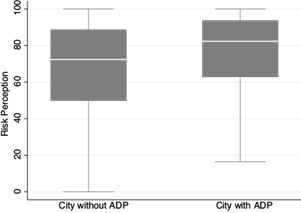
Fig. 3 Risk perception of the participants living in cities with and without an Atmospheric Decontamination Plan (ADP). The two lines outside the box (whiskers) represent the upper and lower values of the data.
In fact, 76% of the individuals in cities with ADP perceived that there is a high risk that air pollution will affect their health, their family, and their neighborhood. In contrast, only 67% of those who live in Victoria and Villarrica (with ADP) perceived their health as at high risk, and their assessment is more widespread (standard deviation = 26%) than the participants from Temuco, Padre Las Casas, and Coyhaique (standard deviation = 22 %).
Table II shows the regression model outputs, where the dependent variable is the participants’ perception of the risk associated with air pollution. The models used socioeconomic and demographic characteristics as independent variables; among them were age, gender, level of education, household income, whether the participants were users of wood-burning stoves, level of information about air quality in the city, and whether they lived in a city with ADP.
TABLE II RISK PERCEPTION OF INDIVIDUALS LIVING IN CITIES WITH AND WITHOUT ATMOSPHERIC DECONTAMINATION PLAN (ADP).
| Model 1 | Model 2 | |
| Age | -0.08+ | -0.09+ |
| Gender (male) | -2.80+ | -3.22* |
| Indigenous population | -2.74 | -2.02 |
| Education (reference: elementary education) | ||
| High school | 3.92 | 4.10 |
| College | 5.10 | 3.70 |
| Monthly household income (reference: < CH $350) | ||
| CH $350-600 | -1.32 | -1.62 |
| CH $600-1.000 | -4.12+ | -4.01+ |
| CH $1.000 -1.500 | 0.91 | 1.06 |
| CH $1.500-2.000 | -2.10 | -2.67 |
| CH $2.000-2.500 | -4.56 | -5.97+ |
| CH >$2.500 | -6.01* | -7.92** |
| User of wood-burning stove (reference:. non-user) | -3.36* | -2.86* |
| Feel informed about air quality in the city (reference: not informed) | ||
| A little informed | 2.78 | |
| Well informed | 6.76** | |
| Very well informed | 14.86*** | |
| Live in a city with an ADP (reference: city without an ADP) | 5.23** | |
| Observations | 1152 | 1139 |
***p < 0.001, **p < 0.01, *p < 0.05, +p < 0.10.
The key variables to understand the differences among the participants’ risk perception are related to gender, household income, level of information about air quality, and whether they are users of wood-burning stoves and live in a city with ADP. First, model 1, which does not control by level of information about air quality and if the participants live or not in a city with ADP, shows that the families with incomes higher than CH $2.5 million have a lower risk perception than those from lower incomes (p < 0.05). Also, the users of wood-burning stoves show lower levels of risk perception than those that do not use wood-burning stoves (p < 0.05). Model 2 added control variables such as the level of information about air quality and whether the participants live in a city with ADP. The output of the model shows that those individuals who are more informed present a higher level of risk perception than those who are not informed (p < 0.05). Finally, people who live in a city with an ADP show a higher level of risk perception in contrast to those who live in a locality without an ADP (p < 0.05).
DISCUSSION
In the Latin American context, risk communication strategies used in most air quality management plans are usually top-down. For example, in the case of the ADPs in southern Chile, policymakers are the ones who prepare the awareness-raising information materials without involving the public, usually with the advice of experts. In general, citizen participation is limited to a 60-day consultation and extended committees where, at the invitation of policymakers, prominent members of civil society provide advice and suggestions during the development phase of the new ADPs. For the first time in the case of cities saturated by wood smoke, this study analyzes the effect of risk communication policies and access to information on public perception of air quality, comparing cities with pollution control plans with cities that do not have such intervention tools. The findings of this research show that, while ADPs have been ineffective in reducing particulate matter emissions to healthy levels, they have impacted public perception. This means that people living in cities with ADPs have a better perception of the health hazards of exposure to poor air quality.
To date, no studies in Chile have compared the perception of air pollution in cities with and without air ADP. However, it can be interpreted that an air quality management policy may encourage attitudinal change through two mechanisms. First, people living in cities with decontamination plans have access to a better and greater flow of information about the causes and consequences of pollution in the city. This increased awareness can lead to a more informed public better equipped to understand and address air quality issues. Secondly, both wood stove replacement policies and restrictions on their use during emergencies modify users’ daily practices. These policies introduce new costs and benefits associated with their actions, which can alter how individuals perceive and respond to air pollution. Furthermore, these changes can foster more frequent discussions among neighbors about air quality in their city, thereby reinforcing shifts in public perception. As a result, these mechanisms collectively contribute to a more proactive and engaged citizenry in addressing air pollution issues.
The results of this research show that air quality management policies matter. ADPs are relevant not only because of economic stimuli, which encourage technological replacement, or coercive ones, which restrict the actions of the worst polluters but also because they change perceptions. Risk communication campaigns improve public understanding of air pollution, a commonly silenced environmental problem in southern Chile, by conflicting with the more accessible and economical heating system. However, it is necessary to be cautious about the practical implications of the results of this research. Even if it were possible to extend the reach of risk communication campaigns to all affected cities in the region, the air pollution problem would be far from being solved. Since the late 1990s, social sciences have shown that removing barriers to information access is only a necessary first condition, but it is not sufficient to promote behavioral change (Walker et al. 1999, Irwin 2002). Frequently, policymakers remain anchored in the deficit paradigm, designing policies that assume a passive public that, like a tabula rasa, would be waiting to be enlightened by expert knowledge to then behave appropriately and coherently with the information received. Unfortunately, the solution to the problem is more complex because, in addition to improving the ability of citizens to understand the dangers of pollution, it is necessary to address the situations of energy deprivation experienced by a large part of the population.
The results of our research align with previous findings and offer a new perspective on the impact of environmental management plans on public perception. Women tend to be more concerned and more aware of the risks of poor air quality, especially if they have children (Barton-Laws et al. 2015, Deguen et al. 2017). A substantial body of social research indicates that gender is a significant factor influencing environmental and technological risk perception (Flynn et al. 1994, Slovic 2000). Several studies conducted in the United States have demonstrated that white, highly educated men residing in high-income households with a conservative ideological profile tend to exhibit a lower risk perception (Palmer 2003, Marshall et al. 2006, Macias 2015). In a similar vein, in our sample, men residing in households with the highest income levels exhibited a diminished risk perception of air pollution. Conversely, the influence of ethnicity or education on risk perception was not statistically significant in this instance. Recent research has yielded disparate findings regarding the impact of education (Zhang et al. 2021, de Macêdo et al. 2022, Kramm et al. 2022). Therefore, this aspect will require further investigation in the future. Previous research has indicated that individuals who recognize the economic benefits of an activity are less likely to perceive the negative impacts of air pollution (Boso et al. 2022b, de Macêdo et al. 2022). This phenomenon may explain why users of wood-burning stoves, whose fuel is the most affordable in the region, have a lower perception of risk than the rest of the participants. As ADPs facilitate the free installation of pellet stoves and other alternatives to firewood, the change in risk perception is also encouraged in these cities through the daily observation of the advantages that modern technologies confer. In sum, our research tends to align with previous findings but offers a new perspective on the impact of environmental management plans on public perception.
To our knowledge, this study is the first to analyze the impact of environmental management plans on air pollution risk perception by introducing cities with poor air quality where public policies have not intervened. In addition, a wide range of confounders reported in the scientific literature was considered to isolate the effect of ADPs. Despite the strengths of this study and its contributions to the scientific literature, it also has several limitations that must be mentioned. First, the cross-sectional nature of this research design restricts our ability to infer causality in the correlations found. Second, this study does not differentiate indoor and outdoor air pollution risk perception. Previous research has shown that risk perception in indoor spaces may be attenuated by various cognitive biases such as the halo home effect or heuristic effect. Finally, this research was conducted during the Covid-19 pandemic. This context made it necessary to change the door-to-door format initially planned for a survey mainly applied online. To protect the research from the possible biases that this mode of data collection entails, great efforts were made to find access channels for the public that potentially has difficulties responding to online surveys. Thus, when possible, the sample was supplemented with telephone and face-to-face surveys of the elderly to guarantee their right to participate, improving the scope and quality of our inferences.
CONCLUSION
Making air pollution risk communication more effective is essential to protect vulnerable populations and foster protective and mitigating behaviors. Undoubtedly, more research is needed to achieve a more precise segmentation of the target audience and customization of educational messages to the different sociodemographic and attitudinal characteristics of the population. However, the first necessary step is for air pollution health risk communication to reach the entire potentially affected population. This study shows that the dangers of delaying the implementation of environmental management plans are not limited to the lack of resources for technological replacement or the absence of sanctions to restrict the actions of those who pollute the most. The absence of ADPs affects people’s ability to adequately perceive the danger of the air pollution to which they are exposed daily.
The high emissions of particulate matter in urban southern Chile have become one of the main public health problems in the country. Despite the efforts made by environmental and sanitary authorities, people in most cities in the region have been breathing unhealthy air for decades. The massive use of wood-burning stoves and stoves originates in a context of energy precariousness, which makes improving air quality particularly complex. Often, citizen involvement in air pollution control implies an additional cost for the household economy of the most disadvantaged social sectors. The adoption of alternative fuels, such as pellets or gas, can mean a significant increase in household budgets. Therefore, improving risk communication is one step in local energy transitions. Still, it is undoubtedly necessary to have greater state investment in energy-efficient infrastructure and technologies, as well as redistributive social policies that have a real impact on improving the living conditions of the most vulnerable population.

