nueva página del texto (beta)
 Inglés (pdf)
 Artículo en XML
 Referencias del artículo
 Traducción automática
 Enviar artículo por email
 Citado por SciELO
  Similares en
SciELO
Similares en
SciELO 
 Permalink
INTRODUCTION
The rapid increase in population, economic growth, urbanization, and industrialization encourages solid waste generation at the global level and boosts environmental contamination when it is not disposed of appropriately. Inadequate waste management promotes illegal dumping, waste burning, and uncontrolled disposal (Ferronato and Torreta 2019).
Environmental impacts from this uncontrolled disposal are mostly related to the migration of contaminants in the form of gases or leachates (Zaı¨ri et al. 2004). However, final waste disposal sites are more dangerous when waste burning occurs, causing the environment to be directly impacted by the contaminants present in burn ashes in the surface soil (Pérez et al. 2013). In addition, waste picking in open dump sites poses serious health risks to people working in these areas (Gutberlet and Baeder 2008).
Final disposal in open dumps prevails in solid waste management (SWM) in Latin America and the Caribbean (Margallo et al. 2019). In Mexico, the SWM system only focuses on waste collection and transportation to final disposal sites (SEMARNAT 2017). According to Article 115 of the Political Constitution of the United Mexican States (CDHCU 2025), municipal authorities are responsible for the collection of municipal solid waste (MSW) from household sources; waste resulting from street sweeping, transport, and treatment; and final legal and illegal disposal services in a site. This condition causes the performance of every final waste disposal site (FWDS) to be different due to material, economic, and human resource limitations, the lack of collaboration with state authorities, and the use of comprehensive management methods, which often fail to comply with the specifications of Mexican regulations. In this sense, searching for a suitable landfill is a complex process that must include socioeconomic, environmental, and technical aspects (Moreno et al. 2019).
Regarding national regulations, the official Mexican Official Standard NOM-083-SEMARNAT-2003 (SEMARNAT 2004) establishes environmental protection specifications for selecting the site location, design, construction, operation, monitoring, closure, and complementary works of a site for the final disposal of urban solid wastes and wastes requiring special handling. However, data from SEMARNAT (2020) showed that the available infrastructure for disposal sites in Mexico is insufficient to assume that they are adequate for waste disposal with a guarantee of environmental protection.
These conditions lead to the need to establish the available information on the current environmental state to mitigate or remedy the adverse effects produced by human intervention (Perevochtchikova 2013). Therefore, environmental impact assessment (EIA) is a tool that allows identifying a project’s environmental, social, and economic impacts. It aims to assess the magnitude of the changes caused by a project and propose appropriate measures to reduce negative impacts.
The main methods and techniques used in an EIA are baseline studies, checklists, matrices, and networks. These tools show relevant information to make appropriate decisions on the most significant impacts (Dougherty and Hall 1995).
Thus, this study aims to identify and determine the environmental impacts before and after implementing the prevention and mitigation measures on two final waste disposal sites, taking as a case study two FWDS of the municipality of Cuauhtémoc, Zacatecas, Mexico, showing the benefits obtained in the SWM when an environmental management plan (EMP) is implemented.
MATERIALS AND METHODS
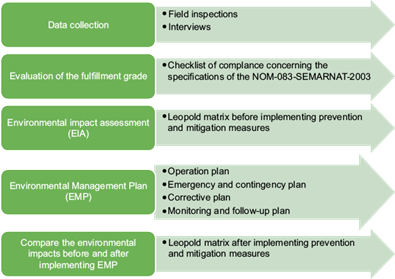
The project was developed in five stages: (1) data collection; (2) evaluation of the grade of fulfillment concerning the specifications stipulated in the Mexican Official Standard NOM-083-SEMARNAT-2003 (SEMARNAT 2004) on both FWDS according to the site category (typse A, B, C, and D); (3) EIA of the management in both FWDS; (4) description of the prevention and mitigation measures integrated into an EMP; (5) comparison of the environmental impacts after implementing prevention and mitigation measures. An overview of the methodology is represented in figure 1.
Case study
The study was performed in 2020 in Cuauhtémoc, Zacatecas, Mexico (Fig. 2). Municipal authorities are responsible for the SWM system. The municipality has a compactor truck with a capacity of 10 t serving the urban center and four of the five communities. The wastes are collected every two days at the urban center and weekly in the communities.
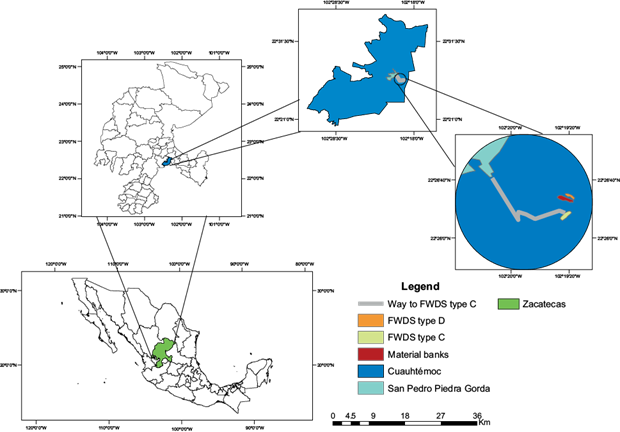
This city has two FWDS. The first one, which has been operating since 2008, is 2.5 km from the urban center and has an approximate area of 2.5 ha, receiving 13 t/day. However, this site has improvement opportunities, mainly in its design, construction, and operational characteristics. The second one is 460 m away from the active FWDS; it was in operation between 1997 and 2008. During this period, the generation received by the MSW was 8-10 t/d, operating through a dump ditch; moreover, this site had uncontrolled disposal, generating local environmental impacts with disease outbreaks, proliferation of insects and rats, generation of foul odors, and soil pollution. In addition, 100 m away from this site, there is a material bank where gravel and sand have been extracted since 2015, causing soil instability and the formation of slopes (Fig. 2).
Data collection and field inspections of the active and closed final waste disposal sites
The first phase of the work was implemented in November 2020 in cooperation with the workers of the Department of Public Services of Cuauhtémoc. Data on the recollection, transport, current FWDS construction and operation, and FWDS closure were collected through field inspections and interviews. Only solid waste from household activities was considered.
Evaluation of the fulfillment grade of NOM-083-SEMARNAT-2003
The Mexican Official Standard NOM-083-SEMARNAT-2003 defines three types of FWDS according to the fulfillment grade of the established specifications (SEMARNAT 2004): (1) landfills, (2) controlled sites, and (3) uncontrolled or open dumps. A landfill is an infrastructure work that involves methods and engineering to control the environmental impacts through compaction and additional infrastructure. A controlled site is an inadequate final disposal site that complies with infrastructure and operation works but does not comply with the waterproofing specifications. An uncontrolled site is an inadequate final disposal site that does not comply with the requirements stipulated in the Mexican Official Standard. Likewise, this environmental regulation categorizes the FWDS according to the amount of waste received per day, as shown in table I.
TABLE I CATEGORIES OF THE FINAL WASTE DISPOSAL SITES (FWDS) BASED ON THE OFFICIAL MEXICAN STANDARD NOM-083-SEMARNAT-2003 (CDHCU 2004).
| Category | Tonnage received per day (t/d) |
| A | >100 |
| B | 50-100 |
| C | 10-50 |
| D | <10 |
The two FWDS were analyzed with respect to the specifications of NOM-083-SEMARNAT-2003 (SEMARNAT 2004), shown in figure 3.
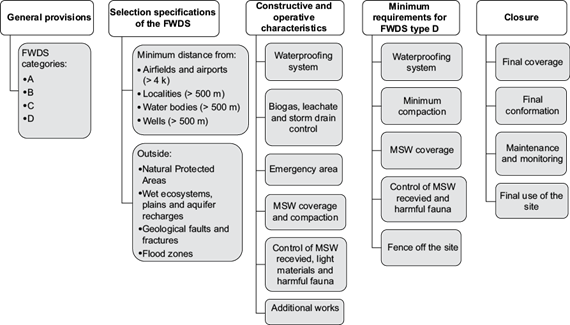
Fig. 3 Specifications of the Mexican Official Standard NOM-083-SEMARNAT-2003 (CDHCU 2004). (FWDS: final waste disposal site; MSW: municipal solid waste.)
The specifications for the selection of both FWDS were assessed by applying a geographic information system (GIS). Additionally, the constructive and operative characteristics of active FWDS, minimum requirements, and closure of FWDS were evaluated based on the degree of fulfillment of the specifications of NOM-083-SEMARNAT-2003 (SEMARNAT 2004), as shown in figure 3.
Identification of environmental impacts
The methodology from the Environmental Impact Assessment System (SEIA 2016) was taken as a reference for performing the EIA in the FWDS. This methodology provides a general scheme for identifying, characterizing, and categorizing the impacts generated on the environment (physical, biological, and social factors). Likewise, mitigation and prevention measures to decrease the negative environmental impacts were proposed from the EIA results.
After the evaluation of the fulfillment grade of NOM-083-SEMARNAT-2003 (SEMARNAT 2004), information about the description, infrastructure, and fulfilled or unfulfilled specifications of both FWDS was used to identify actions that generate impacts on environmental factors (air, water, soil, etc.).
The interaction between the actions that cause impacts and the factors that make up the environment were analyzed following the steps described by the SEIA (2016) methodology. These steps are:
Identifying the project actions (activities) that impact the environmental factors (soil, water, air, and socioeconomic features).
Identifying the environmental factors that could be affected by the actions performed in the FWDS (construction, operation, additional works, etc.).
Using the affected environmental factors as impact indicators (e.g., air and water quality, noise, erosion, employment, and health).
Environmental impact assessment (EIA)
The EIA identifies the impacts with the highest magnitude and importance (FAO 1996). It was performed using Leopold’s matrix (Leopold et al. 1971) as a reference. This methodology consists of 100 possible actions that could impact 88 environmental factors. However, this study used the activities performed in both FWDS, based on the location restrictions, constructive and operational characteristics, and closure specified in the NOM-083-SEMARNAT-2003 (SEMARNAT 2004), as shown in table II.
TABLE II ENVIRONMENTAL FACTORS IMPACTED BY ACTIVITIES PERFORMED IN THE FINAL WASTE DISPOSAL SITES (FWDS). CATEGORY TYPES ARE SHOWN IN TABLE I.
| Activities | Environmental Components | Environmental factors | |||||
| Closure of FWDS type D | Soil | Leached pollution | Littering | Instability | Erosion | ||
| Operation of FWDS type C | Ground slides | Larger area required | Reduction of useful life | Water | Surface water pollution | Aquifer pollution | |
| Operation of FWDS type D | Air | Gases combustion emission | Methane emission | Particulate matter emission | Socio-economic | Population health | Employment |
In Leopold’s matrix, the rows included the environmental factors susceptible to damage, and the columns involved the actions performed in the FWDS that could impact the environmental factors. Each interaction between factors and action was assessed, determining if that action impacted the factor. A positive or negative sign was used, depending on whether the action caused a benefit or damage, respectively. A diagonal line was drawn for the cases that showed an impact. In the upper left-hand corner, a number from 1 to 6 was assigned to register its magnitude, and in the lower right-hand corner, to indicate its importance. Leopold’s matrix methodology uses a scale from 1 to 10 to assess the impacts. This study proposed a scale from 1 to 6 to reduce the subjectivity based on the criteria shown in table III. An empty gray box was used for cases in which no interaction was detected since the action did not impact the factor.
TABLE III SCALE USED TO ASSESS THE MAGNITUDE AND IMPORTANCE OF IMPACTS.
| Value | Magnitude | Importance |
| 1-2 | Punctual | Low |
| 3-4 | Medium | Medium |
| 5-6 | Large | High |
Once the assessment was completed, the values of magnitude and importance were multiplied and summed in each column regarding the sign (positive or negative). The actions (columns) with the highest number of interactions and the product of the sum were identified. Likewise, three impact categories (low, medium, and high) were established regarding the values obtained in the sum. This identification allowed the recognition of the actions that caused negative environmental impacts and required prevention and mitigation measures in the short, medium, and long term. Finally, an average was obtained by dividing the product of the sum by the number of interactions (positive or negative). The average value was estimated to assess the viability of the current SWM (average positive value higher than average negative value).
Implementation of the environmental management plan
After the EIA, an EMP was developed, describing mitigation and prevention measures in the short, medium, and long term, which depended on whether the impacts were classified as high, medium, or low impact, according to the results obtained in the matrix. The specifications of the NOM-083-SEMARNAT-2003 (SEMARNAT 2004), which were unfulfilled, were taken as a reference to develop the necessary actions to maintain the fulfillment of both FWDS.
The EMP was structured with four plans: (1) an operation plan and (2) an emergency and contingency plan to regulate the conditions of active FWDS; (3) a corrective plan to mitigate the impacts present in the closed FWDS; and (4) a monitoring and follow-up plan to maintain under control both FWDS.
Environmental impact assessments before and after the EMP
Finally, a second Leopold’s matrix was built to assess the environmental impacts of the EMP performance through its measures. Then, both matrices’ results were compared with their magnitude and importance values and the number of interactions between the actions and the environmental factors. In the same way, the product and the sum of the positive and negative interactions were obtained, and a categorization of the impacts as low, medium, and high was carried out to recognize the actions that will bring a more significant positive impact by implementing the EMP.
RESULTS AND DISCUSSION
The current FWDS management
From the information on MSW generation provided by the municipal authorities, the actual FWDS was classified as type C and the closed FWDS as type D according to the Mexican Official Standard NOM-083-SEMARNAT-2003 (SEMARNAT 2004), as shown in table I. The operation mode used in FWDS type C is the combined method (trench and ramp methods), which consists of a ditch of approximately 40 cm created so that later MSW is deposited (as far as the ground allows it) in layers forming terraces over the respective area.
Although the compaction level could surpass the stipulations of the Mexican Official Standard, the compaction is carried out every four months because municipal authorities lend the bulldozer. Additionally, this site does not have entrances and exits, only a perimeter fence, which causes clandestine disposal and intentional waste burning by outsiders beyond the control of the site’s management. Likewise, previous studies characterized by the Mexican Official Standard (SEMARNAT 2004) as regional geologic and geohydrologic analyses; geological and geo-hydrogeological evaluations; hydrologic analyses; topographic and geotechnical studies; and waste generation and composition, biogas generation, and leachate generation studies were not performed for this FWDS.
On the other hand, the FWDS type D was operated without the abovementioned analyses and studies. Therefore, a ditch was opened where the MSW was disposed of without coverage or compaction. There was no control of the waste received or harmful fauna. Subsequently, the closure was carried out by order of state authorities, and a unique cover was placed. Since 2015, a private owner began to extract without restrictions materials such as gravel and sand from the banks in the surrounding area.
Grade of fulfillment of NOM-083-SEMARNAT-2003
The assessment of the location restrictions or minimum distances (Fig. 4) for both FWDS was performed with a GIS and multi-criteria weighted overlay analysis. The optimal and non-optimal zones were identified in green and red colors. An optimal zone is a site that fulfills all the location restrictions established by the Mexican Official Standard. A non-optimal zone is a site that does not comply with at least one of the restrictions. The results of this analysis are shown in figure 4. The two FWDS were in the non-optimal zone (red color) since they are located at a distance less than 500 m from streams. Furthermore, the FWDS type D is situated in a flood zone with a return period of 100 years, so it must be verified that there will be no flow obstruction in the flood area or the possibility of landslides or erosion that affect the physical structure of the FWDS in case of an extreme precipitation event.
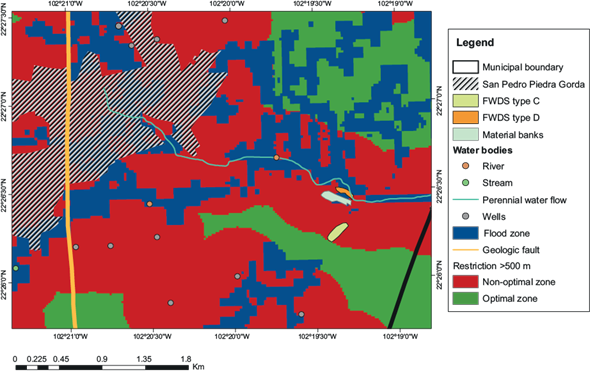
Concerning the constructive and operative characteristics, the FWDS type C only complies with the required 400 kg/m3 compaction level. It does not count with waterproofing, leachates and biogas catchment, storm drain systems, emergency area, daily coverage, control of light materials, harmful fauna, and waste received. Additionally, it complies with access roads and perimeter fences within the complementary works.
Similarly, the FWDS type D only had a perimeter fence without the waterproofing system, the 300 kg/m3 compaction level required, the minimum weekly coverage, and the control of waste received and harmful fauna. In the closure stage, a final cover was placed without considering the conformation and stability of the site. No control system of leachate and biogas was carried out. The final use within the FWDS area was also inappropriate due to material bank extraction.
Table IV summarizes the number of specifications fulfilled and unfulfilled concerning the specifications for the selection of both FWDS, the constructive and operative characteristics, and the additional works of the FWDS type C, along with the minimum requirements and closure of the FWDS type D. The FWDS type C complied with 40% of the specifications, while the FWDS type D only with 38%. Thus, from these results, both FWDS were considered uncontrolled sites.
TABLE IV LIST OF FULFILLED AND UNFULFILLED RESTRICTIONS BASED ON the Maxican OfficNOM-083-SEMARNAT-2003 (CDHCU 2004). CATEGORY TYPES ARE SHOWN IN TABLE I
| Type of site | Specifications of NOM-083-SEMARNAT-2003 | Number of fulfilled restrictions | Number of unfulfilled restrictions |
| FWDS type C | Specifications for the selection of the site | 6 | 1 |
| Constructive and operative characteristics | 1 | 9 | |
| Additional works | 2 | 3 | |
| FWDS type D | Specifications for the selection of the site | 5 | 2 |
| Minimum requirements | 1 | 5 | |
| Closure of the site | 1 | 4 |
Environmental impact assessment
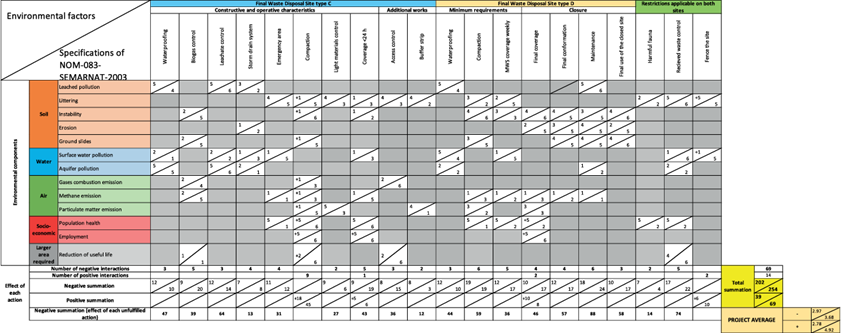
The complete Leopold’s matrix is shown in table SI of the supplementary material. On the other hand, table V shows the results with the project average values. It can be observed that the magnitudes of negative impacts are higher than the positive ones, so the operation and closure of the FWDS type D have not been adequate from the point of view of environmental protection, and the current system (FWDS type C) is not sustainable.
TABLE V RESULTS OF THE LEOPOLD MATRIX.
| Impact value | Project average | Number of interactions | |
| (-) | Magnitude | 2.97 | 69 |
| Importance | 3.68 | ||
| (+) | Magnitude | 2.78 | 14 |
| Importance | 4.92 |
The highest negative impacts of the FWDS type C were caused by the received waste control, biogas control, storm drain system, emergency area, and MWS daily coverage, since these actions were not adequately performed, affecting the population’s health by contaminating the soil with leachate and the air with greenhouse gas emissions. However, the positive impact was identified as the economic and social benefits for the workers of this site (employment).
The highest negative impacts of the FWDS type D were caused by the received waste control, compaction, MWS weekly coverage, and maintenance since these actions were not adequately performed, damaging the population’s health by contaminating the soil with leachate and the air with greenhouse gas emissions. However, the positive impact was identified as the economic and social benefits for the workers who closed this site (employment).
The average values obtained from the sum and product of the interactions, shown in table V, evidence that both FWDS were inadequately managed and the specifications of the Mexican Official Standard were not fulfilled since the negative average value is higher than the positive one. Therefore, an EMP was designed to assess the benefits obtained after its implementation.
A categorization in low, medium, and high impact was established to prioritize the level of action to prevent and mitigate the impacts, considering the sum and product of the interactions in the matrix columns, which indicates the unfulfilled restriction effect on environmental factors. The results are shown in table VI.
TABLE VI CATEGORIZATION OF THE NEGATIVE ENVIRONMENTAL IMPACTS EVALUATED IN THE LEOPOLD MATRIX. CATEGORY TYPES ARE SHOWN IN TABLE I.
| Action | Sum of negative impacts | Number of interactions on the Leopold matrix | Impact category |
| Buffer strip | 12 | 2 | Low impact |
| Storm drain system | 13 | 4 | |
| Harmful fauna | 14 | 2 | |
| Light materials control | 27 | 2 | |
| Emergency area | 31 | 4 | |
| Access control | 36 | 3 | |
| MWS coverage weekly | 36 | 5 | |
| Biogas control | 39 | 5 | Medium impact |
| Coverage < 24 hrs. | 43 | 5 | |
| Waterproofing (FWDS type D) | 44 | 5 | |
| Final coverage (FWDS type D) | 46 | 4 | |
| Waterproofing (FWDS type C) | 47 | 3 | |
| Final conformation | 57 | 4 | |
| Final use of the closed site | 58 | 3 | High impact |
| Compaction (FWDS type D) | 59 | 6 | |
| Leachate control | 64 | 3 | |
| Received waste control | 74 | 5 | |
| Maintenance | 88 | 6 |
FWDS: Final waste disposal site; MSW: Municipal solid waste.
In this way, the EMP aimed to obtain a positive average value higher than the negative one from the second assessment performed in the Leopold’s matrix. Therefore, the EMP implementation would reduce the negative impacts and increase the positive ones, as shown below.
Improvement of waste handling
The EMP consisted of four plans that determine and describe the measures aimed at improving the operation of the FWDS type C, mitigating impacts due to the closure of FWDS type D, and preventing negative changes in the impact categories. Likewise, the personnel responsible for carrying out the operation, stock monitoring, and work schedule were included in the EMP.
For the FWDS type C, the operation plan describes an accurate infrastructure to prevent environmental pollution by leachate generation, biogas emissions, and received MSW control. Also, it proposes a manual daily operation of the cells, with the help of tools and the description of the activities of the working staff, integrating waste pickers. The emergency and contingency plan dictates the prevention measures, the action plan, and suppression methods in the event of spontaneous or intentional waste burning.
The corrective plan for the FWDS type D describes the actions aimed at mitigating the adverse effects and preventing their continuation through engineering principles for the conformation and sealing of MSW exposed to the environment. In addition, the material banks will be regulated according to state regulations. It is worth mentioning that this plan mentioned some engineering measures that are possible to apply. However, these measures could change and improve with the support of the government technical assistance and consulting firms.
The monitoring and follow-up plan corresponds to the control of the new operation and closure of the FWDS, which must include reviews in various stages to evaluate the program’s quality. Hence, this plan establishes the actions to be carried out to verify the execution of measures in fulfillment of the specifications of the Mexican Official Standard.
The content of the four plans integrated into the EMP can be revised in the section “Environmental management plan” in the supplementary material, which proposes measures for each unfulfilled restriction, the personnel responsible for operating and monitoring these actions, the completion timeframes, and stakeholders (governmental employees and authorities, and consulting firms). The plans were designed based on the results shown in table VI. Prevention and mitigation measures in the short, medium, and long term were proposed in the function of the impact category (low, medium, or high).
Comparison of Leopold’s matrices results
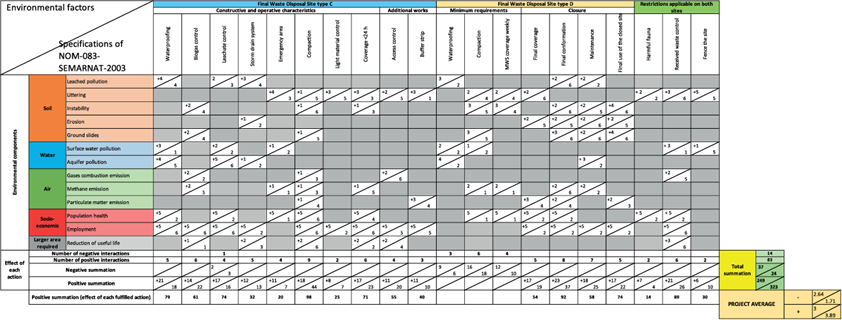
Once the EMP was implemented, an EIA was performed in Leopold’s matrix. The second Leopold’s matrix results are shown in table SII of the supplementary material (“After EMP”). The negative impact of the FWDS type C was caused by leachate control since it was not captured or treated adequately, contaminating mainly soil. However, the highest positive impacts were caused by biogas control, compaction, MWS daily coverage, and received waste control since these actions provided economic and social benefits (population health and employment). Likewise, the highest negative impacts of the FWDS type D were caused by compaction and MWS weekly coverage since these actions were not adequately performed, damaging the population’s health. However, the highest positive impacts were caused by final conformation, maintenance, and received waste control, protecting the population’s health and generating economic and social benefits for the workers who implemented the works on the site (employment).
The average values obtained from the sum and product of the interactions, shown in table V, evidence that both FWDS were inadequately managed without fulfilling the specifications of the Mexican Official Standard since the negative average value is higher than the positive one. Therefore, an EMP was designed to assess the benefits obtained after its implementation.
Table VII summarizes the results of Leopold’s matrix before and after implementing the EMP, showing that the magnitude and importance of positive impacts are more significant than the negative ones. The negative ones were prevented, mitigated, or controlled by implementing the four plans included in the EMP. The results reveal that FWDS were almost adequately managed, fulfilling the specifications of the Mexican Official Standard since the positive average value is higher than the negative one after EMP implementation. Therefore, 79.7% of the negative interactions were reduced, decreasing the average value of the magnitude by 11.2%, and the positive interactions were increased to 592.9%, augmenting the average value of the magnitude by 7.3%.
TABLE VII MAIN RESULTS OF THE LEOPOLD MATRIX BEFORE AND AFTER IMPLEMENTING THE ENVIRONMENTAL MANAGEMENT PLAN (EMP).
| Impact value | Before EMP | After EMP | |||
| Project average | Number of interactions | Project average | Number of interactions | ||
| (-) | Magnitude | 2.97 | 69 | 2.64 | 14 |
| Importance | 3.68 | 1.71 | |||
| (+) | Magnitude | 2.78 | 14 | 3 | 83 |
| Importance | 4.92 | 3.89 | |||
In addition, it is essential to mention that the negative values of the magnitude and importance could not be wholly eliminated because the FWDS type C still causes pollution problems through MSW disposal, soil degradation, and leachate and biogas generation. Likewise, the FWDS type D is susceptible to the clandestine disposal of MSW and slope instability due to the compaction and MWS coverage not being adequately performed.
The environmental impacts identified in this study highlight the inadequate disposal of MSW performed in Cuauhtémoc, Zacatecas, Mexico. The high costs of construction, operation, and monitoring of FWDS, the lack of knowledge regarding the proper management of MSW, and weak regulations by government authorities promote the results of this study to be replicated in almost the entire country. For this reason, it is essential to analyze and replicate this type of study, especially to generate the conditions for fulfillment with the Mexican Official Standard in all the FWDS operating or closed in the municipalities of Mexico since these actions would significantly reduce the environmental impacts generated by inadequate management of MSW and would favor the international commitments that Mexico has acquired in international agreements and conventions on environmental matters.
CONCLUSIONS
The two FWDS of the municipality of Cuauhtémoc, Zacatecas, Mexico were evaluated concerning the specifications of the Mexican Official Standard NOM-083-SEMARNAT 2003 for the selection of both FWDS; constructive and operative characteristics, and additional works of the FWDS type C, and minimum requirements and closure of the FWDS type D. The FWDS type C complied with the 40% of the specifications, and the FWDS type D with 38%; therefore, both FWDS were classified as uncontrolled sites because they were operated without environmental protection.
An EIA was conducted to identify the interactions between the unfulfilled restrictions (actions) and the environmental factors using Leopold’s matrix, where the impacts generated were evaluated with values of magnitude and importance. The highest negative impacts for the FWDS type C were caused by received waste control, biogas control, storm drain system, emergency area, and MWS daily coverage, and for the FWDS type D they were due to received waste control, compaction, MWS weekly coverage, and maintenance, affecting the population’s health by contaminating the soil with leachate and the air with greenhouse gas emissions. Hence, the impacts were categorized into low, medium, and high impact to determine environmental protection actions, which were integrated into an EMP.
An EMP was designed and implemented to reduce the negative impacts on both FWDS. The EMP included an operation plan and an emergency and contingency plan for the FWDS type C, a corrective plan for the FWDS type D, and a monitoring and follow-up plan for both sites. The EMP describes the prevention and mitigation measures, establishing the actions to be performed, the stakeholders (authorities, governmental employees, and consulting firms), and completion timeframes.
Once the EMP was implemented, an EIA was performed in Leopold’s matrix. The results of the second EIA showed that the highest positive impacts for the FWDS type C were caused by biogas control, compaction, and MWS daily coverage, and for FWDS type D by final conformation, maintenance, and received waste control, providing economic and social benefits (population health and employment). The results reveal that FWDS were almost adequately managed, fulfilling the specifications of the Mexican Official Standard since 79.7% of the negative interactions were reduced, and the positive interactions were increased by 592.9%. Therefore, this study provides an achievable proposal of sustainable waste management with socioeconomic benefits for the municipality and mainly for environmental protection.