




Servicios Personalizados
Revista
Articulo
 texto en
 Inglés (pdf)
 Artículo en XML
 Referencias del artículo

 Traducción automática
 Enviar artículo por email
Indicadores
-
 Citado por SciELO
-
 Accesos
Links relacionados
-
 Similares en
SciELO
Compartir

 Permalink

Comunicación y sociedad
versión impresa ISSN 0188-252X
Comun. soc vol.23 Guadalajara 2026 Epub 13-Ago-2026
https://doi.org/10.32870/cys.v2026.9057
Articles
Gender narratives and discursive conflict: The reception of Barbie (2023) among Spanish-speaking audiences

1Universidad de Málaga, España
This research aims to examine the reception of the film Barbie (2023) among Spanish-speaking users on the Filmaffinity platform from a gender perspective. A quantitative method is used to measure review ratings, while a qualitative approach applies critical discourse analysis. The findings reveal a polarized reception of the film, highlighting four discursive categories (misandry, critical feminism, positive feminism, and neutrality) regardless of the audience’s nationality.
Keywords: Feminism; film; gender studies; critical discourse analysis; platforms; audience
El objetivo de esta investigación es determinar la recepción de la película Barbie (2023) por parte de usuarios hispanos en la plataforma Filmaffinity desde una perspectiva de género. Con un método cuantitativo se mide la puntuación de las críticas, y con un método cualitativo se aplica el análisis crítico del discurso. Los resultados muestran una recepción muy polarizada de la cinta y destacan cuatro categorías discursivas identificadas (misandria, feminismo crítico, feminismo positivo, neutralidad), independientemente de la nacionalidad de la audiencia.
Palabras clave: Feminismo; cine; estudios de género; análisis crítico del discurso; plataformas; audiencia
O objetivo desta pesquisa é determinar a recepção do filme Barbie (2023) por parte dos usuários hispânicos na plataforma Filmaffinity a partir de uma perspectiva de gênero. Utilizando um método quantitativo, mede-se a pontuação das críticas, e, por meio de um método qualitativo, aplica-se a análise crítica do discurso. Os resultados mostram uma recepção bastante polarizada do filme, destacando quatro categorias discursivas identificadas (misandria, feminismo crítico, feminismo positivo, neutralidade), independentemente da nacionalidade do público.
Palavras-chave: Feminismo; cinema; estudos de gênero; análise crítica do discurso; plataformas; público.
Introduction
The Barbie doll was created in 1959 by Ruth Handler, co-founder of Mattel Inc., who sought to revolutionize toys of the era, most of which reinforced girls’ roles as mothers and homemakers (Pérez Gómez & Sanabria Rojas, 2024). However, far from being considered a feminist figure, Barbie has long been criticized for projecting a stereotyped image of the perfect woman (Tinat, 2024).
In response to accusations of limiting diversity and gender equality, Mattel has sought to modernize its image and to turn Barbie into a symbol of women’s empowerment through the doll itself, its advertising campaigns, and its animated films and series (Zacipa-Indante & Tur-Viñes, 2025).
The production of the film Barbie (Gerwig, 2023) is part of this brand performance strategy, aligning with the audiovisual fiction phenomenon known as the “new pink”.
It embraces themes characteristic of third-wave feminism, such as intersectionality, Black feminism, and transfeminism and incorporates themes from the fourth wave, which focuses on reclaiming the political agenda to achieve full parity and counter patriarchal violence (Martínez Cano et al., 2024, p. 479 ).
Likewise, the film drives a “pink movement” through audience engagement -moviegoers attended screenings dressed in pink- and through collaborations with various brands (Airbnb offered Barbie’s Dream House in Malibu for rent, Forever 21 and Primark launched film-inspired collections, nyx proposed a makeup line) (Bustos Díaz et al., 2024; Zacipa-Indante & Tur-Viñes, 2025). However, Barbie also sparked debate about gender equality, drawing criticism for its representation of women and men and the commercial interests underlying its gender discourse.
Several academic works have examined this film from different perspectives. Zacipa-Indante and Tur-Viñes (2025) analyzed the use of gender stereotypes in the film, its marketing strategies, and its relationship to the brand’s image. Tinat (2024) interviewed Gender Studies students about feminist clichés. Bustos Díaz et al. (2024) studied the impact on social media of the film’s official account during its opening week. Godoy de Almeida Leite et al. (2025) examined comments on Greta Gerwig’s films on the social network Letterboxd to identify the main gender-related themes discussed by users.
Thus, this research builds on the aforementioned works by proposing a gender-based analysis of the reviews of the film Barbie posted on the film review platform Filmaffinity by Spanish-speaking users. The findings provide a valuable and original contribution to the debate on gender equality surrounding this production. This debate has unfolded on social media and within the contemporary social and political context.
Theoretical framework
The representation of women in audiovisual media has attracted increasing attention in academic research over the past decade (Barrios-Rodríguez et al., 2021; Marcos-Ramos & Mateos-Pérez, 2025; Torres-Romay & Izquierdo-Castillo, 2022). These authors refer to feminist film theory to examine the presence of women characters on screen and the roles they play. This academic perspective emerged in the 1970s in the United States as a response to university activism driven by women’s studies. Its central tenet -gender inequality exists in access to and representation in the audiovisual media- denounces that filmmakers view women as objects of fetishistic contemplation, which Mulvey (1975) termed the “male gaze”.
From the perspective of gender studies, the evolution of the feminist movement is examined, marked by several stages -referred to as “waves”- each with distinct characteristics (Aguilar-Barriga, 2020; Garrido-Rodríguez, 2021). The first wave (the late 19th century and the early decades of the 20th century) emerged with the suffragist movement to eradicate political inequalities. The second wave, or “New Feminism” (1960s-1970s), is defined by its demand for full equality in social and personal spheres (reproductive rights, sexual freedom, workplace discrimination, and the invisibility of domestic work). The third wave of feminism (1990s) sought recognition of women’s diversity and intersectionality. Meanwhile, the fourth wave of feminism (second decade of the 21st century) is characterized by social media activism and the alliance of women and men against the patriarchy (Biswas, 2004; Garrido & Zaptsi, 2021; Garrido Ortolá, 2022; Higueras-Ruiz et al., 2025; Posada-Kubissa, 2020). Within this wave lies the movement denouncing sexual harassment in the audiovisual industry that took place through social media using the hashtag #MeToo, which also aimed to promote greater female presence both in front of and behind the camera, as well as a representation of gender consistent with these principles (Garrido & Zaptsi, 2021).
Within the context of this movement, we find the film productions of director and scriptwriter Greta Gerwig, Lady Bird (2017), Little Women (2019), and Barbie (2023), films with a pronounced feminist character, featuring women protagonists and a strong women’s presence in production, direction, and screenwriting teams. Barbie is a live-action film based on the doll of the same name. It depicts a fictional place called Barbieland, where all the Barbies and Kens live in harmony within a women-led social system. Conflict arises when the Stereotypical Barbie begins to experience unfamiliar emotions, such as fear and anxiety, and decides to travel to the real world, accompanied by Ken, to resolve the situation with Mattel’s executives.
Barbie, released on July 20, 2023, was produced by Warner Bros. and written and directed by Gerwig, starring Margot Robbie and Ryan Gosling. Two months after its release, the film became the highest-grossing movie of 2023 worldwide, earning $1.36 billion (Fernández Mencías, 2023). However, the film did not stand out in the Academy Award nominations, as neither its director nor its lead actress were eligible for an Oscar (Chico, 2024).
The gender discourse surrounding the film has given rise to several considerations relevant to this study. On the one hand, the production is part of Mattel’s strategy to overcome criticism of the stereotypical image of its dolls and to adapt to demands for gender equality. This strategy began with the advertising slogan “You Can Be Anything” and the Fashionistas line (dolls featuring diverse body types, races, abilities, etc.) (Zacipa-Indante & Tur-Viñes, 2025). At the same time, the film has intensified the debate on feminism across social media (Martínez Cano et al., 2024), fueled by the use of platforms -especially Instagram and TikTok- in the brand’s marketing strategies (Bustos Díaz et al., 2024). Indeed, the promotional dynamics applied fall within what has been termed femvertising: “an approach that emerged in the mid-1990s as an advertising strategy linked to feminism, in which gender stereotypes are fused with feminist ideals to promote brands” (Pérez Gómez & Sanabria Rojas, 2024, p. 151).
However, the film’s reception has also drawn criticism from opponents who interpret its narrative as opportunistic feminism-one that fails to address the movement’s intersectionality. Instead, it highlights positions closer to misandry, or those who argue that the production is part of a “washing” strategy that resorts to feminism as a means of modernizing products and boosting sales (Tinat, 2024).
From an academic standpoint, various authors have studied the film and the phenomenon triggered by its release from a feminist perspective, reaching a range of conclusions. Bobaru (2024) asserts that Barbie exemplifies the paradoxes of contemporary media feminism: it attempts to promote discourses of empowerment through a figure deeply embedded in capitalist structures. The film thus serves as a cultural artifact that drives both critical reflection and commercial profitability.
Along the same lines, Zheng (2024) acknowledges the film’s value in its capacity to make visible the mechanisms of gender construction and to foster a broad social debate on contemporary women’s identity. Nevertheless, the author also points out its limitations: Barbie does not completely break with binary logics of domination, nor does it fully explore the representation of non-normative gender identities. This duality embodied by the film is also highlighted by Máthé (2024), who states that the movie is simultaneously a consumer product shaped by patriarchal values and a symbol of the transformation of women’s roles over six decades. In this sense, Greta Gerwig’s film does not attempt to redefine Barbie from scratch but rather to recontextualize her meaning for a contemporary audience through a metatextual and ironic aesthetic. The author acknowledges that Barbie does not resolve the historical tensions surrounding the character, but praises the film for addressing them from a self-critical position without renouncing a commercial aesthetic (Máthé, 2024).
Finally, reference is made to the proposals of Godoy de Almeida Leite et al. (2025) regarding digital spaces. These are scenarios of symbolic production in which users express, contest, and reshape social imaginaries. According to these authors, platforms such as Letterboxd allow us to observe how audiences interpret films directed by women through their own ideological frameworks. This makes it possible to identify gender power relations present in reception. This perspective proves particularly useful for analyzing the reviews posted on Filmaffinity about Barbie, as it shows how users employ amateur criticism as a means of discursive intervention in contemporary debates on feminism, masculinity, and cultural representation.
Objectives and methodology
The study aims to analyze reviews and perceptions of the film Barbie posted by Spanish-speaking users on the film review platform Filmaffinity, from a gender perspective. The first specific objective (O1) is to identify and categorize the discursive positions on gender found in the most visible reviews on the platform. “Visible reviews” are those with the highest number of positive ratings, or “endorsements”, from other users, and are the first to appear for Filmaffinity users.
The secondary objective (O2) is to describe the geographical distribution of the most prominent reviews within the Spanish-speaking context, using this information to provide an interpretative context for the identified discursive frameworks. This exploratory objective is in scope and does not seek to draw international comparisons beyond the Spanish-speaking world, nor to attribute a strong explanatory role to users’ place of origin regarding their assessments or discursive categories.
This study adopts a methodological approach structured in two complementary phases. The first phase is a quantitative analysis of the numerical ratings users assign to Barbie on the Filmaffinity platform. This phase aims to explore general patterns of evaluation and establish a descriptive framework for the distribution of scores, thereby allowing the discourses expressed in the reviews to be contextualized empirically.
Next, in the second phase of the procedure, a qualitative methodology based on critical discourse analysis (CDA) was applied to identify and categorize the gender-related discursive positions present in these reviews. This methodology examines how discursive practices reflect, reproduce, or challenge gender power relations (Colorado Colmán, 2024; Martínez Romagosa & Flax, 2020; Pardo Abril, 2013; Peña Ochoa, 2019). According to van Dijk (1993), CDA involves examining power relations, particularly those related to social, political, and cultural inequalities, including gender inequalities.
Cares Geoffroy (2022) states that CDA “takes sides with oppressed groups against dominant groups, and openly expresses the emancipatory ethos that drives it” (p. 119). This study applies the CDA to explore how critiques of the film Barbie reflect or challenge dominant perceptions of gender roles and stereotypes within the Spanish-speaking sociocultural context. CDA is appropriate for the objectives of this work, particularly as it allows us to “unravel explicit and implicit representations in the discursive actions” of the analyzed work (Colorado Colmán, 2024, p. 14). Combining both quantitative and qualitative methodological phases allows for a comprehensive approach to the object of study, linking observable evaluative behavior with the discursive frameworks that underpin it.
Building on this theoretical framework, the methodological design begins with selecting a sample of reviews written by users of the Filmaffinity portal. Founded by critic Pablo Kurt Verdú Schumann and programmer Daniel Nicolás Aldea, “Filmaffinity is undoubtedly the most important portal in Spain for film reviews written by aficionados” (Del Campo Cañizares & Cifuentes Albeza, 2024, p. 6). Gavilán et al. (2018) define the website as “the largest community for Spanish cinema” and add that “it does not belong to any media outlet or communication group, nor is it an e-commerce site, which enforces its credibility” (p. 555). According to the web analytics portal Semrush (2025), Filmaffinity has an average monthly traffic of 45.8 million users.
The sample analyzed consists of the 100 most visible Barbie reviews on Filmaffinity, meaning those with the most votes from other platform users, regardless of the time frame. This ensures the social relevance and popularity of the opinions analyzed. An additional filter has also been applied, considering only reviews from users who indicate they are based in Spanish or Latin American cities. In this way, the analysis focuses exclusively on perceptions from Spanish-speaking contexts. The reviewer’s gender was not included as a variable because Filmaffinity does not explicitly disclose it beyond the name or nickname used. It is also not considered appropriate to infer a person’s gender from that information.
Once the sample had been selected, the methodological process consisted of several clearly defined stages. In the first phase, a quantitative approach was used to analyze the distribution of ratings in user reviews. To this end, the ratings assigned to the 100 most visible reviews were systematized and quantified to provide an overview of how the work was received critically within the analyzed digital environment.
Subsequently, as part of the CDA, the textual content of the reviews was systematically extracted and organized in a second phase. An exploratory and contextual analysis was then conducted to understand the general frameworks and the explicit or implicit positions on gender. Thereafter, an inductive coding process was applied to identify emerging discursive patterns in the reviews. These patterns enabled the construction of specific analytical categories linked to the treatment of gender: misandrist reviews or those perceived as attacks on men, feminist reviews critical of the superficial treatment of feminism, positive feminist reviews that value the critical and satirical intent, and neutral or mixed reviews that balanced gender perspectives with cinematic elements or analyzed the film from other angles. Next, detailed categorizations were developed and quantified to visualize the degree of discursive polarization and the dominant positions in the analyzed reviews.
To ensure transparency and replicability in the qualitative phase, a codebook was developed with operational definitions, inclusion/exclusion criteria, and anchor examples for each discursive category (misandry, critical feminism, positive feminism, and neutral/mixed). The unit of analysis was the complete review, coded according to the predominant interpretative framework of the text as a whole. To calibrate the instrument, a pilot test was conducted on 25 randomly selected reviews, and decision rules for borderline cases were established based on the identified discrepancies.
As a measure of intercoder reliability, “public justification” was applied: the researchers present the results by referring to the texts used and how they arrived at the findings. Moreover, semantic validity of the study is employed, whereby two or more researchers assign the same unit to the same category and, in this way, the same meaning.
The third phase of the methodological procedure included a descriptive analysis of the user’s declared place of origin in the selected reviews. This phase responds, firstly, to sample delimitation criteria (restricting the corpus to a Spanish speaking context), and secondly, to a contextual interest in identifying territorial concentrations and their potential association with rating trends or the discursive categories identified. Due to the study design and the absence of a non-Spanish speaking comparison group, this phase does not seek to explain reception based on geographic variables or to formulate casual inferences, but rather to situate the analyzed debate within an intra-Spanish framework and to describe the degree of territorial centralization of the most visible reviews. Therefore, this final phase complemented the quantitative perspective and the CDA, contributing to a closer understanding of the ideological and geopolitical frameworks that condition the reception of a cultural product such as Barbie.
This methodological design aims to provide a rigorous, contextualized analysis that offers a comprehensive overview of how gender representations in the media are perceived and debated publicly in contemporary cinematic contexts across the Spanish-speaking world. The study’s results are presented below, organized into the following sections: 1. systematization of ratings in user reviews, 2. categorization of user reviews from a gender perspective, and 3. reviews categorized by place of origin and discursive category.
Results
Systematization of ratings in user reviews
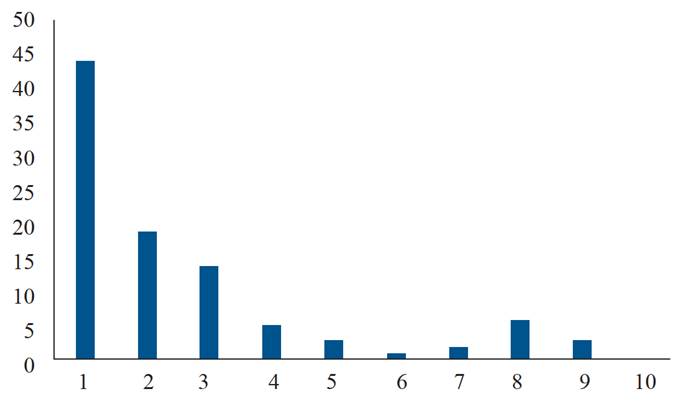
The quantitative analysis in the first phase enabled us to establish a preliminary descriptive framework for the subsequent achievement of the objectives related to the evaluative reception of the film Barbie among Spanish-speaking users on the Filmaffinity platform (2025). Systematizing the ratings users assigned to their reviews reveals a clear asymmetric distribution, in which extremely negative ratings predominate over more moderate or positive ones, despite the overall average user rating being 5.8 out of 10.
Source: The authors.
Figure 1 Distribution of scores given by Spanish-speaking users to Barbie (sample of the 100 most visible reviews)
The distribution of users’ scores for Barbie reflects clear polarization and a notably negative trend in overall ratings. Figure 1 shows a strong concentration of reviews at the lowest ratings, especially 1, 2, and 3, which together account for the majority of votes. This concentration indicates widespread rejection of the film’s narrative and discursive approach by a large proportion of users, and highlights a problematic reception in terms of gender discourse.
On the other hand, the notable scarcity of mid-range ratings (scores of 5, 6, or 7) suggests an absence of moderate or neutral opinions about the film. Users appear to be compelled to take a stance for or against the film’s message, such that middle-of-the-road positions that balance strengths and weaknesses are avoided. This dynamic reinforces the hypothesis that the film is provocative, forcing the audience to take clear stances on sensitive issues such as feminism, gender stereotypes, and media representations of men and women.
In addition, the graph shows that a minority, but clearly differentiated group of users rated the film highly (mainly giving scores of 8 and 9). This group responded positively to the film’s social satire, feminist critique, and purely cinematic aspects. This favorable minority also highlights an audience segment receptive to Greta Gerwig’s narrative approach. Despite its controversial reception, they have rated the film as an effective tool for generating critical reflection on gender.
In general terms, the strong negative skew in the distribution of scores suggests significant cultural resistance to explicit feminist narratives. It also indicates a perception that such media representations may be problematic when they directly challenge traditional and dominant gender roles. This could also be interpreted as a form of resistance to the reception of one of the major commercial successes of 2023’s major studio cinema. In conclusion, this graphical distribution reveals the complexity and controversy surrounding the film’s reception, as well as the current sociocultural context in which gender representations in the media are subject to intense scrutiny, social debate, and polarized positions.
Categorization of users’ reviews from a gender perspective
Applying the CDA to the selected set of reviews clearly identified certain discursive patterns relating to gender perceptions and representations of Barbie, thereby addressing the first objective of this research. These perceptions can be organized into four broad discursive categories that help explain the current polarization of users’ opinions from a gender perspective.
Firstly, a significant proportion of the reviews reflect a negative perception of the film, with many users describing it as an explicit attack on men and labeling it as misandry. These users believe that the film perpetuates negative and stereotypical portrayals of men, depicting them as superficial, incompetent, or even morally inferior to women. This representation is perceived as an unfair reversal of patriarchy that falls short of proposing a genuine vision of equality. The recurrence of terms such as “misandry”, “ridicule”, or “reverse sexism” highlights the discomfort felt towards this portrayal of male characters.
A second category encompasses feminist critiques that reject the film’s simplistic, superficial portrayal of feminism, even as it shares certain egalitarian ideals. From this perspective, some reviews express dissatisfaction with feminism perceived as propagandistic, caricatured, or extremist. They argue that, rather than encouraging reflection on and raising awareness of real issues related to gender inequality, the film trivializes these matters by reducing them to simplified and repetitive messages. Particular criticism is directed at the way the film addresses gender relations, perpetuating an unnecessary and harmful “battle of the sexes”. The most common terms in these reviews are “superficial feminism”, “trivialization”, “propaganda”, “stereotypes”, and “simplistic messages”.
The third category identifies feminist critiques that positively interpret the film’s intent from satirical and critical perspectives. These critics appreciate how the film uses humor, irony, and exaggeration to challenge deeply ingrained gender roles and stereotypes in society. According to these critics, the film fulfills a relevant social function by exposing certain social incoherencies and contradictions in gender expectations through satire. From this perspective, the film is considered a valid tool for promoting constructive debates on feminism and gender. The most frequently used terms in these reviews include “feminist satire”, “social critique”, “irony”, “empowerment”, and “questioning of roles”.
Finally, a fourth category comprises more neutral or nuanced reviews, in which users adopt middle-of-the-road positions that integrate both positive and negative aspects related to gender representation, while placing particular emphasis on other cinematic elements such as direction, screenplay, or performance. These reviews reflect a balanced perspective, in which debate on gender is present, but not necessarily decisive, in the overall evaluation of the film. This reveals a more complex and less polarized view of the film, acknowledging both its potential strengths and limitations in the way it treats gender. The most common terms in these reviews include “balanced”, “nuanced”, “wasted potential”, and “entertainment”.
From an approximate quantitative perspective (see Table 1), roughly half of the analyzed reviews (around 50 %) correspond to the first group, i.e., they perceive a misandristic intention. Around 25 % of the analyzed reviews correspond to the second group, namely feminist reviews that question the film’s superficial feminism. Approximately 15 % fall into the third category, comprising positive and constructive feminist reviews. Finally, close to 10 % present neutral or mixed positions that balance the gender dimensions with other cinematic elements.
These findings indicate a significant level of polarization in the discourse surrounding Barbie and reflect current sensitivities regarding media representations of gender, as well as the diversity of interpretations within feminist discourse. The observed conflict leads us to conclude that the film has acted as a catalyst, highlighting existing tensions in cultural perceptions of feminism and gender relations in the Hispanic community today. It is also worth noting that the hundred most visible reviews on Filmaffinity -those with the highest number of positive ratings- have barely addressed the film’s cinematic merits, but rather have adopted a strongly ideological stance.
Reviews categorized by place of origin and discursive category
Regarding the place of origin of the users responsible for the reviews, the following must be taken into account when interpreting the results of the analysis of the 100 most visible reviews on Filmaffinity: only reviews from users in Spanish-speaking cities were included in the sample. This third part of the research seeks to identify potential territorial patterns in the critical reception of gender discourse.
The geographic analysis of the sample reveals an overrepresentation of Spanish users, who make up 79 % of the sample. Users from major urban centers such as Madrid, Barcelona, Seville, and Málaga are particularly notable, accounting for 51 % of the reviews. This suggests a centralization of discourse in urban contexts, with greater cultural and media dynamism and larger populations. Contributions were also identified from various Latin American cities such as Buenos Aires, Mexico City, Montevideo, Santiago de Chile, San José (Costa Rica), or Bogotá, albeit in a significantly smaller proportion.
This distribution can be explained by the higher level of activity among Spanish users on the Filmaffinity platform. Given the specific nature of Spain’s sociopolitical and cultural context in relation to debates on feminism, equality, and gender representation, the prominence of Spanish users shapes the geographical distribution of opinions and may influence prevailing discursive frameworks.
This prevalence may be linked to Spain’s recent sociopolitical context, where debates surrounding feminism, which the far-right refers to as “gender ideology”, or media polarization around equality policies have become particularly intense. Consequently, the critical language used in these reviews reflects certain male perceptions of grievance or rejection of feminist discourse.
In any case, no clear or systematic pattern has been identified that directly links the city of origin with the score given or to membership of one of the four discursive categories (misandry, critical feminism, positive feminism, and neutrality). However, several specific observations can be made. Firstly, the harshest criticisms, with extremely low scores (1-2), mostly come from Spanish users, who express dissatisfaction with perceived grievances against men within the “misandry” discursive category.
Conversely, although reviews from Latin America (primarily from Buenos Aires, Mexico City, Montevideo, Santiago de Chile, and Bogotá) constitute a minority of the sample, they tend to be more nuanced or to fall into the “positive and constructive feminism” category. Some of these reviews consider the film’s satirical intent and its ability to spark debate. More interpretative discourses are also observed, which are less focused on male grievance and more interested in symbolism, the screenplay, or social critique.
Therefore, no direct correlation should be drawn between place of origin and discourse category. This is due to the underrepresentation of Latin American spaces in the sample, as well as the lack of homogeneity in discourse trends. Finally, although the users’ gender can be inferred from the reviews, it has not been included as a demographic variable in these categorizations due to a lack of reliable data.
Discussion and conclusions
This study sheds light on how Barbie has sparked discourse within the Spanish-speaking digital landscape, offering insights into gender studies and audiovisual reception.
On a platform such as Filmaffinity, user reviews serve as a means of expressing ideologies and cultural perspectives on gender, transcending mere aesthetic assessments. These contributions shape the symbolic space where meanings are negotiated, identities are consolidated, and preexisting social tensions are reignited. Within this framework, digital discursive practices become active forms of cultural participation, referencing broader debates on feminism, masculinity, and gender representation.
In line with Godoy de Almeida Leite et al. (2025), the findings of this study show that evaluations of Barbie cannot be separated from the ideological frameworks that mediate the reception of filmic discourse. As Fragoso et al. (2011) previously noted, digital criticism provides an ideal setting for analyzing the social construction of collective meanings surrounding mass-market cultural products. While the reviews gathered in this sample do not constitute a unified discourse, they do present a polarized structure that clearly reflects the current state of gender debates in the Spanish-speaking context.
From a geographical perspective, Spanish users clearly predominate among those who write the most visible reviews, which receive the highest number of positive ratings. This significantly influences the tone and discursive approach of many of the reviews. Kaplan (1995) emphasizes the importance of examining how works directed by women are received to understand how the meanings they propose are accepted, resisted, or reformulated. In the case of Barbie, a significant number of users reject a discourse questioning patriarchal structures and certain gender privileges. These responses take the form of discourses that discredit the film’s feminist message or interpret it as offensive to men. In contrast, some viewpoints value the film’s critical, ironic, and provocative approach.
In line with the study’s first objective (O1), identifying and categorizing discursive positions within the sample has enabled us to construct an interpretative map of the Spanish-speaking audiences’ responses. The four emerging categories (misandry, critical feminism, positive feminism, and neutrality) reflect differences in how the film was received, as well as the existence of distinct ideological frameworks that act as interpretative filters when engaging with audiovisual content. The prevalence of discourses that interpret the film as an affront to men, alongside those that are more receptive to its satirical and critical approach, reveals a clear fracture in how feminist narratives are processed within the realm of amateur criticism.
The second objective (O2) aimed to analyze whether users’ place of origin and the sociocultural context influenced their assessments. While no systematic correlation between geographical origin and membership belonging to a specific discursive category has been identified, certain patterns can be observed. Reviews from Spain, which predominate in the sample, tend to adopt more polarized positions and exhibit a strong presence of reactive discourse. Conversely, some Latin American reviews, although in the minority, adopt more interpretative or nuanced stances. In any case, it is not possible to infer a deterministic or uniform relationship based on the context in which the critique was produced.
Overall, this study provides a complex view of contemporary forms of critical reception of cultural products marked by gender discourses. The results of this case study reveal a significant level of discursive polarization surrounding Barbie, primarily due to its explicit treatment of gender and feminist themes. The observed controversy reflects a heightened contemporary sensitivity to media representations of gender, indicating how cultural works with explicitly feminist discourses can serve as catalysts for intense debates about equality, stereotypes, and power relations between genders.
This confrontation can also be interpreted as a reflection of the current Spanish-speaking sociocultural context, characterized by ongoing tensions surrounding feminism and gender discourses, and highlights the challenges and complexities inherent in the collective negotiation of meanings related to equality and media representation.
In addition to describing the controversy surrounding Barbie, the results allow us to draw methodological and theoretical conclusions relevant to the study of reception. Theoretically, the proposed categories contribute to the study of films with feminist discourses by empirically disaggregating positions that are often reduced to a binary framework (for/against). This typology shows that the controversy originates from divergent interpretative perspectives and approaches to the same text. This reinforces the notion that reception is a contextualized negotiation of meanings in works created by women (Kaplan, 1995) and in digital spaces of amateur criticism (Fragoso et al., 2011).
Secondly, the results show that platforms such as Filmaffinity serve as spaces for the symbolic production of social imaginaries concerning feminism, masculinity, and gender hierarchies, which are then expressed, contested, and reformulated. Finally, from a methodological perspective, the combination of a descriptive quantitative phase with a CDA applied to a corpus of reviews makes it possible to link the observed rating patterns to the discursive mechanisms that shape them, without making causal inferences.
The main limitations of this study stem from those inherent in a case study, as well as from the biases inherent in the sample delimitation. Consequently, future lines of research could use this approach to explore other films set against the backdrop of the fourth wave of feminism and consider incorporating additional methodologies, such as audience questionnaires, to strengthen the findings obtained here.
REFERENCES
Aguilar-Barriga, N. (2020). Una aproximación teórica a las olas del feminismo: la cuarta ola. FEMERIS: Revista Multidisciplinar de Estudios de Género, 5(2), 121-146. https://doi.org/10.20318/femeris.2020.5387 [ Links ]
Barrios-Rodríguez, S., González-de-Garay, B., & Marcos-Ramos, M. (2021). Representación de género en las series españolas de plataformas de streaming. Cuestiones de Género: de la Igualdad y la diferencia, (16), 298-322. https://doi.org/10.18002/cg.v0i16.6304 [ Links ]
Biswas, A. (2004). La tercera ola feminista: cuando la diversidad, las particularidades y las diferencias son lo que cuenta. Tiempo Cariátide, 65-70. https://www.uam.mx/difusion/revista/sep2004/biswas.pdf [ Links ]
Bobaru, N. (2024). Reimagining Barbie: A feminist analysis of iconography and consumerism in the age of gender reevaluation. Gender Studies, 23(1), 5-25. https://doi.org/10.2478/genst-2024-0005 [ Links ]
Bustos Díaz, J., Perelló Sobrepere, M., & Martín-Vicario, L. (2024). Barbie en Redes Sociales. El éxito de una campaña más allá del cine y la taquilla. Visual Review, 16(1), 267-276. https://dx.doi.org/10.62161/revvisual.v16.5210 [ Links ]
Cares Geoffroy, M. J. (2022). La función social del análisis crítico del discurso. UCMaule, (63), 116-129. https://doi.org/10.29035/ucmaule.63.116 [ Links ]
Chico, F. (2024, 23 de enero). Polémica en los Premios Oscar 2024: ningunean a “Barbie” y le dejan sin dos nominaciones que todos daban por seguras. Fotogramas. https://www.fotogramas.es/premios-oscar-cine/a46502380/premios-oscar-2024-nominaciones-barbie-margot-robbie-greta-gerwig/ [ Links ]
Colorado Colmán, C. C. (2024). Cultural and Social Representations in a Paraguayan Series. Enletawa Journal, 17(2), 13-24. https://doi.org/10.19053/uptc.2011835X.18698 [ Links ]
Del Campo Cañizares, E., & Cifuentes Albeza, R. (2024). Caimán y Filmaffinity: Un estudio comparativo entre la crítica cinematográfica profesional y la cinefilia digital. European Public & Social Innovation Review, (9), 1-18. https://doi.org/10.31637/epsir-2024-1123 [ Links ]
Fernández Mencías, J. (2023, 3 de septiembre). ‘Barbie’ arrasa y se convierte en la película más taquillera de 2023. Fotogramas.https://www.fotogramas.es/noticias-cine/a44982960/barbie-pelicula-mas-taquillera-2023/ [ Links ]
Filmaffinity. (2025). Barbie [Críticas]. https://bit.ly/4cCtr55 [ Links ]
Fragoso, S., Recuero, R., & Amaral, A. (2011). Métodos de pesquisa para internet. Sulina. [ Links ]
Garrido, R., & Zaptsi, A. (2021). Arquetipos, Me Too, Time’s Up y la representación de mujeres diversas en TV. Comunicar, XXIX(68), 21-33. https://doi.org/10.3916/C68-2021-02 [ Links ]
Garrido Ortolá, A. (2022). Reivindicaciones feministas de la cuarta ola: la transnacionalización de la protesta. Asparkía. Investigación Feminista, (40), 191-216. https://doi.org/10.6035/asparkia.6184 [ Links ]
Garrido-Rodríguez, C. (2021). Repensando las olas del feminismo. Una aproximación teórica a la metáfora de las olas. Investigaciones Feministas, 12(2), 483-492. https://doi.org/10.5209/infe.68654 [ Links ]
Gavilán, D., Martínez-Navarro, G., & Fernández-Lores, S. (2018). Influencia social en las comunidades de cine: Filmaffinity como caso de estudio. Estudios sobre el Mensaje Periodístico, 24(1), 551-565. https://doi.org/10.5209/ESMP.59966 [ Links ]
Godoy de Almeida Leite, H., Fernandes da Silva Mandaji, C., & Hartmann Alves, V. (2025). Female in focus: interactions with Greta Gerwig’s films on Letterboxd. Razón y Palabra, 29(122), 86-100. https://doi.org/10.26807/rp.v29i122.2206 [ Links ]
Higueras-Ruiz, M. J., Martín-Martín, P., & Pérez-Rufí, J. P. (2025). Representación de género y valores feministas en la serie de televisión La Maravillosa Sra. Maisel. ASRI. Arte y Sociedad. Revista de Investigación en Artes y Humanidad Digitales, (27), e6831. https://doi.org/10.33732/ASRI.6831 [ Links ]
Kaplan, E. A. (1995). A mulher e o cinema: os dois lados da câmera. Rocco. [ Links ]
Marcos-Ramos, M., & Mateos-Pérez, J. (2025). La Representación Femenina en el Western Televisivo Contemporáneo: Los ejemplos de Godless (Netflix, 2017) y The English (BBC, 2022). VISUAL REVIEW. Revista Internacional de Cultura Visual, 17(1), 37-50. https://doi.org/10.62161/revvisual.v17.5359 [ Links ]
Martínez Cano, S., Meléndez Táboas, A., & Alonso-Martín-Romo, L. (2024). Análisis de la narrativa “rosa” de creadoras y artistas de ficción audiovisual: Barbie y Super FreakyGirl. Historia y Comunicación Social, 29(2), 475-487. https://doi.org/10.5209/hics.95190 [ Links ]
Martínez Romagosa, M., & Flax, R. (2020). Desalienar el ACD: Una revisión de la noción de ideología para devolver la crítica marxista al análisis crítico del discurso. Pensamiento al Margen, (12), 54-66. https://pensamientoalmargen.com/2020/05/07/no12-4/ [ Links ]
Máthé, N. (2024). “I’m not pretty anymore:” Femininity and beauty in the Barbie movie. Gender Studies, 23(1), 81-92. https://doi.org/10.2478/genst-2024-0006 [ Links ]
Mulvey, L. (1975). Visual Pleasure and Narrative Cinema. Screen, 16(3), 6-18. https://doi.org/10.1093/screen/16.3.6 [ Links ]
Pardo Abril, N. G. (2013). Cómo hacer análisis crítico del discurso: Una perspectiva latinoamericana (2ª ed.). Universidad Nacional de Colombia. https://repositorio.unal.edu.co/handle/unal/20012 [ Links ]
Peña Ochoa, M. (2019). El análisis crítico de discurso en textos de políticas públicas: Lineamientos para una praxis investigativa. La Trama de la Comunicación, 23(1), 31-46. https://latrama.unr.edu.ar/index.php/trama/article/view/678 [ Links ]
Pérez Gómez, A., & Sanabria Rojas, Q. A. (2024). La película Barbie: Análisis desde la perspectiva del femvertising y las pedagogías decoloniales. Cuadernos CIMEAC, 14(2), 143-167. https://doi.org/10.18554/cimeac.v14i2.7850 [ Links ]
Posada-Kubissa, L. (2020). Las mujeres y el sujeto político feminista en la cuarta ola. IgualdadES, (2), 11-28. https://doi.org/10.18042/cepc/IgdES.2.01 [ Links ]
Semrush. (2025). Domain Overview: filmaffinity.com. https://bit.ly/42qhWdP [ Links ]
Tinat, K. (2024). La película Barbie: Avalancha de clichés, feminismo washing y reverso a los esencialismos. Entrevista colectiva a estudiantes de la maestría de Estudios de Género. Revista interdisciplinaria de estudios de género de El Colegio de México, 10, 1-14. https://estudiosdegenero.colmex.mx/index.php/eg/article/view/1180 [ Links ]
Torres-Romay, E., & Izquierdo-Castillo, J. (2022). La representación de la mujer en la ficción española. Propuesta de clasificación de roles y estereotipos desde la perspectiva de género. Ámbitos. Revista Internacional de Comunicación, (57), 102-122. https://doi.org/10.12795/Ambitos.2022.i57.06 [ Links ]
van Dijk, T. A. (1993). Principles of Critical Discourse Analysis. Discourse & Society, 4(2), 249-283. https://doi.org/10.1177/0957926593004002006 [ Links ]
Zacipa-Indante, I., & Tur-Viñes, V. (2025). Barbie (2023): el icono cultural que redefine el empoderamiento femenino. Revista de Comunicación, 24(1), 539-557. https://doi.org/10.26441/RC24.1-2025-3752 [ Links ]
Zheng, S. (2024). Women’s Identity Construction and Identity from the Perspective of Gender Theory: Examination of Gender Discourse based on the Film Barbie. Transactions on Social Science, Education and Humanities Research, 7, 225-230. https://doi.org/10.62051/wytfaa38 [ Links ]
How to cite: Higueras-Ruiz, M. J., Martín-Martín, P., & Pérez-Rufí, J. P. (2026). Gender narratives and discursive conflict: The reception of Barbie (2023) among Spanish-speaking audiences. Comunicación y Sociedad, e9057. https://doi.org/10.32870/cys.v2026.9057
Received: April 29, 2025; Accepted: February 10, 2026
 Este es un artículo publicado en acceso abierto bajo una licencia
Creative Commons
