




Servicios Personalizados
Revista
Articulo
 texto en
  Inglés (pdf)
 Artículo en XML
 Referencias del artículo
 Traducción automática
 Enviar artículo por email
Indicadores
-
 Citado por SciELO
 -
 Accesos
Links relacionados
-
 Similares en
SciELO
Similares en
SciELO
Compartir

 Permalink
Comunicación y sociedad
versión impresa ISSN 0188-252X
Comun. soc vol.22 Guadalajara 2025 Epub 10-Oct-2025
https://doi.org/10.32870/cys.v2025.8906
La alfabetización mediática como nuevo ámbito de conocimiento científico
Media and information literacy as a public policy in Ecuador
**
 http://orcid.org/0000-0001-8965-0170
**
http://orcid.org/0000-0001-6807-7635
**
http://orcid.org/0000-0002-4821-3596
**Universidad Técnica Particular de Loja, Ecuador. derivera@utpl.edu.ec. ambeltran@utpl.edu.ec. ldandrade@utpl.edu.ec. avvelasquez@utpl.edu.ec
This paper analyzes the integration of media and information literacy (MIL) in Ecuador’s public policies, using the IGO model to prioritize strategic actions. The research, carried out in collaboration with several entities, highlights the need to incorporate AMI in the national curriculum and to train citizens in media consumption and production. It concludes that a public policy of digital transformation based on MIL is key to improve the credibility of digital content and close the digital divide.
Keywords: Public policy; media literacy; citizenship; education
Este artículo analiza la integración de la alfabetización mediática e informacional (AMI) en las políticas públicas de Ecuador, utilizando el modelo IGO para priorizar acciones estratégicas. La investigación, realizada con colaboración entre varias entidades, destaca la necesidad de incorporar la AMI en el currículo nacional y capacitar a la ciudadanía en el consumo y producción mediática. Se concluye que una política pública de transformación digital sustentada en la AMI es clave para mejorar la credibilidad de los contenidos digitales y cerrar la brecha digital.
Palabras clave: Política pública; alfabetización mediática; ciudadanía; educación
Este artigo analisa a integração da alfabetização midiática e informacional (AMI) nas políticas públicas do Equador, usando o modelo IGO para priorizar ações estratégicas. A pesquisa, realizada em colaboração entre várias entidades, destaca a necessidade de incorporar a AMI ao currículo nacional e de treinar os cidadãos no consumo e na produção de mídia. Conclui-se que uma política pública de transformação digital baseada na AMI é fundamental para melhorar a credibilidade do conteúdo digital e reduzir a exclusão digital.
Palavras-chave: Políticas públicas; alfabetização midiática; cidadania; educação
Introduction
Media and information literacy (MIL) emphasizes an approach to literacy that enables individuals to critically question what they have read, heard, and learned (Logeswari et al., 2021). MIL fosters a set of skills that include the ability to evaluate and select diverse sources-channels of information, as well as the ability to comprehend news and information obtained (Suminas & Jastramskis, 2020). In this framework, Barton (2019) states that the media environment defines the people who consume it, in addition, the massification of false information impacts notoriously on the Internet, making truth a relative rather than a scientific concept.
Understanding and using media assertively or non-assertively, including an informed understanding of the techniques they employ and their effects, is an inescapable process and commitment put forward by UNESCO (Belvončíková & Čiderová, 2022), seeing it as an emerging construct of great value in the digital age where information overload threatens the well-being of society (Lee et al., 2022).
As stated by Mateus (2021), Internet access is a human right, therefore, media policies should focus on empowering citizens, and MIL education policies should address initial and continuous professional learning of teachers to ensure their success. For Ho and Ye (2024), improving people’s MIL skills is an effective way to address current issues through the development of state policies.
Some studies point out that information literacy and poverty will be the new dividing lines of a complex world, as was the metaphor of the “rich north and poor south” in the 20th century (Cerny, 2022). Therefore, the evaluation of a MIL educational policy requires special attention in order to ensure the analysis of its scope, effectiveness and adaptability to the challenges emerging in the media ecosystem (Rojas- Estrada et al., 2023).
This research is based on the IGO model (Importance and Governance) to evaluate and segment actions aimed at creating a public policy for digital transformation that integrates MIL as a transversal axis in Ecuador. This in order to arrive at the necessary principles that govern sound decision making at the media and informational level, determining the main reasons and areas for the framework of a public policy that complements the government’s strategic objectives.
Citizen participation and MIL
The current environment is marked by the omnipresence of new information and communication technologies, which poses a clear social challenge: media literacy (Foronda Rojo et al., 2018). In the knowledge society there is currently a call to cultivate a combination of media literacy and information literacy; however, this requires the ongoing cooperation of these two separate fields of study (Lee & So, 2014).
The forms of citizen participation have been reconfigured in recent years, with the presence of social networks and digital media that favor multiple modes of access to information, expression of ideas and social exchange (López-Gil & Sandoval-Sarrias, 2023). Some authors (McDougall & Rega, 2022) situate MIL as a form of development of context-linked capabilities, as opposed to a set of neutral and universal competencies.
A necessary reflection is then required to think about a sustainable future, which implies the valuation of communicative practices and the challenges in citizenship education brought about by globalization (López-Gil & Sandoval-Sarrias, 2023). In this framework, MIL contributes to the social context to improve interpretation and judgment skills, to develop critical understanding and active participation (Ciuladiene et al., 2023). In recent years, there are outstanding changes in the media and informational environment, such as the culture of participation, constant connectivity and the emergence of content generated from different thematic areas (Borges, 2023).
As suggested by Sengl and Heinke (2023), greater media literacy of the population is a way to counteract the problems and their implications, focusing on the ability to consume news in a reflective manner, a situation that allows the democratic participation of individuals. Baack (2021) states that this participation, enhanced as a result of technological change, contributes to making MIL increasingly important for communicative exchange. The digital era means that both citizens and media professionals require media and information literacy skills for the new real, virtual and hybrid environments (de Vega-Martín et al., 2022).
In modern society, issues linked to MIL seem to be especially relevant due to the spread of false information and unverified news (Avdonina et al., 2022). However, Belvončíková and Čiderová (2022) reveal a higher proportion of general understanding of communication and its role in society, but a lower proportion of awareness of literacy and media literacy.
MIL as public policy
Nations around the world still lack MIL policies, a situation that demands the creation and enactment of state laws to provide a framework that contributes to the acquisition of citizen skills and abilities in media consumption (DiGiacomo et al., 2023). The introduction of media education, the integration of media education tools with other disciplines and the creation of an informative portrait are indispensable parameters in the current scenario (Djumanova, 2022).
As promoted by UNESCO, a national policy approach is needed to ensure the systematic and progressive inclusion of MIL, the starting point being an understanding of national education, ICT, content-related institutions and industries, and freedom of information (Grizzle et al., 2021).
Socially, a multidisciplinary approach to policy making is called for, underlining the key role of MIL in shaping the regulatory and access landscape for emerging technologies (Gasmi et al., 2024). Lin et al. (2020) posit that policies gradually shifted their focus to the digital evolution of media, but lack the necessary planning to realize a coherent system.
The use of critical thinking skills in mediatized scenarios requires developing the ability to interact with the media, not only to be able to use devices, but also to understand their sociocultural effects (Mateus, 2021). Authors such as Jones and Procter (2023) consider that in recent years an increasing number of regional, national and international policies defend and offer frameworks for the development of MIL, even though there is still hard work to be done. Some studies (Altamirano Galván, 2021) point to greater strengths in technological policy skills, but also greater weaknesses in information, knowledge and communication skills.
Current literature emphasizes that MIL is a continuous and long-term process, a reality that demands more didactic proposals on digital skills, together with government policies and efforts (Fernández-Otoya et al., 2024). For his part, Frau-Meigs (2022) raises some specific challenges that affect the incursion of MIL as public policy: 1) it risks being reduced to journalistic literacy, 2) it risks being reduced to fact-checking, and 3) the discourse of misinformation risks reducing the emphasis on information.
In the face of this, the need for a paradigm shift towards convergence in policies for the digital era encompasses a global model of media competencies, which integrates MIL competencies (Gutiérrez-Martín et al., 2022).
Methodology
Through collaborative efforts between the Universidad Técnica Privada de Loja (UTPL), the United Nations Educational, Scientific and Cultural Organization (UNESCO), Ministerio de Telecomunicaciones y para la Sociedad de la Información (MINTEL), Ministerio de Educación and Fundación Andina para la Observación de Medios (FUNDAMEDIOS), this research aims to evaluate and prioritize actions for the development of a Public Policy for Digital Transformation in Ecuador, through the integration of MIL as a state proposal.
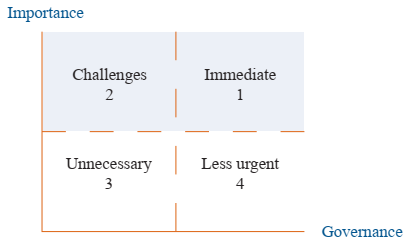
Mojica’s IGO matrix is used: Importance (relevance of the factor) and Governability (capacity one has to control and dominate the factor being analyzed), to classify the strategic factors according to their manageability, when establishing objectives, goals and prioritizing actions, thus establishing action strategies (Gándara et al., 2014). According to the importance of each action, the participants have a list of suggested actions from the brainstorming session (Mojica, 2005).
The criteria of importance and governance are compared to offer a prioritization of actions to be evaluated, after conducting four roundtables in Quito, Guayaquil, Riobamba and Loja with 313 participants, including educators, communication professionals, representatives of governmental/non-governmental organizations and civil society.1
There is an ordered pair (X, Y) for each factor. Then, with governance acting as the X axis and importance as the Y axis, a point is found in the XY plane, producing a cloud of points (one for each factor).
Based on MIL and its various competencies, the positive aspects (potentialities), negative aspects (problems), and possible solutions that influence or impact the implementation and development of the “Digital Transformation” in the nation were examined. The data from the four roundtable discussions held in Quito, Guayaquil, Riobamba, and Loja with 313 participants was systematized using this methodology, segmenting the content into two main thematic axes:
Table 1 Governance factor measured with the igo methodology
| Governance | |
|---|---|
| Score | Description |
| 5 | Strong |
| 3 | Moderate |
| 1 | Weak |
| 0 | Null |
Source: The authors.
Table 2 Importance factor measured with the igo methodology
| Importance | |
|---|---|
| Score | Description |
| 4 | Strong |
| 3 | Moderate |
| 2 | Weak |
| 1 | Null |
Source: The authors.
Table 3 Importance factor measured with the igo methodology
| Section 1: Immediate actions | Upper right corner (those of greater governance and importance) |
| Section 2: Challenges | Upper left corner (higher importance, lower governance) |
| Section 3: Unnecessary actions | Bottom left corner (limited governance and low importance) |
| Section 3: Less urgent actions | Bottom right corner (no significant effect on the system) |
Source: Mojica (2005).
Media and Information Literacy: Comprehension, Access, and Critical Evaluation. Covers the following thematic areas: 1) Information, media, and digital communications in sustainable development and democracy; 2) Use, generation, creation, and distribution of content; 3) Access to information and ethical practices; 4) Critical evaluation of information, its sources, and ethical practices.
Media and Information Literacy: Application, Sociocultural Context, Education, and Promotion. Covers the following topics: 1) Traditional and digital media formats; 2) Information, media, and digital content and their relationship to the sociocultural context; 3) Media and Information Literacy (MIL) in the educational context.
In order to graph and establish relationships within this systematization, Atlas.ti 22 software was used to analyze, organize, and visualize the qualitative data in a structured manner. Through inductive categorization, emerging patterns were identified and grouped to discover key connections between the different elements of the analysis. On this basis, statements were constructed regarding potential issues, problems, and possible solutions in the consolidated roundtable discussions.
Previous diagnosis
The roundtables were complemented by a preliminary assessment for teachers and students, administered to 548 participants to identify their training needs in public policy for MIL. This assessment was addressed to students in middle school (ages 9 to 11), upper elementary school (ages 12 to 14), and high school (ages 15 to 17), as well as teachers from 60 Millennium Educational Units in nine regions of Ecuador. The assessment was divided into seven blocks (MIL competencies).
Subsequently, a validation process was carried out on the “Dialogue 2.0” platform of the Ministry of Telecommunications of Ecuador (citizen participation tool), involving the community in the evaluation and verification of the results derived from the diagnostic survey.
Results
Previous diagnosis
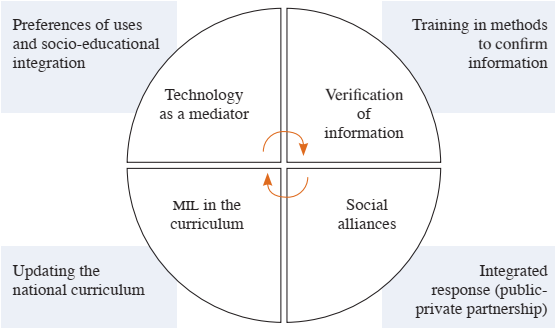
A demand for media education is detected, as a response to the digital processes that mark the course of the country. Students and teachers are beginning to use the Internet as a means to interact with content and receive information, although they do not have the necessary training to process it.
The search for information represents a determining point in this diagnosis, as a consequence of an environment where fake news is widely disseminated on media platforms. Faced with this reality, social actors promote the value of literacy to produce audiences with greater knowledge through the teaching of skills and critical analysis, both in formal and informal environments. The diagnosis requires four determining factors, as seen in Figure 2.
Thematic axis 1: potentialities, problems and possible solutions
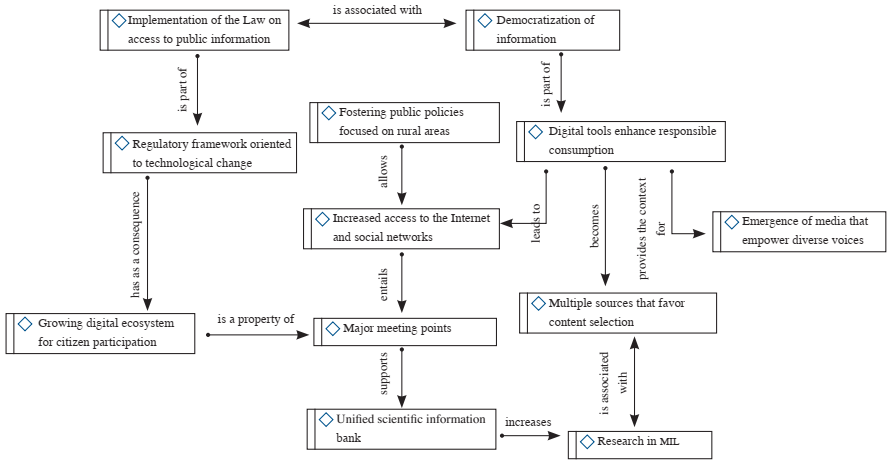
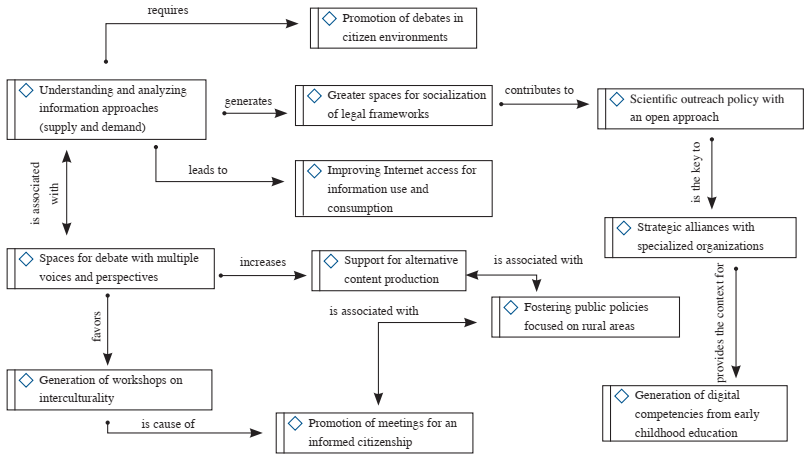
Regarding the potentialities deciphered by the participants, the establishment of regulations as a support for digital and technological communication stands out. “There is a need to promote public policies aimed at rural areas that enable access to the Internet for timely information” (Internews delegate in thematic axis 1), to ensure that historically marginalized communities have the necessary conditions to access information in real time and to establish equity in favor of equal access to information and education.
Within this process, it is emphasized that “digital tools are fundamental, particularly to establish different perspectives at the media level regarding the representation of cultural, social and gender diversity” (Representatives of the Ministry of Women and Human Rights of Ecuador in thematic axis 1). This variety in the media landscape is essential for content selection. As a result, research in media and information literacy (MIL) has become a fundamental tool for critically analyzing the content that proliferates in the digital sphere. It plays a crucial role in identifying potential biases, stereotypes, and discriminatory content that could perpetuate inequalities or violate rights.
However, elements such as the digital divide are one of the most notorious limitations for the participants due to the barriers they generate. “It restricts the dissemination of content, mainly in vulnerable sectors” (Representative of the Universidad Técnica Particular de Loja in thematic axis 1), in this sense, “a representative number of citizens show ignorance regarding the elementary guidelines to consume informative material” (Representative of the Universidad de Guayaquil in thematic axis 1).
Source: The authors.
Figure 3 Relationships between the potentialities detected in the dialogue roundtables - Axis 1
As a result, trivialized contents are presented that do not provide an added value; this is generated by a lack of knowledge regarding the informative evaluation or implicit legal frameworks at the time of consumption. Even the overexploitation of banal topics (with no scientific support) leads to “lowering the level of debate, which is even reflected in the reification of knowledge, ethnicities or nationalities” (Representative of the Interuniversity Observatory of Ecuadorian Media in thematic axis 1).
Possible solutions include the consolidation of citizen debates to raise awareness of diverse informational perspectives, which include key intercultural elements to understand media processes. It is proposed that these factors drive formal socialization spaces with a view to establishing defined policies around MIL, as well as “promoting responsible consumption of information through social alliances” (Representatives of the Communication Council of Ecuador in thematic axis 1); it is aimed at establishing public-private partnerships in favor of MIL education from childhood onwards.
It is essential to produce alternative content; however, they point out that “it is necessary to work in vulnerable areas to ensure equitable access to information and education, promoting inclusion and empowerment of communities” (Representatives of the Telefónica Foundation in thematic axis 1).
Thematic axis 2: potentials, problems and possible solutions
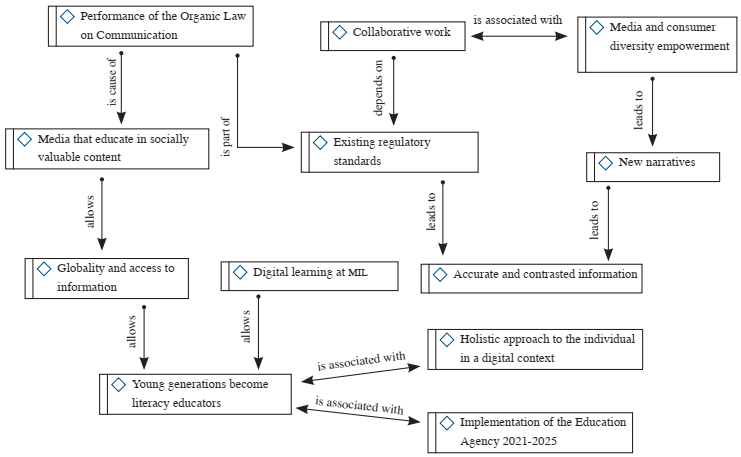
One of the potentialities highlighted is the validity and action of the Organic Law of Communication, thus, a positive factor for the participants is the diversity of media that currently proliferate: “fundamental basis for a collaborative work that in one way or another is subject to regulatory standards” (Representative of Cooperación Gestión Creativa Iberoamericana in thematic axis 2); to this adds the emergence of new narratives, which together with the legal framework established work for a contrasted information.
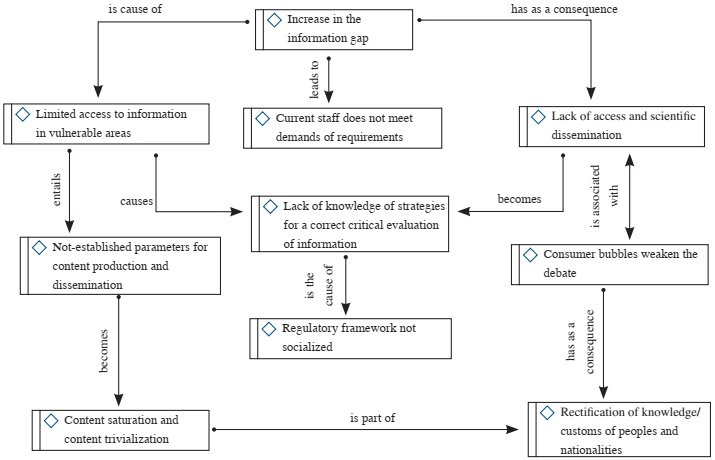
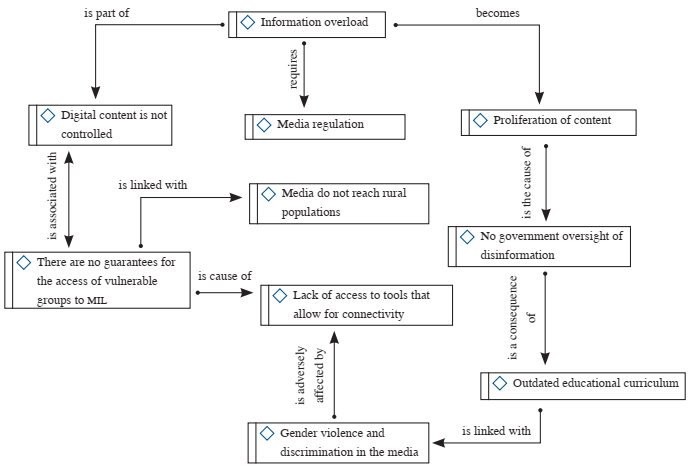
It was pointed out that “information saturation responds to uncontrolled digital content due to a lack of media regulation” (Representative of the Ciudad de Loja Educational Unit in thematic axis 2), which leads to information saturation and creates an ecosystem marked by disinformation. One of the points of concern for the participants is the lack of access to media in vulnerable communities, “which causes limited access to tools that facilitate connectivity” (Representative of the Chimborazo Polytechnic School in thematic axis 2). Therefore, the incursion of MIL as a regulator in the consumption and production of contents is difficult, because the lack of technological infrastructure and the scarce availability of resources limit the benefit of basic digital tools to access, create and distribute contents.
The participants link these access restrictions to “the proliferation of material that does not comply with social coexistence or respect for others” (Representative of the National Council for Gender Equality in thematic axis 2), such as the issue of gender violence/discrimination through content. This reality is aggravated by the lack of updating of the national educational curriculum, an indispensable part in the formation of citizens who are analytical and aware of current challenges and needs. Therefore, the updating of curricula must be accompanied by adequate teacher training.
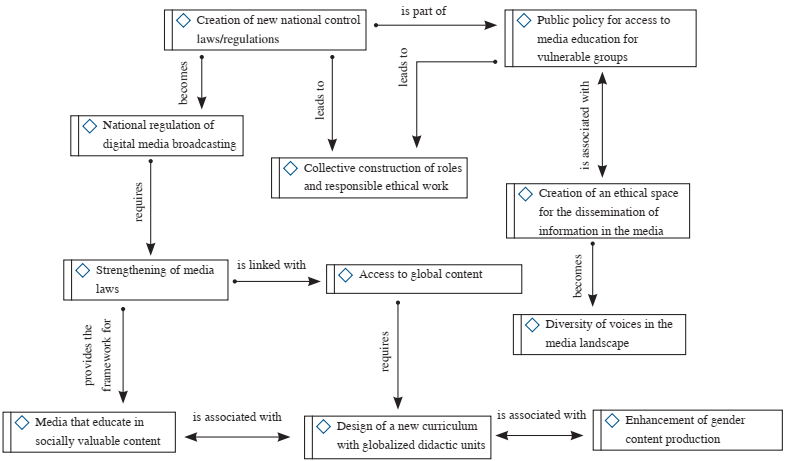
As an answer, the possible solution is established as “the creation of laws and guidelines to regulate the information produced, as well as for a greater reach in vulnerable communities” (Representative of Enseña Ecuador in thematic axis 2); the generation of new media in digital platforms means “the opportunity to broaden access and empower citizens in new roles and profiles” (Representative of the Universidad Laica Eloy Alfaro in thematic axis 2).
Within this framework, it is vital to have access to diverse contents in order to broaden the variety of media proposals, particularly on current issues. The proposal then consists of “creating meeting/dissemination spaces, based on previous knowledge acquired through MIL teaching-learning processes” (Representative of the Ministry of Education in thematic axis 2).
The relevant guidelines among the dialogue roundtables respond to the actions that the participants consider to be a priority in this process. Immediate actions and challenges reach 41 % and 31 %, respectively, becoming, according to the criteria of the roundtables, the aspects that deserve priority attention and constant follow-up to guarantee their correct implementation and resolution. However, between 9 % and 19 % of the ideas shared by the participants correspond to unnecessary or less urgent actions, i.e., those guidelines that do not constitute a prioritization of execution.
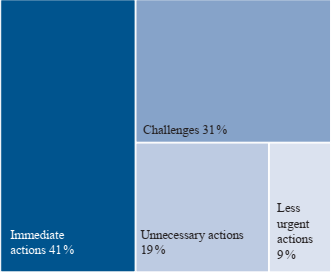
The former prioritize education in MIL, socialization of legal frameworks, training, use of ICTs and critical training in media consumption as determining factors in empowering individuals and enabling them to understand and analyze the information they receive. Informed decision-making and social participation in the media and information environment depend on these aspects.
It is evident among the challenges that Internet access (in terms of technical aspects) is a challenge for Ecuador. There is also a latent need for government entities to clarify official media information, an essential element for the generation of content, as well as the verification of information and the application of criteria to select content (variety of audiences). In this framework, MIL emerges as a key resource for society to be in tune with the educational system.
Unnecessary and less urgent actions obtain lower scores and, therefore, are not considered by the participants as a priority. These include the segmentation of content before it is published, the regulation of artificial intelligence, among others.
Objectives and strategies proposed by the dialogue roundtables
Each thematic axis establishes objectives and a set of strategies to achieve them, with a view to consolidating a public policy that integrates the principles of the IMA. It is a process of joint analysis and socialization among participants to identify priority needs in Ecuador and design effective guidelines.
Thematic axis 1
This axis aims to promote the critical, reflective, creative and safe use of Information and Communication Technologies (ICT), through “the development of digital skills and Media and Information Literacy (MIL) of citizens that promotes economic and social inclusion for greater competitiveness and productivity” (Sharing of objectives and strategies of participants who worked with thematic axis 1). A set of strategies is proposed to achieve this objective, which include:
Table 4 Proposals/strategies for thematic axis 1
| Scope of work | Action |
|---|---|
| Digital spaces | Promotion of rights and freedoms |
| MIL progress | Development of multi-sector alliances |
| Understanding MIL | Professional development and training |
| Access to information | Awareness efforts |
| Assessment of digital competence and MIL | Consolidation of a platform |
Source: The authors.
Thematic axis 2
This axis promotes “MIL to overcome the digital and media gap in education, through various strategies that improve access, training and available resources” (Socialization of objectives and strategies of participants who worked with thematic axis 2), to guarantee an inclusive, quality education with equal opportunities.
Table 5 Proposals/strategies for thematic axis 2
| Scope of work | Action |
|---|---|
| Technological infrastructure | Establishment of strategies, plans and initiatives |
| Academic training | Include MIL at all educational levels |
| Instructional programs | Training for parents, teachers and children |
| Awareness initiatives | Using icts. Gender, equality, and interculturality |
| MIL in formal and informal settings | Public awareness campaigns |
| Telecommunications infrastructure | Tax incentives |
Source: The authors.
Discussion
The roundtable discussions carried out show that the incursion of MIL in Ecuador represents one of the country’s greatest challenges, and the need to educate citizens on consumption and production practices is evident (Barton, 2019), without overlooking technical and connection limitations.
Along these lines, Cerny (2022) and Norman et al. (2022) point out that the digital divide causes vulnerable students to be even more digitally displaced. Although there are government statutes linked to MIL, they lack the necessary awareness to understand their scope (Mateus, 2021); many of the processes focus on citizens’ patterns of use, experience, and acquisition of government information through various digital media (Yavetz & Aharony, 2022). Participants consider it essential to structure a comprehensive public policy that considers MIL as part of the media-information-technological context (DiGiacomo et al., 2023), since policy evaluation is key to ensuring its scope and effectiveness (Rojas-Estrada et al., 2023).
Thus, diverse ways of accessing unlimited content emerge (López- Gil & Sandoval-Sarrias, 2023), with digital technology mediating these processes (Ciuladiene et al., 2023). Faced with this reality, a wide range of sources prevails in media environments (Sengl & Heinke, 2023), and citizens require specific skills that allow them to examine everything they see, read, and observe (Suminas & Jastramskis, 2020). The role of MIL is considered essential to promoting credibility as a competence based on the veracity and relevance of content and sources (Kanižaj & Lechpammer, 2019). The multiplicity of sources is an aspect that revolutionizes communication, but demands, as Avdonina et al. (2022) establish, media literacy training. Participants agree on the need to implement MIL within the national curriculum (de Vega-Martín et al., 2022) as a mechanism to instruct citizens from an early age (Fernández-Otoya et al., 2024). This inclusion, according to Jones and Procter (2023), is key in a media-digital context.
As Ikram and Rahman (2023) and Gutiérrez-Martín et al. (2022) point out, ongoing workshops and training sessions should be conducted to raise awareness among citizens of the importance and influence of MIL, as well as its positioning and the implicit legal frameworks (Lin et al., 2020); this aims to foster an understanding of its effects on everyday life (Moran Reyes, 2022). Thus, the IGO methodology (Mojica, 2005) facilitates the implementation of different action plans for each category found, including those that are imminent, challenging, unnecessary, and less urgent. Implementing MIL actions to achieve specific objectives becomes crucial at the societal level.
Conclusions
MIL is key in Ecuadorian society due to its importance in media consumption practices, considering the ecosystem marked by information saturation and the excess of digital content proliferating on different platforms. It is necessary to consolidate a critical-analytical citizenship regarding its media consumption.
Inequality regarding technological access and digital connectivity becomes the most detrimental factor in disadvantaged and rural sectors, a situation that demands specific public policies to guarantee equal access to devices, systems, and platforms that mediate information.
Therefore, MIL must be part of a comprehensive public policy that considers its relevance in the media, information, and technological context, consistent with social needs and with a long-term vision that guarantees its evolution and adaptation to changes.
The implementation of continuing education programs focused on media and digital education is essential, considering the diversity of audiences, their contexts, and specific needs. Although technology is advancing at a dizzying pace, training proposals must be consistent with this process.
Finally, at the curricular level, MIL must be incorporated as part of the educational curriculum to develop citizens who are aware of the role of media and how it impacts decision-making. Currently, responsible use of information and analytical skills to process content are required.
REFERENCES
Altamirano Galvan, S. G. (2021). Media literacy profile of students and higher education teachers. Cpu-e, Revista de Investigación Educativa, (32), 88-110. https://doi.org/10.25009/cpue.v0i32.2735 [ Links ]
Avdonina, N., Zaitseva, L., Kuprikov, N., & Kuprikov, M. (2022). Analysis of media literacy among students of the journalism train- ing program. Media Education-Mediaobrazovanie, 18(3), 327-335. https://doi.org/10.13187/me.2022.3.327 [ Links ]
Baack, L. (2021). The rote of libraries in media literacy development. Information-Wissenschaft Und Praxis, 72(5-6), 299-307. https://doi.org/10.1515/iwp-2021-2176 [ Links ]
Barton, C. (2019). Critical literacy in the post-truth media landscape. Policy Futures in Education, 17(8), 1024-1036. https://doi.org/10.1177/1478210319831569 [ Links ]
Belvončíková, E., & Čiderová, D. (2022). One literacy and multiple intelligences? the case of media literacy. Media Literacy and Aca- demic Research, 5(2), 54-70. https://www.mlar.sk/wp-content/up-loads/2022/12/3_Eva-Belvonc%E2%95%A0ii%E2%95%A0ukova%E2%95%A0u_Denisa-C%E2%95%A0iiderova%E2%95%A0u-.pdf [ Links ]
Borges, J. (2023). Infocommunicative literacy: Conceptual structure and applications. Journal of Librarianship and Information Science, 55(3), 609-616. https://doi.org/10.1177/09610006221093792 [ Links ]
Cerny, M. (2022). Searching for a definition of information literacy as a socially cohesive component of community: A complementarity of experts and student approach. Social Sciences-Basel, 11(6), 235. https://doi.org/10.3390/socsci11060235 [ Links ]
Ciuladiene, G., Guleviciute, G., Latinyte, R., & Guogis, A. (2023). Promoting media literacy: Lithuanian students’ experience. Entrepreneurship and Sustainability Issues, 11(1), 282-292. https://doi.org/10.9770/jesi.2023.11.1(17) [ Links ]
de Vega-Martin, A., Pinedo Gonzalez, R., & Gutierrez Martin, A. (2022). Media and information literacy in schools of image and sound. Perceptions of teachers and students. Edmetic, 11(2), 1-17. https://doi.org/10.21071/edmetic.v11i2.14978 [ Links ]
DiGiacomo, D. K., Hodgin, E., Kahne, J., Alkam, S., & Taylor, C. (2023). Assessing the state of media literacy policy in U.S. K-12 schools. Journal of Children and Media, 17(3), 336-352. https://doi.org/10.1080/17482798.2023.2201890 [ Links ]
Djumanova, S. (2022). Media consumption and media literacy level of uzbek youth. Media Education-Mediaobrazovanie, 18(2), 157-168. https://doi.org/10.13187/me.2022.2.157 [ Links ]
Frau-Meigs, D. (2022). How disinformation reshaped the relationship between journalism and media and information literacy (MIL): Old and new perspectives revisited. Digital Journalism, 10(5), 912-922. https://doi.org/10.1080/21670811.2022.2081863 [ Links ]
Fernández-Otoya, F., Cabero-Almenara, J., Perez-Postigo, G., Bravo, J., Alcazar-Holguin, M. A., & Vilca-Rodriguez, M. (2024). Digital and information literacy in basic-education teachers: A systematic literature review. Education Sciences, 14(2), 127. https://doi.org/10.3390/educsci14020127 [ Links ]
Foronda Rojo, A., de Morentin Goni, J. I. M., & Urbina, A. (2018). Media competence of adolescent students from Esmeraldas (Ecuador). Pixel-Bit- Revista de Medios y Educacion, (52), 151-165. https://doi.org/10.12795/pixelbit.2018.i52.11 [ Links ]
Gándara, G., Leal, A., & Palomino, C. (2014). Matriz FODA y Matriz IGO, in Métodos Prospectivos: manual para el estudio y la construcción del futuro. Paidós. [ Links ]
Gasmi, F., Um, P. N., Virto, L. R., & Saba, P. (2024). Digital literacy, sustainable development and radiation regulation: Policy and information systems implications. Information Systems Frontiers, 26, 2027-2057. https://doi.org/10.1007/s10796-024-10488-9 [ Links ]
Grizzle, A., Wilson, C., Tuazon, R., Cheung, C. K., Lau, J., Fischer, R., Gordon, D., Akyempong, K., Singh, J., Carr, P. R., Stewart, K., Tayle, S., Suraj, O., Jaakkola, M., Thésée, G., Gulston, C., Andzongo Menyeng, B. P., & Zibi Fama, P. A. (Eds.). (2021). Media and information literate citizens: think critically, click wisely! UNESCO. [ Links ]
Gutiérrez-Martín, A., Pinedo-González, R., & Gil-Puente, C. (2022). ICT and media competencies of teachers. Convergence towards an integrated MIL-ICT model. Comunicar, 30(70), 21-33. https://doi.org/10.3916/C70-2022-02 [ Links ]
Ho, K. K. W., & Ye, S. (2024). Factors affecting the formation of false health information and the role of social media literacy in reducing its effects. Information, 15(2), 116. https://doi.org/10.3390/info15020116 [ Links ]
Ikram, M., & Rahman, B. H. (2023). Beyond media education: Assessing news media literacy in media students of public and private universities in Pakistan. Media Literacy and Academic Research, 6(1), 71-90. https://doi.org/10.34135/mlar-23-01-05 [ Links ]
Jones, S., & Procter, R. (2023). Young peoples’ perceptions of digital, media and information literacies across Europe: Gender differences, and the gaps between attitudes and abilities. Technology Pedagogy and Education, 32(4), 435-456. https://doi.org/10.1080/1475939X.2023.2210152 [ Links ]
Kanižaj, I., & Lechpammer, S. (2019). The role of organisations of journalists in promoting media literacy - building credibility and trust. Media Literacy and Academic Research, 2(1), 24-37. https://www.mlar.sk/wp-content/uploads/2019/04/MLAR_2019_1_cla- nok_2-1.pdf [ Links ]
Lee, A. Y. L., & So, C. Y. K. (2014). Media literacy and information literacy: Similarities and differences. Comunicar, 21(42), 137-146. https://doi.org/10.3916/C42-2014-13 [ Links ]
Lee, E. H., Lee, T., & Lee, B. (2022). Understanding the role of new media literacy in the diffusion of unverified information during the COVID-19 pandemic. New Media & Society, 26(9), 5195-5218. https://doi.org/10.1177/14614448221130955 [ Links ]
Lin, Y., Wang, W., & Chen, P. (2020). Rethinking media literacy policy in the digital internet era. Journal of Research in Education Sciences, 65(1), 115-136. https://doi.org/10.6209/JO-RIES.202003_65(1).0005 [ Links ]
Logeswari, A., Ramaiah, C. K., Shimray, S. R., & Deepti, C. (2021). Awareness about media and information literacy among research scholars of Pondicherry University: A survey. Desidoc. Journal of Library & Information Technology, 41(4), 250-259. https://doi.org/10.14429/djlit.41.4.17187 [ Links ]
López-Gil, K., & Sandoval-Sarrias, A. (2023). Citizen participation and critical digital literacy of university students. Revista Latinoamericana de Tecnología Educativa-Relatec, 22(2), 27-42. https://doi.org/10.17398/1695-288X.22.2.27 [ Links ]
Mateus, J. (2021). Media literacy for children: Empowering citizens for a mediatized world. Global Studies of Childhood, 11(4), 373-378. https://doi.org/10.1177/20436106211014903 [ Links ]
McDougall, J., & Rega, I. (2022). Beyond solutionism: Differently motivating media literacy. Media and Communication, 10(4), 267-276. https://doi.org/10.17645/mac.v10i4.5715 [ Links ]
Mojica, F. (2005). La construcción del fututo. Concepto y modelo de perspectiva estratégica, territorial y tecnológica. Universidad Externado de Colombia. [ Links ]
Moran Reyes, A. A. (2022). Digital epistemology as a bridge between digital literacy and the right to information. Investigación Bibliotecológica, 36(91), 193-206. https://doi.org/10.22201/iibi.24488321xe.2022.91.58579 [ Links ]
Norman, H., Adnan, N. H., Nordin, N., Ally, M., & Tsinakos, A. (2022). The educational digital divide for vulnerable students in the pandemic: Towards the new agenda 2030. Sustainability, 14(16), 10332. https://doi.org/10.3390/su141610332 [ Links ]
Rojas-Estrada, E., Aguaded, I., & Garcia-Ruiz, R. (2023). Media and Information Literacy in the Prescribed Curriculum: A Systematic Review on its Integration. Education and Information Technologies, 29, 9445-9472. https://doi.org/10.1007/s10639-023-12154 [ Links ]
Sengl, M., & Heinke, E. (2023). Teaching journalism literacy in schools: The role of media companies as media educators in Germany. Media and Communication, 11(2), 53-63. https://doi.org/10.17645/mac.v11i2.6389 [ Links ]
Suminas, A., & Jastramskis, D. (2020). The importance of media literacy education: How Lithuanian students evaluate online news content credibility. Central European Journal of Communication, 13(2), 230-248. https://doi.org/10.19195/1899-5101.13.2(26).5 [ Links ]
Yavetz, G., & Aharony, N. (2022). The users’ point of view: Towards a model of government information behavior on social media. Heliyon, 8(8), e10146. https://doi.org/10.1016/j.heliyon.2022.e10146 [ Links ]
1Quito: Internews, Fundación Panamericana para el Desarrollo, Universidad Técnica Particular de Loja (support center Quito), Observatorio Interuniversitario de Medios Ecuatorianos, Ministerio de la Mujer y Derechos Humanos, Cámara de Innovación y Tecnología Ecuatoriana, Fundación Telefónica, Consejo de Comunicación de Ecuador, Enseña Ecuador, Ministry of Education, National Council for Gender Equality, Universidad Iberoamericana, Ecuadorian Professional Training Service, Konrad Adenauer Foundation, National Institute for Educational Evaluation, Telefonica Foundation, Inter-University Observatory of Ecuadorian Media, Higher Education Council and civil society. Guayaquil/Riobamba: Consultora BID, Universidad del Azuay, Cooperación Gestión Creativa Iberoamericana, Universidad de Guayaquil, Universidad Laica Eloy Alfaro de Manabí, Escuela Superior Politécnica de Chimborazo, Universidad Laica Vicente Rocafuerte de Guayaquil, Ministerio de Educación zona 8, Universidad Regional Autónoma de los Andes and civil society. Loja: educational institutions of basic education, high school and higher education, as well as the general public: Alonso de Mercadillo School, Manuel Benjamín Carrión Educational Unit, Pío Jaramillo Alvarado Educational Unit, José Ángel Palacio Educational Unit, Padre Julián Lorente Educational Unit, Ciudad de Loja Educational Unit, Beatriz Cueva de Ayora Educational Unit, Universidad Técnica Particular de Loja, Universidad Nacional de Loja and civil society.
Received: September 18, 2024; Accepted: February 14, 2025
 Este es un artículo publicado en acceso abierto bajo una licencia Creative Commons
