




Servicios Personalizados
Revista
Articulo
 texto en
  Inglés (pdf)
 Artículo en XML
 Referencias del artículo
 Traducción automática
 Enviar artículo por email
Indicadores
-
 Citado por SciELO
 -
 Accesos
Links relacionados
-
 Similares en
SciELO
Similares en
SciELO
Compartir

 Permalink
Comunicación y sociedad
versión impresa ISSN 0188-252X
Comun. soc vol.22 Guadalajara 2025 Epub 30-Abr-2026
https://doi.org/10.32870/cys.v2025.9037
Articles
Las campañas políticas en la América Latina contemporánea. Legados políticos e innovaciones tecnológicas en la encrucijada
Populism and political campaigns: examining populist strategies in the 2022 Colombian elections

1 Universidad Nacional Autónoma de México, México. Correo electrónico: adloje.1988@gmail.com
This paper examines the populist strategies employed by Gustavo Petro and Rodolfo Hernández on the social network Twitter during the 2022 presidential elections in Colombia. To do so, it combines computational methods and qualitative content analysis to analyze 2 340 tweets. The results show that, while both candidates employed clearly populist rhetoric, Hernández emphasized confrontation to attack the elite, while Petro focused on calls to the people and appeals to emotions. With these findings, the research seeks to provide empirical evidence for the political-strategic conceptualization of populism.
Keywords: Populism; Colombia; election campaign; Twitter
Este trabajo examina las estrategias populistas utilizadas por Gustavo Petro y Rodolfo Hernández en la red social Twitter durante las elecciones presidenciales de 2022 en Colombia. Para ello combina métodos computacionales y análisis de contenido cualitativo para analizar 2 340 tuits. El resultado muestra que, si bien ambos candidatos emplearon una retórica claramente populista, Hernández enfatizó el componente confrontativo para atacar a la élite y Petro se centró en los llamamientos al pueblo y la apelación a las emociones. Con los hallazgos, la investigación busca aportar evidencia empírica a la conceptualización político-estratégica del populismo.
Palabras clave: Populismo; Colombia; campaña electoral; Twitter
Este trabalho examina as estratégias populistas utilizadas por Gustavo Petro e Rodolfo Hernández na rede social Twitter durante as eleições presidenciais de 2022 na Colômbia. Para isso, combina métodos computacionais e análise de conteúdo qualitativo para analisar 2 340 tuítes. O resultado mostra que, embora ambos os candidatos tenham empregado uma retórica claramente populista, Hernández enfatizou o componente confrontativo para atacar a elite e Petro se concentrou em apelos ao povo e às emoções. Com as descobertas, a pesquisa busca fornecer evidências empíricas para a conceituação político-estratégica do populismo.
Palavras-chave: Populismo; Colômbia; campanha eleitoral; Twitter
Introduction
In order to investigate populist strategies in electoral contests on social media, the 2022 election campaign in Colombia was chosen. These elections were characterized by a second-round confrontation between two ideologically opposed candidates, Gustavo Petro and Rodolfo Hernández, who strategically presented many elements in common. Both attacked the political establishment, dichotomized society between “us”, the good people, and “them”, the corrupt elite, discursively constructed political identities, “Petrismo” and “Rodolfismo”, and claimed to speak on behalf of the people.
Petro, a former guerrilla fighter with the April 19 Movement (M-19) and a long political career, was the candidate of the left. Hernández, a former mayor of Bucaramanga with no political machinery, rose electorally and became the candidate of the right and the establishment after the defeat of Federico “Fico” Gutiérrez, the standard-bearer of Uribismo. During the election period, both candidates were very active on social media, especially Twitter.
Although both candidates used anti-establishment and populist rhetoric during their campaigns, they represented different subtypes of populism. Petro raised the banner of left-wing populism. This type of populism is anchored in a demand for social justice and equitable redistribution of wealth, appealing mainly to marginalized and excluded groups in society. Hernández embodied the ideas of right-wing reactionary populism, anchoring his proposal in an anti-corruption discourse to mobilize right-wing voters frustrated with the performance of the current government (Barrenechea & Otero-Bahamon, 2023).
Both campaigns demonstrated that, in contexts of deep social discontent, populism can be an effective strategy for maximizing electoral support. The central message of populist campaigns is that elites and their institutions are corrupt and exclusionary and that, therefore, the existing regime is not a true democracy (Levitsky & Loxton, 2013). This leads us to pose the following research question: what populist communication strategies did both Petro and Hernández adopt on social network Twitter to engage their followers during the 2022 presidential elections?
To answer this question, the study adopts a methodology based on automated content analysis, which is suitable for examining large volumes of social media information, and combines it with qualitative content analysis to examine in detail the contexts in which populist discourse appears to be connected. The results show that Petro’s populist strategy was more inclined towards the people-centered and emotional dimension of populism (political inclusion), while Hernández adopted a more anti-elitist populism that denounces and criticizes the political establishment for its corrupt actions.
The 2022 election campaign in Colombia
The 2022 electoral contest in Colombia was characterized by the simultaneous presence of two phenomena never before seen in a political campaign. On the one hand, the arrival in the second round of a left-wing candidate, Gustavo Petro, who managed to unify most of the country’s left-wing forces around his figure to compete against the traditional political class. On the other hand, the 2022 political campaign was the perfect setting for the emergence of populism, which appeared on both the left (Petro) and the right (Rodolfo Hernández) of the ideological spectrum.
For experts on the Colombian political system, the rise of the left was partly due to the signing of the peace agreements in 2016 between the Revolutionary Armed Forces of Colombia (FARC) and the Santos government (2012-2018). Firstly, the peace process opened up a political space for the democratic left that it did not previously have, thereby broadening the political-ideological spectrum in which Colombian electoral politics operated, which had always been a struggle between the center-right and the right (Borda, 2018). Second, the agreement left the right without its most powerful weapon, which was to strategically associate the legal left with the armed left in order to marginalize it in the eyes of society (Borda, 2018).
The rise of anti-establishment rhetoric focused on defending ordinary people was another new feature of this election period that prevailed over traditional politics. Both Petro and Hernández rhetorically constructed an enemy of the people, the traditional political class, and reactivated political conflict through the establishment of political boundaries and the emergence of an antagonistic relationship with the elite (Fonseca & Castillo, 2023). Populism introduced a new divide into national politics (us versus them) that amplified the ideological and emotional polarization that had been brought about by the signing of the peace agreement (Basset, 2020).
As if that were not enough, the emergence of populism during the 2022 elections highlighted the crisis in the party system (Barrenechea & Otero-Bahamon, 2023), which arises when citizens feel that traditional political parties do not represent their interests (Fonseca & Castillo, 2023). In fact, the erosion of ideological and party identities was so acute that the Liberal, Conservador, Centro Democrático, Cambio Radical, and other political parties were unable to impose official candidates due to party logic, so they opted for coalitions to promote strong candidates that would allow them to reach the second round.
Federico Gutiérrez, the establishment candidate, had the support and machinery of the Conservador, Unidad Nacional (Party of the U), and MIRA (Movimiento Independiente de Renovación Absoluta) parties, among other minority groups under the Team for Colombia coalition. Sergio Fajardo, the centrist candidate, received the backing of the Alianza Verde, Nuevo Liberalismo, and Alianza Social Independiente parties, among others, which formed the Centro Esperanza coalition. Petro received the support of Colombia Humana, Unión Patriotica, Polo Democrático Alternativo, and Movimiento Alternativo Indígena y Social under the Pacto Histórico coalition. The only candidate who did not run in an alliance and with a newly created party (Liga de Gobernantes Anticorrupción) was Hernández. For its part, the Centro Democrático party, which ended up supporting Fico’s candidacy, abandoned the race when its candidate, Oscar Iván Zuluaga, withdrew from the party’s candidacy.
Adding to the critical situation of the parties is the political and social crisis faced by the uribista right during the Iván Duque administration (2018-2022). During those years, the streets of the country’s main cities (Bogota, Cali, Medellin, and Barranquilla) became the scene of demonstrations against the package of neoliberal reforms proposed by President Duque. Police repression and the death of protesters at the hands of riot police intensified the protests and added new demands to the government. On the one hand, guarantees of the right to protest and, on the other, the rejection of state repression.
After a period of calm due to the arrival of the Covid-19 pandemic, demonstrations across the country were called by various civil society organizations. The pandemic had brought to light the economic crisis facing the government and the deep social and economic inequality that plagues Colombia (Botero et al., 2023).
It was in this context of institutional erosion and deep social discontent with traditional politics that the 2022 elections were held. The situation favored anti-establishment candidates such as Petro and Hernández, who blamed the establishment for the political and social crisis that hit the most vulnerable sectors of society. These candidates strategically combined anti-elite rhetoric with emerging social movements to shape a populist strategy (Basset, 2023; Jaramillo Jassir, 2023).
This strategy paved the way for them to reach the second round. Petro, with 40.34 % of the valid votes, and Hernández, with 28.17 %, defeated the establishment candidates. For the first time in the country’s electoral history, the contest was fought outside the traditional party system (Barrenechea & Otero-Bahamon, 2023). Below, we explain why this type of strategy works in democracies facing political and social crises.
Populism as political strategy: a theoretical approach
Election campaigns are crucial processes for democracy. They are the moment when political parties and candidates design political communication strategies to convince voters why they should elect them. The election will depend on a good campaign, so the strategies used to attract voters are decisive. In Latin America, one strategy that has gained ground in recent years has been populism. Personalistic leaders such as Jair Bolsonaro in Brazil, Nayib Bukele in El Salvador, Andrés Manuel López Obrador in Mexico, and Donald Trump in the United States have legitimately come to power using an unequivocally populist strategy.
Populism, according to Casullo (2021), is a discourse that works because it knows how to construct convincing narratives of social reality. In political contexts facing crises of representation, people will be attracted to candidates who speak on their behalf and put their collective interests first (Mudde & Rovira Kaltwasser, 2019; Roberts, 2015; Urbinati, 2019a). In these contexts, populist actors mobilize their supporters under the argument that behind this crisis lies a corrupt elite that uses power for the benefit of a few (Urbinati, 2019b).
Different schools of thought have made considerable academic efforts to explain this discourse and its effectiveness in crisis contexts. Mudde (2017), an advocate of the so-called ideational approach, conceives of populism as a set of ideas in which society is divided into two opposing and homogeneous groups: a good people and a corrupt elite. Populists believe that politics should be the expression of the general will of the people and exclude the elite because they consider them morally corrupt (Mudde & Rovira Kaltwasser, 2019). This moralistic criticism is based on the fundamental idea that those in power intentionally neglect the interests of the true people in favor of the interests of powerful minorities. Furthermore, this approach considers that populism is not exclusive to political leaders, but can also be articulated by parties and social movements.
A second approach, derived from the work of Laclau (2005), understands populism as a discourse that dichotomizes the social space between an “us” and a “them” (Panizza & Stavrakakis, 2021). The goal of populists is to constitute the people as a political will, so this approach focuses on the performative nature of discourse. That is, on the construction of popular identity based on a plurality of social demands for which the leader is conceived as the signifier who expresses and condenses those demands (Panizza, 2017).
A third and final approach defines populism as a political strategy adopted by charismatic, personality-driven leaders to obtain and exercise power based on the direct, unmediated, and non-institutionalized support of a large number of followers, most of whom are disorganized (Weyland, 2024a). In this definition, the people, being a disorganized mass of followers, are incapable of acting on their own, so it is up to the leader to give direction to the movement (Weyland, 2017).
With the aim of examining whether populism constituted a campaign strategy for both Petro and Hernández on Twitter, this paper adheres to the conceptualization of the strategic approach in that specific aspect. This means that populism is understood here as a practice that is expressed particularly through a personalistic leader.
For the strategic notion of populism, anti-elitist rhetoric is seen as a tool used by the leader not to empower the people, but rather to generate their massive support and achieve his own empowerment. The best way to generate such support is to convince the masses that they face a common enemy that threatens the popular welfare. As Weyland (2017) points out, “the absence of challenge deflates their leadership and risks eroding their support” (p. 15). Consequently, anti-elitist rhetoric, which is also highlighted by other approaches, is part of the populist toolkit, but it is best understood as a top-down strategy through which leaders seek to maintain their political leadership.
As top-down agency forms the axis around which populism revolves, the concept of the people can also be used strategically. Populists often claim to empower, represent, or embody the general will of the people. However, this empowerment only occurs at the rhetorical level. In practice, they seek to identify the people with that leader so that the people then delegate political power to him or her through the ballot box (Levitsky & Loxton, 2013; Weyland, 2019). When they are successful at the polls, populists see elections as a means of effectively ratifying that the leader embodies the will of the people (Peruzzotti, 2017).
In addition to its basic conceptual structure, unanimously recognized in all approaches, us versus them, the political-strategic approach emphasizes the role of emotions in the populist narrative. Although emotions are not a defining feature of populism, for some theorists they play a central role in the formation of the populist representational bond (Casullo, 2021). Since the leader advocates a direct, personal, and non-institutionalized connection, emotions fulfill this structuring function of the bond between the leader and the followers.
For Weyland (2024b), this “lack of institutional solidity and organizational discipline is compensated for by emotional connection” (p. 21). Populists can mobilize hope, love, resentment, solidarity, loyalty, fear, and anger in an instrumental way. Cristina Fernández, in the 2011 elections in Argentina, made “The power of love” (Casullo, 2021) her campaign slogan, and Petro made “The politics of love” his central message. Populism can appeal to emotions and give these categories an affective charge that contributes to political mobilization, linking negative emotions (anger, fear) with the enemy and positive emotions (hope, love, loyalty) with the people.
Finally, while ideology is important for other approaches, it is secondary for the political-strategic notion. As a political practice, populism is “pure opportunism” since its main objective is to maintain popular support (Weyland, 2024b). In this sense, as long as the populist leader’s goal is to gain power, the force that drives him is political, not ideological (Weyland, 2024a). Argentine Peronism, Weyland asserts, spanned the entire ideological spectrum, from the fascist right to the radical left, and Chávez was advised by both Marxists and Peronist ideologues. His argument is that pure populism has weak and volatile ideological commitments, so in reality it is a hybrid that flexibly adjusts to contextual opportunities to combine different strategies (Weyland, 2024a). These strategies can be deployed in different media contexts; here we focus particularly on the social network Twitter.
Populism in social media
Like all political logic, populism has had a historical relationship with the media. In the past, broadcasting media played an important role in reaching the general public almost directly (Waisbord, 2020). Currently, the consolidation of new communication channels has established a new logic of relationship between the leader and their followers in which the impression of direct contact is created (Bracciale & Martella, 2017; Zulianello et al., 2018). Digital platforms such as Facebook, Twitter, among others, are for contemporary populism a fertile ground to promote direct and unmediated identification with followers (Engesser et al., 2017; Ernst et al., 2017).
These platforms offer direct incentives to leaders who can personalize their election campaigns and strengthen their image (Freidenberg & Cáceres, 2020). Twitter, for example, promotes a type of relationship similar to that highlighted by the top-down political-strategic approach. Through the asymmetric dissemination of information, the site promotes a hierarchical system of users, whereby anyone can follow another user without reciprocity (Calvo, 2015). This fosters a hierarchical structure of Twitter users in which the tweets of the most influential users have more resonance than those of ordinary users (Calvo & Aruguete, 2020).
Therefore, Twitter “behaves as a tool for community and political organization and as a platform for personal promotion” (van Dijck, 2016, p. 123). These intrinsic qualities of the network architecture facilitate the formation of an intimate, direct bond without the traditional intermediaries of politics and the media, creating virtual communities and networks of followers connected by ideological affinities (Calvo & Aruguete, 2020). The unmediated nature of communication on social media can easily fuel voters’ emotional identification with populist actors and create a new political subject made available to the political objectives of the leader (Zulianello et al., 2018).
Various studies have shown that the platform’s particularities foster an environment that favors populist mobilization. For example, in the context of El Salvador’s 2019 presidential campaign, according to Freidenberg and Cáceres (2020), Twitter contributed to reinforcing the charismatic nature of Nayib Bukele’s leadership. Through his account, Bukele appealed to the identity of those who did not feel included in the political system. In Brazil, Iglesias and Castro (2024) demonstrated that Bolsonaro’s personalistic and charismatic leadership constituted the main type of political interaction between the right-wing leader and his followers, building a strong identity bond and culminating in a right-wing populist movement, Bolsonarism. A study on the use of Twitter in Latin America found that populist leaders such as Rafael Correa, Cristina Fernández, and Nicolás Maduro used Twitter to promote vertical communication centered on their political figures (Waisbord & Amado, 2017).
Although media and communication are not an integral part of populism (Mudde, 2004), since it is an inherently political phenomenon (Casullo, 2021), digital platforms appear to be a powerful facilitator of populist communication, as they are for other logics and political discourses. For politicians, social media is a contested field, and the strategy for attracting users matters. Rhetoric, style, emotional appeals, and tactics are central to the formulation of an effective communication strategy that is attractive in contexts of deep citizen discontent with traditional politics. Unlike other political discourses, populism has used the social media to invoke the will of the people, mobilize its followers to the polls, and reinforce the centralization of communication around the figure of the leader, as previous studies in both Europe and Latin America have shown (Forti, 2021).
Populist actors have shown a certain political astuteness in exploiting the advantages of the Internet to suit their cause and create an image of a common enemy who despises the common good. Based on the theoretical approaches presented in these two sections, we examine the strategies implemented by Petro and Hernández on the social media platform Twitter in the context of the 2022 presidential elections and the components (emotions, confrontation, appeals to the people, and general will) of this strategy that were fully emphasized by the then-candidates.
Research design and methodology
The corpus of tweets used to answer the research question was downloaded through the Twitter API using the statistical program RStudio. The original tweets from both leaders were extracted between March 1 and June 19, 2022. The period covers the months leading up to the first round of elections (May 29, 2022) and the weeks between the first round and the runoff election (June 19, 2022). The resulting data corpus consisted of 2 340 posts (Petro: 1 430; Hernández: 910).
The empirical analysis was carried out in two steps. First, a computerized content analysis of the tweets of both candidates was performed using a coding scheme in accordance with the definition of populism proposed by the political-strategic approach. The tweets were automatically examined by the statistical program through the construction of word dictionaries.
A deductive approach was applied to construct the dictionary, which consists of identifying the specific vocabulary that defines populism. The dimensions of the concept, in this case populism, were calculated by counting the occurrence of specific words chosen as indicators of populism (Pauwels, 2011; Rooduijn & Pauwels, 2011). This dictionary-based method has been widely used to measure populism in political texts in several countries around the world (Engesser et al., 2017; Jagers & Walgrave, 2007; Waisbord & Amado, 2017).
For the purposes of this study, four strategies were operationalized: emotional appeals, anti-elitist rhetoric, appeals to the people, and popular sovereignty. Emotional appeals refer to populist activity with emotional content. Some of the emotions used in the construction of the indicator were: “love”, “resentment”, “anger", “fear”, and “hope”. For anti-elitist rhetoric, the lexical basis of some terms such as “corruption”, “selfishness”, “thief", “politician”, and “betrayal” were included. Appeals to the people are captured by words that refer to social groups, such as “the people”, “peasants”, “women”, “indigenous people”, “the black population”, and “the poor”. The vindication of popular sovereignty refers to tweets that mention the sovereignty of the people as the only source of political legitimacy in democracy (some lexemes of sovereignty and popular will are also included).
In a second step, a qualitative analysis of texts is proposed. Previous studies consider that systematic word counting using methods based on automated dictionaries could yield false positives and decontextualize key terms such as “people” or “elite” (March, 2019; McDonnell & Ondelli, 2024), and therefore consider it necessary to combine the dictionary-based method with other methods that contribute to increasing the reliability of the findings (Aslanidis, 2018). A notable feature of computerized text analysis is that it does not alter the qualitative elements of the data corpus, which facilitates qualitative content analysis (Aslanidis, 2018).
The qualitative text analysis of the publications of both leaders was carried out following the coding used for the design of the dictionary. In accordance with these heuristic categories, the semantic content of all publications that fell into at least one of them was analyzed manually. Subsequently those publications that were considered typical cases for their respective category. The results of the empirical analysis are presented below.
Results
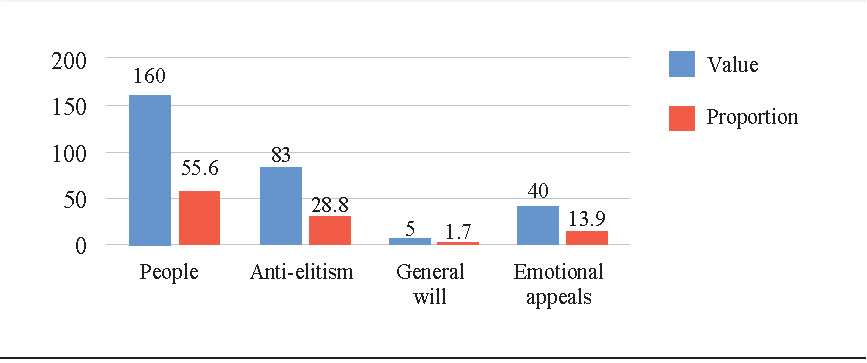
Figures 1 and 2 show the dimensions of the disaggregated populism index containing the four estimated indicators: anti-elitism, people-centered rhetoric, emotional appeals, and popular will, which were constructed to capture the populist strategies of Petro and Hernández on Twitter as a whole.
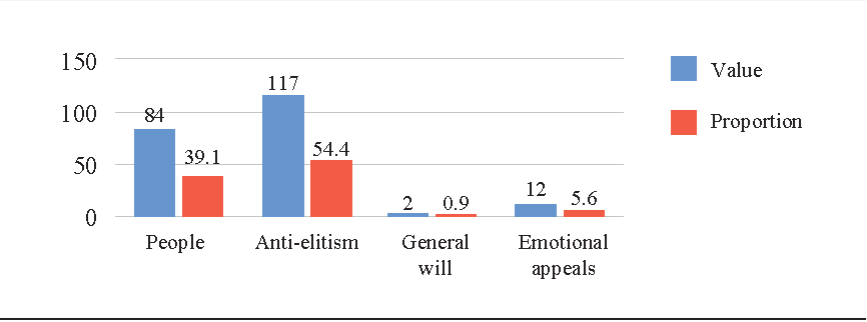
In Hernández’s case, the indicator that groups together the sectors that make up the people appears in 84 mentions, representing 39 % of his discourse content, but what is most notable is the use of confrontational rhetoric, which represents 54.4 %. In other words, more than 100 posts on Twitter were used to criticize his opponents, the system, and the political elite in general.
Emotional appeals, which the strategic approach identifies as part of the process of direct connection between leader and followers, played a lesser role in Hernández’s election campaign compared to the two strategies analyzed above. 12 posts, representing 5.6 % of the entire corpus examined, allude to a particular emotion. Finally, the term general will or will of the people, which is often associated with populist appeals, did not play a central role in Hernández’s campaign.
In the case of Petro (Figure 2), 160 tweets were associated with the people indicator, meaning that more than half (55.6 %) of the posts examined contain a mention of this category. On the other hand, although his posts contain anti-elitist rhetoric, this indicator represents less than a third (28.8 %) of the content disseminated on Twitter.
Unlike Hernández, the dictionary found relatively strong emotional content in Petro’s communications: 13.9 % of the linguistic corpus contains some reference to emotions. This means that Petro used more emotional discourse to connect with the masses. Finally, this analysis finds that appeals to the will of the people were not central to the Pacto Histórico campaign either.
Although the results shown in Figures 1 and 2 suggest that both leaders used populist strategies to some extent, these were not distributed equally. Petro used a more people-centered narrative combined with emotional appeals, while Hernández focused his campaign more on criticizing the establishment than on praising the virtues of the people. Qualitative content analysis delves into the semantic context of these strategies and identifies the social base to which they appealed discursively. It also explores the meanings they gave to emotions in both campaigns.
Appeals to the people are a fundamental pillar of populism. According to the strategic approach, the people are an amorphous and heterogeneous aggregate that the leader mobilizes in pursuit of his or her goals. These appeals may include different instruments with which they seek to attract as much support as possible. In the context of the 2022 elections in Colombia, both leaders appealed to many social sectors, particularly the working classes.
In Petro’s case, his discourse appealed to diverse groups in society, such as the poor, the country’s indigenous and black communities, workers from all sectors, women, peasants, and even environmentalists. His goal was to build a broad movement with many sectors capable of mobilizing support to carry him to the presidency: “I say to all my people that the future is one of social and climate justice, of peace, not violence, of agreement and dialogue, not barbarity. The future is one of civilization. Let us not vote for the old past, let us vote for the new and the future” (2022a).1
He also stated that a virtual arrival in power would mean the empowerment of the people, especially those sectors historically excluded from national politics: “Real change means empowering Colombia’s Black people” (Petro, 2022b). “From slavery to power. It is time for a Colombia of life and democracy” (Petro, 2022c), “Women to the home or women to power and freedom? You decide” (Petro, 2022d).
Populist appeals are also often accompanied by messianic rhetoric with which they seek to convince and engage followers with their saving and redemptive qualities. This heroic feat (saving the people from a dangerous enemy) can only be achieved by a leader capable of confronting those who have caused profound suffering to the people: “They have subjected the Colombian people to a path full of passion and sacrifice, of immense pain. Is Colombia’s resurrection possible? Isn’t peace the resurrection of Colombia?” (Petro, 2022e).
In Hernández’s case, the people include women, peasants, and the poor of the country. It does not include Black and Indigenous communities. Although references to the people were minor, they denoted a clear dichotomous division of society between “us” and “them”: “Your vote is safe with me. I do not make alliances with criminals, only with the Colombian people” (Hernández, 2022a). “#TheChangeInFirst is voting to remove the corrupt political mafia from government, and this is only possible with a leader who unites the people, not divides them like Petro and Fico” (Hernández, 2022b). In addition, Hernández presents himself as one of the people and uses colloquial language: “It’s time to choose a man like you who just wants to end corruption and move Colombia forward” (Hernández, 2022c).
With regard to anti-elitist rhetoric, the strategic approach points out that without an enemy it is impossible to mobilize followers, and personalistic and charismatic leadership is likely to evaporate quickly. In that sense, without a dangerous enemy, the leader’s mission of salvation is meaningless. The revival of constant confrontation through the construction of an “enemy of the people” then becomes a top-down tool to keep his supporters’ commitment to the fight against the enemy intact.
For both candidates, this enemy is represented by the traditional political class and in particular by uribismo, which has governed the country for the last two decades. Duque and his government, which represent uribista ideology, became the main target of attacks. Both Petro and Hernández used derogatory terms to caricature and criticize this potential enemy.
For example, Petro points out: “The alliance between politics and crime in the hands of Uribism shattered peace and condemned Colombia to corruption and violence” (Petro, 2022f), “Either we continue with the status quo and the corruption of those who do business with politics, or we embrace a peaceful but real change that strengthens institutions and brings peace based on greater power for citizens” (Petro, 2022g).
Hernández, for his part, used more direct and confrontational language. In his speech, the elite is portrayed as thuggish, thieving, political, corrupt, and mafia-like: “Six days away from removing all those corrupt politicians who have been entrenched in government for years” (Hernández, 2022d), “It is unacceptable that while Colombians survive on $2 a day, these corrupt and criminal parliamentarians earn salaries of 30-40 million and often do not even go to work” (Hernández, 2022e).
This Manichean and moralistic discourse, which identifies the people with good and the elite with evil, stands out in Hernández as a particular aspect of his strategy. Specifically, qualitative analysis confirms the dictionary’s findings, which show that Hernández’s discourse on Twitter was more anti-elitist and anti-establishment than Petro’s: “They concentrate privileges in the hands of those who make the laws and betray the interests of the Colombian people” (Hernández, 2022f), “Those who put the interests of the poorest above those who have been entrenched in power for more than 30 years are accused of being populists” (Hernández, 2022g).
Emotions also played a central role in the campaign. Two of the emotions that the candidates appealed to most were fear and hope. However, in this area, as the quantitative analysis shows, Petro made better use of emotions than Hernández. For example, fear appears in 15 tweets and hope in 30. In Hernández’s case, hope and fear appear four and nine times, respectively. In addition, Petro appealed to other emotions such as love. He spoke of “governing with love”, “political love”, “the politics of love”, “the path of love”, and even the love that the people feel for him in the face of accusations of electoral patronage: “I have never bought a single vote in my life. The love of my people is enough for me” (Petro, 2022h).
Although emotions are not at the core of populism, for the strategic approach in the absence of organizational intermediation, the emotional connection with the pulpit compensates for this weakness inherent in populism. From this perspective, it is insisted that populism is a top-down agency that seeks at all costs to mobilize large disorganized groups, for which emotions can function as the “glue” that binds followers to the leader.
In practice, emotions can be instrumentalized and appear when they are negative associated with the enemy and when they are positive with the people. For Petro, for example, fear, revenge, hatred, and dread are promoted by his political enemies to demobilize his supporters, while his campaign promotes love and hope. “The status quo can only campaign with fear and lies. You have already seen how they can unleash fear; now the lies will come” (Petro, 2022i), “Today, change begins at the ballot box, casting a vote that brings hope and life to Colombia. I invite Colombians to go out and vote with love” (Petro, 2022j).
Hernández promotes a similar discursive logic when he labels Federico Gutiérrez a cheater for appealing to fear as a political strategy: “#ACheaterIs someone who exploits people’s fears to get to the top. In these elections, vote for hope, not fear” (Hernández, 2022h). “#IbelieveinColombia because it is a country that chooses change, and will choose the best between change based on hatred and division, and change based on unity” (Hernández, 2022i).
Finally, with regard to the will of the people, none of the candidates showed any interest in invoking this concept. Most empirical studies have shown that this dimension of populism tends to be invoked when leaders are in government. Once elected, it is more common for them to assert with certainty that the people have chosen them and that they are therefore the only authentic representatives of the will of the people (Peruzzotti, 2017). It is also common for them to invoke the will of the people when making decisions that go against constitutionally established democratic norms, as some studies have suggested in the case of López Obrador in Mexico (Aguiar Aguilar et al., 2025).
Conclusions
Without a doubt, the main actor in the 2022 presidential campaign in Colombia was populisn, which entered the electoral system from both sides (left and right). This was an unusual phenomenon in a society where populist leaders represented a threat to the status quo and the only response was their physical annihilation, as exemplified by the assassination of Jorge Eliecer Gaitán in the 1940s.
The critical situation the country experienced after the Covid-19 pandemic provided a fertile environment for the emergence of populism in Colombia, which took the traditional political class by surprise. Both Petro and Hernández mobilized social resentment against the political elite, shifting the blame for the problems afflicting society onto the establishment. Their discourses, centered on a dichotomous division of us versus them, had an impact on the electoral contest.
However, the findings of this study also revealed important differences. For example, Petro’s strategy was more focused on appeals to the people combined with a strong emotional component, while Hernández’s strategy focused primarily on criticism of the establishment based on anti-elitist rhetoric. These strategies occupied central places in their campaigns on Twitter, as evidenced in Figures 1 and 2. For Petro, it was more important to connect with people by articulating his charisma and personalistic leadership with emotions
In contrast, Hernández, faced with a lack of clear proposals, used his anti-elitism as a strategy for political mobilization. Attacks, criticism, and the use of disparaging remarks were a constant feature of his campaign, aimed at distinguishing his movement from traditional politics.
The 2022 presidential campaign was also a bid to emotionalize politics, with fear and hope being two of the most important emotions circulating. Both candidates strategically associated negative emotions (fear, hatred, dread) with the enemy and positive emotions (love, hope) with the people and their campaigns. However, in the cases analyzed, it was found that Petro made greater use of this component, not only appealing to hope and fear, but also turning love into a campaign slogan.
These strategies were effective in a context of crisis. As the strategic approach points out, populism is an opportunistic politics capable of exploiting different situations in order to gain power. When the goal is political mobilization, top-down strategies are decisive, since the ability to lead and attract the masses is crucial. Petro and Hernández took advantage of social media such as Twitter to build a communication strategy centered on their political figures and charismatic gifts in order to promote a narrative of guilt toward the political establishment, which was appealing to a society outraged by the traditional political class.
The contributions of this work are along these lines. The first is to enrich empirical knowledge about the political-strategic notion of populism through the operationalization of a concept that allows for an account of top-down populist agency. The second is to contribute to studies on contemporary populism in Colombia in light of the extensive literature on the subject that has flourished in recent decades. Third, to highlight the importance of social media for populist communication and connection with followers.
REFERENCES
Aguiar Aguilar, A., Castro Cornejo, R., & Monsiváis-Carrillo, A. (2025). Is Mexico at the Gates of Authoritarianism? Journal of Democracy, 36(1), 50-64. https://doi.org/10.1353/jod.2025.a947883 [ Links ]
Aslanidis, P. (2018). Measuring populist discourse with semantic text analysis: an application on grassroots populist mobilization. Quality & Quantity, 52, 1241-1263. https://doi.org/10.1007/s11135-017-0517-4 [ Links ]
Barrenechea, R., & Otero-Bahamon, S. (2023). Racionalidad rodolfista y encanto populista. En R. Barrenechea, S. Otero Bahamón, Y. Basset, L. Zanotti, S. Botero, G. Camargo, S. Londoño, A. M. Sampayo, A. B. Franco-Cuervo, F. Cante, U. A. Cárdenas A., S. Fonseca, M. Castillo, M. Jaramillo Jassir (Autores), Gustavo Petro vs. Rodolfo Hernández. ¿Dos populismos encontrados? (pp. 1-22). Universidad del Rosario. [ Links ]
Basset, Y. (2020). La polarización y los nuevos clivajes políticos colombianos en perspectiva territorial. En P. Montilla Niño & C. Jiménez, M. (Eds.), Elecciones 2018 en Colombia: la competencia política en un escenario de paz (pp. 205-233). Universidad Externado de Colombia. [ Links ]
Basset, Y. (2023). La segunda vuelta de 2022: un choque de populismos. En R. Barrenechea, S. Otero Bahamón, Y. Basset, L. Zanotti, S. Botero, G. Camargo, S. Londoño, A. M. Sampayo, A. B. Franco-Cuervo, F. Cante, U. A. Cárdenas A., S. Fonseca, M. Castillo, M. Jaramillo Jassir (Autores), Gustavo Petro vs. Rodolfo Hernández. ¿Dos populismos encontrados? (pp. 23-38). Universidad del Rosario. [ Links ]
Borda, S. (2018). Presidenciales en Colombia: ¿polarización o deterioro de la conversación política? Nueva Sociedad. https://www.nuso.org/articulo/presidenciales-en-colombia-polarizacion-o-deterioro-de-la-conversacion-politica/ [ Links ]
Botero, S., García-Montoya, L., Otero Bahamón, S., & Londoño, S. (2023). Colombia 2022: Del fin de la guerra al gobierno del cambio. Revista de Ciencia Política, 2(43), 223-254. https://doi.org/10.4067/s0718-090x2023005000114 [ Links ]
Bracciale, R., & Martella, A. (2017). Define the populist political communication style: the case of Italian political leaders on Twitter. Information, Communication & Society, 20(9), 1310-1329. https://doi.org/10.1080/1369118X.2017.1328522 [ Links ]
Calvo, E. (2015). Anatomía política de Twitter en Argentina: Tuiteando #Nisman. Capital Intelectual. [ Links ]
Calvo, E., & Aruguete, N. (2020). Fake News, trolls y otros encantos. Como funcionan (para bien o para mal) las redes sociales. Siglo Veintiuno Editores. [ Links ]
Casullo, M. E. (2021). ¿Por qué funciona el populismo? El discurso que sabe construir explicaciones convincentes de un mundo en crisis. Siglo Veintiuno Editores. [ Links ]
Engesser, S., Ernst, N., Esser, F., & Büchel, F. (2017). Populism and social media: how politicians spread a fragmented ideology. Information, Communication & Society, 20(8), 1109-1126. https://doi.org/10.1080/1369118X.2016.1207697 [ Links ]
Ernst, N., Engesser, S., Büchel, F., Blassnig, S., & Esser, F. (2017). Extreme parties and populism: an analysis of Facebook and Twitter across six countries. Information, Communication & Society, 20(9), 1347-1364. https://doi.org/10.1080/1369118X.2017.1329333 [ Links ]
Fonseca, S., & Castillo, M. (2023). Colombia: ¿el populismo imposible que se hizo posible? En R. Barrenechea, S. Otero Bahamón, Y. Basset, L. Zanotti, S. Botero, G. Camargo, S. Londoño, A. M. Sampayo, A. B. Franco-Cuervo, F. Cante, U. A. Cárdenas A., S. Fonseca, M. Castillo, M. Jaramillo Jassir (Autores), Gustavo Petro versus Rodolfo Hernández. ¿Dos populismos encontrados? (pp. 177-199). Editorial Universidad del Rosario. [ Links ]
Forti, S. (2021). Extrema derecha 2.0 ¿Qué es y cómo combatirla? Siglo XXI Editores. [ Links ]
Freidenberg, F., & Cáceres, K. (2020). El candidato millennial: campañas digitales, redes sociales y elección presidencial en El Salvador. En L. Panke (Ed.), Comunicación Política y Campañas Electorales (pp. 1-30). Universidad Autónoma Metropolitana, Cuajimalpa. [ Links ]
Hernández, R. [@ingrodolfohdez]. (2022a, 11 de mayo). Su voto está seguro conmigo. Yo no hago alianzas con hampones, solo con pueblo colombiano [Tweet]. Twitter. https://x.com/ingrodolfohdez/status/1524529305438543876 [ Links ]
Hernández, R. [@ingrodolfohdez]. (2022b, 11 de mayo). #ElCambioEnPrimera es votar para sacar del gobierno a la mafia politiquera y corrupta, y esto solo es posible con un [Tweet]. Twitter. https://x.com/ingrodolfohdez/status/1524401204444504064 [ Links ]
Hernández, R. [@ingrodolfohdez]. (2022c, 18 de junio). Es hora de elegir a un hombre como ustedes que solo quiere acabar la corrupción y sacar adelante a Colombia [Tweet]. Twitter. https://doi.org/https://x.com/ingrodolfohdez/status/1538329124326055937 [ Links ]
Hernández, R. [@ingrodolfohdez]. (2022d, 13 de junio). A 6 días de sacar a todos esos corruptos, politiqueros que llevan años incrustados en el gobierno [Tweet]. Twitter. https://x.com/ingrodolfohdez/status/1536377853192773633 [ Links ]
Hernández, R. [@ingrodolfohdez]. (2022e, 10 de mayo). #EsInaceptable que mientras los colombianos sobreviven con 2 dólares al día, estos corruptos y hampones parlamentarios tienen salarios de 30-40 millones [Tweet]. Twitter. https://x.com/ingrodolfohdez/status/1524020966174740481 [ Links ]
Hernández, R. [@ingrodolfohdez]. (2022f, 24 de abril). Concentran los privilegios en los mismos que hacen las leyes y traicionan los intereses del pueblo colombiano [Tweet]. Twitter. https://x.com/ingrodolfohdez/status/1518196889002422273 [ Links ]
Hernández, R. [@ingrodolfohdez]. (2022g, 5 de abril). Se acusa de populista a quiénes ponen los intereses de los más pobres por encima de los que llevan más [Tweet]. Twitter. https://x.com/ingrodolfohdez/status/1511442254875049985 [ Links ]
Hernández, R. [@ingrodolfohdez]. (2022h, 23 de mayo). #UnTramposoEs el que explota el miedo de la gente para llegar a la cima. Estas elecciones vote por la esperanza [Tweet]. Twitter. https://x.com/ingrodolfohdez/status/1528743674435207168 [ Links ]
Hernández, R. [@ingrodolfohdez]. (2022i, 1 de junio). #CreoEnColombiaPor ser un país que escoge el cambio, y va a escoger lo mejor entre un cambio basado en el [Tweet]. Twitter. https://x.com/ingrodolfohdez/status/1531999420916633601 [ Links ]
Iglesias, E., & Castro Rojas, S. (2024). Liderazgo políticodigital: los tuits de Bolsonaro. Revista Binacional Brasil Argentina: diálogo entre as ciências, 13(1), 288-307. https://doi.org/10.22481/rbba.v13i01.14780 [ Links ]
Jagers, J., & Walgrave, S. (2007). Populism as political communication style: An empirical study of political parties’ discourse in Belgium. European Journal of Political Research, 46(3), 319-345. https://doi.org/10.1111/j.1475-6765.2006.00690.x [ Links ]
Jaramillo Jassir, M. (2023). Populismo progresista y reaccionario en Colombia. En R. Barrenechea, S. Otero Bahamón, Y. Basset, L. Zanotti, S. Botero, G. Camargo, S. Londoño, A. M. Sampayo, A. B. Franco-Cuervo, F. Cante, U. A. Cárdenas A., S. Fonseca, M. Castillo, M. Jaramillo Jassir (Autores), Gustavo Petro vs. Rodolfo Hernández. ¿Dos populismos encontrados? (pp. 195-221). Universidad del Rosario. [ Links ]
Laclau, E. (2005). La razón populista. Fondo de Cultura Económica. [ Links ]
Levitsky, S., & Loxton, J. (2013). Populism and competitive authoritarianism in the Andes. Democratization, 20(1), 107-136. https://doi.org/10.1080/13510347.2013.738864 [ Links ]
March, L. (2019). Textual nalysis: the UK party system. En K. A. Hawkins, R. Carlin, L. Littvay, & C. Rovira Kaltwasser (Eds.), The Ideational Approach to Populism. Concept, Theory and Analysis (pp. 49-66). Routledge. [ Links ]
McDonnell, D., & Ondelli, S. (2024). The Distinctive Vocabularies of Right-Wing Populists. Government and Opposition, 60(2), 335-357. https://doi.org/10.1017/gov.2024.10 [ Links ]
Mudde, C. (2004). The Populist Zeitgeist. Government and Opposition, 39(4), 541-563. https://doi.org/10.1111/j.1477-7053.2004.00135.x [ Links ]
Mudde, C. (2017). Populism. An Ideational Approach. En C. Rovira-Kalwasser, P. Taggart, P. Ochoa Espejo & P. Ostiguy (Eds.), The Oxford Handbook of Populism (pp. 46-70). Oxford University Press. [ Links ]
Mudde, C., & Rovira Kaltwasser, C. (2019). Populismo. Una breve introducción. Alianza Editorial. [ Links ]
Panizza, F. (2017). Populism and Identification. En C. Rovira-Kalwasser, P. Taggart, P. Ochoa Espejo & P. Ostiguy (Eds.), The Oxford Handbook of Populism (pp. 406-425). Oxford University Press. [ Links ]
Panizza, F., & Stavrakakis, Y. (2021). Populism, Hegemony, and the Political Construction of “The People”: A Discursive Approach. En P. Ostiguy, F. Panizza, & B. Moffitt (Eds.), Populism in Global Perspective. A Performative and Discursive Approach (pp. 21-46). Routledge. [ Links ]
Pauwels, T. (2011). Measuring Populism: A Quantitative Text Analysis of Party Literature in Belgium. Journal of Elections, Public Opinion & Parties, 21(1), 97-119. https://doi.org/10.1080/17457289.2011.539483 [ Links ]
Peruzzotti, E. (2017). Populism as democratization’s nemesis: The politics of regime hybridization. Chinese Political Science Review, 2(3), 314-327. https://doi.org/10.1007/s41111-017-0070-2 [ Links ]
Petro, G. [@petrogustavo]. (2022a, 7 de junio). A todo mi pueblo les digo que el futuro es de justicia social y climática, es de la paz, no [Tweet]. Twitter. https://x.com/petrogustavo/status/1534156484808003584 [ Links ]
Petro, G. [@petrogustavo]. (2022b, 31 de mayo). Cambio real es darle poder al pueblo negro de Colombia. Gracias a Luis Gilberto Murillo, excandidato vicepresidencial de la Coalición [Tweet]. Twitter. https://x.com/petrogustavo/status/1531722137056182272 [ Links ]
Petro, G. [@petrogustavo]. (2022c, 24 de marzo). De la esclavitud al Poder. Es la hora de una Colombia de Vida y democracia [Tweet]. Twitter. https://x.com/petrogustavo/status/1507002030681993216 [ Links ]
Petro, G. [@petrogustavo]. (2022d, 29 de mayo). ¿Mujeres a la casa o mujeres al poder y la libertad? Usted decide [Tweet]. Twitter. https://x.com/petrogustavo/status/1531103778409222149 [ Links ]
Petro, G. [@petrogustavo]. (2022e, 17 de abril). La resurrección es el mensaje final de la semana santa, despues de la pasión y el sacrificio Han sometido al [Tweet]. Twitter. https://x.com/petrogustavo/status/1515673411749658632 [ Links ]
Petro, G. [@petrogustavo]. (2022f, 6 de mayo). La alianza de la política y el crimen en manos del uribismo hizo trizas la paz y condenó a Colombia [Tweet]. Twitter. https://x.com/petrogustavo/status/1522629698202779648 [ Links ]
Petro, G. [@petrogustavo]. (2022g, 3 de junio). O seguimos con el “plomo es lo que hay” y la corrupción de los que hacen negocios con la política [Tweet]. Twitter. https://x.com/petrogustavo/status/1532720336474673152 [ Links ]
Petro, G. [@petrogustavo]. (2022h, 13 de junio). Nunca en mi vida he comprado un solo voto. Me basta el amor de mi pueblo [Tweet]. Twitter. https://x.com/petrogustavo/status/1536475481167495168 [ Links ]
Petro, G. [@petrogustavo]. (2022i, 8 de mayo). El continuismo no puede hacer campaña sino con el miedo y la mentira. Ya vieron cómo pueden desencadenar el miedo [Tweet]. Twitter. https://x.com/petrogustavo/status/1523339295754526720 [ Links ]
Petro, G. [@petrogustavo]. (2022j, 13 de marzo). Hoy comienza el cambio desde las urnas, depositando un voto que traiga esperanza y vida para Colombia. Invito los colombianos [Tweet]. Twitter. https://x.com/petrogustavo/status/1503054306643267589 [ Links ]
Roberts. (2015). Populism, political mobilizations, and crises of political representation. En C. De la Torre (Ed.), The promise and perils of populism: global perspectives (pp. 152-171). The University Press of Kentucky. [ Links ]
Rooduijn, M., & Pauwels, T. (2011). Measuring Populism: Comparing Two Methods of Content Analysis. West European Politics, 34(6), 1272-1283. https://doi.org/10.1080/01402382.2011.616665 [ Links ]
Urbinati, N. (2019a). Antiestablishment and the substitution of the whole with one of its parts. En C. De la Torre (Ed.), Routledge Handbook of Global Populism (pp. 77-97). Routledge. [ Links ]
Urbinati, N. (2019b). Political Theory of Populism. Annual Review of Political Science, 22, 111-127. https://doi.org/10.1146/annurev-polisci-050317-070753 [ Links ]
van Dijck, J. (2016). La cultura de la conectividad. Una historia crítica de las redes sociales. Siglo Veintiuno Editores. [ Links ]
Waisbord, S. (2020). ¿Es válido atribuir la polarización política a la comunicación digital? Sobre burbujas, plataformas y polarización afectiva. Revista SAAP, 14(2), 249-279. https://doi.org/10.46468/rsaap.14.2.A1 [ Links ]
Waisbord, S., & Amado, A. (2017). Populist communication by digital means: presidential Twitter in Latin America. Information, Communication & Society, 20(9), 1330-1346. https://doi.org/10.1080/1369118X.2017.1328521 [ Links ]
Weyland, K. (2017). Populism: A Political-Strategic Approach. En C. Rovira-Kalwasser, P. Taggart, P. Ochoa Espejo & P. Ostiguy (Eds.), The Oxford Handbook of Populism (pp. 48-72). Oxford University Press. [ Links ]
Weyland, K. (2019). Populism and authoritarianism. En C. De la Torre (Ed.), Routledge Handbook of Global Populism (pp. 319-333). Routledge. [ Links ]
Weyland, K. (2024a). Populism as a political strategy. En Y. Stavrakakis, & G. Katsambekis (Eds.), Research Handbook on Populism (pp. 154-165). Edward Elgar Publishing. [ Links ]
Weyland, K. (2024b). Democracy’s Resilience to Populism’s Threat. Countering Global Alarmism. Cambridge University Press. https://doi.org/10.1017/9781009432504 [ Links ]
Zulianello, M., Albertini, A., & Ceccobelli, D. (2018). A Populist Zeitgeist? The Communication Strategies of Western and Latin American Political Leaders on Facebook. The International Journal of Press/Politics, 23(4), 439-457. https://doi.org/10.1177/1940161218783836 [ Links ]
Profile
Adalberto López Robles
PhD in Social Sciences from the Autonomous Metropolitan University, Xochimilco Campus. Master’s degree in Social Sciences from FLACSO-Mexico. Bachelor’s degree in Sociology from the University of Atlántico (Colombia). He is a postdoctoral researcher at the Faculty of Political and Social Sciences at UNAM. His main areas of research are political communication, polarization, and populism on social media.
How to cite:López Robles, A. (2025). Populism and Political Campaigns: examining populist strategies in the 2022 Colombian elections. Comunicación y Sociedad, e9037. https://doi.org/10.32870/cys.v2025.9037
Received: March 31, 2025; Accepted: October 27, 2025
 Este es un artículo publicado en acceso abierto bajo una licencia
Creative Commons
Este es un artículo publicado en acceso abierto bajo una licencia
Creative Commons
