




Servicios Personalizados
Revista
Articulo
 texto en
 Inglés (pdf)
 Artículo en XML
 Referencias del artículo

 Traducción automática
 Enviar artículo por email
Indicadores
-
 Citado por SciELO
-
 Accesos
Links relacionados
-
 Similares en
SciELO
Compartir

 Permalink

Frontera norte
versión On-line ISSN 2594-0260versión impresa ISSN 0187-7372
Frontera norte vol.38 México ene./dic. 2026 Epub 09-Oct-2026
https://doi.org/10.33679/rfn.v.e2465
Article
Internal Forced Displacement and Return in the Context of the “War on Drugs” in Mexico

1El Colegio de México (https://ror.org/01vp99c97), jairo.lopez@colmex.mx
The study analyzes the relationship between internal forced displacement (IFD) and return processes in the context of the “war on drugs” in Mexico, focusing on the cases of two communities in Zacatecas (El Durazno and Juanchorrey) between 2020 and 2023. Through in-depth interviews, observation, and a review of press reports and official documents, a comparative analysis was conducted. The findings reveal that internal displacement is shaped by accumulated, instructive violence that extends beyond the initial flight, leaving marks that influence different forms of return for each community, depending on the economic dependence on the territory and its external support networks. The study has limited generalizability, as it is confined to a subregion of Zacatecas. It concludes that return is part of the continuum of violence associated with displacement and that state intervention, geared toward military control rather than reparations, creates an unstable equilibrium for these communities.
Keywords: internal forced displacement; violence; return; rural areas; Mexico
Se analiza la relación entre el desplazamiento forzado interno (DFI) por violencia y los procesos de retorno en el contexto de la «guerra contra las drogas» en México, a partir de los casos de dos localidades de Zacatecas (El Durazno y Juanchorrey) entre 2020 y 2023. Mediante entrevistas a profundidad, observación, y consulta de prensa y documentos oficiales, se hizo un análisis comparativo, encontrando que el DFI se configura por acumulados de violencia aleccionadora que trascienden el momento de la huida, dejando marcas que condicionan formas diferenciadas de retorno según la dependencia económica del territorio y las redes de solidaridad externas. El estudio presenta limitaciones en cuanto a su generalización, al circunscribirse a una subregión de Zacatecas. Se concluye que el retorno es parte del continuo de violencias del desplazamiento y que la intervención estatal, orientada al control militar y no a la reparación, genera equilibrios inestables en estas comunidades.
Palabras clave: desplazamiento forzado interno; violencia; retorno; zona rural; México
INTRODUCTION
Internal displacement caused by violence is an increasingly prevalent phenomenon in Mexico. Although no official figures exist regarding its magnitude, independent estimates indicate that more than 400 000 people have been forced to leave their communities to escape violence (Comisión Mexicana de Defensa y Promoción de los Derechos Humanos [CMDPDH], 2022; Internal Displacement Monitoring Centre, 2024), while national survey data suggest that just over 900 000 people have left their homes because of insecurity (Instituto Nacional de Estadística y Geografía, 2021). Chihuahua, Sinaloa, Michoacán, Jalisco, Guerrero, Chiapas, and Zacatecas are the states in which the severity of the phenomenon has been most widely recognized over the past five years (Alto Comisionado de las Naciones Unidas para los Refugiados, 2022; CMDPDH, 2022), while rural and Indigenous populations, as well as women, boys, and girls, experience differentiated impacts in both places of displacement and places of reception.
International organizations that establish guidelines for States to address forced displacement as a serious human rights violation maintain that stable, safe, and sustainable return is a necessary condition for ensuring processes of reparation (Comisión de Derechos Humanos de las Naciones Unidas, 1998). In a context of persistent violence generated by the policies of the “war on drugs,” intense disputes among criminal organizations, and the growing militarization of public security, the question of the possibilities and impossibilities of return therefore becomes fundamental.
In Mexico, the academic literature has examined the causes of internal displacement, highlighting the relationship between militarization and its increasing incidence throughout the country (Durin, 2019; Pérez & Castillo, 2019; Rubio Díaz-Leal, 2014; Salazar & Álvarez Lobato, 2018), particularly in regions where strategic mining or agro-industrial megaprojects have been developed (Argüello Cabrera, 2022; Bastian Duarte & García Beltrán, 2024; Hernández Soc, 2019; Iglesias Nieto & Gaussens, 2022; Muñoz et al., 2022), the activities of criminal organizations, which particularly affect Indigenous populations and women (Argüello Cabrera, 2024; De Marinis, 2019; Giménez Delgado, 2021; Navarro-López, 2024; Vázquez García et al., 2023), as well as its links to other forms of violence, such as homicides and disappearances (Argüello Cabrera, 2024; Durin, 2024; López & Linares Sánchez, 2024; Querales-Mendoza, 2020).
Likewise, studies have documented the trajectories of displaced populations, which become concentrated in areas of forced immobility along the extensive northern border with the United States (Borzacchiello et al., 2022; Silva Hernández & Alfaro Trujillo, 2021), institutional assistance-based responses (Díaz Vanegas & Monsiváis Carrillo, 2022; López, 2023a), and the growing use of statistical data to construct approximate indicators for measuring the scale of the phenomenon and patterns of mobility (Muro Aréchiga & Rodríguez Chávez, 2022; Rodríguez, 2022).
On the other hand, the international migration literature has extensively addressed the issue of voluntary or forced return, examining it through dimensions such as labor, social, and cultural reintegration, its implications for community development, and its role as part of migrant life trajectories (Rivera Sánchez, 2019). In Colombia, research on return processes has advanced considerably, particularly during transitional periods, examining the reasons for and economic impacts of return, the ways in which return restructures relationships with territory, public policies, and the narratives and experiences of those seeking to overcome displacement, among other aspects (Garzón-Martínez, 2011, 2014, 2021; Ibáñez Londoño, 2010).
Although the literature on internal forced displacement (hereafter IFD) in Mexico has grown significantly, there remains a gap in research on the possibilities and impossibilities of return. If IFD is the outcome of accumulated forms of violence (Argüello Cabrera, 2024; Durin, 2024; López & Linares Sánchez, 2024), forced mobility constitutes only one moment within a broader process. From this perspective, the conditions of return should be understood as an integral part of the phenomenon rather than as a separate stage. In rural areas where confrontations between criminal organizations occur, IFD takes different forms and unfolds across varying periods of non-return, intermittent, partial, or total return. Thus, questions remain regarding the implications for rural communities, family life, and individual lives of having experienced violence that resulted in episodes of internal forced displacement, as well as the ways in which these experiences shape processes of return.
This article analyzes two cases of rural communities in southwestern Zacatecas that experienced episodes of mass IFD between 2020 and 2023, with differentiated return processes: stable and nearly complete return (El Durazno, Jerez), and intermittent return and non-return (Juanchorrey, Tepetongo). Methodologically, the study follows a qualitative comparative case study design, selecting two communities in a geographic area with similar socioeconomic conditions. The processes of displacement and return were reconstructed through three stages: 1) violence and episodes of IFD; 2) community experiences; and 3) forms of return. To analyze the relationship between violence-induced IFD and the (im)possibilities of return, the article establishes a theoretical connection between IFD as disciplinary violence, as part of armed struggles over territory, and its effects on individuals and communities.
The main argument is that IFD is shaped by accumulated forms of violence that extend beyond the episode of forced mobility, leaving their mark on individuals and communities as disciplinary violence and affecting decisions and experiences of return once security conditions allow it. The article argues that the experience of IFD persists as a mark of fear and terror in places where return occurs, manifesting in the instability of return in the face of the latent threat of renewed outbreaks of violence and the State's lack of comprehensive measures to address and repair the harms resulting from episodes of violence-induced IFD.
Violence-Induced Internal Forced Displacement and Return: Theoretical Coordinates
Violence-induced IFD in Mexico increased within the framework of the “war on drugs” policy implemented since 2006, as different armed actors, including organized criminal groups, military forces, and paramilitary groups, have contested control over and presence in strategic territories (Durin, 2019; Rubio Díaz-Leal, 2014; Salazar & Álvarez Lobato, 2018). In many rural areas, populations are embedded in circuits of violence that ultimately produce episodes of mass, individual, or family displacement, as the territories they inhabit possess valuable characteristics for different actors. In this regard, research has documented that militarization and confrontations between criminal organizations, commonly referred to as cartels, have triggered mass displacement in states such as Chiapas, Zacatecas, Chihuahua, Sinaloa, and Michoacán (Argüello Cabrera, 2024; Giménez Delgado, 2021; Hernández Soc, 2024; López, 2023a; López López, 2020; Navarro-López, 2024).
Displacement may be associated with the control of areas where populations are dispossessed and expelled to facilitate the development of megaprojects, but it may also be linked to territorial takeovers aimed at extracting other forms of revenue, such as the production and circulation of drugs, human trafficking, including women subjected to sexual slavery, migrant smuggling, and forced recruitment; extortion through protection payments; or control of roads. There are also staged manifestations of war in which armed organizations with different structures and chains of command operate as part of political-economic criminal networks, while state impunity persists.
The classification of criminal actors is complex and shaped by conceptual debates, whose empirical verification is difficult given the nature of the phenomenon. Accordingly, both the homogenizing notion of cartels and explanations that reduce the activities of criminal groups to drug trafficking as their sole driver have been questioned. Various studies have shown that the forms of interaction and interdependence between criminal groups and political-economic criminal networks give rise to violent forms of governance in territories where the political economy of legal and illegal markets constantly overlap (Alvarado, 2019; Astorga Almanza, 2023; Correa- Cabrera, 2018; De Marinis & Fuentes Diaz, 2023; Duncan, 2014). As Cantor (2014) argues, criminal groups may cause IFD either through their everyday enforcement of rules and norms or during periods of intensified disputes and confrontations, when patterns of cooperation and competition undergo changes.
Civilian populations in rural areas must adapt to and coexist with the presence of irregular armed actors that routinely impose forms of control, loyalty, and order (De Marinis & Fuentes Diaz, 2023; Duncan, 2014; Hernández Soc, 2024).2 However, when the relationships established by these actors are disrupted by other criminal organizations or military forces, armed disputes are accompanied by direct violence against the population (Trejo & Ley, 2021). As the Colombian sociologist María Teresa Uribe de Hincapié (2000, p. 59) conceptualized in the Colombian context, because rural civilian populations are embedded in territories that may be strategically important, they become “potential enemies of all armed actors, including the government, who will demand absolute obedience and loyalty, without this necessarily meaning that such loyalty entails protection from others.” Consequently,
displaced persons ultimately become liminal, situated in that gray zone where different political orders in dispute converge and become entangled, where any gesture toward one of the actors, however insignificant, can turn them into targets to be eliminated or displaced (Uribe de Hincapié, 2000, p. 59).
Research in Mexico has proposed the concept of accumulated violence to define IFD as part of a concatenation of structural forms of violence (marginalization, exclusion, and gender-based violence), symbolic forms of violence (stigmatization and criminalization), and physical forms of violence (threats, extortion, killings, massacres, torture, and disappearances). In rural areas marked by militarization and the presence of criminal organizations, these accumulated forms of violence are pervasive and require displacement to be analyzed beyond the moment of forced mobility (Argüello Cabrera, 2024; Durin, 2024; Querales-Mendoza, 2020, 2024).
Accumulated violence is reinforced by the expressive and disciplinary character of physical violence, exercised upon bodies and objects (Blair, 2010; Reguillo, 2021; Uribe de Hincapié, 2000), which leaves a lasting mark on people's lived experiences (Blair, 2010). When extreme violence is inflicted visibly and cruelly, it has a communicative function insofar as it seeks to convey a lesson about the exercise of power (Segato, 2014, 2018). Threats, extortion, killings, massacres, rape, torture, disappearances, and other forms of abuse perpetrated in rural areas and small communities become intense individual and collective experiences of disciplinary violence (Reguillo, 2021; Segato, 2018). Hence,
climates of fear can become terror, a collective feeling sufficiently effective for an order to vacate, an indiscriminate threat painted on walls, a rumor spread by neighbors, or an anonymous message to produce mass and collective exoduses, as well as to induce displaced persons to adopt strategies of concealment and invisibility in their places of arrival. (Uribe de Hincapié, 2000, p. 67)
These multiple forms of violence shape geographies of terror (Oslender, 2007, 2018), as populations live under the constant threat of armed disputes, with differentiated impacts on children and women (De Marinis, 2019). Consequently, experiences of disciplinary violence and landscapes of terror remain ever-present in processes of return:
although after some time has passed since fleeing their lands, inhabitants frequently return to their homes, the experience of terror persists among the people, and the sense of terror produced remains imprinted in the new landscapes of fear (Oslender, 2018, p. 80).
This article therefore posits a link between the type of violence involved in internal forced displacement and the (im)possibilities of return. When IFD occurs in areas where circuits of drug production and distribution, extortion, and human trafficking, including migrant smuggling and forced recruitment, are contested, populations may find conditions conducive to return once the peaks of armed confrontations subside, either through the establishment of new balances among armed actors or through intervention by state security forces. For this reason, this type of displacement may be shorter or intermittent than displacement in which the dispossession of land is the primary driver and the objective is the “complete emptying” of the territory. However, not all people return following these episodes of displacement, and those who do may face retaliation or difficulties readapting to life after highly traumatic events.
Return entails individual, family, or collective mobility toward the places and communities from which people were forced to flee, with the aim of reestablishing their lives. Depending on its duration, return may be intermittent, temporary, or sustained, while in terms of the population involved, it may be partial or total. Upon returning, people confront “the marks of war […] as physical marks (on objects) and mental marks (in sensations and memories of fear)” (Uribe de Hincapié, 2000, p. 67). Thus, the possibilities of return are always shaped by memory (Garzón- Martínez, 2014) and by the challenge of “readapting” to life after individual and collective traumatic experiences (Bello, 2005; Oslender, 2007), with violence remaining part of a process that extends beyond the act of fleeing.
METHODOLOGY
An approach centered on the contextualized experiences of the subjects makes it possible to analytically reconstruct the links between the forms of violence that shape internal forced displacement and the (im)possibilities of return. This study examines two cases of communities in southwestern Zacatecas that experienced episodes of IFD between 2020 and 2023 (see Table 1) and that, over different periods, have experienced distinct return dynamics: stable and nearly complete return (El Durazno, Jerez) and intermittent and partial return (Juanchorrey, Tepetongo).
Table 1. Characteristics of the Study Cases
| Locality/municipality | Population | Main episode of mass IFD |
Timing and forms of return |
|---|---|---|---|
| El Durazno, Jerez | More than 500 | 2023 (entire community abandoned) |
Stable and nearly complete return |
| Juanchorrey, Tepetongo | More than 250 | 2021 (entire community abandoned) |
Intermittent and partial return |
Source: Own elaboration based on the methodological design.
A comparative case analysis approach was adopted (Della Porta, 2013; Ragin, 2007), with the cases sharing the following characteristics: a) they are rural communities engaged in small-scale agriculture and livestock farming; b) they are localities with a long history of out-migration and population decline; and c) they are located at the foothills of the Sierra Madre Occidental, a strategic corridor for the drug economy and human trafficking. In both cases, the main trigger of IFD was confrontations between the so-called Jalisco New Generation Cartel (CJNG) and the Sinaloa Cartel, which, together with selective state and military responses, resulted in more than three years of indiscriminate warfare. The experiences of IFD were marked by similarities in the types of violence experienced by the population and patterns of flight, as well as differences in the forms and timing of return. As Della Porta notes,
the case-based approach tends to explore diversity through detailed descriptions of one or a small number of cases, often compared across different dimensions. This means that a few cases are analyzed on the basis of a broad range of characteristics. (2013, p. 221)
Therefore, the processes of displacement are narratively reconstructed based on three common stages: 1) violence and episodes of IFD; 2) community experiences; and 3) forms of return. These stages are analyzed in terms of the implications and experiences of violence affecting the territory and its inhabitants (see Figure 1).
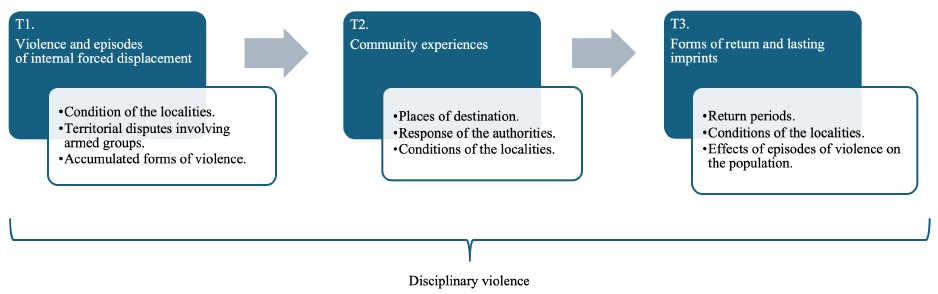
Source: Own elaboration based on the methodological design.
Figure 1. Analytical Stages for Each Case
The methodology is qualitative in nature and is based on fieldwork conducted in the region through several visits between 2021 and 2024, triangulating information collected through observation, press reports, official documents, and in-depth interviews with ten people who experienced episodes of forced displacement, as well as three local journalists. The interviews sought to reconstruct participants’ experiences and lived realities according to the temporalities outlined above. In two cases, follow-up interviews were conducted to trace participants’ trajectories, with the first interview taking place after the episodes of IFD and the second during the process of return to their communities.
Fieldwork in contexts of violence presents various challenges that require research strategies to be adapted according to the possibilities of access and the population’s willingness to participate. An important challenge in this type of research is overcoming the distrust that forcibly displaced people often have toward sharing their experiences, given their vulnerable circumstances. For this reason, prior connections were established with journalists experienced in covering the region, as well as with primary school teachers from the communities, who have extensive knowledge of local circumstances, families, and the ties that connect them to their territories. Their intermediation made it possible to access areas that were previously unknown to the researchers and, more importantly, provided residents with a positive signal of trust, as they recognized these intermediaries as people who were sensitive to the experiences they had endured. Once in the communities, and after engaging in several informal conversations with local residents, relationships of trust were established.
The lack of public attention to the problem is also a risk factor, making it even more difficult for victims to feel safe discussing their experiences, as the lack of clarity about “why what happened happened” often generates a sense of revictimization and guilt over what occurred. Therefore, following an ethical approach, the interviews were not guided by predetermined lines of inquiry, and participants were allowed to narrate their experiences through open-ended accounts. For security reasons, the anonymity of the interviewees and details of the observations are preserved, while providing as little information as possible that could compromise those involved.
Zacatecas: Mining Territory and Illicit Economies
Zacatecas has historically been a state of population out-migration, particularly through international migration. With just over 1.6 million inhabitants, it is estimated that an equivalent number of people of Zacatecan origin reside in the United States. This reflects socioeconomic conditions characterized by high levels of marginalization and poverty, with regional development oriented toward large- scale extractive activities, low levels of technological development in the rural economy, and limited employment opportunities (Márquez et al., 2012). Paradoxically, this trend contrasts with the large- scale business activities of transnational mining companies. The state is the country’s leading producer and exporter of gold, zinc, silver, and copper, and is home to the largest open-pit mine in Latin America, while more than 30% of its territory has been granted as concessions for mining exploitation in an area experiencing high water stress. Alongside these structural conditions, Zacatecas has been embedded in the circuits of illicit drug economies since at least the second half of the twentieth century.
Since the mid-1970s, records have documented extensive areas devoted to the cultivation of marijuana and opium poppies, which came to public attention following operations such as “Operation Commando” in 1963 (Astorga Almanza, 2016, p. 129), as well as the expansion of cultivation following the restructuring of the so-called Guadalajara Cartel in Jalisco during the 1980s. Agents of the then Federal Security Directorate played a key role in facilitating production and transportation during this expansion (Smith, 2022), to the extent that areas where agricultural laborers worked in the fields came to be commonly referred to as “little north” (Smith, 2022, p. 356).
The expansion of these illicit activities can be explained, to a large extent, by the state’s strategic location, which connects Jalisco with Durango, Sinaloa, and Chihuahua through the foothills of the Sierra Madre Occidental, as well as by its extensive areas of sparsely populated land. Zacatecas is the eighth least densely populated state in the country and one of those with the largest territorial extensions. Rural populations in Zacatecas are small and dispersed, and in 2010 the state ranked sixth nationally in terms of the proportion of its population living in localities with fewer than 2 500 inhabitants (Padilla & Torres, 2014). Within this structure, the peasant population occupies a marginal position, serving as a source of cheap labor and low-cost goods.
As the state’s economic orientation became increasingly focused on large-scale mining, the illicit drug economy continued to expand, along with networks of political-criminal interdependence and regulation throughout the territory. In Zacatecas, the equilibrium between “criminal” and political structures reached a breaking point during the administration of Amalia García of the PRD (2004– 2010). Toward the end of her term, several highly visible acts of violence occurred, including an attack against the governor herself and the mass escape of prisoners from Cieneguillas. During this period, the armed wings of the Zetas are also reported to have consolidated their presence in the territory (Trejo & Ley, 2021; Valadez Rodríguez, 2021).
Zacatecas ranked tenth among Mexico’s states in terms of the number of hectares of illicit crops destroyed between 2007 and 2015, with a cumulative total of 1 120 hectares, including 42 hectares of opium poppies and 77 hectares of marijuana. This production is concentrated in the areas bordering Jalisco and Durango: opium crops are found in the “humid highlands” (sierra húmeda) of Valparaíso, Jiménez del Teúl, and Tlaltenango, while marijuana cultivation is concentrated in the municipalities of Tlaltenango, García de la Cadena, Teúl de González Ortega, Tepechitlán, Florencia de Benito Juárez, Mezquital del Oro, Jiménez del Teúl, and Valparaíso (Valadez Rodríguez, 2018). This subregion is precisely where the most intense episodes of internal forced displacement occurred between 2020 and 2023.
The increase in armed disputes was driven not only by drug production but also by the state’s strategic location for drug trafficking and human trafficking (Valadez Rodríguez, 2021). The steady increase in intentional homicides intensified beginning in 2015, with 2021 (1 134) and 2022 (978) being the most violent years in this regard. At the national level, the state went from having an intentional homicide rate below the national average per 100 000 inhabitants to reaching a rate of 67.58 in 2021, the second highest in the country. Patterns of violence intensified during the administration of Alejandro Tello (2016–2021) and the first years of David Monreal’s administration (2021–2026). With regard to disappearances, the increase has been equally pronounced, with 2021 and 2023 recording the highest numbers of reported missing and unlocated persons in the state’s history (López, 2023b).
Expressive scenes of violence increased throughout the territory, with massacres, disappearances, abandoned human remains, and the seizure of roads creating an unprecedented landscape of terror (López, 2023b). One factor associated with the radicalization of disputes in the region is linked to shifts in the international drug market and the growing importance of fentanyl and other synthetic drugs, seizures of which have been reported in the state since 2019.
For Guerrero (2021), the intensification of violence is therefore a response to the increasing fragmentation of armed organizations, with the Gulf Cartel, Sinaloa Cartel, Northeast Cartel, CJNG, and Los Talibanes all present in the state, and the conflict between the CJNG and the Sinaloa Cartel being particularly brutal. On June 25, 2021 alone, an armed confrontation between groups affiliated with these cartels was reported in the municipality of Valparaíso, in the community of San Juan Capistrano, leaving at least 35 people dead, with authorities and military personnel arriving only belatedly. This community, located in the southern part of the state along the border with Jalisco, provides access to the Sierra Madre Occidental (Redacción Ríodoce, 2021), and the massacre resulted in the temporary displacement of community residents.
On November 24, 2022, as the state government of David Monreal announced the first anniversary of Plan Zacatecas II, which doubled the presence of military forces in the state, the first National Guard general was killed during an operation in the municipality of Pinos, on the southern border with San Luis Potosí. The official report attributed presumed responsibility to the CJNG. This incident added to the more than 50 killings of state security personnel recorded in 2022. The immediate response was, once again, the deployment of more than 430 military personnel, joining the thousands of agents already stationed in the state. Nevertheless, by September 2023, 24 police officers had already been killed that year. According to the latest report by the Citizen Security Program at Universidad Iberoamericana, in 2023 Zacatecas ranked fourth among Mexican states in terms of military presence relative to its population, with the number of military personnel exceeding that of police forces.
Two Cases of Violence-Induced Forced Displacement and Return
Amid this context of intense armed disputes, involving criminal groups and a selective state response focused on the militarization of territories, episodes of mass forced displacement occurred between 2020 and 2023, concentrated in southern Zacatecas (López, 2023a; López & Linares Sánchez, 2024). According to official figures, approximately 10 000 people were forcibly displaced from rural communities, and by the end of 2024, the state government was describing the return of these communities as a “successful return.” The following section describes the processes of forced displacement and return in the two communities examined.
El Durazno, Jerez: “We Did Not Think They Would Go That Far”
El Durazno is a small rural community located 10 km north of the municipal seat of Jerez de García Salinas. With an estimated population of approximately 500 inhabitants, it is characterized by small- scale family farming, including the cultivation of peaches,3 corn, and fodder crops, alongside small- scale livestock raising. One of its distinctive features is its good access to water, with several irrigation wells that support agricultural production, a valuable resource in a state experiencing high levels of water stress.
The main episode of mass forced displacement from El Durazno occurred in November 2022, two years after the onset of the most significant displacement events in the state. To some extent, therefore, the community was already aware of the “existence” of the phenomenon. IFD was triggered by an accumulation of violence in the locality and the strategies employed by armed groups to establish a presence and impose order. According to residents’ accounts, beginning in 2021, there was an increase in the presence of people whom residents referred to as “los muchachos” (the boys), who began entering the community and gradually visiting local stores, asking about residents and matters concerning the community.
In their accounts, residents said that from the outset, they doubted that anything serious could happen, such as what had already occurred in Palmas Altas or Sarabia. As interviewee “E1” explained, “we are close to Jerez (the municipal seat), so we did not think they would dare to do something.” However, “the boys” gradually began occupying three vacant houses in strategic locations at the community’s points of access, reflecting the everyday intimidation strategies that characterize the presence of criminal groups in geographies of terror (Cantor, 2014).
As uncertainty grew over the presence of armed individuals who became increasingly inquisitive about the community, information emerged that some residents had filed complaints with the municipal authorities. In an unusual instance of an immediate response by the authorities, the National Guard, State Police, and Army intervened in the community on November 4, 2022, arresting 16 people and freeing an equal number who had apparently been held hostage (Covarrubias, 2022). Although the operation was presented as a success by the Secretariat of National Defense, the security forces completely withdrew from the community the following day. At that point, according to interviewee E1,
the retaliation by the boys began […] Then it was Saturday, and on Sunday two boys rode by on motorcycles, threatening us: “This is not going to end here! We are going to find out who reported us, who made the phone call, and who they are. We are going to come back, and you will never hear the end of it.”
A little over 10 days after the operations, the armed groups reestablished their presence in the community, perpetrating widespread violence against the entire population, including the disappearance of women,4 the killing of three people, and the detonation of grenades against several house facades (García, 2022; Ortiz, 2022). Interviews with residents who experienced these episodes of violence reveal the painful imprints left by these events, which consistently emerge in their accounts as memories marked by anguish, fear, and sadness. The violence was disciplinary in nature, as it was excessive and carried out with particular brutality. One of the victims was shot 18 times, and a series of armed confrontations subsequently began, leaving the population at the mercy of criminal groups, forcing residents to restrict their mobility, and bringing all activities to a standstill. Within these landscapes of terror, threatening signs posted by armed groups also appeared, while threats and intimidation were carried out publicly. As E1 recalled:
they would ride by on a motorcycle firing shots, saying, “Now you’re really done for! You’ll see! You’ll never get away with this! Now open all the houses and kill them all!” They would ride all the way to the top of the ranch and then come back and get into their trucks. Then they would start shooting at anyone who was out in the street. Luckily, it was already getting dark, and we had a kind of feeling that something was going to happen, but we trusted too much.
These expressive and disciplinary forms of violence against people and property triggered the mass displacement, and all residents decided to leave El Durazno in November 2022, initially heading to the municipal seat of Jerez and subsequently taking other routes. The lack of a response from the authorities generated uncertainty, as interviewee “E2” explained: “You’re left in a kind of haze, thinking, well, what did we do, or what? And it was unbelievable: people, my aunts, one aunt, some neighbors, people in their eighties saying, ‘We’re leaving the ranch in your care.’” Faced with the situation, residents fled the community to protect their lives and sought to reassure one another collectively by saying that the armed groups did not want them personally, but rather the community itself, its water, and its roads, as interviewee “E3” recounted:
they want the piece of land, and people already had an idea why; there are exits in every direction, Santa Rita, El Durazno, or Lozano. Whichever street you take, there are roads out in every direction, like a compass rose, you know? Toward the mountains, toward the south, dirt roads, even three or four very good tracks through the plowed fields in every direction. The Santa Rita River, San Nicolás, and not to mention everything to the north. Lozano, Fresnillo, Palmas Altas, all of that, and this whole area here. There are tracks that run from El Durazno and reach the Sierra de Cardos. They connect here with El Porvenir and the little ranch.
The flight took place without documents or belongings and was accompanied by scenes of anguish and “many people crying.” Under these circumstances, displacement became a survival strategy in which, as the interviewees put it, “you take nothing with you but your life.” Because the IFD occurred after several weeks of intense violence in the community and in the absence of a government response, “as if they were letting it happen,” the community, according to interviewee E3, decided to stage a protest in the Plaza de Armas in Zacatecas, the state capital. Carrying banners demanding “an end to the terror” and “the return of peace,” the displaced residents succeeded in securing a response from government authorities (Valadez Rodríguez, 2022).
Initially, the government refused to refer to the situation as forced displacement. As E1 explained: “I told him, well, I don’t know what you want to call it. There were more than 400 of us, and now there are only three, I said. They shot up the church, they shot up the schools, some houses. I told him, well, there it is. I handed him the document.” Following the protest, the displaced residents met with the heads of the Secretariat of Government, the Secretariat of Security, and the Attorney General’s Office of Zacatecas. Although authorities attempted to hold them responsible for having “mishandled the situation” by bringing it to public attention, the residents succeeded in reaching an agreement for the National Guard to establish a presence in the community with more than 20 personnel.
The intervention of the authorities was accompanied by a “gradual stabilization” of security in El Durazno, prompting residents to begin returning (Martínez, 2022). According to the interviews, the return occurred gradually and was consolidated in 2023, although it was not complete. Several residents who had been displaced to Jerez, Fresnillo, Monte Escobedo, Jalisco, Baja California, and Aguascalientes did not return, as did some who migrated to the United States or those who now return only intermittently. Nevertheless, most of the community returned, and in the most recent contact with residents of El Durazno, they reported that more than 300 people were “back in their homes.”
Although the testimonies convey a sense of happiness at being able to “be back,” they also reveal anger and sadness when recalling the episodes of displacement, particularly the violence experienced before fleeing. As interviewee “E4” recounted:
we were left without any desire to return, to be honest. Everything that happened to us was horrifying. The explosions, and I did not experience the last one, but I experienced others, the one in between, gunfire that was whizzing all around us […] it is incredible how powerless people felt, men crying out of helplessness, rage, anger, and sadness because they were driven from their homes, from the place where their roots are, you know?
In 2024, after just over a year of return, residents recognized that collective action had enabled them to begin rebuilding their lives despite the lingering fear. The community continues to seek to maintain a military presence in the territory and therefore helps provide soldiers with food and provisions. In this case of return, state intervention was not aimed at reparation. Rather, the intervention of security forces helped establish “new equilibria,” within which the rural population adapted to “the new peace” (E1):
yes, people go out to work in the fields, everything is fine, as if nothing had happened. There is not much trouble, and right now, you could say that we are at peace, yes. And we know that in the neighboring communities, well, the boys are still there. What we have seen is that there is now a group that controls this little area. You do what they say, but we are at peace.
The imprints of disciplinary violence link forced displacement to return, as reestablishing life in the territory takes place through the memory of what was experienced (E4):
We do not want a single person to come near us; it scares us. t’s starting to get a little more under control, but we’re very -I see her as very sensitive, with her emotions right at the edge […] now in March, when we have our patron saint’s festival, on the 19th, we do not intend to do anything that would generate revenue, no rodeos, no jaripeos, nothing. I mean, we always have a charreada, but we do not even want dances. We only want to have the religious celebration, since most people there are Catholic.5
Return therefore takes place as a process of readaptation in response to latent threats, the lack of reparation for the violence experienced, and an awareness of the continued presence of criminal organizations in the territory.
Juanchorrey, Tepetongo: “We Have Had to Become Accustomed to War”
Juanchorrey is a small locality in the municipality of Tepetongo, located 44 km from the municipal seat of Jerez and bordering Jalisco, with a fluctuating population of just over 250 inhabitants. In addition to its longstanding pattern of migration, the locality is nationally known as the place of origin of families engaged in the tortilla industry who maintain strong ties to the community. In the mid-twentieth century, residents of Juanchorrey migrated to Torreón, where they established what would become a prosperous tortilla production business that expanded to several states across Mexico and the United States. In 2006, they established the National Union of Masa and Tortilla Industry Producers (Unidad Nacional de Industriales de la Masa y la Tortilla), which has maintained a presence and influence in the industry at the national level and has played an important role in investing in the construction and upkeep of the community (Ortiz Cadena, 2019).
Tepetongo had long been a municipality under strong control by criminal groups, to the extent that it was said to have little to no state security presence. Several of the testimonies collected described the area as being under armed control. Interviewee “E5” stated: “Here in Tepetongo, it’s the Jalisco; they collect protection payments, kidnap people, they are very violent, and they have many ways of extracting money.” Meanwhile, interviewee “E6” remarked: “Everyone here knows that we do not mess with the bosses. They have schedules, places, and ranches that belong to them, which is why we have always tried to protect ourselves. The roads have always belonged to them.” During the years when violence was most prevalent in Zacatecas, the federal highway connecting Jerez and Tepetongo was a frequent site of confrontations and the discovery of bodies bearing messages associated with criminal groups (Covarrubias, 2023).
The episodes of mass forced displacement in Juanchorrey occurred between 2020 and 2022, precisely during the most critical period of the COVID-19 pandemic, with several confrontations taking place between the Jalisco New Generation Cartel and the Sinaloa Cartel as they vied for control of the community and surrounding area. The violence included kidnappings, killings in neighboring areas, and forced recruitment, while the community’s entrances and exits were placed under siege. In the words of local journalists interviewed for the study, Juanchorrey became “a veritable stronghold of organized crime,” remaining without its inhabitants for an extended period.
Residents of Juanchorrey recount these events as beginning with the gradual arrival of “outsiders.” In this case, they initially settled in houses located in the upper part of the locality, from where they had a clear view of the road leading to the Sierra. According to residents’ accounts, “the bosses” began to “come down to the ranch” to ask for and purchase goods. In January 2021, the most memorable confrontation took place directly in front of the primary school on the main street. For several hours, an exchange of heavy-caliber gunfire created an atmosphere of intense fear, as the children, together with two teachers, were trapped inside the school. Because of the impact and fear generated by the event, Juanchorrey residents decided to flee, leaving fewer than five families in the locality. People relocated to states including Guanajuato, Aguascalientes, and Coahuila, while many others moved to the capital of Zacatecas.
Unlike other cases of mass displacement in the state, the displacement from Juanchorrey received little media coverage. This can be explained, in part, by the fact that many families had the financial resources and support networks that enabled them to relocate to destinations they had already identified. As interviewee “E7” explained: “They do not depend on the ranch to make a living. There are people who have no other options, who need their crops and livestock. They do not. In Juanchorrey, they live there because they are attached to the community, and they have the money to live somewhere else.”
As part of this disciplinary violence, houses were repeatedly looted as a practice of asserting control over belongings and property (Blair, 2010; Oslender, 2018), reinforcing a sense of helplessness (E7):
I had my clothes, my things, my personal belongings here, and they took everything. This is the third time they have fixed it […] And when they like a house, when they take a liking to it, they move in. You cannot see anything from outside; they do not do anything to you, but they are inside the houses. Everything has been ransacked and all that. They move in and live there for as long as they decide, until they move on to another one.
Residents report that the community decided to leave before adapting to working for any particular group, and given their economic resources, they have not fully returned. As interviewee “E8” explained: “Of those families, and the other two who stayed behind, they were the ones who looked after the properties of those who left. That is the way of life of those who are still there: looking after the properties of those who left.”
The patron saint festivities held in February in Juanchorrey have historically been very important, as they have served as a time for revitalizing local identity and strengthening ties with migrant communities and tortilla industry entrepreneurs, even including training fairs in the industry for local residents (Ortiz Cadena, 2019). However, following the episodes of forced displacement, the fairs were canceled in 2021 and have not been held since (Mejía, 2023). After the mass forced displacement between 2021 and 2022, fewer than ten people remained in Juanchorrey, who had to adapt to the insecurity and tension that prevailed. One of the imprints of disciplinary violence amid IFD is evident in a teacher’s account of its effects on children (E7):
This changed a lot after all the displacement and the shootings. The children started telling me, “I’m going to be a hitman, because the guns are so beautiful, teacher. Look: they came into the store and I hid behind my mother because I was scared, but then, no, teacher, they let me touch it, and they gave me a bill, teacher, but I gave that bill to my mother to keep because she says we should save it, because what if they come back and ask us for it again?” And you could not stop that conversation, you could not change their ideas, but it was important for them to talk about it and say it, because there was no one else they could talk to.
At the school, it was decided that the safest strategy was for one female teacher to serve the three children who remained in the community, as she was perceived to face less risk than a man of being intercepted on the road and subjected to forced recruitment. For a year, there was no government response to the situation in Juanchorrey. As E3 noted, “no one mentioned anything about what happened here. If it was so serious, why was there no action?” This reflected a recurring pattern of delayed institutional responses.
In April 2022, the National Guard arrived and established a camp on the grounds of the primary school. Despite the presence of security forces, the process of return to the community has been very slow and incomplete. Approximately 100 people are reported to have begun an intermittent return, that is, visiting the locality for a few days at specific times without resettling there permanently (Hernández, 2023). In this case, the displaced community supported the presence of the National Guard, but the testimonies show that those who have returned partially or intermittently have had to adapt to forms of violent regulation. According to interviewee E7, when the military leave the camp for several days, criminal groups return to occupy houses in the locality, while the military presence remains the only guarantee that residents can remain in the territory, which they describe as an unstable equilibrium: “The locality is completely empty but peaceful because the soldiers are there, but a few steps farther into the Sierra, all hell is still breaking loose, as if nothing had happened.”
The disciplinary violence that shaped internal forced displacement in Juanchorrey remains present in the readaptation strategies of those who have not yet been able to achieve a lasting return. Among these strategies, it was found that the few remaining community members had “learned” to travel with children, as this apparently protects them from aggression by armed groups. These ways of re-inhabiting the territory, even if temporarily and under unstable conditions, constitute unresolved imprints of the violence associated with forced displacement (E8):
We have had to become accustomed to war. For example, when we go to the community, we do not take cell phones, we wear old or inconspicuous clothes, and we always stick our heads out of the car windows so they can see who we are. It is better not to take men because they are likely to be detained.
During the most recent contact with community members, in November 2024, Juanchorrey remained largely depopulated and under the control of both military forces and criminal groups.
CONCLUSIONS
The two cases examined in this study allow for analytical conclusions regarding the relationship between violence-induced internal forced displacement and return processes. The perspective that conceptualizes forced displacement as part of an accumulation of violence, in which expressive and disciplinary forms of violence are particularly salient, demonstrates that these forms of violence persist through processes of nearly complete, partial, and intermittent return. The experiences of individuals and communities remain marked by pain and fear that are not remedied by the establishment of unstable security equilibria. In this sense, return forms part of the broader process of violence that shapes forced displacement. The comparative analysis of the cases of El Durazno and Juanchorrey in southwestern Zacatecas makes it possible to disentangle, albeit across different temporalities, the relationship between episodes of violence, their effects on communities, and their imprints on return processes (see Table 2).
Table 2. Violence and Returns in the Study Cases
| El Durazno, Jerez | Juanchorrey, Tepetongo | |
|---|---|---|
| Violence and IFD episodes |
Killings, disappearances, extortion, armed confrontations |
Extortion and armed confrontations |
| Community experience |
Displacement to other municipalities, states, and the United States |
Displacement to other municipalities, states, and the United States |
| Forms of return | Following the establishment of the National Guard, nearly complete return accompanied by adaptation |
Following the establishment of the National Guard, partial and intermittent return accompanied by adaptation |
Source: Own elaboration based on the research findings.
In both cases, the small rural populations found themselves caught in the midst of disputes between the Jalisco New Generation and Sinaloa cartels, in a geostrategic area for the development of the illicit drug economy, human trafficking, and extortion. In response to disciplinary violence directed at people and property, residents decided to flee to protect their lives, following different routes of mobility. In-depth analysis reveals a delayed, selective, and militarized state response. In both contexts, the establishment of improvised bases enabled the National Guard and the Army to assume territorial control and provide armed containment, without any other measures aimed at reparation, investigation, or access to justice. As a result, unstable equilibria emerged in both cases. In El Durazno, residents refer to a “new form of control” exercised by criminal groups with whom they have had to learn to coexist, while in Juanchorrey, a situation of tension persists as a result of the continued presence of criminal armed groups in the surrounding areas.
The comparison of the two cases identifies two decisive factors for understanding the modalities of return: economic dependence on the territory and the availability of solidarity networks. The combination of these two factors helps explain why stable return predominated in El Durazno, whereas partial and intermittent forms of return prevailed in Juanchorrey. In El Durazno, where there was a strong dependence on the local agricultural economy, most of those who returned permanently lacked external solidarity networks, while families that were able to establish international migration trajectories mostly chose not to return. This helps explain how high economic dependence on the territory, combined with a lack of alternative livelihoods, generated a sense of urgency that led residents to pursue strategies of permanent return, despite the costs associated with rebuilding everyday life in a context of latent threats of renewed violence.
In contrast, return in Juanchorrey was partial or intermittent. The population did not depend entirely on the productive activities carried out in the community, and those who did not return had strong solidarity networks outside the locality that facilitated their integration into employment and support networks, particularly those linked to the tortilla industry. This combination of factors helps explain their lower sense of urgency to return, making it feasible to remain outside the locality, since, despite the military presence, the risks of renewed violence persist.
Finally, the findings of this study broaden our understanding of the forms of violence associated with IFD, as their effects do not end with forced mobility or flight but also extend to the experiences and decisions surrounding return. In addition to the disciplinary nature of violence, rural populations develop different types of ties to productive or protection networks that shape both the sense of urgency and the feasibility of different forms of return. Likewise, return is shaped by practices through which rural residents adjust and become habituated to the violent equilibria established in their territories. The conditions that triggered internal forced displacement remain unaddressed and unpunished, generating uncertainty that continues to shape the everyday lives of rural communities.
This study contributes to the field of research on forms of IFD and the conditions, experiences, and (im)possibilities of return in Mexico. In the face of rapidly escalating violence, the state has an obligation to develop laws and public policies that provide assistance and guarantee safe, stable, and durable conditions for the return of populations who fled to protect their lives. Without such measures, returns risk becoming forms of adaptation to violent equilibria rather than effective processes of rights restoration. The diverse physical, material, and emotional harms are interconnected, and reparative processes must address them comprehensively. Otherwise, there is a risk of reproducing processes through which disciplinary violence becomes normalized, with unstable equilibria condemning communities to adapt to war.
REFERENCES
Alto Comisionado de las Naciones Unidas para los Refugiados. (2022, julio-diciembre). Una mirada a los avances y desafíos en la protección y soluciones para personas desplazadas internas durante el segundo semestre de 2022. Boletín sobre Desplazamiento Interno en México. https://www.acnur.org/mx/media/desplazamiento-interno-en-mexico-boletin-julio-diciembre-2022 [ Links ]
Alvarado, A. (2019). Organizaciones criminales en América Latina: una discusión conceptual y un marco comparativo para su reinterpretación. Revista Brasileira de Sociologia, 7(17). https://doi.org/10.20336/rbs.539 [ Links ]
Argüello Cabrera, L. (2022). Sierra de Guerrero, México: desplazamiento interno forzado, despojo y estigmatización. Estudios Sociológicos, 40(118), 47-84. https://doi.org/10.24201/es.2022v40n118.2113 [ Links ]
Argüello Cabrera, L. (2024). Violencias y desplazamiento forzado interno: el caso de la Laguna de Hueyenalco, San Miguel Totolapan, Guerrero. En J. A. Álvarez Cruz, M. Macleod y L. M. Salazar Cruz (Eds.), Entre el desamparo y la incertidumbre. Desplazamiento forzado interno en México: experiencias recientes en el centro y sur del país (pp. 133-170). El Colegio Mexiquense. [ Links ]
Astorga Almanza, L. (2016). El siglo de las drogas. Del Porfiriato al nuevo milenio. Debolsillo. [ Links ]
Astorga Almanza, L. (2023). ¿Sin un solo disparo? Inseguridad y delincuencia organizada en el gobierno de Enrique Peña. Universidad Nacional Autónoma de México-Instituto de Investigaciones Sociales. https://ru.iis.sociales.unam.mx/handle/IIS/6083 [ Links ]
Bastian Duarte, A. I., y García Beltrán, Y. M. (2024). Desarrollo, violencia y desplazamiento. Dos casos asociados a la minería. En J. A. Álvarez Lobato, M. Macleod y L. M. Salazar Cruz (Coords.), Entre el desamparo y la incertidumbre. Desplazamiento forzado interno en México: experiencias recientes en el centro y sur del país (pp. 103-132). El Colegio Mexiquense. [ Links ]
Bello, M. N. (2005). Restablecimiento. Entre retornos forzados y reinserciones precarias. En M. N. Bello y M. Villa (Eds.), Desplazamiento en Colombia. Regiones, ciudades y políticas públicas. Universidad Nacional; Corporación Región; Alto Comisionado de las Naciones Unidas para los Refugiados. [ Links ]
Blair, E. (2010). La política punitiva del cuerpo: «economía del castigo» o mecánica del sufrimiento en Colombia. Estudios Políticos, 36, 39-66. https://doi.org/10.17533/udea.espo.6329 [ Links ]
Borzacchiello, E., Glockner Faggeti, V., y Torres, R. (2022). Los «cuerpos-territorios» del desplazamiento forzado en México: un análisis feminista de las geografías contemporáneas del terror. Andamios. Revista de Investigación Social, 19(50), 21-45. https://doi.org/10.29092/uacm.v19i50.949 [ Links ]
Cantor, D. J. (2014). The new wave: Forced displacement caused by organized crime in Central America and Mexico. Refugee Survey Quarterly, 33(3), 34-68. https://doi.org/10.1093/rsq/hdu008 [ Links ]
Comisión de Derechos Humanos de las Naciones Unidas. (1998, 11 de febrero). Principios rectores de los desplazamientos internos (E/CN.4/1998/53/Add.2). Consejo Económico y Social. https://docs.un.org/es/e/cn.4/1998/53/add.2 [ Links ]
Comisión Mexicana de Defensa y Promoción de los Derechos Humanos (CMDPDH). (2022). Episodios de desplazamiento interno forzado masivo en México. Informe 2021. Alto Comisionado de las Naciones Unidas. https://www.cmdpdh.org/publicaciones-pdf/cmdpdh-episodios-de-desplazamiento-interno-forzado-en-mexico-informe-2021.pdf [ Links ]
Correa-Cabrera, G. (2018). Los Zetas Inc. La corporación que funciona como empresa transnacional. Temas de hoy. [ Links ]
Covarrubias, P. (2022, 8 de noviembre). Detienen a cuatro extranjeros en Jerez, Zacatecas; considerados generadores de violencia. El Sol de Zacatecas. https://oem.com.mx/elsoldezacatecas/local/detienen-a-cuatro-extranjeros-en-jerez-zacatecas-considerados-generadores-de-violencia-16952177 [ Links ]
Covarrubias, P. (2023, 17 de octubre). Hallan cuerpo sin vida en la carretera Jerez-Tepetongo.El Sol de Zacatecas.https://oem.com.mx/elsoldezacatecas/policiaca/hallan-cuerpo-sin-vida-en-la-carretera-jerez-tepetongo-16851413 [ Links ]
De Marinis, N. (2019). Desplazadas por la guerra. Estado, género y violencia en la región triqui. Centro de Investigación y Estudios Superiores en Antropología Social. [ Links ]
De Marinis, N., y Fuentes Diaz, A. (2023). Repensar las violencias y el estado en Latinoamérica: Estados de excepción, gobernanza criminal y extractivismo. Bajo el Volcán, 4(8), 11-30. https://doi.org/10.32399/ICSYH.bvbuap.2954-4300.2023.4.8.527 [ Links ]
Della Porta, D. (2013). Análisis comparativo: la investigación basada en casos frente a la investigación basada en variables. En D. Della Porta y M. Keating (Eds.), Enfoques y metodologías de las ciencias sociales (pp. 211-254). Akal. [ Links ]
Díaz Vanegas, I., y Monsiváis Carrillo, A. (2022). Debilidad institucional y atención al desplazamiento forzado en México: el caso de Chiapas. Frontera Norte, 34(16), 1-22. https://doi.org/10.33679/rfn.v1i1.2278 [ Links ]
Duncan, G. (2014). Más que plata o plomo. El poder político del narcotráfico en Colombia y México. Debate. [ Links ]
Durin, S. (2019). ¡Sálvese quien pueda! Violencia generalizada y desplazamiento forzado en el noreste de México. Centro de Investigación y Estudios Superiores en Antropología Social. [ Links ]
Durin, S. (2024). El desplazamiento forzado como proceso acumulativo de violencias: una propuesta analítica. Desacatos, (75), 14-37. https://desacatos.ciesas.edu.mx/index.php/Desacatos/article/view/2779 [ Links ]
García, R. (2022, 29 de noviembre). Se queda sin habitantes El Durazno, Jerez, Zacatecas. El Sol de Zacatecas.https://oem.com.mx/elsoldezacatecas/local/se-queda-sin-habitantes-el-durazno-jerez-zacatecas-17122775 [ Links ]
Garzón-Martínez, M. A. (2011). Ampliando el campo. Estado de la cuestión de la literatura dedicada al tema del retorno de población en situación de desplazamiento. Boletín de Antropología Universidad de Antioquia, 25(42), 11-36. https://doi.org/10.17533/udea.boan.11164 [ Links ]
Garzón-Martínez, M. A. (2014). Las narrativas del retorno. Revista Encuentros, 12(2), 67-77. https://ojs.uac.edu.co/index.php/encuentros/es/article/view/270 [ Links ]
Garzón-Martínez, M. A. (2021). Regresar por el camino viejo. Retornadas y reconstrucción de la vida en los Montes de María. LinimaR. Estudios Sociales y Humanísticos, 19(1). https://liminar.cesmeca.mx/index.php/r1/article/view/789 [ Links ]
Giménez Delgado, I. (2021). Desplazamiento forzado como arma de guerra y despojo en la Sierra de Guerrero, México. Revista de Paz y Conflictos, 14(1), 107-131. https://doi.org/10.30827/revpaz.v14i1.15646 [ Links ]
Guerrero, E. (2021, 25 de enero). Crisis de violencia en la casa de los Monreal. El Financiero. https://sandbox.elfinanciero.com.mx/opinion/eduardo-guerrero-gutierrez/ [ Links ]
Hernández Soc, A. P. (2019). De Tierra Caliente a la Sierra y Costa Chica de Guerrero: desplazamiento forzado interno. Cultura y Representaciones Sociales, 14(27), 143-182. https://doi.org/10.28965/2019-27-05 [ Links ]
Hernández Soc, A. P. (2024). La Sierra de Guerrero, territorio de silencio y desplazamientos forzados. En J. A. Álvarez Cruz, M. Macleod y L. M. Salazar Cruz (Eds.), Entre el desamparo y la incertidumbre. Desplazamiento forzado interno en México: experiencias recientes en el centro y sur del país (pp. 171-194). El Colegio Mexiquense. [ Links ]
Hernández, C. (2023, 12 de junio). Ni la mitad ha vuelto tras desplazamiento criminal.NTR Zacatecas.https://ntrzacatecas.com/2023/06/ni-la-mitad-ha-vuelto-tras-desplazamiento-criminal/ [ Links ]
Ibáñez Londoño, A. M. (2010). ¿Qué hacer con el retorno? Los programas de retorno para la población desplazada. En C. Rodríguez Garavito (Coord.), Más allá del desplazamiento. Políticas, derechos y superación del desplazamiento forzado en Colombia (pp. 224-262). Universidad de los Andes-Facultad de Derecho; Ediciones Uniandes; Alto Comisionado de las Naciones Unidas para los Refugiados. [ Links ]
Iglesias Nieto, R., y Gaussens, P. (2022). Más allá del «narco»: violencia, desplazamiento forzado y despojo capitalista en el noreste mexicano. Geopolítica(s). Revista de Estudios sobre Espacio y Poder, 13(1), 115-145. https://doi.org/10.5209/geop.78154 [ Links ]
Instituto Nacional de Estadística y Geografía. (2021). Encuesta Nacional de Victimización y Percepción sobre Seguridad Pública (ENVIPE) 2021 [Conjunto de datos]. https://www.inegi.org.mx/programas/envipe/2021/ [ Links ]
Internal Displacement Monitoring Centre. (2024). 2024 Global Report on Internal Displacement (GRID). Norwegian Refugee Council. https://doi.org/10.55363/IDMC.DAKY2849 [ Links ]
López López, R. C. (2020). Emigración forzada de familias por la violencia en el sur de Sinaloa: experiencias trágicas y complejas. Secuencia, (108). https://doi.org/10.18234/secuencia.v0i108.1727 [ Links ]
López, J. A. (2023a). Desplazamiento forzado interno en Zacatecas: violencia disciplinaria y respuestas gubernamentales. Región y Sociedad, 35, 1-26. https://doi.org/10.22198/rys2023/35/1767 [ Links ]
López, J. A. (2023b). Zacatecas (2020-2023): exclusión, guerras y violencia. En O. M. Hernández- Hernández y J. A. Sumano Rodríguez (Coords.), Violencia criminal en México en la pospandemia (pp. 13-20). Conahcyt-El Colegio de la Frontera Norte. [ Links ]
López, J. A., y Linares Sánchez, M. (2024). «¡Aquí va a ser zona de guerra, mejor retírense!». Violencia y desplazamiento forzado interno en Jerez, Zacatecas. Desacatos, (75), 56-75. https://desacatos.ciesas.edu.mx/index.php/Desacatos/article/view/2781 [ Links ]
Márquez, H., Delgado, R., y García Zamora, R. (2012). Modernización neoliberal en Zacatecas: extractivismo, insustentabilidad y migración. En R. García Zamora y F. J. Contreras Díaz (Eds.), Seminario Estatal Universitario: por una nueva estrategia de desarrollo integral para Zacatecas (vol. 1, pp. 11-48). Universidad Autónoma de Zacatecas. [ Links ]
Martínez, J. (2022, 12 de diciembre). Regresan a sus casas desplazados por la violencia en Jerez, Zacatecas. Milenio.https://www.milenio.com/politica/regresan-a-el-durazno-desplazados-por-la-violencia-en-zacatecas [ Links ]
Mejía, I. (2023, 17 de abril). El crimen acaba con la capital de la tortilla en Zacatecas. El Universal.https://www.eluniversal.com.mx/estados/el-crimen-acaba-con-la-capital-de-la-tortilla-en-zacatecas-con-esta-cabeza/ [ Links ]
Muñoz, K. G., Llano, M., y Ruiz, N. (2022). Desplazamiento interno forzado en México por violencia e inseguridad en regiones mineras. Investigaciones Geográficas, (109), 1-17. https://doi.org/10.14350/rig.60569 [ Links ]
Muro Aréchiga, K., y Rodríguez Chávez, O. (2022). Desplazamiento forzado de mujeres de Aguililla, Michoacán a Tijuana, Baja California por la violencia criminal. Revista Mexicana de Ciencias Políticas y Sociales, 67(246), 267-297. https://doi.org/10.22201/fcpys.2448492xe.2022.246.81780 [ Links ]
Navarro-López, A. A. (2024). Cincuenta años de desplazamiento forzado interno indígena en Chiapas, México. De conflictos político religiosos a conflictos entre cárteles. Journal of Latin American Geography, 23(2), 91-131. https://doi.org/10.1353/lag.2024.a939020 [ Links ]
Ortiz Cadena, K. (2019). Sentidos comunitarios en diáspora. Reflexiones sobre la migración de Juanchorrey, Zac. Universidad de Guadalajara; Cátedra Unesco Innovación Social y Emprendimiento; Cátedra Jorge Durand de Estudios Migratorios. https://www.academia.edu/44938061/Sentidos_comunitarios_en_diáspora_Reflexiones_sobre_la_migración_de_Juanchorrey_Zac [ Links ]
Ortiz, J. (2022, 13 de diciembre). El Durazno, el «pueblo fantasma» de Zacatecas por miedo al narco. La Silla Rota. https://lasillarota.com/estados/2022/12/13/el-durazno-el-pueblo-fantasma-de-zacatecas-por-miedo-al-narco-405714.html [ Links ]
Oslender, U. (2007). Spaces of terror and fear on Colombia’s Pacific coast: The armed conflict and forced displacement among Black communities. En D. Gregory y A. Pred (Eds.), Violent geographies: Fear, terror, and political violence (pp. 111-132). Routledge. [ Links ]
Oslender, U. (2018). Terror y geografía: examinar múltiples espacialidades en un mundo «aterrorizado». Clepsidra. Revista Interdisciplinaria de Estudios sobre Memoria, 5(9), 68-85. https://revistas.ides.org.ar/clepsidra/es/article/view/364 [ Links ]
Padilla, J., y Torres, M. (2014). Población rural en Zacatecas: entre la pobreza y la marginación, 2000-2010. En A. Burnes y J. Padilla (Eds.), Zacatecas hoy. Nueve ensayos sobre economía y sociedad (pp. 15-31). Universidad Autónoma de Zacatecas. [ Links ]
Pérez, B., y Castillo, M. (2019). Huir de las violencias: las víctimas ocultas de la guerra en México, el caso del desplazamiento interno forzado. Encartes, 2(3), 112-143. https://doi.org/10.29340/en.v2n3.79 [ Links ]
Querales-Mendoza, M. (2020). «No se pueden llevar a mi esposo»: desaparición forzada y desplazamiento interno forzado en el contexto de la guerra contra el narcotráfico en Michoacán (México). Historia y Sociedad, (39), 105-129. https://doi.org/10.15446/hys.n39.82973 [ Links ]
Querales-Mendoza, M. (2024). Cuando las categorías no alcanzan para narrar la movilidad forzada. En J. A. Álvarez Cruz, M. Macleod y L. M. Salazar Cruz (Eds.), Entre el desamparo y la incertidumbre. Desplazamiento forzado interno en México: experiencias recientes en el centro y sur del país (pp. 89-102). El Colegio Mexiquense. [ Links ]
Ragin, C. (2007). La construcción de la investigación social. Introducción a los métodos y su diversidad. Siglo del Hombre Editores. [ Links ]
Redacción Ríodoce. (2021, 25 de junio). Enfrentamiento entre CJNG y Cártel de Sinaloa deja 35 muertos en Valparaíso, Zacatecas. Ríodoce. https://riodoce.mx/2021/06/25/enfrentamiento-entre-cjng-y-cartel-de-sinaloa-deja-35-muertos-en-valparaiso-zacatecas/ [ Links ]
Reguillo, R. (2021). Necromáquina. Cuando morir no es suficiente. Ned Ediciones. [ Links ]
Rivera Sánchez, L. (2019). ¿Volver a casa? Migrantes de retorno en América Latina. Debates, tendencias y experiencias divergentes. El Colegio de México. [ Links ]
Rodríguez, O. (2022). ¿De dónde salieron y a dónde se fueron? Migración interna de regiones de alta violencia en México en las últimas dos décadas. EURE. Revista Latinoamericana de Estudios Urbano Regionales, 48(144). https://doi.org/10.7764/EURE.48.144.12 [ Links ]
Rubio Díaz-Leal, L. (2014). Desplazamiento interno inducido por violencia: una experiencia global, una realidad mexicana. Concepto Gráfico. [ Links ]
Salazar, L. M., y Álvarez Lobato, J. (2018). Violencia y desplazamientos forzados en México. Cuicuilco. Revista de Ciencias Antropológicas, 25(73), 19-37. https://revistas.inah.gob.mx/index.php/cuicuilco/article/view/13767 [ Links ]
Segato, R. (2014). Las nuevas formas de la guerra y el cuerpo de las mujeres. Pez en el Árbol. [ Links ]
Segato, R. (2018). Contra-pedagogías de la crueldad. Prometeo. [ Links ]
Silva Hernández, A., y Alfaro Trujillo, B. (2021). Huida inmovilizada en Tijuana: desplazamiento forzado de mujeres mexicanas hacia Estados Unidos. Revista CIDOB d’Afers Internacionals, 129, 57-77. https://doi.org/10.24241/rcai.2021.129.3.57 [ Links ]
Smith, B. (2022). La droga. La verdadera historia del narcotráfico en México. Debate. [ Links ]
Trejo, G., y Ley, S. (2021). Votos, drogas y violencia. La lógica política de las guerras criminales en México. Debate. [ Links ]
Uribe de Hincapié, M. T. (2000). Notas para la conceptualización del desplazamiento forzado en Colombia. Estudios Políticos, 17, 47-70. https://dialnet.unirioja.es/servlet/articulo?codigo=5263882 [ Links ]
Valadez Rodríguez, A. (2018, 13 de agosto). En Zacatecas cambian el cultivo ilegal de mariguana por el de opiáceos.La Jornada.https://www.jornada.com.mx/2018/08/13/politica/004n2pol [ Links ]
Valadez Rodríguez, A. (2021). La guerra de Florencia. A sangre y fuego los cárteles se disputan Zacatecas. Ediciones Proceso; Universidad Autónoma de Zacatecas-Unidad Académica de Ciencias Sociales. [ Links ]
Valadez Rodríguez, A. (2022, 28 de noviembre). Desplazados por violencia en Zacatecas exigen «alto al terror». La Jornada.https://www.jornada.com.mx/notas/2022/11/28/estados/desplazados-por-violencia-en-zacatecas-exigen-alto-al-terror/ [ Links ]
Vázquez García, V., Ojeda Gutiérrez, D., y Sosa Capistrán, D. M. (2023). Desplazamiento poblacional por minería en Mazapil, Zacatecas: un análisis desde la perspectiva de género. Península, 18(1), 35-59. https://doi.org/10.22201/cephcis.25942743e.2023.18.1.84256 [ Links ]
2These practices range from everyday forms of extortion to the regulation of the sale and purchase of goods within communities. Accounts collected from the cases examined describe how armed groups “punish” community members for selling tortillas or other types of food to individuals considered to belong to “opposing factions.”
4Two young women who were released several days later, prompting their families to flee to the United States.
5In May 2025, the community of El Durazno, together with the Catholic Church, erected a “monument to peace” next to the community’s covered sports court as an act of remembrance and a refusal to forget the episodes they had experienced. This action demonstrates the central role of accompaniment by local priests, as well as the lack of direct reparations from government institutions.
Received: March 18, 2025; Accepted: May 27, 2025
 Este es un artículo publicado en acceso abierto bajo una licencia Creative Commons
