




 texto en
  Inglés (pdf)
 Artículo en XML
 Referencias del artículo
 Traducción automática
 Enviar artículo por email
 Citado por SciELO
  Similares en
SciELO
Similares en
SciELO 
 Permalink
INTRODUCTION
This article deploys a new border film genre to examine the conventions of narrative structures relating to place and culture that have been used by border filmmakers in Mexico and the United States since the beginning of the 20th century. The term border film refers to representations of borderland geographies and peoples on both sides of the 2 000-mile binational boundary line. The idea of place is fundamental in explaining the history of film industries and the production of specific film content (as well as audience reception). The principal distinction informing this inquiry is between the production of film in place, that is, where and how geographical concentrations of film industries arise; and second, the production of place (or filmscapes) through on-screen representations of borderland landscapes, cultures, and people.
This work begins with a brief history of film industries in place within Mexico and the United States, as well as an account of the rise of distinctive geographies and cultures of border film. Next, a recap of the derivation of a border film genre is drawn from an extensive catalogue of film releases in both countries from the early silent era to the present day. On these bases, the analytical core of this paper aims to uncover the principal cultural narrative utilized by border filmmakers on both sides of the line. What topical themes are selected by border filmmakers? How do separate national cinemas engage with a common object, the border? To what extent do Mexican and U.S. approaches converge or diverge in their storytelling? What messages are they attempting to convey?
NATIONAL CINEMAS IN THE UNITED STATES AND MEXICO
Filmmaking in both countries has historically developed as distinct cultural and geographical agglomerations in Hollywood and Mexico City (Dear, 2023). These places evolved from different genetic codes and institutional settings, but during the 20th century they became linked through overlapping circuits of production, distribution, and finance. The success of such interactions explains how Mexico City in its Golden Age became known as the “Hollywood of Latin America,” partly because of professional exchanges with the U.S. film industry and partly because of Mexico’s challenge to Hollywood’s domination of global film markets (Irwin & Castro Ricalde, 2013). Today, their film industries remain geographically distinct, but operations are increasingly integrated through joint projects, financing, casting, crew, special effects, and distribution agreements. Another impetus to collaboration and competition is the emergence of Mexican television programming as a global presence, maintaining strong connections with Los Angeles (Uribe, 2009). Other Latin American countries have reformed their national film industries to accommodate and benefit from similar circuits of international connection and co-production (King, 2000).
Production in Place: Hollywood
During the early years of the 20th century, the principal base of the U.S. film industry was located in the New York-New Jersey metropolitan area (Scott, 2005). Its subsequent move to southern California is often attributed to the region’s agreeable climate, which permitted year-round filming; still, the agglomeration of motion picture personnel and production companies had much to do with the preferences of industry leaders(Jacobson, 2020). By the mid-1920s, the name “Hollywood” was being used as a synonym for the film industry in the United States at large. The five largest companies (Twentieth Century Fox, MGM, Paramount, RKO, and Warner Brothers) controlled all aspects of the film business: production, distribution, and exhibition. In 1937, California employed nearly 90% of the nation’s motion picture industry labor force, while New York accounted for only 8%. Production companies and their sound stages were geographically concentrated in and around Hollywood, with offshoots in Culver City, Beverly Hills, and Burbank. From the beginning, Mexican workers in Los Angeles were active in the Hollywood film industry (Marez, 2004).
The dominance of the studio system weakened after 1948, when antitrust laws forced the majors to divest themselves of theater chains. The studios’ monopoly was further challenged by the birth of television in the early 1950s, followed by steep declines in theater attendance. During the next twenty years, the majors began merging with media conglomerates such as Disney, SONY, and Time-Warner. New markets were opened for industry products, and computerized technologies displaced industry practices (Scott, 2005), and film-production facilities began to be established far beyond Hollywood (in Canada, for instance), attracted by cheaper labor costs and financial incentives.
Yet the power of Hollywood persisted (Thompson, 2005). The studios realized that television could be adapted to market their film products. After the 1960s, television and motion picture production operations were combined, resulting in a major shift of TV production from New York (its original home) to Los Angeles, which became the dominant center for TV program production in the U.S. The same multinationals now dominated both television and film production, even after media deregulation in the late 1970s stimulated an enormous growth in the number of TV channels offered to viewers (Scott, 2005).
In the 1980s, Hollywood was again challenged, this time by new computer graphics technologies and cable television. By 2002, about three-quarters of the digital visual effects firms in the country were situated in LA, often near former studio hubs. Smaller clusters were also established in the San Francisco Bay Area and New York City in response to local markets for production of commercials and TV programs, feature films, music videos, and computer games (Scott, 2005). Independent film production by specialized companies began offering services previously performed by studio labor. What will happen next in the entertainment industries is harder than ever to foresee (Hoberman, 2012, and Casetti, 2015, offer intriguing speculations).
Production in Place: Churubusco
The history of film in Mexico is very different. For most of the twentieth century, filmmaking in Mexico flourished during periods of federal government support but declined when the withdrawal of state support ushered in years of financial deprivation. Only during the last quarter of the twentieth century did this entrenched cycle of feast-and-famine begin to weaken as new structures and cultures of filmmaking emerged (Mora, 2005; Berg, 2015; Wood, 2021).
In Mexico, the first silent moving pictures appeared in 1895, quickly establishing their popularity with the general public (Tomadjoglou, 2017). U.S. producers quickly moved to deliver their products to exhibitors in Mexico. By 1930, 80% of the films shown in Mexico City had origins in Hollywood; only four films that year were Mexican-made (Berg, 1992; Schroeder Rodríguez, 2016).
Despite these fluctuations, the years 1936-1956 are generally regarded as the “Golden Age” of Mexico’s cinema (Hershfield & Maciel, 1999; Noble, 2005). The industry became a respected art form as well as a source of popular entertainment throughout Latin America. Mexico City became a Spanish-language equivalent to Hollywood, defining cultural codes across Latin America (Berg, 1992). Most of the best films at this time originated from the famed Churubusco Studios in Mexico City, opened in 1945, acquired by the federal government in 1950, and still operating (Serna, 2020.) The long period of national prosperity and government support stimulated connections with the U.S. film industry, often training Mexican filmmakers who later returned to work on domestic productions. Film audiences were offered quality films with nationalistic themes and Mexican actors, enjoying recognizing themselves in characters represented onscreen (Agrasánchez, 2006). As time passed, film offerings became more diversified to engage historical sagas, and social and political topics (Wood, 2021).
The loss of state support following the Echeverría presidency (1971-1976) stimulated radical shifts into independent production and commercial cinema (Maciel, 1990; King, 2000). Experimental cinema flourished in Mexico and elsewhere in Latin America (González & Lerner, 1998). The releases of Solo con tu Pareja (Cuarón, 1991), Amores Perros (González Iñárritu, 2000), and Y tu Mamá También (Cuarón, 2001) drew worldwide attention to the new Mexican cinema. In 1997, director James Cameron went to the Fox Baja Studio in Rosarito, Baja California, to shoot his film Titanic. By 2019 five out of the previous six “Best Director” Academy Awards had been awarded to Mexicans: Alfonso Cuarón (twice), Alejandro González Iñárritu (twice), and Guillermo del Toro. The quality and success of such films increased the trend toward international co-productions, affecting national cinemas worldwide.
Production of Place: Creating Border Filmscapes
The first account of a distinct style of border film in Mexico was by Norma Iglesias Prieto in 1991; since then, she has periodically revised and updated her account, and published the most comprehensive updates in Spanish (Iglesias Prieto, 1991, 2003, 2015). Adopting the term el cine fronterizo (border cinema), she identified three historical periods in 20th century Mexican borderland film: 1938-1969, a period of gestation; 1970-79, an era of increased public interest in migration and favorable government financing; and 1980-2000, when border film releases began penetrating the growing market for Mexican films in the U.S. The early border films were frequently Westerns set in a world of bandidos; only later did filmmakers begin to focus on the borderline as a place of contact between two nations and the consequent cross-border migrations with fusions of cultural identities, economies and societies.
The popularity of such themes persisted into the 1970s, but topical shifts also emerged in response to social change, such as the rise of cartels and the prominence of the Chicano movement based in the United States—both motivated by concern that Mexican national identity was under threat. Mexican films of the late 20th century confronted more complex notions of the borderlands and border people, including the spiritual and material challenges migrants faced. Films from both sides, such as Mi Familia (Nava, 1995), reaffirmed Chicano identities as another significant adjustment in border film narratives. Throughout this period, comedy films were plentiful and popular, often targeting la migra (the U.S. immigration and border control authorities).
In the early 1990s, David Maciel offered a rare English-language account of border film that embraced both sides of the line (Maciel, 1990). He, too, recognized the early prevalence of films relating to cross-border drug trafficking and Chicano uprisings. He also tracked independent films sensitive to the lives of migrants upon arrival in el otro lado. Some films of made in the United States were humorous, while more dramatic releases had begun to feature corrupt (and sometimes heroic) U.S. Border Patrol officers.
By the year 2000, border film releases had turned into expensive, star-studded, international co-productions, thematically dominated by drug trafficking, cartels, and law enforcement (Traffic, Sicario). There were many more such films, many of sufficient popularity and quality, to attract sustained attention from film critics and scholars (Brégent-Heald, 2015) and the borderlands became one of the most depicted filmscapes in the national cinemas on both nations, even though border film catalogues remained topically focused more on negative aspects of borderland lives (Dell’agnese, 2005; Staudt, 2014).
Contemporary Mexican scholars have drawn critical attention to changes in Hollywood’s screen representations of the borderlands, often attributed to geopolitical transformations, including events like the attacks of 9/11. Such events generate fresh film tropes, placing the border as the essential axis of tension and fear in the cinematic imagination (Quintana Morraja 2017). Marco Antonio Martín Monforte (2021) observed that in the United States, post-9/11 filmmakers often portrayed their nation as standing alone against threats posed by the rest of the world—including Mexico. The shift toward isolationism in the country’s foreign policy is reflected, he claimed, in cultural stereotypes of otherness aimed at two levels: the narrative/“nivel narrativo”, in which Mexico is portrayed as enemy, and the character/“nivel de personaje”, in which the individual Mexican is reduced to a “sicario” (assassin), whose sole purpose is to kill. The overall impact of rekindled nationalism and stereotyping, Martín Monforte observed, was to resurrect the trope of the U.S. as “una cultura superior”, denigrating Mexico as “un grupo social inferior” (Martín Monforte, 2021, pp. 91-94, 99, 113-115).
Mexico’s new wave has also attracted international attention, especially the proliferation of films featuring drug trafficking, organized crime, and violence, identified by Rejón Hernández (2021) as el cine de narcotráfico. French critic Marjorie Janer (2017, p. 5) wrote that the Mexican film industry’s “new breath of life” involved enormously talented screenwriters and directors who were delivering cinema of the highest quality and winning international recognition. Meanwhile, Pita Alva (2017) followed Iglesias Prieto (2003) in identifying a global “genre du cinémade frontera” with a distinctive “problematique frontaliere,” or cross-border problematic, drawing also special attention to the physical infrastructure of border security, particularly the threats posed by a border wall (Pita Alva, 2017, pp. 128-129).
DEFINING A NEW BORDER FILM GENRE
The new prominence of two decades with narco-related releases is a sufficient motivation to undertake a new inquiry into the border film catalogue. Departing from the appreciation that there has been no comprehensive revision of Iglesias Prieto’s Mexican border film history, nor Maciel’s brief catalogue of Mexican and U.S. border films, few additions to border film research (Aldama, 2019; Hanna & Sheehan, 2019) rarely develop the notion of a specific genre or pursue comparative analyses of border films from both nations. Forty years after Iglesias Prieto and Maciel, a fresh analysis of the binational border film genre seems long overdue, a task that has been endeavored in Border Witness (Dear, 2023). In this section, the results of that inquiry are briefly recapped to provide a foundation for subsequent investigations of border film cultural narratives
The foremost methodological challenge in constructing a “Border Film Genre” is the choice of noteworthy films from archives of borderlands films accumulated in the century-long catalogues of two nations. A “border film” has been identified as one that takes place in a borderland setting, with a thematic focus on the lives of border people and their cross-border connections. To be considered for inclusion in the genre, a film would be more than simply act as background (meaning that the plot could occur anyplace); instead, to be considered a “border film,” the action should reveal the border’s transformative impact on both the person and the plot, in essence becoming a character in the film. In its most advanced form, the border becomes the subject of the film, which then may be described as being about the border.
Only character and subject-oriented films were selected for further investigation, subjecting them to conventional standards of appraisal, such as creativity, originality, visuals, screenplay, music, performances, and (importantly) overall significance in border film history. In this text, film is regarded as empirical evidence, preferring to let the films speak for themselves rather than insisting on prior narrative or theoretical and philosophical conventions. Only fictional feature films originating from sources on both countries were considered to maintain a balance of Mexican and U.S.-origin films, even though practices of international co-production made it difficult to attribute a single country of origin for such films.
The next task was to assemble and categorize the selected sample of films via taxonomic synthesis into a “genre,” akin to Western, comedy or musical. The term genre generally encompasses films that share common characteristics relating to a theme or style of filmmaking. The approach deployed to genre analysis examined the film as product in a particular canon, with changing fashions and practices of production, as well as origins in a specific socio-political circumstances with their own cultural meanings. Such typologies can be useful in categorizing films for audiences, deciding industry production and marketing strategies and schedules, and enabling the comparisons and judgments of film critics. A genre also facilitates the identification of distinct historical periods and stages in filmmaking, typically encompassing “experimental” phases, through a “classical” era (sometimes a Golden Age), to a “late” period of decline, characterized by the proliferation of sub-genres and tired bowdlerizations of an exhausted catalogue. Sometimes filmmakers will attempt to revive a genre by emphasizing novelty, such as neo-noir, for instance.
Over 200 films from both sides of the border were considered in constructing a new genre. Seventy-two films were retained for detailed investigation, and these form the basis for defining a Border Film Genre. The earliest film was released in 1914, the oldest in 2021. The topical emphases in the 72 films were: Drama (24%), Migration (18%), Mystery/crime (18%), and Westerns, including films about the Border Patrol (15%). Together, they accounted for three-quarters of the films comprising the Border Film Genre. Twenty-five of them (from the period between 1935 and 2021) were identified as the Genre’s core “classics,” listed in Table 1, given their exceptional quality, importance in film history, audience attendance at home and abroad, and critical acclaim and public recognition (Berg, 2015).
Table 1. Classics of the Border Film Genre
| Era | Year | Title | Director | Sub-genere |
|---|---|---|---|---|
| Emergence | 1936 | ¡Vámonos con Pancho Villa! | Fernando de Fuentes | Drama |
| 1949 | Border Incident | Anthony Mann | Migration | |
| 1955 | Espaldas Mojadas | Alejandro Galindo | Migration | |
| 1958 | Touch of Evil Orson | Welles | Crime | |
| 1969 | The Wild Bunch | Sam Peckinpah | Western | |
| Consolidation | 1983 | El Norte | Gregory Nava | Migration |
| & growth | 1987 | Born in East L.A. | Cheech Marin | Comedy |
| 1991 | Cabeza de Vaca | Nicolás Echeverría | Drama | |
| 1992 | Como Agua para Chocolate | Alfonso Arau | Drama | |
| 1994 | El Jardín del Edén | María Novaro* | Migration | |
| 1995 | Lone Star | John Sayles | Western | |
| 1998 | La Otra Conquista | Salvador Carrasco | Drama/History | |
| 1998 | Bajo California | Carlos Bolado Muño | Fantasy | |
| Golden Age | 2000 | Traffic | Steven Soderbergh | Crime |
| 2003 | Yo, la Peor de Todas | María Luisa Bemberg* | Drama | |
| 2003 |
And Starring Pancho Villa
as Himself |
Bruce Beresford | Western | |
| 2008 | Sleep Dealer | Alex Rivera | Fantasy | |
| 2008 | Purgatorio | Roberto Rochín | Migration | |
| 2009 | Sin Nombre | Cary Joji Fukunaga | Crime | |
| 2010 | Machete | Robert Rodríguez & Ethan Maniquis |
Fantasy | |
| 2015 | Sicario | Denis Villeneuve | Crime | |
| 2015 | 600 Millas | Gabriel Ripstein | Crime | |
| 2016 | Transpecos | Greg Kwedar | Western | |
| 2019 | Ya No Estoy Aquí | Frías De La Parra | Migration | |
| 2021 | Sin Señas Particulares | Fernanda Valadez* | Drama |
Source: Dear (2023, p. 219).
*Asterisks in the list identify women directors—still very few in number (Rashkin, 2001).
Roughly half the films in this list originated in Mexico and half from the United States. Listed by chronology, the films suggested three stages in the evolution of border film: emergence/origins; consolidation and growth of the border theme; and the rise of a Golden Age in the early 21st century, largely driven by the popularity of narco-related themes.
CULTURAL NARRATIVES OF BORDER FILM
In this section, the 25 films included in the Border Film Genre provide the foundation for exploring the evolution of cultural narratives adopted by borderland filmmakers. Narrative studies refer to the process of storytelling in film (as distinct from other media, such as literature), with particular emphasis on plot development and semiotic codes—those cinematic conventions used to construct meaning and message in film.2 Narrative frames are the architecture and infrastructure of filmic storytelling, including sets, dialogue, landscapes, and visual images, all of which contribute to creating a film’s tone and move it toward resolution. The nine cultural narratives outlined in this section go beyond taxonomy to suggest new ways of knowing film, offering an insight into filmmakers’ choice of themes and the kinds of commentary or critique they advance. At times the real-world authenticity and fidelity of the narrative trajectory can be adjudicated, as well as the extent to which filmmaking may alter audience perceptions. It helps to identify meaningful innovation in film, and how different historical moments persist or fade, and new themes evolve.
1. Origins
Films relating to ancient history obviously reference times before there was an MX-U.S. boundary. Nevertheless, some reveal ancient origins and present-day legacies of ongoing existential, material, and spiritual conflicts. Anthropologist Guillermo Bonfil Batalla supplied a language to link old and new by distinguishing between a México Profundo, a worldview rooted in the cultures and traditions of indigenous peoples, and a México imaginario, based on Spanish and other European sensibilities. He described the recent history of Mexico as a long-lived confrontation between Western civilization and its indigenous predecessors. Mexico’s future, Bonfil Batalla suggested, depends upon recovering the traditions of México Profundo rather than revering obsolete relics from colonial Spain (Bonfil Batalla, 1996).
That said, Hollywood’s cinematic approach to Conquest was sadly uninspired. In 1992, stimulated by the 500th anniversary of the Spanish entrada, Ridley Scott released 1492: The Conquest of Paradise. Its opening titles played over contemporary sketches of genocide, but the film actually forefronts the heroic discovery of the “New World” by Don Cristobal. It depicts testing voyages, betrayals, and battles, all accompanied by rapturous music and excruciating dialogue (e.g., “No-one ever said this was going to be easy, Christopher!”) (Scott, 1992). A second all-star commemorative film, Christopher Columbus: The Discovery (Glen, 1992), has been described as one of the worst films ever made, and has all but disappeared from U.S. film catalogues.
La Otra Conquista (Carrasco, 1998) is a narrative of conquest and its aftermath from the viewpoint of the defeated. Topiltzin, the only surviving Aztec prince, is obliged to convert to Catholicism under the tutelage of Father Diego. Now called Tomás, the prince reveres both the Virgin Mary and the Aztec Earth Mother, and the two men cleave toward an uncertain syncretism. Ultimately, a despairing Tomás commits suicide, leaving Diego to contemplate the dying embers of unity. Kneeling over the prince’s corpse, he gazes heavenward while mouthing the phrase Unum deum (“One god”), but his face conveys an uncertain, anguished soul.
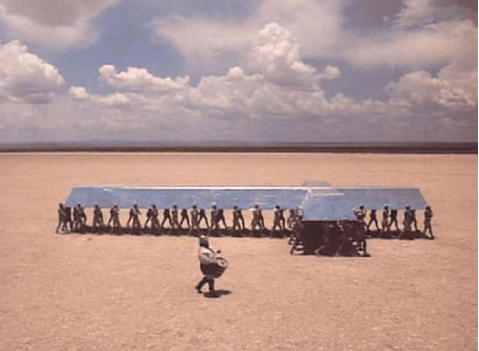
Other post-conquest films expose different aspects of the three centuries of colonial rule in New Spain. Cabeza de Vaca (Echeverría, 1991) is a cinematic portrayal of a real-life Spanish explorer and his companions, who marooned along the now-Texas coastline in 1527 (Picod, 2017). Eight years later, the few who survived were those who had adapted local conventions and forged a hybrid faith based on Catholic and Indigenous mysticisms. But when they later renew contact with Spanish troops, the survivors re-embrace Catholicism in order to avert death at the hands of their countrymen (see Figure 1).3 In film fiction and real life, Cabeza de Vaca subsequently bore witness to Spain’s invaders and missionaries as they enslaved the conquered peoples.
Source: Frame from Cabeza de Vaca (Echeverría, 1991).
Figure 1. Bearing the Burdens of Church and Conquest
The role of the Catholic church in pacification is pinpointed in a poignant account of the fearful Inquisition’s persecution and death of Sor Juana de la Cruz in the film Yo, la Peor de Todas (Bemberg, 2003). Cultivated and intelligent, Sor Juana was persecuted by the church until she descended into abject poverty and perished during a plague. Today, she is widely regarded as a brilliant intellect and proto-feminist writer from Mexico’s 17th century, and even reimagined by some as a prominent lesbian (see Figure 2).4

Source: Frame from Yo, la Peor de Todas (Bemberg, 2003).
Figure 2. Spanish Vice-Regent Meets Mexican Nun in New Spain
2. Modernity, Modernization, Revolution
In film narratives of the unsettled mid-19th and early 20th-century modernity, modernization and revolution are deeply commingled with stereotypes of race and ethnicity, the subordination of women, and reassessments of the Revolution’s heroes. The enormity of social and generational ruptures during and after the Mexican Revolution are reconstructed in the lives of four women in Como Agua para Chocolate (Arau, 1992). The matriarch, Doña Elena, represents pre-Revolutionary society and the authoritarian order of the Porfiriato dictatorship, dying as the Revolution comes to an end. Her eldest daughter, Rosaura, is a transitional figure whose expectations remain rooted in privilege, though she, too, is destined to perish in the passage to the new. Tita, the youngest, is doomed by her obligation to abandon personal ambitions in order to nurse her ailing mother, while Gertrudis, the third daughter, is truly an incarnation of the new, escaping family traditions by running away to marry a soldier and becoming a general in Pancho Villa’s Northern Army.
Myths and memories of the Revolution and its heroes have been enduring themes in Mexican film, especially in the case of Emiliano Zapata and Pancho Villa (Berthier, 2011; Noble, 2011). Villa’s cooperation with the Mutual Film Corporation of America—to film his actual battles—is legendary, and was commemorated in the film And Starring Pancho Villa as Himself (De Orellana, 2009; Beresford, 2003). It is worth noting that the film La Venganza del General Villa (Padilla & Padilla, 1937) has been described as a precursor of “Border Cinema,” partly because of the film’s borderland setting.
¡Vámonos con Pancho Villa! (De Fuentes, 1936) is the story of six friends who join General Villa’s army. Only one survives (Tiburcio), who, disgusted by war, renounces both the Revolution and Villa. But in a surprising alternative ending, the condemnation of Villa is stronger. Villa seeks out Tiburcio and tries to persuade him to rejoin the struggle. Tiburcio declines, gesturing toward his wife and daughter, and Villa immediately shoots both, indicating that he is now free to rejoin his army. In the ensuing struggle, Tiburcio is killed, his newly orphaned son dragged off to war by Villa.
In 1931, Villa’s contemporary, Elías L. Torres, recorded that the general was neither a genius nor monster, but simply one of the most prominent figures of the Revolution, one who will go down in history “haloed in greatness” (Torres, 1973, p. xi).
The revolutionary cause was generally regarded favorably by Hollywood filmmakers, even when U.S. national political sentiments at the time were divided. Sam Peckinpah’s The Wild Bunch (1969) was set in the revolutionary northern borderlands. The film is replete with references to obsolescence and change, represented by railway networks, new weapons of war, and automobiles. But the film’s central narrative is about the moral contradictions and temporary alliances of convenience that occur among opposing outlaws and lawmen, and Mexican rebels and federales. Ironically, such concerns arose during the making of The Wild Bunch, when Peckinpah discovered that Mexican and Anglo actors were being directed to separate dining areas. He immediately canceled the practice (Stratton, 2019).
3. Migration, Belonging; Passages, Prohibition
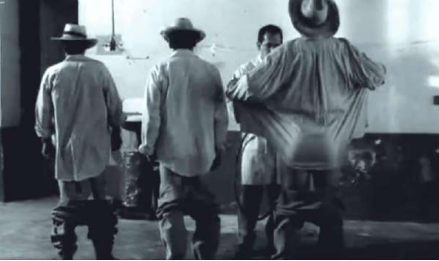
The most durable theme in border film has been migration. Throughout the 20th century, U.S. immigration policy vacillated between efforts to import Mexican workers during labor shortages, only to deport them when numbers exceeded demand. For its part, Mexico understood that even patriotic citizens would abandon impoverished communities in favor of better opportunities elsewhere. As the numbers crossing the line increased, films of both countries warned of dangers in undocumented border crossings and promoted protection for migrants who chanced the perilous journey, as depicted in Figure 3.
Source: Frame from Purgatorio (Rochín, 2008).
Figure 3. Fumigating Braceros Before Allowing Entry Into the American Dream
A landmark in U.S. border film history was the release of Border Incident (Mann, 1949), which imagined optimistic collaborations among cross-border law enforcement that would accelerate the reconstruction of war-depleted societies. Against a backdrop of muscular infrastructure building, the film conveyed uncomfortable truths about the hazards of border crossing: the physical and mental endurance required for the journey, violence at the hands of human traffickers and law officers, and abusive racism by unscrupulous employers. Nevertheless, the film ends with a celebration of successful binational efforts to protect migrant workers (Figure 4).

Source: Frame from Border Incident (Mann, 1949).
Figure 4. Victory Celebration of Cross-Border Policing Collaboration
Four years after Border Incident, Espaldas Mojadas (“Wetbacks”) was released, soon winning recognition as a Mexican border classic (Galindo, 1955). The two films are close in time and subject, offering an unusual opportunity for direct cross-national comparison. Espaldas Mojadas presents an insistently negative view of the U.S.: its people are obsessively materialistic, racist, and violent, who erect observation towers along a borderline inhabited by border guards ordered to shoot and kill—its opening credits included a strongly-worded warning not to attempt unlawful crossings. However, the film’s principal concern is the ordinary heroism, nobility, and stoicism of migrant workers who find strength and comfort in cultural values and traditions from their homelands, especially religion and family. At the same time, Espaldas Mojadas establishes the border as a space of fusion involving the lives of borderlanders and criminals on both sides, creating a hybrid ecology of shifting identities. As the film ends, an exiled couple chooses to return home to Mexico, instead of languishing north of the border, unwanted and rejected.
4. Identities, Mestizaje, Hybridity
In the late 20th century, as border film consolidated its place in the cinematic culture of both countries, powerful narratives began to emerge, concerning the collision of identities, social integration and consequent mestizaje (hybridization). The geographical setting of border films extended beyond the line to more distant though still border-connected locales, especially Los Angeles and New York City. Evolving cultural narratives imagined “neo-Westerns,” in which United States Border Patrol agents replaced the roles formerly occupied by sheriffs and marshals. The widening palette also invoked portraits of small-town life, its isolation and internalized “borders,” as depicted in films like How the Garcia Girls spent their Summer (Garcia Riedel, 2005). By the century’s end, all borderlanders seemed to possess a moral calculus responsive to difference, for better or worse.
El Norte (Nava, 1983) quickly acquired canonical status as a saga of forced departure, migration, and tragedy. Brother and sister Rosa and Enrique quit Guatemala after their father was murdered and their mother disappeared. Preparing to enter Mexico, Rosa sets aside her huipil in favor of something less Indian. Both learn vulgar slang that will help them pass as Mexicans, and the siblings eventually arrive in Los Angeles, where their story reaches its peak after Enrique arrives home proudly wearing his “uniform” of a restaurant employee, and Rosa welcomes him dressed in the gringa-style clothing typical of domestic workers. Both are excited yet uncomfortable about these overt evidences of altered identities. When she later falls ill, Rosa realizes they no longer belong on either side of the line. After her tragic death, Enrique once again dons the garb of a day laborer, realizing that he was a peon in Guatemala and remains as such in this strange land.
Changing inter-generational identities are also acutely observed in Lone Star (Sayles, 1995), which unlocks a deep archeology of buried pasts, warped legacies, and deep hatred. Its ambitious narrative concerns the lives of three generations of white, black, and brown people in a small Texas border town, and features a crowded screenplay addressing racism, incest and miscegenation, corruption and murder, memory and guilt, and undocumented migrants (see Figure 5). Sam and Pilar had nurtured a childhood affection for each other without knowing they had the same father, and even though they were kept apart by their parents. Later in life, they are free to affirm their love. Seeking reassurance of Sam’s readiness to face stigma connected with the “big sin” of incest (she is no longer able to bear children), Pilar is defiant: “All that other stuff, all that history. To hell with it, right? Forget the Alamo” (Sayles, 1995, 02:11:13).

Source: Frame from Lone Star (Sayles, 1995).
Figure 5. In a Small Cafe, an Interacial Couple Mix, “Salt and Sugar in The Same Jar”
5. Dreams, Aspiration, Pilgrimage
Another pivotal axis in border film is the “American Dream.” The term has many meanings, but in the United States today it has come to refer most commonly refers to migrant aspirations of coming to America (Churchwell, 2018). Said one Mexican family: “Our dream is to cross the border. To work and earn money to be able to live well with the family that we will have” (Weber, 2018, p. 111). But a Haitian migrant also intending to cross into the United States instead found work in Tijuana: “[people] have their minds set on the ‘American Dream,’ but I have come to realize there’s a ‘Mexican Dream,’ too” (Pascal Dubouisson, 2019).
A dense cosmology involving aspiration and pilgrimage undergirds the narratives of many films in this category. In El Norte (just mentioned), director Nava raised his film into the realm of the universal by drawing on legends and traditions, emphasizing the epic nature of the journey of Rosa and Enrique. The film invokes a classic Quiché Maya creation account entitled the Popul Vuh (or, “Book of the People”), in which the Hero Twins are children of gods, traveling to the Underworld and perishing after a long journey and many trials, only to magically arise to defeat the lords of the Underworld (Recinos et al., 1950).
Material aspirations relating to migration are the foundation of El Jardín del Edén (The Garden of Eden), in which six arrivals in Tijuana are trying to find new lives. Jane is from the U.S., hoping to reconnect with her exiled brother and find adventures that nourish her writing ambitions (Novaro, 1994). Serena is a Mexican widow with three children. And Liz, a Chicana artist, is in search of her Mexican roots. Three males are also searching. Jane’s brother, Frank, has already realized his Mexican Dream of solitude. Julián, Serena’s almost-teenager son, still grieves for his lost father. And Felipe is a young Mexican man seeking to prosper by crossing over. The film recapitulates their fates. Jane moves on to Oaxaca, deeper into Mexico. Serena succeeds in settling her family. Liz, the artist, discovers her roots and remains in TJ. Felipe joins with teenage Julián to cross the line in pursuit of their now-shared American Dream.
In Bajo California (Bolado Muñoz, 1998), a more mystical pilgrimage is undertaken by Damián, who abandons his pregnant wife and flees Los Angeles, tortured by guilt after a mysterious car accident. He seeks renewal among the ancient cave paintings of central Baja’s mountains. Along the way, Damian exchanges hats with another pilgrim, symbolizing his commitment to altered ways of seeing. He destroys his possessions and prostrates himself before the soaring cliffs and ancestral murals—seemingly the only physical and spiritual landscapes capable of accommodating the dimensions of his despair. We never witness Damian’s homecoming to LA; the narrative in Bajo California is less about arriving than the journey itself across the frontiers of border time and space.
6. Passages, Borders
In an early silent film, Shorty’s Trip to Mexico (Ford, 1914), the boundary is marked by a single stone monument. Shorty smuggles guns from the United States to rebels during the Revolution. In a climactic moment, he drives a stolen car recklessly back to the U.S. with his Mexican sweetheart, and two border guards on horseback allow the fugitive pair to cross safely into the country. Moments later, the same two officers find it surprisingly easy to dissuade a posse of Mexican military from simply riding by the monument in pursuit.
For the rest of the century, filmmakers from both sides have richly documented the mechanics of migrant passages over, under, through, above, and around the border’s looming fortifications: walls, fences, and other obstructions. (Dear, 2015). Mexican perspectives on border walls include Córdova and De la Parra (2012), and Bustamante Redondo (1999), a reminder that not all migrants arriving at Mexico’s northern border are intending to cross into the United States. In Aventurera (Gout, 1952), for instance, a singer/dancer travels north to Ciudad Juárez, where she is forced into prostitution. The city also serves as a place of refuge, allowing her to recover and realize her Mexican Dream without ever crossing to the border.
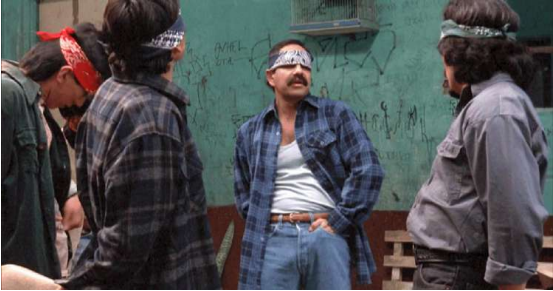
About mid-century, in Touch of Evil (Welles, 1958), the crossing was nothing more than a small kiosk in the middle of the street connecting two adjacent border towns. Water crossings, on the other hand, involved more risk (see Border Incident or Espaldas Mojadas). In the comedy Born in East L.A. (Marin, 1987), Rudy, a U.S. citizen, is accidentally deported to Tijuana without identification. There were no fences at that time in the city, and Rudy joined a mob of joyful migrants who rushed the border crossing, their numbers overwhelming hapless border guards (such unauthorized crowd crossings frequently occurred during the 1990s) (see Figure 6).
Source: Frame from Born in East L.A. (Marín, 1987).
Figure 6. Chicano Exiled in Tijuana Teaches Asian-Origin Migrants How to Act Like Mexicans
For the other part, Sin Nombre (Fukunaga, 2009) features the real-life long train journey undertaken by migrants from Mexico’s southern border to Texas, perched precariously on top of the moving train—known as “La Bestia.” In real life and film, the trip from Guatemala takes many days, and riders face the physical perils of the journey as well as constant attacks by gangs, which form the basis of the narrative. Meanwhile, an unusual and dramatic nighttime crossing occurs in Julia (Zonka, 2008), when an American woman driving off-road across the desert in an attempt to evade a border patrol helicopter and, disoriented by dust clouds and noise, inadvertently crashes headlong through the border fence. The helicopter abandons its pursuit, and in the ensuing silence, Julia restarts the car and slowly creeps over the line into Mexico. Thereafter, her life unfolds in what seems to her to be an alternative universe (Tijuana).
7. Narcolandia, New Order
A deluge of film releases in 2000 and after focused on Mexican drug cartels (Wood, 2021). The dominant trope was of narcolandia—a culture and economy of organized crime involving trafficking in narcotics, guns, and human beings on both sides of the line. Male leading roles in this vogue became locked into stereotypes of machismo and extreme violence, but roles for women began shifting toward ambiguous forms of empowerment. New orders were emerging.
The release of Traffic (Soderbergh, 2000) signaled the emergence of what is referred to as a Golden Age in border filmmaking, characterized by blockbuster, big-budget films invoking a global metastasis of cartel cultures. The cinematic border in this narrative is presented as a porous space, where legal and illegal crossings in both directions are a daily routine (Payan, 2016). This huge volume of transborder connections leads one character in the film to observe: “The border is disappearing” (Soderbergh, 2000, 51:54). Fifteen years later, Sicario (Villeneuve, 2015) exposed an ultra-violent world in which the war against drugs had been won by the cartels (Hernández, 2010; Astorga, 2007). The ensuing stalemate, as captured in Figure 7, is explained to a female U.S. operative by her male Mexican partner: “Nothing will make sense to your American ears. And you will doubt everything that we do. And in the end, you will understand nothing” (Villeneuve, 2015, 22:52).

Source: Frame from Sicario (Villeneuve, 2015).
Figure 7. Enlisting State Police (and Vehicles) to Deliver Cartel Products
The transition in women’s roles in border film is exemplified by the differences between a 2011 Mexican film, Miss Bala (Naranjo, 2011), and a later American remake with the same title. In the original, Laura encounters a drug dealer who coerces her into helping assassinate a powerful general. Fearing for her life, she warns the general of the plot, but instead of being rewarded, she is beaten and paraded as a criminal before the media. Her purpose served, she is dumped onto an anonymous Tijuana street. The American remake of Miss Bala (Hardwicke, 2019) involved a female director, a Latina lead, a predominantly Latino cast, and the muting of the onscreen violence to ensure a PG-13 rating (the original was R-rated). Now called Gloria, the female lead is once again kidnapped to aid in the assassination of a chief police officer. But this time, the encounter with her narco captor is reimagined as they flirt through various romantic situations. In the film’s climax, Gloria is the one who seizes a gun, shoots the police chief, and kills her captor, rewarded later in a luxurious apartment where CIA operatives enthusiastically recruit her to join them in the drug wars.
8. Law, Corruption, Domestication
The collision of cultures evoked by contemporary border films frequently refers to cataclysmic changes arising from global changes in migration, national and international security, arms dealing, and drug/human trafficking. However, small-scale, more granular shifts are increasingly evident in screenwriting devoted to the U.S. Border Patrol (renamed Customs and Border Protection, or CBP).
A striking example of the micro-scale domestication of violence and the consequent erosion of community is 600 Millas (“600 Miles”, Ripstein, 2015), a blunt depiction of cartel penetration into everyday lives. The film focuses on the illegal purchase of guns in the United States for transfer to Mexican cartels across the border, where sometimes, U.S. Border Patrol agents and Mexican drug lords work in collusion (similar to what has been reported in Grillo, 2012). One day, agent Hank is kidnapped by Arnulfo, a foot-soldier hoping to curry favor with his uncle Martín, a local cartel chief. Instead, his uncle is infuriated and, clearing his breakfast dishes, orders his nephew to kill Hank. In the ensuing panic, Arnulfo kills his uncle and escapes with Hank, who, approaching the borderline, abandons Arnulfo in the desert—effectively a death sentence. At his home again, Hank engages in banal chit-chat with his wife, the clattering of their dishes echoing the earlier bloody breakfast at uncle Martín’s, magnifying the enormity of Hank’s deceit.
An even sharper dissection of the moral lives of U.S. border patrol officers occurs in Transpecos (Kwedar, 2016), a tale of three USBP officers who assemble one morning to guard a remote checkpoint. Flores is the officer in charge; Hobbs, a veteran skilled at spotting smugglers; and Davis, a rookie with a secret. When a driver attempts to burst through the roadblock, Hobbs shoots him. Flores discovers drugs in the car, but Davis refuses to report the matter, revealing that his entire family will be murdered if the shipment does not pass through. Flores decides to help Davis deliver the drug shipment to the cartel, and this dangerous trip ends with the deaths of Hobbs and Davis. Later, Flores is warned to remain silent about the incident and is offered a reassignment far from the borderline, which he declines, returning to train new recruits, warning them to pay attention to the landscape: “This is the desert. This thing will kill you” (Kwedar, 2016, 01:20:04).
9. Resistance
The material infrastructure of border walls, fences, barriers, and surveillance apparatus, together with the occupation battalions of law enforcement and national guard personnel, has become a symbol of aggrieved, interrupted, and frustrated borderland lives. Opposition to these conditions of occupation sometimes curdles into resistance, and filmmakers have often responded with satire and humor. In Cheech & Chong’sUp in Smoke (Chong & Adler, 1978), for example, a small van made from marijuana is waved through by customs officials, who perhaps have sampled its cargo? And in From Dusk Till Dawn (Rodríguez, 1996) an American family’s vacation is hijacked and diverted to a remote Mexican saloon infested by vampires, gangsters, bikers, and python-toting strippers, while in Machete (Rodríguez & Maniquis, 2010, 01:23:36), migrant workers join nurses, domestic workers, and dishwashers in armed revolution, yelling: “We didn’t crossed the border, the border crossed us!” (Figure 8).

There are also witty reversals of the established order. In The Day After Tomorrow (Emmerich, 2004), climate change forces legions of freezing Americans to storm the Mexican border seeking warmer climes. And in A Day Without a Mexican (Arau, 2004), a malevolent fog envelops the borderline, causing every Mexican in California to disappear. The state’s economy quickly grinds to a halt, provoking riots in support of Mexicans’ return.
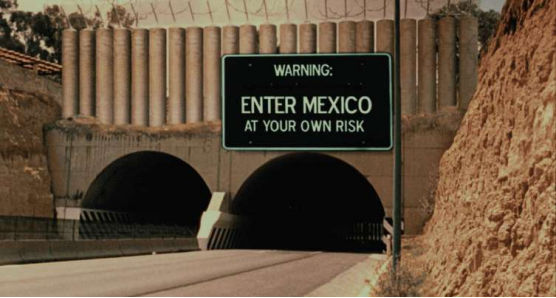
For its part, Sleep Dealer (Rivera, 2008) imagines a new world of high-tech borderscapes, where the United States has completely shut its southern border, and remote surveillance from the United States interior has replaced border patrols and sealed crossings. The labor formerly performed by Mexican migrants (braceros) is now done by cybraceros who reside in Mexico but are connected to robot operatives. The border wall—referred to as the “edge of everything” (Rivera, 2008, 01:23:20)—still shelters seeds of resistance (see Figure 9).
A different kind of resistance is imagined in more recent Mexican films about the devastation caused by the cartels’ takeover of communities. The film Sin Señas Particulares (“No Identifying Features”, Valadez, 2020) is directed, produced, and written by two women, using an almost all-women crew and mostly non-professional actors. The film links the rise of cartel occupation with out-migration to the United States. After a young man crosses over into the later, his mother discovers that he was kidnapped by sicarios, and while searching through devastated landscapes under cartel control, she is captured and delivered to a cartel leader who turns out to be her son, coerced into joining a cartel but risking his life to ensure his mother’s safety.
NEXT STEPS
International boundaries are places of enormous complexity, tension, creativity, and friendship (Konrad, 2015). Many communities along the Mexico-United States line shared cross-border identities and allegiances long before they were divided by an international boundary. They were united through material forms such as commerce, shopping, education, and family connections, all buttressed by cognitive senses of belonging, shared identities, languages, and history (Dear, 2013). These connections are grounded in place and embodied in the urbanized “twin cities” and rural communities along the line, serving as a vital performance space accommodating border film (Sohn, 2022; Dear, 2023). Useful sources establishing the material bases of urban regions along the line between Mexico and the United States include: Alegría Olazábal and Ordóñez Barba (2005), Piñera (2006), Piñera and Rivera (2007), Lucero Velasco (2002), Staudt et al. (2010), Alarcón Cantú (2000), and Gasca Zamora (2002).5
This essay was drawn to film as an independent source of a century-long historical record revealing filmmaker portraits of borderland lives, cultural landscapes, and behaviors that go beyond purely material forms of transborder connection. Its most important contribution is the use of a new Border Film Genre, first reported in Border Witness (Dear, 2023), to identify nine cultural narratives that represent filmmakers’ principal constructions targeting borderlanders’ cognitive worlds, also referred to as “mental maps.” These were: 1) origins; 2) modernity, modernization, revolution; 3) migration, belonging; passages, prohibition; 4) identities, mestizaje, hybridity; 5) dreams, aspiration, pilgrimage; 6) passages, borders; 7) narcolandia, new order; 8) law, corruption, domestication; and 9) resistance.
Together, these dimensions represent a diverse conceptual architecture (with associated linguistic codes) adopted by filmmakers to construct onscreen representations of borderland people and their lives. The next step is to investigate how cultural narratives are useful in understanding the ways in which narrative structures are combined for dramatic effect. The films El Norte and Lone Star, for example, are extraordinarily rich because they draw on multiple narratives: migration, identity, aspiration, and passage in the former; modernization, migration, hybridity, law, and resistance in the latter. In contrast, Sicario is dominated by a single axis, narcolandia, though the film is more impactful precisely because of this singularity (Sicario also possesses the most striking musical score—by Jóhann Jóhannsson—drawing attention to the role of soundscapes in film, another dimension worth investigating).
Cultural narratives also provide opportunities for comparing filmic with real-world borders through tests of fidelity and authenticity. Many border films are based on real events and are reasonably faithful to real-life situations (e.g., Sin Nombre), but fictional films may also convey authentic visions that audiences recognize. For instance, Sleep Dealer establishes a recognizable future cyberworld with which audiences can readily connect, and at different historical periods, films have offered direct prescriptions, advocating change and including explicit didactic messaging, such as warnings against border crossing (Espaldas Mojadas).
Future directions in Mexico-United States border film studies should prioritize expanding the catalogue of Mexican-origin border films and developing frameworks for comparative analyses of border films from other national cinemas. Later, it would be worth incorporating the contents of the rich catalogue of documentary border film (Dear, 2015; Gandy, 2021). The new border film offers a rich agenda for knowledgeable and enthusiastic students, scholars, critics and filmmakers.

