Artículos de investigación
First record of fragrance collection by euglossine bees (Apidae: Euglossini) in Ganoderma (Polyporales, Ganodermataceae)
Primer registro de la recolección de fragancias por abejas euglosinas (Apidae: Euglossini) en Ganoderma (Polyporales, Ganodermataceae)
Lozano-Rodríguez, Miguel Ángel1*
 http://orcid.org/0000-0003-0666-1822
Quintos-Andrade, Gerardo2
http://orcid.org/0000-0002-1783-0436
http://orcid.org/0000-0003-0666-1822Quintos-Andrade, Gerardo2
http://orcid.org/0000-0002-1783-0436
-
Publication dates-
November 03, 2025
Jan-Dec , 2025
- Article in PDF
- Article in XML
- Automatic translation
- Send this article by e-mail
- Share this article +
Abstract:
Background and Aims:
Orchid bees and their relationships have been studied since the 1960’s. Data show that orchids are not the only source of fragrance for euglossine bees. Although mushrooms have been reported as a source of fragrance for orchid bees, there is no information about this between Ganoderma cf. applanatum and Euglossini bees. The aim of this work was to identify the bee tribe of Euglossini species that collect fragrances on the fruit body of Ganoderma cf. applanatum.
Methods:
Five samplings were carried out using an entomological aerial net directly on the fruit body of Ganoderma cf. applanatum during the dry season in April and May 2022 between 11:00 and 13:00 hours. Samplings were carried out in an agroforestry coffee system in the municipality of Jilotepec, Veracruz, Mexico. Ganoderma cf. applanatum was at the end of its spore releasing phase during this period.
Key results:
In the fruit body of Ganoderma cf. applanatum, particularly in the hymenium, male orchid bees were recorded collecting fragrances, of three genera and six euglossine species. Euglossa was the genus with the highest visit frequency of the hymenium of Ganoderma cf. applanatum.
Conclusions:
This report contributes to the documentation of the collection of fragrance by male euglossines on a mushroom (a non-floral scent source) and this activity is recorded for the first time in Mexico.
Key words::
Euglossa dilemma, Euglossa viridissima, insects, mushroom, orchid bees
Introduction
The bee tribe Euglossini of the Apidae family consist of five genera and 245 species widely distributed in the Neotropical region (Moure and Melo, 2023). The euglossines are popularly known and studied for the reproductive habits of males, which involve the collection of fragrant oils from orchids and other resources such as sap, ripe and rotting fruits, feces, corpses, leaves, stems, mushrooms, and even on other male bees’ dead bodies, prior to courtship with females (Roubik and Hanson, 2004; Michener, 2008; Lozano Rodríguez et al., 2022; Karremans et al., 2023; Moure and Melo, 2023; Henske et al., 2024). Recently, it has been reported that orchid bees collect herbicides that mimic natural fragrances (Pemberton and Kindt, 2024). Information about the interaction between these bees and plants is widely recognized. Orchid bees are considered as ecological indicators, as they are easy to sample, their taxonomy is well-known, and information about the influence of disturbances that affect them is available (Gonçalves and Faria, 2021).
-
Moure and Melo, 2023Euglossini Latreille, 1802, 2023
-
Roubik and Hanson, 2004Orchid bees of tropical America. Biology and field guide, 2004
-
Michener, 2008The Bees of the World., 2008
-
Lozano Rodríguez et al., 2022Visit frequency of Euglossine bees (Hymenoptera: Apidae) to mature fruits of Vanilla planifolia (Orchidaceae)Acta Botanica Mexicana, 2022
-
Karremans et al., 2023Report first evidence for multimodal animal seed dispersal in orchidsCurrent Biology, 2023
-
Moure and Melo, 2023Euglossini Latreille, 1802, 2023
-
Henske et al., 2024Non-floral scent sources of orchid bees: Observations and significanceBiotropica, 2024
-
Pemberton and Kindt, 2024Orchid bee collects herbicide that mimics the fragrance of its orchid mutualistsFlorida Entomologist, 2024
-
Gonçalves and Faria, 2021In Euglossini we trust as ecological indicators: A reply to Añino et al. (2019)Sociobiology, 2021
Emissions of volatile organic compounds (VOCs) play important ecological and physiological roles for many organisms (Müller et al., 2013). Fungal VOCs are relatively understudied compared to VOCs of bacterial, plant, or synthetic origin (Hung et al., 2015). Approximately 250 VOCs have been identified from fungi (Chiron and Michelot, 2005; Korpi et al., 2009; Ortíz-Castro et al., 2009). Monoterpenes like a-Pinene, camphene, b-Phellandrene, limonene and linalool have been detected (Breheret et al., 1997). Another compound found in fungi is 1,8-Cineole (Morath et al., 2012), which is widely reported as one of the main VOC recollected by Euglossini bees (Liu et al., 2024). The most common VOC in mushrooms is 1-Octen-3-ol (octanol) (Venkateshwarlu et al., 1999); this is responsible for the particular mushroom aroma (Fahlbusch et al., 2003; Combet et al., 2006). VOCs in fungi play the role of insect attractants of (Morath et al., 2012), such as flies and mosquitoes, which disseminate spores and play a role in the fungal reproduction process (Chiron and Michelot, 2005). Insects (Diptera and Coleoptera) have been reported as spore dispersers in Ganoderma P. Karst. (Mayra et al., 2024; Syarif et al., 2024) and as potential vectors for Ganoderma basal stem rot disease in oil palm plantations (Syarif et al., 2024). Interactions of orchid bees and mushrooms are poorly explored, even though there are several reports (Roubik and Hanson, 2004; Henske et al., 2024). The objective of this work is to describe the interaction between Euglossini bees and Ganoderma and identify the involved euglossine species.
-
Müller et al., 2013Volatile profiles of fungi - Chemotyping of species and ecological functionsFungal Genetics and Biology, 2013
-
Hung et al., 2015Fungal volatile organic compounds and their role in ecosystemsApplied Microbiology and Biotechnology, 2015
-
Chiron and Michelot, 2005Odeurs des champignons: chimie et rôle dans les interactions biotiques-une revueCryptogamie, Mycologie, 2005
-
Korpi et al., 2009Microbial volatile organic compoundsCritical Reviews in Toxicology, 2009
-
Ortíz-Castro et al., 2009The role of microbial signals in plant growth and developmentPlant Signaling and Behavior, 2009
-
Breheret et al., 1997Monoterpenes in the aromas of fresh wild mushrooms (Basidiomycetes)Journal of Agricultural and Food Chemistry, 1997
-
Morath et al., 2012Fungal volatile organic compounds: A review with emphasis on their biotechnological potentialFungal Biology Reviews, 2012
-
Liu et al., 2024Macroevolution of floral scent chemistry across radiations of male euglossine bee-pollinated plantsEvolution, 2024
-
Venkateshwarlu et al., 1999Volatile flavour components of some edible mushrooms (Basidiomycetes)Flavour and Fragrance Journal, 1999
-
Fahlbusch et al., 2003Flavors and FragrancesUllmann’s Encyclopedia of Industrial Chemistry, 2003
-
Combet et al., 2006Eight-carbon volatiles in mushrooms and fungi: Properties, analysis, and biosynthesisMycoscience, 2006
-
Morath et al., 2012Fungal volatile organic compounds: A review with emphasis on their biotechnological potentialFungal Biology Reviews, 2012
-
Chiron and Michelot, 2005Odeurs des champignons: chimie et rôle dans les interactions biotiques-une revueCryptogamie, Mycologie, 2005
-
Mayra et al., 2024Ganoderma diversity and its interactions with hosts and neighbouring insects in Gunung Walat Educational ForestJurnal Biodjati, 2024
-
Syarif et al., 2024Insect community associated with Ganoderma basidiocarps in oil palm plantations of SabahJournal of Oil Palm Research, 2024
-
Syarif et al., 2024Insect community associated with Ganoderma basidiocarps in oil palm plantations of SabahJournal of Oil Palm Research, 2024
-
Roubik and Hanson, 2004Orchid bees of tropical America. Biology and field guide, 2004
-
Henske et al., 2024Non-floral scent sources of orchid bees: Observations and significanceBiotropica, 2024
Material and Methods
Male euglossine bees were recorded in the fruiting body of a specimen of Ganoderma, growing 30 cm from the ground on a dead trunk of Bursera simaruba (L.) Sarg., within a shaded coffee plantation located in the municipality of Jilotepec, Veracruz, Mexico (Fig. 1). The individual of Ganoderma was identified using the key of Cappello-García et al. (2023), it was photographed and the images were shown to Dr. Gerardo Mata (Mycologist from INECOL), who identified the specimen as Ganoderm cf. applanatum (Pers.) Pat. He suggested including cf., taking into account that it would be necessary to perform in vitro culture of the hyphae to confirm that it was this species, which was not within the scope of work. This group of bees was monitored between the months of April and May 2022, during the dry season. Ganoderma cf. applanatum was at the end of its spore releasing phase during this period. Five samplings were carried out using an entomological aerial net, between 11:00 and 13:00 hours.
-
Cappello-García et al. (2023)New records of the genus Ganoderma (Agaricomycetes, Polyporales) for Mexico and TabascoRevista Mexicana de Biodiversidad, 2023
Thumbnail
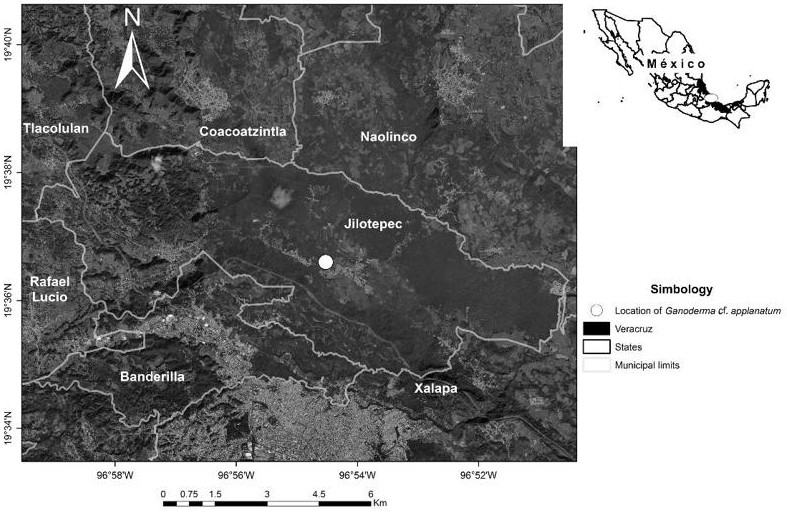
Figure 1:
Location of Ganoderma cf. applanatum (Pers.) Pat. in an agroforestry coffee system in municipio Jilotepec, Veracruz, Mexico, where Euglossini bees were collecting fragrances.
Location of Ganoderma cf. applanatum (Pers.) Pat. in an agroforestry coffee system in municipio Jilotepec, Veracruz, Mexico, where Euglossini bees were collecting fragrances.
The collected bees were identified with the keys by Roubik and Hanson (2004) and Ayala and Engel (2008). The material was deposited in the entomological collection of the Instituto de Ecología, A.C. in Xalapa, Veracruz, Mexico (IEXA). Additionally, the behavior of the bees was recorded by photographs and on video using a Nikon D3100 digital SLR camera (Nikon, Tokyo, Japan). The individual of Ganoderma cf. applanatum was not collected because it was at the end of the spore releasing and the individual died a few dayls later.
-
Roubik and Hanson (2004)Orchid bees of tropical America. Biology and field guide, 2004
-
Ayala and Engel (2008)A new species of Eufriesea from Jalisco, México, with a key to Mexican species of the genus (Hymenoptera: Apidae)Beiträge zur Entomologie = Contributions to Entomology, 2008
Results
In total, 70 individuals from three genera and six species of Euglossini were collected (Table 1). Two specimens of Lestrimelitta nitkib Ayala, 1999 (Apidae: Meliponini) were also collected on Ganoderma cf. applanatum, although this species was not part of the study group. All species of euglossine bees had the typical fragrance collection behavior described by Roubik and Hanson (2004) directly on the hymenium of the fruiting body of Ganoderma cf. applanatum (Fig. 2; supplementary material). Morever, during collection of fragrances, we were able to see spores become attached to the bee bodies (Fig. 3). Euglossa dilemma Bembé and Eltz 2011, and Euglossa viridissima Friese 1899, represent 94% of all Euglossini bees identified. Males of both species are highly attracted to the hymenium of Ganoderma cf. applanatum but there is no information about the specific VOCs that attract them.
-
Roubik and Hanson (2004)Orchid bees of tropical America. Biology and field guide, 2004
Table 1:
Male (♂) euglossine bee species identified collecting fragrances in Ganoderma cf. applanatum (Pers.) Pat.
Male (♂) euglossine bee species identified collecting fragrances in Ganoderma cf. applanatum (Pers.) Pat.
| Genera | Species | Material studied | Individuals |
| Eufriesea Cockerell, 1908 | Eufriesea surinamensis Linnaeus, 1758 | (1 ♂): MÉXICO. Veracruz, municipio Jilotepec, La Concepción, 19°36'35.6''N, 96°54'25.5''W 1000 m a.s.l., 15.IV.2022, ex Ganoderma cf. applanatum, G. Quintos-Andrade LACONC023 (IEXA). | 1 |
| Euglossa Latreille, 1802 | Euglossa dilemma Bembé and Eltz, 2011 | (39 ♂): MÉXICO. Veracruz, municipio Jilotepec, La Concepción, 19°36'35.6''N, 96°54'25.5''W 1000 m a.s.l., 13.IV.2022, ex Ganoderma cf. applanatum, G. Quintos-Andrade LACONC019, LACONC020 (IEXA) (2 ♂); loc. cit., 15.IV.2022, LACONC022 to LACONC045 (24 ♂); loc. cit., 29.IV.2022, LACONC053 to LACONC060 (8 ♂); loc. cit., 4.V.2022, LACONC066, LACONC067 (2 ♂); loc. cit., 5.V.2022, LACONC073 to LACONC075 (3 ♂). | 39 |
| Euglossa variabilis Friese, 1899 | >(1 ♂): MÉXICO. Veracruz, municipio Jilotepec, La Concepción, 19°36'35.6''N, 96°54'25.5''W 1000 m a.s.l., 29.IV.2022, ex Ganoderma cf. applanatum, G. Quintos-Andrade LACONC061 (IEXA). | 1 | |
| Euglossa viridissima Friese, 1899 | (27 ♂): MÉXICO. Veracruz, municipio Jilotepec, La Concepción, 19°36'35.6''N, 96°54'25.5''W 1000 m a.s.l., 15.IV.2022, ex Ganoderma cf. applanatum, G. Quintos-Andrade LACONC046 to LACONC050 (IEXA) (5 ♂); loc. cit., 29.IV.2022, LACONC062 to LACONC065 (4 ♂); loc. cit., 4.V.2022, LACONC068 to LACONC072 (5 ♂); loc. cit., 5.V.2022, LACONC076 to LACONC086 (11 ♂); loc. cit., 13.V.2022, LACONC087, LACONC088 (2 ♂). | 27 | |
| Eulaema Lepeletier, 1841 | Eulaema polychroma Mocsáry, 1899 | (1 ♂): MÉXICO. Veracruz, municipio Jilotepec, La Concepción, 19°36'35.6''N, 96°54'25.5''W 1000 m a.s.l., 15.IV.2022, ex Ganoderma cf. applanatum, G. Quintos-Andrade LACONC053 (IEXA). | 1 |
| Eulaema cingulata Fabricius, 1804 | (1 ♂): MÉXICO. Veracruz, municipio Jilotepec, La Concepción, 19°36'35.6''N, 96°54'25.5''W 1000 m a.s.l., 15.IV.2022, ex Ganoderma cf. applanatum, G. Quintos-Andrade LACONC054 (IEXA). | 1 | |
| Total | 70 |
Thumbnail
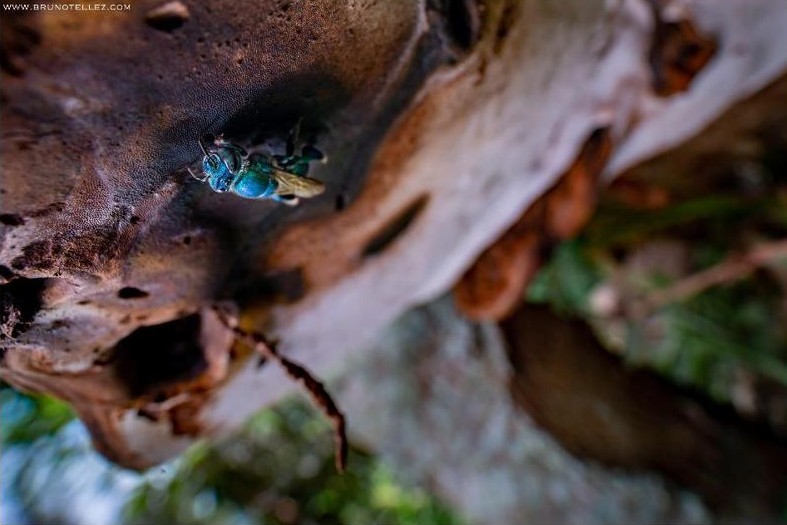
Figure 2:
Male of Euglossa Latreille, 1802 collecting fragrances on the hymenium of Ganoderma cf. applanatum (Pers.) Pat.
Male of Euglossa Latreille, 1802 collecting fragrances on the hymenium of Ganoderma cf. applanatum (Pers.) Pat.
Thumbnail
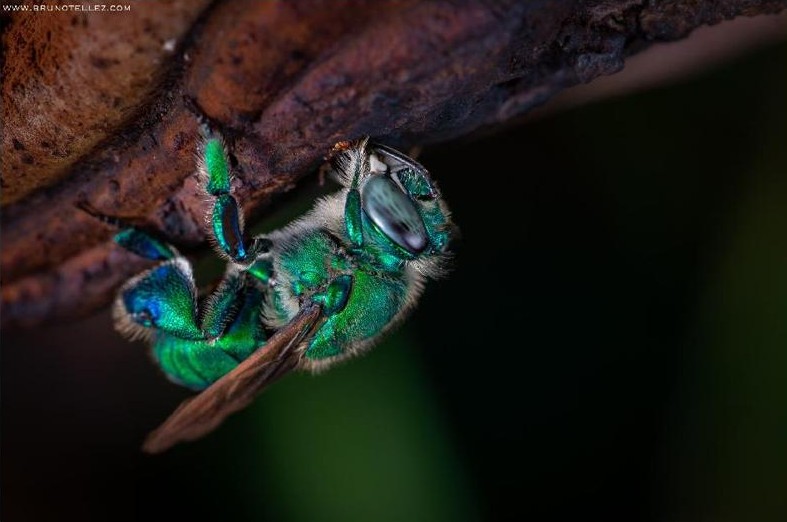
Figure 3:
Spores of Ganoderma cf. applanatum (Pers.) Pat. covering the hairs and wings of Euglossa Latreille, 1802 during the collection of fragrances.
Spores of Ganoderma cf. applanatum (Pers.) Pat. covering the hairs and wings of Euglossa Latreille, 1802 during the collection of fragrances.
Discussion
There is evidence that many of euglossine male bees have generalist habits, collecting fragrances from different aromatic sources (Ramírez et al., 2002). The six species reported have been seen collecting fragrances from more than three genera of orchids and have been observed to visit different types of aromatic attractants, specifically the two species of Eulaema Lepeletier, 1841 (Williams and Whitten, 1983; Pearson and Dressler, 1985; Ramírez et al., 2002; Roubik and Hanson, 2004). In the case of other non-floral aromatic sources, Euglossa variabilis Friese, 1899 has been observed collecting fragrances on decaying logs, probably within small formations of mycelium or mosses (Williams and Whitten, 1983; Whitten et al., 1993). This topic has recently been discussed by Henske et al. (2024), who identified more than 20 different non-floral sources collected by Euglossini bees, but no fungal source was reported.
-
Ramírez et al., 2002Abejas euglosinas (Hymenoptera: Apidae) de la Región Neotropical: Listado de especies con notas sobre su biologíaBiota Colombiana, 2002
-
Williams and Whitten, 1983Orchid floral fragrances and male euglossine bees: Methods and Advances in the last sesquidecadeThe Biological Bulletin, 1983
-
Pearson and Dressler, 1985Two-year study of male orchid bee (Hymenoptera: Apidae: Euglossini) attraction to chemical baits in lowland south-eastern PerúJournal of Tropical Ecology, 1985
-
Roubik and Hanson, 2004Orchid bees of tropical America. Biology and field guide, 2004
-
Williams and Whitten, 1983Orchid floral fragrances and male euglossine bees: Methods and Advances in the last sesquidecadeThe Biological Bulletin, 1983
-
Whitten et al., 1993Nonfloral sources of chemicals that attract male euglossine bees (Apidae: Euglossini)Journal of Chemical Ecology, 1993
-
Henske et al. (2024)Non-floral scent sources of orchid bees: Observations and significanceBiotropica, 2024
Whitten et al. (1993) recorded Euglossa purpurea Friese, 1899 and Eulaema cingulata Fabricius, 1804 visiting fungi in organic litter, in Costa Rica and Panama. Cappellari and Harter-Marques (2010) reported males of Eufriesea violacea Blanchard, 1840 collecting fragrances in the fruiting body of the mushroom Hypholoma aff. ericaceum P.D. Orton in southern Brazil. However, to date, this work is the first report of this interaction in Mexico and the first evidence that these six species collect fragrances from Ganoderma.
-
Whitten et al. (1993)Nonfloral sources of chemicals that attract male euglossine bees (Apidae: Euglossini)Journal of Chemical Ecology, 1993
-
Cappellari and Harter-Marques (2010)First report of scent collection by male orchid bees (Hymenoptera: Apidae: Euglossini) from terrestrial mushroomsJournal of the Kansas Entomological Society, 2010
There is no information about which VOCs are related to the attraction between Ganoderma and Euglossini. It has been reported that mushroom sporulation coincides with an increase of 1-Octen-3-ol and 3-Octanone levels, supposedly to recruit insects to disseminate the fungal spores (Fäldt et al., 1999). In addition, the major aroma compounds identified in Ganoderma lucidum (Curtis) P. Karst. 1881, are 1-Octen-3-ol (Alcohol) and 3-Methylbutanal (Aldehyde) (Taşkin et al., 2013). 1-Octen-3-ol and 3-Methylbutanal can be found in Orchidaceae (Knudsen et al., 2006), which is one of the sources of VOC collected by Euglossini bees (Roubik and Hanson, 2004). Hence, these findings suggest that bees (Euglossini) may be attracted to Ganoderma to collect 1-Octen-3-ol as a reward for spore dispersal, such as flies and beetles in other Ganoderma species (Mayra et al., 2024; Syarif et al., 2024). It is unknown if in Ganoderma there is a relationship between the phenological stage and the production of fragrances, as occurs in other cases like the one reported by Fäldt et al. (1999) and whether this increase of fragrances attracts male euglossine bees. Although spore development trials were not performed on the collected individuals, this correlation among compounds can suggest a potential behavior of the bees as spore dispersers of Ganoderma. Future research should focus on VOCs of Ganoderma applanatum in order to identify the mayor compounds that could attract male Euglossini bees, and evaluate their role in spore dispersal by counting the spores transported by each individual, and whether they are deposited in some wounds of trees from they collect resins, as in some species of the Burseraceae family.
-
Fäldt et al., 1999Volatiles of bracket fungi Fomitopsis pinicola and Fomes fomentarius and their functions as insect attractantsJournal of Chemical Ecology, 1999
-
Taşkin et al., 2013Determination of volatile aroma compounds of Ganoderma lucidum by gas chromatography mass spectrometry (HS-GC/MS)African Journal of Traditional, Complementary and Alternative Medicines, 2013
-
Knudsen et al., 2006Diversity and distribution of floral scentBotanical Review, 2006
-
Roubik and Hanson, 2004Orchid bees of tropical America. Biology and field guide, 2004
-
Mayra et al., 2024Ganoderma diversity and its interactions with hosts and neighbouring insects in Gunung Walat Educational ForestJurnal Biodjati, 2024
-
Syarif et al., 2024Insect community associated with Ganoderma basidiocarps in oil palm plantations of SabahJournal of Oil Palm Research, 2024
-
Fäldt et al. (1999)Volatiles of bracket fungi Fomitopsis pinicola and Fomes fomentarius and their functions as insect attractantsJournal of Chemical Ecology, 1999
This report constitutes a contribution to the documentation of fragrance collection by male euglossines on a Ganoderma cf. applanatum, a non-floral scent source. Also, this is the first report of this activity wich could constitute a mutualism although further studies are needed. It is unknown if 1-Octen-3-ol is the main VOC that Euglossa Latreille, 1802 bees collect from Ganoderma cf. applanatum and responsible of this interaction. Finally, Euglossa bees can act like spore dispersal of Ganoderma cf. applanatum.
Funding
This research was funded by the authors’ own resources.
Data Availability Statement
The dataset that supports the results of this study was published in SciELO Data and can be accessed at DOI: https://doi.org/10.48331/SCIELODATA.5RTP35
Acknowledgements
We want to thank Bruno Téllez-Baños (Centro de Investigaciones Tropicales (CITRO), Xalapa, Mexico) for pictures of Euglossa sp. in Ganoderma cf. applanatum. In addition, we thank Gerardo Mata-Montes de Oca (Instituto de Ecología, A.C. (INECOL), Xalapa, Mexico) for the identification of the mushroom species. Finally, we thank Samaria Armenta-Montero (CITRO) for the map.
Literature cited
- Ayala, R. and M. S. Engel. 2008. A new species of Eufriesea from Jalisco, México, with a key to Mexican species of the genus (Hymenoptera: Apidae). Beiträge zur Entomologie = Contributions to Entomology 58: 227-237. DOI: https://doi.org/10.21248/contrib.entomol.58.2.227-237 Links
- Breheret, S., T. Talou, S. Rapior and J. M. Bessière. 1997. Monoterpenes in the aromas of fresh wild mushrooms (Basidiomycetes). Journal of Agricultural and Food Chemistry 45(3): 831-836. DOI: https://doi.org/10.1021/jf960417h Links
- Cappellari, S. C. and B. Harter-Marques. 2010. First report of scent collection by male orchid bees (Hymenoptera: Apidae: Euglossini) from terrestrial mushrooms. Journal of the Kansas Entomological Society 83(3): 264-266. DOI: https://doi.org/10.2317/JKES0911.16.1 Links
- Cappello-García, S., M. A. García-García, M. G. Rivas-Acuña, S. D. Carreño-Ruiz and J. Cifuentes-Blanco. 2023. New records of the genus Ganoderma (Agaricomycetes, Polyporales) for Mexico and Tabasco. Revista Mexicana de Biodiversidad 94: 1-26 DOI: https://doi.org/10.22201/ib.20078706e.2023.94.5013 Links
- Chiron, N. and D. Michelot. 2005. Odeurs des champignons: chimie et rôle dans les interactions biotiques-une revue. Cryptogamie, Mycologie 26(4): 299-364. Links
- Combet, E., J. Henderson, D. C. Eastwood and K. S. Burton. 2006. Eight-carbon volatiles in mushrooms and fungi: Properties, analysis, and biosynthesis. Mycoscience 47(6): 317-326. DOI: https://doi.org/10.1007/s10267-006-0318-4 Links
- Fahlbusch, K. G., F. J. Hammerschmidt, J. Panten, K. Bauer, D. Garbe and H. Surburg. 2003. Flavors and Fragrances. In: Bohnet, M., C. J. Brinker and B. Cornils (eds.). Ullmann’s Encyclopedia of Industrial Chemistry. Wiley-VCH. Weinheim, Germany. Pp. 1-127. DOI: https://doi.org/10.1002/14356007.a11_141 Links
- Fäldt, J., M. Jonsell, G. Nordlander and A. K. Borg-Karlson. 1999. Volatiles of bracket fungi Fomitopsis pinicola and Fomes fomentarius and their functions as insect attractants. Journal of Chemical Ecology 25: 567-590. DOI: https://doi.org/10.1023/A:1020958005023 Links
- Gonçalves, R. B. and L. R. R. Faria. 2021. In Euglossini we trust as ecological indicators: A reply to Añino et al. (2019). Sociobiology 68(1): 1-8. DOI: https://doi.org/10.13102/SOCIOBIOLOGY.V68I1.4610 Links
- Henske, J., B. P. E. De Dijn and T. Eltz. 2024. Non-floral scent sources of orchid bees: Observations and significance. Biotropica 57(1): 1-7. DOI: https://doi.org/10.1111/btp.13395 Links
- Hung, R., S. Lee and J. W. Bennett. 2015. Fungal volatile organic compounds and their role in ecosystems. Applied Microbiology and Biotechnology 99: 3395-3405. DOI: https://doi.org/10.1007/s00253-015-6494-4 Links
- Karremans, A. P., D. Bogarı, E. R. Valerio and A. Whitworth. 2023. Report first evidence for multimodal animal seed dispersal in orchids. Current Biology 33(2): 364-371.e3. DOI: https://doi.org/10.1016/j.cub.2022.11.041 Links
- Knudsen, J. T., R. Eriksson, J. Gershenzon and B. Ståhl. 2006. Diversity and distribution of floral scent. Botanical Review 72(1): 1-120. DOI: https://doi.org/10.1663/0006-8101(2006)72[1:DADOFS]2.0.CO;2 Links
- Korpi, A., J. Järnberg and A. L. Pasanen. 2009. Microbial volatile organic compounds. Critical Reviews in Toxicology 39(2): 139-193. DOI: https://doi.org/10.1080/10408440802291497 Links
- Liu, J. W., P. Milet-Pinheiro, G. Gerlach, M. Ayasse, C. E. P. Nunes, I. Alves-Dos-Santos and S. R. Ramírez. 2024. Macroevolution of floral scent chemistry across radiations of male euglossine bee-pollinated plants. Evolution 78(1): 98-110. DOI: https://doi.org/10.1093/evolut/qpad194 Links
- Lozano Rodríguez, M. Á., M. Luna Rodríguez, J. M. Pech Canché, R. A. Menchaca García and C. R. Cérdan Cabrera. 2022. Visit frequency of Euglossine bees (Hymenoptera: Apidae) to mature fruits of Vanilla planifolia (Orchidaceae). Acta Botanica Mexicana 129: 1-7. DOI: https://doi.org/10.21829/abm129.2022.2001 Links
- Mayra, M. T., C. Chan, N. H. Abdurrahman and I. P. Putra. 2024. Ganoderma diversity and its interactions with hosts and neighbouring insects in Gunung Walat Educational Forest. Jurnal Biodjati 9(2): 334-347. DOI: https://doi.org/10.15575/biodjati.v9i2.36749 Links
- Michener, C. D. 2008. The Bees of the World. Ed. Johns Hopkins University Press. Baltimore, USA. 913 pp. DOI: https://doi.org/10.1002/mmnz.20020780209 Links
- Morath, S. U., R. Hung and J. W. Bennett. 2012. Fungal volatile organic compounds: A review with emphasis on their biotechnological potential. Fungal Biology Reviews 26(2-3): 73-83. DOI: https://doi.org/10.1016/j.fbr.2012.07.001 Links
- Moure, J. S. and G. A. R. Melo. 2023. Euglossini Latreille, 1802. https://moure.cria.org.br/catalogue/catalogue/catalogue?id=111991 (consulted june, 2025). Links
- Müller, A., P. Faubert, M. Hagen, W. zu Castell, A. Polle, J. P. Schnitzler and M. Rosenkranz. 2013. Volatile profiles of fungi - Chemotyping of species and ecological functions. Fungal Genetics and Biology 54: 25-33. DOI: https://doi.org/10.1016/j.fgb.2013.02.005 Links
- Ortíz-Castro, R., H. A. Contreras-Cornejo, L. Macías-Rodríguez and J. López-Bucio. 2009. The role of microbial signals in plant growth and development. Plant Signaling and Behavior 4(8): 701-712. DOI: https://doi.org/10.4161/psb.4.8.9047 Links
- Pearson, D. L. and R. L. Dressler. 1985. Two-year study of male orchid bee (Hymenoptera: Apidae: Euglossini) attraction to chemical baits in lowland south-eastern Perú. Journal of Tropical Ecology 1(1): 37-54. DOI: https://doi.org/10.1017/S0266467400000067 Links
- Pemberton, R. W. and J. T. Kindt. 2024. Orchid bee collects herbicide that mimics the fragrance of its orchid mutualists. Florida Entomologist 107(1): 1-6. DOI: https://doi.org/10.1515/flaent-2024-0013 Links
- Ramírez, S., R. L. Dressler and M. Ospina. 2002. Abejas euglosinas (Hymenoptera: Apidae) de la Región Neotropical: Listado de especies con notas sobre su biología. Biota Colombiana 3(1): 7-118. Links
- Roubik, D. W. and P. E. Hanson. 2004. Orchid bees of tropical America. Biology and field guide. Ed. INBio. Santo Domingo de Heredia, Costa Rica. 352 pp. Links
- Syarif, M. N. Y., S. Sundram, S. N. Ahmad, M. M. M. Masri and I. A. Sema. 2024. Insect community associated with Ganoderma basidiocarps in oil palm plantations of Sabah. Journal of Oil Palm Research 37(1): 96-109. DOI: https://doi.org/10.21894/jopr.2024.0005 Links
- Taşkin, H., E. Kafkas, Ö. Çakiroǧlu and S. Büyükalaca. 2013. Determination of volatile aroma compounds of Ganoderma lucidum by gas chromatography mass spectrometry (HS-GC/MS). African Journal of Traditional, Complementary and Alternative Medicines 10(2): 353-355. DOI: https://doi.org/10.4314/ajtcam.v10i2.22 Links
- Venkateshwarlu, G., M. V., Chandravadana and R. P. Tewari. 1999. Volatile flavour components of some edible mushrooms (Basidiomycetes). Flavour and Fragrance Journal 14(3): 191-194. DOI: https://doi.org/10.1002/(SICI)1099-1026(199905/06)14:3<191::AID-FFJ810>3.0.CO;2-7 Links
- Whitten, W. M., A. M. Young and D. L. Stern. 1993. Nonfloral sources of chemicals that attract male euglossine bees (Apidae: Euglossini). Journal of Chemical Ecology 19(12): 3017-3027. DOI: https://doi.org/10.1007/BF00980599 Links
- Williams, N. H. and W. M. Whitten. 1983. Orchid floral fragrances and male euglossine bees: Methods and Advances in the last sesquidecade. The Biological Bulletin 164(3): 355-395. DOI: https://doi.org/10.2307/1541248 Links