




 nueva página del texto (beta)
 Inglés (pdf)
 Artículo en XML
 Referencias del artículo
 Traducción automática
 Enviar artículo por email
 Citado por SciELO
  Similares en
SciELO
Similares en
SciELO 
 Permalink

Introduction
The genus Echeveria DC. (Crassulaceae) includes about 204 species and is endemic to the Americas. Its distribution ranges from the southern United States of America to northern Argentina, and Mexico is the country with the highest number of taxa, harboring around 158 endemic species (Pérez-Calix and Guadián-Marín, 2025; Reyes-Santiago et al., 2025). It comprises succulent herbs with leaves arranged in rosettes, lateral inflorescences, pentamerous flowers, and tubular corollas with bright colors (Walther, 1972; Reyes-Santiago et al., 2011c).
In the last decade, taxonomic revision and botanical exploration have resulted in the description of several new species within the genus Echeveria (e.g., de la Cruz-López et al., 2021; Pino et al., 2021; Reyes-Santiago and de la Cruz-López, 2021, 2022; Rosales-Martínez et al., 2024; Steinmann and Ramírez-Amezcua, 2024; Vázquez-García et al., 2024; Jimeno-Sevilla et al., 2025a, b; Pérez-Calix and Guadián-Marín, 2025; Reyes-Santiago et al., 2025), and this number is expected to increase. Likewise, recent fieldwork documenting the gypsicolous flora in southern Mexico has led to the discovery of new taxa (e.g., Cruz-Durán et al., 2023; García-Mendoza and Sandoval-Gutierrez, 2024; Reyes-Santiago et al., 2024; Sandoval-Gutierrez et al., 2024), including a new gypsophile Crassulaceae species (García-Mendoza et al., 2023).
In this context, during a field trip to explore the gypsum outcrops of Guerrero, a distinctive species of Echeveria was collected near the town of Tlapa de Comonfort, Guerrero, in October 2024. To assess its identity, we performed literature and herbaria revision. Given that the plants presented the combination of large stems, glabrous and large leaves, paniculate inflorescences with several cincinni, and free reddish styles, we identified that they belonged to Echeveria series Gibbiflorae (Baker) Berger sensuKimnach (2003).
Currently, there are four species of Echeveria series Gibbiflorae documented for the state of Guerrero: E. aurantiaca J. Reyes, O. González & Brachet from the surroundings of Taxco (Reyes-Santiago et al., 2011b); E. grisea E. Walther from Cañón de la Mano near Iguala (Walther, 1938; 1972); E. guerrerensis J. Reyes, O. González & Brachet from the mountains of Zihuatanejo and San Miguel Totolapan (Reyes-Santiago et al., 2011a); and E. xochipalensis J. Reyes, L.E. Cruz-López & Verg.-Silva from near Xochipala (Reyes-Santiago et al., 2019). Moreover, there are only three Echeveria species documented to grow on gypsum in southern Mexico: E. macdougallii E. Walther, E. nodulosa (Baker) Ed. Otto, and E. subcorymbosa Kimnach & Moran (Ortiz-Brunel et al., 2023b). All of them occur in Oaxaca state and none belong to the series Gibbiflorae. However, none of the descriptions of the aforementioned species completely fit with the plants we found in Tlapa de Comonfort. After a morphological comparison, we concluded that the plants collected corresponded to an undescribed species.
Thus, the aims of the present work were to 1) describe the new species, 2) include an illustration, 3) compare morphologically with the most similar taxa (Echeveria grisea and E. gibbiflora DC.), 4) describe its ecological preferences, and 5) assess its conservation status. In addition, a distribution map and a key for the species of Echeveria series Gibbiflorae in Guerrero are presented.
Materials and Methods
When exploring the surroundings of Tlapa de Comonfort in November 2020, a small population of Echeveria with unusual characters was found growing on gypsum soils. Photos of the plants found were uploaded to the iNaturalist platform (iNaturalist, 2021). An additional expedition to the gypsum outcrops of Guerrero was made in October 2024 to locate more plants of this Echeveria. Flowering plants were collected and then prepared as herbarium vouchers following Lot and Chiang (1986). In addition, photographs, notes, and measurements were taken in situ.
To determine the status of the plants and their morphological affinities, a comprehensive review of specialized literature was conducted (Walther, 1972; Uhl, 2002; Kimnach, 2003; Meyrán and López, 2003; Pilbeam, 2008; de la Cruz-López et al., 2019; Jimeno-Sevilla et al., 2019), along with the review of protologues of species in the series Gibbiflorae that occur in Guerrero (Walther, 1938; Reyes-Santiago et al., 2011a, b, 2019). Online platforms such as JSTOR Global Plants (JSTOR, 2025), the New York Botanical Garden (NYBG, 2025), and the Red de Herbarios Mexicanos (RHM, 2025) were consulted. Also, herbarium specimens deposited in IBUG and digital collections from CAS, MEXU, and NY were examined (acronyms according to Thiers, 2025). The collected specimens resembled Echeveria gibbiflora and E. grisea. Therefore, a comparative table was prepared using morphological data from both the reviewed literature (especially Walther, 1938, 1972; Rosales-Martínez et al., 2024) and the herbarium specimens. This information was also used for the identification key.
After a detailed revision, we concluded that the plants collected corresponded to an undescribed species. Although the plants found in Tlapa de Comonfort shared some similarities with E. gibbiflora DC. and E. grisea, we identified key differences, such as larger corollas and the development of red nectaries with a white base. Even though the circumscription of Echeveria series Gibbiflorae sensuKimnach (2003) does not include species with a simple or bifurcated cincinnus, we included E. aurantiaca and E. guerrerensis in the key. The former was proposed as a member of the series Gibbiflorae by Reyes-Santiago et al. (2011b) and the latter was nested in a clade of solely members of the series in a phylogenetic analysis, showing a clear relationship with them (de la Cruz-López et al., 2019). Moreover, both species develop free styles with reddish color, a character that is also present in all Gibbiflorae species.
In addition, while searching for literature, we detected a study that included a sample of this potential new species in a phylogenetic analysis (de la Cruz-López et al., 2019, Fig. 2D, sample JE-8814 labeled as Echeveria sp.). This specimen information and photographs of living plants are available on the BOLD Systems portal (BOLD Systems, 2025). The morphology of the photographed plants matched with the plants found in the present work. Moreover, according to the authors of the abovementioned phylogenetic study, this sample was collected in Tlapa de Comonfort near the place where we found the plants that we propose as a new species. In the aforementioned work, the sample JE-8814 is the sister group of a clade composed by other members of the series Gibbiflorae. This supports our hypothesis that the plants found in the gypsum outcrops near Tlapa de Comonfort belong to a different lineage than Echeveria gibbiflora and E. grisea, which are the morphologically most similar species and were nested in another clade that had low support for its relationships (de la Cruz-López et al., 2019).
A distribution database of Echeveria series Gibbiflorae from Guerrero was created with the same aforementioned herbarium vouchers and digital platforms used for the morphological comparison. The distribution map was elaborated in QGIS v. 2.14.3 (QGIS Development Team, 2018) using this database.
To assess the conservation status of the new species, GeoCAT (Bachman et al., 2011) was used to calculate the Area of Occupancy (AOO) and the Extent of Occurrence (EOO), following IUCN Red List guidelines (IUCN, 2022). Additionally, threats that may endanger the new species were identified.
Results
Taxonomy
Echeveria jeivana Rosales, I.G. Olivares & Ortiz-Brunel, sp. nov. Figs. 1, 2.
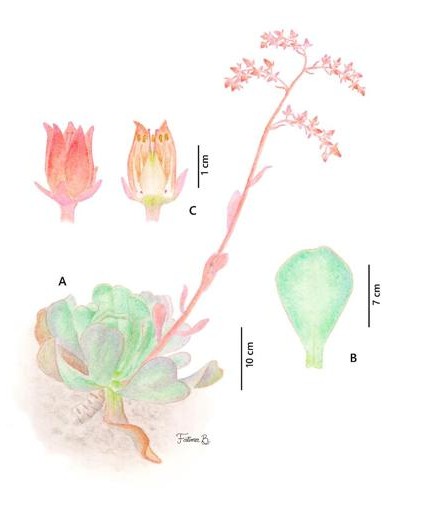
Figure 1: Echeveria jeivana Rosales, I.G. Olivares & Ortiz-Brunel. A. plant and inflorescence; B. leaf; C. flower detail: lateral view (left) and dissection (right). Illustrated by Fátima Bracamontes based on J. P. Ortiz-Brunel 2066 (IBUG).
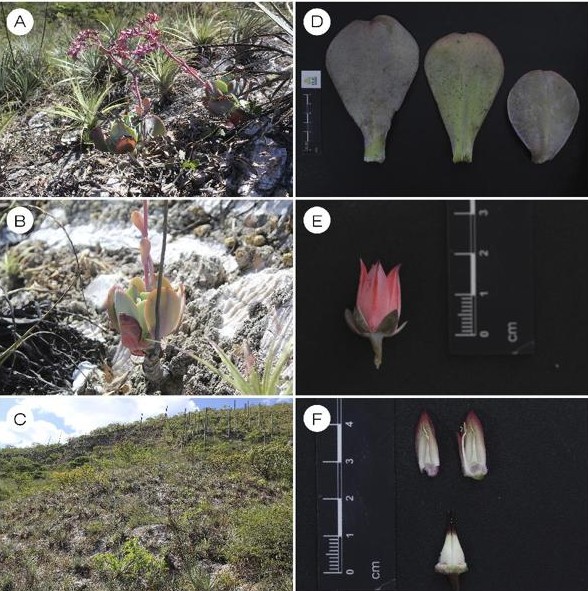
Figure 2: Echeveria jeivana Rosales, I.G. Olivares & Ortiz-Brunel. A-C. plant habit and habitat; D. leaves; E. lateral view of the flower; F. androecium and gynoecium detail. Photographs by Juan Pablo Ortiz Brunel.
TYPE: MEXICO. Guerrero: municipality Tlapa de Comonfort, afloramiento de yeso al norte de Tlapa de Comonfort, 1290 m, 26.X.2024, J. P. Ortiz-Brunel 2066 (holotype: IBUG!, isotype: MEXU!).
Echeveria jeivana is similar to E. grisea in the size of the leaves, height of the inflorescence and number of cincinni per inflorescence; however, E. jeivana differs from the latter in the obovate-oblanceolate leaves (vs. obovate-spathulate), straight and entire leaf margins (vs. undulate and sometimes crenulate), cincinni length of 9-18 cm (vs. 5-8 cm), 8-14 flowers per cincinnus (vs. 4-7), pedicel length of 6-12 mm (vs. 2-4 mm), corolla size of 16-21 × 11-13 mm (vs. 12-13 × 8-9 mm), and red nectaries with white base (vs. entirely pale yellow).
Succulent herbs, solitary, caulescent, glabrous; roots fibrous, enlarged when old; stems simple, 8-35 cm long, 1.5-2.5 cm wide, ascendant, horizontally wrinkled, with conspicuous scars of fallen leaves, gray to light brown-colored, glaucous towards the apex; rosettes terminal, 8-22 cm wide, compact; leaves 8-14 per rosette, 9-16 cm long, 7-10 cm in the widest part, glabrous, pruinose, pseudopetiolate, obovate-oblanceolate, cuneate towards the base, slightly obcordate at the apex, with an inconspicuous mucro, generally flattened, sometimes concave on the lower surface, slightly keeled, canaliculate towards the base, ascendent, imbricate, glaucous or slightly whitish, with orange tinges under abiotic stress, margins straight, entire, whitish, slightly hyaline; inflorescence a lateral panicle, 1 per season, 25-55 cm long, erect or obliquely ascending, peduncle 5-10 mm wide at the base, strong pink-colored, bracts 2-10 cm long, obovate to oblanceolate, cuneate towards the base, rounded at the apex, glaucous to pinkish, cincinni 3-5 per inflorescence, 9-18 cm long, straight or slightly pendulous, pink; flowers 8-14 per cincinnus, pedicels 6-12 mm long, up to 3 mm wide, linear, calyx not symmetrical, 13-17 mm diameter, discoid, sepals unequal, 3-8 mm long, 2-4 mm in the widest part, deltoid, acute to the apex, purple to dark purple in the outer face, purple to pink in the inner, pruinose, corolla 16-21 mm long, 11-13 mm diameter, tubular, oblongoid to ovoid, petals 16-21 mm long, 5-7 mm in the widest part, fused at the base, forming a short tube 2 mm long, widely oblong-lanceolate, shortly acuminate, keeled, concave in the inner part, strong pink-colored on the outer face, slightly red and whitish on the inner one, nectaries 2 mm wide, reniform, red colored in the upper part and white at the base, stamens 10, 5 epipetalous and 5 episepalous, filaments 10-12 mm long when episepalous, 6-8 mm long when epipetalous, linear, narrowing towards the apex, whitish, anthers 2 mm long, ovate, pink when immature, yellow to cream colored in anthesis, pistil 14-15 mm long, 6-7 mm wide at the base, pyriform, carpels 5, free, ovaries white, styles wine red or dark purple, greenish at the base, stigmas capitate, translucid yellow; follicles erect, brown; seeds inconspicuous, dark orange colored.
Distribution and ecology: Echeveria jeivana is a strict gypsophile. It is restricted to a small area of gypsum outcrops in the municipality of Tlapa de Comonfort in eastern Guerrero (Fig. 3). The vegetation corresponds to tropical deciduous forest, and it is similar to other tropical plant gypsicolous communities that occur in southern and western Mexico (Ortiz-Brunel et al., 2023b). The new species grows with Agave megalodonta García-Mend. & D. Sandoval (Asparagaceae), Begonia sp. (Begoniaceae), Cephalocereus mezcalaensis Bravo (Cactaceae), Dahlia sp. (Asteraceae), Euphorbia sp. (Euphorbiaceae), Hechtia sp. (Bromeliaceae), and Pseudosmodingium perniciosum (Kunth) Engl. (Anacardiaceae). Moreover, two observations uploaded to the iNaturalist platform (iNaturalist, 2020; 2023) might represent records of E. jeivana from western Oaxaca, as they show vegetative similarities and were also found growing on gypsum outcrops. However, flowering material with supporting collections is needed to confirm the identity of the plants from these populations.
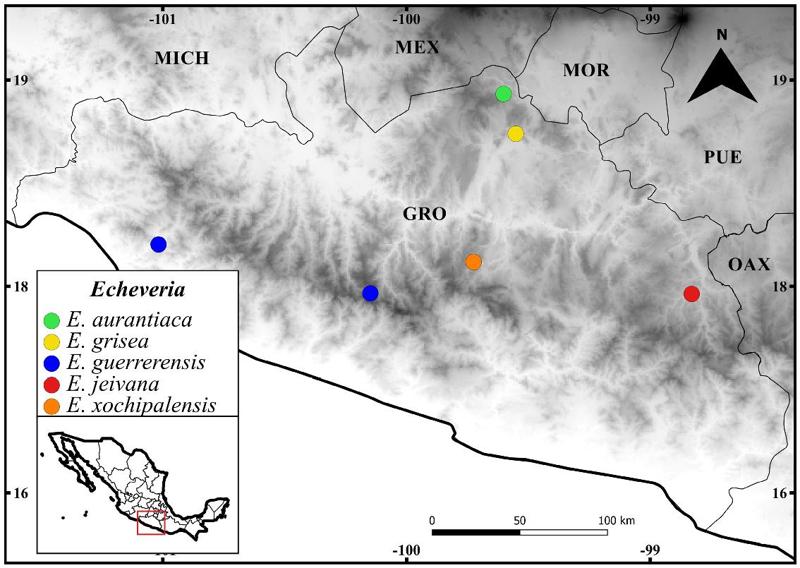
Figure 3: Distribution of Echeveria series Gibbiflorae: Echeveria aurantiaca J. Reyes, O. González & Brachet, E. grisea E. Walther, E. guerrerensis J. Reyes, O. González & Brachet, E. jeivana Rosales, I.G. Olivares & Ortiz-Brunel, and E. xochipalensis J. Reyes, L.E. Cruz-López & Verg.-Silva in the state of Guerrero, México.
Phenology: plants flower from late September to early December and fruit from November to February.
Etymology: the specific epithet honors Jeiv Leilani González Gálvez, daughter of Jesús Iván González Olivares, second author of this manuscript and discoverer of the species.
Preliminary conservation status: Although the gypsum outcrop where the plants occur is extensive, the new species has been only found in very small patches where the individuals are scarce. The estimated population is around 100 individuals, but more exploration is needed to confirm this. The calculated Area of Occupancy (AOO) was 4 km², while the Extent of Occurrence (EOO) was less than 10 km². Following the criteria B1ab(i,ii) + B2ab(i,ii) of the IUCN (2022), it is proposed that Echeveria jeivana should be classified as Critically Endangered (CR) due to its highly specific habitat and restricted distribution. In addition, changes in the use of the soil and vegetation loss were detected very close to the type locality during the explorations.
Additional specimens examined: MEXICO. Guerrero, municipality Tlapa de Comonfort, Cañada La Loma, al Noroeste de Tlapa de Comonfort, J. Reyes 8814 (MEXU).
Discussion
Echeveria jeivana belongs to the series Gibbiflorae, fitting well within the current morphological circumscription of this group (Kimnach, 2003). It also falls within its recorded geographic distribution, ranging from northwestern Mexico to Guatemala (Rosales-Martínez et al., 2024). This series is a monophyletic group that contains two main clades: one with species that occur in the northwestern portion of the country and another with taxa distributed in the southwestern (de la Cruz-López et al., 2019). In the aforementioned work, a sample labeled as Echeveria sp. JE-8814 corresponds to what here is proposed as E. jeivana, based on its locality of occurrence and same morphological characters (BOLD Systems, 2025). The new species was nested within the southwestern clade and is sister to a smaller clade whose internal relationships are not well resolved. This latter clade contains some morphologically unrelated species with E. jeivana, like E. triquiana J. Reyes & Brachet, E. crenulata Rose, and E. fulgens Lem., but also includes morphologically similar species such as E. grisea and E. gibbiflora.
The morphologically most similar species to Echeveria jeivana is E. grisea, sharing a similar leaf size, inflorescence height and number of cincinni per inflorescence, being both endemic to the state of Guerrero. Nevertheless, E. jeivana differs in having obovate-oblanceolate leaves with straight and entire margins, longer cincinni with a higher number of flowers, and longer pedicels and corollas (Table 1). The nectaries in E. jeivana are also distinctive, since they are red with a white base (vs. pale yellow nectaries in E. grisea). Likewise, E. gibbiflora is another morphologically similar species, but E. jeivana can be distinguished by its obovate to oblanceolate leaves, entire straight margins, lower number of cincinni, longer pedicels and corollas, and the previously mentioned red nectaries. Additionally, E. jeivana is the only species of the series Gibbiflorae documented on gypsum and one of just four Echeveria species in southern Mexico inhabiting these environments (Fig. 4).
Table 1: Morphological comparison between Echeveria jeivana Rosales, I.G. Olivares & Ortiz-Brunel and morphological similar species.
| Character | Echeveria jeivana Rosales, I.G. Olivares & Ortiz-Brunel | Echeveria grisea E. Walther | Echeveria gibbiflora DC. |
| Leaf shape | Obovate-oblanceolate | Obovate-spathulate | Broadly obovate-orbicular |
| Leaf color | Glaucous or slightly whitish, with orange tinges under abiotic stress | Glaucous green to grayish green, becoming purplish under abiotic stress | Glaucous green with tendency to show reddish coloration in the whole leaf |
| Leaf margin | Straight, entire | Undulate, sometimes crenulate | Undulate, sometimes crenulate |
| Peduncle color | Strong pink, sometimes glaucous | Glaucous green to grayish brown | Strong pink, sometimes glaucous |
| Number of cincinni | 3–5 | 3–5 | 6–18 |
| Cincinni length (cm) | 9–18 | 5–8 | 10–29 |
| Flowers per cincinnus | 8–14 | 4–7 | 5–18 |
| Pedicel length (mm) | 6–12 | 2–4 | 2–4 |
| Corolla size (mm) | 16–21 × 11–13 | 12–13 × 8–9 | 12–16 × 10–11 |
| Nectary color | Red at the upper portion, white at the base | Pale yellow | White |
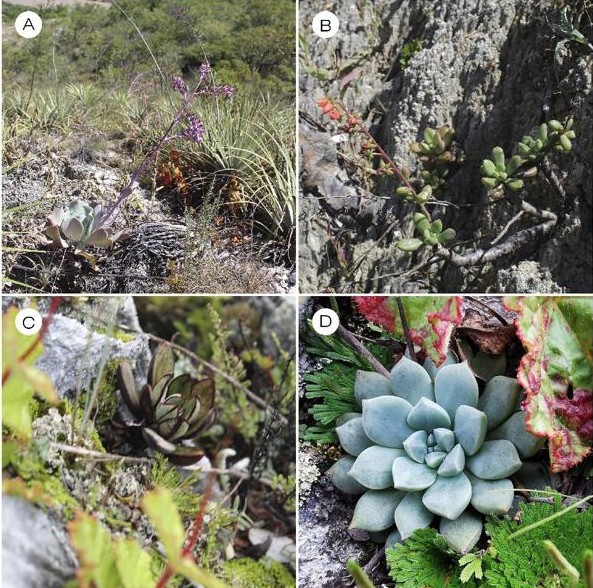
Figure 4: Echeveria species recorded growing on gypsum in southern Mexico. A. Echeveria jeivana Rosales, I.G. Olivares & Ortiz-Brunel; B. Echeveria macdougallii E. Walther; C. Echeveria nodulosa (Baker) Ed. Otto; D. Echeveria subcorymbosa Kimnach & Moran. Photographs by Juan Pablo Ortiz Brunel.
The discovery of Echeveria jeivana contributes to the knowledge about the gypsophilous plant diversity in southern Mexico. The recent description of several new species (e.g. Agave gypsicola García-Mend. & D. Sandoval, Dahlia gypsicola J. Reyes, Ortiz-Brunel & Art. Castro, Dalea verticillata Cruz Durán, D. Sandoval & García-Mend, Graptopetalum irmasoniae García-Mend., Pérez-Calix & D. Sandoval, Polystemma leopardum L.O. Alvarado, García-Mend., D. Sandoval & Lozada-Pérez, Tigridia gypsicola García-Mend. & D. Sandoval, and Zeltnera fonsecae Vigosa, D. Sandoval & D. Morales) highlights the importance of studying gypsum habitats, which usually host microendemic taxa. Interestingly, some gypsophiles that occur in tropical gypsum ecosystems tend to inhabit only a very small portion of the outcrop. This has been documented in species as Mixtecalia teitaensis Redonda-Mart., García-Mend. & D. Sandoval and Graptopetalum irmasoniae in southern Mexico, and in Pinguicula colimensis McVaugh & Mickel and Hunzikeria gypsophila Ortiz-Brunel & Díaz-Mart. in western Mexico (McVaugh and Mickel, 1963; García-Mendoza et al., 2020, 2023; Ortiz-Brunel et al., 2023a). Across Mexico, overall gypsum ecosystem plant diversity might be highest in the south, but the level of exploration of the sites is heterogeneous. For example, there are around 300 plant species documented for some gypsum outcrops in Oaxaca, while in some outcrops in the neighboring state of Guerrero only 30 species have been recorded (Ortiz-Brunel et al., 2023b). This suggests the need for further explorations, not only in gypsum-rich soils but also in the whole state of Guerrero to document its botanical diversity.
This contribution also increases the known diversity of the genus Echeveria in the state of Guerrero, now represented by eight species: E. aurantiaca, E. grisea, E. guerrerensis, E. islasiae J. Reyes & L.E. Cruz-López, E. jeivana, E. multicaulis Rose, E. waltheri Moran & J. Meyrán, and E. xochipalensis. All of them are endemic to the state except E. waltheri. Due to the irregular topography of the state of Guerrero as well as to the presence of several vegetation types where members of the Crassulaceae thrive, it is highly probable that future fieldwork will lead to the description of new taxa and the potential rediscovery of Echeveria longiflora E. Walther, presumably collected from Guerrero but not yet found in the wild (Walther, 1972).
The following is an identification key to the species of Echeveria series Gibbiflorae found in the state of Guerrero:
Identification key to the species of Echeveria series Gibbiflorae in Guerrero
1a. Stems inconspicuous; cincinni simple or bifurcated ……...……….……….………… 2
1b. Stems evident; panicles 3-branched or more ……….………………………………... 3
2a. Leaves pruinose; corolla urceolate; nectary scales white ……………………………… ……………………………………………... E. guerrerensis J. Reyes, O. González & Brachet
2b. Leaves not pruinose; corolla conic to cylindric; nectary scales yellow ……………….. ………………………………..……………... E. aurantiaca J. Reyes, O. González & Brachet
3a. Corolla more than 1.6 cm long; nectary scales red with white base …………………. …………………………………...………… E. jeivana Rosales, I.G. Olivares & Ortiz-Brunel
3b. Corolla less than 1.3 cm long; nectary scales white to pale yellow …………..……… 4
4a. Peduncle bracts oblong-obovate; cincinni 5-8 cm long ……...….. E. grisea E. Walther
4b. Peduncle bracts oblanceolate; cincinni 10-25 cm long ………………………………... ………………..………………….. E. xochipalensis J. Reyes, L.E. Cruz-López & Verg.-Silva

