




 nueva página del texto (beta)
 Español (pdf)
 Artículo en XML
 Referencias del artículo
 Traducción automática
 Enviar artículo por email
 Citado por SciELO
  Similares en
SciELO
Similares en
SciELO 
 Permalink

Introduction
Graffenrieda DC., a Neotropical genus of shrubs, trees and rarely woody climbers, is distributed from southern Mexico, Central America, and the West Indies to Andean South America (Venezuela south to Bolivia), east to the Guianas and Venezuelan tepuis, and south to southeastern Brazil, between sea level and 3200 m (Wurdack, 1973, 1980; Almeda, 2009; Mendoza-Cifuentes and Fernández-Alonso, 2010; Almeda et al., 2014). The genus is characterized by the small to medium sized white flowers (petals mostly 0.5-1.5 cm long), isomorphic anthers, anther connectives modified dorso-basally into small deflexed toothlike appendages, dorsally arcuate anthers with mostly ventrally inclined pores, capsular fruits and cuneiform, filiform, or linear-pyramidate seeds with straight embryos (Almeda, 1984; Mendoza-Cifuentes and Fernández-Alonso, 2011). Four extant species of Centronia D. Don, including the type species, share these characters, and have therefore been proposed for immersion in Graffenrieda (Mendoza-Cifuentes and Fernández-Alonso, 2011; Murillo-Serna et al., 2020; Michelangeli et al., 2022).
Graffenrieda is the second largest genus in the tribe Merianieae of the family Melastomataceae, with about 70 species, the majority of which are concentrated in two main regions of South America: the Andes and the Guiana highlands (Almeda et al., 2014; Murillo-Serna et al., 2019; Michelangeli et al., 2022). Venezuela and Colombia, with 30 and 25 species, respectively (Michelangeli and Cotton, 2008; Almeda et al., 2016), together host approximately 70% of the known species (44) and have a larger number of endemic species (17) than any other area of the Neotropics.
Recent expeditions in the department of Caquetá, Colombia, have allowed the discovery of a taxonomic novelty in Graffenrieda with calyptrate flowers. This article describes this new species, compares it with morphologically similar species, and suggests its conservation status. In addition, a key to all species of the genera Graffenrieda and Centronia with calyptrate flowers is provided.
Materials and Methods
The new species described here was discovered during recent collecting expeditions in 2021 in the Indi Wasi National Natural Park, municipality of Belén de Los Andaquíes, department of Caquetá, Colombia. Once the new species had been identified, a comparison was made between these collections and those of the herbarium COAH of the SINCHI Institute, in order to find possible specimens that could be assigned as paratypes.
For the descriptions, measurements of vegetative parts and inflorescences were made on dry herbarium material, using a digital caliper with an accuracy of 0.01 mm (Mitutoyo 500 series, Neuss, Germany). Measurements of the floral parts were based on fresh flowers preserved in 70% alcohol and collected from the same plant as the type specimen. Trichome types were identified according to the Atlas of Trichomes of Melastomataceae (Wurdack, 1986).
The conservation status of the newly described species was assessed by estimating its Area of Occupancy and Extent of Occurrence using the GeoCAT programme (Bachman and Moat, 2012) and applying the IUCN Red List criteria (IUCN, 2022). Finally, an identification key for the species of Graffenrieda and Centronia with calyptrate calyces is provided. For this purpose, we used the preliminary key presented by Goldenberg and Meirelles (2011) and consulted databases and monographs covering the entire range of Graffenrieda. These include Flora Mesoamericana (Almeda, 2009), Flora de Venezuela (Wurdack, 1973), Flora of Venezuelan Guayana (Berry et al., 2001), Flora of Ecuador (Wurdack, 1980), Flora of the Guianas (Wurdack et al., 1993), Catálogo de las Plantas Vasculares de Bolivia (Jørgensen et al., 2014), Catalogue of the Vascular Plants of Ecuador (Renner, 1999), The Catalogue of the Flowering Plants and Gymnosperms of Peru (Brako and Zarucchi, 1993), Flora of Brazil (Lima, 2020), and the database from Mendoza-Cifuentes and Fernández-Alonso (2010).
Results
Graffenrieda cardenasii Humberto Mend. & Edwin Trujillo, sp. nov. Figs. 1, 2.
TYPE: COLOMBIA. Caquetá, municipality of Belén de Los Andaquíes, Quisayá village, farm Buenavista, three hours walking from the farm to PNN Indi Wasi, 800 m, 1°36'11.6''N, 75°58'22.9''W, 5.X.2021, fl, H. Mendoza et al. 23040 (holotype: JBB!; isotypes: COAH!, COL!).
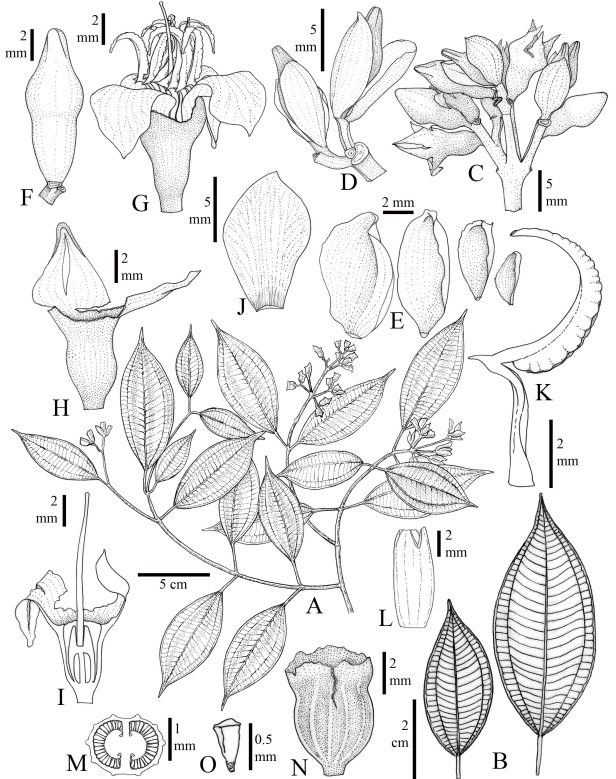
Figure 1: Graffenrieda cardenasii Humberto Mend. & Edwin Trujillo. A. flowering branch; B. leaves of the same node; C. inflorescence apex; D. flower buds with bracteoles; E. bracteoles and size variation; F. flower bud; G. flower in lateral view; H. hypanthium-calyx after anthesis; I. longitudinal section of the hypanthium and pistil; J. petal; K. stamen in lateral view; L. ovary in lateral view; M. horizontal section of the ovary; N. capsule; O. seed. Illustration by H. Mendoza.
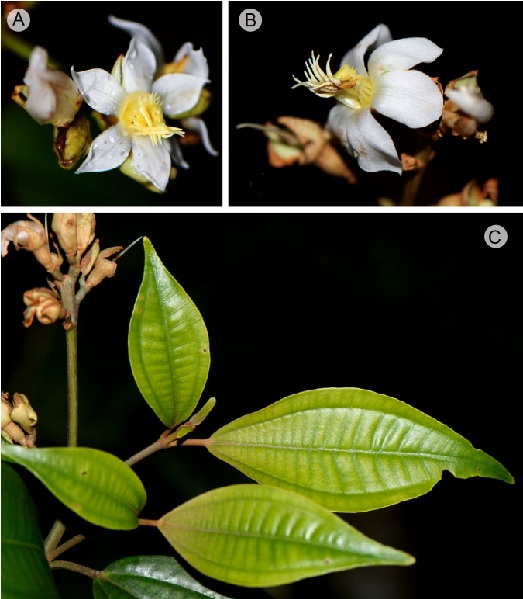
Figure 2: Graffenrieda cardenasii Humberto Mend. & Edwin Trujillo. A. open flowers in front view; B. open flower in lateral view; C. flowering branch. All photos by Alejandro Zuluaga.
Graffenrieda cardenasii is recognized by the dense indument of irregular lepidote trichomes on internodes, petioles and inflorescence, incomplete lateral anisophylly, leafy bracteoles as large as flower buds, flowers 5-merous, calyx calyptrate and opening irregularly, and ovary 2-locular. It is morphologically similar to G. moaensis Wurdack, but the latter has 6-merous, smaller flowers with a 3-locular ovary. It also resembles G. penneysii Michelang. & C. Ulloa, but the latter is characterized by inflorescences without leafy bracteoles and 4-merous flowers with a 3-locular ovary.
Small trees, 4-6 m tall; young branches, petioles and inflorescence with dense light brown indumentum, irregular lepidote trichomes (type 36 of Wurdack, 1986); internodes 0.7-3.7 cm long, 1.6-2.5 mm wide, the uppermost quadrangular becoming terete with age; leaves opposite, isophyllous on central branches, but tending to be slightly anisophyllous on young lateral branches (incomplete lateral anisophylly according to Cremers (1995) and Muehlbert et al. (2010)); petiole 0.9-5.4 cm long, canaliculate; leaf blade 4.5-12.4 × 2.3-5 cm, elliptic to ovate-elliptic, apex acuminate, base obtuse, margin entire, adaxial surface glabrous, abaxial surface with sparse indument of minute glandular trichomes (type 4) and dense indument of lepidote trichomes (type 36) over veins; venation with the primary vein flat on the adaxial surface, prominent on the abaxial surface, with one pair of secondary veins, nerved, impressed on the adaxial surface and prominent on the abaxial surface; tertiary veins (transversals) 26-28, impressed on the adaxial surface, flat to slightly prominent on the abaxial surface; inflorescences 4-10 cm long, terminal, paniculate, with 15-40 flowers, peduncle 0.8-3.5 cm long, central axis with 4-5 branching nodes, basal paracladia 2-5 cm long, with 2-3 branching levels, apices ending in 3 flowers; bracts similar to small leaves; bracteoles 3.5-8.7 × 1.5-7.7 mm, almost entirely covering the flower buds, oblong to obovate, concave, early caducous, with the indumentum similar to the one on the internodes; flowers ca. 12 mm long, 5-merous, diplostemonous, sessile or subsessile; pedicels 0.6-1.2 mm long; hypanthium 3.9-4.3 × 2.7-2.9 mm, subcylindrical to narrowly campanulate, externally with dense light brown indumentum of irregular lepidote trichomes (type 36); calyx calyptrate, externally with dense light brown indumentum of irregular lepidote trichomes (type 36), calyptra ca. 6.4 mm long, opening through irregular lobes and then shedding completely, relictual tube 1.2-1.6 mm long, outer teeth absent; corolla rotate, with the petals erect, subsequently reflexed, petals 10-11 × 5.4-6 mm, obovate, apically rounded to obtuse, white, entire, glabrous; stamens isomorphic, zygomorphically arranged on one side of the flower; filament 3.6-4 mm long, 0.9-1 mm wide at the base, yellow; anther 4-4.5 mm long, subulate, dorsally arcuate, cream-colored, solitary pore 0.14-0.16 mm wide and ventrally inclined; basal connective (elbow) 0.45-0.63 mm long, subulate; pedoconnective 0.24-0.4 mm long; ovary 3.8-4 × 1.5-1.7 mm, 2-locular, totally free, oblong, minutely ribbed; apex 1.4-1.5 mm long, with 4 truncate lobes; placentas with ovules only on the dorsal surface; style 9-10.5 mm long, ca. 0.4 mm diameter, linear, straight, glabrous; stigma 0.25-0.38 mm diameter, punctiform; mature capsules with the enveloping hypanthium ca. 4 × 6 mm, globose-urceolate; bluntly costate; seeds ca 0.5 × 0.3 mm, pyramidal, brown, chalazal end flattened horizontally, antiraphal symmetrical plane angulate, testa smooth.
Etymology: the name of this new species honors the botanist Dairon Cárdenas López (1957-2022), a great connoisseur of the Amazonian flora and an unsurpassed friend. His work as a botanist resulted in more than 50,000 plant collections, mainly from the Colombian Amazon, being deposited in the herbarium COAH.
Habitat and distribution: Graffenrieda cardenasii is endemic to Colombia in the south of the “Cordillera Oriental”, towards the Amazonian flank. This species is known only from the municipality of Belén de Los Andaquíes, in the department of Caquetá, close to the Indi Wasi National Natural Park, between 330 and 970 m elevation (Fig. 3). It grows in tropical rainforest vegetation associated with the foothills of the Cordillera Oriental and all specimens have been found in the interior of well-preserved forests.
Phenology: collected with flowers in March, July, September and October; with fruits in February and October.
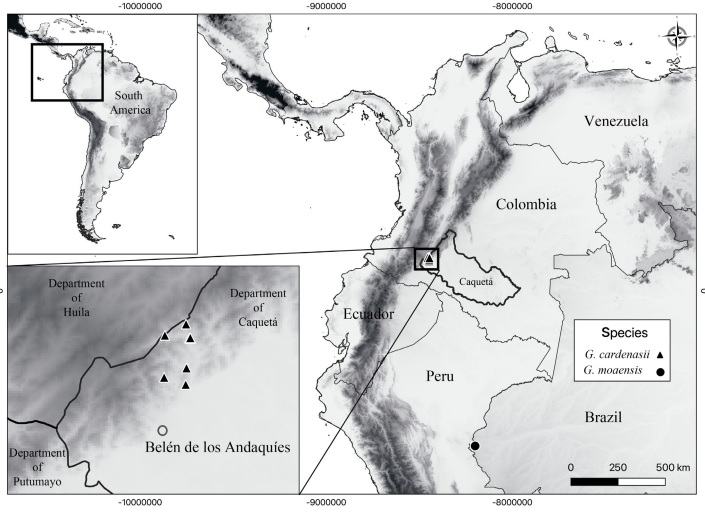
Figure 3: Distribution of Graffenrieda cardenasii Humberto Mend. & Edwin Trujillo and the most similar species (G. moaensis Wurdack) in northern South America.
Conservation status: we propose the category “Endangered” (EN). This species is known only from one population in a small area. The forests in this region are fragmented and in a constant process of degradation due to the clearing for cattle grazing areas. The conservation status of this taxon meets the IUCN (2022) criteria B1a(i, ii) + B2a(ii, iii), based on an Extent of Occurrence (EOO) of 108.5 km2, an Area of Occupancy (AOO) of 28 km2, the fragmentation of its habitat and the deterioration of habitat quality.
Specimens examined: COLOMBIA. Caquetá, municipality of Belén de Los Andaquíes, Alto Sarabando, Indi Wasi National Natural Park, 725 m, 1°27'39''N, 75°57'13.2''W, 1.I.2008, fr, A. González 12 (COAH); sidewalk La Cristalina, upper Sarabando river basin, 600 m, 1°26'36.37''N, 75°53'33.65''W, 3.III.2024, fr, H. Mendoza et al. 2333 (JBB); loc. cit., 1°26'38.66''N, 75°53'34.71''W, 7.III.2024, fr, H. Mendoza et al. 23531 (JBB); Andaquí Municipal Natural Park, La Mina sector, Las Verdes stream, forest between 800-900 m, 1°38'18.4''N, 75°54'14.6''W, 2.II.2017, fr, N. Castaño-A. et al. 9396 (COAH); Andaquí trail, south of the junction between the Andaquí trail and Las Verdes stream, 1°37'17.7''N, 75°53'55.6''W, 16.III.2016, fl, N. Castaño-A. et al. 7891 (COAH); between the Los Ángeles and the Las Verdes villages, 550 m, 1°35'25.02''N, 75°51'54.74''W, 3.X.2021, fl, H. Mendoza et al. 23034 (JBB); Los Ángeles village, road Los Ángeles - Las Verdes, 550-750 m, 1°35'28''N, 75°52'08.7''W, 28.VII.2011, fl, D. Cárdenas et al. 42267 (COAH); La Resaca Forest Park, 332 m, 1°26'12''N, 75°52'54''W, 25.X.2010, fr, D. Cárdenas et al. 40723 (COAH); La Resaca Forest Park, La Resaca stream, 379 m, 1°26'13.1''N, 75°52'53.3''W, 19.IX.2013, fl, W. Trujillo 2947 (COAH); Quisayá village, farm Buenavista, three hours walking from the farm to Indi Wasi National Natural Park, 800 m, 1°36'11.6''N, 75°58'22.9''W, 5.X.2021, fl, H. Mendoza et al. 23041 (JBB); Pescado river basin, Quisayá village, Buena Vista farm, Indi Wasi National Natural Park, 967 m, 1°34'51.6''N, 75°56'54.0''W, 13.III.2012, fr, D. Cárdenas et al. 42644 (COAH).
Discussion
Graffenrieda cardenasii is recognized by the dense indument of irregular lepidote trichomes on vegetative parts, incomplete lateral anisophylly, leafy bracteoles as large as flower buds, flowers 5-merous, calyptrate calyx and ovary 2-locular. The most similar species is G. moaensis from Brazil (Wurdack, 1972), which shares the indumentum, leaf shape and size, short inflorescences and leaf bracteoles as large as the flower buds. However, the latter has notable differences in the size and character of the flowers, as it has 6-merous flowers (vs. 5-merous in G. cardenasii), hypanthium of 3 mm long (vs. 3.9-4.3 mm), petals 5.3 mm long (vs. 10-11 mm), ovary 3-locular (vs. 2-locular), and style 4.5 mm long (vs. 9-10.5 mm). Another vegetatively similar species growing in Ecuador is G. penneysii (Michelangeli and Ulloa Ulloa, 2013), but the latter has abundant sessile glandular trichomes mainly on the inflorescence and hypanthium-calyx (vs. indument of irregular lepidote trichomes in G. cardenasii), the flowers 4-merous (vs. 5-merous) and the ovary 3-locular (vs. 2-locular).
One of the most important characters of G. cardenasii is the calyptrate flowers, i.e., the calyx is closed at the bud stage and before anthesis, so that the imbricate petals are not visible (Mendoza-Cifuentes and Fernández-Alonso, 2010). In Graffenrieda, 43% of the species (about 30) have calyptrate flowers. At anthesis, the calyx can open or shed in two ways: either detaching circumscissily or opening through regular or irregular in lobes. The first is shared by about 12 species in the genus, while the second is shared by 18 species, including G. cardenasii.
The following key, based on that proposed by Goldenberg and Meirelles (2011) for circumscissile calyptrate species, distinguishes species of Graffenrieda with calyptrate flowers. In addition, four calyptrate species of Centronia that should be transferred to Graffenrieda (Mendoza-Cifuentes and Fernández-Alonso, 2011; Murillo-Serna et al., 2020) were also included here.
Key for species of Graffenrieda and Centronia with calyptrate flowers
1a. Calyx circumscissile; calyptra thin-membranaceous, externally differing in color or texture from the hypanthium .............. 2 (based on Goldenberg and Meirelles, 2011)
1b. Calyx opening in regular or irregular in lobes, not circumscissile; calyptra papyraceous and externally similar to the hypanthium …………………………..………........ 14
2a. Lianas (Biogeographic Chocó: Colombia, Ecuador) …..….........................……… G. scandens (Gleason) Wurdack
2b. Subshrubs, shrubs or trees ………………………………........ 3
3a. Hypanthium externally with ribs with serrate margin (Biogeographic Chocó: Colombia, Ecuador) ...………..................………………….. G. scandens (Gleason) Wurdack
3b. Hypanthium externally terete, if ribs are present, they are rounded and slightly protruding …….................… 4
4a. Leaves abaxially with barbate nerve bases; anther connective appendages with glandular trichomes and/or with lacerate margins ………….…………………….............. 5
4b. Leaves abaxially without barbate nerve bases; anther connective appendages glabrous and with entire margins …………………………………………………..………….……….. 6
5a. Leaves 3-nerved; pedicels 2.5-4 mm long; hypanthium 1.5-2 mm long; calyptra ca. 3 mm long; connective appendages 0.05-0.1 mm long, with entire margins and completely covered with glandular trichomes (Amazonia: Northwestern Brazil) …...............................................................…. G. glandulosa R. Goldenb. & Meirelles
5b. Leaves 5-nerved; pedicels 1-1.5 mm long; hypanthium 2-2.5 mm long; calyptra ca. 5 mm long; connective appendages 0.7-1 mm long, with lacerate margins and with glandular trichomes only at their base (Guiana Shield: Venezuela) ……………..… G. tricalcarata Gleason
6a. Flowers 4-merous ……………….………................…………… 7
6b. Flowers 5-6(-8)-merous ……………….………....…………….. 10
7a. Leaves abaxially with lepidote trichomes (Andes: Peru) ….................................. G. tristis (Triana) L.O. Williams
7b. Leaves abaxially glabrous or with stellate or elongated moderately roughened and ferruginous trichomes … 8
8a. Branches, leaves on abaxial surface, inflorescences and hypanthium with semi-dense indumentum of elongated moderately roughened and ferruginous trichomes; leaf base rounded, apex obtuse; flowers sessile (Andes: Ecuador, Peru) ................................................................................... G. robusta (Cogn.) L.O. Williams
8b. Branches, leaves on abaxial surface, inflorescences and hypanthium glabrous or with scattered stellate trichomes; leaf base acute to obtuse, apex acute to acuminate; flowers regularly pedicellate (if sessile, hypanthium-calyx glabrous) …………………………………… 9
9a. Leaves with one pair of nerved secondary veins; leaf blade narrow-elliptic; flowers conspicuously pedicellate; calyx with triangular dorsal teeth; anthers cream-colored or white (Mesoamerica, Andes, Amazonia: Costa Rica, Panama, Colombia, Ecuador, Peru, Bolivia, Brazil) ........................................ G. gracilis (Triana) L.O. Williams
9b. Leaves with two pairs of plinerved secondary veins; leaf blade broadly elliptic; flowers sessile or subsessile; calyx without dorsal teeth; anthers yellow (Andes: Colombia, Ecuador) ………………… G. colombiana Gleason
10a. Leaf base with two revolute auricles; ovary 2-3-celled; calyptra 2-3.8 mm long (Mesoamerica, Andes: Costa Rica, Panama, Colombia) ……………..................….…… 11
10b. Leaf base without revolute auricles; ovary predominantly 4-6-celled; calyptra 3.5-7 mm long .............… 13
11a. Petioles 0.5-1.6 cm long; leaf blade 4.7-8 × 2.1-4 cm, 3-nerved (Mesoamerica: Panama) …………………………..…...........................................………….… G. bella Almeda
11b. Petioles 2-6 cm long; leaf blade 7.5-20 × 4.5-9 cm, 3-5-nerved ……………………..........................………….... 12
12a. Leaf base acute; hypanthium ca. 1.25 mm long; ovary apex without a lobulate collar (Mesoamerica, Andes: Costa Rica, Panama, Colombia) …………….........….............…..…. G. micrantha (Gleason) L.O. Williams
12b. Leaf base obtuse; hypanthium 2-2.5 mm long; ovary apex with a lobulate collar (Mesoamerica: Panama) ….....…. G. jefensis Almeda, Alvear & Humberto Mend.
13a. Nodes with interpetiolar lines; calyptra 5-7 mm long (Mesoamerica, Andes: Panama, Colombia, Ecuador, Peru, Bolivia) ………… G. cucullata (Triana) L.O. Williams
13b. Nodes without interpetiolar lines; calyptra 3.5-4 mm long (Mesoamerica, Andes: Mexico to Panama, Colombia, Ecuador) … G. galeottii (Naudin) L.O. Williams
14a. Lianas or climbing plants .........................…………….. 15
14b. Subshrub, shrub or trees …….…………………...………..… 16
15a. Flowers 4-merous; ovary 2-locular, apex with triangular appendages; inflorescence short, not or slightly branched, regularly axillary (Biogeographic Chocó: Colombia, Ecuador) ……………………….. G. anomala Triana
15b. Flowers 5-merous; ovary 3-locular, apex rounded; inflorescence long and branched, terminal (Orinoquia, Guiana Shield, Amazonia: Colombia, Brazil, Venezuela) …………..........................................……. G. patens Triana
16a. Uninerved leaf (secondary veins are not visible); petals pink …………………………….….................................……. 17
16b. Leaves with 1-2 pairs of visible secondary veins; petals white or cream-colored …………..............………………. 18
17a. Inflorescences unbranched, with glomerular points along axis; bracteoles absent; flowers sessile; hypanthium smooth, with sericeous adpressed indument; ovary 2-locular, with triangular teeth at apex (Guiana Shield: Venezuela) …. G. pedunculata Gleason
17b. Inflorescences branched, with distinct paracladia; bracteoles present, as long as or longer than flower buds, deciduous; flowers short-pedicellate; hypanthium slightly ribbed, with dense indumentum of short dendritic and ferruginous trichomes; ovary 3-locular, with rounded teeth at apex (Guiana Shield: Venezuela) ........................................................ G. versicolor Gleason
18a. Leaves with two pairs of secondary veins accompanying the middle vein (submarginal veins that do not reach the apex are not considered) ……………………… 19
18b. Leaves with one pair of secondary veins accompanying the middle vein …………………………………………………... 23
19a. Leaf blade ovate, <5 cm long; petiole <1 cm long; bracteoles triangular-linear (Guiana Shield: Venezuela) …………………………..................................... G. rufa Wurdack
19b. Leaf blade suborbicular, elliptic to broadly ovate, >10 cm long; petioles ≥3 cm long; bracteoles absent …… 20
20a. Leaves with cordate base (nerved); dense ferruginous indumentum on branches and petiole (Mesoamerica: Guatemala, Nicaragua) …………....…… G. gentlei Lundell
20b. Leaves with truncate, rounded, obtuse or acute base (plinerved or nerved); without dense ferruginous indumentum, scattered if present (Andes, Amazonia: Colombia, Venezuela, Guianas, Brazil, Ecuador, Peru) ……………..……………………...................................……… 21
21a. Flowers 5-merous (eastern foothills of the Andes, Amazonia: Colombia, Venezuela, Guianas, Brazil, Ecuador, Peru) ……….…........………………….... G. intermedia Triana
21b. Flowers 4-merous ………………………...…………………….. 22
22a. Leaves broadly ovate, plinerved conspicuously 5-10 mm above leaf; hypanthium slightly ribbed; anthers yellow (Andes foothills: Colombia, Ecuador) ………...……...................................…..…… G. colombiana Gleason
22b. Leaves elliptic, nerved; hypanthium smooth; anthers white (Mesoamerica, Andes, Amazonia: Costa Rica, Panama, Colombia, Ecuador, Peru, Bolivia, Brazil) …….......................…... G. gracilis (Triana) L.O. Williams
23a. Leaves nerved ………..………………….....................……… 24
23b. Leaves plinerved …………………………………….……….…… 37
24a. Hypanthium and calyx (calyptra) with dense indument of elongated (subulate) trichomes with curly walls (type 17 of Wurdack, 1986) ………………………………….. 25
24b. Hypanthium and calyx glabrous or with arachnoid, lepidote or pruinose adpressed trichomes (not erect elongated trichomes) ….………………………………………. 27
25a. Leaf blade oblong-elliptic, >11 cm wide, base slightly cordate; petioles >4 cm long (Guiana Shield: Colombia, Brazil, Venezuela) ….……………… G. rupestris Ducke
25b. Leaf blade elliptic to ovate-elliptic, <10 cm wide, base rounded to obtuse; petioles <3 cm long ................. 26
26a. Petioles 1-5-2 cm long; leaves predominantly ovate-elliptic; calyptra apiculate; petals ca. 20 mm long; ovary apex below torus level; ovary 6-locular (Guiana Shield: Colombia) ……… Centronia vaupesana Wurdack
26b. Petioles 2.5-3 cm long; leaves predominantly elliptic; calyptra obtuse; petals 6-7 mm long; ovary apex at torus level; ovary 5-locular (Amazonia: Peru) ……..………......................................….... Centronia reticulata Triana
27a. Flower buds supported by laminar bracteoles as large as the flowers ….…….......................................…….… 28
27b. Flower buds without bracteoles ………………………..... 29
28a. Flowers 5-merous; petals 10-11 mm long; ovary 2-locular; style 9-10.5 mm long (Amazonian foothills of the Andes: Colombia) ………..….....................................……..... G. cardenasii Humberto Mend. & Edwin Trujillo
28b. Flowers 6-merous; petals 5-6 mm long; ovary 3-locular; style 4-5 mm long (Amazonia: Northwestern Brazil) ……………………………………………… G. moaensis Wurdack
29a. Ratio of distances A (between the midvein and the first secondary vein) and B (the distance between the first secondary vein and the margin) in the middle part of the blade between 1.5 and 2.6 (leaf blade elliptic); flowers 4-merous ………………………………...……........... 30
29b. Ratio A/B between 4 and 17 (leaf blade ovate, oblong to oblong-elliptic); flowers 4-5-merous …................. 31
30a. Leaf blade membranaceous, apex acuminate, scattered indument of hyaline glandular trichomes abaxially (visible as dots); calyptra apiculate (Mesoamerica, Andes, Amazonia: Costa Rica, Panama, Colombia, Ecuador, Peru, Bolivia, Brazil) …………….................................................................… G. gracilis (Triana) L.O. Williams
30b. Leaf blade chartaceous, glabrous, apex obtuse; calyptra obtuse (Guiana Shield: Venezuela ................................................................….. G. reticulata Wurdack
31a. Leaves abaxially with sericeous appressed indument, tertiary veins not very evident; flowers 4-merous (Guiana Shield: Colombia, Guyana, Venezuela) …………………....................................… G. caryophyllea Triana
31b. Leaves abaxially glabrous, tertiary veins protruding; flowers 5-6-merous ………….................................…… 32
32a. Leaves ovate or oblong to suborbicular, apex rounded to obtuse ………..………...........................………………... 33
32b. Leaves elliptic, apex acute to acuminate ……………… 36
33a. Ratio of distances A (between the midvein and the first secondary vein) and B (the distance between the first secondary vein and the margin) in the middle part of the blade between 13 and 17; inflorescence and hypanthium-calyx with dense indumentum with short dendritic and ferruginous trichomes; inflorescence regularly erect; flower buds calyptrate to subcalyptrate …………..…………….................................................…… 34
33b. A/B ratio between 1.8-5; inflorescence and calyx glabrescent; inflorescence pendulous; flower buds subcalyptrate …………………………………….......................... 35
34a. Leaf blade >25 cm long and >15 cm wide; apex rounded to obtuse (Biogeographic Chocó, Magdalena Medio: Colombia) …………………...... G. grandifolia Gleason
34b. Leaf blade <19 cm long and <10 cm wide; apex acute or slightly acuminate (eastern foothills of the Andes, Amazonia: Colombia, Ecuador, Bolivia, Brazil, Peru) ………… G. limbata Triana (includes G. boliviensis Cogn.)
35a. Leaf base cordate; ovary apex with subulate lobes (foothills Andes: Colombia, department of Caquetá and Putumayo) ........ G. sp. nov. (in process of description)
35b. Leaf base rounded; ovary apex with truncate lobes (Andes: Colombia, Venezuela) ……………………………………………………………………....……. G. conostegioides Triana
36a. Hypanthium-calyx glabrescent; calyptra acute; ovary apex with rounded teeth (Guiana Shield: Venezuela) …………………………..……….. Centronia neblinae Wurdack
36b. Hypanthium-calyx with semidense indument of short dendritic and ferruginous trichomes; calyptra obtuse (sometimes subcalyptrate); ovary apex with subulate teeth (eastern foothills of the Andes, Amazonia: Colombia, Ecuador, Bolivia, Brazil, Peru) ………………….........……… G. limbata Triana (includes G. boliviensis Cogn.)
37a. Ratio of distances A (between the midvein and the first secondary vein) and B (the distance between the first secondary vein and the margin) in the middle part of the blade between 1.5 and 2.5; distance between the inter-secondary veins adjacent to the midvein in the middle part of the blade 2-3 mm; flowers 4-merous; plants with indumentum white (early caducous) or spherical glandular trichomes .............…………………. 38
37b. A/B ratio between 6 and 18; distance between the inter-secondary veins adjacent to the midvein in the middle part of the blade 4-26 mm; flowers 5-merous; plants glabrous or with marroon or reddish brown indumentum ………………………………………...………………………….. 39
38a. Leaf blade moderately lepidote abaxially, with an indumentum of brownish trichomes, base not revolute; hypanthium-calyx pulverulent with an indumentum of white trichomes; calyptra obtuse; linear bracteoles (Amazonia: Brazil, Peru) ….……..............….……. G. goldenbergii L.F. Lima, Baumgratz, Nic Lugh. & J.U. Santos
38b. Leaf blade with indumentum of minute, sessile, spherical glandular trichomes, revolute base; hypanthium-calyx with indumentum of spherical glandular trichomes; calyptra acute; without bracteoles (Andes: Ecuador) ………….... G. penneysii Michelang. & C. Ulloa
39a. Hypanthium-calyx with dense indumentum of long subulate barbellate trichomes (Andes: Colombia, Ecuador, Peru) …..………………….. Centronia laurifolia D. Don
39b. Hypanthium-calyx regularly glabrescent or with a scattered indumentum of short dendritic and ferruginous trichomes ….………………………………………………………… 40
40a. Leaf blade suborbicular to oblong, 15-30 cm wide; inflorescence highly branched, more than 20 cm long; hypanthium-calyx with dense indumentum of short dendritic and ferruginous trichomes (Biogeographic Chocó, Magdalena Medio: Colombia) …….………...............................................…………. G. grandifolia Gleason
40b. Leaf blade elliptic, ovate or lanceolate, 2.5-16 cm wide; inflorescence sparsely branched, 8.5-15 cm long; hypanthium-calyx glabrescent or with sparse indumentum of short dendritic and ferruginous trichomes (Guiana Shield: Brazil, Venezuela) ………..………… 41
41a. Petioles 35-80 mm long; leaf blade 15-40 × 6-16 cm, elliptic; calyptra acute, ovary 5-6-locular (Guiana Shield: Venezuela, Cerro La Neblina) ………………….....................................……... Centronia neblinae Wurdack
41b. Petioles 6.5-11 mm long; leaf blade 6.5-11 × 2.5-4 cm, ovate to lanceolate; calyptra obtuse; ovary 3-locular (Guiana Shield: Brazil, Serra Aracá; Venezuela, Sierra de Unturán) … G. laevicarpa Michelang. & R. Goldenb.

