




 nueva página del texto (beta)
 Inglés (pdf)
 Artículo en XML
 Referencias del artículo
 Traducción automática
 Enviar artículo por email
 Citado por SciELO
  Similares en
SciELO
Similares en
SciELO 
 Permalink
1. Introduction
The interaction between the atmosphere and the ocean influences climate variability; therefore, the links between ocean sea surface temperature (SST) and atmospheric changes are studied for climate monitoring or use as potential hydro-climatic predictors.
The variability of atmospheric circulation is considered to be an important factor in determining changes in the spatial distribution of climatological elements (Halpert and Ropelewski, 1992). The investigation of global climatological patterns, such as the Atlantic Multidecadal Oscillation (AMO) and El Niño-Southern Oscillation (ENSO), may help explain climate variability. Thus, many studies have shown that the ENSO phenomenon is the dominant source of interannual climate variability over a large area of the globe and has a clear influence on the climate of the Middle East region. The atmospheric circulation changes that link to ENSO were indicated to generate changes in the Indian Ocean SST through changes in cloud cover and evaporation, due to the effects of the Walker circulation and its effect over East Asia. However, it has been investigated that ENSO can influence the variability of the Indian Ocean (Cullen et al., 2002).
The large and regional daily temperature variability in the Arab Gulf is studied through the Empirical Orthogonal Function (EOF) analysis from 1979 to 2019. The results identified three modes that could influence the temperature over the represented region (North Atlantic Oscillation [NAO], AMO, and ENSO) (Al Senafi et al., 2024). The ENSO influence on western European temperatures is non-stationary and intermittent, with other modes also affecting this region (Martija-Díez et al., 2021). Additionally, the Eastern Pacific, like ENSO, has a significant impact on European summer rainfall, creating a dipole-like pattern with El Niño bringing wetter conditions to southern Europe and drier conditions to the north (Martija-Díez et al., 2022). ENSO also influences the stream flow in Turkey and causes anomalies in the eastern Arab region (Marti et al., 2010; Donat et al., 2014). Abid et al. (2018) found a strong correlation between El Niño and rainfall in the Arabian Peninsula from 1981 to 2015.
Previous studies on Iraq’s climate have demonstrated strong links with the AMO and ENSO, particularly during winter (Al-Khalidi et al., 2018). Bahrami et al. (2020) found that autumn precipitation in Iran is more closely correlated with La Niña than El Niño. The relationship between temperature and the Southern Oscillation Index (SOI) was weak between 1900 and 2008 (Al-Zuhairi et al., 2013). In Kurdistan, Iraq, the Sulaymaniyah station exhibited a strong correlation between temperature and precipitation from 2008 to 2018 (Palani, 2020). Mutalib et. al. (2020) found that the Indian Ocean Dipole (IOD) and ENSO modes negatively correlate with the Arabian Sea. Drought variability studies (1951-2020) showed weaker correlations in the southern Arabian Peninsula compared to the northern region (Saharwardi et al., 2023).
For the North Atlantic SST, AMO modes are a dominant large-scale pattern of multi-decadal variability (Li et al., 2008). Atlantic Ocean observations and models play a crucial role in the summer Middle East surface air temperature (ME-SAT) multidecadal variability. Over the Middle East area, the positive AMO can help improve summer warming (Ehsan et al., 2020). The spatial and temporal correlation between summer temperatures in the Middle East and the AMO confirmed the decadal trend’s role in SST and its influence on the increasing temperature in the Indian Ocean, which impacts the temperature during summertime in the region (Alawad et al., 2023). Ratna et al. (2020) studied the summer Asian climate response to the AMO mode using an intermediate-complexity general circulation model. The positive phase of AMO is related to the dry season over China and Japan, whereas the negative phase is characterized by precipitation anomalies.
This paper analyzes the spatial and temporal variability of summer and autumn temperatures in Iraq, employing EOF and Principal Components (PCs) analysis, and examines their relations with global SST. The data used were obtained from eight meteorological stations for summer and autumn temperatures, covering the entire area of Iraq.
2. Iraq’s geographical characteristics and climate
Iraq is located in southwestern Asia. Its area spans between 29º5’ and 37º22’ N, and 38º45’ to 48º45’ E (Fig. 1) (Muslih, 2014). Iraq’s climate is significantly influenced by its geographical location, characterized as a continental and subtropical semi-arid region. During the summer, a strong anticyclone is observed in the Azores, which helps to control the circulation over the Iraq region (Kostopoulou and Jones, 2007). According to the Köppen climate classification, Iraq is divided into three distinct climatic regions. In the northern area, the Mediterranean climate regime is found; the upland region (located to the south of the first region) has a subtropical steppe climate, and the central and southern areas of Iraq have a subtropical desert climate (Pannel, 2002).
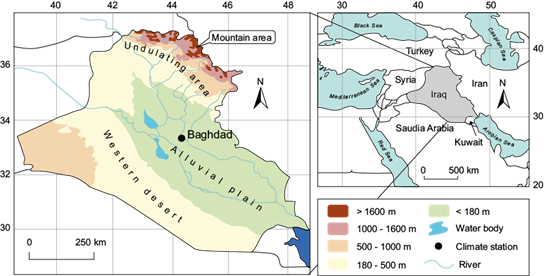
In general, Iraq’s climate is characterized by dry, hot summers. The mean maximum temperature exceeds 48 ºC during the summertime and the beginning of autumn, mainly in the southern and central areas. The winter is cool to cold, with the mean minimum temperature decreasing to near freezing (Walker, 2005).
3. Data and methods
The summer and autumn mean temperature data series used in this study were provided by the Iraqi Meteorological Organization and Seismology. The time series comprises monthly temperatures (ºC) recorded at eight stations across Iraq’s surface for the period 1971-2010, which was used to identify the relationship with ENSO interannual SST modes. The long period (1900-2010) of Iraq’s monthly temperature is used to calculate the correlation coefficient of Iraq’s temperature with a long time series of the AMO index (the AMO has an observation period of 65-80 years). The monthly time series of global SST for the period 1971-2010 was obtained from the Hadley Center sea ice and sea surface temperatures (HadiSST2) with a 1º × 1º resolution for the period 1871-2012 (Rayner et al., 2003).
PCs analysis is a fundamental and robust statistical technique employed in the field of big data analysis. It is a highly effective method of reducing the dimensionality of a data set while maintaining its inherent quality and reducing the number of required matrix operations. A substantial number of studies have demonstrated the use of EOF analysis by meteorologists in the context of examining prospective climate patterns (Kidson, 1975). The objective of EOF is to represent anomalies in terms of a limited number of EOFs. High-order EOFs exhibit low-amplitude spatial incoherence, whilst large-scale variability is described by low-order EOFs (Willmott and Matsuura, 2001; Zhang and Moore, 2014). In addition, Pearson’s coefficient is used to investigate the correlations between SSTs and PCs time series.
4. Results and discussion
4.1 Temporal modes of Iraqi summer and autumn variability
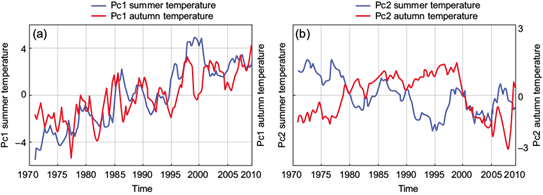
PCs for summer and autumn temperature are characterized by inter-annual variations. In general, the summer and autumn temperatures of PC1 exhibit a single regime with a clear increase over the period 1971-2010. This regime for PC1 temperature could be influenced by large-scale modes that have a similar inter-annual period to ENSO (Fig. 2a). The PC2 of summer and autumn temperature has two regimes over the same time period (Fig. 2b): it decreases over the period 1971-1996 but is stable around the mean from 1997 to 2010. The PC2 of autumn temperature increases over the period 1970-1999, while it decreases from 2000 to 2010. The PC2 time series for temperature could indicate the effect of regional-scale factors, such as the topography of the stations. In synthesis, the PC1 for summer and autumn temperature is characterized by a large-scale influence, while PC2 is marked by a local effect over the two seasons.
In order to emphasize the connection between Iraq’s climate and atmospheric circulations, the following analyses were performed:
EOF1 and EOF2 analyses for summer and autumn temperature (Fig. 3).
Correlation maps of PC1 and PC2 temperatures with global SST fields during summer and autumn over the period 1971-2010 (Figs. 4 and 5).
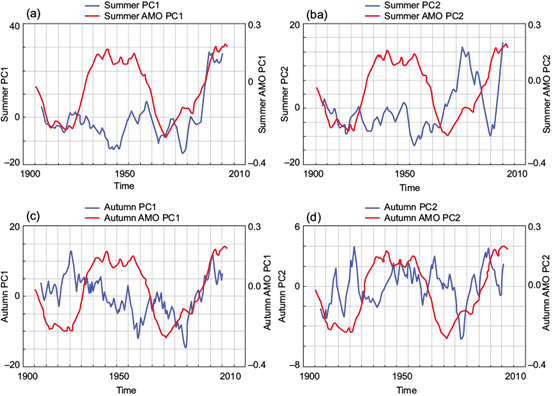
A Pearson correlation between the temperature PCs and the time series of the ENSO and AMO indices (Figs. 6 and 7).
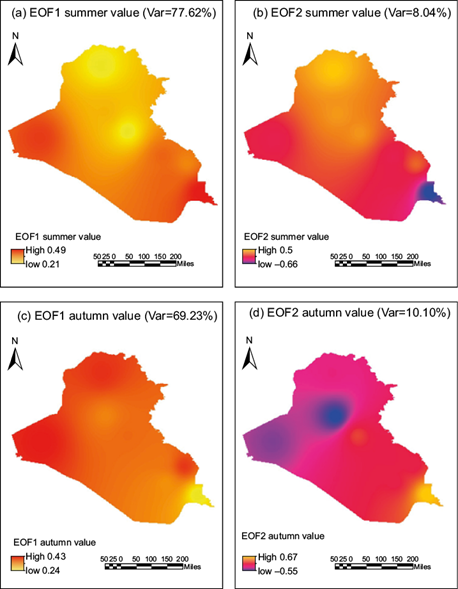
Fig. 3 Summer and autumn temperatures for the period 1971-2010. (a), EOF1 summer values, (b) EOF2 summer values, (c) EOF1 autumn values, and (d) EOF2 autumn values.
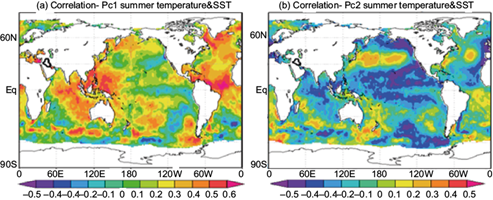
Fig. 4 Correlation maps between (a) PC1, and (b) PC2 Iraq’s summer temperatures with global SST. The black contour marks the borders of Iraq.
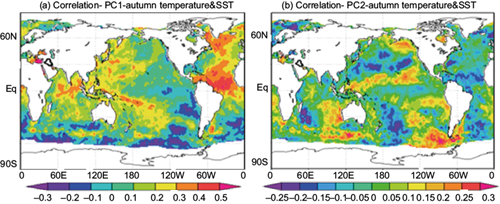
Fig. 5 Correlation maps between (a) PC1, and (b) PC2 Iraq’s autumn temperatures with global SST. The black contour marks the borders of Iraq.
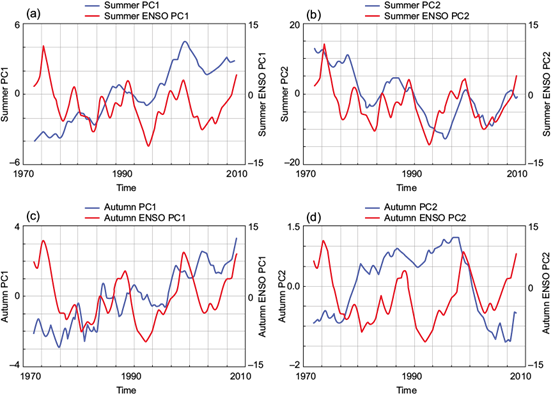
Fig. 6 (a, c) Correlation coefficients of ENSO index PC1 for summer and autumn temperature, and (b, c) and of PC2 for summer and autumn temperatures for the period 1971- 2010.
4.2. Spatial modes of Iraqi summer and autumn temperature variations
The total variance of EOF1 and EOF2 have significant values to characterize the dominant mode of Iraqi temperature over the time period. EOF1 for summer and autumn temperatures has 77.26 and 69.23% of the total variance, respectively (Fig. 3a, c). The monopolar case is characterized by a single dominant pattern that accounts for the most variability in the data. EOF1 has positive values for all stations that represent a monopolar structure. The second EOF for summer and autumn temperatures has 8.04 and 10.10% from the total variance, respectively. It has both positive and negative values, which correspond to the bipolar structure, relating to two modes of control and indicating opposite relationships with the dataset (Fig. 3b, d). The second EOF values vary from positive in the northern mountains region to negative in the western and some southern stations in summer, while, in autumn, the inverse condition occurs. The second EOF could be affected by the different topography of the study stations. In both cases, the EOF helps to determine the main pattern that controls the temperature, and it also allows for the extraction and understanding of the important pattern and climate features.
4.3. Tests for data evaluation
Three statistical parameters were used to evaluate the data: coefficient of determination (R²), Root Mean Squared Error (RMSE), and mean absolute error (MAE). As shown in Table I, the values of these three tests indicate a tenuous and inconsequential correlation between the Iraqi temperature PCs and the SST time series during summer and autumn.
Table I Statistical parameter tests.
| Temperature PCs-SST | R2 | RMSE | MAE |
| PC1 summer-ENSO | 0.099 | 0.972 | 6.165 |
| PC2 summer-ENSO | 0.182 | 0.328 | 19.558 |
| PC1 summer-AMO | 0.226 | 1.029 | 1.0004 |
| PC2 summer-AMO | -0.042 | 0.379 | 1.020 |
| PC1 autumn-ENSO | 0.074 | 1.045 | 9.309 |
| PC2 autumn-ENSO | -0.073 | 0.094 | 34.267 |
| PC1 autumn -AMO | 0.025 | 1.184 | 1.004 |
| PC2 autumn -AMO | 0.032 | 0.41 | 1.004 |
4.4. Relation between Iraqi summer temperature anomalies and global SST modes
A correlation map was constructed to investigate the potential relationship between Iraqi summer temperature anomalies and global SST modes during the period 1971-2010. The initial two PCs derived through the use of EOF analysis were then correlated with the global SST field. The correlation map between summer temperature PC1 and global SST resembles a La Niña structure in the Tropical Pacific and positive AMO mode (Fig. 4a). The interaction between AMO and El Niño and their impact on the Arabian Sea is complex, but when AMO is in a positive phase and La Niña mode coincides with a strong Walker circulation, they bring a hot climate to the Arabian Sea and the Indian Ocean, and then the Arabian region, including Iraq. In addition, the summer temperature PC2 correlation map exhibits El Niño-like conditions in the Tropical Pacific (Fig. 5b). The summer temperature PCs anomaly shows anti-correlation with ENSO conditions and is correlated with the positive AMO mode, which dominates high temperatures in the summer. The change in Indian Ocean SST that is correlated with the ENSO mode, through variability in evaporation, in turn influences the Walker circulation and eastern Asia. These results are in accord with those of Cullen et al. (2002). This influences the climate of the Arabian Peninsula through the air advection mechanism, which brings hot air to the Iraq region from the south. On the other hand, increasing summer temperature correlated with the positive phase AMO mode that weakens the surface northwesterly wind leading to less cold air advection and less evaporation to the Arabian region due to a decrease in the upwelling process. These results are verified by the study of Donat et al. (2014); therefore, it has already been demonstrated that a positive AMO contributes to warmer SSTs in the North Atlantic. When combined with La Niña, which shifts atmospheric circulation patterns, the warming effect in the Atlantic can be amplified. This is attributable to the fact that La Niña has the capacity to weaken trade winds and modify ocean currents, which may result in an accumulation of warm water in the Atlantic.
4.5. Relation between Iraqi autumn temperature anomalies and global SST modes
We constructed a correlation map to investigate the possible link between Iraqi autumn temperature anomalies and global SST modes over the period 1971-2010. The first two PCs derived through the EOF analysis are correlated with the global SST field. The PC1 correlation map for autumn temperature resembles a La Niña Modoki and positive AMO structure (Fig. 6a). On the other hand, the autumn PC2 correlation map with global SST resembles a La Niña and weak AMO structure (Fig. 5b). The impact of the Modoki on the Arabian Sea is less than that of La Niña or El Niño, and also the influence of AMO. Local features, such as monsoon dynamics and Ocean currents, are dominant in the turbulence of Iraq’s autumn temperature. The results agree with those of Muttalib et al. (2020), who found that winter temperatures in Iraq were related to the La Niña mode in the Pacific Ocean. The La Niña phenomenon has the capacity to influence the position of the jet stream, which in turn has the potential to impact weather patterns over the Atlantic. A positive AMO has been shown to reinforce these patterns, leading to warmer temperatures in certain regions.
4.6. Correlation between Iraqi temperature and the time series of ENSO and AMO indices
The Pearson correlation was used to emphasize the relationship between the two modes and Iraq's summer and autumn temperatures. The correlations between summer temperature (PC1, PC2) and ENSO are 0.11 and 0.59, respectively (Fig. 6a, b). In Fig. 6a, the results point to a weak relation between summer temperature and ENSO, while Fig. 6b shows a good relation between Enso and temperature during the summer. Meanwhile, the correlation values of the two PCs for autumn temperature with the ENSO index values are 0. 14 and -0.27, respectively, which refers to a non-significant relation between PC1 and ENSO, but a strong negative relation with the second PC (Fig. 6c, d). The temperature in Iraq has a weak correlation to ENSO during autumn. To confirm the relationship between Iraq's temperature and the long-period AMO index, we considered the period 1900-2009 for Iraq's temperature and the AMO. Data for Iraq's temperature were provided by the University of Delaware (Willmott and Matsuura 2001). PC1 and PC2 for summer temperature have correlation values of 0.31 and -0.2 with the AMO index, respectively (Fig. 7a, b), while both PCs have values of 0.03 and 0.19 during autumn with the AMO time series, respectively (Fig. 7c, d). The influence of AMO on summer temperatures showed a stronger relationship than on autumn temperatures.
5. Conclusion
This study offers insights into the interconnections between Iraqi temperature anomalies and global SST modes during summer and autumn. Its main conclusions are:
The prevailing patterns of Iraqi summer and autumn temperature principal components (PCs) are shaped by global and local modes.
The ENSO and AMO exert a weak influence on Iraqi temperature through the Walker circulation, whereby an increase or decrease in the Indian Ocean sea surface temperature (SST) leads to a corresponding change in the surrounding region, including Iraq.
When the two SST mods in positive phase, the atmospheric moisture and evaporation are enhanced that effect on the redistribution of heating and moisture in the large scale.

