




 nueva página del texto (beta)
 Inglés (pdf)
 Artículo en XML
 Referencias del artículo
 Traducción automática
 Enviar artículo por email
 Citado por SciELO
  Similares en
SciELO
Similares en
SciELO 
 Permalink

Introduction
The management of waste derived from polymeric materials, such as vulcanized rubber, represents a significant challenge in both environmental and technological fields. The durability and resistance of this material hinder its natural decomposition (Cheng, Xia, and Yang, 2023), raising questions about the effectiveness of traditional degradation methods, which are mostly physical (Hu et al., 2023), chemical (Wei, Yu, Du, and Sun, 2022), and recycling-based (Gawdzik, Matynia, and Błażejowski, 2020), as these often generate additional pollution during their execution (Zhao, Liu, Meng, Liu, and Duo, 2024). In light of this problem, there has been a growing interest in developing more sustainable and effective strategies to manage this type of pollutant.
In this context, lignocellulolytic fungi gain relevance due to their demonstrated ability to degrade complex compounds such as lignin (Del Cerro et al., 2024). These organisms represent a potential solution to the challenges associated with rubber degradation and offer promising perspectives for waste management (Bennet, Wunch, and Faison, 2002).
Vulcanized rubber, found in numerous products and widely used in industry (Alarif, 2023), presents considerable challenges due to its robust structure (Fazli and Rodriguez, 2020), which hinders its natural decomposition (Shah, Hasan, Shah, Kanwal, and Zeb, 2013). However, recent research has explored the potential of certain fungi to degrade polymers such as polyurethane, polyethylene (Spina et al., 2021), and even plastics (Bautista-Zamudio, Flórez, López, Monroy, and Segura, 2023), paving a promising way for the biodegradation of these materials.
To achieve these objectives, experiments were designed in which rubber samples were exposed to selected fungi. During these experiments, changes in the chemical structure of the rubber were studied, and weight loss was recorded as an indicator of degradation.
The study of rubber biodegradation by lignocellulolytic fungi is relevant in the context of seeking more effective solutions to address rubber waste and mitigate its environmental impact. The primary objective of this study is to evaluate the capacity of lignocellulolytic fungi to degrade used tire rubber. The purpose is to understand the biochemical mechanisms involved in this process, as well as its applicability in sustainable waste management.
Materials and Methods
The present project was carried out in Laboratory 5 of the National Technological Pole for Research and Analytical Services in Biofuels at the Technological Institute of Tuxtla Gutiérrez in Chiapas, Mexico. To initiate the research, the first step involved selecting strains, which were chosen based on their history of producing specific enzymes such as Laccase and lignin peroxidase, based on a previous study where these same strains were used for hydrocarbon degradation (Sánchez-Corzo, et al., 2021). The strains T. cingulata, T. sanguinea, and Phlebiopsis sp. were selected as suitable for this study. Subsequently, the strains were reactivated in a solid medium enriched with 5% coffee husk and mineral salts. Once the strains grew, they were transferred to a potato dextrose agar (PDA) medium for maintenance.
To carry out the vulcanized rubber consumption assay, the rubber sample, obtained from a discarded tire from a landfill in Villaflores, Chiapas, was treated by washing with distilled water until all visible impurities in the material were removed. Subsequently, the sample was pulverized using a high-pressure pulverizer. Once pulverized, it was sieved to a particle size of 0.25 mm, the desired size for further analysis. The material was sterilized with moist heat (15 psi for 15 minutes) to eliminate any microbial contamination.
Three treatments were established, each with a specific ratio of pulverized rubber to potato dextrose broth (PDB), expressed as a percentage of each solid component of the culture medium. These rubber-PDB solid ratios were set at C1 (50-50%), C2 (75-25%), and C3 (100-0%), respectively, based on the PDB technical sheet, which specifies that 24 grams of solids are required per liter of water for microbial growth. These concentrations were adjusted so rubber acted as the other proportion of total solids in the liquid culture medium. Each treatment was inoculated with each fungal strain and performed in triplicate to ensure reproducibility of the results. Additionally, the minimum mineral medium proposed by Koutny et al. 2006 was added to each treatment, as these mineral salts act as cofactors and are essential for the growth and development of the fungi in the solid culture medium.
To evaluate consumption, the samples underwent a sterilization process, followed by washing with 70% ethanol and then with 10% sodium hypochlorite for 24 hours to remove the biomass. Subsequently, they were filtered and dried at 55 °C. To determine the consumption percentage, calculations were performed using the equation 1:
The results were analyzed using Statgraphics Centurion version 19 software (Statgraphics Technologies, 2024) through a simple ANOVA. To evidence possible changes in the chemical structure of the material, FT-IR spectroscopy was performed, obtaining spectra in the range of 500-4000 cm-1 at a resolution of 4 cm-1 in treated and untreated samples.
Results and Discussion
It has been demonstrated that various factors, such as temperature, humidity, pH, UV radiation, exposure to light, water, and air (Caparanga, Basilia, Dagbay, and Salvacion, 2009; Wang, Huang, Ji, Völker, and Wurm, 2020), can positively or negatively influence the process of polymer biodegradation by microorganisms. Even the type of culture medium can play a significant role. This is particularly the case with fungi, which are more commonly cultured on solid media, as this method facilitates handling by reducing the risk of contamination and is more cost-effective. However, liquid culture promotes fungal growth by presenting the substrate as suspended solids, which improves oxygen supply. This makes liquid media a more suitable option than solid media for optimizing enzyme production and recovery (Gandia, Brandhof, Appels, and Jones, 2021; Marchut-Mikołajczyk, Drożdżyński, Januszewicz, Domański, and Wrześniewska, 2019).
Another crucial factor is the degradation capacity of microorganisms. For example, certain bacteria such as Rigidoporus microporus, Amycolaptosis, and Nocardia, and fungi such as Aspergillus, Penicillium, Fusarium solani, and Ceriporiopsis subvermispora have demonstrated their ability to degrade natural rubber (Maiden, Atan, Syd-Ali, Ahmad, K., and Wong, 2024; Sato et al., 2004; Andler, 2020; Shah, Hasan, Shah, Kanwal, and Zeb, 2013). Since 1928, the ability of certain fungi to degrade rubber has been documented, although most studies have focused on natural rubber and isoprene. Among the fungal genera known for their ability to degrade rubber are Monascus, Aspergillus, Penicillium, Fusarium, Cladosporium, Paecilomyces, Phoma, Calotropis, and Phlebia (Basik, Sanglier, Yeo, and Sudesh, 2021). However, few organisms have shown the ability to degrade vulcanized rubber, such as that derived from tires, due to its high resistance as a polymer.
Nevertheless, the latter are capable of degrading certain polymers, such as polypropylene. Some species, like Coniochaeta hoffmannii and Pleurostoma richardsiae, have been able to grow on this material (Porter et al., 2023). Similarly, Phanerochaete chrysosporium PV1, Lentinus tigrinus PV2, Aspergillus niger PV3, and Aspergillus sydowii PV4 have demonstrated the ability to degrade polyvinyl chloride (Ali et al., 2013). Likewise, Penicillium oxalicum NS4 (KU559906) and Penicillium chrysogenum NS10 (KU559907) managed to degrade both low- and high-density polyethylene (Ojha et al., 2017), suggesting that these fungi could be capable of degrading more rigid substrates, such as vulcanized rubber.
In this context, Andler, D’Afonseca, Pino, Valdés, and Salazar-Viedma (2021) evaluated the degradation of vulcanized rubber using different fungal strains, analyzing radial growth in the presence of rubber particles in solid media. The results showed a biodegradation percentage of 7.5% with Trametes versicolor and 6.1% with Pleurotus ostreatus. Our study focused on the degradation of vulcanized rubber using white-rot fungi, selected for their biochemical capacities and their adaptation to various substrates. This analysis was conducted in liquid media, as the factors mentioned above favor the biodegradation process. The results revealed that T. cingulata did not show consumption capacity in any of the treatments, while T. sanguinea exhibited significant degradation in the C2 treatment (9.58%). In contrast, Phlebiopsis sp. demonstrated consumption capacity in all treatments, reaching a maximum of 43.163% in C2. This highlights the variability in degradation capacity among the strains and treatments evaluated (Figure 1). T. sanguinea showed significant consumption in the C2 treatment (9.58%), consistent with the results of Andler et al. (2021), where T. versicolor also exhibited an approximate percentage of rubber degradation in solid media. This suggests that certain fungi of the genus Trametes have notable potential for rubber biodegradation, regardless of the type of medium used, although in our study, consumption in liquid media was 20% higher, reaffirming the influence of medium type and strain on the biodegradation process.
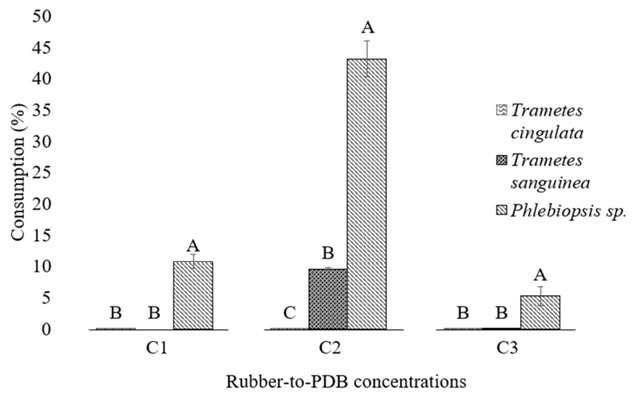
Figure 1: Percentage of vulcanized rubber consumption by different fungal strains under three substrate concentrations. Bars represent the mean values, and error bars indicate the standard deviation. Different letters above the bars denote statistically significant differences (P < 0.05) between treatments according to the applied statistical test.
On the other hand, Phlebiopsis sp. showed significantly higher capacity in all treatments compared to the strains evaluated in both this study and the work reported by Andler et al. (2021) In particular, Phlebiopsis sp. achieved a consumption of 43.163% in C2, far exceeding the levels observed for T. sanguinea (9.58%) and other strains evaluated by Andler et al. (2021), as it achieved a degradation rate four times higher than both organisms. This suggests that Phlebiopsis sp. is an exceptionally efficient strain for the biodegradation of vulcanized rubber in liquid media, likely due to its ability to produce degradative enzymes.
FTIR analyses revealed a reduction in signals associated with the vulcanized rubber structure after treatment with T. sanguinea and Phlebiopsis sp. In particular, a decrease was observed in the band corresponding to methylene stretching between 2920 and 2580 cm-1, as well as in the methylene bending band around 1450 cm-1. These signals are associated with the methylene-carbon bonds typical of natural rubber, which constitutes approximately 41% of the composition of tires (Palos et al., 2021). Similarly, the signal around 870 cm-1, corresponding to the carbon-methylene (C-CH2) bond, also showed a significant reduction.
Aromatic ring vibrations and the signals corresponding to carboxylate and carbonyl groups (1520-1605 cm-¹), associated with carbon black, which represents 28% of the tire composition, also decreased after treatment with T. sanguinea and Phlebiopsis sp. (Palos et al., 2021). This suggests that both fungi not only degrade natural and synthetic rubber but may also alter other components of the material, such as carbon black. Additionally, fungal growth could reduce the carbonyl groups of the original oxidation products, such as esters, lactones, and ketones (Sánchez, 2020) (Figure 2).
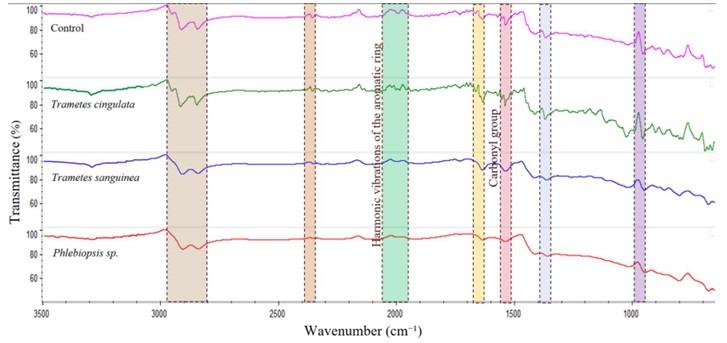
Figure 2: FTIR spectra of vulcanized rubber before and after fungal degradation using T. cingulata, T. sanguinea, and Phlebiopsis sp., compared to the control. The Y-axis represents transmittance (%), while the X-axis shows the wavenumber (cm-1). The highlighted regions indicate key absorbance bands related to aromatic ring vibrations and other functional groups.
These observations suggest that T. sanguinea and Phlebiopsis sp. have a high capacity to modify the structure of vulcanized rubber. The reduction in the signals observed in the treatments indicates biodegradation, as evidenced by the decrease in the characteristic functional groups of the material. In contrast, T. cingulata did not show any significant reduction in the signals, presenting a spectrum similar to that of the control, indicating a lack of biodegradative activity. These results highlight the variability among fungi in their ability to degrade vulcanized rubber and confirm the superior effectiveness of T. sanguinea and Phlebiopsis sp. compared to T. cingulata.
When comparing our results with those of Andler et al. (2021), we observed a similar reduction in CH2 bands and the loss of signals associated with functional groups after treatment with T. versicolor and P. ostreatus. However, in their study, the reduction was more drastic using EM media, while in our work, the most significant changes were observed in treatments with different strains in liquid media. The results suggest that liquid media may facilitate greater diffusion of extracellular enzymes and promote more effective biodegradation compared to the solid media used in previous studies. The difference in effectiveness observed in different media may be related to the fungi’s ability to produce degradative enzymes that act on the rubber components.
These results also suggest that Phlebiopsis sp. and T. sanguinea are capable of performing degradation mechanisms, as both fungal genera have the metabolic capabilities to break the chemical bonds of rubber polymers, making them promising candidates for the biodegradation of tire waste and other polymers.
Conclusions
This study demonstrates that certain lignocellulolytic fungi, specifically Phlebiopsis sp. and T. sanguinea, possess a remarkable capacity to degrade vulcanized rubber, with Phlebiopsis sp. showing the highest consumption potential under various treatment conditions. T. sanguinea also stood out, although with slightly lower efficacy, indicating that it remains a valuable strain for rubber degradation. The reduction in signals observed in the FTIR spectra after treatment confirms the structural modification of the rubber, underscoring the critical role these fungi play in the degradation of recalcitrant materials like vulcanized rubber. Moreover, the notable variability in consumption efficacy among different strains emphasizes the importance of selecting specific strains for industrial bioremediation applications. Given that factors such as the type of medium and environmental conditions significantly influence biodegradation efficiency, future research should prioritize the optimization of cultivation and treatment conditions to improve the consumption rates of these fungi. Additionally, further research into the enzymatic mechanisms involved in rubber degradation will be essential to fully understand and harness the potential of these fungi in addressing challenges related to rubber waste.
Availability of supporting data
The datasets used and analyzed during the current study are available from the corresponding author on reasonable request.
Financing
The project funding comes from two significant sources: the National Council for Humanities Science and Technology (CONAHCYT) and the National Technological Institute of Mexico (TecNM). These institutions have actively supported the research and development of this project, providing the necessary resources to conduct meaningful studies and advance knowledge in this specific field. The financial support from CONAHCYT and the National Technological Institute of Mexico has been fundamental for the successful execution of this research and the achievement of the proposed objectives.

