Articles
Human capital readiness and global market orientation to business performance: The mediation role of green innovation
Preparación del capital humano y orientación del mercado global hacia el desempeño empresarial: el papel mediador de la innovación verde

-
Publication dates-
November 14, 2025
Oct-Dec , 2024
- Article in PDF
- Article in XML
- Automatic translation
- Send this article by e-mail
- Share this article +
Abstract
This study aims to empirically examine the mediating effect of green innovation on the influence of human capital readiness and global market orientation on micro, small and medium enterprises (MSMEs) business performance. This study was conducted on MSMEs in East Java, Indonesia, with a total of 326 respondents. The data analysis technique in this study used the partial least square (PLS) method. The results of this study indicate that green innovation partially mediates the effect of human capital readiness on MSME business performance. Moreover, green innovation partially mediates the influence of global market orientation on business performance.
JEL Code::
J24, L25, O15
Keywords::
human capital readiness, global market orientation, green innovation, business performance
Introduction
This era of the global market demands that all companies, both large and small companies, such as micro, small and medium enterprises (MSMEs), compete to win the competition. The presence of a global market for large companies can spur enthusiasm to continue working and ace the competition. However, for small companies such as MSMEs, the global market is challenging. The weakness of the average MSME is the lack of knowledge and readiness of human resources, so MSMEs often go bankrupt because they cannot maintain their business. MSMEs are one of the Indonesian economy's drivers; they significantly contribute to improving people's welfare (Tjahjadi et al., 2022). Maintaining the survival and business performance of MSMEs is one of the essential things that we must strive for.
-
Tjahjadi et al., 2022Human capital readiness and global market orientation in Indonesian Micro-, Small- and-Medium-sized Enterprises business performanceInternational Journal of Productivity and Performance Management, 2022
Kominfo East Java Province (2022) said that the number of MSMEs is 64.1 million, and the contribution of MSMEs to the Gross Domestic Product (GDP) is Rp. 8.6 T (61.97%), the number of MSMEs in the digital ecosystem is 17.5 million, Investment integration is 60 4%, and Labor Absorption of 97%.s One of the problems of MSMEs is the readiness of human resources, where when receiving workers; sometimes they are not able to work directly or lack work competence. MSMEs must anticipate human resources' willingness to meet work demands. The readiness of human resources is essential for an organization because it can be used to assess business performance.
-
Kominfo East Java Province (2022)Diskop UKM Jatim Gelar Rapat Koordinasi Pendataan K-UMKM Tahun 2022, 2022
Business performance is a measure used to assess the company's success; the better the performance, the more successful the company is. To achieve optimal business performance, companies must have adequate resources, both tangible resources and intangible resources. The Knowledge-resource- based views (KBV) theory developed by Grant (1996) says that strategic resources create the company's success in the form of intangible assets. KBV focuses on managing specific aspects of the company's intangible assets, one of which is knowledge.
-
Grant (1996Toward a knowledge-based theory of the firm: Knowledge-based Theory of the FirmStrategic Management Journal, 1996
Knowledge is one of the intangible assets attached to human resources, or the term is referred to as human capital. RBV theory states that one of the determinants of business performance and competitive advantage is the company's internal resources (Chabowski & Mena, 2017). One of the company's internal resources is human capital. Human capital contributes to creating economic value, which is assumed to improve the company's business performance (Tjahjadi et al., 2022).
-
Chabowski & Mena, 2017A Review of Global Competitiveness Research: Past Advances and Future DirectionsJournal of International Marketing, 2017
-
Tjahjadi et al., 2022Human capital readiness and global market orientation in Indonesian Micro-, Small- and-Medium-sized Enterprises business performanceInternational Journal of Productivity and Performance Management, 2022
High knowledge alone is not enough to improve the company's performance in the global market if it is not balanced with the readiness of adequate resources to understand market conditions (Nakos et al., 2019). One of those resource readiness is the readiness of human capital. The preparedness of human capital plays a vital role in executing the company's strategy. Research conducted by Miyagi et al., (2019) found that the higher the level of readiness of the company's human capital, the more influential the strategy execution, including the transgenic strategy, to improve company performance.
-
Nakos et al., 2019The mediating role of alliances in the international market orientation-performance relationship of smesInternational Business Review, 2019
-
Miyagi et al., (2019)Investigating Customer Perception of Online Businesses' Service Recovery: A Combination of Expectation-Confirmation Theory, Satisfaction-Loyalty Theory, and Perception of JusticeJournal of Applied Economic Sciences, 2019
Global business competition is increasingly competitive. Companies to achieve a competitive advantage at the worldwide level, they must have a strategy. Generally, methods that can be used to create a competitive advantage in the global market include market orientation, innovation and entrepreneurial orientation (Djodjobo & Tawas, 2014). The strategy used by the company must be in line with the company's goals. In addition to the readiness of human capital, a critical approach for improving the company's business performance is global market orientation. Previous research conducted by Nakos et al. (2019), Tjahjadi et al. (2020), Tjahjadi et al. (2022) found that global market orientation is one of the factors that can improve company performance. International market orientation can provide explicit knowledge about the target market following the products offered by the company. The ability referred to in this study is the information needed by the company to complete specific tasks (Grant, 1996). A company that is oriented to the global market is a company that makes the target market a company parameter to run a business. Companies with a high international market orientation have a high impact on company performance as well. A company that is oriented to the global market is a company that makes the target market a company parameter to run a business. Companies with a high global market orientation have a high impact on company performance as well. A company that is oriented to the global market is a company that makes the target market a company parameter to run a business. Companies with a high global market orientation have a high impact on company performance as well.
-
Djodjobo & Tawas, 2014Pengaruh orientasi kewirausahaan, inovasi produk, dan keunggulan bersaing terhadap kinerja pemasaran usaha nasi kuning di kota ManadoJurnal EMBA: Jurnal Riset Ekonomi, Manajemen, Bisnis dan Akuntansi, 2014
-
Nakos et al. (2019)The mediating role of alliances in the international market orientation-performance relationship of smesInternational Business Review, 2019
-
Tjahjadi et al. (2020)The Role of Green Innovation between Green Market Orientation and Business Performance: Its Implication for Open InnovationJournal of Open Innovation: Technology, Market, and Complexity, 2020
-
Tjahjadi et al. (2022)Human capital readiness and global market orientation in Indonesian Micro-, Small- and-Medium-sized Enterprises business performanceInternational Journal of Productivity and Performance Management, 2022
-
Grant, 1996)Toward a knowledge-based theory of the firm: Knowledge-based Theory of the FirmStrategic Management Journal, 1996
MSMEs must strive to create innovations that adapt to global market conditions and the environment. Green innovation can be a solution for companies to continue to carry out production and innovation activities while maintaining environmental sustainability. Green innovation is not only needed by large companies but also needed by small companies such as MSMEs.
MSMEs have created many opportunities, such as employment opportunities, providing opportunities to develop soft skills and hard skills so that they can contribute to economic growth. Innovation is an effective way to improve product quality and increase company productivity, contributing to company performance in achieving competition (Camisón & Villar López, 2010), (Giniuniene & Jurksiene, 2015). GPI applied by companies can improve product design, quality, and environmental concerns that can result in the company's opportunity to set higher prices and make better profit margins, thereby increasing the company's performance (Chen et al., 2006).
-
Camisón & Villar López, 2010An examination of the relationship between manufacturing flexibility and firm performance: The mediating role of innovationInternational Journal of Operations & Production Management, 2010
-
Giniuniene & Jurksiene, 2015Dynamic Capabilities, Innovation and Organizational Learning: Interrelations and Impact on Firm PerformanceProcedia - Social and Behavioral Sciences, 2015
-
Chen et al., 2006The Influence of Green Innovation Performance on Corporate Advantage in TaiwanJournal of Business Ethics, 2006
The results of previous research on human capital on business performance are still inconsistent Chahal et al. (2016) and Agyabeng-Mensah & Tang (2021) found that green human capital has a possitive effect on financial performance, Githaiga (2020) found that human capital has significantly influence bank performance, Onuoha, (2021) found that human capital has possitive effect on corporate financial performance dan structural capital, and Tjahjadi et al. (2022) found that human capital has a positive effect on business performance. Research conducted by Cabrilo & Dahms (2018) found the opposite human capital does not affect business performance. The inconsistency of the results of this study is suspected to be other variables that may mediate the relationship. Therefore, this study proposed a green innovation variable mediating the influence of human capital readiness and global market orientation on business performance.
-
Chahal et al. (2016)The Effect of Perceived High-performance Human Resource Practices on Business Performance: Role of Organizational LearningGlobal Business Review, 2016
-
Agyabeng-Mensah & Tang (2021)The relationship among green human capital, green logistics practices, green competitiveness, social performance and financial performanceJournal of Manufacturing Technology Management, 2021
-
Githaiga (2020)Human capital, income diversification and bank performance-an empirical study of East African banksAsian Journal of Accounting Research, 2020
-
Onuoha, (2021)Does structural capital count in human capital-corporate financial performance relationship? Evidence from deposit money banks in NigeriaMeasuring Business Excellence, 2021
-
Tjahjadi et al. (2022)Human capital readiness and global market orientation in Indonesian Micro-, Small- and-Medium-sized Enterprises business performanceInternational Journal of Productivity and Performance Management, 2022
-
Cabrilo & Dahms (2018)How strategic knowledge management drives intellectual capital to superior innovation and market performanceJournal of Knowledge Management, 2018
Literature review
Resource-Based Views Theory (RBV)
The Resource-Based View (RBV) theory discusses how companies can utilize their resources to compete with other companies. Riahi‐Belkaoui (2003) states that a potential strategy to improve company performance combines tangible and intangible assets. The company will gain its competitive advantage when the company has superior resources. Employees are one of the most valuable resources for a company. The company's ability to manage resources effectively can create an excellent competitive advantage to improve company performance. The Resource-based view theory explains that the internal resources owned by the company that the success or failure of a company will be primarily determined by the strengths and weaknesses that exist within the company internal. Bates & Flynn (1995) emphasize that resources will affect the company's performance and also state that something rare and difficult to imitate by others encourages the emergence of competitive advantage. Resource-Based View Theory can be concluded that the resources owned by the company affect the company's performance, increasing the company's value.
-
Riahi‐Belkaoui (2003)Intellectual capital and firm performance of US multinational firms: A study of the resource‐based and stakeholder viewsJournal of Intellectual Capital, 2003
-
Bates & Flynn (1995)INNOVATION HISTORY AND COMPETITIVE ADVANTAGE: A RESOURCE-BASED VIEW ANALYSIS OF MANUFACTURING TECHNOLOGY INNOVATIONSAcademy of Management Proceedings, 1995
Knowledge-Based Views (KBV) theory
Grant (1991) The Knowledge-Based View (KBV) theory is based on corporate knowledge, indicating that knowledge in its various forms is a resource interest for the company. KBV theory sees that knowledge is an essential thing that someone in creating company value must possess. The company will try to develop new knowledge or information faster than its competitors. This knowledge view-based theory is expected to manage and utilize resources well to improve company performance. Knowledge-based view states that the products and services produced by a company depend on the way the company combines and implements functions within the company. Knowledge-based view theory is a view that focuses on knowledge because, with the development of knowledge, the company can maintain its competitive advantage and will provide an increase in company performance so that the value of the company will increase.
-
Grant (1991)The Resource-Based Theory of Competitive Advantage: Implications for Strategy FormulationCALIFORNIA MANAGEMENT REVIEW, 1991
Human capital readiness
Kaplan & Norton (2004) Human Capital Readiness (HCR) is a framework that enables organizations to identify HC requirements for strategy execution, estimate gaps between HC requirements and employee readiness, and build programs to close gaps between current conditions and readiness. The measurement process of HCR begins by identifying the competencies needed by individuals whose performance affects the company's performance. The result is the level of preparedness of human resource competencies. The role of human capital in the company is a driving force for the company, so the management and readiness of human capital are one of the success factors of the company. Talented human resources can increase company productivity. Human capital can improve the productivity of human resources and company performance through the ability of human resources, knowledge, and skills in work.
-
Kaplan & Norton (2004)Strategy Maps: Converting Intangible Assets into Tangible Outcomes, 2004
Business performance
The more the economy develops, the more competitors can cause its presence to be threatened. If a company can maintain its presence in the market, then the company can keep the company's performance stable. Moerdiyanto (2015) reveals that company performance results from a series of business processes at the expense of various kinds of human and financial resources. The corporate version refers to how well an organization achieves market-oriented and economic goals (Yamin et al., 1999).
-
Moerdiyanto (2015)PENGARUH TINGKAT PENDIDIKAN MANAJER TERHADAP KINERJA PERUSAHAAN GO-PUBLICJurnal Cakrawala Pendidikan, 2015
-
Yamin et al., 1999)Relationship between generic strategies, competitive advantage and organizational performance: An empirical analysisTechnovation, 1999
Green innovation
Innovation is an essential function for the company because it determines how the company's business performance. Innovation is becoming increasingly important as a tool for survival, not only for growth but also in increasingly fierce competition and environmental uncertainty (Han et al., 1998). The increasingly intense competition and changing market needs require companies to create something new to compete with other competitors. Companies are required to develop products or services continuously so that companies can maintain their survival (Robbins, 1994). Green innovation can be used as an appropriate environmental approach to improve environmental efficiency, environmental protection, and waste management (Chen et al., 2006).
-
Han et al., 1998Market orientation and organizational performance: is innovation a missing link?Journal of marketing, 1998
-
Robbins, 1994Teori Organisasi: Struktur, Desain dan Aplikasi, Alih Bahasa Jusuf Udaya, 1994
-
Chen et al., 2006The Influence of Green Innovation Performance on Corporate Advantage in TaiwanJournal of Business Ethics, 2006
Green innovation can be grouped into two namely: Green product innovation is an innovation in products by considering environmental impacts (such as using environmentally friendly materials, green design, minimizing the use of useless goods, and products using recyclable goods) to increase competition Companies (Chen et al., 2006). Green product innovation should be able to provide more value than other products so that the company has an advantage over its competitors and will improve the company's performance. Daniel (2008) revealed that green product innovation is beneficial for customers because, in addition to having environmentally friendly benefits, green products will also produce personal environmental benefits for customers, such as energy savings; then indirectly, this will create more demand, and companies will be motivated to implement better innovations. Green process innovation is using innovative ways to reduce the negative environmental impacts caused by the production process (Chen et al., 2006). The most crucial key to green process innovation is that the products produced do not contain hazardous materials and are processed without harmful chemicals. Green process innovation creates more value for customers and improves the company's image. The savings in using raw materials and production efficiency in green innovation will impact better company performance (Ar, 2012).
-
Chen et al., 2006The Influence of Green Innovation Performance on Corporate Advantage in TaiwanJournal of Business Ethics, 2006
-
Daniel (2008)The effects of customer benefit and regulation on environmental product innovation—Empirical evidence from appliance manufacturers in Germany, 2008
-
Ar, 2012The Impact of Green Product Innovation on Firm Performance and Competitive Capability: The Moderating Role of Managerial Environmental ConcernProcedia - Social and Behavioral Sciences, 2012
Global market orientation
Global market orientation (GMO) is important for companies as global competition increases and the customer always needs change, making them thirsty to be close to their target market. GMO is defined as a company's orientation and activities to market its products in the global market with the aim of increasing competitive advantage (Nakos et al., 2019). Applying global market orientation will increase the company's performance, where the parameter in creating products is the customer's understanding of the wishes and needs.
-
Nakos et al., 2019The mediating role of alliances in the international market orientation-performance relationship of smesInternational Business Review, 2019
Hypothesis development
Figure 1 above shows the conceptual framework of this research. This study uses human capital readiness and global market orientation variables as antecedent variables of business performance variables. This study uses green innovation as a mediating variable on the influence of human capital readiness and global market orientation on business performance. The implementation of the green innovation strategy is believed to be able to improve the company's business performance.
Thumbnail
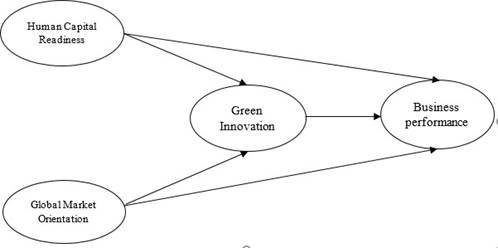
Figure 1
Conceptual framework
Conceptual framework
Human capital readiness and business performance with green innovation as a mediating variable
Human capital is one of the essential factors as a determinant of company performance. The higher the human capital readiness, the higher the company's performance. The enthusiasm of human resources is critical to the success of GMOs. The higher the level of preparedness of the company's human capital, the more influential the strategy execution, including the transgenic strategy so that it can improve the company's performance (Miyagi et al, 2019). The results of previous research conducted by Chahal et al. (2016); Agyabeng-Mensah & Tang (2021); Githaiga (2020); Onuoha (2021);Tjahjadi et al (2022) found that human capital has a positive effect on business performance.
-
Miyagi et al, 2019Investigating Customer Perception of Online Businesses' Service Recovery: A Combination of Expectation-Confirmation Theory, Satisfaction-Loyalty Theory, and Perception of JusticeJournal of Applied Economic Sciences, 2019
-
Chahal et al. (2016)The Effect of Perceived High-performance Human Resource Practices on Business Performance: Role of Organizational LearningGlobal Business Review, 2016
-
Agyabeng-Mensah & Tang (2021)The relationship among green human capital, green logistics practices, green competitiveness, social performance and financial performanceJournal of Manufacturing Technology Management, 2021
-
Githaiga (2020)Human capital, income diversification and bank performance-an empirical study of East African banksAsian Journal of Accounting Research, 2020
-
Onuoha (2021)Does structural capital count in human capital-corporate financial performance relationship? Evidence from deposit money banks in NigeriaMeasuring Business Excellence, 2021
-
Tjahjadi et al (2022)Human capital readiness and global market orientation in Indonesian Micro-, Small- and-Medium-sized Enterprises business performanceInternational Journal of Productivity and Performance Management, 2022
Every company has a different strategy to achieve company goals. The strategy formulation that will be used must pay attention to consumer demand. Recently, consumers have switched to environmentally friendly products, so some companies focus on green innovation in their products. The implementation of this green innovation strategy is believed to be able to improve the company's business performance. This is evidenced by the results of research conducted by Hult et al (2004); Shashi et al (2019); Xie et al (2019), (Beyhan Yasar et al., 2019) found that green innovation has a positive effect on the company's financial performance. Research conducted by Singh et al (2020); Zhang et al (2019); Tjahjadi et al (2020) found that green innovation had a positive effect on MSME business performance.
-
Hult et al (2004)Innovativeness: Its antecedents and impact on business performanceIndustrial Marketing Management, 2004
-
Shashi et al (2019)The impact of leanness and innovativeness on environmental and financial performance: Insights from Indian SMEsInternational Journal of Production Economics, 2019
-
Xie et al (2019)Green process innovation, green product innovation, and corporate financial performance: A content analysis methodJournal of Business Research, 2019
-
Beyhan Yasar et al., 2019Mediating effect of continuous improvement on the relationship between innovation and financial performanceTotal Quality Management & Business Excellence, 2019
-
Singh et al (2020)Green innovation and environmental performance: The role of green transformational leadership and green human resource managementTechnological Forecasting and Social Change, 2020
-
Zhang et al (2019)Green innovation and firm performance: Evidence from listed companies in ChinaResources, Conservation and Recycling, 2019
-
Tjahjadi et al (2020)The Role of Green Innovation between Green Market Orientation and Business Performance: Its Implication for Open InnovationJournal of Open Innovation: Technology, Market, and Complexity, 2020
The readiness of human capital is very influential on the strategy execution process; the strategy execution process is evident in the achievement of company performance. Based on the results of the research and the arguments above, the proposed hypothesis is as follows:
H1: green innovation mediates the effect of human capital readiness on MSME business; ss performance.
Global market orientation and business performance with green innovation as a mediating variable
Public concern for the environment has started to increase recently; this can be seen in the number of consumers who choose to buy environmentally friendly products (Siyal et al., 2021). Green innovation is an essential thing for all companies to do. Companies will generate higher profits by developing, producing, and selling environmentally friendly products (Kopnina, 2017). Green innovation is one of the company's strategies to meet the needs of the world market because the current world customer orientation prefers environmentally friendly products; when achieving this strategy, the company must have a strategy that can understand the world's customer orientation, usually referred to as the global market. orientation. Global market orientation is a vital customer management process that leads to better customer performance and financial performance (Tjahjadi et al., 2020). International market orientation directs companies to focus on product marketing globally to reach the world market. To enter the global market, the company must know the customers and the competitive environment of the worldwide target market and then disseminate this knowledge to various departments (Nakos et al., 2019).
-
Siyal et al., 2021Factors Influencing Green Purchase Intention: Moderating Role of Green Brand KnowledgeInternational Journal of Environmental Research and Public Health, 2021
-
Kopnina, 2017Sustainability: New strategic thinking for businessEnvironment, Development and Sustainability, 2017
-
Tjahjadi et al., 2020The Role of Green Innovation between Green Market Orientation and Business Performance: Its Implication for Open InnovationJournal of Open Innovation: Technology, Market, and Complexity, 2020
-
Nakos et al., 2019The mediating role of alliances in the international market orientation-performance relationship of smesInternational Business Review, 2019
Global market orientation helps companies to know the shortcomings that may arise related to competition in the worldwide market; for example, specialized distribution systems and knowledge of complex local regulations may become impossible to develop in a short time Nakos et al (2019). Previous research conducted by Nakos et al (2019); (Tjahjadi et al (2020); Tjahjadi et al (2022) found that global market orientation has a positive effect on company performance. Based on the description above, the proposed hypothesis is as follows:
-
Nakos et al (2019)The mediating role of alliances in the international market orientation-performance relationship of smesInternational Business Review, 2019
-
Nakos et al (2019)The mediating role of alliances in the international market orientation-performance relationship of smesInternational Business Review, 2019
-
Tjahjadi et al (2020)The Role of Green Innovation between Green Market Orientation and Business Performance: Its Implication for Open InnovationJournal of Open Innovation: Technology, Market, and Complexity, 2020
-
Tjahjadi et al (2022)Human capital readiness and global market orientation in Indonesian Micro-, Small- and-Medium-sized Enterprises business performanceInternational Journal of Productivity and Performance Management, 2022
H2: green innovation mediates the influence of global market orientation on MSME business performance.
Methods
The data in the study were obtained by distributing online questionnaires to prospective respondents. Respondents in this study were MSMEs in East Java, Indonesia. Research questionnaires were distributed in the form of online links through social media. Based on the results of distributing questionnaires for one month, there were 326 answers, which we processed into research data.
Variable definition and measurement
The human capital readiness variable was measured using an instrument developed by Kaplan & Norton( 2004). Human capital readiness is estimated using seven statement items, as listed in Table 1.
-
Kaplan & Norton( 2004Strategy Maps: Converting Intangible Assets into Tangible Outcomes, 2004
Table 1
Indicators of human capital readiness
Indicators of human capital readiness
| Variable | Indicator |
|---|---|
| The readiness of employees' knowledge to carry out operational activities properly | |
| Readiness of employees' knowledge of relationships for customer needs | |
| The readiness of employees to know about quality at an affordable price | |
| Human Capital Readiness | The readiness of employees' skills when processing the business/business that is being run |
| Skill readiness of employees When providing consultation, advice and feedback to customers | |
| Employee values or attitudes towards readiness in business strategy relationships, courtesy, and quick response | |
| Employee values or attitudes towards good teamwork to achieve same goal |
The global market orientation variable is measured using the instrument that has been used by Nakos et al (2019) and Tjahjadi et al (2022), using ten-item statements as listed in Table 2.
-
Nakos et al (2019)The mediating role of alliances in the international market orientation-performance relationship of smesInternational Business Review, 2019
-
Tjahjadi et al (2022)Human capital readiness and global market orientation in Indonesian Micro-, Small- and-Medium-sized Enterprises business performanceInternational Journal of Productivity and Performance Management, 2022
Table 2
Indicators of global market orientation
Indicators of global market orientation
| Variable | Indicator |
|---|---|
| Customer satisfaction drives my company to run an environmentally friendly business | |
| My company is always committed and serving environmentally friendly customers | |
| My company provides information to employees and customers about environmentally friendly products and services | |
| My company's competitive advantage can be determined by its knowledge-oriented eco-friendly customers | |
| Global Market Orientation | My company constantly measures customer satisfaction through environmentally friendly products and service attributes |
| My company has customer service that operates regularly | |
| My company invests more in green products and services than any other competitor | |
| My company believes that this business exists to serve environmentally friendly customers | |
| My company provides information to customers to assess the quality of environmentally friendly products and services | |
| My company conveys customer satisfaction data to all permanent employees |
The green innovation variable is measured using an instrument that has been used by Tjahjadi et al., (2020) and Chen et al (2006) using eight statement items as listed in Table 3.
-
Tjahjadi et al., (2020)The Role of Green Innovation between Green Market Orientation and Business Performance: Its Implication for Open InnovationJournal of Open Innovation: Technology, Market, and Complexity, 2020
-
Chen et al (2006)The Influence of Green Innovation Performance on Corporate Advantage in TaiwanJournal of Business Ethics, 2006
Table 3
Indicators of green innovation
Indicators of green innovation
| Variable | Indicator |
|---|---|
| My company has chosen environmentally friendly raw materials in product development | |
| My company has used energy-saving raw materials in product development. | |
| My company has made efficiency in raw materials for the production process in product development | |
| Green Innovation | My company has evaluated that the product is easy to reuse, easy to recycle, and easy to decompose |
| My company effectively reduces the production of chemicals or waste in the production process | |
| My company can effectively recycle waste and reduce the production process | |
| My company can effectively reduce the use of water, electricity or oil in the production process | |
| My company effectively innovates to reduce the use of raw materials in the production process |
The business performance variable is measured using an instrument that has been used by (Kaplan & Norton, 2004) which has been used by Tjahjadi et al (2020); Tjahjadi et al (2022) using the following twelve statement items as listed in Table 4.
-
Kaplan & Norton, 2004Strategy Maps: Converting Intangible Assets into Tangible Outcomes, 2004
-
Tjahjadi et al (2020)The Role of Green Innovation between Green Market Orientation and Business Performance: Its Implication for Open InnovationJournal of Open Innovation: Technology, Market, and Complexity, 2020
-
Tjahjadi et al (2022)Human capital readiness and global market orientation in Indonesian Micro-, Small- and-Medium-sized Enterprises business performanceInternational Journal of Productivity and Performance Management, 2022
Table 4
Indicators of business performance
Indicators of business performance
| Variable | Indicator |
|---|---|
| Company sales tend to increase | |
| My company has successfully made various efforts for cost efficiency | |
| Company profits tend to increase | |
| My company can sell quality products at affordable prices and deliver them on time | |
| Customer complaints tend to decrease | |
| Business Performance | My company has been able to build an image and reputation so that customer loyalty increases |
| My company has been able to improve the quality of production and service | |
| My company has been able to get new customers and keep old ones | |
| My company has been able to innovate products | |
| Employee skills tend to be better | |
| The ability to process information using a computer tends to be better | |
| Cooperation among employees tends to be better |
Results
Table 5 presents the result of testing the validity and reliability of this research variable. It shows the loading value of each construct above 0.50, which means that the variables in this study are declared valid. The convergent validity test was assessed based on the loading factor of each construct greater than 0.50 (Hair, 2017). It is noted that all constructs in this study have met the internal consistency reliability. This is evidenced by the value of composite reliability and Cronbach's alpha of each construct greater than 0.07.
-
Hair, 2017A primer on partial least squares structural equation modeling (PLS-SEM), 2017
Table 5
Validity and reliability test results
Validity and reliability test results
| Latent Variable | Loading | p-value |
|---|---|---|
| GI (Composite Reliability = 0.853; Cronbach's alpha = 0.803) | ||
| GI 1 | 0.656 | < 0.001 |
| GI 2 | 0.644 | < 0.001 |
| GI 3 | 0.662 | < 0.001 |
| GI 4 | 0.642 | < 0.001 |
| GI 5 | 0.679 | < 0.001 |
| GI 6 | 0.642 | < 0.001 |
| GI 7 | 0.655 | < 0.001 |
| GI 8 | 0.606 | < 0.001 |
| HCR (Composite Reliability = 0.781; Cronbach's alpha = 0.801 ) | ||
| HCR 1 | 0.575 | < 0.001 |
| HCR 2 | 0.165 | < 0.001 |
| HCR 3 | 0.586 | < 0.001 |
| HCR 4 | 0.783 | < 0.001 |
| HCR 5 | 0.653 | < 0.001 |
| HCR 6 | 0.816 | < 0.001 |
| HCR 7 | 0.718 | <0.001 |
| GMO (Composite Reliability = 0.885; Cronbach's alpha = 0.847 ) | ||
| GMO 1 | 0.613 | < 0.001 |
| GMO 2 | 0.651 | < 0.001 |
| GMO 3 | 0.751 | < 0.001 |
| GMO 4 | 0.808 | < 0.001 |
| GMO 5 | 0.751 | < 0.001 |
| GMO 6 | 0.731 | < 0.001 |
| GMO 7 | 0.746 | < 0.001 |
| BP (Composite Reliability = 0.899; Cronbach's alpha = 0.877 ) | ||
| BP 1 | 0.580 | < 0.001 |
| BP 2 | 0.577 | < 0.001 |
| BP 3 | 0.680 | < 0.001 |
| BP 4 | 0.719 | < 0.001 |
| BP 5 | 0.684 | < 0.001 |
| BP 6 | 0.711 | < 0.001 |
| BP 7 | 0.683 | < 0.001 |
| BP 8 | 0.667 | < 0.001 |
| BP 9 | 0.732 | < 0.001 |
| BP 10 | 0.617 | < 0.001 |
| BP 11 | 0.710 | < 0.001 |
Table 6 presents hypothesis testing. The results of testing the first hypothesis, namely green innovation mediating the effect of human capital readiness on business performance. Table 7 shows the beta coefficient on human capital readiness for the business performance of 0.27 with a p-value <0.001, which means that the first assumption of testing using the VAF method is fulfilled so that it can be continued at the next stage. VAF value on the relationship between human capital readiness → green innovation, → business performance is 0.22 or 22 per cent. Hair (2017) classify the level of mediation of variables as follows: VAF value < 20 per cent means not meditating, VAF 20-80 per cent indicates partial mediation, and VAF > 80 per cent suggests complete mediation. Based on the classification results above, it can be interpreted that green innovation partially mediates the influence of human capital readiness on business performance.
-
Hair (2017)A primer on partial least squares structural equation modeling (PLS-SEM), 2017
Table 6
Hypothesis Testing Results
Hypothesis Testing Results
| Panel A. Direct Relationship | ||
| Variable | path to- | |
| Business Performance | ||
| Human Capital Readiness | 0.21*** | |
| Global Market Orientation | 0.37** | |
| Panel B. Indirect relationship (full model) | ||
| Variable | path to- | |
| Green Innovation | Business Performance | |
| Human Capital Readiness | 0.43*** | 0.21** |
| Global Market Orientation | 0.65*** | 0.37*** |
| Green Innovation | 0.64*** | |
Table 7
VAF estimation
VAF estimation
| Human capital readiness → green innovation → business performance | 0.43*0.64 | 0.28 |
| Global market orientation → green innovation → business performance | 0.65*0.64 | 0.42 |
| Total Indirect Relationship | 0.70 | |
| Direct relationship | ||
| Human capital readiness →green innovation | 0.21 | |
| Global market orientation→ green innovation | 0.37 | |
| Total Direct Relationship | 0.58 | |
| Total Relationship | 0.70 + 0.58 = 1.28 | |
| VAF (Human capital readiness → green innovation → business performance) | Indirect relationship = 0.28 |
0.22 |
| VAF (Global market orientation → green innovation → business performance) | Indirect relationship = 0.42 |
0.33 |
The results of testing the second hypothesis obtained the value of the beta coefficient on the direct relationship of global market orientation → business performance of 0.37 with a p-value <0.001. The results of the indirect test obtained that the beta coefficient of international market orientation → green innovation, → business performance was 0.42. After being tested using the VAF formula, a value of 0.33 or 33 per cent was found. This means that green innovation partially mediates the influence of global market orientation on MSME business performance.
Discussion
The first hypothesis in this study states that green innovation mediates the effect of human capital readiness on business performance is supported. The results of this study support the RBV theory, in which MSME owners/managers must use the right strategy to continuously improve their business performance to increase the company's competitive advantage. The results of this study provide an understanding for MSME owners/managers regarding how human capital readiness affects business performance through green innovation. Owners or managers of MSMEs need to improve human capital readiness to ensure that their competencies can meet the standards of customer needs, in this case, environmentally friendly products to compete in the competition. The higher the readiness of human capital to execute the company's strategy will improve the company's business performance (Tjahjadi et al., 2022), (Githaiga, 2020). The readiness of human resources to develop environmentally friendly products plays a vital role in supporting the application of green innovation to improve MSME business performance.
-
Tjahjadi et al., 2022Human capital readiness and global market orientation in Indonesian Micro-, Small- and-Medium-sized Enterprises business performanceInternational Journal of Productivity and Performance Management, 2022
-
Githaiga, 2020Human capital, income diversification and bank performance-an empirical study of East African banksAsian Journal of Accounting Research, 2020
The second hypothesis in this study is that green innovation mediates the influence of global market orientation on supported MSME business performance. The results of this study support the existing sustainability theory. The results of this study provide an overview to the owners/managers of MSMEs about how this global market orientation affects business performance through green innovation. Green innovation is a strategy that MSMEs must develop to attract consumer interest. Environmentally friendly products tend to be more in demand by the public so that they can improve MSME business performance. The application of green innovation to MSMEs products requires adequate knowledge regarding the market share to be targeted, especially the global market. To reach this global market, The company must know the customers and competitive environment of the worldwide target market and then disseminate this knowledge to various departments of the company (Nakos et al., 2019). Global market orientation directs companies to focus on product marketing globally to reach the world market. The existence of a worldwide market orientation will increase the application of green innovation so that it will improve MSME business performance.
-
Nakos et al., 2019The mediating role of alliances in the international market orientation-performance relationship of smesInternational Business Review, 2019
The results of this study provide an overview and understanding for MSME owners/managers to pay attention to the readiness of human capital to face the global market and the readiness of human capital to meet the international community's needs. Investment in human capital readiness is more important than the quantity of human capital because, in this study, it was proven that human capital readiness could improve MSME business performance.
Conclusions
This research aims to empirically test the mediating effect of green innovation on the influence of human resource readiness and global market orientation on MSME business performance. The results of this research conclude that mediating green innovation partially influences the readiness of human resources on the company's business performance, meaning that the readiness of human resources can influence business performance both directly and through green innovation variables. Human resource readiness is one of the main factors for improving MSMEs business performance, because human resource readiness is the driving force for running MSMEs. The readiness of human resources greatly determines the success of the strategies used by MSMEs. One of the green innovation strategies implemented by MSMEs will work well if the readiness of their human resources is also good. The higher the level of human resource readiness, the greater the possibility for MSMEs to successfully implement green innovation which in turn can improve business performance, either through operational efficiency, controlling a larger market or higher profits.
The second conclusion of this research is that green innovation partially mediates the influence of global market orientation on MSMEs business performance, which means that global market orientation can have a direct or indirect effect through green innovation on MSME business performance. MSMEs with a global market orientation may be more inclined to explore business opportunities related to international markets, create products or services that can meet global demand, and pursue broader marketing strategies. This can help increase market share and income of MSMEs. Furthermore, MSMEs with a global market orientation that implement a green innovation strategy will find it easier to reach the market, because the market tends to like products that care about the environment, so that they can increase MSMEs sales which will ultimately improve business performance.
References
- Agyabeng-Mensah, Y., & Tang, L. 2021. The relationship among green human capital, green logistics practices, green competitiveness, social performance and financial performance. Journal of Manufacturing Technology Management, 32(7), 1377-1398. https://doi.org/10.1108/JMTM-11-2020-0441 Links
- Ar, I. M. 2012. The Impact of Green Product Innovation on Firm Performance and Competitive Capability: The Moderating Role of Managerial Environmental Concern. Procedia - Social and Behavioral Sciences, 62, 854-864. https://doi.org/10.1016/j.sbspro.2012.09.144 Links
- Bates, K. A., & Flynn, E. J. 1995. INNOVATION HISTORY AND COMPETITIVE ADVANTAGE: A RESOURCE-BASED VIEW ANALYSIS OF MANUFACTURING TECHNOLOGY INNOVATIONS. Academy of Management Proceedings, 1995(1), 235-239. https://doi.org/10.5465/ambpp.1995.17536502 Links
- Beyhan Yasar, N., Sezen, B., & Karakadilar, I. S. 2019. Mediating effect of continuous improvement on the relationship between innovation and financial performance. Total Quality Management & Business Excellence, 30(7-8), 893-907. https://doi.org/10.1080/14783363.2017.1353415 Links
- Cabrilo, S., & Dahms, S. 2018. How strategic knowledge management drives intellectual capital to superior innovation and market performance. Journal of Knowledge Management, 22(3), 621-648. https://doi.org/10.1108/JKM-07-2017-0309 Links
- Camisón, C., & Villar López, A. 2010. An examination of the relationship between manufacturing flexibility and firm performance: The mediating role of innovation. International Journal of Operations & Production Management, 30(8), 853-878. https://doi.org/10.1108/01443571011068199 Links
- Chabowski, B. R., & Mena, J. A. 2017. A Review of Global Competitiveness Research: Past Advances and Future Directions. Journal of International Marketing, 25(4), 1-24. https://doi.org/10.1509/jim.16.0053 Links
- Chahal, H., Jyoti, J., & Rani, A. 2016. The Effect of Perceived High-performance Human Resource Practices on Business Performance: Role of Organizational Learning. Global Business Review, 17(3_suppl), 107S-132S. https://doi.org/10.1177/0972150916631193 Links
- Chen, Y.-S., Lai, S.-B., & Wen, C.-T. 2006. The Influence of Green Innovation Performance on Corporate Advantage in Taiwan. Journal of Business Ethics, 67(4), 331-339. https://doi.org/10.1007/s10551-006-9025-5 Links
- Daniel, K. 2008. The effects of customer benefit and regulation on environmental product innovation—Empirical evidence from appliance manufacturers in Germany. https://doi.org/10.3929/ETHZ-A-005778569 Links
- Djodjobo, C. V., & Tawas, H. N. 2014. Pengaruh orientasi kewirausahaan, inovasi produk, dan keunggulan bersaing terhadap kinerja pemasaran usaha nasi kuning di kota Manado. Jurnal EMBA: Jurnal Riset Ekonomi, Manajemen, Bisnis dan Akuntansi, 2(3). https://doi.org/10.35794/emba.2.3.2014.5800 Links
- Giniuniene, J., & Jurksiene, L. 2015. Dynamic Capabilities, Innovation and Organizational Learning: Interrelations and Impact on Firm Performance. Procedia - Social and Behavioral Sciences, 213, 985-991. https://doi.org/10.1016/j.sbspro.2015.11.515 Links
- Githaiga, P. N. 2020. Human capital, income diversification and bank performance-an empirical study of East African banks. Asian Journal of Accounting Research, 6(1), 95-108. https://doi.org/10.1108/AJAR-06-2020-0041 Links
- Grant, R. M. 1991. The Resource-Based Theory of Competitive Advantage: Implications for Strategy Formulation. CALIFORNIA MANAGEMENT REVIEW, 22. https://doi.org/10.2307/41166664 Links
- Grant, R. M. 1996. Toward a knowledge-based theory of the firm: Knowledge-based Theory of the Firm. Strategic Management Journal, 17(S2), 109-122. https://doi.org/10.1002/smj.4250171110 Links
- Hair, J. F. (Ed.). 2017. A primer on partial least squares structural equation modeling (PLS-SEM) (Second edition). Sage. Links
- Han, J. K., Kim, N., & Srivastava, R. K. 1998. Market orientation and organizational performance: is innovation a missing link?. Journal of marketing, 62(4), 30-45. https://doi.org/10.1177/002224299806200403 Links
- Hult, G. T. M., Hurley, R. F., & Knight, G. A. 2004. Innovativeness: Its antecedents and impact on business performance. Industrial Marketing Management, 33(5), 429-438. https://doi.org/10.1016/j.indmarman.2003.08.015 Links
- MIYAGI, R. A., MIRAJA, B. A., PERSADA, S. F., PRASETYO, Y. T., REDI, A., & BELGIAWAN, P. F. 2019. Investigating Customer Perception of Online Businesses' Service Recovery: A Combination of Expectation-Confirmation Theory, Satisfaction-Loyalty Theory, and Perception of Justice. Journal of Applied Economic Sciences, 14(3). http://dx.doi.org/10.14505/jaes.v14.3(65).06 Links
- Jogaratnam, G. 2017. The effect of market orientation, entrepreneurial orientation and human capital on positional advantage: Evidence from the restaurant industry. International Journal of Hospitality Management, 60, 104-113. https://doi.org/10.1016/j.ijhm.2016.10.002 Links
- Kaplan, R. S., & Norton, D. P. 2004. Strategy Maps: Converting Intangible Assets into Tangible Outcomes; Hadvard Business Press: Links
- Kopnina, H. 2017. Sustainability: New strategic thinking for business. Environment, Development and Sustainability, 19(1), 27-43. https://doi.org/10.1007/s10668-015-9723-1 Links
- Moerdiyanto, . 2015. PENGARUH TINGKAT PENDIDIKAN MANAJER TERHADAP KINERJA PERUSAHAAN GO-PUBLIC. Jurnal Cakrawala Pendidikan, 1(1). https://doi.org/10.21831/cp.v1i1.4195 Links
- Mutua, M. 2019. Linking Human Capital Resourcing Practices and Performance of Financial Cooperatives in Kenya: Does Presence of Formal Human Resource Department Matter?. Management and Labour Studies, 44(2), 148-167. https://doi.org/10.1177/0258042X18820685 Links
- Nakos, G., Dimitratos, P., & Elbanna, S. 2019. The mediating role of alliances in the international market orientation-performance relationship of smes. International Business Review, 28(3), 603-612. https://doi.org/10.1016/j.ibusrev.2018.12.005 Links
- Narver, J. C., & Slater, S. F. 1990. The effect of a market orientation on business profitability. Journal of marketing, 54(4), 20-35. https://doi.org/10.1177/002224299005400403 Links
- Onuoha, N. E. 2021. Does structural capital count in human capital-corporate financial performance relationship? Evidence from deposit money banks in Nigeria. Measuring Business Excellence, ahead-of-print(ahead-of-print). https://doi.org/10.1108/MBE-03-2021-0041 Links
- Ployhart, R. E. 2021. Resources for What? Understanding Performance in the Resource-Based View and Strategic Human Capital Resource Literatures. Journal of Management, 47(7), 1771-1786. https://doi.org/10.1177/01492063211003137 Links
- Riahi‐Belkaoui, A. 2003. Intellectual capital and firm performance of US multinational firms: A study of the resource‐based and stakeholder views. Journal of Intellectual Capital, 4(2), 215-226. https://doi.org/10.1108/14691930310472839 Links
- Robbins, S. P. 1994. Teori Organisasi: Struktur, Desain dan Aplikasi, Alih Bahasa Jusuf Udaya. Penerbit Arcan. Links
- Shashi, ., Centobelli, P., Cerchione, R., & Singh, R. 2019. The impact of leanness and innovativeness on environmental and financial performance: Insights from Indian SMEs. International Journal of Production Economics, 212, 111-124. https://doi.org/10.1016/j.ijpe.2019.02.011 Links
- Singh, S. K., Giudice, M. D., Chierici, R., & Graziano, D. 2020. Green innovation and environmental performance: The role of green transformational leadership and green human resource management. Technological Forecasting and Social Change, 150, 119762. https://doi.org/10.1016/j.techfore.2019.119762 Links
- Siyal, S., Ahmed, M. J., Ahmad, R., Khan, B. S., & Xin, C. 2021. Factors Influencing Green Purchase Intention: Moderating Role of Green Brand Knowledge. International Journal of Environmental Research and Public Health, 18(20), 10762. https://doi.org/10.3390/ijerph182010762 Links
- Tjahjadi, B., Soewarno, N., Hariyati, H., Nafidah, L. N., Kustiningsih, N., & Nadyaningrum, V. 2020. The Role of Green Innovation between Green Market Orientation and Business Performance: Its Implication for Open Innovation. Journal of Open Innovation: Technology, Market, and Complexity, 6(4), 173. https://doi.org/10.3390/joitmc6040173 Links
- Tjahjadi, B., Soewarno, N., Nadyaningrum, V., & Aminy, A. 2022. Human capital readiness and global market orientation in Indonesian Micro-, Small- and-Medium-sized Enterprises business performance. International Journal of Productivity and Performance Management, 71(1), 79-99. https://doi.org/10.1108/IJPPM-04-2020-0181 Links
- Xie, X., Huo, J., & Zou, H. 2019. Green process innovation, green product innovation, and corporate financial performance: A content analysis method. Journal of Business Research, 101, 697-706. https://doi.org/10.1016/j.jbusres.2019.01.010 Links
- Yamin, S., Gunasekaran, A., & Mavondo, F. T. 1999. Relationship between generic strategies, competitive advantage and organizational performance: An empirical analysis. Technovation, 19(8), 507-518. https://doi.org/10.1016/S0166-4972(99)00024-3 Links
- Zhang, D., Rong, Z., & Ji, Q. 2019. Green innovation and firm performance: Evidence from listed companies in China. Resources, Conservation and Recycling, 144, 48-55. https://doi.org/10.1016/j.resconrec.2019.01.023 Links
- Kominfo Jatim 2022. Diskop UKM Jatim Gelar Rapat Koordinasi Pendataan K-UMKM Tahun 2022. https://kominfo.jatimprov.go.id/berita/diskop-ukm-jatim-gelar-rapat-koordinasi-pendataan-k-umkm-tahun-2022 Links