




 nueva página del texto (beta)
 Inglés (pdf)
 Artículo en XML
 Referencias del artículo
 Traducción automática
 Enviar artículo por email
 Citado por SciELO
  Similares en
SciELO
Similares en
SciELO 
 Permalink
Introduction
2020 can be called the "Coronavirus Year" because it caused Covid-19 to infect the world's population in almost all countries, and caused emergency health problems for the world as well as devastating the economy. Lockdown and social distancing policies implemented in many countries have had a major impact on social, trade, and financial activities, so the World Bank and IMF estimate that the world economy in 2020 will grow negatively, aka recession. The Covid-19 pandemic that occurred in 2020 has had a destructive power on the activities of business actors, especially Micro, Small, and Medium Enterprises (MSMEs). A survey conducted by the Indonesian Institute of Sciences in 2020 informed that MSME sales, especially in the small, micro, and ultra-micro segments, decreased by more than 40%. The implementation of Large-Scale Social Restrictions has a significant impact on business activities, especially MSMEs that have difficulty selling goods and services due to the decline in people's purchasing power (Ika, 2020; 147).
This phenomenon that occurs above is that researchers take research topics regarding studies on MSMEs. Explore the relationship between the relative size of the Small and Medium Enterprises (SMEs) sector, economic growth, and poverty alleviation (Beck et al., 2005). Beck posited a strong and positive relationship between the importance of SMEs and GDP growth per capita. Tambunan (2011) states that in Indonesia, both real gross domestic product (GDP) per capita and government development spending (part of which is used to finance SME development promotion programs) have a positive correlation with the share of SMEs in GDP. Mourougane (2012) stated that MSMEs are the main source of employment and economic growth in Indonesia. Facing the era of 4.0, MSMEs continue to improve to produce a creative economy (Ekraf). The creative economy can support the Indonesian economy because the creative economy contributes to the Indonesian economy. Such as contributions to Gross Domestic Product (GDP), employment, exports, business creation and impacts on other sectors.
The Covid-19 pandemic that hit the world made people have to stay indoors, enforce social distancing and reduce activities which affect global economic conditions. Stalled economic activities result in a decrease in people's incomes which can result in job losses for freelancers and layoffs for employees. Conditions like this make the Indonesian economy disrupted, especially in the creative economy sub-sector. Creative Economy (Ekraf) has an impact on the GDP (Gross Domestic Product) of the Indonesian economy. The decline in revenue of more than 60% has affected the creative industry due to the Covid-19 pandemic. In the architecture sub-sector, there is a slowdown and even a complete stop in working on medium and large-scale projects. In the Visual Communication Design (DKV) subsector, almost 66% of its members are freelancers experiencing termination/delay from clients which resulted in a decrease in revenue of up to 40% from 2019. In the fashion subsector, the impact of the Covid-19 pandemic was also felt from the decline in people's purchasing power, making a significant decrease in fashion sales. The price of fashion products that can still be sold is at a maximum price of Rp. 1.000.000, - while the sale of fashion for Rp. 1.000.000 - Rp. 4.000.000 is very poorly enjoyed by the public.
The Covid-19 pandemic also affected the photography sub-sector, where 79% of photography business actors experienced a decrease in turnover above 50% during the implementation of the PSBB. The same thing was also experienced by the Craft sub-sector where around 3-5% of crafts and crafts could not carry out export activities and 70% experienced a suspension of purchases due to order cancellation. Meanwhile, in the music sub-sector, the impact of the Covid-19 pandemic was also very pronounced, where Rp. 11.2 trillion in the amount of musician honour payments and 101,400 in the number of events involving musicians each year were lost, affecting many bands, solo singers, and music crews who lost income because they could not work during the Covid-19 pandemic. The impact of the Covid-19 storm was also felt in the book publishing sub-sector. About 96% of publishers experienced a decline in sales and shifted book sales using digital media. Publishers found that 75% of copyright violations hit their book sales on the marketplace, making revenue continue to erode. The performing arts sub-sector has also been affected by the Covid-19 pandemic. The cessation of art activities and performances has put many art studios out of business because they have no power to withstand the burden of costs. The TV and Radio sub-sector has also experienced the impact of the Covid-19 pandemic with average revenue reduced by 70-80% and almost all radios have suffered losses in the last 6 months.
This study has differences from previous studies. Previous studies only examined a few existing variables. Such as the influence of entrepreneurial orientation and marketing orientation on company performance in Micro, Small, and Medium Enterprises. Or examine several other variables such as the influence of marketing orientation, business strategy, and market orientation on company performance. So that the causal relationship between exogenous variables and endogenous variables produces an analysis result without involving an intervening dimensional structure. Our study tested exogenous variables consisting of entrepreneurial orientation, business strategy, and market orientation against endogenous variables consisting of company performance variables through intervening or mediating variables called Technical Marketing Strategy. The results of the research gap in this study are related to the influence of entrepreneurial orientation, business strategy, and market orientation on technical marketing strategy and company performance in MSMEs in Indonesia. The results of these different studies encourage further research. The influence of entrepreneurial orientation and market orientation variables results in an ability to provide added value to a competition that is carried out to provide a state of company performance.
Based on the opinions developed above, it can be concluded that the novelty of this study lies in a study of technical marketing strategies. Technical marketing strategies are an implementation of methods in marketing elements that have a strategic role for industry players to remain existing in running their business. Using this variable is expected to affect the company's performance in supporting the existence of MSMEs at this time to revive the wheels of the economy of the surrounding community and assist the Government in advancing the Indonesian economy.
Literature review
Concept of entrepreneurship in micro-entrepreneurs
The creative and innovative process usually begins with coming up with new ideas and thoughts to create something new and different. In corporate organizations, creative and innovative processes are carried out through research and development activities to reach the market. So, entrepreneurship is an ability to create added value in the market through the process of managing resources in new and different ways, through (1) the development of new technologies, (2) the discovery of new scientific knowledge, (3) the improvement of existing goods and services, and (4) the discovery of new ways to produce more goods by utilizing resources optimally and more efficiently. Furthermore (Scarborough, 2008) states that entrepreneurial success will be achieved if you think and do something new or something old in a new way (think and do new things or old things in a new way).
Entrepreneurship is often associated with the situation of a person's business activities that are started on a small business scale and are generally self-managed. Even if there are personnel who help carry out business activities, it is generally family labour. Someone who has an entrepreneurial spirit will usually learn to practice innovation systematically, not an activity that starts with big or grandiose ideas. However, it tends to start with an understanding of the advantages of the potential and resources possessed to start a business. The reality is not always the case, because every new entrepreneur, whether small-scale or directly large-scale, will require a reflection of a positive attitude towards change and renewal that is responded to with mental readiness to control risk and use it as a business opportunity. As a mechanism for changing the value and satisfaction of certain resources, business innovation is a relatively new manifestation in the nuanced dimension of doing old business or modifying new businesses as a result of differences in the dimension of time, dimension of distance, dimension of education, dimension of economy, and so on experienced by an entrepreneur.
Discussing entrepreneurship means discussing a person's behaviour or individual behaviour that has specific personal or personality characteristics. This specific personal characteristic is called entrepreneurship, while individual behaviour is a person's actions that come from reflecting individual attitudes. This individual's attitude is influenced by the condition of the object, subject and situation (Sigit Sardjono, 2004). Entrepreneurial attitude (entrepreneurship) arises when someone dares to develop new businesses and ideas, while the entrepreneurial process includes all functions, activities and actions related to the acquisition of opportunities and the creation of business organizations (W.D. Bygrave, 1995). Entrepreneurship is the ability to create added value through the process of managing resources in different new ways, namely 1) the development of new technology, 2) the discovery of new knowledge, 3) the improvement of existing products and services, 4) the discovery of different new ways to produce more goods and services with efficient resources (Suryana, 2003).
Entrepreneurship is a very complex concept that can be defined in different ways, but essentially, entrepreneurship is the creative process of elaborating social and economic values on the environment (Kodithuwakku & Rosa, 2002). Entrepreneurship analysis will encourage the activities of entrepreneurs to carry out creativity in a sustainable manner (Mulye & Geursen, 2002). When creative activities can be carried out sustainably, entrepreneurs will realize innovation opportunities for attractive markets, modify production processes and eliminate production processes that are considered inefficient. As a result, entrepreneurs can continue organizational learning interactively with a focus on customers to produce competitive advantages based on customers and competencies. This condition is in line with the statement stated by Lin (2007), that entrepreneurial orientation is a source of competitive advantage. Another opinion expressed by Hamel (1994) states that competitive advantage is a position of excellence resulting from the core competencies possessed by the organization.
Entrepreneurial orientation
Entrepreneurial orientation is a level of a corporate phenomenon that shows a process, practice, and decision-making activity that will lead the company to become a leader in entering a new business (Kroeger et al., 2007). As a dynamic conception, the entrepreneurship orientation has undergone development. Starting from a study conducted by Mintzberg (1973), It is argued that entrepreneurship in companies is characterized by seeking opportunities, centralization of power, and proactiveness.
Entrepreneurial orientation will improve the way of thinking and acting proactively. The ability of MSME owners will greatly affect business sustainability. Owners will tend to pay attention to market changes, market needs, and the possibility of designing new products through innovation to keep pace with changing consumer wants and needs to improve marketing performance. The higher the indicator indicates the stronger the entrepreneurial orientation of the leadership of a company. (Silviasih et al., 2016) define entrepreneurial orientation as follows: "entrepreneurial orientation refers to the set of personal psychological traits, values, attributes, and attitudes strongly associated with a motivation to engage in entrepreneurial activities." This statement explains entrepreneurial orientation as a device that includes a person's psychological traits, values, attributes and attitudes related to motivation to engage in an entrepreneurial activity. (Silviasih et al., 2016) define entrepreneurial orientation as the tendency of top management to take calculated risks, be innovative, and show proactivity. Based on this description, it can be concluded that entrepreneurial orientation is an innovative, proactive, and courageous individual attitude in taking risks in managing their business.
Advanced studies conducted by Khanddwalla (1977) on Entrepreneurship in companies show a tendency to take greater risks than other companies and proactively seek new business opportunities. From these initial studies, Miller (1983) Developed a conception of orientation on entrepreneurship by describing corporate entrepreneurship as "one that engages in product-market innovation, undertakes little risk, and first comes up with 'proactive' innovation, as well as delivering blows to beat competitors".
Market orientation
Market orientation is one of the proven marketing concepts if implemented well in the organization, will be one of the main capabilities needed to achieve sustainable competitive advantage (Hurley & Hult, 1998; Ismail et al., 2019; Lam et al., 2010; Van Raaij & Stoelhorst, 2008; Verhees et al., 2011). A market-oriented company is a company that makes customers a mecca for companies to run their business. The definition of market orientation is the collection of market intelligence activities to meet current and future customer needs (Kohli and Jaworski, 1990). This market intelligence dissemination activity is carried out by various divisions and functions within the company and how the company responds to it. Dissemination of market information in all components of market organizations is expected to result in customer orientation, competitor orientation and coordination between functions that lead to two decision criteria, namely long-term focus and profitability (Wahyono, 2002).
Market orientation is a pattern of values and beliefs that helps individuals to be able to understand the functions of an organization based on certain norms. According to (Slater and Narver, 2000) market orientation is a corporate culture that is effective and efficient in creating the behaviours necessary to create superior value for customers. According to (Esteban et al., 2002) a market orientation not only makes choice references real but also makes customers potential. Market orientation is divided into three dimensions, namely customer orientation, market information sharing and coordination between functions within the company, whose decisions will boil down to long-term focus and increasing profits.
Furthermore, it is explained that market orientation can provide the company's needs by focusing on three things, namely: first, efforts to understand what is needed by consumers, both expressive and latent needs; second, an attempt to understand competitors; and third, efforts to create coordination between functions in the organization aimed at generating synergy of organizational resources (Slater dan Narver, 1994). The implementation of a good market orientation will make the organization able to understand its environment, and from this understanding, the organization is expected to be able to be creative in producing innovations that are used as a tool to deliver value to consumers.
Business strategy
Business is an activity or business carried out to obtain profits following the desired goals and targets in various fields, both in number and time (Jakfar, 2006: 6). Profit is the main goal in the business world, especially for business owners, both in the short and long term. The expected form of profit is more in the form of financial. The amount of profit has been determined according to the deadline. Business strategy is a company's effort to take policies and guidelines that have integrated commitments and actions and are designed to build excellence in business competition to meet and achieve business goals. With the business strategy, it is expected that the company will be able to determine the direction of the company by identifying it in terms of markets, competitors, customers, and so on.
When an entrepreneur already has both forms of orientation above, market orientation and entrepreneurial orientation (Kisfalvi, 2002) then they will actualize both orientations in the form of strategy formulation and implementation. Simmons et al. (2010) stated that entrepreneurship is a very interesting field to be studied and researched by academics. This is because entrepreneurial activities can show a major contribution to economic growth become a centre for business development and can create job opportunities for the community. In line with studies conducted by Okpara (2009), The benefits of MSMEs in the economy include creating jobs and as a tool to improve the skills of workers. With dynamic, innovative, efficient, and independent characteristics, small and medium enterprises are expected to be able to implement strategies flexibly and quickly in making decisions.
Company performance
Performance refers to the level of achievement or achievement of the company in a certain period. The company's performance is very decisive in the development of the company. According to (Purnama, 2010), the goal of a company that stands to survive, earn profits and grow which can be achieved if the company has good performance. The company's performance can be seen from the level of sales, profit rate, return on capital, turnover rate and market share achieved. The company's strategy is always directed to produce improvements in marketing performance. Such as the increase in sales volume and the sales growth rate is good and also the financial performance is quite good. This has led to a variety of company performance measurements in business research that are always growing based on varied indications.
Assessing company performance becomes an important task for leaders of corporate organizations. Periodic performance appraisals allow the company's organizational leaders to know the company's current position compared to the targets or objectives that have been set. For example, by comparing our company with competitors and industry averages. By knowing the achievement of the company's goals and position, the company's organizational leaders can make improvements to achieve the desired level. According to Munizu et al. (2019) Measuring the performance of MSME companies there are several indicators, namely sales growth, profit growth, employment growth, market growth, and capital growth. Research results by Wijaya & Harjanti (2013) there are two dimensions of performance in the company, namely marketing performance and human resource performance as well as financial performance and operational performance. Both dimensions of marketing performance are examined using indicators of determining product classification in the market, pricing, giving discounts, how to promote, distribution, and reach of distribution areas. The performance of human resources will be described into indicators of the number of permanent employees, the number of non-permanent employees, and the number of monthly wages and measure the company's performance based on indicators of competitive advantage, where the advantages possessed by the company can be used to beat competitors.
Synthesis of strategic technical marketing concepts
The basic concept of thinking comes from a Marketing Theory where the marketing function is the establishment of contact (Cherington, 1920). Then it developed into a definition that marketing is a business performance that regulates the flow of goods and services from producers to consumers. Marketing is the process of determining consumer demand for a product or service, motivating sales of the product/service, and distributing it to the end consumer by earning a profit (Brech, 1954). Marketing consists of all activities designed to generate and facilitate any exchange intended to satisfy the needs or desires of consumers (Kotler, 1972). The next stage of theoretical study development is the theory of competitive advantage creating and sustaining superior performance (Porter, 1985). The theory posits that strategy is a tool to achieve a competitive advantage. Furthermore, there are several descriptions for achieving competitive advantage, namely with generic strategies which include overall cost leadership, differentiation, and focus. Decision-making is to solve problems through stages so that the decision is right on target and taken to solve the problem solving faced (Wibowo et al., 2018). With permanent decision-making based on the problems faced, the business can run smoothly and produce competitive advantages.
Technical marketing strategy is taken from the premise of a competitive advantage which emphasizes the importance of establishing a strategy that can distinguish our company from competing companies. Theoretical study Entrepreneurial orientation is a level of a corporate phenomenon that shows a process, practice, and decision-making activity that will lead the company to become a leader in entering a new business (Kroeger et al., 2007). Market orientation is one of the proven marketing concepts if implemented well in the organization, and will be one of the main capabilities needed to achieve sustainable competitive advantage (Hult et al., 2004). Furthermore, it is explained that market orientation can provide the company's needs by focusing on three things, namely: first, efforts to understand what is needed by consumers, both expressive and latent needs; second, efforts to understand competitors; and third, efforts to create coordination between functions in the organization aimed at generating synergy of organizational resources (Slater & Narver, 1994b). Innovation indicates an organization's tendency to engage and support new ideas, novelty, experimentation, and creative processes that can result in new products, services, or technological processes (Dess & Lumpkin, 1996).
Methodology
This research is confirmation research and at the same time explanatory research, describing the factors that affect the performance of micro business companies located in the Coordinating Board for Regions II and III, East Java Province, Indonesia.
Technical marketing strategy as a mediator which influences the entrepreneurial performance of the micro-entrepreneur
A description of the indicators of the variables in this investigation is shown in Table 1.
Table 1 Technical Marketing Strategy as a mediator which influences the entrepreneurial performance of the micro-entrepreneur
| Variable | Code | Indicators |
|---|---|---|
| Entrepreneurial Orientation | OK | Innovation |
| Proactive | ||
| Dare to take risks | ||
| Business Strategy | BS | Cost Advantage |
| Advantages of Differentiation | ||
| Focus Strategy | ||
| Market Orientation | OP | Customer |
| Competitors | ||
| Coordination between Functions | ||
| Technical Marketing Strategies | TSP | Decision |
| Network Marketing Development | ||
| Capital | ||
| Company Performance | KP | Sales Volume |
| Customer Growth | ||
| Profitability |
Source: Own elaboration
The hypotheses set out in the work
Based on the literature, in Table 2, The Hypotheses are raised on quantitative indicators that influence the business performance of Indonesian micro-entrepreneurs.
Table 2 The hypotheses set out in this investigation
| Quantitative indicators | The hypotheses set out in this investigation | |
|---|---|---|
| Entrepreneurial Orientation | H1 | Entrepreneurial orientation has a significant effect on Technical Marketing Strategy |
| H2 | Entrepreneurial orientation has a positive effect on company performance | |
| Business Strategy | H3 | Business strategy has a significant effect on technical marketing strategy |
| H4 | Business strategy has a significant effect on company performance | |
| Market Orientation | H5 | Market orientation has a significant effect on technical marketing strategy |
| H6 | Market orientation has a significant effect on company performance | |
| Technical Marketing Strategy | H7 | Entrepreneurial orientation and market orientation have a significant effect on company performance through technical marketing strategies |
Source: Own elaboration
Sample
In this study, the sample techniques used were purposive sampling and accidental sampling methods. Purposive sampling is a technique of sampling from a population based on a certain criterion (Jogiyanto, 2010). Based on purposive sampling techniques, respondents must-have criteria: Respondents are owners/outers in culinary creative industry companies; Respondents used processed culinary raw materials derived from food crops, horticulture, and fisheries commodities; The respondents were under the guidance of the East Java Provincial Cooperative and MSME Office under the Coordinating Board for Regions II and III, East Java Province, which include: Mojokerto Regency, Jombang Regency, Nganjuk Regency, Bojonegoro Regency, Tuban Regency, Lamongan Regency, Gresik Regency, Mojokerto City, Surabaya City, Sidoarjo Regency, Pasuruan Regency, Pasuruan City, Batu City, Malang City, Malang Regency, Blitar Regency, and Blitar City; Respondents have legality for businesses that are carried out such as SIUP, NPWP, TDP, food or beverage distribution permits (PIRT, BPOM or Halal MUI); Respondent has established a business for at least 3 years. Because by having a minimum establishment period of 3 years, it can be assumed that the products produced are stable in the marketing process or production process so that they are better known by the public. In terms of financial feasibility, it has the potential to generate business profits.
Based on the opinion of Roscoe (1975) in Ferdinand (2014) SEM analysis requires a sample of at least 5 times the number of indicator variables (parameters) to be analyzed because submitting a Chi-Square SEM model that is sensitive to the number of samples, a good sample ranging from 100 - 200 samples is needed. The number of samples in this study was set at 150 respondents obtained from the number of all indicator variables. Where the determination of the number of respondents of 150 respondents comes from the results of the calculation of the overall 15 indicators multiplied by 10 so that the number for the sample is 150 respondents. Data collection through questionnaire distribution, field conservation, and observation was carried out within a period of 4 months starting from July to November 2022. The visit to respondents (owners of MSMEs) began from 08.00 -16.30 WIB. Sometimes data collection or visits are carried out at night starting from 18.00 to 21.00 WIB. The visit at night is because the owners of these MSMEs during the day are carrying out other activities so they are scheduled at night.
Analysis and results
The situation of micro-enterprises in an emerging economy such as Indonesia to technical marketing strategy
Firstly, the marketing expertise of the human resources working in micro-enterprises is analyzed. The entrepreneur is asked whether, from their perspective, their human resources are considered to have an adequate level of marketing strategic training. The results show that the lowest or youngest age of the age classification of respondents in establishing a business is 21-30 years with a percentage of 14.7% and a frequency of distribution of 22 people. Then the age of response was 31-40 years with a percentage of 26.7% and a frequency of distribution of 40 people. The age of respondents 41 - 50 years is in the percentage of 40.7% and the frequency of distribution is 61 people. The age of 51-60 years is in a percentage of 17.3% and the frequency of distribution is 26 people. Age over 61 years is in a percentage of 7% and the frequency of distribution is 1 person. Based on these data, it can be seen that the age of 41-50 years is the greatest in establishing or managing a business that has been carried out so far in running a business. The distribution of respondents' gender data obtained from the distribution of questionnaires was that men consisted of 64 people with a percentage of 42.7% while women were 86 people with a percentage of 57.3%. This shows that women are more in managing businesses because of the nature of women who are more dominant and require a high level of patience and accuracy in managing businesses.
The last level of education of respondents was an elementary school with a total frequency of distribution of 3 people and a percentage of 2%. For the last education of junior high school with a total distribution frequency of 15 people and a percentage of 10%. The education level of high school respondents has a frequency of distribution of 68 people with a percentage of 45.3%. The education level of Diploma respondents has a frequency of 13 people with a percentage of 8.7%. The education level of S1 respondents / more has a frequency of 51 people with a percentage of 34%. The final education level of respondents who had the highest score was SMA with a frequency of distribution of 68 people and a percentage of 45.3%. The higher one's level of education, it will produce more product innovations and managerial management capabilities they can give these MSMEs advantages. One form of achievement obtained from observations in the field at one of the MSMEs located in Tuban Regency under the name “Saee Rejeki”. These MSMEs are managed by young people aged 31 years and have received many awards, one of which is an award from the 2022 Radar Tuban Awards on September 7, 2022, as a Driving Figure for MSMEs.
The distribution of data on the length of business establishment of respondents obtained that the length of business establishment of MSMEs 3 years has a distribution frequency of 28 people with a percentage of 18%. The length of business established by MSMEs for 4-5 years has a distribution frequency of 34 people with a percentage of 22.7%. The length of business established by MSMEs is 6-7 years and has a distribution frequency of 34 people with a percentage of 22.7%. As for the length of the establishment of > 8 years, it has a distribution frequency of 54 people with a percentage of 36%. This is a table that shows the length of business established by respondents in the Coordinating Board for Regions II and III shows that they have established a business for more than 8 years and have marketing areas that reach from city to city in East Java Province.
The amount of investment value spent to run a business both to buy, process, and use existing equipment. The initial capital used by MSME actors is very different. The initial capital used with a span of less than Rp. 5.000.000 has a distribution frequency of 115 people with a percentage of 76.7%. The initial capital of Rp. 6.000.000 to Rp. 10.000.000 has a total distribution frequency of 23 people with a percentage of 15.3%. The initial capital used in running a business is Rp. 11.000.000 to Rp. 15.000.000 5 people and a percentage of 3.3% are frequent. The initial capital used in running a business of Rp. 16.000.000 to Rp. 20.000.000 has a total frequency of distribution of 5 people with a percentage of 3.3%. The initial capital used by business actors with a capital of more than Rp. 21.000.000 obtained a total distribution frequency of 2 people with a percentage of 1.3%.
Based on the data above, an illustration is obtained that the initial capital used by MSME actors is under Rp. 5,000,000. Based on the results of interviews conducted at the time of data collection, questionnaires were obtained that by establishing a business, small capital is needed which will then be developed if the business can meet the existing market and if it gets excess capital value, it can be used to meet the amount of capital in running the business. There are MSME owners who state that the initial capital they use in running a business comes from other people, family, or relations so business owners do not spend a certain amount of money to run a business.
The total monthly sales turnover in MSMEs Coordinating Board for Regions II and III with a total turnover below Rp. 5.000.000 has a total distribution frequency of 68 people with a total percentage of 45.3%. For the total monthly sales turnover of Rp. 6.000.000 to Rp. 10.000.000 has a distribution frequency of 39 people with a percentage of 26%. Total sales turnover of Rp. 11.000.000 to Rp. 15.000.000 has a distribution frequency value of 14 people with a percentage amount of 9.3%. The total monthly sales turnover between Rp. 16.000.000 to Rp. 20.000.000 has a total distribution frequency of 11 people with a percentage of 7.3%. While the total monthly sales turnover with a value of more than Rp. 21,000,000 has a total distribution frequency of 18 people with a percentage of 12%. From the data above, it can be seen that the total sales turnover owned by MSMEs in the Coordinating Board for Regions II and III is less than Rp. 5.000.000. Based on the results of interviews with respondents during field observations, the respondents complained about the impact of the Covid-19 pandemic that is still felt by MSME actors. The recovery of Indonesian economy is expected to recover quickly and return to its usual willingness to be able to reabsorb labour and increase sales so that it can have a positive impact on the existence of MSMEs in the surrounding community.
Sources of capital
Personal capital sources are the largest source of capital used by MSME owners in running their businesses. The amount of distribution frequency data on personal capital sources is 103 people with a percentage of 68.7%. While the source of capital by making bank loans has a frequency distribution of 45 people with a percentage of 30%. For other sources of capital used by MSME owners in running their business, they have a frequency distribution of 2 people with a percentage of 1.3%.
Based on the results of interviews at the time of taking research data, it is known that the majority of respondents use very small sources of personal capital and from the results that are redeveloped by owners to enlarge their businesses. They assume that if they use a loan from a bank, it will be very burdensome from the mind and will bear a high-interest burden it aggravates the work rhythm process that will be done by the owners of these MSMEs. This is also different from respondents who choose bank loans, they are better off making loans to banks to expand optimally to obtain a large amount of income. Other sources of capital were chosen by the respondents, because of the establishment of businesses that use joint venture funds and also in addition to a sense of solidarity between close friendships so that the owners of these MSMEs get funding sources from friends and relationships.
Association between technical marketing strategies indicators with company performance
Technical marketing strategies have a significant influence on company performance. The path coefficient also shows a positive value which indicates that the higher the marketing technical strategy, will improve the company's performance, and vice versa, if the marketing technical strategy decreases it will reduce the company's performance. This then supports the research by Usvita (2019) and Kusuma & Devie (2005) which states that there is an influence between competitive advantage and company performance. Thus, the hypothesis proposed in this study is acceptable.
Technical marketing strategies in this study are measured by three indicators, namely, the results of decision-making that have been carried out have been in accordance (accuracy) with circumstances or plans, have an extensive network to introduce products, modal that is very useful for business development so far. The hope is that knowing about technical marketing strategies will improve company performance for MSMEs. In the first item, namely "the results of decision making that have been carried out have been in accuracy with circumstances or plans", which can be explained through the results of the analysis, namely the more appropriate the decision making, the company's performance will increase. The second item, namely, "having a wide network to introduce products", can be explained if the more extensive networks to introduce products, the company's performance will increase. The third item, namely, "the odal owned is very useful for business development so far", can then be explained if the more capital owned for business development, will improve the company's performance.
Goodness of fit
Testing on the SEM model aims to see the suitability of the model, the results of model conformity testing are presented in Table 3 below:
Table 3 Model suitability
| Criterion | Cut Off Value | Test Results | Information |
|---|---|---|---|
| CMIN/DF | < 2 | 1.700 | Fit |
| Sig. Probability | ≥ 0.05 | 0.000 | No fit |
| RMSEA | ≤ 0.08 | 0.069 | Fit |
| GFI | ≥ 0.90 | 0.893 | Marginal |
| AGFI | ≥ 0.90 | 0.840 | Marginal |
| RMR | ≤ 0.05 | 0.031 | Fit |
| TLI | ≥ 0.95 | 0.908 | Marginal |
| CFI | > 0.95 | 0.930 | Marginal |
Source: Own elaboration
Based on Table 3, it can be seen that of the eight criteria, two criteria have good criteria. Ferdinand (2014) states that based on the parsimony rule if some of the model's fit criteria are good, the model has been declared fit.
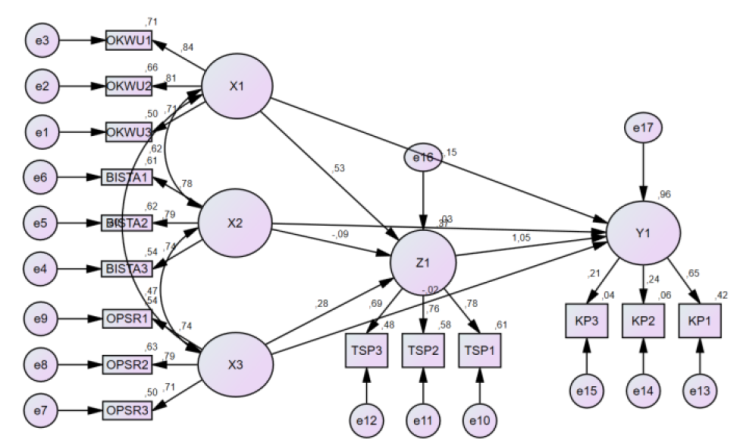
Based on the results of the model conformity test, there are only two criteria met, namely the RMSEA and RMR criteria. Furthermore, this study made improvements to the research model by correlating errors in modification indices. Based on these improvements, the fit model shown in Table 4 was obtained.
Table 4 Model conformity improvements
| Criterion | Cut Off Value | Test Results | Information |
|---|---|---|---|
| CMIN/DF | < 2 | 1.028 | Fit |
| Sig. Probability | ≥ 0.05 | 0.413 | Fit |
| RMSEA | ≤ 0.08 | 0.014 | Fit |
| GFI | ≥ 0.90 | 0.941 | Fit |
| AGFI | ≥ 0.90 | 0.901 | Fit |
| RMR | ≤ 0.05 | 0.025 | Fit |
| TLI | ≥ 0.95 | 0.996 | Fit |
| CFI | > 0.95 | 0.998 | Fit |
Source: Own elaboration
Table 4 shows that all criteria have been fit, thus the improved research model has met the overall conformity criteria of the SEM model.
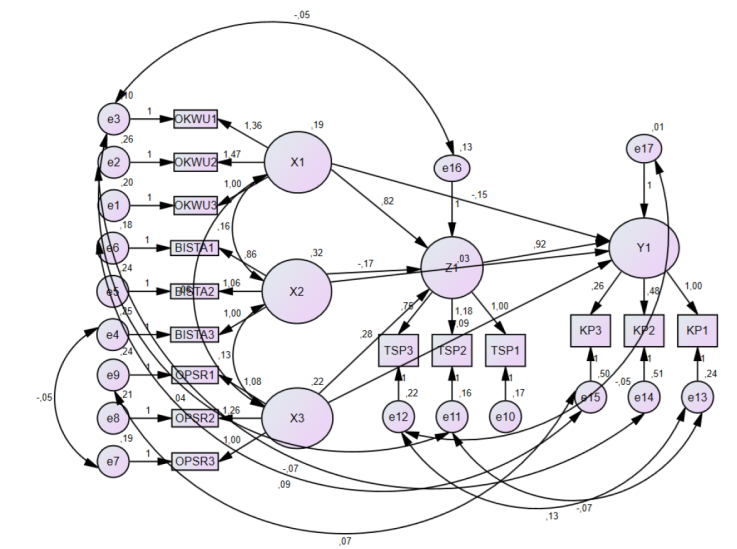
Causality test
Table 5 Causality test
| Estimate | S.E. | C.R. | P | Information | |||
|---|---|---|---|---|---|---|---|
| Z1 | ← | X1 | 0.815 | 0.195 | 4.187 | *** | Accepted |
| Z1 | ← | X2 | -0.173 | 0.145 | -1.193 | 0.233 | Rejected |
| Z1 | ← | X3 | 0.280 | 0.126 | 2.230 | 0.026 | Accepted |
| Y1 | ← | X1 | -0.149 | 0.203 | -0.732 | 0.464 | Rejected |
| Y1 | ← | X2 | 0.250 | 0.137 | 0.185 | 0.853 | Rejected |
| Y1 | ← | X3 | -0.089 | 0.138 | -0.649 | 0.516 | Rejected |
| Y1 | ← | Z1 | 0.917 | 0.203 | 4.519 | *** | Accepted |
Source: Own elaboration
After testing the suitability of the research model, the next step is to test the causality developed in this study. The causality test is used to examine the influence of each hypothesis proposed, namely the influence between exogenous variables, namely entrepreneurial orientation (X1), business strategy (X2), and market orientation (X3) on endogenous, namely, Technical Marketing Strategy (Z) and Company Performance (Y).
The direct influence between variables
In research, the relationship of direct influence occurs between exogenous latent variables consisting of business strategy (X1), market orientation (X2), and source attractiveness (X3), with endogenous variables, namely Technical Marketing Strategy (Z), and endogenous latent variables, namely company performance (Y). A summary of the direct effects of these variables can be seen in Table 6.
Table 6 The direct influence between variables
| Direct influence | Technical marketing strategies (Z) | Company performance (Y) |
|---|---|---|
| Entrepreneurial orientation (X1) | 0.705 | -0.152 |
| Business strategy (X2) | -0.194 | 0.034 |
| Market orientation (X3) | 0.257 | -0.097 |
| Technical marketing strategies (Z) | - | 1.082 |
Source: Own elaboration
Based on Table 6 it can be known the value of the direct influence of the variables entrepreneurial orientation (X1), business strategy (X2), and market orientation (X3) on Technical Marketing Strategy (Z), as well as for the direct influence of Technical Marketing Strategy (Z) on company performance (Y). The largest direct influence was on the entrepreneurial orientation variable (X3) with a value of 0.705. So, it can be concluded that Technical Marketing Strategy is influenced by entrepreneurial orientation variables (X1) of 0.705, business strategy (X2) of -0.194, and market orientation of 0.257. While the company's performance is influenced by marketing strategic technical variables of 1, 082.
The indirect influence between variables
An indirect influence relationship occurs between exogenous latent variables consisting of entrepreneurial orientation (X1), business strategy (X2), and market orientation (X3), with endogenous variables, namely Technical Marketing Strategy (Z), and endogenous latent variables, namely company performance (Y). Based on Table 7, it can be known the value of the indirect influence of the variables entrepreneurial orientation (X1), business strategy (X2), and market orientation (X3) on company performance (Y) through Technical Marketing Strategy (Z). So, it can be concluded that the company's performance is indirectly influenced by entrepreneurial orientation (X1) of 0.762, business strategy (X2) of -0.210, and market orientation (X3) of 0.278. If the indirect influence of business strategy variables (X1), market orientation (X2), and resource attractiveness (X3) on company performance (Y) is greater in its directness, then the Technical Marketing Strategy variable (Z) acts as mediation. Based on the results of the analysis, show that the value of indirect influence on business variables, strategy, and market orientation is greater than the direct influence on company performance, so it can be concluded that Technical Marketing Strategy variables act as mediating variables on the influence of business strategy, market orientation, and source attractiveness on company performance.
The total influence between variables
Total influence is an influence caused by various relationships between variables both directly and indirectly. A summary of the direct influence of research variables can be seen in Table 8.
Table 8 The total influence between variables
| Total influence | Technical marketing strategies (Z) | Company performance (Y) |
|---|---|---|
| Entrepreneurial orientation (X1) | 0.705 | 0.611 |
| Business strategy (X2) | -0.194 | -0.176 |
| Market orientation (X3) | 0.257 | 0.181 |
| Technical marketing strategies (Z) | - | 1.082 |
Source: Own elaboration
Based on the total influence, it can be seen that the largest total influence value on company performance is in the marketing strategic technical variable with a value of 1,082. This explains if Technical Marketing Strategy is an important variable in improving company performance. Thus, companies to improve their performance need to improve their marketing strategic techniques.
Sobel test
The Sobel test is used to test the significance of the mediating role. The t-test results of the Sobel test were compared with the T Table value in this study, which was 1.65 in a sample of 150. Then, if the calculated T value obtained from the Sobel test is greater than T Table, it can be indicated that there is a mediation influence, and vice versa. The Sobel test of this study was measured by the following formula.
The Sobel test results are described in Table 9 below.
Table 9 Sobel test
| Estimate | S.E. | Sobel test result | |||
|---|---|---|---|---|---|
| Z | ← | X1 | 0.815 | 0.195 | 3.060 |
| Z | ← | X2 | -0.173 | 0.145 | -1.115 |
| Z | ← | X3 | 0.280 | 0.126 | 1.990 |
| Y1 | ← | Z | -0.917 | 0.203 |
Source: Own elaboration
The results of the Sobel test on the effect of entrepreneurial orientation (X1) on company performance (Y1) through Technical Marketing Strategy show that Technical Marketing Strategy is a significant mediation. This can be seen from the Sobel test value (3.06) which is greater than the T Table value (1.65). In the second variable, the role of Technical Marketing Strategy (Z) as a mediator of the influence of business strategy (X2) on company performance (Y2) was found not to be a significant mediation with a Sobel test value of -1.15 which is smaller than the table T value (1.65). As for the market orientation variable, Technical Marketing Strategy is also a significant mediation with a Sobel test value of 1.99.
Discussion
This research develops a synthesis of new concepts, namely Technical Marketing Strategy as a mediating of the influence of entrepreneurial orientation, business strategy, and market orientation on company performance. Technical marketing strategy is taken from the premise of a competitive advantage which emphasizes the importance of establishing a strategy that can distinguish our company from competing companies. Theoretical study Entrepreneurial orientation is a level of a corporate phenomenon that shows a process, practice, and decision-making activity that will lead the company to become a leader in entering a new business (Kroeger et al., 2007). Market Orientation is one of the proven marketing concepts if implemented well in the organization, and will be one of the main capabilities needed to achieve sustainable competitive advantage (Hult et al., 2004).
Table 10 Research hypothesis
| Research hypothesis | Result |
|---|---|
| H1: Entrepreneurial orientation has a significant effect on technical marketing strategy. | Accepted |
| H2: Entrepreneurial orientation has a positive effect on company performance. | Only partially accepted because even though is proven to have influence and help explain business performance, their relationship is not direct |
| H3: Business strategy has a significant effect on technical marketing strategy. | Rejected |
| H4: Business strategy has a significant effect on company performance. | Rejected |
| H5: Market orientation has a significant effect on technical marketing strategy. | Accepted |
| H6: Market orientation has a significant effect on company performance. | Only partially accepted because even though is proven to have influence and help explain business performance, their relationship is not direct |
| H7: Entrepreneurial orientation and market orientation have a significant effect on company performance through technical marketing strategies. | Accepted |
Source: Own elaboration
Furthermore, it is explained that market orientation can provide the needs of the company by focusing on three things, namely: first, efforts to understand what is needed by consumers, both expressive and latent needs; second, efforts to understand competitors; and third, efforts to create coordination between functions in the organization aimed at generating synergy of organizational resources (Slater & Narver, 1994a). Innovation indicates an organization's tendency to engage in and support new ideas, novelty, experimentation, and creative processes that can result in new products, services, or technological processes (Dess & Lumpkin, 1996). This study not only explores the mediating impact of technical marketing strategy on entrepreneurial orientation, digital business, and market orientation variables; but it is also one of the first studies to explore the direct relationship between them. Similarly, this study examines a direct relationship with a new proportion of technical marketing strategies that have never been explored before.
Conclusions
The practical implications of this study lie in entrepreneurial orientation in MSMEs in the Coordinating Board for Regions II and III, East Java Province. Entrepreneurship is the creation and invention of business followed by the courage to take risks and requires calculated action in executing an opportunity and overcoming an obstacle to success. Entrepreneurial orientation plays an important role in improving business performance. So MSME managers must improve entrepreneurial orientation through the creation of innovation, proactivity, and risk-taking in starting or managing a business that is run.
In addition, MSMEs also need to pay attention to market orientation so that they can improve the implementation of technical marketing strategies. As well as the importance of technical marketing strategy to the performance of a company. This can be done by paying attention to the results of decision-making that have been done in accordance (accuracy) with circumstances or plans, having an extensive network to introduce products, and the results that are owned are very useful for business development so far. Thus, MSMEs need to implement company technical strategies to improve company performance.
The results of this study have some limitations, but the existing limitations can be used as reference material and have implications for the development of science. Some limitations and obstacles in conducting this research are: This research was conducted in MSMEs in Coordinating Board for Regions II and III, East Java Province; The distribution of research questionnaires using Google Forms allows respondents who do not include predetermined criteria to also fill out questionnaires.

