




 nueva página del texto (beta)
 Inglés (pdf)
 Artículo en XML
 Referencias del artículo
 Traducción automática
 Enviar artículo por email
 Citado por SciELO
  Similares en
SciELO
Similares en
SciELO 
 Permalink
Introduction
Social media on the Internet is enhancing, attracting, and educating healthcare consumers and providers. Although consumers use wikis, video sharing, personal blogs, and other social media for emotional support, they also rely heavily on them to manage their health. Social media represents a beautiful new world of healthcare. It provides a platform for individuals to communicate quickly, easily, widely, and cheaply (Pillai, 2012). Social media is considered one of the most popular channels healthcare practitioners use to communicate with the public, spread knowledge, and promote health (Komodromos et al., 2021). Promotion using social media advertising may act as a catalyst when encouraging others to share content and increase reach. It might be a helpful tool to reach places that peer-to-peer channels cannot. There will inevitably be more rapid improvements in patient care, more so when medical publishers better understand how to target audiences with social media advertising (Johannsson & Selak, 2019). One of the most challenging tasks for social media advertising is to motivate people to change their unhealthy ways-or to avoid making unhealthy choices in the first place (Wolburg, 2019).
Since 1995, several studies have been conducted to examine and complement the representation of the perceived value of advertising to consumers, in our case the health care tool against chronic and pandemic diseases. In other words, the effect of social media advertising (SMAV) is a useful communication tool to make the public aware of the target audience (Ducoffe, 1996), composed here by credibility (CRD), irritation (IRR), informativeness (INF), people attitude (ATT) and advertising value (ADV).
On the other hand, we have the people self-efficacy (SEF) related to SMAV as a person’s perceived ability to reach desired outcomes in the social media environment and examine how people evaluate online advertising information.
Therefore, the research value and originality of this research is the contribution to both the theory of social media advertising value (SMAV) by Ducoffe (1995) and the self-efficacy (SEF) by Bandura (1997) updated with other factors to the XXI century needs as a tool of health care tool against the chronic and pandemic diseases.
Thereby is undertaken an analysis of such SEF-SMAV construct being complemented with additional factors such as self-efficacy (SEF), public level risk perception (RSK), public protection perception (PRT), people sentiment (SEN), and people motivation (MTV).
The Social Media Advertising Value (SMAV)
The concept of advertisement value has been proposed by Ducoffe (1995) to assess the advertisement's effectiveness. The advertising value is defined as the "utility or worth of the advertisement." Indeed, it "may serve as an index of customer satisfaction with the communication products of the organization." it was also defined as "a subjective evaluation of the relative worth or utility of advertising to consumers" (Ibidem).
During the last years, the technology based on social media has been a notorious rise, and massive spread and usage (El-Haddadeh et al., 2012). In fact, for the promotion mix social media is a hybrid element because it enables companies to talk to their customers, in a traditional sense while it enables customers to talk directly to one another in a non-traditional sense (Mangold & Faulds, 2009). According to Statista (2021), the social media advertising represents revenue in the USA for Facebook (29.9 BUSD), Instagram (9.45 BUSD); Linkedin (1.39BUSD); Pinterest (1BUSD): Snapchat (0.92 BUSD); Twitter (1.57 BUSD); the rest (1.23 BUSD).
Thereby, the advertising value model proposed by Ducoffe (1996) was adapted as social media advertising value (SMAV) in an empirical model and used in several type of research since social media like attitude towards web advertising (Aktan et al., 2016), Twitter (Murillo et al., 2016), Facebook (Hamouda, 2018), Instagram (Arya & Kerti, 2020) until political advertising value on attitude (Mohd & Syamsul, 2020) or the food industry (Elahi & Divsalar, 2020) probing its usefulness. The perceived value of advertising helps to form positive opinions about different characteristics of advertisements. The SMAV has been one of the most effective and widely used theories for understanding and determining consumer attitudes and perceptions towards advertising (Murillo et al., 2016), keeping constant contribution (Arora & Agarwal, 2019).
The SMAV framework adapted here is based on:
Credibility (CRD). Many studies have concluded that people will be more persuaded by messages associated with a credible (versus noncredible) source. Individuals often place greater value on alternate and more credible sources of information when making transactions, implying that deceptiveness negatively influences advertising value (Ducoffe, 1996). Credibility is typically defined as a message source's motivation or ability to provide truthful and accurate information (Nan, 2013) being attractive, believable, and convincing, especially for celebrities and internet influencers (Hussain et al., 2020; Weismueller et al., 2020).
Irritation (IRR). Several studies have demonstrated that the main reasons people criticize advertising are related to annoyance or irritation. When advertising employs techniques that annoy, offend, insult or are overly manipulative, consumers are likely to perceive it as an unwanted and irritating influence; irritation undermines advertising value (Ducoffe, 1996). It can adversely influence attitudes toward the ad, brand, and purchase intention. Irritated viewers are highly likely to avoid commercials by clicking the skip-ad button with a reduction in advertising effectiveness (Jeon et al., 2019).
Informativeness (INF). It is defined as the "what is said" of an advertisement and it is one of the main reasons why people value traditional advertising (Ducoffe, 1995), with great potential in the internet version, the online advertising (Ducoffe, 1996), as well as in social media; (Ducoffe, 1995). Indeed, more informative brands posts (non-paid) more popular (De Vries et al. 2012). It is possible that encountering advertising with an open mind leads to greater processing of ad content and therefore higher appreciation of its informational benefits. Prior studies that find that seeking information on the Internet relates to higher perceived ad informativeness would support this prediction (Noguti & Waller, 2020).
People Attitude (ATT). When consumers are questioned, however, their criticism is generally directed at the tactics advertisers employ rather than the institution's mission, toward which attitudes are more favorable than unfavorable (Ducoffe,1996). Advertising perception is the input of an advertising attitude, an essential issue in the necessary components of the brand's attitude, and the right to succeed in the market's testing situation (Mejía-Trejo, 2021)
Advertising Value (ADV). It is conceived as a representation of the perceived value of advertising to consumers; it is a subjective evaluation of the relative worth or utility of advertising to consumers. It is the "what I want in an advertisement" like "low price, quality I get for the price I pay, or what I get for what I give." According to the information technology advancement, consumers may increasingly pay for advertising they desire and screen out the rest (Ducoffe, 1995). Furthermore, advertising value elicits customer inspiration (Abbasi et al., 2020) based on high perception through social media (Ying et al., 2020).
Self-Efficacy (SEF)
The term "self-efficacy" was first coined by Bandura (1997), and it is defined as a person's particular set of beliefs that determine how well one can execute a plan of action in prospective situations. Self-efficacy is a person's belief in their ability to succeed in a particular situation. It states that individuals develop their self-efficacy beliefs by interpreting information from four main sources of influence that Bandura (1997) called: "mastery experience." It is the most influential source interpreted because of one's previous performance. The "social role models (vicarious experience)" involve observing other people successfully completing a task. When one has positive role models in their life (especially those who display a healthy level of self-efficacy) - one is more likely to absorb at least a few of those positive beliefs about the self. A person's "emotional and psychological states" can influence how they feel about their abilities in a particular situation. People who have a high sense of efficacy are likely to view their state of affective arousal as an energizing facilitator of performance.
In contrast, those who are best by self-doubts regard their arousal as a debilitator. Finally, "social persuasion" when the individual receiving positive verbal feedback while undertaking a complex task persuades a person to believe that they have the skills and capabilities to succeed. High self-efficacy has been linked with numerous benefits to daily life, such as resilience to adversity and stress, healthy lifestyle habits, improved employee performance, educational achievement (López-Garrido, 2020), optimism, and resilience (Tayseer et al., 2021).
Based on the SMAV construct, we posed a path between people's attitudes (ATT) to self-efficacy (SEF). This is because ATT plays an essential role in mediating it (Wardana et al., 2020) towards the people's mindset. The other path is advertising value (ADV) to self-efficacy (SEF) because of its decisional balance for changing exercise behavior (Berry & Howe, 2005). Hence, we have the following hypotheses:
Complementing the SMAV framework
Due to self-efficacy (SEF) is the central factor of this research, we posed the following factors that complement the SMAV framework to be related as public level risk perception (RSK), public protection perception (PRT), people sentiment (SEN), and people motivation (MTV), as follows:
Public Level Risk Perception (RSK).
There is increasing attention to how social media mechanisms affect risk perception and preventive behaviors during infectious disease outbreaks (Oh et al., 2021). A particular type of emergency risk communication is infectious disease communication vital to public health and safety (Toppenberg-Pejcic et al., 2019). The serious difficulty of infectious disease communication results from high uncertainty about the exact route of contamination, treatment, and recovery in an outbreak's initial stage (Lin et al., 2016). In this sense, social media appears as first-hand information channels where the public can obtain disease-related information and exchange it with their friends, neighbors, family, and acquittances in real-time, during recent infectious disease outbreaks (Jang & Paek, 2019). The question of how social media use might affect the public's risk perception, affective responses, and preventive behaviors has yet to be fully explored (Oh et al., 2021). For infectious disease outbreaks, theoretical studies aimed to research the public's reactions are limited. However, perception of risk was found inversely associated with self-efficacy in a study on a previous epidemic, avian influenza: the higher the self-efficacy, the lower the perception of risk (De Zwart et al., 2007). In turn, perception of risk and self-efficacy influence the engagement in precautionary actions during outbreaks (Cori et al. 2020). Hence, we posed the following hypothesis:
H3: "SEF contributes negatively on RSK"
Public Protection Perception (PRT). Social media campaigns have an important role in public awareness and protection against chronic and pandemic diseases. Social media platforms have been demonstrated to influence awareness of public health behavioral changes positively. Public health authorities may use social media platforms as an effective tool to increase public health awareness by disseminating brief messages to targeted populations (Al-Dmour et al., 2020). Social media and TV advertisements are important mediums to communicate regarding the spread of any infectious disease and methods to prevent its spread (Misra et al., 2018). Because of its probed importance, this factor is considered in the framework. Thereby, we posed the following hypothesis:
H4: "SEF contributes positively on PRT"
People Sentiment (SEN). Sentiments are the conscious form of emotions: they have a more rational component. Sentiments are present in social media advertisements, classified as positive, neutral, and negative (Goswami et al., 2019). There is evidence about relationships among sentiments with social media use, risk perception, and preventive behavior's by examining self-relevant emotions: fear, anger, sadness, and happiness, demonstrating that social media use is related to the sentiments and to the public's risk perception (Oh et al., 2015) increasing desirable preventive behaviors (Paek et al., 2016). Current risk theories tell us which points to consider when creating messages that ask for behavior modifications. Most messages that communicate risk do so by arousing a certain level of fear (Wolburg, 2019). Here, discarding neutral reactions, we expect that a sentiment based on a negative emotional reaction (anger, fear, or sadness) or a positive emotional reaction (happiness) to trigger the preventive behavior (Mejía-Trejo, 2021). Hence, we proposed the following hypothesis:
H5: "SEF contributes positively on SEN"
People Motivation (MTV). Finally, according to Antheunis (et al., 2013), we proposed 13 main patient motives for health-related social media use, involving five categories: "increasing knowledge," "efficiency in doctor-patient communication," "social support," "exchange advice," and "self-care." All these items have been considered very important to incorporate in the framework due to how they are focused in the following hypothesis:
H6: "SEF contributes positively on MTV"
See Figure 1.
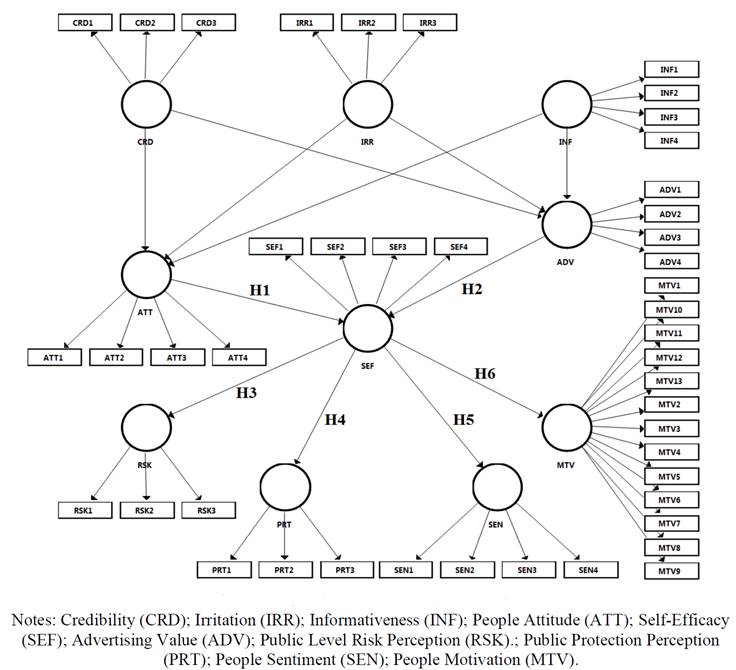
Designing the framework
Because we considered that the items are interchangeable, we posed reflective specification since they (hypothetically) represent the construct equally (as against related to the formative constructs, when dropping an indicator may change the meaning of that construct) (Hair et al., 2019b).
Finally, Table 2 displays 45 indicators that describe the 10 factors of the framework related to the authors that support them.
Table 1 Research sample demographic profile
| Measure | Items | Frequency | Percentage (%) |
|---|---|---|---|
| Age | <18 | 3 | 1 |
| 18-29 | 300 | 60 | |
| 30-39 | 92 | 18 | |
| 40-49 | 45 | 9 | |
| 50-59 | 49 | 10 | |
| >60 | 11 | 2 | |
| Total | 500 | 100 | |
| Gender | Female | 250 | 50 |
| Male | 250 | 50 | |
| Total | 500 | 100 | |
| Marital Status | Single | 120 | 24 |
| Couple | 380 | 76 | |
| Total | 500 | 100 | |
| Education Level | High-School | 90 | 18 |
| Undergraduate | 280 | 56 | |
| Postgraduate | 130 | 26 | |
| Total | 500 | 100 | |
| Monthly Income (pesos) | < =8,999 | 242 | 48 |
| 9000-15,999 | 91 | 18 | |
| 16,000-20,999 | 36 | 7 | |
| 21,000-26,999 | 27 | 5 | |
| 27,000-31,999 | 24 | 5 | |
| 32,000-38,999 | 14 | 3 | |
| 39,000-46,999 | 27 | 5 | |
| 47,000-58,999 | 15 | 3 | |
| 59,999-77,999 | 17 | 3 | |
| >78,000 | 7 | 1 | |
| Gran Total | 500 | 100 | |
Source: Own
Table 2 The measurement model internal consistency reliability, significance, and variance assessment as convergent validity
|
|
Outer Loadings (p-value) | Author | ||
|---|---|---|---|---|
| No. | Item |
|
||
| 1 | CRD1 | I think it is trustworthy. | 0.912 (0.000) | Ducoffe, (1995); Nan, (2013); Aktan, (et al., 2016); Arora, & Agarwal (2019); Mohd & Syamsyul, (2020); Hussain (et al., 2020); Weismueller (et al., 2020). |
| 2 | CRD2 | I think it is believable. | 0.918 (0.000) | |
| 3 | CRD3 | I think it is convincing. | 0.896 (0.000) | |
|
|
Outer Loading (p-value) | Author | ||
| No. | Item |
|
||
| 4 | IRR1 | I think it is irritating. | 0.856 (0.000) | Ducoffe, (1995); Aktan, (et al., 2016); Arora & Agarwal (2019); Jeon (et al., 2019); Mohd & Syamsyul, (2020) |
| 5 | IRR2 | I think it is too much advertising. | 0.848 (0.000) | |
| 6 | IRR3 | I think it insult people's intelligence. | 0.774 (0.000) | |
|
|
Outer Loading (p-value) | Author | ||
| No. | Item |
|
||
| 7 | INF1 | I think is a good source of information. | 0.880 (0.000) | Ducoffe, (1995); Aktan, (et al., 2016); Arora & Agarwal (2019); Mohd & Syamsyul, (2020); Noguti & Waller (2020) |
| 8 | INF2 | I think it supplies relevant information. | 0.890 (0.000) | |
| 9 | INF3 | I think it provides timely information. | 0.889 (0.000) | |
| 10 | INF4 | I tend to see a lot of social media advertising about disease prevention for public health (e.g., COVID-19, dengue, chikungunya, obesity, diabetes, high blood pressure, cholesterol, etc.). | 0.516 (0.000) | |
|
|
Outer Loading (p-value) | Author | ||
| No. | Item |
|
||
| 11 | ATT1 | I think it helps me to find information that match my personality and interests. | 0.824 (0.000) | Ducoffe, (1995); Aktan, (et al., 2016); Arora & Agarwal (2019); Mohd & Syamsyul, (2020); Mejía-Trejo (2021) |
| 12 | ATT2 | I am willing to engage with the advertising. | 0.857 (0.000) | |
| 13 | ATT3 | I think it is a good way to learn about the diseases and their scope. | 0.810 (0.000) | |
| 14 | ATT4 | I am willing to receive the advertising in the future. | 0.802 (0.000) | |
|
|
Outer Loading (p-value) | Author | ||
| No. | Item |
|
||
| 15 | ADV1 | I think it is useful. | 0.878 (0.000) | Ducoffe, (1995); Aktan, (et al., 2016); Arora & Agarwal (2019); Mohd & Syamsyul, (2020) |
| 16 | ADV2 | I think it is valuable. | 0.934 (0.000) | |
| 17 | ADV3 | I think it is important. | 0.900 (0.000) | |
| 18 | ADV4 | I think it is ethics. | 0.829 (0.000) | |
|
|
Outer Loading (p-value) | Author | ||
| No. | Item |
|
||
| 19 | SEF1 | Because I receive positive verbal feedback about the clarity of the information I believe that I can identify misinformation by myself.(Social persuasion) | 0.708 (0.000) | Bandura (1997); López-Garrido (2020) |
| 20 | SEF2 | Because I observed previously, I believe that I can identify my symptoms by myself (Vicarious Experience) | 0.822 (0.000) | |
| 21 | SEF3 | When I am feeling healthy, I believe that I can identify my cure. (Emotional and physiological state) | 0.659 (0.000) | |
| 22 | SEF4 | Because I experienced that situation, I believe that I can strictly follow the instructions and protocols (e.g., wash my hands, use of mask, use of sanitizers, not go to public spaces, avoid mosquitos, etc.) (Mastery Experience) | 0.739 (0.000) | |
|
|
Outer Loading (p-value) | Author | ||
| No. | Item |
|
||
| 23 | RSK1 | Are very serious to me. | 0.873 (0.000) | Lin (et al., 2016); Jang & Paek (2019); Toppenberg-Pejcic (et al., 2019); Oh (et al. 2020) |
| 24 | RSK2 | Makes me think that is likely I would be affected by them. | 0.877 (0.000) | |
| 25 | RSK3 | Makes me think that is very dangerous be affected by them. | 0.880 (0.000) | |
|
|
Outer Loading (p-value) | Author | ||
| No. | Item |
|
||
| 26 | PRT1 | To protect me from disease prevention for public health. | 0.924 (0.000) | Misra (et al., 2018); Al-Dmour (et al. 2020) |
| 27 | PRT2 | To protect others from disease prevention for public health. | 0.947 (0.000) | |
| 28 | PRT3 | In educating others about disease prevention for public health. | 0.943 (0.000) | |
|
|
Outer Loading (p-value) | Author | ||
| No. | Item |
|
||
| 29 | SEN1 | I feal fear. | 0.900 (0.000) | Oh (et al., 2015); Paek (et al., 2016); Goswami (et al., 2019); Wolburg (2019); Oh (et al. 2020); Mejía-Trejo (2021) |
| 30 | SEN2 | I feal anger. | 0.618 (0.000) | |
| 31 | SEN3 | I feel sadness. | 0.895 (0.000) | |
| 32 | SEN4 | I feel happiness. | Removed. Problems with AVE | |
|
|
Outer Loading (p-value) | Author | ||
| No. | Item |
|
||
| 33 | MTV1 | Increasing knowledge. | 0.750 (0.000) | Antheunis (et al. 2013) |
| 34 | MTV2 | Doctor-Patient communication. | 0.710 (0.000) | |
| 35 | MTV3 | Social support. | 0.785 (0.000) | |
| 36 | MTV4 | Exchange advice. | 0.814 (0.000) | |
| 37 | MTV5 | Self-care. | 0.761 (0.000) | |
| 38 | MTV6 | Stay updated on the new developments in healthcare. | 0.816 (0.000) | |
| 39 | MTV7 | Increase my knowledge on my disease. | 0.818 (0.000) | |
| 40 | MTV8 | Express my emotions on my disease or health. | 0.697 (0.000) | |
| 41 | MTV9 | To compare myself with other patients. | 0.610 (0.000) | |
| 42 | MTV10 | Share my experience on my disease and its treatment. | 0.686 (0.000) | |
| 43 | MTV11 | Update others on my current health situation. | 0.611 (0.000) | |
| 44 | MTV12 | Give advice to other patients/get advice from other patients. | 0.651 (0.000) | |
| 45 | MTV13 | Know news about the world/region. | 0.733 (0.000) | |
Notes:
• CRI. Composite Reliability Index. Values 0-1.
• rho_A. Values between 0.6-0.7 are acceptable in exploratory research, 0.7-0.9 reflect satisfactory to good results (Hair et al., 2019). Values >0.95 suggest that the indicators could be measuring the same phenomenon and they are semantically redundant (Hair et al., 2019; Drolet & Morrison, 2001) with a potential common bias, this is, the variation is from the instrument not by respondents (Straub et al., 2004).
• AVE. Average Variance Extracted Index. >0.5 suggests that more than 50% of the construct represents the items variance (Fornell & Larcker, 1981).
• Indicators are according to Likert Scale 1-7: using Likert Scale 1-7 (1. Strongly disagree; 2. Disagree; 3. Somewhat disagree; 4. Neither agree or disagree; 5. Somewhat agree; 6. Agree; 7. Strongly agree). This type of scale provides a balance between the respondents' complexity and the ease of analysis of the information (Hair et al., 2019).
Source: Own adaptation and using SmartPLS 3.3.3. software
Methodology
It is designed in 4 steps, described as follows:
Stage 1. It was based on a literature review to determine state of the art in terms of social media advertising value (SMAV) and self-efficacy of the online users (SEF) as the main constructs. They complement other factors and indicators, considering the consequences of the prolonged emergency closure due to COVID-19. The final framework is composed by self-efficacy (SEF) factor related to 5 SMAV factors: credibility (CRD); irritation (IRR); informativeness (INF); people attitude (ATT), and advertising value (ADV), and other 4 complementary factors such as public level risk perception (RSK); public protection perception (PRT); people sentiment (SEN); people motivation (MTV). All the framework totalizes 45 indicators. See Table 3.
Table 3 Measurement model discriminant validity
| Fornell-Larcker Criteria (Diagonal= Root Square -AVE-) for discriminant validity | ||||||||||
|---|---|---|---|---|---|---|---|---|---|---|
| Factors | [1] | [2] | [3] | [4] | [5] | [6] | [7] | [8] | [9] | [10] |
| [1] ADV | 0.886 | |||||||||
| [2] ATT | 0.579 | 0.824 | ||||||||
| [3] CRD | 0.774 | 0.583 | 0.909 | |||||||
| [4] INF | 0.673 | 0.548 | 0.604 | 0.81 | ||||||
| [5] IRR | -0.378 | -0.193 | -0.192 | -0.312 | 0.827 | |||||
| [6] MTV | 0.437 | 0.49 | 0.336 | 0.364 | -0.26 | 0.73 | ||||
| [7] PRT | 0.621 | 0.609 | 0.526 | 0.502 | -0.315 | 0.419 | 0.938 | |||
| [8] RSK | 0.563 | 0.606 | 0.506 | 0.519 | -0.174 | 0.506 | 0.56 | 0.877 | ||
| [9] SEF | 0.516 | 0.517 | 0.491 | 0.438 | -0.134 | 0.393 | 0.565 | 0.505 | 0.734 | |
| [10] SEN | 0.056 | 0.295 | 0.079 | 0.118 | 0.218 | 0.168 | 0.143 | 0.297 | 0.098 | 0.815 |
| HTMT Ratio<= 0.85<=0.90 for convergent validity | ||||||||||
| Factors | [1] | [2] | [3] | [4] | [5] | [6] | [7] | [8] | [9] | [10] |
| [1] ADV | ||||||||||
| [2] ATT | 0.645 | |||||||||
| [3] CRD | 0.858 | 0.664 | ||||||||
| [4] INF | 0.769 | 0.658 | 0.701 | |||||||
| [5] IRR | 0.454 | 0.237 | 0.232 | 0.381 | ||||||
| [6] MTV | 0.456 | 0.545 | 0.358 | 0.405 | 0.288 | |||||
| [7] PRT | 0.674 | 0.677 | 0.576 | 0.571 | 0.371 | 0.436 | ||||
| [8] RSK | 0.634 | 0.701 | 0.575 | 0.63 | 0.201 | 0.567 | 0.621 | |||
| [9] SEF | 0.626 | 0.666 | 0.607 | 0.568 | 0.24 | 0.459 | 0.684 | 0.637 | ||
| [10] SEN | 0.142 | 0.339 | 0.092 | 0.203 | 0.425 | 0.206 | 0.169 | 0.318 | 0.166 | |
Note: HTMT. It ensures that different constructs capture different concepts. The cut-off value is 0.90 if the constructs are conceptually similar); a more conservative cut-off value is 0.85 (Henseler, et al., 2015). Bootstrapping ensures that HTMT results are statistically significantly different from 1.0 because cut-off values have a high likelihood of falsely rejecting discriminant validity and are very conservative (i.e., Type II error) (Franke & Sarstedt, 2019)
Source: Own using SmartPLS 3.3.3 software
Stage 2. The survey data was applied to 500 Mexican consumers (Sep-Nov, 2021) according to age, gender, marital status, education, monthly income, Mexico’s state (see Table 1), and the period considered as the next normal times (period after COVID-19 pandemic in Mexico).
Stage 3. We contribute with an entire solid empirical reflective framework proposal analyzed with Partial Least Squares Structural Equation Modeling (PLS-SEM) using SmartPLS 3.3.3 software. This PLS-SEM determines the outer loading and tests the framework's reliability with convergent and discriminant validities (seeTables 2 and 3). Here, only one combination of underlying factors and indicators (items) are obtained according to their outer loading obtained through the SEF-SMAV framework.
Stage 4. Once proved the outer loading and tested the framework's reliability with convergent and discriminant validities, the datasets are analyzed to explain how the factors and indicators are interrelated and it is assessed the SEF-SMAV framework explanatory capabilities.
Stage 5. Result analyses, discussion, and conclusions.
Demographic data
According to the results obtained from the frequency analysis of 500 Mexican consumers (Sep-Nov, 2021), the most important data of the participants were: 300/18-29 years old (60%); 250 female and 250 female (50% /50%), 380 couple (76%), 280 undergraduate education (56%), 242 with monthly income less than 9,000 pesos (48%).
Participants were invited to answer the questionnaire via e-mail via google forms (see Table 2), explaining the scope to encourage them and collect their opinions. Participation was voluntary and confidential; no rewards were provided. Therefore, the sample is considered representative of social media online users in Mexico. See Table 1.
Sampling
The critical discussion of applications sample size technique involves how large a sample is needed to produce reliable results. Despite PLS-SEM is not affected by the sample size (Kock & Hadaya, 2018), here we adopt the basic criterion of covariance-based structural equation modeling (CB-SEM), the rule of thumb for sample size (Hair et al., 2019). This is 10 times the number of arrows pointing at a construct, whether as a formative indicator to a construct or a structural path to an endogenous construct. In our case 45 indicators x 10 times= 450. The 500 Mexican consumers sample (Sep-Nov, 2021) fulfill this condition widely.
PLS-SEM analysis technique
PLS-SEM is a component-based approach estimation differing from the CB-SEM to structural equation modeling. PLS-SEM fits a composite model, maximizing the variance explained on how this goal might be accomplished. The PLS-SEM is composed of the "measurement model" representing the observed data and the underlying factor relationships, and the "structural model" showings the relationships between the underlying factors (Henseler et al., 2012; Hair et al., 2017).
The "structural equation" model is solved by an iterative algorithm estimating the underlying factors through "measurement model" and "structural model" in alternating steps or partial. The "measurement model" calculates the underlying factors as a weighted sum of its manifest factors. Through simple or multiple linear regression between the underlying factors estimated by the "measurement model" is how the "structural model" computes the underlying factors.
Until convergence is achieved, this algorithm repeats itself. PLS-SEM analyzes, explores, and tests the established and underlying conceptual models and theory being preferable over CB-SEM when it is unknown whether the data's nature is a common factor or composite-based (Henseler et al., 2012; Hair et al., 2017).
Results
We have reflective constructs (mode A) (Hair et al., 2017) into the framework: that are assessed, as follows:
The measurement model internal consistency reliability, significance, and variance assessment as convergent validity
They were computed according to SmartPLS 3.3.3 software, with values per factor, of Cronbach´s alpha (>=0.7) (Hair et al.,2017), of rho_A index (>=0.7) (Dijkstra & Hanseler, 2015), of composite reliability index (CRI) (>=0.7), and average extracted variance index (AVE) (>=0.5) (Hair et al., 2017). For internal consistency reliability, Cronbach’s alpha is referred as the lower bound being the composite reliability the upper bound. The indicator’s outer loadings should be > 0.70.
The indicators between 0.40-0.70 as outer loadings are for removal only such action leads to an increase in composite reliability and AVE above the suggested threshold value (Hair et al., 2017). Convergent validity is measured AVE, which is the grand mean value of the squared loadings of the indicators associated with the construct (Fornell & Larcker, 1981).
Therefore, we had to remove SEN4 to adjust AVE, achieving all the indexes mentioned above. Hence, the framework fulfills the reliability and convergence validity required. See Table 2.
The measurement model discriminant validity
It was computed with SmartPLS 3.3.3 software. It points to if an underlying factor is measuring a different construct and the degree to which indicators show an example of the target construct. It was calculated according to the traditional discriminant validity assessment method, which requires all relationships between constructs to be less than the lowest of the AVE’s square root values. (Fornell & Larcker, 1981). See Table 3.
It includes the heterotrait-monotrait (HTMT) of the relationship criterion as a complement to evaluate discriminant validity. An estimate of what the true correlation between two constructs would be if they were perfectly measured is represented through the HTMT approach is (i.e., when they are perfectly reliable HTMT<=0.85<=0.90) (Henseler et al., 2015; Hair et al., 2017). Hence, the framework fulfills the discriminant validity.
The significance of the structural model relationships
Path coefficients are the hypothesized relationship among the constructs. They are ranged in standardized values between −1 and 1 (strongly negative or strongly positive). Values close to 0 are weak relationships.
The p-values and the f2 effect sizes dictate the significance of path coefficients used on bootstrapping. It produces a sample distribution approaching the normal distribution; the result is used to establish critical t-values (Hair et al., 2017b), and subsequently the p-values to discuss the clinical or practical significance (Kraemer et al., 2003).
Besides, to modify research conclusions, practical significance involves the magnitude of the observed effect and if it is enough. Therefore, a statistically significant relationship may not be practically significant. Also, some path coefficients might be very small effect size but significant; hence, they are essential to draw appropriate conclusions. there is no consensus, so judgments on the practical significance rely on experts’ considerations about measuring practical significance (Kraemer et al., 2003). In this way, the significance of the structural model relationships is proved according to the hypotheses following Figure 2.
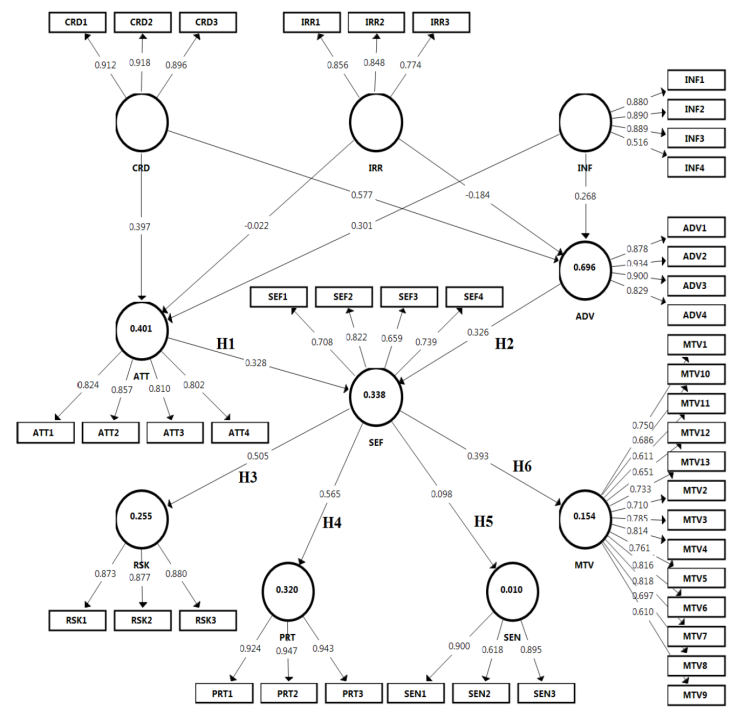
Model´s explanatory power
The coefficient of determination explained variance, or R 2 value, is an essential critical measure in PLS-SEM because it measures the model’s explanatory power. By each endogenous construct, R 2 measures the proportion of variance explained. In our case, the factor SEF with an R 2 of 0.335 (see Table 4) means that 33.5% of SEF variation, is explained by all the constructs that point to SEF. Threshold values are not provided because they depend on the model’s complexity and the subject matter. Thereby, adjusted R 2 criterion, is a good practice to consider because it adjusts the R 2 value based on the model size (James et al., 2013). A specific exogenous underlying factor can be assessed if it has a substantial impact on the endogenous ones, using the f2 effect size (Cohen, 1988). It measures if the exogenous construct has a substantial impact on the endogenous one. Thresholds values: <0.02 represents no effect; 0.02-0.15 for small effect size; 0.15-0.35 for a medium-sized effect;>0.35 a large effect size was proposed by Cohen (1988).
Table 4 Structural Measurement Model and Hypotheses tests
| Hypotheses | Paths | Path (t-value; p-value) | 5%-95% confidence interval | Interval Result (<> 0) | f2 Effect Size (>=0.02) | Not Supported/Supported |
|---|---|---|---|---|---|---|
| H1: “ATT contributes positively on SEF” | ATT → SEF | 0.328 [5.572; 0.000] | [0.206, 0.450] | Yes | 0.108 | Supported |
| H2: “ADV contributes positively on SEF” | ADV → SEF | 0.326 [5.809; 0.000] | [0.212, 0.447] | Yes | 0.107 | Supported |
| H3: “SEF contributes negatively on RSK” | SEF → RSK | 0.505 [11.848; 0.000] | [0.417, 0.585] | Yes | 0.342 | Supported |
| H4: “SEF contributes positively on PRT” | SEF → PRT | 0.565 [13.821; 0.000] | [0.487, 0.642] | Yes | 0.470 | Supported |
| H5: “SEF contributes positively on SEN” | SEF →SEN | 0.098 [1.534; 0.126] | [-0.097, 0.208] | No | 0.010 | Supported |
| H6: “SEF contributes positively on MTV” | SEF→MTV | 0.393 [8.146; 0.000] | [0.304, 0.494] | Yes | 0.182 | Supported |
| Endogenous Factor | Adjusted R2 | Model Fit | Value | HI99 | ||
| ADV | 0.693 | SRMR | NA | NA | ||
| ATT | 0.396 | dULS | NA | NA | ||
| MTV | 0.152 | dG | NA | NA | ||
| PRT | 0.318 | |||||
| RSK | 0.253 | |||||
| SEF | 0.335 | |||||
| SEN | 0.007 | |||||
Notes:
• NA. Not Applicable
• One-tailed t-values and p-values in parentheses; bootstrapping 95% confidence intervals (based on n= 5000 subsamples) SRMR: standardized root mean squared residual; dULS: unweighted least squares discrepancy; dG: geodesic discrepancy; HI99: bootstrap-based 99% percentiles.
• f2 . Effect size. 0.02, 0.15, and 0.35 are interpreted as small, medium, and large (Hair et al. 2017)
• R2. Coefficients of determination represent the amount of explained variance of the endogenous constructs in the structural model. Therefore, values of 0.25, 0.50, 0.75 for target constructs are considered as weak, medium, and substantial, respectively (Hair et al. 2017)
• SRMR. The Standardized Root Mean Square Residual is a common fit measure for CB-SEM (Henseler et al., 2015). For misspecification of PLS-SEM models detection is also used (Henseler et al., 2014). Besides, it is included the following fit measures: squared Euclidean distance (dULS) and the geodesic distance (dG) (Dijkstra & Henseler, 2015b)
Source: Own using SmartPLS 3.3.3 software
Therefore, the framework fulfills the required conditions with the exception of the model fit (SRMR, dULS,dG). In this case, the framework cannot confirm the results, only to explain them. (Hair, 2017, Hanseler et al., 2015). See Table 4.
Discussion
The tools developed using information technology (IT) can be made of social networks to generate new ways to obtain knowledge and improve public health in the 21st century. Incorporating emerging technologies into public health information systems offers excellent opportunities, especially regarding social media, collaborative work, and digital content development (UN, 2012). Social media advertising is about speaking “with” people and not “at” people offering unique advantages by erasing the boundaries created by time and distance, thereby making it infinitely more accessible for individuals to form and maintain relationships online with others in and out of their networks (Worlburg, 2019). Online users are exposed to a variety of advertisings for the sake of their health that includes since quit smoking, drink in moderation, avoid driving under the influence, take precautions when engaging in sexual behavior, say no to drugs, use sunscreen, wear seatbelts, eat a balanced diet, get enough exercise, get regular medical screening tests, until chronic or pandemic diseases messages to avoid them (Wolburg, 2019). Social media applications are low-cost advertising instruments that assist in encouraging network building, the rapid spread of data, and subsequently promising trust and certainty of the public (Srimarut & Techasatian, 2019).
Furthermore, social media has been an important element in disaster and health crisis related communication, like the COVID-19 outbreak, in several and different issues since tourists’ risk perception, the quarantine issues in public health, the authenticity of media coverage, until racial discrimination (Meng et al., 2020). Hence the importance of including health messages against chronic and pandemic diseases as a value into the SMAV (Ducoffe, 1995).
In chronic and pandemic diseases, long-term conditions are the major concern for health services. Self-management in concert with clinical care forms part of the effective management of multi-morbidity. The self-efficacy (SEF) is a mechanism through which self-management can be achieved. Quality of life is adversely impacted by multi-morbidity but could be improved by effective self-management (Peters et al., 2019). However, are the users ready to promote SEF in SMAV as a health care tool against chronic and pandemic diseases?
Theoretical implications
It is based on a literature review where originality and main contribution of this research is to determine how two of the most recognized scales: the social media advertising value (SMAV) by Ducoffe (1995) and the self-efficacy (SEF) by Bandura (1997) are interrelated and updated with other factors to the XXI century needs. Such a relationship is aimed to identify what underlying factors are most relevant in supporting the social media users against the chronic and pandemic diseases for the next normal.
The PLS-SEM measurement model
Based on PLS-SEM with SmartPLS 3.3.3. software,Table 2 results show that the measurement model internal consistency reliability, significance, and variance assessment as convergent validity are fitted into the parameters required for each indicator. Such of parameters required were Cronbach's alpha (>=0.7); Dijkstra-Henseler's rho (>=0.7); CRI (>=0.7); AVE (>=0.5); outer loading (>=0.7) and p values (<=0.05). One exception is that the SEN4 "I feel happiness" indicator was removed due to problems AVE to assure the convergent value's index required.
On the SEF-SMAV framework is necessary to design the improvement of items with an outer loading of 0.40 - 0.70 and (p value <0.05) to be more descriptive, may be in terms of emergency context, mood, meaning, etc. specially all in the range of outer loading >0.6<0.7 before to be removed (Hair et al. 2017). If dropping the item that loads poorly increases the AVE significantly (or from an unacceptable level to an acceptable level, i.e., >0.50), it should be discarded (ibidem), being in this case (see Table 2):
Factor: informativeness (INF) with the item INF4: “I tend to see a lot of social media advertising about disease prevention for public health (e.g., COVID-19, dengue, chikungunya, obesity, diabetes, high blood pressure, cholesterol, etc.) (0.516, 0.000).
Factor: self-efficacy (SEF) with the item (SEF3): “When I am feeling healthy, I believe that I can identify my cure. (Emotional and physiological state)” (0.659, 0.000).
Factor: people sentiment (SEN) with the item (SEN2): “I feal anger.” (0.618, 0.000).
Factor: people motivation (MTV) with the items:
MTV8: “Express my emotions on my disease or health.” (0.697, 0.000);
MTV9: “To compare myself with other patients” (0.610, 0.000);
MTV10: “Share my experience on my disease and its treatment” (0.686, 0.000);
MTV11: “Update others on my current health situation” (0.611, 0.000);
MTV12: “Give advice to other patients/get advice from other patients” (0.651, 0.000).
Our analysis was over relevant demographic data results of 500 Mexican consumers respondents in Sep-Nov, 2021, over 300 persons of 18-29 years old; 50% female and 50% male, 380 couple, 280 with undergraduate education, 242 monthly income less than 9,000 pesos. The social media users were posed to the context "When I see a social media advertising about disease prevention for public health (e.g., COVID-19, dengue, chikungunya, obesity, diabetes, high blood pressure, cholesterol, etc.)…". Afterward, we consider the high outer loading and (p-value) as the most relevant items per factor that explain the SEF-SMAV profile according to the social media users (see Table 2), resulting in:
The people believed that the advertisement was believable (CRD2, 0.918, 0.000); irritating (IRR1, 0.856, 0.000); supplying relevant information (INF2, 0.890, 0.000). The people's attitude was willing to engage with the advertising (ATT2, 0.857 (0.000); thinking that the advertisement was valuable (ADV2, 0.934, 0.000). The self-efficacy was based on the previous observation that believes that the individual can identify symptoms by himself (Vicarious Experience) (SEF2, 0.822, 0.000). The public level risk perception makes them think that is very dangerous to be affected by the disease (RSK3, 0.880, 0.000). The feeling the public protection perception to protect others from disease prevention for public health (PRT2, 0.947, 0.000); with people sentiment feeling fear (SEN1, 0.900, 0.000) and people motivation increasing his knowledge on their disease (MTV7, 0.818, 0.000) to the social media users.
The PLS-SEM structural model
Here is discussed all the hypotheses posed, according to Table 2, as follows:
At the respect of the H1: "ATT contributes positively on SEF" with path (t-value; p-value) 0.328 [5.572; 0.000] and or effect size (>=0.02) = 0.108 considered as medium level (Hair et al., 2017) and hence, approved and supported. Therefore, our model is according to SMAV when people attitude (ATT) is under the relationship to credibility (CRD), irritation (IRR), and informativeness (INF) (Ducoffe, 1995; Aktan et al., 2016; Arora & Agarwal, 2019; Mohd & Syamsyul, 2020; Mejía-Trejo, 2021) related with the self-efficacy (SEF) (Bandura, 1977; López-Garrido, 2020). Some suggestions to improve the ATT-SEF relationship to increase to large effect size ( f 2 ) could be for instance, the need to increase the associations of chronic and pandemic diseases (like COVID-19) related to severity, knowledge, preventive behaviors, and mental health among a representative sample of public (Yildirim & Guler, 2020). This is in the line with previous findings where healthcare workers reported inadequate knowledge and attitudes about the previous pandemic respiratory infectious diseases (Althomairy et al., 2018). About chronic diseases, we have patients with coexisting type 2 diabetes and hypertension generally exhibit poor adherence to self-management, which adversely affects their disease control. Therefore, identification of the factors related to the attitude in the patient’s self-efficacy is warranted against the chronic diseases (Zhenzhen et al. 2020).
If we continue with the H2: “ADV contributes positively on SEF” with path (t-value; p-value) 0.326 [5.809; 0.000]and or effect size (>=0.02) = 0.107 considered as medium level (Hair et al., 2017) and hence, approved and supported. Therefore, our model is according to SMAV when advertising value (ADV) the user is under the relationship to credibility (CRD), irritation (IRR), and informativeness (INF) (Ducoffe, 1995; Aktan et al., 2016; Arora & Agarwal, 2019; Mohd & Syamsyul, 2020 related with the self-efficacy (SEF) (Bandura, 1977; López-Garrido, 2020). Suggestions to improve such a relationship to increase to large effect sizes ( f 2 ) should be considered as a component of firms’ portfolio social media marketing strategies (SMMSs) involving social commerce strategy, social content strategy, social monitoring strategy, and social CRM strategy. It is in social content strategy the meaning of “the creation and distribution of educational and/or compelling content in multiple formats to attract and/or retain customers” , and its primary motivation for the firm is “to connect and collaborate” and for the user is “informational and entertainment reasons” (Fanfang et al., 2020) that could be incorporated as a value in SMAV construct as a tool of health care tool against the chronic and pandemic diseases. Nevertheless, the rest of the SMMSs could be aimed to reinforce the social media advertising value, for instance, the social commerce strategy where the primary motivation for the firm is “to promote and sell” and for the user is “utilitarian reasons (e.g., incentives, promotions)” in the promotion to be vaccinated against a pandemic disease like COVID-19, or medical treatments (Ibidem.).
If we see the H3: “SEF contributes negatively on RSK” with path (t-value; p-value) 0.505 [11.848; 0.000] and or effect size (>=0.02) = 0.342 considered as medium level (Hair et al., 2017) and hence, rejected and supported. Therefore, our model is according to SMAV when people attitude (ATT) and advertising value (ADV) are both interacting with self-efficacy (SEF) (Bandura, 1977; López-Garrido, 2020), but it is related positively with public level risk perception (RSK) (Lin et al., 2016; Jang & Paek, 2019; Toppenberg-Pejcic et al., 2019; Oh et al., 2020). Our results pointed out that the SEF provokes a major awareness or public level risk perception (RSK) against the opposite of other studies (De Zwart et al. 2007). There was probably a low perception of the actual risk of contagion, in favor of significant confidence in one’s ability to manage and cope with the situation and to escape contagion since the spread of the virus was still mainly limited to dense inhabitant areas in Mexico. However, the public health messages spread through the government and the social media advertising value increased the awareness of health danger to change the behavior. For instance, in a previous study of SEF-SMAV and RSK relation under COVID-19 pandemic in the USA, subjects demonstrated a growing awareness of risk and reported engaging in protective behaviors with increasing frequency but underestimated their risk of infection relative to the average person in the country. Social distancing and handwashing were most strongly predicted by the perceived probability of personally being infected (Wise et al., 2020). There is a need for greater public efforts to spread health social media advertising, mainly considering the most vulnerable communities (Diotaiuti et al., 2021).
About H4: “SEF contributes positively on PRT” with path (t-value; p-value 0.565 [13.821; 0.000] and or effect size (>=0.02) = 0.470 considered as large level (Hair et al., 2017) and hence, approved and supported. Therefore, our model is according to SMAV when people attitude (ATT) and advertising value (ADV) are both interacting with self-efficacy (SEF) (Bandura, 1977; López-Garrido, 2020) to be related with public protection perception (PRT) (Misra et al., 2018; Al-Dmour et al. 2020). Here, there are no suggestions for improving the relationship of SMAV-SEF-PRT because there is a clear sense of how the user perceives how to be protected or protect others and how perceives the importance of educating others from disease prevention for public health.
At the respect of the H5: “SEF contributes positively on SEN” with path (t-value; p-value) 0.098 [1.534; 0.126] and or effect size (>=0.02) = 0.010 considered as null level (Hair et al., 2017) and hence, rejected and supported. Therefore, our model is according to SMAV when people attitude (ATT) and advertising value (ADV) are both interacting with self-efficacy (SEF) (Bandura, 1977; López-Garrido, 2020) but without any relation with people sentiment (SEN) (Oh et al., 2015; Paek et al., 2016; Goswami et al., 2019; Wolburg, 2019; Oh et al. 2020; Mejía-Trejo, 2021). This situation may be because. Some suggestions to improve such a relationship to increase to large effect size ( f 2 ) are not only the interact inclusion of anger, fear, or sadness as emotions that tend to be sentiments but also the relationship of SEF SMAV - to new sentiments with high nocive repercussion, more than ever, in the users of social media like anxiety, stress, irritability, depression and addictive social media use (Alemany-Arrebola et al., 2020; Braiolovskaia et al., 2020; Troisi et al. 2022) after the long confinement population product of COVID-19 as pandemic disease.
Finally, we have the H6: “SEF contributes positively on MTV” with path (t-value; p-value) 0.393 [8.146; 0.000] and or effect size (>=0.02) = 0.182 considered as medium level (Hair et al., 2017) and hence, approved and supported. Therefore, our model is according to SMAV when people attitude (ATT) and advertising value (ADV) are both interacting with self-efficacy (SEF) (Bandura, 1977; López-Garrido, 2020) to be related with people motivation (MTV) (Antheunis et al., 2013). Some suggestions to improve such a relationship to increase to large effect size (f2) are based on how SEF-SMAV influences following a healthy life in the users through their MTV against chronic and pandemic diseases. For instance, several chronic diseases (e.g., cardiovascular disease) significantly impact the global population due to their high prevalence. One relevant action is to determine the mechanisms of how to detonate an active SEF-MTV relationship, to adhere to new healthy intake habits showing a high correlation between them and other complementary factors such as life satisfaction (Castillo-Mayén et al., 2020). In the case of type 2 diabetes, (another chronic disease) doctors should also inform patients about the necessity of achieving health-related diabetes goals. A patient´s ability to successfully achieve health-related goals and treatment recommendations could improve their health and decrease the risk of diabetes-related complications (Hricová, 2021); and is possible with the use of SMAV. Furthermore, there is evidence of how motivation can predict preventive behaviors of healthcare workers towards COVID-19 pandemic disease (Bashirian et al., 2020).
Practical implications
This study makes several practical contributions to the context of how the SEF in SMAV as a tool of health care tool against the chronic and pandemic diseases are perceived as of social media users for the next normal described as follows:
First. A final and solid framework composed by self-efficacy (SEF) factor related to 5 SMAV factors: credibility (CRD); irritation (IRR); informativeness (INF); people attitude (ATT), and advertising value (ADV), and other 4 complementary factors such as public level risk perception (RSK); public protection perception (PRT); people sentiment (SEN); people motivation (MTV). All the framework totalizes 45 indicators.
Second. The SEF-SMAV framework is the first attempt to measure and determine the relationship of the main underlying factors using PLS-SEM through SmartPLS 3.3.3. The findings are helpful to different specialists and managers focused on communication, marketing strategies, government health authorities, and academics.
Third. About a description case, let us suppose a firm or government decision to introduce new habits and social distance practices to control and contain the COVID-19 Delta version as a pandemic disease towards a particular social media user target. For instance, females and males of 18-29 years old, with undergraduate education and monthly income less than 9,000 pesos using specific social media advertisements. The social media advertising value (SMAV) construct can determine a precise advertisement value based on different categories of credibility (trustworthy, believable, and convincing), of irritation (irritating, too much advertising, insult people's intelligence), and informativeness (good source, relevant, on time, with a tendency to be a lot informed). In this sense, it is determined if the attitude is matched and engaged to the kind of advertisement, with a disposition to learn and receive the advertising in the future based on values such as how useful, valuable, important, or ethical it is.
SMAV construct produces a specific advertisement value to send, and it is necessary to know what kind of people's self-efficacy (SEF) is reached and driven of the four categories: "social persuasion," "vicarious experience," "emotional and physiological state," and "mastery experience." This stage is the SMAV core framework for the advertisement to be transmitted. This is because depending on the SEF category reached is the kind of public level risk perception (very serious; with likely and very dangerous to be affected), the public protection perception (towards the person, other persons, and educating others) about disease prevention for public health. Besides, different sentiments are elicited (anger, fear, sadness, or happiness), and it is necessary to determine what kind is needed to be boosted for better results. The above mentioned is associated with five categories of motivations: "increasing knowledge," "efficiency in doctor-patient communication," "social support," "exchange advice," and "self-care."
Conclusions
In times of severe chronic and pandemic diseases is essential to take advantage of specific characteristics of the social media users like our study: 500 Mexican consumers respondents (Sep-Nov, 2021), with 300 persons /18-29 years old (60%); 250 female and 250 female (50% /50%), 380 couple (76%), 280 undergraduate education (56%), 242 with monthly income less than 9,000 pesos (48%). This demographic data was the base for determining a SEF-SMVA framework as a health care tool against chronic and pandemic diseases for the next normal using PLS-SEM. Therefore, we conclude:
First. The capability of the individual's belief in his or her capacity to execute behaviors necessary to produce specific performance attainments is called here self-efficacy (SEF).
Second. SEF is susceptible to be driven by specific social media advertisements (SMAV). Hence we obtained a final and solid framework composed by self-efficacy (SEF) factor related to 5 SMAV factors: credibility (CRD); irritation (IRR); informativeness (INF); people attitude (ATT), and advertising value (ADV), and other 4 complementary factors such as public level risk perception (RSK); public protection perception (PRT); people sentiment (SEN); people motivation (MTV). All the framework totalizes 45 indicators.
Third. The results SEF-SMAV framework produced suggestions for improvement according to the kind of social media advertising value to repercuss directly in the items and to increase the positive relationship of SEF-SMAV to people sentiment (SEN) and the reversion of the negative relationship of SEF-SMAV to public level risk perception (RSK).
Limitations and future studies
All empirical studies have certain limitations:
First. Sampling methods may limit survey results due to recruiting respondents' "snowball self-report" nature. The survey results are based on the questionnaire's self-reported data to remind them of their opinions.
Second. SEF-SMAV framework could be probed with several demographic category data like people of different generations (age), gender, education, marital status, monthly income, etc., under different emerging sentiments (anxiety, stress, depression, etc.) as a product of the prolonged lockdown. This could probe different social media advertisement values (SMAV) based on chronic diseases or pandemic scenarios. Different scenarios could be used to verify what specific kind of self-efficacy (SEF), public level risk perception (RSK), public protection perception (PRT), people sentiment (SEN), or people motivation (MTV) are present. Suppose these data are extracted from a specific public and disease as data to be precisely collected, categorized, and assessed to refine a final SMAV for control disease.
Third. It is suggested the application of fuzzy set Qualitative Comparative Analysis (fsQCA) (Ragin, 2008; Mejía-Trejo, 2021b) to the final SEF-SMAV framework. This action would serve to verify how many different patterns of the underlying factors would be obtained (or not) to the same result about a health care tool against chronic and pandemic diseases, besides the unique results obtained from PLS-SEM.
Fourth. It is pertinent to continue analyzing the SEF-SMAV on new mobile technologies like the mHealth concept, which emerged as an important eHealth branch for remote medical care through mobile devices. The concept mHealth has advantages over traditional methods of health care, medical monitoring, and treatment of diseases since medical care can be delivered in urban areas and areas difficult to access (Espinoza-Bautista et al., 2017). Hence the importance of applying the SEF-SMAV framework in such a technology.
Fifth. The SEF-SMAV framework could interact with the Message Strategy Model (Taylor, 1999) that proposed a comprehensive typology of message strategies for advertising planning and development presented as a "strategy wheel" consisting of six segments representing different types of user motivations. The right half of the wheel represents the so-called "ritual view," which corresponds with "feel" or affective strategies and consists of three segments: "ego, social and sensory." The left half is called the "transmission view," which corresponds with "think" or rational strategies and which also consists of three segments: "routine, acute need, and ration." This model suggests advertising managers and creative focus on buying situations and the influence of social factors in the buying process. However, the lack of operational definitions of the strategies suitable for each segment makes this helpful typology a tool for content analysis if it was coupled with the SEF-SMAV framework. Further studies are recommended to do it.

