




 nueva página del texto (beta)
 Inglés (pdf)
 Artículo en XML
 Referencias del artículo
 Traducción automática
 Enviar artículo por email
 Citado por SciELO
  Similares en
SciELO
Similares en
SciELO 
 Permalink
Introduction
The business environment in this digital era is changing very dynamically. This becomes a challenge for SMEs in the fashion sector. The fashion industry is dominated by elements of style that tend to survive in the short term according to market needs (Christopher et al., 2004). SMEs must understand customer needs earlier by sensing the market and leveraging digital platforms. The speed of responding to customer needs and the use of digital platforms will make it easier to create the best value for customers. Therefore, value creation ambidexterity is needed in order to be able to explore and exploit resources to support marketing performance.
Market sensing capability plays a very important role in improving marketing performance when companies are able to capture market opportunities and are able to configure resources appropriately (Morgan, et al., 2009). Companies that are able to retain customers, attract new customers and satisfy customers will drive sales and profit growth (Soliman, 2011;Mulyana et al., 2020; Hendar et al., 2020). Likewise, utilizing information quickly and always responsive to market changes has the potential to increase marketing performance (Vorhies and Morgan, 2005). Hence, being active and formulating the right strategy is needed to face market changes (Martinette and Obenchain-leeson, 2012)
Digitization in business practices can change face-to-face contact with customers, suppliers and channel partners, by leveraging the internet and mobile technology (Coreynen and Van Bockhaven 2016; Vaibhava Desai et al, 2019). Digital platforms are used by companies to manage relationships with customers, suppliers, retailers and retain customers (Wang, 2020) and has a major contribution to marketing performance (Wang, 2020; Chinakidzwa & Phiri, 2020; Hashim et al., 2022). On the other hand, digital capability in business practices is not powerful enough and often become a challenge (Day, 2011; Kane et al., 2015), and digital-based market innovation for SMEs is also unable to increase marketing performance (Chinakidzwa and Phiri, 2020). SMEs have a flexible operating structure that reduces the role of technology and focuses more on business relationships, communication needs and organizational capabilities (Depaoli et al., 2020). Therefore, accuracy in utilizing digital platforms to support marketing activities is very important in order to improve marketing performance.
Previous studies on the relationship between market sensing capability and marketing performance have been carried out, but the results are still inconsistent. Previous research has shown that marketing performance is influenced by market sensing capability (Bailey 2013; Tseng and Lee 2014; Osakwe, et al. 2016; Abubaker and Balal, 2017; Hendar et al., 2020). The results of previous research by Olavarrieta & Friedmann (2008) found that market sensing capability in public companies as measured through information acquisition activities, information dissemination activities, information interpretation activities, and information storage-retrieval cannot improve company performance. Another study shows that market sensing capability increases profitability and sales indirectly through product innovativeness success (Ardyan, 2016). Likewise, the marketing performance of batik SMEs cannot be improved by market sensing capability (Sugiyarti and Ardyan, 2017).
Research on influencing digital marketing capability and market sensing capability on marketing performance with value creation ambidexterity as mediating variables are very interesting to study. Therefore, this study is expected to contribute to add new knowledge and ideas due to the inconsistencies in the findings of previous studies. Besides, it also contributes to the development of SMEs.
Literature review
Value creation ambidexterity
Service Dominant Logic (SDL) states that companies and customers are collaborative partners in creating mutual value through mutually beneficial exchanges (Vargo & Lusch, 2008). Value is an activity to satisfy mutual needs and benefits (Haksever, 2004). Values relate to ideas, behavior, assessments of reciprocal relationships created by employees, customers, business partners and stakeholders (Mahajan, 2018). Value creation is a proactive, conscious, inspiring action that can increase the value of goods, services, ideas so that it is beneficial for all stakeholders (Mahajan, 2017). Effective interaction between companies and partners to share resources and information can trigger value creation (Vargo & Lusch, 2016). Value creation in the organization will encourage the realization of value-added and cost efficiency which has the potential to improve organizational performance (Nuryakin, et al., 2018).
According to Organizational Learning Theory, organizations must develop their capacity continuously in order to gain knowledge through new ideas that develop by empowering their human resources (Basten et al., 2015). Organizational learning is needed to be able to respond quickly to changes in the business environment (Garvin et al., 2008), by developing new knowledge (Cheng et al., 2014). Organizational learning will create ambidexterity which is useful for improving company performance (Valter et al., 2019). Ambidexterity is the ability to explore and exploit organizational resources (Kauppila, 2010). Exploitation is an effort to expand knowledge, increase efficiency and incremental innovation, while exploration involves developing new knowledge, seeking variation and novelty (Atuahene-gima, 2005). Ambidexterity shows agility to solve complex problems in organizations in order to achieve goals (He & Wong, 2004; Lavie et al., 2010; Giovannetti et al., 2020). The synthesis of value creation and ambidexterity will lead to a new concept called value creation ambidexterity. The definition of value creation ambidexterity according to researchers is proactive, conscious, inspiring action to solve problems faced by organizations through exploration and exploitation of resources in order to increase the value of goods and services that are beneficial to all stakeholders.
Market sensing capability
According to Lin & Wang (2015), market sensing is a business ecosystem that is the basis for building dynamic capabilities, such as sensing development of science and technology, customer demand, and market segmentation. Sensing is needed to identify opportunities and threats by mobilizing resources to create value according to market needs (Baden-Fuller & Teece, 2020). The market sensing capability component includes understanding customer needs, competitor information, distribution channels and changes in the business environment (Day, 1994; Lindblom et al., 2008; Morgan, et al., 2009). Market sensing refers to a company's ability to anticipate market changes and detect market opportunities on the basis of information from its business ecosystem (Mu, 2015). Market sensing is to obtain information about customers, competitors and changes in the business environment obtained through market intelligence through sense, sensemaking and response in order to take appropriate action (Ahmed et al., 2017).
Digital marketing capability
The digital revolution enables new models of relationships with customers and is a challenge for companies to increase their market share (Sawicki, 2016). Digital marketing is used as a communication channel that can reach partners in order to meet consumer needs more effectively (Sawicki, 2016). Digital platforms are used to communicate by user groups and communities and can even become an influence or supporter of a company's brand (Shankar et al., 2022). According to Chomiak-Orsa & Liszczyk (2020), the main components of digital marketing include content marketing, e-mail marketing, mobile marketing, internet analysis, search engine marketing and social media marketing. Social media is a contemporary communication channel to build good relationships with customers thereby increasing sales (Sawicki, 2016). Likewise, online media in business practices is used by companies to change face-to-face contact with customers, suppliers and channel partners (Yoo et al. 2012; Coreynen et al. 2016). Digital marketing is an instrument for entrepreneurs, it can turn information into opportunities that generate profits for the company, through product offerings and brand strengthening (Chomiak-Orsa & Liszczyk, 2020). Digital marketing is digital technology that companies use to strengthen collaboration and support marketing programs such as the internet, cell phones and other media (Vaibhava Desai, 2019).
Marketing performance
Marketing performance is an assessment of the relationship between marketing activities and business performance (Clark & Ambler, 2001). Marketing performance shows the value of marketing operations whose focus is not only on products, prices, or customer relationships but also includes other marketing operations such as marketing communications, promotions, and other operations as a representation of part of the marketing budget (Rust et al., 2004). Marketing performance is the success of an organization, which is viewed through two components, namely customer relational performance including customer satisfaction, customer ownership, positive word of mouth promotion and customers profit performance including customer profit performance, identification of profitable customers, acquisition and retention of profitable customers , and conversion of unprofitable customers to profitable ones (Ramani & Kumar, 2008; Kankam-Kwarteng et al., 2021). Marketing performance as an outcome achieved by an organization includes intermediate market outcomes and final market outcomes, namely sales growth, market leadership capability share & profitability (Chinakidzwa & Phiri, 2020). Marketing performance is the result of operational activities in the marketing sector which is measured through sales growth, increase in sales volume, achievement of sales targets, customer growth and expansion of marketing areas (Mulyana et al., 2020).
Hypothesis development
Market sensing capability and value creation ambidexterity
The ability to understand customer needs, competitor information, distribution channels and changes in the business environment is often carried out by companies (Morgan, 2012), and is often referred to as a component of market sensing capability (Lindblom et al. 2008; Day 1994). Organizations that act proactively will be able to formulate the right strategy so that they need speed to understand changes in the business environment (Martinette & Obenchain-leeson, 2012). Likewise, it needs to operate quickly when a company is able to capture market opportunities, understand customer needs, respond to competitors' strategies and provide products according to customer expectations (Mulyana et al., 2020).
Value creation becomes a determinant of innovation activity so that it has an important role in creating value-added (Aron O'Cass, 2013). Value creation is needed in order to be able to respond quickly to customer needs, maintain product quality and create value- added for customers (Nuryakin et al., 2018). Some studies show that value creation is the main key to the success of product innovation so that it influences business performance (Viljakainen and Toivonen 2014;Sorensen and Jensen 2015). Ambidexterity is the ability to explore and exploit resources (Kauppilla, 2010), and it becomes complementary orthogonal variables (Anil K. Gupta et al, 2014). According to March (1991), exploitation as an activity in production, efficiency, implementation and execution, while exploration includes search, risk taking, experimentation, flexibility and innovation. A balance of explorative and exploitative practices can reduce costs, increase efficiency and enable companies to allocate and utilize limited resources optimally (Herzallah et al., 2017). Organizational ambidexterity is essential to deal with market dynamics and create value for customers in order to be successful in the long term. The company has data based on customer needs and competitors' strategies to be agile in creating value- added for customers. Therefore, market sensing capability is possible to encourage the creation of value creation ambidexterity.
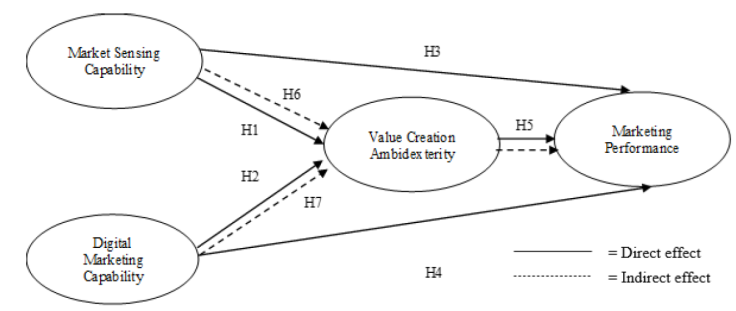
H1: There is a positive relationship between MSC and VCA
Digital marketing capability and value creation ambidexterity
Digital marketing is used to create the best value for customers by sensing the market and strengthening mutually beneficial relationships with its customers (Wang, 2020). Digital marketing is digital technology such as the internet, cell phones and other media that companies use to strengthen collaboration and support marketing programs (Vaibhava Desai, 2019). Likewise, online media in business practices is used by companies to change face-to-face contact with customers, suppliers and channel partners (Yoo et al. 2012; Coreynen et al. 2016). Social media integration in marketing allows users to utilize content as a way of communicating in a virtual environment to share timely information with each other (Indre Jucaitytơ, 2014). Social media is an effective marketing communication tactic and allows interaction with customers on an ongoing basis (Kallio et al., 2015). Digital marketing is a means of supporting marketing programs so as to create harmonious cooperation with partners (Vaibhava Desai, 2019).
Value co-creation is the basic value in collaborative activities (Vargo & Lusch, 2004). Value creation determines business performance if it is able to generate value- added for product quality, cost efficiency, guaranteed product service and fast customer response (Gura˘u, 2015). Value creation relates to the company's internal activities in order to create the best for customers, for example product design and delivery of goods (Gura˘u, 2015). Ambidexterity is the ability to explore and exploit resource organization (Kauppilla, 2010) and demonstrate the organization's ability to manage business efficiently and adaptively to environmental changes (Tariq et al., 2022). Exploitation is an activity in production to create efficiency, while exploration involves taking risks, experimentation, flexibility and innovation (March, 1991). Digital platforms can be used by companies to find information on their needs and build closeness with customers in order to create the best value for customers. Utilization of digital platforms with content that suits the needs of target customers enables the creation of value creation ambidexterity.
H2: There is a positive relationship between DMC and VCA
Market sensing capability and marketing performance
Morgan et al., (2009) stated that marketing performance can be developed through market sensing capability, as companies have the ability to capture market opportunities and configure resources to achieve marketing targets. Companies that are able to retain customers, attract new customers and satisfy customers will drive sales growth and company profits (Soliman, 2011). Market sensing that is developed by seeking information and responding to changes in the market environment quickly can improve marketing performance (Vorhies & Morgan, 2005). Previous studies showed that marketing performance can be developed when companies are able to understand environmental changes, understand competitors' strategies and respond quickly to changes in customer needs (Ahmed et al, 2017; Hendar et al., 2020)
H3: There is a positive relationship between MSC and MP
Digital marketing capability and marketing performance
Companies will gain benefits in the form of reducing information uncertainty and strengthening networks and market growth when they have internet marketing capability (Mathews et al., 2015). Some previous studies showed that digital marketing has an important role to develop marketing performance (Chinakidzwa & Phiri, 2020; Hasyim et al., 2022), and sales performance (Djakasaputra et al., 2021). By implementing marketing programs with digital platforms, it can increase SMEs performance (Wang, 2020; De Pelsmacker et al., 2018; Kawira et al., 2019).
H4: There is a positive relationship between DMC and MP
Value creation ambidexterity and marketing performance
Vargo & Lusch (2008) Service Dominant Logic (SDL) believed that customers and producers are collaborative partners in creating mutually beneficial shared value. It will create interaction between sharing information and resources; and value co-creation (Vargo & Lusch, 2016). Furthermore, value creation contributes to the creation of various innovation activities, so that leaders and employees under them become the determinants of value creation (O’Cass & Sok, 2013). Several previous studies stated that value creation is one of the keys to product innovation that potentially improve business performance (Viljakainen & Toivonen, 2014; Sørensen & Jensen, 2015). The concept of value creation relates to internal activities as an effort to create customer value such as product design, production processes, distribution of goods to the market (Gura˘u, 2015). The effective value creation is the main key to creating value-added for products, cost efficiency and service as well as responding quickly to customer expectations, which ultimately affects financial and marketing performance (Gura˘u, 2015). Organizational ambidexterity shows agility to explore and exploit resources (Gura˘u 2015; Lubatkin et al. 2006), and the ability to manage business efficiently and adaptively to environmental changes (Tariq et al., 2022). Sahi et al. (2020) stated that SMEs that carry out explorative and exploitative resources well can ultimately improve business performance. Therefore, agility exploits and explores resources to create the best value for customers which will increase the number of purchases so that further, it will improve marketing performance.
H5: There is a positive relationship between VCA and MP
Value creation ambidexterity as a mediating variable
Digital platforms are used by companies to sense the market and build relationships with customers so that they can respond quickly to customer needs (Wang, 2020). Likewise, social media is used to support marketing activities that allow users to communicate and share timely information in a virtual environment (Indre Jucaitytơ, 2014). Digital marketing has a significant contribution to improving marketing performance, in the form of sales growth, profitability, market share (Chinakidzwa & Phiri, 2020;Hashim et al., 2022). Digital marketing can improve sales performance (Djakasaputra et al., 2021) and play a role in improving the SMEs performance (Kawira et al., 2019).
Market sensing capability demonstrates the ability to understand customer needs, understand competitors' strategies and tactics and changes in the business environment (Morgan 2012; Mulyana et al., 2020; Hendar et al., 2020). When an organization is always proactive to understand market dynamics, the right strategy will be created (Martinette & Obenchain-leeson, 2012) Previous studies have shown that company sales and profit growth can be achieved if they are able to satisfy customers, retain customers and are able to attract new customers (Soliman, 2011). However, the success of the company's performance is strongly influenced by the ability to capture market opportunities and the ability to configure the resources appropriately (Morgan et al., 2009)
Value creation becomes one of the determinants of innovation (Aron O'Cass, 2013) and is the main key to the success of product innovation that has an impact on business performance (Viljakainen and Toivonen 2014;Sorensen and Jensen 2015). Business performance is easy to achieve if the effective value creation is created, such as creating value-added for product quality, creating cost efficiency, guaranteeing product service and fast customer response (Gura˘u, 2015). Previous studies found that sales growth, profitability and market share can be achieved if value creation runs effectively so as to create value-added product, cost efficiency and product service guarantees (Nuryakin et al., 2018). Value co-creation between companies and customers has contributed to grow SMEs performance (Mulyana et al., 2022).
Ambidexterity includes exploitation and exploration as complementary orthogonal variables (Anil K. Gupta et al, 2014; Auh & Menguc 2005) and adaptive to environmental changes so as to create business efficiency (Tariq et al., 2022). According to March (1991), the company's ability to balance exploitation competence and exploration of new opportunities strongly supports business success (March, 1991). Exploitation competence is in the form of production efficiency activities, implementation and execution, while exploration is in the form of risk taking, experimentation, flexibility and new inventions. High organizational ambidexterity will provide multiple revenue streams to the organization and increase customer satisfaction and create efficiency (Jasmand et al., 2012). Organizations that are able to synergize service and sales activities simultaneously will be able to create the best value and customer satisfaction which has the potential to improve marketing performance (Jasmand et al., 2012). Organizational ambidexterity that is flexible and adaptive through exploring new technologies and markets and configuring resources capable to address new opportunities and challenges (Teece, 2007). Organizational ambidexterity increases company performance as found by (Mardi et al. 2016; Aylin Gozen., 2018; Cafetzopoulos, 2020). Likewise, organizational ambidexterity in the form of precise strategy and data-based infrastructure that is integrated with customers and employees can improve business performance (Tariq et al., 2022).
Companies that is proactive and formulate strategies appropriately will be able to identify customer needs, respond to competitors' strategies and tactics. Success in identifying customer needs and how to satisfy them will encourage value creation ambidexterity that meets customer expectations and has the potential to improve marketing performance. Companies that build harmonious long-term relationships with partners, predict changes in customer preferences, retain customers through digital media will easily obtain information on customer needs and be agile in formulating strategies. Success in obtaining information on customer needs and how to satisfy customers will encourage the creation of value creation ambidexterity for customers so that it will improve marketing performance.
H6: The relationship between MSC and MP is mediated by VCA
H7: The relationship between DMC and MP is mediated by VCA
The empirical model developed to facilitate hypothesis testing is described in the following Figure 1.
Research method
Data collection technique
Fashion SMEs in Central Java, Indonesia are the objects of our research. Owners or leaders of fashion SMEs who have run a business for at least 3 years are involved as respondents, because they are considered experienced in managing a business. Data collection technique of this study used questionnaires that are directly distributed to respondents so that the data obtained is able to reflect the actual field conditions. Researchers distributed 354 questionnaires to respondents, but only 311 are returned. Furthermore, after validated, only 285 data were eligible for analysis. The profile of the respondents can be seen in Table 1 below.
Table 1 Respondent Profiles
| No | Respondents | Amount | % |
|---|---|---|---|
| 1 | Age (years): | ||
| 20-29 | 48 | 16.84 | |
| 30 - 39 | 116 | 40.07 | |
| 40 - 49 | 79 | 27,71 | |
| 50 -59 | 28 | 9,82 | |
| 60 - 69 | 14 | 4.91 | |
| 2 | Gender: | ||
| Woman | 187 | 65,61 | |
| Man | 98 | 34,39 | |
| 3 | Educational background: | ||
| Elementary School | 5 | 1.75 | |
| Junior High School | 47 | 16,49 | |
| Senior High School | 164 | 57,54 | |
| Diploma | 46 | 16,14 | |
| Bachelor | 23 | 8.07 | |
| 4 | Business experience (years): | ||
| 03 - 08 | 64 | 22.45 | |
| 09 - 14 | 162 | 56,84 | |
| 15 - 20 | 40 | 14.03 | |
| 21-26 | 10 | 3.53 | |
| 5 | Business Position: | ||
| Owner | 43 | 15.08 | |
| Manager | 24 | 8,42 | |
| Owner and manager | 218 | 76,49 |
Source: primary data processed, 2022
Measurements
This study used a quantitative approach and measures the variables using a Likert scale with a score of 1 to 5, where the score (1) for strongly disagrees and the score (5) for strongly agrees. The research variable indicators were adapted from the results of previous studies to suit the research context. Market sensing capability was adapted from Morgan et al. (2009) and Lindblom et al. (2008) that measured it through six indicators: the ability to learn about customer needs and desires, discover competitors' strategies and tactics, gain insights about channel members, identify and understand market trends, learn about the broad market environment and respond quickly to market changes. Digital marketing capability was adapted from Feng & Wang, (2012), that measured it through four indicators: managing long-term relationships with customers through digital media, predicting changes in customer preferences using digital media, building long-term relationships with business partners through digital media, and using digital media to retain customers. Value creation ambidexterity was adapted from O’Cass & Sok (2013), Nuryakin, et al. (2018), Cafetzopoulos (2020), that measured it through six indicators: being agile in creating added value to products, being agile in increasing cost efficiency, being able to guarantee fast product service, being able to respond quickly to customer needs, being agile in developing new products, and being able to coordinate quickly to resolve problems. Marketing performance was adapted from Ga, Yang, Hong, & Modi (2011) and Nuryakin et al. (2018), that use five indicators, including: sales volume growth, sales value growth, profitability growth, market share growth, and marketing area growth.
Data analysis and measurement models
The Structural Equation Model (SEM) approach has been used to process the collected research data and has met the criteria required by SEM. This study examined the relationship between market sensing capability, digital marketing capability, value creation ambidexterity and marketing performance. Measurement of variables used indicators that cannot be known directly but can be observed through reflection on the developed construct, while the observed variables can be known directly. Index criteria for determining goodness-of-fit include: Chi-square statistic, normal fit index (NFI); comparative comparison index (CFI); Tucker-Lewis Index (TLI); and root mean square error of approximation (RMSEA).
Table 2 explains that all indicators show a loading factor value of > 0.6 and a p-value of <0.05 so that all indicators are valid. Table 3 explains that all the variables tested have proven to be reliable and all indicators for each variable have internal consistency (Hair, 2010). The results of the reliability test showed a CR value of > 0.6, Variance Extracted (VE) of > 0.5. Market sensing capability, digital marketing capability, value creation ambidexterity and marketing performance variables have a CR value of > 0.7 and AVE > 0.5 so that it is reliable.
Table 2 CFA results for the measurement model
| Variables and indicators | Loading factor | p-values |
|---|---|---|
| Market sensing capability | ||
| We always try to understand the needs and desires of our customers on an ongoing basis. | 0.647 | 0.000 |
| We are constantly working to find competitors' strategies and tactics | 0.707 | 0.000 |
| We always working to gain insights about channel members | 0.653 | 0.000 |
| We are constantly working on identifying and understanding market trends | 0697 | 0.000 |
| We always learn to understand the changing market environment | 0.670 | 0.000 |
| We always respond quickly to changes that occur in the market | 0.758 | 0.000 |
| Digital marketing capability | ||
| We leverage digital media to manage long-term relationships with customers | 0.668 | 0.000 |
| We leverage digital media to predict changes in customer preferences | 0.696 | 0.000 |
| We utilize digital media to build long-term relationships with business partners | 0.767 | 0.000 |
| We leverage digital media to retain customers | 0.724 | 0.000 |
| Value creation ambidexterity | ||
| We are adept at creating added value to products | ||
| We are agile to improve cost efficiency | 0.707 | 0.000 |
| We are able to provide services for products sold quickly | 0.648 | 0.000 |
| We always respond quickly to customer needs | 0.683 | 0.000 |
| We always develop new products quickly according to market needs | 0.775 | 0.000 |
| 0.758 | 0.000 | |
| We quickly coordinate with customers to solve problems together | 0.695 | 0.000 |
| Marketing Performance | ||
| Sales volume is always increasing in the last 3 years | 0.785 | 0.000 |
| Sales value is always increasing in the last 3 years | 0.790 | 0.000 |
| The number of new customers has always experienced growth in the last 3 years | 0.787 | 0.000 |
| Market share has always experienced growth in the last 3 years. | 0.717 | 0.000 |
| The marketing area has always experienced growth in the last 3 years. | 0.745 | 0.000 |
| X² = 192.052; df = 183; Probs = 0.308; GFI = 0.940; AGFI = 0.925; TLI = 0.996; CFI = 0.996; RMSEA = 0.013; CMIN/DF: 1,040 | ||
Table 3 Construct Reliabilities, AVE and Correlations
| N = 217 | 1 | 2 | 3 | 4 |
|---|---|---|---|---|
| Market Sensing Capability (MSC) | 0.844 | |||
| Digital Marketing Capability (DMC) | 0.965 | 0939 | ||
| Value Creation Ambidexterity (VCA) | 0.455 | 0.423 | 0.861 | |
| Marketing Performance (MP) | 0.454 | 0.446 | 0.422 | 0.875 |
| Average Variance Extracted (AVE) | 0.805 | 0.761 | 0.886 | 0.721 |
Results
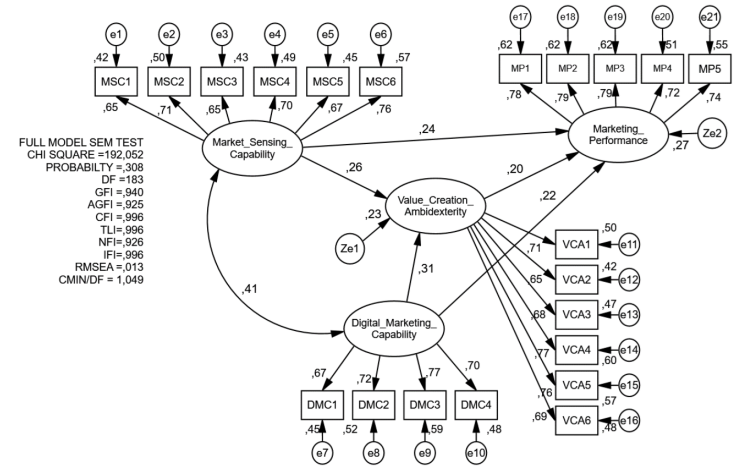
Testing the full structural model through the SEM approach must meet several criteria required. Testing the data has resulted in accordance with the recommended SEM, namely the Goodness-of-Fit index, the value of X2 is obtained 192.052 and not significant at α: 0.05, GFI index: 0.940; AGFI: 0.925; TLI: 0.996; CFI: 0.996. Furthermore, the RMSEA value: 0.013 is less than 0.08 and CMIN/DF is 1.049 or less than 2.00. Therefore, the model built is feasible to test the relationship among research variables.
To calculate the estimated magnitude of the indirect influence of the independent variable on the dependent variable, the Sobel test is used (Sobel, 1982). Table 3 and 4 shows that there is an indirect effect of 0.258 x 0.200 = 0.052, value creation ambidexterity mediates the relationship between market sensing capability and marketing performance (Sobel test 2.214, p-value 0.026 < 0.05). Market sensing capability has a direct influence on marketing performance (0.241), meaning that partial mediation occurred. Furthermore, digital marketing capability has an indirect effect on marketing performance of 0.311 x 0.200 = 0.062, value creation ambidexterity mediates the relationship between digital marketing capability and marketing performance (Sobel test 2.119, p-value 0.034 < 0.05). Besides that, digital marketing capability has a direct effect on marketing performance (0.225), thus partial mediation occurs.
Table 3 Hypothesis Testing
| Relationship among variables | Std β | Unstd β | SE | CR | Result |
|---|---|---|---|---|---|
| MSC -> VCA | .258 | .239 | .070 | 3,394* | H1 is accepted |
| DCM -> VCA | .311 | .278 | 072 | 3,882* | H2 is accepted |
| MSC -> MP | .241 | .294 | 092 | 3,211* | H3 is accepted |
| DCM -> MP | .225 | .267 | 093 | 2,876* | H4 is accepted |
| VCA -> MP | .200 | .265 | .098 | 2,700* | H5 is accepted |
Note: *p < 0.01
Table 4 Sobel Test Results
| Relationship specifications | Sobel test | p-values | Results |
|---|---|---|---|
| MSC -> VCA -> MP | 2,214 | 0.026 | H6 is accepted |
| DMC -> VCA -> MP | 2.119 | 0.034 | H7 is accepted |
Discussion
Market sensing capability has contributed to the realization of value creation ambidexterity. Identification of customer needs and wants as well as competitor strategies is urgently needed. Thus, the ability to understand market trends and marketing channels is a company priority in order to be able to respond quickly to market demands. Companies that have complete information on customer needs, competitor strategies and tactics as well as market trend information will be agile in creating the best value for customers. The availability of information on customer needs will make it easier for companies to design strategies to convey the best value so as to encourage the creation of value creation ambidexterity that meets customer expectations. The results of this study support the findings that the ability to understand market changes and build cooperative relationships with customers will get greater benefits through joint value creation activities (Mulyana et al., 2022). Organizations that understand market changes quickly can act proactively and are able to formulate the right strategy according to the target market segment (Day 1994;Martinette & Obenchain-leeson 2012).
Digital marketing capability is able to encourage value creation ambidexterity. Digital media is used to build long-term relationships, predict customer preferences and retain customers. Digital media makes it easy to communicate and share information to create the best value for customers. The more agile in using digital media to support marketing activities, the more agile it is to create the best value for customers. Completeness of content and ease of access also makes it easy to develop the right strategy in delivering the best value for customers. The results of this study are in line with the findings that digital media is used to support marketing activities, especially sensing the market, thereby building mutually beneficial relationships with customers (Wang, 2020). Digital marketing is able to strengthen organizational ambidexterity (Tariq et al., 2022), and the application of digital instruments for SMEs will make it easier to achieve customer value creation (Matarazzo et al., 2021).
Market sensing capability affects marketing performance. Companies that understand the needs and desires of customers, and find competitors' strategies and tactics will be ready to face the competition. Likewise, the ability to identify and understand market trends and distribution channels will be able to respond quickly to market changes. The availability of this information will make it easier to formulate strategies to meet customer needs and desires, thus encouraging an increase in the number of purchases and marketing performance. The results of this study are in line with the statement that market sensing capability can improve marketing performance (Bailey 2013; Tseng and Lee 2014; Osakwe, C., & Ogbonna, 2016; Abubaker A & Balal I, 2017;Hendar et al., 2020).
Digital marketing capability affects marketing performance. The use of digital media in marketing will facilitate communication and information sharing with customers. Digital media is used as a means of building long-term relationships and retaining customers. Harmonious relationships and meeting customer needs through digital media will encourage an increase in the number of purchases and marketing performance. The results of this study are in line with the findings that digital marketing capability can improve company performance (Wang 2020; De Pelsmacker et al, 2018).
Value creation ambidexterity is able to improve marketing performance. Agility in responding to customer needs, providing new products according to customer expectations and providing product service guarantees quickly is needed by the company. Besides that, dexterity in creating added value to products and carrying out cost efficiencies can encourage pricing that is affordable for customers. Therefore, the company's agility to create the best value for customers will encourage increased marketing performance. This result is in line with the statement that value creation is the main key to the success of product innovation which will have an impact on business performance (Viljakainen and Toivonen 2014;Sorensen and Jensen 2015). Value creation contributes to the realization of value-added products, cost efficiency and services and further, will affect business performance (Gura˘u, 2015).
Value creation ambidexterity mediates the relationship between market sensing capability and marketing performance. Organization has the ability to understand customer needs, competitors' strategies and tactics as well as earlier information on market trends will encourage the realization of value creation ambidexterity that meets customer expectations so that it has an impact on improving marketing performance. Value creation ambidexterity also mediates the relationship between digital marketing capability and marketing performance. The utilization of digital platforms facilitates communication, sharing information and connecting with customers so as to encourage the realization of value creation ambidexterity that meets customer expectations, ultimately having an impact on improving marketing performance.
Conclusions
Improving marketing performance requires the support of market sensing capability, digital marketing and value creation ambidexterity. Market sensing can be developed by identifying customer needs and desires, understanding competitors' strategies and tactics in order to develop the right strategy. Efforts to understand changes in the market environment continue to be made in order to know market trends and be able to respond quickly. Likewise, utilizing digital media to support marketing activities is very necessary in order to be able to respond quickly to customer needs. Efforts to build harmonious relationships and retain customers through digital media will facilitate communication and information sharing. Digital platforms are very helpful for communicating and sharing knowledge with strategic partners for mutual benefit. The integration of adaptive and creative resources continues to be carried out by leaders or owners of fashion SMEs so that product and service innovation can produce the best value for all stakeholders.
Limitations and future research
The number and types of SMEs in Indonesia are very large, but it still faces classic problems, especially access to information, capital, management, creativity and innovation. This limitation makes it difficult to compete in the same industry both from within and outside the country. The ability to integrate adaptive and creative resources is not yet optimal due to weak management and finances so that innovations that produce value-added are not as expected. This research only takes fashion SMEs as an object, while the types and number of SMEs in Indonesia are very large. The results of this study cannot be generalized for SMEs in Indonesia. Therefore, future research can be carried out by taking a broader object or applying it to large companies so that the results are more comprehensive.

