




Servicios Personalizados
Revista
Articulo
 texto en
  Inglés (pdf)
 Artículo en XML
 Referencias del artículo
 Traducción automática
 Enviar artículo por email
Indicadores
-
 Citado por SciELO
 -
 Accesos
Links relacionados
-
 Similares en
SciELO
Similares en
SciELO
Compartir

 Permalink
Contaduría y administración
versión impresa ISSN 0186-1042
Contad. Adm vol.69 no.2 Ciudad de México abr./jun. 2024 Epub 10-Oct-2025
https://doi.org/10.22201/fca.24488410e.2024.5165
Articles
Effects of marketing innovation on perceived value and consumer engagement in a restaurant operator in Mexico City
1 Universidad Nacional Autónoma de México, México.
2 Universidad Popular Autónoma del Estado de Puebla, México.
Innovation is a relevant issue for any organization, and innovation in marketing is no exception, since it highlights the novelties in marketing activities and their relationship with value and engagement. Therefore, the objective of this article is to explain the effect of the perception of Marketing Innovation on Perceived Value and Consumer Engagement, as well as the effect of Perceived Value on Consumer Engagement in restaurants of an operator in Mexico City. A quantitative, explanatory and cross-sectional research was developed; 384 electronic surveys were applied to diners, and a structural equation model was used for the analysis. It was found that Marketing Innovation positively influences Perceived Value and Consumer Engagement, and that Perceived Value also positively affects Consumer Engagement.
JEL Code: M30; M31; O36; Q55
Keywords: marketing innovation; perceived value; consumer engagement; restaurant operator
La innovación es un tema relevante para toda organización, innovación en marketing no es la excepción, pues destacan las novedades en las actividades de marketing y su relación con el valor y el engagement, por ello, el objetivo de este artículo es explicar el efecto de la percepción de la Innovación en marketing sobre el Valor percibido y el Engagement del consumidor, así como el efecto del Valor percibido sobre el Engagement de los consumidores en restaurantes de una operadora en Ciudad de México. Se desarrolló una investigación cuantitativa, explicativa y transversal; se aplicaron 384 encuestas electrónicas a comensales, y se utilizó un modelo de ecuaciones estructurales para el análisis. Se comprobó que la Innovación en marketing influye positivamente sobre el Valor percibido y sobre el Engagement del consumidor y que el Valor percibido también afecta positivamente el Engagement del consumidor.
Código JEL: M30; M31; O36; Q55
Palabras clave: innovación en marketing; valor percibido; engagement del consumidor; operadora de restaurantes
Introduction
Innovation in marketing is a relatively recent topic (Weiber & Pohl, 2016), although it has already been identified as a key to capturing markets, increasing competitiveness, and using novel marketing ideas (Gupta, Malhotra, Czinkota, & Foroudi, 2016). Several researchers note that there are still few references on the construct (Moreira, Silva, & Sousa, 2012; Quaye & Mensah, 2019; Zakerian, Mokhtari, & Sabegh, 2017), as to a large extent, the marketing literature has neglected the term and its effects on variables associated with consumer decisions (Cuevas, Parga, & Estrada, 2020).
The capacity of an organization’s marketing innovation may influence aspects such as value creation and customer engagement (Drucker, 1954; Kanagal, 2015). Nonetheless, previous work has recommended studying this type of relation in sectors other than manufacturing (Sánchez-Gutiérrez, Cabanelas, Lampón, & González-Alvarado, 2019) and from other perspectives, such as that of the consumer. Despite the growth of the service sector-particularly the restaurant sector-it is characterized by focusing mainly on culinary innovation, often leaving aside marketing innovation (Lee, Hallak, & Sardeshmukh, 2019). Therefore, this paper aims to explain the effects that the perception of innovation in marketing has on both perceived value and consumer engagement, as well as the effect of perceived value on consumer engagement in restaurants managed by one of the large operators in this sector in Mexico City.
Review of the literature
Innovation in marketing
This construct is based on the theories of innovation and marketing, based on Schumpeter’s concept of innovation (Lala, Preda, & Boldea, 2010). This author gave meaning to “innovation” with a focus on “marketing” by stating that any organization seeking to make a profit should innovate and, to this end, carry out certain activities such as launching a new product or marketing little-known features of an already known product or service, applying new production and sales methods, opening new markets, obtaining new resources to transform them into goods, and creating new structures in the industry (Šledzik, 2013). Subsequently, the OECD (2005) developed the concept of innovation in marketing, describing it as the application of a new marketing method based on consumer needs, which brings significant changes in product or packaging design, place or distribution (the place where the transaction occurs), and promotion and price to open new markets or develop a new positioning in the market to increase sales.
Five dimensions have been proposed to evaluate marketing innovation (Chavez, 2023): technological, managerial, market research and marketing intelligence, competitiveness, and marketing mix. The technological dimension involves the development of new designs, materials, and products (Zhu et al., 2019). The managerial dimension focuses on business growth and its influence on innovation in management and business structure regarding innovation in marketing (Zakerian et al., 2017). Market research and marketing intelligence refer to the fact that innovation in marketing requires valuable information from customers and is therefore supported by constant market research (Efrat et al., 2017; Grimpe et al., 2017). The competitiveness dimension states that marketing innovation contributes to defining and reinforcing competitive advantage based on distinction, for example, through price, quality, or other attributes in which the company performs well (Weiber & Phol, 2016). Finally, the marketing mix dimension refers to innovation in product design, novel pricing strategy, innovation in packaging, and innovation regarding the place of distribution and promotion (Haghighinasab et al., 2013; OECD, 2005; Widjojo et al., 2020).
Innovation in marketing and perceived value
Perceived value is defined as the consumer’s overall evaluation of the usefulness of a product based on the perception of what is received and what is delivered (Zeithaml, 1988). Authors such as Sweeney and Soutar (2001) developed and validated a scale to measure perceived value by proposing the Perceived Value (PERVAL) scale, with three dimensions consumers perceive of a good: functional value, emotional value, and social value. Functional value corresponds to quality and price, to intrinsic factors of the product, and to those of a utilitarian nature (Gallarza & Gill-Saura, 2006; Sánchez, Swinnen, & Inniesta, 2013; Vivó & Gil-Saura, 2007). Emotional value refers to affective feelings when purchasing, i.e., internal values and subjective ratings that consumers assign to their purchase. It is not an inherent value of products but a value experienced by consumers (Merz et al., 2018; Woodruff & Gardial, 1996). Finally, social value refers to the goodness toward a person, idea, or product, i.e., this goodness involves a fact of worthiness for human life and society (Karababa & Kjeldgaard, 2014) and comprises the relations involved in the purchase (Vargo & Lusch, 2016).
Innovation creates value (Herskovits, 2015), and marketing innovation is expected to lead to innovation in marketing methods that add value to what is offered (OECD, 2006). Consumers can perceive the nature of a company’s marketing innovation strategies. Nonetheless, few studies have attempted to understand perceived value in the context of marketing innovation (Rivière, 2015) and how consumers benefit, contribute, and participate in exchanges in a process, product, or service innovation context (Banyte & Dovaliene, 2014; Dovaliene et al., 2015).
Innovation in marketing influences perceived value. Customer perceptions of new efforts in a company’s marketing strategy are expected to not only lead to differentiation of the product (Van Riel & Allard, 2012) but also impact consumers’ perceived value (Chuah, Marimuthu, & Ramayah, 2016). For example, research conducted in restaurants in South Korea found that motivation to innovate in marketing, particularly in technology, affects consumers’ perceived value (Kwak, Lee, & Cha, 2021). Also, a study on cruise travelers found that innovation focused on marketing experience influences perceived value (Hwang & Hyun, 2015). Thus, from the above, it is possible to propose that:
H1. The perception of innovation in marketing positively and significantly affects the consumer’s perceived value of the restaurants of a restaurant operator in Mexico City.
Innovation in marketing and consumer engagement
Consumer Engagement is a psychological state that occurs through the interaction of consumer experience focused on an object or agent for a brand or company (Brodie, Hollebeek, Jurić, & Ilić, 2011). Engagement is assessed concerning three internal aspects of the consumer (Cheung et al., 2011): vigor, dedication, and absorption. Vigor refers to physical behavior, i.e., the level of energy, time investment, and effort that a person uses as a consumer. Dedication is a person’s commitment or enthusiasm to a consumer activity or brand. It involves emotional aspects that engage the senses, implying pride, enthusiasm, challenge, and inspiration. Finally, absorption refers to the admiration or total dedication to an activity or brand and involves cognitive aspects that imply deep concentration.
It has been highlighted that innovation in marketing activities leads to consumer engagement for fostering long-lasting relationships with customers (Drucker, 1954; Vega, Olivero & Acosta, 2022) and that this kind of innovation intervenes in disruptive or incremental creations that generate value to produce engagement (Banyte & Dovaliene, 2014; Dovaliene et al., 2015). A study on innovation in sports marketing found that innovation in the product increased engagement among fans (Kröckel, Piazza & Wessel, 2023). Therefore, it is possible to propose that:
H2. The perception of marketing innovation positively and significantly affects consumer engagement in the restaurants of a restaurant operator in Mexico City.
Perceived value and consumer engagement
The literature affirms that Perceived Value underpins many marketing decisions (Banyte & Dovaliene, 2014) and shapes consumers’ purchase intentions (Bajs, 2015) as they evaluate the trade-off between the expected benefits of an offer and its cost (Stollery & Jun, 2017). Empirical work has shown that Perceived Value impacts consumer Engagement (Han, Che, & Chen, 2022). For example, research conducted in the restaurant industry found that Perceived Value positively influences consumer Engagement (Itani & Correia, 2019). Therefore, it is proposed that:
H3. Perceived value positively and significantly affects consumer engagement in the restaurants of a restaurant operator in Mexico City.
Method and materials
Quantitative and explanatory research was developed since the aim was to analyze the effects of the phenomena to be studied: Marketing Innovation (IM, Innovación en marketing) and its effects on Perceived Value (VP, Valor percibido) and Consumer Engagement (EC, Engagement del consumidor), as well as the effect of Perceived Value (VP) on Consumer Engagement. The analysis was performed through a PLS-SEM Structural Equation Model using 5 000 subsamples for the bootstrapping analysis.
Based on scales validated in the literature, a questionnaire was constructed and applied through an electronic survey. Five dimensions were used for the marketing innovation construct: technological, managerial, market research and marketing intelligence, strategic management competitiveness, and marketing mix. For the technological dimension, 8 items were used, adapted from Carrascosa, Peiró, and Segarra (2012) and Zhu et al. (2019). For the managerial dimension, 5 items were used, adapted from Carrascosa et al. (2012) and Zakerian (2017). The market research and marketing intelligence dimension was measured with 5 items, adapted from Zakerian (2017) and Pinzón et al. (2013). For the competitiveness dimension focused on strategic management, 5 items adapted from Ferrer, González, and Mendoza (2015) were used. Finally, the marketing mix dimension used 8 items, adapted from Pinzón (2009) and Cuevas et al. (2020).
On the other hand, the consumer-perceived value construct has three dimensions (Gallarza & Gil-Saura, 2006; Sweeney & Soutar, 2001): functional, social, and emotional. The functional dimension was measured with 13 items, adapted from Vivó and Gil-Saura (2007) and Gallarza and Gil-Saura (2006). The social dimension was measured with 7 items adapted from Vivó and Gil-Saura (2007) and Gallarza and Gil-Saura (2006). Moreover, the emotional dimension used 5 items adapted from Vivó and Gil-Saura (2007). Finally, Consumer Engagement considers three dimensions (Dovaliene et al., 2015; Kim, Kim, & Wachter, 2013): Vigor-Physical Behavior, Absorption-Cognition, and Dedication-Emotion. 6 items adapted from Cheung et al. (2011) and Dovaliene et al. (2015) were used for the Vigor-Physical Behavior dimension. Absorption-Cognition was measured with 5 items adapted from Cheung et al. (2011) and Dovaliene et al. (2015). Furthermore, 5 items were used for Dedication-Emotion, adapted from Cheung et al. (2011) and Dovaliene et al. (2015). All items used a 5-point Likert scale, where 1= strongly disagree and 5= strongly agree. Given that the research was carried out in the environment of health measures due to the COVID-19 pandemic in the restaurant sector, two control variables were used to evaluate the consumer’s perception of health safety within the restaurant through two items: Q1: Do you feel safe with the protocols implemented against COVID-19 in the restaurant during the pandemic? And Q2: Do you think it is safe to eat inside the restaurant, or do you prefer to take your meals home because of the risk of contagion?
The research was conducted in Mexico City with diners of a large operator of several restaurants. Seven of the operator’s brands were chosen, focused on serving casual and family food. Based on a non-probabilistic convenience sampling, 384 surveys were used, exceeding the minimum application criteria to run a structural analysis with the model proposed (Gorsuch, 1983). All participants were older than 15, of indistinct gender, and had visited a restaurant of the brands included in the study in the last 12 months (Table 1). Fieldwork was conducted between February and April 2021. Table 1 presents the demographic characteristics of the participants.
Table 1 Demographic characteristics of diners
| Age | Frequency | % | Marital status | Frequency | % |
|---|---|---|---|---|---|
| 16-26 | 239 | 62.2 | Single | 266 | 69.3 |
| 27-38 | 67 | 17.4 | Married | 75 | 19.5 |
| 39-49 | 58 | 15.1 | Cohabitating | 37 | 9.6 |
| 50-60 | 15 | 3.9 | Widow(er) | 6 | 1.6 |
| 61-71 | 5 | 1.3 | |||
| Total | 384 | 100.0 | Total | 384 | 100.0 |
| Gender | Frequency | % | Purchase frequency | Frequency | % |
| Female | 247 | 64.3 | Daily | 2 | .5 |
| Male | 137 | 35.7 | 2 to 3 times per week | 16 | 4.2 |
| Once a week | 23 | 6.0 | |||
| Once a fortnight | 57 | 14.8 | |||
| Once a month | 168 | 43.8 | |||
| Other | 118 | 30.7 | |||
| Total | 384 | 100.0 | Total | 384 | 100.0 |
Source: created by the authors
Results
The analysis was divided into two stages: 1) evaluation of the measurement model and 2) evaluation of the structural model.
Evaluation of the measurement model
The three latent variables were evaluated to verify the reliability and validity of the constructs Marketing Innovation, Perceived Value, and Consumer Engagement. All item loadings were assessed. Those that met the minimum required value of 0.70 were retained (Sarstedt, Ringle, Smith, Reams, & Hair, 2014), while the seventeen that did not meet the loading were eliminated (IMT1, IMT7, IMT8, IMG2, IMIm2, IMMk4, IMMk6, IMMk7, IMMk8, VPF1, VPF2, VPF3, VPF6, VPS1, ECVC1, ECVA5, ECDE4). Furthermore, internal consistency reliability was tested through Cronbach’s Alpha and Composite Reliability (CR). Regarding Cronbach’s Alpha, all three constructs exceeded the minimum acceptable value (α > 0.708) (Henseler, Ringle, & Sinkovics, 2009): IM (0.932), VP (0.931) and EC (0.934), and the same was true for each of the dimensions of the evaluator constructs (Table 2). As for Composite Reliability (CR), all constructs presented high levels of reliability (between 0.854 and 0.956) within acceptable values [0.7 and 0.9] (Hair, Ringle, & Sarstedt, 2011): IM (0.940), VP (0.939), and EC (0.943), the same for their respective dimensions (Table 2).
Table 2 Internal consistency reliability
| Construct | Cronbach’s Alpha α | Composite reliability (CR) |
|---|---|---|
|
|
0.846 | 0.891 |
|
|
0.745 | 0.854 |
|
|
0.816 | 0.891 |
|
|
0.848 | 0.892 |
|
|
0.777 | 0.857 |
|
|
0.905 | 0.922 |
|
|
0.880 | 0.913 |
|
|
0.945 | 0.956 |
|
|
0.767 | 0.866 |
|
|
0.857 | 0.898 |
|
|
0.884 | 0.920 |
Note: created by the authors based on the results of the study obtained from PLS 3.3
The construct validity was also evaluated, which was carried out employing convergent validity and discriminant validity. The convergent validity is shown in the external loadings, and Table 3 shows that all of them are greater than 0.708; therefore, the criterion is met (Sarstedt, Ringle, Smith, Reams, & Hair, 2014). Also, the composite reliability of each construct is greater than 0.75, and the average extracted variance values of all constructs are above 0.50 (Sarstedt et al., 2014).
Table 3 External loadings, composite reliability, and average extracted variance
| Construct | Items | External loads | Composite reliability | Average Variance Extracted (AVE) |
|---|---|---|---|---|
| IMT (Technological) | IMT2 | 0.747 | 0.891 | 0.620 |
| IMT3 | 0.841 | |||
| IMT4 | 0.793 | |||
| IMT5 | 0.761 | |||
| IMT6 | 0.793 | |||
| IMG (Managerial, Gerencial) | IMG3 | 0.837 | 0.854 | 0.662 |
| IMG4 | 0.777 | |||
| IMG5 | 0.824 | |||
| IMIm (Market research and marketing intelligence) | IMIm3 | 0.829 | 0.891 | 0.731 |
| IMIm4 | 0.877 | |||
| IMIm5 | 0.858 | |||
| IMC (Competitiveness) | IMC1 | 0.745 | 0.892 | 0.623 |
| IMC2 | 0.766 | |||
| IMC3 | 0.824 | |||
| IMC4 | 0.826 | |||
| IMC5 | 0.781 | |||
| IMMMk (Marketing mix) | IMMk1 | 0.806 | 0.857 | 0.600 |
| IMMk2 | 0.764 | |||
| IMMk3 | 0.786 | |||
| IMMk5 | 0.741 | |||
| VPF (Functional perceived value, Valor percibido Funcional) | VPF4 | 0.764 | 0.922 | 0.569 |
| VPF5 | 0.752 | |||
| VPF7 | 0.786 | |||
| VPF8 | 0.714 | |||
| VPF9 | 0.771 | |||
| VPF10 | 0.745 | |||
| VPF11 | 0.735 | |||
| VPF12 | 0.800 | |||
| VPF13 | 0.714 | |||
| VPE (Perceived Emotional Value, Valor percibido Emocional) | VPE1 | 0.857 | 0.913 | 0.678 |
| VPE2 | 0.714 | |||
| VPE3 | 0.840 | |||
| VPE4 | 0.846 | |||
| VPE5 | 0.850 | |||
| VPS (Social Perceived Value, Valor percibido Social) | VPS2 | 0.857 | 0.956 | 0.783 |
| VPS3 | 0.872 | |||
| VPS4 | 0.906 | |||
| VPS5 | 0.872 | |||
| VPS6 | 0.906 | |||
| VPS7 | 0.896 | |||
| ECVC (vigor-physical behavior) | ECVC2 | 0.782 | 0.866 | 0.683 |
| ECVC3 | 0.833 | |||
| ECVC4 | 0.862 | |||
| ECAC (absorption-cognition) | ECAC1 | 0.825 | 0.898 | 0.638 |
| ECAC2 | 0.842 | |||
| ECAC3 | 0.781 | |||
| ECAC4 | 0.742 | |||
| ECAC5 | 0.799 | |||
| ECDE (dedication-emotion) | ECDE1 | 0.865 | 0.920 | 0.742 |
| ECDE2 | 0.866 | |||
| ECDE3 | 0.846 | |||
| ECDE5 | 0.868 |
Source: created by the authors
Moreover, the discriminant validity analysis (Table 4) was performed employing the Fornell-Larcker criterion, and it was corroborated that each variable shares more variance with its indicators than with other variables (Hair et al., 2011).
Table 4 Discriminant validity through the Fornell-Larcker criterion
| ECAC | IMC | VPE | ECDE | VPF | IMG | IMIm | IMMk | VPS | IMT | ECVC | |
|---|---|---|---|---|---|---|---|---|---|---|---|
| ECAC | 0.799 | ||||||||||
| IMC | 0.483 | 0.789 | |||||||||
| VPE | 0.492 | 0.551 | 0.823 | ||||||||
| ECDE | 0.813 | 0.529 | 0.499 | 0.861 | |||||||
| VPF | 0.446 | 0.562 | 0.800 | 0.444 | 0.754 | ||||||
| IMG | 0.482 | 0.653 | 0.464 | 0.489 | 0.500 | 0.813 | |||||
| IMIm | 0.501 | 0.745 | 0.644 | 0.525 | 0.622 | 0.683 | 0.855 | ||||
| IMMk | 0.494 | 0.671 | 0.583 | 0.488 | 0.622 | 0.573 | 0.650 | 0.775 | |||
| VPS | 0.656 | 0.470 | 0.343 | 0.689 | 0.313 | 0.393 | 0.405 | 0.442 | 0.885 | ||
| IMT | 0.455 | 0.498 | 0.527 | 0.405 | 0.543 | 0.537 | 0.548 | 0.565 | 0.337 | 0.787 | |
| ECVC | 0.712 | 0.530 | 0.488 | 0.769 | 0.453 | 0.442 | 0.472 | 0.534 | 0.682 | 0.403 | 0.826 |
Note: created by the authors based on the results of the study obtained from PLS 3.3
Structural model
Once the validity of the model was verified, the structural model was run, which helped to evaluate the possible existence of the effects to be tested and the explanation between the constructs by evaluating collinearity, path coefficients (β), validation of the model by Bootstrapping, coefficient of determination R2, effect size f2, and the Stone-Geisser coefficient (Q2). Regarding collinearity, the FIV was 1 for the three constructs (IM, VP, and EC). As these results were lower than 3.3, it can be stated that there is no presence of multicollinearity among the variables (Hair et al., 2011). For the evaluation of the hypotheses and their algebraic sign, statistical significance, and magnitude, path coefficients (β), t-test, and p-values were analyzed.
The standardized value of a path (β) can assume values between +1 and -1. The analysis results were: βH1= 0.764, βH2=0.219, and βH3=0.535, all significant (Table 5), so each of the hypotheses formulated were tested. Regarding the control variables, which measured the effect of COVID-19 on consumer engagement, the results were not significant: Q1 (β=0.032, t=0.786) and Q2 (β=-0.052, t=1.329), which shows that there is no effect of the control variables on consumer engagement.
Table 5 Hypotheses evaluation
| Hypothesis |
|
|
P-values (significance) |
|---|---|---|---|
| H1. Marketing innovation (IM) -> Perceived value (VP) | 0.764 | 32.722 | 0.000 |
| H2. Marketing Innovation (IM) -> Consumer Engagement (EC) | 0.219 | 3.453 | 0.001 |
| H3. Perceived Value (VP) -> Consumer Engagement (EC) | 0.535 | 8.528 | 0.000 |
Note: created by the authors using a 5 000 sample Bootstrapping algorithm
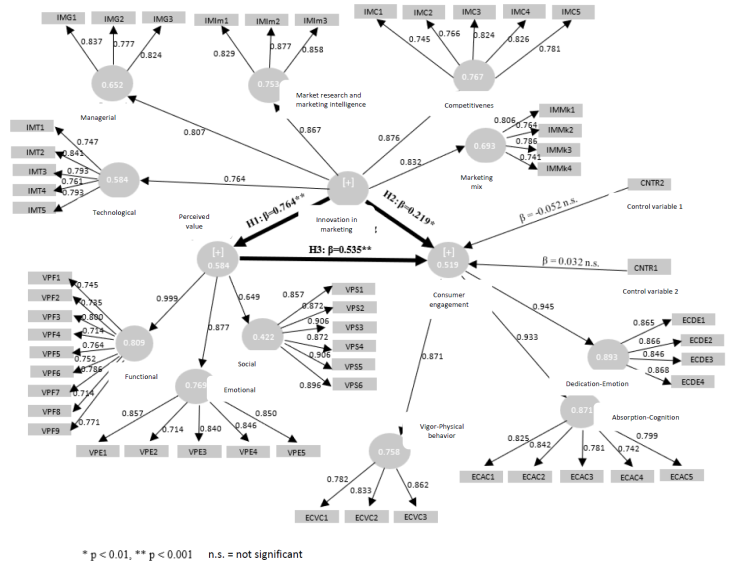
In addition to the evaluation of the hypotheses, the predictive capacity of the model was reviewed through three indicators: the coefficient of determination (R2), the effect size (f2), and the Stone-Geisser coefficient (Q2). Regarding R2, eight variables presented substantial value, with values between 0.67 and 0.75 (Chin, 1998; Hair et al., 2017), and five showed a moderate value, with values between 0.33 and 0.50 (Chin, 1998; Hair et al., 2017). None presented a weak value. Consequently, the latent variables of the model showed a satisfactory predictive power (Chin 1998): Marketing Innovation (IM) explained 58.4% of Perceived Value (VP) and 51.9% of Consumer Engagement (EC). These results showed that both constructs presented a satisfactory predictive quality (Table 6).
Table 6 Coefficient of determination R2
| Construct / Dimension | R2 | Valor |
|---|---|---|
| Cognition | 0.871 | substantial |
| Competitiveness | 0.767 | substantial |
| Emotional | 0.769 | substantial |
| Emotion | 0.893 | substantial |
| Consumer engagement | 0.519 | moderate |
| Functional | 0.809 | substantial |
| Managerial | 0.652 | moderate |
| Research and market intelligence | 0.753 | substantial |
| Marketing mix | 0.693 | substantial |
| Social | 0.422 | moderate |
| Technological | 0.584 | moderate |
| Perceived value | 0.584 | moderate |
| Vigor | 0.758 | substantial |
Source: created by the authors
Concerning effect size f2 (Table 7), Cohen’s criteria (1998) were used, and it was found that Marketing Innovation had a large effect on Perceived Value (1.403) but a small effect on Consumer Engagement (0.041). Moreover, Perceived Value showed a medium-sized effect on Consumer Engagement (0.245). Regarding the predictive relevance (Q2) of the structural model (Tables 8 and 9), Chin’s (1998) reference was used, and it was found that the Q2 of the model had a predictive relevance of 0.25 of Marketing Innovation on Perceived Value and 0.296 on Consumer Engagement. Therefore, it can be stated that the model has a good predictive quality.
Table 7 F2 effect
| Endogenous constructs | |||||
|---|---|---|---|---|---|
| Perceived value (VP) | Consumer Engagement (EC) | ||||
| Exogenous construct | Path coefficients (β) | F2 effects | Path coefficients (β) | F2 effects | |
| Marketing Innovation (IM) | 0.764 | 1.403 | 0.219 | 0.041 | |
| Perceived value (VP) | NV | NV | 0.535 | 0.245 | |
Note: SV=No value
Source: created by the authors
Table 8 Q2 values
| Variables | Q² (=1-SSE/SSO) |
|---|---|
| Cognition | 0.549 |
| Competitiveness | 0.470 |
| Emotional | 0.517 |
| Emotion | 0.658 |
| Consumer engagement | 0.296 |
| Functional | 0.454 |
| Managerial | 0.424 |
| Research and market intelligence | 0.546 |
| Marketing mix | 0.411 |
| Social | 0.325 |
| Technological | 0.356 |
| Perceived value | 0.251 |
| Vigor | 0.512 |
Source: created by the authors
Discussion
This paper aimed to explain the effects of perceived marketing innovation on Perceived Value and Consumer Engagement. Hypothesis 1 states that Marketing Innovation (IM) positively and significantly affects Perceived Value (VP), and as shown in the results, this hypothesis was proven. This means that when the consumer perceives that there is marketing innovation in technology, management aspects, market research and intelligence, competitiveness, and marketing mix, then perceived value improves for various attributes, such as price and product quality, as well as internal consumer issues, and social and emotional aspects. This result coincides with other research that has concluded that innovation creates and generates value (Herskovits, 2015; Widjojo et al., 2020), both co-created and shared (Kanagal, 2015). Works such as those of Mohr (1969) and Vargo and Lusch (2004, 2008) have also supported this effect, advocating that they should be measured from the demand side since, for an invention to be transformed into innovation and have an effect on value, they must be acquired in the market.
Regarding Hypothesis 2, it was confirmed that marketing innovation has a positive and significant effect on consumer engagement. This result is consistent with Drucker’s (1954) postulation and Mollen and Wilson’s (2010) finding that innovation and marketing activities lead to engagement. Therefore, when the consumer perceives some type of innovation in marketing, whether in technology, managerial aspects, marketing intelligence, competitiveness, or marketing mix, consumer engagement toward the company may occur from a physical, cognitive, or emotional point of view.
This research found that perceived value positively affects consumer engagement. Therefore, Hypothesis 3 is accepted. This is consistent with the contributions of Alexander and Jaakkola (2022), as they state that perceived value affects the role of consumer engagement. Likewise, other works have found that Perceived Value positively affects Consumer Engagement (Xie, Guan, He, & Huan, 2021). In the operator’s restaurants studied, consumers develop physical, cognitive, and emotional engagement with the restaurant by perceiving its value, that is, by perceiving value in price and quality, emotional value, and social value.
Thus, Consumer Engagement is influenced by both Marketing Innovation and Perceived Value. Nevertheless, Perceived Value has a greater effect on Engagement, as both Perceived Value and Engagement are internal aspects of the consumer (Dovaliene et al., 2015; Karababa & Kjeldgaard, 2014; Payne, Storbacka, & Frow, 2007; Storbacka, 2019).
Each purchasing situation is unique in the consumption experience, as it depends on perception (Hidayati & Novani, 2015; Vargo & Lusch, 2004). Besides, value is shaped by social experiences (Grönroos & Voima, 2011). Moreover, the value placed by the consumer on engaging in relations (engagement) goes beyond the company (Sweeney, Danaher, & McColl, 2015) as social aspects such as family and friends exert an influence, in addition to cognitive and emotional aspects (Payne et al., 2007). Such aspects make consumers perceive value from within themselves (Karababa & Kjeldgaard, 2014) and are associated with engagement (Dovaliene et al., 2015). Innovation is different, as it occurs from the company to the consumer.
Conclusions
This research pursued two objectives. On the one hand, it sought to explain the effects of consumer perception on marketing innovation regarding both perceived value and consumer engagement and, on the other hand, to evaluate the effect of consumer perceived value on consumer engagement in restaurants managed by one of the largest restaurant operators in this sector in Mexico City. Using empirical research, it was found that the perception of marketing innovations in restaurants positively affects perceived value and consumer engagement. In addition, the value perceived by consumers positively influences the development of Engagement with the restaurant.
These findings are relevant to the restaurant industry, as an investment in generating innovation in the dimensions of technology, management, market research, marketing intelligence, competitiveness, and elements of the marketing mix can be powerful for generating perceived value and engagement, which is likely to translate into profitability and enable a sustainable competitive advantage.
As in other studies, this one also has some limitations since convenience sampling was applied, which limits the generalizability of the study to the restaurant sector. Additionally, data was collected during the red traffic light phase of the COVID-19 pandemic, and therefore, only seven out of twelve brands were considered, belonging to a single restaurant operator in Mexico City. Consequently, it is recommended that future studies replicate the research at a post-pandemic moment and in restaurants in other states in Mexico or other countries. Finally, it is recommended to study the progress of the line of research associated with marketing innovation in the sector also in small and medium-sized restaurants (SMEs).
REFERENCES
Alexander, M., & Jaakkola, E. (2015). Customer engagement behaviours and value co-creation. In J. Brodie, D. Hollebeek (Coord.), Customer Engagement (pp. 3-20). Routledge. https://doi.org/10.4324/9781315725185 [ Links ]
Bajs, I. P. (2015). Tourist perceived value, relationship to satisfaction, and behavioral intentions: The example of the Croatian tourist destination Dubrovnik. Journal of Travel Research, 54(1), 122-134. https://doi.org/10.1177/0047287513513158 [ Links ]
Banyte, J. & Dovaliene, A. (April 2014). Relations between customer engagement into value creation and customer loyalty. 19th International Scientific Conference; Economics and Management (ICEM) 23-25. Riga, Latvia. https://doi.org/10.1016/j.sbspro.2014.11.226 [ Links ]
Brodie, R. J., Hollebeek, L.D., Jurić, B. & Ilić, A. (2011). Customer Engagement: Conceptual Domain, Fundamental Propositions, and Implications for Research. Journal of Service Research, 14 (3), 252-271. https://doi.org/10.1177/1094670511411703 [ Links ]
Carrascosa, P., Peiró, A., y Segarra, M. (noviembre 2012). Relación entre mejora continua, innovación y compromiso medioambiental de la gerencia, un estudio empírico. Tec Empresarial, 6(3), 9-23. https://doi.org/10.18845/te.v6i3.630 [ Links ]
Chávez, M. (2023). Innovación en marketing. Sus efectos sobre el valor en marketing y el engagement del consumidor en el sector de restaurantes en CDMX (tesis doctoral). Universidad Nacional Autónoma de México. Ciudad de México, México. (Disponible en: Disponible en: https://tesiunam.dgb.unam.mx/F/QFEK95DM6EUURYATPHFAVEGN53ERK2H9ELT7VL3J1QTRHFEG7G-00826?func=direct&doc_number=000840805&format=999 ) y (Consultado: 10/07/23) [ Links ]
Cheung, C., Lee, M. & J, X-L (2011). Customer engagement in an online social platform: a conceptual model and scale development. Thirty Second International Conference on Information Systems, Shanghai. (Disponible en: Disponible en: https://aisel.aisnet.org/icis2011/proceedings/onlinecommunity/8/ ) y (Consultado: 10/02/23) [ Links ]
Chin, W. (1998). The partial least square approach to structural equation modelling. En G. Marcoulides (Ed.), Modern Methods for Business Research (295-369). Mahawah, Estados Unidos: Lawrence Erlbaum. (Disponible en: Disponible en: https://psycnet.apa.org/record/1998-07269-010 ) y (Consultado: 05/02/22) [ Links ]
Chuah, S. H. W., Marimuthu, M., & Ramayah, T. (2016). The Contribution of Perceived Firm Marketing Innovation Initiatives to Customer Perceived Value and Loyalty: Does Switching Experience Really Matter?. Asian Academy of Management Journal, 21(Supplement 1), 1-23. http://dx.doi.org/10.21315/aamj2016.21.supp.1.1 [ Links ]
Cohen, J. (1998). Statically power analysis for the behavioral sciences. USA, New York: Laurence Erlbaum Associates. https://doi.org/10.1111/1467-8721.ep10768783 [ Links ]
Cuevas, H., Parga, N. y Estrada, S. (2020). Incidencia de la innovación en marketing en el rendimiento empresarial: una aplicación basada en modelamiento con ecuaciones estructurales. Journal of management and economics for Iberoamerica. Estudios Gerenciales, 36(154), 66-79. https://doi.org/10.18046/j.estger.2020.154.3475 [ Links ]
Dovaliene, A., Masiulyte, A. & Piligrimiene, Z. (2015). The relations between customer engagement, perceived value and satisfaction: the case of mobile applications. 20th International Scientific Conference Economics and Management. Procedia - Social and Behavioral Sciences. 213, 659-664. https://doi.org/10.1016/j.sbspro.2015.11.469 [ Links ]
Drucker, P. (1954). The practice of management. New York: Harper and Row Publisher. https://doi.org/10.4324/9780080942360 [ Links ]
Efrat, K., Gilboa, S., & Yonatany, M. (2017). When marketing and innovation interact: The case of born-global firms. International Business Review, 26(2), 380-390. https://doi.org/10.1016/j.ibusrev.2016.09.006 [ Links ]
Ferrer, L., González, K., y Mendoza, L. (2015). La innovación como factor clave para mejorar la competitividad de las PYMES en el departamento del Atlántico, Colombia. Dictamen Libre, (16), 21-36. https://doi.org/10.18041/2619-4244/dl.16.3066 [ Links ]
Gallarza, M. G. y Gil-Saura, I. (2006). Desarrollo de una escala multidimensional para medir el valor percibido de una experiencia de servicio. Revista española de investigación de marketing, 10(2), 25-59. (Disponible en: Disponible en: https://dialnet.unirioja.es/servlet/articulo?codigo=2137773 ) y (Consultado: 15/04/22) [ Links ]
Gorsuch, R. L. (1983). Factor analysis (2nd. ed.). Hillsdale, NJ: Erlbaum. https://doi.org/10.1207/s15327906mbr2501_3 [ Links ]
Grimpe, C., Sofka, W., Bhargava, M., & Chatterjee, R. (2017). R&D, Marketing Innovation, and New Product. Journal of Product Innovation Management, 34(3), 360-383. doi: 10.1111/jpim.12366 [ Links ]
Grönroos, C. & Voima, P. (2011). Making sense of value and value co-creation in service logic. Hanken School of Economics, working papers. Department of marketing. ISBN 978-952-232-157-2, ISSN 0357-4598. (Disponible en: Disponible en: http://hdl.handle.net/10138/29218 ) y (Consultado: 10/03/22) [ Links ]
Gupta, S., Malhotra, N., Czinkota, M. & Foroudi, P. (2016). Marketing innovation: A consequence of competitiveness. Journal of Business Research, 69(12), 5671-5681. https://doi.org/10.1016/j.jbusres.2016.02.042 [ Links ]
Haghighinasab, M., Sattari, B., Ebrahimi, M., & Roghanian, P. (2013). Identification of innovative marketing strategies to increase the performance of SMEs in Iran. International Journal of Fundamental Psychology & Social Sciences, 3(2), 26-30. (Disponible en: Disponible en: https://citeseerx.ist.psu.edu/document?repid=rep1&type=pdf&doi=354320bb8974e87b02cc909541ffef3531f72c39 ) y (Consultado: 02/01/23) [ Links ]
Hair, J., Hult, G., Ringle, C. & Sarstedt, M. (2017). A Primer on Partial Least Squares Structural Equation Modeling. Thousand Oaks, USA: Sage. Doi: 10.1007/978-3-030-80519-7 [ Links ]
Han, X., Chen, S., & Chen, B. (2022). From employee engagement to customer engagement: A multilevel dual-path model of engagement spillover effects in service ecosystems. Journal of Retailing and Consumer Services, 64, 102815. https://doi.org/10.1016/j.jretconser.2021.102815 [ Links ]
Henseler, J., Ringle, C. M. & Sinkovics, R. R. (2009). The use of Partial Least Squares path modeling in international marketing. Advances in International Marketing, 20, 277-319. https://doi.org/10.1108/S1474-7979(2009)0000020014 [ Links ]
Herskovits, R. (2015). Un modelo de relación entre los programas de innovación abierta y la creación de valor (Tesis doctoral). Universidad Politécnica de Madrid, Madrid, España. https://doi.org/10.20868/UPM.thesis.33817 [ Links ]
Hidayati, R. & Novani, S. (2015). A conceptual complaint model for value co-creation process. Procedia Manufacturing, 4, 412-418. https://doi.org/10.1016/j.promfg.2015.11.057 [ Links ]
Hwang, J., & Hyun, S. S. (2016). Perceived firm innovativeness in cruise travelers’ experience and perceived luxury value: The moderating effect of advertising effectiveness. Asia Pacific Journal of Tourism Research, 21(sup1), S101-S128. https://doi.org/10.1080/10941665.2015.1016051 [ Links ]
Itani, O. S., Kassar, A. N., & Loureiro, S. M. C. (2019). Value get, value give: the relationships among perceived value, relationship quality, customer engagement, and value consciousness. International Journal of Hospitality Management, 80, 78-90. https://doi.org/10.1016/j.ijhm.2019.01.014 [ Links ]
Kanagal, N.B. (2015). Innovation and product innovation in marketing strategy. Journal of Management and Marketing Research, 18,1-26. (Disponible en: Disponible en: https://repository.iimb.ac.in/handle/2074/12020 ) y (Consultado: 05/07/22) [ Links ]
Karababa, E. & Kjeldgaard, D. (2014). Value in marketing: toward sociocultural perspectives. Marketing theory, 14(1),119-127. https://doi.org/10.1177/1470593113500385 [ Links ]
Kim, Y., Kim, D. & Wachter, K. (2013). A study of mobile user engagement (MoEN): Engagement motivations, perceived value, satisfaction, and continued engagement intention. Decision Support Systems, 56, 361-370. https://doi.org/10.1016/j.dss.2013.07.002 [ Links ]
Kröckel, P., Piazza, A., & Wessel, P. (2023). Sports marketing innovation: increasing fan engagement via innovative statistics from facial emotion recognition. BMT22, 4th International Conference Business Meets Technology Ansbach, 7th - 9th July 2022 https://doi.org/10.4995/BMT2022.2022.15631 [ Links ]
Kwak, M. K., Lee, J., & Cha, S. S. (2021). Senior consumer motivations and perceived value of robot service restaurants in Korea. Sustainability, 13(5), 2755. https://doi.org/10.3390/su13052755 [ Links ]
Lala, I., Preda, G. & Boldea, M., (2010) A theoretical approach of the concept of innovation. Managerial Challenges of the Contemporary Society. Proceedings, 151, 151-156. (Disponible en: Disponible en: https://www.ceeol.com/search/article-detail?id=248353 ) y (Consultado: 23/08/22) [ Links ]
Lee, C., Hallak, R. & Sardeshmukh, S. R. (2019). Creativity and innovation in the restaurant sector: Supply-side processes and barriers to implementation. Tourism Management Perspectives, 31, 54-62. https://doi.org/10.1016/j.tmp.2019.03.011Get rights and content [ Links ]
Merz, M., Zarantonello, L. & Grappi, S. (2018). How valuable are your customers in the brand value co-creation process? The development of a Customer Co-Creation Value (CCCV) scale. Journal of Business Research, 82, 79-89. https://doi.org/10.1016/j.jbusres.2017.08.018 [ Links ]
Mohr, L. (Marzo 1969). Determinants of innovation in organizations. The American Political Science Review, 63(1), 111-126. https://doi.org/10.2307/1954288 [ Links ]
Mollen, A., & Wilson, H. (2010). Engagement, telepresence and interactivity in online consumer experience: Reconciling scholastic and managerial perspectives. Journal of Business Research, 63(9-10), 919-925. https://doi.org/10.1016/j.jbusres.2009.05.014 [ Links ]
Moreira, J., Silva, M.J., Simões, J. & Sousa, G. (2012). Drivers of Marketing Innovation in Portuguese Firms. Amphitheatre Economic Journal, 14(31), 195-206. (Disponible en: Disponible en: http://hdl.handle.net/10419/168752 ) y (Consultado: 15/05/22) [ Links ]
OECD (2005). Manual de Oslo, Guidelines for collecting and interpreting innovation data. (Disponible: Disponible: https://www.oecd.org/science/inno/2367614.pdf ) y (Consultado: 02/07/22) [ Links ]
OCDE (2006). Manual de Oslo. Guía para la recolección e interpretación de datos de innovación; tercera edición. México: OCDE. (Disponible en: Disponible en: https://www.madrid.org/bvirtual/BVCM001708.pdf ) y (Consultado: 05/09/22) [ Links ]
Payne, A., Storbacka, K. & Frow, P. (2008). Managing the co-creation of value. Conceptual/Theoritical paper. Journal of the academy of marketing science, 36(1), 83-96. DOI:10.1007/s11747-007-0070-0 [ Links ]
Pinzón, S., Martínez, M.C., y Maldonado, G. (julio-diciembre 2013). La adopción de la orientación al mercado en la PYME manufacturera de México. Revista FIR, FAEDPYME International Review, 2(4), 18-32. DOI:10.15558/fir.v2i4.36 [ Links ]
Rivière, A. (2015). Towards a model of the perceived value of innovation: The key role of perceived benefits ahead of the adoption process. Recherche et Applications En Marketing (English Edition), 30(1), 5-27. https://doi.org/10.1177/2051570714560317 [ Links ]
Sánchez, R., Swinnen, G. e Iniesta, M. (2013). La creación de valor en servicios: una aproximación a las dimensiones utilitarista y hedonista en el ámbito de la restauración. Cuadernos de Economía y Dirección de la Empresa. 16, 83-94. https://doi.org/10.1016/j.cede.2012.05.004 [ Links ]
Sánchez-Gutiérrez, J., Cabanelas, P., Lampón, J. F., & González-Alvarado, T. E. (2019). The impact on competitiveness of customer value creation through relationship capabilities and marketing innovation. Journal of business & industrial marketing, 34(3), 618-627. https://doi.org/10.1108/JBIM-03-2017-0081 [ Links ]
Sarstedt, M., Ringle, C., Smith, D., Reams R. & Hair, J. (2014). Partial least squares structural equation modeling (PLS-SEM): A useful tool for family business researchers. Journal of Family Business Strategy, 5, 105-115. https://doi.org/10.1016/j.jfbs.2014.01.002 [ Links ]
Šledzik, K. (Abril, 2013). Schumpeter’s view on innovation and entrepreneurship. SSRN Electronic Journal. Management Trends in Theory and Practice. doi: 10.2139/ssrn.2257783. [ Links ]
Stollery, A., & Jun, S. H. (2017). The antecedents of perceived value in the Airbnb context. Asia Pacific Journal of Innovation and Entrepreneurship, 11(3), 391-404. https://doi.org/10.1108/APJIE-12-2017-040 [ Links ]
Storbacka, K. (2019). Actor engagement, value creation and market innovation. Industrial Marketing Management, 80, 4-10. https://doi.org/10.1016/j.indmarman.2019.04.007 [ Links ]
Sweeney, J. & Soutar, G. (2001). Consumer perceived value: the development of a multiple item scale. Journal of Retailing, 77(2), 203-220. https://doi.org/10.1016/S0022-4359(01)00041-0 [ Links ]
Sweeney, J., Danaher, T. & McColl, J. (2015). Customer Effort in Value Cocreation Activities: improving quality of life and behavioral intentions of health care customers. Journal of Service Research, 18(3), 318-335. https://doi.org/10.1177/1094670515572128 [ Links ]
Quaye, D., & Mensah, I. (2019). Marketing innovation and sustainable competitive advantage of manufacturing SMEs in Ghana. Management Decision. 57(7), 1535-1553. doi: 10.1108/MD-08-2017-0784. [ Links ]
Van Riel, A. C. (2012). Strategic service innovation management in retailing. Service Management: The New Paradigm in Retailing, 83-95. DOI: 10.1007/978-1-4614-1554-1_6 [ Links ]
Vargo, S. & Lusch, R. (2004). Evolving to a new Dominant Logic for Marketing. Journal of marketing, 68, 1-17. https://doi.org/10.1509/jmkg.68.1.1.24036 [ Links ]
Vargo, S. & Lusch, R. (2008). Service-dominant logic: continue the evolution. Conceptual/Theoretical paper. Journal of the academic marketing science, 36, 1-10. Doi: 10.1007/s11747-007-0069-6 [ Links ]
Vargo, S. & Lusch, R. (2016). Institutions and axioms: An extension and update of service-dominant logic. Journal of the academy of marketing science, 44, 5-23. DOI:10.1007/s11747-015-0456-3 [ Links ]
Vega-Sampayo, Y., Olivero-Vega, E., & Acosta-Prado, J. C. (2022). Efecto mediador de las tecnologías de la información y la comunicación (TIC) en la relación capacidad de innovación y satisfacción estudiantil, en instituciones de educación superior. Formación universitaria, 15(3), 107-118. http://dx.doi.org/10.4067/S0718-50062022000300107 [ Links ]
Vivó, V. S., y Gil-Saura, I. (2007). Valor percibido por el consumidor: Una aplicación en la compra de equipamiento para el hogar. Estudios sobre consumo, 82, 35-48. (Disponible en: Disponible en: https://dialnet.unirioja.es/servlet/articulo?codigo=24920769 y (Consultado: 09/10/22) [ Links ]
Weiber, R. & Pohl, A. (2016). Innovation and Marketing. Deutschland: Kohlhammer Edition. (Disponible en: Disponible en: https://books.google.com.mx/books?hl=es&lr=&id=t2wiEAAAQBAJ&oi=fnd&pg=PP1&ots=ZABlgY4tTt&sig=ogwK2JloC0mma2ulYkYOL0Zld1U#v=onepage&q&f=false9 y (Consultado: 02/02/22) [ Links ]
Widjojo, H., Fontana, A., Gayatri, G. & Soehadi, A. (2020). Value co-creation for marketing Innovation: comparative study in the SME community. International Journal of Innovation Management. 24(03), 2050030. https://doi.org/10.1142/S1363919620500309 [ Links ]
Woodruff, B. R. & Gardial, F. S. (1996). Know your customer: New approaches to Understanding Customer Value and Satisfaction. Malden, USA: Blackwell Business. [ Links ]
Xie, L., Guan, X., He, Y., & Huan, T. C. (2021). Wellness tourism: Customer-perceived value on customer engagement. Tourism Review, 77(3), 859-876. https://doi.org/10.1108/TR-06-2020-0281 [ Links ]
Zakerian, H., Mokhtari, S. E., Sabegh, M. A. J., & Jomadi, M. H. (2017). Innovative marketing in SMEs: an empirical study. International Journal of Business Innovation and Research, 12(3), 315-336. https://doi.org/10.1504/IJBIR.2017.082088 [ Links ]
Zeithaml, V. A. (1988). Consumer perceptions of price, quality, and value: a means-end model and synthesis of evidence. Journal of Marketing, 52(3), 2-22. https://doi.org/10.1177/002224298805200302 [ Links ]
Zhu, Q., Zou, F., & Zhang, P. (2019). The role of innovation for performance improvement through corporate social responsibility practices among small and medium‐sized suppliers in China. Corporate Social Responsibility and Environmental Management, 26 (2), 341-350. https://doi.org/10.1002/csr.1686 [ Links ]
Received: March 24, 2023; Accepted: May 09, 2023; Published: August 01, 2023
 Este es un artículo publicado en acceso abierto bajo una licencia Creative Commons
