




Servicios Personalizados
Revista
Articulo
 texto en
  Inglés (pdf)
 Artículo en XML
 Referencias del artículo
 Traducción automática
 Enviar artículo por email
Indicadores
-
 Citado por SciELO
 -
 Accesos
Links relacionados
-
 Similares en
SciELO
Similares en
SciELO
Compartir

 Permalink
Contaduría y administración
versión impresa ISSN 0186-1042
Contad. Adm vol.68 no.4 Ciudad de México oct./dic. 2023 Epub 14-Oct-2025
https://doi.org/10.22201/fca.24488410e.2023.4719
Articles
Exploration and exploitation of knowledge in the business response capacity of México
The strategic orientation of a company is determined by the degree of its capacity to absorb new knowledge from abroad. Degree to which they are able to acquire and assimilate information from the context, to transform and exploit within the organization. The objective was to analyze the effects of the potential absorption capacity (PACAP) on the realized absorption capacity (RACAP) and its mediating effect on the response capacity (CR), in 4 economic sectors of Mexico: commerce, construction, maquila and services. This research tests, with a structural equation model, samples of more than 12,0000 companies, collected in the Monthly Business Opinion Survey (EMOE). The findings suggest that PACAP influences CR only if RACAP positively moderates its relationship, in the 4 business sectors. This allows providing empirical evidence on how PACAP is related to RACAP and can achieve CR.
Keywords: potential absorptive capacity; realized absorptive capacity; response capacity; structural equations
JEL Code: D8; C8; L22; L25
La orientación estratégica de una empresa está determinada por el grado de su capacidad de absorción de nuevos conocimientos del exterior. Grado en que son capaces de adquirir y asimilar información del contexto, para transformar y explotar al interior de la organización. El objetivo fue analizar los efectos de la capacidad de absorción potencial (PACAP) sobre la capacidad de absorción realizada (RACAP) y su efecto mediador en la capacidad de respuesta (CR), en 4 sectores económico de México: comercio, construcción, maquila y servicios. Esta investigación prueba, con un modelo de ecuación estructural, muestras de más de 12, 0000 empresas, recopiladas en la Encuesta Mensual de Opinión Empresarial (EMOE). Los hallazgos sugieren que la PACAP influye en la CR solo si RACAP modera positivamente su relación, en los 4 sectores empresariales. Esto permite aportar evidencia empírica en cómo la PACAP se relaciona con la RACAP y puede lograr la CR.
Palabras clave: capacidad de absorción potencial; capacidad de absorción realizada; capacidad de respuesta y ecuaciones estructurales
Código JEL: D8; C8; L22; L25
Introduction
The existing literature indicates that most improvements and development of products and services come from the absorption and use of knowledge rather than only arising from the mere intellect of human capital (Alfaro-Ramos & Ferreras-Méndez, 2022; Demuner-Flores, Saavedra-García, & Ibarra-Cisneros, 2022). Organizations are increasingly relying on external sources of knowledge to drive business improvement and development. This process depends on the organization's ability to absorb and utilize these sources effectively. By leveraging external sources of knowledge, organizations can develop new products and services, increase efficiency, and gain a competitive advantage in their respective markets (Madero & Barboza, 2015).
In today's unstable, unpredictable, complex, and confusing landscape, innovation is paramount for any company that wants to succeed in the long term. Simultaneously, the innovation process encompasses two compatible activities: an intensive search for knowledge to investigate new and distinctive markets for available products.
The findings from this new knowledge are then incorporated into the company along with the previously acquired knowledge and used for commercial purposes (González-Campo & Hurtado-Ayala, 2014). This prevents the company from focusing solely on its own expertise.
Exploratory knowledge has the potential to foster greater absorptive capacity (PACAP). Exploratory activities involve different approaches, testing different solutions, keeping options open, and examining divergent viewpoints. In this way, exploring is associated with the search for new possibilities in the context of the company. On the contrary, knowledge exploitation (RACAP) helps transform knowledge, increase efficiency, and expand processes by reducing variance and providing more control and formalization of processes within the organization (Nicolau-Juliá, Expósito-Langa, & Tomás-Miquel, 2015).
However, there are disagreements about the contrast between exploration (PACAP) and exploitation (RACAP) in terms of structures, processes, strategies, and objectives. Studies suggest that PACAP can be leveraged to transform RACAP by eliminating inertia and improving it at the right time. However, this irregular disagreement can create a perplexing problem in achieving organizational integration. Although the characteristics of exploitation and exploration pose conflicting and paradoxical challenges, both are essential for the company to respond to the demands of the environment, strengthening its development and competitiveness (Alonso & Leiva, 2019).
In this sense, several studies affirm that both PACAP and RACAP processes must take place in a sequence for efficiency to be achieved. It is also difficult to transform and exploit knowledge from the outside without acquiring or assimilating it first (Demuner-Flores & Nava, 2018). This suggests that external knowledge can be assimilated and used in two diverse ways, either for learning or to respond to the market.
Highlighting the relationship between Proactive Absorption Capacity (PACAP) and Realized Absorption Capacity (RACAP), the concept of absorption capacity proposed by Zahra & George (2002) can be expanded. PACAP involves exploring knowledge through its acquisition and assimilation, while RACAP requires transforming and exploiting it for the purpose of responding to the environment.
Zahra and George have proposed exploring solutions to close the gap between PACAP and PACAP, activities that are apparently contrasting, but if integrated, allow overcoming barriers to business efficiency. These solutions could involve integration processes that could strengthen the relationship between these activities.
This article delves into the exploration of the response barriers faced by companies from various sectors in Mexico, considering their history in Latin America and the unique knowledge base as an emerging country. Start-ups are often at the forefront of using efficient solutions given their resource constraints. However, their responsiveness can sometimes be detrimental to them, as sudden changes in the environment can render their efforts ineffective. Thus, they should always be open to adapt and change their response strategy if necessary.
Given this concept of responsiveness, the scope of absorptive capacity can be expanded by exploring the structural link between potential capacity (PACAP) and actual capacity (RACAP) in Mexican firms. Some authors have investigated how an absorption strategy can be applied in small businesses (Islas, López, & Palomo, 2020; García Cabrera & García Soto, 2012), while most agree that contextual absorption is more appropriate for companies with greater resources (Barney, Ketchen, & Wright, 2021; Abrego, Sánchez, & Medina, 2017).
Following the contributions of Jansen, et. al. (2005), one places the integration of contextual knowledge, as potential capacity (PACAP) and internal processes of companies, as real capacity (RACAP), both dimensions integrate the absorption capacity of companies. Highlighting the importance of organizations responding strategically to market demands, seen in this study as making decisions to invest; as a reaction that fosters the competitiveness of the organization.
In this regard, the article was organized as follows. First, the literature review on the concepts of potential, real and response capabilities is presented. To identify the working hypotheses, as well as the theoretical model designed. Next, it presents the methodology followed in this research which used Pearson's correlation and the analysis of structural equations with partial least squares (SEM-PLS). Third, the results are shown and discussed. The paper concludes by summarizing the findings of this study and outlines implications for future research.
Literature review
Absorption capacity
The concept that competitive advantage is no longer based on internal knowledge, but on external knowledge, has had a significant impact on the way businesses operate. This notion has given rise to absorptive capacity, which allows organizations to access and assimilate external knowledge for their own competitive advantage. By leveraging the resources of other organizations, companies can identify new opportunities and develop competitive strategies.
Cohen and Levinthal (1989) paved the way for introducing the concept of absorptive capacity, derived from organizational learning theory. This theory suggests that organizations can leverage external knowledge to create value by recognizing and understanding new information, assimilating it into existing organizational structures, and applying it to achieve beneficial outcomes. By utilizing absorptive capacity, organizations can stay ahead of the competition and use their resources more efficiently.
The impact of learning processes on absorptive capacity has been the subject of debate in recent years. Researchers have argued that while both processes have an impact, their effects differ. Therefore, it is suggested that specific strategies are needed to maximize the potential of absorption capacity (Cohen & Levinthal, 1990). In this regard, Zahra and George (2002) proposed a new framework for understanding absorptive capacity by linking it to exploration and exploitation learning activities.
This framework divides absorption capacity into two distinct categories: proactive absorption capacity (PACAP) and realized absorption capacity (RACAP). This new approach provides insights into how organizations can better manage the acquisition, assimilation, use and transfer of knowledge. Knowledge exploration is an essential component of the learning process and is often divided into four subsets: acquisition, assimilation, transformation, and exploitation.
Each subset of knowledge exploration activities represents two dimensions of understanding; Acquisition and assimilation are analogous to the exploration of new information. While transformation and exploitation are related to the application of what has been learned.
Exploitation is a major problem in today's world, which has important implications for people and organizations. Individuals often modify their beliefs to fit existing organizational codes in the individual context, which can lead to exploitation. This process of knowledge dissemination creates an environment in which exploitation can occur and has negative impacts on both individuals and organizations (Tejedo-Romero & Ferraz, 2018).
Nielsen et. al. (2018) points out that exploitation strategies are often considered the fastest way to acquire knowledge but can be detrimental in the long term. While they may produce quick results in the short term, they may not provide a comprehensive understanding of a topic. As such, it is important to consider both exploitation and exploration strategies to ensure sustained learning and knowledge acquisition over time.
Organizational codes and individual beliefs have the potential to shape reality in unique ways. Exploration occurs when these codes are modified by individuals, leading to a creative process that can result in the formation of new ideas (Leiva, Rodríguez, & Monge, 2017).
March (1991) analyzes that exploring and exploiting knowledge is essential for organizations to create new knowledge. Through the exploitation of existing knowledge, organizations can capitalize on existing resources and capabilities to improve their performance. In this sense, Zollo & Winter (2002) explain that the exploration of knowledge allows organizations to develop new ideas and strategies that can lead them to success. By combining these two processes, organizations can create a dynamic environment for innovation and growth. Finally, the contributions of Zahra and George (2015) also invite reflection on whether PACAP and RACAP are two different or complementary processes.
Potential absorption capacity
Identification and assimilation of external knowledge (PACAP) can be a powerful tool for organizations seeking to foster innovation. By leveraging diverse sources of knowledge, everyone in the organization can create an individual combination of knowledge that contributes to innovative solutions. PACAP can enable organizations to access external data and information, allowing them to make smarter decisions quickly and stay ahead of the competition (Ávalo, Yagüe, & Cangahuala, 2016).
In this regard Ruiz-Corrales, et. al. (2022) investigate that knowledge assimilation is an important process for organizations to remain competitive in the constantly evolving business landscape. Through knowledge assimilation, organizations can continuously update their knowledge stocks, leading to better PACAP levels and more innovation. Thus, establishing that this process can help organizations achieve greater success.
Companies in emerging contexts are one of the main drivers of today's economy. While much research has been done on how certain elements, such as potential absorption capacity (PACAP), can directly affect actual absorption capacity (RACAP) (Branstetter & Maskus, 2022; Guerrero-Sanchez, 2021; Guajardo & Zapata, 2020), there is still much to understand about the best ways to take advantage of this knowledge.
Realized absorption capacity
RACAP is a proven method for companies to identify and develop new sources of knowledge. Developed by Zahra and George in (2002), RACAP can provide companies with insights into their current market position and help them create innovative strategies that will increase their overall performance. By using RACAP, companies can gain an edge over their competitors and create long-term success. Organizations are increasingly focusing on the ability to quickly create and develop new strategies to remain competitive in their respective industry sectors.
RACAP is a concept that reflects the ability of an organization to integrate the knowledge acquired and assimilated from abroad, to put it into practice in its processes, routines, and operations. RACAP can help organizations gain a competitive advantage by enabling them to rapidly reconfigure their existing knowledge base into new and efficient competencies (Cruz, Characterization of Technology-Based Companies in Higher Education Institutions in Mexico, 2017; García, León, & Nuno, 2017).
The relationship between PACAP and RACAP has sufficient evidence to support it is necessary for organizational efficiency (Ponce-Espinosa, Segarra-Oña, & Peiró-S, 2020; Máynez, 2016; Cruz, 2014). While some studies have reported that the correlation between these two variables is not significant, others suggest that they are complementary and both are necessary to achieve innovation (Meraz-Ruiz, Olague, & Perez-Cruz, 2023a; Kantis, Federico, & Girandola, 2020; Perez-Cruz, 2020).
Previous research on the relationship between these two dimensions of absorption capacity has revealed that they are interrelated, demonstrating that the correlation will only have positive results if PACAP positively complements the RACAP, thus generating dynamic capacities (Saavedra-García, Demuner-Flores, & Choy-Zevallos, 2020; Restrepo & Vanegas, 2015).
H1. The potential absorption capacity positively influences the realized absorption capacity.
Responsiveness
Business research provides valuable insights into how a company's organizational form relates to its strategic choices and the outside environment. By understanding the structure of a company and its relationship to different strategies and market conditions, companies can make better decisions that lead to better performance and greater efficiency (Irwin, Gilstrap, Drnevich, & Sunny, 2022; Meraz-Ruiz, Olague, Flores-Villanueva, & Perez-Cruz, 2023b).
These decisions involve shifts between investment approaches and expanding production or technology, or maintaining installed capacity (Pérez, Lara, & Gómez, 2017). By carefully balancing their decision-making between both approaches (investing or not), companies can adjust their development stages and marketing cycles to better meet market needs (Leyva, Cavazos, & Espejel, 2018). This allows them to maximize their profits while ensuring they remain competitive in their respective industries (Monge, Rodriguez, & Leiva, 2015).
Teece (2017), points out that the ability to respond implies skills to characterize and exploit business opportunities that arise in the economic context, allowing companies to reorient their strategies and stay ahead of their competition. Thus, allowing companies to save time and resources to generate reliable knowledge that accurately reflects changing market conditions (Flores, García, & Zevallos, 2022; Sánchez, Saavedra, & Choy, 2020).
Teece et. al. (1997) explore the concept of response capacity (CR) as a vital tool for companies to manage their vulnerability in a dynamic environment. The authors argue that CR can be used to proactively assess and respond to external threats, such as market changes, new technologies, and customer needs. By responding quickly and in a timely manner, companies can gain an edge over their competitors in the marketplace. In this order of ideas, the following hypothesis is proposed:
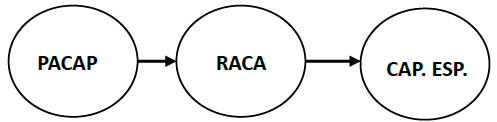
H2. The potential absorption capacity measures the realized absorption capacity and determines the responsiveness.
In this sense, Figure 1 shows the theoretical model specified for this research:
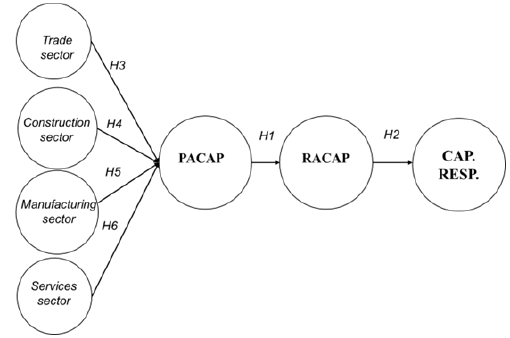
However, CR varies significantly depending on the economic sector in which a company operates, whether it is in commerce, construction, manufacturing, or services (Pérez-Cruz, 2018; Leal-Rodríguez, Roldán, Ariza-Montes, & Leal-Millán, 2014; Ynzunza & Izar, 2013). Thus, in some sectors, CR is high while in others it is relatively low. This variation influences how companies operate and can influence their profitability. Understanding the differences between sectors and their respective CRs is critical to the successful management of any business. In this way, four hypotheses related to the economic sectors to be analyzed are proposed:
H3. In companies in the commercial sector, potential absorption capacity mediates the realized absorption capacity and determines the response capacity.
H4. In companies in the construction sector, the potential absorption capacity mediates the realized absorption capacity and determines the response capacity.
H5. In companies in the manufacturing sector, the potential absorption capacity measures the realized absorption capacity and determines the response capacity.
H6. In companies in the service sector, potential absorption capacity measures the absorption capacity realized and determines the response capacity.
Hence, Figure 2, shows the theoretical model and its relationship with the working hypotheses previously exposed:
To evaluate the working hypotheses, structural equation modeling (SEM) with partial least squares (PLS) adjustment was applied using SmartPLS software (Ringle, Wende, & Becker, 2015). The stages proposed by Hair, et. al. (2019) to evaluate the theoretical model: goodness of fit of the model, measurement model, structural model, hypothesis testing and bootstrapping of the control variables: trade, construction, manufacturing, and services.
Initially, we assessed the adequacy of the theoretical model fit to assess its suitability for analysis. Subsequently, the validity and reliability of the measurement model were examined. In the third section, a structural model is used to explore the correlation between the study variables. Finally, in the fourth part, the research hypotheses are evaluated. Finally, the theoretical models for commercial and service enterprises are examined separately.
Methodology
Data
To assess potential and actual absorption capacity and its influence on business response, data from the Monthly Business Opinion Survey (EMOE) were used from a sample of more than 12,000 companies belonging to the trade, construction, manufacturing, and services sectors (INEGI, 2023). The survey collected and analyzed data from companies in Mexico between the years 2011 to 2020.
Data analysis
The analysis presented here is a conceptual model SEM-PLS using the SmartPLS software, through which the effects of the absorption capacity (AC) of knowledge and its four elements were sought, as predictors of the moment to invest, as an indicator of the response capacity (CR). This analysis will be mediated by control variables (VC) that were: trade, construction, manufacturing, and services companies in Mexico. Table 1 shows the latent variables, indicators, codes, definitions, and scales used.
Table 1 Description of research variables, indicators, and scales
| Latent
variable |
Indicator | Code | Definition | Latent variable |
| PACAP
Potential absorption capacity |
Current economic situation of the country | Explo1 | They are the prevailing economic conditions in the country, considering economic, social, political, and even climatological factors that cause economic losses. | Metric |
| Future economic situation of the country | Explo2 | It is the evaluation of the economic conditions that will prevail in twelve months in the country compared to current conditions, considering the main factors that affect it, whether economic or social. | ||
| Current economic situation of the company | Asim1 | They are the prevailing economic conditions in the company through the analysis of the most important variables such as finance, production, sales, personnel, etc. | ||
| Future economic situation of the company | Asim2 | It is the evaluation of the economic conditions that will prevail within twelve months in the company compared to current conditions, considering the main factors that affect it, whether economic or social. | ||
| RACAP
Capacidad de absorción realizada |
Expenses | Explota1 | Value of expenditure for consumption of goods and services to conduct their economic activity. | Metric |
| Personal | Explota2 | Includes personnel hired directly by the commercial or service company; of plant, casual and unpaid, who worked during a period of study subject to his direction and control, in exchange for a fixed and periodic remuneration covering at least one third of the working day. As well as workers and employee’s dependent on another company name. | ||
| Demand | Explota3 | Number of services or products that consumers perform to the company in the reference period. | ||
| Income | Explota4 | Amount of income obtained by the company for all those activities related to the provision of services or commercial activities that I conducted during the study period. | ||
| CR
Capacidad de Respuesta |
Adequate moment to invest | Cap Resp | It refers to the opinion of the entrepreneur, according to the evaluation of the economic situation that prevails in the country, compared to that of a year ago, to make investments in the same company. | Metric |
| CR
Capacidad de Respuesta |
Economic sector | Com Const Manuf Serv | The economic sector to which the analyzed companies belong - commerce, construction, manufacturing, and services. | Metric |
Source: Author based on INEGI (2023).
Results
Table 2 shows the descriptive statistics of the two dimensions analyzed. The values of central tendency, variability, asymmetry, and kurtosis are observed for each of them.
Table 2 Statistics of the measurement model
| Indicator | Mean | DT | Asymmetry | Kurtosis |
| PACAP | 0.00 | 1.00 | -0.35 | 0.68 |
| RACAP | 0.00 | 1.00 | 0.44 | 3.08 |
| CR | 0.00 | 1.00 | -0.18 | -0.33 |
Source: Author
To measure the accuracy of a structural equation model (SEM) and its fit to the data, two metrics are commonly used: the standardized mean residual root square (SRMR) and goodness-of-fit measures such as d_G and d_ULS (Dijkstra & Henseler, 2015). According to Olague (2015), an SRMR value of 0.05 is generally accepted as an ideal fit for a model. In addition, geodetic distance (d_G) and Euclidean distance squared (d_ULS) values were used to assess the accuracy of the model (Henseler, 2018).
According to what Lyva and Olague (2014) point out, a resampling (bootstrap) of 5,000 repetitions was applied, where the results validate the fit of the SRMR metric. Table 3 shows the fit of the model for the specified theoretical framework.
Table 3 Adjustment model
| Indicador | Saturation | Estimate |
| SRMR | 0.039 | 0.037 |
| d_ULS | 0.129 | 0.126 |
| D_G | 0.118 | 0.124 |
Source: Author.
Measurement model
To determine the reliability of the model, composite reliability (CC) and Cronbach’s Alpha (AC) were verified. Table 4 shows the results, where it is observed that the WC varied from 0.79 to 0.87 in the PACAP, and from 0.83 to 0.91 in the RACAP, complying with the recommended reliability (Nande, Reyes, & Perez-Cruz, 2021).
Table 4 Correlations, reliability and extracted mean variance
| Indicador | α | CC | AVE |
| PACAP | 0.79 | 0.87 | 0.62 |
| RACAP | 0.83 | 0.91 | 0.65 |
Note: α = Cronbach's Alpha; CC= reliability coefficient and AVE= Average variance extracted.
Source: Author.
The AVE ranged from 0.62 to 0.65, thus meeting the minimum accepted value of 0.5 according to (Ringle, Wende, & Becker, 2015).
Discriminant validity
Regarding discriminant validity, the Heterotrait-Monotrait correlation ratio (HTMT) was used (Hair, Risher, Sarstedt, & Ringle, 2019). Table 5 shows that HTMT values were lower than the cut-off value of 1, thus complying with discriminant validity (Hair, Risher, Sarstedt, & Ringle, 2019).
Table 5 Discriminant validity and extracted mean variance.
| Indicator | PACAP | RACAP | CR |
| PACAP | 0.79 | ||
| RACAP | 0.43 | 0.81 | |
| CR | 0.53 | 0.33 | 1.00 |
Source: Author.
In the table above, it shows the correlations between constructs and, on the diagonal (in italics and bold), the square root of the AVE. In view of these results, it can be asserted that there is a discriminant validity between the constructs, according to Fornell and Larcker (1981).
Based on the analyses presented in Tables 4 and 5, it is argued that the dimensions have the discriminant validity values of the specified theoretical model. The next phase was to evaluate the structural model, which evaluates the relationships between variables raised in the conceptual model.
Structural model
For the evaluation of the robustness and predictive accuracy of the structural model, Hair et. al. (2019) explain that the Q2 communality index should be examined. These values must be greater than zero to indicate the predictive accuracy of a specific construct (Hair, Risher, Sarstedt, & Ringle, 2019). The results indicate that for PACAP (Q2 = 0.36) and for RACAP (Q2 = 0.41). The values for the CR (Q2 = 1.00), satisfying the condition of values greater than zero.
Results of hypothesis tests
The values obtained between PACAP and RACAP shown in Tables 4 and 5 show concurrent validity. Next, a two-tailed bootstrapping was performed with 5,000 repetitions, including the t values of the six hypothetical relationships specified, which obtained statistically significant relationships, at levels of 0.01 and 0 .05, which are shown in the following Table 6.
Table 6 Results of PACAP and RACAP hypotheses and decisions
| Hypothesis | Effect | β | t | Ρ | Decision | |
| H1 | PACAP» RACAP | + | 0.02 | 18.35 | 0.000*** | Confirmed |
| H2 | PACAP» RACAP» CR | + | 0.02 | 9.27 | 0.000*** | Confirmed |
Nota: ***p <0.001
Source: Author.
In general, the results validate the proposed model and confirm the two hypotheses raised, evidencing the relationship between the PACAP and RACAP dimensions.
Control variables
For a more detailed analysis of these results, two bootstrapping of two tails were run with 5,000 repetitions, with the control variables: companies in the trade, construction, manufacturing, and services sectors. The bootstrapping was run separately, for each of the sectors. Table 7 presents the results.
Table 7 Resultados del análisis las hipótesis y decisiones
| Hipótesis | Efecto | β | t | ρ | Decisión | |
| H3 | COM» PACAP» RACAP» CR | + | 0.05 | 5.06 | 0.000*** | Confirmed |
| H4 | CONS» PACAP» RACAP» CR | + | 0.07 | 3.28 | 0.000*** | Confirmed |
| H5 | MANU» PACAP» RACAP» CR | + | 0.03 | 5.07 | 0.000*** | Confirmed |
| H6 | SERV» PACAP» RACAP» CR | + | 0.02 | 5.10 | 0.000*** | Confirmed |
Note: COM= commerce; CONS= construction; MANU= manufacturing; SERV= services;
***= p< 0.001.
The table above shows that, in the four business sectors, PACAP and RACAP mediate knowledge for CR, which confirms hypotheses H3, H4, H5 and H6.
Conclusions
Knowledge sharing is a crucial factor in the success of any organization. The mechanisms of exploration and exploitation of information are seen to reduce the barriers between knowledge holders and seekers, allowing greater efficiency in PACAP and RACAP relationships. Zahra and George (2002) highlighted the importance of this type of collaboration, which has since become increasingly relevant as organizations strive to remain competitive.
Thus, the exploration of knowledge is increasingly important in the world of work because they help reduce barriers between managers and companies, allowing greater information exchange and collaboration. It can demand the use of tools to navigate substantial amounts of data, identify patterns, and draw meaningful conclusions from complex data sets. These mechanisms also allow organizations to identify trends, explore new ideas and generate innovative solutions that could have long-term benefits for companies.
So far, research still focuses on absorptive capacity as a precursor of innovation as a response to the market (Alfaro-Ramos & Ferreras-Méndez, 2022; Ávalo, Yagüe, & Cangahuala, 2016; Cohen & Levinthal, 1990). However, they do not explain how absorption and response are related or what elements engage in it. By combining external and internal mechanisms, this study focuses on the integration behavior of PACAP and RACAP and the meaning of responsiveness as a coping strategy and adaptation to environmental demands (Barney, Ketchen, & Wright, 2021; Ponce-Espinosa, Segarra-Oña, & Peiró-S, 2020).
In the first model, the relationship between the two dimensions of PACAP and RACAP was measured, confirming hypothesis one. This model analyzed how PACAP, defined as a company's ability to recognize and absorb external knowledge, influences its RACAP. The findings provide insights into how companies use external knowledge for process strengthening and development and standardization of activities.
Several studies have explored the concept of absorptive capacity in small organizations and therefore with limited resources. Discovering the lack of consensus on how to conceptualize this concept due to conventional representatives. They also highlight the need for more research in this area to provide organizations with an effective way to leverage exploration with knowledge exploitation and increase their responsiveness (2022; Flores, Garcia, & Zevallos, 2022; Islands, Lopez, & Palomo, 2020; González-Campo & Hurtado-Ayala, 2014).
The measurement of absorption capacity is a critical factor in distinguishing between PACAP and RACAP. This activity is usually minimal in relation to educational institutions as generators of Research and Development (Pérez-Cruz, Innovation and technology transfer in enterprise sectors of Mexico, 2020; Demuner-Flores & Nava, 2018; Cruz, 2017). However, it has the potential to significantly impact the process of knowledge exploitation in companies in emerging countries.
It is suggested that companies in emerging countries explore their capabilities as R+D corporations or technology-focused companies according to their ability to absorb knowledge and exploit it. Understanding the differences between PACAP and RACAP can help organizations identify their own strengths and weaknesses to determine the kind on which they should focus.
The second model measured the relationship between the three dimensions: PACAP, RACAP and CR. The results confirmed hypothesis two, which evidences the positive effect that both PACAP and RACAP have on CR when making decisions in companies. While PACAP has an indirect effect on CR, RACAP was shown to have a direct impact. This highlights the importance of developing regulatory frameworks that can support dynamic and innovative activities within organizations.
Regulatory frameworks can help ensure that activities are conducted safely and efficiently, while allowing for flexibility (Madero & Barboza, 2015). By providing structure, they allow organizations to focus on their core competencies instead of worrying about compliance issues. The development of such regulatory frameworks is essential to support both continued growth and innovation within organizations (Leyva, Cavazos, & Espejel, 2018).
If PACAP is seen to establish organizational memory, RACAP allows better performance in terms of innovation. An important feature of advancing technology is the knowledge management employed by executives; Therefore, the creation of organizational memory depends on its capacity.
Finally, the last model analyzed the effect of the three dimensions PACAP, RACAP and CR; in the different sectors analyzed: trade, construction, maquiladoras, and services. In this way, this research contributes to reinforce the implications of the positive effect of the relationships between the organizational context (PACAP), organizational processes (RACAP) and response capacity (RC); which have been well established in different studies (Branstetter & Maskus, 2022; Barney, Ketchen, & Wright, 2021; Teece D., 2017; Zahra & George, 2015).
A more detailed analysis of this relationship reveals that the officers of the organization play a key role in supporting improvement and development initiatives within organizations. The investigations conducted by Meraz-Ruiz et. al. (2023a and 2023b) have shown that managerial perceptions and attitudes allow you to focus on the responses that your organizations give to their group of customers and consumers. Which, regardless of the size and economic sector in which the company operates, is related to an increase in creativity, leadership, efficiency, and organizational performance.
In this way, the role of managers in the exploration and exploitation of knowledge is integral. They have the responsibility of being knowledge intermediaries, transferring and synthesizing ideas from where they know to where they represent (Leal-Rodríguez, Roldán, Ariza-Montes, & Leal-Millán, 2014). This requires a high degree of understanding and experience to transfer knowledge and knowledge effectively across borders, cultures, industries, and disciplines (Leiva, Rodríguez, & Monge, 2017).
Improving the PACAP and RACAP relationship requires companies to improve the balance of structure by assimilation, management team behavior, emphasizing unified work systems, decision-making and the exchange of facts. In this same sense, an important element in the systematization of work is the use of technology; therefore, knowledge management depends to a large extent on its capacity and its exploitation, as indicated by the contributions of various authors (Islas, López, & Palomo, 2020; Abrego, Sánchez, & Medina, 2017; Pérez, Lara, & Gómez, 2017).
Finally, after studying the literature and the results, it was determined that the latent variables function as a direct factor in investment decision making. This provides a more specific way to respond to any situation that arises. These findings on the various economic sectors can provide invaluable information for decision makers. By understanding the interests, values and needs of these sectors, it is possible to make decisions that maximize the potential for success. Such insights could prove invaluable in helping business owners, government agencies, and other decision-makers understand how to get information across, implement it to resource efficiency, and make decisions for long-term, sustained growth.
REFERENCES
Abrego, D., Sánchez, Y., & Medina, J. (2017). Influencia de los sistemas de información en los resultados organizacionales. Contaduría y Administración, 62(2), 303-320. doi:http://dx.doi.org/10.1016/j.cya.2016.07.005 [ Links ]
Alfaro-Ramos, A., & Ferreras-Méndez, J. (2022). Knowledge management and intellectual capital in the business model innovation of Costa Rican manufacturing firms. Tec Empresarial, 16(2), 18-33. doi:https://doi.org/10.18845/te.v16i2.6168 [ Links ]
Alonso, S., & Leiva, J. (2019). Competitividad empresarial en Costa Rica: un enfoque multidimensional. Tec Empresarial, 13(3), 28-41. doi:https://doi.org/10.18845/te.v13i3.4597 [ Links ]
Ávalo, J., Yagüe, J., & Cangahuala, G. (2016). El capital social y la planificación adaptativa en una comunidad industrial innovadora del Perú. Estudios Gerenciales, 32(139), 162-169. doi:10.1016/j.estger.2016.05.001 [ Links ]
Barney, J., Ketchen, D., & Wright, M. (2021). Resource-Based Theory and the Value Creation Framework. Journal of Management, 47(7), 936-1955. doi:https://doi.org/10.1177/01492063211021655 [ Links ]
Branstetter, L., & Maskus, K. (2022). Global Knowledge Flows, Absorptive Capacity and Capability Acquisition: Old Ideas, Recent Evidence and New Approaches. En A. Taubman , & J. Watal (Edits.), Trade in Knowledge: Intellectual Property, Trade and Development in a Transformed Global Economy (págs. 405-430). Cambridge: Cambridge University Press. doi:10.1017/9781108780919.017 [ Links ]
Cohen, W., & Levinthal, D. (1989). Innovation and Learning: The Two Faces of R & D. The Economic Journal, 99(397), 569-596. doi:https://doi.org/10.2307/2233763 [ Links ]
Cohen, W., & Levinthal, D. (1990). Absorptive Capacity: A New Perspective on Learning and Innovation. Administrative Science Quarterly-Special Issue: Technology, Organizations, and Innovation, 35(1), 128-152. doi:https://doi.org/10.2307/2393553 [ Links ]
Cruz, O. (2014). Compromiso organizacional y su relación con las utilidades en el sector turismo en méxico. Turismo y Desarrollo Local, 7(17), 1-25. Obtenido de https://www.eumed.net/rev/turydes/17/turismo-mexico.html [ Links ]
Cruz, O. (2017). Caracterización de las empresas de base tecnológica en las Instituciones de Educación Superior de México. RIIYM - Revista Científica de Ingeniería Industrial y Mecánica, 2(3), 1-14. Obtenido de http://servicios.ingenieria.unlz.edu.ar:8080/ojs/index.php/RIIYM/article/viewFile/25/32 [ Links ]
Demuner-Flores, M., & Nava, R. (2018). Gestión del Conocimiento al Interior de las Instituciones de Educación. GECONTEC: Revista Internacional de Gestión del Conocimiento y la Tecnología, 6(1), 68-81. doi:https://doi.org/10.5281/zenodo.7507161 [ Links ]
Demuner-Flores, M., Saavedra-García, M., & Ibarra-Cisneros, M. (2022). Influence of absorption capacity on response capacity in small mexican manufacturing companies. Tec Empresarial, 15(2), 34-49. doi:https://doi.org/10.18845/te.v15i1.5658 [ Links ]
Dijkstra, T., & Henseler, J. (2015). Consistent and asymptotically normal PLS estimators for linear structural equations. Computational Statistics & Data Analysis, 81(1), 10-23. doi:https://doi.org/10.1016/j.csda.2014.07.008 [ Links ]
Flores, M., García, M., & Zevallos, E. (2022). The Systemic Competitiveness of Latin American MSMEs Under COVID-19. En M. Limón, & M. García, Research in Administrative Sciences Under COVID-19 (págs. 5-30). Bingley: Emerald Publishing Limited. doi:https://doi.org/10.1108/978-1-80262-297-320221002 [ Links ]
Fornell, C., & Larcker, D. (1981). Evaluating structural equation models with unobservable variables and measurement error. Journal of Marketing Research, 18(1), 39-50. doi:https://doi.org/10.2307/3151312 [ Links ]
García Cabrera, A., & García Soto, M. (2012). Ecosistema Emprendedor para las Empresas de Base Tecnológica: Visión Basada en los Recursos. Tec Empresarial, 4(1), 8-21. Obtenido de https://revistas.tec.ac.cr/index.php/tec_empresarial/article/view/612 [ Links ]
García, J., León, J., & Nuno, J. (2017). Propuesta de un modelo de medición de la competitividad mediante análisis factorial. Contaduría y Administración, 62(1), 775-791. doi:http://dx.doi.org/10.1016/j.cya.2017.04.003 [ Links ]
González-Campo, C., & Hurtado-Ayala, A. (2014). Influencia de la capacidad de absorción sobre la innovación: un análisis empírico en las mipymes colombianas. Estudios Gerenciales, 30(132), 277-286. doi:https://doi.org/10.1016/j.estger.2014.02.015 [ Links ]
Guajardo, S., & Zapata, L. (2020). Importance of dynamic managerial capabilities on the performance of small family businesses. Contaduría y Administración, 65(3), 1-28. doi:http://dx.doi.org/10.22201/fca.24488410e.2020.2132 [ Links ]
Guerrero-Sánchez, D. (2021). El impacto de la capacidad de absorción potencial del conocimiento sobre la innovación en marketing. Contaduría y administración, 66(2), 00002. doi:https://doi.org/10.22201/fca.24488410e.2021.2294 [ Links ]
Hair, J., Risher, J., Sarstedt, M., & Ringle, C. (2019). When to use and how to report the results of PLS-SEM. European Business Review, 31(1), 2-24. doi:https://doi.org/10.1108/EBR-11-2018-0203 [ Links ]
Henseler, J. (2018). Partial least squares path modeling: Quo vadis? Qual Quant, 52(1), 1-8. doi:https://doi.org/10.1007/s11135-018-0689-6 [ Links ]
INEGI. (2023). Encuesta Mensual de Opinión Empresarial. Obtenido de Intituto Nacional de Estadística y Geográfica: https://www.inegi.org.mx/programas/ [ Links ]
Irwin, K., Gilstrap, C., Drnevich, P., & Sunny, M. (2022). The acquisition of capabilities: How firms use dynamic and ordinary capabilities to manage uncertainty. Journal of Management & Organization, 28(3), 564-586. doi:10.1017/jmo.2022.23 [ Links ]
Islas, J., López, J., & Palomo, M. (2020). Factores de las TIC que contribuyen a mejorar el desempeño del negocio de las MIPyMES. Contaduría y Administración, 65(4), 1-20. doi:http://dx.doi.org/10.22201/fca.24488410e.2020.2165 [ Links ]
Jansen, J., Van Den Bosch, F., & Volberda, H. (2005). Managing Potential and Realized Absorptive Capacity: How Do Organizational Antecedents Matter? The Academy of Management Journal, 48(6), 999-1015. Obtenido de http://www.jstor.org/stable/20159726 [ Links ]
Kantis, H., Federico, J., & Girandola, M. (2020). Tensions and challenges evaluating the impact of entrepreneurship policies. Tec Empresarial, 15(1), 36-55. doi:https://doi.org/10.18845/te.v15i1.5392 [ Links ]
Leal-Rodríguez, A., Roldán, J., Ariza-Montes, J., & Leal-Millán, A. (2014). From potential absorptive capacity to innovation outcomes in project teams: The conditional mediating role of the realized absorptive capacity in a relational learning context. International Journal of Project Management, 32(6), 894-907. doi:https://doi.org/10.1016/j.ijproman.2014.01.005 [ Links ]
Leiva, J., Rodríguez, J., & Monge, R. (2017). Efectos de la contratación de exempleados de multinacionales en la capacidad de absorción en empresas locales. Contaduría y Administración, 32(1), 657-669. doi:http://dx.doi.org/10.1016/j.cya.2016.06.009 [ Links ]
Leyva, A., Cavazos, J., & Espejel, J. (2018). Influencia de la planeación estratégica y habilidades gerenciales como factores internos de la competitividad empresarial de las Pymes. Contaduría y Administración, 63(3), 1-21. doi:http://dx.doi.org/10.22201/fca.24488410e.2018.1085 [ Links ]
Leyva, O., & Olague, J. (2014). Modelo de ecuaciones estructurales por el método de mínimos cuadrados parciales (Partial Least Squares-PLS). En K. Sáenz, & G. Támez, Métodos y técnicas cualitativasy cuantitativas aplicables a la investigación en ciencias sociales (págs. 480-499). México, D.F.: Tirant Humanidades. [ Links ]
Madero , S., & Barboza, G. (2015). Interrelación de la cultura, flexibilidad laboral, alineación estratégica, innovación y rendimiento empresarial. Contaduría y Administración, 60(1), 735-756. doi:http://dx.doi.org/10.1016/j.cya.2014.08.001 [ Links ]
March, J. (1991). Exploration and Exploitation in Organizational Learning. Organization Science, 2(1), 71-87. Obtenido de http://www.jstor.org/stable/2634940 [ Links ]
Máynez, A. (2016). Cultura y compromiso afectivo: ¿influyen sobre la transferencia interna del conocimiento? Contaduría y Administración, 61(1), 666-681. doi:http://dx.doi.org/10.1016/j.cya.2016.06.003 [ Links ]
Meraz-Ruiz, L., Olague, J., & Perez-Cruz, O. (2023a). Influencia de las percepciones y actitudes gerenciales en la oferta enoturística en empresas vitivinícolas. Pasos, 21(1), 99-113. doi:https://doi.org/10.25145/j.pasos.2023.21.007 [ Links ]
Meraz-Ruiz, L., Olague, J., Flores-Villanueva, C., & Perez-Cruz, O. (2023b). The role of innovation and reference groups on emotions and purchasing decision on consumers of Mexican wine. Journal of Wine Research, 19(1), 1-19. doi:https://doi.org/10.1080/09571264.2022.2143336 [ Links ]
Monge, R., Rodríguez, J., & Leiva, J. (2015). Proposal for an index to measure the absorption capacity of Costa Rican SMEs. Tec Empresarial, 9(1), 7-18. doi:https://doi.org/10.18845/te.v9i1.2204 [ Links ]
Nande, E., Reyes, T., & Perez-Cruz, O. (2021). The Generalized Least Squares Method (GMM) as a tool for causal analysis of spending, budget management and electoral results (Vol. 1). Mexico: ECORFAN. doi:https://10.35429/B.2021.8.1.130 [ Links ]
Nicolau-Juliá, D., Expósito-Langa, M., & Tomás-Miquel, J. (2015). Exploración y explotación de conocimiento en el ámbito empresarial. Validación de escalas en un sector industrial de bajo perfil tecnológico. Investigaciones Europeas de Dirección y Economía de la Empresa, 21(3), 139-147. doi:10.1016/j.iedee.2014.07.001 [ Links ]
Nielsen, J., Mathiassen, L., & Hansen, A. (2018). Exploration and Exploitation in Organizational Learning: A Critical Application of the 4I Model. British Journal of Management, 29(4), 835-850. doi:https://doi.org/10.1111/1467-8551.12324 [ Links ]
Olague, J. (2015). El método de mínimos cuadrados pariales (PLS) como herramienta de análisis causal: un modelo explicativo de los componentes de imágen de destino en función de las motivaciones de viaje del turista urbano. Congreso de Investigación Turística Aplicada (págs. 1-12). Toluca de Lerdo, Estado: Academia. [ Links ]
Pérez, C., Lara, G., & Gómez, D. (2017). Evolución de la capacidad tecnológica en México. Aplicación del análisis estadístico multivariante de cluster. Contaduría y Administración, 62(1), 505-527. doi:https://doi.org/10.1016/j.cya.2017.01.002 [ Links ]
Pérez-Cruz, O. (2018). Agronegocios en México: Competitividad y desafíos. Hermosillo: Qartuppi http://doi.org/10.29410/QTP.18.07. [ Links ]
Pérez-Cruz, O. (2020). Innovation and technology transfer in enterprise sectors of México. Tec Empresarial, 15(1), 1-24. doi:https://doi.org/10.18845/te.v15i1.5391 [ Links ]
Ponce-Espinosa, G., Segarra-Oña, M., & Peiró-S, A. (2020). From absorption capacity to in-company knowledge generation: key aspects’ identification. Tec Empresarial, 14(3), 34-49. doi:https://doi.org/10.18845/te.v14i3.5361 [ Links ]
Restrepo, J., & Vanegas, J. (2015). Internacionalización de las pymes: análisis de recursos y capacidades internas mediante lógica difusa. Contaduría y Administración, 60(1), 836-863. doi:http://dx.doi.org/10.1016/j.cya.2015.07.008 [ Links ]
Ringle, C., Wende, S., & Becker, J. (2015). SmartPLS 3. Boenningstedt: SmartPLS GmbH. USA. Obtenido de http://www.smartpls.com [ Links ]
Ruiz-Corrales, M., Plascencia-Lopez, I., Galvan-Vela, E., & Ravina-Ripoll, R. (2022). Knowledge Transfers and Absorptive Capacities as Determinants of Competitive Advantages: The Mexican Case. IEEE Engineering Management Review, 50(2), 54-65. doi:10.1109/EMR.2022.3171981 [ Links ]
Saavedra-García, M., Demuner-Flores, M., & Choy-Zevallos, E. (2020). Uso de las prácticas de comercialización de las PYME de la Ciudad de México y su relación con la competitividad. RETOS. Revista de Ciencias de la Administración y Economía, 10(20), 283-305. doi:https://doi.org/10.17163/ret.n20.2020.06 [ Links ]
Sánchez, L., Saavedra, M., & Choy, E. (2020). Factores que explican el desempeño competitivo de las microcooperativas de la ciudad de méxico. Criterio Libre, 18(32), 167-197. [ Links ]
Teece, D. (2017). Dynamic Capabilities and the Multinational Enterprise. En B. Christensen, & C. Kowalczyk (Edits.), Globalization (págs. 105-129). Berlin, Heidelberg: Springer. doi:https://doi.org/10.1007/978-3-662-49502-5_5 [ Links ]
Teece, D., Pisano, G., & Shuen, A. (1997). Dynamic capabilities and strategic management. Strategy Management Journal, 18(7), 509-533. doi:https://doi.org/10.1002/(SICI)1097-0266(199708)18:7<509::AID-SMJ882>3.0.CO;2-Z [ Links ]
Tejedo-Romero, F., & Ferraz, J. (2018). Estrategia de gestión y divulgación del capital intelectual: influencia del gobierno corporativo. Contaduría y Administración, 63(2), 1-18. doi:http://dx.doi.org/10.22201/fca.24488410e.2018.1236 [ Links ]
Ynzunza, C., & Izar, J. (2013). Efecto de las estrategias competitivas y los recursos y capacidades orientados al mercado sobre el crecimiento de las organizaciones. Contaduría y Administración, 58(1), 169-197. [ Links ]
Zahra, S., & George, G. (2002). Absorptive Capacity: A Review, Reconceptualization, and Extension. Academy of Management Review, 27(2), 185-203. doi:https://doi.org/10.5465/amr.2002.6587995 [ Links ]
Zahra, S., & George, G. (2015). Absorptive capacity and the entrepreneurial. En C. Cooper (Ed.). John Wiley & Sons, Ltd. doi:10.1002/9781118785317.weom030001 [ Links ]
Zollo, M., & Winter, S. (2002). Deliberate Learning and the Evolution of Dynamic Capabilities. Organization Science, 13(3), 223-353. doi:https://doi.org/10.1287/orsc.13.3.339.2780 [ Links ]
Received: July 22, 2022; Accepted: May 01, 2023; Published: May 04, 2023
 Este es un artículo publicado en acceso abierto bajo una licencia Creative Commons
