




Servicios Personalizados
Revista
Articulo
 texto en
  Inglés (pdf)
 Artículo en XML
 Referencias del artículo
 Traducción automática
 Enviar artículo por email
Indicadores
-
 Citado por SciELO
 -
 Accesos
Links relacionados
-
 Similares en
SciELO
Similares en
SciELO
Compartir

 Permalink
Contaduría y administración
versión impresa ISSN 0186-1042
Contad. Adm vol.68 no.2 Ciudad de México abr./jun. 2023 Epub 02-Dic-2024
https://doi.org/10.22201/fca.24488410e.2023.4828
Articles
Spatial analysis of wage inequality and precarious work in the tourism sector in Mexico
1Universidad Nacional Autónoma de México, México
Wage inequality and precarious work have been the object of study in Mexico for the last decades. These problems have been aggravated even more for female workers in the Metropolitan Area of Mexico, than for male workers. This situation is worse in the tourism sector, where formal employment is temporary and highly dependent on tourism flows. By estimating an econometric model with spatial panel data and using information of the Occupation and Employment National Survey, this work presents evidence that women are the predominant work force of the tourism sector, but also, they are the ones with the most precarious jobs. Women earn less than two minimum wages in different zones of the Metropolitan Area, whereas men of the same sector receive more than three minimum wages. In addition, in destinations that attract international tourism, and that have higher wages, it is men who occupy most of the jobs, while women are relegated to other destinations.
Keywords: wage inequality; precarious work; poverty; tourism sector
JEL Code: C01; I30; J21; J81; Z30
La desigualdad salarial y la precariedad laboral han sido objeto de estudio en las últimas décadas en México. Son problemas que se han generalizado más para las mujeres trabajadoras mexicanas en las Zonas Metropolitanas (ZMs) del país que para los hombres. Esta situación es aún más grave en el sector turístico, en donde el empleo formal es temporal y es altamente dependiente de los flujos de turistas. Mediante la estimación de un modelo econométrico de panel espacial y haciendo uso de la información de la Encuesta Nacional de Ocupación y Empleo de México, en este trabajo se presenta evidencia de que las mujeres son las que más predominan como fuerza laboral en el sector turístico y son también las que ocupan los empleos más precarios. Las mujeres perciben remuneraciones por debajo de dos salarios mínimos en las distintas ZM, mientras que los hombres obtienen más de tres salarios mínimos en el mismo sector. Aunado a lo anterior, los destinos que atraen a turistas internacionales y que son los mejores pagados, tienen también una predominancia de hombres, mientras que las mujeres son relegadas al resto de los destinos turísticos.
Palabras clave: desigualdad salarial; precariedad laboral; pobreza; sector turístico
Código JEL: C01; I30; J21; J81; Z30
Introduction
Productive tertiarization in Mexico has exacerbated not only precarious work but also wage inequality, as shown by Andrés-Rosales, Czarnecki, and Mendoza-González, (2019). Moreover, the working class has been impoverished by labor flexibilization (Martínez-Liceriom, Marroquín-Arreola, & Ríos-Bolivar, 2019; Andrés-Rosales, Carbajal-Suárez, & Mendoza-González, 2021). This problem has become more serious in the service and tourism sectors. In tourism, labor flexibility, temporary contracts, the absence of contracts, and the existence of non-unionized workers are a constant. This situation is much more serious in the states where the tourism sector determines the growth of the State Gross Domestic Product (SGDP) due to its great weight in generating employment (Méndez et al., 2013).
In almost every state in Mexico, most of the employment offered in the tourism sector, in addition to being seasonal, is not precisely offered with vacancies aimed at “managerial positions, but rather part-time employment for workers who generally lack specialized knowledge in tourism and who even come from other sectors of the economy, such as the primary sector” (Méndez et al., 2013: 706). The flexibilization of the labor market in the sector, added to the seasonal demand, makes labor specialization difficult and workers with higher skills migrate to sectors where working conditions are less precarious. This flow is possible in regions where the tourism sector complements the region’s growth since other sectors, such as the industrial or financial services sector, determine its growth. Nonetheless, in the absence of other productive sectors, there are no alternatives for workers to look for better employment options in their places of residence, and what is observed is a migration of specialized labor to other countries or regions.
Mexico has a great diversity of natural, cultural, and gastronomic resources, which makes it possible for tourists from the United States and other regions to prefer it as one of their vacation destinations. Nevertheless, although some regions of the country attract more international tourism, precarious work and wage inequality are a constant in the sector, a situation that worsened with the COVID-19 pandemic in 2020. Furthermore, many sectors and places surrounding tourist centers are not linked to the sector or to the tourist region in some of Mexico’s Metropolitan Zones (MZs), so the positive effects of tourism do not spill over to the entire region of influence.
Given the importance of formal employment as a trigger for the development of a region, precarious work and wage inequality tend to limit and hinder the possibilities of this development. The fact that workers do not have social security or an employment contract, earn less than two minimum wages, and are not unionized implies job uncertainty for workers in the sector, which is reflected in the growth of precarious work (Rogers & Rogers, 1989; Andrés-Rosales, Czarnecki, & Mendoza-González, 2019).
Although some studies show that the tourism sector helps to reduce poverty in tourist areas (Ponce, Aguirre-Padilla, Oliveira, Álvarez-García, & Río-Rama, 2020), this is not a generality for all countries or all regions. Possibly, it can reduce poverty in regions where this sector complements the growth and development of the region, but in regions where it is the main determinant of employment and economic growth, precarious work, wage inequality, and income poverty are more severe. The differential effect of domestic and international tourism has also been studied, where the latter is considered a source of foreign exchange and, like any export sector, leads to positive effects on the current account of the balance of payments and on the income of the government, families, and the productive sectors (Archer, Cooper, & Ruhanen, 2009).
This means that the growth of the tourism sector can potentially contribute to growth and offer better paid and less precarious jobs, but this depends on how it complements other sectors and the type of tourism that predominates in a specific region.
Therefore, this paper poses the following questions: Is female employment more precarious than male employment in a sector with a high participation of women, such as the Mexican tourism sector? Is there a strong gender wage inequality in this sector? Does wage inequality have neighborhood or spatial contagion effects in the different MZs? With these questions, this research aims to investigate whether the Metropolitan Zones that attract tourism have less precarious jobs and less wage inequality.
Under the above premises, the hypothesis of this paper is as follows: the wage gap between men and women tends to decrease in the tourism sector, not because of the improvement in women’s working conditions, but when men’s work precarity worsens.
This paper is divided into four main sections to confirm the above assumptions. The first deals with the importance of tourism for employment generation and its role in influencing regional development. The second describes the data used and the spatial econometric model that will be used for statistical-econometric inference. The third section presents the main findings, and finally, the last section contains the conclusions obtained from the research.
Theoretical discussion on wage inequality and precarious work
Formal employment has been considered the main trigger for a worker’s development. Through the salary people receive for their work in the formal sector, they can improve their living conditions and enjoy a certain social mobility (Robles et al., 2019). Nonetheless, “in the labor markets, labor dynamics were modified through productive and business reorganization aimed at changing work processes, which have made it possible to create occupations, above all, in the tertiary sector. The result of all these changes was the loss of the cohesive character traditionally attributed to work, which facilitated integration between social strata” (Ibid., 2019:4).
These modifications became more acute with productive tertiarization. The service sector began to largely determine employment and production, not only in Mexico but internationally (Andrés-Rosales, Czarnecki, & Mendoza-González, 2019). The characteristic of the growth of this sector is that it goes hand in hand with greater wage inequality and precarious work.
Wage inequality has been discussed by authors such as Rodríguez-Pérez and Germán-Soto (2021), Rodríguez-Pérez and Aguilar-Arredondo (2021), Mendoza-González (2020), and Ponce et al., (2021). These authors emphasize the trend in female wages during the last decades in Mexico and Latin America. They show that wage inequality continues to persist in the region and has become much more complicated with the pandemic from 2020. The service sector has also offered more precarious jobs than the manufacturing sector (Andres-Rosales, Bustamante, & Argumosa, 2019). Nevertheless, precarious work is a phenomenon that has become widespread in many sectors, as is the case of tourism (Martínez-Gayo, 2019; Martínez-Gayo & Martínez-Quintana, 2020).
Precarious work is one of the reasons why wage inequality between men and women has decreased in Mexico. It is not that women have improved their wage conditions in relation to men, but rather, the precarious work of both men and women has influenced the decrease in the existing wage gap in Mexico (Andrés-Rosales, Czarnecki, & Mendoza-González, 2019).
Precarious work has become much more acute due to the productive tertiarization of the Mexican economy, especially because it went hand in hand with the flexibilization of the labor market. Labor flexibility is defined as “the ability of individuals in the economy and particularly in the labor market to give up their habits and adapt to new circumstances” (Dahrendorf, 1986:10). Other authors propose that labor flexibility is a process of change in the labor market that reduces the levels of protection of workers and converts the contract into a flexible instrument that accommodates the search for profits by companies (Chávez, 2001; Camacho, 2014; Martínez-Licerio, Marroquín-Arreola, & Ríos-Bolívar, 2019).
According to ECLAC (2000) (Economic Commission for Latin America and the Caribbean), “the flexibilization of the labor market has been increasing (although it still represents a minority portion of the global labor force, no more than 30%); the stable or protected sector tends to recede, and so precarious work grows rapidly. This is the birth and development of a segment of workers increasingly precarious in their contractual relations with the employer” (quoted by Méndez et al., 2013:717).
Following Rogers and Rogers (1989), Andrés-Rosales, Czarnecki, and Mendoza-González (2019), and Quintana et al. (2019), precarious work implies that workers do not have a standard job in which they enjoy the following labor rights: i) social security: which implies having healthy workers, who do not have to worry about spending their own income when they get sick; ii) employment contract: that workers have job certainty, above all, that they have the security of remaining in a certain time in a particular job and allows them stability, not only of employment but also emotional so that they can plan their immediate future. When instability and uncertainty are present, it is difficult for workers to make plans for their personal and professional lives in the company and region; iii) unionization: the fact that people are not affiliated with a union leaves them adrift in the face of injustices and abuses by companies. In addition, they are easy prey for labor exploitation; iv) an adequate salary: if the salary is not sufficient for workers to be able to obtain their own housing, improve their standard of living, provide education for their children, and obtain good food, they will be in a situation of wage precarity.
Other authors, such as Vejar (2014), consider precarity as a condition, an emerging phenomenon, and a way of life in the world linked to the loss or weakening of social ties of integration and social protection. Thus, the concept of precarious work tends to be associated with the deterioration of working conditions, a condition of job instability or insecurity, a place where workers are unprotected due to the expansion of informal relationships, where laws do not protect them. Although “the problem with precarious work is that it points to the fact that precarity is not only due to a limited duration of the contract, but also to insufficient wages and wage progression, lack of or reduced access to legal laws and social protection, and the organization of labor processes and labor control” (Martínez-Licerio, Marroquín-Arreola, & Ríos-Bolívar, 2019:115).
Studies by the ILO (2001) and ECLAC (2000) show that the degree of precarity resulting from the growth of temporary workers, with or without contracts, has increased in all branches of activity and in all countries. These studies show that this process has been relatively more pronounced in commercial activity and services (Méndez et al., 2013), although the smallest relative increase in precarity is observed in industry (Andrés-Rosales, Czarnecki, & Mendoza-González, 2019; Andrés-Rosales, Carbajal-Suárez, & Mendoza-González, 2021). With the Covid-19 pandemic, precarity and wage inequality between men and women increased (Salas et al., 2020). Nonetheless, it is women who are more affected by economic crises due to their greater labor vulnerability (Rodríguez-Pérez & Germán-Soto, 2021; Rodríguez & Germán, 2021; Salas et al., 2022).
Precarious work in Mexico has been a constant because although it tends to increase during periods of economic crisis, it remains as one of the main characteristics of the labor market (Rubio, 2017). Evidence indicates that the cycles of each region in Mexico have a differentiated effect on the wages and working conditions of men and women (Rodríguez-Pérez & Germán-Soto, 2021). For this reason, the analysis of precarious work and its effects must be differentiated not only by productive sector but also by gender and region. In this paper and following this last argument, it is shown that women represent a flexible labor reserve in the labor market, who are expendable in recessionary times, contrary to what happens with men (Rodríguez-Pérez & Aguilar-Arredondo, 2021). This implies that in times of boom, women are in demand, but in times of crisis or pandemic, they are the first to be dismissed as they suffer more vulnerable and precarious working conditions.
In sum, women are most likely to become poorly paid workers due to their low wages. This is so because they have low-quality, fixed-term jobs with high labor force turnover and with a significant proportion of part-time work (García & Ibáñez, 2017; Rivera, 2019; Martínez-Gayo, 2019).
Studies on precarious work in Mexico show that it is not only a result of the type of productive sector that is usually attributed to the expansion of the service sector but also a product of a deficient institutional framework that, under neoliberal governments, deteriorated to the point of elevating labor flexibilization (Quintana, 2016; Murillo-Villanueva, Carbajal-Suárez, & De Jesús-Almonte, 2021).
Some authors show that this trend is generalized in the Mexican labor market because the registration of temporary workers in social security (IMSS; Spanish: Instituto Mexicano del Seguro Social) has increased much more than that of permanent workers, a process which was complicated by the pandemic but was a generalized trend in Mexico before it (Torres, 2020; Andrés-Rosales, De Jesús-Almonte, & Carbajal-Suárez, 2021).
Although a large part of employment in Mexico indeed tends to be precarious and there is greater discrimination against women, it is in the tourism sector where this situation is most serious due to the greater relative weight of female employment in the sector. The behavior of precarious work in tourism does not follow a homogeneous pattern, as it tends to differ according to the different types of tourism and the sector’s seasonality (Andrés-Sarasa, 1998). To further complicate the situation, Martínez-Gayo and Martínez-Quintana (2020) consider that women in the sector suffer occupational segregation as they face obstacles to promotion and low wages.
The tourism sector and employment in Mexico
In Mexico, productive tertiarization is a reality. According to the National Institute of Statistics and Geography, INEGI (2020) (Spanish: Instituto Nacional de Estadística y Geografía), the participation of the tertiary sector in the total GDP was 64%, the secondary sector 28%, while the primary sector participated with 3%. According to information from the fourth quarter of 2020 from the National Occupation and Employment Survey (ENOE; Spanish: Encuesta Nacional de Ocupación y Empleo), 12.5% of the employed population was concentrated in the primary sector, 25% in the secondary sector (16% in the manufacturing sector) and 62% in the tertiary sector (7% in restaurants and accommodation services). Historically, in Mexico, the population has been mainly comprised of women; in 2020, the Population Census found that women represented 51.2% of the country’s population.
If the analysis is done by sex, the data indicate that of the 126 880 395 inhabitants of the country, a total of 55 653 440 were part of the economically active population (EAP), of which 53 124 071 were employed and 2 529 369 unemployed at the end of 2020.
Data from the National Occupation and Employment Survey for the fourth quarter of 2020 show that 51.4% of the Mexican population are women and 48.6% are men. Of the female population, 31.7% were employed, and 36.7% were unemployed. Of the male population, 41% were employed, and only 13.4% were unemployed. This situation shows that, despite the greater demographic presence of women, the Mexican labor market has a gender bias favoring men.
The situation for women is even more serious if wage distribution is examined. Table 1 shows the spatial distribution of 1 to 3 minimum wages received by Mexican workers in the different Metropolitan Zones (MZs) in 2021. Of the total employed population in each MZ, columns 3 and 4 reflect the percentage of informality of employed male and female workers. It is possible to see that mostly men are in the informal market, although in some MZs such as San Luis Potosí and Oaxaca, women’s labor informality is higher than in the rest of the country. Columns 1 and 2 represent the total percentage of employed women and men. Men represent the highest percentage, and it was found that there are MZs with higher labor participation of men, as is the case of Monterrey (61%), Saltillo (64%), and Tijuana (almost 62%).
Table 1 Wage distribution by Mexico’s MZs, 2021
| MZs | 1. Employed
population men |
2. Employed
population women |
3. Informality
men |
4. Informality
women |
5. One min
wage men |
6. Two min
wage men |
7. Three min
wage men |
8. One min
wage women |
9. Two min
wage women |
10. Three min
wage women |
| Valley of Mexico | 57.58% | 42.42% | 63.98% | 36.02% | 7.42% | 21.01% | 25.72% | 8.90% | 17.30% | 19.65% |
| Guadalajara | 58.23% | 41.77% | 66.91% | 33.09% | 2.74% | 20.14% | 29.84% | 5.10% | 19.03% | 23.17% |
| Monterrey | 61.08% | 38.92% | 64.67% | 35.33% | 2.22% | 19.61% | 32.93% | 3.92% | 17.68% | 23.65% |
| Puebla | 59.41% | 40.59% | 66.22% | 33.78% | 5.25% | 21.83% | 26.97% | 8.82% | 17.56% | 19.57% |
| Leon | 58.84% | 41.16% | 64.52% | 35.48% | 3.63% | 19.88% | 29.52% | 6.41% | 18.53% | 22.02% |
| San Luis Potosi | 54.52% | 45.48% | 53.93% | 46.07% | 3.25% | 17.56% | 26.46% | 6.49% | 20.83% | 25.41% |
| Merida | 55.33% | 44.67% | 58.92% | 41.08% | 4.29% | 19.09% | 24.99% | 8.66% | 19.97% | 22.99% |
| Chihuahua | 57.00% | 43.00% | 74.41% | 25.59% | 2.38% | 19.75% | 29.58% | 3.81% | 19.95% | 24.53% |
| Tampico | 59.70% | 40.30% | 62.79% | 37.21% | 4.78% | 21.40% | 28.15% | 7.58% | 17.39% | 20.70% |
| Veracruz | 56.66% | 43.34% | 58.82% | 41.18% | 5.21% | 19.15% | 25.90% | 9.03% | 18.86% | 21.85% |
| Acapulco | 57.89% | 42.11% | 61.98% | 38.02% | 6.59% | 21.87% | 26.50% | 8.35% | 16.97% | 19.71% |
| Aguascalientes | 56.56% | 43.44% | 68.83% | 31.17% | 2.78% | 20.15% | 29.18% | 5.38% | 19.20% | 23.31% |
| Morelia | 56.40% | 43.60% | 67.72% | 32.28% | 4.82% | 20.75% | 28.40% | 6.48% | 16.85% | 22.69% |
| Toluca | 59.67% | 40.33% | 66.60% | 33.40% | 6.43% | 22.02% | 28.14% | 7.16% | 16.88% | 19.37% |
| Saltillo | 63.95% | 36.05% | 66.71% | 33.29% | 2.04% | 20.45% | 35.67% | 3.41% | 15.98% | 22.44% |
| Villahermosa | 58.61% | 41.39% | 60.25% | 39.75% | 5.43% | 21.31% | 27.84% | 7.52% | 16.88% | 21.02% |
| Tuxtla Gutiérrez | 58.59% | 41.41% | 62.28% | 37.72% | 6.41% | 20.94% | 27.35% | 8.97% | 16.43% | 19.91% |
| Tijuana | 61.71% | 38.29% | 68.87% | 31.13% | 2.19% | 19.69% | 34.56% | 3.19% | 17.23% | 23.14% |
| Culiacan | 56.75% | 43.25% | 68.49% | 31.51% | 2.56% | 16.89% | 27.90% | 5.64% | 20.75% | 26.26% |
| Hermosillo | 56.70% | 43.30% | 62.66% | 37.34% | 3.35% | 18.58% | 28.13% | 5.78% | 19.79% | 24.37% |
| Durango | 55.43% | 44.57% | 65.87% | 34.13% | 4.58% | 20.23% | 26.52% | 6.45% | 19.28% | 22.93% |
| Tepic | 53.14% | 46.86% | 59.92% | 40.08% | 3.90% | 18.14% | 26.05% | 7.26% | 19.56% | 25.08% |
| Campeche | 56.38% | 43.62% | 58.15% | 41.85% | 5.77% | 20.90% | 25.72% | 8.89% | 17.55% | 21.16% |
| Cuernavaca | 54.73% | 45.27% | 66.28% | 33.72% | 6.02% | 20.13% | 25.14% | 8.81% | 18.54% | 21.36% |
| Oaxaca | 51.25% | 48.75% | 54.45% | 45.55% | 5.06% | 17.69% | 23.97% | 10.27% | 19.84% | 23.18% |
| Zacatecas | 53.51% | 46.49% | 61.36% | 38.64% | 4.90% | 19.26% | 25.53% | 7.61% | 19.29% | 23.41% |
| Colima | 52.12% | 47.88% | 58.71% | 41.29% | 4.71% | 17.52% | 24.74% | 8.25% | 20.31% | 24.46% |
| Queretaro | 58.17% | 41.83% | 65.97% | 34.03% | 2.40% | 17.09% | 29.79% | 5.06% | 20.56% | 25.10% |
| Tlaxcala | 58.77% | 41.23% | 59.44% | 40.56% | 7.51% | 21.94% | 25.82% | 9.82% | 16.50% | 18.41% |
| La Paz | 55.52% | 44.48% | 65.91% | 34.09% | 3.51% | 17.94% | 27.72% | 5.97% | 19.67% | 25.19% |
| Cancun | 62.72% | 37.28% | 59.81% | 40.19% | 3.64% | 21.92% | 32.24% | 5.60% | 16.00% | 20.60% |
| Pachuca | 54.48% | 45.52% | 60.09% | 39.91% | 5.01% | 19.15% | 25.93% | 7.98% | 19.23% | 22.70% |
Source: created by the authors based on the ENOE of 2021.
Women receive lower wages than men, as confirmed by their higher percentage weight in the range of up to one minimum wage in the data of Table 1 (columns 5 and 8). The MZs in the country where women represent a high percentage of low pay (up to one minimum wage) are the following: Guadalajara, San Luis Potosí, Mérida, Veracruz, Aguascalientes, Culiacán, Tepic, Oaxaca, and Querétaro. This does not imply that this problem does not exist in the other regions, but in these MZs, the percentage is much higher for women than for men.
If a range of up to two minimum wages is considered, the data in Table 1 (columns 6 and 9) show that in the MZs where women earn more in percentage terms, there is a smaller difference in this type of wages when compared to the percentage of men who receive the same remuneration. For example, in a tourist and service area such as Oaxaca, there are 2.2% more women than men earning up to two minimum wages, while in an area of great tourist importance such as Cancun, there are 6% more men than women receiving these salaries. Nevertheless, when considering three minimum wages and above (columns 7 and 10 of Table 1), men receive the majority of these salaries in all the MZs, and even their participation differential is very high compared to that of women, as in the case of Cancun, where 33% of men receive these salaries compared to 23% of women. Table 1 concludes that women are employed in jobs with a lower salary range than men.
Table 2 shows the information by sector, and, unlike the aggregate behavior of formal and informal employment, women maintain higher participation in the tourism sector. In many of the MZs, as in the case of San Luis Potosí, the participation of women reaches 70% (column 2) of sectoral employment, while in the informal sector, it is almost 80%. In Tuxtla Gutiérrez, it can be observed that those who work more in the informal sector are women (83%, column 10).
Table 2 Spatial distribution of workers in the tourism sector by Mexico’s MZs, 2021
| MZs | 1. Employed
population men |
2. Employed
population women |
3. One min
wage men |
4. One min
wage women |
5. Two min
wage men |
6. Two min
wage women |
7. Full w.
days men |
8. Full w.
days women |
9. Informal
sector men |
10. Informal
sector women |
| Valley of Mexico | 39.56% | 60.44% | 8.13% | 26.37% | 21.76% | 43.73% | 30.26% | 69.74% | 33.12% | 66.88% |
| Guadalajara | 52.00% | 48.00% | 7.45% | 16.63% | 35.64% | 40.29% | 50.67% | 49.33% | 43.87% | 56.13% |
| Monterrey | 53.83% | 46.17% | 3.26% | 13.78% | 38.47% | 44.48% | 49.37% | 50.63% | 49.33% | 50.67% |
| Puebla | 47.63% | 52.37% | 13.93% | 21.89% | 29.01% | 35.17% | 45.36% | 54.64% | 41.42% | 58.58% |
| Leon | 44.41% | 55.59% | 8.13% | 23.22% | 26.67% | 41.98% | 42.11% | 57.89% | 39.92% | 60.08% |
| San Luis Potosi | 29.50% | 70.50% | 3.37% | 18.35% | 16.20% | 62.07% | 26.73% | 73.27% | 20.02% | 79.98% |
| Merida | 43.71% | 56.29% | 7.20% | 23.49% | 27.91% | 41.40% | 44.02% | 55.98% | 31.73% | 68.27% |
| Chihuahua | 51.07% | 48.93% | 6.80% | 14.30% | 37.82% | 41.08% | 48.49% | 51.51% | 40.12% | 59.88% |
| Tampico | 37.57% | 62.43% | 9.34% | 19.87% | 27.06% | 43.73% | 32.95% | 67.05% | 27.59% | 72.41% |
| Veracruz | 39.39% | 60.61% | 11.63% | 21.58% | 25.49% | 41.30% | 41.37% | 58.63% | 30.62% | 69.38% |
| Acapulco | 44.52% | 55.48% | 12.00% | 18.61% | 30.87% | 38.52% | 41.06% | 58.94% | 20.65% | 79.35% |
| Aguascalientes | 44.27% | 55.73% | 5.80% | 14.73% | 33.00% | 46.47% | 35.08% | 64.92% | 32.52% | 67.48% |
| Morelia | 46.05% | 53.95% | 11.94% | 19.25% | 30.60% | 38.20% | 46.51% | 53.49% | 39.71% | 60.29% |
| Toluca | 35.26% | 64.74% | 7.83% | 23.61% | 22.81% | 45.75% | 36.88% | 63.12% | 27.20% | 72.80% |
| Saltillo | 36.62% | 63.38% | 6.32% | 15.28% | 23.57% | 54.83% | 37.39% | 62.61% | 28.28% | 71.72% |
| Villahermosa | 54.93% | 45.07% | 12.57% | 18.59% | 36.65% | 32.18% | 45.93% | 54.07% | 40.62% | 59.38% |
| Tuxtla Gutiérrez | 42.75% | 57.25% | 9.34% | 25.46% | 25.81% | 39.39% | 41.39% | 58.61% | 16.63% | 83.37% |
| Tijuana | 49.95% | 50.05% | 6.69% | 2.78% | 41.48% | 49.05% | 42.36% | 57.64% | 53.24% | 46.76% |
| Culiacan | 54.32% | 45.68% | 9.19% | 14.74% | 34.51% | 41.56% | 51.33% | 48.67% | 45.10% | 54.90% |
| Hermosillo | 44.86% | 55.14% | 7.53% | 9.11% | 31.41% | 51.95% | 38.14% | 61.86% | 40.73% | 59.27% |
| Durango | 33.23% | 66.77% | 8.41% | 19.81% | 23.39% | 48.38% | 35.83% | 64.17% | 27.81% | 72.19% |
| Tepic | 49.34% | 50.66% | 10.56% | 17.57% | 32.14% | 39.73% | 46.12% | 53.88% | 41.88% | 58.12% |
| Campeche | 43.21% | 56.79% | 7.61% | 23.20% | 28.11% | 41.07% | 36.67% | 63.33% | 26.63% | 73.37% |
| Cuernavaca | 37.16% | 62.84% | 11.59% | 22.09% | 25.77% | 40.54% | 28.39% | 71.61% | 31.36% | 68.64% |
| Oaxaca | 31.40% | 68.60% | 6.37% | 24.57% | 20.27% | 48.80% | 35.88% | 64.12% | 21.32% | 78.68% |
| Zacatecas | 43.71% | 56.29% | 5.31% | 18.94% | 30.65% | 45.10% | 41.80% | 58.20% | 41.10% | 58.90% |
| Colima | 37.89% | 62.11% | 6.17% | 21.36% | 25.69% | 46.78% | 37.53% | 62.47% | 36.36% | 63.64% |
| Queretaro | 43.25% | 56.75% | 5.45% | 12.66% | 34.27% | 47.62% | 42.65% | 57.35% | 27.66% | 72.34% |
| Tlaxcala | 34.15% | 65.85% | 7.08% | 29.75% | 21.47% | 41.69% | 35.74% | 64.26% | 26.92% | 73.08% |
| La Paz | 43.60% | 56.40% | 2.76% | 21.22% | 28.22% | 47.80% | 37.47% | 62.53% | 31.38% | 68.62% |
| Cancun | 58.06% | 41.94% | 7.24% | 11.91% | 44.88% | 35.97% | 58.59% | 41.41% | 30.44% | 69.56% |
| Pachuca | 37.48% | 62.52% | 9.05% | 15.25% | 28.72% | 46.99% | 32.36% | 67.64% | 30.44% | 69.56% |
Source: created by the authors based on the ENOE of 2021.
If the low-income range in the formal tourism sector is considered, it is found that a high percentage of women receive up to one minimum wage, and only in the Tijuana zone is the percentage of men who receive this level of salary higher than that of women (columns 3 and 4). If salaries of up to two minimum wages are considered (columns 5 and 6), the data indicate that a greater proportion of women obtain these salaries, except for Cancun, where 45% of men receive this type of salary compared to 36% of women. The share of women in employment in the tourism sector is in the majority, except for Cancun, Culiacan, Chihuahua, Monterrey, and Guadalajara. Finally, as shown in columns 7 and 8, women in almost all MZs have full-time jobs in this sector.
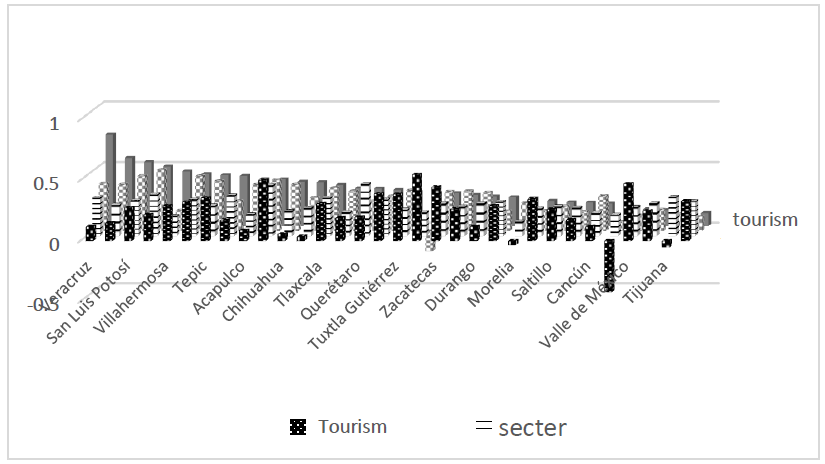
Figure 1 shows the monthly wage gap between men and women in the main MZs of Mexico. For the gender income differential
Source: created by the authors based on information from the ENOE of 2021.
Figure 1 Monthly Wage Gap, 2021
The reading of this indicator is as follows: when it is equal to zero, wage income between men and women is the same; when it is positive, men earn a higher proportion of income than women; and when it is negative, it is women who earn a higher proportion of income than men. Using the monthly wage between male and female formal workers, it is possible to observe that the wage gap is greater or in favor of men in almost all MZs in the country, except for Cuernavaca, where a lower value is observed in favor of women. The data in the graph show that the sector with the largest wage gap is the manufacturing sector (gray), followed by the secondary sector (squared), tertiary (striped), and the tourism sector is in fourth place (black).
Analyzing Figure 1, which groups by sex the monthly wage obtained by workers in the four productive sectors, there is evidence that in Veracruz, Pachuca, San Luis Potosi, Culiacan, Villahermosa, and Campeche, the wage gap is larger than in Toluca, Tijuana, Colima, Valley of Mexico, and Cuernavaca. Regarding the tourism sector, the data in Figure 1 show that La Paz, Valley of Mexico, and Merida lead the wage gap in this sector and that the smallest wage gaps in tourism are found in Morelia, Tampico, Tijuana, and Chihuahua, with Cuernavaca even favoring women.
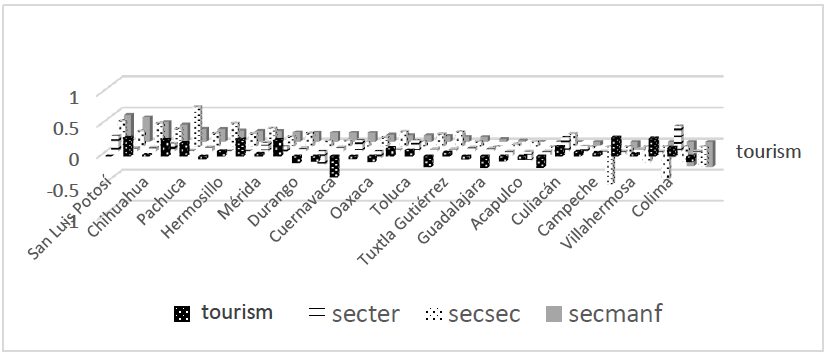
The major problem with analyzing the wage gap by monthly wage is that men mostly work more full workdays than women, so the analysis in Figure 1 is biased. Ideally, the study should be done by hours worked, as shown in Figure 2.
Source: created by the authors based on information from the ENOE of 2021.
Figure 2 Wage gap by hours worked, 2021
The interesting aspect of studying the wage gap by hours worked is that it allows for a more precise evaluation of the sectors with the largest wage gaps. For example, Figure 2 shows that the tourism sector has the largest wage gap in the MZs of Valley of Mexico, Saltillo, Zacatecas, La Paz, Leon, and Puebla. On the other hand, the smallest gaps in the sector are observed in San Luis Potosi, Chihuahua, Tlaxcala, Merida, Queretaro, Monterrey, Acapulco, and Villahermosa. The MZs where women earn more than men in the tourism sector are Cuernavaca, Guadalajara, Tampico, Veracruz, Tijuana, and Durango.
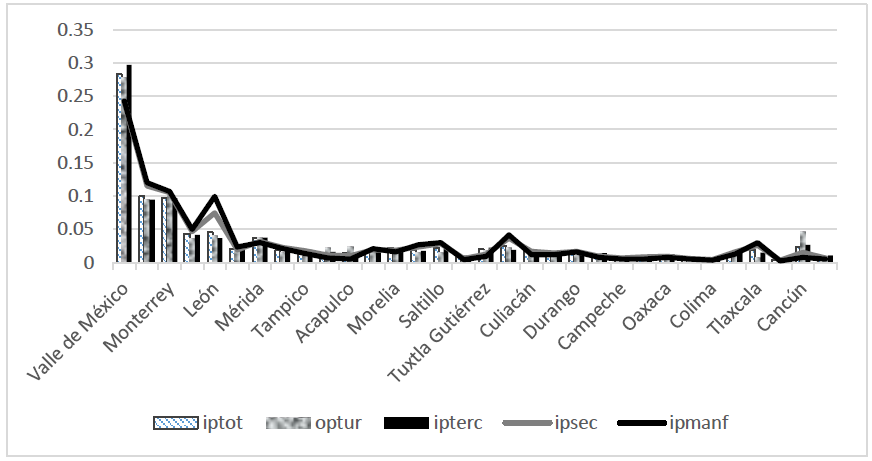
Figure 3 shows the data for total precarious work and for the productive sectors. In Figure 1, the service sector leads in precarious work in the MZs of Valley of Mexico, Tuxtla Gutierrez, Tampico, Tepic, and Pachuca, while the tourism sector leads in Valley of Mexico, Veracruz, Acapulco, Oaxaca, and Cancun. In the rest of the MZs, the manufacturing and secondary sectors offer the most precarious jobs.
Source: created by the authors based on information from the ENOE of 2021.
Figure 3 Precarious Work Index, 2021
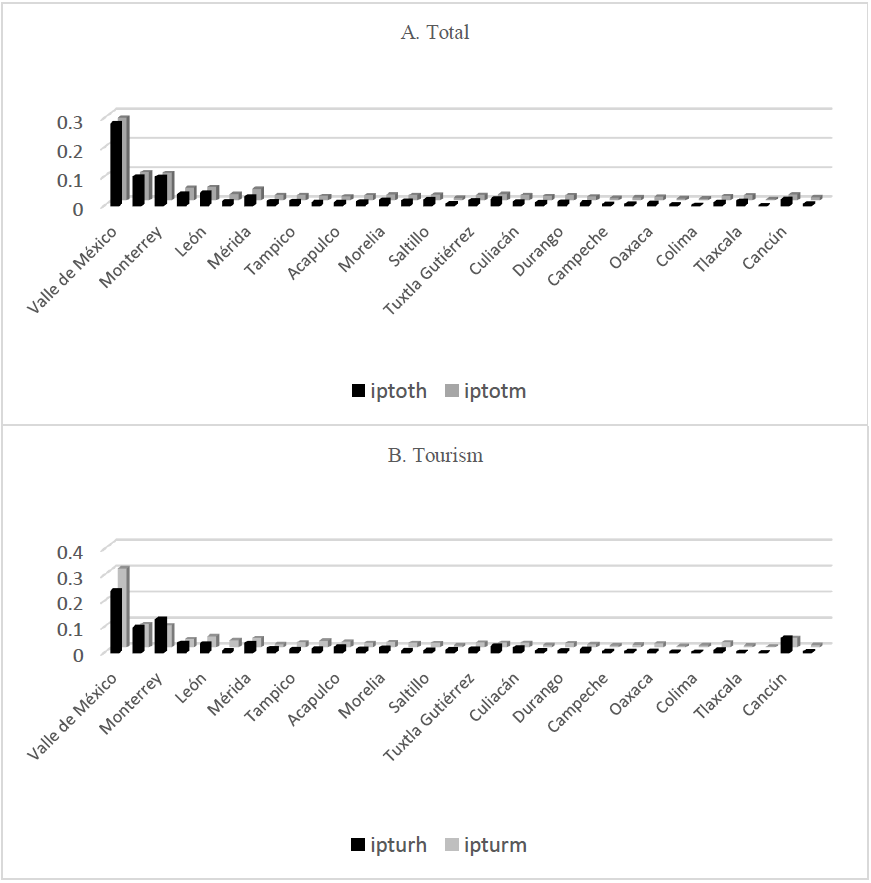
Finally, Figure 4 shows the precarity index by gender for the country as a whole and for the tourism sector in the different MZs. The results indicate greater female precarious work in large MZs such as Valley of Mexico, Guadalajara, Puebla, Leon, and Merida (Figure A). In the tourism sector, the greatest female precarity occurs in the MZs of Valley of Mexico, Leon, San Luis Potosi, Tampico, Veracruz, Durango, Oaxaca, and Queretaro. The MZs where men have the most precarious jobs in the tourism sector are Monterrey, Tijuana, and Cancun (Figure B).
Information sources and model design
Data
The variables used in the econometric model were constructed with microdata from the ENOE for the first quarter of every year from 2005 to 2021 by MZs and according to self-represented cities, which allows statistical inference to be representative for each city and MZ. It is important to mention that as the ENOE has maintained the same structure since 2005, the choice of the compatible analysis period is from 2005 to 2021. Monthly and hourly labor income indicators were obtained for the employed population between 15 and 65 years of age. Monthly labor income was constructed as part of the presentation of the ENOE results, and hourly income was calculated as monthly income divided by hours worked per month. Years of schooling were constructed considering completed primary, secondary, technical secondary, high school, high school with a technical diploma, bachelor’s, master’s, and doctoral studies. Potential work experience was calculated as age minus years of schooling and six years. The employed population was stratified by informal sector, unionized, social program support, social security, with one and up to three minimum wages, temporary contract, without benefits, full-time, and non-unionized.
Econometric model design
In addition to the construction of the wage gap, as defined in the previous section, and to establish the conditions of precarious work, a weighted sum index was constructed following the methodology of Mora (2012), where relative weights of the different dimensions and indicators are attributed to the index. In this case, weights were constructed with the inverse of the proportion of deprivation in each indicator used so that deprivations are weighted according to their relative importance in the region in a formal manner:
Where:
IPL = |
the index of job insecurity for men and women in sector i and region j. |
x1ij = |
the variable of absence of an employment contract in sector i and region j. |
x2i = |
the variable that agglomerates at least two minimum wages per hours worked in sector i and in region j. |
x3j = |
the indicator that shows that the worker lacks social security in the different sectors i and regions j. |
x4j = |
the indicator showing that the worker is not a member of any union in sector i and region j. |
znij = |
the inverse weights corresponding to each of the variables 1...n used in the construction of the index. |
The index oscillates between 0(IPL(1. As it approaches zero, it implies no precarious work and 1, greater precarious work.
The importance of constructing precarious work indexes by gender is to demonstrate that wage inequality has decreased in the different MZs of Mexico mainly due to greater precarity, which means that it is not that women have improved their working conditions but that men now have more precarious jobs just like women.
Authors such as Andres-Rosales, Czarnecki, and Mendoza-Gonzalez (2019) use the hourly wage gap as dependent variable and as independent variables the years of schooling, experience, hours worked, and precarious work in the Mexican economy for the sector as a whole. Unlike them, in this article, it is applied for the service and tourism sector to measure the influence for the total wage gap of the different MZs. The model is defined as follows:
The variable brechlt refers to the wage gap between men and women in the total service sector, while prectur, esctur, primtur, sectur, tertur, exptur, captur, and inftur refer to precarious work, workers’ schooling, primary, secondary, and university or technical studies, experience, training, and informality in the tourism sector in the different Metropolitan Zones of Mexico; all independent variables are in logarithmic terms. The existing wage gap between men and women is constructed as the comparison of men’s average wage income with respect to women’s wage income in each of the MZs. When the wage gap is written in natural logarithms,
The brechlt variable is a vector of NTx1 dependent variable, β is a coefficient to estimate, and εt is an error term. The estimated model is a spatial panel and comprises the 32 MZs of the country for the period 2005-2021.
It is important to note that the spatial part was included in the model, represented by the parameter rho ((); as it approaches one the value implies greater spatial dependence and values close to zero mean zero spatial dependence. The rho value can also be negative, showing a center-periphery type relation. What is of interest in this paper is that the relation is positive and not negative. The W is a positive spatial weight matrix of type k-nearest neighbors (in this case, a criterion of 8 neighbors was used). Its dimension depends on the sample size and it groups the existing spatial interactions. Its value will be equal to 1 if it has neighbors and zero when there are none. Within the main diagonal of the W matrix, there are zero values to avoid self-neighborhood. The W matrix is a weighted and normalized average, where the sum of the rows equals one.
Within the spatial modeling, there are several alternatives. Summarizing Equation 1, it is represented as follows:
Equation 1’ is the same as Equation 1 but in a reduced version. yij is still the wage gap, and xij includes all the exogenous variables of the model. This approach is known as spatial autoregressive (SAR). If the spatial component is incorporated in the perturbations, the spatial error model (SEM) is obtained and is represented as:
If models 1’ and 2 are estimated jointly, the general spatial autoregressive and spatial error model (SARAR) is obtained. Finally, if the spatial lag of the exogenous variables is incorporated in the SAR model, a Spatial Durbin Model (SDM) is obtained mathematically:
Where Wxij are the exogenous variables of the neighbors of a region.
Following Parajuli and Haynes (2017), it is possible to consider the following spatial models:
Empirical evidence of the wage gap and precarity in the Mexican tourism sector
Panel data for the period 2005-2021 were used in the estimation of the spatial model. Fixed effects and random effects models were estimated, choosing the best model through the Hausman test. It is important to note that the robust model version was chosen because of heteroscedasticity problems. Tests for serial autocorrelation are also reported in each model, although no evidence of this problem was found.
The results in Table 3 show that the increase in the precarious work of men in the period analyzed has contributed to a decrease in the wage gap in the Mexican economy by 13%, while the precarious work of female labor in the tourism sector increases it by 10%. This means that employment in the Mexican tourism sector helps to reduce the existing wage gap between men and women because it makes men’s jobs more precarious. Nevertheless, the wage gap widens when this precarious work is for women workers in the sector.
Table 3 Spatial panel data model, 2005-2021
| Wage gap index in the service sector (ln) | Fixed Effects | Random effects |
| Index of precarious work of men in tourism (ln) | -0.13 *** | -0.13 *** |
| (0.042) | (0.038) | |
| Index of precarious work of women in tourism (ln) | 0.09 * | 0.101 ** |
| (0.048) | (0.044) | |
| Primary schooling of male workers in the tourism sector (ln) | 0.05 ** | 0.05 *** |
| (0.02) | (0.019) | |
| Primary schooling of female workers in the tourism sector (ln) | 0.04 | 0.04 |
| (0.029) | (0.026) | |
| Experience of male workers in the tourism sector (ln) | -0.19 *** | -0.19 *** |
| (0.051) | (0.051) | |
| Experience of female workers in the tourism sector (ln) | -0.05 | -0.02 |
| (0.071) | (0.065) | |
| Informality of men in the tourism sector (ln) | 0.05 ** | 0.05 ** |
| (0.023) | (0.019) | |
| Informality of women in the tourism sector (ln) | -0.09 *** | -0.10 *** |
| (0.023) | (0.023) | |
| Constant | 0.14 | |
| (0.159) | ||
| rho | 0.11 ** | 0.11 ** |
| (0.052) | (0.046) | |
| Hausman’s test | 4.08 | |
| Wooldridge’s test | 0.03 | |
| remarks | 544 | |
| No. Groups | 32 | |
| R-sq-within | 0.09 | 0.09 |
| R-sq-between | 0.16 | 0.22 |
| R-sq-overall | 0.11 | 0.11 |
Note: *** significance level at 1%, ** significance at 5%, * significance at 10%. The standard error is in parentheses. All the information used in the model comes from the ENOE.
Source: created by the authors with information from the ENOE, various years.
Given the observed advantage of men in all productive sectors, in terms of employment in the tourism sector, the results show that the simple fact that men have a primary school education gives them a 5% advantage in wages over women, while this variable was not significant for Mexican female workers. The other variables, such as secondary, university, or technical education, did not significantly influence the existing wage gap in the country, so they had to be omitted.
Experience in the tourism sector was the most important variable influencing the decrease in the existing wage gap in the country (19%). This is because men, who keep their jobs and have more experience in the sector, do not receive higher salaries than their counterparts. Nor does training play a relevant role in increasing or decreasing the existing wage gap in Mexico.
The estimates indicate that informality in the tourism sector contributes to increasing the wage gap by 5% when men are involved in informal employment. Nevertheless, when women do so, the existing wage gap decreases, implying that for men, employment in the informal sector has an adverse effect on their income, while for women, their income increases.
Finally, the spatial component rho of the wage gap shows a positive and significant sign. This implies a contagion or spatial spillover effect between the different MZs in the country of the wage gap and that it has increased at a rate of 11% in the observed period. This means that not only the tourism sector contributes to the wage gap as hypothesized, but also the space or neighbors of the different MZs play an important role in this gap.
Conclusions
Tourism is of utmost importance for Mexican cities, especially because many sustain their economic growth in this sector. The employment generated by tourism is of great importance for the country’s working women. Tourism, in addition to influencing people’s income, in some way serves as a distributor of local income as many small and micro businesses are focused on this activity.
The results of this study show that, in tourism, the wage gap is high in many MZs and that despite the high participation of women in the labor force, they continue to earn the lowest wages (1 to 2 minimum wages). Men, despite their lower participation in the tourism sector, are the ones who earn the highest wages.
Evidence was found that the highest wage gap is still observed in the manufacturing sector and in the secondary sector in general. Nevertheless, the tourism sector absorbs and employs the most women, and its wage gap is high in many of the country’s cities. The results show that in practically all productive sectors in the different Metropolitan Zones in Mexico, women earn much less than men.
A structural problem is created by the fact that the Mexican labor market is not only sexist but also that women’s work is undervalued. As a result, women are offered more precarious occupations than men. To improve their income and reduce the existing wage gap, women have to settle for informal jobs, which means that they have lower salaries and fewer benefits and job protection than men. Many of the rights won at the international level, enjoyed by their male counterparts, are still denied to women in the various Mexican MZs.
Women are considered labor reserves, who are in demand in boom seasons but are dispensable in periods of crisis. This makes it difficult for them to keep their jobs and consolidate their position in the formal market as men do. It is more difficult for women to scale different job positions because they do not have jobs that allow them this consolidation process or generate experience, as happens with men’s jobs where experience and training are sufficient to obtain a higher wage than women. This widens the existing wage gap in the sector.
The econometric model results indicate that the precarious work of men tends to reduce the wage gap and that that of women widens it. Nonetheless, precarity cannot and should not be the mechanism by which wage inequality is regulated. Therefore, the increase in minimum wages undertaken by the current government since 2019 and which at the time of writing this paper has accumulated an improvement of 135%, is one of the most appropriate ways to contribute to reducing the existing wage gap in the Mexican economy, above all in a sector such as tourism where Mexican women have a majority participation and are the ones who receive the lowest wages.
Nevertheless, this increase in the minimum wage should be accompanied by greater social security, unionization, and employment contracts for Mexican women workers and, thus, not only reduce the existing wage gap, but also precarious work in Mexico.
Acknowledgments
This article was supported by a UNAM-PAPIIT IN303821 project.
REFERENCES
Archer, B., Cooper, Ch. y Ruhanen, L. (2009). The Positive and Negative Impacts of Tourism. En Theobald, W. , Global Tourism. Elsevier. [ Links ]
Chávez, R. (2001). Flexibilidad en el mercado laboral: orígenes y concepto. Aportes, 7(17), 57-74. https://www.redalyc.org/pdf/376/37661703.pdf [ Links ]
Camacho, R. (2014). Flexibilización sin precarización: estrategias para prevenir la precarización en la era de la modernización económica. Revista Criterio Jurídico, 13(2), 11-33. https://www.researchgate.net/publication/301863295_Flexibilizacion_sin_precarizacion_estrategias_para_prevenir_la_precarizacion_en_la_era_de_la_modernizacion_economica [ Links ]
Lesage, J. y Pace, K. (2009). Introduction to spatial econometrics. London: Taylor and Francis Group. [ Links ]
Andrés-Rosales, R., Carbajal-Suárez, Y. y Mendoza-González, M. (2021). La precariedad laboral del empleo manufacturero como factor determinante de la pobreza en las entidades federativas de México, 2004-2018. En L. De Jesús-Almonte, Y. Carbajal-Suárez y V. Torres-Preciado, Actividad económica en México. Un análisis sectorial (Vol. 1). México, Estado de México, México: UAEM. [ Links ]
Andrés-Rosales, R., Czarnecki, L. y Mendoza-González, M. (2019). A spatial of precariousness and the gender gap in Mexico, 2005-2018. The Journal of Chinese Sociology, 6(13), 1-21. https://doi.org/10.1186/s40711-019-0104-2 [ Links ]
Andrés-Rosales, R., De Jesús-Almonte, L. y Carbajal-Suárez, Y. (2021). Empleo, producción y salario manufacturero en México ante la pandemia por la COVID-19. Un análisis de VAR espacial. Revistas Ciencias Administrativas. Teoría y praxis, 1-25. https://doi.org/10.46443/catyp.v17i2.285 [ Links ]
Andrés-Sarasa, J. (1998). Turismo y empleo femenino. Cuadernos de Turismo (1), 9-27. https://revistas.um.es/turismo/article/view/24591 [ Links ]
Anselin, L. (1988). Spatial econometrics methods and models. California: Kluwer Academic Publishers. [ Links ]
Baltagui, B. (2005). Econometrics analysis of panel data. West Sussex: Wiley & son. [ Links ]
Dahrendorf, R. (1986). La flexibilidad del mercado de trabajo. (MTSS, Ed.) Madrid, España: OCDE. [ Links ]
Elhorst, J. (2014). Spatial Econometrics. From cross-sectional data to spatial panels. The Newtherlands: Springer. [ Links ]
Florida, R. (2013). Las ciudades creativas. por qué donde vives puede ser la decisión más importante de tu vida. Paidos. [ Links ]
García, E. I. e Ibánez, P. (julio-diciembre de 2017). Los trabajadores pobres y los bajos salarios en España: un análisis de los factores familiaries y laborales asociados a las distintas situaciones de pobreza. EMPIRIA. Revista de Metodología de Ciencias Sociales, 41(67), 1-15. https://doi.org/10.5944/empiria.14.2007.1172 [ Links ]
Giuseppe, A. (2014). A primer spatial econometrics with application in R. England: Palgrave McMillan. [ Links ]
Martínez-Liceriom, A., Marroquín-Arreola, J. y Ríos-Bolivar, H. (2019). Precarización laboral y pobreza en México. Análisis Económico, XXXIV(86), 113-131. https://doi.org/10.24275/uam/azc/dcsh/ae/2019v34n86/Martinez [ Links ]
Martínez-Gayo, G. (julio-diciembre de 2019). ¿Empleos cinco estrellas? reflexión sobre la precariedad laboral en la hostelería española. Revista Internacional de Turismo, Empresa y Territorio (6), 1-15. https://doi.org/10.21071/riturem.v3i2.12283 [ Links ]
Martínez-Gayo, G. y Matínez-Quintana, V. (octubre-diciembre de 2020). Precariedad laboral en el turismo español bajo la perspectiva de género. Revista de Turismo y Patriomonio Cultural, 18(4), 649-665. https://doi.org/10.25145/j.pasos.2020.18.046 [ Links ]
Méndez, S. M., Rodríguez, P. O., Osorio, G. M. y Salgado, V. M. (2013). La flexibilidad laboral en el sector turístico en México. Una interpretación teórica. Estudios y Perspectivas en Turismo, 22(4), 705-728. http://www.scielo.org.ar/scielo.php?script=sci_arttext&pid=S1851-17322013000400005 [ Links ]
Mendoza-González, M. (2020). Gender wage discrimination by income distribution in Mexico, 2005-2020. Latin America Economic Review, 29(5), 1-20. DOI: 10.1007/s00168-020-00979-3 [ Links ]
Mendoza-González, M., Cardero, M. E. y Ortíz, A. (2017). Algunos hechos estilizados y explicativos sobre el diferencial y la discriminación salarial por sexo en México, 1987-2015. Investigación Económica, LXXVI(301), 103-135. https://doi.org/10.1016/j.inveco.2017.12.004 [ Links ]
Mendoza-González, M. y Quintana-Romero, L. (2016). Modelos panel y sus aplicaciones en R. En Econometría aplicada usando R. México: UNAM. [ Links ]
Mora, M. (2012). La medición de la precariedad laboral: problemas metodológicos y alternativas de solución. Revista Trabajo (9), 87-121. https://www.researchgate.net/publication/268109394_La_medicion_de_la_precariedad_laboral_Problemas_metodologicos_y_alternativas_de_solucion [ Links ]
Murillo-Villanueva, B., Carbajal-suárez, Y. y De Jesús-Almonte, L. (2021). Desigualdad salarial en los subsectores manufactureros en México, 2007-2018. Ensayos. Revista de Economía, 40(1), 29-54. DOI:10.29105/ensayos40.1-2 [ Links ]
Parajuli, J. y Haynes, K. (2017). Panel data models of new firm formation in new England. Region, 4(3), 65-76. https://doi.org/10.18335/region.v4i3.167 [ Links ]
Ponce, P., Álvarez-García, J., Cumbicus, M. y Río-Rama, M. (2021). Spatial externalities of income inequality on security in Latin America. Mahtematics, 9(245), 1-19. https://doi.org/10.3390/math9030245 [ Links ]
Ponce, P., Aguirre-Padilla, N., Oliveira, C., Álvarez-García, J. y Río-Rama, M. (2020). The spatial externalities of tourism activities in poverty reduction. Sustainability, 12(6138), 1-17. https://doi.org/10.3390/su12156138 [ Links ]
Quintana-Romero, Luis. (2016).Crisis neoliberal y reforma laboral en México. Revista Cuadernos del Cendes, 33(93), 113-123. https://www.redalyc.org/articulo.oa?id=40352382007 [ Links ]
Quintana-Romero, Luis, Carlos Salas, Christian Duarte y Ronny Correa. (2019). Regional inequality and labour precariousness: An empirical regional analysis for Brazil, Mexico and Equador. Regional Science Policy & Practice, 12(1), 1-81. https://doi.org/10.1111/rsp3.12251 [ Links ]
Rivera, M. (2019). Género, turismo responsable y educación para el desarrollo. En M. Osuna y M. Amor, Investigación en la transversalidad de género en el siglo XXI (págs. 267-280). Madrid: Editorial Síntesis. [ Links ]
Robles, L. S., Lozano, K. D., Montoya, A. B. y Román, S. Y. (2019). La precariedad laboral por grupos ocupacionales en el Estao de México, 2005 y 2015. Región y Sociedad, 1-20. http://portal.amelica.org/ameli/journal/48/481821013/481821013.pdf [ Links ]
Rodríguez, F. y Brown, F. (2012). El proceso de innovación en el sector de alojamiento turístico mexicano. Estudios y Perspectivas en Turismo, 21(2), 372-387. http://www.scielo.org.ar/scielo.php?script=sci_arttext&pid=S1851-17322012000200006 [ Links ]
Rodríguez-Pérez, R. E. y Aguilar-Arredondo, M. (abril de 2021). El efecto de la crisis económica en el mercado laboral femenino de México, 1987-2016. Revista Cepal (133), 190-210. https://repositorio.cepal.org/bitstream/handle/11362/47083/1/RVE133_Rodriguez.pdf [ Links ]
Rodríguez-Pérez, R. y Germán-Soto, V. (2021). Desigualdad Salarial por género y ciclo económico en las manufacturas mexicanas. Economía Teoría y Práctica, 29(54), 61-88. http://dx.doi.org/10.24275/ETYPUAM/NE/542021/Rodriguez [ Links ]
Rogers, G. y Rogers, J. (1989). Precarious jobs in labour market regulation: the growth of atypical employment in Western Europe. Geneva: International Institute for Labour Studies; Brussels: Free University of Brussels. https://www.europarl.europa.eu/RegData/etudes/STUD/2016/587285/IPOL_STU(2016)587285_EN.pdf [ Links ]
Rubery, J. (. (1993). Las mujeres y la recesión, economía y sociología del trabajo. Madrid: Ministerio de Trabajo y Seguridad Social. [ Links ]
Rubio, J. (2017). Sindicalización y precariedad laboral en México. Región y Sociedad, 29(68), 37-75. https://www.scielo.org.mx/pdf/regsoc/v29n68/1870-3925-regsoc-29-68-00037.pdf [ Links ]
Ruíz, P. M., Pereira, T. O., Serrano, G. y Saénz, F. S. (2021). Analysis of Tourist system predictive models applied to growing sun and beach tourist destination. Sustainability, 13(785), 1-24. https://doi.org/10.3390/su13020785 [ Links ]
Salas, C., Quintana, R., Mendoza, G. M. y Valdivia, M. (2020). Distribución del ingreso laboral y la pobreza en México. El Trimestre Económico, 4(348), 929-962. https://doi.org/10.20430/ete.v87i348.1148 [ Links ]
Salas, Carlos, Luis Quintana, Miguel Á. Mendoza y José Alvarez. (2022). Analysis of Job Transitions in Mexico with Markov Chains in Discrete Time. Mathematics, 10(10),1693. https://doi.org/10.3390/math10101693 [ Links ]
Torres, P. V. (Septiembre de 2020). La economía de la pandemia: efectos, medidas y perspectivas económicas ante la pandemia de la COVID-19 en el sector manufacturero de México. Contaduría y Administración, 4(65), 1-25. http://dx.doi.org/10.22201/fca.24488410e.2020.3022 [ Links ]
Vejar, D. (2014). La precariedad laboral, modernidad y modernización capitalista: una contribución al debate desde América Latina. Trabajo y Sociedad (23), 147-168. https://www.redalyc.org/pdf/3873/387334695008.pdf [ Links ]
Wooldridge, J. (2002). Econometric Analysis of cross section and panel data. London England: MIT Press. [ Links ]
Received: September 30, 2022; Accepted: February 20, 2023; Published: February 21, 2023
 Este es un artículo publicado en acceso abierto bajo una licencia Creative Commons
