




Servicios Personalizados
Revista
Articulo
 texto en
  Inglés (pdf)
 Artículo en XML
 Referencias del artículo
 Traducción automática
 Enviar artículo por email
Indicadores
-
 Citado por SciELO
 -
 Accesos
Links relacionados
-
 Similares en
SciELO
Similares en
SciELO
Compartir

 Permalink
Contaduría y administración
versión impresa ISSN 0186-1042
Contad. Adm vol.68 no.2 Ciudad de México abr./jun. 2023 Epub 02-Dic-2024
https://doi.org/10.22201/fca.24488410e.2023.4522
Articles
Content and construct validity analysis of an instrument that measures service quality and customer satisfaction in the hotel industry
1Universidad Autónoma de Sinaloa, México
2Universidad Autónoma de Baja California, México
Service quality is considered an alternative for hotels to offer customer satisfaction, since this aspect of tourism means an inflow of foreign currency that contributes to the Gross Domestic Product of Mexico. Hotels should seek to offer a higher quality of service so that customers can have a demand for their services and thus obtain their preference. The objective of the research was to validate an instrument for measuring service quality and customer satisfaction. The focus of the study is quantitative; The instrument was developed based on the review of the literature, it was applied in the months of July and August 2021 to a sample of 120 guests; As a result of the measurement of the two variables under study, a reliability (Cronbach's alpha) was obtained for the quality of the service of 0.963 and for customer satisfaction of 0.825. To assess the validity of the construct, an exploratory factor analysis was carried out, which determined five factors that explain 75.23% of the total variance in service quality and two factors that explain 72.66% in customer satisfaction. The hypothesis test showed that the level of quality in the service is good derived from the good quality of the service provided by the hotels. Thus, the instrument obtained presented adequate reliability and validity properties, which in turn made it possible to measure the impact of service quality on customer satisfaction in the hotel sector.
Keywords: factor analysis; reliability analysis; quality of service; customer satisfaction
JEL Code: M10; M19; Z32
La calidad en el servicio se considera una alternativa para que los hoteles puedan ofrecer satisfacción del cliente ya que esta vertiente del turismo significa una entrada de divisas que contribuyen al Producto Interno Bruto de México. Los hoteles deben buscar ofrecer una mayor calidad en el servicio para que los clientes puedan tener una demanda en sus servicios y así obtener la preferencia de estos. El objetivo de la investigación fue validar un instrumento para la medición de la calidad en el servicio y satisfacción del cliente. El enfoque del estudio es cuantitativo; el instrumento se elaboró con base en la revisión de la literatura, se aplicó en los meses de julio y agosto de 2021 a una muestra de 120 huéspedes; como resultado de la medición de las dos variables en estudio se obtuvo una fiabilidad (alfa de Cronbach) para la calidad de en el servicio de 0.963 y para satisfacción del cliente de 0.825. Para evaluar la validez del constructo se llevó a cabo un análisis factorial exploratorio, que determinó cinco factores que explican el 75.23 % de la varianza total en la calidad en el servicio y dos factores que explican el 72.66 % en la satisfacción del cliente. La prueba de hipótesis arrojó que el nivel de calidad en el servicio es bueno derivado de la buena calidad en el servicio proporcionado por los hoteles. Así, el instrumento obtenido presentó adecuadas propiedades de confiabilidad y validez, que a su vez permitieron medir el impacto que tiene la calidad en el servicio sobre la satisfacción del cliente en el sector hotelero.
Palabras clave: análisis factorial; análisis de confiabilidad; calidad en el servicio; satisfacción del cliente
Código JEL: M10; Z32
Introduction
According to the World Tourism Organization (2017), a growing number of destinations around the world have opened up to and invested in tourism activity, making it a key sector for socio-economic progress through the creation of jobs and businesses, the generation of export revenues, and the creation of infrastructure. This activity has become robust in its turnover equal to or higher than oil exports, automobile production, and food production and has consolidated its position as one of the most important sectors of the world economy. It accounts for 10% of the world’s Gross Domestic Product (GDP), and one out of every 11 employees on a global scale is linked to tourism. This activity has become a major source of income for localities due to the expenditure tourists make on food, services, shopping, and accommodation.
In this regard, the hotel industry is one of the fundamental pillars of tourism in Mexico, where income from accommodation services represents the largest contribution to the Gross Domestic Product from Tourism (GDPT) and accounted for 28.3% in 2017. Additionally, of the 2.3 million jobs in this industry, 9% were generated by some service related to tourist accommodation (López, Galván, & Velazco, 2021).
It is very difficult to determine the exact number of hotels in operation. Some close their doors, but simultaneously, new ones appear in the market to provide their services. Therefore, their members seek ways to distinguish themselves and improve over the competition (López et al., 2018).
Regarding the hotel industry, companies face a series of challenges linked to globalization, the emergence of technologies, climate change, demographic factors, and new market trends that impact the tourist profile and even competitiveness as an opportunity for improvement (Malheiro et al., 2020; de Yta et al., 2018). Referring to the COVID-19 health crisis, the Mexican hotel industry has had downward movements in GDPT due to this extraordinary situation since 2020 that has affected travel mobility. Nonetheless, although it had recovered by 4.1% in 2021 compared to the previous year (Secretaría de Turismo, 2021), it is necessary to implement strategies to face such challenges based on the knowledge of the tourist’s needs.
In this regard, Ogungbayi et al. (2019) and Dehghanpouri et al. (2020) mention that customer satisfaction is a critical success factor in service organizations and that the hotel industry in developing countries-such as Mexico-has to be competitive as they must satisfy both local and international customers. Consequently, customer satisfaction is directly related to some profitability and reputation factors, according to Gonzalez et al. (2019). In the hotel context, customers usually evaluate the degree of satisfaction by rating its characteristics, as Ahani et al. (2019) pointed out.
Since the hotel industry was created to offer services to customers who travel for different reasons, quality should be measured based on their perception, since in this way it will help to improve the flow of visitors not only to the accommodation facilities but to the city itself, thus generating local and tourism development (Millán-Vásquez de la Torre et al., 2015; Soto & Villena, 2020).
It is necessary to point out that measuring service quality and customer satisfaction must be reliable, valid, and decisive. Therefore, it is essential to know the indicators of these variables that show if there is a quality service and if total satisfaction emanates from it. Certainly, there is a need to create and innovate methodological research instruments that are more relevant, that recognize the aspects of the literature, and that generate a mix of all the factors of service quality.
In this regard, very few instruments in the literature validate the content and construct of service quality and customer satisfaction in the hotel industry. Consequently, the state of the art was investigated, and the need to conduct a factorial study of both variables and determine their validity appropriate to the Mexican hotel industry and the indicators from which this study is derived was determined. This research aimed to validate an instrument for measuring service quality and customer satisfaction in the hotel industry.
This article consists of a specialized literature review that introduces the theoretical foundations of the variables from which the instrument’s design is derived. The second section outlines the validity and content study methodology. The results section presents the information obtained. Finally, the last section presents the discussion and conclusions of the study.
Review of the literature
Service quality
Service is an intangible between the organization’s activities and its commitment to the customer (Kumar et al., 2017). Currently, service performance is a major challenge in the hotel industry since the fact that the customer has contact with the employees helps obtain a competitive advantage (Globelna, 2020; Karatepe et al., 2019). For de Lima and de Oliveira (2019), the final decision about accessing a service or product is often determined by the first impression. Service, then, is considered an organizational strategy carried out by the top hierarchy and executed by personnel whose characteristics influence customer satisfaction prior to their expectations and qualified by their perceptions.
Then, as a business strategy, services confer an assumption of achieving a positive customer experience (Wu & Gao, 2019). Particularly, the hotel industry has been interested in developing quality customer relationships to obtain an expected outcome, such as customer satisfaction (Chi, Wen, & Ouyang, 2020). Consequently, customer satisfaction fosters trust in a hotel industry organization and thus the respective commitment to its customers, as Ray and Lu (2018) point out.
Service quality has been considered a difficult term to conceptualize. Nevertheless, Tamayo and Vega (2017) consider that service quality results from a perceived evaluation process and depends on the service expected and received. Zaithaml (1988), Bitrner (1990), and Bustamante et al. (2019) point out that service quality is a global assessment, highly subjective, similar to an attitude, related but not equivalent to satisfaction, which involves a process of continuous assessment over time. Likewise, Vera and Trujillo (2018a) point out that service quality can be viewed as the degree and direction of discrepancy between expectations and the perception of what the customer actually receives. The current models that measure service quality are presented in Table 1.
Table 1 Models for measuring service quality
| Name of the model | Author(s) | Attributes evaluated |
| Servqual | (Parasuraman, Zeithaml, & Berry, 1985-1988) | Reliability, security, tangible elements, responsiveness, and empathy |
| Lodgserv | (Knutson et al., 1990) | Customer expectations |
| Servperf | (Taylor & Cronin, 1994) | Customer perceptions |
| Hotelqual | (Falces et al., 1999) | Personnel, facilities and their operation, and the organization of the service |
| Multi-dimensional and Hierarchical Model of Service Quality | (Wu & Ko 2013) | Quality interaction, quality environment, quality service completion |
Source: created by the authors.
There have been great efforts to determine a measurement scale in the hotel industry to determine whether service quality exists and its likely impact on customer satisfaction.
Dimensions of service quality
For Coronel, Basantes, and Vinueza (2019), the “empathy of human capital” dimension is the degree of personalized attention companies offer to their customers. Ibarra-Morales et al. (2020) indicate that this dimension measures the degree of careful and individualized attention and the ability to listen and understand customer needs. Elche et al. (2020) state that empathy is the ability to cognitively understand and enter into the feelings and emotions of others. Silva-Treviño et al. (2021) consider empathy as the care and personalized attention the company provides considering schedules and customer service policies. The indicators mostly used to measure empathy consider the staff’s interest in resolving concerns (Caiza et al., 2022), understanding the specific needs of customers (Ali et al., 2021), and providing them with special and personal services (Roy & Bains, 2020).
The “human capital and hotel communication” dimension is the system of channels through which messages flow and interaction patterns are established among the organization’s members; it can be formal or informal (Montoya, 2018). From the perspective of an organization, three major views are sustained: corporate with its values, vision, and mission; internal communication, whose purpose is the management to improve the quality of work processes (Contreras & Garibay, 2020); and marketing communication, which proposes to raise the prospects for its profitability (Rebeil & Arévalo 2017, 2018). Then, the service experience of customers in an accommodation center or hotel depends largely on the encounters with human capital. Huang et al. (2020) also state that human capital is considered a form of asset and resource that a person or property of an organization can use to obtain the expected returns. Those indicators measured in communication are usually corporate identity and culture (Melewar et al., 2017; Mohammed et al., 2016; Castillo et al., 2018).
Furthermore, the dimension “knowledge and skills of human capital,” recognized as labor competencies, represents the productive force of each organization that impacts its objectives (García et al., 2018). Within this framework, human capital management becomes a priority process in hotel organizations since this becomes a key axis in economic profitability in the hotel industry (Flores, 2020). Similarly, the indicators of this dimension measure the occupational and functional aspects (Assafiri-Ojeda et al., 2019).
Another dimension is “hotel infrastructure.” This attribute of service quality has particular preeminence with competitiveness in hotel businesses: an advanced state of comfort offered by hotels enables favorable recreational conditions (Gudkov & Dedkova, 2020). Consequently, the state of the comfort of tangible elements such as modern and structurally adequate facilities in view of the customer has an impact on service quality.
“Client security” concerns preserving the client’s belongings (Alnawas & Hemsley-Brown, 2019). The client-host relationship is intimate and extremely important. Knowing how the security aspects are composed gives the client greater peace of mind. On the other hand, the host must know the environment from which the customer came for the purpose of manifesting comfort with the service offered (Choo, Tan, & Yeo, 2018).
Customer satisfaction
Customer satisfaction can be translated into the result of the evaluation of the services or products obtained through a transaction between an organization and an individual, that is, the evaluation of its performance. Nonetheless, the literature maintains the concept with recognized authors supporting this research. Umar and Barhun (2017a) define it as the evaluation following the comparison between expectations and the purchase experience by the customer.
This paradigm of customer confirmation or disconfirmation of the products or services is a guideline for research that permits its growth by building customer loyalty and ensuring that they eventually return to consume its products or services to obtain a profit.
One of the preponderant factors for customer satisfaction (Dhar, 2015) is human capital management since their work also impacts the quality of service and hotel performance. Potentiating the skills of human capital within the hotel industry leads to a process of production and, in this case, of service (Herrera et al., 2020). Consequently, customer satisfaction should result from human capital’s job competence, according to Hewagama et al. (2019). The objective of achieving customer satisfaction makes it possible to address the failures in the processes adequately. Measuring satisfaction in the hotel industry becomes a critical factor for service performance. Evaluating satisfaction in depth is critical for hotel management and its possible success in the industry (Li et al., 2020; Moreno-Perdigón et al., 2021).
Dimensions of customer satisfaction
For the research work, the dimensions of customer satisfaction are the previous expectations and performance of the service, and the customer’s level of satisfaction in the hotel industry, as found in the specialized literature. Expectation can be defined as an aspiration or purpose to be fulfilled. Expectation implies a dynamic perception of satisfaction and, therefore, is part of a decision to repurchase a product or service based on confirmation (Hu et al., 2019; Fu, Zhang, & Chan, 2018).
The dimension “service performance and level of customer satisfaction” can be defined as the final result granted by an organization based on institutional processes that depend, among other things, on the customer’s expectations, the perception of the services, and the collaborative work of the human capital of the organization. Customer satisfaction is evaluated based on the performance resulting from the comparison with expectations. The customer is satisfied if the performance exceeds expectations (Setiawan et al., 2021).
Research hypothesis
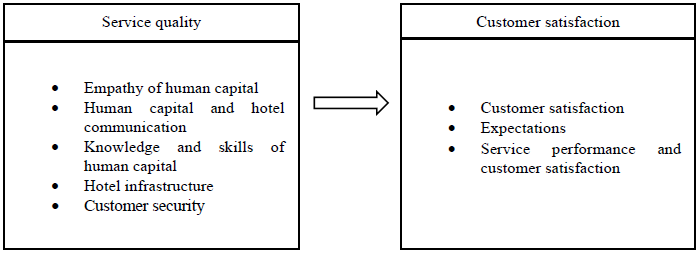
After the literature analysis, the theoretical model of the research was structured, which graphically and simply shows the relation of each of the variables to be studied with their respective dimensions, as shown in Figure 1. The model states that service quality in one- to five-star hotels involves empathy, communication, knowledge, infrastructure, and security for customers. This is influenced by customer satisfaction, which conveys expectations, performance, and satisfaction among guests. Also, the research hypothesis H1 is proposed: The level of customer satisfaction is good, derived from the good service quality hotels provide.
Methodology
The present study was quantitative. One- to five-star hotels served as the unit of analysis, and respondents stayed in Mexican hotels during July and August 2021. Sampling was non-probabilistic by quotas, with a total of 40 customers in the hotels and 80 guests who participated online. The population was infinite; the data collection method was personal surveys to those who entered the hotels, and the remaining interviews were conducted online. The survey included closed-ended rating questions using a 5-point Likert-type scale, where 1 was strongly disagree, 2 was disagree, 3 was neither agree nor disagree, 4 was agree, and 5 was strongly agree. The data were coded and examined using the statistical package SPSS version 26 for social sciences. The instrument was statistically validated using the factorial reduction technique, the determination of Cronbach’s alpha, the Kaiser-Meyer-Olkin (KMO), and the variance explained, thus examining the internal consistency of the items of the study variables.
Description of the sample
Of the 120 clients surveyed, 21% stayed at the hotels for business and 79% for pleasure. Of the total respondents, 52% were male and 48% female. Regarding the educational level of the respondents, 51% had a bachelor’s degree, 35% had a graduate degree, 9% had a baccalaureate degree, 3% had a secondary degree, and 2% had an elementary school education. Regarding the age of the respondents, 60% ranged between 22 and 40 years old, while 40% ranged between 41 and 63 years old. Table 2 shows how the variables were analyzed.
Table 2 Operationalization of the variables
| Variable | Conceptualization | Type of variable | Dimension | Indicator | Instrument |
| Service quality | Degree and direction of discrepancy between expectations and the perception of what the customer actually receives (Vera & Trujillo, 2018) | Independent | Empathy | Politeness | Survey |
| Communication | Communication of human capital to the customer | ||||
| Knowledge and skills | Communication from the organization to the customer | ||||
| Hotel infrastructure | Hotel facilities | ||||
| Customer security | Security | ||||
| Customer satisfaction | Post-comparison evaluation between expectations and purchase experience by the customer (Umar & Barhun, 2017) | Dependent | Pre-service expectations | Expectations | Survey |
| Service performance and customer satisfaction | Service performance and satisfaction level |
Source: created by the authors.
Measuring instruments
The survey-type questionnaire is the most widely used tool for collecting data on social phenomena (Hernández-Sampieri, 2018). For its construction, each item that could best measure the dimensions proposed for each of the variables studied was incorporated. Accordingly, a 5-point Likert-type scale was used (totally disagree, disagree, neither agree nor disagree, agree, and totally agree). The initial version of the survey-type questionnaire consisted of 58 items, see Table 3.
Table 3 Distribution of the initial version of the survey
| Variable | Indicators | Total items |
| Service quality | Empathy of human capital | 6 |
| Human capital and hotel communication | 8 | |
| Knowledge and skills of human capital | 5 | |
| Hotel infrastructure | 17 | |
| Customer security | 7 | |
| Customer satisfaction | Pre-service expectations | 5 |
| Service performance and customer satisfaction | 10 |
Source: created by the authors.
Validity and reliability of the variables
Before using the measuring instrument, it is necessary to confirm its overall reliability. A reliability analysis aims to establish whether a collection of components (or “items”) of a scale can produce results highly comparable to those obtained if the experiment were repeated. In other words, it is necessary to create a scale that produces comparable results when used by different people in different contexts (Merino & Lautenschlager, 2003).
Exploratory factor analysis (EFA) is a statistical technique whose purpose is to explore the set of latent variables or common factors that explain the responses to the items of a test (Lloret et al., 2017). The objective is to define the underlying structure of a data set, analyzing the interrelations or correlations between variables (Pizarro & Martínez, 2020) such that the variables are highly related (López-Aguado & Gutiérrez-Provecho, 2019). Researchers must make evidence-based methodological decisions to conduct an EFA because options are available for the analysis decision, but some are better than others (Watkins, 2018).
The internal validity of the constructs was obtained through an EFA to evaluate the research model. The result of the factor analysis of the service quality scale was loaded into five components based on the interpretation of the underlying factor structure of the scale. The first dimension was labeled as Empathy of human capital (E1, E2, E3, E4, E5, E6), composed of items representing courtesy, attentiveness, and prompt service offered by hotel staff. The second component was labeled as Human Capital and Hotel Communication (CP1, CP2, CP5, CP7, CP8). The items reflect how hotel staff inform guests of the new pandemic care measures and the tangible and intangible services available. The third component was labeled as Knowledge and skills of human capital (CYH2, CYH3, CYH4, CYH5), composed of items in which the hotel staff has the necessary and adequate knowledge and skills to provide quality service. The fourth component is Hotel infrastructure (IH1, IH2, IH3, IH5, IH6, IH7, IH9, IH15, IH16, IH17), which is composed of factors involving all hotel facilities and furnishings to make guests feel comfortable and secure throughout their stay. And the fifth component is Customer security (SC3, SC4, SC5, SC6), which integrates items where the staff was rated as honest, has training in anti-theft security and fire protocols, and there are trained personnel for the pool area. Table 4 shows the results obtained for the service quality variable.
Table 4 Factorial analysis of the service quality variable
| Rotating component matrix | ||||||
| Items | Components | |||||
| Empathy | Communication | Knowledge | Infrastructure | Security | Commonalities | |
| E1 | .777 | .682 | ||||
| E2 | .815 | .836 | ||||
| E3 | .718 | .754 | ||||
| E4 | .752 | .695 | ||||
| E5 | .763 | .750 | ||||
| E6 | .750 | .780 | ||||
| CP1 | .764 | .759 | ||||
| CP2 | .823 | .815 | ||||
| CP5 | .678 | .700 | ||||
| CP7 | .731 | .797 | ||||
| CP8 | .771 | 816 | ||||
| CYH2 | .745 | .740 | ||||
| CYH3 | .758 | .799 | ||||
| CYH4 | .649 | .683 | ||||
| CYH5 | .680 | .727 | ||||
| IH1 | .724 | .803 | ||||
| IH2 | .760 | .771 | ||||
| IH3 | .693 | .752 | ||||
| IH5 | 772 | .752 | ||||
| IH6 | .730 | .752 | ||||
| IH7 | .633 | .722 | ||||
| IH9 | .708 | .678 | ||||
| IH15 | .789 | .721 | ||||
| IH16 | .745 | .745 | ||||
| IH17 | .737 | .722 | ||||
| SC3 | .615 | .705 | ||||
| SC4 | .753 | .744 | ||||
| SC5 | .698 | .758 | ||||
| SC6 | .740 | .803 | ||||
| Cronbach’s alpha | 0.925 | 0.818 | 0.927 | 0.940 | 0.877 | |
| Cronbach’s alpha total: 0.963 | ||||||
| Total accumulated variance: 75.232 | ||||||
| Kaiser-Meyer-Olkin (KMO): 0.916 | ||||||
| Bartlett’s Test of Sphericity | Approximate Chi-square | 3294.073 | ||||
| Gl | 406 | |||||
| Sig. | 0.000 | |||||
| Extraction method: Principal component analysis | ||||||
| Rotation method: Varimax with Kaiser normalization | ||||||
| a Rotation has converged in 7 iterations | ||||||
Source: created by the authors based on statistical analysis performed in SPSS.
Table 4 shows the rotating components matrix of the factor analysis for the service quality variable, where the new items that loaded to transform the new variable can be observed, with its five new factors: empathy of human capital, human capital and hotel communication, knowledge and skills of human capital, hotel infrastructure, and customer security. These factors revealed an adequate intersection between the items (KMO= 0.916; Bartlett= 3294.073; p<.000). The percentage of total accumulated variance is 75.232 %. Likewise, the items have factor loadings greater than 0.6, which are considered significant for being greater than 0.5, so the validity and scale reliability of the quantitative instrument are fulfilled (Tabachnick & Fidell, 2018a).
However, there are different ways to determine the reliability of a construct. The most common is to use Cronbach’s Alpha, which is oriented toward the internal consistency of a test. For values below 0.6, it is considered low reliability; between 0.6 and 0.8, it is acceptable; and above 0.8, it is excellent (Alves & Nuno, 2004). As can be seen in Table 3, where Cronbach’s Alpha was calculated for each of the dimensions (empathy = 0.925; communication = 0.818; knowledge = 9.27; infrastructure = 0.940 and security = 0.877), and in general for the service quality variable 0.963, where all the alphas are higher than 0.8, there is an excellent reliability of the construct.
The result of the factor analysis of the customer satisfaction scale showed two components based on the interpretation of the underlying factor structure of the scale. The first component was labeled as expectations (EXS1, EXS4, EXS5), in which items are presented that involve how the guest believes a service offered will occur based on the communication components adopted by the hotel. The second component was called performance and satisfaction (RPS1, RPS2, RPS3, RPS4, RPS5, RPS6), where the items reflect the attention and friendliness of the human capital, the communication toward the customer on the part of the hotel and its human capital, and the potential level of satisfaction based on the hotel stay. Table 5 shows the results obtained for the customer satisfaction variable.
Table 5 Factor analysis of the customer satisfaction variable
| Rotating component matrix | |||
| Items | Components | ||
| Expectations | Performance and satisfaction | Commonalities | |
| EXS1 | .778 | .622 | |
| EXS4 | .885 | .783 | |
| EXS5 | .872 | .761 | |
| RPS1 | .888 | .790 | |
| RPS2 | .837 | .700 | |
| RPS3 | .891 | .796 | |
| RPS4 | .769 | .592 | |
| RPS5 | .904 | .826 | |
| RPS6 | .800 | .669 | |
| Cronbach’s alpha | 0.801 | 0.916 | |
| Cronbach’s alpha total: 0.825 | |||
| Total accumulated variance: 72.66 | |||
| Kaiser-Meyer-Olkin (KMO): 0.851 | |||
| Bartlett’s Test of Sphericity | Approximate Chi-square | 659.134 | |
| Gl | 36 | ||
| Sig. | 0.000 | ||
| Extraction method: Principal component analysis | |||
| Rotation method: Varimax with Kaiser normalization | |||
| a Rotation has converged in 3 iterations | |||
Source: created by the authors based on statistical analysis performed in SPSS.
Table 5 shows the rotating components matrix of the factor analysis. This analysis aims to determine the structure of the covariances between the variables-in this case, items-to find the new factors. This table shows the new items loaded to transform the new customer satisfaction variable, where two components were obtained: expectations, and performance and satisfaction. The factor analysis converged in 3 iterations, revealing an adequate intersection between the items (KMO= 0.851; Bartlett= 659.134; p<.000). The percentage of total cumulative variance is 72.66%. The items have factor loadings greater than 0.6, which are considered significant for being greater than 0.5 (Tabachnick & Fidell, 2018b).
Hypothesis test
To test the hypothesis, a Pearson’s bivariate correlation test was performed (see Table 6) to determine the relation between variables and their dimensions, which provided an answer to hypothesis H1: The level of customer satisfaction is good, derived from the good service quality hotels provide.
Table 6 Pearson’s Bivariate Correlation between variables and dimensions under study
| Empathy | Communication | Knowledge | Infrastructure | Security | Service
quality |
Expectations | Performance | Customer
satisfaction |
||
| Empathy | Pearson’s correlation | 1 | ||||||||
| Bilateral Sig. | .000 | |||||||||
| Communication | Pearson’s correlation | .689** | 1 | |||||||
| Bilateral Sig. | .000 | |||||||||
| Knowledge | Pearson’s correlation | .639** | .628** | 1 | ||||||
| Bilateral Sig. | .000 | .000 | ||||||||
| Infrastructure | Pearson’s correlation | .649** | .623** | .808** | 1 | |||||
| Bilateral Sig. | .000 | .000 | .000 | |||||||
| Security | Pearson’s correlation | .588** | .588** | .665** | .669** | 1 | ||||
| Bilateral Sig. | .000 | .000 | .000 | .000 | ||||||
| Service quality | Pearson’s correlation | .845** | .843** | .873** | .872** | .819** | 1 | |||
| Bilateral Sig. | .000 | .000 | .000 | .000 | .000 | |||||
| Expectations | Pearson’s correlation | .459** | .389** | .348** | .264** | .317** | .423** | 1 | ||
| Bilateral Sig. | .000 | .000 | .000 | .000 | .000 | .000 | ||||
| Performance | Pearson’s correlation | .741** | .574** | .533** | .579** | .558** | .705** | .309** | 1 | |
| Bilateral Sig. | .000 | .000 | .000 | .000 | .000 | .000 | .000 | |||
| Customer satisfaction | Pearson’s correlation | .717** | .578** | .528** | .494** | .520** | .672** | .859** | .752** | 1 |
| Bilateral Sig. | .000 | .000 | .000 | .000 | .000 | .000 | .000 | .000 | ||
| ** Correlation is significant at the 0.01 level (2-tailed) | ||||||||||
Source: created by the authors based on statistical analysis performed in SPSS.
Table 6 shows a positive and significant relation between the customer satisfaction variable and the empathy of human capital dimension (r=.717, p≤0.000), indicating that various features such as courtesy and individualized attention influence customers’ stay in hotels. On the other hand, it can also be stated that there is a statistically significant and positive relation between the customer satisfaction variable and the human capital and hotel communication dimension (r=.578, p≤0.000) since features such as being attentive to customer needs based on organizational processes can determine an effective and authentic experience for customers with the hotel. Thus, it can be concluded that the interactions between service quality and customer satisfaction are statistically favorable.
Discussion
Currently, the instruments used to measure service quality in the hotel industry at the international level are those that have been validated for more than thirty years, such as Servqual, Lodgserv, Servperf, and Hotelqual. These are contextualized in international research (Fraile et al., 2019). In this study, which was conducted in Colombia, service quality was determined using a mixed methodology.
The measurement of quality and the evaluation of satisfaction is a determining factor in choosing hotels worldwide. Such is the case of the study by Park and Lee (2021), who measured hotel service using Servqual as a model of service quality. It can also be observed in higher category hotels, i.e., it is not exclusive to mid-range and low-end hotels but also to high-end hotels. Mokhtar, Mus, and Sjahruddin (2019) examined the relation between quality and satisfaction using the Servqual model.
As can be seen, the measurement instruments for service quality, regardless of the business line being evaluated, continue to be used at internationally recognized levels. Nonetheless, it is relevant to point out that for the Mexican hotel industry and its characteristics based on sociodemographic aspects, it is important to create, innovate, and apply instruments according to the needs of the industry. The measurement of dimensions in line with the Sars-Cov2 virus crisis is crucial to improving the revenues of organizations in the hotel industry.
The results analyzed provide empirical support for service quality in the hotel industry. The dimensions considered to determine how they are evaluated depend on the needs of the research per se. Nonetheless, according to Bento, Murta, and Sáenz-Padilla (2019a) and Núñez and Juárez (2018a), tangible aspects of hotels and human capital behavior considerations are dimensions that are a common denominator for measuring service quality. In this research, it is observed in the dimensions that human capital is a critical part of satisfaction based on the hotel stay.
It is important to remember that five main components comprise the service quality variable in this research work. The ones recognized by service customers through statistical tests and analysis are empathy of human capital, knowledge and skills of human capital, and human capital and hotel communication. This means that the internal factors associated with human capital would likely explain its competitiveness within the hotel industry, as explained by Pereira et al. (2019a). Consequently, customer security and hotel infrastructure encompass the quality of Baja Californian hotels.
Consequently, knowing users’ needs becomes competitive in the industry (Espino-Rodríguez & Ramírez, 2018a). Likewise, it is necessary to generate or implement a reengineering of the operationalization strategy to train human capital and adapt suggestive roles toward a specific goal, such as customer experience and retention.
According to the research of Espino-Rodriguez and Ramirez (2018b), understanding the needs of customers is critical for the competitiveness of the industry, where it is crucial to develop or implement a new operationalization strategy that considers the capacity of human capital and the suitability of the proposed roles for a given objective. According to the results obtained through the validation of the instrument, the customer experience and retention will yield excellent results in keeping customers satisfied.
Future work in this area of knowledge and application should focus on explaining the effects of using service quality to increase customer satisfaction with various accommodation services. With the new pandemic provisions, these should be considered important in providing good customer service.
Conclusions
The results obtained in this research led to the satisfactory design and validation of an instrument to measure the impact of service quality on customer satisfaction in the hotel industry. The instrument presents adequate reliability and validity properties, confirmed in the survey applied to 120 guests. Likewise, these results are available to the scientific community with a new instrument to quantitatively measure service quality and customer satisfaction, which contributes in an effective way to the management of Mexican accommodation services. This implies that the methodology used is relevant and appropriate due to its reliability.
Therefore, this analysis aimed to validate a methodologically applicable instrument for measuring service quality and customer satisfaction in the hotel industry. A response is given to validate the scales complying with the validity and scale reliability of the quantitative instrument.
Regarding the customer satisfaction variable, prior to the testing and analysis of the data collected in the hotels of Ensenada, Baja California, Mexico, three dimensions were provided that would offer answers to the study’s validity. Nevertheless, service users determined that only the components called pre-service expectations and service performance are the ones that compose the customer satisfaction variable.
Regarding the research hypothesis, it can be pointed out that in terms of theoretical implications, the findings support that the applied model validates the measurement instrument of the variables service quality and customer satisfaction, as well as its dimensions since the factor loadings were statistically significant as supported by the specialized literature.
After the results obtained in the reliability calculation and the factor analysis, it can be affirmed that the instrument offers the required guarantees and is reliable for assessing the information for each dimension defined by the two variables analyzed. Likewise, future studies should consider a series of research dimensions that adjust to the dynamics of the Mexican hotel industry and the needs of the clients who use the services.
REFERENCES
Ahani, A., Nilashi, M., Yadegaridehkordi, E., Sanzogni, L., Tarik, R. A., Knox, K., . . . Ibrahim, O. (2019). Revealing customers’ satisfaction and preferences through online review analysis: The case of Canary Islands hotels. Journal of Retailing and Consumer Services, 331-343. https://doi.org/10.1016/j.jretconser.2019.06.014 [ Links ]
Ali, B. J., Jabbar, O. B., Ali, A. S., Burhan, I. N., Abdalla, H. P., & Anwarg, G. (2021). Hotel service quality: The impact of service quality on customer satisfaction in hospitality. International Journal of Engineering Business and Management, 5(3), 14-28. https://doi.org/10.22161/ijebm.5.3.2 [ Links ]
Alnawas, I., & Hemsley-Brown, J. (2019). Examining the key dimensions of customer experience quality in the hotel industry. Journal of Hospitality Marketing & Management, 28(7), 833-861. https://doi.org/10.1080/19368623.2019.1568339 [ Links ]
Alves, C., & Nuno, G. (2004). Marketing en los servicios de educación: modelos de percepción de calidad. Obtenido de https://eprints.ucm.es/id/eprint/4768/ [ Links ]
Assafiri-Ojeda, E., Medina-Nogueira, Y., Medina-León, A., Noguiera-Rivera, D., & Medina-Noguiera, D. (2019). Método Developing A Curriculum para el análisis ocupacional. Acercamiento a la gestión del conocimiento. Ingeniería Industrial, 40(2), 161-170. Obtenido de http://scielo.sld.cu/pdf/rii/v40n2/1815-5936-rii-40-02-161.pdf [ Links ]
Bento, P., Murta, L., & Sáenz-Padilla, J. (2019). La calidad de los servicios en las empresas de turismo activo en Portugal. Cuadernos de Turismo(44), 27-41. http://dx.doi.org/10.6018/turismo.44.404721 [ Links ]
Bustamante, M. A., Zerda-Barreno, E. R., Obando, F., & Tello-Sánchez, M. G. (2019). Fundamentos de la calidad en el servicio: El modelo SERVQUAL. Revista Empresarial, 13(2), 1-15. https://doi.org/10.23878/empr.v13i2.001 [ Links ]
Caiza, B. Á., Segura, C. E., Cifuentes, C. J., & Díaz, P. Y. (2022). Aplicación del modelo servperf para análisis de la calidad de servicio al cliente en la casa de huéspedes green amazon, Sucumbíos, Ecuador. Ciencia Latina Revista Científica Multidiciplinar, 6(1), 4918-4932. https://doi.org/10.3811/cl_rcm.v6i1.1840 [ Links ]
Castillo, A., Carrillo-Durán, M. V., & Luengo, C. G. (2018). La comunicación de la marca de las cadenas hoteleras a través de sus sedes web: propuesta de un modelo para su gestión. Palabra Clave, 22(2), 1-33. https://doi.org/10.5294/pacla.2019.22.2.11 [ Links ]
Chi, C. G.-Q., Wen, B., & Ouyang, Z. (2020). Developing relationship quality in economy hotels: the role of perceived justice, service quality, and commercial friendship. Journal of Hospitality Marketing & Management , 1-25. https://doi.org/10.1080/19368623.2020.1748158 [ Links ]
Contreras, D. O., & Garibay, R. N. (2020). Comunicación organizacional: Historia, desarrollo y perspectivas de un concepto en constante construcción en América Latina. InMediaciones de la Comunicación, 15(2), 43-70. https://doi.org/10.18861/ic.2020.15.2.3018 [ Links ]
Coronel, S. J., Basantes, A. R., & Vinueza, J. A. (2019). Un estudio de la calidad del servicio en restaurantes de mariscos Ecuador. Espacios, 40(7), 9-18. Obtenido de http://www.revistaespacios.com/a19v40n07/19400709.html [ Links ]
de Lima, L. C., & de Oliveira, A. D. (2019). Las evaluaciones online en la decisión de compra de servicio hoteleros. Estudios y Perspectivas de Turismo, 18(4), 942-961. Obtenido de https://www.redalyc.org/jatsRepo/1807/180762638005/180762638005.pdf [ Links ]
de Yta, C. D., Castillejos, L. B., & Ramírez, L. J. (2018). Práctivcas de calidad y su influencia en el desempeño organizacional en empresas hoteleras de México. Revista Ciencias Administrativas(1), 36. Obtenido de https://www.uv.mx/iiesca/files/2018/11/05CA201801.pdf [ Links ]
Dehghanpouri, H., Soltani, Z., & Rostamzadeh, R. (2020). The impact of trust, privacy and quality of service on the success of E-CRM: the mediating role of customer satisfaction. Journal of Business & Industrial Marketing, 35(11), 1831-1847. https://doi.org/10.1108/jbim-07-2019-0325 [ Links ]
Dhar, R. L. (2015). The effects of high performance human resource practices on service innovative behaviour. International Journal of Hospitality Management, 67-75. https://doi.org/10.1016/j.ijhm.2015.09.002 [ Links ]
Elche, D., Ruiz-Palomino, P., & Linuesa-Langreo, J. (2020). Servant leadership and organizational citizenship behavior: The mediating effect of empathy and service climate. International Journal of Contemporary Hospitality Management, 22(6), 2035-2052. https://doi.org/10.1108/IJCHM-05-2019-0501 [ Links ]
Espino-Rodríguez, T. F., & Ramírez, F. J. (2018). La intensidad de la externalización hotelera y sus beneficios y riesgos percibidos. Cuadernos de Turismo(41), 161-186. https://doi.org/10.6018/turismo.41.326991 [ Links ]
Falces, D. C., Sierra, B., Becerra, A., & Briñol, P. (1999). Hotelqual: una escala para medir la calidad percibida en servicios de alojamiento. Estudios Turísticos, 95-110.Disponible en: https://dialnet.unirioja.es/servlet/articulo?codigo=2196115 . Consultado el 17 de octubre del 2021. [ Links ]
Flores, L. (2020). Gestión del talento humano y rentabilidad del sector hotelero de la región de Puno. Revista Escuela de Administración de Negocios, 87, 59-77. Obtenido de http://www.scielo.org.co/pdf/ean/n87/0120-8160-ean-87-59.pdf [ Links ]
Fraile, B. A., Contreras, C. E., Vega, R. A., & Cortés, M. D. (2019). VILLSERVING: Escala para medir la Calidad en el Servicio de Alojamientos a Pequeña Escala en Villa de Leyva Colombia. Espacios, 40(4), 5-21. Obtenido de http://es.revistaespacios.com/a19v40n04/a19v40n04p05.pdf [ Links ]
Fu, X. M., Zhang, J. H., & Chan, F. (2018). Determinants of loyalty to public transit: A model integrating Satisfaction-Loyalty Theory and Expectation-Confirmation Theory. Transportation Research Part A, 476-490. https://doi.org/10.1016/j.tra.2018.05.012 [ Links ]
García, G. J., Durán, S., Hernández, J., & Moreno, M. (2018). Estrategias gerenciales para fomentar las competencias laborales en el sector hotelero de la costa caribe colombiana. Revista de Investigación Sigma, 5(2), 8-22. https://doi.org/10.24133/sigma.v5i02.1251 [ Links ]
Globelna, A. (2020). Emotional exhaustion and its consequences for hotel service quality: the critical role of workload and supervisor support. Journal of Hospitality Marketing & Management , 395-418. https://doi.org/10.1080/19368623.2021.1841704 [ Links ]
González, M. Ó., Berenguer, C. G., & Serra, C. A. (2019). The impact of value co-creation on hotel brand equity and customer satisfaction. Tourism Management, 51-65. https://doi.org/10.1016/j.tourman.2019.04.024 [ Links ]
Gudkov, A., & Dedkova, E. (2020). Development and financial support of tourism exports in the digital economy. Journal of Digital Science, 2(1), 54-56. https://doi.org/10.33847/2686-8296.2.1_5 [ Links ]
Hernández-Sampieri, R., & Mendoza, T. C. (2018). Metodología de la investigación: Las rutas cuantitativa, cualitativa y mixta. Ciudad de México: McGRAW-HILL. [ Links ]
Herrera, R. M., Gutiérrez, O. M., Moreno, H. A., & Segura, Z. J. (2020). Factores de capital humano que impactan el capital social: estudio de hoteles del sur de Tamaulipas. CienciaUAT, 15(1), 147-161. https://doi.org/10.29059/cienciauat.v15i1.1402 [ Links ]
Hewagama, G., Boxall, P., Cheung, G., & Hutchison, A. (2019). Service recovery through empowerment? HRM, employee performance and job satisfaction in hotels. International Journal of Hospitality Management , 73-82. https://doi.org/10.1016/j.ijhm.2019.03.006 [ Links ]
Hu, F., T., T., Liu, Y., Li, H., & Gundyreva, E. (2019). Evolving customer expectations of hospitality ervices: Differences in attribute effects on satisfaction and Re-Patronage. Tourism Management, 74, 345-357. https://doi.org/10.1016/j.tourman.2019.04.010 [ Links ]
Huang, S., Yu, Z., Shao, Y., Yu, M., & Li, Z. (2020). Relative effects of human capital, social capital and psychological capital on hotel employees’ job performance. International Journal of Contemporary Hospitality Management, 33(2), 490-512. https://doi.org/10.1108/IJCHM-07-2020-0650 [ Links ]
Ibarra-Morales, L. E., Woolfolk-Gallego, L. E., Meza-López, B. I., & Gelain-Rodríguez, E. T. (2020). Evaluación de la calidad en el servicio: una aplicación práctica en un establecimiento de café. Revista CEA, 6(11), 89-197. https://doi.org/10.22430/24223182.1430 [ Links ]
Instituto Nacional de Estadística y Geografía . (12 de Noviembre de 2021). inegi.org.mx. Recuperado de: https://www.inegi.org.mx/temas/itat/ . Consultado el 9 de noviembre de 2021. [ Links ]
Karatepe, O. M., Kim, T. T., & Lee, G. (2019). Is Political Skill Really an Antidote in the Workplace Incivility-Emotional Exhaustion and Outcome Relationship in the Hotel Industry? Journal of Hospitality and Tourism Management(40), 40-49. https://doi.org/10.1016/j.jhtm.2019.06.001 [ Links ]
Knutson, B., Stevens, P., Wullaert, C., Patton, M., & Yokoyama, F. (1990). LODGSERV: a service quality index for the lodging industry. Hospitality Research Journal, 14(2), 277-284. https://doi.org/10.1177/109634809001400230 [ Links ]
Kumar, V., Rajan, B., Gupta, S., & Dalla, P. I. (2019). Customer engagement in service. Journal of the Academy of Marketing Science, 138-160. https://doi.org/10.1007/s11747-017-0565-2 [ Links ]
Li, H. L., Tan, C. W., & Hu, F. (2020). Comprehending customer satisfaction with hotels: Data analysis of consumer generated reviews. International Journal of Contemporary Hospitality Management , 32(5), 1713-1735. https://doi.org/10.1108/IJCHM-06-2019-0581 [ Links ]
López, J. G., Cota, A. H., García, A. R., Jiménez, S. O., & Torre, M. (2018). Modelo de innovación de una organización hotelera en Cajeme, México. Revista Latino-Americana de Turismología, 4(2), 33-49. https://doi.org/10.34019/2448-198X.2018.v4.14036 [ Links ]
López, M. J., Galván, M. O., & Velasco, A. L. (2021). Beneficios del impuesto al valor agregado en los servicios hoteleros de México y otros países. EDUCATECONCIENCIA, 29(32), 48-76. Obtenido de http://tecnocientifica.com.mx/educateconciencia/index.php/revistaeducate/article/view/433 [ Links ]
López-Aguado, M., & Gutiérrez-Provecho, L. (2019). Cómo realizar e interpretar un análisis factorial exploratorio utilizando SPSS. REIRE Revista d´Innovació y Recerca en Educació, 1-14. https://doi.org/10.1344/reire2019.12.227057 [ Links ]
Malheiro, A., Barbosa, S. B., Liberato, D., & Liberato, P. (2020). Sustainability In Tourism And Hospitality: Trends And Challenges. Proceedings of the 35th International Business Information Management Association Conference IBIMA, (págs. 15545-15555). Sevilla. Obtenido de https://www.researchgate.net/profile/Pedro-Liberato/publication/34329 [ Links ]
Merino, S. C., & Lautenschlager, G. (2003). Comparación Estadística de la Confiabilidad Alfa de Cronbach: Aplicaciones en la Medición Educacional y Psicológica. Revista de Psicología, 12(2). https://doi.org/10.5354/0719-0581.2003.17668 [ Links ]
Millán, V. d., Hidalgo, L. A., & Arjona, F. J. (2015). El oleoturismo: una alternativa para preservar los paisajes del olivar y promover el desarrollo rural y regional de Andalucía (España). Revista de Geografía Norte Grande(60), 195-214. https://dx.doi.org/10.4067/S0718-34022015000100011 [ Links ]
Mokhtar, S., Mus, A. M., & Sjahruddin, H. (2019). An examination of the relationships between customer relationship management quality, service quality, customer satisfaction and customer loyalty: The case of five star hotels. Advances in Social Sciences Research Journal, 6(2), 524-540. https://doi.org/10.14738/assrj.62.6202. [ Links ]
Montoya, R. M. (2018). Comunicación organizacional: revisión de su concepto y prácticas de algunos autores mexicanos. Razón y Palabra, 22(1), 778-795. Obtenido de https://www.revistarazonypalabra.org/index.php/ryp/article/view/1134 [ Links ]
Moreno-Perdigón, M. C., Guzmán-Pérez, B., & Ravelo, M. T. (2021). Guest satisfaction in independent and affiliated to chain hotels. International Journal of International Management, 1-9. https://doi.org/10.1016/j.ijhm.2020.102812 [ Links ]
Nuñez, T. L., & Juárez, M. J. (2018). Análisis comparativo de modelos de evaluación de calidad en el servicio a partir de sus dimensiones y su relación con la satisfacción del cliente. 3C Empresas, 49-59. https://doi.org/10.17993/3cemp.2018.070133.49-59 [ Links ]
Ogungbayi, G. B., Olatidoye, O. P., & Agbebi, P. A. (2019). Assessment of service quality on customer satisfaction in selected hotels in Abeokuta Metropolis, Ogun State, Nigeria. Journal of Applied Sciences and Environmental Management, 23(6), 1035-1043. https://doi.org/10.4314/jasem.v23i6.6 [ Links ]
Organización Mundial de Turismo. (2017). Panorama del turismo internacional edición 2017. 1-16. Recuperado de: https://www.e-unwto.org/doi/pdf/10.18111/9789284419043 . Consultado el 27 de octubre del 2021. [ Links ]
Parasuraman, A., Zeithaml, V. A., & Berry, L. L. (1985). A Conceptual Model of Service Quality and Its Implications for Future Research. Journal of Marketing, 49, 41-50. https://doi.org/10.2307/1251430 [ Links ]
Parasuraman, A., Zeithaml, V. A., & Berry, L. L. (1988). SERVQUAL: A Multiple-Item Scale for Measuring Consumer Perceptions of Service Quality. Journal of Retailing, 64(1), 12-40. [ Links ]
Park, J., & Lee, B. K. (2021). An opinion-driven decision-support framework for benchmarking hotel service. Omega, 103, 1-20. https://doi.org/10.1016/j.omega.2021.102415 [ Links ]
Pereira, M. J., Molina, A. J., Taní, G. J., & Pertusa, O. E. (2019). Sostenibilidad, calidad, innovación y ventaja competitiva en el sector hotelero: un estudio de caso. Revista Internacional de Turismo, Empresa y Territorio, 3(1), 1-21. https://doi.org/10.21071/riturem.v3i1.11474 [ Links ]
Ray, I., & Lu, C. (2018). Service quality and share-of-wallet as predictors of loyalty: Examining the intermediating impact of satisfaction, trust, and commitment in the retail industry. Journal of marketing development and competitiveness, 12(4), 112-125. https://doi.org/10.33423/jmdc.v12i4.203 [ Links ]
Rebeil, M. A., & Arévalo, R. I. (2017). Las organizaciones y sus procesos de comunicación: una visión integral. En R. I. Arévalo, & G. Gullen, La comunicación para las organizaciones en México: evolución, teoría y práctica (págs. 25-40). México: Universidad Anáhuac México-Editorial Tirant Lo Blanch. Obtenido de https://editorial.tirant.com [ Links ]
Rebeil, M. A., & Arévalo, R. I. (2018). Comunicación integral para las organizaciones e instituciones: conceptualización y enfoque con responsabilidad social. En G. A. León, E. Castillo, M. Montes, & L. A. Oliveros, Tendencias críticas y nuevos retos de la comunicación (págs. 19-29). México: Qartuppi. Obtenido de https://revistas.anahuac.mx [ Links ]
Roy, M., & Bains, H. (2020). Analyzing service quality in the hotel of Puri: A weekend tourist destination of Odisha, India. International Journal of Advanced Science and Technology, 29(6), 4661-4668. Obtenido de https://www.researchgate.net/profile/Mou-Roy-2/publication/343181512_Analyzing_Service_Quality_in_the_Hotels_of_Puri_-A_weekend_Tourist_Destination_of_Odisha_India/links/5f1abb2c299bf1720d5fdf59/Analyzing-Service-Quality-in-the-Hotels-of-Puri-A-weekend-To [ Links ]
Secretaría de Turismo. (12 de Agosto de 2021). Secretaría de Turismo. Obtenido de https://www.gob.mx [ Links ]
Setiawan, E. B., Valdhavessa, D., Bambang, H., Marina, S., Fitri, L., Agusinta, L., . . . Sidjabat, S. (2021). How to build customer loyalty. Through customer experience, perceived price and customer satisfaction. Turkish Journal of Computer and Mathematics Education, 12(4), 1546-1554. Obtenido de https://turcomat.org/index.php/turkbilmat/article/view/1410/3803 [ Links ]
Silva-Treviño, J. G., Macías-Hernández, B. A., Tello-Leal, E., & Delgado-Rivas, J. G. (2021). La relación entre la calidad en el servicio, satisfacción del cliente y lealtad del cliente: un estudio de caso de una empresa comercial en México. CienciaUAT, 15(2), 85-101. https://doi.org/10.29059/cienciauat.v15i2.1369 [ Links ]
Soto, E. S., & Villena, A. T. (2020). Calidad percibida en los hoteles tres estrellas utilizando el modelo Hotelqual en la ciudad de Huánuco 2018. Revista San Gregorio(38), 27-37. https://doi.org/10.36097/rsan.v1i38 [ Links ]
Tabachnick, B. G., & Fidell, L. S. (2018). Using Multivariate Statistics (Septima ed.). Boston: Person Education. [ Links ]
Tamayo, G. J., & Vega, C. U. (2017). El servicio al cliente como elemento fundamental en la industria hotelera. Turydes: Turismo y Desarrollo, 10(23), 1-23. Obtenido de https://www.eumed.net/rev/turydes/23/cliente-industria-hotelera.html [ Links ]
Taylor, S. A., & Cronin, J. P. (1994). An empirical Assessmentof the Servrpef Scale. Journal of Marketing Theory and Practice, 52-69. https://doi.org/10.1080/10696679.1994.11501669 [ Links ]
Umar, A., & Barhun, R. (2017). The mediating relationship of customer satisfaction between brand trust, brand social responsibility image with moderating role of switching cost. Advanced Science Letters, 33(9), 9020-9025. https://doi.org/10.1166/asl.2017.10015 [ Links ]
Vera, J., & Trujillo, A. (2018). Medir desempeño del servicio de bancos detallistas en México: una adaptación del Servperf. Contaduría y Administración, 63(4), 1-18. http://dx.doi.org/10.22201/fca.24488410e.2018.1106 [ Links ]
Watkins, M. W. (2018). Exploratory Factor Analysis: A Guide to Best Practice. Journal of Black Psychology, 44(3), 219-246. https://doi.org/10.1177/0095798418771807 [ Links ]
Wu, H. C., & Ko, Y. J. (2013). Assessment of service quality in the hotel industry. Journal of Quality Assurance in Hospitality & Tourism, 218-244. https://doi.org/10.1080/1528008X.2013.802557 [ Links ]
Wu, S.-H., & Gao, Y. (2019). Understanding emotional customer experience and co-creation behaviours in luxury hotels. International Journal of Contemporary Hospitality Management , 31(11), 4247-4275. https://doi.org/10.1108/IJCHM-04-2018-0302 [ Links ]
Received: January 10, 2022; Accepted: January 25, 2023; Published: January 26, 2023
 Este es un artículo publicado en acceso abierto bajo una licencia Creative Commons
