




 nueva página del texto (beta)
 Inglés (pdf)
 Artículo en XML
 Referencias del artículo
 Traducción automática
 Enviar artículo por email
 Citado por SciELO
  Similares en
SciELO
Similares en
SciELO 
 Permalink
Introduction
Inequality is a state of the economic situation resulting from a difference in the individual endowment. In the recent period, inequality regains researchers, academicians, and policymakers’ attention due to any given level of any natural or human capital; the more inequitable its distribution, the higher the poverty one could expect (Balisacan and Ducanes, 2006). Furthermore, according to Stiglitz (2012), inequality negatively affects society by increasing social costs through poor education, healthcare, and occupation. Furthermore, social imbalance causes corruption, nepotism, criminal, and many others. Therefore, the state of inequality is subject to pivotal concern due to its versatile effect on the economy in this connection, and empirical literature provides evidence that the researcher and policymakers wish to disclose the key macro fundamentals that can play a critical role in mitigating the gap in the economy.
According to non-classical growth theory, efficient capita mobility in the economy might play a deterministic role in reducing inequality, and trade internationalization is one of the paths. In the study of Suci et al. (2016) and NGUYEN (2020), they established that trade liberalization negatively affects inequality, implying that reduction of the income gap in the economy creates opportunities in income accumulation, redistribution of income, and employment. Similar effects are also available in Bukhari and Munir (2016), Amjad (2015), Salimi et al. (2014), Faustino and Vali (2011), Almas and Sangchoon (2010), Borraz and Lopez-Cordova (2007).
In the study of Gourdon (2011), he claimed that trade liberalization increases inequality in highly educated abundant countries whereas the diminishing effects also in primary educated abundant countries. However, it increases inequality in non-educated abundant countries, suggesting that this part of the population does not benefit from trade openness since it is not included in export-oriented sectors.
It is ubiquitous that people move from their home country to others with a perception of increasing living standards by grabbing higher purchasing power (Koechlin and Leon, 2007). The relationship between migrants and remittance is that migrant families received money as an alternative source of income and induced them to increase their living standards. Among all macro fundamentals, the role of foreign remittance in income inequality importantly appears in the empirical literature (Axel et al., 2010). At the macro level, remittances constitute an important external financing source for many emerging markets and developing economies. At the micro-level, they can facilitate investments in health, education, or small businesses. A large literature has documented their beneficial effects on poverty and inequality yet to unleash convincingly.
In the year 2018, the ratio of remittance inflows to GDP of south Asian countries exhibited like Bangladesh (5.67%), India (2.89%), Pakistan (6.73%), and Srilanka (7/92). Considering the pattern of remittance inflows in south asinine countries, it is evident that a declining nature is observable from the year 2010 to 2017 (see, Figure 1). However, the year 2018 shows growth in remittance inflows in the economy. Foreign remittances, especially migrants worker, remittance inflows are treated as a pivotal ingredient in the capital accumulation process by supplying much need money flows in the economy.
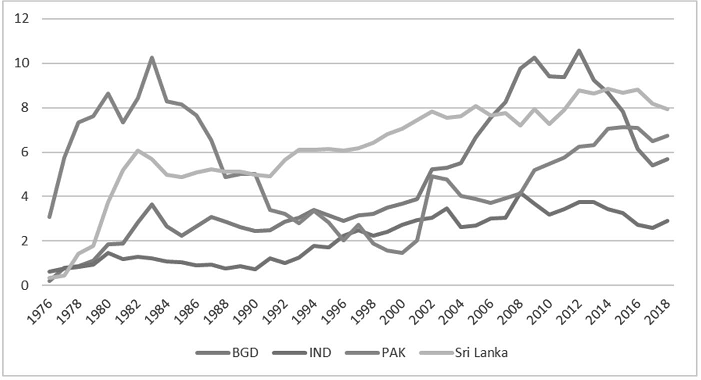
Source: author calculation by using WDI data set
Figure 1 Remittance inflows as a % GDP from 1976-2018
This study is novel in different aspects. First, South Asia is an interesting focus for the study of inequality, not just because it accounts for the bulk of the world’s population but also because of its constituent countries’ variety of experiences concerning inequality and growth. For South Asia, the studies reviewed in this paper show all countries as having had recent experiences of rising inequality (India in the 1990s; Pakistan in the late 1980s; Bangladesh in the first half of the 1990s; Nepal from the mid-1980s to the mid-1990s; and Sri Lanka over the past three decades, according to limited data). Second, the process of stationary is investigated with nonlinear unit root test by following Kruse (2011) and Kapetanios et al. (2003), further nonlinearity is tested by applying nonlinear OLS and BDS test proposed by. third, long-run asymmetry is investigated by following the nonlinear framework proposed by Shin et al. (2014) and directional causality established with asymmetry causality test following proposed framework by Hatemi-j (2012)
Study findings suggest that remittance inflows, trade openness, and the measure of inequality exhibit stationary by following nonlinear processes. Besides, nonlinearity is confirmed by the estimation of nonlinear Ordinary Least Square and BDM tests. Considering the results of NARDL, the standard Wald test results confirm long-run asymmetry between remittance inflows, trade openness, and inequality. Finally, the directional causality output following the asymmetry causality test proposes by Hatemi-j (2012).
The remaining structure of the paper is as follows. Section II exhibits a summary of the relevant literature on the current study. Detail explanation of research variables and econometric methodologies is inserted in Section III. Section IV deals with empirical model estimation and interpretation. Finally, the study ended with a summary finding explaining in Section V.
Relevant literature survey
Nexus between inequality and remittance inflows
The nexus between foreign remittance and inequality is one of the causal relationships immensely attract by the researchers, academicians, and development agencies since the 1980s see, for instance, Adams (1991), Stark et al. (1986). In apparent in the empirical literature that a growing number of empirical studies are conducted in this regard. Taking account of empirical evidence, we observed three lines of findings available.
First, positive effect running from foreign remittance inflows to inequality studies found that migration and remittances increase inequality (e.g.,(Kousar et al., 2019; Bouoiyour and Miftah, 2018; Bouoiyour and Miftah, 2014; Möllers and Meyer, 2014; Lokshin et al., 2010; Adams et al., 2008b; Rodriguez, 1998; Adams Jr, 2006; Barham and Boucher, 1998; Adams, 1991). They argued that remittance inflows in the economy increase recipient groups’ purchasing power, implying that having excess money for consumption in the situation remittance recipients relative change social position compared to the poor and tried to match their consumption with a rich group.
Second thought, foreign remittance assist in reducing inequality in the economy, see for an instance (Acosta et al., 2006; Brown and Jimenez, 2007; Gubert et al., 2010; Margolis et al., 2013; Olowa and Shittu, 2012; MUGHAL and Anwar, 2012; Zhu and Luo, 2010; Pfau and Giang, 2009). Third, the neutral effect running from remittance inflows to inequality, see for instance, e.g. (Beyene, 2014; Yang, 2011; Yang and Martinez, 2006).
Apart from using macro-level data, a group of researchers investigates the impacts of remittance on inequality using household-level data. For example, Howell (2017) performed a study dealing with migrants’ remittance effects on ethnic group income inequality in china. Study results suggested that migrants’ remittance increases income inequality despite reducing spatial inequality. This finding implies that remittance recipients of the ethnic groups enjoy disproportional benefits compared to general people. A similar conclusion also available in Adams et al. (2008b); Barham and Boucher (1998).
Another study performed by Acharya and Leon-Gonzalez (2012) using household survey data in Nepal by applying the pattern of the household consumption function. Study findings established that overall remittance inflows in the economy augment the prevailing situation of inequality.
Nexus between inequality and trade openness
During the mid-1980s, trade liberalization emerged as a catalyst for globalization through technological expertise sharing and transferring across the cross-broader country. During the globalization process, the continual flow of goods, services, and capital expedite economic growth by ensuring efficiency and optimal mobilization in the economy. As a result, the developing economy experiences many opportunities regarding employment generation, financial intermediation, and higher earning possibility. Therefore, in the empirical literature, the role of trade openness considering macroeconomic phenomenon extensively investigated among those impacts on inequality is high. In the study of McCulloch et al. (2001) and Erum et al. (2016); (Bong and Premaratne, 2019), they postulated that trade openness effects could be observed in poverty, but the biggest one appears in inequality which is derived from economic growth. The importance of inequality is explained by Kaldor (1957), who argued that economic growth foster by additional investment in the economy that is rich people save more and assists in capital accumulation in the long run.
Trade openness accelerates the speed of income inequality that is negative association see, for instance (Bucciferro, 2010; Castilho et al., 2012; Bayar and Sezgin, 2017; Milanovic, 2005). The effect of trade openness on inequality is adverse due to several inherent economic attributes such as well-endowed capital,
Another line of empirical studies available in explaining the positive association that is trade openness assists in reducing income inequality in the economy see for instance (Topuz and Dağdemir, 2020; Andersson and Palacio, 2017; Andersson and Palacio Chaverra, 2016) (Yenipazarli and Kucukkaya, 2016; Topuz and Dağdemir, 2020; Khan and Bashir, 2013; Wahiba, 2015; Székely and Sámano, 2012; Vollrath, 2009; Dağdemir, 2008)
(Barro, 2000). Furthermore, A group of researchers concludes with a neutral effect that is there no inclusive evidence running between trade openness and inequality see, for instance (Agusalim and Pohan, 2018; Trabelsi and Liouane, 2013; Dollar and Kraay, 2002; Higgins et al., 1999; Li et al., 1998; Edwards, 1997)
In the study of Jalil (2012). The study findings suggest that when trade openness reaches a certain critical threshold, inequality increases with trade openness; however, when this critical threshold is passed, income inequality decreased, even as trade openness increased. Furthermore, Calderón and Chong (2001) postulated that trade openness increases income inequality in good basic export and reduces income inequality in industrial goods export.
The motivation of the study
Considering empirical literature findings, the nexus between remittance - income inequality and trade openness- income inequality extensively investigated. However, with our best knowledge, nonlinearity is ignored; the study’s motivation is to mitigate the existing research gap by performing nonlinear investigation with several nonlinear tools and techniques available in the empirical literature. Study findings with the nonlinear investigation will create a new avenue for policymakers and researchers as well.
Data and econometric methodology
Annual time series data over the period 1976-2018 were used in empirical investigation. Data were collected from World development indicators of the World Bank (WB), the Federal Reserve Bank of St. Louis (FRED), and the International Financial Statistics of the International Monetary Fund (IMF). As a dependent variable in the empirical estimation, inequality is measured by versatile proxy, however, following Ceesay et al. (2019), Kamila and Baris (2011), Tabassum and Majeed (2008). In the study, we consider life expectancy as one of the potential proxies of the Gini coefficient, which is the measure of inequality. Other than the dependent variable, we have two independent variables: trade openness and remittance inflows.
Methodology
In the study, we perform several econometric techniques of unveiling certain types of information. Investigating variables in the order of integration, we applied both traditional unit root test, namely, ADF: Dickey and Fuller (1979), P-P: Phillips and Perron (1988), and KPSS: Kwiatkowski et al. (1992), assuming linear stationary process and nonlinear unit root tests proposed by Kapetanios et al. (2003) and Kruse (2011). Furthermore, the BrockDechert-Scheinkman-BDS (Broock et al., 1996) nonlinearity test and the nonlinear ordinary least squares (NOLS) estimation techniques were employed for establishing the presence of nonlinear relationship remittance, trade openness, and inequality. The coefficient of nonlinear effects that is positive and negative shocks in remittance and trade openness is estimated by applying nonlinear Autoregressive Distributed Lagged proposes by Shin et al. (2014). And finally asymmetric causal relationship also investigate following asymmetry causality test propose by Hatemi-j (2012).
The Kapetanios-Shin-Snell (2003) test
There is a growing dissatisfaction with the standard linear ARMA framework, which investigators use to test unit roots (Kapetanios et al., 2003). Much of this arises from the fact that a theoretical prediction of stationery in several economic areas is confounded in practice by the persistent failure of the standard Dickey-Fuller (DF) test (Rose, 1988; Taylor et al., 2001). To resolve this issue related to the linear unit root test, Kapetanios-Shin-Snell (2003) introduced an alternative of a nonlinear exponential smooth transition autoregressive (ESTAR) process globally stationary.
Therefore, following Kapetanios et al. (2003); Liu and He (2010); Anoruo and Murthy (2014); and Galadima and Aminu (2020), the paper specifies the ESTAR model as
Where, Yt is the demeaned or detrended time series of interest, β and θ is an unknown parameter, the term
Hence, from equation (1), we test the following hypothesis
And
Obviously, according to Davies (1987), testing the null hypothesis (1) directly is not feasible since β is not identified under the null. Resolving this issue, Kapetanios et al. (2003) suggest applying Luukkonen et al. (1988) and derive at-type test statistic. In addition to the reparameterization of equation (1), obtain a first-order Talyor series approximation to the ESTAR model under the null, and get the auxiliary regression.
This is suggesting that it is easy to get the value of t-statistics for δ = 0, against δ < 1 as,
Where
The Kruse (2011) test
Kapetanios et al. (2003) proposed ESTAR based nonlinear unit root test to assume that the location parameter c in the smooth transition function is equal to zero (see equation 1) for empirical study and became popular among researchers. However, a growing number of studies observed the coefficient of c is significant to see, for example, Michael et al. (1997); Sarantis (1999); Taylor et al. (2001); and Rapach and Wohar (2006). In a study, Kruse (2011) argued that the exclusion of basic assumptions leads to the nonstandard testing problem. Therefore, mitigating location parameter issues, modified test statistics are used by following Abadir and Distaso (2007). Eventually, the following modified ESTAR specification was proposed.
Where εt ~iid (0,σ2). If the smoothness parameter γ approaches zero, the ESTAR model becomes a linear AR (1) model, i.e. Yt = αYt-1 + εt that is stationary if - 2 < α < 0.
Nonlinear OLS. Hence, the modified ADF regress is:
In the equation, the null hypothesis H0:= θ turn out γ1 = γ2 = 0 with the alternative hypothesis of γ1 < 0;γ2 ≠ 0 , where γ2 stems from the fact that the location parameter
‘c’ is allowed to take non-zero values. Therefore, according to Yıldırım (2017), a standard wild test is not appropriate for deriving test statistics, rather Kruse (2011) proposed a modified Wald test by integrating the procedure initiated by Abadir and Distaso (2007), which is widely known as “the Kruse” test in literature. That is
The Hatemi-J (2012) asymmetry causality test
The causality test, according to Hiemstra and Jones (1994), to applying linear assumption possess certain drawbacks that are the incapacity of addressing nonlinear effects from independent variables to the dependent variable. Therefore, following Granger and Yoon (2002) empirical study, the cointegration test was executed using the decomposition of positive and negative shocks for the first time. Furthermore, taking prior nonlinear framework, Hatemi-j (2012) extends their work for investigating causality test and hereafter known as asymmetry causality testing in the empirical literature. The proposed framework referred to as asymmetry in the sense that the proposed framework is capable of detecting both positive and negative shocks effect
Following the pattern, the study decomposition remittance inflows and trade openness into positive and negative shocks and put considerable effort into detecting the effects that are a positive and negative variation of remittance inflows and trade openness on income inequality. It is presumed that positive and negative effects have different impacts on income inequality(Hatemi-j, 2012).
Furthermore, although neglecting the presence of asymmetric causal effects should be prevented, it should be noted that there are many explanations for their prevalence that have yet to be included in the literature. The combined quantities of positive and negative shocks will be used to assess the probability of asymmetry in testing causal variables(Cajueiro et al., 2009). The bootstrap simulation methodology is applied with leverage modification to achieve crucial values that are not vulnerable to non-normality and differing time-varying variance(Qamruzzaman and Karim, 2020b).
To testify the causality between positive and negative shocks in remittance inflows and trade openness on selected south Asian countries’ income inequality. The impact of the cumulative sum of effects can be expressed as follows:
Where,
The underlying motivation to implement the asymmetry causality for gauging the impact of remittances and trade openness. In literature, a general belief available regarding the nexus between income inequality and remittance but the impact of remittances inflows on inequality with asymmetry yet to expose. Furthermore, received remittances allow greater capital accumulation in the society and create income generation opportunities in the economy. Thus, the negative trend in remittances inflows may or may not directly adversely caused by income inequalities.
On the other hand, trade openness expands domestic business with household income acceleration, and the eventual results can be observed in increasing a higher standard level of life. However, in the empirical literature, the impact of the downtrend in trade openness on the macroeconomy does not extensively investigate. Therefore, with this study, the directional effects of trade openness on inequality invested considering asymmetry shocks in trade openness
Empirical model estimation and interpretation
With the investigation of variables order of integration that is a test of stationary by applying widely used conventional unit root test namely the ADP test, P-P test, and KPSS test proposed by Dickey and Fuller (1979), Phillips and Perron (1988), and Kwiatkowski et al. (1992), respectively. The results of the unit root test exhibited in Table 1. Study findings unveiled that either all the researched variables integrated at the level I (0) or after the first difference I (1) but most essentially neither variables exposed for the order of integration after the second difference, which is desirable.
Table 1 Conventional unit root test
| ADF | PP | KPSS | ADF | PP | KPSS | |
| With constant | With constant and trend | |||||
| Bangladesh | ||||||
| IE | -3.322 | -4.319 | 0.803 | 1.127 | -0.597 | 0.201 |
| R | -2.241 | -4.823 | 0.737 | -1.563 | -5.361 | 0.094 |
| TO | -0.728 | -0.682 | 0.701 | -1.622 | -2.536 | 0.118 |
| ∆IE | 0.317 | -3.086 | 0.709 | -4.514 | -3.402 | 0.077 |
| ∆R | -9.739 | -9.24 | 0.427 | -9.887 | -9.623 | 0.135 |
| ∆TO | -3.084 | -7.113 | 0.123 | -2.407 | -7.018 | 0.101 |
| India | ||||||
| IE | -2.176 | -4.52 | 0.812 | 1.307 | -1.204 | 0.21 |
| R | -1.514 | -1.767 | 0.723 | -2.337 | -2.161 | 0.096 |
| TO | -0.665 | -0.736 | 0.756 | -2.061 | -1.652 | 0.102 |
| ∆IE | -0.695 | -2.112 | 0.691 | -2.649 | -2.711 | 0.068 |
| ∆R | -8.148 | -7.966 | 0.153 | -3.071 | -8.03 | 0.074 |
| ∆TO | -5.24 | -5.291 | 0.135 | -5.194 | -5.247 | 0.134 |
| Pakistan | ||||||
| IE | -1.071 | -7.871 | 0.809 | -3.446 | -2.856 | 0.21 |
| R | -2.504 | -1.77 | 0.181 | -1.937 | -1.793 | 0.166 |
| TO | -2.309 | -2.309 | 0.298 | -2.731 | -2.608 | 0.158 |
| ∆IE | -3.525 | -1.125 | 0.727 | -2.522 | -2.151 | 0.13 |
| ∆R | -1.991 | -5.949 | 0.14 | -2.02 | -5.989 | 0.144 |
| ∆TO | -6.955 | -7.015 | 0.203 | -7.051 | -7.85 | 0.165 |
| Srilanka | ||||||
| IE | 0.421 | -0.544 | 0.764 | -3.654 | -1.707 | 0.123 |
| R | -7.062 | -8.011 | 0.667 | -5.736 | -6.233 | 0.149 |
| TO | -1.107 | -1.387 | 0.333 | -1.97 | -2.139 | 0.155 |
| ∆IE | -3.812 | -2.12 | 0.783 | -3.806 | -2.106 | 0.084 |
| ∆R | -4.227 | -4.251 | 0.394 | -2.728 | -5.12 | 0.131 |
| ∆TO | -5.194 | -5.194 | 0.585 | -4.456 | -5.195 | 0.068 |
The nonlinear unit root test result with Kapetanios et al. (2003) is exhibited in Table 2. The tests were conducted using the raw data (Case 1), the demeaned data (Case 2), and the detrended data (Case 3) for the series(Xu et al., 2021; QAMRUZZAMAN et al., 2021). Study findings unveiled the research variables, namely income inequality, remittance, and trade openness, follows the nonlinear process of becoming stationary regardless of the assumption incorporate in the estimation.
Table 2 Results of KSS nonlinear unit root test
| Series | IE | R | TO | |
| Case -1 | Bangladesh | -4.751 | -0.718 | -2.157 |
| India | -2.751 | -3.124 | 0.126 | |
| Pakistan | -6.277 | -3.112 | -6.726 | |
| Srilanka | -6.522 | 3.246 | -2.898 | |
| Case -2 | Bangladesh | -2.517 | -6.774 | -9.654 |
| India | -2.728 | -3.373 | -7.528 | |
| Pakistan | 6.142 | 6.849 | -11.672 | |
| Srilanka | 6.142 | 6.214 | -2.638 | |
| Case - 3 | Bangladesh | -4.517 | -6.782 | -9.124 |
| India | -2.013 | -3.171 | -9.210 | |
| Pakistan | 4.032 | 7.363 | -10.890 | |
| Srilanka | 4.032 | 7.634 | -6.811 | |
| Critical value Kapetanios et al. (2003) | ||||
| level | Case-1 | Case-2 | Case -3 | |
| 1% | -2:82 | −3:48 | −3:93 | |
| 5% | −2:22 | −2:93 | −3:40 | |
| 10% | −1:92 | −2:66 | −3:13 | |
More so, before our discussions in section 3, we did mention that Kapetanios et al. (2003) assumed the test location parameter ‘c’ to be zero (0) while Kruse (2011) has shown that in the real world examples, the possibility of non-zero location parameter is imminent. Hence, he extends the test to allow for a non-zero location parameter. However, as in Kapetanios et al. (2003), the tests were conducted using the raw data, the demeaned data, and the detrended data for the series under investigation.
The results of Kruse (2011) nonlinear unit root test displayed in Table 3. The linear unit root test’s null hypothesis is rejected at either a 1% or 5% level of significance, implying that the series of income inequality, remittance, and trade openness follow nonlinear stationary processes.
Table 3 Results of Kruse nonlinear unit root test
| Series | IE | R | TO | |
| Case -1 | Bangladesh | 24.943*** | 0.921 | 1.634 |
| India | 35.526*** | 8.064 | 10.929* | |
| Pakistan | 12.841*** | 4.575 | 15.115** | |
| Srilanka | 9.874** | 38.126*** | 5.664 | |
| Case -2 | Bangladesh | 14.009*** | 13.064*** | 17.198*** |
| India | 11.267*** | 16.524*** | 9.383 | |
| Pakistan | 5.947 | 3.280 | 13.954** | |
| Srilanka | 15.748*** | 13.046*** | 6.286 | |
| Case - 3 | Bangladesh | 16.952*** | 12.243*** | 16.048** |
| India | 30.948*** | 5.748 | 7.150 | |
| Pakistan | 11.287*** | 3.780 | 3.101 | |
| Srilanka | 14.214*** | 11.332*** | 5.807 | |
| Asymptotic Critical Values of t-statistic | ||||
| Case -1 | Case -2 | Case -3 | ||
| 1% | 13.15 | 13.15 | 17.10 | |
| 5% | 9.53 | 9.53 | 12.82 | |
| 10% | 7.85 | 7.85 | 11.10 | |
Notes: The critical values are from Kruse (2011). A denotes the optimal lag length selected by the SBC. The estimation and tests were conducted using a program code written in “R” produced by Kruse. ***, ** and * denote the rejection of the null of a unit root at the 1, 5, and 10% significance level, respectively Nonlinearity test
The following two estimations are dealing with the investigation of the presence of nonlinearity in the empirical model. Considering the results of the BDS test proposed by Brock et al. (1987). The null hypothesis, irrespective of dimension, is rejected at a level of 1% level of significance, see panel A of Table 4 Suggests a nonlinear relationship between remittance, trade openness, and inequality, and this conclusion is true for all sample countries.Furthermore, the assessment of nonlinearity is also investigated through the application of nonlinear-OLS. Panel -B of Table 4 exhibits the nonlinear OLS results, the nonlinear ordinary least squares estimates of following a polynomial function of degree 4, which was found to be the most economical model using the information criteria. The null hypothesis of linearity in the empirical model is rejected at a 1% level of significance, which implies that the relationship between remittance, trade openness and inequality follows a linear trend.
Table 4 Results of Brock-Dechert-Scheinkma (BDS) and NOLS
| Panel -A: BDS statistics for nonlinearity | ||||||||||||
| Bangladesh | India | Pakistan | Srilanka | |||||||||
| Dimension | BDS Stat | Std. Error | z-Stat | BDS Stat | Std. Error | z-Stat | BDS Stat | Std. Error | z-Stat | BDS Stat | Std. Error | z-Stat |
| 2 | 0.080*** | 0.007 | 10.218 | 0.003 | 0.010 | 0.351 | 0.018 | 0.009 | 1.958 | 0.043 | 0.009 | 4.377 |
| 3 | 0.141 | 0.012 | 11.169 | 0.017 | 0.017 | 1.028 | 0.040 | 0.015 | 2.613 | 0.052 | 0.015 | 3.315 |
| 4 | 0.188 | 0.015 | 12.394 | 0.010 | 0.021 | 0.491 | 0.039 | 0.018 | 2.095 | 0.056 | 0.019 | 2.887 |
| 5 | 0.212 | 0.016 | 13.223 | 0.028 | 0.022 | 1.264 | 0.040 | 0.019 | 2.053 | 0.049 | 0.020 | 2.382 |
| 6 | 0.217 | 0.015 | 13.842 | 0.029 | 0.022 | 1.331 | 0.036 | 0.019 | 1.859 | 0.041 | 0.020 | 2.016 |
| Panel -B: Nonlinear OLS test | ||||||||||||
| Bangladesh | India | Pakistan | Srilanka | |||||||||
| Variable | Coeff | t-Stat | Coeff | t-Stat | Coeff | t-Stat | Coeff | t-Stat | ||||
| R | 0.147*** | 3.159 | -0.028*** | -0.104 | -0.074** | -0.201 | 0.147** | 3.159 | ||||
| TO | -0.021** | -0.398 | 0.080*** | 1.562 | -0.274** | -2.745 | -0.021*** | -0.398 | ||||
| R^2 | 0.0173** | 0.666 | 0.031*** | 1.255 | 0.068** | 0.198 | 0.017*** | 0.666 | ||||
| R^3 | -0.076** | -2.180 | -0.012*** | -0.042 | -0.037** | -0.786 | -0.076** | -2.180 | ||||
| R^4 | 0.032*** | 0.635 | -0.073*** | -0.244 | 0.063** | 0.130 | 0.032*** | 0.635 | ||||
| TO^2 | 0.037*** | 0.631 | 0.053*** | 0.956 | 0.011*** | 0.097 | 0.032** | 0.631 | ||||
| TO^3 | -0.029*** | -0.388 | 0.011** | 0.153 | 0.030*** | 0.230 | -0.029*** | -0.388 | ||||
| TO^4 | -0.067** | -0.848 | -0.019*** | -0.242 | -0.063*** | -0.051 | -0.067*** | -0.848 | ||||
| C | 4.4063*** | 40.866 | 3.697*** | 9.250 | 5.014*** | 10.202 | 4.406** | 40.86 | ||||
| R-squared | 0.936 | 0.928 | 0.746 | 0.794 | ||||||||
| Adjusted R-sq | 0.928 | 0.909 | 0.722 | 0.739 | ||||||||
| Wald test | 6.597*** | 7.759*** | 7.452*** | 2.679** | ||||||||
| 5.130*** | 11.188*** | 0.032 | 0.752 | |||||||||
Note: ***/**/* denotes the level of significance at a1%,5%, and 10%, respectively
The next estimation involves investigating long-run association with autoregressive distributed lagged, hereafter ARDL, proposed by Pesaran et al. (2001). The general form of the ARDL empirical model display in equation (11) and the results of the ARDL are exhibited in Table 5
Table 5 ARDL cointegration tests
| Bangladesh | India | Pakistan | Srilanka | |
| Panel-A: Bound Test | ||||
| F-stat | 36.711*** | 8.917*** | 19.894*** | 5.312** |
| tBDM | -11.84*** | -6.397*** | -13.364*** | -4.789** |
| Panel-B: Long-run and short-run coefficients | ||||
| LnR | -0.088*** | -0.0391*** | -0.023** | -0.048*** |
| lnTO | -0.224*** | 0.127*** | 0.039*** | -0.253*** |
| ∆lnR | -0.029** | 0.108*** | 0.984*** | 0.212*** |
| ∆lnTO | 0.058** | 0.096** | 0.067*** | 0.117*** |
| ECT(-1) | -0.217** | -0.272*** | -0.594*** | -0.372*** |
| Panel -C: Residual diagnostic test | ||||
| Auto | 0.541 | 0.394 | 1.064 | 0.415 |
| Het | 0.551 | 1.297 | 0.617 | 0.667 |
| normality | 0.345 | 1.587 | 0.794 | 0.774 |
| Ramsey RESET Test | 0.664 | 0.448 | 0.881 | 0.807 |
Note: ***/**/* denotes the level of significance at a1%,5%, and 10%, respectively
Referring to the results of bound testing reported in Panel -A, it is obvious that there is a long-run relationship between remittance inflows, trade openness, and inequality. This conclusion is valid for each of the simple countries. The long-term and short-term magnitudes are reported in Panel -B. referring to the error correction term’s coefficient, it is stated that there is a long-run association between remittance, trade openness, and inequality. According to long-run magnitude, it is observed that a negative effect running from remittance inflows to inequality in Bangladesh (a coefficient of -0.488), in India (a coefficient of -0.039), in Pakistan (a coefficient of -0.0233), and Srilanka (a coefficient of -0.048), respectively. On the other hand, trade openness exhibited mixed-effects running towards inequality more precisely, the negative effect observed in Bangladesh (a coefficient of -0.224) and Srilanka (a coefficient of 0.253) and positive effect available in India (a coefficient of 0.127) and Pakistan (a coefficient of 0.039).
In the following section, we move to investigate the possible nonlinearity between remittance, trade openness, and income inequality by applying the nonlinear framework proposed by Shin et al. (2014). NARDL, according to Qamruzzaman et al. (2019), Qamruzzaman and Wei (2019), is a new technique that allows asymmetric modelling effects both in the long-run and the short-run by exploiting partial sum decompositions of the explanatory variables. The generalized form of the nonlinear empirical model as follows;
Where,
The lon g-run elasticity can be computed through, for
Table 6 NARDL cointegration test, long-term and short-term coefficients
| Bangladesh | India | Pakistan | Srilanka | |
| Panel -A | ||||
| FPASS | 36.421*** | 9.793*** | 33.522*** | 50.490*** |
| Wpass | 13.287*** | 18.974*** | 19.889*** | 35.841*** |
| tBDM | -16.021*** | -7.642*** | -37.681*** | -6.313*** |
| Panel-B: Long-run and short-run coefficients | ||||
|
|
-0.129*** | -0.126** | -0.119** | -0.152*** |
|
|
0.018*** | -0.052** | 0.106*** | -0.035*** |
|
|
-0.091*** | -0.081*** | -0.082*** | -0.027*** |
|
|
0.045** | 0.018** | 0.144** | 0.015** |
| ECT(-1) | -0.491*** | -0.394*** | -0.574*** | -0.714*** |
|
|
9.193*** | 17.927 | 3.517*** | 4.496*** |
|
|
6.191*** | 7.214 | 12.371*** | 8.791*** |
| Panel -C: Residual diagnostic test | ||||
|
|
0.441 | 0.794 | 0.164 | 0.415 |
|
|
0.481 | 0.297 | 0.517 | 0.567 |
|
|
0.195 | 0.287 | 0.694 | 0.754 |
| Ramsey RESET Test | 0.564 | 0.548 | 0.251 | 0.473 |
Note: ***/**/* denotes the level of significance at a1%,5%, and 10%, respectively.
Considering the results reported in Table 6, Panel-A. It is observed that the null hypothesis of long-run symmetry is rejected at a 1% level of significance. These findings suggest that the relationship between remittance, trade openness and inequality follows a nonlinear process in the long term.
Results reported in Panel B dealing with long-run magnitudes rennin from positive and negative shocks in remittance and trade openness to inequality. Considering positive shocks in remittance, a negative linkage with inequality, like a coefficient of -0.129 for Bangladesh, a coefficient of -0.126 for India, a coefficient of -0.119 for Pakistan, and a coefficient of -0.152 in Srilanka, respectively. Study findings suggest that the further inflows of remittance assist in reducing inequality in the economy. Besides, the results of negative shock in remittance exhibit positive linkage for Bangladesh (a coefficient of 0.018) and Pakistan (a coefficient of 0.106) and negative association in India (a coefficient of -0.126) and Srilanka (a coefficient of -0.035).
Referring to the output of positive and negative shocks in trade openness, it is palpable that Positive shocks are negatively associated with Bangladesh (a coefficient of -0.091), India (a coefficient of -0.081), Pakistan (a coefficient of -0.082), and Srilanka (a coefficient of -0.027). Findings suggest that the expansion of domestic trade across the national boundary will act as a mitigating factor in reducing the inequality gap in the economy.
Furthermore, given a negative shock in trade openness positively associated with inequality, specifically contraction in international business, will augment the inequality situation in Bangladesh (a coefficient of 0.045), in India (a coefficient of 0.018), in Pakistan (a coefficient of 0.144), and Srilanka (a coefficient of 0.015), respectively. The short-run association was established with the error correction term (ECT) coefficient, which is negative statistically significant.
Considering the results of several residual diagnostic tests (see panel C), namely, autocorrelation, Heteroskedasticity Test, normality, and stability test, confirm the empirical model estimation reliability and stability, which applies to all four empirical models. Furthermore, the CUSUM and CUSUM square test results also produce a similar validity to align with the prior four residual test results(Qamruzzaman and Karim, 2020a).The results of the asymmetry causality test exhibited in Table 7, where the impact of independent variables (i.e., positive and negative shock in remittance inflows and trade openness) on the dependent variable (inequality).
Table 7 Hatemi-J asymmetric causality test
| Null hypothesis | Bangladesh | India | Pakistan | Srilanka |
| R- ≠→ R+ | 1.916(0.162) | 2.241(0.121) | 4.169**(0.023) | 3.535**(0.0390 |
| R+ ≠→ R- | 3.194**(0.043) | 1.325(0.027)** | 1.294(0.286) | 2.003(0.151) |
| IE ≠→ R+ | 9.481***(0.000) | 12.74***(0.000) | 1.787(0.182) | 9.549***(0.000) |
| R+ ≠→ IE | 23.135***(0.000) | 3.665**(0.036) | 4.588**(0.010) | 1.733(0.191) |
| IE ≠→ R- | 1.840(0.174) | 2.333(0.112) | 2.661*(0.084) | 5.756***(0.000) |
| R- ≠→ IE | 8.643***(0.000) | 6.226***(0.005) | 4.309**(0.021) | 11.589***(0.000) |
| IE ≠→ TO+ | 2.643*(0.085) | 4.213*(0.023) | 2.025(0.147) | 0.186(0.830) |
| TO+ ≠→ IE | 6.732**(0.003) | 9.156***(0.000) | 14.648***(0.000) | 8.111***(0.001) |
| IE ≠→ TO- | 5.174**(0.010) | 1.562(0.224) | 1.436(0.251) | 5.771***(0.007) |
| TO- ≠→ IE | 11.953***(0.000) | 2.261(0.119) | 0.131(0.877) | 7.356***(0.002) |
Note: ***/**/* denotes the level of significance at a1%,5%, and 10%, respectively. The value reports in () conforms the associated p-value of each coefficients.
Considering the results of the causality test, we observed several directional causalities available in an empirical model. However, we concentrated on the key nexus, as we are interested in investigating. First, It is observed that the null hypothesis of positive variation in remittance does no cause inequality is rejected at a 1% level of significance. This finding suggests that additional inward remittance can reduce inequality; this conclusion is valid for all selected countries. Second, the null hypothesis of positive change in trade openness does not because inequality is rejected at a 1% level of significance. Finding suggests that trade expansion with internationalization augment consumption and assist in reducing inequality in the economy.
Conclusion
The study’s motivation is to investigate the nature of the relationship between remittance inflows, trade openness, and inequality of south Asian countries for the period 1976-2018. To do so, we performed several nonlinear tests, including the nonlinear unit root test, nonlinearity test, nonlinear autoregressive distributed lagged (NARD), and asymmetric causality test. The summary of the key findings of this study are as follows:
First, the nonlinear unit root test results following Kapetanios et al. (2003) and Kruse (2011) confirmed that remittance, trade openness, and inequality follow the nonlinear process. Furthermore, the nonlinearity investigated through Nonlinear OLS and BDS test was proposed by Brock et al. (1987).
Second, the investigation of long-run asymmetry with a nonlinear framework introduced by shin Shin et al. (2014). Study findings from the standard Wald test ascertain that the movement of remittance, trade openness and inequality is an asymmetry in the long term. Considering the positive and negative shock in remittance, it is observed that positive shock in remittance is negatively linked with inequality. Finding suggests that excess receipt of remittance will decrease inequality by enhancing money flows in the economy, valid for all sample countries. Study findings supported by the existing literature see Adams et al. (2008b); Acharya and Leon-Gonzalez (2012); Beyene (2014); Arapi-Gjini et al. (2020); Aguayo-Téllez et al. (2020).
Anyanwu and Erhijakpor (2010) claimed in their study that inflows of personal remittances encourage the development of small-scale ventures and general self-employment, but that these statistics are not taken into account when estimating unemployment rates. Emerging countries are encouraged to design and enforce proper remittance inflow harnessing strategies to lead to initiatives to minimize unemployment and income disparity. Furthermore, Personal remittances, according to Gubert et al. (2010), have a detrimental effect on income inequalities because they specifically raise household income, boost household members’ health, and will increase their participation in small ventures that may produce more income in the future. Foreign migrant remittances alleviate rural distress by a smaller percentage than domestic remittances, considering their positive impact on inequalities(Adams et al., 2008a). When economies grow increasingly intertwined with foreign labour markets, remittances have a stronger influence on poverty alleviation(Acosta et al., 2008; Anzoategui et al., 2011).
On the other hand, long-run asymmetry is also established between asymmetry shocks in trade openness and inequality. More specifically, the positive shocks in trade openness established a negative tie within inequality, suggesting that domestic trade expansion allows a higher degree of earnings and support to increase living standards. Study findings in the line with Anderson (2005); Wahiba (2015); Ezcurra and Rodríguez-Pose (2014); Arabiyat et al. (2020). Trade openness decreases wealth inequality because it increases local firms’ capacity to contribute to economic development by enabling them to perform successfully globally (Balassa, 1978). As a part of this situation, local employers are willing to generate more employment for local citizens, ultimately reducing wage disparities(Aigheyisi, 2020). Income disparities may be minimized by promoting sustainable economic development, which supports the whole population. Aside from that, the fair exchange should be applied in which economic agents form equal relationships based on the soul and spirit (cooperation) as the reference in trading laws(Agusalim and Pohan, 2018).
Third, directional causality with asymmetric causality test following Hatemi-j (2012). Study findings established bidirectional causality available in Bangladesh for [IE (( R+; IE TO+; IE (( TO-], in India for [IE R+; IE (( TO+], in Pakistan for [IE (( R- ] and in Srilanka for [IE (( R-; IE (( TO-]. Furthermore, a number of unidirectional causality also available that is, in Bangladesh [R- (( IE], in India [R- ( IE], in Pakistan [R+ ( IE; TO+ ( IE] and in Srilanka [IE ( R+; TO+ ( IE], respectively. Growing trading liberalization is correlated with the increased economic disparity in the BRIC nations. This can be due to various variables, including how big a factor endowment the relative factor holder has and how much security the dominant structure had before the market was liberalized, as mentioned in the previous segment(Mahesh, 2016). Analysis on the topic indicates that there are numerous forms in which trade liberalization and income inequality are related. Trade liberalization can not be ignored as negative merely because it has been related to developing-country economic woes (Khan et al., 2020).
Above all, it is established that there is a nonlinear association between remittance inflows, trade openness, and inequality in the selected South Asian countries, namely Bangladesh, India, Pakistan, and Srilanka. Therefore, it is assumed that empirical investigation with a nonlinear framework might produce more vibrant and robust results and eventually open a new thought an avenue for policy formulation by considering a diverse way of exploration.

