




 texto en
  Inglés (pdf)
 Artículo en XML
 Referencias del artículo
 Traducción automática
 Enviar artículo por email
 Citado por SciELO
  Similares en
SciELO
Similares en
SciELO 
 Permalink

INTRODUCTION
Coral ecosystems of the southern Mexican Pacific (SMP) play a relevant role in the dispersal of organisms and in maintaining the connectivity of systems located in the central and southern portion of the eastern Pacific (Lequeux et al. 2018). Due to their extension and degree of development, the most important systems are in the areas of Ixtapa-Zihuatanejo, in the state of Guerrero, and Huatulco, in the state of Oaxaca (Glynn and Leyte-Morales 1997, López-Pérez et al. 2012). These systems have been the most studied and characterized; however, despite their great importance for regional biodiversity, other surrounding systems have been overlooked and have been scarcely explored or remain unvisited (Glynn and Leyte-Morales 1997, López-Pérez et al. 2012, Granja-Fernández et al. 2023).
In the SMP, few studies exist on the areas around Puerto Ángel and Puerto Escondido in Oaxaca, and the area around Punta Maldonado in Guerrero. However, during surveys carried out in the last century (Palmer 1928, Durham 1947, Durham and Barnard 1952, Geister 1977, Leyte-Morales 1997, Reyes-Bonilla and Leyte-Morales 1998), some coral species were recorded for a few sites in Puerto Escondido (e.g., Puerto Angelito) and Puerto Ángel (e.g., Panteones, La Guacha, and Estacahuite). Conversely, the presence of corals at Punta Maldonado has never been documented. Despite this, the relevance of these 3 areas is such that new species of fossil corals have been found and described, even in surrounding land areas (Palmer 1928, Durham 1947, Gío-Argaez et al. 2019).
Previous studies have provided information on species composition for only a few sites, but these included no data on the substrate characteristics of the coral ecosystems of these 3 areas, except the research by Reyes-Bonilla and Leyte-Morales (1998) at Puerto Ángel. Therefore, this work contributes to the knowledge of these SMP coral systems, as it provides records of coral species for a greater number of sampling sites, documents coral records for Punta Maldonado for the first time, and contributes to the characterization of sites with coral systems in Puerto Escondido and Puerto Ángel. This information is relevant to these scarcely studied areas. Furthermore, these areas are experiencing accelerated and constant anthropogenic and environmental changes associated with coastal development, and they are subject to regional interannual events, such as the El Niño-Southern Oscillation phenomenon, and large-scale processes, such as climate change.
MATERIALS AND METHODS
This study included 3 SMP areas with coral systems: Punta Maldonado (Guerrero), Puerto Escondido (Oaxaca), and Puerto Ángel (Oaxaca) (Fig. 1). Due to environmental conditions, the region is commonly described as a “warm pool” of the Eastern Tropical Pacific (ETP), characterized by warm, low-salinity surface waters that lay above a strong, shallow thermocline (Fiedler and Lavin 2017). The region extends across the tectonic boundary of an active convergent margin characterized by the subduction of the Cocos and the Rivera plates beneath the North American plate (Ramírez-Herrera and Urrutia-Fucugauchi 1999). As a consequence of tectonic activity, the continental shelf is very narrow; however, Punta Maldonado shows an anomalous widening of the platform known as Tartar Shoal, delimited by the Quetzala submarine canyon (Carranza-Edwards et al. 2005).
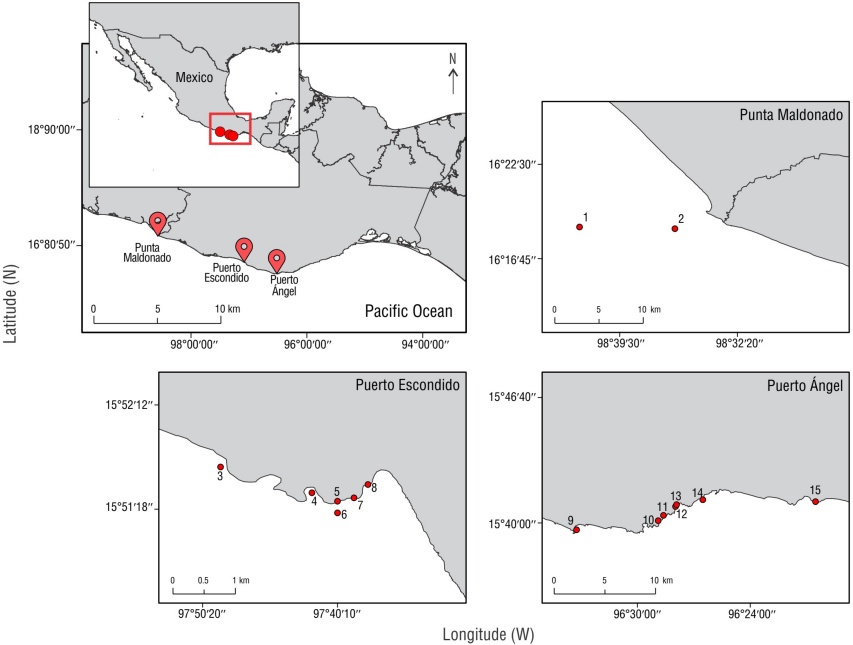
Figure 1 Map of sampling sites in the southern Mexican Pacific (SMP) region. Red markers denote the study areas of Punta Maldonado, Puerto Escondido, and Puerto Ángel. The red dots denote the sampling sites with coral systems: 1 (Las 24), 2 (Altura Baja), 3 (Bachoco), 4 (Carrizalillo), 5 (Puerto Angelito), 6 (El Faro), 7 (Zapatito), 8 (Puerto Escondido), 9 (Mazunte), 10 (Playa del Muerto), 11 (Estacahuite), 12 (La Mina), 13 (Boquilla), 14 (Tijera), and 15 (Salchi).
Between 2009 and 2023, coral ecosystems were surveyed and characterized intermittently using various methods: (1) 20 m intercept point transects (data obtained every 20 cm) to record the type of substrate (i.e., live coral, dead coral, rock, sand, or algae) using scuba diving equipment, (2) visual survey by roving survey dives using scuba diving equipment, and (3) roving navigation using remotely operated underwater vehicle (ROV) (BlueROV2, Blue Robotics, St. Torrence, USA; BLUEROV, Hamburg, Germany; Fifish V6, QYSEA, Shenzhen, China). In each case, the technique and number of sampling units depended on the dimensions and depth of the site and the climatic conditions at the time of the survey, so sampling periods varied between sites. The sampling techniques used at each site are listed in Table 1.
Table 1 Composition of stony corals by site and area in coral systems of the southern Mexican Pacific. The values in the table indicate presence.
| 1c | 2b,c | 3a,* | 4a,b | 5a,b | 6a,b | 7a,b | 8a,b,* | 9a,b | 10a,b | 11a,b | 12a,b | 13a,b | 14a,b | 15a,b | |
| Pavona clavus | 1 | ||||||||||||||
| Pavona gigantea | 1 | 1 | 1 | 1 | 1 | 1 | 1 | 1 | 1 | 1 | |||||
| Pocillopora capitata | 1 | 1 | 1 | 1 | 1 | 1 | 1 | 1 | |||||||
| Pocillopora damicornis | 1 | 1 | 1 | 1 | 1 | 1 | 1 | 1 | |||||||
| Pocillopora effusa | 1 | 1 | 1 | ||||||||||||
| Pocillopora elegans | 1 | ||||||||||||||
| Pocillopora grandis | 1 | 1 | 1 | 1 | 1 | ||||||||||
| Pocillopora meandrina | 1 | 1 | 1 | 1 | |||||||||||
| Pocillopora verrucosa | 1 | 1 | 1 | 1 | 1 | 1 | 1 | 1 | |||||||
| Porites panamensis | 1 | 1 | 1 | 1 | 1 | 1 | 1 | 1 | 1 | 1 | 1 | 1 |
Punta Maldonado: 1 (Las 24), 2 (Altura Baja), 3 (Bachoco), 4 (Carrizalillo), 5 (Puerto Angelito), 6 (El Faro), 7 (Zapatito), 8 (Puerto Escondido), 9 (Mazunte), 10 (Playa del Muerto), 11 (Estacahuite), 12 (La Mina), 13 (Boquilla), 14 (Tijera), and 15 (Salchi).
Sampling technique: a = transect SCUBA; b = roving survey dives SCUBA; c = roving survey ROV.
*No reef-building corals were recorded; only dead coral was recorded.
Substrate types at the sampling sites were graphically explored with a principal coordinate analysis (PCoA) based on a Bray-Curtis similarity matrix constructed with substrate type composition and coverage data; data were transformed using square root to reduce the overrepresentation (dominance) of any type of substrate. The ordination included the vectors of each type of substrate, where the length and direction of the vector indicate the relative importance of each variable in the ordination. Only those variables with a Pearson correlation > 0.7 were included in the ordination (Anderson et al. 2008). Spatial variation of substrate type was assessed using a multiscale model of a nested 2-way permutational multivariate analysis of variance (PERMANOVA) (fixed effect factor: area; random effect factor: sites nested in areas; type III model):
where Y is the response variable, μ is the mean, and εij is the accumulated error. The PERMANOVA was done using data of the composition and coverage of substrate types; the data were transformed using the square root to reduce the relative importance of extreme data and subsequently obtain a Bray-Curtis matrix. Statistical significance of PERMANOVA was determined with 10,000 permutations of residuals under a reduced model and type III sum of squares (Anderson et al. 2008). The PCoA and PERMANOVA were performed using PRIMER 6 and PERMANOVA+ (Anderson et al. 2008).
RESULTS
In total, 15 sites from 3 areas (Punta Maldonado [2 sites], Puerto Escondido [4 sites], and Puerto Ángel [9 sites]) (Table 1) were surveyed. Within these areas, the presence of 10 of stony coral species corresponding to the genera Pavona, Pocillopora, and Porites was recorded. The species Porites panamensis (14 sites), Pavona gigantea (11 sites), and Pocillopora capitata (10 sites) were observed in the greatest number of sites; conversely, Pavona clavus and Pocillopora effusa were recorded at a single site (Table 1).
The colonies recorded during the surveys in the Punta Maldonado area showed the presence of only 2 species of stony corals: P. panamensis and P. gigantea. In the Puerto Escondido area, 5 species were recorded; sites El Faro and Zapatito had the lowest richness (2 species), whereas Puerto Angelito had the highest richness (4 species). Of the 3 study areas, Puerto Ángel had the highest richness of stony corals (10 species). In this area, site La Tijera had the highest richness (10 species), whereas site Puerto Angelito had the lowest richness (4 species).
The Puerto Ángel area had the shallowest coral ecosystems (4-12 m), followed by Puerto Escondido (9.5-20 m), and, finally, Punta Maldonado (12-37 m). The depth range at Punta Maldonado limited substrate evaluation in this area; therefore, only the areas of Puerto Escondido and Puerto Ángel were evaluated. Live coral cover (mean ± SD) was relatively low at sites in the Puerto Escondido area (6.6% ± 8.7, n = 36) compared to those at sites located in the Puerto Ángel area (30.2% ± 21.9, n = 48) (Pseudo-F (1, 82) = 37, P < 0.001). This pattern coincides with what was observed for algal cover (low values in the Puerto Escondido area and high values in the Puerto Ángel area) (Pseudo-F (1,82) = 19.9, P < 0.001). Rock cover showed an inverse behavior (Puerto Escondido: 68.4% ± 18.6; Puerto Ángel: 27.9% ± 35.8; Pseudo-F (1, 82) = 37.9, P < 0.001) (Fig. 2).
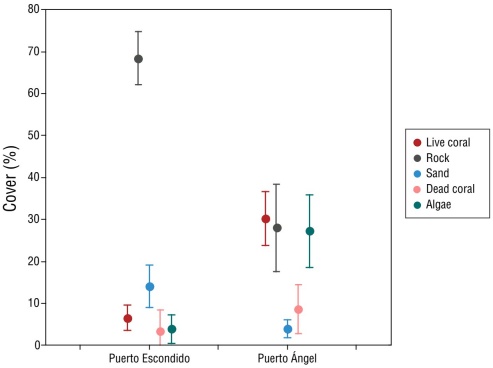
Figure 2 Substrate cover (%) in the study areas of Puerto Escondido and Puerto Ángel in the southern Mexican Pacific (SMP). Data represent the mean ± standard deviation.
The first component of the PCoA ordination (Fig. 3) explained 68.4% of the variation, whereas the second component explained 24%, indicating that almost all of the variation (92.4%) among the sampling sites was explained by the analysis. The ordination showed wide variation between the sites in the Puerto Ángel area compared to sites in the Puerto Escondido area. According to the ordination, sites in the Puerto Escondido area are predominantly rocky reefs, whereas sites in the Puerto Ángel area have an important coral contribution. This is evidenced by the PERMANOVA results, which indicated significant differences between areas (Pseudo-F (1,71) = 12.8, P = 0.0003) and between sites (Pseudo-F (11,71) = 3, P = 0.0002).
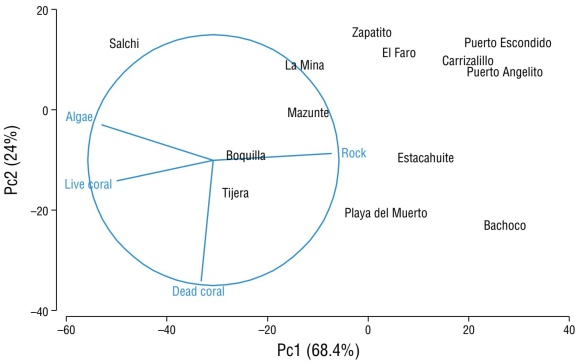
Figure 3 Ordination of the sampling sites in the study areas of Puerto Escondido (Bachoco, Carrizalillo, Puerto Angelito, El Faro, Zapatito, and Puerto Escondido) and Puerto Ángel (Mazunte, Playa del Muerto, Estacahuite, La Mina, Boquilla, Tijera, and Salchi) in the southern Mexican Pacific (SMP), depending on the type of substrate, based on the analysis of principal coordinates. On the right side are the sampling sites of the Puerto Escondido area and on the left side are the sampling sites of the Puerto Ángel area. According to the vectors, to the right side of the arrangement are the sites with significant rock cover, whereas on the left side are the sites with predominant live coral cover. In the lower portion of the ordination are the sites with a relatively high dead coral cover.
DISCUSSION
The results of the present study for the areas of Punta Maldonado, Puerto Escondido, and Puerto Ángel add to previous records of corals and to the characterization of the coral ecosystems of Ixtapa-Zihuatanejo, Acapulco, and Huatulco in SMP (Glynn y Leyte-Morales 1997; Leyte-Morales 1997; Reyes-Bonilla y Leyte-Morales 1998; López-Pérez et al. 2012, 2019). In particular, the survey and evaluation of Punta Maldonado and Puerto Escondido are relevant because they are the first in both areas.
On the continental part, between the entrance of the Gulf of California and Oaxaca, 25 species of zooxanthellate corals have been recorded, of which 17 correspond to the SMP (13 in Guerrero and 16 in Oaxaca) (Reyes-Bonilla et al. 2010, López-Pérez et al. 2012). The results showed that the species composition in the explored areas represents a subsample of the composition previously recorded in the states of Guerrero and Oaxaca. Despite this, the following 7 species that have been previously recorded in the 2 states were not sighted during our surveys: Cycloseris distorta, Gardineroseris planulata, Leptoseris papyracea, Pavona varians, Pocillopora inflata, Porites lobata, and Psammocora stellata (Glynn and Leyte-Morales 1997, Leyte-Morales et al. 2001, Reyes-Bonilla et al. 2005, López-Pérez et al. 2012). Carrying out more detailed surveys in the region will contribute to increasing the number of records of common species, such as P. varians, for which low cover has been observed in some sites in Ixtapa and Huatulco (López-Pérez et al. 2012, 2014). However, future surveys will struggle to increase the records for species rarely observed in the region, such as C. distorta, G. planulata, L. papyracea, P. inflata, P. lobata, and P. stellata; these have low populations and their records are largely restricted to the Gulf of California, the central and southern Mexican Pacific, and Central America (Leyte-Morales et al. 2001, Cortés and Jiménez 2003, Reyes-Bonilla et al. 2005, López-Pérez et al. 2012).
The continental coral ecosystems of the ETP are mainly characterized by the dominance of Pocillopora that typically occurs at shallow depths (0-8 m); however, Pavona and Porites can be found at greater depths (10-30 m) in more exposed areas and with oligotrophic characteristics, such as oceanic islands (Glynn et al. 2017). In the areas of Puerto Escondido and Puerto Ángel, sites with coral were distributed within the bathymetric ranges commonly recorded in the area and the ETP (i.e., <30 m depth) (Pérez-Castro et al. 2022). On the other hand, the shallow coastal strip of Punta Maldonado shows sandy beaches with great wave energy, where corals were detected at unusual depths (34-37 m) for the coastal areas of the Mexican Pacific (Glynn et al. 2017, Pérez-Castro et al. 2022), highlighting the presence of P. gigantea and P. panamensis, as well as the absence of the genus Pocillopora. In terms of depth, these species records at Punta Maldonado exceed the deepest records for the surrounding continental areas (Puerto Ángel) (Pérez-Castro et al. 2023), but add to the records of corals in oceanic sites of the Eastern Pacific (Pérez-Castro et al. 2022).
The presence of P. gigantea and P. panamensis in relatively deep sites in the Punta Maldonado area could be due to the characteristics of the seawater and the presence of specific symbionts. According to the depth and spatial location of the records, the seawater in the Punta Maldonado area could be classified as Type I Turbid Water, for which the upper limit of the mesophotic zone is 15-35 m, whereas the lower limit is 36-60 m (Table 1 in Pérez-Castro et al. 2022). Regarding the type of symbiont, the presence of corals fits the predictions made by Iglesias-Prieto et al. (2004), who indicated that the presence of specific symbionts, adapted to different light regimes, determines the vertical distribution of host corals. Particularly, the presence of P. gigantea could be related to the photo-physiological performance of symbionts adapted to penumbra; that is, P. gigantea “does not like light.”
Another characteristic that draws attention is that, unlike the coral systems of the SMP located near the coastline, those of Punta Maldonado are up to 10 km offshore. This region has an anomalous widening of its continental shelf, known as Tartar Shoal, which promotes a wide extension of shallow waters, where coralline algae and rock fragments predominate (Carranza-Edwards et al. 2005). Therefore, Punta Maldonado is a viable area for the establishment of coral.
Due to the great depth and wide continental shelf of Punta Maldonado, only ROV surveys were possible. The use of this technique resulted in the discovery of a large number of sites with substrates that could host reef-building corals. Nevertheless, further surveys are needed; these could result in records of a greater number of species, including Pocillopora spp., in shallower sites. In addition to the marine area, terrestrial surveying is necessary, since some fossil corals from the Pliocene have been found in the Punta Maldonado Formation (Gío-Argaez et al. 2019). The results of such surveys could help understand and reconstruct the evolutionary history of corals in the region.
Due to their relatively shallow depths, it was possible to use transects to evaluate the Puerto Ángel and Puerto Escondido areas. The differing substrate cover reflects 2 stories in the surveyed area. In the Puerto Escondido area, coral cover (~7%) was consistently low across sites, whereas rock cover was relatively high (~68%). The opposite was observed in the Puerto Ángel area, where coral cover was 5 times higher and rock cover was comparatively low. Compared to the coral ecosystem cover in the areas of Ixtapa-Zihuatanejo (Guerrero) and Huatulco (Oaxaca), the recorded coral cover was substantively lower (Glynn and Leyte-Morales 1997, López-Pérez et al. 2012).
All coral ecosystems in this work are located within the warm water pool of the ETP, so the corals develop under similar environmental characteristics (Fiedler and Lavin 2017). Thus, the differences in the seafloor and the degree of development between coral systems could be related to the geomorphological and oceanographic characteristics of each area or site, such as platform extension, depth, wave intensity and direction, beach orientation with respect to wind direction, and the main currents (Kench and Brander 2006).
Areas, sites, and, consequently, coral systems have historically experienced different types and degrees of anthropogenic disturbance concurrently. For example, while Puerto Escondido and Puerto Ángel were founded in the late 1800s and early 1900s, their population growth has been uneven. Currently, Puerto Escondido is one of the most populated areas on the coast of Oaxaca (INEGI 2020). Associated with this, the deforestation and degradation of forests and jungles have been uneven, although proportional to the population increase (Leija-Loredo et al. 2016). At the same time, oral stories indicate that boats loaded to the gunwale arrived in Acapulco (Guerrero) to sell keepsakes derived from coral in souvenir markets. The demand in souvenir markets for coral keepsakes, associated with the development of the port of Acapulco, exhausted the coral systems surrounding the port. Such practices apparently ended during the late 1980s; nevertheless, the degradation was devastating.
Since then, coral systems at Puerto Escondido have not recovered and there are still patches of dead coral dotted with Pocillopora colonies. There are no records of the extraction of corals for souvenir markets in the Puerto Ángel area. However, the extensive change in land use in the area has the potential to contribute large amounts of terrigenous sediments and nutrients to adjacent coral ecosystems, as has been reported for Huatulco systems (Granja-Fernández and López-Pérez 2008, Leija-Loredo et al. 2016).
CONCLUSIONS
Knowledge of SMP coral ecosystems has focused on studies of areas that are large, easily accessible, and with evident coral cover. However, it is important to maximize efforts to increase information and maintain constant monitoring in regions that are relatively less extensive (Puerto Ángel), remote and difficult to access (Punta Maldonado), or degraded (Puerto Escondido). After the heat wave recorded during 2023, there is strong evidence of massive coral mortality in Huatulco, and reports indicate that mortality in the Ixtapa-Zihuatanejo area was considerable (López-Pérez et al. 2024, Reimer et al. al. 2024). Assuming that the heat wave caused equally severe damage to coral systems in all 3 study areas, the presence of mesoscale corals is currently severely compromised. Not only could millions of coral colonies have been lost, but this loss could severely undermine the current functioning of the coral ecosystems in the region and their future recovery, as these areas could function as sources of larvae and recruits for the connected communities (Lequeux et al. 2018).

