SciELO - Scientific Electronic Library Online

 
vol.50Preengorda del Ostión Americano (Crassostrea virginica) en lagunas costeras tropicales en Yucatán, México: modelación de regresión no lineal y relaciones con variables ambientalesDistribución y actividad potencial de bacterias desnitrificantes aerobias aisladas de sedimentos de una laguna costera al noroeste de México índice de autoresíndice de materiabúsqueda de artículos
Home Pagelista alfabética de revistas  

Servicios Personalizados

Revista

Articulo

Indicadores

Links relacionados

  • No hay artículos similaresSimilares en SciELO

Compartir


Ciencias marinas

versión impresa ISSN 0185-3880

Cienc. mar vol.50  Ensenada ene./dic. 2024  Epub 24-Ene-2025

https://doi.org/10.7773/cm.y2024.3461 

Research articles

Carotenoid content in Ulva lactuca cultivated under aquaculture conditions and collected from intertidal beds in southeastern Brazil: biotechnological implications for biomass use and storage

Alejandra Irina Eismann1 
http://orcid.org/0000-0002-0262-3362

Renata Perpetuo Reis2 
http://orcid.org/0000-0003-4391-5721

Johana Marcela Concha Obando1  3  * 
http://orcid.org/0000-0001-5351-2219

Thalisia Cunha dos Santos3 
http://orcid.org/0000-0002-2043-4805

Diana Negrão Cavalcanti1  3 
http://orcid.org/0000-0001-6013-9889

1Instituto de Biologia, Universidade Federal Fluminense, 24210-201 Rio de Janeiro, Brazil.

2Instituto de Pesquisa do Jardim Botânico de Rio de Janeiro, 22460-030 Rio de Janeiro, Brazil.

3Laboratório de Produtos Naturais de Algas Marinhas (ALGAMAR), Instituto de Biologia, Universidade Federal Fluminense, 24210-201 Rio de Janeiro, Brazil.


Abstract.

Ulva lactuca is an edible green macroalga (Chlorophyta) that can be produced in cultivation systems; it is a natural source of high-value molecules. Ulva lactuca produces metabolites including carotenoids, which are pigments with antioxidant properties that are in high demand in the health and nutraceutical industries and improve the nutritional quality of U. lactuca biomass. We studied the carotenoid and chlorophyll content in U. lactuca thalli collected in 3 different environments in the state of Rio de Janeiro, Brazil: the intertidal beds of the urban beaches of Arpoador and Boa Viagem and a continental integrated multi-trophic aquaculture (IMTA) facility. Carotenoid conservation was evaluated during 1 week, 2 weeks, and 4 weeks of storage. We compared the molecules in fresh U. lactuca collected during the dry season (July 2018) and rainy season (February 2019). The content of carotenoids, such as β-carotene + zeaxanthin, lutein + antheraxanthin, violaxanthin, neoxanthin, and their derivatives (aurochrome and auroxanthin), were analyzed in 100% acetone extracts by ultraviolet visible (UV/vis) spectrophotometry and monitored by thin layer chromatography (TLC) and proton nuclear magnetic resonance (1H-NMR). The extracts of dried U. lactuca produced in the IMTA facility presented higher pigment yields than the dried biomass collected from intertidal beds. Over 4 weeks of storage, carotenoids were well conserved in U. lactuca produced in the IMTA facility, in contrast to what was observed in U. lactuca collected from the intertidal beds, which showed carotenoid losses. In addition, we observed differences in carotenoid content between the dry and rainy seasons in U. lactuca collected from Boa Viagem Beach. However, the U. lactuca collected from Arpoador Beach or produced by the IMTA facility only exhibited significant differences in chlorophyll content. We conclude that U. lactuca produced by the IMTA facility constitutes a potential source of pigments such as β-carotene, lutein, and violaxanthin.

Key words: antioxidant; aquaculture; carotenoids; commercial application; green seaweed; Ulva algae; short-term storage

Resumen.

Ulva lactuca es una macroalga verde comestible (Chlorophyta) que puede ser producida en sistemas de cultivo, la cual es una fuente natural de moléculas de gran valor. Ulva lactuca produce metabolitos, incluyendo carotenoides, que son pigmentos con propiedades antioxidantes muy demandados en las industrias de salud y nutracéuticas, que mejoran la calidad nutricional de U. lactuca. Estudiamos el contenido de carotenoides y clorofilas en talos de U. lactuca recolectados en 3 ambientes del estado de Río de Janeiro, Brasil: en lechos intermareales de las playas urbanas Arpoador y Boa Viagem y en una instalación continental de acuicultura multitrófica integrada (AMTI). La conservación de los carotenoides se evaluó durante 1, 2 y 4 semanas de almacenamiento. Comparamos pigmentos de U. lactuca fresca recolectada en la temporada seca (julio de 2018) y en la de lluvias (febrero de 2019). Los contenidos de carotenoides, como β-caroteno + zeaxantina, luteína + anteraxantina, violaxantina, neoxantina y sus derivados (aurocrómo y auroxantina), fueron analizados en extractos de acetona 100% mediante espectrofotometría ultravioleta-visible (UV/vis) y monitoreados mediante cromatografía en capa fina (CCF) y resonancia magnética nuclear de protón (RMN-¹H). Los extractos de U. lactuca seca proveniente del AMTI presentaron mayores rendimientos de pigmentos que la biomasa seca de los lechos intermareales. Durante las 4 semanas de almacenamiento, los carotenoides fueron conservados en la U. lactuca proveniente del AMTI; la biomasa de U. lactuca de lechos intermareales mostró pérdidas de carotenoides. Observamos diferencias en el contenido de carotenoides entre la temporada seca y la de lluvias en la U. lactuca de la playa de Boa Viagem. Sin embargo, la U. lactuca de la playa de Arpoador o la instalación AMTI exhibió diferencias significativas solo en el contenido de clorofila. Concluimos que la U. lactuca proveniente del AMTI constituye una fuente potencial de pigmentos como β-caroteno, luteína y violaxantina.

Palabras clave: acuicultura; alga verde; alga Ulva; antioxidante; aplicación comercial; carotenoides; conservación a corto plazo

INTRODUCTION

Marine macroalgae are of notable economic importance, serving as staples in human diets, substrates in biofuel production, biostimulants in agriculture, and reservoirs of high-value metabolites (Santos et al. 2023a, 2023b, 2024). Green macroalgae of the genus Ulva (Chlorophyta), formally described by Linnaeus in 1753, encompass a range of edible algae belonging to the Ulvaceae family. Among the most recognized species are the sea lettuces, which are widely distributed along coastlines and commonly observed in rocky intertidal shores in urban areas. Ulva species exhibit short life cycles characterized by high biomass followed by losses in biomass density (Calheiros et al. 2021).

Ulva species show high growth rates and a wide tolerance to abiotic factors (Osuna-Ruiz et al. 2019), which allows them to perform optimally in monocultures, in vitro cultures, and integrated multi-trophic aquaculture (IMTA) (Obando et al. 2022, Pitta et al. 2022). In IMTA, Ulva species are used as biofilters to assimilate dissolved nutrients (C, N, and P) from the effluents of fish and shellfish, consequently reducing water treatment costs and ensuring the production of high-value products (Silva et al. 2015, Nardelli et al. 2019, Oliveira Soares et al. 2022).

Considering the potential for the aquacultural production of Ulva biomass and the quest to develop innovative biotechnological applications to enhance the economic value of these species, several studies have emphasized that Ulva species are natural sources of highly valuable metabolites, including carotenoids (El-Baky et al. 2008, 2009; Chakraborty and Paulraj 2010; Eismann et al. 2020). The most abundant species observed in the state of Rio de Janeiro, Brazil, are the foliaceus Ulva fasciata Delile, Ulva lactuca Linneaus (sea lettuce), and the tubular Ulva flexuosa Wulfen (Calheiros et al. 2021, Carneiro et al. 2022). Recently, U. fasciata was recognized as a variant of U. lactuca (Guiry and Guiry 2024). Notably, in the capital city of Rio de Janeiro, these Ulva species have been cultivated in IMTA startups and sold as gastronomic and functional foods (Reis et al. 2017, Derner 2018, Pitta et al. 2022). Recently, the nutritional quality of Ulva species produced via commercial cultivation systems has been analyzed, confirming the potential of these systems to be environmentally sustainable and profitable income sources (Calheiros et al. 2021, Roleda et al. 2021, Pitta et al. 2022). Although research on the carotenoid content of Ulva species has progressed in Brazil, highlighting the biotechnological potential of these macroalgae (Raymundo et al. 2004, Sousa et al. 2008, Melo et al. 2021), additional studies are needed.

Carotenoids are terpenoids with C40 and conjugated double bonds that are commonly used in foods as natural colorants, antioxidants, and nutritional supplements. In the cosmetic and pharmaceutical industries, carotenoids have been utilized as nutraceuticals and antioxidants (Irwandi et al. 2011, Gateau et al. 2017, Maoka 2020). Carotenoids have photosynthetic and photoprotective properties, and their composition in thylakoid membranes is linked to chlorophylls and other factors that affect photosynthesis (Demmig-Adams and Adams 1996, Demmig-Adams 1998, Esteban et al. 2015). The carotenoids identified in Ulva species are synthesized by the methylerythritol phosphate (MEP) pathway from isoprenyl units in chloroplasts (He et al. 2018). It is worth noting that the following are common carotenoids reported in Ulva species: β-carotene, lutein, violaxanthin, antheraxanthin, zeaxanthin, and neoxanthin (El-Baky et al. 2009, Eismann et al. 2020).

The degradation of pigments, including that of carotenoids, is due to oxidation reactions caused by exposure to oxidant factors, including heat, light, acids, and oxygen. Carotenoid losses in stored dry biomass have created a bottleneck in the commercialization of Ulva species (Goldman et al. 1983, Woodall et al. 1997, Pérez-Galvez and Mínguez-Mosquera 2001). Carotenoid conservation in macroalgae biomass depends on different factors and varies among organisms; microalgae and vegetables can conserve carotenoids for periods of time ranging from 10 days to 3 months (Sugumaran et al. 2022). For instance, Nannochloropsis salina was successfully stored at 3 temperatures (5 °C, 20 °C, or 40 °C) for up to 8 weeks (Safafar et al. 2017), while Spinacia oleracea L. samples were stored in polypropylene bags at 2 °C or 10 °C (Bergquist et al. 2006). Furthermore, the effects of storage time (14 days or 35 days), storage conditions (vacuum-packed or non-vacuum packed), storage temperature (-20 °C, 4 °C, or 20 °C), and preservation method (spray-drying or freeze-drying) on the stability of lipids and carotenoids in fresh microalgal paste of Phaeodactylum tricornutum have been analyzed (Ryckebosch et al. 2011). Although different drying methods affect the chemical profiles of Ulva species (Uribe et al. 2018), it is not known how these methods affect carotenoid conservation.

Previous studies of Ulva species have evaluated various factors, such as the sustainability of biomass sources, storage, and carotenoid yield, and focused on commercial demand in the food and pharmaceutical sectors. In this study, we analyzed and compared the carotenoid and chlorophyll profiles of U. lactuca collected from intertidal sites and cultivated in an IMTA facility. Our work enhances our understanding of pigments and carotenoids in U. lactuca grown under controlled aquaculture conditions and collected from natural intertidal beds and their responses to storage conditions. Ulva lactuca grown in IMTA systems exhibited higher carotenoid content and better pigment conservation than U. lactuca collected from the intertidal beds, supporting the suitability of IMTA-grown U. lactuca for biotechnological applications.

MATERIALS AND METHODS

Sample collection

The sampling sites were located in Rio de Janeiro, southeastern Brazil. Naturally growing U. lactuca was collected from beds in the rocky intertidal site of Arpoador Beach, (22°59′23.399″ S, 43°11′17.3024″ W) and the estuarine waters of Boa Viagem Beach (22°54′33.79″ S, 43°7′50.4288″ W). Additionally, U. lactuca was collected from the IMTA startup D’Alga Urban Aquaculture. We collected samples of U. lactuca from these locations during dry austral winter (July 2018) and the rainy austral summer (February 2019).

Sample replicates were collected once per season. Collection was carried out on days with tides below 0.4. All collections were performed in the early morning to avoid direct carotenoid degradation due to high light radiation (Cruces et al. 2019). The IMTA-produced U. lactuca was grown with Nile Tilapia (Oreochromis niloticus Linnaeus, 1758) in a closed recirculating seawater system (40,000 L total volume) using a blend of artificial (80%) and natural seawater (20%) collected at Cabo Frio, Rio de Janeiro (22°52′20″ S, 42°0′20″ W).

We cultivated the algal specimens in indoor alga tanks (0.5 m2 and 80 L) covered with ultraviolet (UV) filters. The initial algal densities were ~3 g·L-1. Data loggers (UA-002-08, HOBO Pendant, Onset, Bourne, USA) were used to monitor the water temperature every hour. Ten specimens from each sampling site were used to identify the presence of the Ulva species. Voucher materials of each species were deposited in the Botanical Garden Herbarium in Rio de Janeiro. We used the information from Guiry and Guiry (2024) to determine the taxonomic nomenclature and identify species.

After collection, the algal biomass was transported to the laboratory in a polystyrene box with ice to ensure it was properly preserved. Subsequently, the samples were stored at 4 °C until the next day. The samples were thoroughly rinsed with tap water to remove adhered sediments and other substances. The excess water in the thalli was removed using a lettuce dryer and dried in ambient air with dim light for 20 minutes. Then, 5 ± 0.01 g of thalli were weighed in an analytical balance and stored for subsequent carotenoid conservation analyses or immediately subjected to pigment extraction.

Short-term storage experiments

The U. lactuca thalli from the dry season were used to analyze the conservation of carotenoids. For this experiment, we stored 5 ± 0.01 g of fresh thalli in paper envelopes (in triplicate) for 1 week, 2 weeks, or 4 weeks. The envelopes containing the algal biomass were stored in a dark, ventilated place in the laboratory at ambient temperature. After each storage period, the entire sample inside the paper envelope was submitted for pigment extraction.

Crude extracts of Ulva lactuca for pigment extraction

In their work, Thayer and Björkman (1990) used 5 g of acetone in 5 mL for the extraction of dry and fresh material. The final extraction time was 0-24 h at 4 °C (Thayer and Björkman 1990). The extract was filtered and evaporated in a rotary evaporator using a thermal bath at 40 °C. Finally, the samples were filled with N2, sealed, and stored at -20 °C, as recommended by Lashbroke et al. (2010) for carotenoid conservation of plant extracts.

UV/vis spectrophotometry

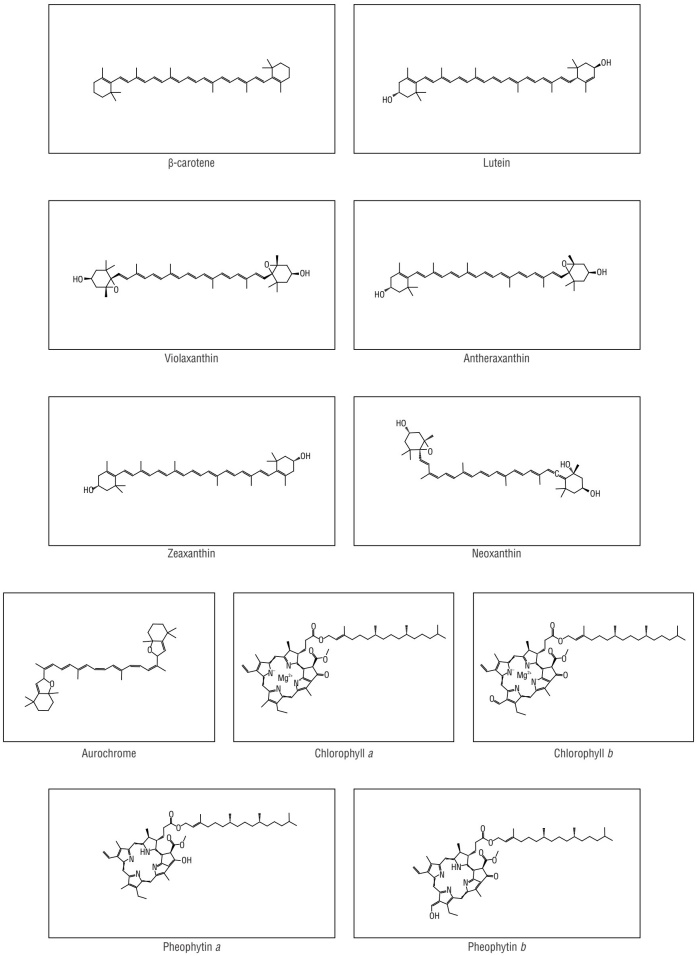
The Gauss-Peak Spectra (GPS) method (Kupper et al. 2007) was used to calculate the carotenoid and chlorophyll content in the crude extracts. In specific terms, solutions of crude extracts in acetone were prepared in a 1:1 ratio (weight:volume). Subsequently, the UV/vis absorption spectra between 350 and 700 nm of the solutions were acquired (1-nm interval) using a UV/vis digital spectrophotometer (Spectramax, Molecular Devices, San Jose, USA) integrated to data acquisition software. The absorbance curves were adjusted between 0.5 and 1 mL by dilution in 100% acetone. To obtain the concentration of carotenoids, chlorophylls, and their degradation products in the solutions, we use the GPS equations programmed in Sigma Plot by Kupper et al. (2007). We quantified the β-carotene + zeaxanthin, lutein + antheraxanthin, violaxanthin, neoxanthin, the β-carotene isomerization product aurochrome, chlorophyll (Chl) a, Chl b, derived pheophytin (Phe) a, and Phe b in 100% acetone solutions (Kupper et al. 2007) (Fig. 1). It is worth noting that the individual concentrations of carotenoid pairs were not separated because they had identical absorption spectra between 350 nm and 700 nm. Finally, the concentration of carotenoids in the extract (C extract ) was calculated using the following equation:

Cextract=CiGPS×dil×Wextract-1 (1)

where dil is the dilution factor, Wextract-1 is the extract weight, and C iGPS is the pigment concentration in the solvent calculated by the GPS method.

Figure 1 Pigment products quantified by ultraviolet visible (UV/vis) spectrophotometry. 

Chemical analysis

Thin layer chromatography (TLC) analyses were performed to evaluate carotenoid conservation using silica gel plates (60 GF254; Merck, Rahway, USA) and an elution solvent of n-hexane:acetone:isopropyl alcohol (69:30:1) (Wright et al. 1997). Each U. lactuca extract (0.5 mg) was spotted on a TLC plate to ensure accurate results. Tentative carotenoid identification was achieved by comparing chromatic profiles and retention factors with the pigment pattern of fresh spinach extract in 100% acetone and information from the literature (Perucka and Oleszek 2000, Rodriguez-Amaya 2001, El-Baky et al. 2008, Mikami and Hosokawa 2013). Additionally, TLC plate adaptation was performed for preparative chromatography. Each extract was chromatographed using 2 different eluent systems (petroleum ether:acetone [7:3] and dichloromethane:ethyl acetate [4:1]). Subsequently, the colored bands were scraped off to isolate compounds with higher spectral purity, which were later confirmed by absorption spectroscopy (350-700 nm) in 100% acetone (Wright et al. 1997). Epoxides were revealed with HCl fume; these structures change color from yellow or orange to blue or green following exposure (Rodriguez-Amaya 2001, Sherma and Fried 2003).

Proton nuclear magnetic resonance (1H-NMR) was used to evaluate carotenoid conservation in the IMTA extracts by comparing the olefinic region of the 1H-NMR spectra (6-7 ppm) according to the quantification methods developed by Valverde and This (2007) and Guadagno et al. (2013). Carotenoid identification was performed using their reported chemical shifts in CDCl3, properly referenced in Putzbach et al. (2005), Sobolev et al. (2005), Valverde and This (2008), and Sivathanu and Palaniswamy (2012). The area below the chemical shifts of the carotenoids was normalized by the tetramethylsilane (TMS) area, according to the methods of Guadagno et al. (2013). The chemical shifts of the solvents, impurities, chlorophylls, and derived molecules (pheophytins and pheophorbide) were discarded from the analyses (Sobolev et al. 2005, Fulmer et al. 2010).

Data analysis

Cochran homogeneity of variance tests were conducted on the data. Parametric data were analyzed using an analysis of variance (ANOVA) and student t-tests. Non-parametric data were evaluated with Kruskal-Wallis or Mann-Whitney tests. All statistical tests were performed in Statistica 7 (StatSoft Inc., Tulsa, USA). Three replicas were used, and the confidence interval for the significance tests was 95% (P = 0.05).

RESULTS

Pigment content in Ulva lactuca fresh biomass

The UV/vis results revealed a higher concentration of carotenoids in fresh U. lactuca thallus extracts during the dry season compared to the rainy season in Arpoador Beach (Fig. 2a). Significant differences were found in β-carotene + zeaxanthin content between the dry and rainy periods at this beach, whereas violaxanthin levels were higher during the rainy period. No significant differences in carotenoid content were observed between the 2 periods in U. lactuca cultivated in the IMTA facility; however, chl a + phe a and chl b + phe b levels were significantly higher during the dry season (Fig. 2b). Ulva lactuca collected from Boa Viagem Beach exhibited a significantly higher carotenoid content during the dry season. Specifically, β-carotene + zeaxanthin and lutein + antheraxanthin were the carotenoids that showed these differences (Fig. 2c). Chlorophyll content was significantly higher in fresh biomass collected from Boa Viagem Beach and the IMTA system during the dry season (Supplementary Material Table S1).
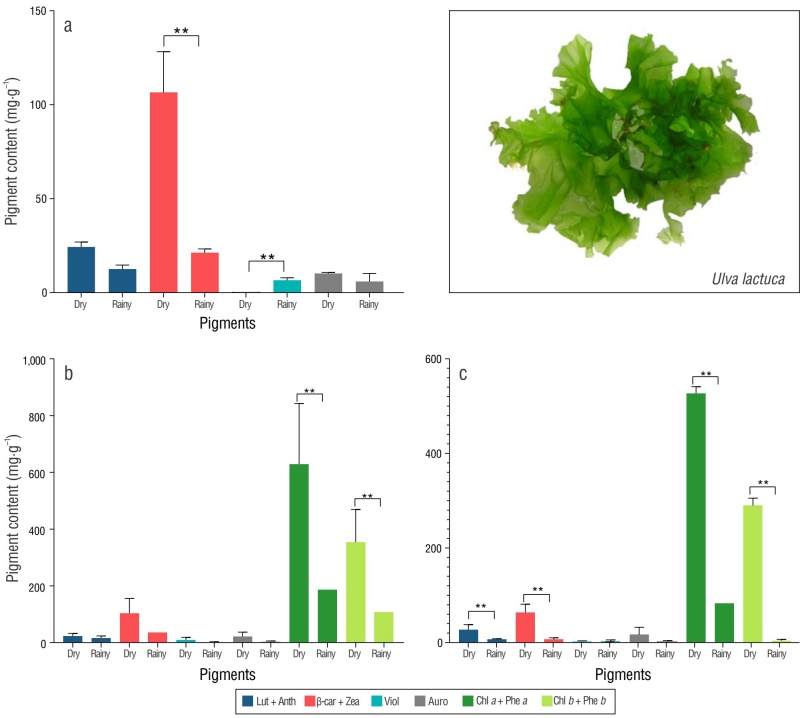
Figure 2 Pigment content (mean ± standard deviation) in Ulva lactuca collected from (a) Arpoador Beach, (b) an integrated multi-trophic aquaculture (IMTA) facility, and (c) Boa Viagem Beach. Pigments: aurochrome (Auro), lutein (Lut) + antheraxanthin (Anth), β-carotene (β-car) + zeaxanthin (Zea), violaxanthin (Viol), chlorophyll (Chl) a + pheophytin (Phe) a, and Chl b + Phe b. *Significant difference (P < 0.05). Pigment content is given per gram of extract. 

Pigments conservation during storage

The extracts of U. lactuca thalli cultivated in the IMTA facility exhibited higher levels of carotenoids, chlorophylls, and their degradation products. It is important to highlight that the data used for comparison were from Boa Viagem Beach and the IMTA system, as these values were higher than those of Arpoador Beach.

Pigment conservation was analyzed in U. lactuca biomass collected from the different sites and stored for 1 week, 2 weeks, or 4 weeks. The UV/vis results showed that carotenoid content in U. lactuca from the IMTA facility was well conserved after 4 weeks of storage. However, U. lactuca collected from Arpoador Beach lost β-carotene + zeaxanthin content during the first week of storage and then lost violaxanthin content in the fourth week of storage (Supplementary Material Table S2). In addition, chlorophylls and derived pheophytins were well conserved in the stored biomass collected from the IMTA facility and Arpoador Beach.

Chemical analyses to monitor pigments during storage

Thin layer chromatography profiles were employed to complement the UV/vis results. A noticeable tendency toward color loss in the β-carotene band in extracts from Arpoador Beach and Boa Viagem Beach after 4 weeks of storage was evident, compared to what was observed after 1 week or 2 weeks of storage. Conversely, the intensity of the β-carotene band in U. lactuca from the IMTA facility was maintained. In comparison, the TLC profile of the fresh IMTA extract exhibited more intense bands and an additional yellow band. The yellow and orange bands in these extracts were tentatively identified as β-carotene, lutein + zeaxanthin, and neoxanthin. The additional band observed in the IMTA extract was tentatively identified as violaxanthin. Dried stored samples were analyzed through 1H-NMR; the olefinic region (6-7 ppm) of the spectra was chosen because it accumulates the hydrogen signals of carotenoids (Sobolev et al. 2005). Carotenoids signals were highlighted in this region to aid analyses.

The carotenoid profile was monitored during storage via olefinic signal patterns observed in 1H-NMR spectra, specifically in the chemical shift region below 6.60-6.64 ppm, which is common to all carotenoids (Sobolev et al. 2005). Algae spectra collected from Boa Viagem Beach and IMTA facility showed effective carotenoid preservation during the initial 2 weeks of storage, with noticeable degradation observed only after 4 weeks. In contrast, the spectra of the samples collected from Arpoador Beach showed a significant decrease in signal intensity between fresh and dried stored algae, indicating a decline in carotenoid content from fresh to dried states, which was likely due to degradation or isomerization during the first week of storage.

DISCUSSION

The U. lactuca collected from the IMTA facility presented significantly higher carotenoid and chlorophyll yields in biomass extracts compared to the samples collected from the intertidal beds, indicating that photosynthetic pigments were promoted. The IMTA facility, unlike the natural beds, was not subject to precipitation, desiccation, winds, grazers, or UV radiation; variables, such as salinity and pH, were controlled in the IMTA facility. Thus, nutrient enrichment and a controlled environment may have enhanced the physiology and growth of U. lactuca, preventing oxidation reactions that degrade carotenoids while inducing pigment synthesis (Eismann et al. 2020).

Moreover, U. lactuca grown in the IMTA facility conserved its carotenoid content during 4 weeks of storage, while some carotenoid losses were observed in the stored biomass of U. lactuca collected from intertidal beds. The TLC and 1H-NMR analyses indicated that the pigment profiles of U. lactuca grown in the IMTA facility and collected from the intertidal beds were conserved in extracts stored for 1 week. However, a loss of carotenoids was observed after 2 weeks and 4 weeks of storage in U. lactuca collected from the intertidal beds. This conservation of pigments may be related to the presence of other compounds with antioxidant properties reported in U. lactuca such as tocopherols and tocotrienols (Ortiz et al. 2006), olefins (Ratnayake et al. 2013), sesquiterpenoids, (Chakraborty and Paulraj 2010), and ulvan (Alves et al. 2013). Pigment production and carotenoid coproduction are interesting topics to explore in future research due to the biotechnological potential of these molecules, which have garnered interest across various industrial sectors, including the food, pharmaceutical, cosmeceutical, and nutraceutical industries.

Overall, the U. lactuca extracts were rich in chlorophylls, β-carotene + zeaxanthin, and lutein + antheraxanthin. The content of violaxanthin in IMTA extracts may be associated with a lower oxidation state of the thylakoid membranes (Zhang et al. 2015), as well as higher overall pigment synthesis. The current carotenoid market is predominantly led by β-carotene and lutein, as these essential pigments are utilized in animal feed and dietary supplements. Thus, the abundant presence of violaxanthin in U. lactuca collected from the IMTA facility is particularly promising. This compound swiftly transforms into zeaxanthin through the xanthophyll cycle (Zhang et al. 2015), and the antioxidant properties of zeaxanthin have been well documented (Sajilata et al. 2008, Esteban et al. 2014, Meléndez-Martinez et al. 2022). Thus, IMTA systems could emerge as novel and sustainable sources of zeaxanthin.

The significant differences in the yields of carotenoids and chlorophylls in the fresh biomass of U. lactuca collected during the rainy and dry seasons may be associated with the macroalgae being affected by a wide range of biotic and abiotic conditions (e.g., temperature, hydrodynamics, desiccation, and biological interactions), which directly influence growth and pigment content (Fort et al. 2019, Jiang et al. 2019, Calheiros et al. 2021). On the other hand, the yields of U. lactuca collected from the IMTA facility reflected less variation in growth conditions; the few differences recorded between seasons were associated with photosynthetically active radiation (PAR) and water temperature.

Both PAR and temperature were higher in the rainy season, coinciding with the lower production of carotenoids and chlorophylls that we observed in this work (Narrain et al. 2023). Some studies have identified a negative correlation between photosynthetic pigments and solar radiation in Ulva rotundata (Henley et al. 1989) and in Ulva species collected from natural beds (Figueroa et al. 2003). It is important to highlight that high acclimation to PAR involves a decrease in photosynthetic pigments as a response to the relocation of thylakoid membranes and antenna complexes (Esteban et al. 2015).

Our results indicate that U. lactuca cultivated in the IMTA facility showed higher levels of carotenoids and better preservation than U. lactuca collected from intertidal beds. The algae collected in natural beds showed greater variability and complexity, which may be attributed to the influence of various environmental factors, such as tidal variations, PAR radiation, and periods of desiccation. Further sampling efforts and environmental analyses are necessary to provide conclusive evidence of metabolite production and storage in U. lactuca collected from natural environments.

CONCLUSIONS

The analyses conducted in this study have revealed that cultivation systems, such as IMTA, represent an excellent option to control environmental factors, which allows for macroalgae biomass and pigments to be produced with the specific qualities required for biotechnological applications. It is noteworthy that U. lactuca grown in the IMTA system demonstrated higher carotenoid content and superior pigment conservation over 4 weeks of storage compared to biomass collected from intertidal sites. Additionally, the fresh biomass extracts exhibited lower pigment content during the rainy season, which correlated with increased PAR radiation and water temperature. Cultivation systems for U. lactuca represent a promising and sustainable source of carotenoids, including β-carotene, lutein, and violaxanthin. These systems can also be optimized to produce zeaxanthin, which exhibits high nutritional value and antioxidant capacity, for biotechnological and industrial applications.

DECLARATIONS Acknowledgments

The authors thank Dr. Elisabete Barbarino and the Microalgae Culture Laboratory of the Federal Fluminense University for technical support and observations regarding the preservation of extracts, Dr. Roberto Martins from the Federal University of Rio de Janeiro for technical support in carotenoids analyses and valuable observations in carotenoids chemistry, the staff of the Laboratory of the Multiple Users Laboratory (LabReMN) of the Federal Fluminense University for the 1H-NMR spectroscopy analyses, the Rio de Janeiro Botanical Garden Institute for the logistical support, and the staff of the herbarium and the laboratory network for providing technical support. We also thank d’Alga Urban Aquiculture for providing specimens for carotenoid analyses and abiotic IMTA data.

REFERENCES

Alves A, Sousa RA, Reis RL. 2013. A practical perspective on ulvan extracted from green algae. J Appl Phycol. 25:407-424. https://doi.org/10.1007/s10811-012-9875-4 [ Links ]

Bergquist SÅ, Gertsson UE, Olsson UE. 2006. Influence of growth stage and postharvest storage on ascorbic acid and carotenoid content and visual quality of baby spinach (Spinacia oleracea L.). J Sci Food Agric. 86:346-355. https://doi.org/10.1002/jsfa.2373 [ Links ]

Calheiros AC, Sales LPM, Pereira Netto AD, Cavalcanti DN, Castelar B, Reis RP. 2021. Commercial raw materials from algaculture and natural stocks of Ulva spp. J Appl Phycol. 33:1805-1818. https://doi.org/10.1007/s10811-021-02413-3 [ Links ]

Carneiro MER, Marques AN, Pereira RC, Cabral MM, Teixeira VL. 2022. Estudos populacionais de Ulva fasciata Delile, indicadora de poluição na Baía da Guanabara. Rev Nerítica. 2:201-211. [ Links ]

Chakraborty K, Paulraj R. 2010. Sesquiterpenoids with free-radical-scavenging properties from marine macroalga Ulva fasciata Delile. Food Chem. 122:31-41. https://doi.org/10.1016/j.foodchem.2010.02.012 [ Links ]

Cruces E, Rautenberger R, Cubillos VM, Ramírez‐Kushel E, Rojas‐Lillo Y, Lara C, Montory JA, Gómez I. 2019. Interaction of photoprotective and acclimation mechanisms in Ulva rigida (Chlorophyta) in response to diurnal changes in solar radiation in southern Chile. J Phycol. 55:1011-1027. https://doi.org/10.1111/jpy.12894 [ Links ]

Demmig-Adams B. 1998. Survey of thermal energy dissipation and pigment composition in sun and shade leaves. Plant Cell Physiol. 39:474-482. https://doi.org/10.1093/oxfordjournals.pcp.a029394 [ Links ]

Demmig-Adams B, Adams WW. 1996. The role of xanthophyll cycle carotenoids in the protection of photosynthesis. Trends Plant Sci. 1:21-26. https://doi.org/10.1016/S1360-1385(96)80019-7 [ Links ]

Derner RB. 2018. Cultivo de macroalgas no Brasil: Potencial desperdiçado. Aquacult Brasil. 12:54-55. [ Links ]

Eismann AI, Reis RP, da Silva AF, Cavalcanti DN. 2020. Ulva spp. carotenoids: Responses to environmental conditions. Algal Res. 48:101916. https://doi.org/10.1016/j.algal.2020.101916 [ Links ]

El-Baky HHA, El Baz FK, El-Baroty GS. 2008. Evaluation of marine alga Ulva lactuca L. as a source of natural preservative ingredient. Am Eurasian J Agric Environ Sci. 3(3):434-444. https://idosi.org/aejaes/jaes3(3)/21.pdfLinks ]

El-Baky HHA, El Baz FK, El-Baroty GS. 2009. Natural preservative ingredient from marine alga Ulva lactuca L. Int J Food Sci Technol. 44:1688-1695. https://doi.org/10.1111/j.1365-2621.2009.01926.x [ Links ]

Esteban R, Barrutia O, Artetxe U, Fernández-Marín B, Hernández A, García-Plazaola JI. 2015. Internal and external factors affecting photosynthetic pigment composition in plants: a meta-analytical approach. New Phytol. 206:268-280. https://doi.org/10.1111/nph.13186 [ Links ]

Esteban R, Fleta-Soriano E, Buezo J, Míguez F, Becerril JC, García-Plazaola JI. 2014. Enhancement of zeaxanthin in two-steps by environmental stress induction in rocket and spinach. Food Res Int. 65:207-214. https://doi.org/10.1016/j.foodres.2014.05.044 [ Links ]

Figueroa FL, Nygård C, Ekelund N, Gómez I. 2003. Photobiological characteristics and photosynthetic UV responses in two Ulva species (Chlorophyta) from southern Spain. J Photochem Photobiol Biol. 72:35-44. https://doi.org/10.1016/j.jphotobiol.2003.09.002 [ Links ]

Fort A, Lebrault M, Allaire M, Esteves-Ferreira AA, McHale M, Lopez F, Fariñas-Franco JM, Alseekh S, Fernie AR, Sulpice R. 2019. Extensive variations in diurnal growth patterns and metabolism among Ulva spp. strains. Plant Physiol. 180:109-123. https://doi.org/10.1104/pp.18.01513 [ Links ]

Fulmer GR, Miller AJ, Sherden NH, Gottlieb HE, Nudelman A, Stoltz BM, Goldberg KI. 2010. NMR chemical shifts of trace impurities: common laboratory solvents, organics, and gasses in deuterated solvents relevant to the organometallic chemist. Organometallics. 29:2176-2179. https://doi.org/10.1021/om100106e [ Links ]

Gateau H, Solymosi K, Marchan J, Schoefs B. 2017. Carotenoids of microalgae used in food industry and medicine. Mini-Rev Med Chem. 17:1140-1172. https://doi.org/10.2174/1389557516666160808123841 [ Links ]

Goldman M, Horev B, Saguy I. 1983. Decolorization of β‐carotene in model systems simulating dehydrated foods: Mechanism and kinetic principles. J Food Sci. 48:751-754. https://doi.org/10.1111/j.1365-2621.1983.tb14890.x [ Links ]

Guadagno CR, Della Greca M, de Santo AV, Ambrosio ND. 2013. NMR (1H) analyses of crude extracts detects light stress in Beta vulgaris and Spinacia oleracea leaves. Photosyn Res. 115:115-122. https://doi.org/10.1007/s11120-013-9833-2 [ Links ]

Guiry MD, Guiry GM. 2024. AlgaeBase World-Wide Electronic Publication: National University of Ireland; [accessed 2024 May 24]. http://www.algaebase.orgLinks ]

He Y, Ma Y, Du Y, Shen S. 2018. Differential gene expression for carotenoid biosynthesis in a green alga Ulva prolifera based on transcriptome analyses. BMC Genomics. 19(1):1-14. https://doi.org/10.1186/s12864-018-5337-y [ Links ]

Henley WJ, Ramus R. 1989. Optimization of pigment content and the limits of photoacclimation for Ulva rotundata (Chlorophyta). Mar Biol. 103:267-274. https://doi.org/10.1007/BF00543357 [ Links ]

Irwandi J, Noviendri D, Hasrini RS, Octavianti F. 2011. Carotenoids: sources, medicinal properties and their application in food and nutraceutical industry. J Med Plants Res. 5:7119-7131. http://doi.org/10.5897/JMPRx11.011 [ Links ]

Jiang H, Gong J, Lou W, Zou D. 2019. Photosynthetic behaviors in response to intertidal zone and algal mat density in Ulva lactuca (Chlorophyta) along the coast of Nan’ao island, Shantou, China. Environ Sci Pollut Res. 26:13346-13353. http://doi.org/10.1007/s11356-019-04775-1 [ Links ]

Küpper H, Seibert S, Parameswaran A. 2007. Fast, sensitive, and inexpensive alternative to analytical pigment HPLC: quantification of chlorophylls and carotenoids in crude extracts by fitting with Gauss peak spectra. Anal Chem. 79:7611-7627. https://doi.org/10.1021/ac070236m [ Links ]

Lashbroke JG, Young PR, Strever AE, Stander C, Vivier MA. 2010. The development of a method for the extraction of carotenoids and chlorophylls from grapevine leaves and berries for HPLC profiling. Aust J Grape Wine Res. 16:349-360. https://doi.org/10.1111/j.1755-0238.2010.00097.x [ Links ]

Maoka T. 2020. Carotenoids as natural functional pigments. J Nat Med. 74(1):1-16. https://doi.org/10.1007/s11418-019-01364-x [ Links ]

Meléndez-Martínez AJ, Mandić AI, Bantis F, Böhm V, Borge GIA, Brnčić M, Pilar M, Cano DMG, Elgersma A, Fikselová M, et al. 2022. A comprehensive review on carotenoids in foods and feeds: Status quo, applications, patents, and research needs. Crit Rev Food Sci Nutr. 62:1999-2049. https://doi.org/10.1080/10408398.2020.1867959 [ Links ]

Melo NSM, Cardoso LG, de Nunes JM, Brito GB, Caires TA, de Souza CO, Druzian JI. 2021. Effects of dry and rainy seasons on the chemical composition of Ulva fasciata, Crassiphycus corneus, and Sargassum vulgare seaweeds in tropical environment. Braz J Bot. 44:331-344. https://doi.org/10.1007/s40415-021-00700-4 [ Links ]

Mikami K, Hosokawa M. 2013. Biosynthetic pathway and health benefits of fucoxanthin, an algae-specific xanthophyll in brown seaweeds. Int J Mol Sci. 14.7:13763-1378. https://doi.org/10.3390/ijms140713763 [ Links ]

Nardelli AE, Chiozzini VG, Braga ES, Chow F. 2019. Integrated multi-trophic farming system between the green seaweed Ulva lactuca, mussel, and fish: a production and bioremediation solution. J Appl Phycol. 31:847-856. https://doi.org/10.1007/s10811-018-1581-4 [ Links ]

Narrain D, Baulroop J, Bhagooli R, Bahorun T. 2023. Differential photosynthetic, phytochemical and antioxidative responses of three macroalgae Ulva lactuca, Gracilaria salicornia and Turbinaria ornata exposed to thermal and irradiance conditions. Indo Pac J Ocean Life. 7(1): 1-15. https://doi.org/10.13057/oceanlife/o070101 [ Links ]

Obando JMC, dos Santos TC, Martins RCC, Teixeira VL, Barbarino E, Cavalcanti DN. 2022. Current and promising applications of seaweed culture in laboratory conditions. Aquaculture. 560(15):738596. https://doi.org/10.1016/j.aquaculture.2022.738596 [ Links ]

Oliveira Soares R, Castelar B, Pontes MD. 2022. Effect of biofilter storage density on the nutrient filtration capacity of Ulva lactuca = Efeito da densidade de estocagem do biofiltro na capacidade de filtração de nutrientes da Ulva lactuca. Res Soc Dev. 11(3):e14111326173. https://doi.org/10.33448/rsd-v11i3.26173 [ Links ]

Ortiz J, Romero N, Robert P, Araya J, Lopez- Hernández J, Bozzo C, Navarrete E, Osorio A, Rios A. 2006. Dietary fiber, amino acid, fatty acid and tocopherol contents of the edible seaweeds Ulva lactuca and Durvillaea antarctica. Food Chem. 99(1):98-104. https://doi.org/10.1016/j.foodchem.2005.07.027 [ Links ]

Osuna-Ruiz I, Nieves-Soto M, Manzano-Sarabia MM, Hernández-Garibay E, Lizardi-Mendoza J, Burgos-Hernández A, Hurtado-Oliva MÁ. 2019. Gross chemical composition, fatty acids, sterols, and pigments in tropical seaweed species off Sinaloa, Mexico = Composición proximal, ácidos grasos, esteroles y pigmentos en especies tropicales de algas marinas frente a Sinaloa, México. Cienc Mar. 45(3):101-120. https://doi.org/10.7773/cm.v45i3.2974 [ Links ]

Pérez-Gálvez A, Mínguez-Mosquera MI. 2001. Structure-reactivity relationship in the oxidation of carotenoid pigments of the pepper (Capsicum annuum L.). J Agric Food Chem. 49:4864-4869. https://doi.org/10.1021/jf010547c [ Links ]

Perucka I, Oleszek W. 2000. Extraction and determination of capsaicinoids in fruit of hot pepper Capsicum annuum L. by spectrophotometry and high-performance liquid chromatography. Food Chem. 71:287-291. https://doi.org/10.1016/S0308-8146(00)00153-9 [ Links ]

Pitta JP, Pontes MD, Castelar B, Hamacher C. 2022. Desempenho de curto prazo de Ulva fasciata produzida em diferentes densidades em Aquicultura multitrófica integrada. Conjecturas. 22(9):1-17. https://doi.org/10.53660/CONJ-1385-AG05 [ Links ]

Putzbach K, Krucker M, Albert K, Grusak MA, Tang G, Dolnikowski GG. 2005. Structure determination of partially deuterated carotenoids from intrinsically labeled vegetables by HPLC-MS and 1H-NMR. J Agric Food Chem. 53:671-677. https://doi.org/10.1021/jf0487506 [ Links ]

Ratnayake R, Liu Y, Paul VJ, Luesch H. 2013. Cultivated sea lettuce is a multiorgan protector from oxidative and inflammatory stress by enhancing the endogenous antioxidant defense system. Cancer Prev Res. 6:989-999. https://doi.org/10.1158/1940-6207.CAPR-13-0014 [ Links ]

Raymundo MDS, Horta P, Fett R. 2004. Atividade antioxidante in vitro de extratos de algumas algas verdes (Chlorophyta) do litoral catarinense (Brasil). Rev Bras Cie. Farm. 40:495-503. https://doi.org/10.1590/S1516-93322004000400007 [ Links ]

Reis RP, Castelar B, dos Santos AA. 2017. Why is algaculture still incipient in Brazil? J Appl Phycol. 29:673-682. https://doi.org/10.1007/s10811-016-0890-8 [ Links ]

Rodriguez-Amaya DB. 2001. A Guide to Carotenoid Analyses in Foods. Washington D.C. (USA): ILSI Press. 60 p. [ Links ]

Roleda MY, Lage S, Aluwini DF, Rebours C, Brurberg MB, Nitschke U, Gentili FG. 2021. Chemical profiling of the Arctic sea lettuce Ulva lactuca (Chlorophyta) mass-cultivated on land under controlled conditions for food applications. Food Chem. 341:127999. https://doi.org/10.1016/j.foodchem.2020.127999 [ Links ]

Ryckebosch E, Muylaert K, Eeckhout M, Ruyssen T, Foubert I. 2011. Influence of drying and storage on lipid and carotenoid stability of the microalga Phaeodactylum tricornutum. J Agric Food Chem. 59(20):11063-11069. https://doi.org/10.1021/jf2025456 [ Links ]

Safafar H, Langvad S, Møller P, Jacobsen C. 2017. Storage conditions affect oxidative stability and nutritional composition of freeze‐dried Nannochloropsis salina. Eur J Lipid Sci Tech. 119(12):1600477. https://doi.org/10.1002/ejlt.201600477 [ Links ]

Sajilata MG, Singhal RS, Kamat MY. 2008. The carotenoid pigment zeaxanthin: a review. Compr Rev Food Sci Food Saf. 7(1):29-49. https://doi.org/10.1111/j.1541-4337.2007.00028.x [ Links ]

Santos TC, Vale TM, Cavalcanti DN, Machado LP, Barbarino E, Martins RC, Obando JM. 2023a. Metabólitos Bioativos e Aplicações Biotecnológicas de Macroalgas do Gênero Sargassum: Uma Revisão. Rev Virtual Quim. 15(4):741-758. http://dx.doi.org/10.21577/1984-6835.20220125 [ Links ]

Santos TC, Obando JMC, Cavalcanti DN, Martins RCC. 2023b. Produtos naturais de algas marinhas pertencentes à família Dictyotaceae: potenciais bioativos antifúngico e antioxidante. Biodiversidade. 22(3):55-78. https://periodicoscientificos.ufmt.br/ojs/index.php/biodiversidade/article/view/16386Links ]

Santos TC, Obando JMC, Martins RCC, Alves MA, Villaça RC, Machado LP, Gasparoto MCG, Cavalcanti DN. 2024. Chemical Profile by UPLC-HRMS and Antifungal and Antioxidant Activity of Marine Macroalgae Dictyota menstrualis. Rev Virtual Quim. 16(1):1-12. http://dx.doi.org/10.21577/1984-6835.20230044 [ Links ]

Sherma J, Fried B. 2003. Handbook of Thin-Layer Chromatography. New York (USA): CRC Press. 1048 p. [ Links ]

Silva DM, Valente LMP, Sousa-Pinto I, Pereira R, Pires MA, Seixas F, Rema P. 2015. Evaluation of IMTA-produced seaweeds (Gracilaria, Porphyra, and Ulva) as dietary ingredients in Nile tilapia, Oreochromis niloticus L., juveniles. Effects on growth performance and gut histology. J Appl Phycol. 27:1671-1680. https://doi.org/10.1007/s10811-014-0453-9 [ Links ]

Sivathanu B, Palaniswamy S. 2012. Purification and characterization of carotenoids from green algae Chlorococcum humicola by HPLC-NMR and LC-MS-APCI. Biomed Prev Nutr. 2(4):276-282. https://doi.org/10.1016/j.bionut.2012.04.006 [ Links ]

Sobolev AP, Brosio E, Gianferri R, Segre AL. 2005. Metabolic profile of lettuce leaves by high field NMR spectra. Magn Reson Chem. 43(8):625-638. https://doi.org/10.1002/mrc.1618 [ Links ]

Sousa MBD, Pires KMDS, Alencar DBD, Sampaio AH, Saker-Sampaio S. 2008. α- and β-carotene and α-tocopherol in fresh seaweed. Food Sci Tech. 28(4):953-958. https://doi.org/10.1590/S0101-20612008000400030 [ Links ]

Sugumaran R, Padam BS, Yong WTL, Saallah S, Ahmed K, Yusof NA. 2022. A Retrospective Review of Global Commercial Seaweed Production-Current Challenges, Biosecurity and Mitigation Measures and Prospects. Int J Environ Res Public Health. 19(12):7087. http://doi.org/10.3390/ijerph19127087 [ Links ]

Thayer SS, Björkman O. 1990. Leaf xanthophyll content and composition in sun and shade determined by HPLC. Photosynth Res. 23:331-343. https://doi.org/10.1007/BF00034864 [ Links ]

Uribe E, Vega-Gálvez A, García A, Pastén A, López J, Goñi G. 2018. Effect of different drying methods on phytochemical content and amino acid and fatty acid profiles of the green seaweed Ulva spp. J Appl Phycol. 31:1967-1979. https://doi.org/10.1007/s10811-018-1686-9 [ Links ]

Valverde J, This H. 2007. 1H-NMR quantitative determination of photosynthetic pigments from green beans (Phaseolus vulgaris L.). J Agric Food Chem. 56(1):314-320. https://doi.org/10.1021/jf070277j [ Links ]

Woodall AA, Lee SWM, Weesie RJ, Jackson MJ, Britton G. 1997. Oxidation of carotenoids by free radicals: relationship between structure and reactivity. Biochim Biophys Acta Gen Subj. 1336:33-42. https://doi.org/10.1016/S0304-4165(97)00006-8 [ Links ]

Wright SW, Jeffrey SW, Mantoura RFC. 1997. Evaluation of methods and solvents for pigment extraction. In: Jeffrey SW, Mantoura RFC, Wright SW. (eds.), Phytoplankton Pigments in Oceanography: Guidelines to Modern Methods. Paris (France): UNESCO Publishing. p. 261-283. https://unesdoc.unesco.org/ark:/48223/pf0000105485Links ]

Zhang X, Mou S, Cao S, Fan X, Yu D, Ye N. 2015. Roles of the transthylakoid proton gradient and xanthophyll cycle in the non-photochemical quenching of the green alga Ulva linza. Estuar Coast Shelf Sci. 163:69-74. https://doi.org/10.1016/j.ecss.2014.09.006 [ Links ]

Funding

This work was supported by the Fundação de Amparo à Pesquisa Carlos Chagas Filho do Estado do Rio de Janeiro (FAPERJ) (E-26/211.069/2019, E-26/211.651/2021, and E-26/205.005/2022 [DNC]). This work was also supported by the National Council for Scientific and Technological Development (310828/2017-1), and by the Coordination for the Improvement of Higher Education Personnel (Finance Code 001).

Data availability

4The data for this study are not available.

Use of AI tools

5The authors, who are responsible for this work, employed AI tools to perform spelling and grammar checks.

Received: January 31, 2024; Accepted: July 01, 2024

*Corresponding author: mc1226@gmail.com

Conflict of interest: The authors declare they have no conflict of interest.

Conceptualization: AIE; Data curation: AIE; Formal analysis: RBR and DNC; Funding acquisition: DNC; Investigation: AIE; Methodology: AIE, RBR, and DNC; Project administration: RBR and DNC; Resources: DNC; Supervision: RBR and DNC; Validation: AIE, RBR, and DNC; Visualization: AIE; Writing-original draft: AIE, JMCO, and TCS; Writing-review & editing: AIE, JMCO, TCS, RBR, and DNC. All authors contributed to the article and approved the submitted version.

Creative Commons License This is an open-access article distributed under the terms of the Creative Commons Attribution License