




Servicios Personalizados
Revista
Articulo
 texto en
  Inglés (pdf)
 Artículo en XML
 Referencias del artículo
 Traducción automática
 Enviar artículo por email
Indicadores
-
 Citado por SciELO
 -
 Accesos
Links relacionados
-
 Similares en
SciELO
Similares en
SciELO
Compartir

 Permalink
Revista mexicana de fitopatología
versión On-line ISSN 2007-8080versión impresa ISSN 0185-3309
Rev. mex. fitopatol vol.43 no.3 Texcoco sep. 2025 Epub 13-Oct-2025
https://doi.org/10.18781/r.mex.fit.2409-1
Phytopathological Reports
First record of Rhizoctonia solani AG-7 causing root rot of common bean in Mexico
1¹ Colegio de Ciencias Agropecuarias, Facultad de Agricultura del Valle del Fuerte, Universidad Autónoma de Sinaloa, Ahome, 81110, Sinaloa, México.
2² Universidad Autónoma de Occidente, Unidad de Investigación en Ambiente, Los Mochis, 81223, Sinaloa, México.
Background/Objective.
In November 2020, in two bean (Phaseolus vulgaris) plantations in northern Sinaloa, symptoms of root rot and plant dieback were observed, with an incidence of up to 35% per plot. The present study was established with the aim of identifying, through the sequencing of ITS and RPB2, the pathogens associated with root rot in beans.
Materials and Methods.
Plants with symptoms were selected from bean crops in Ahome, Sinaloa, Mexico. Samples of the lesion advances of the roots of the plants were taken, and fungi with typical morphological characteristics of Rhizoctonia spp. were isolated, which presented septate, hyaline mycelium, forming a right angle and constriction of the basal cell, did not produce spores, and formed sclerotia. Koch's postulates were performed in pots, the inoculum was placed alongside the seed at the time of planting to evaluate the effect on germination and severity in seedlings. Once its pathogenicity was demonstrated, the isolates FAVF397 and FAVF398 were identified molecularly.
Results.
The isolates FAVF397 and FAVF398 were molecularly identified as Rhizoctonia solani AG-7 and are responsible for the root rot of common bean.
Conclusion.
The AG7 anastomosis group is reported for the first time in beans in Sinaloa. These findings represent a scientific contribution for the benefit of producers of this crop by allowing the design of relevant and effective management strategies.
Keywords: Phaseolus vulgaris; ITS; RNA polymerase II RPB2
Antecedentes/Objetivo.
En noviembre de 2020, en dos plantaciones de frijol (Phaseolus vulgaris), en el norte Sinaloa, se observaron síntomas de pudrición de raíz y secadera de planta, con incidencia hasta de 35 % por plantación. El presente estudio se estableció con el objetivo de identificar, a través de la secuenciación del ITS y RPB2, a los patógenos asociados a la pudrición de raíz en frijol.
Materiales y Métodos.
Se seleccionaron plantas con síntomas en cultivos de frijol en Ahome, Sinaloa, México. Se tomaron muestras de los avances de lesión de raíces y se aislaron hongos con características morfológicas típicas de Rhizoctonia spp. Los postulados de Koch se realizaron en macetas, el inóculo se colocó en base l tallo de plántulas de 15 dias de edad. Una vez demostrada la patogenicidad se identificaron molecularmente los aislados FAVF397 y FAVF 398.
Resultados.
Los hongos aislados presentaron micelio septado, hialino a marrón, multinuclear, con ramificaciones en ángulo recto y constricción de la célula basal, no produjeron esporas, y formaron esclerocios. Los aislados FAVF397 y FAVF398 se identificaron molecularmente como Rhizoctonia solani AG-7 y son causantes de la pudrición de raiz del frijol común.
Conclusión.
El grupo anastomosico AG7 se reporta por primera vez en frijol en Sinaloa. Estos hallazgos representan un aporte científico en beneficio de productores de este cultivo al permitir el diseño de estrategias de manejo pertinentes y efectivos.
Palabras clave: vulgaris; ITS; ARN polimerasa II RPB2
Introduction
In Mexico, over a million hectares of common beans (Phaseolus vulgaris) are planted every year for human consumption. Production can be compromised by the incidence of diseases such as white mold, charcoal rot and rhizoctoniasis, which lead to the death of the plant.
In November 2020, symptoms of rotting were observed in two bean fields (Azufrado Higuera variety) located in Ahome, Sinaloa, Mexico. The diseased plants displayed reduced growth, dark brown canker at the base of the stem, root rot and the absence of secondary roots (Figure 1 A). The incidence of the disease in the field was estimated to be as high as 35%. For the isolation of fungi, symptomatic roots were disinfested superficially with 1% sodium hypochlorite for 2 min, rinsed twice with sterile distilled water and dried using sterile filter paper. Small pieces of diseased roots were placed in potato, dextrose and agar (PDA) medium and incubated at 25 °C for 48 h. Ten colonies, similar to Rhizoctonia were obtained, which were purified using the hyphal tip method. The colonies on PDA were initially white and later turned maroon (Figure 1 C and D). They hyphae were septated, from 4.6 to 5.3 μm and branched at right angles with a septum near the branching point. Microscopic examination by safranin-O staining displayed a range of 2 to 10 nuclei per cell (Figure 1 E).
The morphological characteristics of the isolates obtained coincided with those of Rhizoctonia solani. Two representative isolates were used for the molecular and pathogenicity tests. The isolates were placed in the Collection of Phytopathogenic Fungal Cultures of the School of Agriculture at Valle del Fuerte, Universidad Autónoma de Sinaloa (Accession Nos. FAVF397 and FAVF398). For molecular identification, the genomic DNA was extracted from each isolate, and the internal transcribed spacer (ITS) region and partial fragments of the second largest subunit of the polymerase RNA II gene (RPB2) were aplified and sequenced using the pair of primers ITS5 /ITS4 (White et al., 1990) and RBP2-980F/RPB2-7cR (Liu et al., 1999), respectively. The sequences were placed in the GenBank (accession numbers OR590793 and OR590801 for ITS and SUB14697714.1 and SUB14697714.2 for RPB2). A phylogenetic tree based on maximum-likelihood, which included combined data from the ITS and RPB2 sequences published for diverse anastomosis groups (AG) of Rhizoctonia solani. The phylogenetic tree clustered isolates FAVF397 and FAVF398 within the AG 7 clade (Figure 2). The pathogenicity tests for each isolate were performed with the inoculation of 10 healthy common bean seedlings (aged 15 days) planted in pots. A total of 50 ml of a mycelium una suspension adjusted at a concentration of 1 × 10⁵ mycelial fragments/ml were placed directly on the base of the stem of each plant. Five non-inoculated common bean plants were used as a control. All bean plants were kept in a greenhouse for 15 days at temperatures ranging between 22 and 32 °C. The symptoms of root rot and stem canker were observed in the inoculated plants after 30 days (Figure 1 B). Meanwhile, the control seedlings remained asymptomatic. The pathogenicity test was performed twice with similar results. The fungi were reisolated from the infected roots and were found to be morphologically identical to the isolates used for inoculation, thus fulfinning Koch's postulates (Volci, 2008).
Consecuently, identification by morphology and sequence analysis confirmed that the causal organism of R. solani AG-7. This pathogen was first reported in cotton in Georgia, U.S.A. and Egypt (Baird et al., 1997; 2000; Abd-Elsalam et al., 2009), as well as in soybean in Taiwan (Yu-Cheng et al., 2021) and potato in Mexico (Carling et al., 1998). This is the first report of Rhizoctonia solani AG-7 causing root rot in bean in Mexico. This report will help create new strategies for the management of the disease in bean plants.
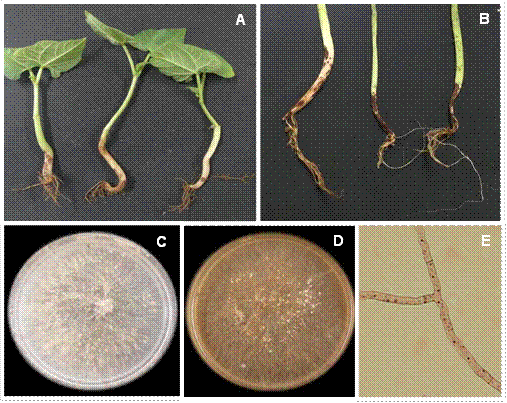
Figure 1 Rhizoctonia solani AG-7 causing root rot of the common bean. A. Symptoms on naturally infected stems and roots. B. Symptoms in artificially inoculated plants, 30 days after inoculation. C. Colony on PDA after 7 days at 25 °C in the dark. D. Colony on PDA after 20 days. E. Hyphae stained with Safranin-O showing multinucleated cells and branching at right angles, slightly constricted at their base.
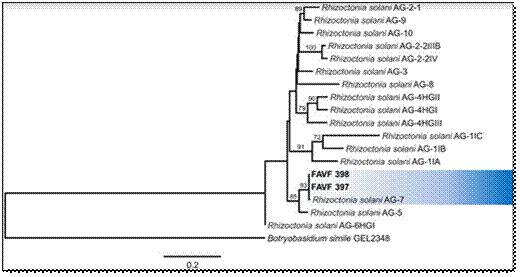
Referencias
Abd-Elsalam, KA, Moawad, R and El-maboud-Aly, AA. (2009). First report of Rhizoctonia solani AG‐7 on cotton in Egypt. Journal of Phytopathology 158 :307-309. https://doi.org/ 10.1111/J.1439-0434.2009.01611.X [ Links ]
Baird, RE, Batson, W, Carling, D and Scruggs, M. (2000). First report of Rhizoctonia solani AG-7 on cotton in Mississippi. Plant Disease 84 :1156B. https://doi.org/ 10.1094/PDIS.2000.84.10.1156B [ Links ]
Baird, RE and Carling, DE. (1997). First report of Rhizoctonia solani AG-7 in Georgia. Plant Disease 81 :832B. https://doi.org/ 10.1094/PDIS.1997.81.7.832B [ Links ]
Carling, DE, Brainard, KA, Virgen-Calleros, G and Olalde-Portugal, V. (1998). First report of Rhizoctonia solani AG-7 on potato in Mexico. Plant Disease 82 :127C. https://doi.org/ 10.1094/PDIS.1998.82.1.127C [ Links ]
Liu, Y, Whelen, S and Hall, B. (1999). Phylogenetic relationships among ascomycetes: evidence from an RNA polymeraseII subunit. Molecular Biologyand Evolution 16 :1799-1808. https://doi.org/ 10.1093/oxfordjournals.molbev.a026092 [ Links ]
Volci, C. (2008). Génesis y evolución de los postulados de Koch y su relacióncon la fitopatología. Una revisión. Agronomía Colombiana Vol. 26. Núm. 1. 107-115. http://www.redalyc.org/articulo.oa?id=180314729013 [ Links ]
White, TJ, Bruns, TD, Lee, SB and Taylor, JW. (1990). Amplification and Direct Sequencing of Fungal Ribosomal RNA Genes for Phylogenetics. In: PCR - Protocols and Applications - A Laboratory Manual. Academic Press. 315-322 pp. https://doi.org/ 10.1016/B978-0-12-372180-8.50042-1 [ Links ]
Yu-Cheng, L, Min-Nan, T and Hao-Xun, C. (2021). First report of soybean seedlingdisease caused by Rhizoctonia solani AG-7 in Taiwan. Plant Disease 01-21-0036-PDN. https://doi.org/ 10.1094/PDIS-01-21-0036-PDN [ Links ]
Received: September 18, 2024; Accepted: August 21, 2025
 Este es un artículo publicado en acceso abierto bajo una licencia
Creative Commons
Este es un artículo publicado en acceso abierto bajo una licencia
Creative Commons
