
Abstract:
Maize (Zea mays) ranks second as food in the world and drought limits its productivity. Plants harbor endophytic bacteria that influence health and drought tolerance. The goal of this research was to estimate the density and diversity of cultivable endophyte bacteria from the root system of seven homozygous maize drought-tolerant and seven drought-susceptible lines in three locations of Mexico during three crop cycles. The density and diversity of bacterial populations was assessed by direct counting on plates and identified by PCR. The results identified three groups of endophytic bacteria: 1) highly frequent (Bacillus subtilis, Bacillus megaterium y Pseudomonas geniculata), 2) frequent (Bacillus firmus, Pseudomonas hibiscola y Sinorhizobium meliloti) y 3) low frequency (Acinetobacter soli, Stenotrophomonas maltophila y Burkholderia gladioli. The analysis of variance (ANOVA) showed significant differences (p≤0.05) in density (Log10 CFU g-1 root) of population by location, crop cycle, days after sowing and maize lines. The density of Bacillus subtilis, Pseudomonas hibiscola at El Batán and Bacillus megaterium, Sinorhizobium meliloti in Tlaltizapán, were significantly higher in drought-tolerant maize lines compared to drought-susceptible lines.
Key words::
Zea mays, endophytic bacteria, bacterial diversity, 16S rADN
Maize (Zea mays) is currently the second most important food staple in terms of energy sources, and provides a protein content of approximately 9.2% to human nutrition (FAO, 2016). Mexico is in the seventh place in maize production, with approximately 25 million tons a year (FIRA, 2016). Maize productivity is limited by several biotic stresses (pests and diseases) and abiotic stresses (drought, nutrient deficiency, salinity and high temperatures) (Grover et al., 2007). Drought is the meteorological term for water scarcity, and is one of the major environmental stress factors that affect germination, plant vigor and productivity of agricultural crops (Kamara et al., 2003; Wilkinson and Davies, 2010). A possible alternative for tackling this problem is to develop knowledge about plant microorganisms that play an important role in the expression of abiotic stress resistance (Gond et al., 2015).
-
FAO, 2016, 2016
-
FIRA, 2016, 2016
-
Kamara et al., 2003The influence of drought stress on growth, yield and yield components of selected maize genotypesJournal of Agricultural Science, 2003
-
Wilkinson and Davies, 2010Drought, ozone, ABA and ethylene: new insights from cell to plant to communityPlant, Cell & Environment, 2010
-
Gond et al., 2015Effect of bacterial endophyte on expression of defense in Indian popcorn against Fusarium moniliformeSymbiosis, 2015
Endophytic microorganisms are bacteria, fungi or viruses that live all or part of their lives in plants’ internal tissues without damaging their hosts. They establish a symbiotic interaction that modulates the health of plants, as well as their ability to adapt to different environmental stress factors (Hardoim et al., 2015). Endophytic bacteria are a subgroup of the rhizosphere and rhizoplane bacterial community that colonizes the internal root tissue of the host plant; this gives them ecological advantages over other populations that colonize epiphytically. Diverse species of Gram-positive and Gram-negative endophytic bacteria have been isolated from different types of tissue from many plant species (Rosenblueth and Martínez-Romero, 2006).
-
Hardoim et al., 2015The hidden world within plants: ecological and evolutionary considerations for defining functioning of microbial endophytesMicrobiology and Molecular Biology Reviews, 2015
-
Rosenblueth and Martínez-Romero, 2006Bacterial endophytes and their interaction with hostsMolecular Plant-Microbe Interactions, 2006
There is evidence of the positive effect of endophytic microorganisms through the expression of mechanisms such as antagonism, induced systemic resistance (RSI) and acquired systemic resistance (RSA), plant growth promoters and induced adaptation response to environmental stresses (Liu et al., 2013). The relationship between the host plant and the endophytic bacterial community reflects a co-evolution in the colonization process influenced by the genotype, growth stage, physiological condition and plant tissue, as well as by soil characteristics, agronomic practices and environmental conditions such as temperature, water and nutrient supply (Higgins et al., 2007).
-
Liu et al., 2013Investigation on diversity and population succession dynamics of endophytic bacteria from seeds of maize (Zea mays L., Nongda108) at different growth stagesAnnals of Microbiology, 2013
-
Higgins et al., 2007Phylogenetic relationships, host affinity, and geographic structure of boreal and arctic endophytes from three major plant lineagesMolecular Phylogenetics and Evolution, 2007
When maize is inoculated with these microorganisms, this increases germination, plant height, root and aboveground mass and improves yield (Morales et al., 2011). It has also been shown that inoculating maize with these bacteria efficiently promotes drought stress tolerance (Fan et al., 2015) as a result of the increase in root length and biomass, which in turn improves water and nutrient absorption (Naseem and Bano, 2014; Yasmin et al., 2013). Endophytic bacteria can induce tolerance to abiotic stresses such as salinity and drought, while some populations confer tolerance to specific stress factors and are responsible for the survival of plants under these particular environmental conditions (Gond et al., 2015; Montañez et al., 2011). Thus, the microorganisms that establish positive interactions with plant roots play a key role in cropping systems and have promising biotechnological potential to be used in sustainable agriculture.
-
Morales et al., 2011Growth response of maize plantlets inoculated with Enterobacter spp., as a model for alternative agricultureRevista Argentina de Microbiología, 2011
-
Fan et al., 2015Soil inoculation with Burkholderia sp. LD-11 has positive effect on water-use efficiency in inbred lines of maizePlant Soil, 2015
-
Naseem and Bano, 2014Role of plant growth-promoting rhizobacteria and their exopolysaccharide in drought tolerance in maizeJournal of Plant Interactions, 2014
-
Yasmin et al., 2013Screening of PGPR isolates from semi-arid region and their implication to alleviate drought stressPakistan Journal Botany, 2013
-
Gond et al., 2015Effect of bacterial endophyte on expression of defense in Indian popcorn against Fusarium moniliformeSymbiosis, 2015
In Mexico there are no studies on endophytic bacterial communities in roots of drought tolerant or drought susceptible maize lines. Such endophytic bacteria could be used to develop future biotechnological strategies such as inducers of drought tolerance and other abiotic and biotic factors that limit crop productivity. Therefore, the objective of this study was to estimate the density and diversity of endophytic bacterial populations in roots of homozygous (S6) drought tolerant and drought susceptible maize lines previously identified as such under field conditions and sown at three Mexican locations during three crop cycles.
Materials and methods
Sampling site. Seven drought-tolerant homozygous maize lines (CLQRQ108, CML384, CML445, CML544, DTMA90, DTMA224, DTMA256) and seven drought-susceptible homozygous maize lines (CML181, DTMA34, DTMA41, DTMA43, DTMA109, DTMA144, DTMA182) were sown, which were selected because they were inbred due to their uniform response to drought. Each line was sown with three replications at the experiment stations of the International Maize and Wheat Improvement Center (CIMMYT) in Tlaltizapán, Morelos (18.68 N; 99.11 O), El Batán, Texcoco, Mexico (19.53 N; 98.85 W), and Agua Fría, Puebla (20.5 N; 97.6 W) during the 2012 summer crop cycle (V-2012), 2012 winter cycle (I-2012) and 2013 autumn cycle (V-2013). Samples of the internal tissue formed in the apical root area of three plants per line were taken for each location and crop cycle 25, 52 and 75 days after sowing (dds) to be analyzed at CIMMYT’s Maize Pathology Laboratory at El Batán, State of Mexico. The size of the sample was determined by the method proposed by Cochran (1982).
-
Cochran (1982)Técnicas de muestreo, 1982
Isolation of endophytic root bacteria. Bacterial isolates from the internal tissue of maize roots that had been superficially sterilized were defined as endophytic strains. Symptomless maize roots were washed with sterile distilled water and cut in 2-cm pieces. 10 g of roots were sterilized superficially for 5 min in sterile glass jars and washed with 70% ethanol for 5 min, 0.53% sodium hypochlorite for 10 min and then rinsed three times with sterile distilled water. After the last washing with sterile distilled water, 100 µL from each jar were sown in Petri dishes containing NB culture medium (1L): 15 g bacteriological agar (BIOXON® Mexico), 5 g peptone (BD DIFCOTM USA), 3 g yeast extract (DIBICO® Mexico, NaCl JT BAKER® Mexico) and incubated at 28±1oC from 2 to 5 days. The absence of bacterial growth in the culture medium confirmed that the root surface had been efficiently sterilized. The roots were ground in cold mortars using 20 mL of a sterile buffer solution (50 mM KH2PO4, 150 mM NaCl, pH 7.6). The resulting suspensions were diluted in series (1:9) from 100 to 10-3; then 100 µL of each dilution and three replications were sown in NB medium and incubated at 28 ºC for 24 h under continuous light. The different bacterial morphotypes were counted and classified according to their color, shape, texture and type of growth. The bacterial growth was considered representative of cultivable endophytic bacteria in maize roots. Bacterial strains were preserved by freezing in NB medium and 20% glycerol for subsequent studies.
Population density of endophytic bacteria. The population density of bacteria per root tissue was estimated by directly counting the colonies on the plate. The number of bacterial colonies isolated from the 14 maize lines was counted using a colony counter (Quebec®, Darkfield Colony Counter). The bacterial population of root tissue samples was expressed in terms of colony forming units (UFC g-1 of root tissue). The resulting data were converted to Log10 UFC g-1 of root and an analysis of variance (ANOVA) was performed using a factorial analysis design to separate the media by DMS (α=0,05) using the SAS statistical program (Statistical Analysis System version 9.1.3 SAS Institute, Cary, NC, USA) according to the crop cycle, location, days after sowing (dds) and the studied drought-tolerant or drought-susceptible maize lines.
Amplification of the 16S rDNA gene and identification of endophytic bacteria. Bacterial DNA was extracted using the protocol described by Mahuku (2004) with the following modifications: bacterial cells were obtained by growing them in NB medium at 28 °C for 48 h. After suspending the precipitate in 100 µL of 1X TE, 2 µL of RNAsa were added (1 mg mL-1) and then incubated in a water bath at 37 °C for 1 h. The DNA quality was verified by electrophoresis in agarose gel. Bacteria were identified by partially amplifying the 16S rADN gene using universal primers 27F (5´AGAGTTTGATCMTGGCTCAG-3´) and 1492R (5´TACGGHTACCTTGTTACGACTT-3´) under the PCR conditions described by Galkiewicz and Kellogg (2008). DNA amplification and sequencing were carried out using Macrogen (DNA Sequency Service. Korean Biotechnology Company), and the sequences obtained were aligned with sequences kept at the GenBank of (NCBI) using the BLASTn program (http://www.ncbi.nlm.nih.gov/BLAST/).
-
Mahuku (2004)A simple extraction method suitable for PCR based analysis of plant, fungal and bacterial DNAPlant Molecular Biology Reporter, 2004
-
Galkiewicz and
Kellogg (2008)Cross-Kingdom amplification using Bacteria-specific primers: complications for studies of coral microbial ecologyApplied Environmental Microbiology, 2008
Results and discussion
Taxonomic identification of endophytic bacteria. Through partial sequencing of the 16S rADN gene, 22 endophytic bacteria species were identified in roots of both groups of maize lines. The greatest abundance of bacteria was associated with the Proteobacteria phyla followed by Firmicutes and Bacteroidetes. Within Firmicutes, 100% of strains were identified as Bacillus sp., and within the class Gammaproteobacteria, 33% were identified as Pseudomonas sp.
The diversity and richness of bacteria naturally associated with maize roots is wide, and their estimation depends on the analytic method used. In this study, a dependent culture approach was used, and the results coincide with previous studies that found that the Proteobacteria phylum was the most predominant of the endophytic bacterial populations isolated from maize roots, stems and leaves (Rosenblueth and Martínez-Romero, 2006). Other studies of the diversity of endophytic communities in maize roots using dependent and independent culture methods also found that the bacteria most frequently associated with this crop are Firmicutes (Bacillus), Gammaproteobacteria (Pseudomonas) (Pereira et al., 2011) and Burkholderia spp. (Ikeda et al., 2013). By analyzing these populations using gas chromatography and fatty acid profiles, Bacillus pumilus, B. subtilis, Pseudomonas aeruginosa and P. fluorescens were identified as the most predominant species in maize stalks (Rai et al., 2007), but when using pyrosequencing, the Proteobacteria, Bacteroidetes and Actinobacteria phyla were identified as being the most abundant in the maize rhizosphere (Li et al., 2014).
-
Rosenblueth and Martínez-Romero, 2006Bacterial endophytes and their interaction with hostsMolecular Plant-Microbe Interactions, 2006
-
Pereira et al., 2011Analysis of the bacterial diversity associated with the roots of maize (Zea mays L.) through culture-dependent and culture-independent methodsInternational Scholarly Research Network, 2011
-
Ikeda et al., 2013Morphological and genetic characterization of endophytic bacteria isolated from roots of different maize genotypesMicrobial Ecology, 2013
-
Rai et al., 2007Endophytic bacterial flora in the stem tissue of a tropical maize (Zea mays L.) genotype: isolation, identification and enumerationWorld Journal Microbiology and Biotechnology, 2007
-
Li et al., 2014Dynamics of the bacterial community structure in the rhizosphere of a maize cultivarSoil Biology and Biochemistry, 2014
Maize research has shown that these populations could be used as bacterial inoculants for controlling drought stress, and suggests that drought tolerance is induced by the production of phytohormones such as abscisic, gibberellic and indole-3-acetic acids, cytokinins, enzymes such as ACC deaminase, production of bacterial exopolysaccharides and systemic tolerance induction (Dimkpa et al., 2009; Kim et al., 2012; Timmusk et al., 2014; Yang et al., 2009). In other crops, they have been identified as tolerance inductors in wheat (Triticum sativum) and legumes (Vigna radiata) when they were inoculated in seed, for they promoted an increase in the levels of regulation of genes related to drought tolerance and the activity of diverse enzymes (Kasim et al., 2013; Saravanakumar et al., 2011).
-
Dimkpa et al., 2009Plant-rhizobacteria interactions alleviate abiotic stress conditionsPlant Cell and Environment, 2009
-
Kim et al., 2012Enhancement of plant drought tolerance by microbesPlant responses to drought stress, 2012
-
Timmusk et al., 2014Drought-tolerance of wheat improved by rhizosphere bacteria from harsh environments: Enhanced biomass production and reduced emissions of stress volatilesPLoS One, 2014
-
Yang et al., 2009Rhizosphere bacteria help plants tolerate abiotic stressTrends in Plant Science, 2009
-
Kasim et al., 2013Control of drought stress in wheat using plant-growth- promoting bacteriaJournal of Plant Growth Regulation, 2013
-
Saravanakumar et al., 2011Plant growth promoting bacteria enhance water stress resistance in green gram plantsActa Physiology Plant, 2011
Based on the frequency of the isolates, three groups of endophytic bacteria in the roots of drought tolerant and drought susceptible maize stand out in this study: 1) highly frequent (Bacillus subtilis, Bacillus megaterium and Pseudomonas geniculata), isolated during the three crop cycles at the three locations, 2) frequent (Bacillus firmus, Pseudomonas hibiscola and Sinorhizobium meliloti), isolated during the three crop cycles at two locations, and 3) low frequency (Acinetobacter soli, Stenotrophomonas maltophila and Burkholderia gladioli), isolated only at two locations and not in all crop cycles (Table 1).
Table 1
Endophyte bacteria species identified in roots of 14 maize lines in three locations during three crop cycles.
Endophyte bacteria species identified in roots of 14 maize lines in three locations during three crop cycles.
| ID | Endófito | Línea | Identidad de Nucleótidos | Clase | Localidad/ciclo de cultivo | ||
| T/S | TL | AF | EB | ||||
| AF101 | Acinetobacter soli Z | T, S | 96% (KU551890) | γ Proteobacteria | 1 | 1 | |
| AF105 | Agrobacterium tumefaciens | T, S | 97% (KX518841) | α Proteobacteria | 1 | ||
| TL007 | Bacillus asahii | T, S | 95% (KU551893) | Firmicutes | 1, 2, 3 | 1 | |
| TL008 | Bacillus firmus Y | T, S | 98% (KU551896) | Firmicutes | 1, 2, 3 | 1, 2, 3 | |
| AF103 | Bacillus megaterium X | T, S | 96% (KC414697) | Firmicutes | 1, 2, 3 | 1, 2, 3 | 1, 2, 3 |
| AF102 | Bacillus subtilis X | T, S | 97% (KU551891) | Firmicutes | 1, 2, 3 | 1, 2, 3 | 1, 2, 3 |
| AF111 | Burkholderia cenocepacia | T, S | 96% (GU433447) | β Proteobacteria | 1, 2, 3 | ||
| AF129 | Burkholderia gladioli Z | S | 97% (EU1611873) | β Proteobacteria | 1, 2 | 2 | |
| AF109 | Chryseobacterium indologenes | T, S | 98% (KU551895) | Flavobacteria | 1, 2, 3 | 2 | |
| TL032 | Enterobacter aerogenes | T, S | 97% (AM184247) | γ Proteobacteria | 1 | 1, 2, 3 | |
| BT011 | Enterobacter spp. | T, S | 97% (KX518848) | γ Proteobacteria | 1 | ||
| TL012 | Flavobacterium johnsoniae | T, S | 96% (KU551897) | Flavobacteria | 1 | ||
| AF116 | Klebsiella oxytoca | T, S | 97% (KU551901) | γ Proteobacteria | 2 | ||
| AF128 | Klebsiella pneumoniae | T, S | 96% (KX518847) | γ Proteobacteria | 1 | ||
| TL015 | Pseduomonas hibiscola Y | T, S | 97% (KX518846) | γ Proteobacteria | 1, 2, 3 | 1, 2, 3 | |
| AF112 | Pseudomonas chlororaphis | T, S | 96% (KX518844) | γ Proteobacteria | 1, 2, 3 | ||
| AF115 | Pseudomonas geniculata X | T, S | 96% (KU551900) | γ Proteobacteria | 1, 2, 3 | 1, 2, 3 | 1, 2, 3 |
| TL011 | Pseudomonas lini | T, S | 99% (KX518842) | γ Proteobacteria | 1 | ||
| AF107 | Salmonella bongori | T, S | 96% (KU551899) | γ Proteobacteria | 1 | ||
| AF106 | Serratia marcescens | T, S | 96% (KX518843) | γ Proteobacteria | 1, 2, 3 | 1 | |
| TL010 | Sinorhizobium meliloti Y | T, S | 98% (KU551892) | α Proteobacteria | 1, 2, 3 | 1, 2, 3 | |
| TL009 | Stenotrophomas maltophilia Z | T, S | 98% (KU551894) | γ Proteobacteria | 1, 2, 3 | 1 | |
The taxonomic and functional structure of bacterial communities in soil is influenced by biotic and abiotic factors such as soil physical and chemical characteristics, weather conditions, plant genotype and interaction with other soil prokaryotes and eukaryotes, a fact that suggests that those interactions are complex. In this study, the structure and large number of isolated bacteria may be associated with the interaction of several factors, including plant genotype, the genetic characteristics of bacterium, soil, temperature, crop cycle and maize plant phenology (Li et al., 2014; Oliveira et al., 2009) that influence the colonization and dynamics of the endophytic bacterial community (Bodenhausen et al., 2013). A specific plant-endophyte relationship was revealed by performing bacterial chemotaxis on host plant exudates as carbon sources that act as signaling molecules (Albareda et al., 2006); it also showed that differences in exudate composition and patterns depend on the crop variety, development stage, exposure of the plant to stress and type of soil, which influence colonization by bacterial communities (Haichar et al., 2008). Studies on maize indicated that root exudates are 65% sugar, 33% organic acids and 2% amino acids, and that changes in the quantity and quality of exudation patterns at different root growth and physiological stages influenced the biomass and the structure of bacterial communities by increasing nutrient activity and deposition by those microbial communities and favored plant growth (Baudoin et al., 2003). Some maize studies that used a dependent culture approach have shown dynamic changes in the bacterial community of the rhizosphere at different crop growth stages (Cavaglieri et al., 2009; Nacamulli et al., 1997).
-
Li et al., 2014Dynamics of the bacterial community structure in the rhizosphere of a maize cultivarSoil Biology and Biochemistry, 2014
-
Oliveira et al., 2009Colonization of sugarcane plantlets by mixed inoculations with diazotrophic bacteriaEuropean Journal of Soil Biology, 2009
-
Bodenhausen et al., 2013Bacterial communities associated with the leaves and the roots of Arabidopsis thalianaPLOS ONE, 2013
-
Albareda et al., 2006Factors affecting the attachment of rhizospheric bacteria to bean and soybean rootsFEMS Microbiology Letters, 2006
-
Haichar et al., 2008Plant host habitat and root exudates shape soil bacterial community structureThe ISME Journal, 2008
-
Baudoin et al., 2003Impact of artificial root exudates on the bacterial community structure in bulk soil and maize rhizosphereSoil Biology and Biochemistry, 2003
-
Cavaglieri et al., 2009Rhizosphere microbial community structure at different maize plant growth stages and root locationsMicrobiological Research, 2009
-
Nacamulli et al., 1997Perturbation of maize rhizosphere microflora following seed bacterization with Burkholderia cepacia MCI 7FEMS Microbiology Ecology, 1997
In this study, specific bacteria were identified such as Burkholderia gladioli, which was isolated at a low frequency only in susceptible maize lines at two locations and crop cycles (Table 1).
Burkholderia gladioli was previously identified in roots of a wild maize ancestor (Zea mays ssp. parviglumis) and in modern maize genotypes as an endophyte showing antifungal properties (Shehata et al., 2016). Also, Burkholderia sp. inoculation in maize had positive effects on drought tolerance (Fan et al., 2015; Naveed et al., 2014).
-
Shehata et al., 2016Bacterial endophytes from wild and ancient maize are able to suppress the fungal pathogen Sclerotinia homoeocarpaJournal of Applied Microbiology, 2016
-
Fan et al., 2015Soil inoculation with Burkholderia sp. LD-11 has positive effect on water-use efficiency in inbred lines of maizePlant Soil, 2015
-
Naveed et al., 2014Increased drought stress resilience of maize through endophytic colonization by Burkholderia phytofirmans PsJN and Enterobacter sp. FD 17Environmental and Experimental Botany, 2014
Density of endophytic populations in maize lines. The density of endophytic bacteria in the 14 maize lines ranged from 1, 6 Log10 UFC g-1 of root. The ANOVA showed highly significant differences (**= p≤0,01) in the density of the endophytic population of B. subtilis, B. megaterium, P. hibiscola and S. meliloti in terms of location, crop cycle, days after transplanting (dds) and group (drought tolerance/ susceptibility) of maize lines (Table 2).
Table 2
Variance analysis and comparison of means of population density (Log10 UFC g-1 of root) in roots of 14 drought-tolerant maize lines and drought-susceptible maize lines.
Variance analysis and comparison of means of population density (Log10 UFC g-1 of root) in roots of 14 drought-tolerant maize lines and drought-susceptible maize lines.
| B. subtilis | B. megaterium | P. hibiscola | S. meliloti | |
| Localidad | ** | ** | ** | ** |
| Ciclo | NS | ** | ** | NS |
| Días | NS | ** | NS | ** |
| Tolerancia | ** | ** | ** | ** |
| Tolerante | 2.2684 a | 3.7374 a | 2.9388 a | 4.8880 a |
| Susceptible | 1.7410 b | 3.3976 b | 2.4501 b | 4.6389 b |
By location, the highest population densities recorded at El Batán were those of B. subtilis and P. hibiscola, while in Tlaltizapán they were B. megaterium and S. melilloti. By crop cycle and sampling date, B. megaterium and P. hibiscola were significantly different (p≤0,05) during the V-2012 cycle at 52 dds. In this study, a total of 22 endophytic bacteria were identified in roots of drought tolerant and drought susceptible maize lines. However, B. subtilis, B. megaterium, P hibiscola and S. meliloti population densities were significantly higher in drought tolerant maize lines than in susceptible lines (Table 2).
The density of bacterial populations is a key element, considered to be the greatest metabolism regulation mechanism in the interaction with the biotic and abiotic environment, through which it coordinates the expression of specialized genes, depending on cellular density. It has been demonstrated that this behavior, known as quorum sensing (QS) in bacteria associated with plants, regulates the expression of genes in the rhizosphere to synthesize secondary metabolites, antifungal compounds, antibiotics and extracellular enzymes involved in biocontrol (Somers et al., 2004; Whitehead et al., 2001).
-
Somers et al., 2004Rhizosphere bacterial signalling: A love parade beneath our feetCritical Reviews in Microbiology, 2004
-
Whitehead et al., 2001Quorum-sensing in Gram-negative bacteriaFEMS Microbiology Reviews, 2001
Thumbnail
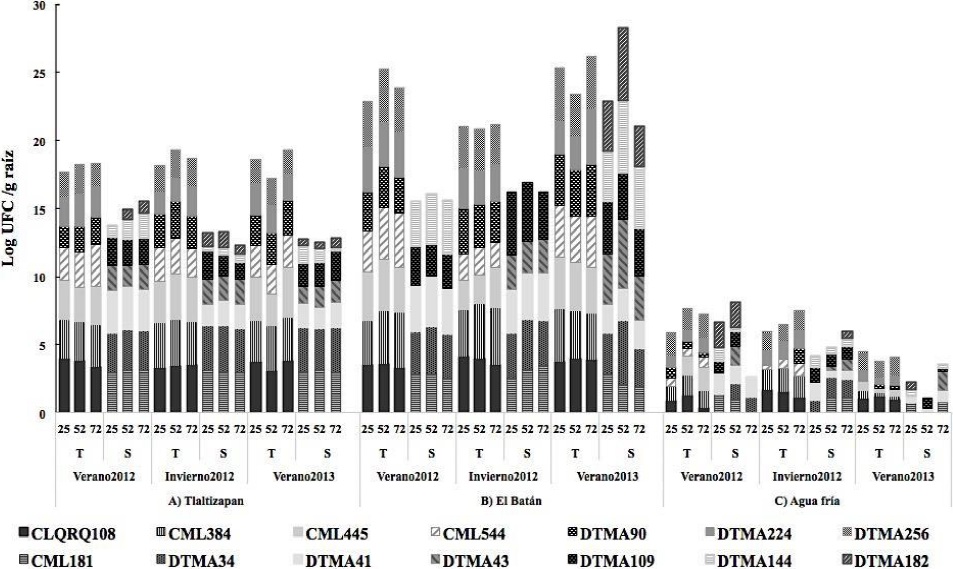
Figure 1
B. subtilis population in 7 drought-tolerant maize lines and 7 drought-susceptible maize lines at 25, 52 y 75 dds during the 2012 summer crop cycle, 2012 winter crop cycle and 2013 summer crop cycle in three locations of Mexico.
B. subtilis population in 7 drought-tolerant maize lines and 7 drought-susceptible maize lines at 25, 52 y 75 dds during the 2012 summer crop cycle, 2012 winter crop cycle and 2013 summer crop cycle in three locations of Mexico.
As an endophyte, B. subtilis is a microorganism of great interest in biotechnological applications as biocontrol agent for biotic and abiotic stresses because of its efficient colonization of plant roots which triggers different biocontrol and adaptation mechanisms in different environments (Marulanda et al., 2006). Additionally, this demonstrates its high capacity to produce volatile organic compounds (VOCs) that act as signaling molecules to trigger a defense response through specific induced systemic resistance (ISR) (Farag et al., 2013). These VOCs activate hormone production paths, including auxins, gibberellins, cytokinins and salicylic acid that foster host plant growth under stress conditions, mainly by increasing root biomass, which in turn improves water absorption (Zhang et al., 2007). Another study showed that maize seed inoculated with selected B. subtilis strains provided important benefits as a growth promoter and increased nutrient absorption capacity (Canbolat et al., 2006)In Tlaltizapán, the population density of B. megaterium in maize lines was from 3, 5Log10 UFC g-1 of root during the three cycles and significantly higher (5 Log10 UFC g-1 of root) in the V-2012 cycle at 52 dds, and in drought tolerant maize lines (Table 2, Figure 2).
-
Marulanda et al., 2006An indigenous drought- tolerant strain of Glomus intraradices associated with a native bacterium improves water transport and root development in Retama sphaerocarpaMicrobial Ecology, 2006
-
Farag et al., 2013Dynamic chemical communication between plants and bacteria through air-borne signals: induced resistance by bacterial volatilesJournal of Chemical Ecology, 2013
-
Zhang et al., 2007Rhizobacterial volatile emissions regulate auxin homeostasis and cell expansion in ArabidopsisPlanta, 2007
-
Canbolat et al., 2006Effect of plant growth promoting bacteria and soil compaction on barley seeding growth, nutrient uptake, soil properties and rhizosphere microfloraBiology and Fertility of Soils, 2006
Thumbnail
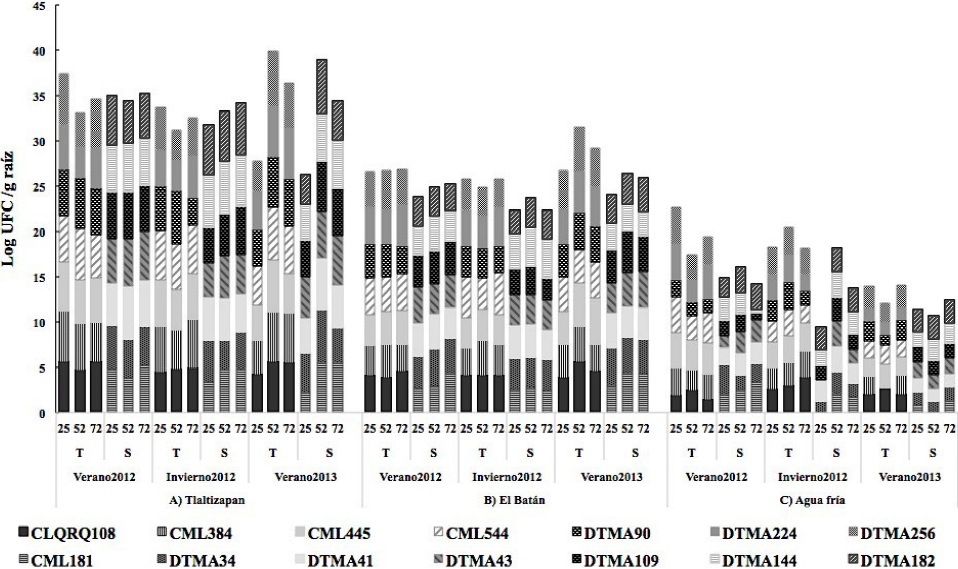
Figure 2
B. megaterium population in 7 drought-tolerant maize lines and 7 drought-susceptible maize lines at 25, 52 y 75 dds during the 2012 summer crop cycle, 2012 winter crop cycle and 2013 summer crop cycle in three locations of Mexico.
B. megaterium population in 7 drought-tolerant maize lines and 7 drought-susceptible maize lines at 25, 52 y 75 dds during the 2012 summer crop cycle, 2012 winter crop cycle and 2013 summer crop cycle in three locations of Mexico.
Recent studies have shown that B. megaterium modifies the maize plant response to several abiotic stresses, and the importance of the population density of some Bacillus species in the drought tolerance and water transportation response in Retama sphaerocarpa, because it promotes root growth and water absorption capacity, as well as the levels of proline and indoleacetic acid (Marulanda et al., 2006). In particular, those studies point out that the presence of B. megaterium in the host plant increases biomass and water content in the root (Marulanda et al., 2009), a fact that suggests that these endophytic populations could be used in maize plants sown in arid and semi-arid areas. The biological function of other endophytic Bacillus species in maize are related to the plant’s efficient defense response against pathogens associated with the production of antifungal lipopeptides that induces the expression of defense genes (Gond et al., 2015).
-
Marulanda et al., 2006An indigenous drought- tolerant strain of Glomus intraradices associated with a native bacterium improves water transport and root development in Retama sphaerocarpaMicrobial Ecology, 2006
-
Marulanda et al., 2009Stimulation of plant growth and drought tolerance by native microorganisms (AM fungi and bacteria) from dry environments: mechanisms related to bacterial effectivenessJournal of Plant Growth Regulation, 2009
-
Gond et al., 2015Effect of bacterial endophyte on expression of defense in Indian popcorn against Fusarium moniliformeSymbiosis, 2015
At El Batán, the population density of P. hibiscola in maize lines was from 3, 5 Log10 UFC g-1 of root during the three crop cycles and significantly higher (5 Log10 UFC g-1 of root) in the V-2012 cycle. It was not isolated in Agua Fría. There were no significant differences among the days after sowing (dds), but the density was significantly higher in drought-tolerant maize lines (Table 2, Figure 3).
Thumbnail
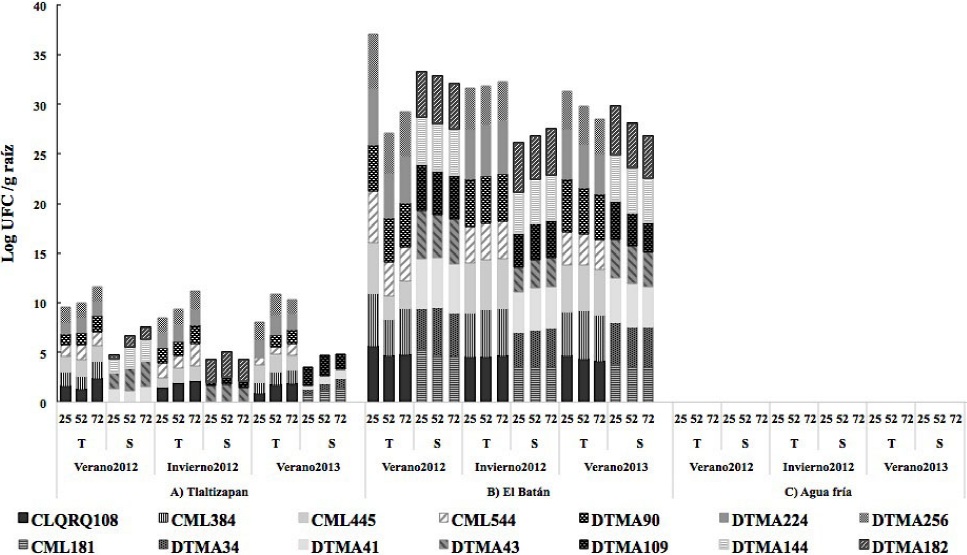
Figure 3
P. hibiscola population in 7 drought-tolerant maize lines and 7 drought-susceptible maize lines at 25, 52 y 75 dds during the 2012 summer crop cycle, 2012 winter crop cycle and 2013 summer crop cycle in three locations of Mexico.
P. hibiscola population in 7 drought-tolerant maize lines and 7 drought-susceptible maize lines at 25, 52 y 75 dds during the 2012 summer crop cycle, 2012 winter crop cycle and 2013 summer crop cycle in three locations of Mexico.
P. hibiscola has not been cited as a maize endophyte. However, according to the phylogenetic affiliation of the P. hibiscola type ATCC 19867 strain based on a comparative analysis of 16S rADN gene sequences and chemical taxonomy profiles, it was reclassified as Stenotrophomonas sp. (Anzai et al., 2000). S. maltophilia has been cited as a maize endophyte (McInroy and Kloepper, 1995) and reported to act as a biological control agent against soil-borne pathogens such as Pythium spp., Fusarium spp. and Rhizoctonia solani. It has also been reported to produce indoleacetic acid, which regulates the development of sprouts and side roots in plants (Mehnaz et al., 2010).
-
Anzai et al., 2000Phylogenetic affiliation of the pseudomonads based on 16S rRNA sequenceInternational Journal of Systematic and Evolutionary Microbiology, 2000
-
McInroy and Kloepper, 1995Survey of indigenous bacterial endophytes from cotton and sweet cornPlant and Soil, 1995
-
Mehnaz et al., 2010Growth promoting effects of corn (Zea mays) bacterial isolates under greenhouse and field conditionsSoil Biology and Biochemistry, 2010
The population density of S. meliloti in drought-tolerant maize lines in Tlaltizapán was from 4, 6 Log10 UFC g-1 of root during the three cycles, and significantly higher (6 Log10 UFC g-1 of root) at 52 dds. It was not isolated in Agua Fría. There were no significant differences per crop cycle, but it was significantly higher in drought-tolerant maize lines (Table 2, Figure 4).
Thumbnail
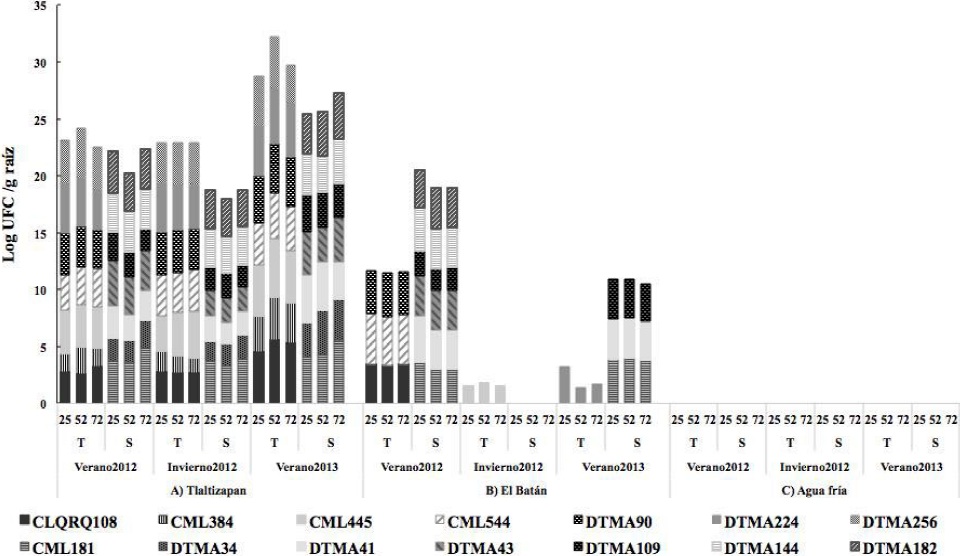
Figure 4
S. meliloti population in 7 drought-tolerant maize lines and 7 drought-susceptible at 25, 52 y 75 dds during the 2012 summer crop cycle, 2012 winter crop cycle and 2013 summer crop cycle in three locations of Mexico.
S. meliloti population in 7 drought-tolerant maize lines and 7 drought-susceptible at 25, 52 y 75 dds during the 2012 summer crop cycle, 2012 winter crop cycle and 2013 summer crop cycle in three locations of Mexico.
S. meliloti is known to be a nitrogen-fixing nodular bacterium in plants of the Medicago genus, and involved in the drought tolerance and salinity response (Roumiansteva and Muntyan, 2015). In Mexico, the presence of a great genetic diversity of native S. meliloti populations in alfalfa (Medicago spp.) was reported, and so far, new species have been identified in woody legumes of the Leucaena (Wang et al., 2002) and Acacia genera (Toledo et al., 2003). The Sinorhizobium genus was found in the maize rhizosphere (Rosenblueth and Martínez-Romero, 2006), and Rhizobium etli bv. phaseoli as an endophyte in maize roots in Mexico (Gutiérrez-Zamora and Martínez-Romero, 2001). However, there is no information about S. meliloti as an endophyte in maize roots, so the present study provides reference information about the natural endophytic colonization of S. meliloti in maize in Mexico. Alfalfa and maize intercropping is common in the studied locations, so this may explain the endophytic colonization of S. meliloti in maize roots. Studies conducted on rice (Oryza sativa) suggest that S. meliloti may produce a lumichrome signaling molecule in the rhizosphere of those plants and promote growth by inducing better root respiration, stomatal conductance, leaf transpiration and photosynthetic efficiency (Chi et al., 2010). When it was applied at nanomolecular concentrations, it promoted legume and cereal growth and increased root biomass in the legume Lotus japonicus and in tomato (Solanum lycopersicum) (Gouws et al., 2012).
-
Roumiansteva and Muntyan, 2015Root nodule bacteria Sinorhizobium meliloti: Tolerance to salinity and bacterial genetic determinantsMicrobiology, 2015
-
Wang et al., 2002Sinorhizobium morelense sp. nov., a Leucaena leucocephala-associated bacterium that is highly resistant to multiple antibioticsInternational Journal of Systematic and Evolutionary Microbiology, 2002
-
Toledo et al., 2003Sinorhizobium americanum sp. nov., a new Sinorhizobium species nodulating native Acacia spp. in MexicoSystematic and Applied Microbiology, 2003
-
Rosenblueth and Martínez-Romero, 2006Bacterial endophytes and their interaction with hostsMolecular Plant-Microbe Interactions, 2006
-
Gutiérrez-Zamora and Martínez-Romero, 2001Natural endophytic association between Rhizobium etli and maize (Zea mays L.)Journal of Biotechnology, 2001
-
Chi et al., 2010Proteomic analysis of rice seedlings infected by Sinorhizobium meliloti 1021Proteomics, 2010
-
Gouws et al., 2012The plant growth promoting substance, lumichrome, mimics starch, and ethylene-associated symbiotic responses in lotus and tomato rootsFront Plant Science, 2012
The frequency of certain bacteria genera isolated from maize roots in this study may be related to the phylogeny of the maize lines. For example, among bacteria showing higher frequency and density in drought-tolerant maize lines, two Bacillus species stand out. Bacillus is considered an important endophytic bacterium that has been isolated from both Teozintle (a maize ancestor) and modern maize genotypes; it has been shown that the composition of the endophytic bacteria colony in maize seed varies and that it has been preserved through the evolution, ethnography and ecology of the maize plant as a host (Johnston-Monje and Raizada, 2011).
-
Johnston-Monje and Raizada, 2011Conservation and diversity of seed associated endophytes in Zea across boundaries of evolution, ethnography and ecologyPLoS ONE, 2011
In this research, we determined that some factors such as drought tolerance/susceptibility of the maize lines used, as well as the location, crop cycle and time (days after transplanting) significantly affected the density of cultivable endophytic bacteria in the roots of the maize genetic materials. Rhizobacteria as promoters of growth (PGPR), nutrition and plant disease management have been extensively studied, but their function in managing abiotic stresses such as drought has generated great interest in recent years (Dimpka et al., 2009; Grover et al., 2010; Kavamura et al., 2013; Yang et al., 2009). The use of endophytic microorganisms may be a viable alternative against biotic and abiotic stresses. Strains isolated in this study are a microbial resource that is intimately associated with maize and has the potential to be used as a biotechnological tool in agriculture; these strains deserve to be evaluated in the future as microbial inoculants and inductors of drought stress tolerance, as well as to other biotic and abiotic factors in regions of Mexico where maize is produced under limiting conditions.
-
Dimpka et al., 2009Plant-rhizobacteria interactions alleviate abiotic stress conditionsPlant Cell and Environment, 2009
-
Grover et al., 2010Role of microorganisms in adaptation of agriculture crops to abiotic stressesWorld Journal of Microbiology and Biotechnology, 2010
-
Kavamura et al., 2013Screening of Brazilian cacti rhizobacteria for plant growth promotion under droughtMicrobiological Research, 2013
-
Yang et al., 2009Rhizosphere bacteria help plants tolerate abiotic stressTrends in Plant Science, 2009
Conclusions
Cultivable root endophytic bacteria that were most frequently present in the 14 maize lines tested belong to the Proteobacteria and Firmicutes phyla. The highest population density of endophytic bacteria was found in drought-tolerant maize lines. Bacteria of the Bacillus, Pseudomonas and Sinorhizobium genera showed the highest frequency and population density in drought-tolerant maize lines at the three study locations and crop cycles. Sinorhizobium meliloti is able to endophytically colonize maize roots.
Acknowledgments
The authors wish to thank the Colegio de Postgraduados and the Consejo Nacional de Ciencia y Tecnología (CONACyT) for funding this research and for the scholarship granted, as well as the International Maize and Wheat Improvement Center (CIMMYT) for providing the seed for conducting this research.
Literatura citada
- Albareda M, Dardanelli MS, Sousa C, Megías M, Temprano F and Rodríguez D. 2006 Factors affecting the attachment of rhizospheric bacteria to bean and soybean roots. FEMS Microbiology Letters 259:67-73. https://doi.org/10.1111/j.1574-6968.2006.00244.x Links
- Anzai Y, Kim H, Park JY, Wakabayashi H and Oyaizu H. 2000. Phylogenetic affiliation of the pseudomonads based on 16S rRNA sequence. International Journal of Systematic and Evolutionary Microbiology 50:1563-1589. DOI: 10.1099/00207713-50-4-1563 Links
- Baudoin E, Benizri E and Guckert A., 2003. Impact of artificial root exudates on the bacterial community structure in bulk soil and maize rhizosphere. Soil Biology and Biochemistry 35:1183-1192. https://doi.org/10.1016/S0038-0717(03)00179-2 Links
- Bodenhausen N, Horton MW and Bergelson J. 2013. Bacterial communities associated with the leaves and the roots of Arabidopsis thaliana. PLOS ONE 8:e56329. https://doi.org/10.1371/journal.pone.0056329 Links
- Canbolat M, Bilen S, Çakmakçi R, Sahin F and Aydi A. 2006. Effect of plant growth promoting bacteria and soil compaction on barley seeding growth, nutrient uptake, soil properties and rhizosphere microflora. Biology and Fertility of Soils 42:350-357. https://link.springer.com/article/10.1007/s00374-005-0034-9 Links
- Cavaglieri L, Orlando J and Etcheverry M. 2009. Rhizosphere microbial community structure at different maize plant growth stages and root locations. Microbiological Research 164:391-399. https://doi.org/10.1016/j.micres.2007.03.006 Links
- Chi F, Yang P, Han F, Jing Y and Shen S. 2010. Proteomic analysis of rice seedlings infected by Sinorhizobium meliloti 1021. Proteomics 10:1861-1874. http://onlinelibrary.wiley.com/doi/10.1002/pmic.200900694/full Links
- Cochran, W. G. Técnicas de muestreo. México: Compañía Editorial Continental, 1982. 513 p. Links
- Dimpka C. Weinand T and Asch F. 2009. Plant-rhizobacteria interactions alleviate abiotic stress conditions. Plant Cell and Environment 32:1682-1694. DOI: 10.1111/j.1365-3040.2009.02028.x Links
- Fan X, Hu H, Huang G, Huang F, Li Y and Palta J. 2015. Soil inoculation with Burkholderia sp. LD-11 has positive effect on water-use efficiency in inbred lines of maize. Plant Soil 390:337-349. https://doi.org/10.1007/s11104-015-2410-z Links
- Farag MA, Zhang H and Ryu CM. 2013. Dynamic chemical communication between plants and bacteria through air-borne signals: induced resistance by bacterial volatiles. Journal of Chemical Ecology 39:1007-1018. https://link.springer.com/article/10.1007/s10886-013-0317-9 Links
- FAO. 2016. Disponible en línea: http://www.fao.org/do-crep/003/x7650s/x7650s10.html (Consulta, marzo 2016) Links
- FIRA, Fideicomisos Instituidos en Relación con la Agricultura. 2016. Disponible en línea: https://www.gob.mx/cms/uploads/attachment/file/61952/Panorama_Agroalimentario_Ma_z_2015.pdf (Consulta, febrero 2016) Links
- Galkiewicz JP and Kellogg CA. 2008. Cross-Kingdom amplification using Bacteria-specific primers: complications for studies of coral microbial ecology. Applied Environmental Microbiology 74:7828-7831. Disponible en línea: http://aem.asm.org/content/74/24/7828.short Links
- Gond SK, Bergen MS, Torres MS, White JF and Kharwar RF. 2015. Effect of bacterial endophyte on expression of defense in Indian popcorn against Fusarium moniliforme. Symbiosis 66:133-140. https://doi.org/10.1007/s13199-015-0348-9 Links
- Gouws LM, Botes E and Wiese AJ, Trenkamp S, Torres-Jerez I, Tang J, Hills NP, Usadel B, Lloyd RJ, Fernie RA, Kossmann J and van der Merwe M. 2012. The plant growth promoting substance, lumichrome, mimics starch, and ethylene-associated symbiotic responses in lotus and tomato roots. Front Plant Science 120:1-20. https://dx.doi.org/10.3389%2Ffpls.2012.00120 Links
- Grover M, Ali SZ, Sandhya V, Rasul A and Venkateswarlu B. 2010. Role of microorganisms in adaptation of agriculture crops to abiotic stresses. World Journal of Microbiology and Biotechnology 27:1231-1240. https://doi.org/10.1007/s11274-010-0572-7 Links
- Gutiérrez-Zamora ML and Martinez-Romero E. 2001. Natural endophytic association between Rhizobium etli and maize (Zea mays L.). Journal of Biotechnology 91:117-126. https://doi.org/10.1016/S0168-1656(01)00332-7 Links
- Haichar FZ, Marol C, Berge O, Rangel-Castro JI, Prosser JI, Balesdent J, Heulin T and Achouak W. 2008. Plant host habitat and root exudates shape soil bacterial community structure. The ISME Journal 2:1221-1230. Disponible en línea: http://www.abdn.ac.uk/staffpages/uploads/mbi010/ISME%20Journal%2012,%201221-1230_1.pdf Links
- Hardoim PR, Van Overbeek LS, Berg G, Pirttilä AM, Compant S, Campisano A, Döring M and Sessitsch A. 2015. The hidden world within plants: ecological and evolutionary considerations for defining functioning of microbial endophytes. Microbiology and Molecular Biology Reviews 79:293-320. Disponible en línea: http://mmbr.asm.org/content/79/3/293.short Links
- Higgins KL, Arnold AE, Miadlikowska J, Sarvate SD and Lutzoni F. 2007. Phylogenetic relationships, host affinity, and geographic structure of boreal and arctic endophytes from three major plant lineages. Molecular Phylogenetics and Evolution 42:543-555. https://doi.org/10.1016/j.ym-pev.2006.07.012 Links
- Ikeda CA, Bassani LL, Adamoski D, Stringari D, Cordeiro VK, Glienke C, Steffens MBR, Hungria M and Galli-Terasawa LV. 2013. Morphological and genetic characterization of endophytic bacteria isolated from roots of different maize genotypes. Microbial Ecology 65:154-160. DOI: 10.1007/ s00248-012-0104-0 Links
- Johnston-Monje D and Raizada MN. 2011. Conservation and diversity of seed associated endophytes in Zea across boundaries of evolution, ethnography and ecology. PLoS ONE 6: e20396. https://doi.org/10.1371/journal.pone.0020396 Links
- Kasim WA, Osman ME, Omar MN, Abd El-Daim IA, Bejai S and Meijer J. 2013. Control of drought stress in wheat using plant-growth- promoting bacteria. Journal of Plant Growth Regulation 32:122-130. Disponible en línea: https://link.springer.com/article/10.1007/s00344-012-9283-7 Links
- Kamara YA, Menkir A, Badu-Apraku B and Ibikunle O. 2003. The influence of drought stress on growth, yield and yield components of selected maize genotypes. Journal of Agricultural Science 141:43-50. https://doi.org/10.1017/S0021859603003423 Links
- Kavamura VN, Santos SN, Silva JL, Parma MM, Avila LA, Visconti A, Zucchi TD, Taketani RG, Andreote FD and Melo IS. 2013. Screening of Brazilian cacti rhizobacteria for plant growth promotion under drought. Microbiological Research 168:183-191. http://dx.doi.org/10.1016/j.micres.2012.12.002 Links
- Kim YC, Glick BR., Bashan Y and Ryu CM. 2012. Enhancement of plant drought tolerance by microbes. In: Aroca R. (eds) Plant responses to drought stress. Springer, Berlin, Heidelberg. https://doi.org/10.1007/978-3-642-32653-0_15 Links
- Li X, Rui J, Maoa Y, Yannarell A and Mackie R. 2014. Dynamics of the bacterial community structure in the rhizosphere of a maize cultivar. Soil Biology and Biochemistry 68: 392-401. https://doi.org/10.1016/j.soilbio.2013.10.017 Links
- Liu Y, Zuo S, Zou YY, Wang JH and Song W. 2013. Investigation on diversity and population succession dynamics of endophytic bacteria from seeds of maize (Zea mays L., Nongda108) at different growth stages. Annals of Microbiology 63:71-79. Disponible en línea: https://link.springer.com/article/10.1007/s13213-012-0446-3 Links
- Mahuku GS. 2004. A simple extraction method suitable for PCR based analysis of plant, fungal and bacterial DNA. Plant Molecular Biology Reporter 22:71-81. Disponible en línea: https://link.springer.com/article/10.1007%2FBF02773351?LI=true Links
- Marulanda A, Barea JM and Azcón R. 2006. An indigenous drought- tolerant strain of Glomus intraradices associated with a native bacterium improves water transport and root development in Retama sphaerocarpa. Microbial Ecology 52:670-678. Disponible en línea: https://link.springer.com/article/10.1007/s00248-006-9078-0 Links
- Marulanda A, Barea JM and Azcon R. 2009. Stimulation of plant growth and drought tolerance by native microorganisms (AM fungi and bacteria) from dry environments: mechanisms related to bacterial effectiveness. Journal of Plant Growth Regulation 28:115-124. Disponible en línea: https://link.springer.com/article/10.1007/s00344-009-9079-6 Links
- McInroy JA and Kloepper JW. 1995. Survey of indigenous bacterial endophytes from cotton and sweet corn. Plant and Soil 173:337-342. Disponible en línea: https://link.springer.com/article/10.1007%2FBF00011472?LI=true Links
- Mehnaz S, Kowalik T, Reynolds B and Lazarovits G. 2010. Growth promoting effects of corn (Zea mays) bacterial isolates under greenhouse and field conditions. Soil Biology and Biochemistry 42:1848-1856. https://doi.org/10.1016/j.soilbio.2010.07.003 Links
- Montañez A, Blanco RA, Barlocco C, Beracochea M and Sicardi M. 2012. Characterization of cultivable putative endophytic plant growth promoting bacteria associated with maize cultivars (Zea mays L.) and their inoculation effects in vitro. Applied Soil Ecology 58:21-28. https://doi.org/10.1016/j.apsoil.2012.02.009 Links
- Morales Y, Juárez D, Aragón C, Mascarua M, Bustillos M, Fuentes L, Martínez R and Muñoz J. 2011. Growth response of maize plantlets inoculated with Enterobacter spp., as a model for alternative agriculture. Revista Argentina de Microbiología 43:287-293. Disponible en línea: http://www.scielo.org.ar/pdf/ram/v43n4/v43n4a09.pdf Links
- Nacamulli C, Bevivino A, Dalmastri C, Tabacchioni S and Chiarini L. 1997. Perturbation of maize rhizosphere microflora following seed bacterization with Burkholderia cepacia MCI 7. FEMS Microbiology Ecology. 23:183-193: https://doi.org/10.1111/j.1574-6941.1997.tb00401.x Links
- Naseem H and Bano A. 2014. Role of plant growth-promoting rhizobacteria and their exopolysaccharide in drought tolerance in maize. Journal of Plant Interactions. 9:689-701. https://doi.org/10.1080/17429145.2014.902125 Links
- Naveed M. Mitter B, Reichenauer TG, Wieczorek K and Sessitsch A. 2014. Increased drought stress resilience of maize through endophytic colonization by Burkholderia phytofirmans PsJN and Enterobacter sp. FD 17. Environmental and Experimental Botany 97:30-39. https://doi.org/10.1016/j.envexpbot.2013.09.014 Links
- Oliveira ALM, Stoels M, Schmid M, Reis VM, Baldani JI and Hartmann A. 2009. Colonization of sugarcane plantlets by mixed inoculations with diazotrophic bacteria. European Journal of Soil Biology 45:106-113. https://doi.org/10.1016/j.ejsobi.2008.09.004 Links
- Pereira P, Ibáñez F, Rosenblueth M, Etcheverry M and Martínez-Romero E. 2011. Analysis of the bacterial diversity associated with the roots of maize (Zea mays L.) through culture-dependent and culture-independent methods. International Scholarly Research Network 2011:1-10. DOI: 10.5402/2011/938546 Links
- Rai R, Prasanta K, Dash BM, Prasanna AS. 2007. Endophytic bacterial flora in the stem tissue of a tropical maize (Zea mays L.) genotype: isolation, identification and enumeration. World Journal Microbiology and Biotechnology 23:853-858. DOI:10.1007/s11274-006-9309-z Links
- Rosenblueth M and Martinez-Romero E. 2006. Bacterial endophytes and their interaction with hosts. Molecular Plant-Microbe Interactions 19:827-837. Disponible en línea: http://apsjournals.apsnet.org/doi/pdf/10.1094/MPMI-19-0827 Links
- Roumiansteva ML and Muntyan VS. 2015. Root nodule bacteria Sinorhizobium meliloti: Tolerance to salinity and bacterial genetic determinants. Microbiology 84:303-318. DOI: 10.1134/S0026261715030170 Links
- Saravanakumar D, Kavino M, Raguchander T, Subbian P and Samiyappan R. 2011. Plant growth promoting bacteria enhance water stress resistance in green gram plants. Acta Physiology Plant 33:203-209. Disponible en línea: https://link.springer.com/content/pdf/10.1007%2Fs11738-010-0539-1.pdf Links
- Shehata HR, Lyons EM, Jordan KS and Raizada MN. 2016. Bacterial endophytes from wild and ancient maize are able to suppress the fungal pathogen Sclerotinia homoeocarpa. Journal of Applied Microbiology 120:756-769. Disponible en línea: http://onlinelibrary.wiley.com/doi/10.1111/jam.13050/epdf Links
- Somers E, Vanderleyden J and Srinivasan M. 2004. Rhizosphere bacterial signalling: A love parade beneath our feet. Critical Reviews in Microbiology: 30:205-240. DOI: 10.1080/10408410490468786 Links
- Timmusk S, Islam A, Abd El D, Lucian C, Tanilas T and Kannaste A, Behers L, Nevo E, Seisenbaeva G, Stenströ E and Niinemets Ü. 2014. Drought-tolerance of wheat improved by rhizosphere bacteria from harsh environments: Enhanced biomass production and reduced emissions of stress volatiles. PLoS One 9:1-13. https://doi.org/10.1371/journal.pone.0096086 Links
- Toledo I, Lloret L and Martínez-Romero E. 2003. Sinorhizobium americanum sp. nov., a new Sinorhizobium species nodulating native Acacia spp. in Mexico. Systematic and Applied Microbiology 26:54-64. Disponible en línea: http://www.sciencedirect.com/science/article/pii/S0723202004701599 Links
- Wang E, Tan ZY, Willems A, Fernández-López M, Reinhold-Hurek B and Martínez-Romero E. 2002. Sinorhizobium morelense sp. nov., a Leucaena leucocephala-associated bacterium that is highly resistant to multiple antibiotics. International Journal of Systematic and Evolutionary Microbiology 52:1687-1693. http://dx.doi.org/10.1099/00207713-52-5-1687 Links
- Wilkinson S and Davies WJ. 2010. Drought, ozone, ABA and ethylene: new insights from cell to plant to community. Plant, Cell & Environment 33:510-525. Disponible en línea: http://onlinelibrary.wiley.com/doi/10.1111/j.1365-3040.2009.02052.x/full Links
- Whitehead AN, Barnard LMA, Slater H, Natalie JL, Simpson G and Salmond PC .2001. Quorum-sensing in Gram-negative bacteria. FEMS Microbiology Reviews 25:365-404. https://doi.org/10.1111/j.1574-6976.2001.tb00583.x Links
- Yang J, Kloepper JW and Ryu C. 2009. Rhizosphere bacteria help plants tolerate abiotic stress. Trends in Plant Science 14:1-4. https://doi.org/10.1016/j.tplants.2008.10.004 Links
- Yasmin H, Bano A and Samiullah A. 2013. Screening of PGPR isolates from semi-arid region and their implication to alleviate drought stress. Pakistan Journal Botany 45: 51-58. Disponible en línea: https://www.scopus.com/record/display.uri?eid=2-s2.0-84873424619&origin=inward&txGid=f67ad4b109d3d368731a8b22a1f14cfa Links
- Zhang H, Kim MS, Krishnamachari V, Payton P, Sun Y, Grimson M, Farag MA, Ryu CM, Allen R, Melo IS and Pare PW. 2007. Rhizobacterial volatile emissions regulate auxin homeostasis and cell expansion in Arabidopsis. Planta 226:839-851. Disponible línea: https://link.springer.com/content/pdf/10.1007%2Fs00425-007-0530-2.pdf Links