




 nueva página del texto (beta)
 Inglés (pdf)
 Artículo en XML
 Referencias del artículo
 Traducción automática
 Enviar artículo por email
 Citado por SciELO
  Similares en
SciELO
Similares en
SciELO 
 Permalink
Introduction
Space, power, and conflict are dimensions that are not only interrelated but also demand a joint analytical framework to understand the interactions among diverse actors engaged in struggles over spatial production. These actors include organized civil society, social movements, private interests, various governmental levels, and many others. This is because every conflict is situated within specific temporal and spatial contexts that not only produce, construct, and reconfigure space itself but also imbue it with content and meaning. Consequently, the spatial dimension cannot be treated as fixed or static; instead, it must be conceptualized as an ongoing process.
It is within this interplay of conflict and power that social movement theories (smts) increasingly engage with the spatial dimension, particularly when movements’ core demands revolve around defending or opposing specific forms of spatial production. As Mahoudeau (2016) observes, drawing on Lefebvre’s (2013) conceptualization of social space, scholarly attention to spatiality in social movement studies has evolved: space is no longer merely the setting for political struggles but also becomes the stake of those struggles -what is ultimately contested.
Thus, through the interdisciplinary exchange between political geography and smts, the latter have begun to ascribe greater significance to the spatial dimension. This shift acknowledges space not only as a factor shaping mobilization -via resources, repertoires, obstacles, and opportunities- but also as central to individuals’ decisions to join movements or participate in protests.
The core objective of this article is to contribute to the theoretical discussion on the role of spatiality in smts, mapping a trajectory that situates the empirical and theoretical contributions leading to the emergence of spaces of contention as an analytical framework.
First, the article outlines key approaches through which smts have engaged with spatiality, enhancing their explanatory power in analyzing both the conditions enabling mobilization and the how and why of social movements’ emergence and success. Second, it introduces the concept of political contention to bridge Tilly’s (2000, 2003) place-oriented analytical elements with the constitutive dimensions of spaces of contention. Third, it synthesizes these elements to advance the theoretical and empirical foundations of spaces of contention through five dimensions: meanings of places, spatial claims, control of places, safe spaces, and geographies of surveillance. Finally, the conclusions summarize the implications of this framework.
Situating space in smts
During the second half of the 20th century, theoretical proposals emerged within social movement literature aimed at developing explanatory tools to address two primary questions: first, how and what enables social mobilization to arise, and second, why such mobilization succeeds or fails. Subsequently, a focus emerged on explaining why individuals decide to mobilize and commit to collective action in response to specific grievances. This inquiry spurred broad dialogue regarding the sufficient and necessary conditions for mobilization to occur, challenging the assumption that shared grievances alone are adequate to drive collective action.
A brief overview of these theoretical trajectories illustrates this evolution. In the 1970s, dominant frameworks included political opportunity structure theory and resource mobilization theory, both centered on explaining the “what” of mobilization. Resource mobilization theory (McCarthy & Zald, 1977, 2002; Tilly, 1987) emphasized the role of preexisting social networks, solidarity within micromobilization contexts (Tavera, 2000: 451), and diverse resources -material, human, and temporal- as well as relationships with media, authorities, and broader society, including constituents, non-adherents, opponents, spectators, potential beneficiaries, and elites (McCarthy & Zald, 1977: 1212-1217). Meanwhile, political opportunity structure theory (Eisinger, 1973; Kitschelt, 1986; McAdam, 1999; Tarrow, 1999) highlighted the opportunities and constraints inherent in political environments (Eisinger, 1973: 11), emphasizing how institutional arrangements, resource configurations, and historical precedents could facilitate or hinder protest movements (Kitschelt, 1986: 58).
By the 1980s, social movement theories expanded to incorporate the “why” alongside the “how” and “what,” probing why individuals mobilize despite shared grievances. This period saw the rise of new social movement theory (Touraine, 1985; Melucci, 1980; Offe, 1985), which shifted focus from material struggles to contestations over forms of life (Offe, 1985: 821-826). This approach intersected with two additional frameworks: the framing process theory (Benford, 1997; Snow & Benford, 1988; Snow, Rochford, Worden, & Benford, 1986), which stressed the role of meanings, beliefs, identities, and values (Snow & Benford, 1988: 197), arguing that mobilization success depends on aligning discourses and interpretive frames (Snow et al., 1986: 478); and the collective identity theory (Melucci, 1991, 1995), which highlighted motivations for action, positing collective identity as an interactive, shared system produced through individual participation (Melucci, 1995: 44). In summary, these five theoretical strands explained mobilization through distinct lenses: resources, political opportunities, new demands on modes of life, framing processes, and collective identity.
It was not until the early 1980s that a “spatial turn” emerged, fostering discussions around a “spatial agenda” in social movement studies through interdisciplinary exchanges between social theory and human geography (Mahoudeau, 2016; Marston, 2003). Marston (2003) identifies three pivotal moments in this integration of spatial dimensions. First, the 1980s marked a period when European theorists began substantially linking social theory to spatial analysis. Second, the culturalist turn positioned spatiality as essential to understanding globalization’s economic, political, and cultural complexities. Third, spatial perspectives were incorporated into social movement theories to analyze contention, collective action, and resistance (2003: 227).
This shift redefined spatiality’s role in social movement studies, transforming how space is conceptualized and analyzed. As Harvey (1993) notes, scholarly focus shifted from asking what space is to interrogating how human practices create and utilize distinct spatial conceptualizations (1993: 13), particularly in mobilization contexts. Martin and Miller (2003) argue that space became integral to studying mobilization processes because opportunities and threats are inherently situated (2003: 144). They critique prior research for minimizing space’s constitutive role in political contention, noting that while space is often treated as separate from the social, it is mutually constitutive: social relations are simultaneously spatial and historical (2003: 144-145).
This perspective aligns with critical geography, which asserts that “the spatial organization of society [...] is integral to the production of the social, not merely its outcome” (Massey, 1994: 4). Thus, “space is defined as a set of representational forms reflecting past and present social relations” (Santos, 1990: 138), while also it is
the product of social action-of practices, relations, and social experiences-yet simultaneously a part of them. Space functions as a foundation and as a field of action. There can be no social relations without space, just as there can be no space without social relations. (Martínez, 2013: 14)
The incorporation of the spatial dimension into social movement studies has occurred gradually. By the late 1990s, scholars began discussing how the ecological conditions of social movements and spatial configurations enabled collective mobilization, as exemplified by Zhao’s (1998) study on the ecology of the 1989 Beijing student movement.
Parallel to this approach, attention turned to the importance of spaces that enable the organization and implementation of protest and mobilization events. From this emerged the concept of free spaces, referring to small-scale places or environments within a community or movement that are removed from the direct control of dominant groups (Polletta, 1999: 1). These spaces, located between private life and large-scale institutions, provide settings where ordinary citizens can act with dignity, autonomy, and vision (Evans & Boyte, cited in Polletta, 1999: 3). An illustrative example is the work of Evans and Boyte (2003), which highlights the pivotal role played by Black churches as organizational cores of the civil rights movement in the United States (2003: 260).
The discussion on free spaces was enriched by scholars such as (Tilly 2000, 2003) and Sewell (2001), who, beyond addressing the role of space in political contention and demonstrating the value of spatial analysis, redefined this category as safe spaces for organization and mobilization. Both authors emphasized the cultural and political meanings of place, which are essential for understanding political struggles both contextually and in terms of what is at stake (Tilly, 2003: 221; Sewell, 2001: 64).
As can be observed, these three approaches to integrating spatiality into social movement theory do not depart from earlier theoretical formulations. Rather, space continues to be read primarily as an opportunity or resource for organization and mobilization. It is no coincidence, then, that one of the social movement theories most closely aligned with spatial analysis is the political opportunity structure approach. This interaction is evident in the proposal by (Martin and Miller 2003: 143), who argue that a spatial perspective can yield greater insight into how people perceive, shape, and act upon demands and opportunities.
(Tilly 2000: 141) also contributed to this line of thinking by showing how spatial organization significantly interacts with political contention, identifying the link between location, time-distance, and spatial representations as explicit causes of political struggles. This led to a focus on the centrality of studying spaces of political contention (Tilly, 2000, 2003).
Several works fall within this same theoretical framework, such as those by Bandy and Bickham (2003), Bran (2013), and Gibril (2018). Bandy and Bickham (2003) highlight the importance of different spatial scales in creating opportunities for activism and mobilization at the local, global, and transnational levels. Their study examines two maquiladora worker movements in Nicaragua and northern Mexico, demonstrating how these workers organize and mobilize against abuses occurring in export processing zones. Gendered tensions within transnational labor movements are used to show how power relations fracture the space of transnational civil society and constrain opposition to neoliberalism (Bandy & Bickham, 2003: 173).
Bran (2013), in turn, analyzes how public space became a site of contention that facilitated the daily dynamics, protest activities, and objectives of the 15M movement in 2011 in the cities of Barcelona and Madrid (2013: 263-264). Lastly, Gibril (2018) explores how new spaces of contention are created under authoritarian regimes that maintain limited political opportunities for oppositional movements. Focusing on the case of the Cairo Ultras -an Egyptian football fan group- in 2011, Gibril shows how the street became a powerful political tool, enabling the emergence of protest spaces in football stadiums and surrounding streets through graffiti and other forms of spatial intervention (Gibril, 2018).
Another perspective arising from spatial analyses emphasizes everyday experiences and relationships with and within specific places, as well as the social relations embedded in particular spatial contexts, as key factors in explaining mobilization. This perspective includes the proposals of Tilly (2003) and Sewell (2001), who, as previously mentioned, underscore the cultural and political meanings of place. Additional contributors include Oslender (1999), Wolford (2000), Guidry (2003), and Wang, Ye, and King-chi (2019).
Oslender (1999) problematizes, from a spatial and locational perspective, why social movements emerge in one place and not another. For him, space is infused with power and knowledge relations, expressed through “material and discursive landscapes of domination and resistance” (1999: 1). The category of place, in turn, encompasses locality (formal and informal frameworks structuring everyday social interactions), location (concrete geographical space), and sense of place (which shapes social relations and local interactions) (1999: 16). From this perspective, Oslender argues that the emergence of social movements depends on how resistance is articulated within specific places, and how such articulation is shaped by everyday experiences of inhabiting those places (1999: 17).
Similarly, Wolford (2000) contends that theories of grievances, political opportunities, and resource mobilization fail to situate acts of resistance in their people or their places (2000: 158). Drawing on the case of Brazil’s Movimento dos Trabalhadores Rurais Sem Terra, she argues that the embedding of social relations in specific spatial contexts was critical for the decision to join the movement, as was the relationship that people had with the land.
On the other hand, Guidry (2003) seeks to demonstrate how the neighborhood movement and the children’s and adolescents’ rights movement in Aurá, Belém, Brazil, ground their claims to citizenship in the spaces of everyday life. These movements contest the fact that constitutionally guaranteed citizenship rights are limited in the very spaces where people live, work, and play (2003: 189). Finally, Wang, Ye, and King-chi (2019) show how the lived experience of and in space influences individuals’ feelings, emotions, and passion for participating in collective mobilization, as illustrated by the student movement that took part in Occupy Central in Hong Kong in 2014.
From the early twenty-first century onward, the spatial dimension has continued to be addressed within the frameworks of political opportunity theories and repertoires of contention (Tamayo, 2016), especially through the interaction between geography and protest (Auyero, 2002), and more specifically within the framework of radical geography (Routledge, 2017).
In this regard, Auyero (2002) proposes integrating the spatial dimension into the analysis of popular collective action by examining the case of the 1993 protests in Santiago del Estero, Argentina -an event of contention known as the Santiagueñazo (2002: 4). In his proposal, the author analyzes how physical and symbolic space both constrained and enabled the protest (2002: 5).
Within this same line of thought, Routledge (2017) argues that all protests are permeated by a geographic logic, in which places -geographically specific sites distinguished by their cultural or subjective meanings-and scales- the connections established across local, national, and international contexts -play a crucial role in the formulation of demands and the capacities of social movements (2017: 2-5). Whether protest takes place in a fixed location or is mobile, crosses borders or unfolds digitally, radical geography frames protest as a means of challenging relations of power and oppression in order to build more just ways of living (Routledge, 2017: 16-18).
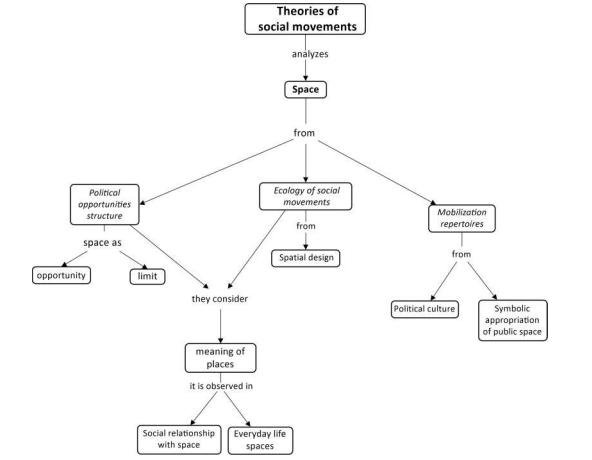
Source: Author’s elaboration.
Figure 1 Approaches to the spatial dimension from theories of social movements.
Tamayo (2016), meanwhile, discusses the spatialization of repertoires -or, in other words, how repertoires of action, defined as how “actors perform, demonstrate, protest, and thereby transform reality” (2016: 22), are translated into space to explain the likelihood of success or failure of social movements. For Tamayo, public space becomes the battlefield for social movements, while repertoires of contention are signified and re-signified by the different antagonists involved in specific political conflicts (2016: 25). Thus, the author closely links three significant components of social movements to explain their outcomes: space, repertoires, and political culture (2016: 45).
Based on the foregoing, we can identify a range of theoretical approaches within social movement studies that have incorporated the spatial dimension to analyze and explain collective mobilization and protest. Figure 1 presents a diagram summarizing this review. It is important to emphasize that the theoretical frameworks included in this diagram are not isolated from one another; as the text shows, they interact, share elements, and present significant points of convergence. However, this analytical separation serves to identify the specific perspectives from which spatial analyses of political contention have been proposed.
An important point to highlight from the preceding review is that most of the theoretical proposals discussed -those used to explain why and how a movement develops, as well as why it succeeds or fails in specific contexts of social mobilization and protest- focus on urban environments. These include major cities, central urban areas, and urban peripheries. While this does not exclude territorial struggles in other contexts, as shown in the work of Wolford (2000), it does draw attention to the types of political contention that emerge in urban settings, particularly those linked to struggles over the production of space.
Having completed the previous review, it is now crucial to move on to defining the concept of political contention, since this definition serves as a bridge between place-oriented analysis and the study of spaces of contention.
Political contention
Political contention is defined as the struggle among different actors to establish the dominance of a political program (Tilly & Tarrow, 2015: 4). It encompasses episodes of revolution, rebellion, war, protest, genocide, or social movements (Tilly, 2000: 137). (McAdam, Tarrow, and Tilly 2004; 2005), along with Tilly and Tarrow (2015) and Tilly (2000), define it as:
episodic, public, and collective interaction among claim makers [subjects] and their objects when: (a) at least one government is a claimant, an object of claims, or a party to the claims, and (b) the claims, if realized, would affect the interests of at least one of the claimants. (McAdam, Tarrow & Tilly, 2005: 5)
In turn, these authors emphasize three essential features required to define an event as political contention. First, contention is episodic, which allows the exclusion of regularly scheduled events, such as elections. Second, it is public, which excludes claims made within organizations with clearly defined boundaries, such as churches or businesses (McAdam et al., 2005: 5). Third, it is collective, as collective action entails the coordination of efforts in the name of shared interests or programs (Tilly & Tarrow, 2015: 8).
According to Tilly and Tarrow, the most basic version of contention always involves two parties, defined as the subjects (those who make the claims) and the objects (those who receive the claims). This interaction necessarily includes at least one claim, which always entails the pursuit of visibility of an issue from a subject toward at least one object (Tilly & Tarrow, 2015: 8).
Leitner, Sheppard, and Sziarto (2008) offer a critique of this concept while simultaneously proposing a complementary definition. For them, the definition proposed by McAdam et al. (2005) is based on an excessively state-centric relationship between conflicting actors and is overly interest-oriented; for this reason, they argue that it is insufficient to recognize the differences within collective action (2008: 157). In response, they suggest redefining political contention as “concerted counter-hegemonic social and political action in which participants with different positions join together to challenge dominant systems of authority, with the aim of promoting and representing alternative imaginaries” (Leitner, Sheppard & Sziarto, 2008: 157). This redefinition is enriching in that it introduces elements not previously considered by McAdam et al. (2005), such as the counter-hegemonic perspective and the relevance of alternative imaginaries.
Within episodes of political contention, an important distinction is made between two types: contained contention and transgressive contention. Both are episodic, public, and collective interactions between subjects (the claim-makers) and their objects. In the first case, at least one government is a claimant, an object of claims, or a party to the claims; the claims, if achieved, would affect the interests of at least one of the claimants; all parties in the conflict are pre-established and recognized as political actors; and all parties use well-established means of public claim-making. In the second case, it shares the first two conditions of the former but differs in that at least some parties in the conflict are newly self-identified political actors, and at least some parties employ innovative means of collective action (Tilly, 2000: 138).
According to Tilly (2000), making this distinction is important because it allows for greater attention to a dimension that had long been neglected in research on social movements and political contention: the spatial dimension. Thus, in transgressive contention, more attention is paid to how existing spatial routines are interrupted through innovative forms of collective action and in the absence of a fully established set of political actors (2000: 138). This refers to how everyday life experiences that unfold routinely in space are disrupted through the implementation of collective action strategies, which can be observed in occupations, reorganizations, or deliberate dramatizations of public space in the making of claims (Tilly, 2000: 138).
This introduction of the spatial dimension into the concept of transgressive contention marked the theoretical step that enabled the development of the elements necessary to carry out a place-oriented analysis, which, in turn, allowed for the emergence of the analytical proposal of spaces of contention.
Elements for a place-oriented analysis
The analytical category of spaces of contention emerged in the early 21st century, inspired by Henri Lefebvre’s notion of social space1 and his conceptual triad of perceived, conceived, and lived space (Tilly, 2000, 2003; Sewell, 2001; Martin & Miller, 2003). This concept responds to key questions surrounding how and why people mobilize, granting spatiality substantial explanatory power within the study of political contention.
Charles Tilly (2000, 2003) was the first scholar of social movements to give shape to this category, though only after having developed his earlier proposals focused on political opportunity structures and resource mobilization theory. Later, theorists such as Sewell (2001) and Martin and Miller (2003) joined the effort to conceptualize space within social mobilization, asserting that it had long remained a silenced dimension and therefore deserved a voice in the study of contentious episodes.
For Tilly (2000), practices, representations, and social relations are integrated into spatial patterns that subsequently constrain future social interaction, including the interaction we call political contention (2000: 137). Contention always takes place in spaces and environments inhabited by people, where not only do costs of time and distance come into play, but also spatial configurations that create both opportunities and constraints for participants in the making of claims (2000: 138).
These spatial configurations can be observed through the connections between social sites,2 which are the settings where organized human actions occur. These include individuals, aspects of individuals, organizations, networks, and places. They always exist in space and are subject to its constraints, but also to the limits imposed by place and scale, while at the same time producing shared meanings and representations that stem from the spaces they occupy (Tilly, 2003: 222).
Tilly (2000, 2003) offers five arguments for taking spatial aspects into account. He states that: 1) time-distance costs and spatial configurations present both opportunities and constraints for participants in the formulation of public claims; 2) the everyday spatial distributions, proximities, and routines of potential participants affect the reach and nature of their mobilization; 3) political contention intervenes in the jurisdictions of governments, which are themselves spatially organized and thus provoke governmental response; 4) the spatial configurations of routine political life shape transgressive contention; and 5) contention transforms the political meaning of sites and spatial routines (Tilly, 2003: 221; Bran, 2013: 246).
Bran (2013) synthesizes these five arguments by stating that “space influences political contention, its protagonists, performances, and resources, in the same way that all of these contentious activities re-signify spaces” (2013: 246). Therefore, as Martin and Miller (2003) affirm, spatial processes are inseparable from and constitutive of social processes (2003: 143).
Building on this, Tilly (2000) identifies three modes through which the interaction between space and political contention has been analyzed: empty space analysis, textured space analysis, and place-oriented analysis. In the first, time and space are untextured, and no spatial cause-and-effect relationship exists between sites and the interactions occurring within them. Location and temporal distance are used merely as indicators of non-spatial effects, rendering space a simple container in which contention unfolds. In the second, space begins to acquire substance and is no longer treated merely as a container. Location, time, and distance are now considered explicit causes of contention, with the emphasis placed particularly on the obstacles/costs and facilitations/benefits offered by different places where contention takes place.
Finally, in place-oriented analysis, location, time, and distance are still present. However, they are joined by the representations actors hold about those spaces, as well as the meanings they assign to objects and the specific relationships that shape their interactions -interactions that are now understood as the explicit cause of political contention (Tilly, 2000: 140-142). It is within this last mode of analysis that Tilly situates the study of spaces of contention.
As Tilly explains, the progression across these three types of analysis shows that the more one moves from empty space toward place-oriented analysis, the more time and space become complex and play a direct causal role in political contention (2000: 142). Based on Tilly’s original graphical representation (2000: 141), Figure 2 recreates each of the three forms of spatial analysis he proposes.
In this progression, which moves from the elements of empty space to place-oriented analysis, we can even observe the initial transformation within the broader discussion of the importance of spatiality in social movement studies. While it is true that the first two types of spatial analysis proposed (empty space and textured space) remain closely aligned with political opportunity and resource theories by viewing space as a container, as an obstacle, or as an advantage, it is also true that the introduction of representation and meaning into place-oriented analysis laid the groundwork for the innovative proposal of spaces of contention.
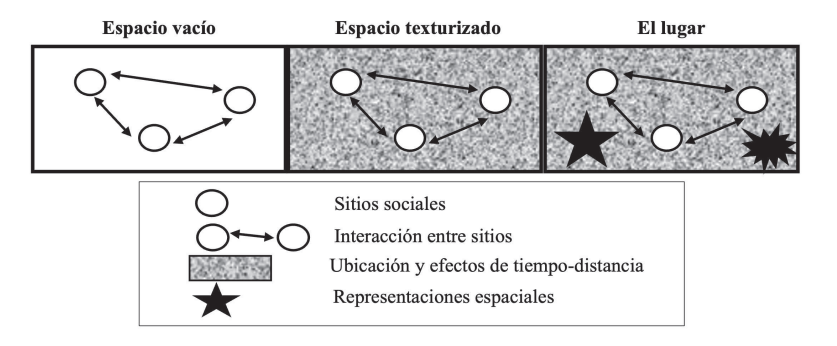
Source: Spaces of contention (Tilly, 2000).
Figure 2 Analysis of empty space, textured space, and place.
To this must be added Sewell’s (2001) own proposal for spatial analysis, which highlights three aspects that warrant particular attention: 1) time and distance, which are shaped by natural conditions as well as by existing modes of communication and transportation that determine costs and availability; 2) spatial routines, which influence decision-making regarding the sites and strategies of social movements in contentious episodes; and 3) the meanings of places, which are culturally marked, carry different symbolic values, and are socially constructed, and are therefore constantly subject to change (2001: 60-64).
In turn, Tilly (2003) introduces a distinction within social sites by presenting two dimensions of variation that closely align with Sewell’s (2001) proposal. These are the mobility dimension, which refers to the degree of connection between the formation of social sites and the surface of the earth, and the proximity dimension, which involves time-distance costs in the intersections between social sites and their people, activities, objects, relationships, and representations (Tilly, 2003: 222).
Analytical proposal of spaces of contention
Each of the elements discussed above provided the tools necessary to formulate the proposal of spaces of contention, a central category for conducting place-oriented analysis in episodes of transgressive political contention. Based on this, authors such as Tilly (2000), Martin and Miller (2003), and Sewell (2001) developed a classification of the various spatial and creative constraints of spaces of contention. Among them, they identified five dimensions (see Figure 3): 1) the meanings of places, 2) spatial claims, 3) control over places, 4) safe spaces, and 5) the geography of surveillance.
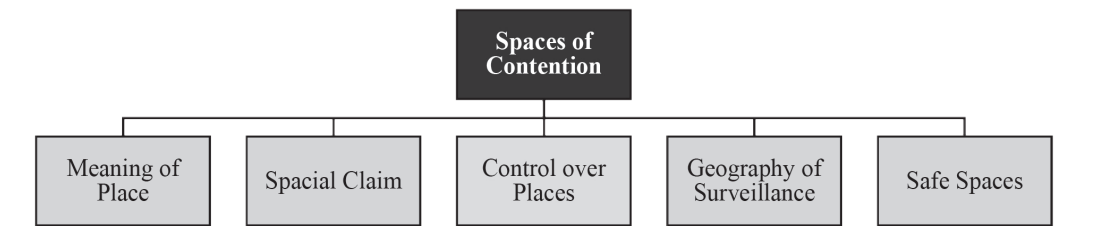
The first dimension focuses on the meanings of places. To contribute to the proposal for spatial analysis, Sewell (2001) argues that in the specific case of social movements, there are not only constraints imposed by the spatial environment in which contention occurs, but also that spaces are significant in the production of new spatial structures and relationships (2001: 52). Moreover, it is possible to speak of the multiplicity of spatialities in political contention, rather than a single, fixed one. As (Leitner, Sheppard, and Sziarto 2008: 166) point out, these spatialities are co-implicated.3 For this reason, Tilly (2000, 2003) affirms that it is through events of political contention that the meanings attributed to places and spatial routines are transformed, which is why it is essential to speak of spaces of contention.
In spatial analysis, it is crucial to address the notion of place, since places differ in the ways they are produced and possess different cultural and political meanings for those who live and work in them, as well as for outsiders (Sewell, 2001: 57). When we speak of places, we refer to where everyday life unfolds; they are formed through flows of signs and meanings that interact and are negotiated in specific locations (Martin & Miller, 2003: 147). For Martin and Miller, one of the crucial components of political contention -identity- is intimately tied to place (2003: 147). In turn, according to Smith (1999, cited in Martin & Miller, 2003: 147), places matter if we are to understand how social identities are formed, reproduced, and limited concerning one another. Places have different materialities and historically constructed environments; they are saturated with meaning, and equally with power -an aspect critically important in political contention (Leitner, Sheppard, & Sziarto, 2008).
According to Leitner, Sheppard, and Sziarto (2008), social movements actively seek strategic ways to
subvert and re-signify places that symbolize the priorities and imaginaries they are contesting; to defend places that represent their priorities and imaginaries; and to produce new spaces in which such visions can be practiced, both within and beyond those places. (2008: 161-162)
The second dimension, spatial claims, refers to all those events of transgressive contention in which demands impact changes in people’s locations, activities, and spatial configurations. This element reveals a complex interplay between location, time-distance, representation, and claim-making, which emerges when political contenders act outside of predefined spatial references and relationships within a given place (Tilly, 2000: 146).
The spatial claims made by a social movement can occur across different geographic scales, since, as Martin and Miller (2003) observe, the significance of specific places derives from a defined boundary or extension. Discussing these scales helps to clarify their scope, along with the variety of social and political relationships they encompass (2003: 148). This makes it possible to observe the relationships that operate in political contention at the local, state, national, and transnational levels.
This dimension encompasses events that disrupt spatial routines and exert significant pressure to meet demands. Examples of spatial claim events include demonstrations, sit-ins, processions, mass gatherings, protests, and performances in public space, among others (Tilly, 2000: 146-147). All of these expressions of transgressive contention may be encompassed by the term demonstrate, which Tilly (2007) defines as:
deliberately gathering in a public place-preferably one that combines visibility with symbolic significance; displaying both membership in a politically relevant population and support for a position through oral proclamations, written words, or symbolic objects; and communicating a collective sense of resolve through disciplined performance either in one place or across a sequence of locations. (Tilly, 2007: 201-202)
Bran (2013) and Gibril (2018) both explore the spatial claims in distinct contexts. On the one hand, Bran examines the occupations of Puerta del Sol in Madrid and Plaça Catalunya in Barcelona by the 15M movement during May and June of 2011, showing how the spatial configurations adopted as repertoires of action were essential for the unfolding of contention during the mobilizations. “This space, as political contention unfolded, either constrained or facilitated the everyday dynamics, mobilization, and goals of the movement” (Bran, 2013: 263-264).
On the other hand, Gibril (2018) focuses on regimes characterized by weak political opportunities for oppositional movements and collective action, as is the case in Egypt. She analyzes the 2011 demonstrations organized by the Cairo Ultras outside Tahrir Square. Her study proposes a framework that emphasizes the centrality of street art as an alternative channel for mobilization. Unlike sit-ins or occupations, the protest potential of graffiti extends beyond the immediate circles of participants (Gibril, 2018: 2-5). She also argues that “the lack of political opportunities leads to the development of new spaces of contention” (2018: 2), which in turn tend to transform into safe spaces that facilitate the formation of collective identity (2018: 8).
Within this same body of literature, we also find quantitative approaches that draw on spatial dimensions to account for the likelihood that individuals will participate in a demonstration or protest event. Such is the case of Cristancho et al. (2017), who conducted a geolocated survey in Barcelona between 2010 and 2016 to determine the costs of distances between individuals and protest events and to assess “to what extent the availability of protest events can mobilize citizens to participate beyond the ballot box” (2017: 2).
The third one, control over places, refers to how the control of particular territories has driven political contention through the power that governments possess to organize territoriality (Tilly, 2000: 149). Within this dimension, Tilly (2000) discusses two types of nationalism that impact how territories are controlled: state-led nationalism and state-seeking nationalism. However, he also notes that the control over places can be exercised through maps, cadastral records, and geographically organized administrative archives. Thus, he emphasizes that this element involves the political and administrative control of territory (2000: 151). This dimension encompasses not only material aspects but also the representations embedded within territorialities. These representations spatially orient actions across different scales -local, national, regional, and international (Tilly, 2000: 151).
Within this category, we can place the work of Monforte (2016), which seeks to understand why and how borderlands have become new spaces of contention since the early 2000s, by exploring the new geographies of protest emerging in response to these controls. The author also proposes building a bridge between border studies, the contentious politics of mobility, and the interest in the spatialities of contentious politics (Monforte, 2016: 411-412) in order to analyze protests and collective actions against border control regimes.
In the fourth dimension, geography of surveillance, Tilly addresses the implications of surveillance over and within both private and public space in different urban areas of capitalist democracies (2000: 142). Drawing on Stinchcombe (cited in Tilly, 2000: 142), he notes how the general phenomena of spatial organization of surveillance, of repressive activities, and of their evasion significantly shape different forms of political contention (2000: 143).
Expanding on this element, Sewell (2001) argues that there is a spatiality of power, since space functions as both an object and a matrix of power, where control is exerted by regulating the spaces in which people live, move, and work (2001: 68). A key factor here is how negotiations between police forces and local authorities unfold before, during, and after episodes of transgressive contention that modify spatial dynamics through concrete claims (Tilly, 2000: 144).
Within this dimension, we can also place the study by Tonda and Kepe (2016), which analyzes the Operation Chosa Vendor implemented in 2006 in Lilongwe, Malawi, aimed at removing street vendors from public spaces. The authors demonstrate how street vendors turned the streets into a space of contention and how this led to episodes of violence, emphasizing that space was used “to make a call for (spatial) justice in the face of an urbanization model based on aesthetics and order, one that denies the existence of street vendors and simultaneously criminalizes them” (2016: 297).
The fifth and last one, the significance of safe spaces, is closely connected to the fourth. This is because, in the face of surveillance and the latent threat of repression, individuals seek locations where they can enjoy some form of protection from -or against- the intervention of authorities or opponents in the contention process (Tilly, 2000: 144).
For Sewell (2001), the existence of safe spaces is essential for mobilization; without them, collective action would not be possible. Oppositional movements need to control spaces where they can organize their activities and recruit individuals without being subjected to state surveillance and repression (2001: 69). In this regard, Tilly (2000) proposes a classification of three ways through which political contention and safe spaces interact:
1)The existence of geographic areas where claims-making gains protection against routine surveillance and repression due to terrain, built environments, or legal status.
2)The formation of segregated institutions, where legal privilege, structural organization, social composition, or governmental neglect allows otherwise prohibited conversations and actions.
3)Public occasions where authorities tolerate or even encourage extended and extraordinary gatherings in selected locations, offering opportunities for the dissemination of claims that are otherwise banned and providing access to broader audiences for those claims (Tilly, 2000: 144).
It is worth noting that these five dimensions are essential for identifying different elements in the spatial analysis of social mobilization, as each of them contains aspects that correspond to central concerns expressed in dominant social movement theories. Together, the five dimensions shed light on the limitations and opportunities that space offers for mobilization, as well as the spatial resources available to carry it out. They also allow us to observe the struggle over the dominance of spatial representations and meanings, which significantly shape the outcome of political contention.
Conclusion
This article first presented a theoretical overview that traced the incorporation of the spatial dimension into social movement theories, highlighting the various contributions that have emerged from integrating this category into the study of political contention. Following this, the key elements for conducting a place-oriented analysis of political contention and spaces of contention were laid out. This allowed for the conceptual development of the notion of spaces of contention through the examination of each of its constituent dimensions and the various elements that shape the meanings of places, spatial claims, control over places, safe spaces, and the geography of surveillance.
From this review, several important points can be highlighted. First, this exercise makes it possible to account for the place the spatial dimension has occupied within social movement theories, and how the role of this dimension has evolved alongside shifting analytical concerns. That is to say, the interaction between social movement theories and political geography has enabled spatiality to acquire greater explanatory power concerning core questions regarding not only how and under what conditions social movements emerge, but also why they emerge, and how they succeed or fail in their efforts to advance their demands.
Second, this review revealed how power, space, conflict, and social movements interact by recognizing that space is not merely a backdrop or container in which political contention unfolds -as posited by political geography- but is also part of what is at stake. In this sense, space is not simply an obstacle, a boundary, an opportunity, or a resource; rather, it is imbued with political and cultural meanings, representations, and identities. For this reason, the analytical proposal of spaces of contention is particularly enriching, as it allows each of these elements to enter into dialogue with one another.
Finally, this review underscored the importance of introducing the spatial dimension within the framework of social movement theory, especially when examining episodes of political contention whose primary demands revolve around decision-making over the production of space. As Mahoudeau (2016) points out, as both a product and producer, social space encompasses various forms, expressions, and representations -among which conflict and contention over the production of space arise particularly concerning competing representations of social space.

