
Herscovici, Alain.
Value, historicity, and economic epistemology: an archaeology of economic science.
Cham, Switzerland:
Palgrave Macmillan, 228 pp.
DOI: 10.1007/978-3-031-21157-7,
Book review
Value, historicity, and economic epistemology: an archaeology of economic science, Alain Herscovici
-
Publication dates-
01 Agosto 2025
Jul-Sep 2024
- Article in PDF
- Article in XML
- Automatic translation
- Send this article by e-mail
- Share this article +
Thumbnail
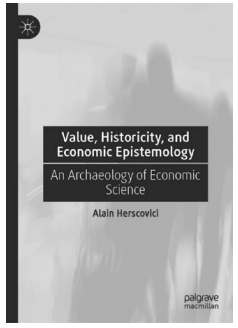
Value, Historicity, and Economic Epistemology: An Archaeology of Economic Science by Alain Herscovici presents a distinctive perspective on the History of Economic Thought (HET). What distinguishes this book is its in-depth examination of epistemological considerations and their practical implications for key aspects of HET. Sheila Dow, in her foreword, echoes the author’s focus on differentiating between methodology -specific to a particular paradigm- and epistemology, which analyzes the succession of paradigms over time. The het is intrinsically linked with epistemology, the central theme of this book, although it occasionally grapples with issues of meta-epistemology. Herscovici meticulously traces the historical evolution of economic thought across epochs, utilizing the concept of “episteme” or the fundamental framework of understanding. The book discerns shifts and disruptions in epistemology that have influenced the course of economic thought over time. Through this exploration, it sheds light on a range of heterodox perspectives, contrasting them with neoclassical and Hayekian approaches.
The innovative and interesting feature of the book is in the epistemology inspired by the French philosophers-social thinkers such as Michel Foucault (1926-1984) and his concept of episteme. A Greek word literally meaning science and etymologically means “standing above but in contact with the object of study” and in Platonic terms “knowledge confirmed by logical arguments”. Foucault’s episteme is contrasted to Thomas Kuhn’s concept of paradigm as “universally recognized scientific achievements that, for a time, provide model problems and solutions for a community of researchers.” Their difference lies mainly in their focus and usage. Episteme is a broader and more abstract concept that deals with the underlying structures of knowledge within a culture or historical period, looking at how knowledge is organized and categorized. Paradigm, on the other hand, is viewed as a narrower concept, that is particularly applied in the philosophy of science to describe the specific sets of beliefs and practices within scientific communities during a particular period, highlighting the practical and observable aspects of scientific research. While there are similarities in the sense that both concepts deal with the organization and historicity of knowledge, they are used in different contexts and have different scopes of application.
The change or rupture is different in the two methodological approaches. According to the paradigm, change comes after the accumulation of many inconsistencies, which in the beginning are considered anomalies or paradoxes, and gradually the conditions become ripe for the transition to a new paradigm. An example might be the lasting and widespread unemployment during the crisis of the 1930s which could not be explained by a theory that preached that there is no unemployment provided that markets work freely. This paved the way for the emergence of the Keynesian paradigm and the associated with-it theory of effective demand. In reality, however, the paradigm concept and the notion of rupture often necessitate a substantial passage of time and seem to be more applicable to the hard sciences than the social sciences.
In the context of the study of complex systems, as seen in the works of Poincaré and Prigogine, among others, this distinction becomes less pronounced. Historicity, the irreversibility of time, and strong uncertainty characterize these so-called hard sciences, bridging the gap between them and the social sciences. In episteme, there are no comparisons, because each episteme is quite different, so their incommensurability is absolute while in paradigms only relative, and therefore comparisons between each other become possible. Similar to the paradigm is Lakatos’s concept of “research programs”. The trouble with episteme is that Foucault does not provide us with further information about the change or ruptures. In short, we move from one episteme to the other without the mediation of a specified mechanism and the precise conditions which set it in motion. Moreover, Foucault contends that every scientific epoch is defined by a singular episteme, a viewpoint that comes under scrutiny in Chapter 8. In this chapter, the author advocates for the idea of a composite episteme and replaces it with the notion of “order.” The key strength of the latter concept over the former lies in its capacity to elucidate the dynamics of change.
The book is divided into two parts. Part I consists of four chapters and focuses on the advantages of episteme over the paradigmatic approach. While the differences between the two are subtle, the chapters in this section deal with the historical aspects of economic theory, particularly the labor theory of value from the perspectives of Adam Smith and David Ricardo. However, the discussion in both cases concerns mainly methodological grounds rather than the essence of competing theories. It is important to note that the labor theory of value is not uniform across all economists, such as Smith, Ricardo, and Marx. For instance, the author argues that the use-value aspect of commodities is excluded in the analysis of Ricardo and Marx or rather it is used only as a precondition for the exchange value of commodities. However, this oversimplifies the matter since both (Ricardo and especially Marx) do consider the concept of demand in their analysis (Tsoulfidis, 2024, chs. 4-6). On the other hand, the utility discussed in neoclassical economics in the same chapter differs characteristically from use-value. Utility involves the measurement or ranking of the intensity of consumer satisfaction whereas use-value in Marx’s (and classical) theory refers to the intrinsic properties of commodities to satisfy human needs, regardless of their origin (Tsoulfidis, 2024, ch. 8). Chapter 4 discusses epistemological issues wherein the Foucaultian concepts of archeology and genealogy take center stage. This brings us back to the problem of the substantive hypothesis, which is adopted in different ways by Ricardo and Marx, but also by neoclassical economics.
-
Tsoulfidis, 2024Competing Schools of Economic Thought. Retrospect and Prospect, 2024
-
Tsoulfidis, 2024Competing Schools of Economic Thought. Retrospect and Prospect, 2024
Part II of the book consists also of four chapters not counting chapter 9 which concludes the book. The central theme of the book is on the concept of capital, explored in depth in Chapters 2 and 5, as a diverse collection of “produced means of production.” This concept necessitates evaluation using a unit of measurement that aligns with the requirements of the applied theory of value and distribution. The author’s focus on capital is fully justified, given its role as the linchpin of capitalism. If the neoclassical economic theory fails to consistently measure capital, it becomes incapable of effectively dissecting this pivotal economic component of capitalism. This issue arises from the challenge of establishing a demand schedule for capital, which in turn shifts the problem to the demand schedule for labor. Consequently, the entire IS-LM mechanics becomes questionable, undermining the coherence of the theory (neoclassical synthesis) and hindering its ability to generate consistent outcomes (Tsoulfidis, 2024, ch. 9). It is essential to underscore that this does not imply that capital is inherently immeasurable; quite the opposite, businesses routinely assess capital in terms of market prices and interest rates. The challenge lies in measuring capital in a manner consistent with the requirements of the neoclassical theory (Tsoulfidis, 2021, ch. 3).
-
Tsoulfidis, 2024Competing Schools of Economic Thought. Retrospect and Prospect, 2024
-
Tsoulfidis, 2021Capital Theory and Political Economy: Prices, Income Distribution and Stability, 2021
Chapter 5 is concerned with the capital theory controversies and the ongoing debates surrounding the reswitching of techniques. These debates represent a fundamental critique of the underpinnings of neoclassical theory. Assuming the reswitching of techniques is valid, it undermines the core principle of neoclassical theory, according to which prices reflect relative scarcity. The reason is that a low rate of profit is consistent with the use of a capital-intensive technique relative to the labor-intensive. However, as the rate of profit rises and capital is no longer scarce, we may move to a labor-intensive technique. And, as the rate of profit keeps rising we may return to the capital-intensive technique! This reswitching of techniques critique was destructive of the neoclassical theory of capital and further showed that the marginal productivity theory of income distribution does not really hold. The marginal productivity of capital (labor) does not determine the profit (wage) rate. The subsequent discussions and I am referring to those of the last few decades, from the 1980s onwards, showed that in real economies there are quasi-linearities in the prices (wage) rate of profit making the likelihood of reswitching a remote possibility. However, this did not rescue the neoclassical theory of value and distribution; instead, it demonstrated that instances of equality between marginal product and factor payments are outcomes of identity, rather than causal relationships. Notably, the unanticipated outcome of the capital theory debates was the further advancement of the classical theory of value and distribution, a fact that, unfortunately, remains unexplored in the book (Tsoulfidis, 2021, ch. 8).
-
Tsoulfidis, 2021Capital Theory and Political Economy: Prices, Income Distribution and Stability, 2021
Chapter 6 focuses on Hayek and his contributions to the understanding of competition and overinvestment. According to Herscovici, Hayek’s perspective marks a departure from neoclassical economics, but it is important to note that this departure represents an incremental shift rather than a fundamental rupture. This is particularly evident in the case of competition, where Hayek’s conceptualization aligns more with Marxian and Schumpeterian approaches, and therefore his view of competition differs significantly from the neoclassical notion of perfect competition. The latter is based on patently unrealistic conditions, such as an infinitely large number of producers producing an infinitesimally (relative to the total) small amount of a homogenous product and having access to all available information. However, upon cross-examination, it becomes apparent that Hayek’s seemingly more realistic perspective on competition still depends on the underlying concept of perfection in competition, constituting another dimension of the same idea. The problem with the neoclassical competitive model, as Sraffa’s seminal works in 1925 and 1926 have shown, lies not in the realism of its assumptions but in its lack of logical consistency. In essence, a successful logical critique of a model obviates the need for ideological or empirical critiques (Tsoulfidis, 2009).
-
Sraffa’s seminal works in 1925Sulle Relazioni fra costo e quantità prodottaAnnali di Economia, 1925
-
1926The Laws of Returns under Competitive ConditionsThe Economic Journal, 1926
-
Tsoulfidis, 2009The rise and fall of the monopolistic competition revolutionInternational Review of Economics, 2009
Hayek rightfully stands alongside other prominent economists such as Smith, Ricardo, Marx, Keynes, and Kalecki as a proponent of the overinvestment theory of economic crises. However, what sets him apart from these economists is his emphasis on an exogenous theory of overinvestment, which attributes crises to the excessive expansion of the money supply and a consequent reduction in interest rate that leads to increased long-term investment spending. The result of this overinvestment is a surplus of output compared to demand, which, in turn, leads to declines in production and employment, ultimately culminating in rising unemployment and economic crises. It is worth noting that Hayek’s perspective regards money solely as a “medium of exchange,” disregarding its roles as a store of value and the standard by which debts are contracted. He has been criticized for this perspective by Sraffa (1932). Additionally, Hayek views savings as a real variable representing intertemporal consumption decisions and, unlike Keynes, as a determinant of investment. However, Hayek’s perspective may not fully account for the modern economies, which are "monetary" and finance based.
-
Sraffa (1932)Dr. Hayek on money and capitalThe Economic Journal, 1932
Continuing the investigation into Hayek’s perspective, Herscovici contrasts it with New Classical Economics and their Rational Expectations Hypothesis (REH). The reh posits that anticipated long-term outcomes are essentially observed in the short run, thus minimizing the role of time and economic dynamics (Tsoulfidis, 2024, ch. 15). However, there are convergences between these two approaches. Hicks demonstrates how Hayek advances a theory of capital instead of a theory of the monetary cycle, a criticism that can also be applied to the REH. Chapter 6 can be summarized as follows: The similarities between Hayek’s theory and the REH outweigh the differences. According to Herscovici, it is not reasonable to claim that Hayek’s theory is entirely dynamic because scientific laws are inherently universal. However, all contemporary studies on complex systems dynamics unequivocally demonstrate that time is irreversible and that scientific laws are inherently historical. In short, Hayek’s views share several elements with the neoclassical hardcore used by the REH, with the most important elements being the dominance of the real sector, implying the neutrality of money in the long term, and the universality of scientific laws.
-
Tsoulfidis, 2024Competing Schools of Economic Thought. Retrospect and Prospect, 2024
Chapter 7 deals with the interest rates and their impact on the economy. Consequently, it becomes evident that Hayek and neoclassical economists converge on the belief that interest rates are influenced by the loanable funds theory, and they both share the perspective that in the long run money’s role in the economy is neutral. Within both Neoclassical theory and Hayek’s perspective, the significance of finance and the presence of information asymmetry are downplayed, with both emphasizing the relative importance of the real sector of the economy over the financial sector.
The central issue of this chapter focusses on the relationship between savings and investment and the direction of causality. Hayek and Neoclassical economics conceptualize savings as the real variable representing intertemporal consumption. When savings lessens, they provide the funds for investment. In contrast, Keynes takes a different perspective. In his view, investment expenditures play a central role in determining savings, thanks to the operation of the multiplier and the generation of income, which ultimately balances savings and investment. The demand for investment remains a challenging variable to theorize, and the interest rate, a monetary phenomenon, along with the marginal efficiency of capital (Keynes’s profitability variable), have significant roles to play (Tsoulfidis, 2024, ch. 11). It is crucial to note that the positive gap between these two variables encourages investment, and when the marginal efficiency of capital is low and falling, along with the interest rate, it creates favorable conditions for short-term “speculative” rather than long-term “enterprise investment” spending. Herscovici appositely observes that there is a resemblance between the neoclassical synthesis and Hayek’s analysis in that both, unlike Keynes’s General Theory, do not account for the ever-present uncertainty in economic decisions. Additionally, both share the assumption that the arrow of causality runs from savings to investment and not the other way around.
-
Tsoulfidis, 2024Competing Schools of Economic Thought. Retrospect and Prospect, 2024
In Chapter 8 Herscovici addresses the question of whether and to what extent the three discussed controversies -capital theory, overinvestment and relation of saving and investment- can be elucidated within Foucault’s analytical scheme. The answer reveals that there are inherent limitations within the concept of episteme, which can potentially be supplemented by the author’s proposed concept of “order”, and is manifested at the aggregate level. In an attempt to offer a concise definition, one might describe it as a “long term equilibrium position” or a state of “normality”, which could be achieved ex ante akin to Hayek’s overinvestment theory, where there exists an anticipation of the economy’s equilibrium position. On the other hand, in institutional economics, the concept of “order” is approached ex post, with institutions established to guide or maintain the economy’s equilibrium position, which tends to deviate if left to its own devices. So, by “order” we may refer the operation of the “invisible hand” as articulated by Smith or the “laws of motion” as theorized by Marx. The “invisible hand” is a normative and self-regulation mechanism, while the institutional, and, more generally, the heterodox approaches are not normative and refute the self-regulation mechanisms.
An interesting feature of the book is its critical stance on the long-standing divide between microeconomics and macroeconomics that appeared in the 1930s and persists to this day. According to Herscovici, “order” does not necessarily manifest at the microeconomic level, which pertains to individual economic agents, but only becomes evident when these units are considered collectively. In fact, the author argues that simple microeconomic rationality is not capable of ensuring the regulation, permanence and perennity of the community. Consequently, the endeavor to merge microeconomics with macroeconomics into a single economic theory as pursued by both Neoclassical and Neo-Ricardian economics (Tsoulfidis, 2017) may appear to be exercises in futility. Neoclassical economics seeks to establish microfoundations to macroeconomics, while the Neo-Ricardian economics aims at uniting the classical theory of value and distribution for the price determination with Keynes’s theory of effective demand. However, over the past nearly five decades, it is widely recognized that little to no progress has been achieved on this front from either perspective.
-
Tsoulfidis, 2017Economic Theory in Historical PerspectiveThe Journal of Philosophical Economics: Reflections on Economic and Social Issues, 2017
REFERENCES
- Sraffa, P. (1925). Sulle Relazioni fra costo e quantità prodotta.Annali di Economia, II(1), 277-328. Translated as “On the relations between cost and quantity produced”. [online] Available at: <https://www.hetwebsite.net/het/texts/sraffa/sraffa25.pdf>. Links
- Sraffa, P. (1926). The Laws of Returns under Competitive Conditions.The Economic Journal, 36(144), 535-550. Links
- Sraffa, P. (1932). Dr. Hayek on money and capital.The Economic Journal, 42(165), 42-53. https://doi.org/10.2307/2223735 Links
- Tsoulfidis, L. (2009). The rise and fall of the monopolistic competition revolution. International Review of Economics , 56(1), 29-45. Links
- Tsoulfidis, L. (2017). Economic Theory in Historical Perspective. The Journal of Philosophical Economics: Reflections on Economic and Social Issues, X(2)(Spring), 102-124. Links
- Tsoulfidis L. (2021).Capital Theory and Political Economy: Prices, Income Distribution and Stability .New York: Routledge. Links
- Tsoulfidis L. (2024).Competing Schools of Economic Thought. Retrospect and Prospect. 2nd Edition. Heidelberg: Springer. Links